I’ve written Monday Musings on autobiographies and memoirs by indigenous Australians, and I’ve reviewed biographies of Australian writers, like Mary Durack and Madeleine St John. However, I haven’t written about what we might call literary autobiographies, that is, autobiographies by authors. So, today’s the day. I have read several literary autobiographies, but few since I started blogging. Being a reader, I’m interested in writers’ autobiographies or memoirs – because I’m interested in writers, and because, rightly or wrongly, I expect a good writer to be able to write a good autobiography (however we define “good”!) There are, as I’m sure you know some famous/popular/well-regarded author autobiographies, such as Nabokov’s Speak, memory, but of course here I’m focussing on Australians.
I’m not going to get into the why and wherefores of writing autobiography or analyse how useful or relevant they might be to understanding a particular writer’s works.I’m just going to list – alphabetically by author – a few that I’ve either read, dipped into, or would like to read.
Robert Drewe’s The shark net (2000) and Montebello: A memoir (2012). I haven’t read The shark net, though it’s on my TBR. However, I did see the 2003 television miniseries. For those of you who don’t know, this is quite different to the usual writer’s growing up story. Drewe grew up in Perth in the 1950s and 1960s when the serial killer Eric Edgar Cooke was creating havoc with the locals’ sense of security. “The murders immediately changed the spirit of the place”, he writes. Drewe knew this man, and knew one of his victims. He wrote this memoir “to try to make sense of this time and place”. I haven’t heard much about Montebello, but Drewe is a significant Australian writer.
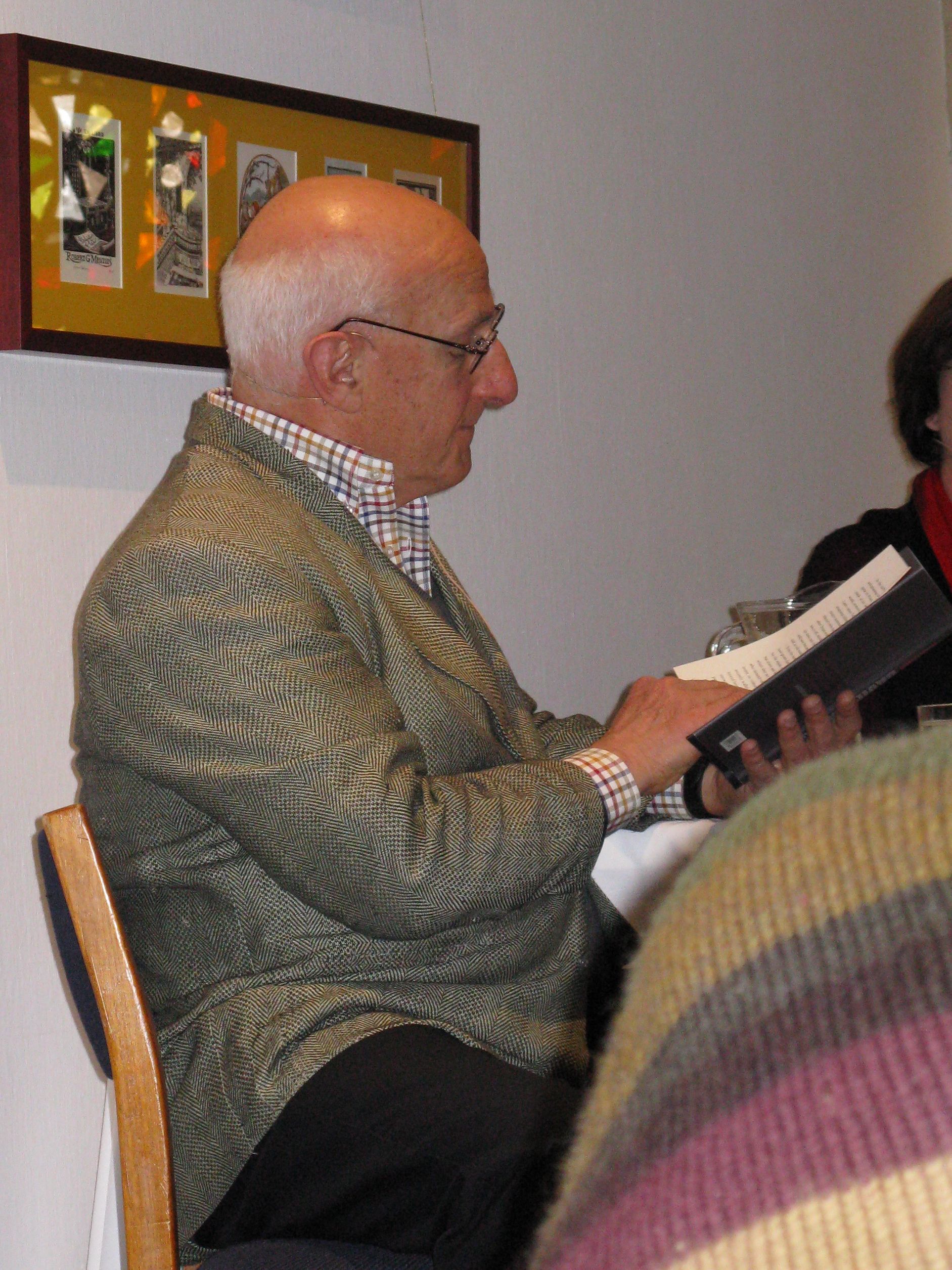
Malouf reading Ransom, National Library of Australia, August 2009
David Malouf’s 12 Edmondstone St (1985) is a very short book, running to just 134 pages. 12 Edmonstone Street is the address of the Brisbane house he grew up in, but this is not your typical autobiography starting with “I was born in …”. Instead, it discusses selected places in his life, starting with that childhood home. I enjoyed his description of that home, of its weatherboard construction with verandahs. His father, he writes, wanted something more modern, something permanent, like brick.
As for verandahs. Well, their evocation of the raised tent flap gives the game away completely. They are a formal confession that you are just one step up from nomads.
So of course, as soon as he could, he closed it in.
This is a thoughtful, meditative – Malouf-like – book.
Ruth Park’s A fence around the cuckoo (1992) and Fishing in the Styx (1993) are more traditional autobiographies, but they are not ordinary. I read them both when they came out and loved them – as much as I loved Park’s books, like her Harp in the South trilogy. A fence around the cuckoo won the Age Book of the Year Non-fiction Award in 1992.
Together, the two books are great reads about life in New Zealand and Australia in the early to mid twentieth century. They also provide wonderful insight into the writer she was to become, and tell the story of one of Australia’s most famous literary couples, Ruth Park and D’Arcy Niland. Here she is on an early contact with Niland (when she was still in New Zealand and he in Australia). He sent, she writes
a stately and respectful letter, carefully written in the sender’s amazing handwriting, and really got up my nose. The writer seemed to think I was some powerful editorial person, capable of assisting him to sell his stories in New Zealand. … I banged off a letter on my three-decker monster, saying that I was but a lowly copyholder with no efficacy or charisma whatsoever, and if he offered to sell my stories in Australia it might be more to the point. Reading his letter now, it is a marvel that the future father of my children did not take a terminal huff and go off and father someone else’s. However, he was choked off for months, much to my relief.
Hal Porter’s The watcher on the cast-iron balcony (1963) is the first of several memoirs written by Porter. It is regarded as an Australian classic, and covers his growing up years. Porter, however, has a reputation for an interest in paedophilia, which has resulted in some different “readings” of this book. Not having read it or any of Porter’s work, I’m afraid I can’t comment.
Patrick White’s Flaws in the glass (1981) is on my TBR. I dip into it frequently when I’m thinking about White, but have not managed to find time to read it from cover to cover. I should though, because every time I dip into it, I find something well worth my dip! For example, he comments frequently on his homosexuality, reflecting particularly on what it means for him and his art. Here is one:
Indeed, ambivalence has given me insights into human nature, denied, I believe, who are unequivocally male or female – and Professor Leonie Kramer*. I would not trade my halfway house, frail though it be, for any of the entrenchments of those who like to think themselves unequivocal.
[…]
Where I have gone wrong in life is in believing that total sincerity is compatible with human intercourse. Manoly [White’s longterm partner], I think, believes that sincerity must yield to circumstance, without necessarily becoming tainted with cynicism. His sense of reality is governed by a pureness of heart which I lack. My pursuit of that razor-bald truth has made me a slasher.
The New York Times Book Review is quoted on my back cover saying that it is “as absorbing an autobiography as has been written by a novelist this century”. Oh dear, I really should read it. Wish I could emulate Stefanie of So Many Books who consistently has five, six or more books simultaneously on the go.
* An Australian academic whom White disdained and called “Killer Kramer”. This singling out of her here is typical of White’s bite.
Do you have favourite literary autobiographies?


![Sherwood Anderson, 1933 (Carl Van Vechten [Public domain], via Wikimedia Commons)](https://whisperinggums.com/wp-content/uploads/2015/08/andersonsherwood1933.jpg)




 Whispering Gums