Paddy O’Reilly, The salesman (Review)

I’ve been wanting to read Paddy O’Reilly for the longest time but somehow haven’t managed to get to her so, as is my wont, I decided to read a short story of hers in the Griffith Review. She made her name, I think, with her short stories, but has also written novels/novellas and a screenplay, and is a regular contributor to Australia’s best literary magazines.

I know you wouldn’t expect this of me, but I’ve just told a lie – just a white one, your honour – because I have read a couple of articles by Paddy O’Reilly, and I did read her opening story in Scribe’s New Australian Stories 2, published in 2010. The story was titled “How to write a short story”. It’s a very short piece, just over a page, but it was my first, albeit very short, introduction to O’Reilly. The piece is presented as a recipe, with a list of steps, such as:

Test whether the story is done by inserting a reader. If the reader comes out clean, the story is done. If the reader comes out sticky, place the story back into the situation for another 500 words.

This story suggested to me that O’Reilly is not afraid to let women’s experience underpin her writing. But, this doesn’t mean that she wants her writing to be labelled “women’s fiction”. As she asks in her recent post for the Australian Women Writers Challenge 2012, what is women’s fiction? Writing for women? About women? By women? I’m inclined to agree with her that it’s not a useful distinction. What after all is “men’s fiction”? Categorising works as “women’s fiction” has the potential to (and in fact does already) marginalise, trivialise even, women writers and readers. So, like Paddy O’Reilly, I tend not to think in terms of “women’s fiction”. I do, however, and I’d argue this is quite different, like to focus on “women writers”.  Hence, here I am, reading (more) Paddy O’Reilly …

“The salesman” is set in a working class suburb of Melbourne where there’s 80% unemployment. It features a salesman (obviously), a young woman named Marly, and her boyfriend and his mate. The story opens with the young woman alone at home. It’s hot and life is clearly not much fun. Her boyfriend Shaun and his mate, Azza, spend their days working on cars, their heads “under the bonnet like stupid long-necked emus”. And, the fridge is “moaning”. Such language in the first paragraph makes it pretty clear that Marly is not a happy woman. In fact, we learn a little later on that she has lost part of a leg, creating an effective metaphor for a life that is missing something critical. Pran, the salesman, appears in the fourth paragraph. He’s a Hindu from Delhi but Marly, and later Shaun and Azza, persist in calling him a Paki.

Pran insists he’s not selling anything, but after Shaun and Azza return, we finally learn that what he is “selling” is a free offer! Shaun and Azza, as (stereotypically) men often do in these situations, lead Pran on while Marly is conflicted. Shaun is an “attentive” boyfriend. “She would not do better than this”, not better, she thinks, than a man “who had not once in eleven months raised a hand to her”. But, she’s attracted to Pran, to his “rich burnt-toffee” coloured skin and his “runny dark brown” eyes. It’s not just the physical though.  She senses through him, through her questions about his beliefs, that there could be more to life than hanging around waiting for the men to bring home beer and pizza. She does not want his visit to end in violence as, we are told, has happened before.

I’ll say no more about the plot. This is a story about the underside of modern Australia. It’s about poverty and deprivation and how these result in an arid, goal-less life in which there is little empathy for other. It’s about racism, about how, if you are the wrong colour, years of study can lead you to peddling “free offers” to people who can’t afford them. The ending is clever. While we are told the general outcome, we have to guess what really went down. What we do know, though, is that no-one ended up a winner. This is just the sort of story I like – it’s accessible, it has a clear vision with a tight focus, and it raises more questions than it answers. You can read it online at the link below.

Paddy O’Reilly
“The salesman”
Published in the Griffith Review, Edition 29, August 2010
Availability: Online at the Griffith Review

Monday musings on Australian literature: Australian women’s non-fiction writing

Today’s Monday Musings was inspired by a post last month in Overland literary journal’s blog. The topic – Women and non-fiction writing – is a big one, bigger really than I have time for now, but I figured it wouldn’t hurt to make a start.

In the Overland post, which comprised an interview with writer, Rebecca Giggs, Giggs discusses the issue of authority in non-fiction and the notion that “nonfiction writing is supposed to have a fidelity to the real world. Disgrace comes to the author who adds too much of the unreal to their mix”. She talks of how it is believed that “things must be stated, accounted for, and settled. Declared. The unknown turned into the known” and sees this view very much as a gendered thing. As male, in other words. And then she continues

But of course, this is not how the world actually is. Inner and outer worlds are not so easily divided! And permitting that fact – allowing such things as the corporeal, the uncertainty, the experiential in – doesn’t just make clear that falsity, it also lets in other modes of authority. It questions the role of women’s interior lives in our political discourse.

So much to unpack here that I fear getting bogged down, so will just keep to the surface (more or less). I have always been intrigued by the subjective in history, ever since I read EH Carr‘s What is history in which he argued, convincingly for me, the interpretive basis of history, that the role of the historian is significant in terms of what we come to know as “history”, as “fact”. I have no idea how Carr is viewed now as I’m not an historian but it would take a good argument to shake my belief in Carr’s basic premise.

And so, I like the changes I’m starting to see in non-fiction writing. I like the fact that the role of the historian – or, let’s broaden this to non-fiction writer – is becoming more transparent in the (in some anyhow) writing. And it seems that a lot of this is being driven (championed, even) by women writers (although my impression could be skewed by the fact that I’ve read more non-fiction by women over the last decade or so. I would love to hear whether you agree). In the rest of this post I’ll discuss a few of the writers who have come to my attention, in roughly the order I’ve read them.

Helen Garner

Garner was the first to confront me with a new personal way of writing non-fiction. She put herself in the picture and told us exactly what she thought about the subjects she was writing about: college master-student harassment in The first stone, murder/manslaughter and duty of care in Joe Cinque’s consolation. Garner caused quite a furore with these books, particularly the former, but I’m not going to go into that here. Google if you are interested. My point is that she was fearless in putting herself in the frame, and in documenting her process. It’s exciting writing – and it’s honest. I like that, whether or not I agree with her views and conclusions. I like the fact that she allows us to see her thinking and to engage in the discussion – and engage we surely did.

Chloe Hooper

Chloe Hooper.

Chloe Hooper (Public Domain, via Wikipedia)

In a way, Chloe Hooper in her Tall man did for Cameron Doomadgee‘s death-in-custody what Garner did for Joe Cinque. Chloe Hooper is less emotional, less heart-on-sleeve, than Garner but she does also put herself into the story, taking us with her as she researches the situation, and admitting her sympathies. She specifically raises at one point the issue of “historical relativities” which I read as meaning that the facts can be seen from different angles depending on where you are in the spectrum – in many often overlapping spectrums in fact, the historical one, the black-white one, the power one, to name a few.

Anna Krien

Krien’s book Into the woods and essay Us and them work very much like Hooper’s book. She’s there in the story she is investigating. She researches all sides as best as she can. She makes her sympathies clear as they become clear to her, taking us, like Hooper, on her journey.

Francesca Rendle-Short

The Garner, Hooper and Krien books I’ve mentioned above are all pretty straightforward. They put the “I” in their nonfiction writing, something that was once a no-no. But they still focus on the “facts”, albeit recognising the subjective and/or interpretive aspect to them. Francesca Rendle-Short’s memoir-cum-fiction, Bite your tongue, though, is quite a different matter. And it is, I think, a good example of what Giggs is talking about when she talks about “letting the experiential in”. Rendle-Short’s story is powerful and no less valid or true because she has chosen to write most of it through a fictional voice. It’s a clever book. Most of it is told in the voice of the fictional Glory because “some stories are hard to tell, they bite back … [so] I’ve had to come at it obliquely, give myself over to the writing with my face half-turned” but the “real” Francesca has the odd chapter which comments on, validates, Glory’s experiences. The truths in this book are palpable.

Anna Funder

Funder has said that she initially planned to write Stasiland as fiction but for several reasons turned it into non-fiction. One was that she wanted to honour the people whose stories she was telling, that in fact “it didn’t feel right” to turn those stories to another purpose. But, another reason was that she felt the stories were so far-fetched at times (such as the story of the “smell samples”) that they would not be believed in fiction. And so Funder wrote Stasiland as non-fiction and she, too, put herself in the book. When she interviews her subjects we don’t get a dry reportage of the results of the interviews, nor do we get a simple interviewer-interviewee style presentation. What we get is her in the room – reacting to the person as a human being while also reacting to, and reporting on, the facts being presented. The result is something rich in which the particulars lead to a complex universality (or truth) that encompasses both sympathy and horror.

Oh dear, I have gone on haven’t I … so I will close here on Giggs’ point about these new approaches letting in “other modes of authority”. I’m not 100% sure what she means by that, but what I take from it is a recognition that this new “authority” can encompass something beyond the mere “declaration” of facts, something that encourages us to empathise, something that might force us to confront the moral dimension to the stories being told. And this is, to me, a good thing. What’s more, in the right hands, it can make for darned good reads.

I’d love to know whether you read non-fiction and what you look for in it, particularly in terms of “authority” or, dare I say it, “truths” …

Whispering Gums has a new URL – and some news

It’s time I did it and so I did. I have, through WordPress, bought my own domain name.

This means that the URL for Whispering Gums is now http://whisperinggums.com

My old address – https://whisperinggums.wordpress.com – will be automatically redirected by the wonderful WordPress to this new one . However, you may find it more efficient to update your bookmarks. Also, if you have generously linked to my blog from yours, you may like to update that link to the new address (that is, http://whisperinggums.com).

I think this means I’ve come of age … well, more or less, as I’m still hosted by WordPress. Can you, do you think, come of age in baby steps?

The news

The time seemed right to make this change, because last week I discovered (thanks to Nigel Featherstone of Under the counter or a flutter in the dovecot) that Reading Matters and Whispering Gums have been included in the reviews excerpted on the first two pages of the September-released small format edition of Gillian MearsFoal’s bread. Two litblog reviews and several newspaper and journal reviews! That’s exciting (to Kim and me anyhow).

With Lisa’s ANZLitLovers now being harvested by Pandora, and Allen and Unwin including litblog reviews in the print edition of a multi-award-winning novel, it seems that litblogs, amateur as well as professional, are starting to be  recognised as part of Australia’s cultural landscape. This carries responsibilities of course, but I reckon we’re up to it!

Nancy Cato, All the rivers run, Book 1 (Review)

It’s been a long time since I reviewed an audiobook or, more accurately, reviewed a book via its audiobook version. As I’ve said before, I don’t listen often to audiobooks, but last month Mr Gums and I did a long drive and so decided to listen to Nancy Cato‘s All the rivers run. I referred to this novel a few Monday Musings ago, because it was one of Australia’s early, successful adaptations for television.

Enough introduction though, time to talk about the book. Our audiobook contained the first book* of Philadelphia (Delie) Gordon’s saga. It starts her story when, in 1890 at the age of 13 she is orphaned in a shipwreck off the coast of Victoria. She is taken in by her dour aunt and more welcoming uncle who lead a spartan prospecting life at Kiandra in the Australian Alps. When her uncle Charles strikes it rich – that is he finds a large nugget of gold – the family (with her cousin, Adam, who is three years older than she) move to a sheep farm on the Murray River not far from Echuca. This first book, which is pretty much a coming-of-age story, finishes when Deli (as she prefers to be called) leaves home at the age of 17, after a tragedy has struck the family.

This is not really the sort of book I would normally read, though it is the sort of book I’d listen to on audiobook. Why so? Well, at the risk of being called a literary snob, I tend not to read sagas (whether they be historical fiction, fantasy or whatever). This is because their focus tends to be plot rather than style, structure, theme and, even perhaps, character development, though I know aficionados will argue with me and they will probably be right (to a degree!). Anyhow, there’s nothing wrong with that, it’s just not what I prefer to read. However, such stories are perfect for listening to in the car. Literature requiring intense concentration is not a safe bet when you are driving (or even when you are navigating). Horses for courses, as they say.

Cato’s book, like good historical fiction, captures the social history of the era well, particularly the tail end of the gold rush, the 1890s depression, life along the Murray River for the pastoralists and paddle steamers, the challenges faced by women in a male dominated society. She also touches on the dispossession of the indigenous people, showing the women working as “house-girls” for the pastoralists and their all too often descent into prostitution, often as the result of being used by and bearing the children of their white male bosses. Cato was, apparently, an active campaigner for indigenous land rights as well as for conservation.

I enjoyed Cato’s vivid descriptions of the landscape. The plot is a little predictable and the characters are somewhat stereotypical – the welcoming, easy-going farmer, the tough wife, the handsome son champing at the parental bit – but not so much that they don’t engage. Delie in this first book, for example, is a believable young girl, orphaned and taken in essentially by strangers and then experiencing her first love. She’s bright but not brash, independent but not without uncertainties.

I enjoyed one little description in particular. At a moment when things are going wrong for Deli, Cato writes that “a pair of kookaburras laughed sardonically”. I liked this description because only recently I’d been thinking about the first white settlers in Australia and what they made of the birds here, many of whom can sound pretty raucous. I wondered, in particular, what they thought when they first heard a kookaburra’s “laugh” as we describe it. Sardonic, is a very good description of it!

Overall then, it’s an enjoyable read, if you enjoy historical sagas, are interested in life in country Australia in the 1890s – and particularly if you have a long drive ahead of you! You could do way worse …

Nancy Cato
All the rivers run: A river not yet tamed (Audio CD)
Read by Kate Hosking
Bolinda Classics
6 hrs 15 mins on 5 discs
ISBN: 9781742336732

* Note: As far as I understand it, the three books in the trilogy were originally separately published as: All the rivers run (1958); Time, flow softly (1959); and But still the stream (1962). Recent editions, however, combine the three novels into one volume titled All the rivers run. I am not sure where the title A river not yet tamed comes from, but it looks like it might be Bolinda’s title for the first part of their recording of the trilogy.

Karen Jennings, Finding Soutbek (Review)

Jennings Finding Soutbek
Finding Soutbek (Courtesy: Holland Park Press)

I don’t, as a rule, accept review copies of books by non-Australian authors, but when New Holland Press offered me Finding Soutbek by South African writer, Karen Jennings, I was intrigued. Intrigued because of connections in our countries’ respective histories, and because I’ve read several books set in South Africa (by, for example, JM Coetzee, Doris Lessing and Nadine Gordimer). This is Jennings’ first novel, but she has written and published poetry and short stories, winning both the Maskew Miller Longman Award in 2009 and the Commonwealth Short Story Competition‘s Africa Region prize in 2010.

I enjoyed Finding Soutbek. It’s an ambitious, layered novel that switches between the 17th century and the present in a small, remote community in South Africa, the fictitious Soutbek in an area called Namaqualand. The town comprises two groups of people, the upper-towners and the lower-towners. In a neat reversal of expectations, the upper-towners are the poor, the under-class, who at the novel’s opening, have just been hit by a fire for the second time in a reasonably short period. The novel tells the story of what happens in the town after this fire, interspersed with chapters from The History of Soutbek, written by the Mayor and a local Professor, about the community’s founding in the 17th century. This history presents the town as having utopian origins, based on “communal living, sharing and acceptance”.

The novel’s main characters are this Mayor and his wife Anna, the destitute teenage girl Sara who appears in the town at the beginning of the novel and is reluctantly taken in by the Mayor, and Willem who lives in the upper town but who also happens to be the Mayor’s nephew. Jennings explores the relationships between these (and other) characters as the Mayor, the town’s first coloured mayor in fact, struggles to achieve his personal goals in a climate that seems to stall him at every step. The potential benefits of The History are undermined by the post-fire chaos in the upper town. There is a dark side to this mayor, to the way he treats others in his quest for personal wealth and power. Anna sees this and recoils from it, and finds herself increasingly isolated until Sara’s arrival. Willem, attracted to Sara, joins these two in a companionship that sees them jointly reading The History.

The themes are pretty universal – power and oppression, the rich controlling the poor, social inequality – but there is also something that seems particularly South African. That is, the book reminded me of works I’ve read by Nadine Gordimer and Doris Lessing. I’m thinking particularly of Gordimer’s short story Six feet of the country and Lessing’s novella The grass is singing, which, like Finding Soutbek, describe marital tensions deriving from a life characterised by the exercise of power by one group over another. This sort of conflict is evident too in JM Coetzee’s Disgrace, though his occurs between father and daughter, rather than husband and wife. These works are more complex and hard-hitting than Jennings’ novel, but they all seem to reflect a pre- and post-Apartheid South African literary aesthetic.

What interested me most about the book though was The History which purports to be based on the previously unknown journals written by the leader of a previously unknown unofficial expedition in 1662. A few chapters into the history, we learn a little more of the Mayor’s co-author, the Professor. We learn he has fallen into disrepute because his previous histories had been pro-Apartheid, had in fact argued that Apartheid should have been “carried further”. Moreover, we are told,

he felt no remorse for his actions. He believed that what he had done was fair and just … He had moulded the past into a suitable present, giving people historical proof of what they already believed.

So, a little way into The History we readers are forewarned. It may not do to be taken in. Willem is intrigued, “attracted by the utopia it described … [and] … its answers for a better life”. But, the oldest man in the village makes him wonder and so he starts to read other histories. Late in the novel he says

History says that for centuries humans have been trying to rule other humans, taking the land and everything else for themselves. That’s all the history you need to know. There’s nothing else.

You might guess from this that the utopian vision presented in The History may not be quite as it looks – and you’d be right but I won’t give too much away of how it all plays out. I’ll simply say that I like the fact that Jennings has tackled the writing of history, and how easily it can be made to serve a purpose. As we in Australia know, “history”, whether knowingly fabricated or not, can completely miss the point. And this can have devastating consequences.

While I enjoyed the book, I had some reservations. The History chapters are longer than they need be for the point they are making and this slows the book down somewhat. And the characters are kept a little at a distance. This is partly due to the almost mythic tone and partly to the shifting point of view. It’s the sort of tone I like, but it fights a little here with the very real story going on, and the shifting point of view makes it hard for us to fully engage with the characters. We don’t get to know them quite well enough to fully empathise with them, and this lessens somewhat the book’s emotional impact.

Finding Soutbek is, nonetheless, a good read. The plot is logically developed, the writing is good and the subject matter is relevant. Jennings writes in her Acknowledgements:

At all times I have been careful to remember that though this is a piece of fiction, it is a tale nonetheless which represents a sore reality, and I have tried my utmost to relate it in a sympathetic and sensitive manner.

She has done exactly that and, despite my reservations, I’m glad I read it.

Karen Jennings
Finding Soutbek
London: Holland Park Press, 2009
273pp.
ISBN: 9781907320200

(Review copy supplied by Holland Park Press)

Monday musings on Australian literature: Martin Boyd, Writer or Potter?

Martin Boyd Pottery

Martin Boyd Pottery

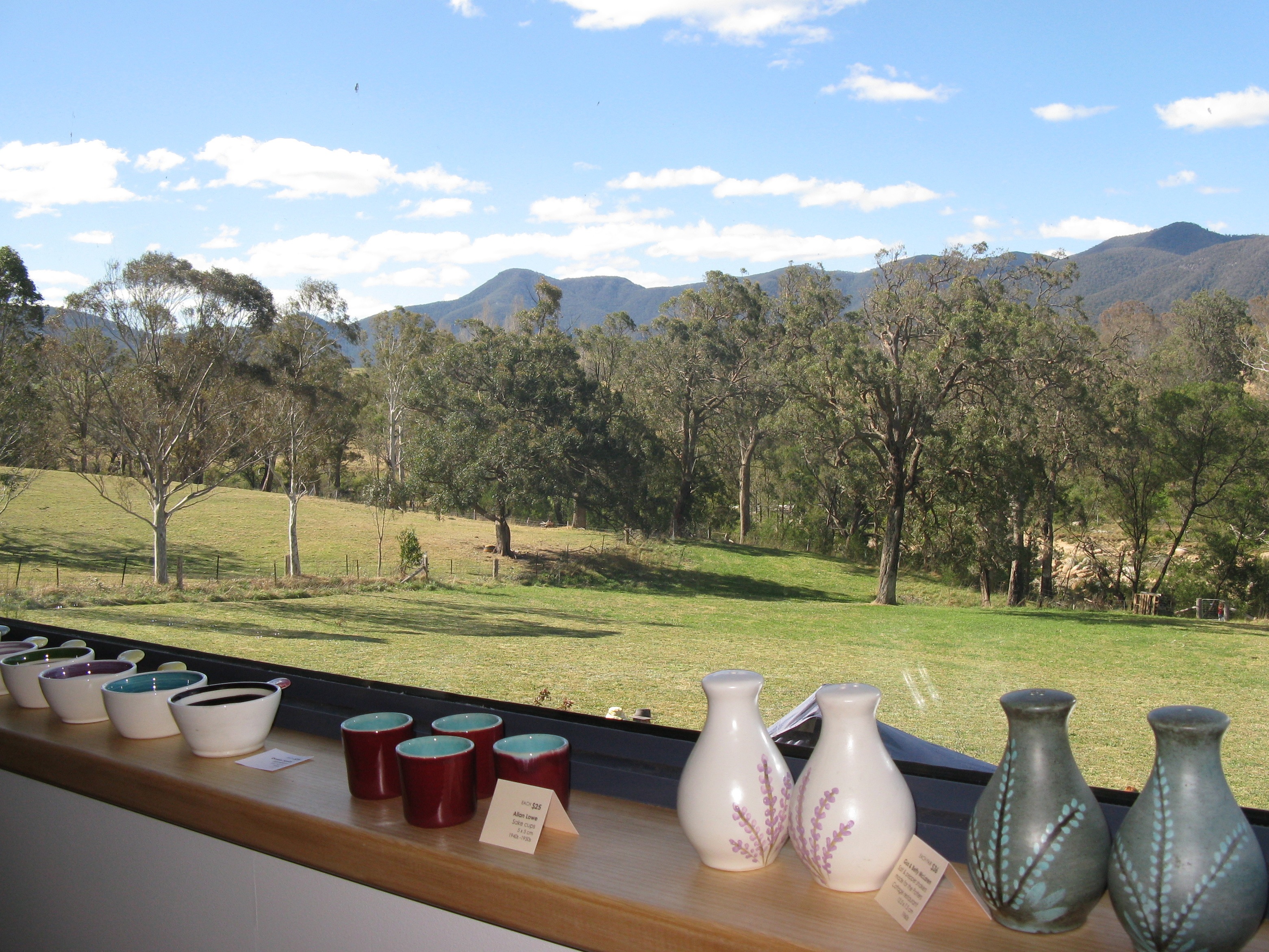
Last week my reading group discussed Martin Boyd’s A difficult young man, which I read and reviewed a couple of years ago. This weekend, Mr Gums and I went, with another couple, to the Grand Opening and River Music Fair at Australian Pottery at Bemboka. Why do I mention this? Because, in another one of those synchronicities, pottery by Martin Boyd was on display in Australian Pottery’s exhibition which, this season, features commercial pottery of, primarily, the 1950s-1970s.

I had to buy a piece of course – but I was a little intrigued because while I knew some of the Boyds were potters, I hadn’t realised that Martin Boyd was. There, however, his name was – clear as day – on the bottom of the pot. Well, I was right to be a little intrigued because Martin Boyd was not a potter … but his nephew Guy was! As Judith, of Australian Pottery, wrote in her blog:

… Merric’s younger brother Martin (1893-1972) was a writer not a potter, but his name lives on in the Sydney-based Martin Boyd Pottery set up by [Merric’s son] Guy with partners Norma and Leonard Flegg in 1946. Guy was training as a sculptor at the East Sydney Technical College (ESTC) after the war and needed an interim source of income. He returned to Melbourne in 1951 but the Fleggs continued to operate the Martin Boyd Pottery as a successful venture until overseas imports put it out of business in 1963 (Dorothy Johnston, The Peoples’ Potteries, pp. 87-91).

So there you have it … nephew Guy Boyd set up a pottery. But, of course, this begs the question: Why did he call it Martin Boyd Pottery? Well, it’s a complicated business. Guy Boyd’s full name was Guy Martin à Beckett Boyd (and, in fact, Martin’s was Martin à Beckett Boyd). According to Kathryn Chisholm in the June 2007 issue of the Friends’ Magazine of National Museum of Australia, “the name was chosen from Guy Boyd’s middle name ‘Martin’ as he preferred to keep his first name for his sculptural work”. However, Chisholm continues, his uncle Martin Boyd was “never happy having his name also associated with pottery, as he found it embarrassing”. David, co-owner of Australian Pottery at Bemboka, told us that the official line is that Martin, who was overseas at the time of the pottery’s establishment, was “bemused” but that in truth his feelings were somewhat stronger. (I think it’s time I read Brenda Niall’s biographies Martin Boyd and The Boyds: A Family Biography.)

Martin Boyd Pottery ramekin

Martin Boyd Pottery ramekin

Anyhow, back to the pot I bought. I chose a ramekin, partly because it reminded me of my 1960s childhood and partly because it is a lovely little piece. As Judith wrote in her blog, ramekins were

… a mainstay of the Guy Boyd and AMB Potteries. This form was simple to throw and decorate. The handle also lends aplomb, particularly when incorporated seamlessly into the form and decoration. We haven’t been able to resist setting up a ramekin collecting sideline …

And, there is something about a ramekin, isn’t there? Ramekin is a word (and object) I grew up with but, until now, I’d never thought about the derivation of the word. So, I looked it up and this is what I found:

French Ramequin from Low German ramken, diminutive of cream, circa 1706. middle Dutch rammeken (cheese dish) dialect variant of rom (cream), similar to old English ream and German rahm. Ancient French cookbooks refer to ramekins as being garnished fried bread.

From here the word came to describe a small heatproof bowl, sometimes with a handle, used for a single serving of a hot dish. They were usually sold in sets of 4 or 6. (Mr Gums and I received a couple of ramekin sets as wedding gifts in the late 1970s). I will not, however, be putting my new ramekin in the oven … but next time reading group comes to my place, they will be served nuts in a bowl signed by Martin Boyd. Or not, as the case may be! But why spoil a story for the sake of the truth …

Australian Pottery at Bemboka

Looking out from Australian Pottery at Bemboka

Thanks Judith and David for a lovely day … and for inspiring this somewhat different Monday Musings.