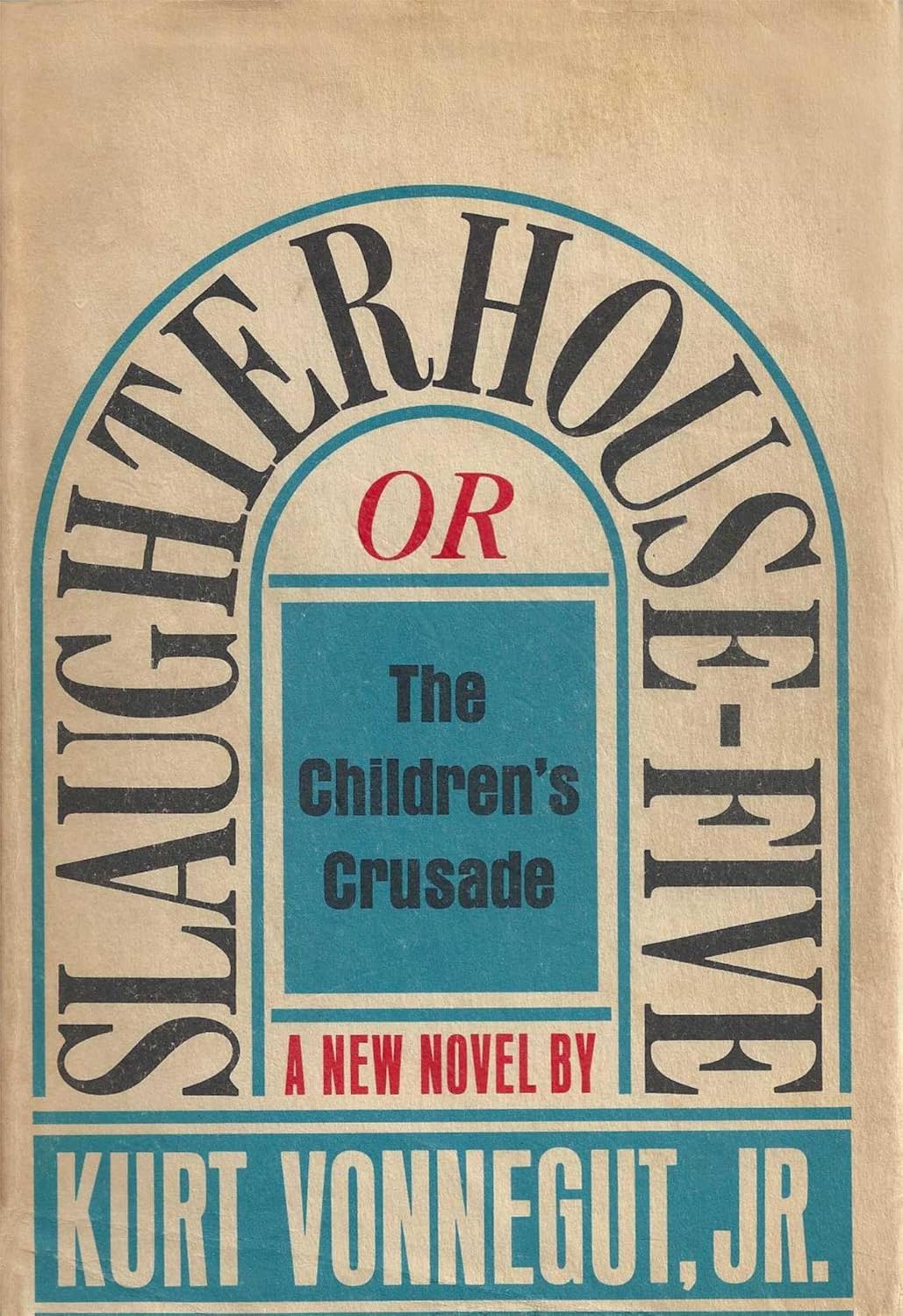
While my reading group’s main reading fare has, from the start, been contemporary fiction, we also mix it up a bit. We do non-fiction, for example, and most years we try to do a classic. Over the years we’ve done Jane Austen, Elizabeth von Arnim, Anton Chekhov, EM Forster, and Randolph Stow, to name a few. This year we turned to Kurt Vonnegut, and, because we couldn’t decide which book to do, we narrowed it to two – Cat’s cradle and Slaughterhouse-Five – and let members decide. You can tell from the post title which one I chose. This was because I have read Cat’s cradle, albeit decades ago. Most of the group, however, read Cat’s cradle, because they’d read Slaughterhouse-Five before.
So, Slaughterhouse-Five it is then – and I’m confronted by the old challenge of what to say about a classic, and a cult classic at that. This book has been analysed ad infinitum, and been found, as the decades have trundled by, to retain its relevance to new generations. However, before I say more, let me give a very brief synopsis, just in case there’s someone out there who doesn’t know the story.
“jumbled and jangled”
Ha, did I say brief synopsis? Easier said than done, but I’ll give it a try. Slaughterhouse-Five tells the story of Billy Pilgrim, from his early years, through his time as an American soldier during World War II including being in Dresden when it was bombed, to the post-war years. During his life, Billy is also abducted by flying saucer and taken to the planet of Tralfamadore, where he is displayed in a zoo. The critical issue underpinning all this is that Billy was damaged by his wartime experiences, something we now recognise as PTSD. Vonnegut conveys – and represents – Billy’s discombobulation, his trauma, through a complex non-linear, non-chronological narrative, in which Billy, who “has come unstuck in time”, travels not only back and forth through time, but also back and forth between Earth and Tralfamadore.
Slaughterhouse-Five is, as a result, a challenging, sometimes mystifying read, but it is also an exhilarating one, because Vonnegut tells his story through satire and absurdity, both of which I love. In the first chapter, the narrator, who is Vonnegut, tells us about writing the book we are now reading. As he hands his finished book to the publisher, he says
It is so short and jumbled and jangled, Sam, because there is nothing intelligent to say about a massacre.
Alongside the occasional appearance of this first-person narrator, we have the unsuccessful science fiction writer Kilgore Trout, who can also be read as a version – caricature – of Vonnegut. His “unpopularity was deserved”, the narrator tells us. “His prose was frightful. Only his ideas were good”. But, Billy loves him. We first meet Trout when Billy is introduced to him by Rosewater, another patient in the hospital to which Billy had committed himself when he feels he is “going crazy”:
Rosewater was twice as smart as Billy, but he and Billy were dealing with similar crises in similar ways. They had both found life meaningless, partly because of what they had seen in war. Rosewater, for instance, had shot a fourteen-year-old fireman, mistaking him for a German soldier. So it goes. And Billy had seen the greatest massacre in European history, which was the fire-bombing of Dresden. So it goes.
If you’ve read the novel, you will know that “so it goes” is its over-riding refrain. Used over 100 times, at moments of murder, death, and other disasters, it functions as a motif, one that both underlines and undermines the horror, by drawing attention to it, then passing it off. The constant opposition, in the novel, of the serious with the offhand keeps the reader unsettled, which is part of the point.
The occasional self-conscious appearance of the author/Vonnegut and the references to Kilgore Trout, along with its story-within-a-story framework, its wild playing with time and place, its fragmentary approach to storytelling, and its unapologetic undermining of “reality”, make this book a postmodern work, if that interests you. By this I mean what sort of work it is doesn’t matter, really. It’s what the work says or makes you feel that really counts. However, it’s these features and techniques which enable Vonnegut to convey what he wants to say in such a powerful way. The how of it is inseparable from the meaning of it.
Slaughterhouse-Five is said to be about many things, including war and pacifism, fate and free will, our experience of time. I could discuss each of these in turn, but the academics already have. I’ll simply say that my primary takeaway is that it’s about the absurdity and incomprehensibility of life and, by example, about how our everyman Billy Pilgrim copes (or doesn’t) with such life.
Slaughterhouse-Five was published at the height of the Vietnam War and the anti-war movement. It was, it seems, the right novel at the right time. Although Vonnegut had had some success before, this was the novel that apparently established him. I can see why. With wars just keeping on coming – and being just as horrific and absurd as the ones that came before them, I can also see why this novel continues to speak to new generations of readers. I mean, how can you not laugh at Billy on display in Tralfamadore:
Then he did exercises he had learned in the Army—straddle jumps, deep knee bends, sit-ups and push-ups. Most Tralfamadorians had no way of knowing Billy’s body and face were not beautiful. They supposed that he was a splendid specimen. This had a pleasant effect on Billy, who began to enjoy his body for the first time.
And, you know what? I’m going to leave you right here, because if this doesn’t convey why this book is such a complex, funny, humane read, I don’t know what will.
Kurt Vonnegut
Slaughterhouse-Five, or, The children’s crusade
Horizon Ridge Publishing, 2024 (Orig. pub. 1969)
199pp.
ASIN: B0D9SKLL68
 I’ve said before that I’m surprised by how many takes there can be on World War II, and on the Holocaust, in particular – and once again I’m here with another such story, Emuna Elon’s House on endless waters. I hadn’t heard of Elon before but,
 I was keen to read Melanie Myers’ debut novel, Meet me at Lennon’s, because it is set during the Brisbane of my mother’s early teens, that is, wartime Brisbane when her school,
  Melanie Myers



 Whispering Gums
