Albert Camus, The plague (orig. La peste)

All I maintain is that on this earth there are pestilences and there are victims, and it’s up to us, so far as possible, not to join forces with the pestilences. (Tarrou)

and

… to state quite simply  what we learn in a time of pestilence: that there are more things to admire in men than to despise. (Dr Rieux)

Albert Camus 1957

Camus 1957 (Public domain from the New York World-Telegram and Sun Newspaper Photograph Collection, via Wikipedia)

I love Albert CamusThe plague. I loved it when I first read it in my teens, and I’ve loved it every time I’ve read it since. Why is this? Well, firstly, I have always loved Tarrou’s quote above. As Tarrou goes on to say, “This may sound simple to the point of childishness; I can’t say if it’s simple, but I know it’s true”. Someone once said to me in our current more cynical century, “Oh, but that means accepting victimhood!”. I don’t see it that way though … and neither I think did Camus.

Tarrou’s, and Rieux’s, statements, then, are one reason I love this book. Another is that it can be read on multiple levels … but first a quick rundown of the plot for those who haven’t read it. It is set in the town of Oran, on the Algerian coast, in the late 1940s. The town is stricken by the plague, and so closes itself off for the duration of the disease. The novel then follows the progress of the disease and how the citizens cope with such a pestilence and its impact on their lives. We see the story through the actions and conversations of several characters including Dr Rieux, Tarrou (a “goodhumoured” but somewhat mysterious visitor to the town), Rambert (a visiting journalist), and more secondary characters including the Priest Paneloux,  Grand (a minor government official), and Cottard (a criminal).

That’s the basis of the literal story … but there are other levels. It can be seen as an allegory of the French occupation in World War 2, but I prefer to see it more broadly as a metaphorical story about how to live in an “absurd” (that is, inherently irrational) world. It might have been inspired by the Nazi occupation and the French Resistance, but I think Camus’ concerns are more universal.

So, how to talk about this book? In the sixty plus years since its publication, it has been under almost constant analysis from every angle you can think of. What can I add? I’m not sure but I’ll give it a go – and talk about what I see as the three critical concepts explored in the novel:

  • pestilences;
  • their impact;
  • how we are to live in a world in which they occur.

Camus sees the world as “absurd”, that is, one in which the irrational can, and will, happen:

Everybody knows that pestilences have a way of recurring in the world; yet somehow we find it hard to believe in ones that crash down on our heads from a blue sky. There have been as many plagues as wars in history; yet always plagues and wars take people equally by surprise.

Camus’ point seems to be that it doesn’t matter where this “irrationality” comes from – man or nature – but that it  does come, and it’s always a surprise. “Pestilences” is his word for the things that come and destablise us; they are the “impossible” things that make normal life not possible.

The impact of these pestilences is, in Camus’ view, very specific – loss of freedom, loss of individuality, loss of planning for the future, and apathy:

They fancied themselves free, and no-one will ever be free as long as there are pestilences.

and

They forced themselves never to think about the problematic day of escape, to cease looking to the future.

and

They maintained saving indifference.

So, how do we react to and live under pestilences? Camus explores three main reactions – rebel, escape and accept – and decides, not surprisingly, that the only real response is to rebel. Rebelling to him, though, doesn’t require a heroic taking to the hustings. It can simply mean not giving in. Here is Rieux:

What’s true of all the evils in the world is true of the plague as well. It helps men to rise above themselves. All the same, when you see the misery it brings, you’d be a mad man, or a coward, or stone-blind to give in tamely to the plague.

And so you do the decent thing, you do what you can to “fight” the plague and help your fellow humans. This is what Rieux, Tarrou and Grand do – and what Rambert eventually decides to do (saying that “this business is everybody’s business”) after spending much of the novel trying to escape. Rieux, Tarrou and Rambert spend a lot of time intellectualising the plague, while Grand gets on with it. Grand could be a laughable character – he devotes his spare time trying to find the right words for the first sentence of his book – but the narrator doesn’t laugh at him. Grand:

was the true embodiment of the quiet courage that inspired the sanitary groups. He had said ‘Yes’ without a moment’s hesitation and with a large-heartedness that was second nature to him.

When Rieux thanks him Grand says in surprise:

Why, that’s not difficult. Plague is here and we’ve got to make a stand, that’s obvious.

Meanwhile, Father Paneloux tries to understand the plague in terms of religion. His first reaction is that traditional one of God visiting his wrath upon a sinful people. But, as the plague sets in and he sees an innocent child die a painful death, he is forced to rethink his religion. He sees two options: to reject God or to totally accept whatever God presents. Since he is not willing to reject God, he decides that he must surrender totally to God’s will. Camus, it’s clear, doesn’t buy it!

Then there’s the criminal Cottard who flourishes under the plague. I won’t labour his story, but just say that one of the issues for him is that he’s safe from the police while the plague exists, and he relishes the fact that suddenly he’s not the only one who is miserable. In fact, as the townspeople become more miserable, the cheerier he becomes. He’s not prepared to join Rieux et al in their fight:

It’s not my job … What’s more, the plague suits me quite well and I see no reason why I should bother about trying to stop it.

The irony is that the person who most cares about Cottard is Grand!

Well, I have gone on about this novel, and could go on more. I’ve barely touched on its literary technique (its narrative style, structure, characterisation and language) but I think I’ve written enough. I will end with Rieux’s assessment of what it all means, because it means as much today as it did when it was written. That makes it a universal work.

None the less, he knew that the tale he had to tell could not be one of a final victory. It could be only the record of what had had to be done, and what assuredly would have to be done again in the never-ending fight against terror and its relentless onslaughts, despite their personal afflictions, by all who, while unable to be saints but refusing to bow down to pestilences, strive their utmost to be healers.

Camus’ worldview here is a moderate form of humanism, one that is realistically rather than idealistically based. It makes a lot of sense to me.

Albert Camus
(Trans. by Stuart Gilbert)
The plague
Middlesex: Penguin Books, 1960 (orig. 1948)
252pp.
ISBN: 0140014721

Mario Vargas Llosa, The feast of the Goat

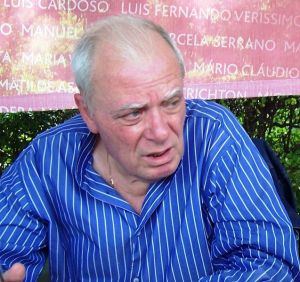
Mario Vargas Llosa, signing books

Mario Vargas Llosa signing books in 2010 (Courtesty: Daniele Devoti, via Wikipedia, using CC-BY-2.0)

If Nobel Laureate Mario Vargas Llosa‘s The feast of the goat had been a traditional historical novel, chances are it would have started with the assassins concocting their plan and then worked chronologically to its logical conclusion. But, it is not a traditional historical novel, as is reflected in the structure Vargas Llosa has chosen to tell his story.

Before we get to that though, the plot. The central story revolves around the dying (literally) days of the 30-year Trujillo (“the Goat”, “the Benefactor”, “the devil”) regime in the Dominican Republic. This means the main action takes place in 1961. However, overlaying this is the perspective of Urania, the daughter of one of Trujillo’s head honchos. She’d left the country days before the regime ended and cut herself completely off from her father – for thirty-five years, until her sudden return at the novel’s start. The novel is told from these two time perspectives – 1960/61 and 1996 – and from multiple points-of-view*, the main ones being:

  • Urania
  • Trujillo
  • The conspirators/assassins

But this isn’t all there is to this novel’s structure and narrative style. I’m not quite sure how Vargas Llosa gets away with it, but he has written a book that is very accessible (once you get across the intricacies of Latin American names) and yet also rather complex. This complexity is found, primarily, in the structure. The book can, essentially, be divided into two parts. Chapters 1-16 proceed pretty systematically, cycling through, in turn, the stories of Urania, Trujillo (usually with one of his offsiders), and the Conspirators (usually focusing on one of them in particular). By Chapter 16 the two major crises of the book have occurred or been introduced. The last 8 chapters continue to cycle through different points-of-view but not in the same systematic order. In other words, the narrative structure becomes erratic and the rhythm more urgent, as chaos and uncertainty take over.

And yet, there’s more. For example, the novel is told primarily in third person, with the point-of-view changing chapter to chapter. But, every now and then, for just a sentence or two, or maybe a paragraph, the voice lapses into second person. This happens most often with Urania and conveys the sense that there has been some trauma that she hasn’t been able to fully integrate/recover from. We discover the origins of this trauma in Chapter 16, but it is not fully revealed until the last chapter.

… You were still a girl, when being a girl meant being totally innocent about certain things that had to do with desire, instincts, power, and the infinite excesses and bestialities that a combination of those things could mean in a country shaped by Trujillo. She was a bright girl … (Chapter 16)

This little slip into second person in Urania’s story is telling.

Okay, so this is the architecture, the behind-the-scenes technical stuff, but why write it this way? Well, the reasons are intellectual and emotional. Intellectual in that the multiple alternating points-of-view enable us to get a number of “stories” first hand. Through the eyes of the perpetrators and the disaffected, we explore the regime, and how, as happens so often with dictatorships, the early benefits are gradually (but surely) overshadowed by the corruption and violence perpetrated to maintain power, and how this leads to the assassination conspiracy. And emotional in that the constant shifting in perspective, particularly from people we can trust to those we can’t (to the best of our knowledge), and back again, unsettles and discomforts us … just as those who lived through the regime were kept on edge.

It’s impossible, without writing a thesis, to cover all the angles in this book, so I’m just going to look at one more – the characterisation of Trujillo himself. A historical novelist (rather like a biographer) has to choose what to include and what to exclude when describing a person. Vargas Llosa was lucky, really, that Trujillo had some traits that made this choice rather easy, traits that work on both the literal level and the ironic and metaphoric. Fairly early in the novel is this description of Trujillo

…that master manipulator of innocents, fools, and imbeciles, that astute exploiter of men’s vanity, greed and stupidity.

Fairly typical, wouldn’t you say, of a dictator? But, Trujillo was also fastidious about cleanliness and appearance, believing that

Appearance is the mirror of the soul.

If that’s so, then Trujillo’s “soul” is a very superficial thing because his disdain for the rights and feelings of others is palpable. Throughout the novel, Vargas Llosa sets Trujillo’s obsession with personal care (“the man who did not sweat, did not sleep, never had a wrinkle on his uniform, his tuxedo, or his street clothes”) against the coldness of his mind. That his mind is cold is made perfectly clear through his attitude to his offsiders (whom he liked to scare – “it cheered him to imagine the sizzling questions, suppositions, fears, suspicions he put into the head of that asshole who was the Minister of the Armed Forces”) and to women. This regime values machismo above all: it’s brutal to those those less powerful, and has careless disregard for the innocent. Women, of course, bear the brunt:

Again the memory of the girl at Mahogany House crossed his mind. An unpleasant episode. Would it have been better to shoot her on the spot, while she was looking at him with those eyes? Nonsense. He had never fired a gun gratuitously, least of all for things in bed. Only when there was no alternative, when it was absolutely necessary to move this country forward, or to wash away an insult.

Trujillo was nothing if not a master of self-justification.

How it all falls out, what happens after Chapter 16, is both expected and unexpected as those involved do or don’t do what they’d committed to. The end result is a devastating portrayal of how the political becomes the personal! Not a new message, perhaps, but The feast of the Goat is a compelling read that engaged my heart and mind. I recommend it.

Mario Vargas Llosa
(Trans. by Edith Grossman)
The feast of the goat
London: Faber and Faber, 2002
475pp.
ISBN: 9780571207763

* As in most historical fiction, the novel is peopled with historical characters and fictional ones. Most, in fact, are historical but Urania and her father, though based, I understand, on real people, are fictional.

Arnold Jansen op de Haar, King of Tuzla

Translated works always represent a challenge. There is something slightly disconcerting about knowing that you are not reading the actual words of the author, but someone else’s interpretation of them. There’s been some discussion of this around the blogs and in the media this year, partly because of the publication of Why translation matters by award winning literary translator Edith Grossman.

Ramona Koval, of Radio National‘s The Bookshow, interviewed Edith Grossman earlier this year. Koval introduced the interview with:

According to Edith Grossman, translation is a strange craft, generally appreciated by writers, undervalued by publishers, trivialised by academics, and practically ignored by reviewers.

Well, maybe translators are ignored by professional reviewers, but I’ve often seen the issue discussed in blogs and online bookgroups. We are keenly aware of the translator’s role and have been known to compare translations. Anyhow, to continue… The Wikipedia article on Grossman includes a quote from a speech she made in 2003:

Fidelity is our noble purpose, but it does not have much, if anything, to do with what is called literal meaning. A translation can be faithful to tone and intention, to meaning. It can rarely be faithful to words or syntax, for these are peculiar to specific languages and are not transferable.

Arnold Jansen op de Haar, King of Tuzla bookcover

Book cover (Courtesy: Holland Park Press)

This brings me nicely to Arnold Hansen op de Haar’s King of Tuzla. I found it a strangely compelling book. I can’t say I loved it, and at the beginning I nearly gave it up, but it’s short and so I decided to push on. However, more of that anon. First a brief plot. It tells the story of a young Dutch army officer, Tijmen, who finds himself in the middle of the Bosnian War as part of a UN unit, and tracks his experience of the war and his feelings about it. Interspersed between his story are little “cameo” stories about various civilians and the impact of the war on them. In fact, the novel starts with one such cameo, the Muslim Galib who had been a civil servant but had lost his job due to the war and was now a farmer. These cameos do not become part of the main narrative.

The book is divided into 5 parts. The first three parts are essentially chronological, while the last two are told after the war, in flashback, some of it through Tijmen’s journal entries. Overall I liked the structure of the book. The early chronological sequence, the interspersed cameos that gave “life” (albeit often horrific) to the matter-of-factness of the military detail, and the change in pace and perspective in the last two parts give the book interest by layering meaning.

The characterisation of Tijmen and his fellow officers is effective. Tijmen himself is an intriguing character: a bit of a loner, interested in the arts (reading, ballet, iceskating), ambitious (but “Eleven years later and still he had got nowhere”), and a little proud (the King of Tuzla, the Duke of Sapna, is how he sees himself during the conflict). I must say, though, that I don’t quite know why the book has been described as a coming-of-age novel. He is an adult when the novel starts and, while he is a little naive in the ways of the world, I saw no coming-of-age focus.

The trouble is that the book is a bit of a plod to read at times, and I wonder whether this is to do with the translation. So, here’s the rub: do I place my concerns at the author’s or the translator’s feet? Part of the problem is the flow. It felt clipped and jerky, but not in a way that seemed like it was done for effect. And at times, the sentences just plodded on one after another, like a boring history text. Maybe all this was intended, but I found it hard going. In addition, there are errors, such as “the colonel still lay there snorting” (“Snoring” seems more likely) and some awkward expressions, such as “It was some minutes before Eddy was able to extricate himself from the situation with some difficulty”. Is this a translation problem? “With some difficulty” seems redundant, and makes the sentence clunky to read.

There are, however, also some lovely images and gorgeous rhythms. I particularly liked this, for example (despite the errant, to me, semi-colon after “popes”):

This was the area where the different population groups overlapped like different geological strata. It was the land of popes; the mullahs and rabbis, the Christians, the Muslims, the Jews and the gypsies. The land of the long hot summers and the long severe winters, of rakija, walnuts and prunes and the land of the centuries-old struggle between the Turks, Hungarians, Austrians and Germans…

And this poignant description of Tijmen’s flat:

Eight years in the same flat, where time’s mechanism had jammed. No-one had been loved there.

In the end, figuratively speaking as we learn this two-thirds of the way through the book, the war is too much for Tijmen and he leaves the army. The book concludes with some nicely structured words beautifully conveying what he had earlier described as “this uselessness, this futility, human helplessness”. (Wouldn’t it be better with another “this” before human?) This may not be the best war novel I’ve read, but it has its power.

This book has received some varied reviews. You may like to read a couple: Stu at winston’s dad and Lisa at ANZLitLovers.

Arnold Jansen op de Haar
(Trans. by Paul Vincent)
King of Tuzla
London: Holland Park Press, 2010
(Orig. pub. 1999)
199pp.
ISBN: 9781907320064

(Review copy supplied by Holland Park Press)

Haruki Murakami, Blind willow, sleeping woman

Murakami, Blind willow, sleeping woman

Bookcover, used by permission of the Random House Group Ltd

Granted, my fiction contains more than its share of invention, but when I’m not writing fiction I don’t go out of my way to make up meaningless stories. (from “Chance traveller”, 2005)

This is as good a way as any to commence my review of Haruki Murakami’s recent short story collection, Blind willow, sleeping woman, because it clues you in immediately to the games Murakami plays with his reader. In “Chance traveller”, we are told that the “I” “means me, Haruki Murakami, the author of the story” and that most of the story is “third-person narrative”. In fact, this short story, like several in the book, comprises a story-within-a-story, a story told to a narrator who is present in the story himself.

It may sound odd to say this about a short story collection but I found it a bit of a page-turner. It comprises 24 stories written between 1980 and 2005. There are a lot of similarities between the stories  – the “disconnected” tone, the frequent use of first-person narrator, the story-within-a-story technique, and the regular use of flashbacks – but Murakami’s inventions are so varied and odd that you are compelled on.

What I love about Murakami is the matter-of-fact rather detached tone he uses to tell stories that often start off being quite ordinary but usually end up taking us to the strangest places. By focussing on the ordinariness of people, by including seemingly unimportant everyday and often pedantic-sounding details, Murakami lulls us into believing in his world so that when the bizarre happens – as it often does – we accept it with barely a blink.

Those of you who know about Murakami know that he is enamoured, if that’s not too strong a word, with the West – and his stories are peppered with allusions to Western culture from Elvis to Richard Strauss, from John Ford to Balzac. His cultural knowledge is quite prodigious. It is this “westenisation” that has, historically, put him at odds with the Japanese literary establishment. He explores this amusingly but pointedly in his story “The rise and fall of Sharpie Cakes” (1981/82) which satirises the drive to conformity and tradition. The final words of this story are:

From now on I would make and eat the food that I wanted to eat. The damned Sharpie Crows could peck each other to death for all I cared.

Like Murakami’s novels, these stories tend to be about alienation and loneliness. Most of his characters have trouble connecting with others, and when they do it often doesn’t go as well as they hope. Murakami  seems to see being alone as the essential condition of life:

He found it natural to be by himself:  it was a kind of premise for living. (“Tony Takitani”, 1990).

In  “The Ice Man” (1991) the couple go to the South Pole which “turned out to be lonelier than anything I could have imagined”. “The year of spaghetti”  (1981/82) concludes with the narrator alone, cooking spaghetti and suggesting that, in exporting durum, the Italians had exported “loneliness”. And so on, from story to story. Somewhat related to this focus on loneliness is a sort of fatalism, a view that life is not to be understood but just is:

Life: I’ll never understand it. (says Tony Takitani, in “Tony Takitani”, 1990)

Life is pretty damn hard. (says a girl to the narrator in “A ‘Poor Aunt’s’ story”, 1980/81)

That’s life. (says the young man, about something pretty trivial, in “A perfect day for kangaroos”,  1981/82)

He had to be as true to his homosexuality as he was to his music. That’s music, and that’s life. (“Chance traveller”, 2005)

Get all the fun out of life while you’re still able. They’ll serve you the bill soon enough. (“Hanalei Bay”, 2005)

And alongside all this, Murakami explores the fine line between reality and unreality or illusion. His characters tend to either escape reality when they can or find it slipping away from them – or, conversely, find it intruding when they don’t want it. The young couple in “A folklore for my generation” (1989) find “reality … invisibly starting to worm its way between them”. The first-person narrator in “Man-eating cats” (1991) writes that “for a second or two my consciousness strayed on the border between reality and the unreal … I couldn’t get a purchase on the situation” and a little later says “From time to time I was sure that I could make out the cat’s eyes, sparkling between the branches. But it was just an illusion”. And in one of my favourite stories, “A ‘Poor Aunt’ story” (1980/81), the fictional aunt becomes “real”, “stuck” to the narrator’s back, and disconcerts his friends:

‘Gives me the creeps’, said one friend.
‘Don’t let her bother you. She minds her own business. She’s harmless enough.’
‘I know, I know.  But, I don’t know why, she’s depressing.’
‘So try not to look.’
‘OK, I suppose’. Then a sigh. ‘Where’d you have to go to get something like that on your back?’
‘It’s not that I went anywhere. I just kept thinking about some things. That’s all.’

Not only do I like this for its idea – the making concrete of the thing you are thinking about – but it’s a good example of Murakami’s facility with dialogue.  “A ‘Poor Aunt’ story” has to be a bit of a writer’s manifesto – about the power and the limits to that power of words (and perhaps more generally of art). In fact, the idea of art as salvation appears a couple of times in the book. Earlier in this story it is suggested that writing about something, like a poor aunt, means “offering it salvation” and in “A seventh man” (1996) there’s a sense that art may offer “some kind of salvation … some sort of recovery”.

I could write much more on this book – tease out delicious story after delicious story, and give lots of examples of his expressive imagery, such as “I was beginning to feel like a dentist’s chair – hated by noone but avoided by everyone” (“A ‘Poor Aunt’ story”). However, that might spoil the pleasure for you (if you haven’t already read it), so I will finish with Murakami’s own words from his introduction:

My short stories are like soft shadows I have set out in the world, faint footprints I have left behind. I remember exactly where I set down each and every one of them, and how I felt when I did. Short stories are the guideposts to my heart, and it makes me happy as a writer to be able to share these intimate feelings with my readers.

All I can say to this is, what a fascinating heart to know…

Haruki Murakami
(Trans: Philip Gabriel and Jay Rubin)
Blind willow, sleeping woman
London: Vintage Books, 2007
436pp.
ISBN: 9780099488668

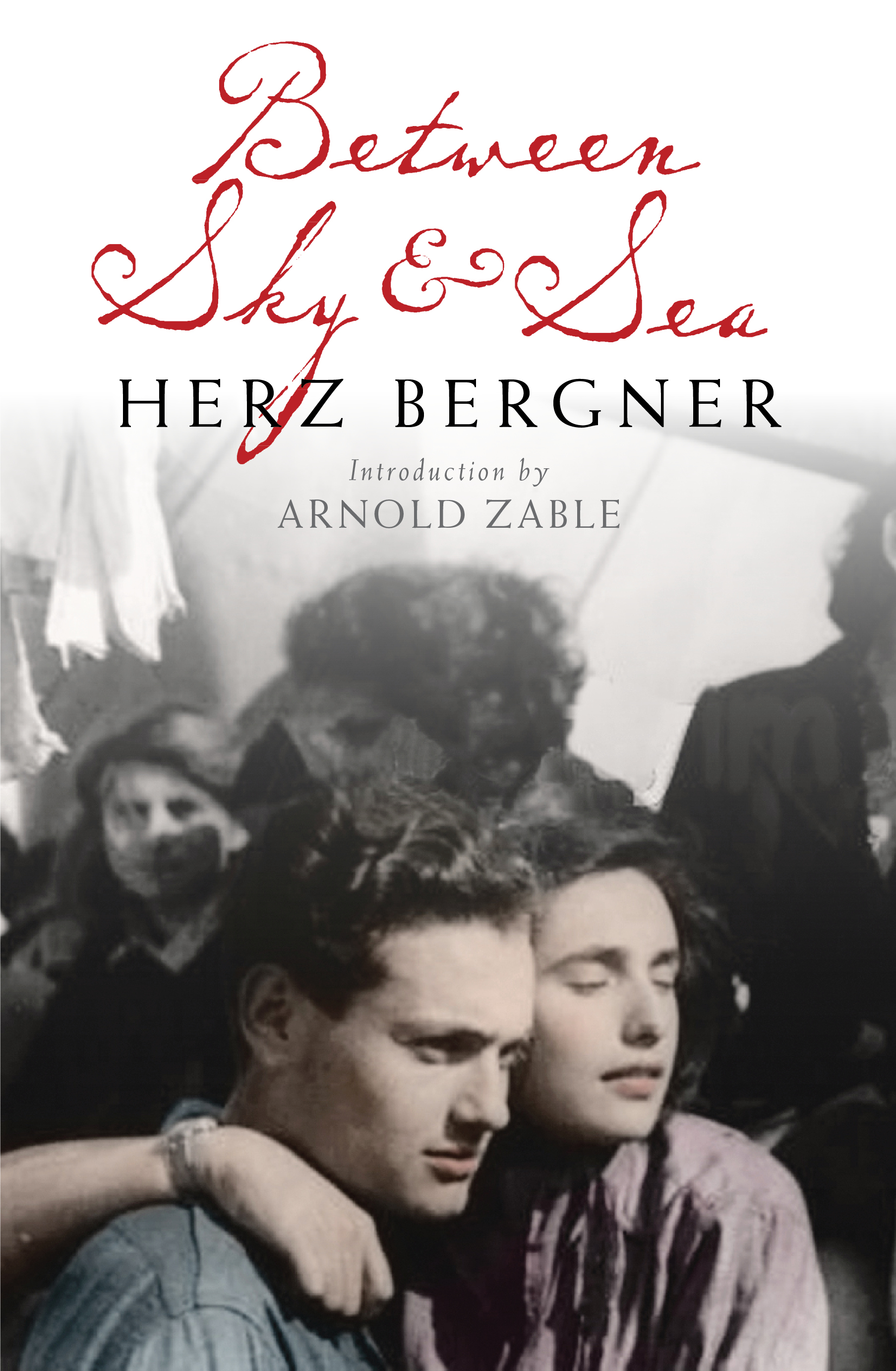
Herz Bergner, Between sky and sea

Hans Bergner, Between sea and sky
Book cover (Courtesy: Text Publishing)

Do you read introductions to novels? And, if you do, do you read them before or after you read the novel itself? I read them, but always afterwards because I like to come to  novels as objectively as I can. And so, this is what I did with Herz Bergner’s  Between sky and sea which won the Australian Literature Society’s Gold Medal for Book of the Year in 1948. I’d never heard of it. (Well, I wasn’t around then, but still …!) However, this year Text Publishing has republished it, which is a pretty savvy decision because, as Arnold Zable suggests in the introduction, it has some resonances for contemporary Australia – but more on that anon. Zable also tells us that while Bergner, a Polish Jew who emigrated to Australia in 1938, wrote the book in Yiddish, it was first published in English, having been translated by another Australian Jewish novelist, Judah Waten.

The novel has a straightforward plot. It tells the story of a group of Jewish refugees from the Nazi invasion of Poland who are passengers on an old Greek freighter bound for Australia where they hope for a new life. (Australians, at least, will see the contemporary resonances now. Think SIEV X, for example). There is, though, an older resonance which Bergner presumably knew – that of the MS St Louis which tried to find a home for Jewish refugees in 1939 after they were turned away from Cuba (and which later inspired the book Voyage of the damned, so titled because, as many of you know I’m sure, they continued to be turned away as they went from port to port). These resonances and more are all referred to in the Introduction. Knowing readers will pick many of them up, but isn’t that the fun of reading? To pick them up yourself? So, read the book, I say, and then the rather fine Introduction.

Anyhow, back to the book. As I was reading it, I couldn’t help also thinking of that allegorical boat trip, the Ship of Fools. This is not that allegory – they are not fools, and the boat does have a captain, but as I read the novel I felt that awful sense of a world out of control that the allegory represents.

If this book were a film, it would be described as having an ensemble cast, because it has no identifiable heroes or heroines, no real anti-heroes either. Rather, it has a bunch of people who are thrown together by circumstance but who have little in common other than that they are Jewish refugees. Their backgrounds are diverse and they vary in their practice of Judaism (if they practise it at all). They include Nathan and Ida (who lost their respective spouses and children while escaping the invasion), the know-it-all Fabyash and his family, the flirty but mostly kind-hearted Bronya and her stolid overweight husband Marcus, Mrs Hudess and her two daughters (whose only remaining possession is one doll), and several others. As you might expect with such a set up, the novel explores the increasing tensions – the arguments, the pettinesses alongside the kindnesses – that occur as supplies of food and water dwindle and people get sick, while the journey goes on and on without an end in sight:

They were ashamed to lift their heads, to look each other in the face, and for two reasons. Because Fabyash had sunk so low that he had stolen food from a child, and because Mrs Hudess, who was regarded as such a refined person, had burst forth with the language of the coarsest market vendor. To what depths suffering can bring a person.

The strength of the novel is, in fact, its characterisation. Despite its almost non-existent plot (though there is a climax that I won’t give away), the novel maintains our interest because its characters are real in the way they relate to each other and their circumstances. We know these people, we are these people. In this regard it is a little different from those Holocaust novels – many of which also deal with “ordinary” people – that work on a larger-than-life heroism-betrayal scale.

Towards the end of his introduction, Zable quotes Waten regarding the translation. Waten apparently translated it with Bergner by his side, and says that Bergner was “very odd because he wanted every word translated, and if the number of words came out fewer in English he wasn’t very happy. He never really mastered the English language”. This makes a bit of sense because there are times when the novel feels a little – well – wordy. This never becomes a big problem, however, because Bergner’s imagery (mostly simile and analogy) tends to be fresh and is often two-edged:

A soft haze shimmered in the summer air, caressing their faces like spider webs. [on Nathan and Ida’s escape from Warsaw]

and

For a moment the moon shone through, glittering like a lance, and then it was quickly hidden again.

and

… at midday when the sun was ripe and full like a great golden pear that hung heavily from the centre of the sky.

I enjoy writing like this that contains layers of meaning that make you think a little before you move on. The language is not particularly complex, but Bergner has a habit of inserting a word or phrase that undercuts your expectation and keeps you reading.

The themes are both particular and universal – particular because they specifically depict the anti-Semitism that was rife during World War 2 (to the extent that even the crew on the boat treat the passengers as less than human), and universal because they explore the various ways humans behave under stress. The overriding theme – the biggie, in fact – is the way we continue to turn away other. The irony is that even when we are the other – such as the Jews on this boat – we find otherness amongst ourselves to turn away (until a bigger calamity forces us to reconnect). Will we ever change? I fear not. In fact, that’s what makes the universal, universal, isn’t it?

It is encouraging to see publishers like Sydney University Press and Text Publishing – not to mention of course Penguin –  reissuing long out-of-print Australian classics. I hope it pays off, not only because I like to see forgotten Australian classics brought to life again but because, as in this book, the messages conveyed by these classics can be as valid today as they were when they were first written.

Herz Bergner (trans. by Judah Waten)
Between sky and sea
Melbourne: Text Publishing, 2010 (first ed. 1946)
215pp.
ISBN: 9781921656316

(Review copy supplied by Text Publishing)

Sawako Ariyoshi, The doctor’s wife

The doctor’s wife is the third Ariyoshi novel that I’ve read. The other two – The River Ki and The twilight years – I read well over a decade ago. According to Wikipedia The doctor’s wife is considered her best novel. All, though, are fascinating reads providing an insight into a culture which is so different from my own but in which, at the same time, people experience similar desires, pressures and emotions.

The twilight years is set in 1970s Japan and beautifully captures the cultural changes that were occurring around the time as Japan was (and still probably is) moving from  feudal/traditional parent child relationships to our more modern independent ways, with women caught in the middle. The River Ki chronicles three generations of women from the late 19th to mid 20th century, exploring changing attitudes and expectations of women. You are probably getting a picture here and you’d be right: Ariyoshi’s overriding theme concerns the role of women in Japanese society, both historically and in modern times. (Ariyoshi died in 1984.)

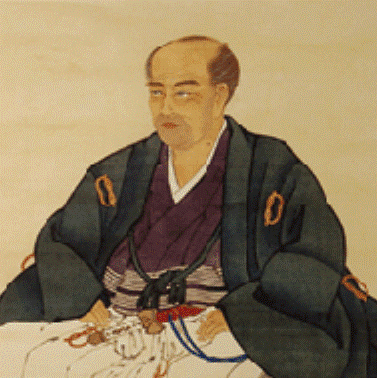
Hanaoka Seishu

Hanaoka Seishu (Public domain, via Wikipedia)

The doctor’s wife is an historical novel, spanning 70 years from around 1760 to 1830 and based on the life of famous Japanese doctor Hanaoka Seishu. A quick plot summary. The doctor’s wife is Kae, a young woman from a wealthy family, who is lured to become Seishu’s bride by his ambitious mother Otsugi, herself a woman married from a wealthy into a poorer family. The novel then chronicles Kae’s life in this extended family household as Seishu develops his medical skill and training until, near the end, he performs the world’s first surgery under anaesthetic (1804, breast cancer)*. While Seishu’s development as a doctor frames the novel, the real plot concerns the relationship between Kae and Otsugi.

The novel is told in third person, mostly the more objective omniscient voice, but occasionally we feel we are specifically in the heads of Kae or Otsugi. According to my edition’s introduction, Ariyoshi had access to Seishu’s personal records, diaries and books. However, being a man of his time and a doctor focused on his research, he did not, I assume, document much of his family life. The story, then, of the women is largely fictional. Mostly through dialogue, with description as needed, Ariyoshi describes how the loving supportive role Otsugi initially presented towards her daughter-in-law changes when her son (who had been married to Kae in absentia some three years before) returns home from his medical studies in Kyoto. Overnight, the relationship, to Kae’s shock and distress, changes into a competitive one – a competition that has serious consequences as they vie to be guinea pigs for his experiments in anaesthesia. Both women are presented as flawed, but as it is Kae who opens the novel and is the more powerless, it is with her that we are most keen to identify and empathise.

Why has Ariyoshi chosen to tell this story of conflict and competition within an historically based story of a great man? Does the historical “truth” add credibility to her exploration of familial power discrepancies? I’m not sure it’s necessary, but perhaps it helps … It is a very human tale – the grand gestures made by the women to support his research are small in the scheme of things though the impact on them, particularly on Kae, is immense. Ariyoshi realistically explores the nuances of their relationship through the normal day-to-day patterns of life (weaving, cooking, house management, childbirth) suggesting that this sort of conflict doesn’t have to be but that it often (traditionally, even) is. In fact, we readers are lulled into seeing it as the norm – the lot of women – until we are shocked out of that frame of mind near the end by Seishu’s unmarried sister who says (in broken speech because she is ill):

I think this sort of tension among females . . . is . . . to the advantage . . . of . . . every male.

She continues to explain her particular perspective on women’s secondary lot, and pronounces that:

as long as there are men and women side by side on this earth, I wouldn’t want to be reborn a woman into such a world.

Clearly, given the story Ariyoshi has told, she rather agrees  – or, at least, agrees for such societies as she depicts here in which women’s lot is not only an inferior one but which work to discourage them from cooperating and supporting each other. The novel may be set in Japan, but the fundamental truths, unfortunately, are not so confined.

What I have described here is the main story, but there’s more here that can be discussed, including the development (or history) of medicine in the east and west, the experimentation on animals and humans, and Japanese social life and customs in the Tokugawa period.

It’s a short but engrossing read. It falters a little I think right at the end when the historical facts are presented so prosaically that they threaten to overwhelm its novelistic achievements, but the last line fuses the two so beautifully that you forgive this.  The doctor’s wife is a fascinating and keenly observed novel that deserves to be read.

*Ironically, in 1811, novelist Fanny Burney underwent a horrific mastectomy without anaesthesia because it was unknown in the west!

Sawako Ariyoshi
The doctor’s wife
(trans. by Wakako Hironaka and Ann Silla Kostant)
Tokyo: Kodansha International, 1966 (orig ed), 1978 (trans)
174pp.
ISBN: 0870114654

Jorge Amado, Gabriela, clove and cinnamon

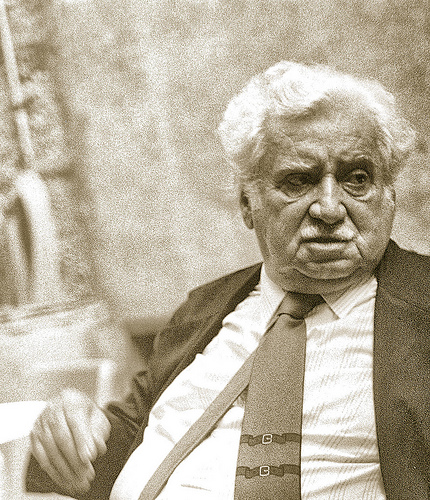
Jorge Amado

Jorge Amado, 1985 (Courtesy: Xan Carballa, via flickr, using CC-BY-NC-2.0)

How could you resist reading a book with a title like this? I don’t manage to read all the books scheduled for the various bookgroups I belong to, but when this one came up I decided it was a must – because it was by a non-Anglo writer and one I hadn’t read before, and because of its gorgeously evocative title. I wasn’t disappointed. This is fun and rather easy to read, but that doesn’t mean it’s simple.

Jorge Amado is a Brazilian writer, and Gabriela, clove and cinnamon (1958) is set in Ilhéus, a coastal city where he spent his childhood. The novel takes place in 1925 – during a time of great social change:

New streets had been opened, automobiles brought in, mansions built, roads constructed, newspapers published, clubs organised – Ilhéus was transformed. But the ways men think and feel evolve more slowly. Thus it has always been in every society. (p. 2)

The basic plot concerns Nacib (the Arab) and his love for Gabriela (the simple, but sensuous, mulatto girl he hires as his cook). But the book’s subject matter is far wider, dealing with politics and society at a time when “old ways” were being challenged by “new ways”. The “old ways” are typified by macho violence, by the notion, really, that “might is right”. Violence is used by the old leaders (mostly the “colonels”) to attain and maintain political power – and to maintain possession of women. It was accepted practice, for example, for a man to kill an adulterous wife and her lover. In fact, the novel starts with such a murder and then a little later we hear of another man being reviled for not doing so, even though his way of handling it had a delicious come-uppance about it. Ilhéus is, we are told, changing but not yet civilised; it still clings to its old and violent customs; it is

so feudal still despite its much publicised and undeniable progress.

While men hold the power, the novel is structured around women. There are four chapters, each commencing with a poem about a woman:

  • The languor of Ofenísia (who would rather die a virgin if she can’t have the Emperor)
  • The loneliness of Gloria (the mistress of a wealthy man, who has everything but what she wants)
  • The secret of Malvina (the young student who will not be controlled by a man)
  • The moonlight of Gabriela (the free spirit who should not be changed)

The first, Ofenísia, does not really appear as an active character in the book (though we are told that her “importance must not be judged by the brevity of her appearance”). The other three though manage to achieve what they want…and in doing so they epitomise the conflict between the “old ways” and the “new”, between maintaining the “status quo” (with its attendant double standard) and accepting change.

The book is peopled with a wonderful array of characters. I found it hard at the start to keep track of all the characters – particularly the many Colonels – but eventually I did, and realised that they fall into two main camps: those tied to the “old ways” and those supporting change. Colonel Ramiro Bastos is the leader of the former, and new arrival Mundinho Falcâo is a proponent of new ways of doing things, such as through negotiation. This conflict is represented literally and symbolically by the sandbar. It prevents the town being used as a port for the new cacao industry and Falcâo promises to dredge it. The scene is set for a big showdown as the various citizens of the town align themselves with one side or another, but the resolution is not as simple and dramatic as we expect. And this is partly what makes this a novel well worth reading. Change is presented as generally good, but it is not “simply” or even always so. Amado conveys this subtly. The characters are complex and through their very realistic interactions and sometimes contradictory behaviours we see that old versus new is not a simple dichotomy. Gabriela, for example, cannot be changed to fit Nacib’s image of a wealthy man’s wife: she is a free spirit who doesn’t quite represent the old or the new. She just is. And symbolically, the sandbar will not stay dredged and will need regular clearing. It is not a simple answer to continued progress for Ilhéus. Nonethess, by the end, some level of civilisation is achieved. At the trial of the husband who’d murdered his adulterous wife and her lover at the beginning of the book, the lawyer Dr Ezequiel Prado is reported as saying:

Ilhéus was no longer a land of bandits, a paradise of assassins; his theme was civilization and progress.

It is interesting to think that this book was published around the same time as Patrick White’s Tree of man (1955) and Voss (1957). Amado and White are both described as modernists, but how different they are. White is psychologically intense, while Amado here is full of humour, colour and movement, reflecting the messiness of society. Modernism, though, is a forgiving church as Lisa (ANZLitLovers) shows in her post on the subject.

There is so much to write about this book. Its humour and satire, the complex characterisation, the clever way the double murder introduced at the beginning is woven as a motif through the book, and the breadth of its subject-matter are just a few of the the topics that could be explored in depth.

I’ll leave those for others though and come back to a favourite aspect for me which is its thorough analysis of the way the desire for progress clashes with the status quo. I’ll end with statements made by two of the town’s old guard. First, the Colonel who sees that change is coming:

That’s right Colonel. Everything you’ve said is right as far as it goes. But it’s right by the conditions and needs of an earlier time. We spend our lives working hard, and we don’t realise that time is going by and that things are changing…

Then, the Colonel who doesn’t see it:

What does Ilhéus want beyond what we’re giving it? What more is there to do? To tell the truth I don’t see these new needs.

It was ever thus eh?

Jorge Amado
Gabriela, clove and cinnamon
(trans. by James L. Taylor and William L. Grossman)
New York: Vintage International, 1958 (1992)
426pp.
ISBN: 9780307276650

António Lobo Antunes, The natural order of things

António Lobo Antunes, 1998 (Photo: Gonçalo Figueiredo Augusto, from Wikipedia, under Creative Commons Licence, CC-BY-3.0)

António Lobo Antunes, 1998 (Photo: Gonçalo Figueiredo Augusto, from Wikipedia, under Creative Commons Licence, CC-BY-3.0)

Virtuosic? Tour de force? These are such clichéd terms to use in a review – and yet, I can find no other words to better describe Portuguese writer António Lobo Antunes’ 1992 novel, The natural order of things. This is one of those beautifully written, but rather challenging, books that you know you really should read again to get all those nuances, relationships, and connections that you sense but can’t quite fully grasp. If that puts you off reading the book, so be it, but in doing so you’ll miss something quite special.

As you might expect the title is ironic – there is very little natural order here. The novel does not follow the “natural (aka chronological) order” either of fiction or of life. The characters – including a middle-aged man living with a schoolgirl, a miner who “flies” underground, a girl/woman who spends her life in an attic, an ex-secret policeman who teaches hypnotism by correspondence – do not fit the “natural order” either.

The imagery is rich, evocative and effective in building up a picture (mostly of disorder and decay) and a feeling (mostly of melancholy, if not despair). The rhythm – produced by repetition, and by run-on paragraphs that don’t begin with new sentences – compels you on. The characters are convincingly drawn despite their often mad-sounding confusions. The mixing of the surreal with the real works – as does the weaving of two scenes from different points in time in the same sentence, not to mention the telling of a story by two voices in the same sentence. Somehow he makes it work. Here is an example:

…and eleven months later I met Mr Valadas at a restaurant and liked his double chin, he wasn’t as handsome as the skin doctor who hated Verdi, but I felt sorry for him, always by himself, eating lunch all alone,

and my sister Teresa, who kept looking at you and shaking as if she’d been hit by the world’s worst tragedy, “When is the wedding Fernando?” [p. 186]

Two voices alternating in one long run-on sentence – and for some reason, you go with the flow and know who’s speaking when. But that is the thing to do with this book – go with the flow.

So, what is it about? In superficial terms it’s about, as the blurb on my back cover says, “two families and the secrets that bind them”. But really, there’s not a strong plot, though several stories are told. The novel comprises 5 books, each of which is broken into chapters told from two alternating points of view, resulting in 10 voices. The stories are set between 1950 and around 1990 and deal, in their various ways, with post-1974 Carnation Revolution Portugal and the resultant disintegration of Portuguese society (not only in Portugal but in its African and Timorese colonies). This said, the over-riding sense of the book is one of personal stories, of past, present and the way memory works, and not of politics:

Relax, don’t lose your temper, I swear I’m doing the best I can, but that’s how memory is, it has its own laws, its own rhythm, its own whims, … (p. 23)

In a bit of self-consciousness that brings us back to earth, the second last voice in the book, the dying Maria Antonia, says:

I amused myself by imagining that the redheaded girl was the sister of my neighbours at the Calçada do Tojal, I moved her to the house of the Vacuum Oil employee and the imprisoned army officer … my nephew announced with a smile , “You’re going to live forever, Aunt Antonia”, and I nodded so as not to upset him, I stuck a Tyrolean hat on his head and place him in Hyacinth Park of Alcântra, married to a diabetic girl from Mozambique or … [p.263]

because we who are from here but are not from here, who are from a here that no longer exists, have filled up these buildings with the silt of mementos and albums and letters and faded pictures from the past, and our present is occupied by these ruins of memory, not only the memory of those who preceded us, but the memory of ourselves, because we also forget, because names and images and faces get lost in a fog that makes everything equally blurry, … [p. 274] … with me will die the characters of this book that will be called a novel, which I’ve written in my head, fraught with a fear I won’t talk about, and which one of these years someone, in accord with the natural order of things, will repeat for me in the same way that Benefica will be repeated in these random streets and buildings, and I, without wrinkles or gray hair, will water my garden with the hose in the late afternoon, and the palm tree at the post office will grow again, … [p.277-8] … even if we’re not very large trees, and even if they knock us down, we’ll remain in photos, in scrapbooks, in mirrors, in the objects that prolong and remember us, … [p. 278]

And so here is made clear what should already be clear through the way the book is written and structured – though the repetition of phrases, the recurrence of bird and tree images, and the intertwining of stories and voices – and that is that the present and past intermingle and repeat each other, that the real and the unreal both have a place, that nothing really ends or begins, and that, perhaps, no matter how bad things are there is hope. What also seems to be made clear is that this has all been the fabrication of Maria Antonia – or has it? After all it is not she but the redheaded girl (Julieta) who has the last say. Read it and decide for yourself.

(Translated by Richard Zenith)

Imre Kertèsz, Fateless (or Fatelessness)

[WARNING: SPOILERS, of sorts]

Let’s get the first thing clear. I like holocaust literature – not because I enjoy the subject matter but because in it I find the most elemental, universal truths about humanity. Depending on the book, this literature contains various combinations of bravery and cowardice, cruelty and kindness, love and hate, self-sacrifice, self-preservation and betrayal, resilience and resignation, and  well, all those qualities that make up humanity and its converse, inhumanity. I have by no means read all that is out there but here are some that have moved me: Anne Frank’s The diary of a young girl (of course) and Anne Holm’s I am David, from my youth, and then books like Martin Amis’ Time’s arrow, Bernhard Schlink’s The reader, Marcus Zusak’s The book thief, and Ursula Hegi’s Stones from the river. There are gaps, though, in my reading, such as Thomas Keneally’s Schindler’s ark (I did see the film), the works of Primo Levi, and Elie Wiesel’s Night. I have, however, just added Imre Kertèsz’s Fateless to my list of books read.

Kertèsz, 2007 (Photo by Csaba Segesvari, from Wikipedia under GNU Free Documentation License 1.2)

Kertèsz adds a new spin to the universal truths explored by these books – it’s what he describes (in my 1992 translation anyhow) as “stubbornness” which seems to me to mean “resilience” or a determination to survive, and even to have, if possible, little wins against the system.

Anyhow, first the plot. The novel takes place over the last year of the war and concerns Gyorgy Koves, a 14-year old Hungarian Jew, who, one day, is suddenly called off a bus, along with all other Jews on the bus and transported to Auschwitz, and then Buchenwald, Zeitz and back to Buchenwald, before returning home at war’s end. It chronicles his experiences, his thinking, and the impact on him of his experience. He begins as the archetypal naive narrator…but by the end, though his tone has changed little, he is no longer naive. This is rather beautifully achieved as we see his youthful application of logic being changed into something more cynical and survival focused.

Gyorgy speaks with a strange sense of detachment borne, to start with, of an apparent unawareness of what exactly was happening to him and a disbelief that anything untoward would happen. And so, in the beginning, as events unfold he describes them as “natural” because of course, when they got to Auschwitz, it was sensible to inspect each person to see who was physically fit and capable of working. He didn’t know then what would happen to those not found physically fit. The horror gradually builds as reality sets in and he goes about making it through each day – through his share of beatings, the reduced food rations, and all the other deprivations that make up concentration camp life. In the first part of the book he uses the term “naturally” to mean some sort of normal logic but by the end it comes to mean, as he explains to a journalist who asks him why he keeps using the word for things that aren’t natural, that these things were natural in a concentration camp.

Early on in his captivity he says that they approached their life (and work) “with the best of intentions” but they soon discover that these “best of intentions” do not bring about any kindness from their overseers, and so his attitude to getting on, to surviving starts to change. As he starts to physically weaken, become emaciated and develop infections, he observes that “my body was still there. I was thoroughly familiar with it, only somehow I myself no longer lived inside it”. Always dispassionate, always matter-of-fact, while describing the most heart-rending things.

Towards the end, he is placed in a hospital ward and there he is treated better and, even, with a certain amount of kindness. This in its way is as shocking to him as the cruel beatings he experienced at Zeitz. He can see no logic, “no reason for its being, nothing rational or familiar”. He can only understand kindness in terms of the giver receiving “some pleasure” from it or having some “personal need” satisfied. Never is there any sense that altruism might come into play. His view of “justice” is based very much on survival. He says, when he is spared, “everything happened according to the rules of justice … I was able to accept a situation more easily when it concerned someone else’s bad luck rather than my own … This was the lesson I learned”.

And so, in the end he returns home, and finds it hard to explain to people just what happened and how he now views life. He describes getting through his time as “taking one step after another”, focusing just on the moment. He implies that if he had known his fate he would have focused on time passing – a far more soul-destroying activity than concentrating on getting through each day “step by step”. This brings us to the fate/fateless bit. He says at the end that:

if there is a fate, there is no freedom … if, on the other hand, there is freedom, then there is no fate. That is … that is, we ourselves are fate.

I find this a little hard to grasp but he seems to be saying that we are free to make our own choices, even in a concentration camp – we are not fated but make our own fate. He was and is not prepared to accept any other approach to life. But life will not be easy:

I am here, and I know full well that I have to accept the prize of being allowed to live … I have to continue my uncontinuable life … There is no impossibility that cannot be overcome (survived?).

And yet, at the very end of the book, he says “and even back there [in the concentration camp], in the shadow of the chimneys, there was something resembling happiness”. Wow! This is an astonishing book – it charts horrors with a calmness that is quite shocking, and it is particularly shocking not because Gyorgy is unfeeling but because he can’t quite grasp what is happening to him. This is the fundamental irony of the book, and the fundamental truth of a naive narrator: we the reader know exactly how it is even as Gyorgy tries to make sense of it using logic and reason. I must read this book again – and preferably the newer more highly regarded 2004 translation by Tom Wilkinson.

(Translated by Christopher C. Wilson and Katharina M. Wilson)

Pramoedya Ananta Toer, This earth of mankind

Nationalism, in today’s western world, is pretty much a dirty word – and yet it is the idea of nationalism which underpins Indonesian writer Pramoedya Ananta Toer‘s Buru Quartet, of which I have just read the first book, This earth of mankind. Toer’s concept of nationalism was formed under colonial rule of his country by the Dutch and then under military rule by Indonesians. His notion of nationalism encompasses ideas of individual freedom and dignity, and the right of individuals and, by extension, the nations which they form, to be self-determining. None of these are well supported under colonial or military regimes.

Toer & a translator. Photo: Michael Scott Moore at radiofreemike.com

Toer & a translator. Photo: Michael Scott Moore at radiofreemike.com

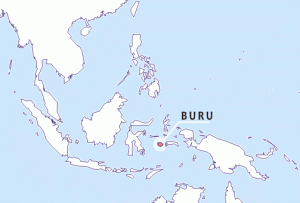
Toer (1925-2006) spent quite a bit of his life as a political prisoner and, in fact, this novel was first told orally to co-inmates in 1973 when he was imprisoned on the Buru Island penal settlement. He was first imprisoned (1947-1949) by the Dutch government after an anti British and Dutch revolution, and then later by the Indonesian government, first in 1963 when he supported Chinese minorities, and then after a military coup in 1965.  On this third occasion, he was imprisoned until 1979, though after that was essentially kept under house arrest until 2002. The first two novels were published in 1979/1980, and were translated into English in 1981 by Australian diplomat in Indonesia, Max Lane, who was recalled to Australia that same year as a result. Clearly, the Indonesian government was not amused. Indeed, the books were banned by that government in 1981.


From Wikipedia, under GNU Free Documentation License

From Wikipedia, under GNU Free Documentation License

This earth of mankind is set in 1898, and provides a fascinating look at colonial life in Indonesia at that time. It tells the story of a Native, the only one to attend an elite school. Being a Native he has no formal name, and so throughout he is called several names – Sinyo or Nyo, Gus, and most commonly Minke. Early in the novel, he is introduced to a succesful concubine Nyai Ontosoroh and her beautiful daughter, Annelies, and is gradually drawn into their lives. The novel follows his – and their – fortunes as the colonial authority does its best to see that a Native does not rise above his station. Life turns out to be a paradoxical one for Minke – on the one hand his education teaches him to think and argue and believe that all things are possible while on the other hand the colonial structure, within which he lives, works to ensure that little is possible.

The novel is peopled with a wide range of characters of various ethnic backgrounds – primarily Dutch, Indo (people with Dutch and Native parentage), and Natives, but also French and Chinese. This ensures that the strictly enforced layer of colonially-decided rights is set against a wide variety of political and personal opinions and provides the reader with an excellent insight into a complex society. This is perhaps also the cause of its main flaw because it is, at heart, an ideological novel. And, like many ideological novels, characters and plots are simplified and exaggerated to make the point. So, in simple terms the story can be seen as poor clever boy meets rich powerful concubine and falls in love with her beautiful but weak daughter only to be crossed by the wicked brother. The story has a melodramatic edge and there’s not a lot of complexity – of greys – to the characters. They are there to serve a purpose.

That said, it is a rivetting read. Told, first person, in Minke’s voice, the novel immediately engages us with him and his situation. He is, in fact, a little more rounded than the others: we get a sense of his uncertainty as he makes his various decisions throughout the book. This is largely because it is also a coming-of-age novel: paralleling the ideological issues underpinning the novel is the story of Minke’s emotional, social and intellectual development. A major thread is that of education and what can (should) be expected of an educated person. Early in the novel his “mentor”, the French artist, Jean Marais, tells him:

You’re educated Minke. An educated person must learn to act justly, beginning first of all with his thoughts, then later in his deeds. That is what it means to be educated.

This advice underpins Minke’s thought and actions from that point on: at each test or decision point he tries to apply his education.  There’s bitter irony here though because it is the source of that education – Europe – that causes his major problems at the end. As Minke is fast learning, you have to be strong to survive.

There’s a lot more that can be teased out in this book – including the role played by language in controlling and enforcing power and status – but rather than ramble on, I will end with the words of Minke’s favourite teacher, Magda Peters. She says:

…without a love of literature, you’ll remain just a lot of clever animals

It is not surprising then that Minke, Toer’s alter ego in this book, becomes a writer!

(Translated by Max Lane)