Well, my record for 2019’s Six Degrees of Separation meme continues, that is, I still haven’t read a starting book! By comparison, last year I’d read three of the first five (which may have been a record in the opposite direction!) However, I have always read the books in my chain. And now before I share my chain, the formalities, which are simple: if you don’t know the rules of the meme, please click on meme leader Kate’s blog name – booksaremyfavouriteandbest – and you will find them.
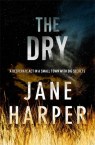 So, this month’s starting book is Jane Harper’s The dry, a book which got her career off to a rip-roaring start, and that’s been followed by two more, Force of nature and The lost man. These are all in the crime genre, I believe, which is not a genre I gravitate to.
 There are some books that “everyone” reads, but that I don’t, for various reasons, usually to do with genre. Occasionally though, something happens to change my mind. This may happen one day with The Dry, but for today’s post, I’m choosing Vicki Laveau-Harvie’s The erratics (my review), which won this year’s Stella Prize. It had not been on my TBR list, but winning the prize tipped it over … and, of course, I’m glad it did.
 Now, The erratics was written by an Australian-based writer who was born in Canada. Another memoir written by an Australian-based writer who was born elsewhere (this time, England) is Emma (now Eddie) Ayres’ Cadence: Travels with music (my review). This is a travel memoir in which Ayres cycled from England to Hong Kong with her violin.
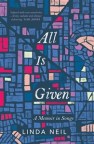 Sticking with memoirs, though I promise we’ll leave them soon, I’m choosing another travel memoir with a music focus, Linda Neil’s All is given: A memoir in songs (my review). Neil describes her travels in the usual and unusual places, the songs she wrote and how music helped her make connections she may never have made otherwise.
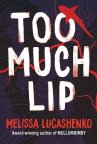 And now, finally, we move onto fiction! Neil’s book came to me as a review copy from the wonderful UQP (the University of Queensland Press). The most recent book I reviewed from them is Melissa Lucashenko’s Too much lip (my review). It’s another excellent book from UQP, which has a marvellous track record in publishing indigenous Australian writers.
 Oh, oh! I’m back to memoirs! You would think from this post that memoirs comprise the bulk of my reading! Not so. Just under 8% of my reviews are for memoirs. ‘Nuff said? Now, on with the chain … Lucashenko is the most recent indigenous Australian author I’ve read and reviewed. The first book by an indigenous Australian author that I read for my blog was Boori Monty Pryor’s Maybe tomorrow (my review), in June 2009, just one month into my blog.
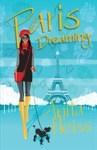 Boori Monty Pryor was an author ambassador in Australia’s 2012 National Year of Reading program. Many authors from around Australia were nominated as ambassadors, but I’m going to end this chain on another indigenous Australian author who was one of these ambassadors, Anita Heiss. You’ll be pleased to know, however, that although I’ve read a memoir by her, one that came out in 2012 no less, I’m going to choose her novel, Paris dreaming (my review), because I heard her speak about it at the Canberra Readers Festival in 2012. Fair enough?
Hmmm … we’ve been everywhere this month, starting in Canada, then travelling all over the globe with Ayres and Neil, before landing in Australia, albeit ending on a foray to Paris with the Aussie protagonist of our last book. And for those who like chains to end in circles, you may like to know that the author of my opening book, The erratics, lived in France, before moving to Australia!
… over to you: Have you read The dry? And, regardless, what would you link to?




















 Whispering Gums