Delicious descriptions: Richard Flanagan on Poetry

In my review of Richard Flanagan’s The narrow road to the deep north I talked a little about the importance of poetry to some of the main characters. I can’t resist sharing just a little more on this topic.

This is Dorrigo thinking, at the end of his life, though he doesn’t know just how near it is at the time:

He felt the withering of something, the way risk was increasingly evaluated and, as much as possible, eliminated, replaced with a bland new world where the viewing of food preparation would be felt to be more moving that the reading of poetry; where excitement would come from paying for a soup made out of foraged grass. He had eaten foraged grass in the camps; he preferred food. The Australia that took refuge in his head was mapped with the stories of the dead; the Australia of the living he found an ever stranger country.

Dorrigo Evans had grown up in an age when a life could be conceived and lived in the image of poetry, or, as it was increasingly with him, the shadow of a single poem. If the coming of television and with it the attendant idea of celebrity – who were otherwise people, Dorrigo felt, you would not wish to know – ended that age, it also occasionally fed on it, finding in the clarity of those who ordered their lives in accordance with the elegant mystery of poetry a suitable subject for imagery largely devoid of thought.

I was thrilled when I read that Dorrigo, who was born around 1913, had “grown up in an age when a life could be conceived and lived in the image of poetry”. It reminded me of my recent observation that poetry seems to have played a more significant role in people’s lives back in the 1920s than now. So, for Dorrigo, poetry is what he turns to for sustenance, for meaning or explanation, in his life. He says at one point that he can sleep without a woman, but he can’t sleep without a book. I love the idea of a world where poetry is widely known, loved and referred to.

Anyhow, here is Nakamura, dying of cancer, thinking about “goodness”:

He told himself that, through his service of this cosmic goodness, he had discovered he was not one man but many, that he could do the most terrible things he might otherwise have thought were evil if he had not known that they were in the service of the ultimate goodness. For he loved poetry above all, and the Emperor was a poem of one word — perhaps, he thought, the greatest poem — a poem that encompassed the universe and transcended all morality and all suffering. And like all great art, it was beyond good and evil.

Yet somehow — in a way he tried not to dwell upon — this poem has become horror, monsters and corpses. And he knew he had discovered in himself an almost inexhaustible capacity to stifle pity, to be playful with cruelty in a way that he found frankly pleasurable, for no single human life could be worth anything next to this cosmic goodness. For a moment, as he was being eaten by Tomokawa’s* oppressive armchair, he wondered: what if this had all been a mask for the most terrible evil.

The idea was too horrific to hold on to. In an increasingly rare moment of lucidity, Nakamura realised what was imminent was a battle not between life and death in his body, but between his dream of himself as a good man and this nightmare of ice monsters and crawling corpses. And with the same iron will that has served him so well in the Siamese jungle, in the ruins of the Shinjuku Rashomon and at the Blood Bank of Japan, he resolved that he must henceforth conceive of his life’s work as that of a good man.

Nakamura, as I said in my review, saw poetry as portraying “Japanese spirit” and it helped him justify his actions as commander of the camp. After the war, he gradually started to question his actions, but here at the very end of his life he wants, needs in fact, to see himself as a good man. And by force of will he does so, enabling him to choose as his death poem one which concludes with “clear is my heart”.

I love the idea of choosing your own death poem – and think I’ll start thinking about mine. What about you?

* He’s visiting Tomokawa, who had been one of his corporals on the Railway.

Monday musings on Australian literature: Poetry awards

Over recent months, I’ve devoted several Monday Musings to exploring various Australian literary festivals and awards. I was inspired to write this one on poetry awards by two things. The first is that during my recent exploration of Australian literature in the first few decades of the 20th century, and particularly of the 1927 plebiscite conducted of Argus readers in Melbourne in 1927, I became aware that as much if not more of the discussions about the results focused on the poets. It seems – but of course, my research is somewhat serendipitous – that poetry played a greater role in literary (and perhaps ordinary) life then, than it does now. I’d love to hear what others think – or know – about this (in Australia or their other countries).

And then, following close on the heels of my these ponderings, I received an email from Five Islands Press announcing their new poetry award, the Ron Pretty Poetry Prize, and asking me to spread the word through my blog. Now, my problem is that while I’m a big supporter of Australian literature, I don’t see myself as part of a formal publicity machine. I want to maintain some level of independence. However, given my recent thoughts about poetry in Australia and the fact that I haven’t yet written on poetry awards, I decided I could include this prize in a Monday Musings post on these awards. Make sense? I hope so!

The interesting thing about poetry prizes in Australia is that many of them are named for poets – far more so than the other specialised literary awards. I wonder why this is? Like other awards, though, they vary in their establishment and management, some being part of larger awards such as premier’s literary awards, some sponsored by writers’ organisations or festivals, and some by magazines or publishers.

I’m structuring this post a little differently to my other awards posts because they can be logically divided into fairly distinct categories. As always, of course, the list comprises just a selection. Here goes:

Lifetime achievement award

The best-known (and perhaps only) award in this category is the Christopher Brennan Award which is given annually to “a poet who has written work of sustained quality and distinction”. It is administered by the Fellowship of Australian Writers (Victoria), and has been awarded since 1974. The award is a plaque, rather than money. Previous winners include the big names of modern Australian poetry, such as Judith Wright, Les Murray, Bruce Dawe, Dorothy Porter and Geoff Page, some of whom I’ve reviewed on this blog.

Awards for poetry in book form

(Presumed Public Domain, via Wikipedia)

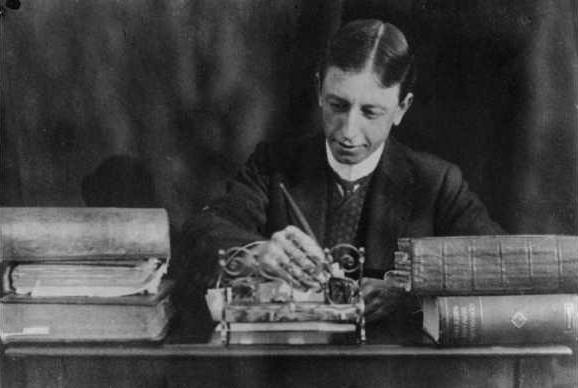
CJ Dennis, ca 1890s (Presumed Public Domain, via Wikipedia)

Some awards are made for individual poems (see below) while others are for poetry collections, or long poems that are published in book form. These awards include:

  • Anne Elder Award for a first book of poetry: established in 1977 and administered by FAW (Vic). The prize is currently $1,000.
  • CJ Dennis Prize for Poetry (part of the Victorian Premier’s Literary Awards): established in 1985. The prize is currently a cool $25,000.
  • Grace Leven Prize for Poetry for a volume of poetry by an Australian writer or a naturalised Australian of at least 10 years’ residence: established in 1947, so is one of the oldest awards. Its monetary prize is small, but it’s apparently highly regarded by poets and has been won by many of Australia’s best known poets.

Awards for poetry, limited by length

  • Gwen Harwood Poetry Prize for a single poem or “linked suite of poems” of up to 80 lines: established in 1996 and administered by Island Magazine. First prize is currently $2000, with two prizes of $500 able to be awarded at the judges’ discretion.
  • Peter Porter Poetry Prize for a poem of up to 100 lines: established by ABR (Australian Book Review) in 2005, and renamed to honour Peter Porter in 2010. There is a cash prize and publication in the ABR.
  • Ron Pretty Poetry Prize for a single poem of up to 30 lines, not limited by nationality: established in 2014 by Five Islands Press in the name of its founder, the poet Ron Pretty. The inaugural prize will be $5,000. There is an entry fee, and submissions are made online.

Awards for unpublished poetry

  • Thomas Shapcott Poetry Prize for an unpublished manuscript by a Queensland author: established in 2003 by Arts Queensland. The prize is currently $3,000 plus a publishing contract with UQP.
  • Val Vallis Award for an Unpublished Poem for a poem or suite of poems of up to 100 lines by an Australian writer: established around 2000 by Arts Queensland. The first prize is  $1,000, one week at the Writers’ Retreat at Varuna, and publication in Cordite Poetry Review.

And something a little different

Rather different to the above awards, and others of their ilk, is the Vincent Buckley Poetry Prize. It is a biennial award that is offered alternately to enable an Australian poet to visit Ireland and to facilitate the visit of an Irish poet to Melbourne. Interesting, huh? Established in 1992, it commemorates the life and work of Buckley who was a poet, critic and Professor of English at the University of Melbourne and who loved both Australian and Irish poetry. The prize includes a return airfare, a contribution towards living expenses and an honorary fellowship at the University of Melbourne. The winner in 2002 was Cate Kennedy, well-known for her short stories and, as I’ve discovered, her poetry. She has also won the CJ Dennis Prize for Poetry.

More awards are listed at Wikipedia. It’s not complete either, but it’s a start.

Monday musings on Australian literature: Red Room Poetry Object Competition 2014

Just a quick Monday Musings today but an interesting one I hope.

Red Room Poetry Object is a poetry-writing competition for Australian students in Years 3-10. It was created by The Red Room Company, which is a not-for-profit organisation that was established in 2003. It apparently grew out of the Red Room Radio Show. The company’s aim is to create “unusual and useful poetry projects which transform expectations of, and experiences with, poetry.” They want to make poetry more accessible,  especially to “those who face the greatest barriers to creative opportunities”. They run a wide variety of, mostly, public poetry projects of which the Red Room Poetry Object is just one.

The Red Room Poetry Object was first held, I think, in 2013. It involves young writers and their teachers submitting poems of 20 lines or less about objects that are special to them. What a great idea – it provides some level of structure and framework, while being very open as well. According to the website, the 2013 project involved 72 schools from Australia and New Zealand, and they published 1200 poems by students and teachers. You can read the students’ poems here. The winning poems were exhibited from November 2013 to February 2014 at Customs House in Sydney. Submissions for this year’s project are now open, and poems can be submitted until 19 September.

Can this Snow Gum in the Snowy Mountains be my object?

Can this spirit-moving Snow Gum in the Snowy Mountains be my object?

While, formally, a “talismanic object” is “an object that brings a person protection or good luck” (like coins, a ring or other piece of jewellery), for this project Red Room is looking for objects that are special to individual people, objects that “may not be worth anything to anybody else”,  that may only be precious or important to the writer (like a favourite teddy bear). The winning Secondary Student poem last year was “My book” while the winning Primary Student poem was “Nitro car”. It’s just ten lines, and concludes:

You have an engine in your head,
and wheels in your shoes
that’s why I love you.

(James, Year 6, Holy Saviour School, NSW, Winning Student Poem (Primary), 2013)

“Making the objects sing in a new way” is how one judge apparently described it.

The teacher’s resource book includes exercises for handing out to students. I particularly like the one on “Overcoming clichés and using specific imagery”. It encourages students to think of a clichéd image, such as “as blue as XXX” and to then replace it with a more apposite image. I was only thinking about clichés the other day, about the struggle to find fresh words to use in reviews. So hard … I think I’ll go off now and have a go at that exercise …

PS the Red Room Company ran an event at the Sydney Writers’ Festival this year, the culmination of a project, which received funding from the Australia Council, and which they coordinated with ARTAND Australia.


Wrapping in the rain

Mr Gums and I spent last weekend in the lovely historic town of Beechworth staying with two other couples in the gorgeous 1890s Indigo Cottage (owned by one of the couples). Quite coincidentally, we discovered that this weekend was Beechworth’s WRAP Festival. That’s Writers, Readers and Poets, an annual event that has been sponsored by the Beechworth Arts Council since 2011.

Amy Brown

Amy Brown

Of course, some of us wanted to check it out. I didn’t manage to get to sessions with Tony Birch, author of the Miles Franklin short-listed novel Blood. However, Eric, of Canberra Jazz blog, and I did get along to Poetry at the Post Office where, under umbrellas protecting us from the welcome drizzle, we heard several, mostly local poets read from their work.

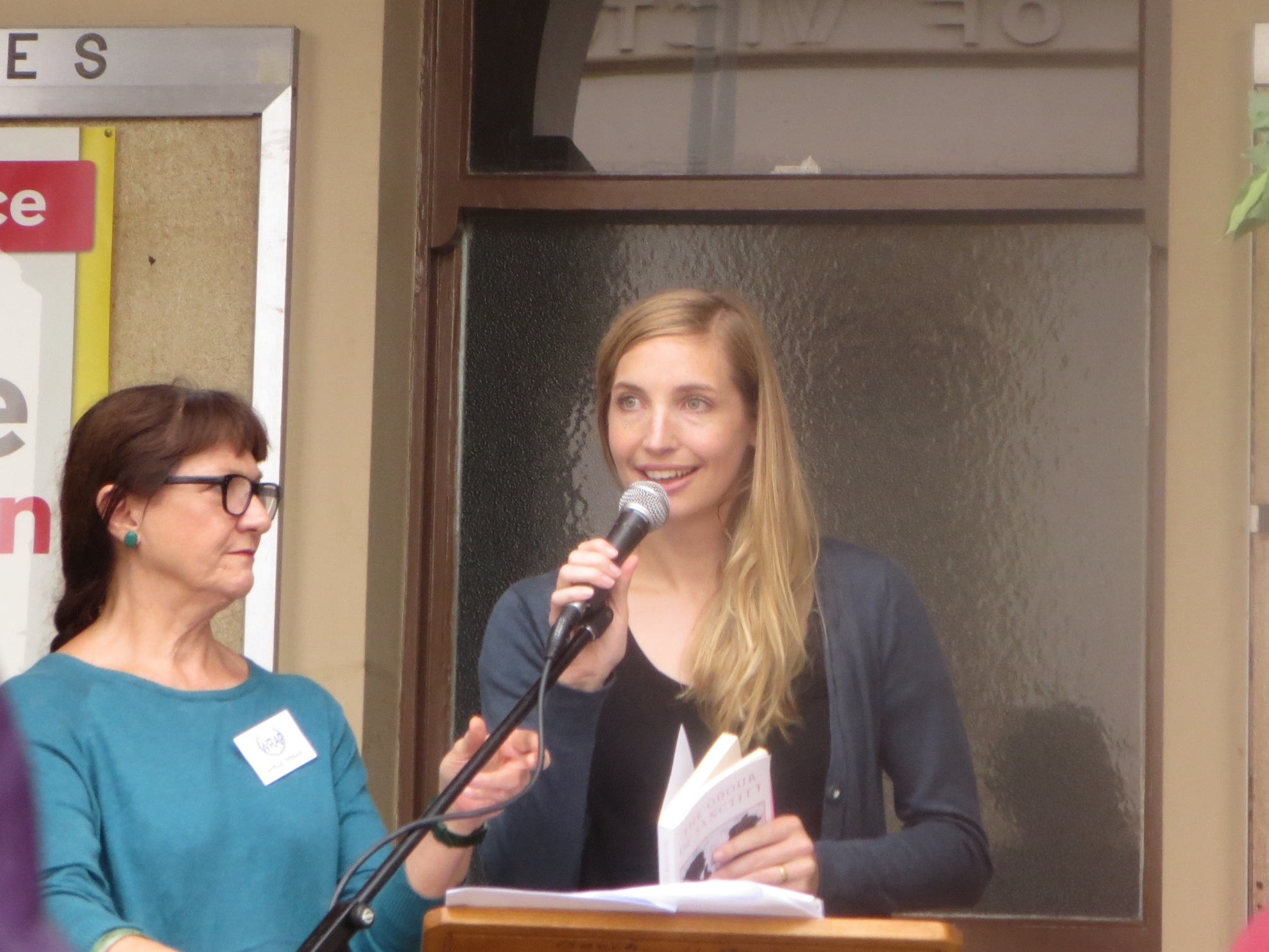
They were a varied bunch, some more experienced readers than others, but they all gave us something to think about, from Geoff Galbraith’s political pleas to Lisa Ride’s satires on modern living, from Jean Memery’s tribute to janitors to Amy Brown’s moving poem in the voice of the infant saint Rumwold from her epic poem, The odour of sanctity (published by New Zealand’s Victoria University Press). The odour of sanctity sounds intriguing. She explores “six candidates for sainthood” from the 300s to the 1990s. What a fascinating topic! Anyhow, the session was relaxed, nicely em-ceed by Estelle Paterson, and showed what a local Arts Council can do to support and encourage literature in country towns.

Eric, who juggled note-taking in the rain better than I, has written up the event in more detail on his blog – with photos. Do check it out. Thanks Eric for doing the write up and for standing in the rain with me!

Poetry at the Gods … with Les Murray

What can I say but that it was wonderful to be in the presence of the man who is arguably Australia’s greatest living poet, Les Murray. Poetry at the Gods is a monthly event which has been run for many years by local poet Geoff Page*. (The Gods is a cafe-bar attached to the Australian National University’s Arts Centre.) I have only managed to get to a few readings over the years but, having had to miss Murray in the past, I was darned sure I was going to make it this time. Not only did I get there, but I got my copy of his Selected poems (Black Inc, 2007) signed. Woo hoo!

Before continuing, I should briefly explain Murray for non-Australians who may not have heard of him. His career has spanned over forty years. He has won multiple awards, has published many volumes of poetry (not to mention verse novels and prose works), is on the National Trust of Australia’s 100 Living Treasures, and is often spoken of, here at least, as a Nobel Laureate contender. I must admit that I don’t always get his poetry – but I enjoy the challenge. That’s poetry isn’t it?

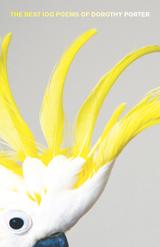
Les Murray, Best 100 poems

Courtesy: Black Inc

Now to the evening. Murray read in two “sets” both lasting around 30 minutes. The first set comprised unpublished (I believe he said) poems written in recent years, while the second came from The best 100 poems of Les Murray published by Black Inc in 2012. (I am currently reading their Best 100 poems of Dorothy Porter).

I’m afraid I can’t tell you much about the reading. As much as I love attending poetry readings, because it is special to hear poets read their own poems, I find it hard to report on them. No sooner is one poem read, than the next one starts. It’s impossible – for me anyhow – to process the poems and say something meaningful about them as a whole. I will however make a few scattered observations.

I’m not sure how much Murray, now 75 years old, had planned in advance what he was going to read, but it looked pretty impromptu. In both “sets” he simply (simply?) flicked through the book he was reading from and chose poems he seemed to feel like reading. Sometimes he provided a few words of introduction to the poem, sometimes he didn’t. Sometimes he gave a little chuckle before or after, and sometimes he didn’t! In the first half, the poems ranged across such diverse subjects  as an apartment block in Beijing, English as a second language, and the challenge of writing haiku. I wish I had them before me. The variety spoke to an active, curious mind, to the poet’s ability to draw something beautiful, meaningful, from pretty well anything, which is what we want our poets to do, isn’t it? Oh, for such a mind.

In his second set, he read some poems that I do have before me, poems such as “The future”, “Postcard”, Lyrebird” and “Dead trees in the dam”. One that has stuck in my memory is the poem about his son who has autism. Titled “It allows a portrait in line scan at fifteen”, it was written when his son was fifteen, and perfectly conveys what I understand to be the experience of living with autism:

Giggling, he climbs all over the dim Freudian
psychiatrist who told us how autism resulted
from refrigerator parents

The poem conveys the split between the person and “it”, the condition. There’s humour, frustration and anger, as much the son’s as the parents’. Murray conveys the fascination with facts and rules, the focus on objectivity, the prodigious memory, that can be typical of autism. The final lines are heart-rending:

He surfs, bowls, walks for miles. For many years
he hasn’t trailed his left arm while
running.
I gotta get smart! looking terrified into the
years. I gotta get smart.

Religion is important to Murray. In fact, the two books of his that I have are dedicated “To the glory of God”. However, his poems are not, overall, self-consciously religious, are not dogmatic but many are informed by a faith in and an understanding of religion. In this context and as one who likes thinking about words and truths, I enjoyed poem “Poetry and Religion”. Here are the opening lines:

Religions are poems. They concert
our daylight and dreaming mind, our
emotions, instinct, breath and native gesture

into the only whole thinking: poetry.
Nothing’s said until it’s dreamed out in words
and nothing’s true that figures in words only.

And that, I think, is as good a place as any to end on, don’t you think?

*I’ve reviewed his verse novel The scarring.

Lesley Lebkowicz, The Petrov poems (Review)

Canberra poet Lesley Lebkowicz has made a couple of brief appearances in my blog: first in my post on The invisible thread anthology, and then when she won this year’s ACT Poetry Award. I was consequently more than happy to accept for review her latest book, The Petrov poems.

English: Evdokia Petrova at Mascot Airport, Sy...

Evdokia being escorted by two Russian diplomatic couriers to a plane at Mascot Airport, Sydney (Presumed Public Domain, from NAA, via Wikipedia)

It’s intriguing that nearly 60 years after the events, we are still interested in the Petrovs. In fact, I have written about them before, in my review of Andrew Croome’s historical novel, Document Z. Most Australians will know who they are, but for those global readers here who don’t, the Petrovs were a Russian couple who worked at the Soviet Embassy in Canberra in the early 1950s. Vladimir (Volodya), Third Secretary, and his wife Evdokia (Dusya) were both Soviet intelligence officers (or, to put it baldly, spies). They defected in 1954. The defection was particularly interesting because Vladimir defected first, and Evdokia two weeks later at the airport in Darwin after some dramatic scenes at Sydney’s Mascot airport.

At first glance, The Petrov poems looks like a collection of poems but in fact it is a verse novel, albeit one comprising many short individually-titled poems. These poems are organised into four “chapters”: Part 1, Volodya defects; Part 2, Dusya defects; Part 3, The Petrovs at Palm Beach; and Part 4, The Petrovs in Melbourne.

I must admit that I wondered, initially, why Lebkowicz had decided to write about the Petrovs, given that they have already been picked over in novels, non-fiction, theatre, and television. But, as soon as I started reading it, I could see why. Lebkowicz gets into the heart of these two characters, bringing them back to ordinary human beings who were caught up in something that was both of and not of their own making. It is a rather pathetic story. There are no heroes here – and yet, as happens with these sorts of things, it captured the world’s attention for a short time.

Now, before I comment specifically on this book, I’d like to quote another Canberra poet Paul Hetherington from an interview with Nigel Featherstone in the online literary journal Verity La:

One of the ways I recognise the poetic is when I find works in which language is condensed, ramifying, polysemous and unparaphraseable. Part of what I wish to do when writing poems is to make works that speak in such ways – but to do so without resorting to any kind of trickery or artificial obscurity.

While I wouldn’t use words like “ramifying” and “polysemous”, and while we can paraphrase the ideas to a degree, this is pretty much what Lebkowicz achieves in The Petrov poems. In just 80 pages or so she manages to not only tell the story of their lives but get to the nub of their hearts and psyches – as much, anyhow, as anyone can do for another person. We learn that Volodya is not succeeding at spying:

He wants to succeed but stumbles. Failure
follows him like iron torn from a roof and
rattled along the wind.
(from “Glass I”)

We learn that he loves Dusya (“Dusya is his place in the world”), but that he loves booze, his dog and prostitutes more. He seems weak, but he’s a man struggling. With Stalin’s death and the arrest of his boss, he fears reprisals when he returns to Moscow. Here he is at the moment of defecting (which he does, after disagreements on the subject, without telling Dusya):

Once again he’s going to be wrenched from the soil.
He remembers his father – struck by lightning, buried up to his neck
by foolish men, and dying in the freezing night.
Then chaos and not enough food. Uprooting a full-grown plant
is no easy thing: so many roots
are wound through the earth. He mutters the Russian words
for sadness and home and ruffles his Alsatian’s fur.
(from “Loss”)

Dusya, on the other hand, is a stronger character, but she has suffered severe losses in her life, including her first love and her daughter:

This is something Dusya does not allow herself to think: how her
life might have been if Romàn had not been arrested. […]
If she had gone on taking happiness for granted. Living with
Romàn had been like walking along a winter street and arriving
in a field of warm poppies. If Romàn had not been broken in a
labour camp. If Irina had not died –
(from Romàn I)

While she understands Volodya’s fear, she fears even more what might happen to her family if she defects. At Darwin airport she doesn’t want to make a decision: “If only/this government man would abduct her”. But of course he can’t.

We then watch them as their relationship falters, first during ASIO’s interrogation, and then the years of living together in Melbourne, officially in disguise but known nonetheless. (“The whole street knows they are Petrovs -/too many photos, too much publicity”).

While I’m not a Petrov expert, I’ve read enough to feel that Lebokowicz’s interpretation is authentic. She explores what happens when the political interferes with the personal; she recognises the pull of culture and the despair that losing one’s home can engender; and she sees that corruption is not confined to communism:

so when ASIO falsifies (No! Not falsifies
amends, adjusts, even corrects) the documents
he brought from the Embassy – of course he assents
(from “Bones”)

Australian Women Writers ChallengeThese are wonderful, readable poems. They are poetic but, to quote Paul Hetherington’s goal, without “trickery” and “artificial obscurity”. The imagery is strong but clear. I particularly liked the way Lebkowicz varies and plays with form. None of it is rhymed, but there are sonnets, couplets, poems with multi-line stanzas but closing on a single dramatic line, and others. There are poems with short lines or terse rhythms, indicating action or stress, and poems with long lines conveying thoughts and reflections. There is also a shape-poem, “Torment”, in which the zigzag shape mirrors Dusya’s distress (“Her life is a staircase that switches directions”).

Like any good historical fiction – if a verse novel can be called that – you don’t need to know the history to understand the story told here. And like any good historical fiction writer, Lebkowicz has produced something that enables us to reconsider an historical event from another perspective and to understand the humanity below the surface of the facts. An excellent and moving read.

Lesley Lebkowicz
The Petrov poems
Sydney: Pitt Street Poetry, 2013
95pp.
ISBN: 9781922080141

(Review copy supplied by Zeitgeist Media Group)

Two under-the-radar Australian literary awards announced

A couple of lesser known – but significant to me – literary awards were announced over the last week or so, one national and the other local. I’d like to tell you about them!

ALS Gold Medal 2013

The ALS Gold Medal is awarded by the Association for the Study of Australian Literature. It doesn’t usually get a lot of publicity, partly I suspect because it doesn’t carry a large purse but, rather, well, a gold medal! It is ” awarded annually for an outstanding literary work in the preceding calendar year”. Last year it was won by Gillian MearsFoal’s bread (my review), which also won the Prime Minister’s Literary Award (for Fiction). This year the medal was won by Michelle de Kretser’s Questions of travel, which also won, in May, the Miles Franklin Award. It’s my next read – and I can’t wait. The judges said:

Questions of Travel embarks on an exploration of the present and emerging conditions of late modernity on a scale that could only be successfully achieved by a highly accomplished writer. Through her two central characters, Australian woman, Laura, and Sri Lankan man, Ravi, De Kretser creates an expansive fictional space that both traverses continents while never losing sight of the separateness of individual lives defined by their especial relationships to place and culture, new and old. (AustLit News)

It was selected from a shortlist of five, which included books that haven’t been appearing on many other shortlists: Jessie Cole’s Darkness on the Edge of Town, Robert Drewe‘s Montebello, Christopher Koch‘s Lost Voices and P.A. O’Reilly’s The Fine Colour of Rust.

For reviews of these books, please check out Lisa at ANZLitLovers who’s already read them all!

ACT Poetry Prize 2013

I don’t often report on poetry prizes, and particularly not on local ones, but given my focus on Canberra’s Centenary this year, I figured why not. And, anyhow, I like the winning and shortlisted poems. There were apparently 128 entries, and they were judged by a blind panel of local poets, two male, one female.

The winning poem (and you can read it and the two shortlisted ones online) is “Inside” by Lesley Lebkowicz, whom I only really discovered this year through her short story about her immigrant parents,”The good shoppers”, in The invisible thread. “Inside” is about that invisible disease that afflicts women, osteoporosis, about living with something “inside”. Interestingly, this is also what “The good shoppers” is about, though what the characters are living with inside in that story is their experience of the Holocaust. “Inside” is a short poem, just 15 lines. Its language is accessible and evocative

Inside her, bone sheared off from itself like
limestone in a private landslide – and she fell.

But just when you think that’s all there is, you get the ending. It adds another layer to the story. Read it (using the link in the first line of this para).

The two shortlisted poems are also by women – Libby Porter (“Stabat Mater”, a bittersweet poem about loss, framed through perspectives on age) and Elizabeth Lawson (“Emily Kngwarreye”, a wry poem about indigenous versus non-indigenous attitudes to art). You can read them too at the link.

Canberra is, I think, blessed to have such excellent poets.

On the literary road: Gundagai Redux

20130509-154945.jpgGundagai, a small country town only two hours drive from my home, was the first place featured in my first literary road post back in 2009. I didn’t on that occasion write about its early history.

The Gundagai area was home to the Wiradjuri people, and was settled by white people in the late 1820s. It was officially gazetted in 1840 despite repeated warnings by the Wiradjuri about the risk of large floods to this part of the Murrumbidgee River floodplain.

According to the Poet’s Recall Motel, Gundagai’s first streets were named for poets: Shakespeare Tce, Milton St, Pope St, Johnson St, Maturin St, Landon St., Hemans St, Sheridan St, Otway St, Byron St, Homer St, Virgil St, and Ovid St. However, believe it or not, the Wiradjuri knew their country and in 1852 a huge flood destroyed the town. Over one third of the 250 inhabitants and a number of travellers died, and 71 buildings were destroyed. The old mill is the only building still standing from the original town. As for the poets, when the town was rebuilt, on higher ground, the poet street names, according to the Motel’s notes, were not reused. However, looking at a modern street map of Gundagai, I did spy Sheridan, Homer, Byron Streets, plus a reference to Ovid Lane and the other poets. Presumably these have been returned to the town in more recent times.

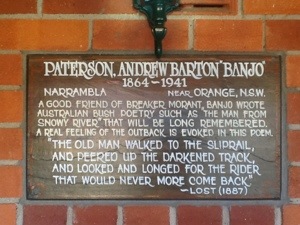
Anyhow, this is where the Poet’s Recall Motel comes in. The owner – I’m not sure when – decided to revive Gundagai’s poetic history. Each motel room is named for a poet – the original 13 and then some. I was rather delighted to find that our room was Banjo Paterson, and the two rooms next to us were Henry Lawson and Breaker Morant. Fine room-mates for Whispering Gums! In addition, the historic bar in the motel’s restaurant is decorated with painted portraits – on local slate – of the original 13 poets.

Once again I’ve learnt that country towns can be surprising places … I don’t imagine I would ever have heard of Felicia Hemans, who was published in the early nineteenth century by John Murray, Jane Austen’s publisher, if I hadn’t stayed at the Poet’s Recall Motel.

Autumn and a favourite poem

Autumn Leaves

Autumn leaves

I was lying in front of a sunny window reading my current novel this afternoon when an urge came upon me to write about one of my favourite poems. It’s one of the few I can recite from heart. The poem is “Spring and Fall” by Gerard Manley Hopkins, and it goes like this:

To a young child

Margaret, are you grieving
Over Goldengrove unleaving?
Leaves, like the things of man, you
With your fresh thoughts care for, can you?
Ah! as the heart grows older
It will come to such sights colder
By and by, nor spare a sigh
Though worlds of wanwood leafmeal lie;
And yet you will weep and know why.
Now no matter, child, the name:
Sorrow’s springs are the same.
Nor mouth had, no nor mind, expressed
What héart héard of, ghóst guéssed:
It is the blight man was born for,
It is Margaret you mourn for.

Spring and Fall Quilt, 1985

Spring and Fall Small Quilt, 1985

Now, I know you Northern Hemisphere people are enjoying spring and looking forward to the lazy, hazy, crazy days of summer, but down here in the south it is autumn which is, for me and I suspect many of us, a bittersweet time. Sweet because the weather is usually mild and stable, and the light soft and warm, but bitter because there’s a chill in the air, the days are shortening and the frosts are coming. It is for this paradox – and its implications, its recognition of our mortality – that I love Hopkins’ “Spring and Fall”.

What I love about this poem is what I love about Hopkins in general. Firstly there’s his heart that is so openly on show in all his poems, both the religious crisis poems and the ones about life and nature. Then there’s the tone, which is, in this poem, rather melancholic. After all, he is telling the child, Margaret, that what she’s really grieving for, though she’s unaware of it now, is her own mortality. I also love his rhythm (which he called “sprung rhythm“) and how in this poem there’s a jolt towards the end when he makes his main point.  And associated with this, the rhyme, which is appropriately simple here for a poem addressed to a child. But most of all, I love his language, particularly his imagery and the neologisms (like “wanwood leafmeal”). Or, perhaps, not quite most of all … I think most of all I love the way the language so perfectly matches the heart.

The older I get, the more I understand and love this poem!

Do you have poems that come back to you again and again at different points in your life?

Monday musings on Australian literature: Capital women poets

Since Australia’s capital, Canberra, is celebrating its centenary in 2013, it seems timely to devote a few Monday Musings posts – scattered throughout the year – to its literature. Comparatively speaking, Canberra is a small city, but it is rich in poets, past and present, female and male, so I’ve decided to make my first topic Canberra’s women poets. I’ll write, as I usually do in these sorts of posts, about a representative few. They all appear in The invisible thread, Canberra’s centenary anthology about which I’ve written before.

Judith Wright (1915-2000)

Australian high country (Mt Stilwell)

Australian high country (Mt Stilwell)

Wright spent the last 28 years of her life in the wider Canberra region, and is arguably Canberra’s best known woman poet. She was a prolific writer, and a committed environmentalist and Aboriginal rights activist. Her poetry ranges over a huge range of subjects from the bush, birds and nature, through life and relationships, to all sorts of social justice and political issues. Like her contemporary Patrick White, she was not afraid to speak out about the issues that concerned her. As pretty well every biography reports, she took part in an Aboriginal Reconciliation March in Canberra not long before she died at the age of 85.  Several of her poems, including “Bullocky”, “Woman to man”, and “South of my days”,  are anthology standards. A self-confessed lover of our bush, I adore this from “South of my days”:

low trees, blue-leaved and olive, outcropping granite-
clean, lean, hungry country. …

I also like the lesser known (to me, anyhow) poem selected for The invisible thread, “Counting in sevens”, in which she counts off her years in, yes, sevens:

Seven threes are twenty-one.
I was sailing my own sea,
first in love, the knots undone.

Rosemary Dobson (1920-2012)

Another grand dame of Australian poetry, and also a prolific one, Dobson moved to Canberra in 1971 with her husband Alec Bolton. I’ve written about them before in my Literary Couples post. Like Wright, she turned her hand to many forms of writing and also worked as an editor. Both women knew that to make a career out of writing, you wrote … but in Dobson’s case she also translated – Russian poetry! I quoted a couple of her poems in the post I wrote after her death, including the one she wrote to/for Christina Stead. The poem from which I’ll quote here, though, is the intriguing “Child with a Cockatoo” in which a child, sitting for a painting by Simon Verelst in a time before the discovery of Australia, is given a sulphur-crested cockatoo, presaging Europe’s future contact with the southern land:

That sulphur-crested bird with great white wings,
The wise, harsh bird – as old and wise as Time
Whose well-dark eyes the wonder kept and closed.

Susan Hampton (b. 1949)

I must say I know Susan Hampton more as the editor, with Kate Llewellyn, of The Penguin book of Australian women poets, than as a Canberra-based poet, but I’ve discovered that she’s lived in Canberra since 1993. Her poems, from what I’ve seen, tend to be personal with a witty, whimsical or poignant edge, such as this one about “Hands” which starts

for some reason are battered and speckled,
the claws of an old hen poke through the skin.
I stare at my hands the way Escher
makes you stare at his …

I know the feeling … and isn’t that partly what poetry is about?

Melinda Smith

Now Smith, who has been in Canberra, on and off apparently, since 1989, is new to me, but I do love her cheeky poem in The invisible thread. It’s titled “No bed” and here is its beginning:

When love is on the wrong side of the sheets
romance must give way to expedience
and, short of coupling in the public streets,
all places serve at love’s convenience.

Kerry Cue at Poem Pig quotes another of Smith’s poems, “Mother love”. It’s a beautifully structured poem but you’ll have to go to Poem Pig to see that, as I’m just going to quote a verse:

Heaving itself onto an empty beach,
the sea still finds the energy to give.
I start a task whose end I’ll never reach.
I give you life, not knowing how you’ll live.

And here are the first two lines of a poem called “Virginia Woolf” from Smith’s own blog, Mull and Fiddle:

Veiled in muslin,
intellect like a steel ribbon.

“Intellect like a steel ribbon”. Love the combination of strength and fragility, masculinity and femininity, solidity and fluidity, in that image.

Penelope Layland (b. 1962)

My last poet – but there are many more in Canberra, including one I’ll review soon – has spent pretty much all her life in Canberra. I’m most aware of her through her work as a journalist and columnist but she is also a poet. I’m rather tickled that the poem of hers included in The invisible thread speaks to an earlier Monday Musings, that about the “lost child” theme in Australian literature. The poem was published in 2005 and doesn’t feel dated. The “myth” clearly resonates still. The poem starts:

They search the stock dams first –
neighbours, solid men feigning nonchalance,
the self-righteous, the busy-bodies, the merely excited
and somewhere the father, whose looks keep going
to the bush beyond, gathering itself.

And there you have it … an all too brief introduction to some of our capital women poets.

Who are your favourite women poets?