Monday musings on Australian literature: National Poetry Month 2025

National Poetry Month – in Australia – is now five years old, and once again it is spearheaded by Red Room Poetry, which should not need any introduction by now to regular readers here. This year it runs a bit over a month, from 30 July to 3 September.

As before, they have appointed Poetry Month Ambassadors, with 2025’s being author and journalist Stan Grant, comedian Suren Jayemanne, screenwriter Luke Davies, rapper Dobby, musician Leah Senior, model Nyaluak Leth, and author and broadcaster Julia Baird. (You can read more about the Ambassadors on this dedicated page.) Arts Hub reports that this year they are introducing a Youth Ambassadors program “to showcase and foster the next generation of Australian poetic talent”. I understand that there will be four Poetry Month Youth Ambassadors, and that they will be announced online, tomorrow, 12 August, in time for International Youth Day.

Red Room is running similar events and activities to those they’ve run before – the 30in30 daily poems/reflections/writing prompts, and the National Poetry Month Gala, which will be on 28 August at the State Library of NSW (and also live-streamed via Red Room Poetry’s YouTube). This year’s 30in30 features, reported thatshowblog, “an impressive roster of contemporary Australian voices including Evelyn Araluen, David Brooks, Winnie Dunn, Nardi Simpson, and Tyson Yunkaporta, alongside emerging talents like Grace Yee and Madison Godfrey”.

New events and initiatives this year include (though some are now past!):

  • Art After Hours: Ekphastic Fantastic at AGNSW (Wednesday 6 August)
  • Middle of the Air: Lyric Writing Workshop (Wednesday 6 August)
  • Hatred of Poetry Great Debate (Thursday 14 August) at the Wheeler Centre in Melbourne: arguing that the hatred of poetry is justified will be Evelyn Araluen, Sez, and Suren Jayemanne, with their opponents being Eloise Grills, PiO, and Vidya Rajan.
  • Poetry After Dark: Panel & Performance at Dymocks, Sydney (Friday 22 August)
  • Middle of the Air Competition for poetry set to song, offered in partnership with the ABC: entries close on 1 September. The two winning songs/poems will be broadcast on The Music Show in November (More info here)
  • Poetry and Film Showcase (Wednesday 3 September) at the Sydney Opera House

Internet searches reveal more events – such as this page from What’s On City of Sydney. It feels like this month is becoming established in Australia’s literary calendar.

Poetry posts since the 2024 National Poetry Month
How slack have I been? I have only written two posts on poetry since last August:

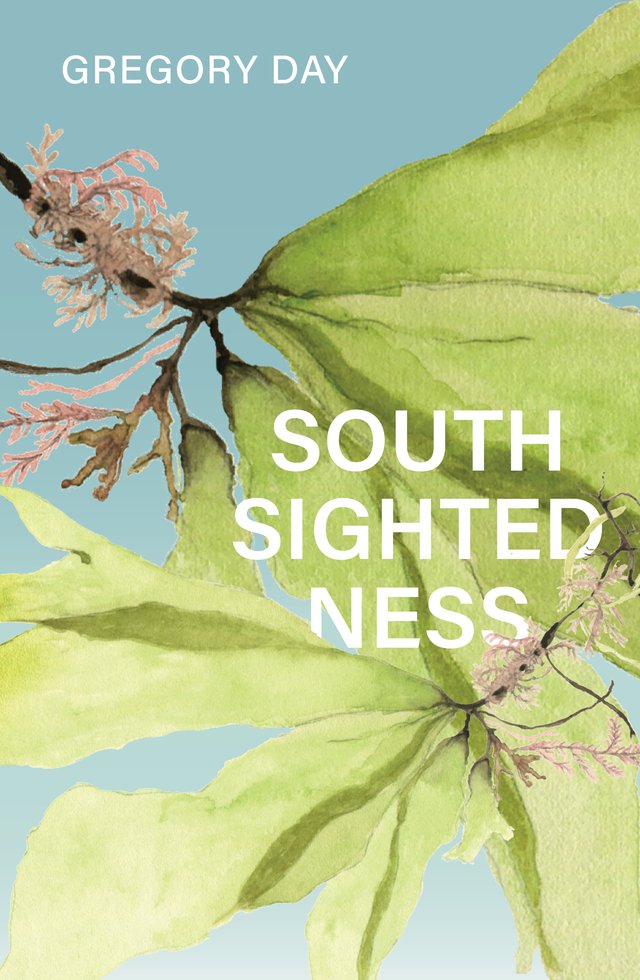
I do have several poetry books on my TBR, including those mentioned in the World Poetry Day post, and Gregory Day’s gorgeously produced Southsightedness.

Red Room’s 10 essential Australian poetry collections

On 31 July, to herald National Poetry Month, The Guardian published “10 essential Australian collections that will change how you read”. It was compiled by Red Room Poetry’s artistic directors, David Stavanger and Nicole Smede, who said in their introduction:

This list isn’t about ranking or canon-building, but about spotlighting collections that crack language open, unsettle expectations, and echo long after the last line. From poetic noir, epic love lines and jazz-inflected dreamscapes to sovereign storytelling and lyrical confrontations with history, these books remind us of poetry’s unmatched ability to hold truth, tension, and transformation.

The collections are, in the (mysterious to me) order given:
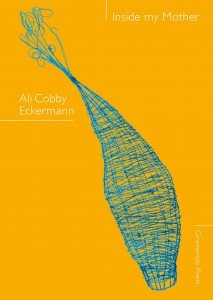
Ali Cobby Eckermann, Inside my mother
  • Ali Cobby Eckermann, Inside my mother (2015, my review)
  • Dorothy Porter, The monkey’s mask (2000, on my TBR still, but I have read Porter’s The bee hut)
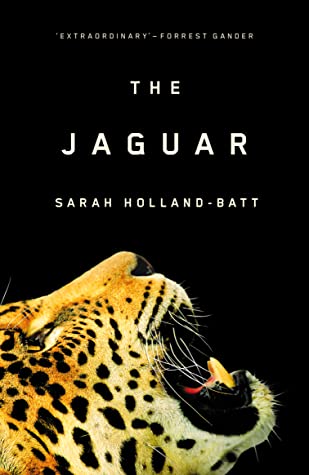
  • Sarah Holland-Batt, The jaguar (2022, on my TBR, Kate’s and kimbofo’s review)
  • Samuel Wagan Watson, Smoke encrypted whispers (2004)
  • Bill Neidjie, Story about feeling (1989)
  • Luke Davies, Totem (2004)
  • Judith Wright, The moving image (1946)
  • Alison Whittaker, Blakwork (2018, Bill’s and Brona’s posts)
  • Nam Le, 36 Ways of writing a Vietnamese poem (2024)
  • Shastra Deo and Kate Lilley, Best of Australian poems 2024 (2024)

It’s a good list, not the only list, because nothing is, but a good list. It’s diverse in authorship, and it includes a verse novel, a Stella winner, Judith Wright from the 1940s, and a Best of … anthology.

At the end of the article, The Guardian asks a question, so I’m asking it too:

Do you have a favourite Australian poetry book that wasn’t mentioned here? (Or any other poetry collection, particularly if you are not Australian!) Please share it in the comments.

Notes:

  • Links on writers’ names are to my posts for the writer (though the posts aren’t always about poetry).
  • Image: I assume Red Room Poetry is happy for their Poetry Month banner to be used in articles and posts about the month.

Monday musings on Australian literature: Poetry Month 2024

National Poetry Month – in Australia – is now four years old, and once again it is spearheaded by Red Room Poetry, which is described by ArtsHub as “Australia’s leading organisation that commissions poets and produces live poetry events nationally”. ArtsHub adds that this Month is “a festival that celebrates emerging and established writers, as well as public figures with an unexpected passion for poetry”. I don’t know how successful it is at reaching its goal of increasing “access, awareness and visibility of poetry in all its forms and for all audiences” but something must be working. I was thrilled to not only hear the month mentioned on our national ABC radio station but to hear that the ABC would be featuring poems during the month.

Red Room is running similar events and activities to those they’ve run before – their 30in30 daily writing competition with prompts from Red Room commissioned poets, poetry ambassadors, online workshops, showcases, a community calendar, and more. And this year, “more” includes something new which is that they are closing out the month with “the UK’s biggest poetry and performance festival, Contains Strong Language” in Sydney from August 28-31. 

Poetry is beyond time. It’s a way of bringing together the countless generations of humanity. It’s a means of connecting past and present. It’s a way of imagining the future~ L-Fresh the Lion (via Red Room Poetry).

National Poetry Gala … and more

This year their National Poetry Month Gala, if I read the website correctly, will happen in Sydney on 29 August at the State Library of New South Wales. It will be hosted by Chika Ikogwe (an award-winning Nigerian born actor and writer) and will feature Julia Baird, Ali Cobby Eckermann, Lorna Munro, Felicity Plunkett, Hasib Hourani, Rob Waters, Dan Hogan and Pascalle Burton, plus guests from the UK, Simon Armitage (their current Poet Laureate) and Princess Arinola Adegbite, and live music from Paul Kelly.

Contains Strong Language is a four-day festival in which local poets and spoken word artists will appear on stage alongside visiting UK poets including Simon Armitage. It’s the first time this annual broadcast festival, founded by the BBC in 2017, has left Britain. Events will be held across Gadigal and Dharug land in Greater Sydney (including one in the Blue Mountains) and will also be broadcast to Australia and around the world, through the BBC and ABC. The events include “performances, masterclasses, panels, galas, slams, live and online workshops, and international writing collaborations featuring 70+ artists”. Sounds like a real coup. The program, which includes free and paid events, can be found here.

Line Break is a new podcast from Red Room Poetry, and is presented in partnership with the Community Radio Network. It will include, over August, their daily 30in30 poetry commissions and writing prompts, plus various special series hosted by our Red Room producers. Some of Australia’s poetry-loving favourite public figures will apparently also share their ‘gateway’ poems. Who are they, and what will they share?

If you would like to know what is happening through the month – in various locations, including online – this Showcase page is a good place to start (or Red Room’s main site which I’ve linked in the opening paragraph).

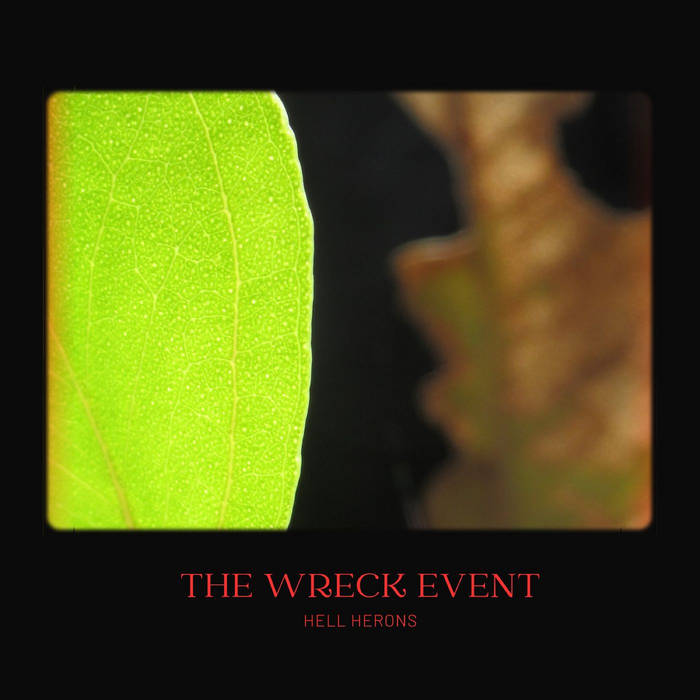
And, I’ll just add that this might be a good month to check out – on your preferred music streaming service – the Hell Herons’ debut spoken word (poetry and music) album, The Wreck Event, about which I posted recently.

Musica Viva, the Choir of Kings College Cambridge, and a Poem

On Saturday night, we attended the Canberra Concert of the Kings College Choir of Cambridge’s current Musica Viva Australian tour. As regularly happens when this choir comes to Canberra, Llewellyn Hall was packed. It was a wonderful program which included some different programming decisions, but my focus here is the commissioned piece they performed*.

This piece was a setting to music of a prose-poem by, coincidentally, the Canberra-based poet and visual artist, Judith Nangala Crispin, who traces her ancestry to the Bpangerang people of North-Eastern Victoria and the NSW Riverina, as well as to Ghana, the Ivory Coast, France, Ireland and Scotland. Titled On finding Charlotte in the anthropological record, the poem won the Blake Poetry Prize in 2020 – read it online here – and was set to music by composer Daniel Barbeler. He says, in the program, that the poem captures “the real-life experiences and reflections” which came from Crispin’s “20-year search through paper records and via physical travels” to find information about her Indigenous Australian heritage. She eventually found “a solitary photograph of her great-great-grandmother, Charlotte”.

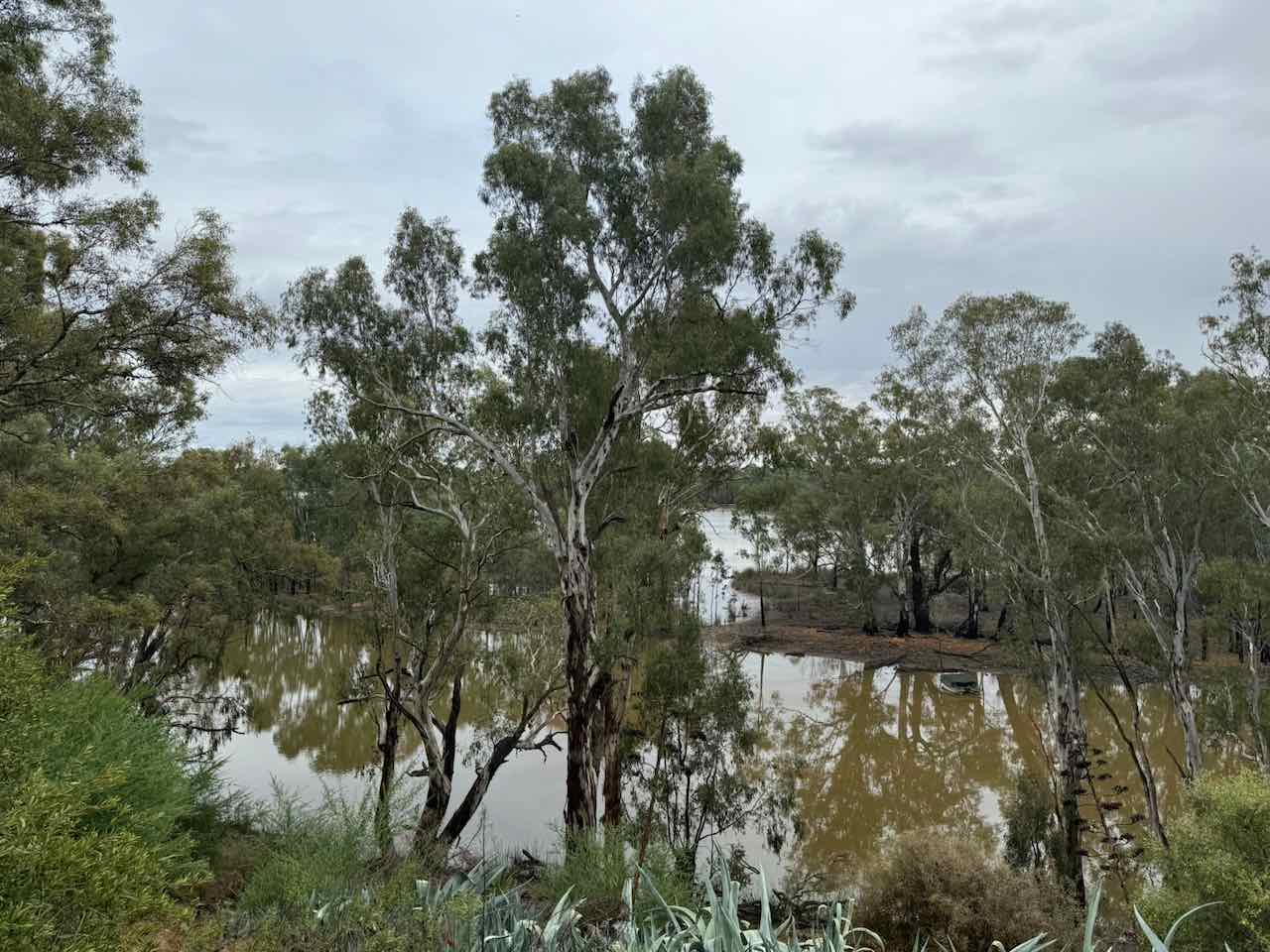
Among other things, Barbeler says his music captures the Australian landscape, specifically Lake Moodemere (pictured) in Northern Victoria where it’s likely Charlotte was born and died. Barbeler describes this part of the country as “peaceful but haunting” and, having visited this lake a few times (including earlier this year), I concur. The poem is certainly haunting, and one particular line from it – “Charlotte is a map of a Country stained by massacres: Skull Creek, Poison Well, Black Gin’s Leap” – is repeated a few times in the musical version. I wondered what these (some very) young British choristers made of it. (You can listen to the piece via music streaming services, as a single under the Choir of Kings College Cambridge.)

* A special thing about Musica Viva concerts is that they regularly commission new Australian pieces for the visiting international artists to perform in their program.

Image: I assume Red Room Poetry is happy for their Poetry Month banner to be used in articles and posts about the month.
Thinking about the Line Break program, I’d love to know if you have a “gateway” poem, and what it is.

Monday musings on Australian literature: Poetry Month 2023

This year Red Room Poetry is running their third annual National Poetry Month. How excellent is that? I don’t know how successful it is at reaching its goal of increasing “access, awareness and visibility of poetry in all its forms and for all audiences” but sometimes you just have to hang in there and build recognition. Poetry Month runs throughout August.

They are offering similar events and activities to last year with their 30in30 daily writing competition with prompts from Red Room commissioned poets, poetry ambassadors, online workshops, showcases, a community calendar, and more. Do check their page, for events that might interest you.

National Poetry Gala … and more

This year they also, they said, returned their National Poetry Gala to celebrate Red Room’s 20th anniversary. It was held, unfortunately, on 4 August! It was emceed by Benjamin Law, and was held at the Australian Chamber Orchestra’s new venue near Sydney Harbour Bridge. It featured some of Australia’s “finest contemporary poets” including Jazz Money, Sara Saleh, Freya Daly Sadgrove (NZ), Rebecca Shaw, Red Room’s 2023 Fellow Charmaine Papertalk Green, and this year’s Stella Prize winner, Sarah Holland-Batt.

There was also to be a musical performance by First Nations choir Mudjingaal Yangamba and the current Minister for the Arts, Tony Burke, was a special guest.

Also to commemorate their 20th anniversary, Red Room has published a poetry anthology titled A line in the sand: 20 years of Red Room Poetry. Its introduction is by Ali Cobby Eckermann, and it contains “over eighty pieces from leading poets and public figures in a retrospective that covers twenty years of the best commissioned Australian poetry”. They include writers I have heard of, and some of whom I’ve read, though not always their poetry, like Yassmin Abdel-Magied, Maxine Beneba Clarke, Tony Birch, Dorothy Porter, Eloise Grills, Sarah Holland-Batt, Jazz Money, Omar Musa, Bruce Pascoe, Maria Tumarkin and Uncle Archie Roach AC. Tomorrow night, Tuesday 8 August, they are holding an online showcase via Facebook. The event is free but you need to book.

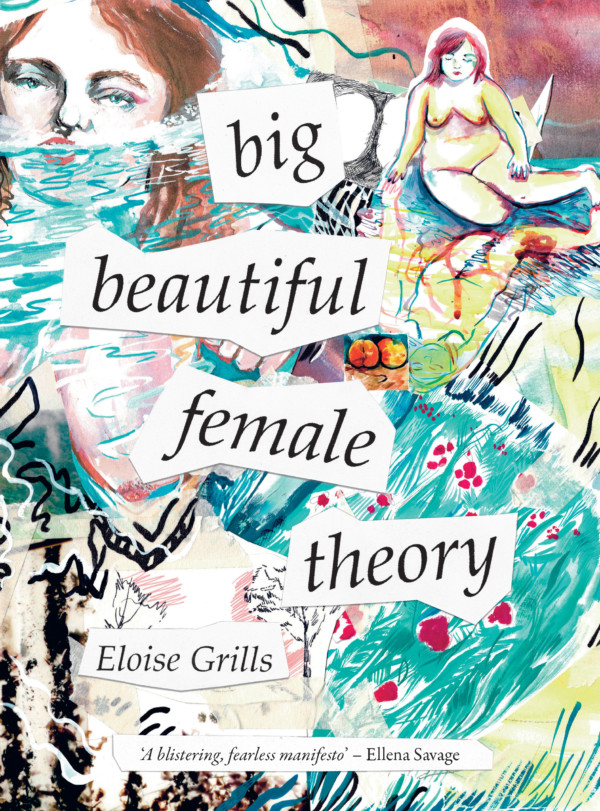
Meanwhile, if you missed the National Poetry Gala, you might be interested to know that the Victorian Poetry Month Gala has not been held yet. It is scheduled for 17 August at the Wheeler Centre. The host is a poet-playright I haven’t heard of before, Izzy Roberts-Orr, and the event will feature, says the promotion, “new work from a dazzling line-up of poets working across forms – from spoken word and performance to music and multimedia”. I don’t know many of the names those I do include Andrea Goldsmith reading unpublished poems by Dorothy Porter, and Eloise Grills whose book big beautiful female theory has been shortlisted for several literary awards this year. There is also a mention of “a collaboration” between journalist and author Erik Jensen and musician Evelyn Ida Morris. For other state and regional showcases and galas, check Red Room’s Showcases page.

These are just three of many events – online and live – scheduled during the month. If you are interested, check out the Community Calendar which lists events from across the country.

Do you attend poetry events – of any sort?

Monday musings on Australian literature: Supporting genres, 7: Poetry

As with the last post in this series, which was on novellas, poetry isn’t so much a genre as a form. However, to repeat what I said then, when I started this sub-series, I couldn’t find one all-inclusive word to cover all the types of literary works I thought I’d cover, so settled on “genres”. With August being National Poetry Month, it seemed a good time to do the poetry post.

I’ll start by saying that over the years of this blog, I have written several posts that could be seen to cover ways in which poetry is supported in Australia … so I’m going to begin with some of those posts, all Monday Musings:

  • Australian Poetry Library: In 2011, I wrote on a wonderful initiative, the online Australian Poetry Library which was launched that May. Unfortunately, as those of you who have read last week’s Monday Musings comment trail will know, the site is off-line at the moment. It’s a fabulous site, and we believe the hiatus is technical rather than permanent. We urge that “fixing” it be given priority.
  • National Poetry Month: This has to be a major initiative for supporting Australian poets and poetry and I have written two Monday Musings posts on it, one in 2021 and one in 2022.
  • Poetry Awards: In 2014, I wrote a Monday Musings on Poetry Awards, in which I listed many of Australia’s best-known poetry awards.

Publishers

In my 2021 National Poetry Month post (linked above), I mentioned two publishers which focus specifically, or heavily, on poetry – Giramondo and Pitt Street Poetry – so you can read more about those there. Other more general publishers also support poetry. There are too many for me to include here, but I will exemplify with a few:

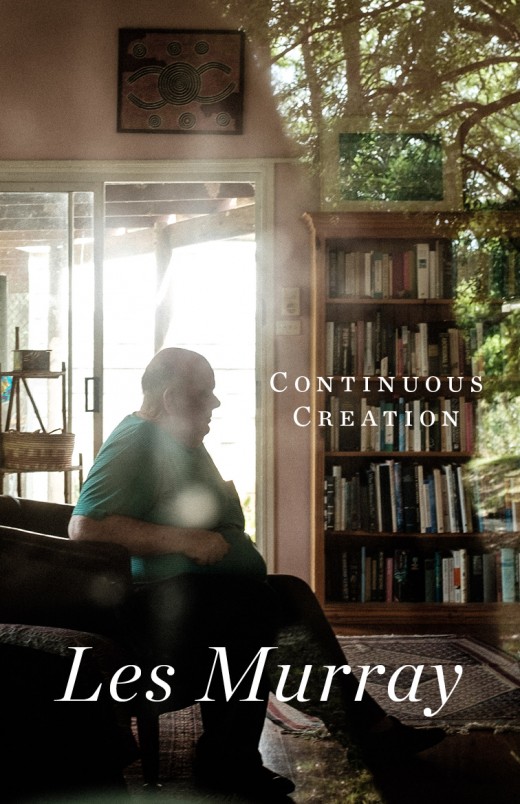
  • Black Inc: an independent Melbourne-based publisher which supports poetry, with a focus (I’d say) on established poets. They have published annual Best Australian poems anthologies (though not since 2017 it seems); they publish The best 100 poems of [poet, like Dorothy Porter] series, and they also publish poetry collections, including, most recently the posthumous Les Murray collection, Continuous creation.
  • Fremantle Press: an independent Western Australia-based publisher which publishes poetry regularly, both as single poet collections (including John Kinsella and Tracy Ryan) and anthologies.
  • UQP: a university-based publisher in Queensland, which is also a strong publisher of poetry. Not surprisingly, given their track record in publishing First Nations writing, they are a major publisher of First Nations poets, like Evelyn Araluen, Tony Birch, Jazz Money, and Ellen van Neerven, alongside many other new and established poets.

I have reviewed poetry from all of the above. For more publishers, check out this Poetry Sydney page which includes these, plus more, like Ginninderra Press, Magabala Books, and Wakefield Press.

Awards

I covered several of Australia’s significant poetry awards in my dedicated Monday Musings post linked above, and Wikipedia has a useful list too. I love that the majority of poetry awards are named for poets. Here I will share a few that I didn’t include in my 2014 post:

  • Anne Elder Award has gone through some changes since its establishment in 1976 by the Victorian Branch of the Fellowship of Australian Writers. It goes to the best first book of poetry published in Australia, and since 2018 has been managed by Australian Poetry.
  • Biennial Helen Anne Bell Poetry Bequest Award is a more recent poetry prize, with the inaugural award being made in 2013. The original prize was $7,000 but it’s now described as Australia’s richest poetry prize, with $40,000 going to the 2021 winner. It is “dedicated to celebrating women poets”, with, says AustLit, the award going to “an Australian woman poet for a collection of previously unpublished poems”. It is managed by the University of Sydney.
  • Mary Gilmore Award has gone through a number of permutations and slight name changes since it was established by the ACTU (Australian Council of Trade Unions) in 1956. Love this. It is currently an annual prize for a first book of poetry published in Australia, and is managed by the Association for the Study of Australian Literature. The 2022 winner was Jelena Dinic’s In the Room with the She Wolf published by Wakefield Press.

Festivals

Many writers festivals include a poetry panel or two, and those of you who attend folk festivals will know that these festivals often include poetry sessions (mostly, in my experience, of the bush verse variety).

However, there are some specialist poetry festivals, like the following:

  • Perth Poetry Festival, is an annual festival with this year’s being its 18th. Its webpage is brief but you can read more about it there. It is run by WA Poets Inc.
  • Poetry on the Move is a festival that was established in Canberra in 2015 by the University of Canberra. Its website describes its aims as being “to promote poetry as a vibrant art form through the engagement with international, national and local poetry communities”.
  • Queensland Poetry has operated as an incorporated association, the Queensland Poetry Festival Inc, since 2007. Their aim, according to their home page, is “Supporting poets on page and stage across Queensland”. Check out their website for the range of their activities, but as far as I can tell, this year’s festival, Emerge, ran from June 3rd to 6th.
  • Red Dirt Poetry Festival has already appeared on this blog, through Glen Hunting who often comments here. As its website says, it is a “4-day International poetry and spoken word celebration in Mparntwe/Alice Springs”. It’s a hybrid festival offering both in-person and digital sessions, and involves national and international poets. The sessions include “presentations, workshops, showcases and exclusive commissioned works”.
  • Tasmanian Poetry Festival is a longstanding festival which started in 1985 ran its 37th event in 2021.

It goes without saying that many festivals, including these, have been significantly affected by COVID and so what were annual, in-person events, have in some cases missed a year or two, recently, and/or become hybrid events. Some are run by poetry associations which offer many more programs than “just” the festival. You can find out more by navigating the links I’ve provided.

Do you like poetry and, if so, how do you engage with it?

Previous supporting genre posts: 1. Historical fiction; 2. Short stories; 3. Biography; 4. Literary nonfiction; 5. Crime; 6. Novellas.

Monday musings on Australian literature: Poetry Month 2022 and Verse novels

Having launched their Poetry Month in 2021 which I wrote about at the time, Red Room Company (or, Red Room Poetry) clearly felt it was successful, because they are back again this year with another Poetry Month. Its aim is to “increase access, awareness and visibility of poetry in all its forms and for all audiences”, and it will run throughout the month of August.

From what I can tell, they are following a similar plan to last year with their 30in30 daily poetry commissions, poetry ambassadors, online workshops, prizes and residencies, and more. Do check their page, which includes a link to a calendar, to find ways in which you can take part, or, simply, introduce yourself to some new poets and poems.

Meanwhile, I thought I’d celebrate the month by writing a little tribute to verse novels.

Verse novels

When I decided to write this post, I found a good introduction to verse novels at The Australian Poetry Library. However, when I checked the link I’d saved, it said “currently unavailable”. I will share what it said, but you may not be able to find it online any more. (They do still have a Facebook page.)

A verse novel tells a long and complex story with many characters, much as a prose novel would, through the medium of narrative verse. The verse may be blank verse in the manner of Shakespeare, or free verse, or (less often) formal rhymed verse of any type.

The ancient epics were verse novels, of a sort, and so were the Alexandrian epyllia such as Apollonius’ Argonautica, but the modern verse novel, like the novel itself, is a fashion that found a large audience in the nineteenth-century: Don Juan (Byron), Amours de Voyage (Arthur Hugh Clough), The Ring and the Book (Robert Browning).

Movies, paperback novels and television seem to have killed it off in the early twentieth century, but it found a strong revival after the 1970s: Another life (Derek Walcott), The golden gate (Vikram Seth) and The changing light at Sandover (James Merrill).

Notable Australian verse novelists are Alan Wearne, Dorothy Porter, Les Murray, Steven Herrick and John Tranter.

A selection of Australian verse novels

Susan Hawthorne, Limen, book cover

Wikipedia’s article on the form provides a brief history, going back to epics like Gilgamesh. After appearing to have declined with Modernism, it has, Wikipedia continues, “undergone a remarkable revival” since the 1960s-70s, and is particularly popular in the Caribbean, Australia and New Zealand. I wonder why these particular regions?

I should add, though, that verse novels do have a longer history in Australia than this later 20th century revival suggests. CJ Dennis’ The songs of a Sentimental Bloke (1915) and The moods of Ginger Mick (1916)(my post) are earlier, and very popular, examples.

Of course, I did a little search of Trove, but, given the form’s apparent recent revival and the fact that Trove is not so useful yet for recent decades, I didn’t find much. However, I was intrigued to find reference to a satirical work called Solstice, by 20-year-old Matt Rubenstein. It was shortlisted for The Australian-Vogel award (in 1994, I presume). Sen, writing in The Canberra Times, was reasonably positive, saying that “the narrative has its share of sentimental blokes as well as philosophers like the homeless Arthur, and the relationships and issues it explores are treated relevantly as well as entertainingly. It could start a verse-novel cult. Could, I said.”

I’m not sure that there’s been quite a cult, but my little list below confirms some level of ongoing popularity in Australia. But, back to Rubenstein’s Solstice, I also found through Trove that it had been adapted by the author into a play to be performed at the Adelaide Festival of Arts in 1996, with Kate Ceberano as the featured singer. That says something about the quality of the work. I note that the play is available from Ligature Digital Publishing.

Anyhow, I do enjoy a verse novel, and have reviewed several on my blog, as have some other Aussie litbloggers. Here is a selection of some of the verse novels we have reviewed on our blogs:

  • Ali Cobby Eckermann, Ruby Moonlight (2012) (my post, and Lisa’s): this is particularly interesting because it is a First Nations historical fiction verse novel. It is a moving, and generous read.
  • Lesley Lebkowicz, The Petrov poems (2013) (my post): also historical fiction, this work tells the story of the Petrov affair providing a personal perspective on a very political event.
  • Susan Hawthorne, Limen (2013) (my post): Hawthorne’s quiet yet forceful work explores women going camping, the threats and vulnerabilities that confront them, and how they navigate the lines that appear.
  • Geoff Page, The scarring (1999) (my post): Page has written other verse novels, including Freehold, which I have also read, but The scarring is particularly strong and gut-wrenching about war, the mistakes people make, and the power men can wield over women.
  • Dorothy Porter, El Dorado (2007) (Brona): Porter’s last verse novel is described by Brona as “another dark crime story with a psychological twist”.
  • Dorothy Porter, The monkey’s mask (1994) (Brona): Porter’s most famous verse novel is also a psychological crime story, and, says Brona is “gritty, exciting & passionate”. It surely qualifies now as a classic, particularly given it is taught in schools and universities. It was also adapted for a feature film.
  • Alan Wearne, The night markets (1986) (Bill): this book was highly praised when it came out, and won significant awards including the ALS Gold Medal and the National Book Council Award. Bill knew Wearne at school, and has read this book a few times “because it feels so intensely familiar”. The Canberra Times reported on its ALS Gold Medal win, saying the judges ‘were impressed by the ambition and confidence with which Wearne approached his task. The novel’s subject, political and social change in the past two decades, had rarely been approached, they said, and its verse form was “bold and exciting”‘.

Readings Bookshop has provided lists of Australian and non-Australian children’s and YA verse novels, for those of you interested in these audiences.

Do you read verse novels? And if so, care to share your favourites (Aussie or otherwise)?

Poetry Month 2021: Your favourite poems

Earlier this month, I wrote a Monday Musings on Poetry Month, at the end of which I asked readers to name their favourite poem.

Poetry Month finished yesterday, 31 August, so I thought I’d close out the month by listing the nominated poems, alphabetically by poet. I should add that some commenters cheekily named more than one (so I did too). Links on the poem title takes you to an online version

If this list has suddenly inspired you to add your own, please do so in the comments, and I will add it to this list.

Meanwhile, here are some thoughts about poetry posted on Instagram by the month’s organisers, RedRoom Poetry

“Poetry … brings me great comfort and discomfort, and I’m thankful for both” (David Stavanger, Lead Producer))

“Writing is also an act of reading–not only books but all forms of textuality: the ground, the vegetation, the ‘world around us’. (John Kinsella, #30in30 writing prompt)

“Poetry for me is the project of trying to put into language ideas and states of being that feel unnameable or uncontainable” (Izzy Roberts-Orr, Digital Producer)

“Poetry has no limits or positions. It is a freedom. It can be one word or many.” (Tenzin Choegyl, #poetryambassador)

And this, a challenge for Bill:

“I’m not interested in hearing people read other people’s poems. I’d rather listen to a truck driver read out a poem about his truck, than the world’s finest actor read out the world’s finest sonnet. It’s about the poet for me.” (Brendan Cowell, #30in30)

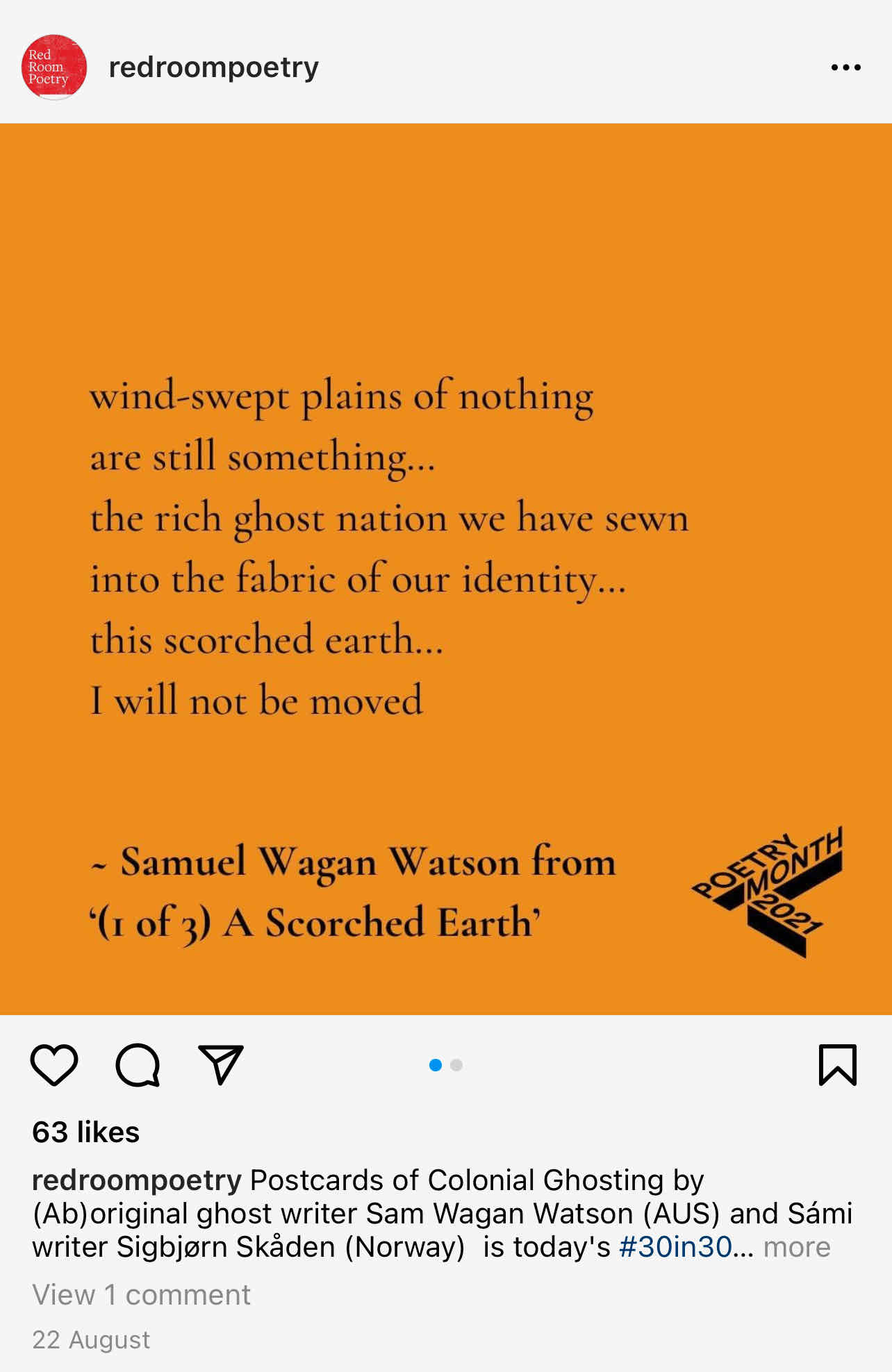
And finally, to close out Poetry Month, an image from RedRoom Poetry’s Instagram account of one of the many poems posted during the month (as part of the paired-poets #fairtrade project). (I think it is ok, copyright-wise, for me to share this)

And remember, it’s not too late to share your favourite/s.

Monday musings on Australian literature: Poetry Month 2021

I have posted on World Poetry Day, which occurs in March, several times in recent years. And I have written about Australian poetry various times, including about the Red Room Company (or, Red Room Poetry). Their vision is very simple: “to make poetry in meaningful ways”. They have initiated and supported various projects over the years, and have now come up with a new one, Poetry Month. It seems the perfect topic for another Monday Musings on poetry in Australia.

Many of you are probably aware that the US has various months dedicated to literary/humanities/justice issues, like Black History Month in February. One of these is their National Poetry Month which has been going now since 1996. I’ve often thought it would be good for Australia to emulate some of these. We do have NAIDOC Week, of course, but that could be a month, eh? Anyhow, now Red Room has initiated a Poetry Month which is exciting:

Our goal is to increase access, awareness, value and visibility of poetry in all its forms and for all audiences. The inaugural Poetry Month will be held during August 2021 with the aim of an ongoing annual celebration.

What are they doing?

A lot, in fact. They say that they have

an electrifying lineup of poetic collaborations, daily poems and writing prompts, online workshops, poetic residencies and live to live-streamed showcases, designed to engage everyone – from veteran poetry lovers to the (for now!) uninitiated.

There is a calendar. They have 8 poetry ambassadors, who are an eclectic and appropriately diverse bunch: Yasmin Abdel-Magied, Tenzin Choegyal, Peter FitzSimons, Dr Karl Kruszelnicki, Stephen Oliver, Grace Tame, Megan Wilding.

My love of reading and writing poetry is guided by a lifelong attraction to the seemingly simple and unadorned.

~ Tony Birch

Specific events are …

  • 30in30 daily poetry commissions: every day there are/will be “new original text/video poems, poet reflections and writing prompts from some of the country’s leading poets, authors, spoken word artists and playwrights”. They can be accessed on the site, and on social media (with the hashtag #30in30). Today, for example, there’s a 2-minute video from First Nations author, Tony Birch, on what poetry means to him. He talks of poems that can have new meanings each time you read them. 30in30 will include commissions from their larger Fair Trade project which involved First Nations poets from around the world.
  • Line Break: a weekly online show, on Tuesdays through August, 7pm AEST, on Facebook and YouTube, providing previews from feature poets, publishers, spoken word artists, and musicians, and more.
  • Poets in Residence: a program, supported by City of Sydney (how great is that). The poets were to be located at Green Square Library “for a period of writing, reading and performing poetry on site, engaging the general public in various ways and showcasing COS library collections”. Unfortunately, Sydney’s current lockdown has forced the postponement of this.
  • Showcases: a “raft” of live and online events across the country, including the inaugural Poetry Month Gala supported by The Wheeler Centre. Click on the Showcases link to see events from, indeed, around the country, including in South Australia and Western Australia.
  • Workshops: weekly online workshops, on Wednesday nights 7-9pm, via Zoom, catering “for all poets at all levels … anywhere in Australia”, with the topics being “stripping poetry back, breath and beatboxing, the intersection of poetry and comedy, and a special older emerging voices workshop”. They suggest a donation of $10. The workshop leaders are Sarah Temporal, Hope One, Vidya Rajan and Tony Birch.

What an exciting-sounding and diverse program.

Here is a taster … Australian of the Year, Grace Tame, with her strong 30in30 contribution, “Hard pressed”.

A little value add from me …

If you are looking for contemporary Australian poetry, you could start with two independent publishers:

Ali Cobby Eckermann, Inside my mother
  • Giramondo, which published Jonathan Shaw’s chapbook that I reviewed recently). They have also published Ali Cobby Eckermann, Jennifer Maiden, Gerald Murnane, Gig Ryan, Fiona Wright, and so many more known and unknown to me.
  • Pitt Street Poetry, which published Lesley Lebkowicz’s The Petrov poems (my review) and Melinda Smith’s Drag down to unlock or place an emergency call, which won the 2014 Prime Minister’s Literary Award for poetry. They have also published Eileen Chong, John Foulcher, Peter Goldsworthy, Geoff Page, and Chris Wallace-Crabbe, to name some of the better known (to me) from their stable.

There is also the Australian Poetry Library, about which I’ve written before. It now contains, the website says, “tens of thousands of poems from hundreds of Australian poets”. You can read poems free online, but if you want to download and print poems, there is “a small fee, part of which is returned to the poets via CAL, the Copyright Agency Limited”. This resource is particularly geared to teaching poetry, but is available to anyone.

Lesley Lebkowicz, The Petrov Poems

If you are looking for Australian bloggers who write about poetry, try Jonathan Shaw at Me fail? I fly. This link will take you to his poetry tagged posts, of which there is now a substantial number. Also, blogger Brona (This Reading Life) is planning to support the month, so if you don’t already subscribe to her blog, do check her out if you are interested in poetry and/or in what Red Room is trying to do for Australian poetry.

Finally, you can also find poetry reviews in the Australian Women Writers database.

And now my question: do you have a favourite poem to share with us? (And do you, like Tony Birch, go back to it again and again, and find something different each time?)