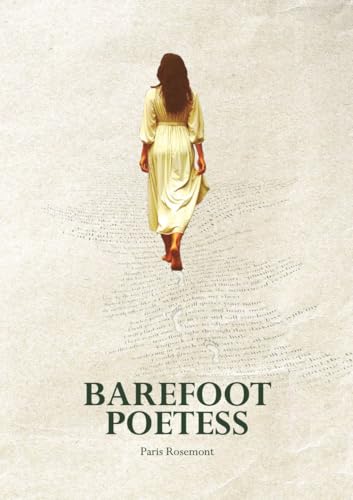
Fierce, raw, honest are all clichés used to describe strong, powerful writing, but when it comes to Paris Rosemont’s poetry collection, Barefoot poetess, they are hard to go past. However, I prefer to avoid review clichés, so let’s start again …
Paris Rosemont’s second poetry collection, Barefoot poetess, turned out to be quite the page-turner for me. This is not something I expect to experience with a poetry collection, albeit I admit to having read some page-turner verse novels. The thing is that it was a page-turner as much for its language, tone and formal inventiveness, as for its content, though the content engaged me too, from the opening poem which I excerpted in my recent World Poetry Day post. Indeed, it was that poem which convinced me to choose this book next from my review copies TBR pile.
Rosemont is a Sydney-based, second-generation Asian-Australian performance poet, and Barefoot poetess is her second collection of poetry. Her first, Banana girl (2023), was listed for several awards nationally and internationally, and won the “Distinguished Favourite” award in the 2025 NYC Independent Press Awards. My sense is that writing as a performance poet is partly what makes her poetry so accessible. Poetry really is best read aloud. Performance poets know this. They know how to infuse their poetry with the sort of power that can quickly draw their audience in. A generalisation – yes – but like most generalisations it has a basis in truth.
As I wrote in my World Poetry Day post, poet Tim Loveday describes Barefoot poetess in his Introduction as “confessional poetry in all its glorious exhibitionism”, which means that, almost by definition, they will embody the cliches of “raw” and “honest”. Certainly they appear to capture something of Rosemont’s life to date, the pain of broken relationships and the thrill of finding new ones, the experience of being Asian in a non-Asian world, the difficult act of balancing motherhood against finding her creative self. It unapologetically confronts living in a complex world. Take the title. We second-generation feminists eschewed gendered nomenclatures like, well, to be blunt, “poetess”. However, in her opening note Rosemont respects the fortitude of women who paved the way for her – which included losing terms like this – but then reclaims “poetess as an act of rebellion”. It feels, she says, “wild and whimsical, seductive and a little dangerous. I like the illicit feeling of it in my mouth… “.
I like this too. I like it because it reclaims this word with intention, because being a poetess in the past could be dangerous. Any woman who was clever with words, who self-expressed with little care for the niceties of feminine expectations, was at risk. This word encompasses that history and Rosemont uses it with vigour. So, back to that opening poem that got me in, “Mama’s flown away with the mockingbirds”. It’s a heartbreaker about mothering when you are broken, about the wisdom of kids who “know”, and about a mother’s recognition of the costs:
I pity these wretched orphans. Imagine
how unsettling it must feel to be sung
to sleep by a ghost who knows
their favourite lullabies and looks so
like someone they once knew.[But]
… their mother has brokered a fool’s-
gold escape. She has mortgaged her heart.
The cost of her wings. Two tiny souls.
What an opener.
“making poetry tutors blush”
There is a trajectory to the collection, though it’s not simply chronological. It picks up on themes and moves us through aspects of her life – her childhood as a migrant’s daughter, her failed marriage and other relationships that brought pain or joy or both, passion and sexuality, motherhood, not to mention the act of becoming a poet (“paris rosemont: making poetry tutors blush since 2022”, from “(ii) poetry with pip”). The opening poem is followed by poems expressing her anguished questions, before we move back into an earlier chronology – her migrant father’s arrival in Australia (“The Colombo Plan”) and her marriage (“Foot and spouse disease”) – and then out again. Words (like “kawasakis” and “koels”) and people (like her father and lovers, the various yous) link poems and ideas across the collection, while the ordering of the poems leave us in no doubt about intent. Life is complex. Painful poems about fractured and destructive love, are followed by poems about love’s experiments, which are followed by love found. Prose poems, which convey story more straightforwardly (but never simply), are interspersed with wilder poems and quieter ones, encapsulating more emotional responses. The prose poem “Evaporated milk” about motherhood’s dilemmas is followed by poems about the pains and dangers of love, home and childhood. Punches are not pulled, knuckles are bared, in “Terracotta knuckles”, “Home is where the dark is”, and the later “Simon says” (which starts as a prose poem but splinters at the end).
The ideas and feelings in this collection are personal and powerful. They keep us reading – often with hearts in mouths. But what makes the reading exciting is, as I’ve already said, the language, the variety of and experimentation with form, and the wit. Wit underpins many of the poems, regardless of how serious the content. “Lila’s Mixtape of Lovers” comprises 6 stanzas in what Rosemont calls a 69-er, her “contemporary twist on the form 9x9x9”. Each stanza is inspired by songs, ranging from a sitcom theme song to one from alternative rock band Garbage. They document love’s failures, and are part of a group of poems in which innuendo and explicit sexual wordplay bounce against each other to convey love’s power to inspire and destroy. “Fierce” is right for these poems, which can be both shocking and funny at once.
But there are also graceful poems expressing joy (and, admittedly, its uncertainty) and more lighthearted poems (like the self-deprecating “(i) tea with tony”). I enjoyed – partly because I love these cactus and the deserts they are found in – “We are Saguaro”. It’s a reverse poem which neatly questions the speaker’s ability to love. If you read it forwards and then in reverse, the nuance is hopeful. However, if you only read it forwards … It jolts rather than flows, but the point is made.
The poems in Barefoot poetess are accessible but not simple. They require attention – but they repay that attention with surprises of recognition (“is that …? is she really …?”, from “(iii) shooting stars”), and with an energy that is infectious. These are poems I can imagine reading again to see what more they might say.
Paris Rosemont
Barefoot poetess
Parramatta: WestWords, 2025
87pp.
ISBN: 9781923044456
(Review copy courtesy WestWords)
 Whispering Gums