Yuri Herrera, Signs preceding the end of the world (#BookReview)

Yuri Herrera, Signs preceding the end of the worldWhile I was travelling in the USA last month, I wanted to read at least one book relating to the regions we were visiting. I started by looking for a novel set in/about the northwest, but then Yuri Herrera’s Signs preceding the end of the world, set in the southwest, popped out at me, and I knew I had my book.

When you live in the southwest, as we did in the 1990s, you can’t help but be aware of the issue of migration, “illegal” or otherwise, across the border from Mexico. I’d seen the film El Norte (about two Guatemalan youths fleeing to the US via Mexico) and read T. Coraghessan Boyle’s The tortilla curtain, but I hadn’t read a Mexican author on the subject – until now.

Signs preceding the end of the world tells the story of Makina, who is sent to “the other side” by her mother to carry a message to her brother who’d gone and not returned. To obtain the help she needs to make the crossing, she also agrees to take a message from Mexican gangster, Mr Aitch. This synopsis would suggest to most readers an adventure story – a thriller perhaps – or at least some sort of plot-driven drama, but that’s not what this is at all. Yes, it follows a traditional linear journey narrative, but the tone is more mythical, which means that it works on two levels, the literal Mexican-American border story and something more universal about crossings and transitions.

Herrera achieves this by keeping details to a minimum. Places aren’t named, but just described. Chapter titles like “The place where the hills meet” and “The place where people’s hearts are eaten” exemplify this beautifully. Most people aren’t named, either, and, where they are, the names are minimal (such as Chucho who helps her cross the border) or enigmatic (such as the alphabetical three, Mr Double-U, Mr Aitch and Mr Q!) It is in this shadowy context that Makina makes her journey.

He also achieves it by starting the novel with a surprising scene that isn’t critical to the literal plot, but which provides a thematic or symbolic link to the ending. We meet Makina walking in the street, when, suddenly, a sinkhole opens up and a man is swallowed up. Makina manages to pull herself back and survive, but we learn in the opening paragraph the tenuousness of life and, perhaps, that Makina is either lucky or has good survival instincts. Meanwhile, the sinkhole itself, while a literal geographic phenomenon, also conjures up the underworld, the murky sub-legal world that Makina must traverse to make it to, and survive in, “the other side”.

Herrera evokes the dangers of the journey vividly, but having already set up Makina as a resourceful young woman, he convinces us of her ability to survive the crossing – and she does, despite being accosted by a young thug, nearly drowning in the river, being shot at near a mountain pass. She locates her brother too, even though the information she has regarding his whereabouts is minimal.

What really makes this book, though, besides the strength and heart of Makina, is Herrera’s language (albeit in translation). It’s written in the sort of spare language I like. Here’s Makina’s experience of the city:

The city was an edgy arrangement of cement particles and yellow paint. Signs prohibiting things thronged the streets, leading citizens to see themselves as ever protected, safe, friendly, innocent, proud, and intermittently bewildered, blithe, and buoyant; salt of the only earth worth knowing. They flourished in supermarkets, cornucopias where you could have more than everyone or something different or a new brand or a loaf of bread a little bigger than everyone else’s. Makina just dented cans and sniffed bottles and thought it best to verse …

Yes, “verse”. Dillman in her translator’s note discusses the challenges of translating the book, which she says is about “bridging cultures and languages”. One way Herrera conveys this theme is to use neologisms, signifying the idea of a new language for the potentially new people forged out of migration. One of his neologisms is “jachar” which he uses to mean “to leave”. Dillman needed to create/choose an English word that would play the same role, and came up with “to verse”, because it refers to poetry and is also part of “several verbs involving motion and communication (traverse, reverse, converse) as well as the ‘end’ of uni-verse”.

As I implied earlier, this is a road novel, a journey to another place as well as to the self. Here’s Makina looking for her brother:

It had taken everything she had just to pronounce the eight tundras. To cleave her way through the cold on her own, sustained by nothing but an ember inside; to go from one street to another without seeing a difference; to encounter barricades that held people back for the benefit of cars. Or to encounter people who spoke none of the tongues she knew: whole barrios of clans from other frontiers, who questioned her with words that seemed traced in the air. The weariness she felt at the monuments of another history. The disdain. The suspicious looks. And again, the cold, getting colder, burrowing into her with insolence.

And when she arrived and saw what she’d come to find it was sheer emptiness.

Here and elsewhere, Mexican-born Herrera, who now lives in the USA, is clear about the materialistic, insular reality of “the other side”.

As I read this book, I was reminded of other journeys and crossings, specifically crossing the Styx (it’s no accident I’m sure that the first chapter is titled, simply, “The earth”), Dante’s journey to hell, and even Alice’s fall down the rabbit-hole. Herrera, though, while invoking these journeys in Signs preceding the end of the world, has created his own, one that addresses the politics of borders and boundaries (and dare I say “walls) between countries, while exposing the personal, psychological and spiritual implications of traversing these borders. Its ending is unsettling – but perfect for all that.

Yuri Herrera
Signs preceding the end of the world
(Trans. by Lisa Dillman)
London: And Other Stories, 2015 (Orig. lang. ed. 2009)
114pp.
ISBN: 9781908276421

AS Patrić, Black rock white city (Review)

AS Patric, Black rock white cityWith that extended conflict known as the Yugoslav Wars (1991-2001) now over for more than a decade, we are starting to see books written about them. I’ve reviewed two on this blog to date, Aminatta Forna’s novel The hired man (2013) (my review) on the Croatian War of Independence, and Olivera Simić’s memoir Surviving peace (2014) (my review) on the Bosnian War. AS Patrić’s Miles Franklin Award winning novel, Black rock white city, (2016), which also draws from the Bosnian War, now makes three.

Like The hired man, Black rock white city explores the aftermath of war, but unlike Forna’s book, which is set within the war-torn country, Patrić’s book is set in Australia, and tells of refugees, Jovan and his wife Suzana. The novel starts about four years after their arrival and, although both were academics in Sarajevo, they, like so many refugees, work in their new country as cleaners and carers. It soon becomes clear that they have not recovered from their war experience. Gradually, over the course of the book, Patrić reveals the horrors of their experience. We learn that, like so many who suddenly find their country at war, they had to face that awful question, “should I stay or should I go”. As it turned out, they stayed too long, and Jovan feels he failed his wife by not going early. When we meet them, their relationship is stressed, and they seem unable to provide each other the love and emotional support they so badly need. It’s excruciating to read, because it’s so real, so believable.

I found this book particularly enlightening because I worked with a woman who was damaged by this war. Like Patrić’s two protagonists, she was Bosnian Serb, but unlike them she left early. However, the impact on her of this forced loss of her country, her culture, was immense.

But, I digress … back to the book. It opens with hospital cleaner Jovan cleaning graffiti in an examination room. We soon discover that the hospital is experiencing a bout of graffiti-writing, and that Jovan is the graffiti cleaning expert. No-one knows who is creating the graffiti, which becomes increasingly bizarre. It appears on all sorts of surfaces (such as a corpse’s back, a menu blackboard, the optometrists’ charts) and comprises a variety of seemingly random, though often pointed, words and phrases (such as “The/Trojan/Flea”, “Obliteration”, “Dog Eat Dog” and “Masters of Destiny Victims of Fate”), which Jovan starts to read as messages to him. The graffiti artist is dubbed Dr Graffito. This storyline gives the book the patina of a mystery or even, perhaps, a thriller.

However, while the graffiti provides a plot-line for the novel, the main narrative concerns Jovan and Suzana, their relationship with each other and with other people, including a lover (for Jovan, because Suzana, in her pain, has withdrawn sex), work colleagues, friends and neighbours. Underpinning this narrative is the ongoing trauma of war. Jovan, for example, is frequently dogged by “the black crow”. He “feels as though he uses a rail for a pillow – always listening to the vague rumblings of oncoming annihilation”. Once, Suzana remembers, he could

turn almost anything over to a new perspective, see something deeper, redeeming, more beautiful even if painful. It was what made him such a superb poet back in Yugoslavia … He doesn’t write anymore and it’s as though he never did.

There is poetry in his head though – including a mantra that gets him through his days: “Maroochydore and Mooloolaba, Noosa and Coolum”. Language – the loss of his own, his inability (or is it refusal?) to speak proper English, not to mention the disturbing graffiti – functions as a metaphor for his sense of displacement.

Meanwhile, Suzana, notes Jovan,

is spending more of her time scribbling into her notebooks. The only place safe for her in the time since Bosnia, was somewhere buried underground. Coming to the surface isn’t going to be easy.

Patrić crafts the story skilfully. It’s a debut novel, but Patrić has published two short story collections and is a teacher of creative writing. It shows. The story is told third person, initially from Jovan’s perspective, but later Suzana’s is alternated with his, which fleshes out our understanding of Suzana, while keeping the perspective tightly focused on their experience. The plot unfolds stealthily, as we shift between two questions: will the graffiti artist be discovered, and can Jovan and Suzana pull through? By the end, the strands come together – so cleverly, so shockingly. And then there’s the sure, controlled writing. The pacing, the wordplay and touches of humour, the imagery, the dialogue, and the changing rhythms, make it delicious to read, even while the content confronts and distresses.

Late in the novel, Suzana suggests to Jovan that Dr Graffito is “putting his pain into someone else”, and that seeing his “madness in someone else might make it feel more bearable”. I don’t want to spoil the novel, but Suzana seems to be right, until the end where Dr Graffito’s actions force a confrontation that bring it all to a head.

What is Patrić’s motive for writing this? Early in the novel, Jovan finds one of the many notes Suzana loves to leave around, a quote from her favourite author, Nobel-prize winner, Ivo Andrić:

You should not be afraid of human beings. I am not, only of what is inhuman in them.

Jovan, on the other hand, says that “so much of what happens, shouldn’t happen”. These two ideas form the crux of the book. We have a cast of human beings, who are all real, all flawed in some way. They muddle on, some better than others, some needing a bit of “moral flossing”, some a bit of “ethical cleansing” (and what a clever wordplay that is, keeping war’s horrors close to our minds.) We see what happens, during and after war, when people let hate get the better of themselves and release the “inhuman” within, thereby wreaking what “shouldn’t happen” on others. This is a big book, for all its mere 250 pages, because it tackles the fundamental question of how are we imperfect humans to live alongside each other.

Fiction, Suzana says, is writing for the soul. If that is so, Black rock white city is one soul-full book – and a worthy winner of the Miles Franklin.

Lisa (ANZLitLovers) was also impressed by this book, as was Bill (the Australian Legend).

AS Patrić,
Black rock white city
Melbourne: Transit Lounge, 2015
248pp.
ISBN: 9781921924835

Phillip Stamatellis, Growing up café: a short memoir (Review)

StamatellisGrowingFinlayLloydPhillip Stamatellis’ Growing up café is the third book I’ve read in publisher Finlay Lloyd’s fl smalls collection. Unlike the previous two, by established creators Paul McDermott and Carmel Bird, it is a debut work by an unknown writer. According to the author bio provided at the beginning of the book, Stamatellis is studying writing at the University of Canberra. What an achievement to have this work published, while still studying.

Growing up cafe is an enjoyable read. It tells the story of his growing up in his family’s cafe, the Radnor, in Goulburn, which is just 100km from Canberra. I used to visit cafes there regularly on trips to Sydney, that is, until it was bypassed by the highway. Now, if we go off the highway for a cuppa – and we do – it is not usually to the centre of Goulburn, but that’s another story. Back to the book …

Stamatellis has structured his short memoir cleverly. It is not told chronologically, and nor is it told in one voice. The story of his boyhood is told third person (“the boy”) via anecdotes that shift backwards and forwards across the years between 1965 and 1982. Reflections from adulthood are told first person, from the present, that is from 2014 and 2015. Whilst on the face of it the anecdotes from the past look rather higgledy-piggledy, careful reading shows that there is always a connection. There is method in the madness, in other words – and anyhow, as his friend says to him when he worries about his book making sense, “it doesn’t have to make sense, it’s not like life does.” Fair enough.

Things I enjoyed about the book include the nostalgia factor (the memories of Greek and Italian cafes or milk bars that I grew up with, though not “in” like Stamatellis) and the social history (the documenting of such cafes and the lives that surrounded them). Stamatellis captures all this nicely, from a young insider’s perspective. Phillip is, as far as this memoir tells us, the youngest of three boys born to Greek parents. The boys all grew up “in” the cafe, and they all worked in it from the moment they could. “I’ve lost count of the number of tables I’ve cleaned”, he writes, “I could do a three-plate carry by the time I was eight.”

The book opens at “Lunchtime, Summer, 1977”. The opening sentence – “The midday sun was stark in the street, and the small chirruping of cicadas almost drowned the rumbling of a passing Holden GT” – captures Australian country towns in summer perfectly, noisy cicadas and noisy Holden cars. It also reminded me of a song written in 1975 about another regional Australian city, Newcastle. The song, by Bob Hudson, includes the lines:

All the young men of Newcastle
drive down Hunter Street
in their hot FJ Holdens
with chrome plated grease nipples
and double reverse
overhead twin cam door handles,
sitting eight abreast in the front seat,
and they lean out of the window
and say real cool things to the sheilas
on the footpath, like ‘Aah g’day’.

Stamatellis, in his opening paragraph, describes teenagers in the cafe: “Cigarettes hung from their lips, the girls with their arms around their boyfriends’ waists.” It’s all so 1970s Australian – as is, unfortunately, the racism. “Thanks wog“, says a customer. A little further on is an anecdote in which “the boy’s” mother confronts racist graffiti on the cafe’s toilets, and then treats an indigenous person generously. All she says is to her son is:

‘Life is hard for some people but the sun shines for everyone, not just the wealthy’.

It’s not all serious though. There are funny, family anecdotes here too – brothers getting up to mischief, for example. There are stories about local characters, such as fun parlour owner Uncle Con, jeweller Ange Zantis, and the priest Father Sinesios, not to mention the challenge of serving the annual influx of an often unruly snow crowd. (If you are from this region you’ll know all about the trek to the snow through Goulburn, Canberra and Queanbeyan each winter). And there are the reflections from the present. These modern chapters round it out nicely. Through them we learn a little about where “the boy” is now, but overall I most enjoyed the chapters focusing on the past. They provide insight into a life now gone, and yet the lessons – such as tolerance, hard work, family cooperation – are timeless.

In the last chapter – set in 2015 – Stamatellis reflects on nostalgia:

I suppose at this very moment I’m feeling nostalgic and it seems that nostalgia makes a point of highlighting the good stuff and even finds positives among sadness – but my nostalgia is burdened by an unseen weight, a sense of entrapment …

Stamatellis doesn’t expand upon this, but I wonder if this little “small” is the beginning of something larger. It’s certainly a time and place that could do with some further scrutiny because we haven’t yet, I think, properly documented the experiences (and contributions) of that wave of southern European immigration.

(Note: I did find several typos, which is rare in my experience from Finlay Lloyd.)

Phillip Stamatellis
Growing up café
(fl smalls 8)
Braidwood: Finlay Lloyd, 2015
63pp.
ISBN: 9780987592972

(Review copy courtesy Finlay Lloyd)

Hanif Kureishi, The buddha of suburbia (Review)

Hanif Kureishi, The buddha of suburbiaThe first thing to say about Hanif Kureishi’s 1990 Whitbread award-winning novel The buddha of suburbia is that it’s pretty funny. It’s a comic satire – over-the-top at times, confronting at others. It has its dark moments, but it’s also brash, irreverent and ultimately warm-hearted towards its tangled band of not always admirable but mostly very human characters. I’ve come late to this book, and only read it now because my reading group decided to align one of our books with ABC RN’s bookclub, which this year is featuring novels from the subcontinent. Kureishi’s book was one of the few we hadn’t read, so it got the guernsey.

It’s a coming-of-age novel about Karim, who is seventeen years old at the start and the son of a Pakistani/Muslim father from Bombay and an English mother. He lives in the suburbs south of London, a place populated, in his eyes, by “the miserable undead”. He wants to live “intensely: mysticism, alcohol, sexual promise, clever people and drugs”. The dreams of a young man which, of course, run counter to everything his parents would wish for – except that his parents aren’t watching. His father leaves his mother early in the novel to pursue his own mid-life crisis enlightenment as a “buddha” dispensing wisdom to other suburbanites, while his mother sinks into her misery and her bed. And so the scene is set …

This is a rather raunchy, bawdy read in which characters push the sexual envelope with little concern for consequences. They engage in all sorts of sex for all sorts of reasons that represent a broad spectrum of human experience and behaviour, some loving, some brutal, some exploratory, some exploitative. The novel is set in early to mid 1970s England, before AIDS, at the dawn of punk, and just before Thatcher’s England (1979 to 1990). This could date it, but I don’t think it does, because its concerns remain relevant today: racism, multiculturalism, the stereotyping of “other”, materialism versus the search for meaning, the role of the arts in our lives, and of course, given the title, the urban-suburban divide.

So, what happens? Both a lot, and not much, in that this is a character and ideas-driven novel rather than a plot-driven one. Told first person by Karim, the novel has two parts – “In the suburbs” followed by “In the city”. In the first part Karim talks of his life in the suburbs, of his friends and family, and describes the breakdown of his parents’ marriage as his father moves in with the lively go-get-’em Eva. It’s a life characterised by racism:

The thing was, we were supposed to be English, but to the English we were always wogs and nigs and Pakis and the rest of it.

Aspirations are low, and education is not seen as being useful:

This was the English passion, not for self-improvement or culture or wit, but for DIY, Do It Yourself, for bigger and better houses with more mod cons, the painstaking accumulation of comfort and, with it, status – the concrete display of earned cash.

The city, on the other hand, is a place where you can remake yourself. It seemed, to Karim, like “a house with five thousand rooms, all different”, far from the stultifying dullness of the ‘burbs. But the dichotomy is not as simple as it sounds. Having moved to the city, like his father and Eva, Karim continues to return to the suburbs to see friends and family. He experiences warmth and support there, while the city, where “the piss-heads, bums, derelicts and dealers shouted and looked for fights” can intimidate him.

Nonetheless, once in the city, Karim does start to remake himself – as an actor. But, as elsewhere in the novel, there’s a sting in the tail. The first role Karim is offered is Mowgli in The jungle book. He does well, and his white family and friends praise him, but his honest, feisty childhood friend Jamila sees it differently:

‘And it was disgusting, the accent and the shit you had smeared over you. You were just pandering to prejudices …’.

Karim, who has, earlier and somewhat defensively, described himself as “beige”, moves on to another theatre group where he is chosen because he is “black”:

‘We need someone from your own background,’ he said. ‘Someone black.’
‘Yeah?’ I didn’t know anyone black, though I’d been at school with a Nigerian.

I think you’ve got the drift now. The humour is sharp, with stereotypes being subverted, twisted or just plain skewered. The book is full of witty asides, clever but insightful quips, and some downright absurd situations. There’s tenderness too. I loved the “heart-ambulance”, in the form of a sister and brother-in-law arriving to take Karim’s mother home with them when her heart is broken.

There’s a fascinating subplot involving Jamila and the marriage arranged for her by her father, Anwar. She accedes, but when her husband, the physically disabled hapless but kind-hearted Changez arrives, she lays down the rules for their so-called marriage, and then sets about reinventing herself – in the suburbs – as a strong, independent, liberated woman.

I said at the beginning that this is a coming-of-age novel, but it’s more than that. It’s about transformation and shape-shifting for people of all ages. The only character among the central group, who is unable to accept the challenge of change, is Jamila’s father Anwar, and his ending is not a positive one. By contrast, his friend, Karim’s father, seeks enlightenment. He wants to be something more than a Civil Service clerk who will never be promoted above an Englishman. So, he sets himself up as a “buddha”, a “visionary” who will provide wisdom from the east. I loved the multiple satire here – the joke of suburbanites seeking wisdom from a so-called eastern mystic, and the subversive idea of a Pakistani Muslim setting himself up as that mystic, a buddha.

The novel is about other things too, such as the arts and culture, and the possibility they offer for salvation. While Karim develops a career as an actor, working out how he can or should use his “culture” to further his goals, his friend Charlie reinvents himself as punk star, Charlie Hero. Like Karim, though for different reasons, he discovers it’s not all as straightforward as he thought.

It’s also about love – romantic love, sexual love, parental love, and the love between friends. All the characters seek it, though not all find it. And underpinning all this is the “immigrant condition”, and the idea that, perhaps, “the immigrant is the Everyman of the twentieth century”.

But, in the end, what it’s really about is the desire for a meaningful life and, without giving away details, I think it’s fair to say that most of Kureishi’s characters achieve this, albeit somewhat messily. That said, I can’t help thinking that Karim’s conclusion that “I thought of what a mess everything had been, but that it wouldn’t always be that way” has an ironic edge.

Hanif Kureishi
The buddha of suburbia
London: Faber and Faber, 1990
ISBN: 9780571249398 (epub edition, 2008)

Olivera Simić, Surviving peace: A political memoir (Review)

Olivera Simic, Surviving peace

Courtesy: Spinifex Press

I hadn’t heard of Olivera Simić when Spinifex Press offered me her book, Surviving peace: a political memoir, to review, but her subject matter – the Bosnian war, to put it broadly – was of particular interest to me, so I said yes. You see, I worked for several years with a woman who, like Simić, was also “survivor” of that war, and while she’d talked a little about it, I was hoping this book would fill in some of the gaps. It sure did – and then some.

Simić was born in the former Yugoslavia, and lived through the Yugoslav Wars (1991-1999). She was nineteen years old and living in Banja Luka in Bosnia and Herzegovina (BiH) when the Bosnian War (1992-1995) broke out. To keep her safe, her parents sent her to friends in Serbia for the duration of the war. She was living in Serbia* in 1999 when NATO bombed it –  Operation Merciful Angel** (really!) – as part of the Kosovo War (1998-1999). These aren’t her only traumatic experiences, but I won’t give her whole biography here.

According to her Spinifex author page, Simić is now “a feminist, human rights activist and academic at the Griffith Law School, Australia”. She teaches international law and transitional justice, suggesting that her personal experience of war and peace is underpinned by thorough academic grounding. The book has an extensive bibliography, which not only substantiates her arguments, but provides an excellent resource, both fiction and non-fiction works, for further reading on the subject.

So, how does an academic, working in an area in which she has been personally involved, write and teach about it? Surviving peace is described as a memoir so, as she says in her Preface, “the personal ‘insider’ perspective assumes the lead” in this book, but she also wants to increase understanding of war trauma and its impact on people’s lives. She’s a feminist, and brings a feminist sensibility to her academic work, one which accepts that personal experiences provide legitimate evidence in research. She believes, as I do, that there is no such thing as “objective knowledge”. Consequently, this “memoir” can also work as a scholarly study of the consequences of war, of the challenge of living post-conflict, of, as she describes it, surviving peace.

One of the features that makes this book more than “just” a memoir, is that it’s not told in a simple linear chronology. She does start with the beginning of the war in 1992, and end pretty much with the present, but in between she structures the book more thematically, so I’ll do that too, roughly aligned with her themes.

Where are you from?

In Chapter One Simić describes how within a decade of Tito’s death, Yugoslavia had changed from a place of “collective identity” in which ethnicity was not an issue to being an ethnically divided society that descended into war and genocide. She now “identifies”, reluctantly, as a Serb (Bosnian Serb/Orthodox Christian), formally separated from her old compatriots, Bosniaks (Muslims) and Croats (Roman Catholics). “The war”, she says,”erased my country, my language, my youth”. Her discussion of how language has played out in this breakdown of society is fascinating – but her description of the impact of having an identity “forcibly attached” to her, is painful:

The ethnic identity that I have been reduced to in peacetime has become a chain around my neck that threatens to choke me. It determines everything I do, say and write … Every time someone starts to enquire about my ‘ethnic identity’ I find myself walking a minefield of people’s judgements and closed-mindedness.

Of course, she’s not the only one caught in this trap – and she supports her discussion of the issue with academic writings and the personal experiences of others. Later in the book she describes how her father changed from communist to “ultra-right nationalist”. He now mixes only with Serbs, and has “nothing to discuss” with Bosniaks and Croats, among whom he’d had close friends pre-war. It’s impossible not to generalise, and draw truths, from the “stories” she tells, truths about constructing ethnicity which extend far beyond Bosnia and the Balkans.

Speaking the truth – and moral responsibility

In Chapter Two, titled “Traitor or truthseeker”, Simić discusses why she is driven to write about atrocities – particularly the Srebrenica massacre – committed in “my name” by her people. It has brought her into direct conflict with her father. “Truth” she shows is a relative thing – if we didn’t know it before. Each ethnic group has its own truths about what happened, making it “almost impossible to have respectful conversations about politics and war in today’s BiH”.

I found this section particularly interesting, because its generalities extended, for me anyhow, beyond the Bosnian War to indigenous relations in Australia. She discusses her feelings of “moral responsibility” for acts committed in her name, and argues

Of course, I cannot be held accountable for atrocities perpetrated by members of my ethnic group; that is their burden. However, I can and do feel a responsibility to demand justice and examine crimes committed by ‘my clan’.

That makes perfect sense to me. Simić quotes Hannah Arendt as saying that every government should assume “political responsibility for the deeds and misdeeds of its predecessors, and every nation, for the deeds and misdeeds of the past”. She also quotes Bernard Schlink (of The reader) who wrote that the past can “cast a long shadow over the present, infecting later generations with a sense of guilt, responsibility and self-questioning”. Oh yes! I do hope we here in Australia are finally recognising this … (Interestingly, she also raises the issue of survivors feeling they have sole ownership of their experience and that only they have the right to talk about it. This reminded me of our discussion on this blog earlier this year about whether white writers can write indigenous characters.)

Simić talks of “dirty peace”, which she defines as a time when killings have stopped but ‘war’ is still being fought. In BiH, for example, those who speak uncomfortable truths – and she gives examples – are ostracised and threatened. She talks about forgiveness (which I discussed earlier this year in another post) and argues that real peace is unlikely to be achieved until once-warring parties can sympathise with each other. Reconciliation, she says, means something more than simple co-existence.

“The answer to violence can never be more violence”

Simić is a pacifist and abhors violence. She details in the memoir her own painful experience of post-traumatic stress syndrome (PTSD). It is the most personal, intimate part of the book. Her PTSD primarily stemmed from her experience, as a civilian, of the NATO bombing. She is particularly bitter about NATO’s actions. She discusses it at some length, including both her personal experience, and the “facts”. She doesn’t excuse what the Serbs did in Kosovo, but argues “there must be other ways”. What those other ways might be, however, is not the subject of this book.

Her discussion of modern warfare, in fact, is chilling – and reminded me of Andrew Croome’s inspiration for his novel Midnight empire. The more remotely war is conducted, the easier it is for those conducting it to not see the real people, real lives, being affected. In this new warfare, the number of “ungrievable lives”*** multiplies.

The ramifications of war, then, are enormous, besides the loss of life and destruction that occur during the violence, besides the PTSD suffered by combatants and civilians afterwards. She writes of her own life as a refugee, of dislocation in the lives of others, of a “peace” that for many is no life at all. Some of this she conveys in Chapter Four through letters between three women, including herself, which bear direct witness to violence and its aftermath.

Incorporating truth into history

You’ve probably gathered by now that I found this a deeply engrossing book. It is unapologetically written from the point of view of a survivor. Quoting academic Elizabeth Porter, Simić believes that stories provide the basis for incorporating truth into history. I like this because for me history is more than facts and events, more than great men and their actions. It comprises the truths drawn out of – generalised from – people’s lived experiences. Nonetheless, there were times when I wondered if Simić were pushing her personal barrow a little too far, but then remembered that this is, first, a memoir.

I’m never one to say you must read a book. However, if the subject interests you, then Surviving peace would be well worth adding to your pile!

awwchallenge2014Olivera Simić
Surviving peace: A political memoir
North Melbourne: Spinifex Press, 2014
188pp.
ISBN: 9781742198941

(Review copy courtesy Spinifex Press)

* I mistakenly wrote Sarajevo in my original version of this post.
** The name reported to Simic by a pilot, but this name, used briefly in Yugoslavia, was a misnomer.
*** Janet Butler’s term for whole populations “barely considered as human” by those conducting or reporting on war.

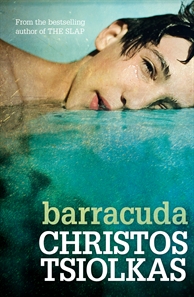
Christos Tsiolkas, Barracuda (Review)

Christos Tsiolkas, Barracuda

Courtesy: Allen & Unwin

The best way I can describe Christos Tsiolkas’ latest novel Barracuda is to liken it to what Tsiolkas would define as a “good man”, tough on the outside, but tender within. I don’t know how Tsiolkas does it, but he manages to reach into your heart while at the same time confronting you to your core.

On the surface, Barracuda is about success and failure, specifically in sport. The plot concerns Danny Kelly aka Psycho Kelly aka Barracuda who is a talented swimmer. He receives a scholarship to attend one of Melbourne’s elite private schools and be coached on the swim team. Danny, with his Scottish truck-driving father and Greek hair-dresser mother, is not the normal demographic for the school and feels an outsider from the start, but he knows – or believes, at least – that he can be “the strongest, the fastest, the best”. However, things don’t go according to plan and Danny, who had poured his all into a single vision for his future, is devastated. The novel explores how a young man copes with such a major blow to his self-image, what happens when his expectations for his future are destroyed. Tsiolkas examines the social, political and economic environment in which Danny lives and the role they play in what happens to him, but he also delves deeply into the psyche, because what happens to Danny can only be partly explained by external forces. In the end we are, as Danny comes to realise, responsible for ourselves and our actions.

Contemporary writers annoyed him

Barracuda is quite a page-turner, but it bears slow reading, because it is a carefully constructed novel and some of its joys come from considering what Tsiolkas is doing. There is an amusing moment in the book when Danny, now in jail, becomes an enthusiastic book reader – primarily of 19th century novels. When the librarian asks:

‘Why are you always buried in those old farts?’ Danny would accept the teasing good-naturedly for he knew it was apt. Contemporary writers annoyed him, he found their worlds insular, their style too self-conscious and ironic.

I say amusing because there’s a self-consciousness in Tsiolkas’ style and I can only assume that he is having a little dig at himself. The novel’s structure reminded me somewhat of Evie Wyld’s All the birds, singing (my review) because both start at a point in time and then, in alternating chapters (sections), radiate forwards and backwards from that point. Tsiolkas, though, follows this structure a little less rigorously than Wyld, and he combines it with a change in person. In the first half of the novel, the sections moving backward are told in third person (limited) through the eyes of Danny, while the sections moving forward are told in first person through the eyes of Dan. This effectively enables the growing, maturing Dan to disassociate himself somewhat from his old self, although the dissociation – or perhaps the reintegration – of the two selves have a long way to go when the book opens. In the second part of the novel the point-of-view is reversed with the third person used for the older Dan, and first person for the younger, perhaps suggesting some progress towards the realignment of the selves? I need to think about this a bit more! Not only does this book warrant slow-reading, but rereading wouldn’t hurt either.

He couldn’t bridge the in-between

A significant issue for Dan is managing the two worlds he finds himself in:

It’s like two worlds were part of different jigsaw puzzles. At first, he’d tried to fit the pieces together but he just couldn’t do it, it was impossible. So he kept them separate: some pieces belonged to this side of the river, to the wide tree-lined boulevards and avenues of Toorak and Armadale, and some belonged to the flat uniform suburbs in which he lived.

When the two worlds conflict, Danny feels split open, cracked apart. “No one could ever put him back together”. And so, he starts to occupy what he calls “the in-between” but that leaves him silent, and alone. This dissection of worlds, of  “class”, and of anglo-Australia versus immigrant Australia, is an ongoing concern for Tsiolkas. We came across it in his previous novel, The slap (my review) and we see it again here. Tsiolkas is not the only writer exploring this territory, but he’s one of the gutsiest because he’s not afraid to present the ugliness nor does he ignore the greys, the murky areas where “truth” is sometimes hard to find (though he doesn’t use the word “truth”).

While Danny is the main conduit for teasing out the tensions in society between two worlds, other characters also reflect it. There’s Danny’s childhood friend, Demet, whose working class migrant background is challenged when she goes to university, and his school friend Luke, a nerdy ostracised boy at the elite school who, with his Vietnamese mother and Greek father, is also “half and half”. These characters manage to traverse their worlds more easily than Danny, but Tsiolkas shows that it isn’t easy.

His father was a good man

Barracuda is about a lot of things. It’s not an exaggeration to say that Tsiolkas taps into the zeitgeist of contemporary suburban Australia. But I might explore that in another post, because this post is getting long and I do want to end on the theme that struck me the most, that of defining “a good man”.

Throughout the novel, Danny meets many men – his father, grandfather and coach, in particular, when he’s a boy, and his lover Clyde, old schoolmate Luke and brain-damaged cousin Dennis when he’s an adult. As an adolescent, and somewhat typically, Danny loves his grandfather, rejects his father, and dotes (until he “fails”) on his Coach. Adult Dan is more circumspect about men, but sees good qualities in Clyde and Luke, while still rejecting his father. None of these men, though, seem able to break through his destructive self-absorption. However, late in the novel, living a self-imposed lonely life, albeit one now committed to helping others, Dan has an epiphany. In a confrontation with his father, he suddenly realises:

His father was a good man. It struck him with a force of revelation, exultation, light flooding through him. His father was a good man. His father was the hero of his own life.

At this moment, he realises he wants to be a good man. He also starts to get a glimmer of what a good man is, and it has nothing to do with being the strongest, fastest and best.

I have more to say about this book, and so will do a follow-up post rather than write a longer essay here. Meanwhile, I know there are readers of this blog who do not like Tsiolkas. He is, I agree, a confronting writer. His characters are not aways easy to like, and he doesn’t shy away from their grubbiest (that is, unkind, violent, sexual) thoughts, but for me he has some valid concerns to share and I want to hear them.

Christos Tsiolkas
Barracuda
Sydney: Allen & Unwin, 2013
515pp.
ISBN: 9781743317310

Monday musings on Australian literature: Australian migration literature

Last week I reviewed Gabrielle Gouch’s memoir, Once, only the swallows were free, in which she tells of her family’s migration from Hungary to Romania to Israel, and then her own on to Australia. While Gouch focuses more on the brother left behind, she does touch on the challenges of migration – the dislocation and loneliness that often ensues. One of the commenters on that post, Ian Darling, suggested that “Australia must have produced some particularly fascinating emigrant accounts in its literature”. We have, and way too many to list here.

It would be worth some time exploring the changes in that literature over the two or so centuries since white settlement – from the early days of British confidence, through to the changes that came as different nationalities started to appear (such as the Chinese on the goldfields in the nineteenth century and the Italian and Greek migrants after the Second World War), to the Asian migration of the later 20th century. But, that’s not what I’m going to do here. It’s nearly Christmas, so I’m going to take it easy and just list a few  I’ve read in recent years that I found interesting. Migrant literature, as you’d expect, crosses genres, particularly literary fiction and memoir.

Yasmine Gooneratne’s A change of skies (1991)

Gooneratne emigrated to Australia from Sri Lanka. I first knew of her as a Jane Austen fan and English literature lecturer at Macquarie University, but then my reading group read her novel, A change of skies, about the experience of migration. She writes about educated middle class migrants – like herself I presume – who work to find a balance between fitting into the new culture while at the same time preserving their Sri Lankan identity.

Melina Marchetta‘s Looking for Alibrandi (1992)

Marchetta’s book is a young adult novel about the daughter of an Italian family and her desire to fit into an Australian world against the family pressure to live the old Italian way. She’s young, bright, and in the last year of high school. She wants to meet boys – and not just Italian ones. She wants to live as her friends do. Gradually, she learns to make peace with her family, to recognise the rich heritage she belongs to while at the same time showing them that she can walk two worlds. It was a hugely popular book when it was published and was later adapted into a successful movie. It is I believe taught in high schools.

Arnold Zable‘s Cafe Scheherezade (2001)

I read this novel a few years before I started blogging. It was inspired by the eponymous cafe in Melbourne at which Jewish immigrants – survivors mostly of the Second World War – would meet, talk and provide support for each other. It is a gorgeous novel, about the power of stories to provide support and aid survival. Zable is a warm, generous writer. I remember the book for that, but I also remember it for  teaching me about the various ways Jewish people came to Australia. I didn’t know, for example, how many had transitioned through Shanghai. Zable’s The sea of many returns, which I reviewed early in this blog, is also about migration and yearning for home – and about the power of stories. Stories, we know, are a powerful mechanism for preserving culture – whether it be our national identity or the micro-culture of our families!

Nam Le‘s The boat (2008)

Le’s book is a collection of short stories, many of which are not about migration, not specifically anyhow. However, two of the stories – ““Love and honour and pity and pride and compassion and sacrifice” and the title story “The boat” which closes the collection – are autobiographical, and draw directly on his life and on family’s experience of migrating to Australia from Vietnam as boat refugees when he was just one. The interesting this is that, while most of the stories aren’t specifically about migration, they do tend to all be about survival, which suggests, to me anyhow, that the experience of migration has strongly informed Nam Le’s world view.

Alice Pung‘s Unpolished gem (2007) and Her father’s daughter (2011)

As with most of the books in this list, I read Pung’s memoir, Unpolished gem, before I started blogging. It tells the story of her growing up in an immigrant household. She focuses particularly on the challenges of being a child growing up in a culture that her parents are unfamiliar with, of being caught between two worlds. While I loved the book, it bothered me a little that she didn’t empathise with, or try to understand her parents as much as I would have liked. I guess she was just young! However, she rectifies this in her next memoir, Her father’s daughter, which I reviewed a couple of years ago. She starts to understand two things – what their lives were like and what they’d lost/sacrificed, and why they had worried about her and tried to protect her the way they did. I loved this recognition in the book:

She started to see her mother and father in a new light. They had a sense of humour! They knew their private lives were completely separate from the world their daughter had described in another language.

Hats off, I say, to all those families who traverse this tricky ground.

Kim Scott‘s That deadman dance (2010)

Up to this point, I’ve presenting this list chronologically, but I wanted to end with this one, because it is, for Australia, the ultimate migration story. Written by an indigenous Australian, it explores the first meeting in Western Australia between British migrants and the indigenous inhabitants. Drawing from documentary evidence, Scott tells a story in which arrogance reigns over good will, setting Australia down a path from which we haven’t yet recovered. Bobby, the main indigenous character, says at one point in the novel:

We thought making friends was the best thing, and never knew that when we took your flour and sugar and tea and blankets that we’d lose everything of ours. We learned your words and songs and stories, and never knew you didn’t want to hear ours.

I think I’ll leave it there …

Willa Cather, Peter (Review)

Surely a whole year can’t have passed since I last wrote about a Library of America short story? But yes, it has. My last one was Robert Frost’s “The question of a feather” in July last year. Many times I’ve chosen one to read, and many times I’ve let other things get in the way – but finally I sat down to read a short piece by Willa Cather, one of my favourite American writers. The story is “Peter” and was apparently her very first published piece. It was published when she was 19 as the result of her university professor sending it off to a magazine.

LOA’s notes, as usual, provide some interesting background, including the information I’ve just provided above. They say that she went on to publish it two more times in 1892 and 1900, each with some revisions, and then incorporated its essence into her novel My Antonia which I’ve reviewed here. No wonder it felt familiar!

English: Willa Cather's childhood home in Red ...

Willa Cather’s childhood home in Red Cloud, Nebraska. (Photo courtesy: Museumsparrow via Wikipedia)

It is, essentially, a character sketch. Its focus is Peter, an old man – now 60 – who emigrated to Nebraska from Bohemia with his wife, oldest son Antone, and other children five years before the story starts. In Bohemia, Peter had been a second violinist “in the great theatre in Prague”.  Without belittling the important role of second violinists, I think in terms of Cather’s story, “second” is meant to convey something about Peter:

He could never read the notes well, so he did not play first; but his touch, he had a touch indeed …

Why he could never read the notes well, we are not told, but we can guess because his neighbours in Nebraska see him as “a lazy, absent-minded fellow”. In fact, it is his son who runs the place:

… people said he was a likely youth, and would do well. That he was mean and untrustworthy every one knew, but that made little difference. His corn was better tended than any in the country, and his wheat always yielded more than other men’s.

There is no love lost between these two rather unappealing men. The story starts with Peter telling his son that “thou shalt not sell it [the violin] until I’m gone”. From his son’s point of view, Peter can no longer play due to trembling and the money would be useful. For homesick Peter though it’s his link to happier times. He doesn’t like “the country, nor the people, least of all he liked plowing”. Cather’s characterisation is effective. We are forced to choose between the hard but hardworking Antone who is trying to support the whole family in a harsh land, and the rather pathetic Peter who, even in his past, was “a foolish fellow, who cared for nothing but music and pretty faces”. Antone and Peter are set up as foils for each other, opposites, and Cather wants us, I think, to see and understand but not judge.

This is a classic migrant story, in which the old find it harder to adapt than the young, for whom the immigration was usually made in the first place! It’s also a father-son/generational clash story. Neither understands each other, and neither seems inclined, it seems, to make many concessions. Given all this, the ending is both shocking and not surprising.

It’s an impressive debut for a 19-year-old writer. However, according to LOA’s notes, Cather regretted allowing her professor to publish it before her style matured. Her biographer Phyllis Johnson wrote that the older Cather “warned aspiring young writers against too early publication”. I wonder why? What damage does she think it did to her? As a reader, I love having access to early works like this – or, to say, Jane Austen’s juvenilia. They illustrate, as LOA suggests, the writer’s “the literary journey”.

What do you think? Do you like to read early/youthful works of favourite writers, or would you rather only read their mature works?

Willa Cather
“Peter”
First published: The Mahogany Tree, May 1892.
(Published several times after this, in various revised versions)
Available: Online at the Library of America

Michael Sala, The last thread (Review)

Michael Sala The last thread bookcover

The last thread (Courtesy: Affirm Press)

It’s clear why Affirm Press chose a comment by Raimond Gaita for the front cover of their latest publication, Michael Sala’s autobiographical novel, The last thread. Gaita, for readers here who don’t know, wrote an award-winning memoir, Romulus, My Father, about growing up as a migrant with mentally unstable parents. Sala’s story is different but both boys suffered emotional deprivations that they chronicle in their books … except, and this is a big one, Sala’s book is classified as “fiction”, and we must therefore read it as such. A bit, in fact, like Francesca Rendle-Short’s Bite your tongue!

So, what is his story? The novel is told from Michaelis’ (later Michael’s) point of view. It is divided in two parts: Bergen Op Zoom and Newcastle. It starts, then, in the Netherlands when Michael is around three or four years old, and his brother, Con (Constantinos) three years older. But it’s not quite this simple, as in the first part which is told third person we follow them from the Netherlands to Australia to the Netherlands and then back to Australia. The family’s unsettled state physically – they also move multiple times in Australia – works metaphorically too because there is little emotional stability in the boys’ lives. At the start of the novel, the mother has left the boys’ father, the Cypriot Phytos, and is living with the physically and emotionally abusive Dutchman, Dirk. (“There’s no problem”, Michael writes of this handyman stepfather, “that he can’t solve with his hands”.) By the end, when the boys have grown up, the mother has been married a couple more times. She is skilled, you would say, at choosing wrong men: “The men in my life take advantage of me”, she says.

What makes this somewhat age-old story compelling is the writing. It is told more or less chronologically but in little vignettes. The two parts are divided into chapters, but the chapters themselves are broken into smaller sections that provide an eye into scenes from Michael’s world. It’s a child’s eye, until near the end, so we readers must try to fill the gaps between what Michael describes and what we know could be the meaning behind what he’s seeing. Why, we must ask ourselves, would a young boy think this:

Michaelis can’t imagine anything more frightening than living forever.

And Michael’s eye, though a child’s one, is very observant. He particularly notices faces, watching them it seems for signs of warmth and connection, but

Each time light blazes from the screen, it washes across Con’s face and reveals it like something carved from stone.

and

She [mother] holds her belly and sighs, and there’s a look in her eyes as if she might burst into tears.

I could be mistaken but it felt to me that as we moved through the second part, Newcastle, which is told first person by the adult Michael, the chronology became more disjointed, mirroring I think Michael’s growing awareness of what lies behind the dislocations in his family, and of its impact on him.

As you’ve probably gathered by now, there are secrets in this family that contribute to the dysfunctional behaviour. These secrets are not mentioned on the backcover, so I won’t mention them either. Sala handles them well. He doesn’t labour them but rather lets them hover in a way that we know they are there but that doesn’t let them occupy centre-stage. We learn to live with them, the way the family has to. In the way of modern novels, there’s no dramatic denouement …

In talking of the writing, I’ve mainly discussed the narrative style but I should also mention the language. It is, in a word, gorgeous. Here are just two descriptions that convey Sala’s ability to capture the essence of things. First, being dumped by a wave:

There is such strength in the sea. He has forgotten it until now. It pulls at his limbs so that his feet touch nothing and only his desperate grip keeps him there. A sensation comes to him of being separate, of seeing it all from a great distance as if he cannot reach out and touch the world. Then the noise dies in his ears, the sky appears again above him.

And next, of his mother’s house:

The rooms and corridors of my mother’s house became like the arteries of a heart attack victim, all clogged up. Even the breeze had to bend in half to get through.

I’ve read quite a bit of autobiographical/biographical fiction, fiction-cum-memoirs, and memoirs in recent months, and some I’ve found a little wanting here and there. This, though, is hard to fault – if, that is, you like reading more for the interior than the exterior, for what’s going on inside rather than for what’s happening in the material world.

In the very last pages of the book, Michael’s mother says that “words and stories can be dangerous” (echoing Francesca Rendle-Short’s “to think, to write, is dangerous”). They can indeed, but sometimes that danger can have positive outcomes. I hope that, for Sala, the dangers of putting his story, his truths, on the page will be restorative. There’s no guarantee though that such bravery will have its just rewards … in life or in fiction.

Michael Sala
The last thread
Mulgrave: Affirm Press, 2012
238pp
ISBN: 9780987132680

(Review copy supplied by Affirm Press)

Ana Menéndez, Celebrations of Thanksgiving: Cuban offerings

I love food and I enjoy reading about food. I particularly enjoy reading about food – and food traditions – from other cultures. And so, when Ana Menéndez’s story popped up on the Library of America last month I made a note to read it. The last piece of food writing that I read from LOA, John Duncan’s “A Virginia barbecue”, was also an example of travel writing. This piece, though, could also be described as immigrant literature: in it Menéndez describes her Cuban family’s Thanksgiving celebrations and how it changes over time as they become more American.

Menéndez commences by describing her how Cuban family celebrated Thanksgiving – what they called Tansgibin – with black beans and rice, fried plantains and yucca. They didn’t know, she said, that they were being “ethnic” or trendy” in eating this food! It’s all about perspectives, eh? She then describes how, as their stay in America lengthened, they went about transforming the meal. For Cubans that meant making pig (or roast pork) the central feature, rather than turkey.

The pig is marinated in mojo” which she describes as

the most important part of the equation and families lived and died by their mojo recipes. Today you can buy a strange chemical syrup in bottles labeled “mojo” – of which the best one can say about it is that it’s another sad example of the banality of exile.

To digress a little, this reminded me of my recent trip to Japan. Our host at a ryokan we stayed at told us that, traditionally, each family would have its own Miso Soup recipe but that now people tend to buy the instant variety in the supermarkets. He, however, wasn’t talking about “the banality of exile” but of the impact of commercialisation (and modernisation). It’s not only immigration, then, that sees cultural practices decline. Anyhow, on with the story …

The whole business, she writes – the preparing of the “mojo”, the digging of the pit and the preparation of the grill for the pig, the men tending to the meat with the women preparing the rest of the meal – was a ritual, and, more importantly, “a happy, bantering gathering”. In fact, she describes herself as

one of the few women of my generation who does not consider the kitchen a chore or an affront to my independence, but rather a place of warmth and sustenance.

I take her point – to a point! But that’s another story.

Menéndez then describes how, little by little, change occurred. Someone brings a pumpkin pie (breaching the wall, she says), then comes the cranberry sauce, and a stuffing … and the final blow, the pig is replaced by the turkey. Not only are there concerns that the pig might be unhealthy but it starts to seem like “an embarrassing extravagance, a desperate and futile grasping after the old days”. Our author admits to liking the change. As the younger member of the family, she had become annoyed by

my family’s narrow culinary tastes – which to me signaled a more generalised lack of curiosity about the wider world.

Fascinating how food (and attitudes to it), as she says a little earlier in the article, prefigures change. And yet, change doesn’t come easily. Her family didn’t know how to cook turkey so, what did they do? Well, they cooked it like they cooked their pig. And then they would bestow their best compliment on the cook: “This tastes just like roast pork”!

I enjoyed the article … it provides much food (sorry!) for thought. Even in my own Christmas celebrations I love to find a balance between maintaining family traditions – so that the meal feels like Christmas and not just another festive event – and injecting some change (or difference) each year so that the tradition doesn’t become stale. How much tricker though this challenge is for immigrant cultures. What do you keep? What do you let go? And why?

At the end of the article is her recipe for Mojo … so if you’d like your turkey next year to taste like pork (or, at least, Cuban), you can look it up (in the link below).

In addition to writing pieces like this, Menéndez has written two novels, Loving Che (2004) and The last war (2009). Before them, she published a short story collection, In Cuba I was a German Shepherd, which was a 2001 New York Times Notable Book of the Year.  LOA’s notes tell us that her overall theme, as in this story, is the experience of exile. I wonder if any readers here – Americans particularly – have read her? I’d love to know what you think.

Ana Menéndez
“Celebrations of Thanksgiving: Cuban offerings”
First published: US Society & Values, 9 (4), July 2004
Available: Online at the Library of America