Julie Janson, Benevolence (#BookReview)

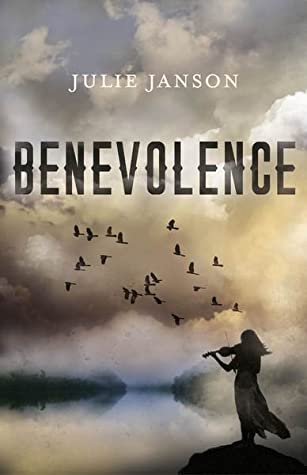
In a rather curious synchronicity, the last three books I’ve read have all had single word, multiple-meaning, titles, all relating to the colonial settlement of Australia – Gay Lynch’s historical fiction Unsettled (my review), John Kinsella’s memoir Displaced (my review), and now Julie Janson’s historical fiction Benevolence whose title drips with irony.

Recently, I commented that it would be good to see an Indigenous Australian novel responding to Kate Grenville’s The secret river. Well, it appears that Benevolence is that novel. In her Acknowledgements, Janson, of the Darug Nation, writes that Benevolence is “a work of fiction based on historical events of the early years [1816-1842] of the British invasion and settlement around the Hawkesbury River in Western Sydney, New South Wales”. Protagonist Muraging, renamed Mary by the colonisers, is based on the author’s ancestor, Mary Ann Thomas, just as Grenville’s novel, set around the same place and time, was inspired by, though not exactly based on, her ancestor, Solomon Wiseman. There, of course, the similarity ends, because while Grenville’s protagonist becomes a “big” man in colonial Sydney, Muraging’s experience is very different.

Benevolence starts in 1816, when the motherless Muraging is “about 12 years old” and handed over by her father to the British to be taught English at the Parramatta Native Institution. She is, says her father (naively we now know), “to be an important part of helping their people and she must learn their language and their ways”. Thus begins Muraging’s life of being caught between two cultures. Early on “she thinks she can be in two worlds and not have to choose”. However, she is never properly accepted by the British (of course) and, while accepted by her own Darug people, it is clear very early that Indigenous culture is being dismantled by dispossession, dispersal and death (through disease, murder and massacre), resulting in Indigenous people’s lives (already) becoming one of survival rather than of living fully.

And so, as the novel progresses through the years, we follow Muraging as she leaves or escapes the British settlement to find comfort, support and/or protection within Indigenous communities, only to return for one reason or another to the settlement, with the cycle starting all over again. Each time she returns to the settlement, the brutality and humiliations ratchet up. It’s a terrible story, but a credible one based on Janson’s detailed research, part of it done while she worked as a senior researcher for Professor Peter Read at the University of Sydney. This research resulted in the creation of the History of Aboriginal Sydney website.

However, this book is not history but historical fiction, so the characters are inspired by a mixture of historical fact and Janson’s imagination – and it is her imagination that brings these characters to life as authentic beings, particularly Muraging, her mixed-up friend Mercy, the weak-if-well-meaning reverend Henry Smythe, and to a lesser degree Captain Woodrow. The grotesque reverend Masters is another matter altogether.

Muraging is established from the start as a person with agency. She does not want to be a “servant” or “a fine maid”. Rather, she wants, she says, to ‘”improve my situation” … but she is ignored’. She never gives up her search for an independent life, and, though she makes poor decisions at times, she behaves courageously, loyally (sometimes at great risk to herself), and in a way determined to be true to herself and her people.

“You have no home” (Masters)

While the personal implications of colonialism and dispossession are conveyed through Muraging’s story, Janson reinforces this with historical fact, including references to documented massacres, discussions between characters about current events, and the occasional appearance of a governor (like Macquarie, like Gipps.) Janson also opens selected chapters with specific historical information. Chapter 4 (“1818: White people things”), for example, begins with an excerpt from the Sydney Gazette reporting massacres from, of course, the settler perspective. Chapter 20 (“1835: Deerubbin, The Hawkesbury River”) commences with a statement about Governor Bourke passing “the Proclamation of terra nullius”. And so on. These occasional documentary facts anchor Muraging’s story in the historical timeline.

The biggest villain of the piece is the appropriately named Reverend Masters. He represents the worst of British power, conveying or enacting British policy with little thought for the humanity of those he deals with. Like a certain world leader today, it’s all about him.

And this brings me to the writing. Janson’s descriptions are beautifully lyrical, though not always simply so. The novel opens with:

The grey-green eucalypts clatter with the sound of cicadas. Magpies and currawongs warble across the morning sky as the sun’s heat streams down. It is eaglehawk time …

Almost idyllic Australia, except “eaglehawk” time suggests the idea of violence … of hunter and prey!

There are also wry ironic touches, such as Captain Woodrow’s comment, “I have fought savages on the Indian frontier and I know that no honour exists among savages”. Hmm, who are the savages without honour here? Or, good guy ex-convict Ferdinand, with his Darug wife, defying Masters with “This is my land. My grant.” Whose land? In such ways, Janson encourages us to think behind the words of waibala people.

I also like the way Janson used local Indigenous language throughout the novel, enough to convey (and promote) local culture and language, but not so much as to impede understanding.

I was less comfortable, however, with the writing about actions and events. It can be quite cut-and-dried, with a disjointed or staccato feel that, for me, broke the flow of my reading. Maybe this was intended, as Lisa (ANZLitLovers) has suggested, to convey the violence – or, at least, the instability – of that world. I can see that, though I’m not sure it fully worked that way for me.

And finally, of course, there’s that powerful title. Who thinks they are benevolent, who pretends to be benevolent, who really is benevolent, not to mention what is benevolence anyhow, are the questions that confront us on every page of this timely novel.

“You won’t win, you know” (Masters)

Benevolence, then, is a compelling and worthwhile read. The history is good, offering First Nations readers something that more closely accords with their understanding of what happened, and non-Indigenous readers a corrective to the history we’ve been fed most of our lives. The story is engaging, with Janson treading a fine line between utter negativity and unrealistic hopefulness. I particularly liked the tone struck by the ending, but that’s for you to find out!

We need more books like this …

Challenge logo

Julie Janson
Benevolence
Broome: Magabala Books, 2020
345pp.
ISBN: 9781925936636

(Revieve copy courtesy Magabala Books)

Anna Goldsworthy, Melting moments (#BookReview)

Book cover

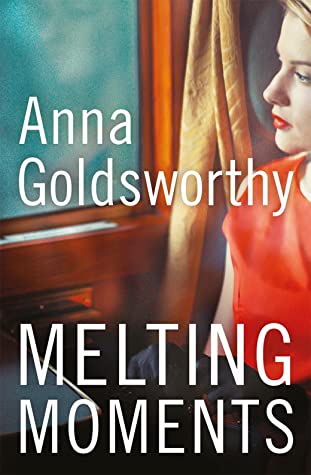
Melting moments is Australian writer and concert pianist Anna Goldsworthy’s debut novel, following her highly successful memoir of a decade ago, Piano lessons (my review).

Melting moments – for those not familiar with this Antipodean classic – are little shortbread-based biscuits (cookies) sandwiched together with buttercream. In titling her book by these little treats, with the added intimation of moments that melt our heart, Goldsworthy flags the tone and subject matter of her book. The tone is going to be gentle, and the subject matter domestic. The question is: does this make for an interesting book, or just a sweet one?

Overall, I’d say interesting. As a member of my reading group suggested, there is another connotation of the title, that of moments that melt away, of moments that don’t last. So, Goldsworthy’s Melting moments captures the life of a woman from the so-called “greatest generation”. Born between 1901 and 1927 (so my mother just misses it), they went though the Great Depression and World War 2. Sociologist Glen Elder suggests they came out of these experiences “with an ability to know how to survive and make do and solve problems”. This could describe Goldsworthy’s protagonist, Ruby, who marries Arthur, after a short courtship, on the eve of his heading off to the War. She might as well have the “war widow pension” he says, an idea that was, I think, behind a few marriages at the time. This social history aspect is one of the reasons for reading this book which takes us through the decades of marriage, children, empty nest, ageing parents, retirement village life, leaving us when Ruby reaches her early eighties.

This, I know, makes it sound like one of those big family sagas, but in fact it’s not, on two counts. First, it’s short, at just 230 pages, and second, it has no big dramas – just the little trials and tribulations of life.

“misplaced life”

However, this doesn’t mean the book is boring. Ruby lived in the pre-feminist world when women had few rights but many gender-prescribed responsibilities – stay-at-home, cook and house-keep, bring up the children, and keep the husband happy. Like many of her generation, she doesn’t rock boats, but knuckles down to it (using her consciously developed “resourcefulness” to help her along the way). But, she’s not blind to what all this means and, sometimes, she feels

the emptiness rush in at her, as if she were living on a road from nowhere to nowhere …

Or, occasionally wonders

whether life should be something more than a series of daily tasks, successfully dispatched.

Indeed, later in the novel, she considers a path not taken – one involving throwing it all in for the exciting man. But that way led to “briars … social condemnation; impecuniousness; the heartbreak of children”, and, anyhow, the man had removed himself. Nonetheless, she sometimes feels

as if she had missed a summons. As if she had somehow missed her life.

This situation, of course, is not unique to her generation, but it is true that making such a break in her era would have been more difficult. And, anyhow, Arthur, as Ruby recognises herself, was not a bad husband – just a “stolid” one – and their marriage was “more or less” successful.

The novel is written third person, but its focus is Ruby, meaning that the other characters are not significantly fleshed out. Most are nonetheless more than just simple stereotypes. The “stolid” but kind Arthur, for example, is more willing to accept daughter Eva’s grasping the freedom of the 1960s and 1970s than Ruby. And Eva, though frustrated with her mother’s conservatism and inability to understand the changing world, is a loving daughter who finds a balance between living her life her way and loving and supporting her mother.

Ruby’s parents have some individualised flesh on their bones too, but Arthur’s mother, Granny Jenkins who lives with them much of their married life, is rather more the stereotypical unsupportive, demanding mother-in-law. However, Ruby just gets on with that too – as most women did – organising things as much as she can to minimise the imposition .

Now, early in this post, I mentioned that this book, despite its chronological sweep, is not a saga. This begs the question of how Goldsworthy tells the story of such a long life in such few words. She does it by using an episodic structure, skilfully paced so that you always know where you are in Ruby’s life. The gaps are obvious, of course, but it’s also clear that we are getting the critical “moments” in Ruby’s life.

The end effect of all this is a quietly observed book, one unsatisfying for some, and perfectly satisfying for others, as my reading group discovered. Some of us wanted the gaps filled in. Why was Arthur released early from active service, for example. Others of us accepted that the focus was Ruby and what she thought and cared about. When the opportunity finally comes when Arthur might share his war story, she turns away and makes a cup of tea! “What’s done is done”, she says.

There is some humour in the book, and I did smile many times, but, while it felt like an Austen-ish story, it doesn’t have the sharpness of her wit. I must say that in a nicely observed story like this, I did miss that bit of bite.

Melting moments, then, did not exactly wow me, but neither did I find it trivial. Without being consciously political, it works as a reminder of those women who didn’t always identify what it was that caused their feelings of “emptiness”, but who just got on with it, and somehow managed at the same time to bring up the Evas who went on to grab the opportunities available. Goldsworthy has paid credit to them, in a warm-hearted and enjoyable book.

Challenge logo

Anna Goldsworthy
Melting moments
Carlton: Black Inc, 2020
230pp.
ISBN: 9781863959988

Monday musings on Australian literature: Modern sensibilities and Historical fiction

Book cover

Following last week’s Monday Musings, and my recent review of Gay Lynch’s historical novel, Unsettled, I thought it might be worth teasing out the fraught issue of “modern sensibilities” in this genre.

By teasing out, I mean that this will not be a thorough analysis of the topic so much as my sharing a few ideas and thoughts for you to respond to with your own.

I was inspired, of course, by Bill (The Australian Legend) – who wouldn’t be! – when he commented on my review of Unsettled that “I’m glad that she included the Boandik people and that they had some input. I suspect though that Rosanna has modern sensibilities when it comes to Indigenous relations.”

I could research the journals and letters of women at the time to see what discernment there might have been among those women, but most likely women from oppressed groups like Rosanna’s are not well represented in the papers held in libraries and archives. For a start, many may not have been able to read, though Rosanna could. Those who could read would have, like Rosanna, struggled to afford paper. Writing journals and letters was probably rare for them.

Consequently, I’ve decided to tackle the wider issue, rather than try to prove this particular one.

Why do people write historical fiction? I quoted HNSA in last week’s post as saying that historical fiction presents “an authentic world which can enrich a reader’s understanding of real historical personages, eras and events”.

Lynch made it clear in her Acknowledgements, as I wrote in my post, that she wanted to “to materialise Lynch girls” who were absent in all meaningful ways from the record. She noted that their “lack of documentation and therefore their invisibility reflect their early settlement status on the frontier.” So, how to do this without documentation? And how are we to assess this?

Let’s start with what we want from historical fiction? What I want is light to be thrown on issues relevant to now. Sure, stories can be fun for their own sake, but I like my stories to have something more. I want to be challenged to think about how things were, and how they affect or reflect how things are. In other words, I want to get at the “truth” of history. The thing of course is that the “truth” of history does change with the times, whether we like it or not.

Right now, in Australia, historical “truth” includes issues like the invisibility and powerlessness of women, and the dispossession of Indigenous people. It hasn’t always been so. There was a time when historical “truth” focused on what many of us now view as the ANZAC myth. There was a time when the story of early settlement was only about the hardship faced by and the achievements of the white settlers. And, so on … history may be based on facts but how those facts are interpreted, which facts are interpreted, who is interpreting them and why, makes all the difference.

In a past post, I included the following from novelist Jose Saramago’s The Elephant’s Journey (2008):

It must be said that history is always selective, and discriminatory too, selecting from life only what society deems to be historical and scorning the rest, which is precisely where we might find the true explanation of facts, of things, of wretched reality itself. In truth, I say to you, it is better to be a novelist, a fiction writer, a liar.

The novelist, then, can explore “truths” that society may scorn (reject) as not being “historical” or, I would add, that is not readily available on the historical record. However, how do you convey historical “truths” in situations where they come with a lack of record, with minimal evidence or facts. If you are powerless and dispossessed you are unlikely to leave a verifiable mark. How, in this circumstance, do you convince your readers that your characters and/or story are authentic as well as true?

Authors, I’d argue, have to start by presenting the times and characters in ways that feel authentic; they have to get enough of the “facts” right that we are happy to go along with what might be less easy to verify. Then, they have to present an interpretation of the facts that makes sense according to what we believe or know to be true.

I have been interested in this issue for some time, and have shared on this blog the thoughts of various novelists expressed at events I’ve attended. I thought I’d reiterate some here.

Robyn Cadwallader, The anchoress

Robyn Cadwallader, who has written two mediaeval historical novels, The anchoress (my review) and Book of colours (my review), spoke of her interest in ordinary women and how they “managed to find value in their lives within the constraints” of their times. She spoke of the challenges of making these women’s gains and achievement believable for those times, of not wanting to “damage” them “by presenting them differently from what they are”.

Rachel Seiffert, who has written historical fiction about the Third Reich, spoke about how her character in A boy in winter doesn’t know the Holocaust is proceeding. Her challenge was to show that he had to make choices not knowing the full story, which the readers do know.

(Seiffert’s point here is relevant to the idea that we should only read fiction written at the time it is about. As she says, people at the time do not “know” their whole time. They cannot therefore provide the perspective we gain in retrospect, and which historians and historical novelists offer us.)

Roslyn Russell, Maria Returns Barbados to Mansfield Park

Historian and historical fiction novelist (Maria returns: Barbados to Mansfield Park), Ros Russell, spoke about ethical responsibilities, saying that historians must not distort what they find. They must be true to their sources, but she always looks out for things that might say something different to the prevailing narrative.

In the end, the issue of “modern sensibility”, particularly where the author has rendered the period authentically, comes down to the reader. We have to decide whether that authenticity includes the novel’s characters sounding just like prevailing views of their era, or whether we accept that there were always people who “bucked” that prevailing view.

As you probably know, I’m with the latter group. So, if I’m happy with the overall authenticity, I’m prepared to give novelists the benefit of the doubt if their characters express views that seem to be “modern”. So-called “modern” ideas don’t pop out of nowhere, after all …

Now, over to you … where do you stand on this issue?

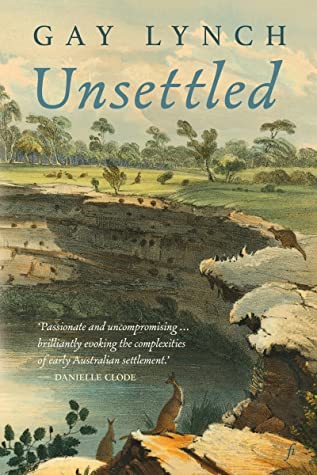
Gay Lynch, Unsettled (#BookReview)

Coincidentally, my first review after this week’s Monday Musings on historical fiction happens to be a work of historical fiction, Gay Lynch’s cleverly titled Unsettled. Consequently, I’m going to start there, that is, talking about the form.

Well, more or less, because I should at least give you a sense of its subject. It is set primarily in South Australia’s Gambierton (later Mt Gambier) from the 1859 to 1880, with most of the action taking place in the 1860s. It’s the story of an Irish family, the Lynches, who migrated to Australia in 1848. The Lynches, as you might have guessed from the author’s name, are based on her husband’s family. Unsettled explores their story primarily through two fictional characters, Rosanna and her younger brother Skelly.

… in the spirit of the story

Which brings me to the genre. In her Acknowledgements, Lynch provides some useful insights into the book. Firstly, regarding intention, she says that she specifically wanted “to materialise Lynch girls, absent from every family anecdote and official documents, church, state and school, apart from their birth documents … the girls’ lack of documentation and therefore their invisibility reflect their early settlement status on the frontier.” The challenge, of course, in “materialising” invisible characters from the past is to make them real, and avoid anachronism. This is difficult when records are few, but I think there are enough records of frontier women in general to validate Lynch’s conception here.

Lynch also addresses where she has changed Lynch family “facts”, such as their and their employers’ names. She also says that her two main characters, Rosanna and Skelly, “exist only in [her] imagination”, but “her lived experience as Lynch wife and mother, verifiable historical events, and historical Lynch antecedents” offered her “the connective tissue” needed for their fictional lives.

She goes on to say that “in the spirit of historical fiction” she has kept close to official records so that the characters drawn from life are as “true” as she can make them, but that “in the spirit of story, some events may not be verifiable”. That, of course, is historical fiction; it’s about fleshing out lives and times with story, where the facts are not known or are minimal.

Finally, she addresses her inclusion of the local Boandik people, an issue we often discuss here. She writes that they “tell their own South-East story – they still live on that once dangerous frontier, on land they never ceded – of their attempted eviction and genocide”. She says she “benefitted from knowledge shared by Boandik custodian Ken Jones”, conversed “with Boandik linguist linguist David Moon”, and was supported in addressing “important questions about voice and Indigenous historicity”. As I’ve said before, it’s really up to the Boandik people to say whether they agree with their representation, but Lynch has, it seems, done the right thing: she has included them in her narrative (in an appropriate way) and has conferred with the people she ought about doing so.

I’ve spent a bit of time on this I know, but it’s important with historical fiction to be very clear about what it is we are reading. I’m not an expert in South Australian settler history, but I feel Lynch has provided me with enough here, in addition to the knowledge I do have, to reassure me that her story is a valid one, so let’s get to that …

“now that the country is settled”

Nearly halfway through the novel, Rosanna converses with her employer, the hard, English station-owner, Mr Ashby. He is searching for some local Indigenous people who, he believes, have been “filching” from him. Rosanna, who has befriended the young local woman, Moorecke, tells him that Moorecke “belongs on this land”. She adds, hoping to throw him “off the scent”, that she rarely sees “Blacks, now that the the country is settled.”

Here, and throughout the novel, Lynch layers meanings in brief exchanges. Implied in this little scene, for example, are multiple power imbalances – between settlers and the original inhabitants, between the landowning English and the oppressed Irish, and between man and woman. And of course, overlaying this is the fraught idea of being “settled” and all its connotations, political and personal, physical and emotional. “Now that the country is settled” implies of course that it was “unsettled” before. This novel, with its title, “Unsettled”, keeps this foundational wound front and centre in our minds, which, dare I say, “unsettles” us.

This layering of meaning is one of the reasons I found the book an enjoyable read, because I enjoy such thoughtful, provocative writing, but the enjoyment here is compounded by the characters, particularly Rosanna and Skelly. Both are well individualised, with the novel’s third person perspective shifting mainly between them.

Over the course of the novel, Rosanna is our guide to what happens on the frontier. She works for the landowning Ashbys; she spends time with and learns from Moorecke of the Boandik people; she rides with the poet Adam Lindsay Gordon and confesses to Father Tenison Woods. She falls in love naively, makes many mistakes big and small, can be mean and tender, but she is a warm, courageous young woman who is determined to make her way authentically through a world which pays little attention to the dreams, let alone rights, of women. A world, in fact, in which “men are dangerous creatures if thwarted”.

Skelly, her sensitive and somewhat frail younger brother, is both foil and support to Rosanna. Their relationship contains the typical sibling tensions, but love and loyalty underpin it. It is what happens to Skelly at a school in Melbourne that propels Rosanna’s actions which provide the novel’s opening drama.

As is common in historical fiction, Lynch uses a family drama to drive the narrative forward and engage our emotions and interest. Lynch also imbues her story with references to both Australian and English literature of the times. For keen-reader Rosanna, Anthony Trollope’s Irish heroine Feemy Macdermot, from his first novel The Macdermots of Ballycloran, offers lessons to heed.

The main work that threads through the novel, however, is Edward Geoghegan’s play The Hibernian father, which was a popularly performed tragedy in mid- to late-nineteenth century Australia. It tells a tragic story of the Lynches of Galway, whence our own Lynches had come. The tragedy distresses our young Lynches, and threatens to destabilise them as they struggle to forge their lives without failing in the same catastrophic way. Rosanna’s father Garrick Lynch reassures his family that “it’s an ancient story … from bloody times”, but the irony is that “bloody times” are still with them.

In the end, all of this has one goal, to serve the real point of Lynch’s story, the complicated politics of settlement, oppression and dispossession, the injustices of colonialism. As Rosanna becomes aware, during an interaction with her employer Mrs Ashby, “living on the edge of civilisation unsettles everyone”. Gay Lynch’s book does the same – and that, I’m sure, was her intent.

Challenge logo

Gay Lynch
Unsettled
Balmain: ligatu.re, 2019
421pp.
ISBN: 9781925883237

(Review copy courtesy the author.)

Monday musings on Australian literature: Supporting genres, 1: Historical fiction

While my prime focus here is literary and classic fiction, I do also delve into other forms (like biography, autobiography/memoirs, poetry, history), and other genres (like crime, dystopian fiction, and historical fiction). So, I’ve decided to start a little MM subseries on other genres and forms, starting with historical fiction. My aim is less to analyse the genre itself, than to share some of the ways in which it is supported in Australia.

I’m starting with historical fiction because of the recently announced longlist for the inaugural ARA Historical Novel Prize, which Lisa (ANZLitLovers) posted on recently. Let’s start with the prize’s home, the …

Historical Novel Society of Australasia (HNSA)

HNRA describes itself as

the third arm of the international Historical Novel Society, and is recognised as the home of the historical fiction genre in Australasia. The Society promotes the writing, reading and publication of historical fiction … Our events showcase the best literary talent and enable readers, writers and publishing professionals to celebrate the genre.

They consider historical fiction

to be important to both the entertainment and education of readers as it contributes to the knowledge of the reader and provides a valid perspective beyond the viewpoint of the historian. Both the imagination and dedication of historical novelists present an authentic world which can enrich a reader’s understanding of real historical personages, eras and events.

The secret River cover

While I agree that there is an educative aspect, we readers need to appreciate what sort of education we’re getting. We can’t expect certifiable facts but can expect insight into how things were or might have been. My favourite historical fiction, though, does more; it explores the past in a way that throws light on the present. I find the statement that historical fiction provides “a valid perspective beyond the viewpoint of the historian” interesting in light of The secret river controversy. Beyond? I think alongside might be better?

Anyhow, on the ARA Historical Fiction Prize page, they define historical fiction. It:

  • means novels written at least 50 years after the events described, or written by someone who was not alive at the time of the events and who therefore approaches them only by research.
  • can include historical mystery, historical romance, historical fantasy, and historical fiction written for children and young adults; and also alternate history, pseudo histories, time-slip novels, multiple-time novels, and parallel narrative novels with flexibility to crossover between eras stretching from 50 years or more in the past until contemporary times.

HNSA has now held three biennial conferences – in 2015, 2017 and 2019. They also offer a suite of prizes/awards of which the new ARA Historical Novel Prize is “the crown jewel”. The others are the ARA HNSA Short Story Contest and the TCW HNSA First Pages Pitch Contest. They also offered a Colleen McCullough Residency on Norfolk Island in 2019, and this year instituted the Elizabeth Jane Corbett Mentorship for Young Adult historical novelists (that is, for previously unpublished writers of young adult fiction, not for writers who are young adults1)

ARA Historical Novel Prize

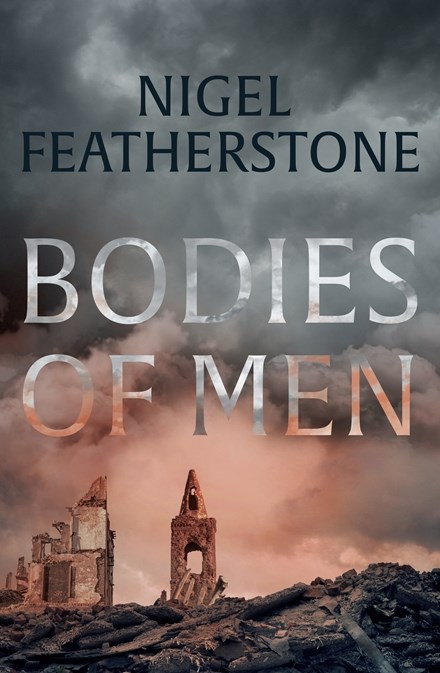
Nigel Featherstone, Bodies of men

This prize, which is supported (fascinatingly) by a building and facilities company, the ARA Group, is worth $60,000, with $50,000 going to the winner, and $5,000 each to two short-listed writers. It is open to Australian and New Zealand writers. The longlist was announced on 6 October, with the shortlist of 3 books to be announced 28 October, and the winner on 10 November.

The inaugural 2020 longlist is:

  • Sienna Brown’s Master of my fate 
  • Nigel Featherstone’s Bodies of men (my review)
  • Catherine Jinks’ Shepherd
  • Mirandi Riwoe’s Stone Sky Gold Mountain (want to read, Theresa’s review)
  • Dominic Smith’s The Electric Hotel (my review)
  • Christos Tsiolkas’ Damascus (my review)
  • Pip Williams’ The Dictionary of lost words (on my TBR, Lisa’s review)
  • Tara June Winch’s The yield (my review)

Surprisingly for me, I have read half of them!

HNSA Conferences

In 2019, the conference included a full-day academic stream, focusing on the overall conference theme of History repeats. There were three panels through the day: Genre and gender; Genre and the discourse of history; and War and conflict. Abstracts of the papers can be found at the link above.

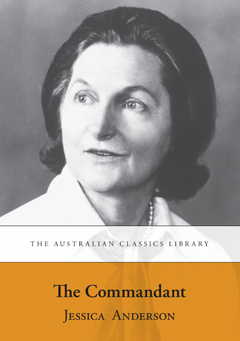
Jessica Anderson, The commandant Book cover

One of the papers was “‘the truth of the book’: Jessica Anderson’s The Commandant as a work of biofiction, Merran Williams“. I have reviewed this book, which is Anderson’s only historical fiction work. In her abstract, Williams says that “Historical novels have the ability to provide unique insights into untold histories” and that

Anderson subverted the traditional biofiction of a man of importance by feminising the masculine history of Patrick Logan and the Moreton Bay convict settlement and telling much of his story from the point-of-view of the soldiers’ female family members. I focus on her fiercely forensic approach to historical research and how she applied this to her writing practice to produce a work of historical biofiction that shines a light on a foundational period of Australian history.

This is a stream of the conference I’d love to attend if it ever came my way.

AWW Challenge

Challenge logo

Many of you know that I have been involved in the Australian Women Writers Challenge pretty much from its inception. It collects on-line reviews by contributors of any books – all forms and genres – written by Australian women. At regular intervals, mostly monthly or bimonthly, volunteers post round-ups of reviews contributed in the previous period for specific genres/forms. Our current Historical Fiction volunteer is Theresa Smith (Theresa Smith Writes.)

You can find her Historical Fiction round-ups at the AWW site. The Books Reviewed search page will find all contributors’ reviews posted to the challenge. The site comprises an excellent resource for reviews on books published recently and in the past, because our reviewers read widely.

Other

The Nib Literary Award could be seen to support this genre in a broad way, because, although its winners tend to be non-fiction, its aims are to celebrate excellence in research, including in fiction.

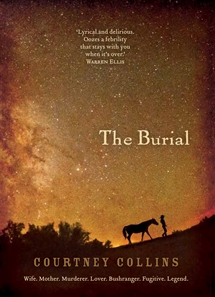
Courtney Collins, The burial

There is also an interesting international site called historicalnovels.info which devotes a page to Australasia. It’s uncomfortably simplistic in its understanding, offering this about Indigenous Australians regarding historical fiction: “Native Australians, dubbed Aborigines by European settlers, did not fare well as colonization spread, but modern novelists recognize the positive aspects of their culture”. However, for readers looking for a list of Aussie historical fiction books, there’s something here. The list includes classic and contemporary novels – including writers like Eleanor Dark and Brian Castro! I learnt a few things, including that Courtney Collins’ The burial (my review) was published in the USA as The untold.

I’d love to hear what you think about historical fiction – even you Bill! – particularly regarding whether you like and why or why not?

Emuna Elon, House on endless waters (#BookReview)

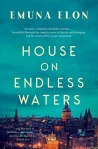
Book coverI’ve said before that I’m surprised by how many takes there can be on World War II, and on the Holocaust, in particular – and once again I’m here with another such story, Emuna Elon’s House on endless waters. I hadn’t heard of Elon before but, according to Wikipedia, she’s an Israeli author, journalist, and women’s rights activist. Her first novel translated into English, If you awaken love, is about life on the West Bank, where she lived for many years.
House on endless waters, however, is historical fiction – or, at least, one of those novels which flips between the present and the past. It tells the story of successful Israeli author Yoel Blum who had been told by his late mother to never go to Amsterdam, from which they’d emigrated. However, the time comes when the middle-aged and internationally successful Blum is urged to Amsterdam by his literary agent to promote his latest Dutch-translated novel. While there, he and his wife visit the Jewish Historical Museum, and here, in a little looping video, he catches an image of his mother Sonia in Amsterdam during the war. Next to her is a man holding a little girl, his sister Nettie, but the baby she is carrying is not he! Who is this baby, and where was he?

Yoel returns to Israel, but, after obtaining the incomplete information his sister is able to provide (which is not divulged to the reader), he goes back to Amsterdam, alone, to research his past and write a novel about it. The result is one of those novels within a novel, as we follow Yoel’s journey alongside reading the story he is writing as he uncovers his family’s – and his – past. How much is “true” and how much Yoel imagines is not the point. We are carried along in the horrors of war-time Amsterdam, in stories of decent hardworking people’s disbelief that life could change so horribly so quickly, of Jewish collaborators, of the hidden children, of the most difficult choices people have to make. Elon conveys viscerally the shock felt by Jewish citizenry as one by one their rights are removed and as the foundations of their lives – something they thought immutable in such a place as Holland – crumble.

Much of this story has been told before. Anne Frank comes to mind of course, and many novels have dealt with the ways in which Jewish people were gradually ostracised and betrayed by their own society (the yellow stars, the loss of jobs, the resumption of homes, the rounding up, the transporting to concentration camps, and so on). What makes this one a little different – at least in my reading to date – is its exploration of the hidden child phenomenon, within a larger story of collaboration, betrayal, resistance and difficult choices.

The important thing, however, is less this difference than that it is a deeply absorbing read. Elon’s ability to manage her two story threads, and maintain our interest in both, speaks to a practised, skilled writer. There is no rigid chapter by chapter alternating of stories. Rather, as Yoel becomes increasingly invested in the life of his mother, Elon starts to blend the two stories, with Yoel sometimes feeling himself in both stories at once. As his sense of self becomes increasingly discombobulated, the line between past and present starts to blur:

Yoel would have liked to write about the architectural significance of Amsterdam, about the implication behind the labor invested in the rows of tiny reddish bricks, about the stylized cornices above the windows and the artistic embellishments that adorn every single building. But early the next morning, Sonia is walking along the street, and across the road the police are evicting a Jewish family from their beautiful art-nouveau-design house. The members of the banished family are trying to walk proudly to the truck that has come to take them away …

For Yoel, unlike the tourists he sees blithely enjoying the sun and culture of Amsterdam, “the past is still here” and it begins to overwhelm him.

Why a story-within-a-story?

This bring me to the question of why would Elon use the story-within-a-story-device? I can think of three reasons, the most obvious being that it draws the reader into the story, engaging us in its unravelling along with the protagonist. Secondly, in this case, it also mirrors how many children of the Holocaust generation didn’t know their parents’ stories – weren’t told them – and therefore had to work out those stories piece by piece. Finally, also in this case, it enables Elon to expose the personal development of her narrator, Yoel, who is initially revealed to be decent but emotionally remote. Very early in the novel, we learn this about him:

Perhaps the day will come when he’ll even train himself to live, a day when he will walk the earth like everyone else without being overcome by the thought that in fact it’s odd , even ridiculous to be a human being …

He is, says his wife, “scared of living”. This novel, then, is partly about identity. Yoel didn’t know his past but it’s clear that the traumas of that past had unconsciously impacted him, as we now know they do. Slowly, as he comes to understand who he is, he also starts to live, to be an engaged human being.

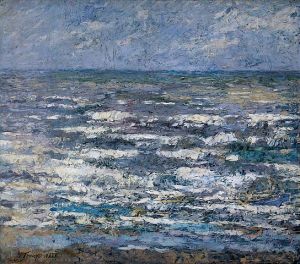
Jan Toorop, The Sea at Katwijk, 1887 (Public Domain)

There is much to this book, with Elon and her novelist Yoel drawing on art and music to reflect both Holland’s cultural achievements and its darker side. A motif running through the book is a stolen work of art – Jan Toorop’s The Sea at Katwijk – that had belonged to Sonia’s friends, Anouk and Martin, who are implicated in what happens. Martin suggests to Sonia that the painting is more about Toorop – “every painter evidently knows only how to depict himself” – than place. However, Sonia also sees herself in it: “there she is in black, there in red, there she is borne from wave to wave, moving in the infinite.” For Yoel, this sea “is a huge finite vessel containing infinite waters”. All this contributes to the novel’s message, one which Yoel finally realises Sonia was telling him:

Whatever was, was. Those waters have already flowed onward.

The trick is to know when to fight those waters, and when to let your “heart encounter the heart of the sea” and be at peace.

House on endless waters came to me out of the blue, but what a find. A Holocaust novel, it contains the horrors of that time but is also imbued with a generous, philosophical spirit that, without excusing atrocity, recognises the humanity of those who made selfish decisions and those who had to live with them. We need perspectives like this.

Emuna Elon
House on endless waters
Translated from Hebrew by Anthony Berris and Linda Yechiel
Sydney: Allen & Unwin, 2020 (Orig. ed. 2016)
309pp.
ISBN: 9781760877255

(Review copy courtesy Allen & Unwin)

Karen Jennings, Upturned earth (#BookReview)

Book coverIntroducing my review of South African writer Karen Jennings’ debut novel, Finding Soutbek, I noted that I don’t normally accept review copies from non-Australian publishers but that I will, very occasionally, make an exception if the writer or subject matter interests me. Upturned earth, Jenning’s fifth book, is set in a nineteenth century mining town. Given some general similarities between colonial South Africa and Australia, and my own, albeit youthful, experience of living in a mining town, I was intrigued to read it.

Upturned earth is set in 1886 in Namaqualand, the copper mining district of what was then Cape Colony. It’s an arid region crossing the South African-Nambian border, with its largest town being Springbok (Springbokfontein at the time of the novel). The novel commences with the arrival by boat from Cape Town of 28-year-old William Hull, who is due to take over as magistrate. On first appearances, Hull seems almost like an antihero:

Weak-willed, forgetful, Hull was a poor employee. He did as he was told, yet somehow was never able to fulfil the chores of the position with the same success as his colleagues did. He confused cases, misfiled documents, knocked over inkwells.

In fact, it seems that he is more interested in nature, than work. “He carried,” we’re told, “the droppings of animals folded in handkerchiefs, kept pink newborns warm in his hat”. However, on realising he had been given the job “because no other man would take it”, he resolves to “be firm. Punishments would be meted out. The law would be laid down.”

Unfortunately, life as Okiep’s Magistrate is not as he expects. Slowly, he learns that no-one in Okiep is independent, not even the Magistrate, because the town is unofficially run by the Cape Copper Mining Company. Its head is the Super, Mr Townsend, whose widowed daughter, Iris McBride, returns to Namaqualand on the same boat as Hull. Initially, despite hints to the contrary, he doesn’t realise the true situation, so settles down to a life of work and following his naturalist’s heart, which sees him going out in every spare moment to collect plant and animal specimens. He’s keen to contribute to scientific knowledge. But, the irony is that in “trying to understand the dead things around him”, he is overlooking the live ones.

The narrative is told through two parallel stories. Hull’s is one, the other is Noki’s. He’s a Xhosa mining labourer, one of many who come into Okiep to work and send money home to families in the surrounding regions. Noki, though, has an added concern. While he is away visiting family, his 17-year-old brother Anele is arrested for drunken and disruptive behaviour, and is imprisoned in the gaol attached to Hull’s Residence. This gaol is managed by gaoler-cum-Hull’s-manservant, Genricks. He dissuades Hull from inspecting the gaol. After all, he has it all in hand, and weak Hull, though making an attempt to do the right thing, lets himself be put off.

Given the novel is set in a colonial society, and one involving mines with white and indigenous workers overseen by an arrogant brutal man, you’ll have a picture of what this novel is about. Gradually, things come to a head and people’s true colours are exposed. It’s to his credit that Hull comes to his senses and finds a strength he didn’t know he had – but the calamity can’t all the righted, and the ending is an appropriate one. This is literary historical fiction, so it doesn’t all play out to form, opting for something a little more realistic. I’ll leave the plot at that.

The perfectly titled Upturned earth is Jennings’ third novel. Her writing is tight and expressive. She talks about indigenous workers being “broken down into acceptance”, and here is Hull’s perspective of the place after he suffers a disappointment:

… and he saw as though with new eyes what he had lived in and grown accustomed to these past months. The dull sky, the wearying streets and stained homes, the disgrace of the prison building.

Plain language, but it is all that’s needed.

Why?

The important question to ask about historical fiction is – why? The obvious answer is that there are many stories worth telling, stories that the majority of us have never heard, like, for example, Eleanor Limprecht’s Long Bay (my review) about abortionist Rebecca Sinclair who was gaoled in Long Bay in 1909, and Emma Ashmere’s The floating garden (my review) about the demolition of homes in the 1920s to make way for the Sydney Harbour Bridge.

Jennings explains her reason for writing this book in her Author’s Note and Acknowledgements. She was inspired John M. Smalberger’s book, Aspects of the history of copper mining in Namaqualand (1846-1931), in which she found magistrate William Charles Scully. From there she went to various other books, including Scully’s own reminiscences. This is fiction, however, so, says Jennings, her character Hull’s “weaknesses are all his own”. However, the brutality (and name) of gaoler Genricks are fact, though the events relating to him, the Super and others have been fictionalised. Then comes her main point: she sees her novel as being “a comment on the history of commercial mining in South Africa – the exploitation, conditions and corruption that began in the 1850s and continue to the present”.

The novel, then, is a plea for humanity, for kindness. Here is Hull, halfway through the novel, talking with Cornish miner Tregowning whom he has just met. Tregowning describes the mistreatment of the miners, and particularly the indigenous ones, but Hull can’t quite believe or accept what he is saying:

Tregowning turned to face the magistrate. ‘Are we not taught to vindicate the weak and fatherless, to help the afflicted and destitute, to rescue the feeble and needy? To deliver them out of the hands of the wicked?’

Hull looked around uneasily. His tongue felt thick as he spoke. ‘Some would call those revolutionary words.’

‘I thought they were biblical.’

Which way will our weak Mr Hull go is the question we confront as we read. But, the theme is clear from the start – man’s inhumanity to man (especially in these colonial environments) and what can be done about it. Pondering what has changed and what hasn’t is why we read historical fiction. I enjoyed this book.

Karen Jennings
Upturned earth
London: Holland Park Press, 2019
202pp.
ISBN: 9781907320910

(Review copy courtesy Holland Park Press)

Christos Tsiolkas, Damascus (#BookReview)

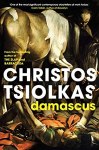
Book coverI have reviewed (and enjoyed) two of Christos Tsiolkas’ books since blogging – The slap and Barracuda – so I was of course interested when Allen & Unwin sent me his most recent release, until, that is, I saw its subject matter. Biblical history, or historical fiction set in biblical times, are not really big go-to areas of interest for me. However, it was Tsiolkas so, finally, when its turn came, I dived in.

What did I find? I hadn’t read reviews, but I had heard that it was pretty violent, and it certainly is in places. Indeed, it starts with the stoning of a woman – but it wasn’t gratuitous or dwelt on. The actual stoning was over in a couple of sentences, and, given Tsiolkas is a serious writer, I decided to trust that he was going somewhere interesting.

Damascus – the title referencing Saul’s (Paul’s) epiphany regarding Christ on the road to you know where – uses the story of Saul, his acolytes, and people he knew, to explore the first few generations of Christians and, through them, the foundations of Christianity. The media release which accompanied my copy says that the novel “explores the themes that have obsessed Tsiolkas as a writer: class, religion, masculinity, patriarchy, colonisation, exile.” Class is the first one to raise its head in the book, and is the one that encouraged me to keep going, because the book reminds us of Christ’s teachings about equality. A few refrains run through the novel, but the first one that captured my attention was “The first will be last, and the last will be first”. It is this teaching, this original Christian belief, that most infuriated Christianity’s opponents. That slaves, for example, should be treated as equal, should sit down at the table with others, was an affront. Given Christianity’s problematic history, I loved being reminded of this fundamental point.

The book, for me, explores two main issues. One is this Christian value of equality – accepting all people as worthy of love and attention. It dominates the first part of the book. However, another issue also raises its head fairly early – through another refrain that ends with “Truly, he is returning” – the Christian belief in the Resurrection. This theological concern occupies much of Saul’s thinking and dominates the book’s ending. In Angela Savage’s YVWF conversation with Tsiolkas, he said that he doesn’t believe Christ was resurrected. He doesn’t believe in an eternal kingdom, but that finding how to live a good life has to be worked out here and now. He therefore chose to include the character of Thomas, the doubter from the Gospel of John, to suggest another direction in which the church could have gone. His Thomas appears in the novel as the apocryphal twin of Jesus, thus giving flesh to the dichotomy between these two world views. This dichotomy is also neatly embodied in the love another of the book’s main characters, Timothy, has for both Saul and Thomas.

So, these were the two themes that kept me interested in the book, but what about the actual experience of reading it? Like many Tsiolkas’ novels, it is a multiple (or “roving”) point-of-view novel. It has a complex structure, comprising two chronologies, as you can see in the following list of the book’s parts:

  • Saul I 35 Anno Domini
  • Hope Lydia, Antioch 57 A.D.
  • Saul II 37 Anno Domini
  • Faith Vrasas, Rome 63 A.D.
  • Saul III 45 Anno Domini
  • Love Timothy, Ephesus 87 A.D.
  • Saul IV 57 Anno Domini

One chronology tells the life, thoughts and inner conflict of Saul, while the other explores the impact of Saul on others. Lydia appears in the biblical book of Acts as the first woman Saul brings to the new religion; Vrasas is his jailer in Rome and has a hatred of those he describes as “death-worshippers”; and Timothy, his companion in the Bible, had a pagan Greek father and a Jewish mother and so embodies, Tsiolkas said, “between world-ness”.

All this is rather complex, and if you don’t know your biblical history you need to concentrate hard on who is who, and where they are going, on the various belief systems and their suspicion if not hatred of each other. You also need to go with Tsiolkas’ view of Saul as a flawed man struggling with his own temptations, his lusts, pride and envy. Tsiolkas’ Saul is a man not a paragon, one who struggles even as he tries to bring the new religion to people on his travels. Here he expresses guilt over his love for Timothy:

Saul falls to his knees on the stony ground. He is sin, he is evil. The storm inside him rages and scorns. He will never conquer the serpent that coils around his loins–its poison floods his heart and mind. What arrogance to believe he is loved by the Lord! How vain to think that he has been chosen by the Saviour. (p. 264)

Inner conflicts like this are well-known, I believe, to Christians.

One of the major joys in reading this book is the characterisation. Lydia, whose first baby is abandoned on the mountains because she is an unwanted girl, is a powerful, but moving character who shares her life as a wife in a seemingly typical merchant family before she takes to the mountains herself. Vrasas, on the other hand, is a brutal character. His section is called, ironically, “Faith”. His faith is a brutal one, and his section contains some of the most brutal scenes in the book, starting with a sacrifice. The aforementioned Timothy, who loves both Saul and Thomas, is a particularly engaging character. His section, “Love”, contains another brutal scene, the punishment of a Jesus-follower by a pagan cult. Timothy, in a way, helps resolve the theological conflict between Saul and Thomas. He sees, I think, the essence of what they both believe. He comes to realise that the point is not the second coming, the cataclysm – though he believes it will come – but the love and hope that are conveyed in the Christian message.

Now, as you have probably realised, Tsiolkas, being Tsiolkas, does not hold back in his graphic descriptions of the brutality of the times. This is not a namby-pamby story but a gritty, mucky, one. It will offend some people in its physicality and viscerality, and it will offend others for its perspective on some much-loved biblical characters, but it is also suffused with one of the main metaphors of Christianity, light. When Saul is grappling with his conversion, “he marvels at the solace of light, the joy it brings him”. It’s a hard-won conversion. At one stage, conflicted by what Ananias’ group is saying, he prepares “to condemn the wicked circle” only to feel “that the light has gone.” Gradually, Ananias teaches Saul to see that Yeshua’s “words were a light” and that this light helps his followers shed darkness, hate, bitterness, cruelty. Light metaphors recur throughout the novel, sustaining characters whenever they feel its presence.

Damascus is not a novel for everyone. Its confronting exploration of the early Christians, alongside the complex history of times that many of us are no longer familiar with, make it a challenging read. However, I related to Tsiolkas’ heart, which aligns with Saul’s “misery at what the world is. At what the world can do”. If only we could recover those original Christian values of loving our neighbour, of treating every person we meet with equal respect, so much of that misery would be gone.

Christos Tsiolkas
Damascus
Crows Nest: Allen  & Unwin, 2019
423pp.
ISBN: 9781760875091

Review copy courtesy Allen & Unwin

Steven Carroll, The lost life (#BookReview)

Audiobook coverLast year, Mr Gums and I bought a new car to replace our loved but aging 15-year-old Subaru Forester. We’ve been keen to move into the hybrid world but wanted to stay with the SUV-style for various practical reasons, so, as soon as a reasonably-priced hybrid SUV appeared on the market here – the Toyota RAV4 – we were in, and so far so good. However, the real reason I’m sharing this is because another impetus for buying a new car was all the new technology, including the audio systems that enable you to play music – and books – via your phones. And so it was that I borrowed my first ever e-audiobook from our local library, Steven Carroll’s The lost life. The technology worked a treat.

Long-term readers here know that I’m not a huge fan of audiobooks, for reasons I’ve explained before. Fortunately, the reader here, Deirdre Rubenstein, did an excellent job. She was expressive, appropriately English-sounding, but read more than played the characters. That helps a lot.

So now, the book. I chose it for two reasons – it was short, making it a good test case, and it was by Aussie author Steven Carroll, whom I haven’t read yet, and whose Eliot Quartet series I’ve been wanting to read. The lost life, the first book in this series, is inspired by the poem “Burnt Norton”, the first of Eliot’s Four Quartets. Makes sense, huh! “Burnt Norton” was published in 1935, and most of Carroll’s novel is set in September 1934. The novel is framed by the story of Eliot and Emily Hale*, who did, in fact, visit Burnt Norton manor in 1934, but their love is paralleled by that of a young couple, 18-year-old Catherine and 22-year-old Daniel. Eliot, himself, is a fairly shadowy figure in the story, with the focus here being on Miss Hale and Catherine.

The story starts at Burnt Norton, a country estate to which Catherine and Daniel have gone for a romantic picnic and maybe a swim. It’s summer, and Carroll beautifully evokes the passion beating in the “ardent” young Catherine’s breast as she looks forward to further development of their physical relationship, which has not yet been consummated. But, they are interrupted by the appearance of two older people, who turn out to be, of course, Eliot and Miss Hale, and they scurry away because they are trespassing. However, they do observe, from behind the shrubs, a little lovers’ ceremony between the older couple, one that Daniel later violates, fortunately unbeknownst to Eliot and Miss Hale, but distressing to Catherine.

Here, I might pause and refer to the poem which inspired this novel. It starts:

Time present and time past
Are both perhaps present in time future,
And time future contained in time past.

A little later come the lines that I remember so well from my university days:

At the still point of the turning world. Neither flesh nor fleshless;
Neither from nor towards; at the still point, there the dance is,
But neither arrest nor movement.

I don’t know what it is about Eliot’s lines that move me so, but I think it’s their almost confounding spareness and mesmerising rhythm. Putting that aside though, it’s this sense of timelessness, of past, present and future being tied to the here and now, of both stillness and movement, of almost suspended animation too, that pervades Carroll’s novel as the protagonists work through their ideas about love and life.

“a felt experience”

Now, Catherine and Miss Hale know each other, as Catherine’s summer job is cleaning the house in which Miss Hale is staying. The plot is, to a degree, predictable. However, it is not the point. The point is how the characters react and feel about what happens. This is an introspective novel in which the two women reflect on love, their own attitudes to it, and what they see, or think they see, in each other. Miss Hale sees her young self in Catherine, her eighteen-year-old self whose disappointment she does not what to see repeated, while Catherine sees wisdom but also sadness in Miss Hale. She comes to realise, in fact, that Miss Hale, who describes her love with Eliot as “a different kind of love”, is a virgin. It is this experience of love, this mystery that endows a special knowledge, that drives the plot.

There is, though, so much to this novel. The tone is gorgeously melancholic, mirroring the poem that inspired it. Carroll also uses images from the poem – sunlight, roses, light – to suffuse his book with a sense of lost time. Repetitions like “young man of whom great things were expected”, “ardent ways”, and “the woman who won’t let go long after she has any right” add to the melancholic tone, while also anchoring our understanding of the characters.

There is also a link drawn between performance and reality. Catherine sometimes feels she is in a play or story, and this contributes to the theme of “the lost life”. Literally, it is the life Miss Hale lost by waiting all those years for Eliot rather grabbing life herself, but more broadly it can encompass all those lives we never have. Even if we, as Miss Hale realises we should, “grasp our moments as they arrive”, there will always be other lives not taken or lived. As Eliot writes in “Burnt Norton”:

Footfalls echo in the memory
Down the passage which we did not take
Towards the door we never opened.

Ironically, Catherine, who delivers “a felt experience” for Miss Hale, becomes an actor who can “deliver a felt experience on cue”, offering up other lives to her audiences, while living her own moments as they arrive. It’s an inspired conclusion to a book about love, living, and the biggest of them all, time.

Lisa (ANZLitLovers) loved this book.

Steven Smith
The lost life (Audio)
(Read by Deirdre Rubenstein)
Bolinda Audio, 2010 (Orig. pub. 2009)
5:57 e-audiobook (Unabridged)
ISBN: 9781742333830

* Check Wikipedia for more on the relationship between Eliot and Hale.

John Clanchy, In whom we trust (#BookReview)

Book coverMy first question when I read a book of historical fiction is why? And so it was for John Clanchy’s latest novel In whom we trust, which is set in Victoria around World War 1, albeit is not about the war. It is, in fact, about a Catholic home for orphaned children, St Barnabas, and three people associated with it, visiting chaplain Father Pearse, and two young people, inmate Thomas Stuart and scullery maid Molly Preston. Of course, when I say “about” St Barnabas, I don’t really mean that. St Barnabas frames the novel, provides its context, but the novel itself is about something far more complex, which gets me back to my opening question, why?

Now there are, to my mind, two main responses to historical fiction. One is to see it as something in the past, something that we might learn from but that overall we can leave firmly in the past. The other is to see its relevance to the present, to look at past actions or events, with the perspective of time, in order to reflect on now. This response also brings in those universals we like to talk about, those things about us that history (or time) doesn’t change. John Clanchy’s In whom we trust demands this second response: it asks us to look at the institutional abuse of children and its long history, and to see the human factors that enabled it then right on through to now. As Hilary Mantel has said, “all historical fiction is really contemporary fiction; you write out of your own time.”

In his Author’s Note and Acknowledgement, Clanchy thanks publisher Finlay Lloyd for “taking on a difficult book such as this”. What “difficult” does he mean? The difficult content or the difficulty of its execution? Probably both. The content is, of course, difficult. We have St Barnabas run by the tortured and torturing Brother Stanislaus. He is the epitome of the old-school hell-fire-and-damnation Brother. Ravaged by the Church’s constraints (particularly abstinence), he twists the scriptures, the theology, to justify his abuse of those in his care, who include, of course, Thomas and Molly.

However, this book is also “difficult” in its construction, which is not the same as saying that it’s difficult to read, because the story flows beautifully, despite frequent changes in voice or perspective. The story is told from three main – and easily differentiated – points of view: the third person subjective perspectives of Father Pearse and Thomas, and the first person voice of Molly via her diary.

The narrative is framed by a meeting between Thomas and Pearse, at the latter’s parish in Sale, some three years after the abuse had occurred. Gradually, through their conversations and private reflections, and through the insertion of Molly’s diary entries, the back story comes out and Thomas’s request of Pearse is revealed. At this point the diary entries finish and the narrative moves into a simpler chronology as Pearse works to fulfil his promise to Thomas, who has by now enlisted and wants this thing done before he leaves. What he wants done cannot right the wrongs of the past but will hopefully help prevent them continuing in the future. And that’s about all I’ll say about the plot.

“the strange, savage world”

That Clanchy can make such subject matter both engrossing and deeply moving is down to his writing and his understanding of humanity. The novel opens in Father Pearse’s head:

‘There was a boy came while you were out, Father Pearse,’ Mrs Reilly said. And stood.
The woman wanted strangling.

I loved this. So simple, but already we’ve learnt a lot, the main thing being, as the rest of the chapter confirms, that Father Pearse is not your warm-hearted priest. He’s an impatient, easily irritated one, so, when the boy, Thomas, appears, we are predisposed to like him more than we like Pearse. As the novel progresses, Thomas firmly but gently brings Pearse around to being – to use modern parlance – the best version of himself! In other words, Pearse, who is not a bad man, just a weak, cowardly one who “means no real harm”, is brought to see the right and humane thing to do.

This doesn’t come easily though. He is suspicious of and resistant to this trouble-making Thomas. He doesn’t trust him! And here is cornerstone of the novel, trust (as you might have guessed from the novel’s title.) There are many layers of trust in the novel. Clanchy shows how trust develops between people, such as between Molly and Thomas, between Thomas and his indigenous friend from St Barnabas Benton, and, eventually, between Pearse and Thomas. There is trust in authority and institutions, such as that St Barnabas will care for the children entrusted to it. There is trust in forms and rituals, like the confessional. And there is trust that people will do what they promise or undertake to do. All of these – their successes and failures, and the nuances surrounding them – are explored in this novel. The reality of the challenge becomes clear to Pearse late in the novel:

Trust. That was the crux of it. How was anyone meant to find a path through this forest of competing trusts?

Muddying this path are competing – or, shall we just call a spade a spade and say twisted – values and priorities. These include the age-old issue of abstinence and the inviolability of the confessional, and the need, as Pearse’s Bishop makes perfectly clear, to protect “our Mother Church”.

Through all this, Clanchy weaves a compelling, painfully true story about human beings – weak ones, arrogant ones, damaged ones, wise ones, loyal ones. Of all these people, it’s the young Thomas who has the clearest vision. He has, recognises Pearse, the

trick of putting his finger on truths so obvious that most other people, in search for something which redounded more to their own credit, looked right past.

And now, before I conclude, something about the writing, because it is this, alongside Clanchy’s understanding of human motivations and relationships, that make this “difficult” book also a pleasure to read. Clanchy’s ability to nail his points with a few words can take your breath away:

… then Thomas Stuart was equally checked by the massive theological boulder which the priest now rolled into his path.

AND

The crimson cloth of the Bishop’s patience was rapidly becoming threadbare.

The vernacular he creates for Molly’s diary – including words like “tumple” and “fumply” – gives her colour and character. There’s also some clever word play and light ironic touches, not to mention the little biblical in-joke about doubting Thomas, because in this book it’s the priest who doubts Thomas more than vice versa. Indeed, it’s the careful, sure way Clanchy develops the see-sawing doubting-trusting relationship between Pearse and Thomas that provides the novel’s backbone and interest.

There are of course no simple answers to the dilemma facing Father Pearse, and the ending we get is the only one it could be. It’s to Clanchy’s credit that he doesn’t opt for the easy feel-good fix. There are wins along the way but Clanchy knows, and we know, that it would be morally suspect and historically inaccurate to provide the ending we’d like. In whom we trust is a powerful and wonderful read.

John Clanchy
In whom we trust
Braidwood: Finlay Lloyd, 2019
251pp
ISBN: 9780994516558

(Review copy courtesy Finlay Lloyd)