On the literary road, in Gippsland

The Gippsland area of Victoria is a particularly rich one in terms of Australia’s literary history. It is also an area I’ve never visited before and so this week we decided to return home from Melbourne via the less common path, that is via Gippsland. Unfortunately our trip through the region was a quick one, with just one overnight stop at the pretty little fishing and tourist town of Lakes Entrance. It has whetted my appetite for a more leisurely exploration of the area in the future. Gippsland is a diverse region with plains, lakes, rivers, mountains and coastal landscapes – the sort-of “something for everyone” place that tourist guides like to promote.

Some of the authors commonly associated with Gippsland are Eve Langley, Mary Grant Bruce, Katharine Susannah Prichard and Hal Porter … Some were born there (such as Porter) and some visited there (such as Katharine Susannah Prichard), but all wrote about the region. The English writer, Anthony Trollope, also visited the area in 1872.

Eve Langley, whose novel The pea-pickers was the subject of one of my early posts, was particularly well known for extolling the virtues of Gippsland. In The pea-pickers, her two main characters travel through Gippsland – to places like Bairnsdale and Lakes Entrance – working as agricultural labourers. Steve, the main character, yearns to return to her family’s glory years as “princes” of Gippsland.

One of my favourite – though rather politically incorrect these days – childhood authors was Mary Grant Bruce. She set several of her lesser novels in the region and drew on her experiences there for her children’s series, The Billabong novels. My literary guide suggests that “the sense of escape and immersion in untouched nature”  are evident in Bruce and Langley. While clearly there is more settlement now than there was in the early to mid twentieth century when these writers were writing, there are still many wild and natural spaces to enjoy in the Gippsland.

One discovery – and a rather embarrassing one for a person who prides herself on her knowledge of Australian geography – was that it is in Gippsland that the Snowy River, of Banjo Paterson fame, has its mouth. How did I not know that? Anyhow, I was pleased to see it at its quieter end!
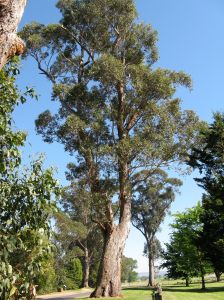
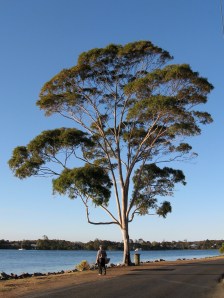
Gum tree, Orbost

Towering gum tree, Orbost

None of the region’s literary heritage was evident to the casual traveller – how I wish we celebrated our writers more. I will finish though with some lines from a poet of the region, Jennings Carmichael, as quoted in the guide under the entry for the town of Orbost:

Each soaring eucalyptus, lifted high,
The wandering wind receives;
I watch the great boughs drawn against the sky,
Laden with trembling leaves.
A soft harmonious music, full and rare,
Murmurs the boughs along–
The voice of Nature’s God is solemn there,
In the deep undersong.

Snow gums

Give me a home among the gum trees (from song by W. Johnson and B. Brown)

Every Australian should have a gum in their yard somewhere! Pretty well every home I’ve lived in, and I’ve lived in a few, has had one in the yard or in the street just outside. My current home, in which we’ve lived for 12 years, has a lovely Snow Gum or Eucalyptus Pauciflora, and here it is:

Eucalyptus Pauciflora

Eucalyptus Pauciflora

Pauciflora means “few (or poor) flowers” and I suppose that’s true. Our tree does produce flowers in season – creamy white ones – but, while you can see them, they don’t jump out at you, partly I suppose because of their muted colour and the height of the tree. According to the article at the Australian National Botanic Gardens, another name they go by is Weeping Gum. I think you can see why when you look at ours. It has quite a lovely drooping habit (and would have had more if I’d been able to stop Mr Gums having a go at it last year!)

But, the thing they are most famous for is their wonderfully coloured bark, particularly on the subspecies (at least I think it’s a subspecies) that grows in Australia’s (admittedly not very high) alpine regions. These alpine ones can also be stunted, often into quite amazing shapes. As a result, if you search for “snow gums” on the internet you will find many gorgeous photos (both amateur and professional). I may as well add to them: it was taken on the Dead Horse Gap Walk in Kosciusko National Park in the Snowy Mountains. Judging by the little off-trail detour path to it, I’m not the only one to have photographed it:

Snow Gum trunk

Snow Gum trunk

This trunk, after rain, would be wearing a more intense technicolour coat of creams, browns, olives, and greys. And, just to bring this back to books, think of these (and other) gums when you read my next review (coming soon) – A.B. (Banjo) Paterson’s The man from snowy river and other verses.

Time for another gum

Sydney Blue Gum on the Hastings River

Sydney Blue Gum on the Hastings River

This is, I believe, a Sydney Blue Gum (Eucalyptus saligna) though I could also be wrong as I’m very much an amateur when it comes to tree identification. It does look like: they can be found up and down the east coast of New South Wales, of which the Hastings River is part, and they can grow to 60 or more metres tall which this one certainly seems to be aiming for. Whatever it is, I couldn’t resist photographing it. It rather dwarfs Mr Gums below doesn’t it?

Blue Gums are apparently the trees referred to in Henry Lawson’s 1919 poem, “Chatswood”:

And a little wood was on it, and the trees were tall and good,
And his young wife used to dream there, so he called it “Chattie’s Wood”.

“Chattie’s Wood” has long since gone, and shops are standing in a row
Where the young wife went a-dreaming in a the days of long ago,

Chattie was apparently Charlotte Harnett, the second wife of Richard Hayes Harnett, a North Shore Sydney landowner in the 1860s and one-time Mayor of Willoughby, and she did wander the Blue Gum High Forest of Chatswood West. The trees have long disappeared (from there anyhow) and some suggest that Lawson played a little loose with the specific details of their story but  it is generally agreed that Chattie’s Wood is the origin of the name of the Sydney suburb of Chatswood.

Another poem, “Blue Gum Forest” (1976) by Roland Robinson, was also inspired by these trees:

The blue gums soar, naked
smooth, to where they over arch …

This year Australian composer Matthew Orlovich set this poem to music for a capella choir. I’d love to hear it one day. Anyhow, these are just two examples I found by doing some quick research. It seems that while the Sydney Blue Gum may have made way for shops in Chatswood, they still survive – in both physical and imaginative form. Long live the gum!

Here come some gums

Actually, the terms “gum tree” and “eucalypt” are more complex than many of us, I think, realise. The trees I have habitually called Gums or Eucalypts actually come from three genera: Eucalyptus, Corymbia and Angophera. I was quite shocked when I discovered a few years ago that in the 1990s there had been a reclassification of Eucalypts, with about 113 species being moved to the Corymbia genus. Apparently the Angophera had already existed. I just wasn’t aware that they too were what I called gums. They all belong to the Myrtle family. Perhaps it would be easier to just call them that? Whispering Myrtles anyone?

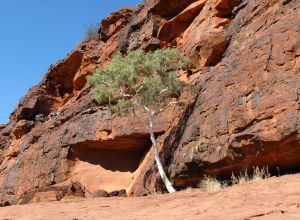
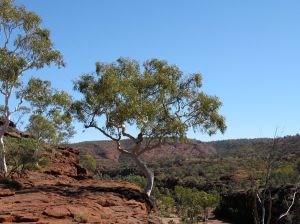
Anyhow, while Central Australia is not the place where gums are the most prolific, you do find some wonderful specimens there. One of the most famous is the Ghost Gum (which is actually a Corymbia aparrerinja). It can grow in the most amazing places, seeming often to prefer exposed rock faces.

Ghost Gum against the red rocks of Palm Valley

Ghost Gum against the red rocks of Palm Valley

And here’s one, in a really precarious spot…

Ghost Gum on a cliff edge in Palm Valley

Ghost Gum on a cliff edge in Palm Valley

One of the other common gums in the area is the River Red Gum (which is really a eucalyptus – the Eucalyptus Camaldulensis). It is found in many parts of Australia, including Central Australia, and mostly grows in or by water courses. A useful marker in the Centre!

River Red Gum trunk at Jessie Gap

River Red Gum trunk at Jessie Gap

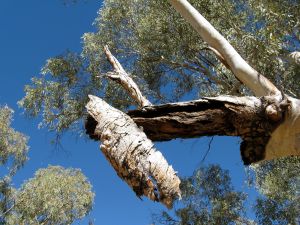
These are the gums that are sometimes called “widow makers” for their habit of suddenly dropping large boughs – apparently a protective mechanism against drought. We walked under this one – though this is only half the bough that is about to fall off. Still it looked dramatic.

Looking up at a River Red Gum in Serpentine Gorge

Looking up at a River Red Gum in Serpentine Gorge

I took many more photos but will save more for another post! But, aren’t they beautiful?