Helen Macdonald, H is for hawk (Review)

Helen Macdonald, H is for hawkMy reading really has been rather odd lately. I’ve read a memoir about horse-racing (Gerald Murnane’s Something for the pain), a novel about hedge-funds and investment banking (Kate Jenning’s Moral hazard), and now a grief memoir focused on falconry (Helen Macdonald’s H is for hawk). None of these are topics I would naturally pick up, but in each case I’ve enjoyed being presented these very different worlds. H is for hawk, this post’s subject, is additionally interesting because it combines three different forms of writing – memoir, biography and nature writing.

T. H. White lecturing on his Arthurian fiction (Courtesy John J. Burns Library, Boston College, via Wikipedia CC BY 2.0).

TH White (Courtesy John J. Burns Library, Boston College, via Wikipedia CC BY 2.0).

As I don’t read reviews before I read books, I really didn’t know what I was getting in for, except that I understood it was about a woman managing her grief through raising a hawk. It is about this, but it is about so much more too, including being a sort of mini-biography of novelist TH White. You probably know White through his most famous works, The once and future king and The sword in the stone, but you may not know that he also wrote a book called Goshawk about the training of his goshawk called Gos. Imaginative name that! Macdonald was far more creative. She named hers Mabel! (She does explain this surprising tame-sounding name).

Many people have written about falconry over the years so why does Macdonald light on TH White? Well, it’s complicated. She had read Goshawk when she was a young girl, and hadn’t much liked it. However, she read it again and

saw more in it than bad falconry … White made it a metaphysical battle. Like Moby-Dick or The old man and the sea, The goshawk was a literary encounter between animal and man that reached back to Puritan traditions of spiritual contest …

White, you see, wrote it after he’d left his teaching post in 1936 to live in a workman’s cottage. He was fleeing a world in which he, a homosexual, didn’t fit, a world in which he had to live “in perpetual disguise”. Macdonald suddenly recognises a fellow-feeling, writing that

I felt, for the first time, that my urge to train a hawk was for reasons that weren’t entirely my own. Partly they were his.

Because MacDonald was training her hawk to escape her grief following the sudden death of her beloved father. She was, she writes, “running” like White. Both, we gradually learn, experience a sort of madness that they need to resolve and recover from.

And so the book progresses in fits and starts, but chronologically so, as Macdonald parallels the awful and sad story of White and Gos with hers and Mabel’s. It makes fascinating reading.

Now, this book has been out for well over a year. It won the Samuel Johnson Prize for Non-fiction (which our very own Anna Funder won for Stasiland) among other awards and shortlistings. It’s been comprehensively reviewed, I believe, so I fear reiterating what others have said before. Consequently, I’m just going to give a broad brush overview of my response to it (and follow up with a Delicious Descriptions post of some of its truly gorgeous nature writing).

To start with, I enjoyed it immensely. It fits into what we call literary or creative non-fiction. That is, it uses some novelistic techniques such as dialogue, poetic imagery and a narrative arc, but it is very definitely non-fiction. It contains a lot of fact about her life, and much research about falconry and TH White. And there are several pages of end-notes identifying sources of quotes, though these notes are not flagged in the text.

I was fascinated by her stories of falconry – her own and from the past – and I am always interested in the lives of writers. Macdonald is an historian by profession, and weaves history through the telling of her own experiences. Although as a child she had agreed with the general censure of White’s training of Gos, as an adult she is more sympathetic, empathising with White’s loneliness and understanding his lack of knowledge and experience. I must say that while I was intellectually interested in the falconry, I would be among those of her friends who find the idea “morally suspect”. It seems a cruel activity to me – and, in fact, cruelty is one of the many threads running through the book. White, who had been physically and emotionally abused as a child, was, apparently, a “sadomasochist”, though Macdonald argues that he consciously worked to keep that part of himself at bay.

This brings me to another aspect of the book I enjoyed – the way she weaves multiple ideas or themes through it. Freedom is one. Macdonald seeks it through her hawk:

The hawk was everything I wanted to be: solitary, self-possessed, free from grief, and numb to the hurts of human life.

Hawks seek it too, sometimes. Macdonald describes “bating”, in which a bird tries to fly from a fist or perch while still attached, as a “wild bid for freedom”. And White definitely seeks freedom. Macdonald frequently refers to his desire for it. She quotes his own writing:

A longing came to my mind, then, that I should be able to do this also. The word ‘feral’ had a kind of magical potency which allied itself with two other words, ‘ferocious’ and ‘free’ … To revert to a feral state I took a farm-labourer’s cottage …

Feral. This word conjures another theme, that of wildness. Both White and Macdonald revert to wildness in their own way – by training wild birds, and by withdrawing from society. Macdonald describes how she becomes, essentially, one with her hawk. She starts to think and see like a hawk, and is taken, she writes, “to the very edge of being human”. Eventually though, sense returns. She comes to understand that falconry is “a balancing act between wild and tame” – and not just for the hawk! She rejects American naturalist John Muir’s “earth hath no sorrows that earth cannot heal”, arguing instead that “the wild is not a panacea for the human soul.” All this makes me think that there’s a fourth form of writing that this book could fit into – the quest story – because it is, fundamentally, a quest for sanity and peace, for both Macdonald and White.

There are other ideas and themes, but I fear that my broad brush is starting to become a fine pen. I will write a little about nature and the environment in my Delicious Descriptions post, so will end my main analysis here.

I read this with my reading group. Some found Macdonald a little too self-obsessed for their liking. Why did the death of her father create such a schism in her soul? Why was she not able to see that her mother’s need, as the bereaved spouse, was surely greater? I wondered a little about this too, though it didn’t affect my appreciation of the book. The answer is, I suppose, that we are all different. For whatever reason – timing, perhaps, the quality of the father-daughter relationship, definitely – Macdonald’s father’s death knocked her for a six. Having accepted that as a given, I found H is for hawk a thoughtful, complex book that engaged me from the start.

This is a long post, I know, but I want to share one more thing. It occurs two-thirds of the way through the book, and, to me at least, shares one of life’s important lessons:

There is a time in life when you expect the world to be always full of new things. And then comes a day when you realise that is not how it will be at all. You see that life will become a thing made of holes. Absences. Losses. Things that were there and are no longer. And you realise, too, that you have to grow around and between the gaps, though you can put your hand out to where things were and feel that tense, shining dullness of the space where the memories are.

Helen Macdonald
H is for hawk
London: Vintage Books, 2014
300 pp.
ISBN: 9780099575450
Jane Austen, Northanger Abbey (Review)

Although I’ve titled this a review, as I do when I write about a book, this post on my latest read, Jane Austen’s Northanger Abbey, is not really going to be a review. Like all her novels, it’s been intensively written about from multiple angles, and in fact there are many themes and ideas I’d love to write about, but for this post I am going to focus on one aspect that particularly struck me this time. This aspect is not exactly new to me, but it came together this read in a particular way – and it is this …

Northerner Abbey illus br Brock

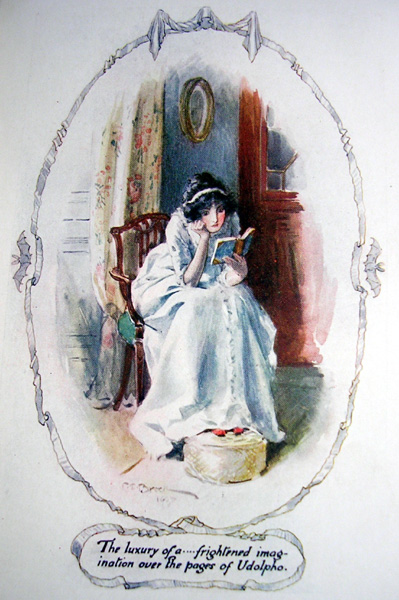
From Chapter 9, illus. by CE Brock (Presumed Public Domain, from solitaryelegance.com)

Northanger Abbey is often seen as a spoof or satire of gothic novels. And it certainly does make fun of these novels, but it does so largely through satirising readers of these novels, particularly (young) suggestible readers. Northanger Abbey is also famous for its defence of the novel, on which I’ve posted before. However, the thing which stood out this read was how much Austen comments on the art or practice of writing novels. The novel opens with:

No one who had ever seen Catherine Morland in her infancy would have supposed her born to be an heroine.

Now this partly sets up the whole Gothic novel thread, the idea that heroines of Gothic novels are certain sorts of people, and that certain sorts of things happen to them, but on this read I was very conscious that there was more going on here between Austen and her reader (in this case, me). Before I explore this a little more, it’s probably worth outlining the novel’s publishing history. Initially called Susan, it was written around 1798–99, when Austen was 23-24 years old. She revised it in 1803, and it was sold to a bookseller, who never published it. In 1816, the year before Austen died, her brother Henry Austen bought it back. Austen revised it a little more, including changing the name of the heroine, and of the novel, to Catherine, but died before putting it out for publication again. In the end Henry organised for it to be published as Northanger Abbey, along with Persuasion, in 1817.

So, it was the first novel she finalised for publication (even though she had previously started on the books that later became Sense and sensibility and Pride and prejudice) but was the last published. The interesting thing about this essentially “first” novel is that the voice, or point-of-view, is a little different from the other five novels which are written more consistently in third-person omniscient voice. In Northanger Abbey however, the author-narrator frequently intrudes into the story to address the reader – sometimes, though not always, using first person – and in so doing tends to draw attention to the making of the fiction.

For example, she introduces the Thorpe family with a brief background, then writes:

This brief account of the family is intended to supersede the necessity of a long and minute detail from Mrs. Thorpe herself, of her past adventures and sufferings, which might otherwise be expected to occupy the three or four following chapters; in which the worthlessness of lords and attornies might be set forth, and conversations, which had passed twenty years before, be minutely repeated.

There is an element here of satirising Gothic novels which tended to be long and detailed and to deal with nobility, but it is also, as I see it, part of Austen’s novelist’s manifesto. She’s telling us that for the purposes of her story we don’t need long digressions into irrelevant, albeit possibly exciting, pasts.

Her frequent references to Catherine and whether or not she is a heroine sets up the reader for a traditional Gothic romance while at the same time teases us to think about what fiction might really be about. We know, from a letter to her niece, that this is, for her, “Three or four families in a country village”. So, on the one hand Austen tells us that Catherine has been “in training for a heroine” and “that if adventures will not befall a young lady in her own village, she must seek them abroad”, and then on the other hand, she returns us to reality with statements like:

she felt more obliged to the two young men for this simple praise [that she was “a pretty girl”] than a true-quality heroine would have been for fifteen sonnets in celebration of her charms.

Austen plays with us like this throughout, comparing the concerns and expectations of a Gothic novel heroine with those of a more “realistic” one.

Towards the end, the two threads – the Gothic and the natural or realistic – come together. Having discovered that all her wild imaginings of murder and mayhem at the Abbey were just that, wild imaginings, Catherine does have to confront a very real crisis when the General suddenly turfs her out of the Abbey, his home, with no explanation:

Yet how different now the source of her inquietude from what it had been then—how mournfully superior in reality and substance! Her anxiety had foundation in fact, her fears in probability; and with a mind so occupied in the contemplation of actual and natural evil, the solitude of her situation, the darkness of her chamber, the antiquity of the building, were felt and considered without the smallest emotion; and though the wind was high, and often produced strange and sudden noises throughout the house, she heard it all as she lay awake, hour after hour, without curiosity or terror.

This is one of the narrator’s third person pronouncements, but Austen, the author, intrudes in first person again at the end, with two statements that refer directly to the making of fiction. One alludes to the final resolution of the romance:

The anxiety, which in this state of their attachment must be the portion of Henry and Catherine, and of all who loved either, as to its final event, can hardly extend, I fear, to the bosom of my readers, who will see in the tell-tale compression of the pages before them, that we are all hastening together to perfect felicity.

The other refers to the introduction of a new character in the last chapter who helps bring about the above “perfect felicity”:

… I have only to add—aware that the rules of composition forbid the introduction of a character not connected with my fable—that this was the very gentleman whose negligent servant left behind him that collection of washing-bills, resulting from a long visit at Northanger, by which my heroine was involved in one of her most alarming adventures.

I love this aspect of Northanger Abbey – that is, I love Austen’s cheeky, inventive voice. She’s not scared to talk to us, to tell us what she’s doing and what she thinks. It’s a fresh, bright novel that beautifully bridges her juvenilia pieces with her more, let’s say, controlled works. We see here the lively intelligence of a young writer who is thinking, perhaps, about imagination and reality, and certainly about what she likes to read and what she wants to write.

This has been pretty brief, and may not have argued my point as coherently as I would have liked, but at least it documents for me the ideas that this reading brought to the fore. I hope it’s given you something to think about too.

Jane Austen
Northanger Abbey
Digireads.com, 2011
ISBN: 9781596251144 (ebook)

Richard Lloyd Parry, People who eat darkness (Review)

ParryDarknessCapeCommenting on my review of Helen Garner’s This house of grief, Ian Darling recommended Richard Lloyd Parry’s People who eat darkness: Love, grief and a journey into Japan’s shadows. I’m ashamed that I rarely follow up the great recommendations I receive here, and I admit that it’s odd that when I did this time it was for a genre I rarely read, true crime. But, I was intrigued because it’s about a crime in Japan, and Japan is a country that I love to visit. Fortunately, Ian didn’t lead me astray. It’s a fascinating book.

I’m not a big reader of crime, in fiction or non-fiction form, but I have read a small number of true crime books over the years, starting, long ago, with Truman Capote’s In cold blood. True crime books vary in emphasis, but the ones that attract me are those that throw light on character and society. This is certainly the case with Parry’s People who eat darkness which tells the story of Lucie Blackman, a 21-year-old English woman who went missing in Tokyo in the summer of 2000 and whose remains were found that winter. Parry writes early in the book that “the story was familiar enough – girl missing: body found: man charged – but … it became so complicated and confusing, so fraught with bizarre turns and irrational developments, that conventional reporting of it was almost inevitably unsatisfactory, provoking more unanswered questions than it could ever quell”.

And so Parry attempts to answer these questions. In so doing he covers a lot of ground. He gives us biographies of both Lucie and the man convicted of killing her, Joji Obara; he exposes Japanese discrimination against Koreans; he explains the role of “hostesses” in modern Japanese culture; he explores Japanese policing and the wider justice system; he looks at the media; and he tells the story of the devastating impact of the murder on Lucie’s family. He’s a good writer and tells it well, but I felt we didn’t need as much of Lucie’s biography as he gave. We needed to know a little about her, of course – including why she was in Japan working as a hostess in Roppongi – but, while it was relevant to delve into Obara’s life, I did wonder about the relevance of telling us about, for example, Lucie’s various friends and earlier boyfriends. Did he include all this to balance out the space he was giving to the perpetrator? Why should Obara get more airplay, after all? The victim is often invisible enough. Still, it’s a long book and could have been tightened a little in this area.

However, this is a minor niggle, because Parry has written a compelling story. I must say that I feel uncomfortable using the word “story” for such a devastating event, and even more uncomfortable calling it “compelling”, but I can’t think of any alternative language, so will just have to continue. What makes it compelling is that this is a crime story that departed the usual scripts. Parry analyses the hows and whys of these departures.

“conquest play”

The first “script relates to the murder: it was not, it seems, premeditated but a date-rape (or, “conquest play” as the perpetrator so chillingly called it) that went terribly wrong. Obara had been practising for many years his perverted idea of “conquest play” in which he invited (or lured) women to spend time with him, during which he would sedate them with chloroform or date-rape drugs to enable him to carry out sexual acts. His behaviour had resulted in the death, in 1992, of an Australian woman Carita Ridgeway, but her death had not been recognised as a “murder”. This, together with the failure of the police to follow up a number of complaints about Obara, meant that Lucie was the next unlucky one to not survive Obara’s gruesome idea of “play”. Obara, though, argued to the end that she died of a self-administered overdose.

“not Japanese”

The next “script” is the trial, which did not run the typical Japanese course. Trials in Japan, Parry tells us, “do not resemble fights, battles or sporting events, as the adversarial logic of its laws seems to prescribe, but rather ‘ceremonies’ or ’empty shells’, devoid of even minor disagreements.” However, Obara fought his case vigorously. Parry describes in great detail Japan’s justice system, from policing to the trial and appeals. In Japan, he says, “you are not innocent until proven guilty”. He quotes sociologist David Johnson’s statement that “Prosecutors, like just about everyone in Japan, believe that only the guilty should be charged and that the charged are almost certainly guilty”. Consequently, in Japan, over 90% of those committed to trial are convicted – and a confession is expected. Parry writes:

‘The police are experienced in persuading people to confess,’ a senior detective told me. ‘We make efforts to let the criminal understand the consequences of their actions. We say things like “The sorrow of the victims is truly deep” and “Have you no sense of reflection on what you have done?” But he was not that kind of person. With him those tactics would never work.’ The detective had no difficulty in explaining this quirk in Obara’s character, although he hesitated a little in spelling it out to a foreigner. ‘It is hard for you to understand, perhaps. But it’s because he is . . . not Japanese.’

Obara was of Korean background, you see, and, as Parry details, Japan does not treat its Korean citizens well. Why Obara was the way he was is too complex to discuss here – though Parry makes a good attempt in the book – but from the police point of view, he was “not Japanese” and, once arrested, did not follow the expected path of a charged man.

“the most terrible, terrible event”

Finally, Lucie’s family, rather than presenting “a tight-knit” unit as is so often presented in post-tragedy media reporting, was bitterly divided. Her parents had been divorced many years before her murder, but it was not amicable. Lucie and her two younger siblings, Sophie and Rupert, lived with their mother Jane, while father Tim lived on the Isle of Wight. Lucie was close to her mother, and often kept the peace between her sister and mother. If all this was a sad situation before Lucie died, it was devastating after. The parents could agree on nothing, from how they responded to the media to how they would inter Lucie.

Jane is a more shadowy figure, because she largely kept to herself. Tim though, with Sophie, was active in the search for Lucie, using whatever resources he could garner. Parry clearly got to know him well, and presents to us an intriguing, sometimes contradictory, man, one who said that the death of his daughter was “the most terrible, terrible event of my life” and yet who could say he felt sorry for Obara. Parry writes of this that:

Nothing better caught the complexity of Tim’s own character, his stubborn unorthodoxy, which to me was so likeable and admirable, but which to many people was repellent. Almost on principle, he refused the obvious point of view and the temptations of conventional morality. The high ground was his for the taking, but instead of marching ahead to claim it, he dawdled and skirted around it, finding shades of pathos and ambiguity where others could see only black and white. Onlookers were not merely puzzled by this – they were appalled.

Parry’s portrait of Tim is one of the most interesting aspects of the book, but his picture of a family destroyed is heart-wrenching. Here is Sophie on the day Lucie’s remains were interred:

What was most glaringly obvious was how Lucie’s death had changed the relationships between all of us, and how as a brother and a sister, and a mum and a dad, we were just four strangers sitting round a table.

It’s a desperately sad story, which had longterm ramifications for Lucie’s siblings.

“the drive to pass judgement”

Parry, an English journalist based in Tokyo, spent around ten years researching this book. He attended the very lengthy trial, spoke to family, friends, police and others involved, and read a lot of written material including letters, diaries and emails. He tells the story from a first person point of view, sharing his research process along the way. He is not actively “in” the story like, say, a Helen Garner, but we can discern his hand.

Humans, he writes

are conditioned to look for truth which is singular and focused, hanging for all to see, like a clear, full moon in a cloudless sky. Books about crime are expected to deliver such a photographic image, to serve up a story as dry as a shelled and salted nut. But as a subject, Joji Obara sucked away brightness; all that was visible was smoke or haze, and the twinkling upon it of external light. The shell, in other words, was all that was to be had of the nut; but the surface of the shell turned out to be fascinating in itself.

Near the end, he suggests that the “drive to pass judgement was one of the extraordinary effects of the case”. It is to his credit that he manages to steer an astutely observed but even course through unexpected scripts to capture the complexity of its “actors”, and thus of humanity. There is value in reading a book like this.

Richard Lloyd Parry
People who eat darkness: Love, grief and a journey into Japan’s shadows
London: Jonathan Cape, [2011]
404p. (in print ends.)
ISBN: 9781448155613 (ePub)

Jane Austen, Emma Vol 3 (continuing thoughts)

I’ve now finished my re-read of Emma, and found that the theme of friendship, which I discussed in my Volumes 1 and 2 posts, did continue to play out in the last volume. In those previous posts, I suggested that Austen was presenting friendship as having both personal and social value, and I gave examples of different acts of friendship, some generous, others more questionable if not down-right self-serving.

Now, having finished the novel, I’d like to identify the different sorts of friendships which Austen presents to her readers:

  • neighbourly/kind friendship
  • “general” friendship
  • self-serving friendship
  • “true” friendship

Since I touched on some of these in previous posts, I will just expand a little more here. Neighbourly or kind friendship encompasses giving mostly practical support to others. In Emma this includes, for example, providing transport or food to poorer women in the neighbourhood. Many characters offer this sort of friendship, including, even, the unpopular Mrs Elton.

General friendship, on the other hand, is the sort of hail-fellow-well-met tolerance/acceptance of other people, with little regard to substance. Mr Weston is a perfect example of this. He’s “straight-forward, open-hearted”. He doesn’t discriminate against people on the basis of, say, class, but neither does he discern between sincerity and superficiality. And he’s inclined to gossip rather than hold his counsel. Here’s Emma on Mr Weston at the Crown where he is hosting a dance. He’d invited her to arrive early to pronounce on whether everything is in order, but she finds that he had similarly invited many other “friends”:

Emma perceived that her taste was not the only taste on which Mr. Weston depended, and felt, that to be the favourite and intimate of a man who had so many intimates and confidants, was not the very first distinction in the scale of vanity. She liked his open manners, but a little less of open-heartedness would have made him a higher character.—General benevolence, but not general friendship, made a man what he ought to be.—She could fancy such a man.

Such a man is, of course, Mr Knightley. Emma is, admittedly, a bit of a snob and likes to be recognised for her “place” in Highbury, but nonetheless, Mr Weston is presented to us as someone who “takes things as he finds them, and makes enjoyment of them somehow or other” rather than one who can be relied upon, for example, to make good judgement about character. He’s an appealing character, but not the ideal man.

Self-serving (or self-aggrandising) friendship is epitomised by the execrable Mrs Elton whose protestations of friendship, particularly towards Jane Fairfax, belie her real motivations, which are to look good and to spite Emma. She chooses her friendships on the basis of what they do for her.

And then there’s “true” friendship, the sort of friendship which is not swayed by superficial concerns, which is not scared to speak the truth, and which quietly works for the benefit of others without looking for praise or recognition. This is the sort of friendship offered by Mr Knightley, who tells Emma when he feels she’s behaved rudely or improperly, who consistently judges people correctly, and who is prepared to make sacrifices for the benefit of others.

There are readers who find the relationship between 21-year-old Emma and 38-year-old Mr Knightley a little paternalistic, if not creepy, but I’d argue these were different times with different expectations and mores. Emma is not a push-over and it’s clear that Austen sees their relationship as one built on love and “true” friendship. The last lines of the novel are:

The wedding was very much like other weddings, where the parties have no taste for finery or parade; and Mrs. Elton, from the particulars detailed by her husband, thought it all extremely shabby, and very inferior to her own. “Very little white satin, very few lace veils; a most pitiful business! Selina* would stare when she heard of it.” But, in spite of these deficiencies, the wishes, the hopes, the confidence, the predictions of the small band of true friends who witnessed the ceremony, were fully answered in the perfect happiness of the union.

Before I leave this topic of friendship, I want to mention a somewhat related topic – that of civil falsehoods. Austen introduces the term through Frank Churchill who, on being encouraged by Emma to go hear Jane Fairfax play the pianoforte, expresses an inability to pretend to like it if the instrument’s tone is poor. He says “I am the wretchedest being in the world at a civil falsehood”. The irony, of course, is that he is being false to Emma. Emma, though, blithely unaware, tells him that “I am persuaded that you can be as insincere, as your neighbours, when it is necessary”.

Emma, more than any of Austen’s novels, deals with a whole community. Austen teases out the idea that communities survive on the basis of “civil falsehoods”, that these falsehoods are at times “necessary”. On another occasion, when Mr Weston invites Mrs Elton to the Box Hill picnic, stating that “she is a good-natured woman”, a disappointed

Emma denied none of it aloud, and agreed to none of it in private.

Emma, in other words, does the polite thing and holds her tongue. But Austen knows there are costs, and that there is a place for “civil falsehoods” and a place for honesty. Falsehoods, even civil ones, Austen argues need to be handled with care. By the end of the novel, it’s clear that she, like Emma, would always prefer “openness” to concealment. I wonder if this is why she, known for her sharp tongue, felt Emma would be a heroine that only she would like!

Re-reading

Noticing this friendship theme is just one of the delights I’ve had in this re-reading of Emma. Each time I read it, I notice more – both in terms of Austen’s concerns and her technique.

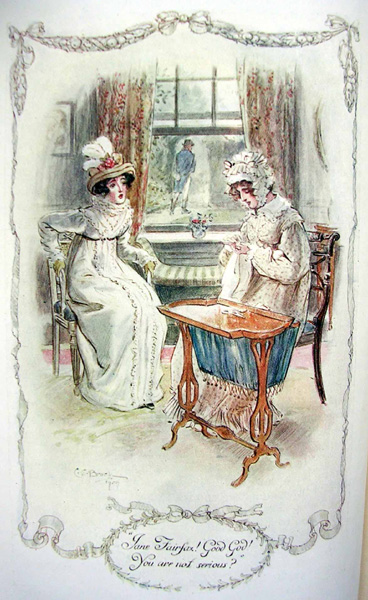
Illustration, Emma and Mrs Weston

“Jane Fairfax. Good God! You are not serious!” (Illus, by CE Brock)

One feature that interested me this read is the way she shows characters’ real love interests by whom they are watching (out for). It’s subtle and can be missed on early reads but it’s there. For example, while everyone thinks Frank Churchill is interested in Emma, Frank is watching out for Jane Fairfax. When Jane arrives at the Crown with her aunt, Miss Bates, it looks as though it’s Miss Bates whom Frank tends – “Miss Bates must not be forgotten” he says to his father as he rushes out to make sure they don’t get wet. But Miss Bates, in her chatter, lets drop his real interest:

My dear Jane, are you sure you did not wet your feet? It was but a drop or two, but I am so afraid: but Mr. Frank Churchill was so extremely—and there was a mat to step upon. I shall never forget his extreme politeness.

Similarly, when Emma and Harriet discuss a past occasion when they were with Mr Knightley and Mr Elton, Emma remembers where Mr Knightley had been standing, while Harriet only remembers Mr Elton:

“Stop; Mr. Knightley was standing just here, was not he? I have an idea he was standing just here.”

“Ah! I do not know. I cannot recollect. It is very odd, but I cannot recollect. Mr. Elton was sitting here, I remember, much about where I am now.”

Absolutely delicious. By the time this occurs, Harriet is over Mr Elton, and Emma is still unaware of her love for Mr Knightley, all of which adds to our delight in reading this scene.

Another technique which struck me was how often characters mis-read clues, how often they assume the wrong reason for an occurrence. Near the end, Mr Knightley holds Emma’s hand and is “on the point of carrying it to his lips—when, from some fancy or other, he suddenly let it go”. Emma doesn’t read this as love but as a sign of “perfect amity”. And when Frank, on his return to Highbury, visits Emma but doesn’t stay long, she assumes “it implied a dread of her returning power, and a discreet resolution of not trusting himself with her long”. However, the real truth, we realise on subsequent readings if not our first, is that he wants to visit Jane.

I could, in fact write three times this and more, on Emma, but I’d rather not. I’d much prefer it if these little tidbits encouraged you to read it (again!). At 200 years old, and despite its dated snobbery, this is a book that still has much to offer about human nature – and about skilful writing. I’m sure to read it again.

* Selina is Mrs Elton’s sister whom she sees as the arbiter of all things impressive.

Jane Austen, Emma Vol 2 (continuing thoughts)

EmmaCoversThe friendship plot – that theme I discussed in my post on Volume 1 of Emma – thickens in Volume 2. Several “new” friendships are presented, as Austen continues to deepen our understanding of what constitutes community via the little village of Highbury. For Jane Austen, I think we are going to realise, friendship is both a deeply personal thing as well as something that underpins society.

In Volume 2, three people are introduced to Highbury – Jane Fairfax and Frank Churchill, about whom we’d heard heard in Volume 1, and Mrs Elton, the new bride of Highbury’s minister, Mr Elton. Through them, and the previously introduced characters, we are introduced to several facets of “friendship”. Positive examples include:

  • Colonel Campbell’s generous act of friendship to Jane Fairfax’s late father by taking Jane into his household and educating her along with his daughter;
  • Mr Knightley’s neighbourly style of friendship in providing food from his estate to the Bates and transport for them to a wintry evening dinner-dance;
  • Emma’s similarly neighbourly friendship in providing food to the Bates;
  • Miss Campbell’s open-hearted, trusting acceptance of her fiancé’s preference for her friend Jane Fairfax’s piano playing over her own; and even
  • Mr Woodhouse’s entertaining some of the older women in the town.

More questionable ones include:

  • Mrs Elton’s profusions of friendship to Jane Fairfax but in fact interfering with Jane’s wishes; and
  • Emma’s inability to befriend Jane Fairfax.

In Volume 1, Austen explored the role (and value) of friends in providing advice and emotional support to each other, what we could call perhaps the more “personal” side of friendship. In Volume 2, there is I think a slight shift of emphasis to more practical, or societal, aspects such as the provision of material comforts and company. Through all these manifestations of “friendship”, Austen seems to be building a rich picture of human relationships, of what we need from, and can do for, each other.

There is also in this volume a discussion of what Emma doesn’t like in a friendship: it’s the “coldness and reserve” that she sees in Jane Fairfax, with whom everyone, including Mr Knightley, expected and still expects her to be intimate. She says of not looking to Jane for friendship:

But I must be more in want of a friend, or an agreeable companion, than I have yet been, to take the trouble of conquering any body’s reserve to procure one.

An additional impediment to Emma’s willingness to befriend Jane Fairfax is fact that Jane is lauded for skills in areas in which Emma is less accomplished (through, it seems, lack of application!) Interestingly, late in the volume, Mr Knightley, responding to suggestions that he might be thinking of marrying Jane Fairfax, says he is not interested:

She is reserved; more reserved, I think, than she used to be: and I love an open temper.

It will be interesting to see whether the issue of love and its relationship to friendship is teased out in Volume 3.

Jane Austen – protofeminist?

Just how “feminist” you see Jane Austen depends somewhat on your definition of feminism, but for me she demonstrates a clear recognition of the (economic) inequalities that affect women’s lives and of the (societal) factors that hold them back. She demonstrates this in Emma by presenting a heroine who is independently wealthy and who therefore has no economic need to marry. Emma recognises this and says early in the novel, in volume 1 in fact, that she won’t marry:

“I have none of the usual inducements of women to marry …  without love, I am sure I should be a fool to change such a situation as mine. Fortune I do not want; employment I do not want; consequence I do not want: I believe few married women are half as much mistress of their husband’s house as I am of Hartfield; and never, never could I expect to be so truly beloved and important; so always first and always right in any man’s eyes as I am in my father’s.”

Part of the trajectory in Emma is for her to learn that there are other reasons to marry besides those of money and consequence. By contrast, her foil/double, Jane Fairfax has no independent wealth. The most likely course of life for her is to be a governess, but it’s not a cheery thought:

“I did not mean, I was not thinking of the slave-trade,” replied Jane; “governess-trade, I assure you, was all that I had in view; widely different certainly as to the guilt of those who carry it on; but as to the greater misery of the victims, I do not know where it lies…”

For Jane Fairfax, a good marriage would save her from what she sees as a pretty devastating fate.

Contrasting these two quite different situations is Mrs Elton. In Austen, as in most authors, you need to be aware of who is speaking when assessing what they say. Mrs Elton is a figure of ridicule in Emma, rather like Mr Collins in Pride and prejudice. She’s the upstart who “has a horror of upstarts”. Her idea of standing up for women involves counteracting Mr Weston’s statement that “delicate ladies have very extraordinary constitutions”. She says:

I always take the part of my own sex; I do indeed. I give you notice, you will find me a formidable antagonist on that point. I always stand up for women; and I assure you, if you knew how Selina feels with respect to sleeping at an inn, you would not wonder at Mrs. Churchill’s making incredible exertions to avoid it. Selina says it is quite horror to her; and I believe I have caught a little of her nicety. She always travels with her own sheets; an excellent precaution.

The satire here is multi-layered, but includes ridiculing Mrs Elton’s notion of standing up for women by asserting their focus on niceties!

More …

There’s a lot more I could discuss about this volume, such as its perfect plotting in which very little happens, or is said, that doesn’t move the plot forward, but that does it in such sly ways that we are barely aware it’s happening. However, I think I’ve made the main points here that particularly caught my attention during this re-read … so, onto volume 3 in April.

Jane Austen, Emma Vol 1 (Review, or perhaps just thoughts)

EmmaCovers

Every now and then my local Jane Austen group does a slow read of one of Austen’s novels. With 2015 being the 200th anniversary of the publication of Emma, we decided it was the logical choice for our next slow read. I love this activity because what happens when I re-read an Austen novel – particularly when I take part in a slow read – is that I “see” something new in the novel, something new to me that is, because it’s hard to think that anyone could come up with something totally new about Austen.

So, last time I re-read Emma, the thing that stood out for me was how beautifully plotted it is. There isn’t a word or action that doesn’t imply or lead to something telling, even if we don’t know it at the time. This read, with the plotting firmly in my brain, I’m finding that the aspect is flying a little under the radar. Instead, I’m noticing how often the word “friend” or notion of “friendship” is appearing. The novel, in fact, starts with Emma losing her ex-governess-then-companion Miss Taylor to marriage. They’ll remain friends but … so Emma, alone in a big house with her fussy, demanding, albeit gentle father, develops a friendship with Harriet, “the natural daughter of Somebody … [who] had no visible friends but what had been acquired at Highbury”.

This, though, is not the only friendship involving Emma to appear in Volume 1. Mr John Knightley, Emma’s brother-in-law, advises Emma “as a friend” that Mr Elton’s attentions are more than friendly, but Emma believes that she and Mr Elton “are very good friends, and nothing more”. Emma and her long-standing friend and neighbour, Mr Knightley, decide to “be friends again” after one of their quarrels. Meanwhile, we, like Mr Knightley, wonder whether Emma’s friendship is helpful to Harriet or not.

In the third paragraph of the novel, Austen suggests what she sees friendship to entail:

Sixteen years had Miss Taylor been in Mr. Woodhouse’s family, less as a governess than as a friend, very fond of both daughters, but particularly of Emma.  Between them it was more the intimacy of sisters.  Even before Miss Taylor had ceased to hold the nominal office of governess, the mildness of her temper had hardly allowed her to impose any restraint; and the shadow of authority being now long passed away, they had been living together as friend and friend, very mutually attached, and Emma doing just what she liked; esteeming Miss Taylor’s judgment, but directed chiefly by her own.

I’m talking about the words “and Emma doing just what she liked”. Miss Taylor/Mrs Weston, as Mr Knightley says to her later, had been a good companion to Emma but had also been better at submitting her will to Emma than in giving Emma the “complete education” he thinks she needed. Mr Knightley’s view of friendship encompasses providing honest, wise advice. He’s therefore severely angry with Emma when she encourages Harriet not to accept Robert Martin’s proposal:

 You have been no friend to Harriet Smith, Emma.

There are other friendships in the novel that don’t directly involve Emma, some with and between neighbours, and some within families. Her father, Mr Woodhouse, may be “no companion” for Emma, but we learn in Chapter 3 that he “liked very much to have his friends come and see him”. One of those visiting friends is Miss Bates who feels fortunate to be “surrounded with blessings in such an excellent mother and so many good neighbours and friends”. And one of these “good neighbours and friends” is Mr Knightley who supplies the low-income Bates’ women with apples and other produce from his estate. Emma’s friend Harriet, herself, has friends who invite her to visit, the Martin family who manage a farm on Mr Knightley’s estate. See what’s happening? An intricate set-up of all sorts of friendships. Austen must be on about something.

Emma more than any of Austen’s six novels paints a fairly in-depth picture of a diverse community. There are the Westons, Mrs and Miss Bates, and their niece Jane Fairfax, Mr Knightley and his estate, Mr Elton the minister and his wife, Mrs Goddard and other members of her school, the new-money Coles, and various other members of the community who appear briefly, including the poor and gypsies. This is a more complete “Country Village” than we find in the other novels, even though her focus here is still her favourite, that is, “3 or 4 families” (Letter to her niece, Anna, 9 September 1814). It’s not surprising, then, that with such a wide and diverse group that friendship would feature more significantly. I look forward to watching and thinking about how she develops this concept over the next two volumes. Watch this space …

Jane Austen, Lady Susan (Review)

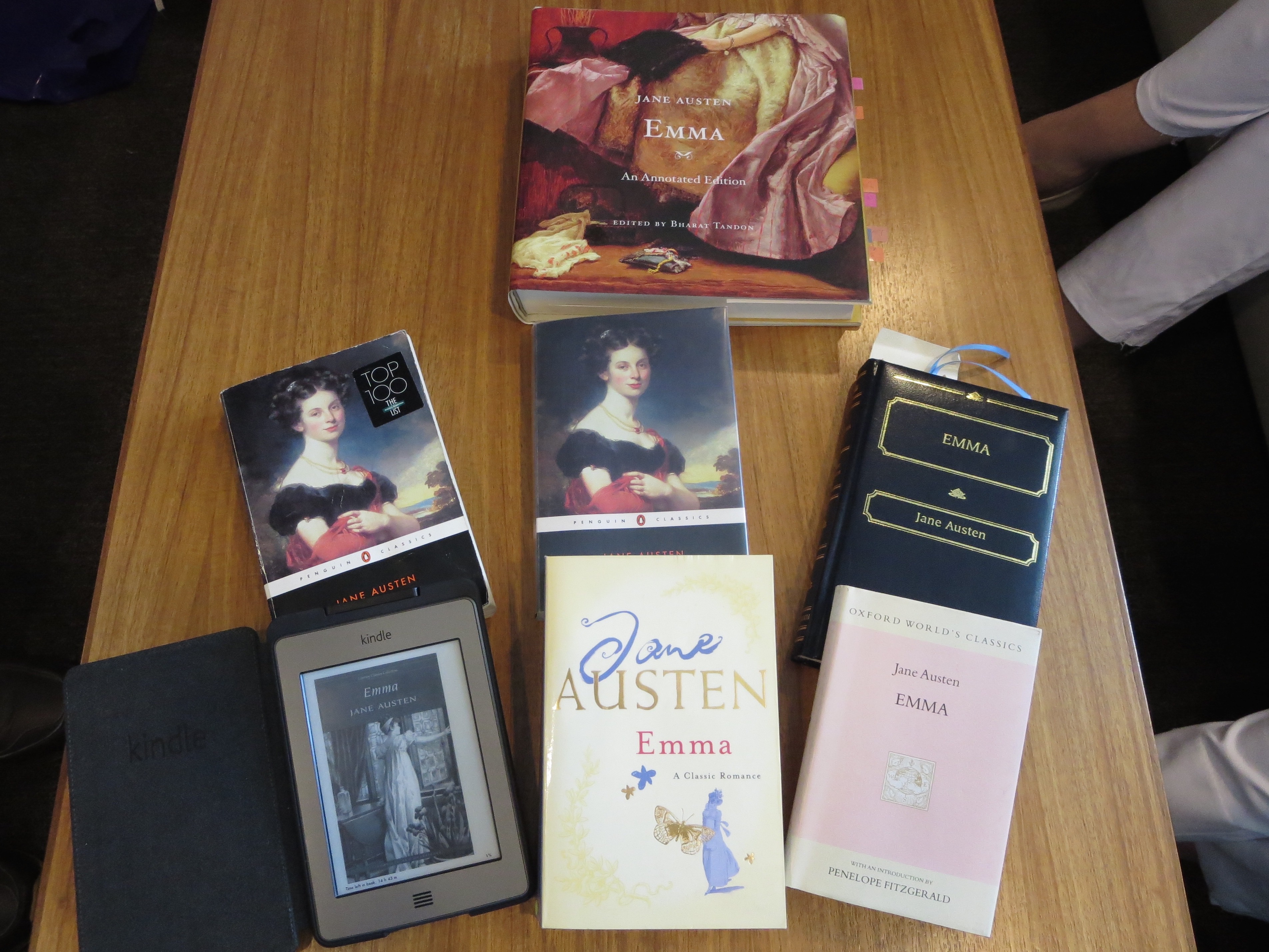
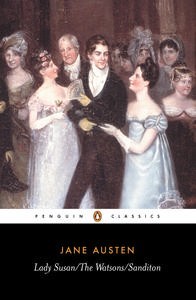
AustenLadySusanPenguinIt is a truth universally acknowledged – I know this is a tired old joke but I seem programmed to do it – that Jane Austen fans will collect multiple editions of her works. There are many reasons for this behaviour, but one of them is our interest in different introductions. And so, although I already had a copy of Lady Susan, in the Minor works volume of R.W. Chapman’s The Oxford Illustrated Jane Austen, I bought the Penguin edition for my Kindle because it had an introduction by Margaret Drabble. And I have a second confession to make: this is a rereading, but my reason for rereading has little to do with the reasons I gave in my recent post on Flanagan. The reason is simple – my local Jane Austen group decided to schedule it for our October meeting. I was happy with that. As far as I’m concerned all bets are off my usual “rules” when it comes to Jane Austen.

If you’re not an Austen fan, you may not have heard of Lady Susan. It is a complete novella that sits between her Juvenilia and her adult novels. It was written, we believe, in 1793/4 when Austen would have been 18-19 years old, but was not published until 1871, well after her death, when her nephew James Edward Austen-Leigh included it in his memoir of her.  It is epistolary in form, something she tried again with Elinor and Marianne. While this latter one she rewrote in her well-known third person omniscient voice, retitling it Sense and sensibility, for some reason she didn’t go back to Lady Susan. One reason might have been its subject matter.

 “the most accomplished coquette in England” (Reginald of Lady Susan)

Lady Susan is a beautiful, 35-year-old widow of four months, who is already on the prowl for a new, wealthy husband. The novel opens with her needing to leave Langford, where she’d been staying with the Manwarings, because she was having an affair with the married man of the house, and had seduced his sister’s suitor, Sir James Martin. She goes to stay with her brother-in-law Charles Vernon and his wife Catherine, whom she’d done her best to dissuade him from marrying. She’s not long there before Reginald, Catherine’s brother, arrives to check her out because, from what he’s heard,

Lady Susan possesses a degree of captivating deceit which must be pleasing to witness and detect.

Of course, the inevitable happens and the artful Lady Susan captivates him. Meanwhile, Lady Susan wants her 16-year-old daughter, Frederica, to marry Sir James, the man she’d seduced away from Miss Manwaring – but sweet, sensible Frederica wants none of this weak “rattle” of a man.

You’ve probably worked out by now that this is not Austen’s usual fare. Lady Susan belongs to the 18th century tradition of wickedness, lasciviousness and adultery, forced marriages, and moralistic resolutions. The novel’s characters tend to be types rather than complex beings, and it is racily written, with a broad brush rather than a fine pen. And yet …

“Lady Susan is not wholly a villain” (Margaret Drabble)

This is also where Austen’s mature touch starts to appear. For all Lady Susan’s self-centred “bewitching” machinations, she is also, as Drabble says, “witty, energetic, intelligent and charming”. Drabble and other critics argue that Lady Susan’s spirit can be seen in characters like Elizabeth Bennet, Emma Woodhouse and, particularly, Mary Crawford who, like Lady Susan, comes from London where she moved in “fast” circles. How could a teenaged country parson’s daughter imagine into being such a duplicitous character? Austen was, we know, a great reader and read the gothic novels of her day. She also knew the behaviour of Mrs Craven, the mother of her neighbour Mrs Lloyd. According to Drabble, Mrs Craven “had treated her daughters shockingly, locking them up, beating them and starving them, until they ran away from home …” just as Lady Susan’s daughter ran away from school. And, as her letters demonstrate, Austen was capable of bite.

We don’t know why Austen didn’t pursue this book, besides making a good copy of it in 1805, or why she didn’t try again to write about a beautiful 35-year-old widow.

Hints of what’s to come

All this is well and good, and I loved the read, but my main reason for reading these early Austens is their insight into the writer to come – her wit and irony, and her commentary on human nature. Lady Susan, having been written on the cusp of her maturity, is particularly interesting in this context. The melodrama, for example, is toned down, compared with the books Austen would have been reading. Frederica isn’t locked up as she might have been in Walpole’s Castle of Otranto (my review), there are no rapes as we see in Richardson’s Clarissa. Austen is moving, in other words, towards the naturalism of her favourite topic, “3 or 4 families in a Country Village”.

I love Austen’s irony, and there’s plenty in evidence here. A good example is when Reginald, completely convinced by Lady Susan, writes to his father of how she has been misrepresented, saying that this

may also convince us how little the general report of any one ought to be credited … I blame myself severely for having so easily believed the scandalous tales invented.

The joke is on him because, of course, he should believe these “scandalous tales”. One of the complexities of the novel is this issue of gossip – who should believe what and whom? As Austen readers know, gossip plays a significant role in her characterisation and plots.

Other ideas and themes that we see in later novels also appear in Lady Susan. Bad mothering is one. Another, more specific, is this delightful comment on accomplishments, reminding us of the discussion between Mr Darcy, Miss Bingley and Elizabeth at Netherfield. Lady Susan writes to her equally scheming friend Alicia Johnson:

Not that I am an advocate for the prevailing fashion of acquiring a perfect knowledge in all the languages arts and sciences; it is throwing time away; to be mistress of French, Italian, German, music, singing, drawing etc., will gain a woman some applause, but will not add one lover to her list.

And then there’s that main reason I love Austen – her terse, pithy commentary on human behaviour. There’s much in Lady Susan, including

but where there is a disposition to dislike a motive will never be wanting

and

Silly woman, to expect constancy from so charming a man!

Have I convinced you to give it a go? I do hope so.

Jane Austen
“Lady Susan”
in Lady Susan, The Watsons, Sanditon
London: Penguin Books, 2003
Kindle Edition EISBN: 9780141907901

Available in e-text.

Jo Baker, Longbourn (Review)

Jo Baker, Longbourn

Used by permission of The Random House Group Ltd

“Never say never” is one of my favourite mottos, though I must admit there are some things I never will do, such as climb Mt Everest, say, or even write a novel. However, when it comes to reading choices, there are certain types of books that are not my preference, such as crime and Jane Austen sequels, but as regular readers will have seen over the years I can be persuaded. And so, I was persuaded to read Jo Baker’s Longbourn: Pride and prejudice, the servants’ story, a Pride and prejudice spin-off, for my local Jane Austen group’s monthly meeting. I can’t say I loved the book, but it did interest me.

So, what’s it about? As the title suggests, it concerns the “downstairs” staff, the servants, at Longbourn, the residence of the Bennet family of Pride and prejudice. These servants appear, either directly or by indirect mentions, in Austen’s novel, but of course we know nothing about their lives. Baker rectifies that in her story by exploring who they are, how they got there, and what their aims and ambitions are. There’s Mr and Mrs Hill (butler and housekeeper/cook), Sarah and Polly (housemaids) and, for a short time, James the footman. The “heroine”, if a poor orphan housemaid with bleeding, chill-blained, “pruney” hands can be called that, is housemaid Sarah. The plot, particularly concerning James and his relationship to Longbourn, is a little melodramatic and the romantic resolution a little predictable for my tastes but it is probably traditional historical fiction fare. The book is well-written, the characters realistic and engaging, and the plot well-paced. I’m no expert in the genre but it is, I’d say, a perfectly fine example.

Baker nicely handles the relationship with the “parent” novel. The downstairs staff are privy, of course, to what happens to the Bennets, so we see many of the scenes, such as Mr Collins’ proposal to Elizabeth and Lydia’s “elopement” with Wickham, through their eyes. They have their own views on the characters and their own reactions to the events. Baker’s imagination of these is completely believable. Mrs Hill, for example, is sympathetic to Mrs Bennet, understanding that much of her behaviour stems from Mr Bennet’s lack of love and respect for her. She is also very aware of the precariousness of the servants’ situation. What will happen when Mr Bennet dies and the estate falls into Mr Collins’ hands? Will there be enough work for them all as the young misses marry and leave Longbourn?

All this was interesting enough, and the story wasn’t so melodramatic that I was turned off, but what mostly captured my attention was Baker’s evocation of the life of servants in Regency/Georgian times. They work hard, and over long hours, sometimes from 4.30am to 11pm. Baker describes in some detail their duties such as laundering and the hand-ruining scrubbing needed to remove stains, the emptying of chamber pots, and the making of soap and other products such as dubbin. Their needs and feelings are rarely considered. Even “kind” employers’ like the Bennets tend to be oblivious of their servants’ lives, just as the thoughtful Anne Elliot in Persuasion doesn’t notice her sick friend Mrs Smith’s nurse. Their living quarters are cramped, in uncomfortable parts of houses, with housemaids often sharing a bed. Through James, the footman, we learn about the awful lives of young men who “take the King’s shilling” and end up fighting in harsh conditions, treated like fodder and at the mercy of corrupt superiors. James realises:

I had handed my freedom right over. I signed it clean away. I sold myself.

In addition to these rather era-specific aspects of the book were references to behaviours that are more universal to relationships involving disempowered people. One relates to naming. There are two such situations in Longbourn. There’s housemaid Polly whose real name is Mary, but

It’s only ‘cos she’s the Miss and I imnt, that she got to be called Mary, and I had to  be changed to Polly, even though my christened name is Mary too.

This practice, we know, wasn’t limited to English servants. It happened regularly, for example, with indigenous people, as Kim Scott tells us regarding the naming of Bobby in That deadman dance (my review), and Eleanor Catton regarding her Maori character in The luminaries (my review). Then there’s Bingley’s footman, the mulatto Ptolemy Bingley. When Sarah questions his last name, he says:

If you’re off his estate, that’s your name, that’s how it works.

The other issue that struck me was the way servants watch their masters/employers. I’ve already noted that the employers often didn’t notice their servants, but the servants sure noticed them – and more than was simply required for the work they were employed to do. Servants needed to watch because their lives were closely attached to the fortunes of their masters. Similarly, I’ve read that indigenous Australians watch and know non-indigenous Australians way better than we know them. As indigenous activist Lee says in Margaret Merrilees’ The first week (my review):

You think we can’t see you? You think we haven’t been watching you for two hundred years? We’ve had to find out everything there is to know about you.

These sorts of insights are, for me, one of the prime values of reading historical fiction – the lessons learned about how we’ve been and behaved, and the historical continuities between people and times. It’s for these reasons, in particular, that I’m not sorry I devoted some precious reading hours to reading Longbourn.

Jo Baker
Longbourn: Pride and prejudice, the servants’ story
London: Doubleday, 2013
365pp.
Design: Clare Ward
ISBN: 9780857522023

Evie Wyld, All the birds, singing (Review)

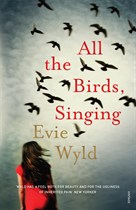
Evie Wyld, All the birds, singing

Courtesy: Random House Australia

Quite by coincidence, I read Evie Wyld’s second novel All the birds, singing straight after Eleanor Catton’s The luminaries. I was intrigued by some similarities – both have a mystery at their core, and both use a complex narrative structure – but enjoyed their differences. Wyld’s book is tightly focused on one main character while Catton’s sprawls (albeit in a very controlled way) across a large cast. Paradoxically, Wyld’s 230-page book spans a couple of decades while Catton’s 830-page one barely more than a year. And yet both convey, through their structures, an idea of circularity, of the close relationship between beginnings and endings. But, enough prologue. On with All the birds singing.

The book opens powerfully:

Another sheep, mangled and bled out, her innards not yet crusting and the vapours rising from her like a steamed pudding. Crows, their beaks shining, strutting and rasping, and when I waved my stick they flew to the trees and watched, flaring our their wings, singing, if you could call it that. I shoved my boot in Dog’s face to stop him from taking a string of her away with him as a souvenir, and he kept close by my side as I wheeled the carcass out of the field and down into the woolshed.

And so we are introduced to Jake and the things that dominate her life – Dog, sheep and birds. Soon, we learn there’s another thing – fear. But fear of what, or whom, we don’t know. From this opening, Wyld tells her story in alternating chapters: the odd ones, set in England, move forward, and the even ones, in Australia, move back to what started it all. It’s an effective structure that explores the ongoing impact on Jake of whatever it was that happened. We see what’s happening now, and we slowly see how she has got to this point.

Jake, at the start of the novel, is in her 30s. She’s a loner, capably running a sheep farm on a remote British island. Her nearest neighbour, Don, keeps a bit of a fatherly eye on her, and tries to encourage her to engage with the local community, to go to the pub for example, but Jake is not interested. As we move back in time we learn snippets about various significant people in her life – a lover while she was a shearer, a controlling man whom she’d initially seen as her rescuer, a female friend and co-worker. We also learn that she’s estranged from her Australian family, and we discover that she has scars on her back, but how they were caused are part of the mystery.

Wyld’s writing is marvellous. The imagery is strong but not heavy-handed because it blends into the story. The rhythm changes to suit the mood. The plot contains parallels that you gradually realise are pointing the way. There’s humour and irony. I love the fact that our Jake, on the run from whatever it is, smokes “Holiday” brand cigarettes.

There’s a bleakness to the novel, but it’s not unremitting. Jake, always the outsider, is tough and resourceful. She sleeps with a hammer under her pillow, but she has a soft side that is revealed mostly through her tenderness towards her animals. She talks to Dog, and losing a sheep always brings “a dull thudding ache”. The imagery is focused. Black, shadows, and fire in various permutations recur throughout the novel. They provide possible clues to what started it all; they contribute to the menace she feels now; and they help create an unsettling tone for the reader. We are never quite sure whether the shadow she sees out there, watching, following her, is real or a figment of her imagination. Jake is not an unreliable narrator, but we see through her eyes, and her eyes are influenced by her very real fears. She is “damaged goods”, though not in the sense meant by the paying customer (if you know what I mean!) offended by her scarred back.

And of course, there are the birds. They’re omnipresent. Sometimes they reflect her mood (“the birds sing and everything feels brand new”); sometimes they break tension; sometimes they suggest death. There are specific birds – butcher birds, night jars, galahs, merlins, currawongs and crows – and there are birds in general. The imagery references the real and metaphorical, from the crows hovering over the dead ewe in the opening paragraph to the birds near the end that attend the defining event:

[…] and the birds scream, they scream at me, Chip, chjjj, cheek, Jaay and jaay-jaay notes, Tool-ool, twiddle-dee, chi-chuwee, what-cheer … Wheet, wheet, wheet, wheet […]

awwchallenge2014It’s deafening. But it’s the silence and the dead birds afterwards that impresses the full horror on us:

The trees don’t want me there … There’s not a single bird to make a sound.

All the birds, singing is about how the past cannot “be left alone”. “We’ve all got pasts”, the shearers’ boss tells Jake early in the novel, but for some people the past must be dealt with before they can move on. The novel is also about redemption. It’s not the first novel about the subject, and neither will it be the last, but it is a finely told version that catches you in its grips and makes you feel you are reading it for the first time.

John at Musings of a Literary Dilettante loved the book too. Thanks to my brother and family for a wonderful Christmas gift!

Evie Wyld
All the birds, singing
North Sydney: Vintage Books, 2013
232pp
ISBN: 9781742757308

Jane Austen on reading novels

Jane Austen’s defence of the novel in Northanger Abbey is famous. Not only does the hero, Henry Tilney, tell the heroine Catherine, that:

The person, be it gentleman or lady, who has not pleasure in a good novel, must be intolerably stupid …

but Austen, in an authorial comment early in the book, says

… there seems almost a general wish of decrying the capacity and undervaluing the labour of the novelist, and of slighting the performances which have only genius, wit, and taste to recommend them. “I am no novel–reader — I seldom look into novels — Do not imagine that I often read novels — It is really very well for a novel.” Such is the common cant. “And what are you reading, Miss — ?” “Oh! It is only a novel!” replies the young lady, while she lays down her book with affected indifference, or momentary shame. “It is only Cecilia, or Camilla, or Belinda”; or, in short, only some work in which the greatest powers of the mind are displayed, in which the most thorough knowledge of human nature, the happiest delineation of its varieties, the liveliest effusions of wit and humour, are conveyed to the world in the best–chosen language.

This is Austen, though, and while she was passionate about the value of reading fiction, she also saw the other side. Not all novels, perhaps, are equal! And so, Catherine, a fan of the Gothic novel, is shown to be a rather silly novel reader, letting her imagination run too far and getting herself into trouble as a result. She does learn, though …

Northanger Abbey was published posthumously in 1817*. However, Austen wrote it in 1798/99, and revised it in 1803, when it was the first of hers to be sold to a publisher – Crosby & Co. They decided not to publish it, and it was bought back in 1816. Austen did further work on it before her death in 1817. My point though relates to the fact that the bulk of it was written in 1798/99. This is interesting, when you compare the excerpt above to this from her letter (no. 14) to her sister written on 18 December 1798:

I have received a very civil note from Mrs. Martin requesting my name as a Subscriber to her Library which opens the 14th of January, & my name, or rather Yours is accordingly given. My Mother finds the Money. …  As an inducement to subscribe Mrs. Martin tells us that her Collection is not to consist only of novels, but of every kind of Literature, & c. & c-She might have spared this pretension to our family; who are great Novel-readers & not ashamed of being so; – but it was necessary I suppose to the self-consequence of half her Subscribers.

Those comments “great Novel-readers & not ashamed of being so” and “The self-consequence of half her Subscribers” tell us very clearly that novel-reading in the late 1700s to early 1800s was seen by many as a frivolous activity. No wonder she, a beginning novelist, felt the need to defend her craft!

* Published in December 1817, but the imprint date is 1818.