Canberra Writers Festival 2025: 2, What happened in the outback

Garry Disher and Gail Jones with Michael Brissenden
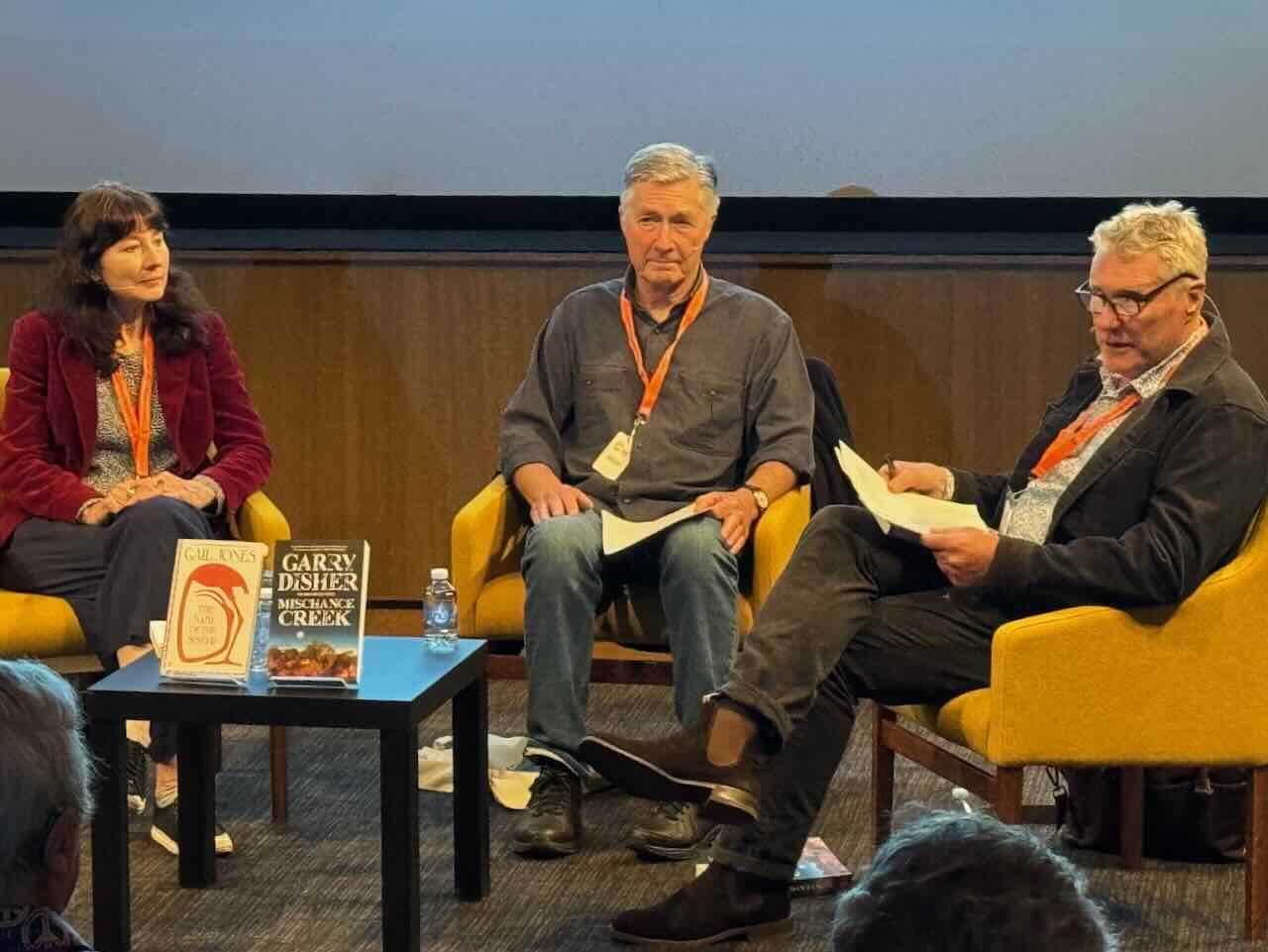
The program described the session as follows:

Join two of Australia’s most highly regarded writers speak about the lure of the Australian outback with its landscapes, characters and unsettled complexity. Here we have different tales of desperate searches to uncover what has happened to two women in the outback. Stories multiply. Heart and horror beat in tandem. Cops try to do their best. Gail Jones (The Name of the Sister) and Garry Disher (Mischance Creek: The new Hirsch novel) will together explore the power of beautifully written outback crime. Moderated by Michael Brissenden (Dust)

Journalist and novelist Michael introduced the authors, outlining their work and achievements before getting onto the discussion which centred, of course, around two concepts – the outback and writing about crime. It was an intriguing if sometimes slightly odd discussion, with Gail Jones talking almost as much about Disher’s work as her own, and an underlying (but also explicitly explored) tension between literary writing and crime (or genre) writing.
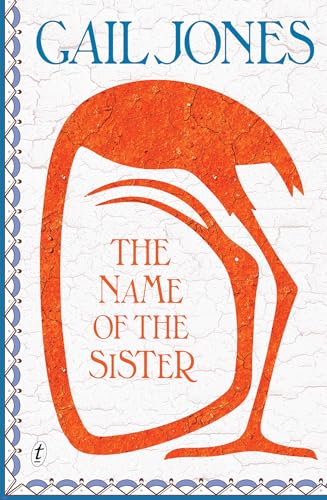
The session started with the usual question asking the writers to précis their novels. Gail Jones described hers as non-genre, and said it was set in Sydney, Broken Hill and Berlin. It starts not with a death of a woman but with a woman being found. It doesn’t have a traditional crime plot, and is about people whose stories and identities are lost.

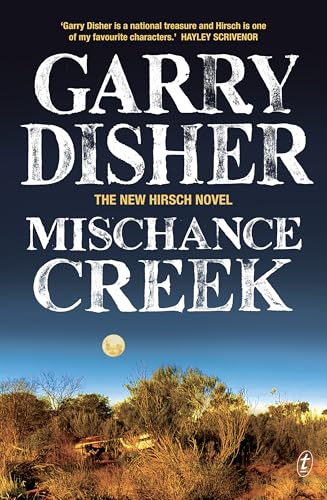
Garry Disher’s book, on the other hand, does have a crime plot. It’s the 5th in his Hirsch series, but Hirsch doesn’t match the common tropes of crime. Most crime fiction, for example, is closely related to place – think Bosch in LA and Rebus in Edinburgh, for example. Hirsch, however, is from Adelaide, and is an outsider in the small town he has retreated to (though of course, the novels are imbued with this new-to-him place). Most crime fiction protagonists are relatively senior in rank, but Hirsch is lowly. And finally, most crime protagonists are troubled, dark, while Hirsch is genial.  The driver for the novel, Garry said – though it was written before the 2025 Porepunkah incident – was the idea of sovereign citizens and their capacity for violence, but there is another plot involving a woman who has come to town, unhappy with the investigation into a case concerning her parents.

The discussion proper then started with that question that won’t go away concerning whether a distinction still exists between literary and crime fiction. Gail said “good writing is good writing”, and that the concept of “literary” is less a judgement of writing than about subject and mode. She is interested in writers who “don’t stay in their lane”. She has also been interested in crime and guilt for a long time, but is less interested in plot than in exploring consciousness, and the covering over or hiding of crime, and secret guilt. When it was suggested to her that she write a crime story, she thought about loss and the dissolution of marriage (which she admitted is probably a more common “literary fiction” subject). Her novel intersects between crime and literary.
Garry addressed Brissenden’s question concerning how crime fiction is changing and where it is now. He delved back into the past, and how in planning for the Spoleto Festival (which has now morphed into the Melbourne Writers Festival) he had suggested inviting Peter Corris, the popular and successful Sydney crime writer at the time, but was firmly told “no, this is a literary festival”. There is still a sense of this divide. He would like to talk about fiction more broadly but he is always invited onto crime panels at festivals – organisers, take note! He senses that there’s a feeling crime writers would embarrass other writers if they appeared together (though didn’t explain what he meant by “embarrass”). His early writing was not crime, and writing craft is important to him. What matters most to him is the characters not the plot.

The conversation then got onto the outback, the session’s subject. Garry said that the term “outback noir” was coined by a journalist talking about the early work of Jane Harper and Chris Hammer, but feels that it has had its day. Writers jumped on the bandwagon, resulting in some copycat (my word) novels that were not necessarily good. Good crime, all agreed, deals with prevailing social values and conditions – well-written and in an entertaining way, said Brissenden.

So, what is this thing called the outback, and to what degree does it play into the concept of place and character? This is where the session became particularly interesting to me, because we bandy around this term, often without a great deal of thought.

Gail thinks it is an antiquated term that she believes began with Lawson’s 1893 poem “Out back”, which has words like “blistering”, “furnace”, and concludes with “Where the bleaching bones of a white man lie by his mouldering swag Out Back”. The poem implies “out back” is homicidal to white men, and “extinguishes”, said Gail, First Nations people. It flattens and reduces the land to one idea, one, more often than not, reduced to a sort of psychodrama. It’s interesting that we (as in non-Indigenous Australians) use “outback” rather than “country”. Our usage – incorporating a sense of being in “the middle of nowhere” – denies the fact that it is other people’s “somewhere”.

Garry agreed with Gail, building on it and adding his own thoughts. Most of us, he suggested, have a vision of the “outback” as vast and encompassing long drives, but also with a mythical overlay, as reflected in “we of the never never” (Mrs Aeneas Gunn) and “the great Australian loneliness” (Ernestine Hill). The sense – also conveyed in paintings by artists like Russell Drysdale and Sidney Nolan – is that it is remote, not pleasant, even though it is home to someone. The outback (like the beach) suggests loss – lost children, lost travellers, the lost women in their novels. On the other hand, there’s the “outback” that is romanticised by travel companies.

Gail added that the challenge is learning about the Indigenous world view, their knowledge of and regard for land. White Australia has not come to terms with the mysticism and animism associated with First Nations’ understanding of the land, a place rich with meaning. The travel idea of “adventure” misrepresents what the land is, but has extraordinary persistence. Similarly, she said, the ideas of “noir” and “gothic” (which originated in 18th century England and Walpole’s Castle of Otranto) come from other lands and cultures, and are a mismatch with the outback. She likes that Garry’s Hirsch is richly human and that his novels include women and Indigenous people.

We then moved onto the idea of loneliness in a sparse place. Garry reiterated that Hirsch is an outsider, without deep friendships (though he has a lover living outside the town). He has to be all things to all people. Gail’s character Angie is a freelancer which can be a lonely occupation, but Gail is more interested in solitariness rather than loneliness.

Gail didn’t want to have cop character in her novel because she doesn’t know police stations and procedures, but she had to “get out of Sydney”. She is interested in mining towns – her father was a miner, one of the “labouring poor” – so she could relate to the harshness of Broken Hill. She commented on the profound masculine overlay there created by films/novels like Wake in fright and the Mad Max movies, while Hirsch, she said, despite being a male cop in a small town, is aware there are other meanings – layers – in the place. She likes crime that has this social complexity.

Talking fathers, Garry said his told him that farming was a mug’s game and to get an education, which he did. This included researching the landscape writers of the 1930s with their complicated messages about the outback (including towards Indigenous people who were either feared or treated as children). However, his brother became a small town cop. He can go to him for practical questions (like would a paddy wagon be air-conditioned?)

There was more, including readings by both from their novels, and a comment from Gail about liking it when policemen/detectives in crime novels are also readers! Hirsch for example mentions Helen Garner’s diaries.

Oh, and for those interested, there will be another Hirsch novel, but he does write standalone novels in between. The next one draws on children’s fears (like his in the 1960s about Russians and communists.)

There was no Q&A. And we didn’t really need it after this thoughtful, deep dive into “the outback”.

Canberra Writers Festival, 2025
What happened in the outback
Saturday 25 October 2025, 10-11am
Shelley Burr, Vanish (#BookReview)

With Vanish, the third novel in her Lane Holland series, Burr mixes it up yet again, which appeals to me because my main reason for not liking genre fiction is that it can be formulaic. I know this is why many like it, and I understand that need for comforting reading. It’s just not my need.

So, a brief recap. In Wake (my review), we are introduced to a private investigator, Lane Holland, who arrives in a remote, outback, fictional town to investigate an old missing persons case. He’s keen and caring, but he also has his own agenda – and the resolution is shocking. The next book, Ripper aka Murder town (my review), is set in a different country town. It initially looked like something different, as Lane is in prison from Wake‘s fallout, but it soon becomes a dual investigation story that coalesces when it turns into both a murder and a missing persons case.

And now, book 3. It seems you really can’t keep a good PI down, even if he is in prison! Vanish is set a few years later. Lane is still in prison but, because of prison governor Carver’s vested interest, he soon manages to get himself on a pre-parole release program in order to continue the unsolved investigation from Ripper. If you’ve read Ripper you’ll know what that is, and if you haven’t, it becomes clear very soon. My point, though, is that once again Burr has produced a highly readable crime novel that manages to be a bit different from the preceding book, while retaining enough familiarity for those invested in her characters and worldview. It’s a fine balance that Burr has trodden nicely.

Like its predecessors, Vanish belongs to the rural noir sub-genre, and is consequently, noir-ish – or Australian Gothic – in tone. It features characters we have met in the previous novels, including Lane Holland, his sister Lynnie, and his first client Mina McCreery. Further, its plot centres again on a missing person. In Vanish, however, there’s more than one missing person. A serial missing persons case!

Some stay. Some leave. Some disappear.

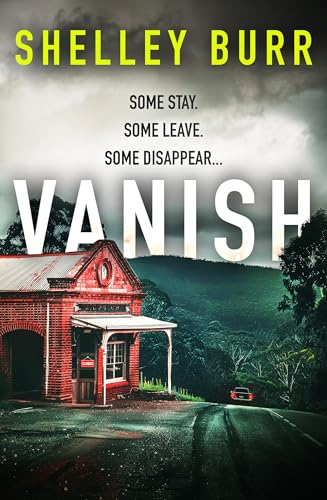
“Some stay. Some leave. Some disappear” appears above the title in the book’s first Australian edition (as you can see in the cover pic above). What it references is the main setting of the novel – a farm near Hume Weir, southeast of Albury, an area Burr knows well. At the novel’s opening, Lane has tracked down several missing people as having visited this farm, then disappearing from view – hence the tag line. What is this farm, and why have some people disappeared? Lane wants to find out and Carver, with his daughter still missing, is happy to help him do so.

Consequently, with ankle bracelet, a prison guard minder, and an agreement for him to work at the farm, Lane arrives – but not without a mysterious-sounding death having just happened on the road in. This, of course, captures Lane’s attention – and we’re off.

Now Lane is, of course, your suspicious type. He takes nothing at face value, and he closely observes all that’s going on around him. There’s something about this farm that doesn’t feel right. Is it a community of like-minded people who want to escape their old lives and live more simply, growing their own food and reducing their energy impact on the world? Or is it a cult? How genuine is the owner Sam Karpathy, not to mention his recently deceased father? What do the people in the nearby township know, and why do they seem evasive when Lane tries to find out? And, why is a certain person from a previous novel there too?

Oh, and who is the trapped, sick, or injured person whose story is told in short italicised sections interspersed with the main narrative? (It added to the intrigue, and I didn’t guess it at all.)

As in her previous novel, Burr’s builds her crime story around wider issues. In Ripper for example it was “dark tourism”. Here, it is the idea of people wishing to live eco-minded, sustainable lives. So, as the investigation progresses, Burr also interrogates what this sort of life means in terms of whether or not you compromise and why, whether you stockpile for an end-of-world scenario, whether you eschew western medicine, and so on. These are questions Lane considers as he tries to understand the community he is living in. And it starts with the controlling Karpathy.

Lane, as he needs to be, is a trustworthy narrator for us. The novel is told third person, through his eyes, and he brings us along with him, sharing his thoughts and explaining his processes. His awareness of body language and his experience of human behaviour guide his actions. I loved those details. There’s risk and tension, some creeping around the farm at night, a locked room, magic mushrooms, and more. I didn’t find it edge-of-the-seat suspenseful, but I don’t like that anyhow, so the level of stress was just about right for me. The plot builds slowly, sending us off in various directions, and keeping us uncertain as we consider what Lane sees and questions. Is Karpathy, for example, coercive or simply wanting to keep control of a dream he is vested in. The denouement, when it comes, unfolds quickly, and at just the right time.

I enjoyed the read. I have been invested in Lane from the beginning, and he continued to interest me in this book. He’s conscientious, intelligent and decent, but, appealingly, is not always sure of himself, particularly when it comes to relationships. Also, Burr evokes place well. The farm, which is set in mountains just far enough from a little town to feel isolated, feels believable, as do the natural disasters – flood and bushfire – which threaten it.

My only question now is, will we see more of Lane? As a convicted felon he will not be able to renew his investigator licence. There is a hint at the end that there might be a way around it. Time will tell, but if you are a Lane Holland fan, I think you can have hope.

Shelley Burr
Vanish
Sydney: Hachette Australia, 2023
384pp.
ISBN: 9780733652158

(Review copy – an uncorrected book proof, hence no quotes – courtesy Hachette Australia)

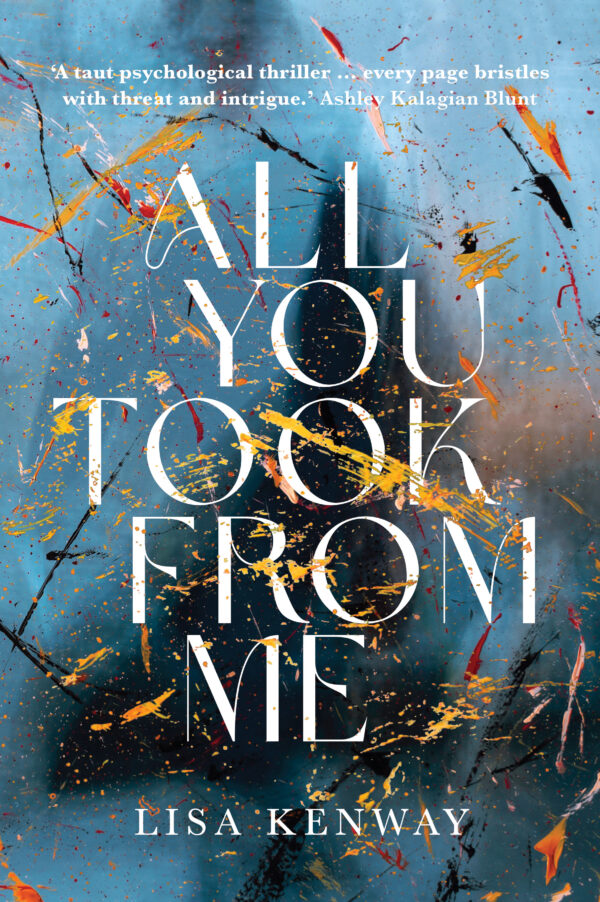
Lisa Kenway, All you took from me (#GuestThoughts)

With my Review TBR pile teetering on the brink, I decided to call in a favour from Mr Gums, and handed him Lisa Kenway’s debut novel, All you took from me, thinking it might be up his alley.

Now, a word about Mr Gums. He is an engineer by training, and not the world’s biggest reader. When he does read – in the past at least – his go-to has been Jane Austen (whose books he has read multiple times, including more than once in German) and other classics. However, with more time at his disposal since retirement, he has started reading a little more broadly. He likes to be “entertained”, not overly challenged in his reading. (Apparently, reading Mansfield Park in German is not challenging!) Life is challenging enough, he says. So, crime fiction seemed to be a good fit, and he’s been trying out several authors with varying success. Chris Hammer is a big hit. Garry Disher goes down pretty well too. Peter Temple not so much. He has also read non-Australian crime writers – English, and others, including, recently, a Japanese author (thanks to JacquiWine). As you can tell from his Austen love, he is more than happy to read women writers, and has crime by Dervla McTiernan and Shelley Burr, and recently, Dinuka McKenzie’s first novel. So, why not Lisa Kenway?

So, Lisa Kenway. According to the media release that came with my review copy, she is an Australian writer and anaesthetist. This debut novel, All you took from me, was “inspired by her longstanding fascination with memory and consciousness”. An earlier manuscript version was longlisted for Hachette’s Richell Prize for Emerging Writers in 2020 (out of over 800 submissions). That must have given her confidence to keep working on it, because here it is, published by Transit Lounge in 2024.

Anyhow, the novel is set in two places – the Blue Mountains (which I love) and Sydney. The protagonist, Clare Carpenter, is an anaesthetist – write what you know! – whose husband has died in a single-vehicle car accident which also caused her to lose her memory. Soon after, she senses she is being followed by a stranger. Why? Finding the answer becomes her mission, but it is hampered by her loss of memory. Can she reverse that? Of course nothing is simple, and the risks and threats mount. This novel is not Mr Gums’ (nor my) preferred type of crime, which is the police procedural. It is, instead, as the blurbs say, a psychological thriller.

Mr Gums was intrigued by this debut, but he had reservations. He particularly liked the set up – the protagonist as anaesthetist. It was different, and an interesting idea. He enjoyed reading the technical details about anaesthesia, and liked the attention paid to details in those parts of the story. (Like me, he enjoys it when novels teach him about a world he doesn’t know much about.) However, this is also where his main reservation came, because, scientifically trained himself, he found Clare’s behaviour hard to believe. The risks she took, her foray into unscientific ideas, lost him. Mr Gums, though, has not been in the position Clare found herself in. Perhaps, in the same desperate circumstances, he might try anything too?

All you took from me is told first person, and the voice rings true. Clare is articulate and intelligent, and honest, as she starts to uncover less pleasant things about herself. The novel opens in the hospital a month after the accident, with Clare starting to return to her – new – consciousness. From here, the plot picks up, becoming increasing dramatic and sensational, as you’d expect for its genre, with Clare’s shaky memory, and her attempts to recover it, underpinning much of the intrigue. There are the usual red herrings and misleading threads, which kept Mr Gums challenged as he tried to work out what was true and what wasn’t.

Overall, Kenway’s novel is not Mr Gums’ preferred crime genre. He prefers more dogged analysis in his crime to the stress and tension of a thriller. However, he did conclude that All you took from me was “strangely entertaining”, which suggests to me that Kenway’s debut should not be the last novel she writes. I’d love to know if anyone else has read it?

Lisa Kenway
All you took from me
Melbourne: Transit Lounge, 2024
328pp.
ISBN: 9781923023123

[Review copy courtesy Transit Lounge (via Scott Eathorne of Quikmark Media)]

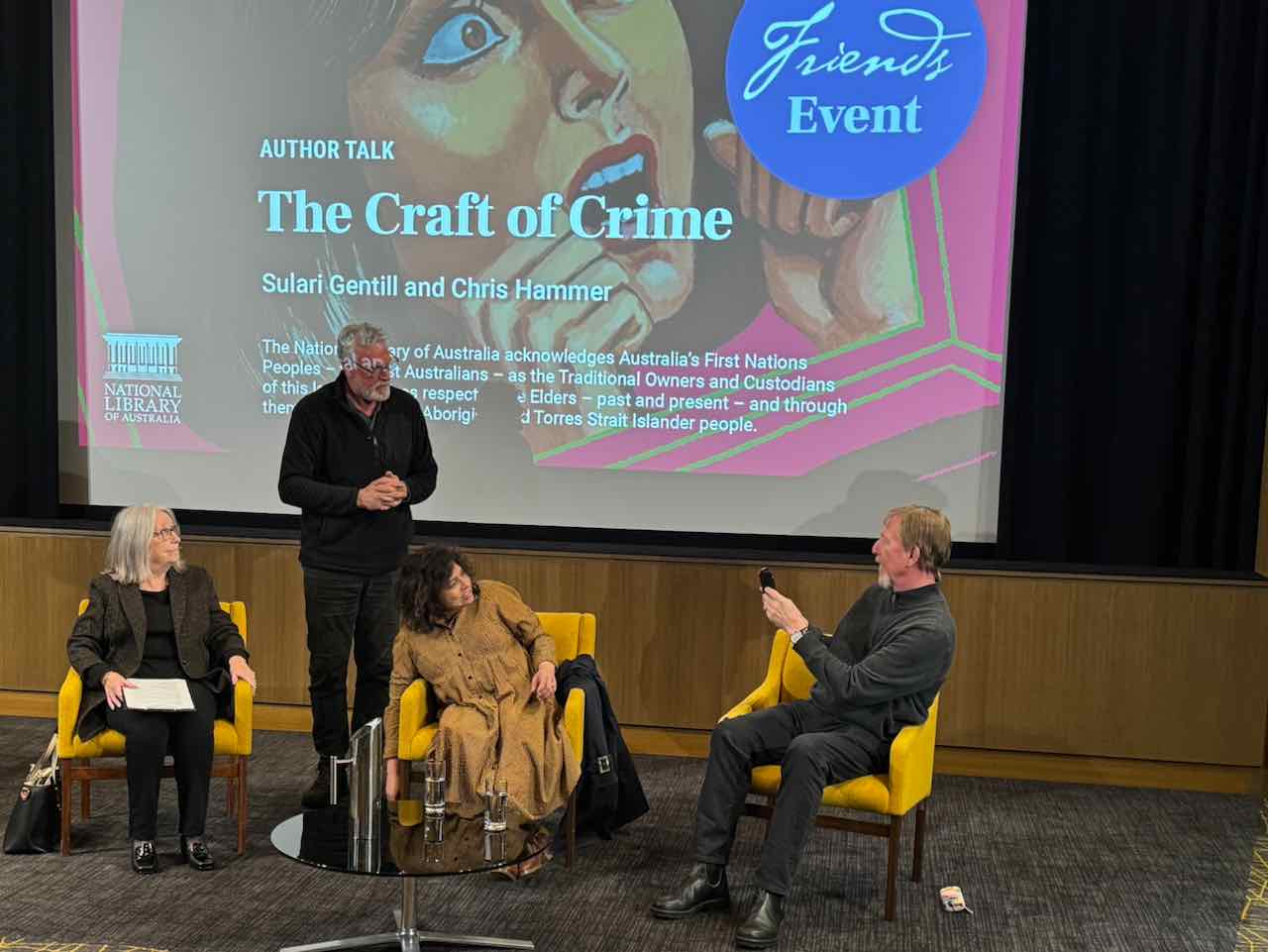
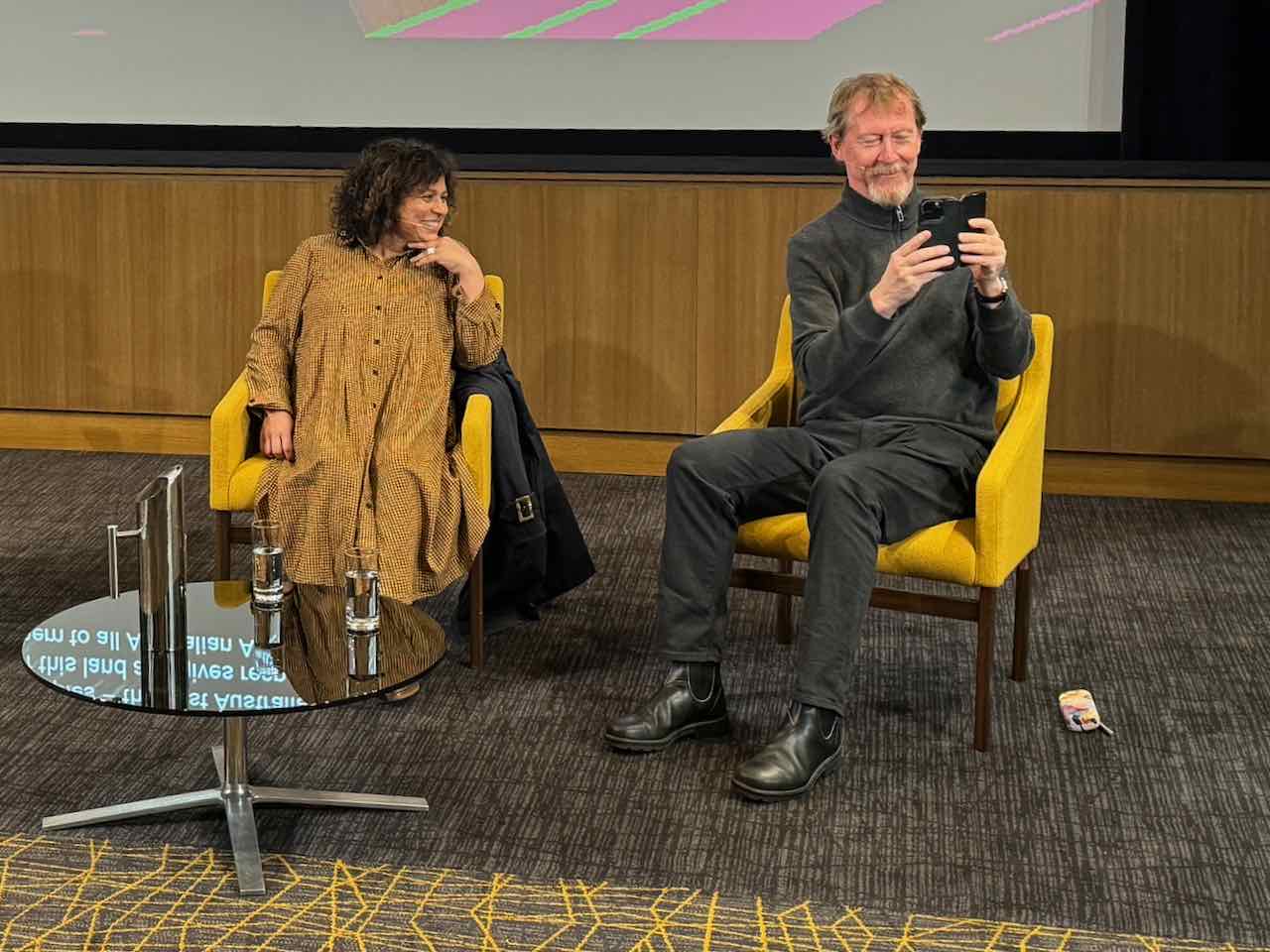
Author Talk: the Craft of Crime, Sulari Gentill & Chris Hammer with Anna Steele

This author talk was not one of my usual series – that is, not ANU/Canberra Times Meet the Author or Muse Canberra‘s conversations. Instead, it was presented by the Friends of the National Library of Australia, of which I am a member. Despite the cold, drizzly night, it was a full house, which is not surprising given the topic was crime fiction and the participants two local-ish, successful crime writers.

The event was MC’d by Nancy Clarke, from the Friends committee. After acknowledging country, she introduced the subject of the evening, and pointed us to a recent post on the NLA Blog on Australian crime fiction. She then introduced our authors and moderator:

  • Sulari Gentill: author of 15 novels, including 10 in her Rowland Sinclair series, since 2010, and winner of Ned Kelly and Davitt Awards.
  • Chris Hammer: author of two non-fiction works, and, since 2018, of 6 crime novels. And, winner of several awards.
  • Anna Steele: reviewer of crime and other fiction for local newspapers, including, currently, the City News. Before retirement she was Head of English at Canberra Grammar School. (She is also a friend of mine, through our local Jane Austen group).

The conversation

After also acknowledging country, Anna explained that the focus of the evening was the craft of crime writing, and suggested they start with how and why they became successful crime writers.

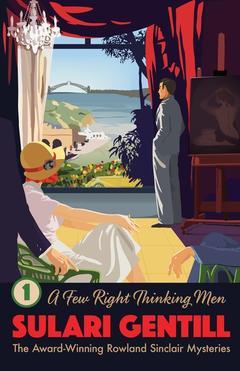
Sulari Gentill, A fete right thinking men

The ever-entertaining Sulari – I’ve heard her before – explained that she had been a lawyer, but also loved hobbies. After trying many, including welding, she thought she’d try writing. Very quickly, it “felt just right”, and she knew she wouldn’t stop. She lost interest in law. Her first foray was writing mythic fiction.

That was the how, more or less. As to why crime, she said that her main reader, her English history teacher husband, found mythic fiction a challenge. He suggested she write “something with names you can pronounce”, and that including a murder might be good. Now, writers, she said, are obsessed, and often “absent”, so living with them can be hard. Given she didn’t want to give up writing or her husband – see what I mean about ever-entertaining – she had to make these two worlds work. So, she looked at her husband’s history thesis on 1930s Sydney and found her subject.

Chris started by quoting Balzac’s “behind every great fortune is a great crime”*. He jokingly said that turning to crime writing was easy because he got sacked! Actually, though, the trajectory was a little more complicated, but the gist is that after writing two low-selling non-fiction works around 2010, he returned to his journalism career. But, he missed writing, so decided to “have a crack at making things up”. He wrote Scrublands (2018) and got a publishing deal after an exciting auction process. His timing was perfect, as he wrote it just after Jane Harper’s huge success with The dry.

As to why crime for him, it was because he didn’t feel he was a good enough writer for literary fiction (his main reading go-to) and he didn’t have an idea. Also, he added – only partly joking – having been a journalist he really “wanted to kill someone”! He liked American hard-boiled writers like Dashiell Hammet, the Australian Shane Maloney, and, in particular, Peter Temple, who had shown the way in terms of combining plot, character, human drama, action.

Anna then asked, Where did their great characters come from?

Chris replied that Martin Scarsden was not based on himself. But, not knowing anything about police work and detectives, and given journalists are experienced investigators who poke their noses into things, he decided to make his protagonist a journalist. Martin, then, is based on his knowledge and experience, but not on his character. However, through his career as a journalist he had met many career war correspondents who were messed up. Scrublands is a redemption story for Martin.

Sulari talked about the challenge of deciding on her character. 1930s Sydney was highly class-based. She needed a character who came from a comfortable background, but who could walk easily among all classes. Then she had an epiphany, he could be an artist, as artists tend to accepted across the social spectrum. Also, she paints, and although she is not a painter, she understands how a painter looks at the world. Authors don’t need to be the same as their protagonist but it is useful to have some link with the character (like Hammer and his journalist.) She talked about some of the other ongoing characters, and why she created them. For example, she didn’t want to write sex scenes, but Martin needed romance, so she created an unrequited love for him.

Are they plotters or pantsers? (Some audience members didn’t know these terms, so for those here who don’t, plotters plan their plots out in advance – albeit to different degrees – while pantsers write “by the seat of their pants”.)

Both laid claim to being pantsers, though there was a little repartee about this at one stage with Sulari suggesting that someone who writes multiple drafts, as Chris does, can’t be a pantser. Chris retorted that if you only write one draft, as Sulari does, you must be a plotter! As Chris said later, if you get 12 writers together in a room together you’ll have 14 different ways of doing things!

Anyhow, back to the question. Notwithstanding Chris’ dig (and I’ll add here that these two get on very well), Sulari claimed to be an “extreme pantser”. She does no plotting at all; she has no idea who is going to die, let alone who did it. She writes while in bed, watching television shows like Midsomer murders, Lewis, etc. She believes, as author Kylie Ladd suggested, that this distraction enables her prefrontal cortex (our creative centre) to come up with the words. She’s not sure if this really is how it works, but she’s been writing this way for so long she doesn’t want to “poke around” in case it breaks the magic! So, things pop into her mind as she’s writing, and they will “suddenly” drive the narrative. Her novels are conversations with the reader about things she’s thinking about.

Chris is also a pantser, though not quite so extreme. For him setting is the critical thing – it’s how you cast a spell and invite the reader in. He might have a murder in mind, and a framing idea, but he won’t know who did what. He couldn’t be a plotter, because he would find it boring to know all in advance, and just have to “get on with it”. That Hollywood image of a book appearing to authors fully formed rarely happens.

Why leave behind successful characters? (As Sulari did with her metafictional Crossing the lines, and Chris in his shift to a police procedural series.)

Sulari said that her first book had been seen as literary fiction, but from then on they were slotted as genre. This separation of “serious” and “elite” from “just enjoyable” irritated her, so she wanted to try literacy fiction; she wanted to write a novel that explained how characters take on agency, and that explored the line between imagination and reality. Ironically, the book ended up including a crime! She sees this book, Crossing the lines, as her truly “novel” book, because there’s not other like it. She needed to do something different.

Chris was aware that booksellers need to know where to shelve your books. A police procedural is easy in that regard. Hence, Treasure and dirt, which was intended as a stand-alone, but has ended up not being so! Also, by end of third Martin Scarsden book, he could think up more crime but didn’t want just “mechanistic investigators”. He likes them to have “skin in the game”. Martin does appear in this new series, and he will probably return to Martin and Mandy in the future.

Then, Anna just had to ask him about his amusing character names. He said he got bored with plain names; he likes Dickensian names; and his editors didn’t complain! One reader has told him that his distinctive names help her keep track of who’s who in his complex plots.

Q & A

On how their “first readers” and drafting process works: Sulari’s husband – her first reader – sometimes sees a chapter at a time, sometimes sees the whole in a “last minute flurry”. He helps with plausibility. As a historian he can advise on the right tone in the language for her period, but as a grammarian and English teacher he will fuss over grammar and want to add adjectives! For Chris, journalist friends read his first book, but now, with the best editors in Australia, they are his first readers.

On their writing schedule/fitting writing into life: Sulari would rather write than do anything else so it’s easy. She does other things first, then settles down to her writing. She writes 1000 words a day, which results in a novel in 3 months. (Writing is like a relationship: you are passionate at the start; then it’s like a long-term marriage and you have to work. By the end you hate the “damn thing”, but when you come back to it you love it again.) Chris is at the stage where he has no kids, and no other job, so he has time. He is addicted to writing, and writes anywhere, including trains and noisy cafes. In the first part of the year he runs out of steam by lunchtime, but as year wears on, the book captures him and he thinks about it all the time.

On getting started, and what they wish they’d known: Chris said the best thing is to enter unpublished manuscript competitions, many of which are for debut authors. Also, try to find an agent, particularly for fiction. Read the acknowledgements at the end of books to get useful names of publishers, agents, editors. And get used to being rejected! Sulari said that it can be hard to get an agent, and they don’t guarantee getting published, but they can mitigate your gratitude to publishers when it comes time to sign the contract!

Conclusion

This was an excellent conversation because Anna used just a few well-targeted questions which kept it closely to the brief, the craft of crime writing.

Anna concluded by quoting Canberra thriller writer, Kaaron Warren, who recently said at the Bristol CrimeFest:

“I have a theory that people who deal with murder and death are always jolly in person … I mean have you ever met a miserable butcher?”

We all laughed and went off into the cold Canberra night feeling well-pleased with the effort we’d made to come out. Big thanks to the Friends, Anna, and our two writers, Sulari and Chris.

* The actual quote is, apparently, “Behind every great fortune is a crime”.

Author Talk: the Craft of Crime, Sulari Gentill & Chris Hammer with Anna Steele (Friends Event)
MC: Nancy Clarke (Committee of the Friends of the National Library of Australia)
National Library of Australia
Wednesday 5 June 2024

Holly Throsby, Clarke (#BookReview)

My reading group’s last book of the year, Holly Throsby’s third novel, Clarke, was a popular end-of-year choice. It’s a straightforward but compelling read that was inspired by a story we were all across, the Lynette Dawson story. Inspired, though, is the operative word, as Clarke is not Lynette Dawson’s story.

For a start, while Clarke’s missing woman disappears in the same decade as Lynette, the 1980s, Throsby’s story is set in a different location (a regional town not a capital city) with a different sort of husband (a physiotherapist, not a teacher). Further, there is some sort of resolution a few years, not forty years, later. This was a wise choice by Throsby. It decouples the story from Lynette Dawson, which encourages us to see it as part of a bigger story. And, setting it in a smaller environment lets Throsby explore regional town life. This latter is one of the strengths of the book.

The novel opens with fifty-something Barney being visited by the police at the house he is renting. They have a warrant to excavate the backyard as the result of their having received new information concerning the disappearance of Ginny Lawson five years previously. Clarke tracks this new police investigation through the eyes of the neighbourhood, primarily Barney, his next-door neighbour Leonie, and Dorrie and Clive across the road. Leonie, Dorrie and Clive all knew Ginny and believe her husband Lou, now living in Queensland, is implicated. They have wanted this investigation ever since Ginny disappeared, but the police at the time weren’t much interested in missing women.

The main joy in reading the novel comes from Throsby’s handling of the relationships between her characters, and the way she conveys how neighbours and communities chat or gossip about and try to second-guess situations like these. They phone each other, visit each other, talk over the fence, and discuss it with their workmates. It’s so realistic, you can hear yourself doing the same over similar scenarios.

It’s a fundamentally tough story – a disappeared wife with its hints of domestic abuse, among other griefs – but Throsby handles it with a light touch, including occasional black humour. Here, for example is Leonie talking to her workmates about some concrete in Barney’s backyard that the police are now excavating. It’s clear that it had been a topic of conversation at the time of the disappearance:

The suspicious concrete’, said Varden.
‘Yes, because that’s what you do when your wife and the mother of your child has just disappeared’, said Leonie. ‘You landscape.’

There is also some subtle wordplay. For example, Ginny’s husband Lou’s “disturbing the dirt and who knows what else” in his back yard after his wife’s disappearance mirrors the disturbance felt by the neighbours. And there are some wonderful descriptions, like Leonie’s on her tricky relationship with her mother: “Leonie remembered the warmth of her mother as a heady storm that blew in fast but never stayed long”. Or on sad Barney: “His skin was kind of grey and rough and reminded Leonie of an egg carton”.

“It would be fantastic to be able to choose one’s memories. It would make life so much more bearable.” (Barney)

There are, as I hinted above, other layers to the the narrative besides the disappeared-Ginny plot line. Barney is no longer living with his wife Deb (but why?) and Leonie has her four-year-old nephew Joe living with her (why too?). Both people, it’s clear, are dealing with some sort of grief. Throsby drip-feeds us their backstories as we get to know them, and as they get to know each other. Dorrie, across the road, provides a voice of reason for Leonie, while also engaging in the neighbourhood speculations about Ginny.

I’ll leave the narrative there, and move onto the form. Clarke is fundamentally a crime story or mystery, but it doesn’t fit those genre expectations. It’s a cold case, but the criminal investigation occurs in the background. There is no protagonist detective, and we only meet the police through their interactions with the main characters. There is, admittedly, an element of the amateur-sleuth cosy-mystery going on. Our main characters do a little of their own “amateur surveillance”, as Barney calls it, and we would, of course, like to know what happened to Ginny. But, the main focus is on what is going on for Barney and Leonie, personally, and whether they will resolve the griefs in their lives that are holding them back. It reminded me of that idea that if you scratch just beneath the surface of most people’s lives you will find a sadness or tragedy.

So, my overall assessment? I thoroughly enjoyed the read. Throsby’s language, excellent characterisation, and authentic evocation of suburban 80s-90s Australia made it a compelling read. However, the twist near the end felt a bit forced, and the ending is a bit neat, albeit there was some restraint. Generally, I prefer edgier books, books that keep me thinking about where they are going. With Clarke, I wondered about what happened to Ginny, whether we’d find out, and whether a relationship would develop between Leonie and Barney, but it didn’t, for example, delve deeply into the fundamental issues that brought about the situation in the first place. As a result, it called more on my emotions than my mind, and I do like both.

Nonetheless, Clarke is an enjoyable read – and I’d happily recommend it to readers looking for generous stories about real people grappling with life’s challenges.

Holly Throsby
Clarke
Crows Nest: Allen & Unwin, 2022
346pp.
eISBN: 9781761185540

Chris Hammer in conversation with Jack Heath

Apologies for those of you expecting a Monday Musings. I did think about it, as this conversation turned out to be a bit of a Chris Hammer retrospective so it could have worked as one of my Monday Musings spotlight-on-an-author post. However, after considering my options, I decided to call this post what it is, a report of an author event. It was held at the wonderful Muse Canberra, a restaurant-cum-bookshop or vice versa, where co-owner Dan did the introductions before passing the baton to Jack Heath to conduct the conversation.

The participants

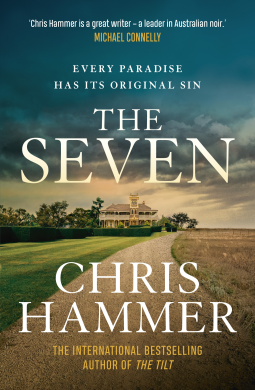
Chris Hammer is a multi-award-winning local Canberra author, who worked for 30 years as a journalist, during which he also published two nonfiction books. Since 2018, when he was 58, he has written six bestselling crime novels. (If he’d been around when I wrote my Late Bloomers post in 2011, he would have qualified – as the only man!) His first three novels (Scrublands, Silver, and Trust) feature the journalist Martin Scarsden, with the next three (Treasure and dirt, The tilt, and The seven) featuring a detective duo, Ivan Lucic and Nell Buchanan. The seven was the official subject of the conversation.

Jack Heath is also a local writer – of fiction for children/young adults and adults. He is definitely not a late bloomer, having published his debut novel, The lab, in 2006, when he was 20. Since then he has written around 40 science fiction and crime novels. His new book, Kill your husbands, is coming out now.

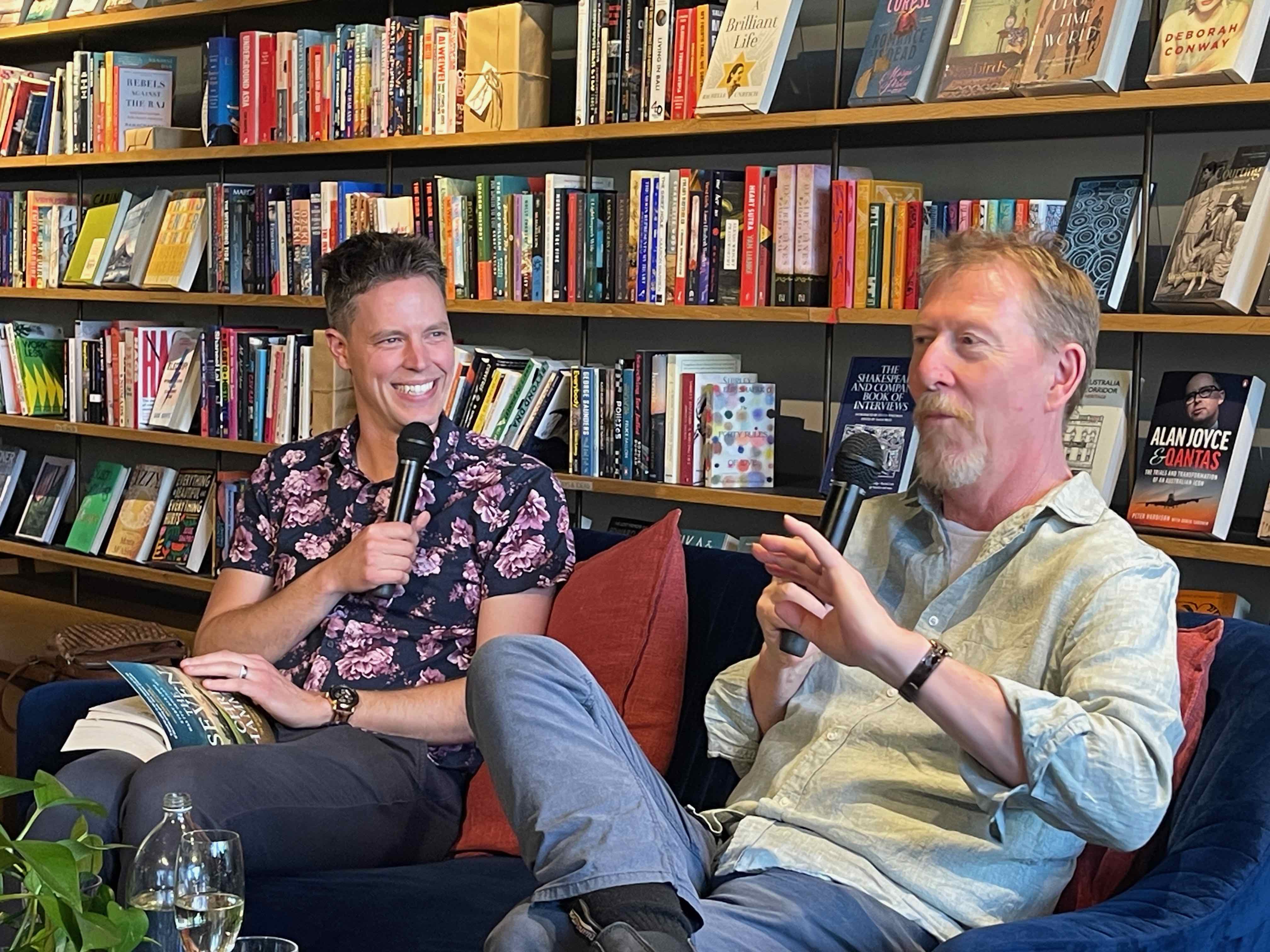
From these intros, I think you’ll be able to work out who’s who in the pic!

The conversation

I loved that Jack launched straight in, with little of the usual pleasantries. It was clear that they were comfortable with each other, which is probably not surprising, both being Canberra-based crime writers.

On moving from nonfiction to fiction 

Although his first novel only came out five years ago, Chris said that fiction had always been a passion. Like many writers, he has in his drawer a very bad one he wrote in his 20s (that will never see the light of day – unless, joked Jack, you don’t destroy it and your literary executor thinks otherwise! We all know some of those examples.) Chris said he didn’t have the talent or attention span for fiction when he was young, so he turned to journalism, but persistence pays off.

On dramatic openings

The seven starts with a bizarre death. Is this his modus operandi, Jack wondered. Chris’s answers to this and the next question were fantastic, taking us through his novels, and, at the same time, his development as a writer. I’m not sure I’ve ever attended such a lucid discussion of a writer’s oeuvre in one session before.

After giving a sly little plug to the premiere of the Scrublands TV series on Stan later this week, Chris said not all start like that, but most, including Scrublands, do. He finds it works effectively.

However, Scrublands did not start like that. He was six or seven drafts in before he decided to start with a prologue describing the murder. He was learning on the job, he said. The narrative then jumps a year with his journalist investigating the murder on its first anniversary.

With The Seven, the dramatic opening death marks the start of a contemporary story. The homicide detectives arrive. (The murder victim is an accountant. They are good victims, Chris said, because they have secrets. That got a laugh.) Anyhow, the killer is still on loose, so the detectives are in a race against time. But, there are two other storylines: a university student in the 1990s who decides to do his thesis on the history of irrigation (during which he finds some skeletons); letters from an Indigenous girl from 1913. The connection between them all is not clear until near the end.

On his voices

All Chris’ novels are set in Australia, and all but one are rural. Will this always be the case? Further, Scrublands, his debut novel, features a journalist, a bit like himself. It is set in the present, but gradually, through his later books, he has been moving back in time, and diversifying his characters. How did he get into voices that aren’t a middle-aged ex-journalist?

Chris described his development beautifully:

  • Scrublands, the first of his journalist series, has a simple structure, and is told completely chronologically.
  • Silver, the second in the series, has similar trajectory but there are flashbacks.
  • Trust, the third (and currently final) in the series, has two alternating points-of-view.
  • Treasure and dirt, the first of his detective duo (Ivan-Nell) series, has a dramatic prologue (like Scrublands) and alternating points-of-view. The duo start finding crimes in the past, and this got him into some exposition. However, writers are always told to show-not-tell, so in ….
  • The tilt, the second Ivan-Nell book, he decided not to use exposition, which meant needing to create voices from the past. The 1973 voice wasn’t a big stretch since he was alive then, but the 11-year-old boy from World War 2 was a challenge, so he created an old man looking back on his time as an 11-year-old. This novel has multiple (four, I think) points-of-view.
  • The Seven, the third Ivan-Nell book, also has multiple points-of-view from different times, but they include a 15 to 16-year-old Indigenous girl. Before I or anyone could ask the question, Chris said that we need diverse – including Indigenous – characters in books, otherwise it’s terra nullius all over again. But there’s the issue of appropriation, so he decided to tell her story through letters, which, he said, can be unreliable, given people “present” themselves through letters.

Each book, he told us, has built on the experience of the previous books, with the latest ones being “more accomplished”. This doesn’t necessarily mean they are better stories! Jack interrupted, though, with the comment that Chris just keeps getting better and better.

By this point in the session, I felt we were getting gold.

On second-guessing issues of the day

Jack noted that many of his books seem to have second-guessed coming issues of the day (such as reference to Afghanistan war crimes in 2018’s Scrublands, and irrigation corruption in The seven). How did he do it?

Some has been luck, some has come from keeping his ear to the ground (with his journalist friends). For example, rumours were just starting to appear regarding the SAS-Afghanistan war crimes when he was writing Scrublands, so he included that. Given it’s fiction, he didn’t have to be factual. Most of his books are set in rural Australia, where ongoing concerns are climate change and Indigenous dispossession. These are part of The seven. It’s not hard to write his stories, he said, because, given its history, “the Australian continent is a crime scene”. Touché. He added that “Crime writers often touch on matters of societal concern”.

However, the opal mines’ skulduggery in Treasure and dirt he made up, only to be told later that what he’d described really does happen.

On changing his setting

Most of his novels, except for Trust, are set in dying country towns, but The seven’s setting is a beautiful, tidy town. Was he playing against his “type”?

The answer in a single word was No – but he was looking for something new. An earlier novel had featured a lot of water, and he thought water-trading would be good to explore, but not in that book. The town in The seven is fictional, but is based on Leeton, which was planned by Canberra’s Griffins. It has circular layouts and lovely art deco buildings.

On being a nice guy!

Finally, Jack, saying what a nice guy Chris was, offered four reasons: 1. he’s not really nice, but is a villain; 2. he’s so successful, he can afford to be generous; 3. he came to success late, so he realises how lucky he is; and 4. he’s just always been very nice!

Having learnt from his two nonfiction books how hard it is to make a living from writing, Chris considers himself fortunate to be “living the dream”. Scrublands was life-changing, and he is very grateful. He is financially secure and doesn’t have to struggle for that work-life-writing balance that most writers do. Also, Australian crime writers are welcoming and collegial, and – unlike many journalists – have their egos under control!

Q & A

There was a brief Q&A, some of which required knowledge about Hammer’s earlier books.

  • On whether there will be more Ivan and Nell books, or a new tortured detective: The next book is another Ivan one, but he is thinking of bringing journalist Martin back. (The way this questioner started her question made Jack and Chris palpably nervous about spoilers!)
  • On whether he plots carefully: As I’ve heard authors say before, Chris said there are the “plotters” (like Jane Harper) and the “pantsers” (like himself). He has a setting, an idea, and a few plot lines, and then sees how it goes. If he doesn’t know where the plot is going, how can the reader, the implication being this is good in crime writing. He also wants his main character/s to have “skin in the game”. There is usually an emotional storyline, whose trajectory he knows, but the crime plotting is done constantly as he goes.
  • On his “silly” character names, which critics have commented on: If I understood correctly, he said that as he was writing Scrublands, he got a bit bored and created fun names. He feels sheepish about them now as he is stuck with them, the reason being he has many recurring characters, and can’t really have recurring characters with exotic names alongside new ones with plain names. Also, his editors didn’t complain, which they’d do if they disapproved. And, one reader told him that the distinctive names helped her keep track of who’s who.

A wonderfully lively session, one enjoyed also by Mr Gums who has read three of the novels, and bought a fourth from Muse.

Chris Hammer in conversation with Jack Heath
Muse (Food Wine Books)
Sunday, 12 November 2023, 3-4pm

Patrick Modiano, Sundays in August (#BookReview)

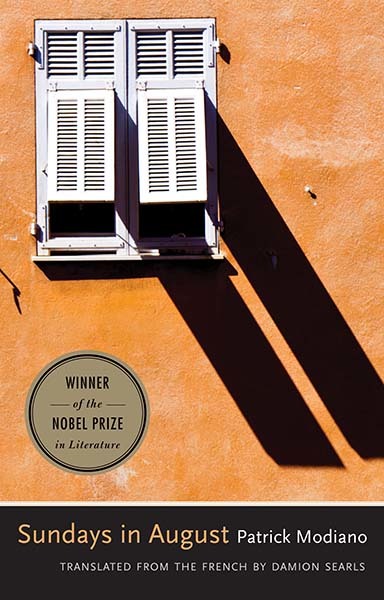
Disappointingly, I ended up missing my bookgroup’s discussion of the book I had encouraged us to read, Sundays in August by 2014 Nobel prize-winner Patrick Modiano. I have no-one else to blame but myself, since I did the schedule and should have remembered that I was going to be in Hobart for my brother’s exhibition. C’est la vie.

I recommended this book for a couple of reasons, one being high praise from Kim (Reading Matters) and the other being to include translated fiction in our reading diet. Also, the book intrigued me. Kim described it as a “jewel heist”, albeit qualified by “with a difference”. That seemed unusual subject matter for a Nobel prize-winner. Having now read it, however, I see that he is a skilful writer. I loved reading it. But the subject matter?

According to Wikipedia, Modiano (b. 1945) is “a noted writer of autofiction, the blend of autobiography and historical fiction”. He has published over 40 books, and in them, Wikipedia continues, has “used his fascination with the human experience of World War II in France to examine individual and collective identities, responsibilities, loyalties, memory, and loss. Because of his obsession with the past, he was sometimes compared to Marcel Proust”. I’m not sure about the “was” here, as he is still alive. Anyhow, it is this obsession with the past, with its associated exploration of memory and loss, that made Sundays in August (Dimanches d’août) so fascinating. I am drawn to stories about the past that are told in well-controlled melancholy tones, stories that involve a later reflection on what had happened and the implications for the protagonist’s present. (By the way, this does not appear to be one of Modiano’s autofiction works.)

The novella is set in Nice, and starts with a first person narrator (identified partway through the book as Jean) spotting someone he’d known seven years ago. The man is Villecourt, and he is selling leather goods in the market. Neither man, in fact, has done well in the years since they’d met. Both are alone, and not living the apparently secure lives they had been. We quickly realise that this is not a case of old acquaintances happily re-uniting. Instead, there is palpable tension. After they meet for a drink, Jean makes clear he wants nothing more to do with Villecourt, while Villecourt tries to keep the contact going. He does little to ingratiate himself, however, reminding Jean that he, Villecourt, was the only man someone called Sylvia had loved. He also says that he and Sylvia had not been married. Why had she lied to him about that, Jean thinks to himself?

In this way, in the first few pages, we are drawn into a mystery involving these three. Soon after, the aforementioned jewel – a diamond, with a “long and bloody history”, called the Southern Cross – is introduced, and we learn that Jean and Sylvia had been on a mission to sell it. Then, a little further down the track we meet the mysterious Neals, who seem to live in a grand home named Château Azur, and who all too soon offer to buy the diamond.

It sounds like a simple story involving a love triangle and a heist, but in fact, it is a complex crime story in which it behoves readers to attend carefully for hints and clues about what’s really going on. These are conveyed through the narrative, as Jean tries to “rejoin the invisible threads”, and through gorgeously written imagery that creates an oppressive, foreboding atmosphere, occasionally lightened by the Riviera’s bright sun, and blue skies and water.

“blurred … dissolving”

As we read, the ground constantly shifts beneath our feet. People appear and disappear, and sometimes shapeshift. Virgil Neal, for example, sounds American, then he doesn’t, then he does again, before finally turning out to be someone else. Cars and buildings, too, aren’t always what they seem. Nonetheless, through cleverly managed flashbacks and foreshadowings, we gradually start to see – or, think we see – the set-up. It is all complicated, however, by that tricky beast, memory. Jean writes:

I don’t know anymore whether we met the Neals before or after Villecourt arrived in Nice. I have searched my memory, looking for points of reference, but am unable to sort out the two events. Anyway, there’s no such thing as “events.” Ever. It’s a false term, suggesting something definitive, spectacular, brutal. In fact it all happened gently, imperceptibly, like the slow weaving of a design into a carpet…

Soon after this reference to meeting the Neals, Jean says

The word “meet” doesn’t apply, any more than “event.” We didn’t meet the Neals. They slipped into our net.

Who slipped into whose net is the question. And how many nets were there? Jean will probably never know it all, but by the end he’d learnt that “our anxiety didn’t come from our contact with that cold stone with glints of blue – it came from life itself”.

Typical for a novella, the book is tightly written. Every word counts, and is worth noticing. I loved, for example, that Jean was a photographer who now can’t seem to remember the necessary details, and that Sylvia’s last name is (ironically?) Heureux. These little details aren’t casual, and make us readers think and question at every step, as we are alternately unsettled then proffered glimmers of light.

Sundays in August is an accessible, noir-ish tale about loss and the emptiness that accompanies it. It explores life’s shadows and uncertainties, shows how innocence can be so easily taken advantage of, and it doesn’t wrap everything up neatly, leaving us to ponder the possibilities. I won’t spoil the ending, but it is spot on, and explains, at last, the title, leaving us on a little up despite it all. I’ll be reading more Modiano, if I can.

POSTSCRIPT: I believe we know the main culprit in it all, but the question is, who else was in on it and who else was taken in. It would take more reads to work through that, but in the end I think we can’t ever know it all because we can only know what Jean saw and tells us.

Read for Novellas in November.

Patrick Modiano
Sundays in August
Translated from the French by Damion Searls
New Haven & London: Yale University Press, 2017 (Orig. French pub. 1986)
156pp.
ISBN: 9780300223330 (Read on Kindle)

Susan Glaspell, A jury of her peers (#Review)

One of my retirement activities is to co-ordinate a little band of volunteer indexers at the National Film and Sound Archive. Not only do we do useful work for the Archive, but we get to socialise a little with our peers, meaning we talk about what we are watching, listening to, and reading. Recently, one of the team sent me a short story to read. He “raved” about it, he wrote in the accompanying email. Well, I have now read it and I’m mighty impressed too. It’s by an American writer and appeared in one of the those annual best short stories volumes, this one for 1917.

Susan Glaspell

The author of the story, as you will have worked out from the post title, is Susan Glaspell (1876-1948). I had never heard of her, but fortunately she has a decent-sized Wikipedia page which you can read, but I’ll give a brief summary here. She was a playwright, novelist, journalist and actress. Indeed, she and her husband founded America’s first modern theatre company, the Provincetown Players. Wikipedia then says, and I’ll quote because why try to paraphrase it:

First known for her short stories (fifty were published), Glaspell also wrote nine novels, fifteen plays, and a biography. Often set in her native Midwest, these semi-autobiographical tales typically explore contemporary social issues, such as gender, ethics, and dissent, while featuring deep, sympathetic characters who make principled stands. Her 1930 play Alison’s House earned her the Pulitzer Prize for Drama.

Wikipedia has much more to say but essentially, like many women writers, her star faded, partly Wikipedia says, because her “strong and independent female protagonists were less popular in the post-war era, which stressed female domesticity”. However, from the 1970s on – we all know about this revival don’t we – she started to regain traction. Now, she is recognised as a “pioneering feminist writer and America’s first important modern female playwright”.

All this might clue you in to why I so enjoyed her story.

“A jury of her peers”

Kindle ed.

“A jury of her peers” is quite a long short story, but it engrosses from the beginning because of how Glaspell slowly unfolds the story, incisively developing, as she goes, a number of ideas that still speak to us today. We readers work out fairly quickly what has likely gone on, but our fascination lies in how the two women protagonists come to their understanding of the matter, how they try to resist what they have intuitively guessed, and what they decide to do about it. Overlaying this are the assumptions made about them (and about women in general) by the men involved, which adds a social dimension to the moral one. It’s a wonderfully complex story. It’s no accident that the main action takes place in that women’s domain, the humble kitchen.

The story, according to Wikipedia again, was loosely based on the 1900 murder of a man called John Hossack which Glaspell covered while working as a journalist. She originally wrote it in 1916 as a one-act play, Trifles, for the Provincetown Players, before turning it into a short story. Later, it was adapted for an episode of that 1950s TV series, Alfred Hitchcock Presents, and into a 30-minute film by Sally Heckel in 1980.

The plot is simple. A farmer, John Wright, has been murdered, and his wife, the diminutively named Minnie, taken into custody, the day before the story’s action takes place. The story opens with Sheriff Peters and the county attorney Mr Henderson picking up the Wrights’ neighbour, farmer Mr Hale, who had called in the death the day before. Their aim is to visit the scene to look for evidence that might explain what had happened, that might provide a motive. In the buggy is the sheriff’s wife Mrs Peters who is coming along to collect some clothes for Minnie. At the last minute, Mrs Hale is asked to join them, at the request of Mrs Peters who appears to need some support in her sad task.

So, this band of five arrive at the Wrights’ “lonesome-looking place” and, while the men go in search of their evidence, the women remain in the kitchen-living area to get those items Minnie had asked for. As they do, they start to notice things around them – providing insight into Minnie’s life and state of mind – and slowly they piece together an understanding of what had happened. These two women don’t know each other well, so they are cautious with each other, sometimes moving “closer together” in solidarity, particularly when the men appear at intervals and invariably belittle women’s skills and knowledge, but other times drawing apart, uncertainly feeling each other out as they simultaneously feel out their own thoughts and feelings.

The practical farmer’s wife Mrs Hale increasingly senses what sort of life Minnie had led, and feels guilty, criminal even, about never having visited her, but she is uncertain about how the timid-seeming, law-abiding Sheriff’s wife is reacting. However, every now and then she catches in Mrs Peters “a look of seeing into things, of seeing through a thing to something else”. Eventually, they connect, “in a steady burning look in which there was no evasion, no flinching”.

It is so beautifully done, with barely a wasted word or description, with every interaction carrying weight, with perfect use of metaphor (involving birds, cages, and knots) and irony. It reminded me, just a little, of Pat Barker’s The women of Troy (my review), another story in which men underestimate women, to their detriment (though they may not always know it). And so, in this story, a number of issues are explored, including morality and natural justice versus the law; gender and men’s superior, condescending dismissal of women’s skills and knowledge; neighbourliness and guilt; and female solidarity.

“A jury of her peers” is a subversive crime story, one that wowed me, for its subject matter, particularly given the time it was written, and for its sure, unflinching writing. I’m impressed that it was chosen for an annual best anthology by a man – but perhaps that’s me being condescending now. Whatever! I would love to read more Glaspell.

Susan Glaspell
“A jury of her peers” (orig. pub. in Every Week, 5 March 1917)
in Edward J. O’Brien (ed.), The best short stories of 1917 and The yearbook of the American short story
Boston: Small, Maynard and Company, 2014
pp. 256-282
Available online at Hathitrust

Shelley Burr, Ripper (#BookReview)

When I started reading Ripper, Shelley Burr’s follow-up novel to her bestselling award-winning debut novel Wake (my review), I thought about crime novels, about how they are often written in series and how I am not a big series fan. Ripper looked to me like a stand-alone novel – and it is, somewhat! I say somewhat, because a few chapters in we come across one Lane Holland.

The plot thickens…

Lane Holland, I thought. I know that name. Sure enough, Lane Holland is the private investigator protagonist of the aforementioned Wake. However, he is not the prime investigator in this novel, because he is in prison as a result of his previous investigation. (You’ll need to read Wake to find out more!) The result is an intriguing crime novel in which we have our prime, self-appointed amateur investigator, Gemma, plus the police working away in the background, and Lane who is pulled into the investigation by his prison governor, Patton Carver. Yes, you’ve guessed right, the plot thickens – except I haven’t really told you about the plot yet.

Ripper is set in a fictional town called Rainier, which, as Burr confirms in her acknowledgements, is partly based on the town of Tarcutta. Seventeen years before the novel opens, three murders had occurred in this little country town, the last one outside the door of Gemma’s little teashop. She – and the town – have never fully recovered from these events. The town has stagnated under its black reputation, and Gemma herself suffers PTSD from what she had experienced. Now a tour company has arrived wanting to run a true crime or dark tourism walking tour of the Rainier Ripper’s murderous path, but Rainier’s residents have mixed feelings about the idea. On the eve of the trial tour aimed at garnering their support, the tour operator is killed in what looks like a copycat murder. It has to be copycat because the Rainier Ripper is in prison, the same prison as Lane Holland. As I said, the plot thickens, and part of the thickening springs from why prison governor Carver is interested.

Once again, I enjoyed Burr’s story, because once again it is more than a crime story, exploring issues like the impact on a small town of having a reputation for violence, the impact on people who have been close to a violent crime, the idea of dark tourism, and the murky world of police investigations and the ways in which confessions are elicited. I am not an expert but Burr’s research into the relevant issues, including prison life, felt thorough but lightly applied.

I also enjoyed Burr’s characterisation. Gemma and Lane are well-evoked. Other characters are necessarily more sketchy, but they are individualised enough to lift them above pure stereotype, to make them feel true. There is an engaging exploration, through Gemma’s daughter and her friends, of how teenagers cope with a complex adult world. There are some truly “tangled” family relationships in the town. There is some diversity, including a non-binary teen and a Wiradjuri woman, which Burr introduces without trying to appropriate other experiences. There are farmers, business people, pub owners, and doctors whose lives are entwined through marriage and murders. It’s a lot to convey, and there are plenty of names, but I rarely got lost!

Ripper has some similarities with Wake, in addition to also belonging to the rural noir sub-genre. It’s told through roughly alternating third person voices (Gemma and Lane); the protagonist is privately investigating; and it deals with a cold case, which involves a missing person. But it is significantly different, too, including the fact that Gemma is an amateur unlike Wake‘s Lane, and that it is set in a different place with different issues to confront. This means that it is not formulaic, which keeps us readers on our toes. We can’t assume anything about where Burr is going.

Now, I am not a big plot-follower, by which I mean I don’t put serious brainpower into trying to work out who dunnit. Rather, I read crime like I read most books, that is, with a focus on the characters and the issues being explored. But of course, I can’t help following the actual plot, particularly when the characters have engaged me and I want them to fare well. In Ripper, I worked out one of the plot twists, but it had several – like those Christie and Christie-like TV shows I watch – and they left me for dead. They did make sense, though, which is the important thing.

On the basis of her manuscript for Wake, Burr won a two-book deal with Hachette, and Ripper is the second book. I do hope she is offered more book deals because, while there is absolute closure on this book’s crimes, there is also a clear hint at the end about where a next book might go – and I’m intrigued. Burr is a clever writer, with her wits about her. Ripper’s readers will guess the main investigation Burr plans for her next novel, but what will the context be this time? What will be the issues? Time will hopefully tell.

Shelley Burr
Ripper
Sydney: Hachette Australia, 2023
346pp.
ISBN: 9780733647857

(Review copy courtesy Hachette Australia)

Meet the Author: Dervla McTiernan

You’ve heard me say it before and I’m sure to say it again, I am not a “crime reader” – but I do read crime novels when something about them catches my attention. I have been interested to read Irish-born Australian writer Dervla McTiernan since her first book started appearing with positive reviews on the AWW database. As it turned out, this conversation brought out a couple of points that particularly interested me, and further spurred my interest in McTiernan’s novels.

The participants

Dervla McTiernan: author of the internationally bestselling Cormac Reilly series (The rúinThe scholarThe good turn), and of three audio novellas The sistersThe roommate and The wrong one. She has won many awards, including an International Thriller Writer Award. Her latest novel is a standalone, The murder rule.

Anna Steele: since retirement has reviewed crime, historical and literary fiction for The Canberra Times and the ACM Press, using her nom-de-plume, Anna Creer. Before that, Anna was Head of English at Canberra Grammar School. I should add that I count Anna as a friend, as for many years we have been active members of our local Jane Austen group, JASACT.

The conversation

Anna commenced by explaining that the conversation would be structured as a retrospective of Dervla’s career so far, meaning it would not be one of those latest-book focused conversations. She also reassured Dervla and the audience that there would be no spoilers!

On how she started

Dervla McTiernan, The ruin, book cover

Anna then mentioned Dervla’s Irish heritage, which is known for story-telling, and yet Dervla has said her writing would not have happened if she’d stayed in Ireland. Why? She followed this up with “why crime?”

Dervla said she’d been a lawyer in Ireland, but the 2007 GFC and its aftermath had been traumatic, with suicides and other serious distress amongst family and clients. By time she and her partner left Ireland in 2011, she never wanted to practise law again. After arriving in Perth and needing to support themselves, she nearly returned to law, but her husband reminded her of their promise to each other to now do it their way, so she got quasi legal work and wrote for two hours every night. The result was a contract with Harper Collins, and The rúin was born.

She said she had not initially intended to write crime, but she had a story she wanted to tell – about two siblings she named Maud and Jack. Up popped a young, uncertain twenty-something cop, Cormac Reilly, whose job it was to save the children. Also, she was a crime fiction reader.

On her detective, Cormac Reilly, and her success

Anna then asked more about Cormac Reilly. He’s not an alcoholic, not tormented, and he arrived on the scene, Anna felt, fully fledged. Dervla has called him, a “man of my generation”. What did this mean, Anna asked. Anna felt that he is one of the reasons for the success of the first novel, but wondered what Dervla thought.

Cormac, said Dervla, was a reaction to the crime fiction she was reading. She enjoys Ian Rankin, and others, but their male heroes tended to not have other responsibilities, which is not true to her generation’s experience of men. She wanted to write about someone she could admire, who could sustain relationships long term, about men who could change nappies, cook meals, and so on. She felt she’d be lying if she wrote an inept man. Love this – though I don’t think it’s only her generation that has “ept” men!

As for the novel’s success, although Anna instructed her not to be modest, Dervla said she really didn’t know. But, she did say that the story has to matter, that writers need to have genuine emotion about what they are writing, otherwise the writing is “dead on the page”.

On place

The next few questions concerned place, about which Dervla feels strongly. Why were her first three novels set in Ireland?

Dervla said that Galway, the setting for The rúin, is the place she knows best. Also, the story of Maud and Jack is an Irish story, and beyond that, she has questions and concerns about various aspects of Irish history.

Developing this, and moving us on to the second novel, The scholar, which is set in a university, Anna quoted Dervla’s statement that “all writers bring their life experience to their books”. Anna wondered what experience she’d brought to this novel. Again, Dervla said that she knows that place, a place that can be both safe and unsafe (particularly for women). The novel involves Cormac’s girlfriend, who is a scientist, which is not Dervla’s experience, but she has dealt with scientific issues in her legal work. Besides these are more subtle things such as how people talk.

Regarding the third Cormac Reilly book, The good turn, Anna, who clearly knows Dervla’s books well, noted that in this novel, policeman Peter Fisher, who had appeared in The scholar, has a much stronger role. She wondered why. She also noted that it is not set in Galway.

Dervla talked a bit about Peter Fisher, whom she clearly enjoyed writing. She was interested in his relationship with his father. Also, Cormac is a good person but is not universally liked, giving Peter a challenge – stick with Cormac or go with the consensus?

She set this novel in a rural area that she also knows well. She has decided to only write about places she wants to spend time in, but she also said that with Irish villages, they may be beautiful but you only have to scratch the surface …

On the trilogy

One of the things I enjoyed learning from this interview was Dervla’s decision to create in Cormac a competent man with outside responsibilities. The other thing I loved was Dervla’s response to Anna’s question regarding whether, given her comment that The good turn “rounds off” the previous two, she always knew Cormac Reilly was going to be a trilogy,

Dervla said that yes, she thinks it’s a trilogy – though she may write about Cormac again later. She didn’t want to write a long procedural series, as they tend to be episodic without overall narrative arcs. She wanted to challenge Cormac, to have a narrative arc which would see him changed by the end. I don’t like series, so I enjoyed hearing her perspective.

More on characters

Anna asked her about the female detective she’d started but not finished, and about the unlikeable Hannah Rokeby in The murder rule. Dervla said that she’d been waylaid from her female detective by the idea that became The murder rule. She was interested in the Innocence Project, which many Irish students get involved in, but felt she didn’t have a story. Then, she had the idea of flipping it: from having the traditional idealistic young woman to an angry, bitter one. She likes Hannah Rokeby. Hannah is “wish fulfilment” for her because Hannah represents the younger generation of women who don’t feel they have to be “the nice girl”, who, when they think something, “they own it”! Hannah’s problems are separate from her competence.

On police abuse of power in her books

Anna asked whether the police abuse of power that threads through the books was conscious or just part of the stories. Dervla felt it was the latter, but commented that in any community where there’s power there’s corruption. She said that teams like the police work very closely together and when something even a little untoward happens the tendency is to support the team rather than remember their true role!

On coming books, adaptations and the pandemic

The interview wrapped up with a number of questions about Dervla’s plans. Dervla explained that due to The murder rule she’d been given a three-book contract by Harper Collins’ American arm for books set in America. Her new book, now completed, is set in Vermont, which she visited. It’s about a young couple, in love and beloved in their community. They go away. He comes back, without her. Her parents want the truth, while his parents want to protect him.

Regarding when she will write an Australian-set novel, Dervla said she is currently working on a novella set in Perth and Margaret River.

Anna also asked her about the screen optioning of two of her novels. She’s not heard about The Rúin, but a miniseries for The murder rule is moving into full script.

Anna then asked whether the pandemic affected her writing, given she’d been writing a book a year until then. Dervla said it had been a weird artificial environment, and was a time of needing to focus more on family. She is usually always thinking of her characters when she is not doing other things, but the pandemic broke that pattern. It’s coming back though!

Q&A

There was a brief Q&A, which I’ll summarise:

  • On staying motivated when starting out: the two hours a night was her present to herself; she gave herself permission to have those two hours. This kept her going.
  • On support, like a writing group or mentor: she’s a solitary person, and so decided to put all her focus on writing, on doing the best writing she could. (It is a lonely profession, she had earlier admitted to Anna, so it is good for writers to make opportunities to engage with each other.)
  • On knowing how a police station works: research and common sense, she said. The Irish police produce useful annual reports.
  • On writing to deadlines: it is important if you are going to be a good publishing partner, but she also wants to write the best story she can, so deadlines are important but sometimes you need to take space.
  • On whether she feels the need to make female characters (like the tough Hannah Rokeby) likeable: no, she’s not driven to make her as likeable as Cormac.
  • On whether there’s a difference writing for audio versus print: can use fewer attributions (he said, she said, etc) and don’t need to describe responses (like “she gasped”) though she might provide a stage-type direction to person doing the reading.
  • On literary critics being scornful of crime: There are two writing worlds “commercial fiction” which is “story and character driven” and “literary fiction” which is not so. Some literary fiction can lift off the page, but not all. There is good and bad in both types, but for some, literary fiction is seen as the “real” writing. However, it is commercial fiction which supports publishing and bookshops. She’d like critics to recognise what people like to read. Anna commented that John Banville who has started writing crime, said that he “found freedom” in writing it.
  • On writing about murky psychological and social issues: she needs to start with character and let the story go from there. She doesn’t like to start with the theme. She doesn’t want to write issues-based books, but she will often write about something she’s angry about.

Another excellent conversation – well-prepared and generously answered.

Meet the author: Dervla McTiernan (with Anna Steele)
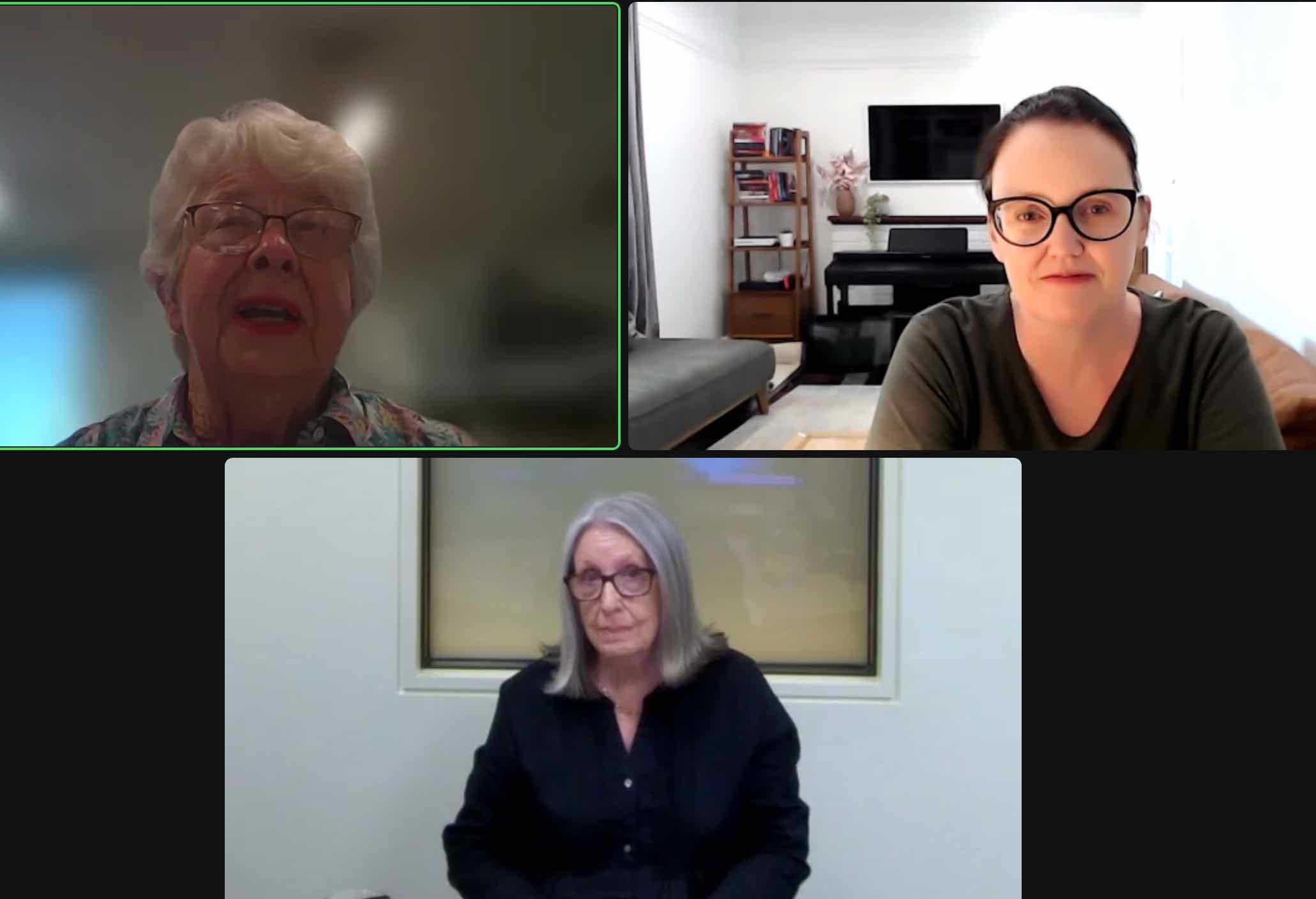
Webinar via Zoom, organised by the Friends of the National Library of Australia
Wednesday, 15 February 2023, 6-7pm