Delicious Descriptions from Down Under: Francesca Rendle-Short on writing

In my recent review of Francesca Rendle-Short’s fiction-cum-memoir, Bite your tongue, I concluded on the suggestion that for Rendle-Short the act of writing, as well as of reading, “changes things”. Today I thought I’d share two excerpts from her novel that confirm this, one from her fictional persona of Glory, and the other from her writing as herself.

First, Glory:

Glory decides writing is a way of thinking: to think, to write, is dangerous. Transgressive. It is no small thing for Glory to tell this story in Glory’s way, to put into words things that until now have been left unspoken, to pin her heart to the page. Writing changes things, changes everything. It’s a risky business. (end Ch. 9)

And then, Francesca:

Looking at photographs is a bit like reading books; they invite acute feeling. You reveal yourself in the most intimate of moments. They elicit desire; illicit desire. Because in my family desire was illicit, like alcohol, like dancing. If you pay enough attention to small things, there is a chance for connection, a chance for transformation and transfiguration to occur. Writing grows skin, grows bones, a new heart. Just watch. D. H. Lawrence knew this. He attests that Lady Chatterley’s lover* was a beautiful book, that it was tender like a naked body. (end Ch. 25)

This is pretty raw stuff … and it tells us a bit about what sort of writer Rendle-Short is, about why she writes, about what literature means to her. It also, by-the-by, gives a good sense of her rhythmic, evocative style. I did like this book.

* Lady Chatterley’s lover was, of course, on her mother’s “burn a book a day” death list.

Francesca Rendle-Short, Bite your tongue (Review)

Francesa Rendle-Short book cover Bite your tongue

Bite your tongue Bookcover (Courtesy: Spinifex Press)

How much do you think about the first sentence of your review? Like me, you probably try to find some anchor or point of interest to lead off from, but my problem with novelist-journalist Francesca Rendle-Short‘s fiction-cum-memoir, Bite your tongue, is that I have too many angles to choose from. Which one do I use? Do I go with the unusual form of this fiction-cum-memoir? Do I talk about my old friend synchronicity and how one of my first reviews in 2011 was a (semi)autobiographical novel about an Australian childhood, Barbara Hanrahan‘s The scent of eucalyptus? Or, do I talk about how I’m sure Spinifex Press had no idea how close to my heart this book would be when they offered it for review – how I (more or less) share a late 1950s/early 60s Brisbane childhood with Rendle-Short and how the very word “spinifex” is nostalgic for me due to my mid-1960s years in the mining town of Mount Isa? There, I’ve covered them all … so now I can get on with the review!

This is a mother-daughter story. How many of those have you read? I’ve certainly read a few in the last decade or so, including straight memoirs (such as Jill Ker Conway‘s The road from Coorain) and thinly veiled fictional pieces (such as Kate JenningsSnake). These books can be challenging for daughters to write, particularly when there is significant pain involved. Rendle-Short’s solution is to (mostly) tell from a “fictional” standpoint. She creates names for the family, including MotherJoy for the mother, Glory for herself, Gracie for her nearest and youngest sister, and Onward for her father. The last-name she devises for this family is Solider, which is an anagram of “soldier”. With the father being Onward, and the family being devoutly Christian, the hymn “Onward Christian Soldiers” must surely have inspired her naming. Rendle-Short writes, in the introduction, about how she chose to tell the story:

Some stories are hard to tell, they bite back. To write this one, I’ve had to come at it obliquely, give myself over to the writing with my face half-turned; give my story to someone else to tell. My chosen hero is a girl named Glory …

Australian Literature Month Platypus logo

Reading Matters’ Australian Literature Month

Why is this story so hard to tell? Well, Glory’s (Rendle-Short’s) mother was “a morals crusader, an ‘anti-smut’ campaigner. An activist. She was on a mission from God to save the children of Queensland” (from the Prologue). This mission involved banning “lewd” and “pornographic” books (of which 100 are listed at the back of the book in “Dr Joy’s Death List: Burn a Book a Day”). Clearly Rendle-Short (aka Glory), the fifth of six children (all girls in the book, five girls and a boy in reality), had a painful childhood. It’s not that she and her siblings weren’t loved – they clearly were – but it was a hard love, a love based too much on a narrow Christian ideology and too little, it seems, on the needs of children. One of the most painful scenes in the book is when Glory visits her mother in hospital after heart surgery and wants to kiss her but can’t bring herself to do so! Can’t kiss her old mother! That shows more than words ever could the pain in this relationship.

The book pretty well covers the story from Glory’s birth to MotherJoy’s death in her 80s, though it focuses primarily on Glory’s school years. There are 100 chapters in less than 250 pages. Most of these chapters are told third person, from Glory’s point of view. What makes this book particularly interesting form-wise, though, is that 14 chapters are written in first person, memoir-style. That is, Francesca speaks of herself and her mother, Angel, using their real names. In these scattered first person chapters, Francesca writes on her research, on how she pieced together her mother’s story through, for example, research at the National Library of Australia and the National Archives of Australia. She also occasionally comments on where the “fact” diverges from the “fiction” such as:

Unlike Glory, I wasn’t in Brisbane when my mother died, I was at home in Canberra where I was living at the time – because there was a scene. There was always a scene with Angel, especially where her children were concerned, the ‘jewels in her crown’, and on her deathbed it was no different. All six children had been at her bedside while she was dying …

And then, without describing exactly what happened, she tells us that, despite all of them having made the effort to get there, including from overseas, “seven days before she took her last breath, all six of us walked out on her. We had to do it …”.

Australian Women Writers Challenge 2012 Badge

Australian Women Writers Challenge (Design: Book’dout – Shelleyrae)

Now, if you are a reader who likes closure, who wants to know exactly what happened, you are not going to get it in this book, not specifically anyhow, but you will, if you read the clues, know what life was like in that family, at least what it was like for Glory/Francesca. You will know that she loved her mother, and wanted her mother’s approval, but that she had other attitudes and other feelings that were clearly not in accord with her mother’s. We are given enough “scenes” involving her mother (directly or indirectly) to tell us all we need to know. A particularly excruciating example is when Glory is cruelly bullied by her school “peers” (one can’t say  “mates” in the context) because of her mother’s views. (Where her father, an academic in pediatrics and a creationist, stood in all this is unclear. He’s there in the book, but we see little active parenting from him.)

Oh dear, I have so much to say on this book that I could easily turn this post into an essay, so I will finish here. I thoroughly enjoyed this book … on multiple levels. The writing is good, comprising many of the things that appeal to me – wordplay, lovely rhythm, effective imagery (such as the “tongue” motif). The story is easy to follow, despite changes in voice and chronology (as we flip backwards and forwards from childhood to MotherJoy/Angel’s old age). There are universals about love and forgiveness (real and wished for) between parents and children. And, there is love for books (in all their glory!):

Books show us how to love, really love body to body between the pages. Love perhaps where we’ve never loved before. That’s what Glory hopes.

Reading changes things …

… as, I suspect for Rendle-Short, does writing!

Francesa Rendle-Short
Bite your tongue
North Melbourne: Spinifex Press, 2011
246pp.
ISBN: 9781876756963

(Review copy supplied by Spinifex Press.)

Review to count towards the Australian Women Writers 2012 Reading and Reviewing Challenge.

Monday musings on Australian literature: Guest post from Kim of Reading Matters

This week’s Monday musings brings you my fourth guest post, this time from Kim of Reading Matters. Like Guy, Kim started commenting on my blog in its infancy and I soon discovered that this blogger from England was actually an Australian. Naturally we developed a rapport. I have appreciated Kim’s support of my blog – through regular commenting  (particularly in my fledgling days) and through inviting me to be a Triple Choice Tuesday guest. She is one of England’s top litbloggers and this month is hosting an Australian literature month as I advised in last week’s Monday Musings.

I’m thrilled that Kim decided to write on children’s literature. Her guest post on children’s classics beautifully complements Louise’s recent post on current writers/illustrators.

Australian classic books from an Australian childhood

When you are an Australian expat who’s lived overseas for as long as I have (13 years and counting…) it’s easy to think you’ve never lived anywhere else. Then you have little “cultural blips” that rudely remind you that you grew up on the other side of the world.

For me, these “blips” usually occur when friends and colleagues start reminiscing about sweets (or should that be lollies?) from their childhood that are no longer available, or British TV shows they watched when they were growing up which were never screened in Australia. Once I had to sit in on a lengthy discussion about children’s literature where many of the references went completely over my head.

This got me thinking about my favourite books from childhood, all by Australian authors, which do not appear to have ever attracted an international audience. Here are three classics, none of which have been out of print in Australia, that mean a lot to me:

Blinky Bill by Dorothy Wall

Dorothy Wall (1894-1942), a New Zealand-born Australian, originally illustrated books for other writers before creating her own series about a mischievous male koala called Blinky Bill. The first book — Blinky Bill: The Quaint Little Australian— was published in 1933 and two others followed — Blinky Bill Grows Up (1934) and Blinky Bill and Nutsy (1937).

My aunt had three books in one beautifully bound volume. I still remember the distinctive red cover and the cheeky little picture of Blinky Bill, wearing bright orange trousers, toting a swag and billy can on a stick slung over his shoulder. It was always a real treat when I was allowed to take the book down from the shelf and look at the colour-plates inside. I remember turning the pages with awe and being very careful not to mark the book in any way.

Funnily enough I can’t really remember what the stories were about, but I remember the pictures with almost perfect clarity, they were so vivid and funny.

I’m delighted to say that you can read the text online at Project Gutenberg Australia

The Muddle-Headed Wombat by Ruth Park

The muddle-headed wombat by Ruth Park, book cover

Ruth Park (1917-2010), yet another New Zealand born author who called Australia home, also turned to Australian wildlife for inspiration.

Her main character was a wombat — a creature with which many non-Australians may not be familiar, think of a very cute furry pig with a cheeky face and short stumpy legs — whom was very muddle-headed.  He spoke in spoonerisms and misused similar sounding words — for instance “sensibubble” instead of “sensible” — which meant he often said very funny things without realizing it.

Wombat, as he was officially known, had two friends — a skinny grey cat called Tabby and a practical female mouse called Mouse — whom accompanied him on all kinds of adventures.

I can only recall vague details of particular stories — there were more than 16 in the series, all written between 1962 and 1971 to accompany an ABC radio show, which was cancelled by the time I was born. For instance, in one story Wombat bought a bicycle with shiny red wheels and in another he ate some chalk that made him sick.

But it was the quite hilarious illustrations that I remember most — along with the cute red jacket and floppy purple hat Wombat used to wear!

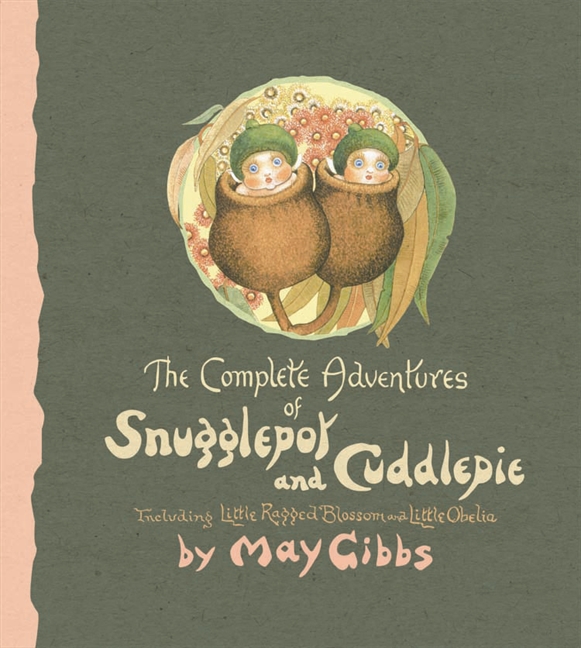
The Adventures of Snugglepot and Cuddlepie by May Gibbs

May Gibbs' Snugglepot and Cuddlepie

May Gibbs (1877-1969) was an English-born Australian writer and illustrator whose stories were inspired by Australian native flora.

She’s probably best known for her gumnut babies, Snugglepot and Cuddlepie, who are cute little foster brothers that resemble eucalyptus nuts.

The pair go on an adventure in the Australian bush, but they have to take care not to run into the big bad Banksia men — horrible creatures modeled on banksia cones, which are a bit like hairy pinecones.

As a child I remember being physically scared of the Banksia men, but as ever in the world of children’s literature, good overcomes evil and they sink to the bottom of the sea!

The best part about Snugglepot and Cuddlepie, which was first published in 1918, are the truly beautiful illustrations by the author. To this day these illustrations are used on all kinds of merchandise, but what I hadn’t realized until I started writing this piece is that all profits go to UNICEF, the Spastic Centre of NSW and the NSW Society for Crippled Children (now the Northcott Society), according to the wishes of May Gibbs’ bequest.

May Gibbs home Nutcote, on the shores of Sydney Harbour, is also open to the public.

I suspect that all three books, with their emphasis on Australia’s unique plants and animals, may be responsible, not only for my love of Australian literature, but my love and respect of the Australian bush, too.

Monday musings on Australian literature: Guest Post from Guy of His Futile Preoccupations

Monday Musings’ Guest Post no. 3 comes from Guy Savage of His Futile Preoccupations. Guy started commenting on my blog very early on and endeared himself to me by giving me the nickname of Gummie. That is a very Aussie thing to do – or is it English? Guy, you see, is an expat Brit living in the USA. (At least I think I’ve got that right.) I quickly discovered that Guy had an interest in and knowledge of things culturally Australian and we have shared some interesting conversations about Australian authors and films over many posts here and there. He is also interested in the classics, including authors like, oh, Jane Austen for example. His other interest – he’s a man of many talents – is crime fiction and film noir, and he writes with great flair on things criminal! Do check out his blog. You won’t be disappointed.

But, on with the post. Guy stunned me when, commenting on my very first Monday Musings, he named Max Barry as his favourite Aussie writer. Max Barry, who is he? Well, today Guy is going to tell (me) us … read on …

Max Barry 2006

Max Barry 2006 (Courtesy: dejahthoris, via Wikipedia, using CC-BY-SA 3.0 Unported)

Max Barry: One of Australia’s National Treasures

Ok, I’ll admit it. I’m not rational about Max Barry. I’d like to say that I’m his number one fan, but that makes me sound as though I’m ready for psycho-therapy, and anyway, if you make a trip to Max’s website and sign up as a member of Max’s Posse (currently at 5785 and climbing), you’ll see that he’s his own number one fan. So instead I’ll land on the safer statement that I’ve been a fan of this Australian author for 10 years. Born in 1973, Max Barry is a young writer, and there’s going to be a lot of great books coming from his home in Melbourne. I suspect that he’s better known outside of Australia, but I’m basing that on the fact that Gummie hadn’t heard of Max Barry before I mentioned him, and she’s my barometer for all-things-to-do-with-Australian-culture.

Yes it’s been ten years since I first came across Max Barry in 2001 via an out-of-print copy of his first book, Syrup, a brilliantly funny novel which satirizes marketing and consumerism. Actually I’d better back up a bit here–the book, published in 1999, was attributed to Maxx Barry in a continuation of the marketing idea. Max says he added the extra X:

because it seemed like a funny joke about marketing, and I failed to realize everyone would assume I was a pretentious asshole.

Syrup is the story of an unlikely hero, Scat, a marketing graduate from Iowa who moves to L.A. He devises a marketing plan for a new drink called Fukk and plans to sell his idea to Coca-Cola, but before he can seal the $3 million dollar deal, Scat’s roommate, Sneaky Pete, in a wickedly funny backstabbing move of corporate theft, claims the copyright.

Syrup is one of the funniest books I’ve ever read, and when I concluded the novel, I was troubled that I’d found it purely by accident. I took the book’s out-of-print status rather personally, and buying about a dozen copies, I sent them out to anyone who was still speaking to me and urged them to read the book. Without exception, everyone who got one of those copies of Syrup loved the book.

Barry’s second novel appeared in 2003. Jennifer Government is an alternate-reality vision of globalization in which most countries are nakedly dominated by corporations rather than by governments. Corporate employees take the name of the corporation they work for as surnames, and schools are sponsored and controlled by corporations intent on raising the next generation of avid consumers. This is a novel in which corporate competition has become so fierce that consumers become stiffs in a guerilla marketing campaign guaranteed to hype sales of crappy new tennis shoes. Jennifer Government is a remarkably intelligent and prescient novel, for some of the fictional dire social conditions Barry created no longer seem quite so futuristic in the post-boom gloom.

Barry’s 2006 novel Company again placed the individual in the middle of corporate nastiness. This novel, set in Seattle, explores the shady dealings of the Zephyr Holdings Company, and when Stephen Jones from the Training Sales Dept. begins to ask a few awkward questions, he finds himself catapulted into management. In this novel, Barry blends the nonsense rules of corporatism with the naturally absurd results, and consequently, this is a perfect depiction of the insanity of life within the corporate machine.

This year Barry published his fourth novel, Machine Man–the story of corporate scientist Charles Neuman, employee of Better Future, who accidentally loses a leg in an industrial accident. Charles’ discovery that the replacement leg is better than the original sets off a chain of events in which Charles decides to improve himself limb by limb in a grimly hilarious skewering of corporate culture.

Over the years, Barry’s novels have been optioned for film and disappointingly several projects have not gone beyond the blue sky phase; I was rather excited at the news that Steven Soderbergh and George Clooney’s Section 8 films optioned Jennifer Government, but so far nothing on that score. But someone out there has noticed the Vast Talent that is Max Barry and 2012 will see the release of Syrup from director Aram Rappaport. Max Barry flew to America and watched the filming and even got a small cameo role.

Ok so Max Barry has written four novels–two of which are the funniest books I’ve ever read, and now it looks as though he’s about to get some long delayed-global recognition, but there’s a lot more to this author that makes him exceptional. Max has also taken control of his own marketing–albeit that no-one was interested in Max back when his first novel was out-of-print, but any new author out there could learn a thing or two from Max. Max has maintained an active website since 1999 and keeps in touch with his fans (and I’d like to think we’re a little nuttier and stranger than the average readers) via an e-newsletter. In 2004, Max converted his website to a weblog where he shares his news. On the site, you can check out NationStates, a game designed by Max to help market Jennifer Government:

NationStates is a state stimulation game. Create a nation according to your political ideals and care for its people. Or deliberately oppress them. It’s up to you.

Max even has a few videos up on youtube. But if you want to get a taste of Max’s wonderful sense of humour, check out his weblog where you will see comments about nasty critics in a piece called Things Critics Do That Piss Me Off . Here’s Number 3:

#3: Spots Plot Holes That Are There

Max Responds: Shut the fuck up! Go write your own novel, you hack!

And on the Q& A subject of whether or not Syrup is based on Max’s sordid period of employment with Hewlett-Packard:

That’s a filthy lie. Why, if HP was like Syrup, it would be a seedy den of politics and corporate back-stabbing, brimming with sexual tension. That is absolutely not true. There was very little sexual tension.

Actually, HP was a great place to work and taught me a lot about how companies function. I worked with some tremendously talented salespeople, most of whom used their powers for good instead of evil.

As a reader of crime fiction, I’ve noticed that many crime writers tend to take a different type of approach from other so-called literary authors that leaves no room for ivory tower elitism. Not only do many crime writers maintain extremely active blogs (thinking Max Allan Collins, James Sallis, Duane Swierczynski here), but there’s also a high level of reader involvement. Duane Swierczynski (Severance Package, The Wheelman), for example, is even organizing a Philadelphia bus trip January 2012 to the grave site of author David Goodis (Dark Passage). Crime writers don’t seem to feel the need to distance themselves from fans; perhaps they’ve even learned that maintaining a place for readers to check to see what they’re reading and writing is actually a good thing, or there again perhaps they’re tougher than their average readers, and they’re not scared to get within punching distance. Whatever the reason behind this internet-author-reader-relationship, this is the sort of proximity I see in Max Barry–there’s an innate humility in this writer that makes me, as a reader, cheer for his success. He’s an Everyman who’s worked in mind-numbingly boring, demeaning jobs, and he just happens to have the talent to write about his experiences which become, in turn, our experiences. He’s not just a writer who produces a book once in a while; if you’re a fan, you’re involved. We’ve been with Max through his disappointments and his successes, through the birth of two children (to clarify, Max’s wife, Jen  gave birth–not Max), and when Max wrote a serial called Machine Man, newsletter subscribers got to read chapters and give feedback. When Max landed a book contract for Machine Man, we even voted on the choice of cover.  It makes me feel all warm and fuzzy just thinking about it…. Sniff…

… and you’ve made us all warm and fuzzy with your passionate post Guy. I recently bought Company – I just have to find time to read it! Meanwhile, readers here might like to check out Book Around the Corner’s reviews of Syrup and Company and Guy’s own reviews of Jennifer Government, Companyand Machine man.

Monday musings on Australian literature: Women of letters

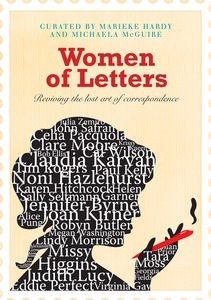
Women of Letters, edited by Marieke Hardy and Michaela McGuire

Women of letters (Courtesy: Penguin Books Australia)

Letter-writing has a long literary tradition – both fictional and non-fictional. Epistolary novels, according to Wikipedia, go back to the 1400s, and I’m sure if you’re a reader you’ve read at least a few. My favourite Australian example is a gut-wrenching young adult novel Letters from the inside by John Marsden. But these are not my topic today. The other sort of letters are the “real” letters written to “real” people. If the letters are good enough and/or the people significant enough these also have a long publishing tradition. I’ve reviewed some here – by Jane Austen (of course)! Collections of published letters can be found for some of Australia’s famous women writers, including Christina Stead, Henry Handel Richardson and Miles Franklin. But these aren’t today’s subject either.

My subject is a specific book of letters compiled by two Australian women, Marieke Hardy and Michaela McGuire, from an initiative of theirs in which they asked Australian women (initially) to “‘pen’ letters to a theme and read them aloud”. Their aim was to raise funds for Edgar’s Mission, “a not-for-profit sanctuary for neglected, discarded and abused farmed animals” in Victoria. Their project commenced in March 2010, and has involved live “shows” in several Australian cities – and now, this book.

The letters have been organised under 16 “recipients”, such as “To the night I’d rather forget”, “To my first boss”, and “To the photo I wish had never been taken”, which gives you a sense of where this collection is going. They are written by 69 well-known (though not quite all so to me) Australian women (mostly!) writers, performers, politicians and so on. I will admit that I have not read the whole 400+ pages book yet, but with Christmas around the corner and a good cause, now seemed to be a good time to write about it. (No, I am not under a retainer for Penguin!). Three of the contributors are writers I’ve reviewed in my blog, so I reckon they’d be a good place to start:

  • Anna Krien “to my first pin-up”. Trouble was Anna Krien was a tomboy and not like other little girls. When they wanted “love”, she wanted friends, so she turned to her cat, Tiger. It’s a light-hearted letter with a serious core about the damage that little girls can do to little girls (“the twisted best-friend bully dichotomy”), something Margaret Atwood explored to great effect in Cat’s eye.
  • Alice Pung “to the moment it all fell apart”. It contains anecdotes from her latest book, Her father’s daughter, presented as a letter to her father. She leads us on about an online relationship only to … but I won’t tell what, except to say it’s to something typically reflective of her and her father’s experiences.
  • Helen Garner “to the letter I wish I’d written”. That sounds like an apposite recipient for a writer who has never shied from controversy – but in fact, being Garner, her contribution isn’t the expected. Rather, it’s a series of letters to her “gazombies”, to people who’ve died, friends who’ve suddenly disappeared from her life, and people who crossed her path but became missed connections. They’re “fragments” that add up to a disjointed but very Garner-ish whole. She thanks the science teacher who taught her that “hot air rises”, she’s sorry that she lost contact with her “nanna” because “my adolescence extended right into my thirties”, she tells a man she regrets not accepting his offer to dance because blokes who can dance “are very thin on the ground”, and she writes to her three ex-husbands thanking them for what they gave her and telling them “there is nothing to forgive”.

There are a few contributions from men, mostly “To the woman who changed my life”. There are light-hearted letters such as actor Jane Clifton’s to her “1991 Nissan Pintara with only 20 000km on the clock” that she calls “the Nissan Piñata, because no matter how many times you get hit, you are the gift that keeps on giving”, and singer Georgia Fields’ to Mariah Carey telling her that “next time I’m at a party and your name comes up, I’m not going to sit quietly and pretend I don’t know you …”. But, I’ll conclude with actor Claudia Karvan’s letter to love, itself, in the “A love letter” section. It’s a cheeky little number telling love she is “eternally grateful for your landing on my shores” but suggesting:

You have a strange habit of departing, and departing quite swiftly. So quick your footsteps aren’t heard. No doorbell sounding the arrival of your cab, just bang, you’re gone […] You really are quite the magician.

This is, as you’ve probably worked out, a book for dipping into. The letters might be artificially created but there’s a lot of art in them – of letter writing, of life. Just the thing, really, for a post-Christmas read.

Do letters play a role in your life? Do you like to read them? Do you write them?

Marieke Hardy and Michaela McGuire (curated)
Women of letters: Reviving the lost art of correspondence
Camberwell: Viking, 2011
413pp
ISBN: 9780670076093

(Review copy supplied by Penguin Books Australia)

Alice Pung, Her father’s daughter

Pung Her Fathers Daughter Black Inc

Bookcover for Pung's Her father's daughter (Courtesy: Black Inc)

Her father’s daughter (2011) is Alice Pung‘s second memoir – if you can quite call this book a memoir. Unpolished gem (2006), her first, established Pung in the eyes of both critics and readers as a writer to watch. I agreed with them, but with some minor reservations. She certainly demonstrated the ability to write and tell stories – plenty well enough for me to be happy to read more of her – but, it was a young person’s memoir about a family that had experienced things (such as the Pol Pot regime) that most of us couldn’t imagine. And Pung, born in Australia, didn’t seem to quite have the maturity then to fully appreciate this fact in the way she wrote of her family. Five years, though, have made the difference and I would happily apply my favourite Marion Halligan quote to this book:

Read a wise book, and lay its balm on your soul.

Because, this book is the whole package.

The first thing that stands out is the voice. The book is, in a way, a hybrid, a memoir-cum-biography, and Pung has chosen to write it in third person. This decision reminded me of Kate Holden’s The romantic: Italian nights and days in which she too chose third person to tell her story. But, these are very different stories, and the reason for using third person reflects the difference rather than suggesting a similarity. The difference is that this is not just Alice’s story as Unpolished gem was, but also her father’s story. It is Alice’s attempt to understand the things that clearly frustrated her in Unpolished gem, such as the over-protectiveness of her parents. In this book, her father has a voice. In fact, the book’s chapters see-saw between those labelled “Father” and “Daughter”, so that it reads almost like a conversation.

This conversation style is one part of the narrative structure. Another is the movement in geographic setting from Alice’s time in China, to her return to Melbourne, to her father’s life in Cambodia and then her much later visit to Cambodia with her father, and finally back in Melbourne again. This geographic movement is overlaid with the third significant aspect of the structure, its chronology. The book moves back in time from the present, from when Pung’s family is well-established in Australia with a successful business, with, that is, the life Pung wrote about in her first memoir. At the beginning of this book, Pung, in her late 20s, goes overseas for the first time and her father, as is his wont, is fearful:

It panics him whenever any of his children are far away.

He can’t understand why she must go away to write. After all, she can see these other places on Google Maps, so

why couldn’t she just see the world through these satellite pictures. It was safer.

Alice, being Australian-born, doesn’t understand the full extent of his fears but, as she writes the book, she learns why her father believes that

To live a happy life … you need a healthy short-term memory, a slate that can be wiped clean every morning.

We’ve all read and/or seen about the killing fields of Cambodia so I’m not going to detail here her father’s story of survival through one of the world’s terrible genocides. I will say, though, that for someone looking from the outside (me, the reader), Pung seems to have captured her father’s story authentically and conveys it in a way that we can understand why he expresses his love for his family in the fearful and sometimes controlling way he does. The result is a greater understanding from daughter to father, and, if Pung has got it right, from father to daughter too.

There are some lovely touches in the book about the business of writing memoir. Pung refers briefly to her parents’ reactions to Unpolished gem. Her father is proud but says that if he’d seen it pre-publication “there would have been parts we wouldn’t have let her include”. Pung continues:

She waited for more reproaches, even excoriation. It seemed impossible that this would be the extent of it, but it was. She started to see her mother and father in a new light. They had a sense of humour! They knew their private lives were completely separate from the world their daughter had described in another language.

Then, on different tack, comes this one, late in the book, on the writing of Her father’s daughter:

‘Do you think [says her dad] there’s too much suffering in the Cambodian part? Maybe white people don’t want to read about too much suffering. It depresses them.’

Ouch! There are a few ways to think about this one. Anyhow, Pung’s reaction is:

She didn’t know what to say about that. She knew exactly what he meant though. Her first book had been filled with the sort of sardonic wit that came easily to a person whose sole purpose in life was to finish university and find her first graduate position, knowing she was well on the way to becoming comfortably middle-class …

She decides that the time has come to look back and confront this part of her/their identity that her father had wanted to hide but that had heavily affected his parenting … In fact, it was around this point that I started to realise that my uncertainty about Unpolished gem might be more due to her father’s desire for “dismemory”, that is, to deliberately forget, than to her youthfulness. And the astonishing thing is, through all the description of people who did unimaginable things to other people, of people who suffered horrendously, of people who’d “lost their minds and did not bother to retrieve them”, the overriding emotion she conveys is that of love:

There’s no vocabulary
For love within a family, love that’s lived in
But not looked at …
(Epilogue, quoted from TS Eliot‘s “The elder statesman”)

 This is a fine, fine book and I’d recommend it to anyone – for its story, its writing and its humanity.

Alice Pung
Her father’s daughter
Collingwood: Black Inc, 2011
238pp.
ISBN: 9781863955423

(Review copy supplied by Black Inc)

Nigel Featherstone, Fall on me

Featherstone, Fall on me
Fall on me bookcover (Courtesy: Blemish Books)

Nigel Featherstone is nearly a local writer for me – he lives in the country town an hour down the road – but I haven’t read him before, even though he has published a goodly number of short stories and short fiction. How does this happen? Anyhow, Fall on me is his second novel, or novella, to be exact. It is, in a way, an age-old story. The protagonist has experienced something in his past that has stalled his life, made him lose his way. From pretty early on, you know that this is what the story is about, but Featherstone tells it in such a way that it doesn’t feel old, that makes you want to keep on reading to find out exactly what did happen, and how (because you assume he will) our protagonist is “unstalled”.

How does Featherstone achieve this? I’ll explain soon, but first I’ll flesh out the plot just a little more. There are three main characters – Lou, our protagonist, who’s 38 and owns a small cafe in Lonnie (Launceston, for the non-locals); Luke, his son, who is 17 (and, significant to the plot, therefore not quite an adult yet); and Anna Denman, their boarder, who’s in her late 20s and works in a bookshop. As the back cover blurb says, the plot revolves around a decision by Luke “to risk all by making his body the focus of an art installation” which forces Lou “to revisit the dark secrets of his past, question what it means to be a father, and discover …”. Well, you’ll have to read the book – or at least find the back cover – to discover what Lou discovers!

The title of the book comes from the R.E.M. song, “Fall on me”, which is, says songwriter Stipe, a song about oppression, about the things that “smash us”. For Lou, a big R.E.M fan, what’s smashing him is his inability to move on from what happened in the past, when Luke was one month old. It is Luke’s art installation, of course, which finally precipitates Lou’s “unstalling”. Featherstone’s plotting is sure; he drops clues to what had happened, without telling us too soon but not dragging it out too long either. We realise fairly quickly that it involves a loss (after all he’s a single father) but how this occurred and who might be involved is not immediately made clear. The past is gradually filled in, through flashbacks, and the picture is slowly built up – though only sometimes in the expected direction. Where, we wonder, for example, does his old schoolfriend, Fergal, fit in?  Meanwhile, in real-time, the art installation plot runs its course.

A number of themes run through the novel, besides the “unstalling” one. One relates to art. I like the way the plot, without specifically mentioning it, reminds us of the Bill Henson “is it art or pornography” controversy which caused a furore in Australia in 2008. What happens when art pushes the edges, particularly when children are involved? Lou is shocked by Luke’s “My Exposure for You” installation and fears for his son. He wonders about “laws” that might come into play, and whether some sort of “‘artistic licence'” might apply. Luke, though, gets to the point: “But my body – ultimately – means nothing. It’s my heart that counts”. Another theme relates to parenting. Lou worries about the “installation”:

He can’t allow the exhibition to happen. He won’t – he could never – allow his son to put himself in the sort of danger that might now be coming his way, their way […]

Hang on. Is that really his responsibility, stopping his son from getting in the way of danger? Isn’t a greater responsibility encouraging his son to be all that he can be?

The writing is direct, straightforward. It’s not wildly innovative, but that doesn’t mean it’s uninteresting. There’s the occasional word-play and irony, some effective description, and apposite allusions including a sly reference to Lou reading Patrick White‘s The Twyborn affair. The characterisation is good. This is a novella, so only the main characters are developed and, even then, Anna is a little shadowy. We know what we need to know – but perhaps not as much as we’d like to know!

I enjoyed this book. It’s warm and generous, and it feels real. Around the middle of the book, when Lou expresses his desire to protect his son, Luke responds that “safety doesn’t always equal life”. Some risks need to be taken … as each of the characters realise, some later rather sooner. The end result is a story with heart … and that is a lovely thing.

Nigel Featherstone
Fall on me
Canberra: Blemish Books, 2011
130pp
ISBN: 9780980755633

(Review copy courtesy Blemish Books)

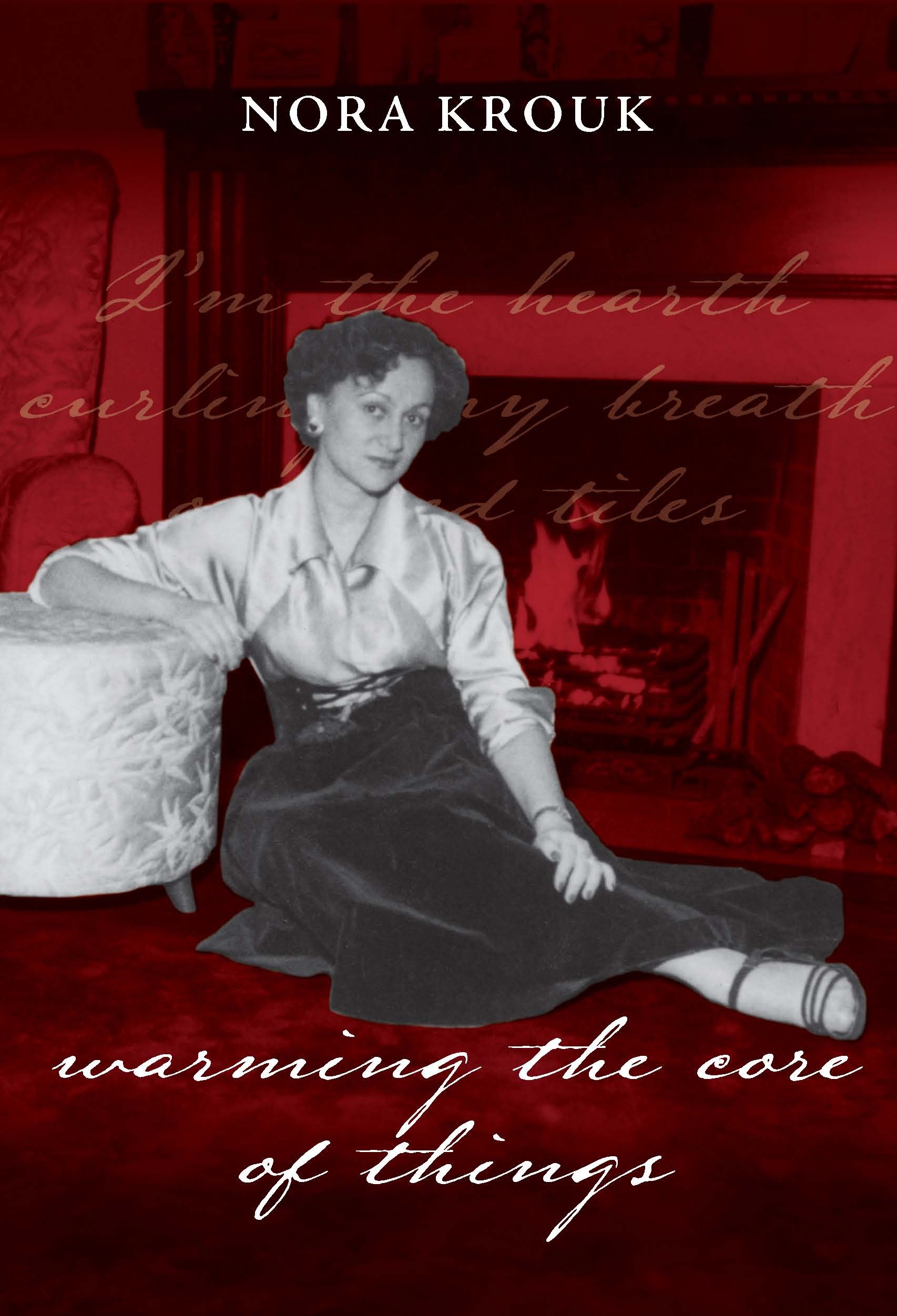
Nora Krouk, Warming the core of things

Nora Krouk, Warming the core of things, book cover

Nora Krouk, Warming the core of things (Image courtesy Hybrid Publishers)

life wrapped in bundles
of painful joy
(from “Skies will be luminous”)

The reason I like to read poetry is the obvious one – the way poets can capture a feeling or idea in just a few carefully chosen words that are presented through a controlled rhythm. Nora Krouk fills this bill nicely!

I hadn’t heard of Krouk before this book came to my attention … but she’s been around for a while. In fact, she’s 90 years old and has been in Australia since 1975. She is the daughter of a Polish Catholic father and a Jewish mother. She was born in China, married in Shanghai and lived in Hong Kong before emigrating to Sydney. She was educated in Russian schools and has written poetry in Russian and English. She has been published internationally, and has won several awards. Phew! I don’t usually provide such detail about authors, but it seems appropriate to do so here.

The collection is organised into three sections, and the order of these sections is interesting: In memoriam, Renewals, Transitions. I like the way it moves from death, through awakenings and rebirths, to change accompanied by uncertainty. This order keeps us on our toes. It offers no easy conclusions to the challenges posed in the first section but neither does it suggest hopelessness as the reverse order might have.

The poems are, for the most part, very accessible. Elizabeth Webby is quoted on the back of the book as saying that the poems “will appeal to both those who usually read poetry and those who don’t”. I’m in the middle ground here – I like to read poetry but don’t read it often enough – and I think Webby is right. Many of the poems have stories – seemingly about people Krouk knows – and those stories speak to the ordinary things of life which, for someone of Krouk’s age, include memory, aging, loss and death. These things are explored with a sense of enquiry and some resignation, rather than with a railing and ranting. The poems move between her daily life and historical events (some of which she or her family experienced), particularly the horrors that occurred under Hitler and Stalin.

I commenced this review with two lines from a poem in the Renewals section because they encapsulate what seems to be Krouk’s philosophy: Life is not easy, she’s saying, but there is much to enjoy and wonder at. The first poem in the book is a widow’s poem. It speaks of grief, but it also introduced me to something interesting about her poetry, what Anna Kerdijk Nicholson describes on the back of the book as her “idiosyncratic rhythm and lineation”:

I don’t weep much.     I read
and write     even cook     then
catch myself and return to you
(from “Fima (1914-2008)”)

These spaces in her lines control, force even, the rhythm for the reader. They allow us to breath, to feel the sense of the words and, in a way, they provide a more intimate, conversational tone to the work. They slow us down and prevent us from rushing through the poems.

Aging and memory, as I’ve already mentioned, are recurrent themes in the collection.  Memory, though, is a pretty broad church, and Krouk explores it in its various guises – from loss of memory to remembering the (often painful) past:

They chase a name
a thought     an event
(“The couple”)

It’s different for us
we have no grave
He was last seen
in the prison yard
(from “For Leon K” who died under Stalin’s regime)

But not all the poems are about challenge. There are lighter poems, and there is humour. I loved her short poem about a young smiling woman:

A smile is hovering over our street
a light funny quizzical smile
It slipped off her lips
brushed past the creamy cheek

dripped over a sunny wattle and stayed.
(from “A young woman”)

Much of her imagery is domestic, everyday. There are family dinners and bridge afternoons with friends. Jacarandas and gums, camellias and lavender feature, grounding her poetry in her Australian life. But, there are also allusions to things literary (such as Shakespeare and Tolstoy) and political/historical (as mentioned earlier), which confirm her as a poet of universal concerns.  Some of her poems combine the Australian and the political – such the example below, which demonstrates that she is capable of more than a little irony:

Where do we turn Matilda     Lead the dance
As promised in the anthem     we advance
(from “Sorry”)

There are also a few specifically religious poems, but I found some of these (“Widowed a hundred times”, and “I am not envious Lord”) a little too melodramatic for my liking, while others, such as her meditation on snakes (“Snakes are much maligned”), engaged me. Poetry, as I’ve said before, is such a personal thing.

Krouk has lived long and experienced much. There are many more poems I’d love to excerpt – and maybe I will in a future post. Meanwhile, I can’t think of a better way to summarise this book than through her own words:

Under the skies     luminous
things drop
(from “Skies will be luminous”)

Nora Krouk
Warming the core of things
Melbourne: Hybrid Publishers, 2011
126pp.
ISBN: 9781921665431

(Review copy supplied by Hybrid Publishers)

Irma Gold, Two steps forward

Irma Gold's Two steps forward Bookcover

Irma Gold's Two steps forward (Courtesy: Affirm Press)

Irma Gold’s* Two steps forward is, apparently, the last release in Affirm Press’s Long Story Short series. I have reviewed two others previously – Gretchen Shirm’s Having cried wolf and Leah Swann’s Bearings – but, before talking about this book, I must say how much I love the books themselves. I am starting to read eBooks. I recognise they are likely to be the future and they do offer advantages over print books. They take up less space, for a start. You can change font size to suit your eyes. And, eReaders have inbuilt dictionaries which can be useful when you are reading while out and about (or are just too plain lazy to get off your seat to find the dictionary). But, this doesn’t mean I don’t like print books – especially lovely ones to look at and hold like this Affirm Press series. I like their slightly smaller size and their simple, clear, modern design. The three I’ve read also have very stylish monochromatic covers. There’s little, in fact, not to like about them.

Now, though, the book. This is one of those short story collections, like Swann’s Bearings, that has its own title rather than one drawn from one of the stories within. I like that – and the title of this book, Two steps forward, is a particularly clever one, because of course it immediately calls forth the complete saying “two steps forward one step back”. This concept works well for the stories in Gold’s book.

Irma Gold is a writer and editor. She has been published in various journals, such as Meanjin and Island, but this is her first published collection. Well done her, because it’s an engrossing collection. Gold’s writing is clear and warm, and she demonstrates in this collection an ability to handle a range of voices and points of view. There are 12 stories in the book: five are told 1st person, two 2nd person, and the other five 3rd person. Her protagonists are mostly women, but there are a few male voices too. The stories could be described as “scenes from a life” (well, lives, really). Her characters include a single mother hoping for love (“The art of courting”), an empathetic woman working in a refugee detention centre (“Refuge”), a father experiencing his first access visit, after two years, with his 8-year-old daughter (“Tangerine”), an emotionally-neglected teen girl living in a caravan park (“Sounds of friendship”), an old homeless man (“Great pisses of Paris”), and so on. The characters are authentic. You know who they are, what they feel, and what they are confronting:

You notice how thin your lips have become, how the flash of greasy fuchsia looks almost crude. You pull at the loose skin on your neck, and the spongy puffs around your eyes filled with lines, the skeleton veins of a dead leaf. (“The art of courting”)

I want to touch him, but the space between us is fractured. (“Refuge”)

I compose sentences in my head, but none of them work. (“Kicking dirt”)

Says they can’t afford to waste cash on stuff they don’t need, though apparently alcohol is essential. (“Sounds of friendship”)

There’s a painful vulnerability to her characters, as they confront their particular challenges, such as visiting a terminally ill friend (“The visit”), facing a miscarriage (“The third child”), or trying to reconnect with a young daughter (“Tangerine”). Their lives are finely observed, so much so, in fact, that you feel you’ve been there – even if you haven’t. Their triumphs, when they have them, are hard won.

I also liked Gold’s use of imagery. It’s apt, evocative, and is not overdone or pushed too far – which suggests careful writing, good editing, or both:

 A day leaking away with a spill of apricot. Air stung with lavender. (“The art of courting”)

… and Abby catches the cold-barrelled words Mick fires at her mother. (“Sounds of friendship”)

But it was all icing slathered over stale cake. (“The anatomy of happiness”)

The tone doesn’t vary much, but this doesn’t spoil the experience. The stories, overall, have a somewhat melancholic air, as the characters struggle to keep a forwards momentum in their lives ahead of a backwards one. And, there are touches of humour (mostly wry) and some occasional irony (such as a reference to our anthem’s “boundless plains to share” in “Refuge”) that provide relief.

Endings are always hard … at least that’s what E. M. Forster told us in Aspects of the novel … but Irma Gold has handled them well. Keeping with the title, most of her stories have more hope than not – but none are fully resolved. Like life really.

Irma Gold
Two steps forward
Mulgrave, Vic: Affirm Press, 2011
(Series: Long Story Shorts, 6)
192pp.
ISBN: 9780980790474
Also available in eBook format

(Review copy courtesy Affirm Press)

* I was tickled to note in her Acknowledgements that Gold spent some time at Varuna Writers’ Centre.

Hazel Rowley, Franklin and Eleanor: An extraordinary marriage

First Family of the United States

Roosevelt Family, 1919 (Courtesy: Franklin D Roosevelt Presidential Library and Museum, via Wikipedia

I wonder what would make an Australian biographer decide to write about an American couple? And I wonder, having now read Hazel Rowley’s Franklin and Eleanor: An extraordinary marriage, what she would have made of, say, Joseph and Enid Lyons, Australia’s own political power couple. Unfortunately we’ll never know as Rowley died just around the time this, her latest biography, was released. There is, of course, good reason for writing this story: Franklin and Eleanor are an interesting couple, and they did have an impact on the international stage, as well as their national one.

In her acknowledgements at the end of the book, Rowley writes:

I learned quickly that all sources, both primary and secondary, were unreliable. There was so much that could not be said, even in private letters…

Therein lies the rub for the would-be biographer of Franklin and Eleanor Roosevelt. There’s a lot of primary source material available. They wrote copiously to each other and to others, others wrote copiously to them and to others about them. There are diaries written by many in the Roosevelt circle. There’s Eleanor’s newspaper column, My Day, which she wrote for nearly three decades. And there are memoirs, interviews, and sundry other items documenting their private and public lives. Indeed, even though it’s known that some significant letters were destroyed, the biographer of Franklin and Eleanor is challenged by a surfeit of records, unlike those poor biographers of Jane Austen who try to make a lot out of what is a rather small historical record.

And yet, there are still gaps. This is, in the end, what makes fact different from fiction, isn’t it? When you are writing about real people you cannot know everything in their hearts, you cannot be sure of their real motivations, and so whatever biography we read, no matter how thoroughly researched and well written it is, there are things we will never know. With fiction – and maybe I’m being a little ingenuous – the character only exists in the author’s mind and on the page. Whatever the author tells us is all we can know and we must work with that …

Enough intro, let’s get to the book. Franklin and Eleanor: An extraordinary marriage is an extraordinary read. The research Rowley did was clearly comprehensive – as the endnotes demonstrate. Rowley takes, she says, a different tack to the other biographies out there by choosing to focus specifically on the marriage. Her thesis is that it was not simply a patched up compromise (after Franklin’s betrayal with Lucy Mercer) or simply a political marriage, but “a joint endeavour, a partnership that made it possible for the Roosevelts to become the spectacular and influential individuals they became”.

And that’s certainly how she presents it … and, moreover, how the evidence she presents suggests it was, though we’ll never know, really, what interior compromises the couple made in terms of their personal happiness. Eleanor was devastated by Franklin’s love affair with Lucy Mercer in 1918, and divorce was apparently mentioned. Threats of disinheritance and of loss of his political career plus, it seems, his love for Eleanor resulted in reconciliation and the marriage continued. However, it did shift gear, particularly after Franklin’s polio attack in 1922, and began to encompass a variety of “romantic friendships” for both. Eleanor wrote, many years later in her book You learn by living that

You must allow someone else to meet the need, without bitterness or envy, and accept it.

That tells us, I think, that the “new” marriage was not easily come by. But it also tells us that it was come by. And so, in the mid-1920s during Franklin’s “recovery” from polio,

Franklin had Warm Springs [resort bought by FDR]; Eleanor had Val-Kill [cottage]. Franklin had Missy; Eleanor had Nancy and Marion. Both had Louis Howe.

The fascinating thing about the Roosevelts is the loyalty they inspired in the people who worked with them. Many of the long-standing friendships and relationships chronicled in the book are with the secretaries, body guards, campaign managers, journalists who were in their employ or worked alongside them. There are stories galore in the book about how they opened their homes, including the White House, to others, enjoying communal living way before the 1960s.

The book is, as I’ve already mentioned, well-researched. Most of what Rowley tells us appears to be based on primary records (that are well documented in the extensive endnotes at the back of the book), and she occasionally indicates when she thinks the “facts” have been modified with an eye on posterity. But there are also times when she makes assumptions, such as her belief that Franklin and Lucy did not have a real “affair” because they had little opportunity to be alone; because Lucy was Catholic, single and probably a virgin; because they would have feared pregnancy; and so on. All logical enough but the facts aren’t known.

While the book is about their marriage, we don’t learn a lot about their parenting style. However, their political life is told at a general level – FDR’s New Deal, CCC and Lend-Lease programmes, his relationship with Churchill, and Eleanor’s political works including her involvement in the creation of the United Nations. We learn a little of how Eleanor’s more radical ideas were tempered by the supportive but more political Franklin. I loved a government official’s description of Eleanor at the United Nations General Assembly:

Never have I seen naiveté and cunning so gracefully blended.

As a 21st century reader, I was also interested in the behaviour of the press and how the extent of FDR’s handicap was either hidden from the press or, sometimes, hidden by the press from the public:

From today’s perspective, it is astounding that the press stuck to the rules. Even journalists who disliked Roosevelt respected the dignity of a handicapped man.

They weren’t perfect though. Towards the end of his life when he was sick and convalescing in the South, FDR was driven in his car one day in front of the press simply to halt the rumours that had started to fly. He apparently said:

Those newspapermen are a bunch of God-damned ghouls.

Little did he know!

It’s a great read – for its analysis of the “extraordinary marriage” and for its picture of the times. I thought, as I read of Eleanor’s debut early in the book, that her young womanhood was somewhat close in time and place to the women who populate Edith Wharton’s novels, but Eleanor, through either luck or good judgement, escaped the lives and fate of those characters. How lucky, really, for the world that she did.

Hazel Rowley
Franklin and Eleanor: An extraordinary marriage
New York: Farrer, Strauss and Giroux, 2011
345pp.
ISBN: 9780374158576