Andrew Croome, Midnight empire (Review)

Andrew Croome, Midnight Empire

Courtesy: Allen & Unwin

Andrew Croome’s latest novel Midnight empire is yet another read this year that is outside my usual fare. I read it because of my reading group’s focus this Centenary year on Canberra writers. It wasn’t a big ask, though, because I had read and enjoyed his first novel, Document Z. While both deal with spies, they are very different novels: Document Z is historical fiction, while Midnight empire is a thriller. I wonder what Croome will do next. Romance? Interestingly, Croome, who attended my reading group’s discussion, suggested that Midnight empire is more like a first book. This is because when writing Document Z, he could always go back to the historical record when he stalled, but with Midnight empire he had to rely on his own ideas to keep the story going. Croome told us that the inspiration for the book was drones and, developing that, the idea that with drones people can conduct “war” from their office desk. What does this mean for our psyches, he wonders. And where is the line between who is at war and who isn’t? But more on that later.

First, a little about the plot. The protagonist, Daniel Carter, is a rather naive 26-year-old computer programmer whose company’s encryption algorithm has been bought by the US government for its drone program. Daniel is sent by his Canberra-based company to Creech Airforce Base, outside Las Vegas, to install the software and make sure it runs properly. Suddenly he finds himself at war, albeit sitting at a computer terminal in the American desert, a long way from Afghanistan and Pakistan where the actual war is being waged. Unlike the airforce pilots and CIA agents Daniel is working with, he has not been trained for war.

Parallelling the story of Daniel’s professional life is his personal one. He comes to Las Vegas despite the wishes of his long-term girlfriend Hannah. Their relationship has been foundering and his, to her mind, not well thought through decision to go to Las Vegas is the catalyst for her to break up. Daniel is disappointed, but it leaves him free to meet someone new – and he does, of course. He meets the beautiful Russian, Ania, at the poker table. This is Vegas after all!

As you would expect for the genre, things start to go awry. An agent double-crosses them, pilots start dying mysteriously in Vegas, and the drones are sent in to Peshawar to take out their target. Daniel becomes perturbed about the morality of what he sees and decides to leak some information. Meanwhile, his life with Ania becomes complicated when she tells him her brutal husband has come to Vegas looking for her. Daniel is torn between his work and his personal responsibilities, and starts crossing even more lines from which he may not be able to return. As we read on, we are not sure who to trust or believe. Is or isn’t Ania the traditional spy-tale Femme Fatale? And are the CIA starting to suspect him?

Daniel … in the lion’s den

Croome has, I suspect, chosen Daniel’s name for its allusive – and ironic – value: we can see where Daniel is, but he seems pretty oblivious. Fairly early in their relationship Ania questions Daniel about his work. She’s mystified by the fact that he says he’s fighting a war, even though he didn’t volunteer for it and wasn’t conscripted:

‘Then why are you here?’

‘It is simply that I have a job. I am doing my job.’

You are at war because of your job?’

‘Yes’.

She seemed to find this amusing. ‘But that is not romantic,’ she said. ‘How am I supposed to believe that you are my hero, if it is your job?’

She tries to understand this war in which he says that he won’t be killed. It’s not a war, she believes, if he is not in danger of being killed. Daniel sees it differently:

‘We drop bombs on people … They are trying to harm people and we blow them up. I don’t know what else you’d call it’.

At this point, the war is just like a job to Daniel.  He goes to work on the base, they track targets with the drones, and he goes back to his temporary home in Vegas and lives his life. When he is reminded by his CIA boss Gray that “like it or not, you happen to be at war” his reaction is disingenuous:

if people were dying or endangering one another, it had stuff-all to do with him. Gray could shove it. If the alertness of your encryption operator was your primary concern, you needed your priorities set straight.

He has a point – to an extent – and yet, as his ex-girlfriend had clearly understood, he had agreed to be part of it. Not long after this, they attack their target, completely demolishing a building in which people, including children, had been. It’s remote, cold, clinical … Daniel looks for the children hoping they’ve not been taken out too, but “where were they?” And yet, still, the penny hasn’t fully dropped. Ania, as Hannah had before her, wants Daniel to recognise what he is doing:

I am just saying think, Daniel … I am just saying there are choices – there are decisions to make.

I won’t labour this further; I’m sure you’ve got the main theme by now.

The midnight empire …

How do you critique a novel like this, one that is more plot driven than I’m used to? What should my review focus on? Plot, character, setting are, I’m guessing, the critical things – and I’d give them the thumbs up. The plot is plausible, the character of Daniel believable, and the setting chillingly realistic. The resolution – particularly in terms of who is implicated – is a little more ambiguous than Croome apparently intended but that’s probably the risk you take when you start to play with genre formula. I did find some of the technical details – the encryption technology, and the ins-and-outs of poker playing – somewhat uninteresting at times, but that’s more to do with me and my reading focus I think. Overall, it’s a carefully orchestrated and gripping read that should appeal to a wide readership.

‘Aren’t you interested, though?’ she said. ‘That people would be able to do this – exist somewhere beyond the rest of us, surfacing, emerging at night, a strange midnight empire, you would almost say traceless.’

Ania is talking about the people – and they are real – who live in the storm drains beneath the Strip – but what, we wonder, about the other, infinitely more worrying midnight empires? Croome has made very clear in this novel why we should be intersted in them…

Andrew Croome
Midnight empire
Crows Nest: Allen & Unwin, 2012
238pp
ISBN: 9781743311127
Woven Words: What a night!

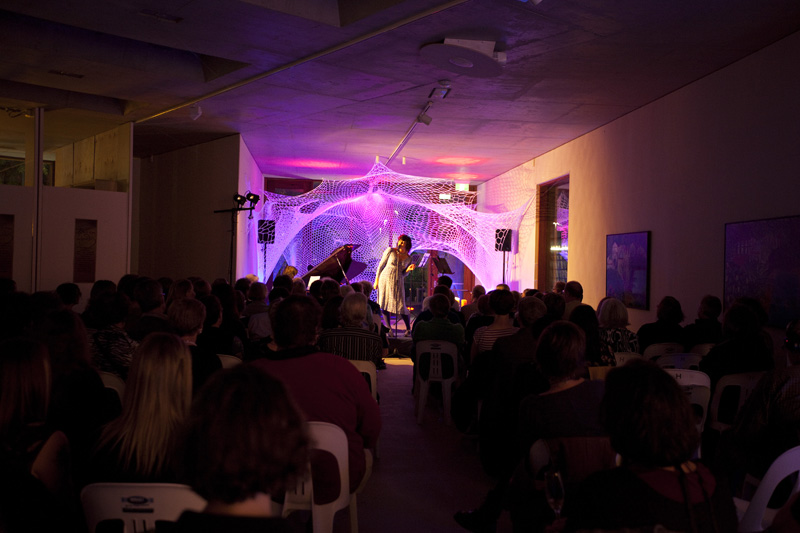
Chanel Cole, Nishi Gallery (Photo: Katherine Griffiths)

Chanel Cole, Nishi Gallery (Photo: Katherine Griffiths)

As we were driving home from Woven Words, the most recent event associated with The invisible thread anthology, it occurred to me that the evening, which blended words with music, was rather like a three movement musical composition. It went a bit like this:

  1. Sara Dowse‘s bright and slightly quirky allegro
  2. Alex Miller‘s intense adagio
  3. Alan Gould‘s cheeky scherzo.

The event took place in an intimate venue in Canberra’s newest inner city precinct, New Acton, which, I understand, is positioning itself as an arts hub. Even before a fire in mid-2011 set the area back, there had been some lovely musical evenings in Flint, one of the precinct’s restaurants. The Nishi Gallery, though, is a very recent player on the block, so recent that I’m not quite sure what its long-term plans are. Last night, however, it became a delightful space in which a gathering of, guessing here, about 100 people heard three great authors read from their works, bookended by music (mostly) chosen by them and performed by local professional musicians. It was, in a word, a blast.

Sara Dowse text

Sara Dowse (Courtesy: NewActon.Com)

After some pre-show piano music performed by Adam Cook, Allegro started with the gorgeous Chanel Cole singing Kurt Weil’s “Speak Low” accompanied by Cook. Sara Dowse chose this because it was the theme song of Ava Gardner‘s film, One Touch of Venus, which is the title of Dowse’s piece in The invisible thread. In it she describes a weekend she spent with Ava Gardner when she was 7 and Gardner about 24. An unusual choice perhaps for a Canberra anthology, but the anthology isn’t solely about Canberra. Dowse’s piece is about those moments in your life in which you learn something precious and lasting. Her time with Gardner provided one of those moments for her. Her movement finished with another jazz piece performed by Cole and Cook, “Old Devil Moon”.

At question time I asked her how someone with such strong creative drive – she sings, writes and paints – ended up working in bureaucracy. She was, for those who don’t know, the first head of the Office of Women’s Affairs which was established by our new reformist Prime Minister, Gough Whitlam, in 1972. Her answer was perfect: They were very creative times, she said.  Can’t argue with that. They were.

Alex Miller

Alex Miller (Courtesy: NewActon.com)

After a short break, it was time for Adagio, my least favourite movement when I was a young music-lover. I was impatient, wanted something faster, with more beat. Now, though, I’ve learnt to enjoy and love the slow and the opportunity it provides to dwell. Tonight’s Adagio provided exactly that … It was bookended by Adam Cook playing the “City of Carcosa” by Larry Sitsky and the CSO (Canberra Symphony Orchestra) String Quartet playing Samuel Barber’s elegaic “Adagio”. Alex Miller has a love-hate relationship with Canberra, mostly the latter it seems! He earned a polite but forgiving (I think) hiss from the audience when he said that no-one chooses to live in Canberra. Wrong! However, he also said that he felt privileged to be involved in the event.

Miller suggested that writers would like to write music, that music manages to express something that writers never quite achieve. Now that’s something for us to ponder. Has it to do with music being the universal language I wonder? Would all writers agree? He talked about writing – about the importance of voice, about the imagination and the act of “imagining something into being”. How to write his novel, The sitters, from which he read, came while he was sleeping on a plane flight between Los Angeles and Sydney. It is about a portrait artist, and explores the nature of “art” and the relationship between artist and subject. The reading ended on:

It’s a story not an explanation.

I like that … it sounds simple but packs a lot.

Alan Gould

Alan Gould (Courtesy: NewActon.com)

The final movement, Scherzo, belonged to poet-novelist Alan Gould. It started with CSO String Quartet performing Percy Grainger’s “Molly on the Shore”. I noticed Gould’s head, up front, bopping away just like mine. Gould read several poems starting with “The Roof Tilers” which I mentioned in a recent Monday Musings. I love that poem. Gould was an engaging reader, introducing each poem with some background. He read his most recent poem “A Rhapsody for Kenneth Slessor” and “Sea Ballad“. And concluded with two flamenco inspired poems, first describing the challenge of replicating in poetry a flamenco rhythm. He read “Flamenco Rehearsal” and “Flamenco Pair”, at times toe-tapping the rhythm as he went. Appropriately, Gould’s movement ended with guitarist Campbell Diamond performing two Spanish pieces, “Junto al Generalife” by Joaquín Rodrigo and (appropriately) “Finale” by Antonio José.

When asked, at the end, whether a sense of dislocation was important to being an artist, Gould, also a model shipmaker, said that for him it was more a sense of being “oceanic” which he described as “being at home in the unstable element”. That may be why I’m a reader not a writer!

The evening was beautifully em-ceed by ABC 666 Radio announcer, Genevieve Jacobs. She was a charming presenter who engaged well with each writer. And she managed her high heels on the tiny stage with great courage!

The evening had a few little challenges. The microphones did not properly work for the singer who opened the evening, the seats were a little hard after three hours, and the venue has just one all-purpose toilet. These were minor. Far more important was the wine! As an Anything-But-Reisling girl, I do hope a choice of white wine is offered next time …

Seriously though, it was a delightful evening. The writers were generous, the musicians superb. Irma Gold, editor of The invisible thread, is doing a stunning job of exploring and exposing the invisible threads that connect the anthology to other arts, to readers, to Canberra. It’s exciting to be part of it.

POSTSCRIPT: With thanks to Dave, of NewActon.Com, for the images.

Dorothy Johnston, The house at number 10 (Review)

Johnston, House at Number 10 bookcover

Courtesy: Wakefield Press

Dorothy Johnston‘s The house at number 10 has one of the cheekiest opening sentences I’ve read for a long time … but I’m not going to tell you what it is. If you are interested you’ll have to find out for yourselves – and tell me if you agree.

I decided to read this novel for a couple of reasons. Firstly, I’d known of Dorothy Johnston since the 1980s but have only read some short stories (specifically, those in the recent Canberra-focused anthologies, The invisible thread and Meanjin’s Canberra Issue.) Secondly, I chose this particular novel because it is set in Canberra and this Centenary year I’m focusing a little, though not exclusively, on books set in Canberra or by Canberra writers.

Dorothy Johnston was a founding member of the Seven Writers, a group of women writers in Canberra who met for many years to share and critique each other’s writing. They have become the stuff of legend, at least to Canberra readers. Johnston has written several novels including four crime novels set in Canberra. She has also been shortlisted for the Miles Franklin award – twice. But The house at number 10 is not one of her crime novels, nor one of the shortlisted novels. It is, though, a good read … and it’s time I got to it!

The novel is set in the early 1990s, on the cusp of the legalisation of the sex industry in Canberra. Its protagonist, late-twenties-something Sophie, has been left by her husband, Andrew, not for another women but for “a floating, open-ended freedom”, for “a raft of girls”. They are sharing the care of their four-year-old, rather self-possessed daughter, Tamsin, and Sophie, now living in the garden flat at the back of the old widow Mrs B’s home, needs to support herself. So she applies for a job in a small, newly established and rather shabby brothel in the suburb of Kingston, at 10 Andover Street. Hence the novel’s title. The novel explores Sophie’s various relationships – with Elise and Kirsten who work in the brothel, with Marshall the brothel owner and Elise’s partner, with her landlady, with her old friend (and architect) Ann, with a couple of her clients, and of course with her estranged husband and her daughter.

There is a little bit of the “oh what tangled webs we weave” about this novel as Sophie strives to keep her two lives separate – but Johnston is not so much interested in mysteries and intrigues here as in how we navigate complicated relationships and cope with betrayal. It’s a surprising set-up but it works, because she keeps the story grounded in the relationships and not in its potential for salaciousness.

And the relationships are what keep you reading, as Johnston slowly draws the various characters into Sophie’s new life. Ann designs a renovation for the brothel, Mrs B takes over fixing up its garden. Characters look out for each other – Kirsten deflects Marshall who is keen to try out this new “girl”, while Sophie looks out for Kirsten through a long illness; Ann and Mrs B accept Sophie’s choice, supporting her while also offering advice. Not all is rosy though. Elise is suspicious and prickly, and Ann has a little fling with Andrew, albeit with Sophie’s not-overly-happy knowledge.

Underpinning all this is a tension stemming from Sophie’s grief and anger at her abandonment. She doesn’t rant, and she holds it together in front of her daughter, but her feelings are made clear when she meets her first client:

She handed him a condom and he rolled it expertly. Now, she thought, now, as grief at her failed marriage made barriers transparent, each one constructed of material so thin she could burst through it at will. Anger welled up, and resentment and self-pity. Blame struck out and swam through the lamplight towards this stranger who wore Andrew’s hair.

It’s a dangerous game she’s playing, particularly when she takes on Jack, who is into bondage, something the brothel has not offered before. For Sophie, though, it provides an opportunity to enact revenge on Andrew, displaced though it is to Jack. She knows he’s not Andrew, but she can imagine so – and this works for a while. However, you can’t of course maintain a secret or divided life forever. Eventually the crunch comes, and Sophie risks losing what matters to her most …

Besides her sensitive characterisation, Johnston also does place well. Canberra is rightly depicted as a place in which ordinary people live and go about their business, but she also captures its particular beauty – the “flat, clean” sun which has a “greedy kind of clarity”, and the light and colours of the changing seasons that are so marked in Canberra. The house at number 10 has a character of its own – shabby, but somehow warm with its worn out armchair and cosy kitchen. Not quite what you’d expect for a brothel – though how would I know – and yet it feels true. And there’s Sophie’s garden flat with its comforting garden:

There was the dark green garden, watered to the gills, and the sense it always gave her of luxury, repleteness, a deep satisfaction with its own existence.

Johnston uses imagery lightly but effectively. Sophie’s divided life is represented by her living on one side of the lake and working on the other. We often drive with her over the lake, making the transition clear. As the novel builds to its climax, the colour “red” and words like “fire” and blood” start to appear, suggesting anger, violence (real or imagined), and revenge. Contrasted with this are references to water, primarily via the lake and a Cupid fountain bought for the brothel’s garden, implying something more female, perhaps calming but also a little mysterious. And then, throughout, there’s gardening and its association with nurture and growth, with vision and imagination.

So what really is it about? Revenge is the motive for the plot, but it is not really the theme. Rather, it’s about facing life bravely and taking risks even if you “draw blood”, about friendship and the things you do for your friends, and about love in all its guises. A quiet book, despite its subject matter, and well worth the read.

AusLitMonth2013Dorothy Johnston
The house at number 10
Kent Town: Wakefield Press, 2005
257pp.
ISBN: 9781862546837

Read for Australian Women Writers’ Challenge and Reading Matters’ Australian Literature Month.

Courtney Collins, The burial (Review)

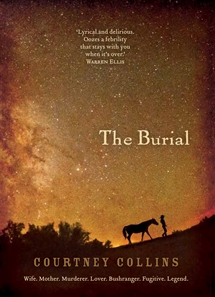
Book cover (Courtesy: Allen & Unwin)

Book cover (Courtesy: Allen & Unwin)

I became aware of Courtney Collins’ The burial when it was longlisted for the Stella Prize. It has since been shortlisted for the Stella, shortlisted for the new writing award in the NSW Premier’s Literary Awards, and longlisted for the Dobbie Literary Award for new writing. It had previously been shortlisted for the 2009 Australian/Vogel Award for Unpublished Manuscripts. This is one impressive debut. While I’m attracted to several of the books longlisted for the Stella, I particularly wanted to read this one because of its subject matter; it is inspired by the life of Jessie Hickman, an Australian woman bushranger. I hadn’t heard of her before and thought this would be an interesting introduction. I wasn’t wrong. The burial is no ordinary historical fiction.

The bulk of the novel takes place in 1921 when 27-year-old Jessie, having had a gutful of her abusive, horse rustling husband Fitz, takes off, having first … well, let’s just say, done to him what she’d been wanting to do for a long time. In other words, she’s on the run. Now Jessie is no saint. She’s already been in prison for rustling, but she didn’t deserve the treatment she got at the hands of Fitz. The novel chronicles Jessie’s escape, and the story of the two men looking for her, Jack Brown, her lover and co-horse rustler for Fitz, and Sergeant Barlow, who has a story of his own. Escape is, we discover, Jessie’s speciality. It’s not for nothing that the book starts with a story of Houdini, or that Jessie’s horse is named for him.

As I read, I was reminded of two American writers – Toni Morrison and her powerful, gut-wrenching novel Beloved, and Cormac McCarthy and his western novels – for pretty obvious reasons. The burial is narrated by Jessie’s prematurely born daughter whom she kills and buries at the start of the novel, reminiscent of Sethe’s daughter Beloved, despite their different behaviours. And the elemental, evocative language along with the themes – human against human, human against nature, in a forbidding and lawless environment – immediately bring Cormac McCarthy to mind.

What is particularly impressive about this debut is Collins’ handling of the narrative voice and structure. The baby’s voice is generous and wise, not maudlin or pathetic. She cares about this mother of hers, and is a bit like a guardian spirit, albeit one without any power. Somehow, despite what Jessie did to her, she humanises Jessie and encourages us to feel sympathy rather than horror. Collins is light-handed in her use of this trope. As the novel progresses, it feels like a third person story, which it is, really, because it is not about the narrator but is her story of her mother. Every now and then, though, we are reminded of our narrator when she says “my mother”.  As for the structure, the narrative alternates, loosely rather than rigorously, between Jessie’s story and that of Brown and Barlow. It’s basically chronological but there are flashbacks to fill us in on Jessie’s origins as we follow her escape.

Back now to the story. Early in the novel, Jessie is released from jail to be an apprentice horse-breaker and domestic help to Fitz, and pretty soon we are told all we need to know:

Her hope was that her employer was a good man. But he was not.

I love the way Collins’ language flows – from lyrical description to the plain and straight.

Fortunately, Jessie, while fearful of this man who beats her, is also spunky and “found freedom in the ways she defied him”. There is a bit of the picaresque in the novel, as we follow Jessie’s escape and the various people she meets, but it has none of the lightness of that form. A better description is probably gothic. It’s a tough world Jessie finds herself in – one that is particularly cruel to women and children. She spends time, for example, with an old couple. The woman wants her because “All of these years in this miserable place I have prayed for the company of someone other than you and here she is. I am taking her”. The man’s response?  “She’s of no value”!

The brightest spot in the novel occurs when Jessie meets a gang of young rustlers led by the 16-year-old Joe in a spirit of mutual support and cooperation. She joins them and helps them in a well-planned heist in which they manage to steal 100 cattle, sell them at saleyards and return to the hills before the owner notices the loss. It is remote country, after all. However, the theft is discovered and a bounty is put on Jessie’s head – for the cattle they believe she’s stolen and for the rumoured murder of Fitz. And so the final hunt begins involving a bunch of men who are after the bounty, and Brown and Barlow who hope to get to her first.

For a while the gang stays hidden but, eventually, some of the hunters get close:

That’s the sound of desperate men, said Joe. I know this type of man, said Bill. He has no god. And he is all the more dangerous to us because, worse than that, he has no law in him or myth to live by.

Jessie, at her insistence, heads off alone, setting up the climax which is not totally unpredictable – after all, one can’t stay on the run forever – but which contains its surprises.

This is a novel about a hard world in which

A man can rape or kill and expect no consequence except his own consequence. You mean conscience? Consequence is what I said and what I mean to say!

But it is also about love and forgiveness, magic and myth, resilience and resourcefulness … I’ll not forget it quickly.

Courtney Collins
The burial
Sydney: Allen & Unwin, 2012
ISBN: 9781743311875 (Kindle ed.)

Read for Australian Women Writers’ Challenge and Reading Matters’ Australian Literature Month.

Helen Trinca, Madeleine: A life of Madeleine St John (Review)

Trinca, Madeleine
Madeleine (Courtesy: Text Publishing)

I wanted to read Helen Trinca’s biography Madeleine for several reasons. First, of course, being a reader, I’m interested in biographies and autobiographies of writers. Secondly, Madeleine St John belongs to that group of Australians, half a generation or so older than I am, that has made quite a mark on the literary and arts world. Her friends and acquaintances included Sydney University peers Clive James, Bruce Beresford, Robert Hughes, Richard Walsh, most of whom lived ex-pat lives like she did. Thirdly, her father Edward St John, was a controversial conservative politician (and then barrister) who fought injustice and whom Justice Michael Kirby described as “a contradictory, restless, reforming spirit”. And finally, I was hoping to find out more about what happened to Bruce Beresford’s plan to film her first novel, The women in black. Trinca covers all these bases and more in her biography.

Madeleine was – as Trinca ably, but fairly it seems, demonstrates – a complicated and difficult woman. She could be called a tragic figure if we define that as a person brought down by a flaw in their character or make-up. Trinca’s Madeleine, though, would probably not agree with that assessment. As far as she was concerned, her troubled life was solely caused by her father, “the ghastly Ted”. More on that anon. First I’d like to quote from a letter Madeleine wrote as she was trying to write her first novel:

I somehow feel (not for quite the first time) that life is beyond my capacities … meanwhile am trying to write some fiction, which is abominably difficult & and therefore terrific – but horrifying.

This quote says a lot about St John – about how hard she found life, and about the heightened way she lived it.

Madeleine was born in 1941 to Edward St John (Ted) and his lively, sophisticated wife Sylvette. Sylvette did not, for several reasons carefully explored by Trinca, adjust well to the life of wife and mother. She became an alcoholic and mentally unstable, to the point that Ted, apparently in order to protect his two daughters, placed them in boarding school in 1953. They didn’t understand, and were miserable. The next year their mother took her life, a fact which was not made clear to the girls at the time and which Madeleine never accepted. Ted remarried the next year a women ten years his junior, 27-year-old Val Winslow. Madeleine never accepted this either and at the age of 18 was told to leave home. While she saw and communicated with her family, on and off, for the rest of her life she never reconciled with them and believed to the end that they were the architects of all that was wrong with her life. We will never know the truth of course, and many records have been destroyed. However, while mistakes were made, partly due to individual personalities and family dynamics and partly as a consequence of the childrearing practices and patriarchal attitudes of the time, Ted and Val, Trinca argues, did their best to support Madeleine but she never gave them an inch, never saw things from any other perspective but her own. Tragic, really, however you define it …

… and making her, I think, a tricky subject to write about. Madeleine was, and there is documentation from a variety of sources to support this, a controlling and emotionally erratic friend who would, as one said, “just destroy everything, destroy a relationship”. She was, as we’d say now, high maintenance, and wanted, needed, to call the shots. And yet, people stuck with her, because she was witty, intelligent company, and also because people saw her need. Trinca handles this minefield with a clear, even-handed but sensitive eye, enabling us to feel Madeleine’s pain while being frustrated at her inability to lift herself out of it.

St John moved to London in the 1960s, leaving, more or less by mutual agreement, her first and only husband behind in the USA, and eventually took out English citizenship. She was horrified when, on being shortlisted for the Booker Prize in 1997 for her novel The essence of the thing, she was hailed as an Australian writer. She didn’t want to be aligned with the place, but she was the first Australian woman to be shortlisted for the Booker, so no wonder she was hailed that way.

Trinca’s biography is a traditional, chronologically told one. It’s tight, with little superfluous detail but enough examples to provide a good picture of Madeleine and her life. I particularly enjoyed the chapters covering the writing and publication of her novels. The book is very well documented, using clear but unobtrusive numbers linked to extensive notes at the end. In her acknowledgements, Trinca details what records she had available and where the gaps are. In addition to the oral history St John recorded (covering the first couple of decades of her life), Trinca had access to letters by and to Madeleine (though many were destroyed) and other documentation such as wills, and obituaries written by those who knew her. Trinca also interviewed many of the significant people in her life. I was intrigued to discover names familiar to me in other contexts, such as filmmaker Martha Ansara. The older we get, it seems, the more we discover our paths have crossed in interesting ways with others.

If you need any proof that Madeleine is worth reading, Clive James’ statement made in 2006, the year she died of emphysema, may convince you:

Sometimes, when I’m reading one of the marvelous little novels of Madeleine St John, part of whose genius was for avoiding publicity, I think the only lasting fame for any of the rest of us will reside in the fact that we once knew her. (quoted by Trinca from his memoir North Face of Soho)

A slight exaggeration perhaps, given who the “us” are, but James clearly believed that this complex late bloomer who produced four novels in six years deserved more recognition than she was getting. Thanks to Text Publishing, all four of her novels are back in print and we have this thorough and highly readable biography. All we need now is to see The women in black in film!

Helen Trinca
Madeleine: A life of Madeleine St John
Melbourne: Text Publishing, 2013
280pp
ISBN: 9781921922848

(Review copy supplied by Text Publishing)

Irma Gold (ed), The invisible thread (Review)

The invisible thread, by Irma Gold

Cover (Courtesy: Irma Gold and Halstead Press)

I even get nervous when I open a book, you know, for the first time. It’s the same thing, isn’t it. You never know what you’ll find, do you? Each person, each book, is like a new world … (from Mark Henshaw’s Out of the line of fire, in The invisible thread)

At last, you may be thinking, she’s going to review the whole book. At least, I hope that’s what you’re thinking, because this book deserves a dedicated review rather than the scattered posts I’ve done to date. The book I’m talking about is, of course, Canberra’s centenary anthology The invisible thread.

The aim of the anthology is a little different to that of Meanjin‘s special Canberra issue, which I recently reviewed. While its editor, Sanders, wanted to offer “a taste of Canberra”, Gold’s aim was to present “literature of excellence” from writers, past and present, who have had a significant relationship with Canberra. For her, Canberra is “not the headline act” but provides “the invisible thread” linking the writers to each other and to the rest of Australia. In her foreword, Robyn Archer, the centenary’s Creative Director, puts it this way:

Many of the pieces are not about Canberra, but they reveal a diversity of interest and style among writers in this region, and thus reflect the unique nature of a city which is located rurally, but positioned nationally.

In other words, The invisible thread is not a parochial apologia for Canberra but an intelligent presentation of the city’s and thence the nation’s cultural, political, social and interpersonal life. The nation’s concerns are Canberra’s concerns – at both the macro (war, indigenous-non indigenous relationships, the environment, and so on) and the micro (birth, marriage, death, and everything in between) levels. You would be hard-pressed as an Australian, or even as an international citizen, not to find something in this book to interest and move you.

Reviewing an anthology is tricky though, and this is particularly so with The invisible thread because it comprises highly diverse pieces – poems, short stories, essays, and excerpts of novels and non-fiction works.  The pieces are not grouped by form, like the Meanjin issue, but in a more organic way intended to take us on a journey in which, editor Irma Gold writes in her Preface, “each work is allowed to converse with those beside it”. And so, in preparation for my reading group’s discussion, I went back to the start and read the book in the order presented. What a pleasure that turned out to be because I did indeed discover added meanings that weren’t necessarily apparent from the dipping-in-and-out approach I had been using.

Let me give an example. The anthology opens with an excerpt from war historian CEW Bean’s Anzac to Amiens, itself a condensation of his Official history of the first world war. I knew of Bean but had not read his history. I was surprised by his use of imagery, such as this:

And out on every beautiful fresh morning of spring come the butterflies of modern warfare – two or three of our own planes, low down …

After another war-related non-fiction piece, the anthology segues to a short story (“The Good Shoppers”) by Lesley Lebkowicz, which is about her refugee parents, now old and shopping in the supermarket but still affected by the Holocaust, and then to two poems about age (Judith Wright‘s “Counting in sevens” and AD Hope‘s “Meditation on a Bone”). The “conversation” encouraged by this sequence is complex and, I expect, different for each reader. For me, the juxtaposition suggests an irony: “war” steals “age” from many of the youths sent to it. This is just one small example of the sorts of “conversations” Gold has set up in the anthology. Considering them as I read the book added another layer to an enjoyable reading experience. I like reading that challenges my brain on multiple levels.

Compiling an anthology involves, obviously, selecting what to include. It must be hard enough to choose poems, short stories and essays, but what about writers who are best (or only) known for novels or non-fiction books? They can only be represented through excerpts, but there is the risk that these cut-down pieces will be less satisfying to read. Alternatively, of course, they might encourage us to locate the full work and read it. The Bean example above is an excerpt. There are many others, including those from Kate Grenville’s Sarah Thornhill, Jack Heath‘s Third transmission, and Roger McDonald‘s When colts ran. I have noted many to follow-up, which tells you how I found the excerpts overall!

A trickier challenge, probably, is that of representing diversity – not just regarding chronology, subject-matter, tone, and form or genre, but in terms of the writers themselves, such as their gender, or whether they are of indigenous, migrant or other minority background. What emphasis should be given to these in the selection process? And, anyhow, should the writer’s background be highlighted? I’m not sure what Gold and her committee decided about this but the anthology, while primarily representative of the majority culture, is not exclusively so and probably reflects the writing community it drew from.

This is not the last you’ll hear from me on the anthology. It is much too delicious, much too rich, much too full of “luminous moments”* for me not to continue to draw from it. I’m possibly – probably? – biased, but I believe this book should be on every Australian bookshelf and, without disrespecting Irma Gold’s hard work, I’d say it doesn’t really matter whether you read it in its original order or just dip into it as the spirit moves you. What would matter would be to not read any of  it at all.

Irma Gold (ed)
The invisible thread: One hundred years of words
Braddon: Halstead Press, 2012
256pp.
ISBN: 9781920831967

* from Marion Halligan’s essay “Luminous moments” which concludes the book.

Meanjin’s Tournament of Books 2012 (2013), Final, or the Winner is announced

Sorry folks, but I have been slack. Meanjin took a little while to post the final round but I’ve taken even longer to report back to you. February was not a good reading and blogging month for me as my Past Whisperings link shows. I am, however, back now and ready to post the winner which, you may remember, was to be chosen from Thea Astley‘s “Hunting the wild pineapple” and Tom Cho’s “Today on Dr Phil”. I have (now, anyhow) read them both.

And what a pair of stories they are … it’s fitting in many ways that it came down to these two because they are probably the most “out there” of the stories in the tournament. Both take you on wild rides where one minute you feel firmly planted in reality and next you’re not quite sure. They seem grounded in reality but what’s going on stretches your imagination almost to breaking point. Cho’s “Today on Dr Phil” exposes our modern culture’s propensity for public confession, for seeking our five minutes of fame, while Astley explores the violence lurking just below the surface of many human relationships.

For the final round, Meanjin used three judges all of whom are published authors themselves:

Ryan O’Neill, the Scottish born Australian writer of  The weight of a human heart, wrote that Cho “expertly controls the story until the fitting, chaotic climax, while at the same time posing serious questions about identity and self”. But, he gives it to Astley’s story for “the spikiness of its style, the oddness of its characters, and the vividness of its setting”.

Susan Johnson, author of several novels including Life in seven mistakes which I’ve reviewed, writes of Astley’s “wonderful, theatrical, imaginative flourish”. However, using a horse race metaphor, she gives it to Cho, not only because he manages to make some “brilliant cultural and ethnic allusions” but because “he’s alive, and straining, and needs to get home to eat”.

So, one vote each now. Who will win?

Chris Flynn, author of A tiger in Eden which I’ve also reviewed, has the casting vote – and what a vote it is. I love it because, while appreciating Tom Cho’s wonderful, clever story, he gives it to Thea Astley – and I can’t argue with his reason:

… this is Thea Astley we’re talking about here. If Cho had been up against any of the more realist writers we’ve seen in the competition, some of which he’s already taken out, it would be game over man, game over … But … Astley was the progenitor, the chain-smoking, wise-cracking, jazz-loving four times Miles Franklin-winning champion of linguistic manipulation whose style got on Helen Garner’s nerves and who pushed the envelope of Australian literature when no-one else had the cojones to do so. My vote goes to Thea Astley, as without her, I don’t know where we’d be today.

I love that Flynn recognises and takes into account Astley’s contribution to Australian literature. I hope Cho isn’t disappointed because he was beaten by a real grand dame. He has nothing to be ashamed of – and I will continue to read his short stories in Look who’s morphing. It’s a great collection.

And so the winner of the latest Meanjin Tournament of Books is Thea Astley’s “Hunting the wild pineapple”.

You can read the full judgements here.

Graeme Simsion, The Rosie project (Review)

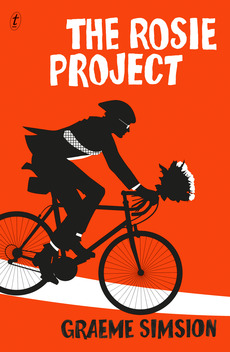
Simsion, The Rosie Project

Bookcover (Courtesy: Text Publishing)

While I go to films fairly regularly, I rarely think of adapting books to film when I am reading. However, I was only a few pages into Graeme Simsion’s The Rosie project when it occurred to me that it was perfect film material. The feeling got stronger – and then around a third of the way through the novel I decided to look at the publicity sheet Text Publishing sent with the book. I usually read these sheets after reading the book. Guess what? The Rosie project started as a screenplay and has won a Writers’ Guild Award for Best Romantic Comedy.

This brings me to the other thing that crossed my mind as I read it:  how to categorise it. I’ve now read two books in a row that are a little outside my usual fare. Like the previous one, Anita Heiss’s Paris dreaming, The Rosie project is a romance, but it’s not chicklit and I’m not sure it fits the romance genre as a whole either. You see, the protagonist – as the cover may have told you – is a man, one Professor Don Tillman. As I understand it, romance novels tends to involve a female protagonist and the trials and tribulations she meets en route to true love. Movies have a genre called “romcom” but I’m not sure that term is used for novels. It is, however, the most appropriate description for this novel – because it’s a romance and it’s funny.

Now, I’d better give you a brief outline of the plot. It opens with Don Tillman, a genetics professor, about to give a public lecture on Asperger Syndrome as a favour for his friend Gene (ha!), a psychology professor. In the second paragraph, you start to suspect that Don himself has Asperger’s:

The timing was extremely annoying. The preparation could be time-shared with lunch consumption, but on the designated evening I had scheduled ninety-four minutes to clean my bathroom.

Ninety-FOUR minutes!? The novel continues in this vein with Don admitting to being socially inept, to being routine-driven and focused on efficiency over all else, and so on. He knows all this about himself, but never in the novel is he named as having Asperger Syndrome so I won’t either. However, this description of him provides a good introduction to the novel’s basic premise. Don, nearing 40, wants a wife but, not surprisingly given the way he approaches the world, he hasn’t had much success. He starts the Wife Project and creates a 16-page questionnaire designed to help him eliminate unlikely candidates before he wastes time on getting to know them. In comes 30-year-old Rosie, whom he thinks Gene has sent to him as a candidate. But Rosie, he quickly realises, would fail his questionnaire on the first page. She smokes, works in a bar (and so, he presumes, would fall below the required IQ), is not punctual, dresses unconventionally – you get the picture. Yet, there’s something about Rosie … so, pretty soon, Don offers to help her find who her father is, and thus begins the Father Project, which rather puts on hold the Wife Project.

From here, the novel runs pretty much to a romcom formula. The light tone tells you that it is likely to turn out the way you expect but despite this, the novel engages. This is because, although the plot is formulaic, the characters aren’t. Don is an unlikely hero. He’s aware of his difference and, as the novel progresses, starts to think about whether he can change himself to become more acceptable to people. It’s, dare I say it, poignant – but it’s not saccharine. Don and Rosie are too themselves for that. The novel also has some truly laugh-out-loud scenes. Comedy which involves ridiculing difference can be uncomfortable but again the tone saves it – it’s light and it’s warm. We like Don and our laughter is not so much at his behaviour as at the absurdity of the situations he sometimes finds himself in. I loved, for example, his description of his special treatment by airlines:

As we drank champagne in the lounge, I explained that I had earned special privileges by being particularly vigilant and observant of rules and procedures on previous flights, and by making  a substantial number of helpful suggestions regarding check-in procedures, flight scheduling, pilot training and ways in which security systems might be subverted. I was no longer expected to offer advice, having contributed ‘enough for a lifetime of flying’.

I enjoyed the book. It is a warm, but not stuffily earnest, book about accepting and celebrating difference, about negotiating relationships that accommodate different ways of being. It would make a great film.

Lisa at ANZLitLovers also found it fun.

Graeme Simsion
The Rosie project
Melbourne: Text Publishing, 2013
329pp.
ISBN: 9781922079770

(Review copy supplied by Text Publishing)

Anita Heiss, Paris dreaming (Review)

Anita Heiss Paris Dreaming

Paris Dreaming (used by permission of The Random House Group Ltd)

Late last year I wrote a post about the inaugural Canberra Readers’ Festival. One of the speakers was indigenous Australian author, academic and activist, Anita Heiss. I wrote then that I bought one of her books. It was her fourth (I think) chick lit novel, Paris dreaming. This might surprise regular readers here, as chick lit is not really my sort of thing, however …

There are reasons why I was happy to read this book. First was that my reading group chose it as part of our focus on books featuring Canberra for our city’s centenary year. Yes, I know, it’s called Paris dreaming, but the heroine starts in Canberra and Canberra is mentioned (not always positively I must say) throughout the book. The other reason is the more significant one, though, and that is Heiss’s reason for writing the book. I said in the first paragraph that she is an activist and her chick lit books, surprising though it may sound, are part of her activism. In fact, I think pretty much everything Heiss does has an activist element. In her address at the Canberra Readers’ Festival she described herself, an educated indigenous Australian, as in the top 1% of the bottom 2.5% of Australia. She feels, she said, a responsibility to put her people on the “Australian identity radar”.

Does this book do it, and if so how? Well, one of her points is that 30% or more of indigenous Australians are urban and this book, as its genre suggests, is about young urban indigenous women. Anita Heiss manages I think (though I’m not the target demographic so can’t be sure) to present characters that both young indigenous and non-indigenous women can relate to. Our heroine Libby and her friends are upwardly mobile young professionals. They care about their work; they love fashion, drink and food (this is chick lit remember!); and they wonder how to marry (ha!) their career goals and romance.

Indigenous design vase, on hall table, Governm...

Indigenous art vase, Government House, Canberra

So what’s the plot (besides the obvious chick lit formula which this book certainly follows)? At the start of the novel  30-year-old Libby, manager of the education program at the National Aboriginal Gallery, is on a man-fast. She’s been bitten one too many times and has sworn off men, much to the dismay of her tiddas (her “sisters”). She is, though, keen to develop her career and wants a new challenge – all part of the chick lit formula – and so pitches a proposal to her boss that she mount an exhibition of indigenous Australian art at the Musee du Quai Branly in Paris. Of course, her boss approves and off she goes to Paris where, following the formula, she falls for hunky, sexy Mr Wrong while Mr Right watches on, spurned (and spurned and spurned). But, of course, I don’t need to tell you how it comes out in the end do I? This is not subversive chick lit because that would not serve Heiss’s purpose …

Did I enjoy it? Yes, but not so much as a piece of literature because my reading interests lie elsewhere, but as a work written by a savvy writer with a political purpose. This purpose is not simply to show that young, urban, professional indigenous Australians exist but, as she also said in her address, to create the sort of world she’d like to live in, a world where indigenous Australians are an accepted and respected part of Australian society, not problems and not invisible. She is therefore unashamed about promoting indigenous Australian creators. She names many of them – artists, writers, filmmakers – and discusses some of their work, educating her readers as she goes. Most of the people, works and places she mentions are real but there’s an aspirational element too. The National Aboriginal Gallery does not exist but she presents it as a significant player in the Canberra cultural institution scene. Good for her!

I’ll probably not read another of Heiss’s choc lit (as she, tongue in cheek, calls it) books, but I’m glad to have read this one – and I’ll certainly look out for works by her in other genres (including her memoir Am I black enough for you?). Heiss is a woman to watch.

Anita Heiss
Paris dreaming
Sydney: Bantam, 2011
313pp.
ISBN: 9781741668933

Thea Astley, The monstrous accent on youth (Review)

I was going to start this post with that well-known quote by Sophocles – or was it Plato – complaining about the young people of today, but a little bit of research turned up the fact that that quote is somewhat spurious. It was probably inspired by Plato’s Republic in which he presents a dialogue with Sophocles about the ideal education, advocating a “stricter system” to ensure young people “grow up into well-conducted and virtuous citizens”. It was not a tirade on “the youth of today”. That permutation was the work of variously identified twentieth century writers/speakers.

So, instead, I’ll dive straight into Thea Astley‘s essay, “The monstrous accent on youth”. It was written in 1968 and reproduced in last year’s Meanjin anthology which contains a selection of essays organised by decade, starting with the 1940s. I plan to dip into the anthology over the year as there are essays by writers like Patrick White and David Malouf, poems by Judith Wright, and so on. A treasure for dipping into.

I was, I suppose, surprised by the Thea Astley essay, though in retrospect I probably shouldn’t have been. She was never one to go lightly and she sure doesn’t here in criticising the youth of the 1960s. She talks of discussing moral dilemmas in a “middle-class girls’ high school” and being horrified by her students’ callous responses to her questions about conscription during the Vietnam War:

Girls, like female spiders, want to have their men and eat them, too. I was appalled by the selfishness of their reactions and wondered if this were merely a by-product of thinking in a Liberal Party voting area.

She suggests that the generation of the 1960s were frank and (by implication “progressive”) about sex and drugs but had a “hard conservative core”. She then talks of discussions at Macquarie University and says attitudes were more liberal there, “particularly noticeable in the nuns”. (I went to Macquarie University in the 1970s and had many nuns and seminarians in my tutorials. She’s right. They were usually thoughtful tutorial participants.) But, she’s discouraged by the narrowness of the reading. Her students hadn’t read, she said, “Compton Burnett, Cheever, Edmund Wilson, Nabokov, Gordimer …”. Hmm, must say that, with the exception of Nabokov, I hadn’t read those writers then either – in fact, I didn’t even hear of Gordimer until the 1980s – and yet I called myself a reader.

She ponders the reading issue, wondering if that generation spent more time drinking than reading, and worries that “their livers are in more danger than their morals”! I found this fascinating given the current concerns about drinking and the young …

Anyhow, I started to be concerned that the essay was simply going to be a rant against the young and, while it is that to a degree, her main concern is more to do with social change, I think. She writes:

The permissiveness of our generation to the younger has created the monstrous over-rated importance of youth. Oldies – pregnant, sick, reeling – can tremble vertical upon trains and buses while thick-thighed youngsters cling to their seats.

“Thick-thighed”. That sounds like Astley. But, back to the argument. Here in this paragraph near the end of the essay is her main point: “life is so easy for the young and, because of this, so difficult”. She is, in other words, not completely critical of the young. She sees their behaviour in a wider social context, as something that’s partly of her generation’s own making. Perhaps she would have approved of Plato’s “stricter system”?

Thea Astley
“The monstrous accent on youth” (1968)
in Meanjin Anthology
Melbourne University, 2012
(Kindle ed.)