Ouyang Yu, Diary of a naked official (Review)

Ouyang Yu, Diary of a Naked Official

Courtesy: Transit Lounge

When I was offered Chinese-born Australian writer Ouyang Yu’s latest novel Diary of a naked official to review, I was warned that it is rather graphic. And so it turned out to be, but, not having read Ouyang Yu before, I did want to give it a go. The accompanying publicity sheet describes it as “Ouyang Yu’s most commercial novel to date – erotic fiction set in contemporary China”. So now you, my blog readers, have also been warned.

Where to start? Perhaps with the title. Not being an expert on Chinese culture, I wouldn’t have fully understood the title if it hadn’t been for the back cover. It explains that “naked official” is a recognised term in China describing men who locate their wives and children overseas, where they also deposit all their money. The men remain in China “naked” and, in this case at least, “totally free” to indulge in whatever they desire – which brings me to the subject matter of this novel …

The main part of the novel comprises diary entries written by our naked official (who may be named Shi Ma and so that’s what I’ll call him) over a period of three months*. In it he details a life driven by satisfying carnal pleasures with no desire (ha) to rein them in. He is so focused on “enjoying” other women – young, beautiful ones – through pretty much any act you could imagine and then some, that he has no time or energy for intimacy with his wife, who does not move to Australia until halfway through the novel. “Sex”, he says early in his diary, is “a keyword of our times, it is like a poisoned liquid that seeps into the minds of everyone, including women”. (Including women, eh! How gender plays out in the novel, in fact, could occupy a whole post).

Framing the diary is the encompassing conceit that the story is presented to us by a writer, who is probably Chinese-Australian and who had found the diary on a USB stick left on a Melbourne train. He decides to present it in its entirety “with a bit of editing here and there, just to make it less offensive to the middle-class sensitivities in this country”. He warns his readers, just as I have, to be prepared for an assault on their “moral values”.

As you have probably gathered by now, this is a clever, complex and rather slippery book. I say slippery because it looks like it’s a critique (or satire) of modern China, of a world where obsession with sex and fast adoption of capitalism collide, and where increasing independence for women sees “concubine” become “working girl” with different expectations. But, when you comprehend that the character “publishing” this diary is based in Australia – and that writer-translator Ouyang Yu spends his life between Australia and China – you see that this is no simple tale. This is not to suggest that the book is autobiographical but rather that, through these layers, Yu plays with our minds, and forces us to recognise that Australia and China have more in common than we may think.

The layers are complicated further by the fact that Shi Ma himself works in a publishing house. His job is to recommend works to his boss, B, for publication. B, though, rarely agrees with him. Our narrator says:

But it is books that speak the honest truth to a hurting degree that are denied the chance of publication because the comfort zone is outstepped and our core values are challenged.

And so, Shi Ma, whose life of self-centred debauchery alienates us, also draws us in with his desire to publish difficult or confronting works. Publishing now, he says, “is dictated by MM, money and market through B, Banker of Books”. At one point, he considers whether a particular erotic book

might be considered for publication if not recommended outright. In today’s China, things are much more confronting, and much more physically permissive than a decade or so back as it is good for the economy … Still, I am not sure because B may object on the basis of market and censorship.

Censorship in China is one issue, but western readers are only too aware that publishing in so-called “free” countries is by no means free of the impact of the market. Shi Ma is pretty devastating in his comment on publishing:

In the scheme of things, an excellent book, by the time it is edited and published, becomes a good book, and a good book, a so-so book. It is amazing how a so-so book can sell, such as the one penned by the guy called Hung Heavens, but I have ceased to be amazed by the mediocrities as the world is made for them, books written by the mediocre for the mediocre, like common food, eaten only to be shat.

In another interesting layer, Shi Ma is given the job of assessing applications for “self-funded poetry”. Ouyang Yu, himself, is a poet and clearly knows only too well how difficult it is to get poetry published.

I have, I know, digressed somewhat, because the examination of publishing is only one aspect of this novel, and I probably haven’t given you much sense of its actual narrative. The novel does have a story, albeit a flimsy one based around sexual exploits. There are recurring characters, including the aforementioned B, a mother and daughter with whom Shi Ma has a complicated relationship, his friend Sam, and various working girls. However, while Shi Ma, himself, does develop to some degree – becoming “absolutely bored with a multitudinous accumulation of bodies” – none of the other characters are “developed” or even “rounded” in the usual way of fiction, because this is not a traditional novel. It is, rather, what I’d call an “ideas novel” that explores not only what is happening in modern China but also, more generally, what a sex-focussed, market-driven world looks like. And it ain’t pretty. Human relationships and original artistic expression are measured by money, and such values as love and morality are degraded in the wake.

Diary of a naked official is a book that shocks and appalls, but that can also surprise and even make us laugh. In it, Ouyang Yu, unlike B, is not afraid to expose “the night in our hearts”. Shi Ma is not a sympathetic character and yet, at times, he makes sense. There are no easy answers, and this book certainly doesn’t provide any. It does, however, ask some very pointed questions.

Ouyang Yu
Diary of a naked official
Melbourne: Transit Lounge, 2014
220pp.
ISBN: 9781921924705

(Review copy supplied by Transit Lounge)

* In an interview I heard with Ouyang Yu, he pointed out that the diary starts on 4 June (the Tiananmen Square date) and ends on 11 September (9-11 in other words). More layers, you see …
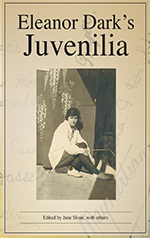
Eleanor Dark’s Juvenilia (Review)

Eleanor Dark's Juvenilia

Courtesy: Juvenilia Press

Eleanor Dark was quite a star in Australia’s literary firmament of the 1930s to 1950s, and has left an important legacy, not only in her most famous book The timeless land but also in the fact that her home Varuna in the Blue Mountains is now one of Australia’s most significant and loved writers’ retreats. It’s therefore wonderful that the Juvenilia Press was able to produce a book on her early work.

Unlike the Press’s volume on Mary Grant Bruce, which comprises works that push their definition of juvenilia, Eleanor Dark’s Juvenilia fits clearly within their guidelines. All pieces were written between 1916 and 1919, when Dark was 15 to 18 years old. Like the Bruce volume, it was edited by secondary school students and their teacher, rather than the Press’s more usual practice of using tertiary students. (The Press is a teaching press). The decision to use secondary school students is particularly appropriate for this volume as the students come from the school, Redlands, which Dark attended, in her childhood name of Pixie O’Reilly. Research for the volume included the school’s own archives, and all the pieces come from the school magazine, The Redlander. A Foundation Day speech given by the (then) school’s archivist, Marguerite Gillezau, is one of the appendices.

Like other Juvenilia Press editions, this book includes useful extra matter such as Pixie O’Reilly’s school report! There is, too, an introduction, this one titled “Pixie to Eleanor: From a spark to a flame”. It is creatively, and entertainingly, organised under headings taken from the school report – “Making fair progress”, “Very promising indeed”, and so on. The volume is also illustrated with photographs and other images from Dark’s school days – and there is also the list of references consulted.

As with most juvenilia, the pieces here provide an insight not only into the author’s childhood but also into the passions and interests they’ll develop later. Dark went to Redlands school in 1914 (an auspicious year) after her mother died. Although it was a girl’s school – why do I say “although”? – the school did not seclude its students. Indeed the school archivist in her Foundation Day speech said that, since its establishment in 1884, the school “has been aware of the world outside its front gates”, including war. One of Dark’s pieces in this volume is a poem about the First World War, “Jerusalem set free”.

For those of you who don’t know Dark, she and her husband were politically radical – or – socialist in leaning, something for which they were often persecuted. Not having read biographies of her, I cannot say how much of this may have come from the family, but the Introduction says that one writer on Dark, Marivic Wyndham, stresses the importance of the school’s ethos on her development. Wyndham writes that the school provided her “not only with flesh-and-blood models of the new woman and the radical intellectual she eventually adopted, but also with models of community and sisterhood that later featured prominently in her vision of a ‘good society'”.

These values are evident in the piece most dear to my heart, “The Gum Tree’s Story”. I loved this little 2-page piece for three reasons: it contains delightful descriptions of Australian flora; it contains a story-within-a-story about that Australian archetype, “the lost child in the bush”; and it’s an allegory about inclusion rather than exclusion. The story concerns Waratah who wants to organise a party to enliven his drooping companions but wishes to exclude the interloper White Rose. (Is it girlish, that the Rose is white not red, do you think?).

The other story in the volume – there are two stories and four poems – encompasses another theme common to classic Australian literature, the bushranger. Titled “‘Thunderbolt’s’ Discovery”, it tells of young boys on a picnic who play bushrangers – Australian readers will be aware that Captain Thunderbolt was a famous bushranger – and come across an unconscious man who, they imagine, is a bushranger. What I love in this is her description of the bush:

It was very deep in the bush. A clear stream trickled down over the rocks, and there was the faint bush smell of damp earth and fallen gum leaves. Maiden-hair grew thickly, and clumps of pale wide violets and pretty, delicate ferns. Where the stream was at its wildest a huge old tree had fallen across it, and the damp bark was covered with soft green moss. Further up the hillside flannel-flowers and Christmas bells grew among the tall bulrushes, and Christmas bush was already nearly in full bloom.

Dark, it is clear from this and “The Gum Tree’s Story” knew her botany – but I think she evokes it well too, without going overboard as young writers can do.

The four poems speak to different aspects of Dark’s girlhood – from the war to hatred of exams. They show someone comfortable with language and with expressing ideas through them. They also show an ability to mix tone, to work in the serious and the light, in the grand and the more personal, in the fanciful and the real.

Not everyone, I know, enjoys Juvenilia but I am thoroughly enjoying these texts, and the insight they provide into the writers to come. I look forward to telling you about the next one in, hopefully, a month or so.

awwchallenge2014Eleanor Dark
(ed. Jane Sloan with students from Redlands, Sydney)
Eleanor Dark’s Juvenilia
Sydney: Juvenilia Press, 2013
26pp.
ISBN: 9780733433733

* The book only costs $12 plus postage, from the Press.

My previous posts on the Juvenilia Press are: Monday Musings and Mary Grant Bruce.

Sara Dowse, Schemetime (Review)

Sara Dowse SchemetimeWhat Sara Dowse didn’t know when she recently commented here on her love-hate relationship with Los Angeles was that I was in the closing stages of reading her novel, Schemetime, set there. I’m somewhat embarrassed to say that I’ve had this novel since Christmas 1990 when I was living in the LA area (in adjoining Orange County, in fact). For some reason, I didn’t read the book then, and it has been sitting on my TBR pile ever since, along with several other novels by Aussie writers from the 1980s and early 1990s.

It was interesting to read a book in 2014 that was published in 1990 but set mostly in the late 1960s. This is not a unique situation of course, but most books in my TBR pile are set around the time they were written. Why then was this one set a couple of decades before it was written, making it a “bit” historical, but not really? I think it’s because the late 1960s was an exciting time, politically and socially. It was the time of the anti-Vietnam War movement, a time when high ideals were being vigorously tested against commercial imperatives. Where better to set such a novel than in LA – using the film industry as a framework?

Early in the novel, Dowse establishes this tension through her description of place:

California the golden, Eden re-entered. People pretend they are children. They revel in the heat and the sunshine. But they are fretful. Do they deserve this? The question nags. So there is always, underlying the play, the fear of catastrophe. For a paradise, it has known its fair share. Earthquakes make dogs howl and plateglass shatter and bricks spill from walls, and the fires that sweep through the hills and down the canyons have consumed the grandest of estates. Coyotes live in those hills …

I love this prose – so crisp, so clear, so evocative, and yet so provocative too.

But now to the plot. Schemetime concerns an Australian filmmaker, Frank, who comes to LA wanting to make a career in the film industry, a quality career, though, on his terms. Through him we meet a varied cast of characters: refugee film director Mannheim who wants to make artistic films but needs to make commercials and B-grade movies to survive; Frank’s old flame Susan, a physiotherapist and anti-war campaigner, who leaves her Aussie husband for Nathan; this Nathan, a lawyer conflicted about money and his ideals; the black singer-actress, Paula, with her precarious career; and sundry others. We watch Frank as he enlists these characters to help him, practically, artistically or financially, achieve his goal of making a film about his somewhat mysterious father.

This is not a plot driven novel, however. It is about LA, but more than that, it is about characters searching for, well, meaning. This may sound clichéd, but isn’t it what most of us seek? What makes this novel not clichéd is the style and structure Dowse puts to her task. Often when we describe a novel as reading like a film script, we are suggesting, usually a little dismissively, that the author has written it with a movie deal in mind. But, when I say Dowse’s book reads like a film script, I am implying something very different. I am implying a complex picture comprising multiple little scenes, that sometimes flow and sometimes jolt us along with sudden changes in perspective, much like a camera can, particularly in an experimental movie. In fact, particularly given its time, I’d say this novel is innovative (or experimental) in structure and narrative point-of-view, in the way it moves between first person narration by Frank, and the third-person subjective perspectives of the main characters. It is, though, highly readable because the language is accessible. The syntax is flexible and the imagery expressive, but they are both comprehensible.

If it’s not plot-driven, then, what does drive it? Several things really. The characters’ relationships with each other, for one. An exploration of the meaning of art, for another. And dreams, the dreams and passions that drive us. Much of the novel concerns Frank’s filmmaking venture with Mannheim and Paula. There are lengthy discussions about the 1931 film Tabu, made by Murnau and Flaherty. It was a production mired in conflict between two, if I understand correctly, competing perspectives – Murnau’s focus on aesthetic “truths” and Flaherty’s on those coming from social or political realities. Dowse seems to be suggesting that “art” is (perhaps even should be) a constant struggle between these two imperatives. In Tabu, Mannheim argues, Murnau’s

craft and artifice triumphed. But there is enough of the real to make us believe …

There’s another reason why Dowse seems to have chosen Tabu to discuss, and this is its setting, the Pacific. The Pacific is the link between her two lives – her American birth and her adopted Australian home. Its nature is paradoxical, representing different things to different people: to Mannheim, “nothing in the Pacific is quite as real” as Europe;  to Susan it is both escape and barrier, “the way to freedom and then the highest wall”. One of my favourite scenes occurs when Frank, Paula and Nathan do a beach-crawl along the LA coast looking for the perfect Australian-looking beach! Various stories and images of the Pacific appear throughout the novel, making it, perhaps, her “poem to the Pacific” like Murnau’s Tabu.

Schemetime is a novel of grand conception. Even the title with its hints of schemes, screens and dreams suggests that. I’m not sure I’ve fully grasped all that Dowse intended, and I certainly haven’t touched on all that she raises in this book about “money and love and culture”. I haven’t explored, for example, the rise and fall of Nathan as a hotshot lawyer-investor or the conflicted restlessness of his second wife Susan or the survival skills of first wife Estelle or even the discussions about artists in exile.

“The camera”, Mannheim lectures early in the novel, “is no golem … it sees things you cannot imagine”. And so, we find, does Dowse’s pen. Schemetime is a fine read – and one that is as relevant today as it was when it was written, perhaps even moreso.

awwchallenge2014Sara Dowse
Schemetime
Ringwood: Penguin, 1990
295pp.
ISBN: 9780140080742

Monday musings on Australian literature: In conversation with Black Words

Today* marks the first day of NAIDOC Week 2014, which will run through to July 13. In honour of this, and of Lisa’s Indigenous Literature Week at ANZLitLovers, I thought I’d devote this week’s Monday Musings to indigenous Australian writers – and specifically to Anita Heiss’s “In conversation with Blackwords” series.

This series is described on the AustLit website as follows:

In late 2013 Dr Anita Heiss sent a series of questions to contemporary Aboriginal and Torres Strait Islander writers. The responses she received are at times funny, sad, moving, and always deeply insightful. Universally an important piece of advice was to ‘Read, read, read’ if you want to write. As an ambassador for the Indigenous Literacy Foundation, Anita was very happy to see that advice coming from some of Australia’s most admired and read authors.

As far as I can understand from the website, some 20 interviews were gathered, and posted on the site between November 2013 and May 2014. The last interview (to date anyhow) is with Heiss herself. The writers interviewed include some well-known to me like Melissa Lucashenko, Kim Scott, and Bruce Pascoe, and some I’m not at all familiar with like Dub Leffler and Sue McPherson. Heiss starts by asking them about their mob and where they are from, and then asks them about their writing and their reading – about, in other words, all those things other readers and writers love to know.

I haven’t read all the interviews, as they are pretty extensive, but have at least dipped into most, and will read more in the coming days. Here, in no particular order, are some of the things they say:

Samuel Wagan Watson (internationally recognised poet and storyteller) said this in response to “what makes a good writer”:

As far as what makes a ‘good writer’ … I don’t know? I’m an ‘established writer’ yet I wouldn’t consider myself a ‘good’ writer. Should we define a ‘good writer’ as someone who publishes a novel every year or an artist who simply falls in love with language and is a skilled technician who writes a sentence now and then that simply smokes with pearly-wings of an epiphany in the midst of your mind’s eye?

Anyone who can write “smokes with pearly-wings of an epiphany in the midst of your mind’s eye” must surely make some claim to being a good writer?

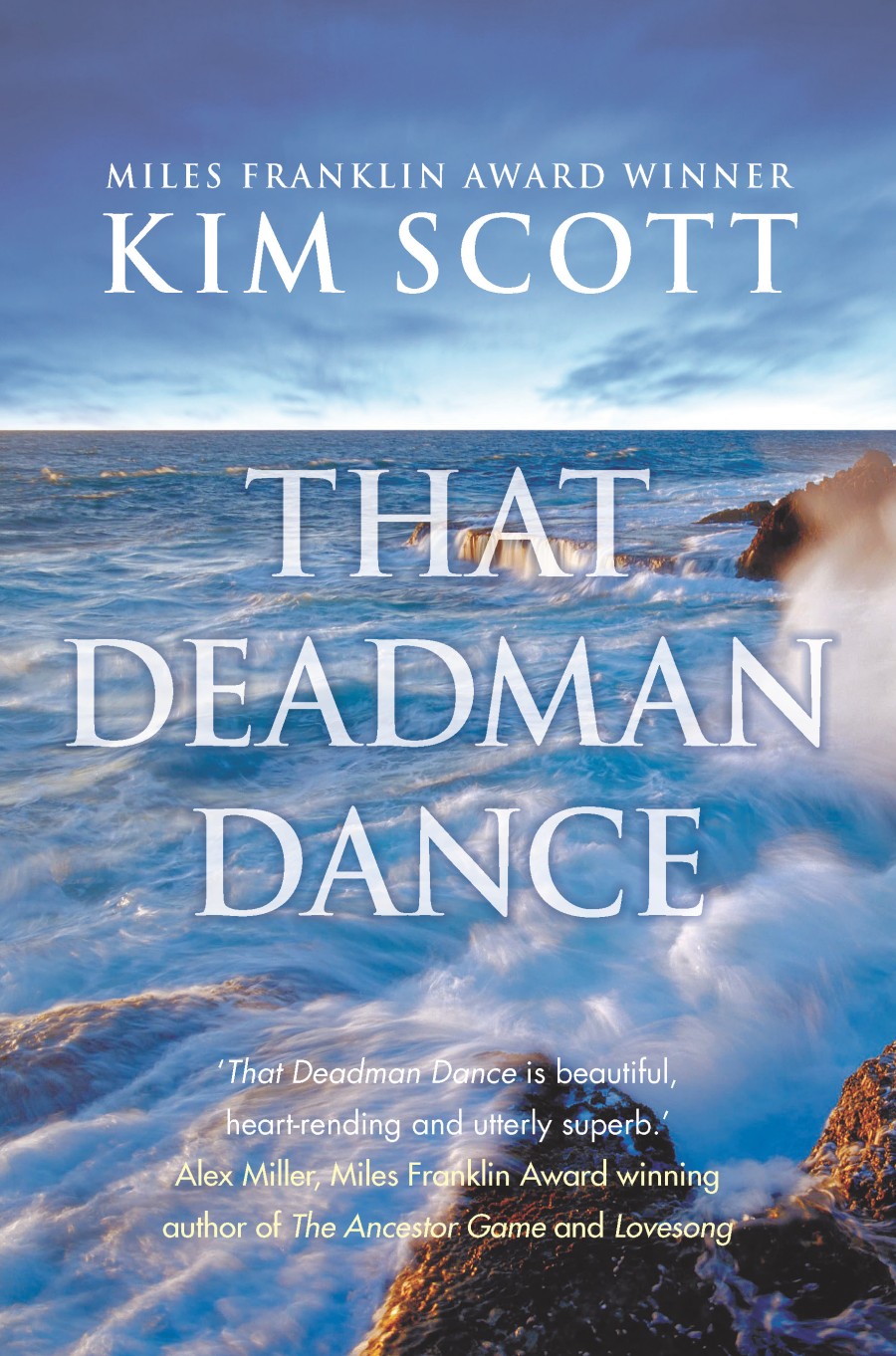
Kim Scott That Deadman Dance

(Courtesy Picador Australia)

Kim Scott (author of That deadman dance, among other things) said this about his aims as a writer:

To reach and connect. To provoke, sometimes. To transform, if only a little. As Elizabeth Jolley said, to provide ‘places where people may meet’.

To touch on greater truths. Language and stories shape the world; I sometimes want to flex and remake it again.

He’s won me over, first, by referring to one of my favourite writers, Elizabeth Jolley. But, I also like his desire to “touch on greater truths”. It’s not surprising that an indigenous writer might also want to “flex and remake” the world.

Ali Cobby Eckermann (poet, and author of Ruby Moonlight) offered this advice to writers:

My advice is to be creative! Turn the telly off and be creative. A half an hour each day has the capacity to achieve remarkable results. Be relentless, and find happiness in honouring your story, the legacy of your cultural knowledge.

Being creative, I think, is easier said than done, but I do love her suggestion to “find happiness in honouring your story”.

Ellen van Neerven (winner of David Unaipon Award in 2013) is a writer I hadn’t heard of before. She said in answer to “who do you write for?”:

Sometimes I could be writing for my younger self. I want people to feel less alone. I want people to feel less confused.

Now, that’s an answer from the heart.

Bruce Pascoe (writer of fiction, non-fiction and YA fiction). I had to finish with Pascoe’s response to the question about his writing process:

Get up, go into room and work arse off. Break for lunch, tour of vegetable garden, back into room. In good weather I write down by the river, especially if it’s a job I’m writing longhand. In my room I’ve got a growing gallery of dead Black friends to watch over me and all the birds who come to the door and want to know if it’s ok if they tell me a story. The Willy Wagtail is good but the Scrubwren is profound, the Powerful Owl haunting, the pelican a bit superior on occasions and the cormorants are always good for a laugh. I get a hell of a lot of story from birds and animals.

With such an imagination, you can sure see why he’s a prolific writer.

I plan a follow-up post on this series of conversations for next week’s Monday Musings to conclude NAIDOC Week.

* Hmm … just realised today is 7 July! NAIDOC Week started officially on 6 July!

Richard Rossiter (ed), The trouble with flying and other stories (Review)

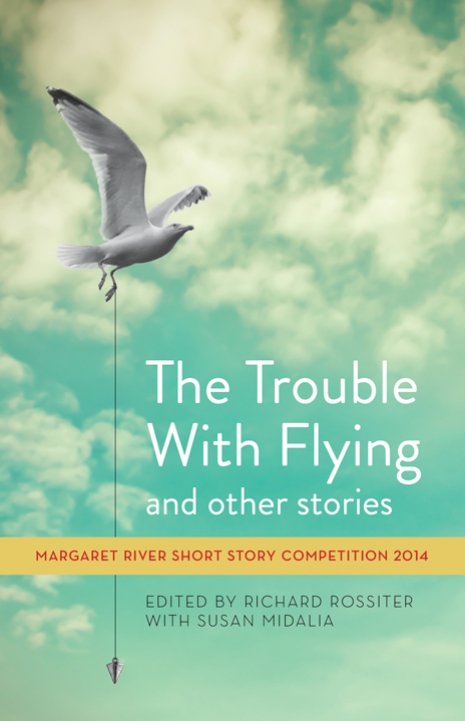
The trouble with flying book cover

Courtesy: Margaret River Press

The trouble with flying and other stories is the second collection I’ve read from the Margaret River Short Story Competition. I greatly enjoyed last year’s collection, Knitting and other stories, so was very happy to read this one. I’m pleased to see Margaret Press maintain its commitment to publishing stories from the competition, and hope that annual publication will help both the competition and the press, itself.

There were apparently 218 entries for the 2014 competition, which is somewhat fewer than last year’s 260 entries. Stories came from every state in Australia, as well as one from New Zealand. They include both new and experienced writers, many of whom have won awards and/or been published in some of Australia’s best literary journals. I was pleased to see that four of the 24 writers included in this volume, appeared in last year’s collection.

Last year, 20 of the 24 stories were by women, and the trend continues this year with 21 being by women. Presumably this roughly reflects the gender ratio of the overall entries. I wonder why this is? Is writing short stories something women who want to write feel they can juggle more easily with other responsibilities? Or? I’d love to know whether this is a common pattern, and why it might be.

Finally, before I get to the stories, I should say that of course the collection includes the winner, runner-up, and five highly commendeds, as well as the winner and two highly commendeds in the special award for writers from the South West (where Margaret River is located). They didn’t all accord with my favourites, but that’s the subjectivity of reading isn’t it?

Like last year’s collection, the title comes from winning story, Ruth Wyer’s “The trouble with flying”. In the bios, we are told that Wyer is “a fledgling writer from south-west Sydney”. Fledgling she may be, but she has a delightful way with words. It’s a story about transitions, about Rita, an unconfident young girl, moving from high school to TAFE. Intriguingly, Rita doesn’t appear until a few paragraphs in, which disconcerts the reader somewhat as to who this story is about. It is in fact quite an unsettling story, combining humour with pathos and a sense at the end that Rita may not break free of “the loosely bound fog” that she feels envelops her. Flying, in other words, is not easy. It’s a bit cute to say, I suppose, but in many of the stories the characters struggle to fly, to escape the concerns that mire them – and, in fact, some don’t.

One who doesn’t is the immigrant mother in Linda Brucesmith’s “A bedtime story”. Ridiculed by her husband one too many times, she leaves the house after midnight. Another mother in trouble is Annika in Cassie Hamer’s “A life in her hands”. Overwhelmed by a colicky baby – and oh, how I related to that – she decides that “escaping together would make them both much happier”. So, like the mother in “A bedtime story”, she heads to the sea. There, the kindness of one young man and the near tragedy of another shocks her to her senses and she feels “the euphoria of a lucky escape, a second chance”. Life for some, we realise, can often hang on little chances that determine the decisions we make.

A mother of a different kind is Tara in Lauren Foley’s entertainingly titled “Squiggly arse crack”. This is a bright, breezy story about an older single mother enjoying her “staycation”, that is, a brief shopping expedition away from her beloved child, Squig. To ensure she doesn’t change her mind about leaving him with her friend, she “sashays” out the front door without looking back, “pretending her neck is in an Elizabethan collar or pet lampshade”.

This is just one of the stories that departs from the resigned or melancholic tone that seems to be more common in short stories. Another upbeat story is Chinese-born Australian writer Isabelle Li’s “Red Saffron” about a feisty woman prepared to go after love. No shrinking violet, she. Announcing at the beginning of the story that

If poetry is language making love, then cooking must be food making love

she tells us that she’s cooking for Walter. She’s a poet and editor of a poetry magazine, and her aim is to seduce fellow poet Walter while her current lover, Richard, is away. This is a woman in charge of her destiny:

I know how sweet I am, in men’s eyes that follow my movements. I look younger than my age, with my dense hair and lustrous skin. I know they want to taste me on their tongue. But they are wrong: I’m no honeysuckle.

Glen Hunting’s Martha in “Martha and the Lesters” is spirited too. The story is told by Martha’s lodger, who is – no, not Lester. The Lesters are the spiders which proliferate in elderly Martha’s rather untidy home. Our narrator Roland, for that’s his name, describes the Lesters going about the business of life – reproducing, eating, sometimes other insects, sometimes each other. They play a complex role in the story. Martha feels blessed by their presence, and yet, as we see, their lives represent “gluttony and violence writ small”. Perhaps that’s the point. Unlike Martha’s children, they accept her, don’t judge her, and don’t pretend to be other than they are!

Continuing in the vein of positive stories is Kate Rotterham’s “Potholes” about a rather curmudgeonly, recently retired husband and father, Les, “who was surprisingly confident in diagnosing a range of mental disorders” in those around him, but who, delightfully, does a complete about-face at the end.

There are, though, some devastating stories such as Bindy Pritchard’s second-prize winner “Dying” about a rural mother with terminal cancer, and Leslie Thiele’s portrait of a man with dementia in “Catching trains to Frankston”. The challenge of ageing, in fact, appears several times in the collection. I enjoyed Kathy George’s story, “Walking the dog”, about a lonely old widower who, like Martha in Hunting’s story, is confronting the limits of his independence.

Not surprisingly, the collection encompasses many concerns currently facing Australians, with issues like ageing, cancer and fire appearing in several stories. Indigenous issues and our multicultural make-up also appear, albeit way less frequently, reflecting I’m guessing the backgrounds of the writers. It would be good to see more diversity here – but that is another discussion methinks.

And now for the apology. I would love to comment on every story in this collection, not only because each has something to offer but because I know writers (like all of us) love feedback. I can imagine, if I were a writer, coming to a review like this wondering whether my story would be featured. All I can say is that many of the stories, besides those I’ve chosen to write about here, touched me. I’m sorry I couldn’t mention them all.

“Practise senseless acts of beauty” is one of the instructions Harry (“Potholes”) reads in Ten Ways to a Happier Life. I’m so glad the writers in this volume had a go at their own “acts of beauty”. They’ve given me much to ponder.

Richard Rossiter, with Susan Midalia (Eds)
The trouble with flying and other stories: Margaret River Short Story Competition 2014
Witchcliffe: Margaret River Press, 2014
348pp.
ISBN: 9780987561527

(Review copy supplied by Margaret River Press)

Howard Goldenberg, Carrots and Jaffas (Review)

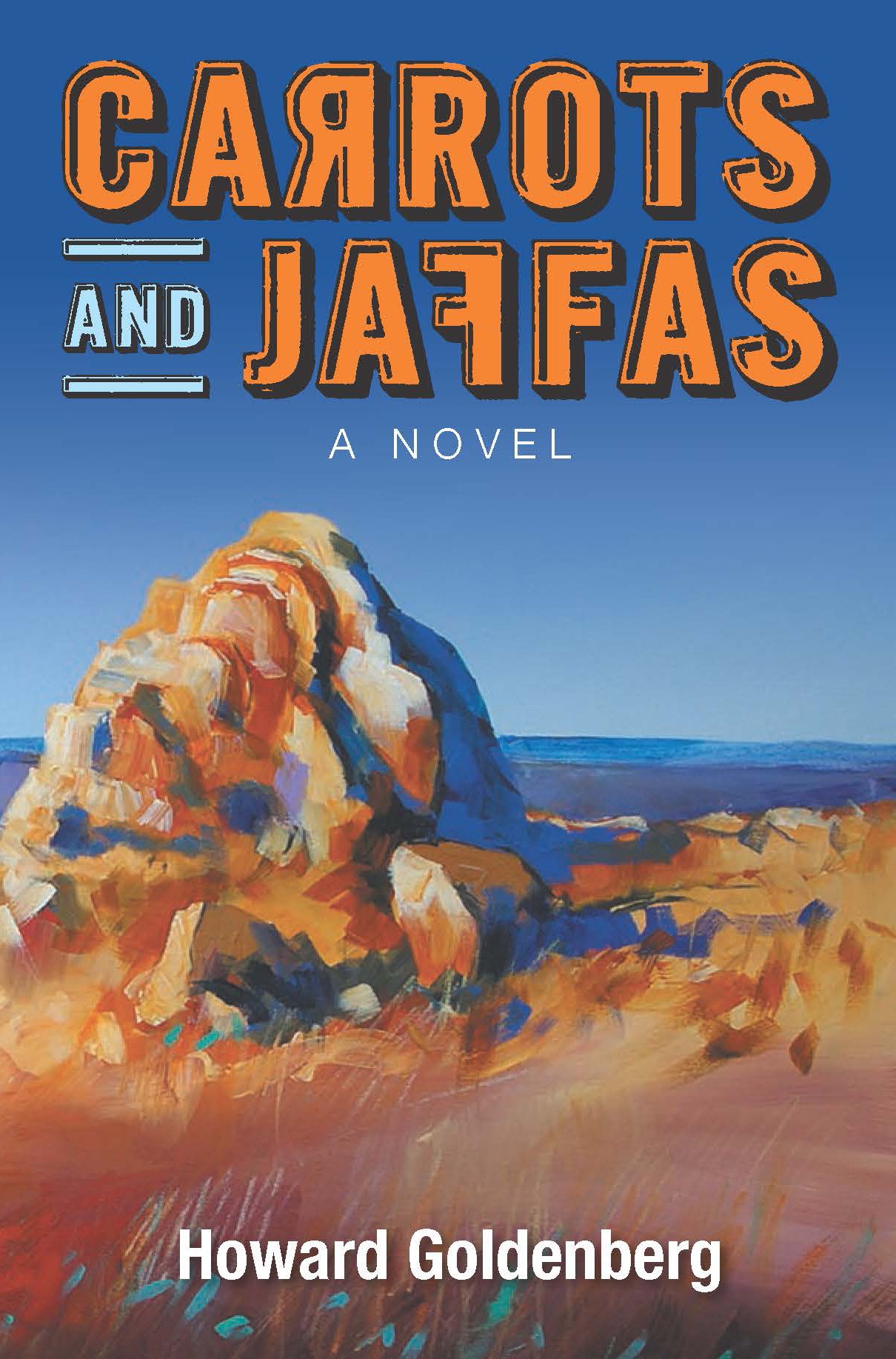
Howard Goldenberg, Carrots and Jaffas

Courtesy: Hybrid Publishers

Howard Goldenberg, we are told in “About the Author” at the back of his debut novel Carrots and Jaffas, is the sole practitioner of a literary genre – the rhyming medical referral letter! Wouldn’t I love to see some of those! Anyhow, you’ve probably guessed now that Goldenberg is a doctor, and you’d be right. But he’s a doctor with some very specific experience. Earlier this year I wrote about white writers writing on indigenous subjects. It resulted in quite a discussion. While the overall opinion was that there should be no taboos in subject matter for writers, we agreed that such writing is most effective when done from a standpoint of knowledge (and, it goes without saying, sensitivity). Howard Goldenberg, whose novel Carrots and Jaffas I’ve just completed, has such knowledge*, as he has and still does practise for part of his time in outback Aboriginal communities. Beats me how he could also find time to write a novel, but like all passionate writers, he has!

I hadn’t heard of Howard Goldenberg before, but apparently he was featured in one of the sessions at this year’s inaugural Melbourne Jewish Writers festival, about which (the festival, not Goldenberg) Lisa (ANZLitLovers) and Jenny (Seraglio) have posted on their blogs. Goldenberg writes on his blog of his session with Martin Flanagan. He says that Flanagan “led a conversation about the book, about my choice to turn from serious non-fiction to the novel, about stolen children – the ultimate wound, about twinness, about the problems and pitfalls of the whitefella writing about blackfellas.” Oh, wouldn’t I have loved to have been there!

This novel, Carrots and Jaffas, is pretty ambitious. It covers a lot of ground, asking us to make the right connections between different experiences of suffering and loss. It uses parallel stories and a frequently shifting narrative perspective to do this. It has the odd awkward moment – a coincidence pushed a little far, an irony that doesn’t quite ring true, an earnestness that gets in the way – but these are minor in a story that totally got me in from the first page. Goldenberg has written two works of non-fiction – a memoir about his father, My father’s compass, and a book of stories about his experiences as a doctor in outback Aboriginal communities, Raft. These non-fiction works have clearly honed his narrative skills.

The main action of the novel occurs around 2004, with the setting split between suburban Melbourne and the Flinders Ranges in South Australia, in Adnyamathanha country. The plot starts with the abduction of 9 year-old Jaffas, one of identical twins, by an ex-drug addict, ex-con, who plans to deliver him to an old indigenous woman, Greta, who had two sons stolen from her in the 1960s. Clean now, but with a brain damaged by PCP, he (Jimmy aka Wilbur) sees himself as Golem or the Redeemer. He is going to right a wrong. He planned to take the two boys but it goes wrong and he ends up with just Jaffas, leaving behind a distraught Carrots. The story then flashes back to the story of how Carrots and Jaffas came to be, to the meeting and subsequent marriage of their parents, Bernard, an IT specialist who had lost his father when young, and Luisa, an immigrant from Buenes Aires who, we gradually learn, had suffered significant trauma and loss in her youth. Later, we meet Doc who works in the Flinders Ranges, but who has experienced a loss of his own, a sibling through divorce.

From here the story alternates between Carrots at home, and Jaffas in the outback in a neighbouring state. As Carrots starts to fall apart, Jaffas, who was threatened with the death of his twin if he tells, is introduced to indigenous culture. He is not happy, is biding his time for an opportunity to go home, but in the meantime, over a period of a couple of months, he starts to hear different stories about life – indigenous ones from Greta and scientific ones from Doc – and learns another way of living. I will leave the story at this point … except to say that there is drama alongside reflection. It’s quite a page turner, in its quiet way!

There is humour here, despite the serious subject matter. I particularly loved the chapter on the kindergarten fancy dress parade. It brought back such memories. Even in this lighthearted scene, though, there’s seriousness. One child is particularly diminutive, and Goldenberg writes:

No one in his class considered him abnormal. But already behind him, forever past, were the years of parity with his classmates. This would be his last year of unselfconsciousness, the last year before he entered the big school, where bigger kids would be free with unkind comparisons. Luisa gazed at him, concerned; she realised the child did not suffer from dwarfism – not yet.

Oh, the power of labels!

The characters are engaging, each clearly individualised – from Luisa’s bible-learnt English and understandable fearfulness to Greta’s confident, nurturing nature, from Bernard’s practical approach to life to the Doc’s passionate if somewhat eccentric one.

There are many losses explored in this novel – parents “lose” children, and children their parents, siblings lose siblings – and they are mostly needless, human-induced. Goldenberg examines what happens to the soul, the spirit, when it experiences such pain. Not everyone responds in the same way – some start to disintegrate, some go into problem-solving mode, others respond with increased generosity of spirit – but all suffer.

Carrots writes letters that he clearly can’t send to the abducted Jaffas. In one of them he writes “I am not me without you”. They are of course twins, but most people, Goldenberg shows, are irrevocably changed when they experience loss. For all this, the novel is redemptive. I’d love to know how indigenous people respond to the novel but, for me, it’s a novel written with love from the heart. I enjoyed it.

Howard Goldenberg
Carrots and Jaffas
Melbourne: Hybrid Publishers, 2014
242pp.
ISBN: 9781925000122

(Review copy courtesy Hybrid Publishers)

* Read, for example, his powerful, heartfelt blog post on the current Budget recommendations regarding co-payment for medical treatment.

Barbara Baynton, Bush church (Review)

awwchallenge2014“Bush church” is my sixth and last* story from Barbara Baynton’s Bush studies, and it presented a rather pleasant change in tone from most of the others in the book. I’m sorry in a way that I read these stories quite out-of-order. “Bush church” is the fifth story in the collection, appearing after “Billy Skywonkie” and before the very grim “The chosen vessel”. It would work well in this position I think.

Like “Billy Skywonkie”, “Bush Church” contains a lot of dialogue in the vernacular of that particular place and time, making it somewhat of a challenge to read. However, I didn’t find it off-puttingly so. This may be because I’ve developed a bit of an ear for it (and you do have to use your ear when reading it) or perhaps because there is less dialogue. The story concerns a motley group of graziers and selectors gathered together at a grazier’s property to attend a church service delivered by a travelling parson. It becomes clear early on that attending a church service is a very rare occurrence in this neck of the woods. There are couples not married, children not christened, and people, indeed, who have never been to a church service.

It is, in many ways, a comic piece. But, here’s where I should take back that word “pleasant” in my first sentence because, while it doesn’t have the violence that several of the other stories have, the comedy is bitter. Baynton’s people here, as in her other stories, are not the noble sufferers we meet in Henry Lawson’s “The drover’s wife” or those two stories by Mary Grant Bruce that I recently reviewed. They are, with few exceptions, jealous, self-centred and/or mean-spirited.

The story, divided into two parts, starts with the parson on a horse en route to the grazier’s property. It’s not a good horse. The story opens:

The hospitality of the bush never extends to the loan of a good horse to an inexperienced rider.

The implication, of course, is that the bush is hospitable. You know, country hospitality and all that! However, as the story progresses we see little if any evidence of bush hospitality. Early in the story, our unnamed parson, is joined by “flash” Ned, who is desperate for a smoke, but gets none from the non-smoking parson, nor from “hairy Paddy Woods of eighteen withering summers” whom they meet along the way.

Perhaps because of this or just because he’s who he is, Ned decides, mischievously, that the parson is there as an Inspector, and spreads this news to all and sundry, so that they start hunting for:

land receipts, marriage lines, letters from Government Departments, registered cattle brands, sheep ear-marks, and every other equipment that protects the poor cockey from a spiteful and revengeful Government, whose sole aim was “ter ketch ’em winkin'” and then forfeit the selection. All of these documents Ned inspected upside down or otherwise, and pronounced with unlegal directness that “a squint et them ‘ud fix ‘im if thet’s wot ‘e’s smellin’ after”. He told them to bring them next day. Those of the men who had swapped horses with passing drovers, without the exchange of receipts, were busy all afternoon trumping up witnesses.

No wonder Ned, who, we also discover, is a wife-beater, “was no favourite” among his neighbours!

This is where the first part ends. The second part comprises the church service which takes place on the grazier’s verandah. The attendees, we are told, are “ten adults and eighteen children”. Baynton provides us with colourful descriptions of these people as they arrive, and then the service starts:

For a few minutes the adults listened and watched intently, but the gentle voice of the parson, and his nervous manner, soon convinced them that they had nothing to fear from him. Ned had been “poking’ borak” at them again; they added it to the long score they owed him.

Not surprisingly, with a couple of exceptions, they all gradually lose interest. The adults bicker, while the children find the food the hostess had prepared for a post-service lunch for the parson, herself and her husband. Her hospitality was not extending any further, but she’s one-upped by the children and one of the mothers! When the service is over, she has a problem to solve!

This is not a story with a strong plot, but is, rather, a slice of life, presented with a good deal of humour peppered with bite and irony. Susan Sheridan, in her introduction to my edition, suggests that Baynton’s writing belongs to the naturalist tradition of writers like Zola and Gorky. Naturalism, she says, is a style that “was crafted to express the view that the uncontrollable forces of the natural world had their equivalents in human nature, and that the values of civilisation were a mere crust over an underlying struggle to death among various life forms”. In this style, she suggests, violence and cruelty are expressed in a detached way. That doesn’t mean, I think, that we readers react in a detached way. Rather, the detached tone adds to our feeling of horror.

Barbara Baynton, I’ve decided, was a very interesting woman. I plan to do a Monday Musing on her soon to share a little more about who she was.

Barbara Baynton
“Bush church” in Bush studies
Sydney University Press, 2009
ISBN: 9781820898953
Available online: in Bush studies at Project Gutenberg.

*For my previous reviews of stories in this book, click the appropriate title: A dreamerScrammy ‘and, Squeaker’s mate, The chosen vessel, and Billy Skywonkie.

Deborah Sheldon, 300 degree days & other stories (Review)

Sheldon, 300 Degree Days, book cover

Courtesy Ginninderra Press

What I found particularly interesting about Deborah Sheldon’s short story collection, 300 degree days & other stories, is that the stories deal almost exclusively with a particular type of family relationship, the one to do with children, parents and, sometimes, grandparents. I’m not sure I’ve read a short story collection before that has been quite so tightly focused, but that’s not to say that it is boring. Far from it, because Sheldon explores these relationships from multiple, and sometimes surprising, angles.

There are eleven stories in the collection, most told from a third person point of view. They vary in length from two or three pages to eight or so. This produces an effective change in pace which nicely counteracts the impact of a similarity in tone across the stories, a tone which tends to be on the melancholic end of the mood meter. This tone is not unusual in short stories about families and relationships because writers are, not surprisingly, most often drawn to the challenges people face. Sheldon certainly was. Many of her stories deal with fractured relationships in which resolution seems unlikely or with relationships in which there is a sadness – such as childlessness in “Closed for Renovations”, or the after-effects of illness in “Bull Rider”, or ageing in “Thy Way, O God, is in the Sanctuary” – that tests deeply loving relationships.

Sheldon has the ability to make you sit up with her insight. “First and Last Words” is a devastating, tight little vignette about a single mother giving birth. And the other tiny story, “Little Yellow Hat”, contains a shocking – almost unbelievable – display of lack of compassion from those who should know better, leaving the young people gasping for air. The title story, “300 Degree Days”, is the longest, and explores a first-time pregnant woman’s fears, her lack of confidence in facing the change coming, even though she knew “she was a good worker and a good wife”. There’s nothing to suggest that she won’t be a good mother, but emotions run high in late pregnancy and Sheldon captures this nicely through a very Australian image, a plague of blowflies!

Sheldon’s language is clear and direct. She has, I understand from her website, written scripts and plays, which suggests that she’s not likely to over-indulge in description – and she doesn’t, but neither does she overdo the dialogue. It’s just that there’s little that’s wasted here. She uses imagery sparsely, but effectively. I’ll give just one example of her writing. It comes from her story, “The Birthday Present”, in which a mother takes her son to visit his cranky, unwelcoming grandfather on the grandfather’s birthday:

‘Josh, go on, he won’t hurt you,’ she said.

But the kid didn’t look too sure. He advanced across the rug, brandishing the present as if it were a shovel and Don was a tiger coiled in the shade. Don flung out an arm and gestured hurry up, hurry up, hurry up, but the kid faltered and stalled in the middle of the rug.

Not all the stories are hopeless, as I may have implied, and this is where order in the collection plays an important role. In “Bull Rider”, the opening story, the love and care are palpable as the son puts himself out for his frail mother. He finds her relaxed attitude to risk mystifying, given the risk-averse way she’d raised him. It’s not for nothing that his job involves “contributing to the financial security of the country”. The already mentioned “300 Degree Days” occurs in the middle of the collection, and then couple of stories later is “Closed for Renovations” about a couple forced to accept childlessness. Their sadness, particularly the wife’s, pervades the story. Their love is strong but will the husband cope with her grief? And then there is the last story which departs dramatically from the preceding ten, in that parents and children don’t feature, although a grown-up brother does. It is about a sixty-something gay man facing life after prostate cancer. It is a warm story about uncertainty and fear of loneliness, but ends on a note of hope, which makes it a perfect conclusion for the collection.

I enjoyed 300 degree days for its authentic portrayal of how people behave and respond to challenges in their relationships. It’s not always pretty, but it’s real, and that made it a winner for me.

awwchallenge2014Deborah Sheldon
300 degree days & other stories
Port Adelaide: Ginninderra Press, 2014
74pp.
ISBN: 9781740278577

(Review copy supplied by Ginninderra Press)

Mary Grant Bruce, The early tales (Review)

Mary Grant Bruce, Early Tales

Courtesy: Juvenilia Press

Around a month ago I wrote a Monday Musings post on the Juvenilia Press, and said that I would read and post on some of its publications. Well, here is the first of those posts.

While I discovered the press through its Jane Austen juvenilia, the books I ordered were those for juvenilia by Australian authors. My first reading choice was the Mary Grant Bruce volume. You probably haven’t heard of Bruce if you are not Australian, and perhaps not, even if you are. She is best known as the author of the children’s series, the Billabong books (1910-1942). They were published way before my time, but my mum knew them and gave them to me to read when I was a child. I loved them. They probably contributed to my early love of and identification with the Aussie outback.

However, the Juvenilia Press’s book, The early tales, contains two stories that Bruce wrote for an adult audience when she was working for The Leader newspaper in MelbourneThese stories push the envelope in terms of the Press’s criteria for juvenilia, which is that the works should be written when the author is 20 years old or younger. Bruce was born in 1878, and the two stories in this volume were published in 1898 (“Her little lad”) and 1900 (“Dono’s Christmas”). I’m glad though that they stretched their definition. Rules, after all, don’t always need to be slavishly followed.

I will get to the stories soon, but first, I want to comment on the quality of the publication. It might be juvenilia but it is thoroughly scholarly, as the Press aims. It contains an in-depth introduction, which, in the way of academic introductions, contains spoilers, so beware that if you don’t like spoilers. It also explains the source of the text, and the text itself is comprehensively annotated with notes explaining editorial decisions, linguistic features, and points of literary interest. There four appendices on a range of topics, including how Bruce represented the Australian voice/speech patterns in her writing. And, of course, there is a list of references.

Now to the stories. They are an interesting pair. Both were published as Christmas Supplements of The Leader. And both are stories about families – the first a poor selector family and the second a more comfortable squatter family. However, despite their difference in means, both families experience the challenge of living isolated lives in the harsh Australian bush. Money, it seems, may provide a more comfortable house, an extra room or two, but it can’t protect you from the dangers of a life lived in isolation.

The stories belong to the tradition that includes Henry Lawson’s The drover’s wife (1892) and Barbara Baynton’s The chosen vessel (1896). In both, the father must leave his family for a day or so (wife and toddler son in “Her little lad” and wife and two young sons under ten in “Dono’s Christmas”) – and, of course, a crisis ensues that the family must cope with alone. I don’t want to give the stories away but both stories involve snakes (as does also The drover’s wife). One also involves dangerous illness, and a child and a horse lost in a storm. In both stories, too, characters find themselves short of water. These are all common motifs in Australian bush literature. The introduction explores them, and refers us, for example, to other works, like Banjo Paterson’s poem “Lost” and Frederick McCubbin’s painting of the same title. (Longstanding readers here might remember my post on the lost child motif. I wasn’t making it up!)

What, though, is it all about? With so many stories – of which the four mentioned above are just a few – dealing with such similar subject matter, it’s clear that what is being portrayed is the Australian character, and what is being developed is a sense of national identity. The introduction defines this character as comprising “independence, resourcefulness and resilience”. The fiction, poetry and art of the period portray the hardship and the failures. Citing another McCubbin painting, the introduction suggests that these works don’t idealise, but they nonetheless convey a sense of nobility. (This is a generalisation, of course. Nobility can be hard to find in many of Baynton’s stories!)

I won’t write much more here because I’d love you to read them yourselves*: they are well-told stories that have an emotional punch alongside their historical interest. Rather, I’ll leave you with a couple of short excerpts describing the bush, starting with the opening of “Her little lad”:

Across the clearing fell the first rays of the sun, each laying a path of living gold upon the long, withered grass. They lit up the giant gums, and lingered lovingly in the tangle of clematis and convolvulus which wreathed their great branches; and as they fell the night wanderers of the bush – the awkward wallaby, the giddy possum, and the shy bandicoot – started in affright and fled every one to his hole. Then the sunbeams penetrated still further, through the wild scrub tangle, down to the quiet creek, and there they lay upon its surface, forming, with the reflection of the over-hanging trees, a delicate mosaic of shadow and gold. They opened the buds of the wild orchids, the swaying bluebells, and kindled into flame the orange clusters of the grevillea; and, on the hut in the midst of the clearing, they spread curiously, as who should ask by what right man, with this ungainly excrescence, so marred the face of nature.

The introduction doesn’t discuss whether Bruce also had an environmental agenda, but she clearly recognised “man’s” impact. But for now, here is the sun, in “Dono’s Christmas”:

The sun was already up, and seemed to be climbing quickly into the cloudless sky; it was going to be a real scorcher, Dono thought, and he resolved to push on as fast as he could before the great heat commenced, when he hoped to be in the shade of the bush. So he cantered sharply over the hard-baked plain, where the sun had split big gaping fissures in the dry earth …

Reading these stories reminded me why I so enjoyed her children’s novels way back when. What a thrill to have discovered this little book at the Juvenilia Press.

awwchallenge2014Mary Grant Bruce
(ed. Pamela Nutt with students from the Presbyterian Ladies College Sydney)
The early tales
Sydney: Juvenilia Press, 2011
90pp.
ISBN: 9780733429415

* The book only costs $12 plus postage, from the Press.

Angela Meyer (ed), The great unknown (Review)

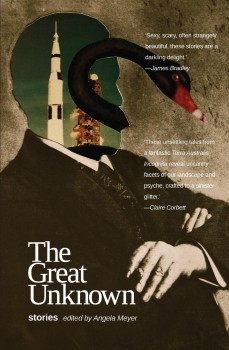
Angela Meyer, The great unknown

Courtesy: Spineless Wonders

The great unknown is a mind-bending collection of short stories which explores, as editor Angela Meyer says, “the unknown, the mysterious, or even just the slightly off.” I was, in fact, expecting more horror, thriller even, which are genres that don’t really interest me, but this collection is not that. There are some truly scary scenes – so if that’s your bag then you’ll appreciate this collection – but many are more subtly mysterious, giving the collection a broader appeal.

There are nineteen stories, most of which are the result of Meyer’s direct invitation to some favourite authors. Six, though, come from the shortlist for the Carmel Bird Short Fiction Award, 2013, of which Meyer was the judge. The invited authors were given the same brief as that for the competition, which was to write a story inspired by the “fifth dimension”, that is, the world found in shows like The Twilight Zone and The X-Files where inexplicable things happen. The result is a collection of stories that vary greatly in setting, voice, subject matter – and even tone. Some are funny, some sad, most are disconcerting and some, of course, are scary.

The collection starts in a suitably creepy way with Krissy Kneen’s “Sleepwalk” in which the protagonist, Brendan, wakes up in the middle of the night to find his partner, Emily – the sleepwalker of the title – missing from their bed. This doesn’t sound particularly unusual, except that upon investigation Brendan discovers Emily intently taking photos – and not with a modern digital camera, but one requiring “real” film. When developing the photos, they see a blurry grey figure. Who is it? What does it mean? To find out you’ll have to read the story – but I can say that it provides a perfect opener to a collection of stories in which the relationship between a couple is a common springboard. After all, where better to explore the inexplicable but in that closest of human relationships, the one in which love and hate, trust and fear, so often collide.

Several of the stories confront contemporary dilemmas. One of my favourites, and winner of the Carmel Bird Award, is Alexander Cothren’s “A Cure”, a truly disturbing Twlight-Zone-like story about a treatment, the appropriately named MindFi, for compassion fatigue. Another TZ-like story I enjoyed is Guy Salvidge’s “A Void”, which is also futuristic and drops us into a world of “Seekers” and experimental drugs. I’m not sure why I enjoyed these TZ-like stories because it was a Twilight Zone episode that set off the most distressing period of my childhood. I’m sure it was that show that turned me off horror for life – quite the opposite reaction to Angela Meyer’s it seems!

Another clever story, and one with an unexpected narrative point of view, is Mark O’Flynn’s “Bluey and Myrtle” about a caged bird and his old mistress. Both have lost their loves and are lonely, but it’s the self-aware bird who takes things into his own hands. Growing older is also the theme of Susan Yardley’s “Significance” in which a woman’s sense of invisibility and irrelevance manifests itself physically. As a woman of a certain age, I can relate to that (though fortunately not within my own family). This story reminded me of Anne Tyler’s novel Ladder of years, except that Tyler explores her theme without resorting to the “fifth dimension”.

Before I stop picking out favourite stories, of which there are several more, I’ll just mention PM Newton’s “The Local” which perfectly captures life in a remote country town and the dangers that lie within. There are of course stories that I didn’t like as much. For me, the writing in Chris Flynn’s “Sealer’s Cove” was too self-conscious and the time-travel story didn’t grab. And Ali Alizadeh’s satire on the Oprah Winfrey-Lance Armstrong interview in “Truth and reconciliation” was a good idea and funny to a point but a little too heavy-handed for my tastes. Satire is like that, I suppose.

An important part of editing a collection is ordering the contents. Meyer has done a neat job of placing the stories in an order that seems natural and thereby enhances our reading. For example, two outback stories featuring missing people, PM Newton’s “The Local” and Rhys Tate’s “The Koala Motel”, one set in a pub and the other a motel, are placed together. And Paddy O’Reilly’s “Reality TV” is followed by the TV-set show, Alizadeh’s “Truth and reconciliation”. It, in turn, is followed by Guy Salvidge’s “A Void” in which drugs feature. Three stories in a row – by Marion Halligan, Susan Yardley and AS Patrìc – feature missing or disappearing women. Put this way, it sounds a little mechanistic but in fact it provides a subtle underlying coherence to what is a highly varied collection.

Meyer concludes the collection with Ryan O’Neill’s “Sticks and Stones” in which a reader, who smugly comments that “characters in ghost stories behaved as if they’d never read ghost stories”, becomes haunted, hounded even, by words. They move, follow and curse him … words, indeed, are dangerous. Be afraid, be very afraid – but don’t let that put you off reading this book! It’s well worth the odd heart palpitation.

awwchallenge2014Angela Meyer (ed)
The great unknown
Strawberry Hills: Spineless Wonders, 2013
177pp.
ISBN: 9780987447937

(Review copy supplied by Spineless Wonders, via Angela Meyer)