Week 4 of Nonfiction November … rolling right along …
Nonfiction November, as you surely know by now, is hosted by several bloggers, with week 4 hosted by Christopher at Plucked from the Stacks:
This week we’re focusing on all the great nonfiction books that *almost* don’t seem real. A sports biography involving overcoming massive obstacles, a profile on a bizarre scam, a look into the natural wonders in our world—basically, if it makes your jaw drop, you can highlight it for this week’s topic.
This is a new addition to the Nonfiction November weekly prompts, which is exciting, even for me who hasn’t done this month assiduously in the past. But, how to respond?
What comes to my mind when I think “stranger than fiction” are those coincidences (and the like) that happen in real life that a fiction writer could never get away with. Christopher, though, has taken a broader view, including things like “overcoming massive obstacles”. My problem is that although I’ve read the same amount of nonfiction this year, as last, none of it really seems to fit his description, but I’ll see what I can do about fitting my reading to the theme.
Stranger than fiction: 1, Overcoming massive obstacles
Wendy and Allan Scarfe had to overcome many political, personal and cultural obstacles in supporting a poor Indian village,particualrly in terms of improving educational opportunities, in their memoir, A mouthful of petals (my review).

But, when I think about overcoming obstacles in my reading this year, I have to go to Marie Younan, and her memoir A different kind of seeing (my review).
The story of how she lost her eyesight – the coincidences and lack of knowledge, among other things, that resulted in her losing her eyesight when a young child, and then the ongoing ramifications of this which meant that she did not get the right treatment, later, which may have restored some of her eyesight – is a tragic story.
The story of how she finally managed to migrate to Australia to join her family, having been rejected more than once because of her blindness, is a disgraceful indictment on Australia’s immigration system.
The story of how she, as an adult, found a person (or, he found her), who recognised her needs and who nurtured and gently pushed her into becoming literate – to learn Braille, mix with people, learn English – so that she eventually found employment and became independent, is an inspirational story.
So, yes, Marie Younan had to overcome massive obstacles to get to where she is today. It’s a story that would be hard to make believable in fiction.
Stranger than fiction: 2, Diary as therapy?
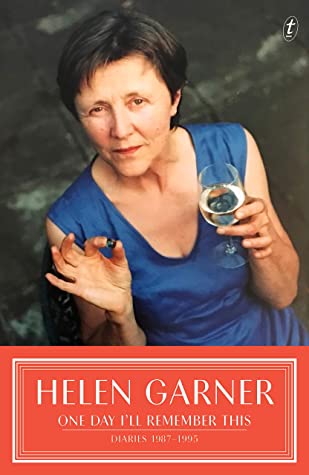
Thinking about this topic, though, I realised that Garner’s diaries are perfect, besides the irony of reading her actual diaries when her novels, her fiction, have been criticised as “just” her diaries. Does this make the point moot?
If I soldier on, though, I am a little anxious about what I’m going to say next, because I am presuming to criticise another person’s life choice, in this case Garner’s “strange” relationship with “V”. He is the man who becomes her husband during the second volume of her diaries, One day I’ll remember this (my review). I feel anxious, but I also feel it’s ok because Garner wrote about it, and because we know the outcome, so I’m not exactly saying anything new.
The point is that the relationship turned out disastrously for Garner, and anyone reading the diary could surely see that coming. If this were fiction – besides Garner’s of course, her diaries being the stuff of her fiction, says she cheekily – I would have been hard-pressed to believe the relationship. There just seemed to be too much angst, too much difference between them, for it to work.
However, here’s the thing. What do we write in diaries? Mostly our angst? Of course, diarists will occasionally write the really happy stuff, and, those diarists who are writers, will also often jot down ideas, observations and inspirations. Mostly, though, we write out our angst. We get it out of our hearts and onto the page, which makes us feel better. Diary as therapy, in other words. Taking Garner’s diaries in this context, and knowing too that she’s edited them, we cannot presume to know the whole of her relationship with “V”. However, looking at it purely on the basis of what we read, the fact that they ever married does seem “stranger than fiction”. I think that’s fair enough for me to write.
And now, I’d love to hear how YOU would answer this question. Sock it to me! I’ll believe you!












 Whispering Gums