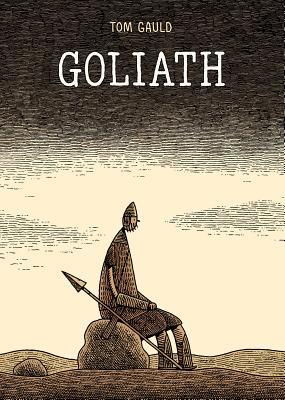
It’s probably just me, but I hadn’t heard of Tom Gauld until a member of my little volunteer indexing team sent me a link to some of his “cultural” cartoons in The Guardian. I was immediately enchanted. And then, he lent me one of Gauld’s graphic novels, the above-named Goliath. Being primarily a textual person, I am not a big graphic novel reader, but our son became keen on them in his teens, so I have some familiarity and have read a handful.
Now I’ve added Goliath to that elite bunch. It’s the sort of graphic novel I enjoy – spare, drily witty, a bit melancholic. It is also, as you will have assumed, a retelling of the biblical David and Goliath story. Like many modern retellings, Goliath is told from a different perspective, that of Goliath himself, who is seen as a pawn in the game of war. In a wry touch, Goliath is your quintessential gentle giant. When, out of the blue, he is approached to be measured for some armour, he says to the armour-maker, “Are you sure this isn’t a mistake? I mainly do admin”. As one who doesn’t mind a bit of admin, I’m with Goliath.
Gauld has published well over 20 books, starting back in 2001, but according to Wikipedia he is best known for Goliath (first published in 2012) and Mooncop (2016). I notice that his latest, published just this year, is Revenge of the librarians. Now, that’s one I’d love to read!
Anyhow, back to Goliath. Although he’d rather do admin work, destiny has other plans for him as we know – and so, he finds himself, under the Philistine king’s orders, waiting in a valley, armoured and armed up, issuing, morning and night, a challenge to the Israelites:
I am Goliath of Gath, Champion of the Philistines.
I challenge you:
Choose a man, Let him come to me that we may fight.
If he be able to kill me then we shall be your servants.
But if I kill him then you shall be our servants.
Poor Goliath. “I’m not a champion”, he says. In fact, he continues, “I’m the fifth worst swordsman in my platoon … I do paperwork. I’m a very good administrator.” But, in classic political spin, he’s told that there won’t be any fighting. He just has to “look like a champion” and “the enemy will cower”. We all know how that turned out … along came David (albeit in this version, after a very very long time of waiting for poor Goliath).
The reviews on the back cover sum it up beautifully. The New York Times says that Gauld uses “simple, clever images to explore the larger, more complicated issues of war and heroism”, while London’s The Times says, and I particularly like this, that “Goliath is a master class in reduction … a celebration of the Christian underdog becomes a subtle meditation on the power of spin and the absurdity of war”. The rest of the back cover review excerpts are similarly spot on.
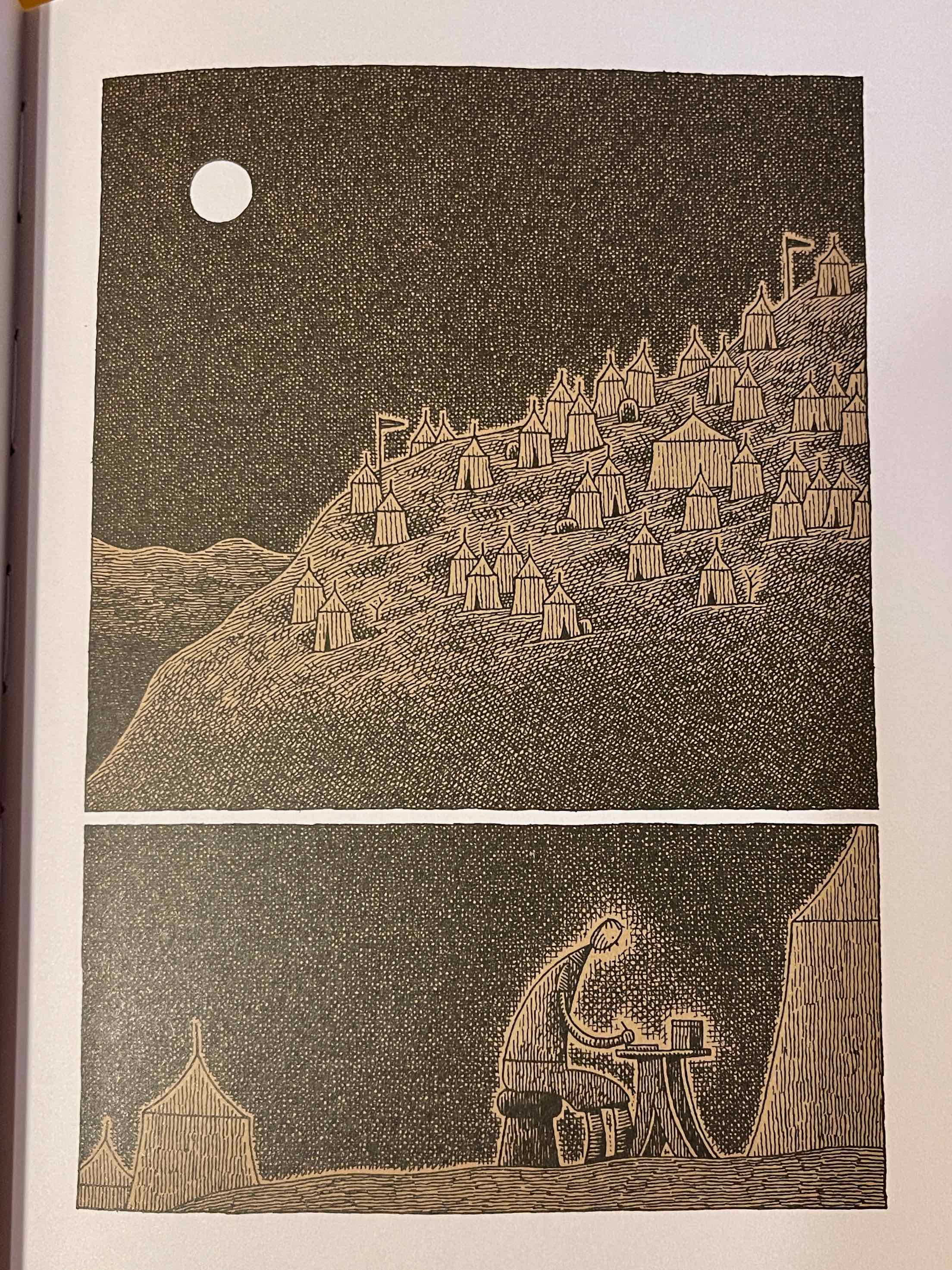
Small reproduction, allowed for review purposes.
So, did I enjoy it? Yes, I did. I liked the spareness of the art and the text. The first five textless pages set the scene – that is, they show Goliath going about his day quietly, peacefully, doing his paperwork, having a stretch at his desk, and trudging down the hill on which the encampment is located to get a drink. One of my challenges with graphic novels is taking in the images and the text, without letting one distract me from the other, but in Goliath the spareness of both made this easy. Making it easy to comprehend, though, is not the main reason for the spareness! It also reduces the story to its essence, encouraging us to engage with Goliath and what he is experiencing.
I also liked the humanity of Goliath and the small boy whose job it is to support him. As they traipse to see the captain, the small boy carries Goliath’s oversize shield. “Are you OK with that?”, asks Goliath. “Sort of” replies the boy. These two, we clearly see, are pawns in the game, potential “collateral damage” as it were, though of course the Philistine leaders believe they have the winning hand.
I also liked the subtle humour, which you have hopefully picked up already. And, of course, I appreciated the anti-war message conveyed through a twist which shows the ostensibly powerful giant as the manipulated underdog – just by changing the perspective. Something we all need to do, eh? See and feel things from another side. Recommended.
Tom Gauld Goliath Montreal: Drawn and Quarterly, 2017 (orig. ed. 2012) [96]pp. ISBN: 978770462991
Recently, I came across a blogger discussing what she described as “community novels”. The blogger is Liz Dexter at Adventures in reading, running and working from home, and the book she was discussing was an English novel, Small miracles by Anne Booth. It got me thinking, because I love community.
Community, however, is a word with multiple meanings and applications, but Liz’s concept of “community novel” is one which has “a range of other characters, each with their own story that intertwines with the whole”. These characters, if I understand Liz’s blog correctly, can belong to communities that can range from those as “compressed” as a nunnery to those more open like a seaside town. The point is that the characters are all connected by their community, and the novel incorporates the stories of several members of that community.
Of course, I searched the internet for community novels, and found our own Annette Marfording (who has appeared on my blog). Back in 2016 she discussed the topic on her blog in a post titled 10 Great Novels on Community. Annette writes:
Using a community in fiction has several advantages: a community almost invariably provides a hotbed of conflict between its members, and it is conflict that drives a story. Communities also provide the opportunity for the author to begin the story with a new person joining the community, which can serve as the springboard or inciting incident for the story. Furthermore, community allows authors to display their skill at conveying a strong sense of the place where the writing is set.
So, a significant feature for her are the dramatic opportunities offered by having a new person join a community. To this I would add the opportunities offered by someone returning to a community, which seems a common trope these days. Anyhow, Marfording goes on to list ten “great” Australian community-based novels – at the time of writing – noting that they tend to be set in “small rural or coastal towns, but it would, of course, also be possible, albeit more difficult, to build such communities in a city suburb”. (Check her post for her thoughtful list.)
Both Liz and Annette point to the factors that make “community novels” interesting. The small community, for one, which means readers can quickly come to know and feel engaged with it. The opportunity for conflict and difference – and hopefully resolution at the end – is another. In my internet search I found reference to a book published in 2014 by J. Hillis Miller. Titled Communities in fiction, its subject is described on Amazon as
the question of how communities or noncommunities are represented in fictional works. Such fictional communities help the reader understand real communities, including those in which the reader lives. As against the presumption that the trajectory in literature from Victorian to modern to postmodern is the story of a gradual loss of belief in the possibility of community, this book demonstrates that communities have always been presented in fiction as precarious and fractured.
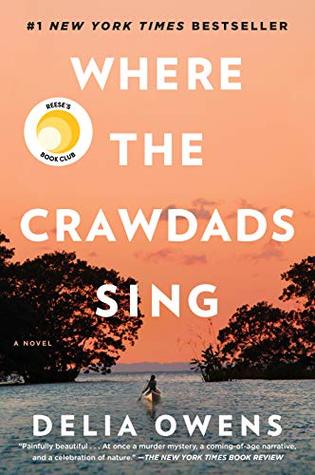
I’ll leave the trajectory issue to the academics, but I’d be interested in your perspective on whether communities in fiction are always presented as “precarious and fractured”. For me, it depends on the definition of “precarious and fractured”. If “precarious” means “likely to fall or collapse” (Oxford Languages), I’d argue that many fictional communities might be fractured, that is, “damaged” or “broken”, but are not necessarily going to succumb. Take a recent American case, for example, Where the crawdads sing (my review). That community was never going to fall or disappear, but it sure was fractured.
I also found another interesting article* on JSTOR, from 1988, which I scanned. It’s about a genre the writer, Sandra Zagarell, calls “narrative of community”, which she describes as “committed to rendering the local life of a community to readers who lived in a world the authors thought fragmented, rationalised, individualised”. Zagarell and others argue that these novels see community as important to survival in an increasingly individualistic – or, some say – capitalistic world. Zagarell comments at the end of her article on the progress of this genre into modern times, writing that
Embracing increasingly heterogeneous visions of the collective life, narrative of community is expanding the story of human connection and continuity.
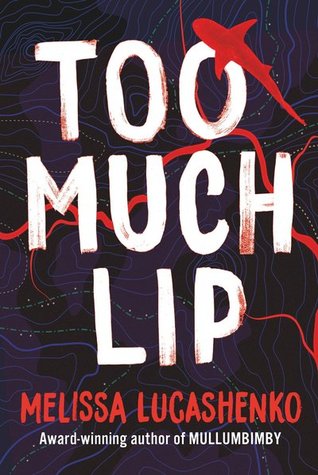
Notably, she sees this happening particularly in the writing of African-American authors like Toni Morrison and Alice Walker. Interesting. We can surely see some of this in First Nations Australian literature. In Melissa Lucashenko’s Too much lip (my review) Kerrie returns to her community because her grandfather is dying but she decides to stay to fight for Granny Ava’s island. This is, in fact, a precarious community. It’s respected leader, Uncle Richard, says near the end that
We had to grow hard just to survive … But the hardness that saved us, it’s gonna kill us if it goes on much longer.
This is a community learning how to live in modern rural Australia. It’s a similar story in Nardi Simpson’s Song of the crocodile (my review) which is also about a community being torn apart, and about the resilience of a culture that is, philosophically, community-based.
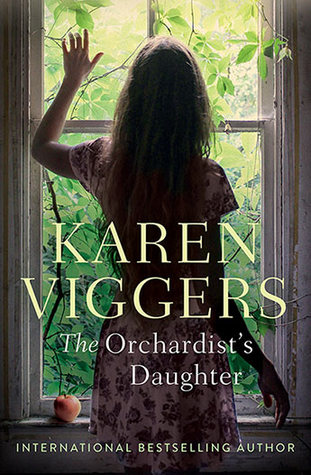
Besides these and other First Nations novels, I’ve read other several community-set novels in recent years, such as Malcom Knox’s coastal Bluebird(my review) and Karen Viggers’ rural The orchardist’s daughter (my review). Both are set in vividly delineated communities and explore the tensions, prejudices, greed and/or corruption that can tear communities apart, while paradoxically also conveying the potential in community for the opposite.
I opened this post by saying I love community, which means I also love novels set in communities, so my question of course is …
Do you like “community novels” and if so, what do you like about them and would you like to share some favourites?
* Sandra A. Zagarell, “Narrative of Community: The Identification of a Genre” in Signs, 13 (3) Spring, 1988: 498-527
It might be spring but it’s not a particularly appealing one here, with so much grey and rain, which is unusual for my corner of the world. But, Daylight Savings starts this weekend, which is always a plus, and the spring blossoms and bulbs are out which cheer up the grey. What also cheers up the grey is that it’s Six Degrees time again, which is a time of reconnecting with bloggers I don’t always catch up with over the month. As always, if you don’t know how it works, please check meme host Kate’s blog – booksaremyfavouriteandbest.
The first rule is that Kate sets our starting book, and in September it is another book I haven’t read, though I did see the movie, Zoë Heller’s Notes on a scandal. It was also published under another title, What was she thinking? If I’d realised that before – I only discovered it when I was searching for the book cover – I might have started my chain with the idea of different titles, but I didn’t and so I’m not!
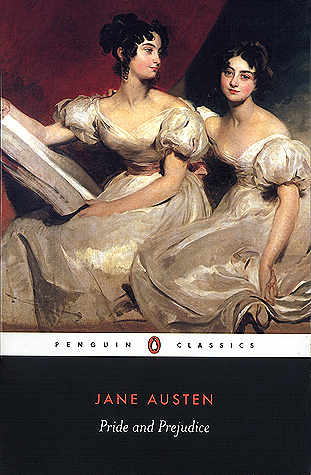
As I said above, I have not read the book but have seen the movie, which stars Cate Blanchett and Judi Dench, so I’ve decided to go with a book that was adapted to a film in which Judi Dench played a role. There are of course many many such books in her long career but I couldn’t resist the opportunity to include a Jane Austen novel again. Judi Dench played Lady Catherine de Bourgh in the 2005 Pride and prejudice (a post on the novel), so that’s what I’m linking to.
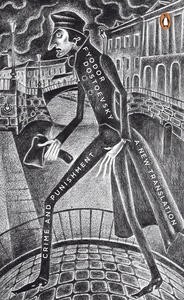
Next up is a simple link, another book with a three-word-title with “and” in the middle. I think I’ve done this sort of link before, but no matter, it works and my time is limited. The books is Fyodor Dostoevsky’s Crime and punishment(my review).
In Crime and punchishment, our antihero protagonist, Raskolnikov, is sentenced to Siberia for eight years. Diego Marani’s protagonist in his The last of Vostyachs (my review) is Ivan, who is the eponymous last of the Vostyachs, an ancient Siberian shamanic tribe – hence my link!
My next link is a more usual one, the nationality of the author. Diego Marani is Italian, and so is Vincenzo Cerami, whose novella, A very normal man (my post) has remained in my mind ever since. Perhaps because ….
… its protagonist was a civil or public servant, as I was (though in libraries/archives rather than a government department.) This public-servant subject matter, and the fact that it’s set in Canberra, is partly why my next book also remains memorable for me, Sara Dowse’s West Block (my review). It also happens to be an excellent read, and a novel with a slightly different structure that I found enjoyable to think about as I read. However, that’s not what I’m linking on next.
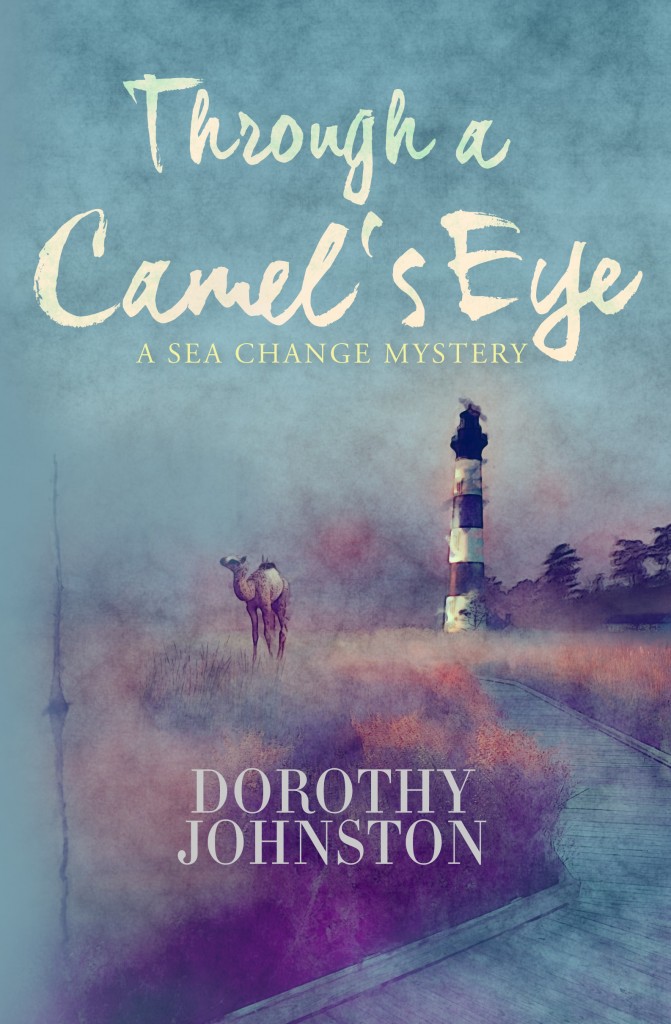
My final link is on publisher. Both Dowse’s book and Dorothy Johnston’s Through a camel’s eye (my review) were published by a small and, I gather, highly personal publishing company For Pity Sake Publishing. I wanted to mention this because I did once meet the publisher, Jen McDonald, and found her a lovely, warm person. Tragically, however, she died this year, way too young. Sara Dowse has written a beautiful tribute on her blog. (I should add that I could also have linked Johnston to Dowse through their joint membership of Canberra’s Seven Writers group).
This month, we’ve traveled from England through Russia to Italy and across to Australia. We’ve stayed mainly in the 20th and 21st centuries but have also popped into the nineteenth century. Oh, and we’ve read a few translated novels. This month the gender split is 50:50.
Now, the usual: Have you read or seen Notes on a scandal? And, regardless, what would you link to?
Julian Barnes’ Elizabeth Finch is a curious book. It’s my fourth Julian Barnes, and the third I’ve read with my reading group. In 1995 we read A history of the world in 10 1/2 chapters, and in 2012 it was his Booker Prize winning The sense of an ending (my review). (I have also read his curious but enjoyable Pedant in the kitchen.) All have intrigued me, for different reasons.
Elizabeth Finch tells the story of a man’s fascination with an inspirational teacher, the eponymous Elizabeth Finch, who taught an adult education class on Culture and Civilisation. This man is Neil, our first person narrator, and he maintains a friendship with EF (as he refers to her), through semi-regular lunches, until her death some two decades later. Through Neil’s memories of the class and his reading of EF’s papers that she’d bequeathed him, Barnes explores various ideas, including how we live our lives (particularly in terms of friendship and love), and the impact and thrust of history (primarily through considering the so-called last pagan emperor, Julian the Apostate). (Interestingly, the protagonist in The sense of an ending is also bequeathed personal writing.)
The novel, while told chronologically, is quirky in form. Part One comprises Neil’s introduction to EF, up to her death; Part Two contains Neil’s “essay” on Julian the Apostate (who was significant to EF’s ideas); and Part Three returns to Neil, now focusing on trying to understand EF with a view to possibly writing a memoir/biography. Here, he also catches up with old student friend, and ex-lover, Anna, who does enliven the book. In a sense, the novel reminded me a little of J.M. Coetzee’s tricksy books, like Elizabeth Costello and Diary of a bad year (my review), because they also tread this strange fiction/nonfiction, novel/philosophy ground.
At this point, I’m going to depart a little from my usual approach, and share some of my reading group’s discussion, because the book book engendered widely divergent reactions. They fell into three groups. One member loved it, describing it as a dense, compact novel which takes readers down interesting paths. She enjoyed thinking about Julian the Apostate, and what might have happened had he prevailed, and she enjoyed reading about the wide range of thinkers who have pondered Julian over time. A couple actively disliked it or were “very disappointed”. They felt the novel had some interesting threads but found it simplistic, repetitive, disjointed. They didn’t like the EF character, and one described the novel as “an ordinary study of a crush on an ordinary woman”. The rest of us, including me, had mixed feelings. Our reactions varied but we all found things to like (or be intrigued by) as well as dislike (or be mystified by). I won’t share all our ideas, but a couple of us felt that the book read like something that Barnes wanted to “get off his chest” at this stage in his life. (He’s 76). A couple of us particularly enjoyed the discussions of Epictetus and of history.
The book’s narrator, Neil, was problematic for some, but I rather liked his self-deprecatory tone, the sense of bumbling along as a middle-aged British male. Neil is not Barnes, but I wondered if he reflects Barnes’ self-assessment or, at least, a recognition of how he and his peers are viewed in the current age. It is tempting, actually, to see an autobiographical element to the novel, because EF was apparently inspired by the late British novelist Anita Brookner. She had beaten Barnes in the 1984 Booker Prize, but they had subsequently become friends and had lunched semi-regularly after that. I have read (and enjoyed) several of Brookner’s novels and can imagine her being somewhat like EF, who was “high-minded, self-sufficient, European” and “whose vocabulary was drawn from the same word-box she used for both writing and general conversation”. (Brookner’s books aways send me to the dictionary!)
What might Barnes have wanted to get off his chest? This is where I came unstuck a little. As I started reading the book, it felt like the elder Barnes wanting to work through long-pondered ideas, but what exactly were they? As the novel progressed, I felt less certain. Is Barnes – ironically perhaps – emulating EF, and throwing out seemingly random ideas for us all to consider. However, there are, actually, recurrent threads. One concerns whether the world might have been better had “history” fallen out differently. This is where Julian the Apostate comes in, because early in the novel EF poses the idea that Julian’s defeat in 363 was “the moment when European history and civilisation took a calamitous wrong turn” (p. 31), it being the moment when Christianity defeated paganism/Hellenism. I wondered if the novel was going to be an anti-Christianity treatise, but it’s not exactly. EF raises many questions – but she also draws some long bows. I think Barnes challenges us to think about this.
Anyhow, history is one of the book’s central concerns, which is not surprising, given Barnes’ age and the ideas that have underpinned his writing to date. I have only read three of his novels but from those, I’ve gathered that he likes to interrogate, often playfully, the slipperiness of life and relationships, culture and history. So, in this novel, he explores what we believe and who we rely on, when it comes to history (and that related field, biography). In his Julian essay, which some in my group found lifeless, Neil describes how perspectives on Julian’s role and significance varied over time. He’s been either completely ignored, or seen as the cause of all ills, or held up as a model for good thinking.
History, in other words, is “fallible”. It’s “for the long haul … not inert and comatose … [but] active, effervescent, at times volcanic”. This is not new, but worth repeating all the same.
EF also shares with the class an idea she attributes to Ernest Renan, which is that “getting its history wrong is part of being a nation” (p. 33). Renan, she points out, does not say part of “becoming” a nation. This point was appreciated by my reading group, given where Australian “history” is right now. I’m guessing it may also reflect Barnes’ own reflections on British history.
Another recurrent thread in the novel is EF’s interest in the Greek Stoic Epictetus‘ statement that
Some things are up to us and some are not up to us. Our opinions are up to us, and our impulses, desires aversions – in short, whatever is our own doing. Our bodies are not up to us, nor are our possessions, our reputations, or our public offices, or, that is, whatever is not our doing. (p. 21)
Epictetus’ point, as Anna clarifies with the often obtuse Neil in Part 3, is that learning to distinguish between the two, and understanding that we can’t do anything about what is not up to us, “leads to a proper philosophical understanding of life”. My reading group discussed this, with one member suggesting that “a proper philosophical understanding of life” means “not being neurotic”, that is, “not expending energy on the things you can’t influence”. Made sense to us!
The novel does meander a bit, but that’s not all bad if you find the ideas you are meandering through interesting. Ultimately, I’d say that Elizabeth Finch is part homage to the people who inspire us, part a discussion of the business of living, and part an exploration of the fallibility of history and biography. It is not Barnes’ most exciting book, but I found it compelling enough all the same.
Lisa (ANZLitLovers) also enjoyed this book, which in fact she generously sent me. Thanks so much Lisa. Her post commences with an interesting discussion of its cover.
Julian Barnes Elizabeth Finch London: Jonathan Cape, 2022 181 pp. ISBN: 9781787333932
Some months ago, I became aware of The Miles Franklin Rights Project, and of course, it piqued my interest, so I flagged it for a future Monday Musings. The project apparently commenced in early 2021, and is still continuing. Before I describe the project, though, I need to explain for non-Aussie readers here that the Miles Franklin Award, though no longer Australia’s most valuable award in monetary terms (albeit is still generous), is arguably our most prestigious literary award. It is also one of our oldest, having been first awarded in 1957. That first winner was Patrick White’s Voss.
So now, the project …
It is led by Dr Airlie Lawson, who is “a literary sociologist and cartographer, a Visiting Fellow at the ANU’s College of Arts and Social Sciences, and the Postdoctoral Fellow on Untapped: the Australian Literary Heritage Project (on which I posted earlier this year) at the University of Melbourne”. The project intrigues me because it asks some questions that are dear my heart. Here is how it is introduced on the AustLit website, which is funding the project:
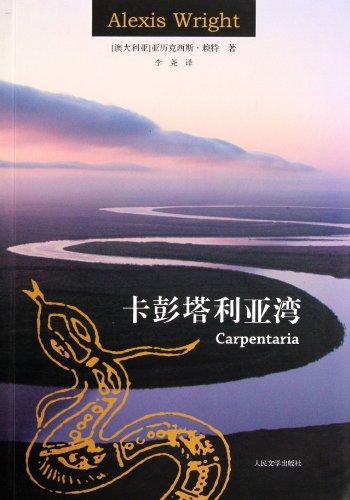
Chinese edition of Carpentaria
Over the last 21 years, the Miles Franklin Literary Award has been won by many acclaimed Australian novels including Alexis Wright’s Carpentaria, Michelle de Krester’s Questions of Travel, Tara June Winch’s The Yield, Peter Temple’s Truth and Tim Winton’s Dirt Music. But which of these novels has been published internationally—where and in what languages? And shortlisted titles—have they had international success? Is there a discernable gender difference? Associations between publishers? What about change over time? How might we find out?
The site goes on to say that
Globally, publishers and agents report a strong association between literary awards and prizes in international interest in a novel and, subsequently, the licensing of the publishing rights internationally.
The problem is that there’s been little research into what impact awards and prizes have had on rights transactions. A prerequisite for such research, really, is “a comprehensive set of international editions” of Miles Franklin Award winners, but this has not been easy to find. Consequently, the aim of this project is “to create such a list—and to create an efficient, accurate international edition identification model that can be used for other AustLit projects”. They are focusing on the novels which won or were shortlisted for the award from 2000 to 2020. This list, which comprises 22 winners and 93 shortlisted titles, will provide, they hope, a basis from which the global impact and value of this award can be explored.
As you can imagine, it’s not easy tracking down the editions, but they are starting with two major international book databases: WorldCat (library-supplied data) and GoodReads (crowdsourced). As you would expect from an academic project, the information obtained from these databases, and elsewhere, is then checked against multiple sources, including authors, agents and publishers.
You can read about the project on the AustLit website. In fact, this website was my major source for this post, but I did find information about a paper given (via Zoom) by Airlie Lawson in May this year. The paper was titled “How Global is Australian Literature in the 21st century? A story of gender, genre and the international literary field”. The talks’ description says that the “paper draws primarily on data produced for the Conditions of Access (COA) project*, supplemented by data from the industry report Success Story (Crosby et al) and AustLit’s The Miles Franklin Rights Project. Specifically, it draws on data relating to what the COA project models as international rights ‘transactions’ for adult novels first published in print between 2000-2020″. The description also says this:
Analysis of this data reveals several rather different accounts of international access over a twenty-year period, but all have one element in comment: in contrast with the domestic field, they tell a positive story for women authors.
Interesting, but not wholly surprising, because anecdotally-speaking, at least, my sense is that many of our women writers are finding their way to overseas readers. We are seeing it in posts by international bloggers, for a start. Presumably Lawson explored why this might be the case. The point she makes here is not comparing our women with our men authors overseas, but our women authors overseas versus them at home.
I also found a Q&A with Lawson. The first question concerned the inspiration for the project, and Lawson responded that
There’s been a lot of discussion in Australia about literary prizes in recent years—the cost of entering, the type of books more likely [to] win them, their proliferation—but there’s no question that a prize win can boost copy sales. I wanted to find out if there was a similar effect on international rights licensing.
Anecdotally, she said, Australian industry professionals claim some do have an influence, and her own research has supported this, but there’s no “reliable comprehensive data set of international editions” to enable this to be properly proved (or not). On why she chose the Miles Franklin Award as her basis, she said that
it is often described as Australia’s “most prestigious literary award”;
it’s long running (though they are starting with a 21-year period); and
it stipulates Australian content, so “examining the international publication records for works associated with it can tell us something about how Australian literary culture is valued internationally”.
As for who the research is for, it’s broad: it’s for other researchers (of course), students, readers, book clubs, and publishers.
Certainly, as a reader and book-club member, I am fascinated by the publishing environment within which authors work, and what can help them reach more readers. Moreover, as one who loves to read works from overseas writers, I am also keen to see overseas readers read our writers. Consequently, I love the idea of this project.
Does such research interest you – and why, if it does?
* The Conditions of Access project is another Airlie Lawson project. Its aim was, said the talk’s description, “to better understand, from a data-driven and conceptual perspective, where, when and why Australian novels have travelled in the early years of the twenty-first century”.
Followers of the short story form will probably know of O. Henry, the pen-name of American author William Sydney Porter (1862-1910). Although he also wrote poetry and non-fiction, Henry was best known for his prodigious short story writing. His legacy, as Wikipedia says, includes the O. Henry Award, which is an annual prize awarded to outstanding short stories. The award was first made in 1919, and since then the winning stories have been published in an annual collection. I was introduced to this via the 2003 collection which includes stories by writers like A.S. Byatt, Anthony Doerr, T. Coraghessan Boyle, William Trevor, and Alice Munro. You can see the quality we are talking about. The 2003 issue also introduced me to another writer, Chimamanda Ngozi Adichie, whose “The American Embassy”, I read from the collection, and whose novel, Half of a yellow sun, I went on to read as a result.
All this is to introduce the fact that Library of America (LOA) recently published an O. Henry short story, and I thought I’d share it here.
“Conscience in art”
LOA, as always, provides some introductory notes to the story, starting a bit mysteriously in this case, by referencing the turn of the century Pittsburgh millionaires, such as electricity magnate George Westinghouse, steel company executives F. T. F. Lovejoy, Andrew Carnegie, and Henry Clay Frick, and other wealthy industrialists. Many “were passionate collectors of art”. Then they make their point, because this fact, they say, “supplies the plot of O. Henry’s story”. It’s worth pointing out, too, that an article referenced by LOA, says that Henry disliked Pittsburgh.
LOA goes on then to say that in November 1906, the editors of McClure’s magazine, wrote that
“In five years of magazine writing, O. Henry has reached the top of current fiction. The quantity as well as the quality of his work is remarkable, and he grows with every story. More stories of New York, the field of his great book The Four Million, will appear in McClure’s in the coming year.”
O. Henry, LOA continues, had signed a contract for a dozen stories at $300 each. This might sound a big ask, but he was famously productive, having published 121 stories in 1904 and 1905. However, as it turned out, not one O. Henry short story appeared in McClure’s that year, largely because his health was declining as his drinking increased. Henry did, however, write some stories that year, with nearly half of them, says LOA, featuring “an affable con man named Jeff Peters” who had debuted in a 1903 story. Some ten or so Jeff Peters stories were distributed nationally by the McClure Newspaper Syndicate in 1907 in a series they called “The Gentle Grafter.”
Then came the information that surprised me, because I don’t know Henry’s story. LOA says that these Jeff Peters stories came out of Porter’s three years in prison – for embezzlement – at the turn of the century. He worked the night shift as the druggist in the prison’s hospital, and is believed to have first drafted some of these tales during that time. According to LOA, the prison’s head pharmacist Dr. John M. Thomas reported that many of the stories were told to Henry on his rounds. Thomas said that he would frequently “find a story written on scrap paper on my desk in the morning, with a note telling me to read it before he sent it out.” LOA says that “Conscience in Art” is perhaps the best-known story in the collection. In it, they say, “the criminal principles and linguistic malapropisms of the swindler Jeff Peters finally meet their match in the ethically challenged Andy Tucker.”
So, the story concerns two con men, Peters who has some conscience – “I never believed in taking any man’s dollars unless I gave him something for it” – and Tucker who had no such qualms. Tucker comes up with the idea of swindling the Pittsburgh millionaires, who, Tucker tells Peters, will be easy to meet because:
‘They are rough but uncivil in their manners, and though their ways are boisterous and unpolished, under it all they have a great deal of impoliteness and discourtesy. Nearly every one of ’em rose from obscurity, … If we act simple and unaffected and don’t go too far from the saloons and keep making a noise like an import duty on steel rails we won’t have any trouble in meeting some of ’em socially.’
Tucker comes up with an art fraud plan, and of course there’s a twist in which Tucker manages to succeed in a scam in a way that doesn’t offend his accomplice’s tender conscience! I’ve only read one other O. Henry story, “The gift of the magi” – which is often compared with Guy de Maupassant’s “The necklace”. It’s an intense story, and different to “Conscience in art”, which is lighter, more comic, in tone. However, behind the lightness is some insight into those heady turn-of-the-century times in the US when faith in rags-to-riches held rein, and perhaps, Henry’s attitude to the rich.
Have you read any O. Henry? If so, I’d love to hear your thoughts.
O. Henry “Conscience in art” First published:by the McClure Newspaper Syndicate (July 1907); then collected in The gentle grafter (1908). Available: Online at the Library of America
Given I am currently in Fremantle, I felt it appropriate to give a little shout out to one of the first independent presses I became aware of, back in the 1980s, the Fremantle Press. Then it was called the Fremantle Arts Centre Press, and it published one of my favourite authors at the time, Elizabeth Jolley.
I must admit that felt sorry for them – and a little cross with Jolley – when she left them for Penguin, but I understood too. Writing is a tough business, and being in the stable of a company with the reputation and clout of Penguin must certainly help your visibility and thus your sales and income. Nonetheless, these small presses, which tend to be the ones to take a risk on new writers, are so important to Australia’s literary culture, so we need to support them.
A little history
Fremantle Arts Centre Press was established in 1976, and publishes a wide range of works – fiction and nonfiction, adult’s and children’s. The write that their
core purpose is to identify talented new and emerging Western Australian writers and artists, and to publish and distribute their work to the widest possible audience.
How did they start, though, and when did their name change? This sort of information is hard to find when organisations don’t document it on their site – and Fremantle doesn’t on their About Us page. My Internet search retrieved, of course, lots of hits on specific books they’ve published or the occasional news item about an award. However, I persevered and found an article written in the University of Western Australia’s Mots Pluriels (no. 5, 1998) by academic Phillip Winn. The issue is devoted to a study of the Press, and containsinterviews with authors and staff of the Press, as well as Winn’s article.
Winn’s article is titled “The Fremantle Arts Centre Press: a case study of a smaller publishing house”, and he explains the case study’s aims and hints at its findings:
Armed with a barrage of questions designed to expose the ‘how to’ of getting published in Western Australia, it soon became apparent that the search for a general response was the least fruitful. How do lesser-known authors get published? Is it easy? What help does a publisher give a budding writer? What is a good book in the eyes of the reading committee? In this study of FACP, such questions have been more meaningfully answered on the individual rather than the corporate level; for the dominant theme to emerge from this series of interviews is the importance of the personal touch. Public questions of universal interest have, it seems, very private and personal answers.
Winn documents a bit more of the Press’ history, saying that it is part of the cultural heritage of Fremantle itself. He says that by the mid 1970s, the Fremantle Arts Centre “had established a highly successful, community based, creative writing program” and that on the basis of this, the Centre’s then dire actor, Ian Templeman, “saw the possibility of establishing a press to gain wider recognition for Western Australian authors”. Winn says that the creation of the Press (FACP) in 1975 (not 1976 as the website says), “is now considered a watershed in Western Australian history”. He argues that part of the Press’s significance was that it was able to reduce ‘the so-called “brain-drain phenomenon”‘, that common problem in Australia’s artistic scene, whereby “those with talent in search of recognition are first seduced eastwards to Sydney and Melbourne, and then overseas”.
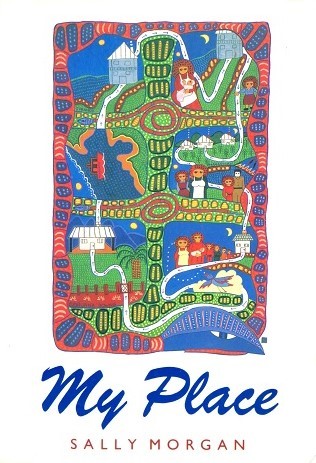
From the beginning, FACP’s focus was Western Australian artists and writers, and its early writers from the 1970s and 80s, like Elizabeth Jolley, Albert Facey (My fortunate life) and Sally Morgan (My place), are still internationally renowned.
This early success continued in the 1990s, with authors like Kim Scott, whose Benang won the 1999 Miles Franklin Award. Winn notes that in this decade FACP diversified, with their catalogue at the time of his writing, including “a wide variety of texts in the fields of art, history, education, biography and autobiography, cultural studies, and children’s books as well as their traditional lines of literary prose and poetry.”
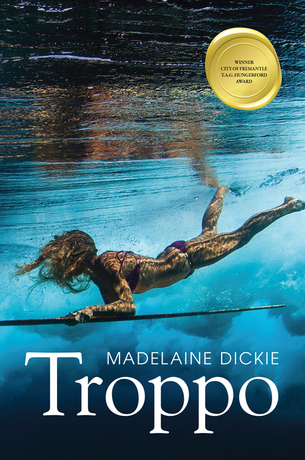
And this has continued. Fremantle books I have reviewed in recent years include Margaret Rose Stringer’s memoir, And then like my dreams (2013), and Madelaine Dickie’s novels Troppo (2016) and Red can origami (2019). Fremantle has also started republishing classics, in a series they call Treasures. Books in this series include a collection of stories by T.A.G. Hungerford, Stories from Suburban Road.
As for when it became “just” the Fremantle Press, that I found in Wikipedia – and it was 2007. Wikipedia doesn’t explain why, though.
In April 2022, the Fremantle Library unveiled “its extensive new collection” of Fremantle Press books. Local author David Whish-Wilson is quoted as saying:
“I applaud the step taken by Fremantle Library to gather Fremantle Press’ entire list and back-list in one place, and I, for one, will be eagerly perusing the shelves.”
Any initiative which aims to ensure continued availability of backlists (like the Untapped project I wrote about earlier this year) must be commended. Of course, you would expect libraries to be at the forefront of such endeavours, but in these days of reduced resources, even they cannot always provide the depth of collection that we would expect of them.
As well as publishing books, Fremantle sponsors two writers’ awards:
the City of Fremantle Hungerford Award, co-sponsored by the City of Fremantle and Fremantle Press, is “Western Australia’s most prestigious award for an unpublished work of adult fiction, narrative non-fiction or young adult fiction by an unpublished writer”. The prize is $15,000 cash and a publishing contract with Fremantle Press.
The Fogarty Literary Award, co-sponsored by the Fogarty Foundation and Fremantle Press, is a biennial award for an unpublished manuscript (of adult fiction, narrative non-fiction or young adult fiction) by a Western Australian author aged between 18 and 35. The prize is $20,000 cash and a publishing contract with Fremantle Press.
If you are an Aussie who was sentient in the 1950s and/or 60s, you have probably heard of Rachel Henning. If not, she may be new to you, though she does have something of a classic status in Australia. Let me explain.
Rachel Henning (1826-1914) was an Englishwoman who came to Australia in 1854 with her sister Amy, following her brother Biddulph and another sister Annie who had come previously for Biddulph’s health. She did not enjoy the life: she was homesick, she disliked bush life “extremely”, and hated the hot climate. She wrote on 29 March 1855 of being
tired of the perpetual glare of sunshine. Fine days here bring me no pleasure as they do in England: they are too hot and too numerous, and besides, you cannot enjoy them by taking nice walks–there are no walks to take.
So, she returned to England in 1856. However, in 1861, back she came to Australia, determined to be more positive, and found it much more to her liking. It was well into autumn when she landed on this second trip, which helped. After spending a few days in Melbourne, she got a steamer up to Sydney arriving there in mid-May. She writes in her first letter after arrival:
The next morning I got up early, and a most lovely Australian morning it was, the sun shining and everything looking bright and beautiful.
…
I do not know how to give you any idea of the beauty of Sydney Harbour. I certainly underrated the Australian scenery, but, then, it is winter now; I should tell a different story in the heat and dust of summer. (Letter to sister Etta, May 15, 1861)
After spending a little time in New South Wales, she joined her Australian family in the Bowen region of Queensland where Biddulph had taken up a property. From there she lived in several parts of eastern Australia, before spending the end of her life in Sydney.
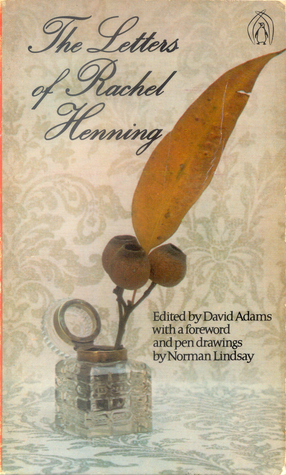
Penguin ed. 1969
Rachel Henning died in 1914, but her letters, which were never intended for publication, were not published until The Bulletin serialised them over 1951 and 1952. This was followed by publication as a book in 1954, illustrated by none other than Norman Lindsay, and edited by David Adams. Here is where it gets interesting because, as Bill writes (and as Judy Stove told my JASACT group), Adams severely edited them (reminding us of how Austen’s sister Cassandra “curated” Austen’s life by destroying so many of her letters). Bill reports that Adams reduced the original 179 letters down to 90. Not only did he remove repetitive salutations etc, but he also deleted references to “women’s problems” (which would be so interesting now) plus her most scathing comments about her fellows and most of her complaints about ‘colonials’. None of this editing was acknowledged at the time, and was only exposed decades later.
I’m not sure, and nor was Judy Stove, about the current state of the original manuscripts – or whether there are plans to release a more complete edition of the essays. However, Stove said that Norman Lindsay apparently liked the letters, and, I believe, likened them to Jane Austen’s letters which, unlike many male readers, he also liked.
Now, at the beginning I indicated that Henning’s letters were very popular in the 1950s and 60s, but implied that, if you weren’t sentient then, you may not have heard of her. This is because she fell out of favour, mainly, said Judy Stove, due to her “snobbish” attitudes, including to First Nations Australians. These attitudes changed a little over the time, with her expressing some humanity towards the original inhabitants. Fundamentally, though, it appears, as Bill cites cacademic Anne Allingham saying, that Henning “became party to the pastoralist’s pact to maintain silence on frontier conflict, the hope being that silence would imply that it simply did not exist.” In the letters, she clearly distinguishes between the “wild blacks” and the “boys” who worked on the station. She does seem aware that the term “boys” is not really right, but still, she accepts the status quo:
He [Biddulph] takes with him Alick, one of the blackboys–they are always called “boys”, though the said Alick must be thirty-five at least. People who are going for a long journey almost always take a blackboy with them. They are most useful servants in the bush, get up the horses in the morning, light fires at night, and know by a sort of instinct if there are any wild blacks lurking in the neighbourhood of their camp. They are very faithful, too. I never heard of an instance of a traveller being murdered or robbed by his own blackboy. (Letter to Mr Boyce, 23 March 1864)
Regardless (or perhaps because) of these attitudes – which were not uncommon in her time – Henning offers valuable insight into colonial Australia. Caldwell puts in this way, at the end of her ADB entry:
Her letters read like a novel with ‘darling’ Biddulph the hero, and give an invaluable picture of colonial life; with vivid descriptions and shrewd, if not always charitable, observations on people, they have both charm and humour.
Australian Women Writers blog (AWWC): review of the letters by Bill Holloway (The Australian Legend), but includes the interesting story of the letters’ publication
As I often do with Library of America (LOA), I bookmarked their recent Story of the Week featuring Ernest Hemingway’s short story “Cat in the rain” to read later. “Later” came today. I have no Hemingway on my blog, so this seemed a perfect opportunity, and I do like short stories anyhow.
First ed. cover, from Wikipedia article. Public domain.
With many of my LOA posts, I need to start by introducing the writer, but this is not one of those occasions. However, if, perchance, you don’t know who Hemingway is, you can check his Wikipedia article.
Meanwhile, some background to the story. It was originally published in Hemingway’s first short story collection, In our time, in 1925. It is a very short, short story, but it has, according to LOA’s notes, garnered much critical interest. There is also a Wikipedia article on it. I’m not sure how much more I can add to what’s been said, given I am not a Hemingway scholar. However, I enjoyed reading it, partly because it felt more sensitive than macho, so I will say something!
“Cat in the rain”
The storyline is simple. An American couple is on holiday in Italy, and the story is set in and around their hotel. It’s raining, so they are stuck in their hotel room, she staring out the window and he lying on the bed reading. She sees a cat outside, hiding under a table, and she wants to rescue it. On her way outside, she sees the hotel-keeper (“padrone”), whom she likes. When she gets outside, however, the cat has gone, so she returns to her room and her husband. Wikipedia tells you exactly what happens, but generally I try not to spoil stories here, unless I know they are well-known (like, say, Pride and prejudice.)
The thing I like about Hemingway’s writing – though I’ve only read a little, and that was decades ago – is its spareness, and this is on display here. There are short, plain sentences, and simple repetition. These make it not only strangely beautiful to read but convey so much while seeming to say little. They convey a tone of lassitude, and also a sense of tension or lack in the marriage, though not a cross word is spoken.
Here is the wife, passing the hotelkeeper on her way out to find the cat:
He stood behind his desk in the far end of the dim room. The wife liked him. She liked the deadly serious way he received any complaints. She liked his dignity. She liked the way he wanted to serve her. She liked the way he felt about being a hotel-keeper. She liked his old, heavy face and big hands.
There is lovely rhythm to this – but there is also information about her character and about what she likes in people. Later, back in the room, her husband George asks her what happened. She tells him the cat had gone, then:
“I wanted it so much,” she said. “I don’t know why I wanted it so much. I wanted that poor kitty. It isn’t any fun to be a poor kitty out in the rain.”
George was reading again.
George, in other words, is not listening to her wants or, indeed, needs, because both are wrapped up in this statement. I love this: the repetition (again), the staccato-like rhythm, and the direct, plain statement about George conveys, almost paradoxically, such intensity.
David Lodge, according to LOA, has written a “thorough and now-classic examination of the story” noting conflicting interpretations. They quote him as saying:
“although it is a well-formed narrative, with a clearly defined beginning, middle and end, the primary action is not the primary vehicle of meaning.” That is, the story presents “a plot of revelation (the relationship between husband and wife) disguised as a plot of resolution (the quest for the cat).”
That makes sense to me from my reading of the story; I read it as being about the wife, her needs and her relationship with her husband.
The story also – and Lodge’s comment doesn’t contradict this – exemplifies Hemingway’s theory of omission (or “iceberg theory”), which is the idea that, as with icebergs, there is more below the surface than above. In this case, there is the idea, for example, that there is more to the cat than just being a cat, even though Hemingway doesn’t tell us what. That’s for us to consider – and the critics sure have.
There are other reasons this story interests critics and Hemingway aficionados, a major one concerning whether it is autobiographical. According to LOA, Hemingway, himself, wrote to F. Scott Fitzgerald saying that it wasn’t about his wife, Hadley, even though they thought it was. However, continues LOA, there’s evidence that she was at least the inspiration, and that biographers agree. Hemingway biographer, Michael Reynolds “admits … that Hadley must have recognized her own marriage in the portrait of the couple”, and Hadley biographer, Gioia Diliberto agrees that “it’s not hard to see Hadley’s vulnerability and loneliness in ‘Cat in the Rain.’”
I can see why this story has garnered such interest. Despite its seeming simplicity – the story itself isn’t hard to understand – there are multiple ways it can be thought about and interpreted, from the opening sentence to the intriguing last.
If you haven’t read it, do consider giving it a go at the link below – it really is short, and quick to read. If you have read it, what do you think?
Last Thursday night we went to our fifth Seymour Biography Lecture at the National Library of Australia. We missed the last one in 2019 because we were travelling. Little did we know then that it would be three years before another one could be held. The Seymour Biography Lecture, which is one of the highlights on the Library’s calendar, is an annual lecture devoted to life-writing. It was endowed by Dr John and Dr Heather Seymour AO in 2005, and provides eminent ‘life writers’ with an opportunity to explore the business and craft of biography, autobiography or memoir.
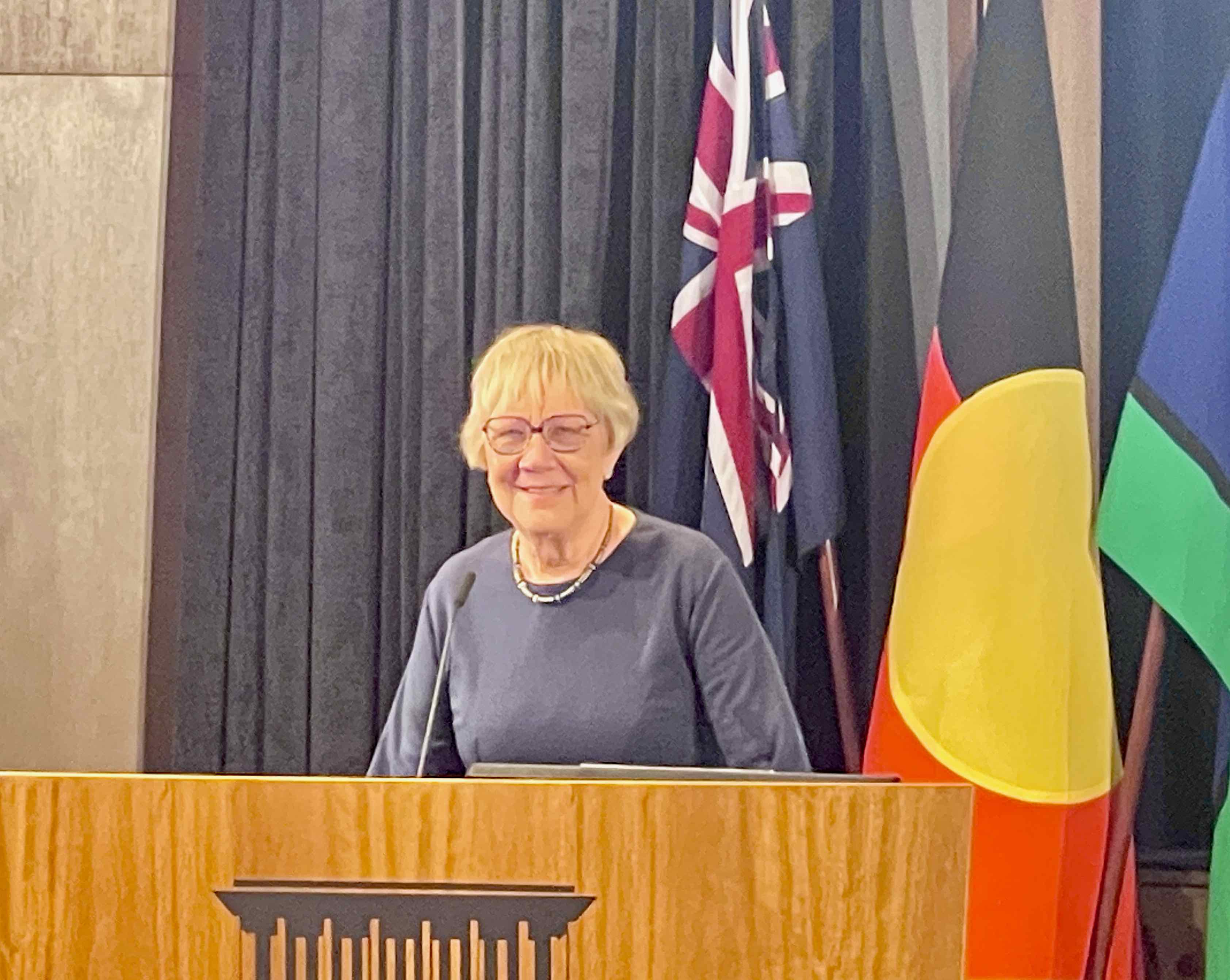
Jacqueline Kent, Sept 2022, National Library of Australia
This year’s speaker, Jacqueline Kent, was introduced by the NLA’s Director-General, Marie-Louise Ayres. She has an impressive life-writing track record, including:
A certain style: Beatrice Davis, a literary life (2001): won National Biography Award and the Nita B. Kibble Award
An exacting heart: The story of Hephzibah Menuhin (2008): won the Nita B. Kibble Award
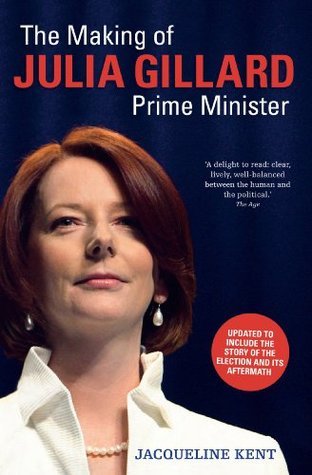
The making of Julia Gillard (2009): written before Gillard became Australia’s first female Prime Minister
Take your best shot: The Prime Ministership of Julia Gillard (2013): covers her Prime Ministership, and her story isn’t finished yet, said Kent.
Beyond Words: A year with Kenneth Cook (2019): a memoir; shortlisted for National Biography Award (Lisa’s review)
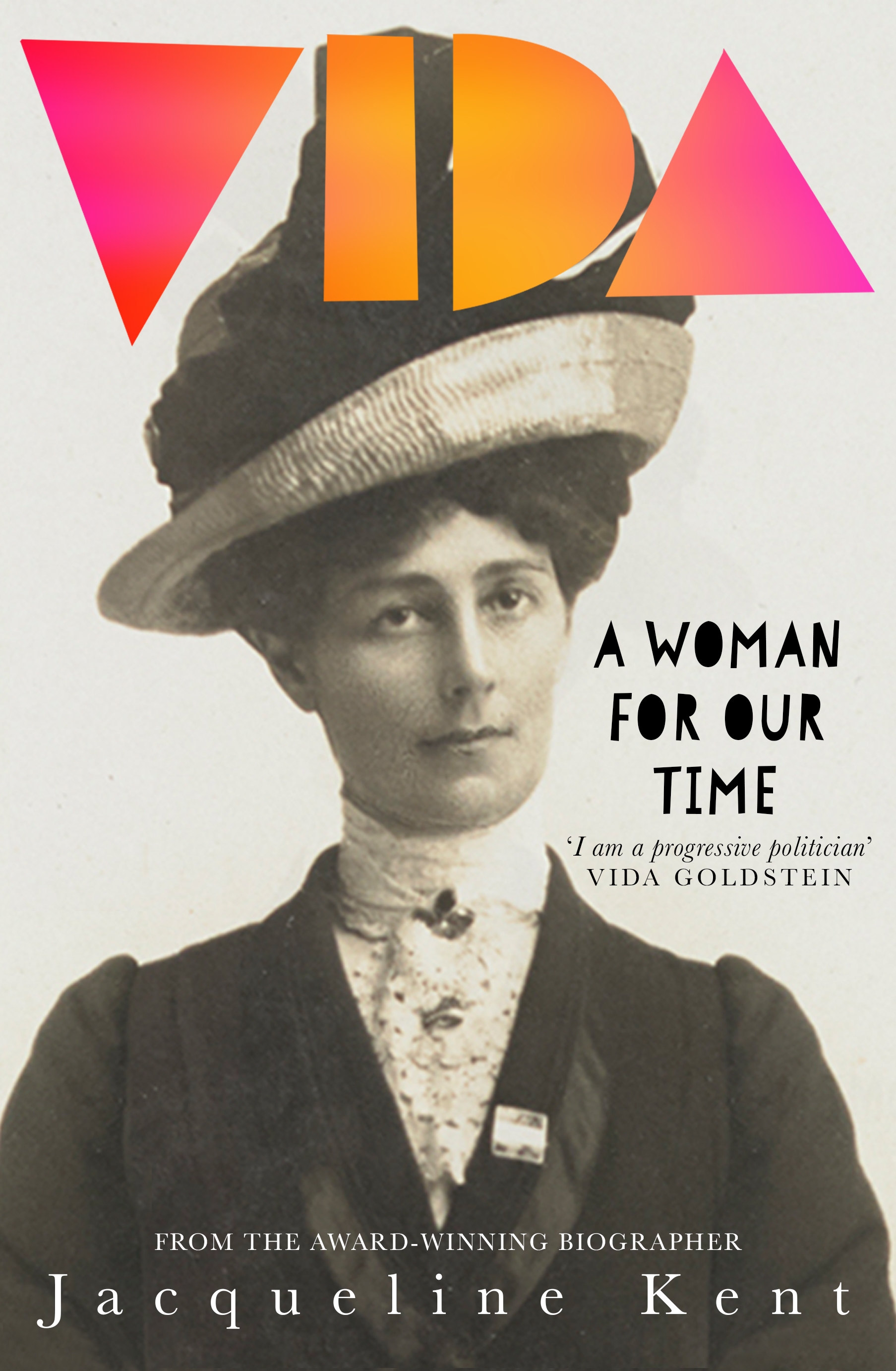
Vida: A woman for our time (2020)
Kent, though, first came to my attention long before these, with one relevant to my work, Out of the bakelite box: The heyday in Australian radio (1983). She trained as a journalist and broadcaster, but has also been a book editor and reviewer, and has written fiction for young adults. She was, I have to say, one of the liveliest Seymour lecturers I’ve heard, and is also the first woman I’ve heard (though 2019’s lecture was also by a woman, Judith Brett).
Kent set the tone she was to take by saying that “biography” is such an important word that maybe she should start with the great biographers of the past, like Tacitus, or Boswell, or Lytton Strachey, but she wasn’t going to. Instead, she was going to “lower the tone” and go to Donald Rumsfeld, which of course brought a chuckle from the audience. You can probably guess what’s coming and you’re right; she was going, she said, to structure her discussion by using Rumfeld’s now famous statement that
there are known knowns; there are things we know we know. We also know there are known unknowns; that is to say we know there are some things we do not know. But there are also unknown unknowns—the ones we don’t know we don’t know.
She said that this oft-maligned statement does contain some truths. (Yes, agree.) It also reminds her of a quote by Artemus Ward, that was loved by Abraham Lincoln: “It ain’t so much the things we don’t know that get us in trouble. It’s the things we know that ain’t so.” For a biographer all these knowns and unknowns can be quite a challenge.
She would these ideas, she said, through what she knows best, her own work.
Known knowns
What you know, said Kent, usually provides the impetus for starting a biography. It’s some interesting fact, or some central mystery (what made them do it, what did they think they were doing) that makes you want to investigate them. You write about them because “they are worth memorialising”. You also want to like your subject because you spend a few years with them.
Her first full biography was of Angus and Robertson’s legendary editor, Beatrice Davis, for whom she had worked. Davis was the “grand dame” – in every sense of the word. She did not like the new writers coming up towards the end of her career, like Helen Garner and Kate Grenville! Kent said that many books about publishing focus on the challenges and problems, but she want to write about what fun it also is. She wanted to give her profession its due. Also, she said, these days a book can be produced without ever seeing paper – writing, editing, publishing, can all be digital – so she also wanted to create a record of an industry that was changing.
As for Hepzibah Menuhin, she and her brother Yehudi were “rock stars” of their time. Kent’s interest here was in people with precocious talent, and what happens to them. Having been nurtured and feted as a musician, Hepzibah suddenly married, at the age of 17, a Victorian grazier and pharmaceutical company heir, and pulled back on her career. Then, she suddenly left her husband and 9- and 11-year-old sons to return to Europe. What someone to do that? She hurt a lot of people, said Kent, but had no idea of this.
Julia Gillard was suggested to her as a subject. Her interest here were what drove Gillard and what were the steps she took along her way. The mystery was what led her, as an up-till-then loyal Deputy Prime Minister, to undermine Kevin Rudd. Kent felt that Gillard had enormous dignity post-parliamentary-career, particularly in not getting involved in Australian politics, unlike others. She was a challenging subject, however, because she was guarded.
Vida Goldstein was a much easier subject because she was dead and she had no family, so there were no descendants to worry about. She had previously been written about in a worshipful way.
Known unknowns
These, said Kent, are the things you know you have to find out, the things that illuminate a subject. Often friends will share things you already know, because they think they have been privileged to know them. But some information can be hard to unearth. With Hepzibah Menuhin, a critical question was her divorce, the events surrounding her divorce. In this case, out of the blue, she had a stroke of luck when, visiting Hepzibah’s niece, she was suddenly given a bunch of correspondence written between Hepzibah and her father around the time of the divorce. This enabled her to finish the book.
Unknown knowns
This was not in Rumsfeld’s list, Kent said, but it refers to the things you don’t realise you know. Regarding her memoir about her life with the author Kenneth Cook, who was her husband for a year and is best-known for the novel Wake in fright. As she wrote the book, she realised that despite its bleakness, it had a jocular tone. It also, in fact, tells the same story as They’re a weird mob, except that this letter was specifically played for laughs. She also realised that Cook’s novel, The wine of God’s anger, is also the same story. It’s not an unusual story – the arrival of a stranger in a place unfamiliar to them – but that Cook told this story more than once was telling.
(Interestingly, she suggested that The wine of God’s anger is “the only complete Australian anti-Vietnam novel”. However, I can think of Josephine Rowe’s A loving faithful animal (my review). Any others?)
Unknown unknowns
These are the worst, said Kent. They can be the things you find out just when you are going into print, or, worse, when it’s too late.
The first is that your knowledge of the past–apart from, occasionally, a limited visual record and the odd unreliable survivor–comes entirely from written documents.
[…]
The second realization that strikes you is, in a way, the opposite of the first: the more material you dredge up, the more elusive the subject becomes … One instinct you need in doing historical research is knowing when to keep dredging stuff up; another is knowing when to stop.
But, you can’t make stuff up she said, and she referenced the controversial case of Dutch: A memoir of Ronald Reagan, by Edmund Morris, which was intended to be a biography but ended up being more fiction than biography. It was “presented as a proper researched biography” but, she said, you have a contract with reader, which means you can speculate but you must flag it.
She also talked about how small incidents you discover in your research can turn out to be real “depth charges”. One example was discovering that Beatrice Davis, working at a time when women couldn’t work after marriage, had got married during lunch in a Registry Office, and went straight back to work as Miss Davis. Hepzibah’s wedding photo revealed a very strange outfit which Kent suddenly realised was Hepzibah emulating Little Bo-Peep. (She was marrying a grazier. This outfit gave insight into her expectations.)
Then there was working out Vida’s washing. Vida was always praised for her looks, not what she said. Who did her washing, to enable her to look so fresh when she was on speaking tours? Questions like this drive you mad, Kent said. Julia had always described how poor she’d grown up, but then her parents bought her a car to drive to Melbourne when she left Adelaide as a young woman. This gave insight into her family’s love and their closeness. Details like this bring your subject alive on the page.
To conclude, Kent, with a bit of a wink, went erudite, sharing a quote from the London Review of Books. She said “this is a bit pay-attention-class”! Unfortunately, I didn’t pay attention, so missed the name of the writer she was quoting, and can’t find the full quote. It started something like, the “past is more unknown than known”. A cautionary point for biographers and historians.
Q&A
There was a short Q&A, which included the following:
On biographer’s role: there’s what biographers know and the public doesn’t. Often the public has a caricatured view. The biographer’s job is to show a multifaceted person (but Edmund Morris couldn’t find one in Reagan!)
On getting family/descendants’ support: people find it flattering to have their relative the subject of a book, but problems arise when questions get close to the bone (as they did for Gabrielle Carey with the family of Randolph Stow, but she managed to get around the issue.) She struck problems with extended family in her biography of Hepzibah, and Kenneth Cook’s children were not happy with her memoir. Families are a minefield.
On whether knowing the techniques of psychology helps: no, she doesn’t find it so; it tends to be too generalised, and can lead to too many rabbit holes, which biography is full of anyhow!
That seems a good point on which close this report. It was an enjoyable and entertaining lecture, which took a fresh, practical approach to the subject.







 Whispering Gums