This week’s question is new to me, and I like it. It goes:
Pick your top novellas in translation and think about new genres or authors you’ve been introduced to through novellas.
I love this question because it feels like I’ve read almost more novellas in translation than English language novellas. Is this because translation is such a difficult and expensive task that publishers tend to commission translations for shorter books more than for longer ones? But no, I don’t really think so. Just look at all those big Russian classics that have been translated – and translated more than once. My guess is something more simple, that perhaps some literary cultures value novellas more than others.
This idea is supported by something I read only a few months ago in Trove. The article, which appeared on 6 July 1907 in Sydney’s The Australian Star, cites an English writer named Basil Tozer, who had made a “plea for shorter novels”. He commented that
The habit of loading a story with indifferent descriptive passages still prevails to a great extent, though it might with considerable advantage be dispensed with. A beautiful woman loses her charm when every good point she possesses, from the creamy smoothness of her complexion to the alluring, curve of her eyebrow, is described separately and in detail; and in the same way a glorious scenic panorama metaphorically falls flat when every square mile of it is analysed and dissected.
He says these “faults” are “commonest among young writers” but also occur “among some of our novelists who have served a long apprenticeship”. He doesn’t name these offending writers, but he does name the opposite, French writers like Daudet, Hugo and de Maupassant, whose writing includes no “superfluous verbiage”. These are, he admits, three of France’s most polished fiction writers, but even “the rank and file” French novelists “seldom err upon the side of overloading their work with unnecessary vocables and third-rate descriptive passages”. He argued that British novels would be strengthened if they were more condensed. That was over 100 years ago, but I wonder – without much evidence to support it – whether there really is something cultural in this?
Whatever … I can say that of the translated fiction I’ve read over the years, novellas represent a large proportion. This started way before blogging, and is not because I specifically chose to read novellas. They just seemed to be the books most often recommended to me.
So, before blogging, my favourites included Albert Camus’ The outsider (French, and which I did first read in French, as L’étranger, at school), Alexander Solzhenitsyn’s One day in the life of Ivan Denisovich (Russian), and Gabriel Garcia Marquez’s Chronicle of a death foretold (Colombian). These three have stuck with me over a long time. Marquez’s has such a mesmerising opening, “On the day they were going to kill him…”
Since blogging, I have read so many compelling translated novellas that I find it hard to choose, but I’ll name three, in alphabetical order by author, that have captured my interest:
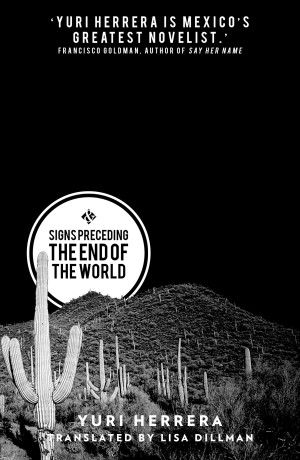
- Yuri Herrera, Signs preceding the end of the world (Mexican, my review), because it deals with the Mexican-USA migration issue, but with an almost mythical tone that overlays it with a bigger story about crossings and transitions.
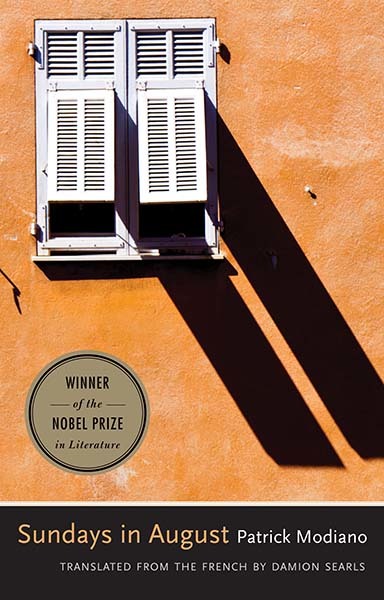
- Patrick Modiano’s Sundays in August (French, my review), because of the carefully structured journey we are taken on, one that leaves us at the end with so many questions to think about, while also revealing enough about what had happened that we know its impact on the protagonist.
- Sayaka Murata’s Convenience store woman (Japanese, my review), because of the way Murata gets into the head of her mystified outsider in a culture that values conformity.
I found it hard limiting myself to three but, it had to be done or I’d go on forever.
In terms of how these have broadened my horizons, well, there’s the obvious thing to do with reading different cultures. Herrera’s and Murata’s books deal with issues I know to be significant in their cultures, but it means something to read about them from artists working within the culture rather than from the perspective of the news. Modiano’s exploration of disappearance, loss and memory is less obviously a specifically French issue, but it does I think have roots in a postwar European sensibility.
Each book uses the novella form a bit differently, but each is characterised by a sustained tone which can denote a novella. By this I mean that novels, being longer, will often vary the tone because not to do so could become oppressive, whereas the intensity of a sustained tone (whatever that tone may be) is part of what makes a novella. I’m generalising of course, but this seems to be the case in the novellas I love.
As for the other part of the question. I don’t think I’ve been introduced to new genres through novellas, just to different ways of writing those genres, but I have certainly been introduced to many great new writers – like the three above, for a start. But, moving away from translation, I have been introduced to other writers too through their novellas, such as Edith Wharton through her intense Ethan Frome. From that introduction, I went on to fall in love with Edith Wharton.
Novellas … any whichway, I love them.
What about you?
Written for Novellas in November 2023








 Whispering Gums