Jo Baker, Longbourn (Review)

Jo Baker, Longbourn

Used by permission of The Random House Group Ltd

“Never say never” is one of my favourite mottos, though I must admit there are some things I never will do, such as climb Mt Everest, say, or even write a novel. However, when it comes to reading choices, there are certain types of books that are not my preference, such as crime and Jane Austen sequels, but as regular readers will have seen over the years I can be persuaded. And so, I was persuaded to read Jo Baker’s Longbourn: Pride and prejudice, the servants’ story, a Pride and prejudice spin-off, for my local Jane Austen group’s monthly meeting. I can’t say I loved the book, but it did interest me.

So, what’s it about? As the title suggests, it concerns the “downstairs” staff, the servants, at Longbourn, the residence of the Bennet family of Pride and prejudice. These servants appear, either directly or by indirect mentions, in Austen’s novel, but of course we know nothing about their lives. Baker rectifies that in her story by exploring who they are, how they got there, and what their aims and ambitions are. There’s Mr and Mrs Hill (butler and housekeeper/cook), Sarah and Polly (housemaids) and, for a short time, James the footman. The “heroine”, if a poor orphan housemaid with bleeding, chill-blained, “pruney” hands can be called that, is housemaid Sarah. The plot, particularly concerning James and his relationship to Longbourn, is a little melodramatic and the romantic resolution a little predictable for my tastes but it is probably traditional historical fiction fare. The book is well-written, the characters realistic and engaging, and the plot well-paced. I’m no expert in the genre but it is, I’d say, a perfectly fine example.

Baker nicely handles the relationship with the “parent” novel. The downstairs staff are privy, of course, to what happens to the Bennets, so we see many of the scenes, such as Mr Collins’ proposal to Elizabeth and Lydia’s “elopement” with Wickham, through their eyes. They have their own views on the characters and their own reactions to the events. Baker’s imagination of these is completely believable. Mrs Hill, for example, is sympathetic to Mrs Bennet, understanding that much of her behaviour stems from Mr Bennet’s lack of love and respect for her. She is also very aware of the precariousness of the servants’ situation. What will happen when Mr Bennet dies and the estate falls into Mr Collins’ hands? Will there be enough work for them all as the young misses marry and leave Longbourn?

All this was interesting enough, and the story wasn’t so melodramatic that I was turned off, but what mostly captured my attention was Baker’s evocation of the life of servants in Regency/Georgian times. They work hard, and over long hours, sometimes from 4.30am to 11pm. Baker describes in some detail their duties such as laundering and the hand-ruining scrubbing needed to remove stains, the emptying of chamber pots, and the making of soap and other products such as dubbin. Their needs and feelings are rarely considered. Even “kind” employers’ like the Bennets tend to be oblivious of their servants’ lives, just as the thoughtful Anne Elliot in Persuasion doesn’t notice her sick friend Mrs Smith’s nurse. Their living quarters are cramped, in uncomfortable parts of houses, with housemaids often sharing a bed. Through James, the footman, we learn about the awful lives of young men who “take the King’s shilling” and end up fighting in harsh conditions, treated like fodder and at the mercy of corrupt superiors. James realises:

I had handed my freedom right over. I signed it clean away. I sold myself.

In addition to these rather era-specific aspects of the book were references to behaviours that are more universal to relationships involving disempowered people. One relates to naming. There are two such situations in Longbourn. There’s housemaid Polly whose real name is Mary, but

It’s only ‘cos she’s the Miss and I imnt, that she got to be called Mary, and I had to  be changed to Polly, even though my christened name is Mary too.

This practice, we know, wasn’t limited to English servants. It happened regularly, for example, with indigenous people, as Kim Scott tells us regarding the naming of Bobby in That deadman dance (my review), and Eleanor Catton regarding her Maori character in The luminaries (my review). Then there’s Bingley’s footman, the mulatto Ptolemy Bingley. When Sarah questions his last name, he says:

If you’re off his estate, that’s your name, that’s how it works.

The other issue that struck me was the way servants watch their masters/employers. I’ve already noted that the employers often didn’t notice their servants, but the servants sure noticed them – and more than was simply required for the work they were employed to do. Servants needed to watch because their lives were closely attached to the fortunes of their masters. Similarly, I’ve read that indigenous Australians watch and know non-indigenous Australians way better than we know them. As indigenous activist Lee says in Margaret Merrilees’ The first week (my review):

You think we can’t see you? You think we haven’t been watching you for two hundred years? We’ve had to find out everything there is to know about you.

These sorts of insights are, for me, one of the prime values of reading historical fiction – the lessons learned about how we’ve been and behaved, and the historical continuities between people and times. It’s for these reasons, in particular, that I’m not sorry I devoted some precious reading hours to reading Longbourn.

Jo Baker
Longbourn: Pride and prejudice, the servants’ story
London: Doubleday, 2013
365pp.
Design: Clare Ward
ISBN: 9780857522023

Sue Milliken, Selective memory: A life in film (Review)

Sue Milliken, Selective memory

(Courtesy: Hybrid Publishers)

Funny how things go sometimes. I may not have read Sue Milliken’s memoir, Selective memory, had the publisher, Hybrid Publishers, not noticed my rather particular interest in film via my recent review of Margaret Rose Stringer’s And then like my dreams. I’m glad they did because this book took me down memory lane …

Sue Milliken is a name well-known to me through my career as a librarian-archivist working with film and television. Her career as a film producer started in the same decade, 1970s, that my career started (albeit mine towards the end of the decade). Consequently, I enjoyed her memoir. She writes in her author’s note at the beginning that she had intermittently kept a diary, that

as the dramas around me escalated, I found myself given to recording the day’s events. They form the basis for this work.

She acknowledges that other participants “may have widely varying memories and opinions of the same events”. This is obvious, really, but probably a wise point to make when writing about an industry high in emotion and ego. Never hurts to cover yourself! And Milliken, while I suspect she has been quite circumspect in places, is rather honest in this book. She’s not afraid to let her feelings be known about certain people, such as the former wife of Barry Humphries, Diane Milstead. Diane and I, she writes, “quickly grew to loathe each other”. Admittedly, they were working on a disastrous film, Les Patterson Saves the World. How, she asks, “do you tell the funniest man in Australia that he’s not funny?” They tried, she says, and some changes were made, but “the train had left the station and we were along for the ride”. There are many such moments in the book. One that made me laugh relates to her decision to not let on to a large group of her peers that her current production, Total Recall, was going belly-up:

Anything was preferable to telling 200 industry schadenfreudeists at the conference, here are the sets but the movie has just been cancelled.

Australian director Bruce Beresford, who has made three films with Milliken, writes in the introduction that this is “a forthright and witty account”. He’s right about that.

Milliken tells her story pretty much chronologically, and focuses primarily on her work, with occasional references to her personal life. I must say that, being a typical voyeuristic reader, I’m usually interested in people’s lives, but the snippets included here sometimes felt like items from the cutting room floor. That is, they seemed to be just popped in, perhaps because that’s how they appeared in her diaries, or perhaps because they showed that she did have a life too! I enjoyed it all, but in terms of coherence, I’m not sure these little asides were necessary. What was necessary, though, was her insider’s insight into some of the most important decades in Australia’s film history.

Her main role in the industry has been as a producer; she has produced many major Australian feature films, including The Fringe-dwellersBlack Robe, Sirens, Paradise Road. However, Milliken has also worked as a film guarantor and a film censor, and held significant positions in the industry such as Chair of the Australian Film Commission, a board member of ScreenWest, and president of the Screen Producers’ Association of Australia. As you can imagine there’s a lot of politics behind these organisations, and she has many times been at the centre of them. She chronicles it all clearly but lightly, not bogging us down in excessive detail, but getting the salient points across.

But now, I’m going to go subjective, and pick out a few points in the book that have particular interest for me. The first relates to the film, The Fringe Dwellers (1987). Adapted from a novel by Nene Gare, it’s about an indigenous Australian family living on the fringe of an Australian country town. It was a moving and confronting movie, but of course it was made by white Australians from a book by a white Australian. Having recently discussed this contentious issue in a post, I was not surprised to read that there was criticism “from young Aboriginal activists who disapproved of white filmmakers telling a story about Aboriginal people, and of the story itself which was written by a white writer”. Milliken agrees that they had a point, though she also notes the positive aspects of the process – work for indigenous Australians, and increased understanding of indigenous issues for her, the cast and crew (and, hopefully, for the audiences). In 2008, Milliken was made an Officer of the Order of Australia (AO) for, among other things, support and encouragement of indigenous filmmakers. This is not to ignore the problem, but it indicates goodwill and intentions on Milliken’s part.

Another relates to Paradise Road (1997), the film of which she’s the most proud. I smiled when she discussed the casting. Its ensemble cast includes many significant actors such as Glenn Close and Frances McDormand. I happened at the time to know a good friend of the director, Bruce Beresford, and this friend and I were chuffed that Beresford (who, I believe, was also chuffed) had managed to get Jennifer Ehle for the cast. Ehle was, of course, the gorgeous Lizzie Bennet in the famous Colin Firth Pride and Prejudice (1995). It’s always bothered me that Ehle has never got the recognition she deserved for that role, all because of the fawning, which I totally understand mind you, over Firth. Anyhow, what amused me was that while my colleague and I were thrilled about Ehle, Milliken was fighting to get another, still largely unknown, actor for the film – Cate Blanchett! It was, I gather, her first feature film.

The third film I want to mention is one that hasn’t been made, The Women in Black, from the book by Madeleine St John (my review). As I’ve mentioned before, Bruce Beresford was very taken with the book and wanted to make the movie. It was Milliken he approached. She agreed that it would “make a charming film” and writes “we set about acquiring the rights”. At the completion of Paradise Road, it became the film she most wanted to do but financing “proved elusive”. It is apparently still proving to be so!

Milliken’s memory may be selective, and she may not have told every story worth telling, but this is a good read, not just for those interested in Australian film history but for anyone interested how films are made, particularly from a producer’s point of view. 

awwchallenge2014Sue Milliken
Selective memory: A life in film
Melbourne: Hybrid Publishers
267pp.
ISBN: 9781921665875

(Review copy supplied by Hybrid Publishers)

Monday musings on Australian literature: Capital women novelists

Hmmm … it’s taken me a while to get back to my so-called series on Canberra’s writers. Over a year ago I wrote posts on Capital women and Capital men poets, and fully intended to write about the fiction writers last year too, but somehow the year got away from me. However, today is Canberra Day, the day we celebrate the “birth” of Canberra, and so it seemed like a time to get back to my series. As I did with the poets, I’ll start with the women, some of whom you’re sure to recognise from other posts.

Canberra Seven or Seven Writers

I have written before about this group of seven women. On one occasion, my post on Canberra’s Centenary, Dorothy Johnston wrote in the comments:

I don’t know whether you all had young families when you began your reading group in 1988, but half of us had small children, when 7 Writers started in the early 1980s. I remember Margaret Barbalet bringing her twin boys, and I quite often took my daughter – it was that, or not go to the meeting. I also remember that we held a small celebration when the combined number of our published books finally outstripped our total of children and grand-children!

Lovely story eh? The seven were, in alphabetical order: Margaret Barbalet, Sara Dowse, Suzanne Edgar, Marian Eldridge, Marion Halligan, Dorothy Horsfield, Dorothy Johnston. I have reviewed some here – Suzanne Edgar’s collection of poetry The love procession, Marion Halligan’s Valley of grace, and Dorothy Johnston’s The house at number 10 and Eight pieces on prostitution. Long before blogging, I read several others by Halligan and Sara Dowse’s West block. I still, to my embarrassment, have a book by Margaret Barbalet in my pile! Several of these authors are excerpted in Irma Gold’s anthology, The invisible thread.

A Canberra setting isn’t the criterion for this series of posts, but of course I’m interested in works that are set here. Many of these writers did set at least some of their books here, such as Sara Dowse in her novel West block: The hidden world of Canberra’s mandarins. In addition to being a novelist and artist, Sara Dowse was a high profile bureaucrat. Indeed, she was head of the Whitlam Labor government’s women’s affairs section, a position she held for around 3 years until she resigned in 1977. West block, set in the mid 1970s, draws from her experience as that public servant. My reading group, Canberrans all, loved reading about something so close to our understanding, but, looking at it now I feel rather depressed. Here is the character Cassie, fearing the impact of Labor losing the coming election:

She would have liked to thrash it out with someone. State it baldly. Look here, she might say. Women, blacks, migrants, kids, old people, the unemployed. We’re the ones who need a public sector. Not the bastards who take it for their own, then disavow it …

Oh dear … she could have written that last year, and it wouldn’t have been out of place!

Blanche d’Alpuget

I’ve only read one book by d’Alpuget, and that’s her biography of one of our most colourful prime ministers, Bob Hawke (to whom she is now married). However, she is also a novelist, with her books including Monkeys in the dark, Turtle Beach (which was adapted for a movie), and Winter in Jerusalem. She wrote her first novel, Monkeys in the dark, in Canberra, when she had a young baby. Turtle Beach, which won The Age Book of the Year in 1981, is set in Canberra and Malaysia, and explores the plight of Vietnamese boat people in Malaysian refugee camps. I’ve always meant to read this book and it seems like now – Australians will know why – would be a good time.

Francesa Rendle-Short book cover Bite your tongue

Bite your tongue Bookcover (Courtesy: Spinifex Press)

Francesca Rendle-Short

Born in Queensland and now living in Melbourne, Rendle-Short lived in Canberra for a couple of decades. She has written, among other things, novels, short stories and the fictional memoir, Bite your tongue, which I reviewed a year or so ago. Her novel, Imago, which I haven’t read, is set in Canberra in the 1960s. Blogger Dani reviewed it last year in her blog Dinner at Caph’s, and included a couple of lovely descriptions of Canberra from the book. Lisa (ANZLitLovers) also reviewed it recently. She includes a lovely description of English Molly revelling in Canberra’s summer heat. This book sounds like it might be an interesting companion to Frank Moorhouse’s Cold light (my review) which covers the same time period but looks at life in Canberra from a very different perspective to Rendle-Short’s two suburban wives.

Kaaron Warren

Warren is an author I hadn’t really heard of before reviews of her books started appearing in the Australian Women Writers Challenge, and even then I didn’t realise her Canberra connections until Irma Gold’s The invisible thread anthology. Warren has, in fact, lived in Canberra for over 20 years. However, her genre is science fiction, which is not something I seek out. I did, nonetheless, enjoy her contribution to the anthology, an excerpt from her short story, “The glass woman”. She is a multi-award winning author in her field, so if you are into science fiction and horror, and haven’t discovered her, she is clearly worth checking out.

Irma Gold

I’d like to end this post on Gold. She has not had a novel published yet though I believe she has written one and is now on the publisher trail. However, she has published a collection of short stories, Two steps forward (which I reviewed a couple of years ago and which was shortlisted for the MUBA award). It’s an excellent collection that demonstrates a sure grasp of form. I particularly liked the way she mixes up voice and point of view. There are mothers, teenagers, children, old men, and they all – this is fiction after all – confront challenges, the sorts of real challenges anyone can face, such as a miscarriage, or seeing a terminally ill friend, or working in a detention centre. I can’t wait to see what her novel is about!

As with all my regional literature posts, this contains an idiosyncratic selection and is by no means comprehensive. Some have written about Canberra, while others haven’t necessarily made Canberra their focus. They are all, though, interesting writers well worth following up when you have the inclination.

Neomad: A Yijala Yala Project

First up, I have to admit that I’m rather challenged when it comes to e-book apps. I did love The Wasteland app which I reviewed a couple of years ago, but it was clearly designed for a, let us say, more staid demographic. Neomad, “a futuristic fantasy” in three episodes, is another matter. Consequently, my aim here is less to review it as a work and more to talk about what seems to be an exciting collaborative project involving 30 young people from Roebourne in the Pilbara, comic artist Sutu and filmmaker Benjamin Dukroz.

We hear so much negativity about indigenous communities in outback Australia that it’s easy to feel the situation is hopeless. However, while we should not forget for a minute that the situation for many indigenous Australians is still dire, things are happening. Not enough, but nonetheless something, and these things can surely be seen as models for further action.

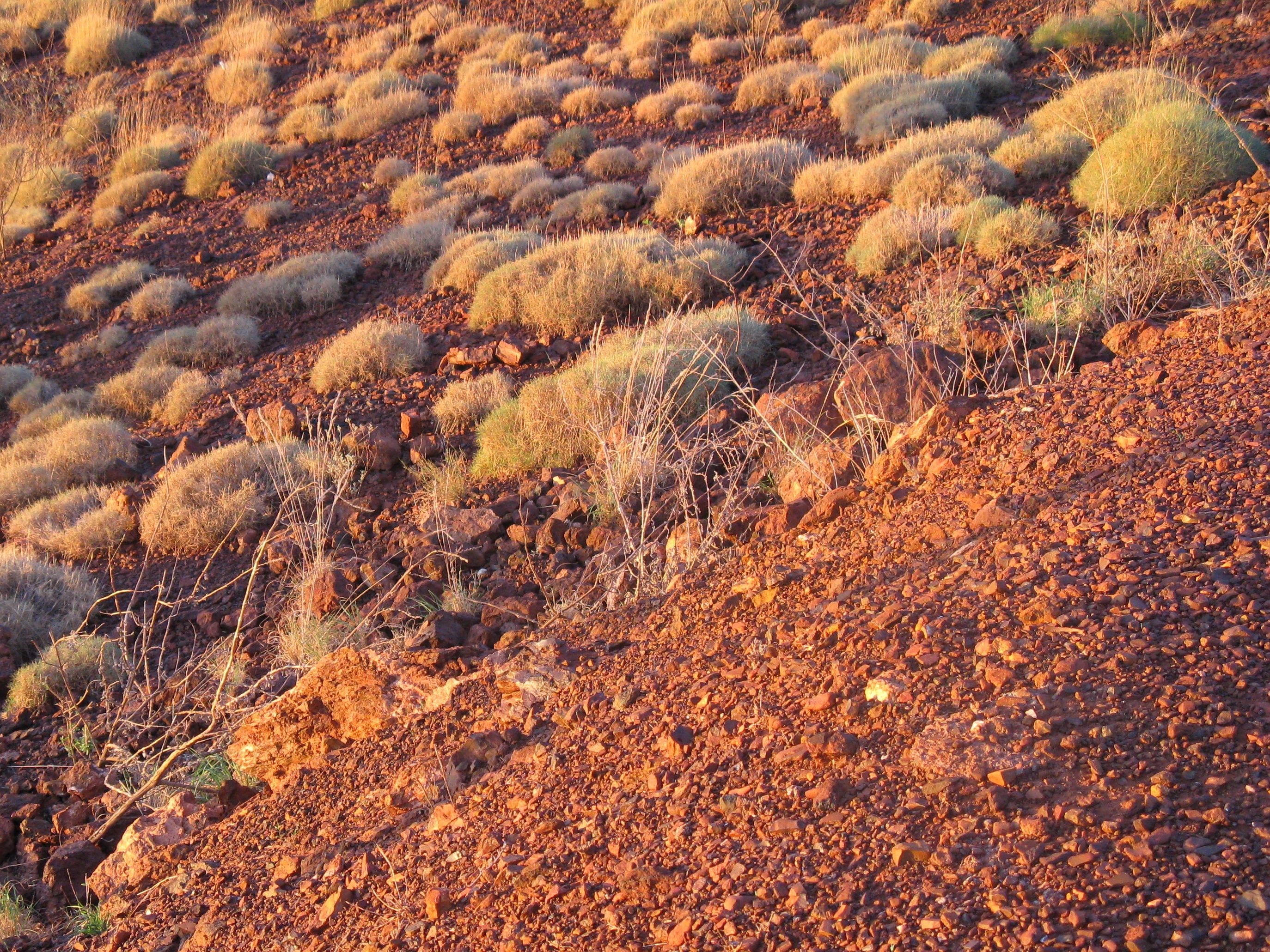
Pilbara landscape, Newman, WA

Pilbara landscape, Newman, WA

So, back to Neomad. Produced as part of the Yijala Yala Project, it’s currently available free from iTunes (or the Apple App store), so I decided to have a look. It’s colourful and infectious. The Facebook site calls it “an interactive digital comic”. Late last year it won Best Game – Multimedia Production in the 2013 ATOM (Association of Teachers of Media) Awards. So what is it? A game? A book? What’s in a name did I hear you say? Fair enough. Let’s not get bogged down in categorisation right now, except to say that it’s an example of what is apparently being described as “interactive fiction”.

Ignoring the categorisation issue, though, the ATOM site is useful for the neat little summary it provides of the story:

Set over three episodes, NEOMAD follows the story of the Love Punks and Satellite Sisters, techno savvy young heroes from a futuristic Roebourne in the Pilbara region of WA, who speed through the desert full of spy bots, magic crystals and fallen rocket boosters branded with a mysterious petroglyph.

The app itself says it is “based on real characters, places and stories that connect people to their country”. This becomes evident when you click “Play” on the Home page, as it starts with a lovely live-action sequence set somewhere in the Pilbara, involving a group of indigenous boys. They are the Love Punks and they feature in Episode 1. They tell us “When you see a star fall at night be sure to welcome it to the land for the star brings new life”. The story is set in 2076 and sees the Love Punks chasing a space robot (oops, space bot) across the sky, only to find, when it crashes to earth, that it bears the image of an ancient petroglyph. What does this mean? Episode 2 begins with quite a different live-action sequence involving indigenous girls, The Satellite Sisters, learning about the importance of their ancestors. Like Episode 1, this sequence progresses into an animated comic, which you can read as text or click on the speech bubbles to hear the characters speak the words.

As an interactive-game-challenged person I wasn’t always sure how much was on each “page”. For example, on some pages extra “things” pop up when you tap to “turn” the page. I presume that you can’t miss anything important, that no matter where or how often you tap or swipe, the app won’t take you to the next “page” until you’ve seen everything on the current page. However, I did find it disconcerting, as pages vary in layout so you never know what might be there behind the clicks! I expect this is not a problem for the people to whom the app is targeted though!

There’s an Extras section, comprising short live-action movies providing background to the project. We hear the kids talk about the meaning – one Satellite Sister tell us “that film is about the Satellite Sisters looking after the country” – and the process, such as how they learnt to use PhotoShop to colour the animation. There is also a “junk percussion” music video in which the Love Punks perform music using found objects such as corrugated iron, old drums and metal bars. I love it!

What is exciting about this project is that, amongst all the glitz and colour, it reaffirms the importance of country. As the name – Neo (new) Mad (nomad) – suggests, it marries respect for tradition with acceptance of change, looking for the points where they coincide:

“You boys need to respect these men and their robots. They’re all part of our community and they’re all looking after our ngurr, our country.”

“Sorry Nanna Tootie.”

This is kids telling a story in their language for other kids – and it is good fun. If you have young children around – and even if you don’t – do check it out. Meanwhile, thanks to E. Teacherlord, as our daughter calls her brother, for introducing me to the Love Punks and Satellite Sisters.

Adelaide Festival Awards for Literature, 2014

As you know, I don’t report on every literary award announced throughout the year in Australia. There are way too many. But I did want to announce the Adelaide Festival Awards for Literature, partly because they are only awarded biennially. They were established in 1986. The fact that they are awarded biennially means of course that they draw on a larger pool than most of our literary awards.

Ten awards/fellowships were made this year, some of them for works and/or authors I don’t know, but here they are:

  • Premier’s Award: Frank Moorhouse, Cold light (my review). Coincidentally the first book in Moorhouse’s Edith trilogy, of which Cold light is the final book, won the 1994 Adelaide Festival Award. Cold light also won the Queensland Literary Prize last year.
  • Nonfiction: Kate Richards, Madness: A memoir. Richards’ memoir about living with psychosis for 10 years was also shortlisted for the 2013 Queensland Literary Awards Nonfiction prize.
  • Children’s literature: Catherine Jinks, A very unusual pursuit. Jinks is an established, multiple award-winning author of adult and children’s fiction in multiple genres, including science fiction and crime.
  • Young adult fiction: Vikki Wakefield, Friday Brown. Wakefield apparently won this award in 2012, also.
  • John Bray Poetry Award: Lisa Jacobson, The sunlit zone. This book was shortlisted last year for the inaugural Stella Prize. I have this book – a speculative fiction verse novel – in my sights. According to Wikipedia, the late John Bray was a lawyer, academic and published poet, and also served as Chief Justice of the Supreme Court of South Australia.
  • Wakefield Press Unpublished Manuscript Award: Cassie Flanagan-Willanski, Here where we live. I recently reviewed the winner of this prize at the 2012 Festival, Margaret Merrilees’ The first week.
  • Jill Blewett Playwright’s Award: Phillip Kavanagh, Replay. The late Jill Blewett was a playwright. She was married to Labor politician, Neal Blewett, and tragically died when she was electrocuted. In 2012, Kavanagh won the Patrick White Playwright’s Award.
  • Barbara Hanrahan Fellowship: Jennifer Mills, Common Monsters. I haven’t read Mills yet, though I have her well-regarded Gone in my pile. She has won several awards for her short stories, and in 2012 was named one of Sydney Morning Herald’s Best Young Australian Novelists. I must get to that book! The late Barbara Hanrahan, author and artist, wrote the gorgeously evocative autobiographical novel, The scent of eucalyptus, which I’ve reviewed here.
  • Max Fatchen Fellowship: Catherine Norton (pseudonym for Helen Dinmoe), Falling. The late Max Fatchen was a journalist and children’s writer. The fellowship is, consequently, for writers for young people.
  • Tangkanungku Pintyanthi Fellowship for South Australian Aboriginal and Torres Strait Islander writers: Ali Cobby Eckermann, Hopes crossing. Cobby Eckermann is an established indigenous Australian novelist and poet. She was a member of the stolen generation. She met her birth mother when she was 34, and started to connect with her culture from this time. This is the first time this award has been offered, and I understand that Tangkanungku Pintyanthi, from the Kaurna language, means ‘writing from the heart’.

Most of these authors are clearly well-established, but that doesn’t mean of course that they are flush with money.  Congratulations to them all, established or not. May their awards make a difference to their writing lives.

Angela Savage, The dying beach (Review)

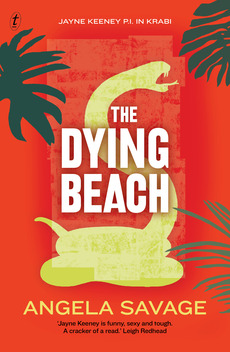
Angela Savage, The dying beach

Courtesy: Text Publishing

When I received Angela Savage’s novel The dying beach out of the blue last year as a review copy, I didn’t put it high in my list of reading priorities. I had – and still have – a pile of books waiting patiently, and I rarely (never say never) read crime novels. However, two things changed my mind. One is that Christos Tsiolkas dedicated Barracuda to Savage, and the other is that this year, for the first time, I will visit Thailand, which is the novel’s setting. So, I read it!

The dying beach is apparently Savage’s third Jayne Keeney novel. Jayne is a Private Investigator, an expat Australian living in Bangkok. Like many female PIs, she’s gutsy, hard-living, resourceful, somewhat of an outsider, and rather inclined to bristle if her independence is questioned. (Perhaps this latter is not confined to female PIs, but can be said of many women working for a living in a male dominated environment.) In this, her third outing, she’s holidaying in Krabi with her new (I believe) business and romantic partner, Rajiv, an expat Indian. They are a bit of an odd couple, but we all know about opposites attracting:

Jayne had never imagined she could find love with a man five years her junior, whose background was so different from her own. But Rajiv gave her a whole new way of viewing the world. As if he’d walked into her life and drawn back the curtain, revealing a window she hadn’t even known was there.

I love that image of “revealing a window she hadn’t even known was there”. Savage’s writing is pretty direct, keeping a good pace appropriate to its genre, but that doesn’t mean that it lacks lovely descriptions and turns of phrase. Indeed, the language is one of the delights of the book. Without disturbing her pacing, Savage regularly surprises with telling descriptions. This, for example, gives you a perfect picture of Jayne in full flight:

She was like an appliance without an off switch that kept accelerating under pressure until it threatened to short circuit.

The novel opens with a sort of prologue in which Sigrid, who doesn’t play an ongoing role in the novel, finds a body floating in the water at Princess Beach. Sigrid is surprised to discover that it’s the tour guide Pla whom she’d spoken to only that week. She notices some bruises around the neck suggesting Pla “did not die gently”. The novel proper then starts at Chapter 1 with Rajiv and Jayne in bed. It’s here (in the chapter not the bed!) that Savage provides us with the necessary background to their relationship, to where it stands at this point, and implies tensions that may play out in the future – as indeed they do. There is, in other words, a love story to this crime novel. At the end of this chapter they front up to the counter at Barracuda (surely a little homage to Christos Tsiolkas) Tours planning to book a tour with the “exceptional guide” they’d had a couple of days previously – the unlucky Pla, of course. And so the scene is set for their holiday to become another job, albeit unpaid, something that bothers the practical Rajiv but not our justice-seeking heroine.

I’m not going to write a lot more about the story, because it’s the sort of book people read for plot and surprises, and I don’t want to give them away. I will say though that it offers lovely insights into Thai character and culture. It is also unashamedly political with its plot revolving around the conflict between economic development and environmental degradation. The title itself refers to the fact that mass shrimp-farming results in the destruction of mangrove forests which in turn causes the beaches to “die”.

Savage also presents a critique of Australia, when she has Jayne contemplate why she is living in Thailand:

Truth was Jayne had long felt an outsider among her peers. Since her final year of high school, in fact, when she spent six tantalising months on a student exchange in France. When she returned home, her passion for the outside world met with a lack of interest, if not downright hostility – as though it was disloyal to find anywhere as attractive as Australia. […] For all that Australians like to boast about the national larrikin spirit, in reality only irreverence was tolerated. Unconventionality was not.

It’s a little didactic, but ouch! There is, unfortunately, some truth in this.

The final point I’d like to make relates to its narrative style. Having read several complex novels recently, that is, books with shifting points of view and intricate chronologies, I rather enjoyed reading something more straightforward. I say this, however, comparatively speaking, because The dying beach does not have a simple, linear chronology. Not only are there a few flashback chapters interspersed strategically through the book, but occasionally the narrative focus shifts from Jayne and her cohort to a couple of characters who appear to be implicated in at least some of the murders. The voice is essentially third person omniscient, though sometimes we seem to shift inside a character’s head. Savage does it well, and I enjoyed the change after the intensity of my recent reads.

The dying beach is a compelling page-turner that also makes some points about cultural difference and tolerance, the challenge of tourism, and the complexity of environmental management in developing countries. It achieves this without, to the best of my admittedly limited knowledge, deviating dramatically from the conventions of its genre. And that is a good thing, because the result is the sort of novel that could appeal to a cross-over audience. The challenge, though, is how to get readers, like me for example, to cross over.

awwchallenge2014Angela Savage
The dying beach
Melbourne: Text Publishing, 2013
339pp.
Cover design: WH Chong
ISBN: 9781921922497

(Review copy supplied by Text Publishing)

Monday musings on Australian literature: Confronting Australian novels

Recently I wrote a post about reading difficult novels and proposed categories for different sorts of “difficulties”. One of those categories was “emotionally confronting”, but I realise now that a better category would have been “emotionally and/or intellectually confronting”. By intellectually confronting I don’t mean challenging in terms of style, language, structure, but in terms of ideas. Many books which confront us with difficult ideas can, of course, evoke an emotional response in us, but I didn’t explore that in my original post. However, having just read Tsiolkas’ Barracuda (my review) I now plan to.

An intellectually confronting book is, I’d say, one that shocks us out of our complacency. This is what Christos Tsiolkas wants to do. In a conversation with Heather Taylor Johnson in Meanjin‘s Canberra issue, he expressed his concern that:

We are reading for confirmation of ourselves rather than to challenge ourselves and I think that is a real danger.

And said, in response to a question regarding mixed reactions to The slap, that

I want to pose questions that are unsettling or troubling.

He certainly does that. I’d love to hear what you think about novels that confront you – that unsettle your mind, shake your world view, disturb your core. Meanwhile, I’m going talk about some of the authors whose novels have surprised or challenged me over the last 2-3 decades.

Thea Astley could hardly, I think, be said to write to confirm ourselves. Her books face head on the ugliness in our culture – between white and black, rich and poor, city and country. The first book of hers that I read, the ironically titled A kindness cup, deals with racism and violence in a country town. The multiple effects of rain shadow (my review) explores the impact on a group of people of a violent episode on Palm Island. Interestingly, given my recent post on the subject, one of the voices telling the story is indigenous. Drylands is concerned with the impoverishment of the spirit as she sees it in late 20th century Australia. I wonder what she’d think now! One of her characters in The multiple effects of rainshadow says:

There must be a million readers out there who crave boredom! Who love the dangling participle! Who wallow in truisms and fatuous theorisings! … Slap in your popular aphorisms, buddy, but don’t make ‘em think!

Helen Garner has to be one of our bravest writers. Her nonfiction books, The first stone and Joe Cinque’s consolation, and her novel, The spare room, in particular, demonstrate her willingness to explore ideas that may be unpalatable, that run against the status quo. Somehow, she’s managed to confront the resultant criticism – which she’s faced since her first critically acclaimed but also slammed first novel, Monkey grip –  and keep on going. I’ve said it before – and will probably say it again – I don’t always agree with Garner, but I like that she confronts us with ideas that we need to think about in our dealings with others. Whether you agree with her take on the Ormond College sexual harassment case or whether you relate to her frustration with her terminally-illl friend, you have to admit that she doesn’t let us get away with “soft” thinking.

Elizabeth Jolley unsettled readers from the beginning with her willingness to expose the soul’s darkness in ordinary people and to have them enact that darkness in often shocking ways. It was Weekly’s ruthless action at the end of The newspaper of Claremont Street, the second or third Jolley book I read, that sold me. Really! I soon learnt not to be surprised by anything her characters thought or did. Jolley is more about the interior, the psyche, than the other writers I’m mentioning here but she’s no less confronting to our comfort.

Andrew McGahan‘s first two novels Praise and 1988 are examples of Grunge Lit or Generation X literature. I found them, particularly Praise, confronting because of the nihilism, hopelessness of the characters. They have no goals, they immerse themselves in sex, drugs and alcohol rather than “honest work”.  According to Wikipedia, Grunge Lit, a term not necessarily accepted by those it’s been applied to, did not last long. But, in these two books, McGahan did present Australian readers with something that made us sit up and take note – not just for the writing, but for the unappealing lifestyles he presented.

Kim Scott‘s That deadman dance (my review) is an historical novel, so we could perhaps tell ourselves that things are different now, but any honest reader would realise that Bobby’s statement in the novel that –

We learned your words and songs and stories, and never knew you didn’t want to hear ours

– continues to have ramifications today, and that, in fact, we are still not very good at hearing their story. Scott is just one of several contemporary indigenous writers, such as Alexis Wright, Melissa Lucashenko and Jeanine Leane, who are starting to confront us with their story, with their perspective of what living in Australia today is like for those who have been disenfranchised.

Christos Tsiolkas needs little introduction if you’ve been reading my recent posts. He has been shocking readers pretty much since his first novel, Loaded, which I’m embarrassed to say that I haven’t read. I did, though, hear about it! His books are firmly urban/suburban and tend to be set within immigrant subcultures. As far as I understand, most if not all traverse similar subject matter, the cultural conflict, social mobility, sexual identity confusion, racism, that often lead to aggression if not actual violence. His language is raw, and unapologetic, but his characters are real. You may not like them all, you may feel you aren’t like them or that you don’t know people like them, but they seem to be part of contemporary Australia, an Australia in which ridicule of and violence against people who are different seems to be getting worse. At least, I fear it’s not getting better. Tsiolkas wants us to think about this, to not sit in our comfortable middle-class suburban homes and worry about nothing more than our generally self-serving concerns.

Australian feminist, Anne Summers, said in a lecture that “I found [Helen Garner’s] The First Stone to be brave and honest and quite confronting–the hallmarks of a very good book.” I think she’s right. There’s nothing wrong with reading books that reflect ourselves and explore our concerns, but surely our reading has the most value when we are shaken out of the familiar and made to face other worlds and different ideas.

Now, over to you …

Christos Tsiolkas, Barracuda (Review)

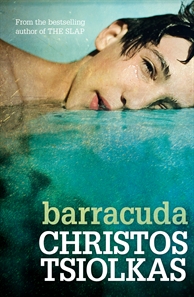
Christos Tsiolkas, Barracuda

Courtesy: Allen & Unwin

The best way I can describe Christos Tsiolkas’ latest novel Barracuda is to liken it to what Tsiolkas would define as a “good man”, tough on the outside, but tender within. I don’t know how Tsiolkas does it, but he manages to reach into your heart while at the same time confronting you to your core.

On the surface, Barracuda is about success and failure, specifically in sport. The plot concerns Danny Kelly aka Psycho Kelly aka Barracuda who is a talented swimmer. He receives a scholarship to attend one of Melbourne’s elite private schools and be coached on the swim team. Danny, with his Scottish truck-driving father and Greek hair-dresser mother, is not the normal demographic for the school and feels an outsider from the start, but he knows – or believes, at least – that he can be “the strongest, the fastest, the best”. However, things don’t go according to plan and Danny, who had poured his all into a single vision for his future, is devastated. The novel explores how a young man copes with such a major blow to his self-image, what happens when his expectations for his future are destroyed. Tsiolkas examines the social, political and economic environment in which Danny lives and the role they play in what happens to him, but he also delves deeply into the psyche, because what happens to Danny can only be partly explained by external forces. In the end we are, as Danny comes to realise, responsible for ourselves and our actions.

Contemporary writers annoyed him

Barracuda is quite a page-turner, but it bears slow reading, because it is a carefully constructed novel and some of its joys come from considering what Tsiolkas is doing. There is an amusing moment in the book when Danny, now in jail, becomes an enthusiastic book reader – primarily of 19th century novels. When the librarian asks:

‘Why are you always buried in those old farts?’ Danny would accept the teasing good-naturedly for he knew it was apt. Contemporary writers annoyed him, he found their worlds insular, their style too self-conscious and ironic.

I say amusing because there’s a self-consciousness in Tsiolkas’ style and I can only assume that he is having a little dig at himself. The novel’s structure reminded me somewhat of Evie Wyld’s All the birds, singing (my review) because both start at a point in time and then, in alternating chapters (sections), radiate forwards and backwards from that point. Tsiolkas, though, follows this structure a little less rigorously than Wyld, and he combines it with a change in person. In the first half of the novel, the sections moving backward are told in third person (limited) through the eyes of Danny, while the sections moving forward are told in first person through the eyes of Dan. This effectively enables the growing, maturing Dan to disassociate himself somewhat from his old self, although the dissociation – or perhaps the reintegration – of the two selves have a long way to go when the book opens. In the second part of the novel the point-of-view is reversed with the third person used for the older Dan, and first person for the younger, perhaps suggesting some progress towards the realignment of the selves? I need to think about this a bit more! Not only does this book warrant slow-reading, but rereading wouldn’t hurt either.

He couldn’t bridge the in-between

A significant issue for Dan is managing the two worlds he finds himself in:

It’s like two worlds were part of different jigsaw puzzles. At first, he’d tried to fit the pieces together but he just couldn’t do it, it was impossible. So he kept them separate: some pieces belonged to this side of the river, to the wide tree-lined boulevards and avenues of Toorak and Armadale, and some belonged to the flat uniform suburbs in which he lived.

When the two worlds conflict, Danny feels split open, cracked apart. “No one could ever put him back together”. And so, he starts to occupy what he calls “the in-between” but that leaves him silent, and alone. This dissection of worlds, of  “class”, and of anglo-Australia versus immigrant Australia, is an ongoing concern for Tsiolkas. We came across it in his previous novel, The slap (my review) and we see it again here. Tsiolkas is not the only writer exploring this territory, but he’s one of the gutsiest because he’s not afraid to present the ugliness nor does he ignore the greys, the murky areas where “truth” is sometimes hard to find (though he doesn’t use the word “truth”).

While Danny is the main conduit for teasing out the tensions in society between two worlds, other characters also reflect it. There’s Danny’s childhood friend, Demet, whose working class migrant background is challenged when she goes to university, and his school friend Luke, a nerdy ostracised boy at the elite school who, with his Vietnamese mother and Greek father, is also “half and half”. These characters manage to traverse their worlds more easily than Danny, but Tsiolkas shows that it isn’t easy.

His father was a good man

Barracuda is about a lot of things. It’s not an exaggeration to say that Tsiolkas taps into the zeitgeist of contemporary suburban Australia. But I might explore that in another post, because this post is getting long and I do want to end on the theme that struck me the most, that of defining “a good man”.

Throughout the novel, Danny meets many men – his father, grandfather and coach, in particular, when he’s a boy, and his lover Clyde, old schoolmate Luke and brain-damaged cousin Dennis when he’s an adult. As an adolescent, and somewhat typically, Danny loves his grandfather, rejects his father, and dotes (until he “fails”) on his Coach. Adult Dan is more circumspect about men, but sees good qualities in Clyde and Luke, while still rejecting his father. None of these men, though, seem able to break through his destructive self-absorption. However, late in the novel, living a self-imposed lonely life, albeit one now committed to helping others, Dan has an epiphany. In a confrontation with his father, he suddenly realises:

His father was a good man. It struck him with a force of revelation, exultation, light flooding through him. His father was a good man. His father was the hero of his own life.

At this moment, he realises he wants to be a good man. He also starts to get a glimmer of what a good man is, and it has nothing to do with being the strongest, fastest and best.

I have more to say about this book, and so will do a follow-up post rather than write a longer essay here. Meanwhile, I know there are readers of this blog who do not like Tsiolkas. He is, I agree, a confronting writer. His characters are not aways easy to like, and he doesn’t shy away from their grubbiest (that is, unkind, violent, sexual) thoughts, but for me he has some valid concerns to share and I want to hear them.

Christos Tsiolkas
Barracuda
Sydney: Allen & Unwin, 2013
515pp.
ISBN: 9781743317310

Christos Tsiolkas on success and failure

I will soon post my review of Christos Tsiolkas’ latest novel Barracuda, which is about a young man who fails in his quest to become an Olympic swimmer. It tears him apart. In tonight’s news, here in Australia, we heard that one of our successful Olympic swimmers is going into rehab for addiction to Stillnox. Another recently went into treatment for depression.

Tsiolkas’ Danny didn’t make it the way these Olympians did, but I wonder whether their (apparent) suffering has the same roots as Danny’s – the loss of a future. Danny lost it because he “failed” (in his eyes) at a crucial moment. For post-Olympians (as I’ll call them), it seems to be more about what to do after they’ve achieved the goal. Danny thought that his future was set, but even if he had achieved his goal, would it have been?

Here’s Danny:

He flexed his right hand, opening and closing it, stretching his fingers till he could feel the tingle, then clenching them in tight. Sometimes in the garden he came across dried-up plum kernels from fallen fruit that had been buried all winter and then resurfaced. He’d pick up a kernel, it would be shrivelled, the colour of the soil, and it would disintegrate into dust in his hand. That was the future, that’s what had become of it.

His hand open and closed.

He’d had a future. It had been as hard and as strong as the stony heart of an unripened plum, so strong it would have taken a hammer blow to crack it. He’d had that future for years but it too had crumbled into dust. His theory was that you only got one future to dream. He’d f****d it up. He’d failed and now it was gone.

Only one future to dream? Therein lies the rub, perhaps, regardless of whether you succeed or fail (in sport or other single-minded endeavour)?

Monday musings on Australian literature: The Bread and Cheese Club, again

I promise that this, my third post on Melbourne’s now defunct Bread and Cheese Club will also be my last, but it was such an interesting club that I can’t resist one more post. Just to remind you, it was formed in 1938, with the following goals:

To promote mateship and fellowship among persons of mutual interests, to foster a knowledge of Australian Literature, Art and Music and to cultivate an Australian sentiment … (from H.W. Malloch’s Fellows all, p. 17)

My first post introduced the club, and particularly one of its founders, John Kinmont Moir (1893-1958), who was clearly the Club’s leading light, while my second post focused on some of the ways in which the Club supported indigenous Australian culture. In this post I want to give a flavour of how widely their activities and, probably, influence extended. To keep it simple, I’m just going to list a few of the activities I came across while researching the Club in the National Library of Australia’s Trove database for newspapers. Here goes:

  • Children’s Poetry Competition. Reported in The Argus, 1939
  • Exhibition of art and literature at the Velazquez Gallery. The writer in The Argus, 1940, saw it as a “mixed bag” (I love the language here!):

If the club had a selection committee to deal with the art side of the show, it was doubtless a committee more anxious to obtain a wide representation than a particularly high standard. It is doubtful whether a more mixed lot of pictures has ever been hung on the walls of any gallery in Melbourne. They range from admirable examples of the work of some of Australia’s most capable artists to hopeful (or despairing) efforts by the veriest tyros.

  • Publication of Frank Clune’s book, Chinese Morrison, about George E Morrison who, as many Australians will know, became an influential political adviser to the Chinese Republic in the early 20th century. Reported in The Argus, 1941
  • Short story competition, judged by Mrs Vance (aka Nettie) Palmer. Reported by the Courier Mail, 1942
  • First art exhibition by members of the Bread and Cheese Club Art Group. Reported in The Argus, 1946
  • Publication of naturalist David Fleay’s book, Gliders of the gum trees. Reported in the Queensland Times, 1947
  • Junior Art Competition. Reported in the Cairns Post, 1948
  • Surprising Dame Mary Gilmore with a bouquet of flowers on her 84th birthday. Dame Mary apparently said that “I had forgotten it was my birthday, but I’m so happy that my friends all over Australia remembered”. Reported in The Daily News (Perth), 1949
  • Organising significant people to address its meetings, such as Chief Justice of the High Court, Sir John Latham. (I liked this one because Latham is a mentor of the fictional Edith in Frank Moorhouse’s Edith trilogy). Reported in Barrier Miner (Broken Hill), 1951
  • Awarding annually the Australian Natural History Medallion. According a report in The Argus, 1956, the award was instituted by J.K. Moir in 1938 and was the most coveted natural history award in Australia. The 1956 award was given to Stanely Mitchell “for work on the artefacts of the Australian aborigines”.
  • Erecting a memorial in Darwin to commemorate Northern Territory pioneer Jessie Litchfield who, when she died in 1956, left “most of her estate for the encouragement of Australian literature”. Reported in The Canberra Times, 1964

Besides the variety of the Club’s activities evidenced in this (pretty) random selection, one of the most interesting things about these newspaper reports is where they are from. While the Club was Melbourne-based, albeit with some interstate members, its activities were clearly national, and were reported nationally. Sir John Latham’s talk in Melbourne, for example, was reported in a Broken Hill newspaper, and the Jessie Litchfield monument in a Canberra one. Is it just that these papers were desperate for copy or was the Club widely influential?

I will end my mini-series on the Bread and Cheese Club with a report on one more activity, because the report made me laugh. In The Argus of 14 September, 1951, Christina Mawdesley wrote an article titled “Nothing is new about prefab. houses”. She shares information from a reader who advised that Governor Latrobe’s cottage was an early prefab home, dating to 1839, and therefore earlier than the 1853 home that the paper had written about. She then goes on to quote Sir Thomas Mitchell writing from London, in 1830s-40s, about one “Manning of Holbourn” who was building wooden houses in sections for use in Australia. Mawdesley concludes her article with:

Could we discover the remains of one such pioneer prefab?

I am sure the Bread and Cheese Club would mark the spot with an engraved plaque, commemorating the good old days and “Manning of Holbourn”.

Is there anything, I wonder, that the Bread and Cheese Club didn’t do?