Monday musings on Australian literature: Literary awards back then

A comment by blog-reader Ian Darling on a recent Monday Musings post that he supposed literary prizes existed back in 1927, followed by the tardy announcement a couple of days ago of the shortlist for this year’s Prime Minister’s Literary Awards (see Lisa ANZLitLovers’ post), got me thinking about the history of literary awards.

I’ve long been aware of The Bulletin’s prize for fiction which was inaugurated by its editor, SH Prior, in 1928. The inaugural prize was won jointly by M. Barnard Eldershaw’s A house is built and Katherine Susannah Prichard’s Coonardoo. The next year, it was won by Vance Palmer for The passage. I’m not sure what happened to the prize except that, according to the Oxford companion to Australian literature, The Bulletin’s next editor, John Webb, established the SH Prior Memorial Prize for Fiction, and it was awarded 1935 to 1946. But, were there other awards? Trove and the Oxford companion came to my rescue.

What I discovered was something that confirmed my understanding of the fundamental raison d’être for awards – to support writers and literature. I know some writers question the value of awards, and we’ve had some good discussions about the issue here, but putting aside some very valid concerns, it’s clear that the impetus is usually to support the writing endeavour. And so, the article on Literary Awards in the Oxford companion starts with this:

The rewarding of Australian writers began soon after the establishment of the first colony when in 1818 Lachlan Macquarie, governor of NSW, awarded Michael Massey Robinson two cows from the government herd for his services as an antipodean “poet laureate”. Macquarie’s decision inaugurated government patronage of Australian literature.

The article continues to tell us that the government at times found jobs for writers – such as a government inspector of forests job for poet Henry Kendall in 1881! This is supporting literature? (The article also says that the government gave his widow a job as superintendent of cleaners in a government office in 1884!) Interestingly, via Trove, I found a reference to this employment practice in the Albury Banner and Wodonga Express, in 1916The writer of the article, which was about government encouraging literature through a prize as it was already doing for music and painting, introduced his/her argument with the comment thatPositions in the Government service had in the past been found on two poets — Kendall and Daley — but the positions were unsuitable”.

The Oxford companion continues, saying that it wasn’t until the twentieth century that Australian writers began to receive prizes and awards on a regular basis. It divides these awards into two categories, those that:

  • support creative activity by supporting a writer during the creation of a work (fellowships and writer-in residence programs, being examples); and
  • reward a finished, usually published work.

We all know of current examples of both these categories so, in the rest of this post, I’m going to share (in chronological order) a rather random grab-bag of awards from the first half of the twentieth century:

  • 1908-1972 Commonwealth Literary Fund. According to the Oxford companion, this fund, established by Alfred Deakin’s government was “the first systematic federal government initiative in support of the arts”. For the first 30 years it focused on providing pensions to sick authors and their families or families of authors who’d died poor or “literary men doing good work but ‘unable on account of poverty to persist in that work'”. However, from 1939, as the result of lobbying, the Fund was increased and started to offer annual fellowships and grants to writers, publishers, literary magazines. Through Trove I found articles identifying winners of fellowships in various years. In 1952, for example, fellowships were given to Judah Waten for “a novel dealing with a Jewish migrant family”, Kylie Tennant for “a novel about travelling beekeepers”, Victor Kennedy for “an interpretative biography of [poet] Bernard O’Dowd”, and Xavier Herbert for “the completion of a novel dealing with feminine behaviour in time of war”.
  • 1908 Australian Exhibition of Women’s Work Literary Prizes. Apparently, the First Exhibition of Women’s Work was held in Philadelphia in 1876, but the first Australian one was held in 1907. What intrigues me about these awards is the categories: Story of not less than 100,000 words (with the first prize being £50); Play of three acts, scene laid in Australia; Temperance novel; Esperanto essay; Best historical sketch of Exhibition (Illustrated). Temperance novel? Esperanto essay? Signs of their times, eh?
  • 1909 Tasmanian Literary Awards. I’m not sure exactly of the provenance of these awards as the article is very brief, but again, it’s the categories that intrigue: Essay, open to residents of Tasmania, any age, not to exceed 3000 words, subject, ”Modern Patriotism”; Original poem, not to exceed 100 lines, subject, lines written for “Foundation Day, 1910”; Original tale, not to exceed 3000 words, subject, any connected with some incident of Australian history.
  • 1943 United Nations Literary Competition. This prize is clearly not related to the United Nations, given that body didn’t exist in 1943, but was created by the English publisher, Hutchinson and Co. Presumably its title comes from the fact that entry was open to international writers. It sounds like several prizes were offered, with the overall purse being £10,000. The article gives a range of topics: “Fiction, detective stories and thrillers, autobiography, war experiences and travel, history and biography, essays and belles lettres, poetry, children’s literature, philosophy of religion and general philosophy, scientific and technical literature”. I’m presuming these are not specifically award categories but subjects the publisher knows will sell well and would like to receive?
  • 1946-1951 “Herald” Literary Competition. In 1946 (as far as I can ascertain), the Sydney Morning Herald instituted a literary competition for novels, short stories and poetry. In 1947, Jon Cleary won for his social realist novel You can’t see ’round corners, which spawned a popular television series in 1967 (albeit reset in the Vietnam era). In 1949, however, the judges did not feel any submissions met their expectations, so did not grant first prize in either the novel or short-story categories. They did award second prize to T. A. Hungerford for his novel Sowers of the wind, and third prize to D’Arcy Niland for his Gold in the streets. Niland also won second prize for his short story. The awards were discontinued in 1951 on the recommendation of judges, who felt that “the succession of competitions has been too rapid to allow competitors sufficient time for proper preparation and revision”.

Hmmm … we might continue this discussion another day.
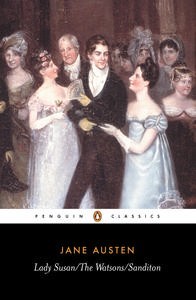
Jane Austen, Lady Susan (Review)

AustenLadySusanPenguinIt is a truth universally acknowledged – I know this is a tired old joke but I seem programmed to do it – that Jane Austen fans will collect multiple editions of her works. There are many reasons for this behaviour, but one of them is our interest in different introductions. And so, although I already had a copy of Lady Susan, in the Minor works volume of R.W. Chapman’s The Oxford Illustrated Jane Austen, I bought the Penguin edition for my Kindle because it had an introduction by Margaret Drabble. And I have a second confession to make: this is a rereading, but my reason for rereading has little to do with the reasons I gave in my recent post on Flanagan. The reason is simple – my local Jane Austen group decided to schedule it for our October meeting. I was happy with that. As far as I’m concerned all bets are off my usual “rules” when it comes to Jane Austen.

If you’re not an Austen fan, you may not have heard of Lady Susan. It is a complete novella that sits between her Juvenilia and her adult novels. It was written, we believe, in 1793/4 when Austen would have been 18-19 years old, but was not published until 1871, well after her death, when her nephew James Edward Austen-Leigh included it in his memoir of her.  It is epistolary in form, something she tried again with Elinor and Marianne. While this latter one she rewrote in her well-known third person omniscient voice, retitling it Sense and sensibility, for some reason she didn’t go back to Lady Susan. One reason might have been its subject matter.

 “the most accomplished coquette in England” (Reginald of Lady Susan)

Lady Susan is a beautiful, 35-year-old widow of four months, who is already on the prowl for a new, wealthy husband. The novel opens with her needing to leave Langford, where she’d been staying with the Manwarings, because she was having an affair with the married man of the house, and had seduced his sister’s suitor, Sir James Martin. She goes to stay with her brother-in-law Charles Vernon and his wife Catherine, whom she’d done her best to dissuade him from marrying. She’s not long there before Reginald, Catherine’s brother, arrives to check her out because, from what he’s heard,

Lady Susan possesses a degree of captivating deceit which must be pleasing to witness and detect.

Of course, the inevitable happens and the artful Lady Susan captivates him. Meanwhile, Lady Susan wants her 16-year-old daughter, Frederica, to marry Sir James, the man she’d seduced away from Miss Manwaring – but sweet, sensible Frederica wants none of this weak “rattle” of a man.

You’ve probably worked out by now that this is not Austen’s usual fare. Lady Susan belongs to the 18th century tradition of wickedness, lasciviousness and adultery, forced marriages, and moralistic resolutions. The novel’s characters tend to be types rather than complex beings, and it is racily written, with a broad brush rather than a fine pen. And yet …

“Lady Susan is not wholly a villain” (Margaret Drabble)

This is also where Austen’s mature touch starts to appear. For all Lady Susan’s self-centred “bewitching” machinations, she is also, as Drabble says, “witty, energetic, intelligent and charming”. Drabble and other critics argue that Lady Susan’s spirit can be seen in characters like Elizabeth Bennet, Emma Woodhouse and, particularly, Mary Crawford who, like Lady Susan, comes from London where she moved in “fast” circles. How could a teenaged country parson’s daughter imagine into being such a duplicitous character? Austen was, we know, a great reader and read the gothic novels of her day. She also knew the behaviour of Mrs Craven, the mother of her neighbour Mrs Lloyd. According to Drabble, Mrs Craven “had treated her daughters shockingly, locking them up, beating them and starving them, until they ran away from home …” just as Lady Susan’s daughter ran away from school. And, as her letters demonstrate, Austen was capable of bite.

We don’t know why Austen didn’t pursue this book, besides making a good copy of it in 1805, or why she didn’t try again to write about a beautiful 35-year-old widow.

Hints of what’s to come

All this is well and good, and I loved the read, but my main reason for reading these early Austens is their insight into the writer to come – her wit and irony, and her commentary on human nature. Lady Susan, having been written on the cusp of her maturity, is particularly interesting in this context. The melodrama, for example, is toned down, compared with the books Austen would have been reading. Frederica isn’t locked up as she might have been in Walpole’s Castle of Otranto (my review), there are no rapes as we see in Richardson’s Clarissa. Austen is moving, in other words, towards the naturalism of her favourite topic, “3 or 4 families in a Country Village”.

I love Austen’s irony, and there’s plenty in evidence here. A good example is when Reginald, completely convinced by Lady Susan, writes to his father of how she has been misrepresented, saying that this

may also convince us how little the general report of any one ought to be credited … I blame myself severely for having so easily believed the scandalous tales invented.

The joke is on him because, of course, he should believe these “scandalous tales”. One of the complexities of the novel is this issue of gossip – who should believe what and whom? As Austen readers know, gossip plays a significant role in her characterisation and plots.

Other ideas and themes that we see in later novels also appear in Lady Susan. Bad mothering is one. Another, more specific, is this delightful comment on accomplishments, reminding us of the discussion between Mr Darcy, Miss Bingley and Elizabeth at Netherfield. Lady Susan writes to her equally scheming friend Alicia Johnson:

Not that I am an advocate for the prevailing fashion of acquiring a perfect knowledge in all the languages arts and sciences; it is throwing time away; to be mistress of French, Italian, German, music, singing, drawing etc., will gain a woman some applause, but will not add one lover to her list.

And then there’s that main reason I love Austen – her terse, pithy commentary on human behaviour. There’s much in Lady Susan, including

but where there is a disposition to dislike a motive will never be wanting

and

Silly woman, to expect constancy from so charming a man!

Have I convinced you to give it a go? I do hope so.

Jane Austen
“Lady Susan”
in Lady Susan, The Watsons, Sanditon
London: Penguin Books, 2003
Kindle Edition EISBN: 9780141907901

Available in e-text.

Richard Flanagan, the Booker Prize, and Books

Lisa at ANZLitlovers has posted on Richard Flanagan’s (exciting-to-us) Booker Prize win for The narrow road to the deep north, and has provided links to reviews by several bloggers. So, I thought I’d do something different. In my review and follow-up post, I discussed the role of poetry in the novel. Reviewer (and novelist) Romy Ash suggests that there are two love stories in the book, the second one being a “love letter to literature”.

And certainly, there are many references to literature and books, besides the specific references to poetry that I’ve previously discussed. Early in the novel, on what we later realise was Dorrigo’s last sentient night, he’s in bed with his lover:

On the night he lay there with Lynette Maison, he had beside their bed, as he always did, no matter where he was, a book, having returned to the habit of reading in his middle age. A good book, he had concluded, leaves you wanting to reread the book. A great book compels you to reread your own soul. Such books were for him rare and, as he aged, rarer. Still he searched, one more Ithaca for which he was forever bound. He read late of an afternoon. He almost never looked at what the book was of a night, for it existed as a talisman or a lucky object — as some familiar god that watched over him and saw him safely through the world of dreams.

I was intrigued by the distinction he makes between a “good” book and a “great” one. There are many reasons why I want to reread books. Most of them, I’d say, have to do with the “joy” those books bring me. I don’t mean “joy” in terms of “happiness” but in terms of “inspiration”. This inspiration can take many forms – spiritual, intellectual, emotional, cultural, linguistic. And it usually springs from the two things I mostly read for – insights into human behaviour and great prose. Jane Austen is a good example of this. I’m not sure that I think about it in terms of my soul. Have you thought about why you reread?

Anyhow, there’s one other quote I wanted to share regarding books. This one occurs before the war, in the bookshop where Dorrigo meets Amy, the love of his life:

It wasn’t really the great poem of antiquity that Dorrigo Evans wanted though, but the aura he felt around such books — an aura that both radiated outwards and took him inwards to another world that said to him that he was not alone.

And this sense, this feeling of communion, would at moments overwhelm him. At such times he had the sensation that there was only one book in the universe, and that all books were simply portals into this greater ongoing work — an inexhaustible, beautiful world that was not imaginary but the world as it truly was, a book without beginning or end.

What I particularly like about this quote is the idea that books can make you feel you are not alone. I love it when I read a book and think “I know that feeling” or “That’s me”. Of course, I also love it when I gain insight into how others think or feel too, but it can be reassuring to feel that someone else understands your particular neuroses or dark thoughts or sense of the ridiculous or whatever it is that sometimes makes you feel alone. Books can be such cheap therapy can’t they? I also like the second part of this quote, and its suggestion that there is only one book, one story that encompasses all stories. If only we could all see the world that way …

Monday musings of Australian literature: The duty of readers and critics

Hmmm, my post title for this week’s Monday Musings sounds rather provocative, but I’m going to keep this post pretty light. It’s been a busy few days so I’m just going to share an interesting little article I read a few weeks ago while I was reading about Australasian Authors Week in 1927. It’s from the Evening News of 24 February 1927, and is by someone using the by-line, Zeno.

It’s a short article, but it caught my eye for its opening paragraph:

When the really brilliant Australian novelist arrives, he will not fail of joyous welcome, and is assured of his reward. Meantime, it is the duty of readers and critics to encourage, as far as possible, those who are in process of development, and to help them in their difficult path to distinction.

Don’t you love that (ignoring the traditional-for-the-times use of “he”)? It denies the fact that some excellent novelists had already arrived, such as Henry Handel Richardson (a “she”) – but I do like its optimism (albeit somewhat naive).

That’s by-the-by, however. My main point here is his* argument that readers and critics have a duty to “encourage” writers on “their difficult path to distinction”. Admittedly, he does qualify this with “as far as possible” which I suppose allows us to use our critical faculty and not encourage thoughtlessly. The interesting thing is that the two authors he then “encourages” are not well-known today – so they, rightly or wrongly, despite his encouragement, didn’t achieve distinction. The two authors and their books are Stephen Westlaw and The white peril, and James Pollard and The bushland man.

Stephen Westlaw received 23 votes in the Argus’ plebiscite. I’ve had trouble finding out much about him. AustLit writes his name as “Steven” (though the plebiscite listing, like Zeno, spells it “Stephen”) and indicates that his birth-name was John Pyke. This doesn’t help much, but I did find a newspaper article stating Steven Westlaw was a nom-de-plume because of a relative writing under his birth-name. The article also indicated that he wrote satirical material under the name R.X. Jackson.

Anyhow, Zeno tells us that Westlaw’s The white peril is “a startling story of an insidious evil which is creeping slowly, but surely, into our cities”. The subject matter is apparently drug traffic, and Zeno says that Westlaw’s “description of the method of distribution tallies with the disclosures made by the New York police and apparently the same conditions obtain to some extent in Australia”. He concludes that “to read The White Peril in the light of this knowledge, will give some idea of the direful consequences which will result if this evil be not nipped in the bud”.

James Pollard received 6 votes in the plebiscite. He was born in Yorkshire in 1900, and so was young, 27, when the plebiscite occurred. He emigrated to Australia in 1913, serving with the Australian Army World War I. He then became a soldier-settler but abandoned this focus on writing. He wrote three adult novels, two children’s novels, and short stories. He also wrote articles for Walkabout magazine, and a natural history column in the West Australian using the by-line, Mopoke. According to AustLit, he lobbied for and established free libraries for children – presumably in Western Australia.

Zeno describes Pollard’s The bushland man as “a romance of the open spaces”. It’s about a forest ranger with “an intense love of the bush”, and describes “crops and herds, bush-tracks and broken roads; country folk with typically Australian speech, acres of wheat, loads of wool; sheep skins and marsupials”. Zeno calls it “a book for all Australians and one which may go forth to the world. It contains neither fulsome flattery nor stupid libel”. So glad there’s no “stupid libel”! As it turns out, the assessment from our times is that his work is popular rather than literary, and that he presents “a somewhat romantic picture of the beauty of the South-West for a growing number of readers becoming interested in their own country – in fact, the discovery of it through the novel and stories” (Veronica Brady and Peter Cowen, ‘The Novel’, The Literature of Western Australia, cited by AustLit). 

I guess Zeno was writing for an evening newspaper, but these “reviews”, if that they be, tell us nothing really about the style or literary quality. Perhaps this is Zeno’s way of being encouraging – focus on the story, and get people to buy and read? Fair enough, but I think the duty of a critic is a little more than this.

* As Zeno is a male Greek name, I’ll use the male pronoun here.

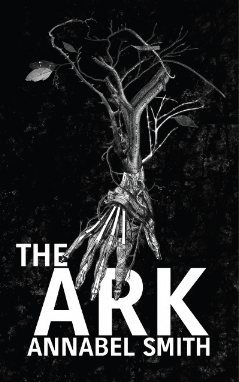
Annabel Smith, The Ark (Review)

SmithArkSelfPubI must start by thanking Western Australian short story writer Glen Hunting* for recommending Annabel Smith’s The Ark in his comment on a recent Monday Musings post. Hunting wrote that it “is self-published and available as a print book, e-book, app, and has its own interactive website”. I was intrigued so checked it out. My initial reaction was “hmm, is this for me?” But, I’ve wanted to read Smith for a while, so decided where better to start than with this innovative project? I bought the iPad app version and was entertained from the first page. Lisa (ANZLitLovers), who reviewed it just after I started reading it, felt the same.

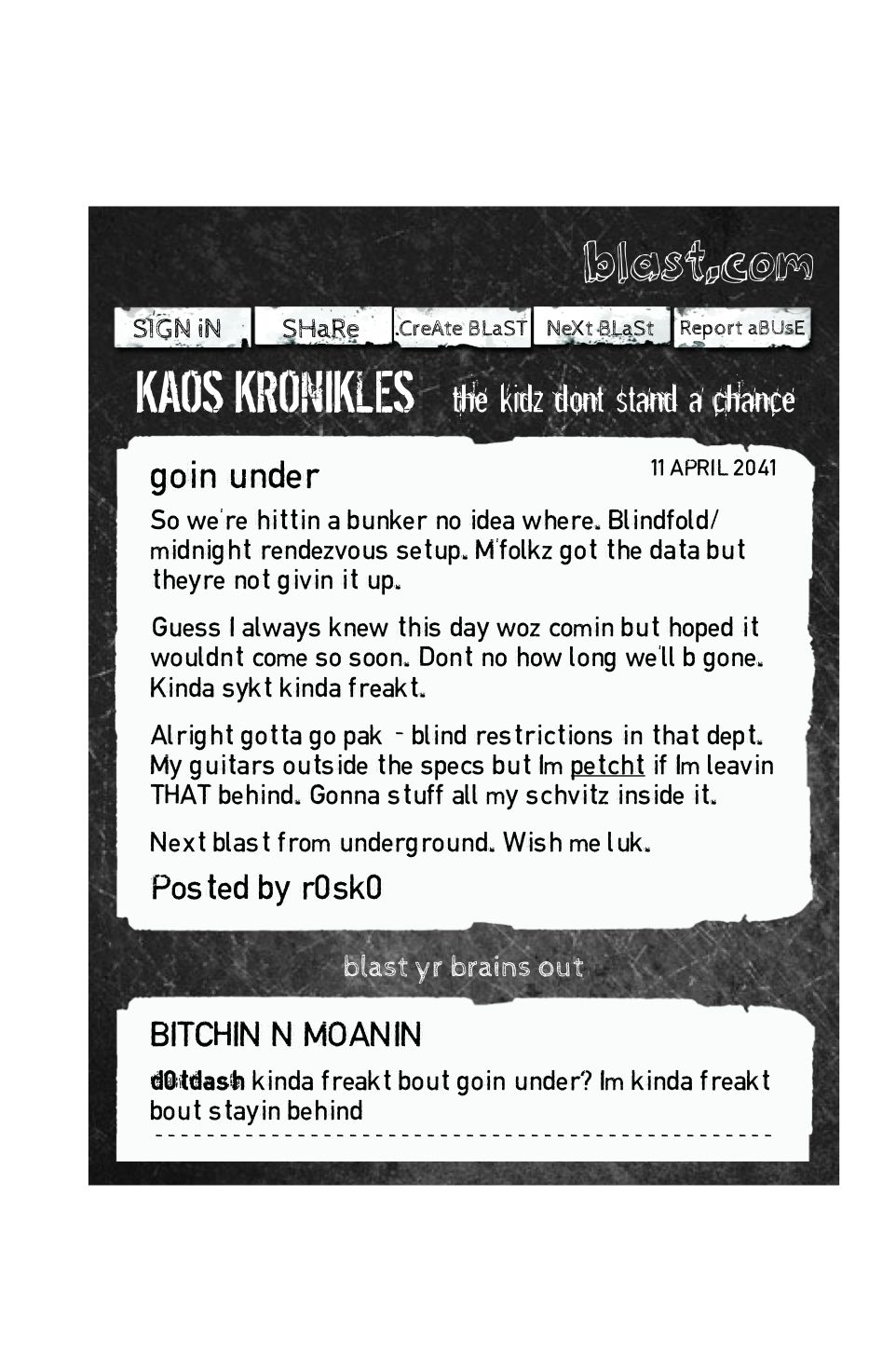
The Ark is, for want of a better description, dystopian speculative fiction presented in the form of a modern epistolary novel with interactive options. I say “modern” epistolary because the story is told through a variety of textual communications – emails, a blog, memos, reports, minutes of meetings, and news articles. It is divided into two books, of which the first is told, sequentially, through four characters, one on the outside followed by three inhabitants – Kirk Longrigg, CEO of SynBioTec Australia which established the Ark; Ava, a wife, mother and deferred PhD student-expert on despots; Roscoe, the 15-year old son of futurologist Mia; and Pilot, a botanist. At different points in the book we are invited to investigate the Ark via links though which we can tour the bunker, hear the inhabitants, add our own contributions or fan-fiction. I liked the graphics used to depict the Ark, but didn’t spend a lot of time exploring these interactive elements. I suspect different readers, depending on their interests, will behave very differently in this regard. Perhaps game-players will engage more with the interactive features? The good thing is that the book is flexible. It’s not necessary to engage in these digressions, but it can, I’m sure, enhance your enjoyment if you are so inclined.

Roscoe's Blog

Roscoe’s Blog

Not surprisingly, an important element of the book is its design. Each different type of communication has its own visual style – the “dailemails”, the more private person-to-person “Gopher”, the supposedly secure “Headless Horseman”, Roscoe’s “Kaos Kronikles” blog, BLiPPs, and so on. Once these become familiar, they signpost the context in which each communication is occurring. As I was reading, I couldn’t help thinking what fun Smith must have had coming up with all the names and acronyms (like GARDEN, the Growth Apparatus for Regenerative Development of Edible Nourishment) used in the Ark.

But please, I hear you asking by now, what is it all about? The story is set between 2041 and 2043, but commences with a brief newspaper report in 2093 announcing that:

Seventeen people have been recovered from a bunker built into Mount Kosciuszko in south-east Australia, where they have been living in total isolation for almost five decades, since the government collapse in the wake of the post-peak oil chaos in 2041.

There is more to the Ark than that though. It was not principally about saving people – as the presence of the botanist may clue you into. The Ark was in fact a seed bank or “National Arboreal Protection Facility” aimed at preserving seeds for an uncertain future. This aspect of the novel reflects Smith’s concern about climate change, something that is reinforced when we discover that the Mount Kosciuszko area in Australia’s high snow country is now rife with sandstorms! But, there is another theme to this novel, besides this specific climate change one. It’s a more universal one to do with charismatic-cum-despotic leaders. Consequently, it is Ava, the expert in despots, who is the first of the inhabitants to carry the story after Kirk’s opening section which concerns a disagreement between him and the Ark’s project manager, Aidan Fox, regarding Aidan’s unauthorised lockdown of the site for security reasons. For some time, we don’t know who to believe. Smith complicates the issue by Ava’s possibly being unreliable due to having suffered mental problems in the past.

Anyhow, the plot thickens. There’s adultery, a few deaths, and some excursions outside. As more things start to go wrong, conflicts arise regarding freedom and human rights versus security… It’s clever, but believable, and fits comfortably with other dystopian novels about people trapped in isolated locations or in alien futures, and it also draws on what we know about the experience of people in religious cults.

This is a plot and ideas-driven novel rather than a character-based one, which is partly due to Smith’s goals and the genre she is working in, and partly a factor of the multi-voice epistolary form which does not lend itself to in-depth characterisation. I say this, though, not as a criticism. It’s a good read, and doesn’t suffer for this lack of character focus, much as I love character-driven novels. It’s just that the characters are generally more “types” than fully realised individuals – the conniving henchman, the willing nurturer, the trusting hardworking followers, the loyal but open-minded offsider. There is, too, an opening for a sequel that could explore, for example, how the seventeen members engage with the world they enter (or reenter) in 2093.

As regular readers know, I’m not a keen e-Book reader. I’ve read a few books on my Kindle, but this was the first complete book I have read on my iPad. It was fine, partly because the form did not mean pages of dense text to confront on a glary screen, but I was disappointed that although I could bookmark pages of interest, I could not make notes on the text as I can on the Kindle or on “regular” books on the iPad. I do like my marginalia, but I guess it’s dependent on how the content is generated. Oh well.

Have I told you enough? I hope so. It’s well worth a read if you like dystopian fiction and/or if you are interested in experiencing different ways of telling stories in our digital world. I’d never want straight prose novels to disappear – and I don’t believe they will – but the arts should also be about experimenting and playing with boundaries, and this is what Smith has done here. Good for her.

awwchallenge2014Annabel Smith
The Ark
Self-published, 2014
ISBN: 9780646923109

* Glen Hunting’s story “Martha and the Lesters” appeared in Knitting and other stories, which I reviewed a few months ago.

Delicious descriptions: Richard Flanagan on Poetry

In my review of Richard Flanagan’s The narrow road to the deep north I talked a little about the importance of poetry to some of the main characters. I can’t resist sharing just a little more on this topic.

This is Dorrigo thinking, at the end of his life, though he doesn’t know just how near it is at the time:

He felt the withering of something, the way risk was increasingly evaluated and, as much as possible, eliminated, replaced with a bland new world where the viewing of food preparation would be felt to be more moving that the reading of poetry; where excitement would come from paying for a soup made out of foraged grass. He had eaten foraged grass in the camps; he preferred food. The Australia that took refuge in his head was mapped with the stories of the dead; the Australia of the living he found an ever stranger country.

Dorrigo Evans had grown up in an age when a life could be conceived and lived in the image of poetry, or, as it was increasingly with him, the shadow of a single poem. If the coming of television and with it the attendant idea of celebrity – who were otherwise people, Dorrigo felt, you would not wish to know – ended that age, it also occasionally fed on it, finding in the clarity of those who ordered their lives in accordance with the elegant mystery of poetry a suitable subject for imagery largely devoid of thought.

I was thrilled when I read that Dorrigo, who was born around 1913, had “grown up in an age when a life could be conceived and lived in the image of poetry”. It reminded me of my recent observation that poetry seems to have played a more significant role in people’s lives back in the 1920s than now. So, for Dorrigo, poetry is what he turns to for sustenance, for meaning or explanation, in his life. He says at one point that he can sleep without a woman, but he can’t sleep without a book. I love the idea of a world where poetry is widely known, loved and referred to.

Anyhow, here is Nakamura, dying of cancer, thinking about “goodness”:

He told himself that, through his service of this cosmic goodness, he had discovered he was not one man but many, that he could do the most terrible things he might otherwise have thought were evil if he had not known that they were in the service of the ultimate goodness. For he loved poetry above all, and the Emperor was a poem of one word — perhaps, he thought, the greatest poem — a poem that encompassed the universe and transcended all morality and all suffering. And like all great art, it was beyond good and evil.

Yet somehow — in a way he tried not to dwell upon — this poem has become horror, monsters and corpses. And he knew he had discovered in himself an almost inexhaustible capacity to stifle pity, to be playful with cruelty in a way that he found frankly pleasurable, for no single human life could be worth anything next to this cosmic goodness. For a moment, as he was being eaten by Tomokawa’s* oppressive armchair, he wondered: what if this had all been a mask for the most terrible evil.

The idea was too horrific to hold on to. In an increasingly rare moment of lucidity, Nakamura realised what was imminent was a battle not between life and death in his body, but between his dream of himself as a good man and this nightmare of ice monsters and crawling corpses. And with the same iron will that has served him so well in the Siamese jungle, in the ruins of the Shinjuku Rashomon and at the Blood Bank of Japan, he resolved that he must henceforth conceive of his life’s work as that of a good man.

Nakamura, as I said in my review, saw poetry as portraying “Japanese spirit” and it helped him justify his actions as commander of the camp. After the war, he gradually started to question his actions, but here at the very end of his life he wants, needs in fact, to see himself as a good man. And by force of will he does so, enabling him to choose as his death poem one which concludes with “clear is my heart”.

I love the idea of choosing your own death poem – and think I’ll start thinking about mine. What about you?

* He’s visiting Tomokawa, who had been one of his corporals on the Railway.

My View from Here is over at BookerTalk

My Social Media Pic

My Social Media Pic

Karen who writes the BookerTalk blog asked me to write about reading and writing here in Australia for her inspired View from Here series.

If you’d like to read what I wrote, check out my post on her blog. If you’re an Aussie, I’m sure Karen would love you to add your own perspectives in the comments, because I couldn’t say all that I’d love to have said. Of course, if you’re not an Aussie, please comment too!

If you’d like to read the other View from Here posts, check out this list. You might be surprised by what you find. I’ve certainly enjoyed them.


Monday musings on Australian literature: Some Australian librettists

I’ve written some long posts recently so have decided to make this one a short one. I have been intrigued in recent years to discover how many Australian novelists and poets have turned their hands to libretti, often adaptations of novels but not always. Some are opera libretti, but others are for other vocal musical works. I’m not an opera tragic – though I did attend the Sydney Opera House’s opening season and have attended several operas over the years – so I’m not going to critique what these authors are doing. My post here is purely informational because I find it interesting. I’ve chosen 5 writers, who are of particular interest to me, to write about.

David Malouf (b. 1934)

I’ve written about David Malouf several times in this blog, including reviewing his most recent novel, Ransom. I also wrote early in this blog’s life about an event I went to focused on Patrick White’s novel, Voss. David Malouf wrote the libretto for the opera, which was performed in 1986. He sat on the board of Opera Australia from 2001 to 2009).

His libretti are:

  • Voss (1986)
  • Mer de glace (which seems not to have been well-regarded) (1991)
  • Baa Baa Black Sheep (based on an autobiographical short story by Rudyard Kipling, and drawing also on The jungle book) (1993)
  • Jane Eyre (based on you know what) (2005).

Randolph Stow (1935-2010)

Randolph Stow, like Malouf, is a Miles Franklin Award winning author. He wrote novels, poetry, children’s books and, of course since he’s in this post, libretti. Both his libretti are for theatrical works by English composer and conductor, Peter Maxwell-Davies.

His libretti are: 

  • Eight songs for a mad king (a half-hour monodrama about King George III) (1969)
  • Miss Donnithorne’s maggot (half-hour piece based on the life of the woman claimed by some to have been the model for Dickens’ Miss Havisham), (1974)

Louis Nowra (b. 1950)

Like Stow and Malouf, Nowra is a versatile and an award-winning writer, having written novels, plays, essays and other non-fiction, and yes, libretti. I’ve reviewed his most recent novel, Into that forest.

His libretti are:

  • Inner voices (about the son of Catherine the Great, with music by his ex-wife, Sarah de Jong) (1978)
  • Whitsunday (3-act opera about farmers and slaves in 1913 northern Queensland) (1988)
  • Love burns (subtitled “an ironic opera in two acts”) (1992)
  • On the beach (presumably based on the Nevil Shute novel) (2000)

Peter Goldsworthy (b. 1951)

Goldsworthy is a writer and GP, and, like those preceding him here, is versatile, writing novels, short stories, poetry, film scripts and libretti. I have only read (before blogging) one of his novels, Three dog night, which was shortlisted for many awards, including the Miles Franklin. His daughter, Anna Goldsworthy, is a concert pianist and has written two well-regarded memoirs. Both his libretti were written with the Australian composer and conductor, Richard Mills.

His libretti are:

  • Summer of the Seventeenth Doll (based on the classic Australian play by Ray Lawler) (1996)
  • Batavia (about the wreck of the Batavia off the Western Australian coast in 1628, which inspired William Golding’s The lord of the flies) (2001)

Batavia won the 2002 Robert Helpmann Award for Best Opera and Best New Australian Work.

Dorothy Porter (1954-2008)

And last is the only woman in the group, the late poet Dorothy Porter whom I’ve reviewed a couple of times. Primarily a poet, including several acclaimed verse novels, she also wrote children’s books, and lyrics. Both her libretti were written with composer Jonathan Mills. When she died she was working on a rock opera with musician, Tim Finn.

Her libretti are:

  • The ghost wife (based on a short story by Barbara Baynton) (2000)
  • The Eternity Man (about Arthur Stace who, over 35 years or so, wrote “Eternity” on the walls and footpaths of Sydney) (2005)

Have any readers here seen any of these works? And do you know of other novelists or poets who have written libretti?

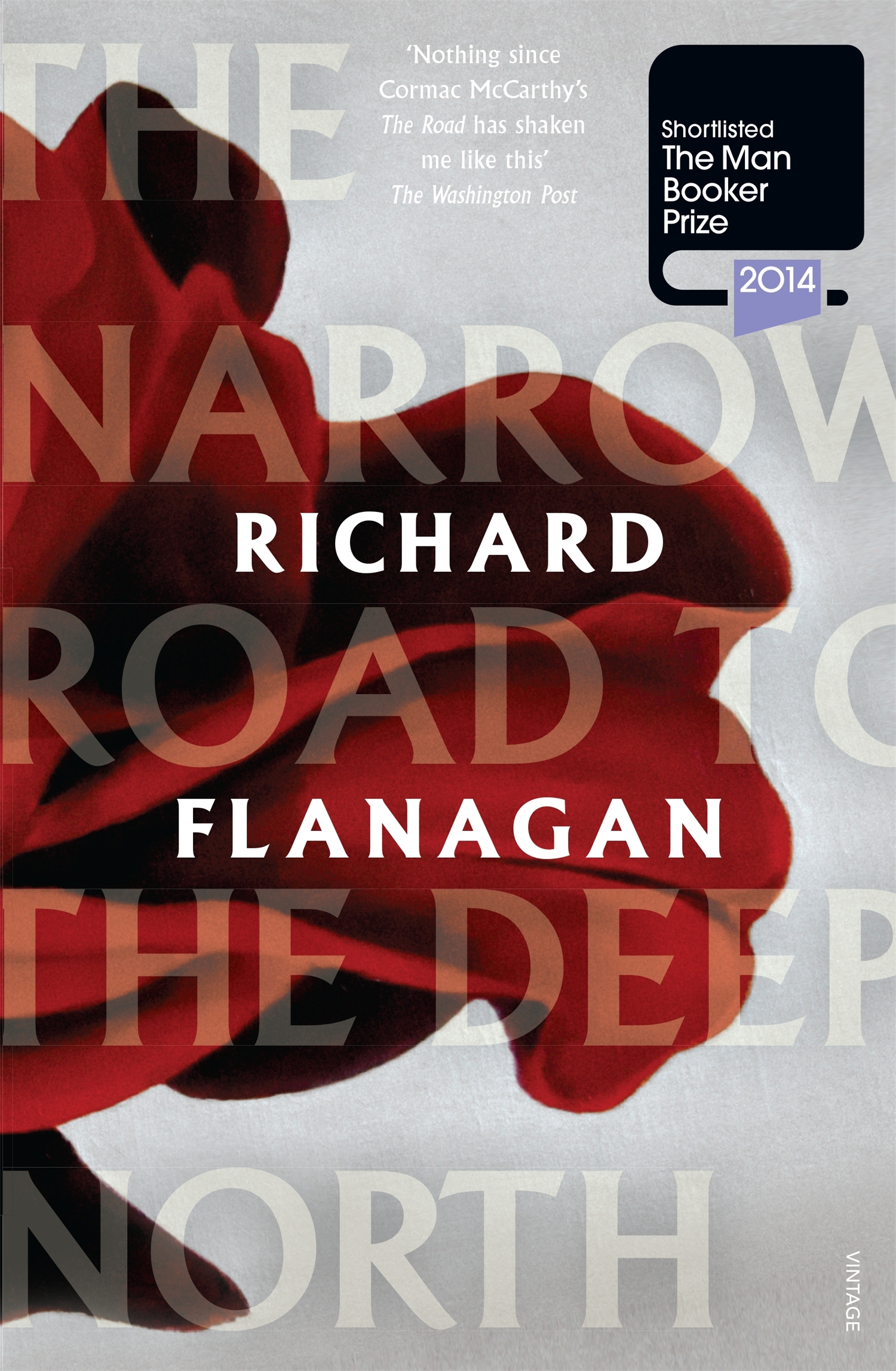
Richard Flanagan: The narrow road to the deep north (Review)

Courtesy: Random House Australia

Courtesy: Random House Australia

I love generosity of spirit, the ability to rise above terrible things to see the humanity that lies beneath. Richard Flanagan’s Booker Prize shortlisted The narrow road to the deep north is, without being sentimental or glossing over the horror, a generous book – and this is why I expect it will be one of those books I’ll remember long into the future.

I know I’m late reading it – but this is because I’ve been saving it until my reading group did it, which was earlier this week. Consequently, I spent the last few days of September engrossed in the life of Dorrigo Evans, war-hero, lover of poetry (and of too many women), and, most significantly, POW from the Thai-Burma Railway. It’s one hell of a tale … and not exactly what I expected.

On the surface, Dorrigo had a successful life. He survived the POW camp for one thing, was highly regarded in his career, became a war-hero celebrity due to a documentary (loved this!), and had a long-lasting marriage with three children. But, this is not the full story. Chapter 2 of Book 1, commences:

A happy man has no past, while an unhappy man has nothing else. Dorrigo Evans never knew if he had read this or made it up. Made up, mixed up and broken down. Relentlessly broken down.

This sounds like it could be PTSD, but it’s not. PTSD is important, of course, but Flanagan is interested in broader issues. In many ways the book feels like a big 19th century novel – it has lots of characters, spans a long time-frame, doesn’t shy from coincidences, and explores big themes – but in style, it’s very contemporary, with frequent shifts in time and place, and multiple third-person subjective points of view. It requires concentration to get all the connections, and would benefit from a second reading. Just the sort of book I enjoy getting my teeth into.

I said in my opening paragraph that the book wasn’t exactly what I expected. That’s because I was expecting more war, and perhaps more anger, than I found. There is war, of course, much of it gruesome, as fits the “truth” of that situation, but the main thread is a love story, accompanied by meditations on ideas like truth, goodness and manhood. I can’t possibly discuss all these or we’ll be here forever, so I’m just going to focus on a couple.

“to somehow be more truthful as a human being” (Nakamura)

One of the novel’s strengths is the balance Flanagan strikes between brutality and humanity. He does this partly by paralleling the life of Dorrigo, the commanding officer of the POWs, with Nakamura, the commanding Japanese officer. Nakamura is the enemy but isn’t vilified as you’d expect. Flanagan shows Nakamura to be brutal towards prisoners but we also get inside his head. We learn that he is not comfortable in his own skin – he is, in fact, addicted to shabu (speed) – and that he needs his superiors’ arguments to convince himself of the right of what he is doing. That he is able to do so – that is, to buy completely into the notion of the “Japanese spirit”, into the Emperor’s goals of “The World Under One Roof” – is believable. What soldiers don’t buy into their nation’s “mythology” (whatever it is based on)?

Flanagan follows Nakamura post-war until his death, as he endeavours to rebuild his life – firstly under a false identity to escape being tried as a war-criminal, and later as himself, married and a father. He struggles to define himself – and is surprised to feel himself transformed into “a good man”. A decade or so after the war, his memory of his brutality fades:

time … allowed his memory instead to nurture stories of goodness and extenuating circumstance.

However, when he is dying, he finds it increasingly difficult to hold onto “his idea of his own goodness”. Comparing this goodness with that of his wife, it comes “close to collapsing altogether”. He searches for the “good things in his life — separate of the Emperor’s will, of orders and authority” but finds they are few when compared with his memory of “skeletal creatures crawling through the mud”. His death poem, concluding with “clear is my heart”, is tinged with irony, but reflects his desire “to conceive of his life’s work as that of a good man”.

By contrast, Dorrigo believes himself not to be a good man, to be “entirely bogus”. He marries a woman he doesn’t love, believing his true love to be dead:

For the rest of his life he would yield to circumstance and expectation, coming to call these strange weights duty. The guiltier he felt about his failure first as a husband and later as a father, the more desperately he tried to do only what was good in his public life. And what was good, what was duty, what was ever that most convenient escape that was conveniently inescapable, was what other people expected.

And yet, he’s a “war hero” and validly so. At one point on the Railway, when they are all starving, he refuses to eat some steak. Rather, he sends it back to the men, having “found himself the leader of a thousand men* who were strangely leading him to be all the many things he was not”. This is not false modesty – the men did bring out his best – and yet this modesty is not completely valid either because Dorrigo did have good in him. He was a man prepared to take action for others, at risk to himself. In his last comatose days, he feels that his life had “only ever been shame and loss”, but his final words are words of action, alluding, self-deprecatingly perhaps, to Don Quixote’s windmill but also reminding us of the last line of the poem that defined him, Tennyson’s “Ulysses” – “to strive, to seek, to find, and not to yield”.

 “a poem is not a law” (Bonox Baker)

Two other notions run through the novel – and I’ve already alluded to them both – the love of literature, particularly poetry, and the workings of memory. One scene in particular brings these ideas together. It concerns the funeral pyre for some cholera victims, who include the artist Rabbit Hendricks. When cholera victims are burnt, their personal belongings must also be burnt, but Bonox Baker wants to save Rabbit’s sketchbook because:

it’s a record … So people in the future would, well, know. Remember, that’s what Rabbit wanted. That people will remember what happened here. To us.

Dorrigo quotes from Kipling’s poem, “Recessional”, arguing that everything is forgotten in the end, that it’s better to just live. Bonox disagrees, telling Dorrigo that

A poem is not a law. It’s not fate Sir.
No, Dorrigo Evans said, though for him, he realised with a shock, it more or less was.

For Dorrigo, for Nakamura and for his commanding officer, Colonel Kota, poetry is essential in some way to their lives. Dorrigo, who lived at a time “when a life could be conceived and lived in the image of poetry” eventually finds himself “living in the shadow of a single poem”, while for Nakamura poetry emulates “the Japanese spirit” by which he tries to justify or explain his actions.

Bonox, though, is interested in something else. He continues to argue with Dorrigo about the sketchbook:

Memory is the true justice, sir.
Or, the creator of new horrors. Memory’s only like justice, Bonox, because it’s another wrong idea that makes people feel right.

And so we come to one of the paradoxes that Flanagan exposes in the book – individual memory versus the memory industry. Dorrigo is outed as a war hero through a documentary, which makes him uncomfortable, and yet “to deny the reverence seemed to insult the memory of those who had died”. The memory industry, however, too often ignores the “truth” of the experience in preference for the facts, as bugle-player Jimmy Bigelow discovers:

His sons corrected his memories more and more. What the hell did they know? Apparently a lot more than him. Historians, journalists, documentary makers, even his own bloody family pointing out errors, inconsistencies, lapses and straight out contradictions in his varying accounts. Who was he meant to be? The Encyclopaedia bloody Britannica? … His words and memories were nothing. Everything was in him. Could they not see that? Could they not just let him be?

Paradoxically, Flanagan is questioning the memory industry while at the same time contributing to it. And it is a powerful contribution. Just goes to show the power of literature!

This is a big messy novel, about the two messiest things humanity confronts – love and war. I love its messiness, its lack of answers, but it sure made it hard to write about. Fortunately, Lisa at ANZLitLovers and John at Musings of a Literary Dilettante have also given it a go.

Richard Flanagan
The narrow road to the deep north
North Sydney: Vintage Books, 2013
ISBN: 9781741666700
466p.

* Aussie readers will recognise Flanagan’s reference here to Weary Dunlop.

Monday musings on Australian Literature: Lansdowne Press’s Heritage Books

Just as some contemporary publishers, like Text, have decided to publish Australian Classics, so did publishers in the past attempt such projects. One such publisher was Lansdowne Press which, according to N.B. in the Canberra Times in 1963, began “a series of reprints from Australiana” which they called Heritage Books.

N.B. discusses two books in the series, Anthony Trollope’s Harry Heathcote of Gangoil* and Mrs. Charles Clacy’s A lady’s visit to the gold diggings of Australia in 1852-53*. Unfortunately, it doesn’t seem that Lansdowne used “Heritage Books” in their imprint because I can’t find this series in library catalogues. I therefore have no idea what other books were published in the series, or how long it lasted. I did find other Lansdowne books that might have been in the series, such as The felonry of New South Wales: being a faithful picture of the real romance of life in Botany Bay: with anecdotes of Botany Bay society and a plan of Sydney by James Mudie (first pub. 1837), and Reflections on the colony of New South Wales by George Caley (first pub. 1829).

The Canberra Times article is headlined “Contemporary accounts of the good old days”, and you can see from the titles that “accounts” is the operative word. They are not all novels. In fact, of the four I’ve listed, only Trollope’s is a novel.

Trollope’s “Slight Plot”

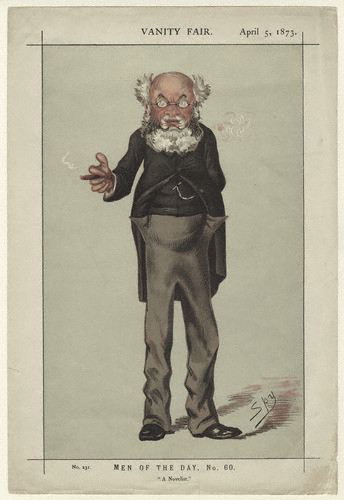
Trollope, 1873, in Vanity Fair (Public Domain, via Wikipedia)

Trollope, 1873, by Sir Leslie Ward, in Vanity Fair (Public Domain, via Wikipedia)

N.B. starts by discussing Trollope who visited Australia in 1871 and stayed with his son who apparently ran a sheep-station in the Queensland outback. Trollope ended up writing a travel book, Australia and New Zealand (1873), and two novels, Harry Heathcote of Gangoil (1874) and John Caldigate (1879). NB clearly knows Trollope well. I laughed at his/her statement that Trollope, “even at his best, which is very good indeed, tends to be careless and to use three words where one would do.”

So to Harry Heathcote. It has, s/he, says a slight plot about rivalry between free selectors and sheep farmers in Queensland. N.B.’s assessment is that Trollope’s portrayal is authentic and that the book

is still well-worth reading for its entertainment value for anyone who can dispense with the slicker techniques and concise prose of modern popular novelists.

And then, having a bet both ways, s/he also says, it

is short and dramatic, virtues which will commend it to modern readers who shrink from the traditional Victorian three-decker.

It’s for assessments like these that I so enjoy delving into old newspapers. They provide such insight into the thinking of another time (if 50 years ago is another time!). Anyhow, N.B. continues that Trollope, not a sentimentalist, presents in Heathcote “a real person with faults of personality as well as the representative virtues of an English gentleman …”.

In case you are interested, here* are paragraphs 2-4 from Chapter 1:

“I’m about whole melted,” he said, as he kissed her. “In the name of charity give me a nobbler.** I did get a bit of damper and a pannikin of tea up at the German’s hut; but I never was so hot or so thirsty in my life. We’re going to have it in earnest this time. Old Bates says that when the gum leaves crackle, as they do now, before Christmas, there won’t be a blade of grass by the end of February.”

“I hate Old Bates,” said the wife. “He always prophesies evil, and complains about his rations.”

“He knows more about sheep than any man this side of the Mary,” said her husband. From all this I trust the reader will understand that the Christmas to which he is introduced is not the Christmas with which he is intimate on this side of the equator–a Christmas of blazing fires in-doors, and of sleet arid snow and frost outside–but the Christmas of Australia, in which happy land the Christmas fires are apt to be lighted–or to light themselves–when they are by no means needed.

Trollope clearly cottoned on to Australia’s hot summers and the serious risks of bushfire. If this is a good example, N.B. is right about its authenticity.

Lansdowne’s “Real Service”

However, it seems that Lansdowne’s real service in N.B.’s eyes, was republishing A lady’s visit. Once again the issue of length is raised, this time by Patricia Thompson in her introduction to Clacy’s book. She says it’s not “too long, too dull, too pompous for the taste of the 20th century” like many early books of Australia. Thompson describes Clacy’s book as both interesting historically and a good read.

Clacy came to the Australian goldfields, “those auriferous regions” as she calls them, with her brother. N.B. says that Clacy’s book

should not be missed by anyone who appreciates a racy record which catches the flavour of what it was like to be there in Australia’s most rumbustious era.

Again, to give us a taste, here* is the second paragraph of Chapter 3, which describes their arrival in Australia:

The first sounds that greet our ears are the noisy tones of some watermen, who are loitering on the building of wooden logs and boards, which we, as do the good people of Victoria, dignify with the undeserved title of PIER. There they stand in their waterproof caps and skins–tolerably idle and exceedingly independent–with one eye on the look out for a fare, and the other cast longingly towards the open doors of Liardet’s public-house, which is built a few yards from the landing-place, and alongside the main road to Melbourne.

You can see what N.B. means, can’t you, about her style?

But what of Lansdowne now?

According to their website, Lansdowne is:

a leading independent book publisher and packager. We produce high-quality books and book-related products for publishers, retailers and distributors around the world.

We specialize in the subject areas of cooking, new age, interior design, gardening, health, history and spirituality for the international market.

Hmmm … a “packager”? They say they won the American Independent Publisher’s Award in 2000. An American independent publisher’s award? Intriguing. However, I can’t see any evidence of activity since 2006.

* Both books can be read at Project Gutenburg Australia: Harry Heathcote and A lady’s visit to the gold diggings of Australia in 1852-53.
** Nobbler is a small shot glass of hard liquor.