Fiona McFarlane, The night guest (Review)

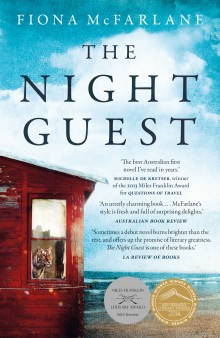
McFarlaneNightGuestPenguinThose of you who followed the literary award season in Australia last year will have seen Fiona McFarlane’s debut novel The night guest pop up several times. The more it popped up, the more I wanted to read it – but also the more I thought it would be good to read with my reading group. So, I bought it, and held onto it until this year, as we did, in fact, schedule it for our end of February meeting.

The first thing to say about this book is that it’s an easy, quick read, a page-turner in fact. But, it is not a simple read. It’s a read that keeps you guessing right to the end, even though you are pretty sure you know what is going on. It’s about Ruth. She’s in her mid-seventies, and recently widowed. She lives in the family’s old holiday house to which she and her husband had retired a few years previously. And, she’s “reached the stage where her sons worried about her”.

Then, along comes Frida, from the government she says, to be Ruth’s carer, because Ruth, as we’d suspected, has dementia, albeit in early stages. She is, she feels, “still self-governing”. Apparently, both of McFarlane’s grandmothers had dementia which helps explain why McFarlane has been able to present Ruth’s state of mind so convincingly. I say “helps explain” because there’s clearly a perceptive and skilled writer at work here too. It’s one thing to experience family members with dementia, but it’s quite another to be able to present it with such authority and authenticity.

How does McFarlane do this? The most important decision a writer has to make I think – and I’ve certainly heard many say this – is the voice. For this book, McFarlane chose third person subjective, that is, it is told third person but almost completely from Ruth’s perspective. A good decision, because we can feel Ruth’s uncertainty as she slides between confidence and uncertainty, between independence and neediness, between reality and a strange world that doesn’t always make sense. Because it’s from her point of view – and not an omniscient author’s – we are kept on our toes, not always sure, as Ruth is not, of where she is on any of those spectrums at any given time. Sometimes it’s patently obvious, but other times it’s not so clear.

Ruth has a few guests during the course of the book – including Frida (of course) and a man called Richard Porter. But there is another one, a tiger! The tiger appears in the opening sentence of the novel:

Ruth woke at four in the morning and her blurry brain said, ‘Tiger’.

She was of course dreaming, except that now she’s awake, she starts to hear noises, “something large … rubbing” against her furniture, and “the panting of a large animal”. These noises are too big to be coming from her cats. The tiger is ongoing “character” in the novel. More on this anon.

The second guest to arrive is the aforementioned Frida. She appears out of the blue one day – “You don’t know me from Adam” she says – to start caring for Frida. The question though is, is she “out of the blue” or is it that Ruth didn’t remember that someone was coming. Questions like this recur throughout the novel, keeping us in a sort of readerly vertigo. One minute we believe we know, and the next we are uncertain again. By the half-way point, though, I suspect most readers are pretty confident of what’s really going on, but even then there are uncertainties about how it will actually play out. All this makes the book an engrossing challenge.

Then there’s the third guest, Richard Porter, who was her first, and unrequited love, when she was a young woman living in Fiji with her missionary parents. Ruth invites him for a visit, hoping that “things could still happen to her”.

It’s hard to know how to write more about the book though because this is one of those stories in which the plot and the meaning are intertwined. However, I can say that it’s broadly about ageing, grief, love and loss. It’s also about trust, honesty and the responsibilities we have for each other.

The tiger

The tiger, as I’ve already indicated, appears on the first page. He’s a complex figure, alluding partly, I’m sure, to Blake’s “The Tyger”. But, and here perhaps I’m drawing a longer bow, he also reminded me of the tiger (aka Richard Parker, which is very close to Richard Porter, but that might be a bridge too far!) in Yann Martel’s Life of Pi. Both tigers reflect a duality: they are both fearsome (and perhaps representative of evil, though I like to avoid that word), but both can also be seen positively. Blake’s tiger was made by the God who also made the lamb, and so by extension can be seen to encompass both forces. Martel’s tiger needs to be kept at bay, but his very presence also gives Pi the strength and focus he needs to survive.

So, too, in The night guest does the tiger play a complex role. He appears when Ruth is at her most uncertain, most fearful, most disoriented, disappearing when she’s calm. In that sense he represents the negative. But, there’s something grand, and perhaps even reassuring about him. In his first appearance, Ruth thinks:

A tiger! Ruth, thrilled by this possibility, forget to be frightened and had to counsel herself back into fear.

A little later, when she is feeling comfortable, the tiger is “safely herbivorous”. But, he comes back, and Ruth is irritated “because there was no point to him now that she had Frida and Richard; the tiger had prepared the way for them and was no longer needed”. I’m tempted to suggest that Frida and Richard could represent the tiger’s duality, but the book isn’t simplistically conceived, so I don’t want to take that line of thinking too far.

Towards the end, when the tiger is fighting for his existence,

Ruth felt for a moment on the verge of understanding exactly what the tiger was saying when he roared. He wasn’t concerned for his safety, but for his dignity …

I’ll leave the tiger there, but I think you can see how McFarlane uses him in the novel.

There are other images and symbols which run through the book, some of them biblical, like lilies (“she was safe behind her lilies”), which makes sense given Ruth’s missionary upbringing. And, of course, Ruth’s name itself is biblical. None of this is heavy-handed though, or suggests a slavish adherence to symbolism. It just adds to the depth with which we can contemplate this book – at least, I think so.

In the end, this is a book about people – and how we treat each other. Several people, besides those I’ve mentioned here, are involved in Ruth’s life, such as her sons and a young mother who’d found her husband as he was dying. The book asks us to consider how far do we – should we – take our duty of care? How do we decide when we should intervene in another’s life and when we should not. I did enjoy this book.

Lisa at ANZLitLovers didn’t enjoy it as much as I did. I agree that it doesn’t really work as a psychological thriller, which is how some of the blurbs on my edition describe it. But, as I was reading it, I wondered whether that’s what McFarlane intended … or just how it’s been promoted?

awwchallenge2015Fiona McFarlane
The night guest
Melbourne: Penguin Books, 2014 (orig. ed 2013)
275pp.
ISBN: 9780143571339

Monday musings on Australian literature: Writer development programs

I’m not a writer – as regular readers here would know – so I only have an outsider’s understanding of how writers develop their skills. Here is what I know. First, of course, writers have to write – and write – and write. This is a pretty lonely business – and I suspect, often a frustrating one. They may need help developing their manuscript to completion, or they may not know how to navigate the publishing process,

But, they can receive help. There are creative writing courses in schools and universities. There are writers’ retreats (as I’ve written about before) where writers get to work on a project and sometimes receive advice while doing it. And there are targeted development programs. These are the ones I’m writing about today. They vary in length, format, funding arrangements, and who they target, but they all have one goal – to help writers succeed.

As usual, I’m just going to share a few to demonstrate the variety of offerings out there:

  • Gertrude Contemporary and ARTAND Australia Emerging Writers Program is a very specific program targeting “emerging visual arts writers” who want to “contribute to the critical discussion of Australian contemporary art”. It teams four writers with mentors to help them “develop their writing practice, publish their work and gain further insight into the field of contemporary art writing”. It was established in 2005 and they say it’s the longest-running program of its kind. (That’s a great achievement though I’m not sure what they define as their “kind”). (Melbourne, Victoria)HARDCOPY 2015 - Nonfiction Edition - open for applications
  • Hard Copy, run by the ACT Writers Centre, with funding from the Australia Council for the Arts, targets “committed emerging writers”. It has several aims, writerly ones like helping them develop their manuscripts to completion, and practical ones like increasing their knowledge of the industry and their ability, if I read the aims correctly, to network. In 2015, Hard Copy is focusing on writers of non-fiction, and applications close on 13 March. (Canberra, ACT)
  • QWC/Hachette Australia Manuscript Development Program is a program jointly run by the Queensland Writers Centre and the publisher Hachette. It has been running now for 7 years, and has resulted in the publication of books like Favel Parrett’s Past the Shallows and Inga Simpson’s Mr Wigg. It’s a four-day program for 10 emerging fiction and non-fiction writers, and provides individual consultation with Hachette editors and the opportunity to meet “publishing industry professionals such as literary agents, booksellers and established authors”. (Brisbane, Qld)
  • SA Writers Inc Professional Development Program is, I think, typical of the programs run Australia’s state-based writer’s centres. The describe their professional development program as comprising “a wide variety of events, workshops and masterclasses”. If you click the link I’ve provided, you will see the calendar for the current month, showing that at the end of February there is a Masterclass in Creative Writing and a Spoken Word Workshop for Young People run by Omar Musa. (Adelaide, SA)
  • Varuna, The Writers House, like many writers retreat venues, offers a wide range of development opportunities to writers besides its residential program. They divide their non-residential or outreach program into two groups, Workshop and Events, and Writer Development Program. The former can include short-term courses like the Introduction to Life Writing Workshop presented by Patti Miller in 2014, while the latter provides writers with one-on-one consultations on their manuscripts. (Katoomba, NSW)

If you’re a writer, have you attended any professional development programs? Were they useful (and what made them so, if they were!)?

Ellen van Neerven, Heat and light (Review)

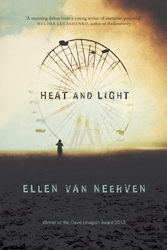
Ellen van Neerven, Heat and light, book cover

It’s silly I know, but I had a little thrill at the end of Ellen van Neerven’s Heat and light, because not only was the last story set in a place where I spent six of the formative years of my childhood – Sandgate on the northern edge of Brisbane – but one of the characters learnt to swim in the same pool there that I did, and her brother has a beagle, just as we did. Ah, childhood. Enough, though, of readerly nostalgia. Time to properly discuss the book.

Heat and light won the David Unaipon Award for Unpublished Indigenous Writer in 2013, and has been on my TBR for several months. I hadn’t prioritised it for reading, but its longlisting for the Stella Prize last week convinced me to squeeze it in before two works I had to complete by 21 and 24 February. I hope I won’t regret it. No, let me rephrase that: I know I won’t regret having read it, but I hope I don’t regret my decision to read it right now!

The first thing to say is that Heat and light isn’t a novel. It has, in fact, an intriguing form, something that’s not unusual with writers from an Indigenous background. Simplistically speaking, it comprises short stories organised into three sections titled Heat, Water and Light. However, each of these sections is quite different. Heat comprises interconnected short stories (5) about three generations of the Kresinger family, while Water is longform short fiction (54 pages in my edition) in the speculative fiction genre. Light, on the other hand, is more like a “traditional” collection of short stories (10). Together, the three sections, including the future-set Water, create a rich picture of contemporary indigenous life and concerns.

And here I confront again the challenge of being a non-Indigenous Australian reviewing a work by an Indigenous Australian featuring Indigenous people. It always makes me a little anxious: I fear sounding earnest or, worse, patronising; I fear making what’s different sound exotic; and, I fear missing the point. And yet I love reading Indigenous writers, because their perspective is different and because they (see, I’m generalising, aren’t I?) tend to be adventurous in their story-telling, often taking risks with voice, form, chronology, genre, and more. Van Neerven, as I’ve already implied, is such a writer.

The titles of the three sections – Heat, Water, Light – make me think of the elements. They are not quite the classical elements (fire, air, water, earth) but they convey, it seems to me, the essence of what’s needed for life. The focal character in Heat, though we don’t see a lot of her, is Pearl, the grandmother of the narrator of the first story which is titled, in fact, “Pearl”. Pearl is a bit of a free spirit – earthy, hot (in its sexual meaning, with “her siren eyes”), and likely to appear or disappear with the wind. Over the five stories in this section we learn about Pearl, her sister Marie, and the two succeeding generations. Van Neerven’s writing is confident, moving comfortably between first and third person narrators, all of whom are members of a complex extended family. Loyalties – to their indigenous background and to their blood relationships – are tested. As the narrator of “Pearl” says:

So much is in what we make of things. The stories we construct about our place in our families are essential to our lives.

And this is true, whether or not the stories so constructed are “true”. The implication is you need to know what you are doing. Colin, for example, finding himself, through his own actions, disconnected from his Indigenous heritage, wants to return, but

she told me if I was going to make my way home I’d better do it soon before the dust had covered my tracks.

The third section, Light, explores similar issues to those in Heat, but through ten separate stories, ranging from 2 pages to 30. The characters in both sections both move between city and country, but, while Heat is set in southeastern Queensland, the stories in Light are set in Sydney, Western Australia and Queensland. The protagonists tend to be young, and female. They also tend to be in formative stages of their lives, or at crossroads; they are sorting out their relationships, their sexuality, their identity. They confront racism and face conflict, but they also experience and give love. There’s humour, some of it wry, such as the young girl noticing that the tag on her pants states that “this colour will continue to fade”.

Water, the longform story that occupies the middle of the book, is very different. For a start, it’s set in the near future, the 2020s, when Australia is a republic with a female president. There’s a new flag and Jessica Mauboy’s song “Gotcha” is the national anthem. There’s also a social media ban! I reckon Van Neerven enjoyed imagining this. However, life isn’t perfect. Our narrator Kaden has a new job as a Cultural Liaison Officer and was initially pleased because she thought she’d be working with “other Aboriginal people” which would provide a “way of finding out about my culture and what I missed out on growing up”. But, she discovers she’ll be working with “plantpeople” who are sort of mutant plants with human features created during “islandising” experiments. Kaden’s job is to evacuate them in preparation for the Australia2 project.

I don’t want to give any more of it away, but you’ve probably guessed that it’s a story about how we treat other, about segregation, discrimination and dirty politics. It’s also about connection to country and about the importance of controlling one’s own art. Artist Hugh Ngo says:

I don’t make art for galleries. Or for money. I make art that speaks the truth.

This is a clever (and true!) book. The bookending sections Heat and Light present stories of Australian people going about their lives, and most of them happen to be indigenous. Their indigeneity is evident, and it affects the issues they confront, but there’s no specific advocacy. The middle section, on the other hand, is more overtly political. It picks up issues that appear in the shorter stories and provides a coherent, ideological context for the whole.

Heat and light is one of those really satisfying reads: it combines engaging writing with stories that make you feel you’ve got to the things that matter. So no, regardless of whether I meet my other deadlines, I’m not sorry I bumped this book up in my reading priorities.

awwchallenge2015

Ellen van Neerven
Heat and light
St Lucia: UQP, 2014
226pp.
ISBN: 9780702253218

Note: One of the stories in Light, “The Falls”, is available on-line at Kill Your Darlings

Tara Moss, The fictional woman (Review)

Courtesy: HarperCollins Australia

Courtesy: HarperCollins Australia

In terms of feminist argument, I’m not sure that Tara Moss told me anything I didn’t already know or believe in her first work of non-fiction, The fictional woman, but that didn’t stop me enjoying her take, her approach. Moss is an interesting woman. Her careers as a model and a crime writer meant she wasn’t really on my radar for the first twenty years of her working life, but that changed a couple of years ago when she began appearing on commentary shows I watch like Q&A (see an appearance here) and The Drum. I discovered that she’s a woman of wide interests and many talents. Here are some of them: UNICEF Ambassador for Child Survival, Goodwill Ambassador; UNICEF Australia Patron for Breastfeeding for the Baby Friendly Heath Initiative; Ambassador for the Royal Institute for Deaf and Blind Children; and a PhD candidate in the University of Sydney’s Department of Gender and Cultural Studies.

So the book. Her main thesis – born of her own experience – is that women’s lives and roles are subject to an inordinate number of fictions that contradict reality, and that this helps perpetuate ongoing inequalities for women in representation, status, value. The book starts more like a memoir, telling us how she became a model in her early teens (“The Model”), her experience of being measured by her body (“The Body”), how she survived some early experiences, including rape (“The Survivor”), and her transition to being a writer (“The Writer”). She then moves on to discuss wider topics such as “The ‘Real’ Woman”, “The Archetypal Woman”, “The Beautiful and the Damned”, and “The Crone”, though in these too, she often uses her personal experiences. To illustrate the fictions women live under, she tells of taking a polygraph test to prove that she, a “dumb” “blonde” “model”, could actually have written a successful novel.

Moss supports her discussion of the fictions she identifies with an impressive array of statistical and other evidence. The book is extensively foot-noted (or, is that end-noted), as you would expect from a PhD student. While the points she makes aren’t necessarily new to me, much of her evidence is – and that’s worrying because her evidence is recent confirming that things haven’t changed as much as I’d have hoped since I first started thinking and reading about feminism in the 1970s.

I won’t elaborate the multiplicity of fictions she explores, the way women are simplified into virgin, whore, witch, crone, for example, because we all know them. Even the male readers here know them, I’m sure. Rather, I’d like to talk about some ideas that I found particularly interesting.

One of these ideas relates to the issue of beauty, which comes up in several chapters, but my focus here is “The ‘Real’ Woman” in which she discusses the various campaigns for/promotions of “real beauty” which encourage women to show themselves au naturel. No, I don’t mean naked, but without makeup, and other enhancing products and processes. Having lived my life this way (little or no make-up, no hair-dyeing, no waxing, etc), I was feeling comfortable in this chapter, until I reached her suggestion that these “campaigns” can be “like a beauty pageant, only with different parameters”. In other words, once again, we are asked to “judge” women on the basis of their appearance. She writes:

I see some disturbing similarities between the kinds of appraisals of women’s appearance that we commonly view as misogynistic, and appraisals that present themselves as ‘pro-woman’.

I take her point. “Using images”, she argues, “to make the claim that you are freeing women from the prison of image is a tricky thing to pull off”. I found this chapter the most confronting because, unlike the others which tended to cover more familiar ground, this one forced me to think more deeply about the complexity of how we “see” women. It’s not surprising that she loves John Berger’s excellent work, The ways of seeing.

She explores some of the underlying structural causes, particularly the way our market-driven society supported by the media contort and distort “reality” through stereotyping, simplifying and then generalising. She argues that women’s visibility in the public sphere is dominated by/limited to those “images” needed to sell products. Advertising has become “so entangled with mainstream culture … so entangled with female identity in particular”, she argues, that we do not see the real diversity of women’s engagement in society.

For many people, “gender” and “feminism” are tricky concepts. Moss unpacks them both with excellent clarity. Her definition of feminism is exactly mine. Feminists want

equal opportunity, equal rights, equality for women. (Equality = same value or status. They want to be equal to, not the same as, men).

Yes! How often do we need to repeat this? “Equal” does not mean “same”. And just because you don’t agree with some feminists doesn’t mean you’re not a feminist if you believe in equality for women. Moss understands, though, women fearing to own the term. She tells of once being asked on ABC TV whether she was a feminist, and admitted she felt

an actual ripple of fear. Part of me was afraid of the vitriol I would be subjected to for publicly identifying with the very movement that had given me the right to vote, the right to own property, the right to work and earn my own pay.

How can that be?

And this brings me, in a way, to another theme that pops up through her book: the way women undermine each other. She discusses, for example the “mummy wars” in which working mums are pitted against stay-at-home mums, and breast-feeding mums are pitted against formula-feeding mums. And yet, she also debunks the fiction “that all women hate each other” or that “women are their own worst enemies”, not only by confirming that for many women, other women provide their greatest support, but by exploring how society, and particularly the media, “read” female behaviour and interaction to put this spin. She tells how a joking comment of hers was read as “a swipe at Miley Cyrus”. Again, the main point of her argument is the social construction that supports these “fictions” about women.

In her final chapter, she discusses what she sees as the wider problem which is that the world is not “a fair and balanced place”. We do not have equality – across gender, race or class. This is what we need to address, and she calls us all to action.

Occasionally I worried that Moss was drawing a long bow or skewing her argument a little by her own experience, but in fact I found her thesis and thinking to be clear and logical, intelligently-framed, and forceful without being judgemental. It’s a good read – and provides much for us to contemplate.

awwchallenge2015Tara Moss
The fictional woman
Sydney: HarperCollins Publishers, 2014
328pp.
ISBN: 9780732297893

(Signed copy received from my sister-in-law)

Monday musings on Australian literature: New prize for experimental NON-fiction

We’ve all heard of prizes for experimental fiction, I’m sure, such as the new(ish) Goldsmith’s Prize won by Eimear McBride’s A girl is a half-formed thing in 2013, but have you heard of a prize for experimental non-fiction? I hadn’t until I read about Lifted Brow’s new prize recently.

The Lifted Brow is a Melbourne-based publisher, which publishes, “excellent writing and artwork”. They publish in print quarterly, in digital monthly, and online every other day. They have, they say, “eyes all over the world”. This last point is important because their The Lifted Brow Prize for Experimental Non-Fiction is not limited to Australia. They describe the prize as “looking to unearth new, audacious, authentic and/or inauthentic voices from both Australia and the world”. The prize is AUD1000, plus publication in The Lifted Brow’s redesigned/reformatted magazine (edition 25, due out in March 2015). Submissions, which closed at the end of January, had to be no more than 5,000 words, and there was a small entry fee. The judges are (somewhat) international too: Australian author-academic Rebecca Giggs, and US writers John D’Agata (essayist) and Mallory Ortberg (author of Texts from Jane Eyre).

Anyhow, here is the longlist which was announced earlier this month:

  • Sophia O’Rourke’s “Flaming June – Still Life and the Anthroposcene”
  • Scott Sandwich’s “Music Begins Where the Possibilities of Language Ends”
  • Jocelyn Hungerford’s “Don Quixote, Which Was an Essay: A Plagiarism for Kathy Acker”
  • Kelly Neal’s “The Ax and the Ex: Texts and Contexts”
  • Harry Saddler’s “Thought Experiment”
  • Ilan Oberon’s “A Holiday with Space Hippies”
  • Mattie Sempert’s “Navel Gazing”
  • Ben McLeay’s “The Lake”
  • Oscar Schwartz’s “Humans Pretending to be Computers Pretending to be Human”
  • Sian Campbell’s “Bleach”
  • Caroline Crew’s “Slipcover”
  • Rachel Hennessy “Kristeva’s Blood”
  • Sam Cha’s “Why I Am Not A Pianist”
  • Kimberley Starr’s “The Caged Bird Speaks”

I’ve listed these in their order, restraining myself from alphabetising to keep with the spirit of the prize. But, oh dear, I would like some sort of order to facilitate locating particular names any time I come looking at this page again. Just me, I suppose. (You can take the girl out of the library, but you can’t take … well, you know the rest!)

Anyhow, at first glance, I only recognise one of the authors listed here, Rachel Hennessy, whose novel, The heaven I swallowed, I’ve reviewed here. Of course, The Lifted Brow folk did say that were looking for writers they’ve never heard of before as well as ones they know, so some of these could be new. I wonder how many are international? Here’s what a superficial Google search revealed:

  • Not found (or not with reasonable confidence): Sophia O’Rourke, Kelly Neal, Ben McLeay
  • Found (with reasonable confidence): Scott Sandwich (Australian performance poet whose “real” name is Tom Hogan); Jocelyn Hungerford (Australian author/editor); Harry Saddler (Australian author born in Canberra); Ilan Oberon (Australian writer-artist based in Queensland): Mattie Sempert (Australian writer and acupuncturist based in Melbourne); Oscar Schwartz (Australian writer-poet based in Melbourne, currently researching whether computers can write poetry); Sian Campbell (Australian “freelance writer, student, wannabe bassist and lit nerd” based in Melbourne and Brisbane); Caroline Crew (American writer-poet); Rachel Hennessy (Australian writer, born in Canberra); Sam Cha (American writer-poet, based in Massachusetts); Kimberley Starr (Australian novelist and teacher)

So there you have it. Most are Australian, as I suppose you’d expect given the sponsoring magazine is Australian. And the gender spread looks pretty even (albeit exact numbers aren’t clear given that a couple of the names are gender-neutral).

I love the idea of experimental non-fiction. I’ve read (and reviewed here) some non-fiction that has played with voice and structure, or that has straddled, for want of a better description, the fiction-non-fiction divide, but not a lot, and probably not as “out there” as I suspect this prize is seeking. I look forward to seeing who wins it and just what the winning entry entails.

What do you understand by experimental non-fiction, and have you read much?

The Griffyns go to China with Gough

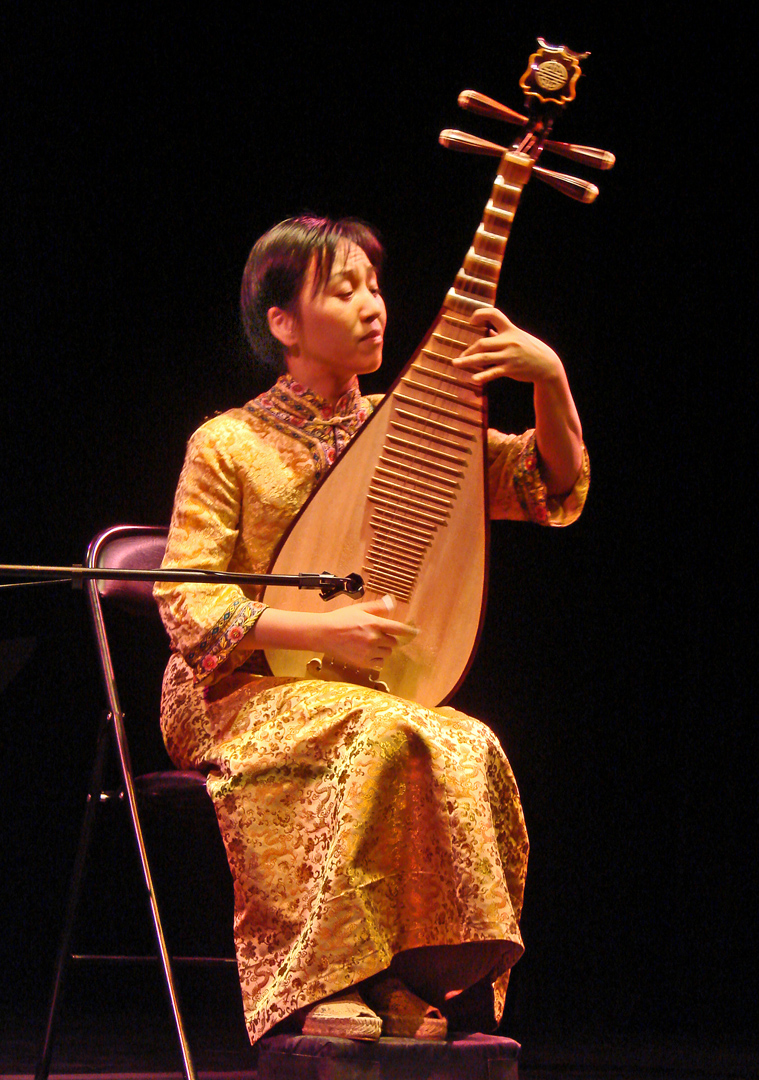
… figuratively speaking, of course! The Griffyn Ensemble commenced their 2015 season in fine style, with guest artist, Chinese pipa player, Professor Zhang Hongyan. As always, the concert had a theme, evident from its title, Whitlam in China (and the development of friendly relations between our two countries). It was a tightly performed, well conceived and thoroughly enjoyable concert.

Lingling Yu playing Pipa at Musée Guimet, Paris (Courtesy: Dalbera, CC-BY-2.0, via flickr)

Lingling Yu playing Pipa at Musée Guimet, Paris (Courtesy: Dalbera, CC-BY-2.0, via flickr)

First though, we had the pre-concert entertainment by the string quartet from the China Philharmonic Orchestra. They played three Chinese pieces – all folk-based – in the National Library of Australia’s Lower Ground public space. I don’t remember the names of the first two pieces, but the second one had a gorgeous melancholy to it, and it sounded a little familiar. The first violinist told us that it was about longing and homesickness, and is frequently used for Chinese New Year. I’ve probably heard it somewhere! The third piece was a lovely contrast, “Happy Girl”. Many of us listening couldn’t resist bobbing our heads a little. These folk tunes sounded fine in a Western string quartet configuration.

After this prelude, we all filed into the National Library’s lovely 300-seat theatre, a favourite place of mine and one that I had much to do with professionally, many moons ago. I love visiting it.

Somewhat unusual for the Griffyns, this program’s narrative had a clear chronology, commencing with Gough Whitlam’s election to parliament in 1952 and ending pretty much with the famous dismissal in 1975. The music itself though moved around a bit in time. Here is the program, with links to online versions* (mostly played by other performers) where I have found them:

  • I will build my house on the water. By Horace Keats to a 4th century Chinese poem. Performed by the Griffyn Ensemble (Soprano JaneParkin with Pianist Clemens Leske version)
  • Dragon boat. Traditional. Performed by Hongyan Zhang
  • Moonlit night on the Spring River. Traditional, based on a Chinese poem by Zhang Ruoxu. Performed by  Hongyan Zhang, with the Griffyn Ensemble (China Broadcasting Traditional Orchestra version)
  • In our image, in our likeness. Movements 1, 3, 4. By Leilei Tian. Performed by Kiri Sollis (Recorders), Chris Stone (Violin) (mp3 version)
  • Like spinning plates. By Radiohead. Performed by the Griffyn Ensemble, featuring Susan Ellis (Soprano). (Radiohead’s own version)
  • It’s time. By Paul Jones and Mike Shirley. Performed by the Griffyn Ensemble, featuring Susan Ellis (Soprano). (Original version)
  • Dance music of the Yi People. By Wang Huiran. Performed by Hongyan Zhang. (Chu Yuan version)
  • Big decisions: The Whitlam dismissal. By Robert Davidson. Performed by the Griffyn Ensemble.
  • The song of the pipa player. By Mo Fan to a poem by Bai Juyi. Performed by Hongyan Zhang, with the Griffyn Ensemble (Ding Yi Music Company version)

If you listen to any of these you will realise what a varied – as usual – concert it was.

The concert was narrated by Griffyn musical director Michael Sollis, frequently accompanied by apposite little bars on the double bass (Holly Downes). He had clearly done a lot of reading about Whitlam’s political life, and his narration included quotes from people of the time, such as other politicians and officials, commentators and journalists. While Mr Gums and I, unlike the Griffyns, lived the era, I did learn some things. Gough, after all, was some decades older than I! I learnt, for example, that the first time he mentioned Australia recognising or making overtures to China was in 1954! Sollis described in some detail Whitlam’s history-making visit to China in 1971, when he was still Opposition leader. Whitlam, Sollis reported with a wry look, told Chinese premier Zhou Enlai that

The Australian people have had a bitter experience in going all the way with LBJ. They know America made [Prime Minister Harold Holt] change his policy and they will never again allow the American president to send [Australian] troops to another country.

Sollis also quoted Stephen FitzGerald, who accompanied Whitlam and who later became Australia’s ambassador to China. FitzGerald described the trip as:

an expedition of great bravado and exposure but [also?] great political judgment and luck. It was a journey to the unknown because no one knew what would come of it or who Whitlam would meet. It was personal diplomacy of great political sensitivity.

This section of the narrative was accompanied by a performance of Leilei Tian’s In our image, in our likeness by Kiri Sollis on recorders and Chris Stone on violin to evoke the meeting between Whitlam and Zhou Enlai. I enjoyed listening to the music and thinking about how the two instruments, the two melodies, might reflect the content and tone of the talks. And it was performed with such aplomb and skill by these two musicians who clearly enjoyed what they were doing. One of the many highlights of the night.

Another highlight was the revival-style performance, led by soprano Susan Ellis, of the ALP’s 1972 election song, It’s time. The audience couldn’t resist clapping along.

And finally, while still on the Whitlam theme, I enjoyed Big decisions: the Whitlam dismissal, a piece composed by Australian Robert Davidson for wind quartet with recorded speech. We, of course, had the Griffyns, not a wind quartet, and I presume Sollis had arranged it, as he had the final piece, The song of the pipa player. The recorded speech component of Big decisions comprised excerpts of speeches made at the time – most of which we of a certain age, or students of politics, recognised. The Australian Music Centre says that “The music emphases the inherent melody in recorded voices of Gough Whitlam, Malcolm Fraser, Sir John Kerr and a supporting cast of Paul Keating, Sir Joh Bjelke-Petersen, Sir Charles Court and others”. I loved the way key words and lines from the speeches were repeated with musical accompaniment working around them. Intriguing. Clever.

And then, on top of all this was the pipa, played with such energy and yet delicacy too by Zhang Hongyan. Just check the link I’ve provided under Dragon boat to see what I mean. The concert ended with an ensemble performance of The song of the pipa player composed to a 9th century poem by Bai Juyi. Sollis explained the origin of the piece … here is the beginning of the poet’s foreword to it:

In 815 I was demoted from the Capital to a local Officer of Jiujiang Prefecture. One autumn night of the following year, while seeing off friends on a boat leaving Penpu harbor on the Yangtze River, I suddenly heard a pipa tune being played from the neighboring boat. The music style was clearly from the capital. Being totally surprised, I made an inquiry and learned that the musician was a lady who used to be a famous star in the Capital … Then her glorious years past with the time as her beauty faded. Finally she had to lower herself to marry to a merchant.

Demotion, you see … a fitting conclusion to a wonderful concert in which music and narrative combined perfectly to keep the audience engaged from beginning to end.

Ensemble: Kiri Sollis (flute), Chris Stone (violin), Laura Tanata (harp), Holly Downes (double bass), Susan Ellis (soprano), Michael Sollis (director/composer).

* I tend to provide links where I can because much of the music the Griffyns play is unfamiliar.

Stella Prize 2015 Longlist

As a team-member of the Australian Women Writers’ Challenge, I’m particularly interested in the Stella Prize, which, as you probably know, is a prize limited to Australian women writers. The great thing about it, though, is what it isn’t limited to – and that is form and genre. The first winner in 2013 was a novel, Carrie Tiffany’s Mateship with birds (my review), and the second, last year, was a history, Clare Wright’s The forgotten rebels of Eureka (my review). What will it be this year?

Well, it could be a book of short stories or a memoir, or it could be true crime or, yes, a novel, or it could even be a young adult novel or a book about the human race. Here, if you are interested, is this year’s longest (the shortlist to be announced on March 12):

Helen Garner, This house of grief book cover
  • Maxine Beneba Clarke’s Foreign Soil: a collection of short stories which has been receiving positive reviews.
  • Emily Bitto’s The Strays: a debut novel set around the 1930s and published by small publisher, Affirm Press
  • Ceridwen Dovey’s Only the Animals: a collection of short stories giving, I understand, a animal’s-eye-view of humans, at our best and worst.
  • Helen Garner’s This House of Grief: a sort-of true-crime-cum-courtroom story which I reviewed last year.
  • Sonya Hartnett’s Golden Boys: novel by one of our well-established well-regarded writers
  • Christine Kenneally’s The Invisible History of the Human Race: non-fiction about the development of the human race, looking at DNA and historical factors.
  • Sofie Laguna’s The Eye of the Sheep: second novel from an author whose first novel was longlisted for the Miles Franklin Literary Award and shortlisted for the Prime Minister’s Literary Award.
  • Joan London’s The Golden Age: I loved London’s Gilgamesh, and also enjoyed her The good parents (which I’ve reviewed here) so why haven’t I yet read this one?
  • Alice Pung’s Laurinda: debut novel, for young adults, by acclaimed memoirist Pung whose second memoir I’ve reviewed here).
  • Inga Simpson’s Nest: second novel by an author proving to be popular with AWW Challenge reviewers. She’s on my radar.
  • Ellen van Neerven’s Heat and Light: debut novel which won the 2013 David Unaipon Award, and it’s on my TBR.
  • Biff Ward’s In My Mother’s Hands: memoir by the daughter of historian Russell Ward, which I’ll be reading in March, as it’s been scheduled for my reading group.

This year’s stellar (couldn’t resist that) judges are critic and writer Kerryn Goldsworthy (chair), journalist and broadcaster Caroline Baum, writer and lecturer Tony Birch, singer–songwriter Sarah Blasko, and author Melissa Lucashenko. You can read the judge’s full report on the Stella Prize website.

Monday musings on Australian literature: Capital men novelists

It’s been a year since I wrote my post on Capital women novelists, the third in my series on Canberra’s writers. (The other two were Capital women and Capital men poets.) Today I am finally getting to the male novelists.

I’ll start in a round-about way with a local controversy. Last year, the ACT government changed the eligibility requirements for its ACT Book of the Year awards, narrowing location to ACT residents only. As the City News reported at the time, this contradicted “the principle enunciated in artsACT’s arts policy framework of ’embracing Canberra’s position as a regional centre and fostering opportunities for increased engagement with regional communities’” and it reversed the previous practice of allowing nominations from writers in the region. Fortunately, after serious lobbying from arts practitioners and supporters in the ACT, the government agreed that “regional NSW residents with an ACT based arts practice” could apply. I’ve told you all this not only because it shows that lobbying can succeed, but to justify my including regional writers in my ACT-based series!

As will other posts in this series, I am just going to share a few current novelists – in alphabetical order.

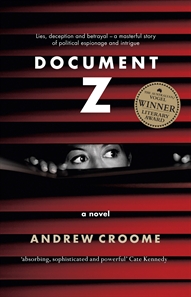
Andrew Croome

Document Z bookcover

Allen & Unwin

Croome, like many writers, is (or has been) somewhat peripatetic but is currently based in Canberra and has been for a couple of years at least. His first novel, Document Z (my review), which was published in 2008, deals with one of Canberra’s most famous stories, the Petrov spy scandal. It won  the The Australian/Vogel Literary Award and the New Writing award in the NSW Premier’s Literary Awards, and was shortlisted for others. I thoroughly enjoyed it, both for the perspective he presented and for his evocation of 1950s Canberra. His second novel, Midnight Empire, which I’ve also reviewed, was not set here though its main character had come from Canberra. It will be interesting to see where he goes next.

John Clanchy

Like many writers based here, indeed like many people of a certain age who live here, Clanchy came from elsewhere. I discovered in the ACT Writers Showcase that he moved to Canberra in 1975, the same year I did. He is still based here, as far as I know. In my recent review of his latest book, Six, I indicated that I was sorry I hadn’t read Clanchy before this. He has published 10 works of fiction, some of which are short story collections and two of which are crime thrillers co-written with another Canberra writer, Mark Henshaw. He apparently taught writing at the Australian National University, and in addition to fiction has co-written non-fiction books on academic writing, research and related topics. A versatile writer.

Julian Davies

Julian Davies, Crow mellow Book cover

Finlay Lloyd

You may remember Davies because, like Clanchy, he’s another established writer that I’ve come to late. He is also one of two men behind the Finlay Lloyd non-profit publishing venture. He has published around 6 novels, plus many short stories and essays. According to the ACT Writers Showcase, he has lived in Canberra or what we call the Southern Tablelands for most of his life. I’d like to think the grand house in Crow Mellow (my review) is located in the region, though I suspect it’s a little north. Regardless of where it is, I did enjoy the descriptions of place in the book, of which this is one:

This far view was unmistakably Australian, the bunched crowns of eucalyptus gleaming blue on the ridge-tops, deep green plumwood trees and sassafras holding to their lower creases. In the valley, the farm’s paddocks showed their patchwork of varying greens, some farm sheds and, higher than the others, an old two-storey building, a brick mill which Mitchell had painstakingly restored. At the valley bottom, the enormous dam, and beyond it, short reaches of the creek gleamed between stands of dusky she-oaks.

Nigel Featherstone

Courtesy: Blemish Books

Blemish Books

Nigel Featherstone is the local writer who has featured most in my blog, through my reviews of his novellas, a guest post, and an interview. Featherstone was born in Sydney, has lived in Canberra, and currently lives in Goulburn, an hour’s drive away. He has published a novel, novellas, short stories and is a freelance writer for the Canberra Times. He is also the founder of the online literary journal, VerityLa. He is active in the ACT (and wider Australian) arts community, being committed to the idea that a strong arts community is critical to the health of our society. He walks the talk – and I look forward to seeing what he comes up with next.

Alan Gould

Alan Gould, author of The lakewoman which I reviewed, is yet another under-recognised Australian writer. English-born he came to Canberra in 1966. He is a poet and novelist – and I did mention him in my Capital Male Poets post, so will move on to others whom I haven’t mentioned before.

Mark Henshaw

Henshaw is the writer least known to me, though I do have his latest, Snow kimono, on my TBR, and I did attend its launch. He lives in Canberra and worked until recently at the National Gallery of Australia. He made a big splash with his first novel, Out of the Line of Fire, which, Susan Wyndham, literary editor of the Sydney Morning Herald, wrote “bedazzled critics with its post-modern playfulness, philosophical intelligence and European sophistication”. It was shortlisted for the Miles Franklin and Age Book of the Year awards. It was also, she says, “translated into several languages, and became one of the best-selling Australian literary novels of the decade”. Between it and Snow kimono which came twenty-six years later, he co-wrote two crime thrillers with the aforementioned John Clanchy. I am greatly looking forward to reading Snow kimono which, he told us at the launch, he wrote without ever visiting Japan. A brave and clearly interesting man!

Roger McDonald

McDonald is the most successful of the writers I’ve listed here, at least in terms of writerly accolades. These include his first novel, 1915, winning the Age Book of the Year award and being made into a successful miniseries; The Ballad of Desmond Kale winning the Miles Franklin Award in 2006; and When Colts Ran being shortlisted for the Vance Palmer, Miles Franklin and Prime Minister’s awards in 2011. Like Gould, he is also a poet. McDonald was born in Young, NSW, about 2 hours drive from Canberra. He has lived mostly in rural areas, on farms, as well as in Canberra. He is now based, I understand, in the Braidwood area (where Julian Davies also lives). His novels tend to reflect his rural background – pubs, sheep stations, and the lives of the men and women who live there. This description of young Colts from When Colts ran captures such lives perfectly:

Loose soil and road ruts baked in the sun were the material of his playground then, soil blunting his hearing as he wiggled a finger in his ear imitating the way men did, at the same time as holding their pipes. The grainy feeling of Limestone Hills dirt, the taste of it spat from his tongue, clinging to damper cooked in the ashes, dirt stuck to a boiled lolly taken from a paperbag, was the medium Colts was born into, as far as he could tell. A fly got stuck in his ear, sizzling deeper. That was the feeling too. He’d never get over it, or past it either. The hum of the dry bush, crickets, Christmas beetles, cicadas.

This book, too, is on my TBR. So much to read …

On understanding the arts

Earlier this year I wrote a post about reading difficult literature. I said that I like to be challenged by literature, and discussed the features that define “difficulty” for me. Since then I’ve come across various statements, some contradictory, about the role of “difficulty” in the arts – and I thought I’d share them with you as part of a continued discussion.

Australian art critic Robert Hughes (quoted from the recent documentary series, Brilliant creatures):

You have to realise, of course, that no painting that’s of any quality is really very easy to understand because the function of a painting is always to expand one’s experience and so if it were easy to understand, then it would fall within what you already knew.

I’m not sure I agree with this. Surely art, and here I’m extending Hughes’ statement to all art forms, doesn’t have to be difficult to introduce a new idea or experience way of seeing things? Difficulty can be useful because it can force us to think, but I don’t see it as essential. Am I reading this statement too simplistically?

In Tolstoy’s book, What is art (which I admit to not having read, so I may be taking this out of context), he says that:

The business of art lies just in this, — to make that understood and felt which, in the form of an argument, might be incomprehensible and inaccessible.

Here Tolstoy seems to be saying pretty much the opposite to Hughes, arguing that the aim of art is to make an idea accessible, which I read, in my simple way, as “easy” to understand.

I’ve read similar contradictory statements about poetry.

Methinks the difference relates to their ideas about the role of art. Hughes, I suspect, saw art as expanding our experience and, perhaps as a result, leading to new thinking, wheras Tolstoy saw art, I believe, as having a moral purpose. It can’t just be for its own sake. If you see art in those terms it must be comprehensible, eh?

I’d love to know what you think about these two ideas. Are they totally contradictory, or can we encompass them both! I know I’m being somewhat wilfully simple here, but sometimes that is the place to start?

John Clanchy, Six: New tales (Review)

ClanchySixFinlayLloydJohn Clanchy, like Julian Davies whose Crow mellow I recently reviewed, is another Australian writer I’d heard of but not read until his piece in the Canberra centenary anthology, The invisible thread. What a treasure trove that has turned out to be! Anyhow, titled “The gunmen”, Clanchy’s contribution was an excerpt from his first novel, The life of the land, published in 1985. He’s a versatile writer, it seems, crossing genres (such as crime and mystery) and form (novels, short stories, and non-fiction). Six, the book I’ve just read, is a collection of six short stories – long short stories, in fact. An earlier collection of his, Vincenzo’s Garden, won the 2005 Queensland Premier’s Literary Award for Short Stories and the 2006 ACT Book of the Year. If it’s anything like Six, I can see why.

But, before I get onto the book itself, a little about the publisher. Finlay Lloyd describes itself as a

a non profit publisher dedicated to encouraging imaginative and challenging writing, to subtly innovative design and to celebrating the pleasures of print on paper in an electronic age. Without the commercial imperative of most publishers, we are able to champion ideas and authors for their intrinsic interest and quality. We support independent bookshops as local outlets for these ideas and authors. Our books are printed in Australia to support the local industry (by Griffin Press and Ligare Book Printing).

It’s the “subtly innovative design” I particularly want to mention here (while also appreciating the rest of their philosophy). I’ve handled now about four of their books and they are beautiful. The shape varies, with some, such as Six, being long and thin. Subtly different (just like all planes!), and nice to hold. Six has an additional special touch – the first page of each of the stories is on slightly whiter, finer paper. There’s no table of contents, but you can quickly locate each of the stories by flicking the book through to these pages. These are simple things, but they make you feel that the book in your hand has been produced with love and care.

Anyhow, onto the book itself. I found all six stories completely engaging, imaginative, and one, surprisingly, laugh-out-loud funny. I say surprisingly because it’s rare that I’d read a truly funny short story, although there’s often one or two in a collection that make me smile. This story, “Slow burn”, is, I suppose, a “mere male” story, and, while I don’t really approve of “mere male” stories – they can be somewhat condescending – this one is too funny, too beautifully controlled, not to make me laugh. It’s all about Daryl Turtle who is “ill. Dangerously, perhaps fatally ill” and his wish to make himself a comforting piece of toast to go with the thermos coffee his thoughtful wife has left for him.

The other five stories – “Slow burn” is the third in the collection – are more serious. They deal with contemporary situations, a father who turns out to be gay and another who is discovered to have had a second family in another country. There’s a husband whose affair with an indigenous woman exposes an ugliness that shocks him. And there’s a powerful story about a couple whose daughter was killed overseas in a Bali-style bombing. These are the sorts of situations you read or hear about and wonder how the people at the centre of them cope. Clanchy explores just this, with sensitivity and authenticity, teasing out the underlying humanity of his characters. Whether they are a philandering husband, or rebellious daughter, a grieving father or lonely postman, we empathise and are encouraged to see the extent of human capacity to accommodate the unexpected. To put it another way, Clanchy’s characters tend to be confronted with seemingly black-and-white situations but find themselves capable of recognising the greys and responding, in most cases, generously and/or with growth.

The stories are not tricksy. In other words, they are not the sorts of short stories that you get to the end and wonder, “what was that about?” This may come from Clanchy’s experience in writing genre – two collaborative crime thrillers with another Canberra writer, Mark Henshaw. It may also relate to the fact that these are long-form short stories. (My rough calculation is that they are around 15,000 words, some shorter, some longer, whereas short stories are typically half that or less.) You may have noticed that, with the exception of “Slow burn”, I haven’t named the stories I’ve referred to. This is to avoid spoilers implicit in my comments. That said, while each story has a strong narrative arc with clear plot points, the focus is not really the plot. It’s the characters – which is where my interest lies and why I enjoyed the book so much.

I also enjoyed Clanchy’s writing. It’s clear and direct, and abounds with sharp observation. There’s humour, even in the serious stories, and fun wordplay. Here’s a description I loved:

Dot runs the general store and post office in town. She hates the sound of ‘Dot’ and you won’t get the time out of day if you call her that. ‘Dot is what a pen does to an eye,’ she says to anyone who doesn’t know, ‘and I’m an optometrist’s daughter, so call me May.’ And since she’s in charge of the town mail, that’s exactly what people do, though most people think that Dotty would suit her better. (from “True glue”)

As I neared the end of the last story, I was reminded of one of my favourite quotes, Wallace Stegner’s “Civilisations grow by agreements and accommodations and accretions, not by repudiations” in Angle of repose. In Six, as in most fiction of course, the characters are challenged by some event or situation and need to decide how they will respond. Stegner’s quote can, I believe, be applied not just to civilisations but to relationships and, indeed, character. Six evokes this perfectly. I really don’t know why Clanchy is not better known.

John Clanchy
Six: New tales
Braidwood: Finlay Lloyd, 2014
245pp.
ISBN: 9780987592934

(Review copy courtesy Finlay Lloyd)