Monday musings on Australian literature: Ernestine Hill

Regular readers of my musings will know by now that I sometimes use this spot to explore and share things that I don’t know much about. This post is one such. It was inspired by an article I read a year ago in Inside Story, Swinburne University of Technology’s online journal about current affairs and culture. The article was titled “How American servicemen found Ernestine Hill in their kit bags”, and was written by Anna Johnson, an academic from the University of Tasmania.
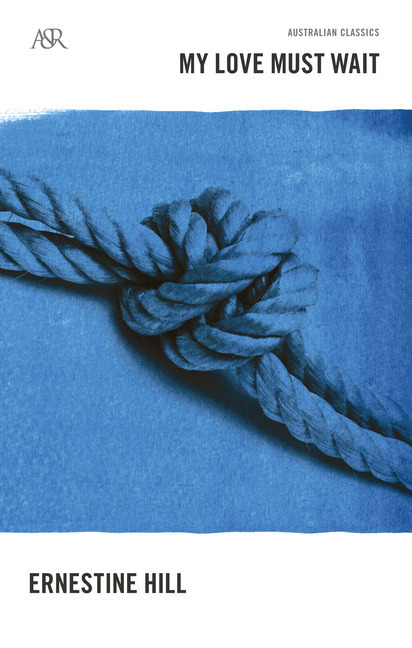
My love must wait 2002 cover

Cover for A&R Classics edition

Ernestine Hill (1899-1972) first came to my attention as a teenager with her novel, My love must wait, about Matthew Flinders. Although it was published in 1941, long before my teens, it was still popular at a time when young adult fiction had not come into its own. Primarily a journalist and travel writer, she only wrote that novel. And it’s not, I must clarify, the book that found its way into American servicemen’s kit bags! That book was Australian frontier, published in Australia in 1937 as The great Australian loneliness. Johnson doesn’t spend much time on these kitbags, but the story is that America’s non-profit Council on Books in Wartime, which believed books were “weapons in the war of ideas”, sent “stimulating reading [in Armed Services Editions*] to soldiers so that their leisure time was both educational and enjoyable”. I hadn’t known about this.

Johnson’s focus though is Hill, whom she describes as a “middlebrow” writer. She writes:

Although these so-called middlebrow writers [such as Ion Idriess and Frank Clune] have been frequently scorned by critics and neglected by subsequent Australian literary history, they were very influential cultural brokers who mediated debates about place, race, and culture for the interested general reader.

Hill’s books, says Johnson, were widely popular because they “were perfectly pitched between a sentimental attachment to late nineteenth-century ideas about the bush [..] and great excitement about modern technology and enterprise”. The Great Australian Loneliness, she writes, treads a fine line between lamenting “the passing of the old bushmen and their way of life” and celebrating “pilots and planes whose mail runs ‘have brought the Great Australian Loneliness well on to the map’.” Her writing was often condemned by critics “as romanticised purple prose” but Johnson suggests her books “forged bonds … between people who were geographically, socially and culturally dispersed”.

Hill’s popularity meant that booksellers loved her and promoted her, to the detriment of Australia’s more literary writers. Miles Franklin wrote in her diaries (ed. Paul Brunton) about a dinner held by Ell’s (a Newcastle bookseller) in September 1949:

I was able to note that booksellers, or representatives of publishers know little of the contents of the books they vend. They have not the taste, the ear, or the capacity. Take the case under observation, A & R [Angus and Robertson] boosted Idriess, an old steady, & Timms who is a thruster and insister & whom a person with Dr Mackaness’s literary standards considers an important Australian writer. But they did not bother about my books. I was there because invited by the cultural committee of Newcastle. My book continues to sell steadily though I’ve never had a Christmastide sale, was denied editions during the war boom in favour of E. Hill, who has powerful boosters behind her. I’ve never had a window or even a counter display.

Poor Miles. Hopefully not all booksellers and publishers were the same, but it’s a reminder that being a literary author has never been easy. I wonder how many people read Ion Idriess and EV Timms today?

Anyhow back to Hill. Reflecting her times, she was uneasy about multiculturalism, and wanted more white women, to support white men, in the outback. Johnson writes that her “vision of white Australia was common in the 1930s” and that she was “rarely complimentary to Aboriginal, Chinese, Malay, or Afghan Australians”, although she apparently filled her books with colourful vignettes about the lives of these people. She was, however, more positive about indigenous Australians. Johnson writes that she

attested to violent colonial conditions and lamented the passing of Indigenous lives and histories whose formative role in the nation had largely gone unrecorded. Her books and journalism joined others in modernising attitudes, which eventually saw the liberalisation that benefited Aboriginal people from the late 1960s onwards, even if her ‘modern’ opinions now seem uncomfortably tainted with colonialism.

So, a mixed bunch in terms of her attitudes. Regarding her book being published in America, she was thrilled. Articles by her were also published there. She wrote, in the 1940s, that she was encouraged “to rush my best and most arresting articles on this country to America to make them conscious of what a loss we’d be. Britain has never realised that. We must call Americans here.” Fascinating to see Hill’s vision of the power of literature, and its critical role, as Johnson describes it, in “securing the nation’s geopolitical future”.

Hill was a complex woman. She was also a friend of Daisy Bates, and, according the Australian Dictionary of Biography (link above), there was some controversy over Hill’s contribution to some of Bates’ writing.

Unfortunately, I couldn’t find any e-texts of Hill’s books, but once again Trove came to the rescue. Here is an excerpt of the foreword from The great Australian loneliness:

It was in July 1930 that I first set out, a wandering ‘copy-boy’ with swag and typewriter, to find what lay beyond the railway lines. Across the painted desert and the pearling seas, by aeroplanes and camel and coastal ship, by truck and lugger and packhorse and private yacht, the trail has led me on across five years and 50,000 miles, a trail of infinite surprises. I have interviewed men living in wurlies of paperbark who read Gibbon and wrote Greek and danced in corroboree, witch-doctors of the Warramunga, lepers and the dying, deep sea divers and prospectors for gold. I have attended Japanese feasts of lanterns, Chinese banquets, black fellow burials, and Greek weddings. Many of the notes have been taken by the flickering of the camp fire—the typewriter has always been with me, dangling from a camel-saddle jingling on a truck, covered with a camp sheet in the rains.” (The Shepparton Adviser, 31/3/1937)

Another book to add to the TBR list.

* A complete list of the 1322 titles is available online.

Helen Keller, I go adventuring (Review)

My reading has been so disjointed recently that I thought I’d look at recent Library of America (LOA) offerings for inspiration, and came across Helen Keller‘s “I go adventuring”, an excerpt from her Midstream: My later life. It appealed to me because I haven’t read anything by Keller since I was a teenager, and because this piece is about New York. I couldn’t resist.

Helen Keller sitting holding a magnolia flower, circa 1920 (Presumed Public Domain, from Los Angeles Times photographic archive, UCLA Library)

Helen Keller sitting holding a magnolia flower, circa 1920 (Presumed Public Domain, from Los Angeles Times photographic archive, UCLA Library)

Firstly, Keller. What an amazing woman. Like many, I suppose, I have always been in awe of her ability to make a meaningful life for herself without sight or hearing. LOA’s always useful introductory notes discuss Keller being asked, in relation to another excerpt, “what she could possibly have ‘seen’ from the top of the Empire State Building”. She replied that

I will concede that my guides saw a thousand things that escaped me from the top of the Empire Building, but I am not envious. For imagination creates distances that reach to the end of the world … Well, I see in the Empire Building something else—passionate skill, arduous and fearless idealism. The tallest building is a victory of imagination.

The notes continue to say that throughout her adulthood, Keller “faced scepticism over her abilities and criticism for her choices of language”. On one occasion, she responded that the deaf-blind person “seizes every word of sight and hearing, because his [using the male pronoun common to her times!] sensations compel it. Light and color, of which he has no tactual evidence, he studies fearlessly, believing that all humanly knowable truth is open to him”. American novelist and essayist, Cynthia Ozick, LOA tells us, accepts Keller’s point, saying, simply, “She was an artist. She imagined”.

Secondly, New York. Before I first visited New York in the early 1980s, I’d lived in Sydney, and had visited great European cities like London, Paris and Rome. None of these interested me greatly because I really don’t much like cities. (Yes, I liked the museums and galleries, the historic sites, but as places to “be” they didn’t really appeal). But New York. There was something about it – and I finally “got” cities. I still don’t like them a lot, but I credit New York with opening my eyes to “city-ness”, if that makes sense, to the buzz and rush and life of them.

However, I’ve indulged myself enough now, so let’s get to Keller’s piece. She starts by referring to her situation:

Cut off as I am, it is inevitable that I should sometimes feel like a shadow walking in a shadowy world. When this happens I ask to be taken to New York City. Always I return home weary but I have the comforting certainty that mankind is real flesh and that I myself am not a dream.

See, that’s New York for you! She then talks about the great bridges, starting with Brooklyn Bridge, which she says is “the oldest and most interesting of them … built by my friend, Colonel Roebling”. In my first visit to New York, one of the places I had to visit was Brooklyn Bridge – because of Ken Burns’ wonderful documentary of the same name. It’s an old film now, 1981, but is well worth viewing if you haven’t seen it and get the chance. Keller, though, says she mostly uses the Queensborough Bridge. She writes that not all poetry is found in poetry books, that

much of it is written in great enterprises of engineering and flying, that into mighty utility man has poured and is pouring his dreams, his emotions, his philosophy. This materializing of his genius is sometimes inchoate and monstrous, but even then sublime in its extravagance and courage. Who can deny that the Queensborough Bridge is the work of a creative artist?

While we continue to build astonishing structures, continue to push the edges of what we can achieve,  we are also, I think, more blasé about the achievements and more questioning about the value and implications. Keller’s admiration reminded me of the awe and wonder of the nineteenth and early twentieth centuries towards engineering feats, though she too, with the word “monstrous”, is perhaps sensing some other ways of seeing?

Keller’s piece is really short, so I’m not going to commentate it all. She describes circumnavigating New York in a boat and talks about about life on the water, and she ends with a vivid description of the power of the subways. I want to close though on another reference to herself. She writes:

New York has a special interest for me when it is wrapped in fog. Then it behaves very much like a blind person. I once crossed from from Jersey City to Manhattan in a dense fog. The ferry-boat felt its way cautiously through the river traffic. More timid than a blind man, its horn brayed incessantly. Fog-bound, surrounded by menacing, unseen craft and dangers, it halted every now and then as a blind man halts at a crowded thoroughfare crossing, tapping his cane, tense and anxious.

With that, she conveys so beautifully, for sighted people, some of her experience of the world.

Helen Keller
“I go adventuring”
First published: In Midstream: My later life, 1929.
Available: Online at the Library of America

Monday musings on Australian literature: Explorers’ journals

In last week’s Monday Musings post I quoted from some explorers’ journals. There’s something wonderful about reading early impressions of a place – which in the case of Australia means the impressions of Anglo-European explorers, by sea in the late 17th and 18th centuries, and by sea and land in the nineteenth centuries. The impressions of our indigenous inhabitants who have been here 40,000 or more years, depending on which region we are talking about and which scientist you listen to, are not written, but passed on orally and in rock art. I won’t be discussing them in this post, but of course theirs is a significant part of our historical record.

I’ve mentioned Project Gutenberg Australia before. Just to recap, it’s a sister (why do we say sister not brother? is sibling better?) site to Project Gutenberg. It provides access to international texts that are in public domain – in Australia. This means you’ll find non-Australian texts here, including, due to different copyright legislations, some texts not yet available via Project Gutenberg. However, its main value is that it provides an entrée to Australian material, through various sections which organise the content by subject/type. One of these sections is the Library of Australiana. Last time I wrote about this I focused primarily on Australian fiction and poetry. This time it’s the Explorers’ Journals.

PGA introduces this section by describing how “the map of the inland of the continent was drawn, first with the discovery, by Blaxland Lawson and Wentworth, of a way across the Blue Mountains”, and then by explorers like Sturt, Oxley, Eyre, Stuart, Giles, Leichhardt, and Burke and Wills, while the continent’s outline was “mapped by navigators including Cook, Flinders, King and Stokes”. PGA continues:

At the time of their discoveries there was great interest in the exploits of these explorers and it was a was a common practice for them to prepare a journal of their expeditions for publication in England. Then, for more than a century afterwards, their exploits were taught in schools.

A reassessment has since taken place, where settlement is seen as invasion and exploration is seen as expropriation. Of course, these were men of their time and as such behaved in a way which would be unacceptable to us now. However, their courage, determination and curiosity shine through in their writing. Furthermore, in reading their journals we are able to take part in the journeys which they made. Sue Asscher, who prepared many of the ebooks listed below, summed it up very well when she commented “I do love and hate the explorers [my emph]: they kill anything that moves, turn turtles over, poke through graves, look up grass skirts, take things for further examination never to be returned, scoff at anything superstitious, etc. taking notes all the time…and then call, with a sneer, some native girls who come to take a look at them, the explorers, ‘the inquisitive sex'”.

And so, for the modern reader, these journals have multiple interest. They tell us about:

  • the landscape as it was (or as it was understood) at the time of exploration;
  • meetings with local indigenous people and how communication with them went; and
  • attitudes, of both the specific explorers and, by a degree of extrapolation, of the times.

This is all important. More than the specific names and dates, it’s useful to know what the country looked like (compared with now, for example) and how those early contacts went. It surely helps us better understand and manage the present and prepare for the future. I wonder how much of this is taught in schools, today. In my day it was more the “heroic” stuff – the first to discover this (path, lake, river, mountain, or whatever it was), the tragedy of the near miss, and so on. We learnt little of the details and the experience.

PGA contains the journals of nearly 30 explorers, some well-known, and others less so. They are listed alphabetically, starting with Gregory Blaxland (chronicling his trip across with Blue Mountains in 1813 with William Wentworth and William Lawson) and ending with William John Wills (member of the tragic Burke and Will expedition). His journal, edited and published by his father in 1863, is poignantly titled, Successful exploration through the interior of Australia, from Melbourne to the Gulf of Carpentaria. From the journals and letters of William John Wills. It was successful, measured by its goal of reaching the Gulf, but not so if your measure of success includes the safe return of the party!

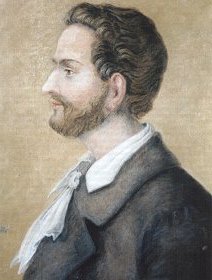
"Ludwig Leichhardt" by Friedrich August Schmalfuß (1791–1876), (Leichhardt-Museum, Trebatsch) - http://www.nvn-cottbus.de/themen/t_leichhardt.htm. Licensed under Public Domain via Wikimedia Commons

“Ludwig Leichhardt” by Friedrich August Schmalfuß (1791–1876), Licensed under Public Domain via Wikimedia Commons

Another tragic explorer was Ludwig Leichhardt. I’ve chosen him for my example because of his link to literature – he was the inspiration for Patrick White’s wonderful novel Voss – and because for a few years in my childhood, I lived in a town on the Leichhardt River. Unlike Wills’ posthumously published journal, this one by Leichhardt is for a trip from which he returned – Journal of an overland expedition in Australia: From Moreton Bay to Port Essington, a distance of upwards of 3000 miles, during the years 1844-1845. (Don’t you love the long, descriptive titles of these journals!).

Leichhardt prefaces his journal with a quote from Goethe:

Die Götter brauchen manchen guten Mann
Zu ihrem Dienst auf dieser weiten Erde.

(“The upper powers – Gods?- need many a good man for their service on this wide earth”.)

Presumably Leichhardt saw himself as, or aimed to be, such a good man, and saw his exploration as “service”. In chapter 2, he describes a meeting with “friendly natives” in southern Queensland:

On the 30th October, towards evening, we were hailed by natives, from the scrub; but, with the exception of one, they kept out of sight. This man knew a few English words, and spoke the language of Darling Downs; he seemed to be familiar with the country round Jimba; and asked permission to come to the camp: this, however, I did not permit; and they entered the scrub, when they saw us handle our guns, and bring forward two horses to the camp. On the 3rd of November they visited us again, and communicated with us, behaving in a very friendly way: they pointed out honey in one of the neighbouring trees, assisted in cutting it out and eating it, and asked for tobacco; it was, however, impossible to make any presents, as we had nothing to spare. They particularly admired the red blankets, were terror-struck at the sight of a large sword, which they tremblingly begged might be returned into the sheath, and wondered at the ticking of a watch, and at the movement of its wheels. The greater part were young men of mild disposition, and pleasing countenance; the children remained in the distance, and I only saw two women.

According to their statements, the scrub extends to the Condamine.

Intersting … the continuing friendly disposition despite what seems to be little coming back from the explorers.

There are many references to such meetings, and learnings, from “the natives”. Here are excerpts from chapter 5:

The natives had, in my absence, visited my companions, and behaved very quietly, making them presents of emu feathers, bommerangs, and waddies. Mr. Phillips gave them a medal of the coronation of her Majesty Queen Victoria, which they seemed to prize very highly. They were fine, stout, well made people, and most of them young; but a few old women, with white circles painted on their faces, kept in the back ground. They were much struck with the white skins of my companions, and repeatedly patted them in admiration. Their replies to inquiries respecting water were not understood; but they seemed very anxious to induce us to go down the river. (from Feb 27)

In consequence of the additional fatigues of the day, I allowed some pieces of fat to be fried with our meat. Scarcely a fortnight ago, some of my companions had looked with disgust on the fat of our stews, and had jerked it contemptuously out of their plates; now, however, every one of us thought the addition of fat a peculiar favour, and no one hesitated to drink the liquid fat, after having finished his meat. This relish continued to increase as our bullocks became poorer; and we became as eager to examine the condition of a slaughtered beast, as the natives, whose practice in that respect we had formerly ridiculed. (from Feb 29)

So interesting … and so wonderful that this material is now available for reading by anyone with access to the internet.

Kavita Nandan, Home after dark (Review)

NandanHomeUSPWhen Kavita Nandan offered me her novel to review I was happy to accept because its setting – Fiji, Australia and India – intrigued me. I’ve read several novels set in India, and by Indian writers, but none set in Fiji or by Fijiindian writers. Moreover, as Nandan wrote in her email, and as the back cover blurb says, the novel is “set against the backdrop of the first Fijian coup of 1987”. I certainly hadn’t read any literature about that!

Nandan is, as you have probably gathered, a Fijiindian Australian. She was born in India, grew up in Fiji, and migrated to Australia in her teens after the 1987 coups. She currently lectures in Literature and Creative Writing at Charles Darwin University. This is her first novel, and like many first novels it is told first person and has strong autobiographical elements.

The novel starts with a story about the Colonel’s involvement in saving the main character Kamini’s life from choking, and then jumps 18 years to the coup when that same Colonel places Kamini’s father, a politician in the Fijian parliament, under house arrest along with other Fijiindian ministers. The stage is set then for a story about the fine balance between love/loyalty and betrayal. There’s humour, as well as pain, in Nandan’s description of the coup:

Most of us only had a vague idea of what a coup was and even after it happened, the word sounded foreign in our mouths as we ignorantly clucked out the “p” like chickens on my cousin Ravi’s farm.

Nandan conveys the unreality of the coup (or coups), but it was not a happy situation and, as Wikipedia says, it resulted in a strong wave of migration from Fijiindians. Nandan (and her character) were part of that wave.

The narrative tos-and-fros a little – taking us to her childhood village life in Fiji and her grandmother’s home in India – but it is mostly chronological. In chapter 3, having set the scene with the coup, Nandan jumps the story forward to when Kamini is 35 years old and returning to Suva, with a husband, to work at the University as a lecturer. It becomes quickly clear that her relationship with her husband, Gavin, is fraught. Gavin suffers from depression and hasn’t worked since their marriage three years previously. This, it appears, is not a marriage of mutual support and respect, and most of Kamini’s family do not understand why she had married Gavin in the first place.

It’s an interesting story, though I wondered at times why Nandan had decided to write it as a novel. This is a critical decision, and one I’ve seen several authors discuss and change their minds about. Kate Grenville, famously, started her novel The secret river as a non-fiction work about her ancestor, but felt she had too many gaps in knowledge about the things she wanted to explore, so turned to fiction to explore them. Anna Funder, on the other hand, intended Stasiland to be fiction but, having done her research, felt the best way to honour the stories was to make her book non-fiction. Nandan’s book is strongest in her descriptions of life in India and Fiji, and less so in the story of the relationship between Kamini and Gavin, which I suspect is the main fictional component of the novel. Kamini is negative about Gavin most of the book, while continuing to want to make the marriage work. It didn’t quite gel emotionally for me, so the links Nandan tries to draw between the personal and the political felt tenuous.

Nandan does, however, have some evocative turns of phrase, such as this of the relationship between her Indian grandmother, Nani, and her aunt:

She had always craved better connection with her youngest daughter, but what passed through the gap was mostly cold air.

Or this, about the pull of the past:

I had run my fingernail along those ancient walls of memory and now I was being disturbed by strange echoes.

And she understands the paradox of immigration. Here’s her description of her great-grandfather leaving India on a boat for Fiji:

He felt his back alert and alive. His legs held their ground on a swaying ship. His entire body was seeking a new life.

The act of leaving his parents, his sisters, his brothers, his old grandmother and voyaging to a faraway place changed my grandfather forever. Building upon the memories of the old, he created the foundations of a new home and a new language. His single intent had been a courageous one. He was not to know that the new shore would give not only life but a new kind of death to his children.

Early in the novel, Nandan writes:

My father created a universe of hope through books and reading. But he was careful to remind us that life was always more important than anything read in books.

In Home after dark, the most powerful sections are those that seem to be drawn most closely from life, that is, those detailing the effect of multiple migrations on an extended family. It is in this theme of dislocation and loss, rather than in the story of a relationship, that Nandan’s heart is clearest, her hand surest. I’d like to see her develop it more.

awwchallenge2015Kavita Nandan
Home after dark
Suva: USP Press, 2014
185pp.
ISBN: 9789820109216

(Review copy supplied by the author)

Life … sends you detours

Love on the road 2015, book cover“Life … sends you detours” is a line I quoted from the short story “Sunrise over Sausalito” in the last review I posted here at Gums. That review, posted on 11 July, was for the short story collection Love on the road 2015. Unfortunately, since then we have experienced our own love-on-the-road detours. This is why, as some of you may have noticed, my posting here has slowed to a crawl – the last three posts were in fact written more than a fortnight ago and scheduled for posting over the last two weeks – and why you have not seen me commenting on blogs that I do try to visit regularly. I have, in fact, not opened a book in the last two weeks, even though I have always had one or two near at hand.

Here in a nutshell is the story. On 18 July we were heading off on a trip through Central and Northern Australia with two friends. However, on 17 July one of those friends found herself in hospital undergoing surgery for a broken hip. In one of those coincidences we’d hate in fiction, at exactly the same time she was under the knife in Canberra, Son Gums was under the knife in Seoul for a badly broken arm. He was in Korea on a brief teacher exchange but a team-building water sport activity went a little awry for him and … life, as they say, sent him a detour!

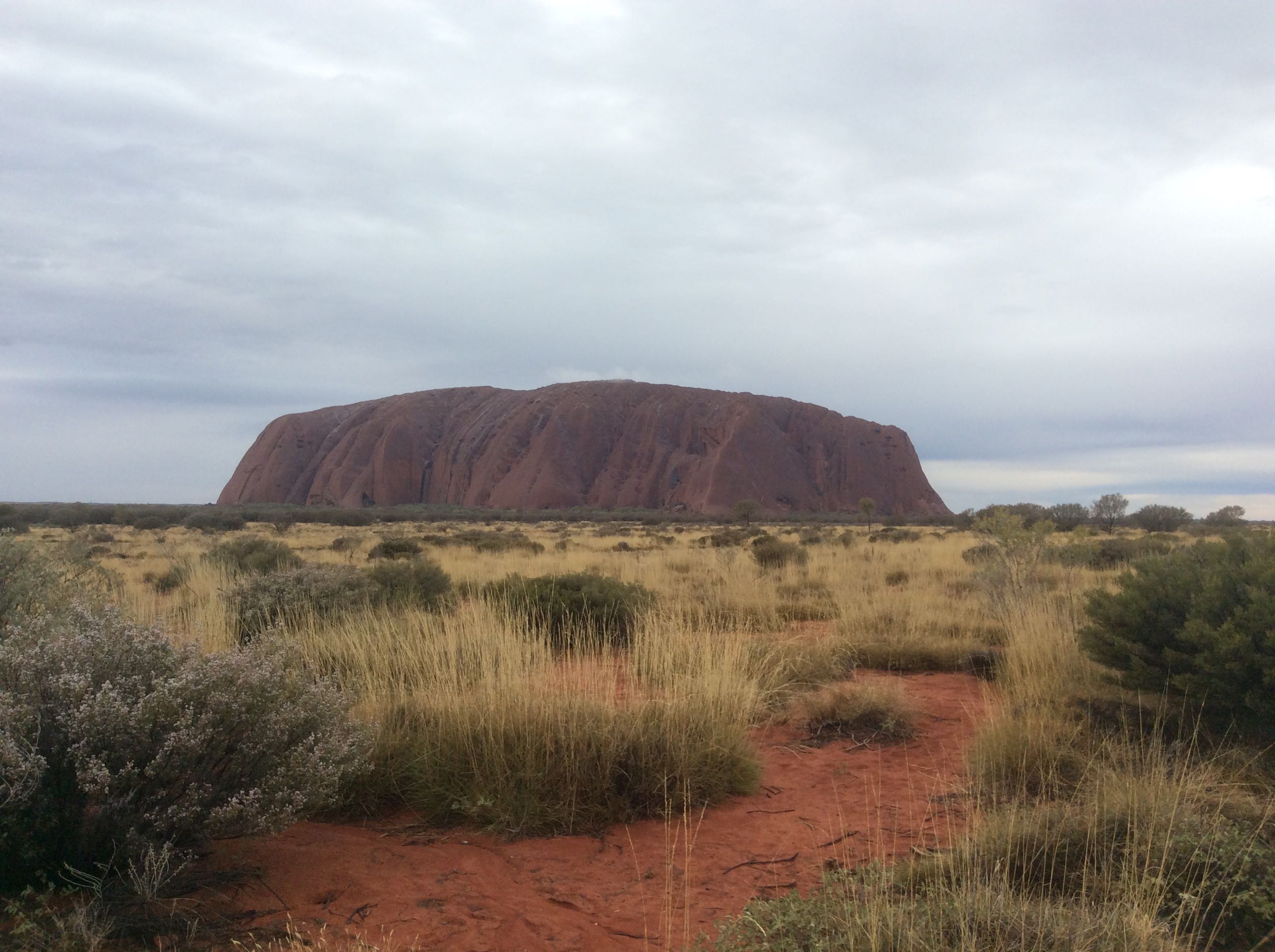
Uluru, on an unusually grey winter day

Uluru, on an unusually grey winter day, but rather suiting our mood

So, we rather reluctantly set off on our holiday as a twosome rather than a foursome and rather expecting that we’d have to cut our holiday short if our son returned to Australia – which is exactly what happened a week into our trip. So, any spare time during our trip was spent not relaxing with a book but rejigging, and then re-rejigging our travel plans, or communicating with relevant parties about the two patients.

I won’t bore you with more – both patients are on the mend now – but I did want to explain that a) I will get back to visiting your blogs soon and b) I am not in a reading slump. It’s simply that the love of children and friends has taken priority for the moment and detoured us from the road we had planned for this July.

Now, where is that book …

Monday musings on Australian literature: Let’s get physical – The Red Centre

A couple of years ago I wrote three Let’s get physical posts in which I focused on physical descriptions of places in Australia. Since, I am currently in Central Australia (for my third time), I thought it would be good to write another post or two in this series. Central Australia – or the Alice Springs Region, or the Alice-MacDonnell Ranges area – comprises the southern part of the Northern Territory, and includes the famous sites of Uluru and Kata Tjuta.

Alice Springs, itself, is the second major city in the Northern Territory, after the capital, Darwin. My introduction to the Alice was through Nevil Shute’s novel A town like Alice, but but in fact very little of the book is set in Alice Springs. Eleanor Hogan author of Alice Springs in New South’s Cities series said recently in a Wheeler centre interview:

I was particularly interested in the idea of Alice as a microcosm of national identity and history. It’s not a metaphor that you can take to literal extremes, but there are plenty of conundrums and paradoxes about life in Alice as the premier outback town at the heart of the country that intrigued me.

Central Australia is the quintessential outback. It’s geologically old – very flat with low mountain ranges which were formed 350-300 million years ago – and the earth is red. Population is sparse and distances great. It’s replete with heroes and “characters” like explorer-prospector Lasseter, missionary and Flying Doctor Service founder John Flynn, anthropoligist Ted Strehlow, and indigenous artist Albert Namatjira. It has been criss-crossed by many explorers, and it is where Robyn Davidson started her across-desert trek with camels, chronicled in her book (and the later film), Tracks. And it is, most importantly, home to large communities of indigenous people, who, according to Wikipedia, make up about 50% of the region’s population.

Since my focus here is the physical, though, I won’t go further into the history (or we’ll be here all day). The most famous (white) explorer of colonial Australia in this region was John McDouall Stuart, whose south-north expeditions resulted in the establishment of the Australian Overland Telegraph Line and of the main route from Port Augusta to Darwin (now known as the Stuart Highway). Stuart’s journals (covering 1858 to 1862) are available at Project Gutenberg Australia. I’ll share a couple of excerpts from the Journal of Mr Stuart’s fourth expedition – fixing the centre of the continent. From March to September, 1860. These entries describe the landscape a little south of the Alice:

At eight miles the red sand hills commence, covered with spinifex; and on the small flats mulga scrub, which continues to the base of the hill. Red loose sand; no water (Tuesday, 3 April)

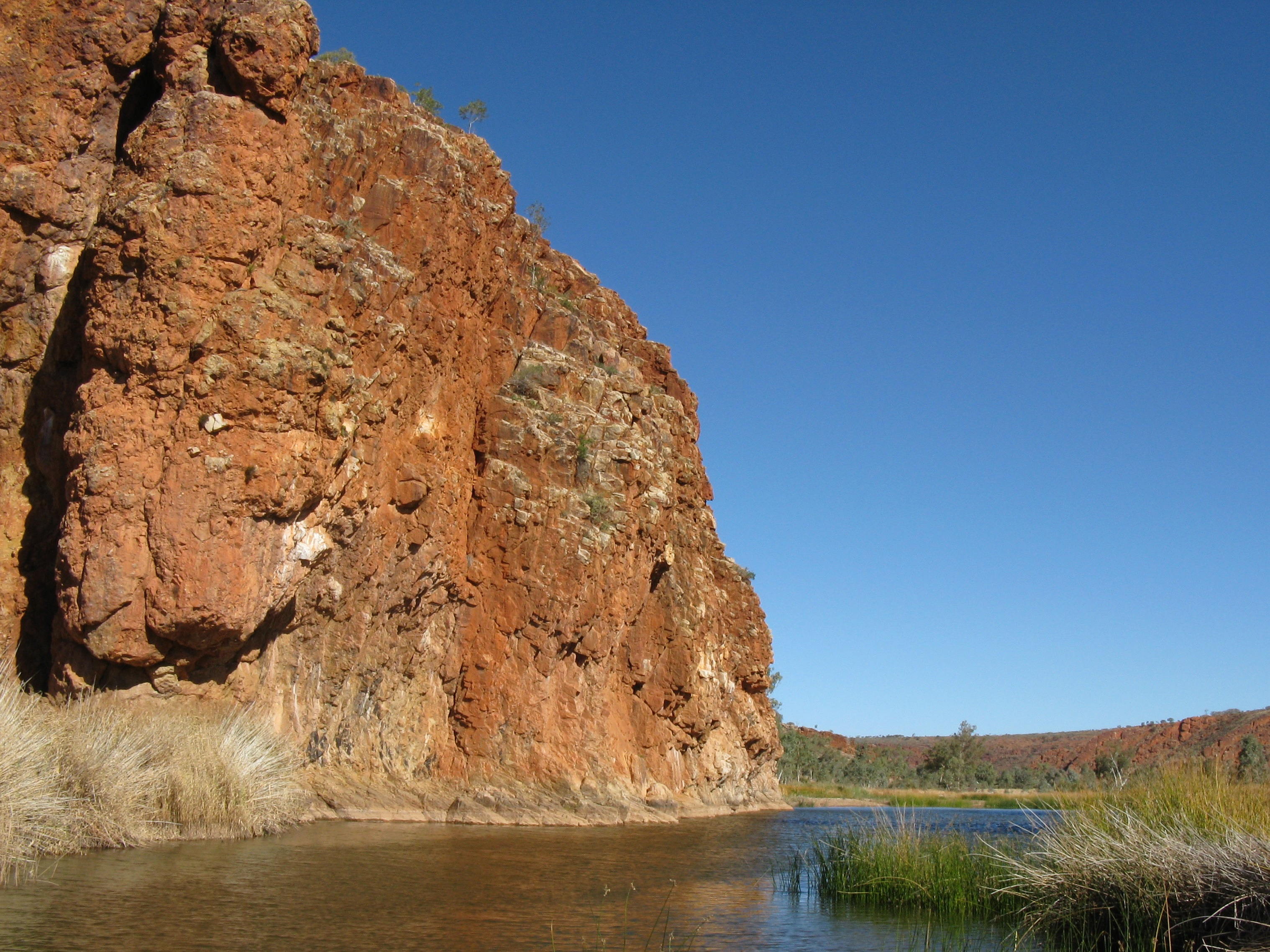
Finke River

Finke River, Glen Helen Gorge, West MacDonnells

The creek is very large, with the finest gum-trees we have yet seen, all sizes and heights. This seems to be a favourite place for the natives to camp, as there are eleven worleys in one encampment. We saw here a number of new parrots, the black cockatoo, and numerous other birds. The creek runs over a space of about two miles, coming from the west; the bed sandy. After leaving it … we passed over a plain of as fine a country as any man would wish to see–a beautiful red soil covered with grass a foot high; after that it becomes a little sandy. At fifteen miles we got into some sand hills, but the feed was still most abundant. I have not passed through such splendid country since I have been in the colony. I only hope it may continue. The creek I have named the Finke, after William Finke, Esquire, of Adelaide, my sincere and tried friend … (Wednesday 4 April)

It was he who “named” the MacDonnell Ranges. His journals are beautiful in their description of the geology, plants and fauna of the region. He also notes the presence of local indigenous people (either by seeing them or their tracks or campsites).

Uluru

Uluru – what more can you say. Ancient and sublime!

A little later came Ernest Giles, who “named” Mount Olga (now returned to the indigenous name of Kata Tjuta). The following comes from his Australia twice traversed:

Its appearance [Ayers Rock, now Uluru] and outline is most imposing, for it is simply a mammoth monolith that rises out of the sandy desert soil around, and stands with a perpendicular and totally inaccessible face at all points, except one slope near the north-west end, and that at least is but a precarious climbing ground to a height of more than 1100 feet. Down its furrowed and corrugated sides the trickling of water for untold ages has descended in times of rain, and for long periods after, until the drainage ceased, into sandy basins at its feet. The dimensions of this vast slab are over two miles long, over one mile through, and nearly a quarter of a mile high. The great difference between it and Mount Olga [now Kata Tjuta] is in the rock formation, for this is one solid granite stone, and is part and parcel of the original rock, which, having been formed after its state of fusion in the beginning, has there remained, while the aged Mount Olga has been thrown up subsequently from below. Mount Olga is the more wonderful and grotesque; Mount Ayers the more ancient and sublime. (July 1874)

And now, something written by an indigenous woman from a book titled Women of the centre (edited by Adele Pring, 1990). The story-teller is Ruth Mackenzie (b. 1919), an Aranda/Aluritja woman, born just south of the Northern Territory border. This particular description is of country a little further south again, but is still relevant. I’m including it because she’s describing traditional Aboriginal knowledge:

He [husband] told us stories … All this country was jungle. That’s a long way back and there used to be big snakes but the seasons changed. Drought and that came and buried everything up and what they call Yandama sandhills the other side of Lake Frome – all those sandhills – that’s all the trees that’s covered up. I think they’ve found animals there. Animals were bigger – wombat, kangaroo. Everything was a lot larger than what they are now. That’s what he said. Australia was different from what it is now, like it’s all barren country now. It was like Darwin I suppose.

For those of you inspired to read about the region, the following books may be of interest:

Many more books are listed on Wikipedia’s Australian outback literature of the 20th century page.

The majority of Australians live on the coast and are drawn to the sea. Not me. I am drawn to the deserts and the Outback. Maybe this post has explained why?

Note: An excellent discussion of “literary constructions” about the Centre can be found in Chapter 8 of The Cultural Values of the Central Ranges: a preliminary report (for the region’s inclusion as a World Heritage area) (2008).

.

Emma: 200 years of perfection: Pt 3, Gender and the study of Austen

Jane Austen and gender studies are made for each other, not only because the content of her novels inspire feminist critique (albeit sometimes conflicting, because, well, all her heroines get married, don’t they?), but also because reactions to her tend to be polarised along gender lines. (Remember my reporting in a recent post on VS Naipaul’s assessment?). It is this latter issue that Barbara Seeber addressed in her second paper of the conference, “The pleasures (and challenges) of teaching Emma“.

Seeber commenced her talk by stating that “the politics of gender underpin divided opinions of Jane Austen”. She looked at some of the reasons why students (readers, more widely too, I’d say) say they don’t like Emma – Emma herself is unlikable, the book lacks a plot, and it’s mostly a romance – and teased them out one by one, particularly in terms of their gender implications. I’m not going to summarise the paper, but will just share a few salient points that contribute to issues I’ve been thinking and writing about here.

Unlike VS Naipaul, Sir Walter Scott praised Jane Austen’s writing. Nonetheless, in his review of Emma, Sir Walter Scott distinguished between “cornfields and cottages and meadows” which he saw as typical of “the sentimental and romantic cast” and works dealing with “the rugged sublimities of a mountain landscape”. Although Scott himself praises Austen’s “precision” and comic ability, this distinction that he makes does, Seeber argued, reflect a common feminine versus masculine divide.

So, how does the gender divide play out for readers of Emma?

Unlikeable Emma

Well, Seeber herself recognised that as a young woman she did not like Emma because she is bossy and controlling, but did not feel the same about Mr Knightley. She realised she had internalized the prevailing attitudes regarding femininity, the double standard that allows men to be authoritative and commanding but disallows the same in women.

(I must say that Emma’s bossiness wasn’t an issue for me when I first read the novel – perhaps because, as the oldest child, I had a bossy tendency myself!  It was her snobbery that made her less likeable to me, but I have come to a more complex understanding of that.)

Nothing happens, or what happens isn’t important

There’s a gender point too – of course – behind the idea that nothing happens. Seeber quoted Virginia Woolf from A room of one’s own:

Speaking crudely, football and sport are ‘important’; the worship of fashion, the buying of clothes ‘trivial’. And these values are inevitably transferred from life to fiction. This is an important book, the critic assumes, because it deals with war. This is an insignificant book because it deals with the feelings of women in a drawing-room. A scene in a battle-field is more important than a scene in a shop — everywhere and much more subtly the difference of value persists.

Related to this issue of “feelings”, Seeber said that the popular film/tv adaptations can work for and against appreciation of the novel in the classroom. The films, she said, tend to focus on feelings, and can result in students resisting to expand their thinking beyond feelings. Also, in terms of gender, the issue is further complicated by the fact that male students can be self-conscious about liking Austen because of these films.

Too romantic

My dearest, most beloved Emma, tell me at once (Illus. CE Brock, 1909, via solitaryelegance.com)

My dearest, most beloved Emma, tell me at once (Illus. CE Brock, 1909, via solitaryelegance.com)

The focus on feelings in the movies, has been described by some as the “Harlequinisation of Austen novels”. It can result in the shaming of boy Austen readers. Anxiety about normative masculinity, Seeber said, can be present in the classroom. On the other hand, male students can be surprised to find that Austen is actually interesting, and female students surprised to find the male students enjoying her! (Oh dear!)

But then Seeber’s argument became really interesting for me in terms of recent discussions on this blog regarding gendered reading and writing. Seeber argued that denouncing the films as Hollywood romanticism, that dismissing them as popular culture, is related to the devaluing of women, in that works enjoyed by women are often dismissed as trivial. This is ironic, she argued, because Austen satirizes those who claim themselves above the popular novels (eg Mr Collins in Pride and Prejudice, and John Thorpe in Northanger Abbey). Austen, she said, does not distinguish readers by what they read.

The obvious, and frequent, counter made to the argument that nothing happens in the novels, that they are merely domestic or romantic, is to point to references or allusions to wider issues like the Napoleonic Wars, the slave trade, and the governess trade in Austen’s novels. BUT, Seeber argued, to justify Austen in this way is to undermine the real story of, say, Emma, which is about the achievement of self-awareness and living in the every day, about being human or acting humanely, as Norton describes it, or, as I might describe it, about being civil.

In other words, to try to justify the value of Austen by pointing to her references to the bigger picture is to undermine the importance of the so-called feminine (or more domestic) values.

I liked this argument.

Monday musings on Australian literature: Guest post by Annette Marfording of the Bellingen Writers Festival

Courtesy: Annette Marfording

Courtesy: Annette Marfording

Having been intrigued by comments made by Annette Marfording, Program Director of the Bellingen Readers and Writers Festival, about running a literary festival, I approached her about writing a guest post for my blog. I thought her experience might intrigue at least some of my readers here too.

Marfording chairs one-on-one conversations and panels at the Festival, and is also a broadcaster at Bellingen’s community radio station 2bbb fm for which she created a monthly program on Australian writers and their work. Marfording’s recently published book, Celebrating Australian Writing: Conversations with Australian Authors, is based on in-depth interviews broadcast on this program. All profits from the sale of the book will go to the Indigenous Literacy Foundation. What a generous gesture! I have bought a copy of this book, which includes writers like David Malouf, Cate Kennedy and Larissa Berendt. You can too at lulu.com.

Now, here’s Annette’s post …

Some time ago, Sue asked me as Program Director of the Bellingen Writers Festival (full name Bellingen Readers and Writers Festival) to do a guest post for her wonderful blog on the joys and challenges of organising a writers’ festival. I’m delighted to do so.

This year the Bellingen Writers Festival (full name Bellingen Readers and Writers Festival) had its fifth birthday. In the period since our first in 2011, there’s been an explosion of new literary festivals all around Australia. With the exception of big city specialised sub-festivals, such as the Sydney Jewish Writers’ Festival and its Festival of Speculative Fiction, and some school or suburb festivals, such as the Abbotsleigh Literary Festival and the Sutherland Shire Writers’ Festival, most of the new festivals are in small regional towns and not specialised in any particular genre. Even though not all of them survive (for example the Gloucester Writers Festival), at the time of writing there are at least nine such regional festivals in New South Wales alone in addition to the big ones: the Sydney Writers’ Festival, the Byron Bay Writers’ Festival and the Newcastle Writers Festival.

On the one hand, this proliferation of festivals is wonderful for readers and book sales and demonstrates that the book is not dead. On the other, for several reasons, it is cause for concern:

  1. All these festivals compete for government grants and sponsorships.
  2. They also compete for authors, and understandably authors tend to prefer the greater publicity and book sales associated with the big festivals. Our invitations are often declined on the grounds that the author is overseas at the time/wants to concentrate on her/his next book/can’t possibly attend every writers’ festival in the country.
  3. Several of the festivals are scheduled in winter, enhancing the competition for authors during those months.
  4. Sadly these difficulties are compounded when other regional festivals choose to schedule theirs at the exact same time as another, as the newer Batemans Bay Writers Festival did with the Bellingen Writers Festival. Thus two of the authors we had invited appeared in Batemans Bay instead. Similarly it is confronting to find that other regional festivals have copied your advertising slogan, as the Southern Highlands Writers’ Festival in Bowral did with their adoption of ‘Be a part of the story‘ (in comparison to Bellingen’s ‘Be part of the story.’

Even if there were only one literary festival in the country, organising a festival is not for the faint hearted. The large festivals attract big money from government agencies and sponsors while the smaller ones have to make do with far less. That usually means that large festivals have a large number of paid staff, while the smaller ones tend to be organised and run by volunteers.

In Bellingen all festival committee members work as unpaid volunteers, which means they have to be brimming with passion and enthusiasm for there is a lot of work to be done: books must be read, authors and chairs selected and invited, contracts drawn up, funding applied for, sponsorship sought, venues booked, an experienced bookseller chosen, transport and accommodation organised, possibly a schools program organised, the program put together and proof-read multiple times for print and website, newsletters written for the website, social media and print publicity employed to spread the word. For the event itself, you need an event producer/organiser, sound engineers, microphones for all venues and multiple speakers, additional volunteers and an organiser for those volunteers. After each festival there are clean-up tasks, author payments and accounting to be done. Over the five years we have lost several festival committee members due to burn-out or the need for an income-generating job. We have also gained a few new ones each year, but they don’t always stay. Only four members have been involved since the beginning.

Government funding bodies often demand the introduction of a new aspect or theme for each year’s festival. For 2013 the Bellingen Writers Festival chose Celebrating Women Writers and Women’s Stories, because 2012 marked the beginning of a conversation about gender in literary culture. In 2013 the Stella Literary Award was awarded for the first time. As the readers of this blog may remember, a number of women authors, critics and publishers pushed for the introduction of an award for women writers after women had been left off the shortlist for the Miles Franklin Literary Award for Fiction for two years in a row. Another response was the creation of the Australian Women Writer’s Challenge. For 2015 the Bellingen Writers Festival chose Politics and Society and attracted a number of politicians, journalists, screenwriters and fiction writers exploring social issues and added three forums on mental health issues with Professor of Psychiatry Gordon, clinical psychologist David Roland and author of Australia’s first memoir on youth suicide Missing Christopher Jayne Newling.

Festival visitors often don’t realise that authors need to be paid not only for their transport costs and accommodation, but also earn a fee for every festival appearance (in accordance with standards set by the Australian Society of Authors). In small regional towns such as Bellingen, where small businesses often struggle, it is very difficult to attract sponsorship from local businesses, especially since Bellingen hosts several music festivals as well. Government grants are difficult to obtain on a recurring basis, especially in these times of funding cuts to the arts. This means that smaller festivals become ever more reliant on ‘big name’ authors to attract visitors prepared to pay for tickets. The further away authors live from the festival location, the higher the authors’ transport costs. This means that authors who live on the other side of Australia, in Tasmania, let alone the US, are unaffordable for the Bellingen Writers Festival.

I think it’s obvious from the above that the challenges are formidable. The joys of organising a writers’ festival require far fewer words, but nevertheless win in the end for those who are engaged and passionate about reading and/or writing. The joys of introducing favourite authors to new readers, observing the audience’s enthusiastic faces, rapt attention, and long queues for books and autographs. Even better if the authors have a good time, too, and in Bellingen, they always do. For me personally, involvement in the festival has also made it easier to interview some of the authors in my recently released book Celebrating Australian Writing: Conversations with Australian Writers which has sold 80 copies in the first two weeks – to the benefit of the Indigenous Literacy Foundation, which will receive all the profits from the sale.

****

Thanks so much Annette for this wonderful behind-the-scenes insight into running a festival. Readers like me owe a big debt to people like you who are willing to undertake the hard yakka of putting on a regional festival. I wish I lived closer to Bellingen!


Emma: 200 years of perfection: Pt 2, The art of literary research

For my second post on JASA’s Emma: 200 years of perfection conference, I want to share (or, at least, summarise for my own edification) some of the ways the speakers had gone about researching Emma, at least as they became apparent to me via their papers. None of these are particularly mind-blowing – they are the bread-and-butter of literature academics – but I enjoyed seeing how they’d variously gone about it to present the papers and ideas that they did.

Contemporary reading

Sayre Greenfield, David Norton, Barbara Seeber and Susannah Fullerton all drew on works contemporary to Jane Austen’s time to explore their theories about the novel or to elucidate deeper meanings from them.

Sayre Greenfield shared some his research into works that are in the library at Chawton House*, showing how they contribute to our understanding of Austen’s world view and how that might have played out in the writing of Emma. For example, as is obvious to the reader and as many critics like to discuss, riddles and word games feature heavily in Emma. Greenfield pointed us to books and magazines which show that these were a major form of entertainment for girls and young women of Austen’s time. Not only did he remind us of extant riddles written by Austen when she was young, noting that hers tended to be more satirical than those by her brothers, but he also referred to The Ladies Magazine which, like magazines today, contained games and puzzles for its readers. He discussed the role of these word games in the novel’s plot, but also pointed to Mr Knightley’s criticism of Emma to Mrs Weston that:

But I have done with expecting any course of steady reading from Emma. She will never submit to any thing requiring industry and patience, and a subjection of the fancy to the understanding.

For Mr Knightley, games are all well and good, but Emma could do with something more serious!

Another topic that Greenfield explored was that of old maids. He described a book by William Hayley, published in 1785, titled A philosophical, historical, and moral essay on old maids. By a friend to the sisterhood. In three volumes. This description of old maids in one of his chapters sounds very much like Miss Bates:

The curious Old Maid is a restless being, whose insatiate thirst for information is an incessant plague both to herself and her acquaintance; her soul seems to be continually flying, in a giddy circuit, to her eyes, ears, and tongue; she appears inflamed with a sort of frantic desire to see all that can be seen, to hear all that can be heard, and to ask more questions than any lips can utter …

Now, said Greenfield cheekily, Hayley defines old maids as women unmarried by their fortieth year, and it just so happens that the unmarried Jane Austen turned 40 the month Emma was published. What was she really wanting to say about “old maids” he asked.

Seeber drew on contemporary texts regarding animal rights to argue a relationship, that was made during Austen’s time, between the mistreatment of animals and the domination of social “other”, like women and slaves. I’m looking forward to reading her paper, so I can grasp her argument more fully. She had some interesting things to say about fussy Mr Woodhouse and vegetarianism too!

Fullerton explored the many royal connections to places in the novel, which she suggested is partly about “who will be queen of Highbury”, while Norton turned to Samuel Johnson’s dictionary definitions to help us understand the contemporary meanings of words used by Austen. When Emma calls Mr Knightley “humane”, for example, she was likely meaning Johnson’s definition of “civil, benevolent, good-natured”. Remember my point about “civility” in my previous post?

Close textual analysis

Close analysis of the text is, of course, standard practice for academic critics, if not for more general reviewers. I’m mentioning it here, therefore, not because it was surprising but because for me close analysis – of word choice, imagery, structure, and so on – can inform meaning, and provide support for arguments, in interesting and sometimes unexpected ways. And so it proved to be at this conference.

Fullerton and Norton, for example, talked about the wordplay in names – Highbury, where Emma is buried; Donwell, where Mr Knightley has done well, a farm that is doing well; and Hartfield, or the field of the “heart”, of  feelings. These are fun to think about, but what I found most fascinating was Norton’s discussion of punctuation and grammar.

Grammar and punctuation, he said, are straightjackets on how we think, they exert controls on the expression of our thoughts. Austen knew that, Norton argued, and exploited it. Pride and prejudice, he suggested is one of Austen’s most rational, logical novels. We know exactly what Elizabeth Bennet thinks, and her thoughts and feelings progress logically in the book. Emma, on the other hand, is her most secretive novel. Nothing is really as it seems, and what is happening on the surface – Emma’s matchmaking of Harriet, and the possible romance between Emma and Frank – is not the real story.

One way Austen conveys this irrationality and this secrecy is through dashes! Yes, you heard correctly, dashes. And here is where the analysis was particularly interesting because in Pride and prejudice, he said, there is only one dash per 192 words, but in Emma it is one per 52 words. Who’d have thought? The dashes play two roles. Sometimes they convey the dashing around of thoughts – irrational thinking as it were – as characters jump from topic to topic. Miss Bates does this a lot in breathless prose, but Emma is also guilty of it. Etymologically, Norton told us, the “dash” punctuation mark is related to the verb “to dash”, so a dash can give a sense of movement of the mind.

But, formally, according to Samuel Johnson, the “dash” represents “a pause or omission”. And it also plays this role in Emma when characters pause before they say something they might regret, or have not fully realised themselves. Here is Miss Bates trying not to give voice to rumours about Emma and Mr Elton:

A Miss Hawkins. Well, I had always rather fancied it would be some young lady hereabouts; not that I ever — Mrs. Cole once whispered to me — but I immediately said, ‘No, Mr. Elton is a most worthy young man — but’ [and so on]

What, Norton asked us, can happen in a pause?

And so, he argued, Pride and prejudice is written in coherent, grammatical prose, while Emma is significantly less grammatical – and that tells us something about the novels themselves and the minds of their respective characters. If you don’t believe me, go check them both out, and see what you think.

Adaptations

I’ve rambled on enough, and this third one is a little tangential, but Greenfield and Troost’s speciality is the study of Austen adaptations. They explore how analysing adaptations can throw light on both the adaptations themselves – duh – and on Austen’s originals. At this conference, they discussed three recent adaptations of EmmaEmma (BBC miniseries, 2009), Aisha (Anil Kapoor Films, 2010), and Emma – Appoved (Pemberley Digital VLOG, 2014). They demonstrated how these productions focus on themes or ideas that we don’t find in Emma itself, chief among these being materialism, the pursuit of fun, and the idea that life is about being true to yourself. Most recent adaptations of Emma, they argued, have roots in Clueless.

For Greenfield and Troost, adaptations are a worthy topic for Austen study. In my last post on the conference, I’ll tell you what Barbara Seeber thinks.

* Chawton is where Jane Austen spent the last years of her life, and from where all of her novels were published. Her house is now a museum.

Monday musings on Australian literature: David Unaipon Award

David Unaipon (Courtesy State Library of NSW, via Wikipedia. Public Domain)

David Unaipon (Courtesy State Library of NSW, via Wikipedia. Public Domain)

I’ve mentioned the David Unaipon Award several times in passing but have never devoted a post specifically to it. Today seemed to be a good time to do it, as it would mean I’ve bookended this year’s NAIDOC week with Monday Musings posts devoted to indigenous literature.

Just to recap, David Unaipon is credited as the first indigenous author to be published, with a commissioned book on Aboriginal Legends in the early 1920s. He is featured on Australia’s $50 note. To commemorate him, the David Unaipon Award for unpublished Aboriginal and Torres Strait Islanders was established in 1988, and has had a rather chequered career. In 1999, it became part of the Queensland Premier’s Literary Awards. When those awards were abolished in 2012 by new Premier Campbell Newman, it was carried over to the new Queensland Literary Awards.

I have read and reviewed several past winners on this blog: Ellen van Neerven’s Heat and Light (2013), Jeanine Leane’s Purple Threads (2010), Marie Munkara’s Every Secret Thing (2008), and Tara June Winch’s Swallow the Air  (2004, originally titled Dust on Waterglass). 

But this is only a start. The list of winners, from the first award made in 1989, represents a useful list for anyone looking for works by indigenous authors to read. Here are a few writers that I’m keen to follow up:

  • Samuel Wagan Watson, a poet, who won in 1999 with Of Muse, Meandering and Midnight. According to the New South Wales Writers’ Centre this work is “a collection of moments: snatches of life in urban Brisbane, glimpses into childhood recollections”. Watson is a well-known raconteur, and during NAIDOC Week last week, I heard him recite a very entertaining, gently subversive poem “A message to my publisher”. It reminded me that I need to keep him high in my TBR list, either this book or one of his later ones.
  • Larissa Berendt, a writer, lawyer and academic, who won in 2002 with her novel Home. This novel also won the Commonwealth Writers Prize for Best First Novel in the south-east Asian/South Pacific region. It explores the complex notion of “home” for people for whom home has become a fraught notion: they’ve been dispossessed, stolen, or separated for a variety of reasons from their roots and significant connections. Her second novel, Legacy, won the Victorian Premier’s Literary Award for Prize for Indigenous Writing in 2010. She is frequently recommended to me, and so is also high on my TBR list.
  • Gayle Kennedy, a writer who won in 2006 with her “road trip” novel Me, Antman and Fleabag. It was also shortlisted for the Victorian Premier’s Literary Award and Deadly Award. She was featured in a Guest Post on the Australian Women Writers Challenge last week so, rather than add my own words here, I’ll just point you to there! Fair enough? (There’s an added incentive for visiting that post. If you read and review a work by an indigenous Australian in July you can go in the draw to win a copy of Me, Antman and Fleabag.)
  • Dylan Coleman, a more recent winner of the award, winning in 2011 with Mazin’ Grace. It was also shortlisted for the Commonwealth Book Prize and longlisted for the 2013 Stella Prize. Like Marie Munkara’s Every secret thing, its subject is mission life, a significant part of indigenous Australian experience and a story that needs to be told.

These are just four from a much longer list. I have no idea how many of these books are still in print, but hopefully most if not all are available in libraries. I wonder?