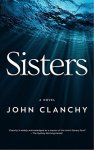
 Local writer John Clanchy has appeared a couple of times in this blog – as the author of the short story collection, Six: New tales (my review), and as the person launching Stephanie Buckle’s collection, Habits of silence (my review) – but never for one of his novels, until now. Sisters has an interesting history: it was originally drafted at the La Muse writers retreat in southern France in 2008, and has now been published by the retreat publisher, La Muse Books.
Given I introduced the versatile, and too little known, Clanchy in my review of Six, I’ll turn straight to discussing this latest novel of his. Briefly, Sisters tells the story of three late middle-aged sisters and the month they spend together at the family home on the north-central coast of New South Wales where the eldest, Sarah, now lives. The other two sisters, Grace and Rose, are twins. There is a mystery about why Sarah has asked them to come, though Grace is pretty sure she knows why, and we readers are pretty sure we know what it is that Grace believes she knows! It is, however, a little more complex than that – as you would expect. So, the first thing to say is that there is a plot.
The next thing to say is the obvious one – this is a book about sisters. There are, in fact, very few men, and I wondered how Clanchy had managed to capture women so well, because the book succeeds or fails on the basis of his ability to convince us with his women. Well, I had forgotten his dedication, which is “To my sisters Mary, Helen, and Elizabeth / and to Brigid, as ever”. (Brigid is his partner, I believe). I don’t know whether he has brothers too, but clearly he has spent a lot a lot of time with women. No wonder he writes them so well – and with such sensitivity.
So, pretty quickly their individual characters are established. Sarah, as the oldest, is the bossy planner who expects to control their time together. Indeed, she’s orchestrated this month because she has “thinks to discuss … things … to tell.” Grace, the older twin by 49 minutes (!), is widowed and has had breast cancer. She’s a counselor and is seen as the empathetic, reliable one. Rose, by contrast, has had a few husbands and even now is pining for her latest lover back in the city. She can be flighty and a bit oblivious, but can surprise Grace with her perception nonetheless. Clanchy captures the shifting alignments and allegiances between the three beautifully – Sarah’s separation from the twins, Sarah and Grace’s protectiveness towards Rose, Rose and Grace’s natural connection, and so on.
Gradually, Clanchy develops his plot, interweaving the sisters’ time together with stories of their childhood. While they were relatively happy, their growing up was not without drama, recalling Tolstoy’s famous opening to Anna Karenina. Their disabled four-year-old brother drowned in a cave at the beach while under their care, and their father left home for France to live with his mistress. How and why all this happened, what they made of these events as young people and now as adults, and who knew and knows what, underpins the plot. Mystery and secrecy rule. The end, when it comes, is fairly predictable, but then this is not unusual in a well-constructed story. It’s the journey to that point, and the little details in the telling, that make most books worth reading. Here, it’s also the warmth and generosity in the tone that make it such an engaging read – particularly if you are of a certain age!
Of course, Sisters is about more than its plot of unfolding secrets – and the epigraph provides a clue. It comes from TS Eliot’s Four quartets: “We are born with the dead: / See, they return, and bring us with them.” Besides the fact that an old death drives the plot, there is the bigger issue of mortality. The sisters are in their mid-to-late sixties, and one has already had cancer. Rose believes, in fact, that Sarah wants them there to talk about wills. She doesn’t, but mortality is behind her request for them to come – and awareness of mortality imbues much of the sisters’ thoughts and communications over the month. Early on, in Chapter 3, Sarah shows them the work she’s done to restore their (appropriately named) Grandfather Forrest’s orchard:
‘I had to rip the old one out,’ Sarah said without turning her head. ‘It was done for. Over sixty – and over the hill,’ she added. Reminding each of them of a personal fact.
Supporting the plot and theme is Clanchy’s writing. It flows easily from description to dialogue and its various, sometimes funny, set scenes, all supported by evocative turns of phrase. Here’s lively Rose “within whose house of memory window after window was now flying open of its own accord”. And this is thoughtful Grace:
The past was another kind of train journey. One undertaken with only random glimpses of the landscape outside to anchor or trouble the memory …
Memory is, of course, part of the picture – what we remember, how we remember, when we remember, and who remembers what.
There are a few other characters who make brief appearances – those from the past via the sisters’ memories and two policemen, particularly the young, uncomfortable Constable Demko who first visits the sisters to check on neighbours’ reports of nightly activity in the orchard, “Music, people running about, loud voices, laughter …”. It is, of course, the sisters enjoying their summer evenings, “the original Bacchantes” as Sarah tells him.
And here I’ll leave it. Sisters is a gentle, thoughtful novel – sad, but realistically wise. It’s about life and death, regrets and missed opportunities, secrets and guilt, and most of all about love and forgiveness. On the surface, it seems simple – it’s certainly an easy read and it could feel clichéd with its family-secrets-driven plot – but in fact it’s a philosophical book from an older writer reflecting on how we make sense of our lives. His conclusion, I’d say, is that the answer is in the quality of the relationships we forge, and the generosity with which we maintain them. This is the stuff of life.
John Clanchy
Sisters
Labastide Esparbairenque: La Muse Books, 2017
259pp.
ISBN: 9791097233006 (eBook)
(Review copy courtesy La Muse Books)









 Whispering Gums