Mansfield Park Symposium, Jane Austen Festival Australia, 2014 (Part 2)

WORDPRESS GREMLIN: Those of you who subscribe to my blog will have received two notifications yesterday of my Part 1 post – as the result of what was rather a nightmare. I published the post. Up popped WordPress’s successfully published screen as usual, and then POOF it all disappeared. It was nowhere to be seen – not publicly, not administratively. It still isn’t anywhere that I can see, though I gather when you click on that first notification, you are taken to a page. Fortunately, I had previewed it not long prior to publishing and still had the preview tab opened, so I was able to copy and past that content and republish! Phew, I was planning to use the two posts as preparation for my Jane Austen meeting this month so would have been devastated (relatively speaking) had I lost it!

Continued from my previous post covering the first two speakers at the Mansfield Park Symposium.

Gillian Dooley, No moral effect on the mind: music and education in Mansfield Park

Dooley, from Flinders University, focused on music, making the point that music played big part in Jane Austen’s own life. She argued that Jane Austen seems to share John Locke’s view that learning (education, I presume she meant) is subservient to qualities developed through upbringing and experience.

Like Neilson, she sees Mansfield Park as being about education, particularly women’s education. She reminded us of Mary Wollstonecraft’s Vindication of the rights of women which was published in 1792, when Austen was 17 years old*. Austen, she said, shows the “larger” passions in Fanny that develop in her along lines of Wollstonecraft. Fanny is not a musician. Her cousins, Maria and Julia, say she doesn’t want to learn music and drawing, but Dooley suggests Austen is showing Fanny’s resilience, determination and her desire not to be showy. Fanny has noticed, Dooley said, that such skills haven’t made them better people and she would not went to emulate them.

Despite their accomplishments, in fact, Maria and Julia are not shown to have much feeling for music. Sir Thomas realises, too late, that “to be distinguished for elegance and accomplishments, the authorised object of their youth, could have had … no moral effect on the mind”. In Chapter 20, just after Sir Thomas has returned home and discovered, to his horror, the acting scheme, emotions are running amok. Music is used ironically it seems to cover up the lack of harmony:

and the music which Sir Thomas called for from his daughters helped to conceal the want of real harmony.

For the Bertram girls, and for Mary Crawford, Dooley said, there is a dependence on material trappings and external appearances, on female trappings, that betrays their lack of the moral character we see in Fanny.

For Mary Crawford, musicality is an important part of a woman’s armoury. Jealously, she asks if the Owen sisters, whom Edmund is visiting, are musical:

“That is the first question, you know,” said Miss Crawford, trying to appear gay and unconcerned, “which every woman who plays herself is sure to ask about another…”

Mary certainly uses music as part of her armoury, Dooley explained. Mary’s appeal is increased when she plays the harp, and she sets out to charm Edmund. As Austen writes:

A young woman, pretty, lively, with a harp as elegant as herself, and both placed near a window, cut down to the ground, and opening on a little lawn, surrounded by shrubs in the rich foliage of summer, was enough to catch any man’s heart.

Dooley argued that the harp symbolises fashionable modernity and wealth. (It comes up in Emma, too, where Mrs Elton suggests Jane Fairfax would be better if she played a harp as well as piano.)

The saga of harp’s arrival tells, Dooley said, of Mary’s belief in the London maxim that everything can be “got” with money, including marriage. She is surprised when country values see her priorities rather differently. But Mary, as Fanny puts it, has “a mind led astray”. She, aligned with city values, is careless as a woman and a friend.

Fanny, on the other hand, is aligned with things country and natural. Early in the novel, she stands at a window looking out into the night, after Mary Crawford has left them to join a glee, and is joined by Edmund:

 “Here’s harmony!” said she; “here’s repose! Here’s what may leave all painting and all music behind, and what poetry only can attempt to describe! Here’s what may tranquillise every care, and lift the heart to rapture! When I look out on such a night as this, I feel as if there could be neither wickedness nor sorrow in the world; and there certainly would be less of both if the sublimity of Nature were more attended to, and people were carried more out of themselves by contemplating such a scene.”

Scenes like this point to Austen’s being on the threshold of Romantic era.

Anyhow, at the end of this scene, Edmund moves towards Mary taking part in the glee, leaving Fanny to her musings..

Austen, Dooley said, is not black-and-white on the issue of music. Mary Crawford truly enjoys music, is not just a coquette, and, while Fanny prefers reading, she also appreciates and enjoy music and dancing. Austen is however critical of the place of music in education. The musicians in this scene are judged as having wasted their time in developing their music skills. Fanny, in fact, says Mary’s faults come from her education. Fanny’s education, on the other hand, had been directed by Edmund (which ties neatly with Neilson’s thesis about “good” education).

At the end of the novel, Austen, through Sir Thomas, praises the effects of the Price family’s hardship – “the advantages of early hardship and discipline, and the consciousness of being born to struggle and endure” – but during the novel we see that much about the Price family is not admirable. Dooley suggests that Austen’s point is probably that the Price family does not value decorative accomplishments. Musicianship, in other words, isn’t condemned but neither is it seen as necessary for a girl.

This paper is, apparently, adapted from her article in the June 2006 issue of Sensibilities.

* We don’t have evidence that Austen read Wollstonecraft, but we know from her extant letters, which start in 1796, that she was a prolific and wide reader. It’s hard to imagine she was not well aware of Wollstonecraft’s work and ideas, whether or not she had actually read the book.

Dr Christine Alexander, The genius of place: Mansfield Park and the genius of place

Alexander, from the University of New South Wales, focused on place, and how it relates to aesthetics and moral values. She commenced by suggesting there are three critical questions to ask:

  • Why is Mansfield Park set in countryside on an estate?
  • Why is the visit to Sotherton important?
  • How does all this relate to Fanny?

The country estate setting, she said, facilitates exploration of the city-country clash. Austen is following here the classical tradition in terms of the town versus country debate, which had flourished in the 18th century. This clash had cultural and aesthetic implications. Changes in agriculture, like that depicted in Downton Abbey (albeit a century or so later), were resulting in the collapse of rural patterns of life.

At the same time, cities were growing. An increase in trade brought wealth to the cities. But, contemporary attitudes were ambivalent. Cities represented art, culture, luxury but they were also characterised by sewers and filth. William Cowper’s most significant work, “The Task” praises country values over what he saw as the dehumanisation of industrialisation in the cities. Dr Johnson said of London that it “sucks in the dregs of each corrupted state”. And so, the Crawfords are seen as bringing to Mansfield Park their contaminated city values. The harp saga epitomises this clash: the harvest takes precedence, rather to Mary’s surprise, over the transport of her harp. Mary’s faith in “the true London maxim, that everything is to be got with money” is tested by “the sturdy independence of your country customs”!

Alexander reminded us of Sense and sensibility, and Marianne’s “feeling all the happy privilege of country liberty, of wandering from place to place in free and luxurious solitude”.  There is a sense here of returning to nature for moral insights and virtue. Similarly, Fanny’s response to sublimity is that nature can inspire virtues, reflecting a Wordsworthian view! Alexander suggested that in the scene in which Fanny and Mary sit in the shrubbery we see the superficial improvement of a woman set against real moral intelligence.

Yet Austen, she said, is not naive about country. The Crawfords reflect the variety and excitement of the city lifestyle, of the temptations of an undefined and unconstructed social space where people can live out their more “dubious inclinations”. The city is also where people acquire aesthetic sensibilities. Generally, in Austen’s novels, the influence of London is regretted while the country house ideal. She quoted Pope and his promotion of the “right use of riches”, of a “life of rural simplicity”. Ostentation, typical of the city, satisfies vanity and pride, in contrast to unpretentious plainness.

Fancy homes, she suggested, often disregard “the genius of the place”, a phrase used by Pope to mean the need to respond to/draw from nature and the inherent sense of a place. But this was a time of absurd grandeur, of conspicuous consumption by Whig magnates. The Mansfield Park community, by contrast, still fulfils country traditions even if some of the behaviours within run counter to those traditions. Sotherton, however, is in more upheaval under its new owner. Rushworth is overturning his mother’s traditions, manifesting the contemporary fashion for improvement.

In fact, Alexander argues, the idea of improvement is a significant part of the novel’s plot and moral structure. Austen uses the characters’ attitudes regarding aesthetic values and improvement to identify their moral values. In Chapter 6, Fanny listens to Rushworth on Sotherton and says nothing until he talks of chopping down trees, at which point she says:

“Cut* down an avenue! What a pity! Does it not make you think of Cowper? ‘Ye fallen avenues, once more I mourn your fate unmerited.’”

Alexander suggested that contemporary readers would have recognised the reference to Cowper’s “The task”. Most readers would have known the next lines: “once more rejoice/That yet a remnant of your race survives.” Edmund’s reaction that:

“… had I a place to new fashion, I should not put myself into the hands of an improver. I would rather have an inferior degree of beauty, of my own choice, and acquired progressively. I would rather abide by my own blunders than by his.”

shows him to be the perfect partner for Fanny.

Jane Austen, we know, approved picturesque views and approves judicious improvement (such as that at Pemberley in Pride and prejudice) and the creation of social spaces (such as Catherine’s bower). But, said Alexander, Austen, like landscaper Uvedale Price, disapproved the cutting down of ancient trees. Note, she said, that Fanny has same surname! In other words, Austen ridicules excessive improvement that fails to account for “the genius of the place”. In Mansfield Park, Rushworth on Sotherton and Henry Crawford on Edmund’s parsonage at Thornton Lacey, reflect this rush to improve. Henry suggests cutting down the trees, and altering the stream, so:

you may give it a higher character. You may raise it into a place. From being the mere gentleman’s residence, it becomes, by judicious improvement, the residence of a man of education, taste, modern manners, good connexions.

Henry’s improvements are not appropriate to Edmund’s role and, thus, argued Alexander, in vey bad taste.

Austen, Alexander suggested, is critical of the changing relationship between nature and artifice. In the visit to Sotherton, Fanny retires to shady trees, after being being sorry to see the dilapidated state of the chapel. Mansfield Park promotes the value of natural process and growth, of necessary improvements made judiciously over time. Alexander suggests that this process applies not just to the landscape, but to Fanny herself.

It’s important to note, though, Alexander said, that the word “improvement” is used contradictorily throughout the novel. You need to notice who is using it or in what context it is being used.

When Fanny returns to Mansfield Park after Portsmouth, she looks at the landscape again. These nature passages, Anderson argued, suggest growth and deepening of Fanny’s character, and reflect both traditional and romantic values. Fanny needs needs nature to recover. The old estate is suffering from spiritual impoverishment. It is not rich in the spiritual or moral values that Fanny is rich in. Fanny acts, she said, by refusing to act – and could be seen as “the genius of the place”. She assumes role of an improver, when she returns: she takes the place of the daughters, she is the faithful remnant of the older order and value system. But, Alexander said, appropriating the past does not mean being dominated by it. It means incorporating the best values as you change over time.

And so, she concluded, Mansfield Park‘s values are conservative, but Austen was trying to engage in a serious discussion about the state of the nation. Emphasising traditional values is part of her moral purpose. This is a conservative Austen “but with promise”. Fanny is open to change, to the romantic aspect of nature and natural beauty, but her idea of change is one attuned to “the genius of the place”, to what is appropriate, perhaps, for the context.

QUESTION: There was a question regarding Austen’s statement that she was writing a novel about ordination. Alexander replied that it is very much about Edmund’s ordination. Sotherton chapel’s dilapidation suggests that it no longer represents the spiritual heart of the estate. Mansfield Park explores, perhaps, where the church stands in relationship to changing values.

* During the Q&A at the end, the point was made that in the movie The King’s Speech reference was made to Wallis Simpson cutting down 700-year-old trees.

Mansfield Park Symposium, Jane Austen Festival Australia, 2014 (Part 1)

The seventh annual Jane Austen Festival Australia, which was held in early April, is establishing itself as a comprehensive affair. Originally focusing primarily on Regency times and activities, it has gradually increased its literary content. This year it introduced a new feature, a half-day literary symposium dedicated to in-depth discussion of the year’s feature novel, Mansfield Park. It hasn’t been given the publicity that Pride and prejudice garnered last year, but 2014 marks the novel’s 200th anniversary.

Six speakers were originally scheduled to speak, but the two male speakers – for family and health reasons – had to withdraw at late notice. That probably didn’t hurt in the end, much as I looked forward to hearing the absent speakers, as the four remaining speakers provided more than enough thoughtful content for a morning.

I’ll report, as best as I can, on the speakers in order … covering the first two in this post, and the second two in a follow-up post.

Janet Lee, Addicted to letter-writing

Lee is a doctoral student at the University of the Sunshine Coast. Her thesis is that sister Cassandra was Austen’s muse. Austen, as many of you know, was a keen letter-writer and most of the letters she wrote were to Cassandra. Consequently, Lee chose letters as the subject of her paper.

Given the importance of letters to Austen, it’s not surprising that she used them in her novels. Indeed, we believe that Pride and prejudice and Sense and sensibility started as epistolary novels. Lee argued that letters drive Mansfield Park. Letters, in fact, are strategic turning points in most if not all of Austen’s novels. Remember Darcy’s letter to Elizabeth after she rejects his proposal?

Back, though, to Mansfield Park, in which letters feature consistently – and touch pretty much all the main characters. Austen uses letters to further the plot, but she also tells us about the politics of letter-writing and their use at the time. Letters, Lee reminded us, are critical in the opening paragraphs of the novel. Angry letters between Mrs Norris and Mrs Price (Fanny’s mother) on the occasion of the latter’s marriage set up a distance between the three sisters and their families that lasts until, many years later, Mrs Price writes another letter requesting the Bertrams take one of her children. This results in the re-opening of relationship between the families. In this way, said Lee, Austen “anchors and orients the novel with letters”.

And so it’s letters, for example, which carry much of the plot development when Fanny is in Portsmouth, bored and waiting for news. It is how she, and we, mostly learn about what is happening at Mansfield Park – but again, Lee demonstrated, we also learn about the art and politics of letter writing. For instance, Fanny receives a letter from Edmund in which he rather off-handedly passes on, at the end, his mother’s gossip about the Grants:

Everybody at all addicted to letter–writing, without having much to say, which will include a large proportion of the female world at least, must feel with Lady Bertram that she was out of luck in having such a capital piece of Mansfield news as the certainty of the Grants going to Bath, occur at a time when she could make no advantage of it, and will admit that it must have been very mortifying to her to see it fall to the share of her thankless son, and treated as concisely as possible at the end of a long letter, instead of having it to spread over the largest part of a page of her own.

This letter, though, conveys unpleasant news for Fanny – Edmund’s continuing fascination with Mary Crawford – so unpleasant that Fanny, who had been pining for a letter from Edmund, thinks “I shall never again wish for a letter to arrive”.

For Lady Bertram, though, things look up because, in the same chapter, she, who Austen tells us “rather shone in the epistolary line”, does get to write a letter of importance – about the illness of her eldest son Tom!

Early in the novel, Edmund talks to Fanny about her writing home and discovers Fanny has no paper. Not only does he furnish her with paper and pen, but tells her that her uncle (his father) will “frank it”. Readers of the time would know that in those days it was normally the receiver who paid for the postage. Edmund’s offer is kind, but it also subtly shows his rank and his power over a poor relation.

In Chapter 6, Mary complains that men, referring primarily to her brother, write poor letters in which all is told “in the fewest possible words”. But Fanny’s brother, William, is quite the opposite, and thus Austen conveys the depth of Fanny’s relationship with her brother versus that between Mary and Henry. And yet, Lee said, Henry Crawford is adept at letters, when he wants to be, and uses them as power over women.

Lee also spoke of Austen’s own letters written at the time she was writing the novel. They show her researching facts regarding ships (to her naval brother), houses, gardens (to Cassandra, about hedgerows). She also reports in her letters some pre- and post-publication responses to the novel, and asks her niece in one “to make everyone at Hendon admire Mansfield Park”.

Lee concluded by referring us to the Jane Austen Fiction Manuscripts website, which includes Austen’s record of people’s reaction to the novel. If you’ve never read them before, do. They make interesting reading, particularly in the light of the ongoing mixed reactions to the novel.

Dr Heather Neilson, Mansfield Park and education

Neilson, from the University of New South Wales in Canberra (aka the Australian Defence Force Academy), commenced by apologising that she had the least experience in the room of Mansfield Park, and had in fact only read it for the first time in the last year.

She began by talking about her own education in Mansfield Park – about reading Edward Said and his critique regarding the significance of Sir Thomas Bertram’s plantation in Antigua, and about her view that Patricia Rozema’s film of Mansfield Park may not be an exact adaptation but is “faithful in concept” (Hear, hear, I said under my breath!).

Neilson’s talk was fascinating and I hope, given the time that has elapsed, that I have managed to remember her main arguments (from my sketchy notes at the time). One of her main points concerned Sir Thomas Bertram’s own education – about his poor education of his daughters. It occurs in the last chapter (48) of the novel. The people who must change the most, Neilson said, are Sir Thomas and Edmund. Like Mr Bennet in Pride and prejudice, Sir Thomas had not done well by his daughters. Neilson argued that his “enlightenment is complete”, that he will live with his regrets for the rest of his life. He has been educated, she said, by the scandalous behaviour of his own children:

Too late he became aware how unfavourable to the character of any young people must be the totally opposite treatment which Maria and Julia had been always experiencing at home, where the excessive indulgence and flattery of their aunt had been continually contrasted with his own severity. He saw how ill he had judged, in expecting to counteract what was wrong in Mrs. Norris by its reverse in himself; clearly saw that he had but increased the evil by teaching them to repress their spirits in his presence so as to make their real disposition unknown to him, and sending them for all their indulgences to a person who had been able to attach them only by the blindness of her affection, and the excess of her praise.

Here had been grievous mismanagement; but, bad as it was, he gradually grew to feel that it had not been the most direful mistake in his plan of education. Something must have been wanting within, or time would have worn away much of its ill effect. He feared that principle, active principle, had been wanting; that they had never been properly taught to govern their inclinations and tempers by that sense of duty which can alone suffice. They had been instructed theoretically in their religion, but never required to bring it into daily practice. To be distinguished for elegance and accomplishments, the authorised object of their youth, could have had no useful influence that way, no moral effect on the mind. He had meant them to be good, but his cares had been directed to the understanding and manners, not the disposition; and of the necessity of self–denial and humility, he feared they had never heard from any lips that could profit them.

Bitterly did he deplore a deficiency which now he could scarcely comprehend to have been possible. Wretchedly did he feel, that with all the cost and care of an anxious and expensive education, he had brought up his daughters without their understanding their first duties, or his being acquainted with their character and temper.

Neilson argued that Austen distinguishes cleverness from moral intelligence, and that Fanny is shown to be guiding her sister Susan with affection in contrast to the way Sir Thomas had brought up his girls. She also referred to Mary Crawford’s less-than-happy upbringing. When Mary’s aunt (and guardian) dies, Austen writes that:

Admiral Crawford was a man of vicious conduct, who chose, instead of retaining his niece, to bring his mistress under his own roof.

Neilson wondered what Mary might have witnessed or even experienced with such a man! Critic Lionel Trilling argues that Mary impersonated the women she thinks she wants to be. She could have been educated by Edmund, but it’s too late. Her past experiences have set her.

Henry, Neilson suggests, is plausible. His devotion to his sister is creditable, he has talent for reading, is intelligent, and wealthy. Mrs Norris and Mary both blame Fanny for the Maria-Henry catastrophe. Neilson argued that we could discount these assessments on the basis of their sources but, she said, even the narrator suggests at the end that Henry would have been better had he succeeded with Fanny. He needed to be more patient, Neilson said – but of course, that’s the very point, he wasn’t. He was, rather, “ruined by early independence and bad domestic example” (like his sister).

Neilson said that Austen makes clear that Henry loves Fanny, but that we are warned against Henry. His reading of Shakespeare “was capital”, but it was from Henry VIII, which could be Austen’s code that he’s an unsafe husband. The novel’s unanswered question is whether a woman like Fanny could reform (educate?) him.

Neilson briefly discussed Austen’s narrative technique. John Wiltshire, she said, argues that in this novel in particular, the narrative moves between the consciousness of the characters. When you are in a character’s head you are more likely to have sympathy for them. Consequently, the fact that we are often privy to Mary’s private thoughts can make us feel at times that she is the heroine. (This adds, methinks, to the complexity of this novel and the fun to be had in discussing it!)

Neilson made some comparisons with Jane Eyre which is also a Cinderella story with two suitors. Both Jane and Fanny move from fringe to the centre but Bronte inverts the Mansfield Park story: Jane Eyre does not end up with her cousin. In fact, Neilson argues, in Mansfield Park the best possible marriages (from an education/reform point of view?) are perverted.

Finally, she briefly referred to Canberran Ros Russell’s recently published sequel/fan fiction novel, Maria returns. She suggested Russell had taken to heart Said’s theory regarding the relationship between Mansfield Park and the Bertrams’ plantations in Antigua, and the implications for British values. I don’t generally read fan-fiction, but Ros will be addressing my local group’s meeting in July, so I will read it for that.

To be continued …

Australian Women Writers 2014 Challenge completed

awwchallenge2014Regular readers here know by now that I only do one challenge, and that’s the Australian Women Writer’s Challenge. As in previous years, I signed up for the top level: Franklin-fantastic. This required me to read 10 books and review at least 6. I have now exceeded this. I will continue to add to the challenge, as I’ve done in previous years. However, one of the requirements of completing the challenge is to write a completed challenge post. Here is that post.

I have, so far, contributed 14 reviews to the challenge.

Here’s my list in alphabetical order, with the links on the titles being to my reviews:

Only two of these – Baynton and Anderson – are for non-recent works. I would like in the second half of the year to read more backlist, more classics. Let’s see what happens when I write my end-of-year post for the challenge.


Kirsten Krauth, just_a_girl (Review)

Kirst Krauth, Just a girl

Courtesy: UWA Publishing

If you’ve already heard about Kirsten Krauth’s debut novel just_a_girl, you’ll know something about its confronting nature – and it is confronting, though perhaps not quite in the way I expected. It was both more and less, if that makes sense.

However, if you’re not Australian, you may not have heard about this novel. Essentially a coming-of-age story, just_a_girl is told in three voices. Two are first person – Layla, a 14 to 15 year-old-girl, and Margot, her mother – and the other is, interestingly, told third person, Tadashi, a lonely Japanese man. The main voice, though, is Layla. She opens and closes the novel, which is set around 2008 in Sydney and the Blue Mountains.

Layla typifies the modern knowing teenage daughter that parents worry they may have. She’s sexually precocious and is acutely aware of her effect on men. She’s what many would call “a tease”. She tells us, though, that she’s a virgin (technically, anyhow, because she’s done pretty much everything else). She wants, she says, to wait until she’s 16:

Fifteen just seems too skanky. You tell your kids you lost your virginity at 15. They’ll just want to do it even younger.

This tells us something more about Layla – her street-wise wisdom. It’s believable because Layla has had to grow up fast. Her parents separated when she was in primary school because her father finally admitted his homosexuality. Her mother, prone to depression, turned to an evangelical church. Layla has learnt to navigate these waters with smart talking, and by using all the weapons at her disposal including personal attributes and modern technology. With studied insouciance, she tells us about her relationships, with her mother, her friend, her father, and various boys and men. She is not innocent, but she is also abused in several ways, by old and young, through the novel.

Meanwhile, her mother Margot struggles with depression, a sense of rejection and failure, and consequent inability to properly relate to her daughter. She has turned to God, but unfortunately the church she has chosen, with its hypocritical leader, is unlikely to be her salvation. You see how easily relationships can go awry during these turbulent years if family members are not strong and confident in themselves. But, Krauth keeps it real. This is not melodramatic. There are no over-the-top mother-daughter scenes, just lack of real communication leading to distance and lack of mutual support where both need it. By the end of the novel both have learnt something and are starting to see each other as people, rather than simply as roles. In other words, it’s not only Layla who needs to grow in this contemporary coming-of-age novel.

Into this mix is added a third voice, Tadashi. He often travels on the same train as Layla, and on one occasion rescues her from a risky situation. Like Margot, he’s lonely, used to relying on a mother who has now gone. In scenes reminiscent of the bitter-sweet movie Lars and the Real Girl he orders and takes possession of a sex (or love) doll which he sees as “a person” who will alleviate his loneliness. In some ways it’s an odd inclusion in the story but, besides his probably not essential role as rescuer, he adds another angle to the exploration of loneliness and relationships, and the use and misuse of sex to address gaps in people’s lives.

In her “Sources and permissions” note, Krauth tells us about her sources for “love dolls” and other ideas or events in the novel. She also explains that some of Layla’s comments have been inspired by teenagers who have appeared on SBS’s Insight program. She has listened well, because from my experience of similar programs I felt very comfortable (if one can call it that!) with Layla’s voice. She’s so fresh, so funny, so knowing, that you can’t help liking her and worrying about her vulnerability, while also being horrified.  Here’s a short example:

Mum says I have to be careful now that I’m in year 9. Because men will start looking at me in a new way. Fuckadoodle, they’ve been looking at me like that for years. Especially when I eat Chupa Chups on the train.

I was going to share the Chupa Chups (“I have a favourite game on the train trip home from school”) episode with you, but I reckon you should read it yourselves. It would be funny if it weren’t so disturbing. It’s a fine piece of writing about a sexualised young girl who “knows” too much. Talk about playing with fire!

Margot’s voice is quite different – the long run-on sentences versus Layla’s short ones convey her anxiety and uncertainty well. Here she is, for example:

When is this soul-searching going to end, I mean, I knew coming off the meds would be hard as I’ve tried it a few times before but it’s like I’ve sunk into a bog, and it’s been a horrendous week because of that film Layla hired, Brokeback Mountain, you know she loves Heath Ledger and was completely devastated when he died last year and everyone thought … [and on she goes for several more lines]

I feared at times that Krauth was trying to pack too much in – single mother, gay father, hypocritical evangelical church, breast cancer scare, viral you-tube, sex doll, workplace sexual harassment, and so on – but no, she made it work. They are treated as things that happen. She doesn’t trivialise, but neither does she labour. Instead, she keeps her focus on the main game, which is how we, and particularly young people and their parents, must navigate the modern digital world with its potential for serious ill, and how in such a world might we still forge meaningful relationships. A thoroughly modern book for a thoroughly modern audience. It will be interesting to see what Krauth does next.

Lisa at ANZLitLovers also liked the book.

awwchallenge2014Kirsten Krauth
just_a_girl
Crawley: UWA Publishing, 2013
265pp.
ISBN: 9781742584959

(Review copy supplied by UWA Publishing)

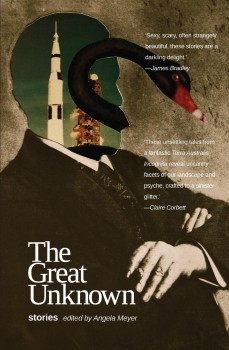
Angela Meyer (ed), The great unknown (Review)

Angela Meyer, The great unknown

Courtesy: Spineless Wonders

The great unknown is a mind-bending collection of short stories which explores, as editor Angela Meyer says, “the unknown, the mysterious, or even just the slightly off.” I was, in fact, expecting more horror, thriller even, which are genres that don’t really interest me, but this collection is not that. There are some truly scary scenes – so if that’s your bag then you’ll appreciate this collection – but many are more subtly mysterious, giving the collection a broader appeal.

There are nineteen stories, most of which are the result of Meyer’s direct invitation to some favourite authors. Six, though, come from the shortlist for the Carmel Bird Short Fiction Award, 2013, of which Meyer was the judge. The invited authors were given the same brief as that for the competition, which was to write a story inspired by the “fifth dimension”, that is, the world found in shows like The Twilight Zone and The X-Files where inexplicable things happen. The result is a collection of stories that vary greatly in setting, voice, subject matter – and even tone. Some are funny, some sad, most are disconcerting and some, of course, are scary.

The collection starts in a suitably creepy way with Krissy Kneen’s “Sleepwalk” in which the protagonist, Brendan, wakes up in the middle of the night to find his partner, Emily – the sleepwalker of the title – missing from their bed. This doesn’t sound particularly unusual, except that upon investigation Brendan discovers Emily intently taking photos – and not with a modern digital camera, but one requiring “real” film. When developing the photos, they see a blurry grey figure. Who is it? What does it mean? To find out you’ll have to read the story – but I can say that it provides a perfect opener to a collection of stories in which the relationship between a couple is a common springboard. After all, where better to explore the inexplicable but in that closest of human relationships, the one in which love and hate, trust and fear, so often collide.

Several of the stories confront contemporary dilemmas. One of my favourites, and winner of the Carmel Bird Award, is Alexander Cothren’s “A Cure”, a truly disturbing Twlight-Zone-like story about a treatment, the appropriately named MindFi, for compassion fatigue. Another TZ-like story I enjoyed is Guy Salvidge’s “A Void”, which is also futuristic and drops us into a world of “Seekers” and experimental drugs. I’m not sure why I enjoyed these TZ-like stories because it was a Twilight Zone episode that set off the most distressing period of my childhood. I’m sure it was that show that turned me off horror for life – quite the opposite reaction to Angela Meyer’s it seems!

Another clever story, and one with an unexpected narrative point of view, is Mark O’Flynn’s “Bluey and Myrtle” about a caged bird and his old mistress. Both have lost their loves and are lonely, but it’s the self-aware bird who takes things into his own hands. Growing older is also the theme of Susan Yardley’s “Significance” in which a woman’s sense of invisibility and irrelevance manifests itself physically. As a woman of a certain age, I can relate to that (though fortunately not within my own family). This story reminded me of Anne Tyler’s novel Ladder of years, except that Tyler explores her theme without resorting to the “fifth dimension”.

Before I stop picking out favourite stories, of which there are several more, I’ll just mention PM Newton’s “The Local” which perfectly captures life in a remote country town and the dangers that lie within. There are of course stories that I didn’t like as much. For me, the writing in Chris Flynn’s “Sealer’s Cove” was too self-conscious and the time-travel story didn’t grab. And Ali Alizadeh’s satire on the Oprah Winfrey-Lance Armstrong interview in “Truth and reconciliation” was a good idea and funny to a point but a little too heavy-handed for my tastes. Satire is like that, I suppose.

An important part of editing a collection is ordering the contents. Meyer has done a neat job of placing the stories in an order that seems natural and thereby enhances our reading. For example, two outback stories featuring missing people, PM Newton’s “The Local” and Rhys Tate’s “The Koala Motel”, one set in a pub and the other a motel, are placed together. And Paddy O’Reilly’s “Reality TV” is followed by the TV-set show, Alizadeh’s “Truth and reconciliation”. It, in turn, is followed by Guy Salvidge’s “A Void” in which drugs feature. Three stories in a row – by Marion Halligan, Susan Yardley and AS Patrìc – feature missing or disappearing women. Put this way, it sounds a little mechanistic but in fact it provides a subtle underlying coherence to what is a highly varied collection.

Meyer concludes the collection with Ryan O’Neill’s “Sticks and Stones” in which a reader, who smugly comments that “characters in ghost stories behaved as if they’d never read ghost stories”, becomes haunted, hounded even, by words. They move, follow and curse him … words, indeed, are dangerous. Be afraid, be very afraid – but don’t let that put you off reading this book! It’s well worth the odd heart palpitation.

awwchallenge2014Angela Meyer (ed)
The great unknown
Strawberry Hills: Spineless Wonders, 2013
177pp.
ISBN: 9780987447937

(Review copy supplied by Spineless Wonders, via Angela Meyer)

Delicious descriptions: Jessica Anderson and urban life

I didn’t quote much from Jessica Anderson’s One of the wattle birds in my recent review, which is unusual for me – so I decided a Delicious Descriptions post was in order. I had trouble however choosing which excerpt to quote. My first thought was to share an example of the book’s wonderful – and often very funny – dialogue, but each example I looked at seemed to need too much explanation to make it work out of context. So, I’ve gone with some internal reflection instead, partly because it also demonstrates something Anderson was known for, her urban/suburban setting.

This excerpt occurs early in the book when Cec has turned up unannounced at her Uncle and Aunt’s place in Turramurra* to ask her uncle for the umpteenth time about her mother’s decisions. (See my review linked above if you need to be refreshed on this central issue in the book).

I’ve chosen it for a few reasons. It gives insight into Cec’s confused mental and emotional state, and her values. It also shows the way Anderson uses rhythm to convey that state, and it gives us a glimpse of her satirical humour.

The RIVERLAND orange isn’t bad for this time of year, and as I eat it I look through the big glass doors into the living room. The fortress look hasn’t extended to this part of the house, and I can see on the other side the twins huddled over the phone talking to Amy. It’s a big room with high ceilings and pale thick sculpted-looking curtains and polished floorboards with rugs and altogether that well-known look of peaceful opulence that Katie and I used to say was the dread and horror of our lives. But now, because at Annandale our yellow cotton blinds are sun-streaked with greyish-white, and there is dust on the tops of our paper moons, and the fronts of our Ikea drawers keep popping out like little awnings and have to be kicked back into alignment, and because I ought to be studying like mad so that one day I’ll have a wonderful steady job, and earn enough money to have a room equivalent to that (and then what?) and because I feel sorry for Wil being hampered with someone like me, I feel generally very depressed and hopeless, and wonder if I really want to ask Uncle Nick any questions, or whether I just want him to hug me and massage my scrawny little hands in his.

Phew, that last sentence is long! I like the way this excerpt conveys self-knowledge alongside her uncertainty. I like the youthful rejection of an older generation’s values alongside a recognition of that being the likely progression of things. Cec comes across as a young woman in pain but with a good head on her shoulders. We feel that she will get through this … but how, and with what further insights, is the interesting question.

* I’ve added the location for those who know Sydney. Turramurra is a beautiful, leafy suburb in the affluent upper North Shore.

Jessica Anderson, One of the wattle birds (Review)

I have finally read Jessica Anderson’s final novel, One of the wattle birds, which has been sitting in my beside cabinet since my parents gave it to me in 1998! Never let it be said that I don’t read books given to me – though, on reflection, I’d prefer you didn’t hold me to that! I have many many books in my TBR pile and most of them are not in the bedside cabinet. For a start, they wouldn’t fit. Anderson, though, has stayed there because she really was high priority, as I do like her. What finally prompted me to read this novel was Lisa Hill (ANZLitLovers) who recently reviewed Anderson’s penultimate novel, Taking shelter. She suggested that we swap books, when I’d read mine. When I suggested that it might take me some time, she sneakily said, “I’ll send mine up to you and then you will feel guilty if you don’t do it.” That was mean, don’t you think?

And so, being the responsible person that I am, I read One of the wattle birds and am glad of that little nudge (but don’t tell Lisa!). It is a deceptively simple book. When I started reading it, I wondered whether I was really interested in the first-person story of a 19-year-old female university student and her boyfriend. I thought I knew what it would be about, but how wrong I was. Set in Sydney, it describes three days in the life of the narrator, Cecily Ambruss, the only child of a single-parent family. Cecily’s mother, we discover, had died of breast cancer the previous year while Cecily was overseas with her boyfriend, Wil, and two other couples. Not surprisingly, Cecily is grieving deeply. Her grief is not helped by her inability to understand two things: why did her mother let her go overseas without telling her about the terminal illness and, what’s more, refuse to let her be called back, even for the funeral; and why did her (unmarried) mother stipulate that Cec must marry before she can inherit. Interesting, n’est-ce pas?

Red Wattlebird (Photo: JJ Harrison, using CC-BY-SA 3.0, via Wikipedia)

Red Wattlebird (Photo: JJ Harrison, using CC-BY-SA 3.0, via Wikipedia)

The three days over which the story takes place happen to be part of stu-vac, but while Wil – good, decent, conscientious law-student Wil – is taking his study seriously, arts student Cec is distracted. She cannot get her questions out of her mind. She has given up bothering Wil about them as he’s tired of her talking about her mother. And yet, grief is like that, particularly grief after unexpected deaths. You talk and mull, and mull and talk, over and over and over.

This brings me to the birds. There is, of course, the wattle bird. Cec calls it the DOIK*, for its sound, or “no-comment bird”, because it seems to be drowned out by other birds, reflecting, presumably, Cec’s feeling of inconsequence.  In another reference to birds, Cec says :

I feel like one of those raggedy birds you see trying to feed their remorseless young. And among the gaping beaks, that one gapes widest. And among the chorus of cheeps, that one cheeps loudest.

The beaks and cheeps are the insistent questions that the bird tries to quieten with answers she’s gathered from others, such as her mother’s friends, her uncle and aunt, and even her counsellor. But they don’t satisfy, so she keeps searching – and eventually comes to her father, a man who had professed to have no interest in her and whom, therefore, she had long ago decided she didn’t want to meet.

Alongside this search for answers, Cec does do the occasional study – and what she’s studying is Malory’s story of King Arthur which is, appropriately enough, a quest story. But, it raises other issues for Cec too, such as how much magic versus Arthur’s “own hands” played in his achievements. I suspect this has something to do with Cec learning that not everything has a clear, logical answer.

While all this is interesting, much of the delight in reading the novel comes from the interactions between characters. They are, generally, exquisite. The often prickly Cec has wonderful exchanges, for example, with her Aunt-by-marriage Gail, her Gran, and her father who tries his best to help her see where her mother may have been coming from. These characters aren’t paragons, but neither are they malign. They are, simply, human. My only quibble with Anderson’s characterisation is that Cec and her friends – all around 19 years old I assume – seem at times a little improbable. How many 19-year-olds – particularly university students – talk about mortgages and the like?

Anyhow, by now you must be wondering about Cec’s mother. Without spoiling anything, there’s nothing to suggest they had a difficult relationship – and the answers to Cec’s questions are probably pretty mundane. The point of the novel is, in other words, not so much Cec’s relationship with her mother but her coming to terms with her grief, her identity, and her relationship with Wil.

This novel is not easily categorised. Part quest, part comedy-of-manners, part family drama, it has some laugh out-loud moments as well as reflective ones. It explores many of the themes common to Anderson’s work. One is money and power. Cec’s family has money – “fruit and veg have been good for us” – and money is used both subtly and not so, as a means of control. Another is deceit and concealment. As the novel progresses, Cec starts to tell Will less and less. At first she justifies it because it’s all too complicated to explain – and he does tend to brush her emotional concerns off –  but, by the third day, there are many things she doesn’t tell him. “I foresee no end to the things I won’t tell Wil”, she says. And another, as the surprising last paragraph makes clear, has to do with the act of creation or, perhaps more correctly, with living life creatively.

One of the wattle birds is a tight, cleverly conceived “concoction” that makes, I’d say, a fitting conclusion to Anderson’s literary life. Has anyone else read it?

Jessica Anderson
One of the wattle birds
Ringwood: Penguin Books, 1994
Cover design: Joanna Hunt
192pp.
ISBN: 9780140240320

*A not very tuneful bird. We have a resident Red Wattlebird in the tree outside our bedroom. It squawks us awake every morning.

Barbara Baynton, Billy Skywonkie (Review)

awwchallenge2014Well, I must say that “Billy Skywonkie”, my fifth* story from Barbara Baynton’s Bush studies, fair near defeated me, so I was rather relieved to read in Susan Sheridan’s introduction that “in this story and others, Baynton’s use of dialect to represent the speech of these uneducated bush folk can also act as a barrier to understanding”. I did understand it, but only just in places. I reckon it would be a good one to hear in audio version.

The story concerns a woman from the city coming to work as “a housekeeper” on a station in drought-ridden outback Australia. It starts on the train, in which she travels with a bunch of drovers accompanying their cattle. En route several cattle die in the heat and squash of their carriage, and the drovers make no attempt to speak nicely to the woman sharing their journey. This sets the scene for the coarse speech, lack of any sort of chivalry, and racist attitudes that feature in the rest of the story after she is picked up by rouseabout Billy Skywonkie in the buggy.

On the first page, Baynton describes the country our female passenger is coming to:

The tireless greedy sun had swiftly followed the grey dawn, and in the light that even now seemed old and worn, the desolation of the barren, shelterless plains that the night had hidden, appalled her.

As she alights at the Gooriabba siding her dismay – and hesitation – as the train disappears in the distance is palpable. There is a buggy waiting but, although she is the only person to alight, the driver seems not to recognise that she is his passenger! We’ve been given no description of our passenger – we have no idea how old she is, what her background is, or why she’s coming outback –  but clearly she’s not the “piece” Billy was expecting. “There’ll be a ‘ell of a row somew’ere” he rather ominously pronounces.

Most of the rest of the story concerns the 12-mile trip – perhaps a bit more given Billy’s shortcut to the “shanty” – to the station. Nothing that happens on the trip goes anywhere near reassuring our passenger or, in fact, the reader, that things are going to get better. Billy evinces no kindness to his charge – leaving her sitting in the hot buggy while he has a drink and a flirt with Mag in the shanty – though he is kind to the drunk kangaroo-shooter collapsed in the sun outside the shanty. That’s telling.

This is racist country. Chows or Chinks in particular are not liked. “Blanky bush Chinkies! I call ’em. No one can tell them apart”. Billy would rather “tackle a gin as a chow any day”, and we soon learn why. His missus, Lizer, is “dusky”, and has him under her thumb, though not enough to prevent his little side-trips to Mag!

There’s rough humour here. The characters tease Billy Skywonkie (whose name apparently means “weather-prophet”) with the question, which they find hilarious, “W’en’s it goin’ ter rain?”. There’s no lightness in the story’s humour though. It’s mostly bitter, unkind stuff, as though the land doesn’t encourage any sort of empathy or genuine relationship. Baynton’s people in this story are not the heroic or tragicomic bushmen of Henry Lawson, Banjo Paterson and Adam Lindsay Gordon. They are, well, base – and the story’s unrelenting language leaves us in no doubt regarding how we are to read it.

When Billy finally arrives at the station with his charge, things do not turn out well, but why is something I’ll leave you to found out (by reading the story in the link below). My problem, though, is that not telling you why severely hampers my discussion of this story. It’s interesting that “Billy Skywonkie” is not as well known as “The chosen vessel” or “Squeaker’s mate” because its exploration of racism, in particular, must surely be pioneering. I certainly found it powerful when I realised what had been going on under my nose! It may be that the challenges involved in reading it, and the ambiguities it contains, put readers off, but it deserves wider readership and attention.

And now, I have one story to go to complete my reading of Bush stories. What an interesting and eye-opening collection it is for one used to romanticising the bush!

Barbara Baynton
“Billy Skywonkie”
in Bush studies
Sydney University Press, 2009
ISBN: 9781820898953

Available online: in Bush studies at Project Gutenberg.

*For my previous reviews of stories in this book, click the appropriate title: A dreamerScrammy ‘and, Squeaker’s mate, The chosen vessel.

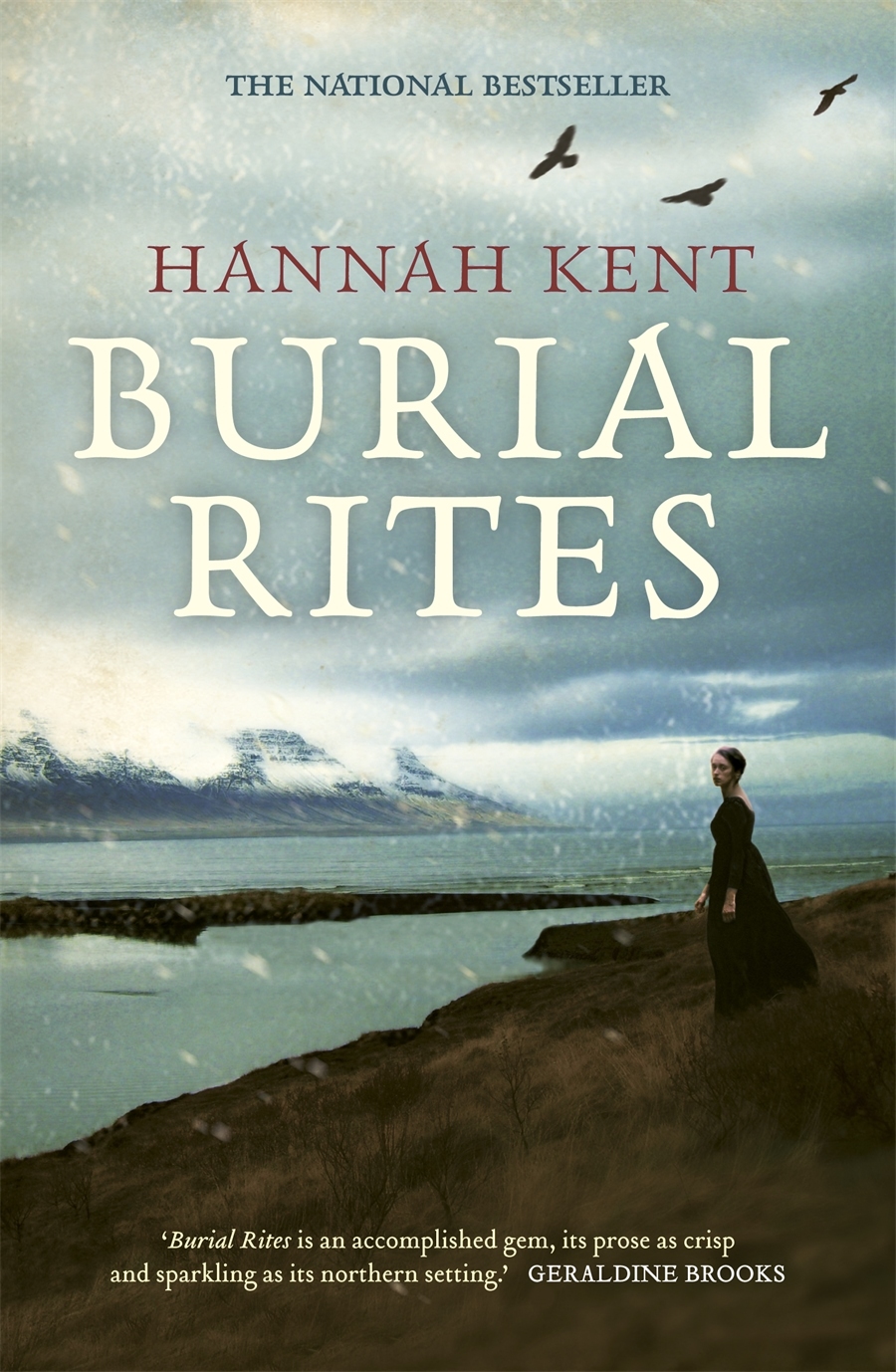
Hannah Kent, Burial rites (Review)

Hannah Kent, Burial Rites bookcover

Courtesy: Picador

“We’ll remember you” says Margrét to Agnes on the day of her execution. We sure will, if Hannah Kent’s debut novel Burial rites has anything to say about it. Kent’s book is the second novel set in Iceland I’ve read, the first being Icelandic writer Halldor Laxness’s unforgettable Independent people. Although Laxness’s novel is set a century after Burial rites, it prepared me for Kent’s novel – for the difficult landscape, the hard lives, and the unforgiving natures that such an environment can engender. Yes, that’s a generalisation I know. You can find unforgiving natures anywhere, but oh, they work so well in harsh environments. Just think, for example, of My Antonia (my review).

But now, what to say about a book that hit the book stands running? I wanted to read it last year, but I also wanted to read it with my reading group, which is why I have only now read it. Reading a book so late can make it difficult to add anything meaningful to the conversation. Fortunately though, while I couldn’t avoid the early buzz, I haven’t read the myriad reviews out there, enabling me to come to it reasonably freshly. So, here goes …

Remember your place, Agnes

It’s a compelling read. Icelanders may know the basic story, but we don’t. It concerns Agnes Magnúsdóttir – great sounding name, eh? – who, in 1830, was the last person to be executed in Iceland. She and two others, Fridrik Sigurdsson and Sigrídur Gudmundsdóttir, were convicted of murdering Natan Ketilsson, a complicated and probably cruel man, and his friend Pétur. Fridrik was also executed, while Sigrídur’s sentence was commuted to life imprisonment. Apparently, executions were normally carried out in Denmark but District Commissioner Björn Blöndal wanted to make an example of Agnes. As it would take some time to organise the executions and as Iceland had no real prison facilities, Agnes and Fridrik, were, literally, farmed out to live with public officials who were also farmers. Most of the novel takes place on the farm, Kornsà, to which Agnes was sent. The main characters, there, are the farmer’s dying wife Margrèt, her two daughters Steina and Lauga, and her husband Jón. Making regular visits is Assistant Reverend Tóti, chosen by Agnes to be her religious adviser. As the novel progresses, we also meet the victim and Agnes’s co-murderers.

Kent creates a believable world in which the people at Kornsà are initially resentful and fearful, but gradually, more gradual for some than others, come to recognise Agnes’ humanity and to believe that her sentence “isn’t right”. Similarly, the anxious but conscientious Tóti grows through his relationship as Agnes’ mentor. We learn about Agnes’ childhood, in which she is early deserted by her mother and then loses a loving foster-mother through death in childbirth. And we learn about her struggles to support herself as a woman. She thought she’d found her place with Natan, who seemed to offer her love while also offering her a job, but he soon reminds her of “her place”! Kent’s Agnes lives most of her life alone, lonely, and unsupported, which was probably not uncommon for women of her class at that time. This is, I’m sure, one of the themes Kent wants to explore in her novel.

You could argue that, overall, Kent’s women are fleshed out more than her men, but this is Agnes’ story and we know, I think, what we need to know about the men. There is a feminist reading to the book, but it is also more broadly sociological, to do with poverty and disempowerment. That women are more likely than men to find themselves in these positions is part of the problem.

This is what I told the reverend

Kent doesn’t use a simple, direct narrative to tell her story. (What novelist does in this post-postmodern world of ours!) For a start, she opens each chapter with one or more translated archival documents. This regular interruption of the main narrative could irritate readers by breaking emotional engagement with the story, but I found it enhanced the novel, particularly considering Kent’s intentions. One of these intentions, as she explained in an interview at last year’s World Book Expo, relates to the fact that she sees the novel as “speculative biography” not “historical fiction”. She describes, in this and other interviews, her methodology which was to use facts wherever they were available. Where the facts weren’t available, she says, she did broader contextual research about Iceland to imagine what was most likely to have occurred. She felt “free to invent” only in the outright gaps. She describes this approach as “research-driven creative-practice”. It’s logical, given all this, that she would use archival documents to support her “story”.

The other main narrative technique Kent uses is to switch voices from first person for Agnes, to third person for everyone else. This also makes sense given that Kent’s prime motivation was to give Agnes a voice, to “find her ambiguity, her humanity” and lift her out of the prevailing, more caricatured image. Again, I think it works, mostly. Agnes’ voice is distinctive, strong, and wavers, as you would expect, from confidence and hope to anxiety and fear. However, there were times when the switch back to third person seemed unnecessary. Mostly the third person sections focus on other characters, even when they are interacting with Agnes, but on a couple of occasions the shift occurs in the middle of Agnes’ story. One minute she is telling her story – “This is what I told the reverend” – and next minute the reverend asks “What happened then” and her story continues in the third person with her words in quotation marks. This was a little disconcerting, though it didn’t spoil the story significantly.

A magic stone

While the main point of the novel is Agnes’ story, Kent, in the process, paints a rich picture of Icelandic society, of the farmers, healers, neighbours, poets, gossips, maids and so on. Religion is clearly important, but for some characters, omens and superstition are equally if not more powerful. Natan is depicted as highly susceptible to bad omens, and for Agnes the ever-present ravens – “their black feathers poisonous against the snow” – reflect her sense of aloneness, and bode ill. By contrast, stones suggest good luck:

The stone Mamma gave me before she left. It will bring you good luck, Agnes. It is a magic stone.

It is, therefore, telling when she spits out a stone from her mouth on the day of her execution.

This brings me to Kent’s writing. It’s strong, evocative and often visceral. She uses motifs, like the ravens and stones, to reinforce her ideas. (It’s probably not coincidental, either, that the novel has thirteen chapters!). She is though, a first-time novelist, and at times the writing becomes a little heavy-handed, like this, for example:

Sometimes, after talking to the Reverend, my mouth aches. My tongue feels so tired; it slumps in my mouth like a dead bird, all damp feathers, in between the stones of my teeth.

But who’s complaining? Burial rites is a magical read that gets you in from the first page and doesn’t let you go until you get out your hanky at the end. Consider yourself warned.

awwchallenge2014Hannah Kent
Burial rites
Sydney: Picador, 2013
Design: Sandy Cull
338pp
ISBN: 9781742612829

William Wells Brown, Madison Washington (Review)

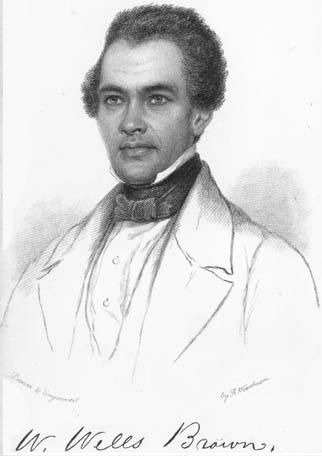
William Wells Brown,

William Wells Brown, 1852 (Courtesy Project Gutenberg, via Wikipedia)

Having recently reviewed Harriet Ann Jacobs’ story “The lover” in the Library of America‘s (LOA) Story of the Week program – and also having seen the movie 12 Years a Slave – I couldn’t ignore William Wells Brown’s story, Madison Washington, when it appeared last month as an LOA offering.

Brown (1814-1884), like Jacobs, was born into slavery. He managed to escape to Canada when he was 19. LOA’s introductory notes tell us that within a decade he’d married, moved to Buffalo, and taught himself to read and write. He lectured against slavery in both Europe and the USA. In 1847, he published Narrative of a fugitive slave which apparently sold so many copies that four printings needed to be done in less than two years. Wikipedia tells me that his novel Clotel, published in England in 1853, is considered to be the first novel written by an African-American. He lived in England from 1849 to 1854, due to the increased risk of recapture posed by the 1850 Fugitive Slave Act.

During and after the American Civil War, Brown continued to publish fiction and non-fiction, earning a reputation as one of the most prolific African-American writers of his time. He apparently actively recruited black Americans to fight in the Civil War, and supported African-American migration to Haiti.

The story published by LOA is just one from his book, The black man: His antecedents, his genius, and his achievements, which contains sketches of the lives of individuals who, Brown writes in his “Preface”,

by their own genius, capacity, and intellectual development, have surmounted the many obstacles which slavery and prejudice have thrown in their way, and raised themselves to positions of honor and influence.

He concludes his Preface with:

If this work shall aid in vindicating the Negro’s character, and show that he is endowed with those intellectual and amiable qualities which adorn and dignify human nature, it will meet the most sanguine hopes of the writer.

The sketch chosen by LOA concerns Madison Washington. But, before I write about that, I must say something about his name. I’ve often been intrigued by how many African-Americans were, and are, named “Washington”. Presumably this has something to do with George Washington, but what exactly? According to the Huffington Post, the 2000 US Census reported 163,036 people with the surname Washington, of whom 90% were African-American. This is apparently a far higher “black” percentage than for any other common name. The article describes a rather complex situation regarding the name. It tells us that during the early post-abolition period, when slaves were allowed to have surnames, many chose Washington. This is most likely linked to the president. However, George Washington had, the article explains, a complicated relationship with slavery, and so the reasoning behind the use of the name is not totally clear. Interestingly, in the case of Madison Washington, his first name is also the name of a slave-owning president? Coincidence?

Now to “Madison Washington” the story! It starts with a description of the man:

Among the great number of fugitive slaves who arrived in Canada towards the close of the year 1840, was one whose tall figure, firm step, and piercing eye attracted at once the attention of all who beheld him. Nature had treated him as a favorite. His expressive countenance painted and reflected every emotion of his soul. There was a fascination in the gaze of his finely-cut eyes that no one could withstand. Born of African parentage, with no mixture in his blood, he was one of the handsomest of his race. His dignified, calm, and unaffected features announced at a glance that he was one endowed with genius, and created to guide his fellow-man.

The story proper then begins six months into his time in Canada when his employer, pleased with his work, realises that Washington is discontented. Upon his enquiry, the story comes out. Washington had a wife with whom he’d planned to escape, but the escape plans had gone awry and he alone had got away. His aim was to work hard, and save the money to purchase her freedom, but he’d begun to realise that it would take him five years to save the required money. So, what does he do? He decides to return to the south, ignoring advice to the contrary and risking recapture, to effect her escape. As Brown reports, “Liberty is worth nothing to me while my wife is a slave”.

Well, the inevitable happens, but Washington manages to escape again, this time by orchestrating a mutiny on the “Creole” which was carrying him and other slaves to the New Orleans slave market.  Via this mutiny, he effected the freeing of 128 slaves, resulting in what is recognised as the most successful slave revolt of the period, more successful than the more famous Amistad mutiny which freed only 53 slaves.

Brown’s telling of the story shows Washington to both a principled and resourceful man – principled because of his treatment of the sailors once the ship was under slave control and resourceful because of the careful planning he’d done to prepare for an escape. It is also, though, rather melodramatic, which is typical of the times, and involves the amazing coincidence of his wife, the “majestic, “beautiful and accomplished” Susan, being on the boat. According to LOA this is “an almost certain apocryphal addition” that appeared in an article a year after the mutiny. It makes for a good story, however!

Interestingly, in 1853, Frederick Douglass wrote a novella, The heroic slave, presenting a fictional account of Madison Washington. Wikipedia, which told me that Brown’s 1853 published Clotel is considered to be the first African-American-written novel written, also states that Douglass’s novella “is now considered the first known piece of African-American fictional literature”. Let’s let Wikipedia fight it out because, in the end, I don’t think it really matters. What matters is that African-Americans were writing and being published, and that we can still access to their works today.

William Wells Brown
“Madison Washington”
First published: In his book, The black man, his antecedents, his genius, his achievements, 1862.
Available: Online at the Library of America or in Documenting the American South