Monday musings on Australian literature: Sources for early Australian Women Writers

As I think you know, Elizabeth Lhuede (founder of the Australian Women Writers Challenge), Bill Holloway (The Australian Legend), and I, are behind the re-framed Challenge. Our focus is early Australian Women Writers, by which we mean women writers from the nineteenth and early-to-mid twentieth centuries. We are particularly interested in those women writers who have never received due recognition, but we’ll cover the bigger names too. We publish twice weekly – articles and reviews on Wednesday mornings, and excerpts (mostly) of actual writings on Friday mornings (Australian time of course).

Currently, I post on the last Wednesday of the month, and my first two posts were on sources for researchers and anyone else interested in the topic. I have decided to document them here, for my own records – and, just in case some of you haven’t caught those posts, but would be interested in them:

  1. Early Australian women writers: 1, Primary sources: focuses on where actual writings by the authors can be found… Read on …
  2. Early Australian women writers: 2, Secondary sources: focuses on where information and writings about the authors and the period can be found… Read on …

Clicking on either of the Read on links will take you to the blog. Once there, please potter around to see what else we’ve posted to date. You might find something interesting. We’d love to hear from you if you did, and if you have an idea of something relevant you might like to contribute, please contact Bill who is our commissioning editor, theaustralianlegend[at]gmail.com.

This is a very short Monday Musings this week. Enjoy the respite!

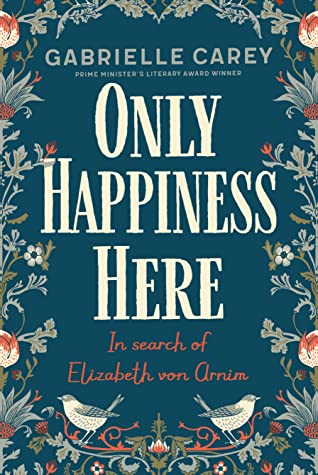
Gabrielle Carey, Only happiness here: In search of Elizabeth von Arnim (#BookReview)

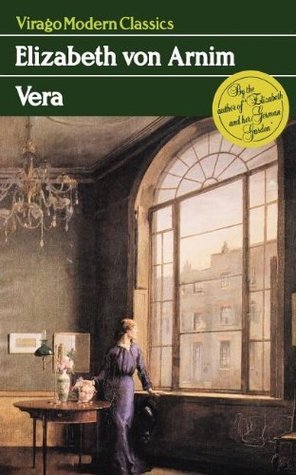
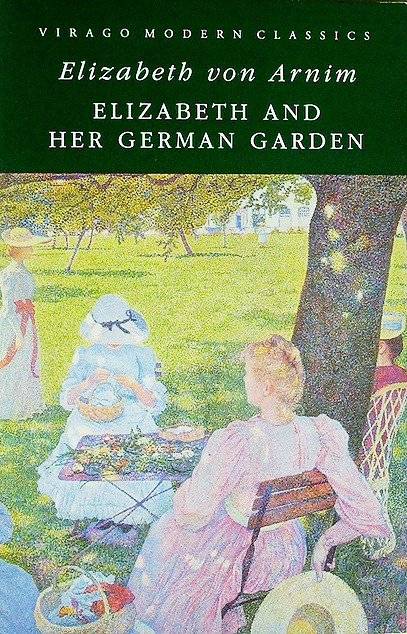
I discovered Elizabeth von Arnim (nee Mary Annette Beauchamp, 1866-1941) back in the 1990s when Virago republished her first novel, Elizabeth and her German garden. Published in 1898, this novel, writes Gabrielle Carey, was an immediate hit, turning her, almost overnight, into one of England’s favourite authors. It was certainly a revelation to me.

I went on to read several of her books, including her pseudo-autobiography All the dogs of my life, over the next decade. I was completely charmed by her wit and humour together with her insights into love and marriage, and their impact, in particular, on women’s lives. Anyone who’s a Jane Austen fan couldn’t fail, I’m sure, to see von Arnim’s ancestry. I wrote one of my early Monday musings posts on her.

Book cover

What, a Monday Musings on Australian literature on Elizabeth von Arnim? It was cheeky I know – and I admitted it at the time. Yes, she was born in Australia, but yes, she left here, never to return, when she was three. However, I just wanted to write about her. And so, it seems did Gabrielle Carey, who opens her hybrid memoir-biography with

When I first discovered Elizabeth von Arnim, I found, for the first time, a writer who wrote about being happy. So much of my reading life – which essentially means so much of my actual daily life – had been spent reading miserable literature because, let’s face it, most literature is miserable.

Carey isn’t clear about when she discovered von Arnim in relation to when she started working on this book, but says that once she discovered von Arnim, she became something of a “von Arnim evangelist”. She was “incensed” that von Arnim had been so completely forgotten. I could relate to this, because I felt the same. Unfortunately, my evangelising didn’t go far because no-one in my reading group had heard of her when I recommended that we do one of her novels as our “classic” this year. More on that, then.

If you are among those you don’t know this writer, you might be surprised to hear that several biographies have been written about her, including three in the last decade. I have two of them, Jennifer Walker’s more traditional literary biography, Elizabeth of the German garden: A literary journey, published in 2013, and Gabrielle Carey’s. The third is Joyce Morgan’s The countess from Kirribilli, published in 2021. Just this should tell you something about the fascination with which this woman is held, this woman who published 21 books, whose first cousin was Katherine Mansfield, and who knew EM Forster, had an affair with HG Wells and married (among others) Bertrand Russell’s brother. She had a life – and then some!

OK, so I’ve written quite a bit about Elizabeth von Arnim, but not much about Gabrielle Carey’s book. Only happiness here is the third sort-of literary biography that Carey has written, the other two being Moving among strangers (my review) about Randolph Stow and her family’s connection with him, and Falling out of love with Ivan Southall about her losing faith in this childhood writing idol. Carey, it seems, likes to explore her subject matter through the prism of her own life and experience (a bit like Von Arnim did with her fiction). This is not to everyone’s taste, but when done well, like, for example, Jessica White’s Hearing Maud (my review), it can be both engaging and effective.

I loved White’s book for the way she explored Maud Praed (daughter of novelist Rosa Praed) through their joint experiences of deafness, neatly marrying information with activism. Carey’s book has a very different driver, one I foreshadowed in the opening quote from her book. A few pages on, Carey makes her goal clear:

What did Elizabeth von Arnim understand about happiness that no other writer I’ve ever come across did? And is it something I too might be able to learn?

She wanted to know “the secret to her enviable ability to enjoy life” because it was clear from her novels and journals that she did, despite the many trials she faced. Indeed, the book’s title is the sign von Armin put over the door of her Swiss chalet. Carey argues that von Arnim “was, perhaps unknowingly, one of the earliest proponents of positive psychology”. Carey was so serious about her goal that amongst the end-matter in her book is a page titled “Elizabeth von Arnim’s Principles of Happiness”. There are nine, but if you want this bit of therapy you are going to have to read the book yourself! However, to whet your appetite, the first one is “Freedom”.

Carey tells her story – I mean, von Arnim’s story – chronologically, regularly interspersing her own reflections and experiences in relation to von Arnim’s. An early example occurs when she writes about von Arnim’s first marriage to the much older Count von Arnim, and her novel inspired by this, The pastor’s wife (albeit the Count was not a pastor!) In this novel, von Arnim writes that “Ingeborg in her bewilderment let these things happen to her”. Carey immediately follows this with:

How well I understand this experience of letting things happen. All my life I had let things happen to me, often without my consent.

And she then spends nearly two pages exemplifying this from her life. Mostly this approach of Carey’s was interesting, even illuminating, but there were times when it felt a little too self-absorbed. However, this didn’t overly detract from what is a thoughtful introduction to von Arnim and her work. In under 250 pages, Carey manages to tell us something about almost every one of Von Arnim’s books – how each one fit into her life, what aspects of her life it drew from, and how it was received at the time. In that same number of pages, she conveys the richness of von Arnim’s long and event-filled life. I’m impressed by how succinct and yet engaging the book is, and am not surprised that it was shortlisted for the 2021 Nib Literary Award. I should add here that while the book is not foot-noted – its not being a formal “literary biography” – there are two and a half pages of sources at the end.

So, what did I, as a reader of von Arnim, get from this book, besides a useful introduction to her complete oeuvre? Well, firstly, I got a deeper understanding of how much of her oeuvre drew from her own life, and from that I got to better understand her attitude to marriage and to the relationship between men and women, and to her exploration of, as Carey puts it, “the clash between the concept of the ideal and the real”. I also got to understand more about her times, its literary milieu, and her place within it – and to see how we can never really foretell which writers will survive and which won’t. When von Arnim died, obituary writers were sure she’d not be forgotten. They also believed she’d be far more remembered than her shorter-lived cousin, the above-named Katherine Mansfield. But …

… as Carey sums up, “her style of conventionally plotted novels, however, rebellious, insightful or entertaining, soon went out of literary fashion”, because, wrote English novelist Frank Swinnerton, “her talent lay in fun, satirical portraiture, and farcical comedy”. These, he said, were ‘scorned by the “modern dilemma”‘. We are talking, of course, of Modernism, which, as Carey puts baldly, “didn’t believe in happiness”, a value that has carried through to today.

I will leave this here, because I want to return to it in a separate post. Meanwhile, I’d argue that while von Arnim’s books might be witty, they are not simplistic. They come from an astute and observant mind that was able to comment both on the times and on universalities in human nature. They may not have Modernism’s bleakness, but they aren’t light fluff either. Carey’s simple-sounding quest has, I think, touched on something significant.

Brona (This Reading Life) enjoyed this book, which she ascribes to the bibliomemoir genre.

Gabrielle Carey
Only happiness here: In search of Elizabeth von Arnim
St Lucia: UQP, 2020
249pp.
ISBN: 9780712262975

Nella Larsen, Passing (#BookReview)

For last year’s Novellas in November, Arti (of Ripple Effects) posted on a book and author I’d never heard of, Nella Larsen’s Passing. She also discussed its 2021 film adaptation. Quite coincidentally, that same month, my Californian friend Carolyn wrote positively about the film in a letter to me. It sounded right up my alley, so how grateful was I when, this month, Carolyn sent me the book. I decided to squeeze it in …

According to Wikipedia, Nella Larsen (nee Walker) was born in a poor part of Chicago to a Danish immigrant mother, and a father “believed to be a mixed-race Afro-Caribbean immigrant from the Danish West Indies”. He disappeared early in Nella’s life, and her mother married another Danish immigrant. Because of Nella they were seen as a “mixed” family and were not welcome in the mostly white neighbourhood where they’d moved. Nella grew up in that difficult limbo of being neither white nor black.

Eventually, she married a Black-American* physicist and they moved to Harlem where they became involved with “important figures in the Negro Awakening”, later known as the Harlem Renaissance. I share all this because it is relevant to Passing, which was her second novel.

Passing, set mostly in 1927, tells the story of two Black women, Irene and Clare. Both can pass as white, but Irene lives in Harlem with her darker doctor husband, while Clare lives in white society, as a White, with her Black-hating banker husband. At the start of the novel, Irene receives a letter from Clare, referring to an accidental meeting they’d had in a swish hotel in Chicago where both had been “passing” as white. This meeting had been 12 years after they’d last seen each other as teens in Chicago, at which time Clare had been whisked away by her White aunts after the death of her drunken janitor father.

Two years had passed since that uncomfortable Chicago meeting, two years during which Irene had done her best to forget an occasion “in which even now, after two years, humiliation, resentment, and rage were mingled”. But now, Clare was wanting to see Irene again …

“they always come back” (Brian)

Much has been written about this book, which speaks directly to the challenges and conflicts faced by African Americans at the time. There was a new Black bourgeoisie – a professional middle class – to which Irene belongs, and in which she feels comfortable. She’s committed to the whole “uplifting the brother” project and does good works to that end. Clare, on the other hand, has turned her back on her race. The scene is set, we think, for conflict.

And there is, but if you think it’s going to encompass a simple dichotomy, you would be wrong. From the start, Larson keeps us on our toes, forcing us to see two very different ways of living as a black woman in that place and time. The story is told third person, but through the perspective of Irene. She is the conservative rule-follower who is sure of her path, while Clare, who is probably closer to Larsen herself, is more adventurous, a risk-taker. She’s lively, sensual, a breath of fresh air, but how are we to read her – and, for that matter, Irene?

As the novel progresses, we (and our allegiances) are tossed between the two, just as tensions between the two ebb and flow. Are we to approve Irene’s conscientious approach to life, or should we empathise with the “lonely” Clare who wants to reconnect with the black community? Both are flawed characters. Irene’s choice involves buying into the whole aspirational, consumerist, success-focused values of the bourgeoisie, so much so that she rides rough-shod over the wishes and needs of her husband and sons. Clare, on the other hand, might be lively but she can also be “selfish” and “wilful”, with her risk-taking being potentially dangerous or damaging to others, including her neglected young daughter. It’s clear that if her husband discovered she’d been touched by “the tar brush”, she’d be in deep trouble. It’s to Larsen’s credit that we do not see these characters as black and white (hmm!).

Irene and Clare are not the only characters in this tight novella, but the most interesting of the others is Irene’s husband, Brian, who finds himself caught between the two women after Clare inveigles herself into their lives. At the end of Part 1, just after the meeting in Chicago, Irene is preparing to return home to New York and Brian whose “old, queer, unhappy restlessness had begun again within him, that craving for some place strange and different, which at the beginning of her marriage she had had to make such strenuous efforts to repress.”

“caught between two allegiances” (Irene)

Passing is told in three parts – Encounter, Re-encounter, and Finale. In Re-encounter we learn more about these characters through their interactions, and we discover the source of Brian’s restlessness. He is, potentially, another adventurer, though different to Clare.

Early in this final part, Irene and Brian discuss Clare, “passing” and race. Brian has a more nuanced understanding of “race”, it seems. Answering Irene’s question about why those who pass “always come back”, he says, “if I knew that, I’d know what race is”. Much later, we learn that race is at the core of Brian’s restlessness. When Irene upbraids him for honestly answering their son’s question about lynching, he lashes out:

…I’d feel I hadn’t done my duty by them if I didn’t give them some inkling of what’s before them. It’s the least I can do. I wanted to get them out of this hellish place years ago. You wouldn’t let me. I gave up the idea because you objected. Don’t expect me to give up everything.

Passing is about many things, only some of which I’ve discussed. It’s about convention and security versus risk and adventure, about gender and marriage, about class and money, and about self-definition. There is much here that is universal about human nature, but, of course, race is a driving factor. As the novel draws to its conclusion, Irene finds herself

caught between two allegiances, different, yet the same. Herself. Her race. Race? The thing that bound and suffocated her.

But, there is another layer to this novel, a foreshadowing of something darker. Half-way through the novel, Irene says to Clare that “as we’ve said before, everything must be paid for”, while a little further on, Clare says to Irene

“Can’t you realize that I’m not like you a bit? Why, to get the things I want badly enough, I’d do anything, hurt anybody, throw anything away. Really, ‘Rene, I’m not safe.”

It’s chilling, but I’ll leave it there. I was engrossed by this novel from its opening sentence to its clever, unsettling ending.

* I’m uncertain about nomenclature, given the language used in this 1920s novel is not what we use now. I hope I’ve made a fair call.

Nella Larsen
Passing
New York: Penguin Books, 2018 (orig. pub. 1929)
128pp.
ISBN: 9780142437278

Ida Vitale, Byobu (#BookReview)

Uruguayan writer Ida Vitale’s Byobu was my reading group’s second book of the year. Originally published in Spanish in 2018, with the English translation released in 2021, Byobu is Vitale’s first book of prose to be translated into English. Few, if any of us, had heard of her – and yet, this now 98-year-old woman was, in 2019, named by the BBC as one of the 100 most influential women of the year. The things we don’t know!

Anyhow, Byobu is a curious book. It has no clear narrative, and only one character, the eponymous Byobu. It’s just 85 pages, and comprises 34 “chapters”. It is replete with allusions to a diverse range of writers, thinkers, musicians. In other words, it’s one of those books you can struggle with, if you don’t come up with a way of reading it. For me, this was to jettison preconceptions about what a novel is and go with the flow to see what fell out. And what fell out was a mind-opening, and sometimes witty, series of thoughts and observations about life and living. I can’t say I understood all of it, but I thoroughly enjoyed the reading experience.

The best way I can encapsulate Byobu is to describe it as a sort of modern Everyman story, the story of an individual in a world that can be confusing, if not sometimes downright hostile. The overall theme seems to me to be: How do you live in this world?

Before I explore this more, some basics. Byobu is set in Uruguay, and although there’s no plot per se, there is some structure. (I’d probably find more structure had I time to read it a few times). The opening chapter introduces the idea of “story” – and clues us into the idea that we are going to be unsettled:

a story’s existence, even if not well defined or well assigned, even if only in its formative stage, just barely latent, emits vague but urgent emanations. (“A story”)

The next few chapters introduce us to Byobu, conveying a general sense of who he is. These are followed by chapters that consider bigger issues in contemporary life.

However, although we are introduced to Byobu, he remains somewhat shadowy. We don’t know how old he is, but one member of my reading group suggested he was old, like his author, and that he encompasses an old person’s thoughts about life. I can accept that. Regardless, besides not knowing how old he is, we don’t know whether he is (or has been) married, has a family, is working, and so on. A family home is mentioned, and there are references to daily activities including attending a conference. All this vagueness supports the idea of him as an Everyman (albeit, possibly, an old one!)

We do, though, learn some things about the sort of person Byobu is. He can be indecisive. He has “an intractable inclination to complicate things”, and hates change. He’s not a good storyteller, but he likes nature and enjoys minutiae. Unfortunately, though,

often distracted by some minutia captivating him at a particular moment, he misses fragments of conversations that later turn out to be important. (“On anodyne things”)

I found him very human and engaging, to the degree I could, given his shadowiness.

I fear though that I’m not selling the book, so I’ll try now to share some of its joys and intellect. I’ll start by talking a little about the style. Many of the “chapters”, and I put them in quotation marks because some are only a paragraph long, start with what you could call truisms, but they don’t read as cliches, like:

Everything important lies below the surface. (“Terrestrial labours”)

Byobu concludes that he must begin by ending. (“Knots”)

Byobu has heard it said that ‘every mile has its rough patch’. (“Epiphanies”)

Byobu is not always able to predict how the situations he gets involved in will end. (“Dangerous misunderstandings”)

How can you be sure that the avenue, boulevard, or ordinary road you’re facing is not actually a blind alley? (“Crossroads”)

Just look at that sentence, “Byobu concludes that he must begin by ending”. So terse, so clever. “Knots”, in fact, is one of those one-paragraph chapters. It concerns Byobu’s realisation that if he doesn’t end his “trepidations” and “tepid transactions”, if he doesn’t “lay limbos aside” and “ignore everything initiated by the iniquitous” – he will have to “accustom himself” to “the cage”. But, can he recreate himself?

“Crossroads” addresses another recurrent idea in the book, the importance of the imagination, of mystery, over the mundane. Opposing mystery and imagination are “straight lines” which also recur, starting in the second chapter, “Life is not a straight line”. In “Knots”, Byobu learns that straightness “lays snares” and in “Against the Argive Way”, he is aware that “The world loves conversations in straight lines and single-minded strides. Intersections divert. Labyrinths confound.”

A few chapters in, then, it dawned on me that Byobu was about more than a man muddling through life, that it’s a commentary on modern life. Byobu pleads for the imagination, for not going in straight lines. It critiques conformity, power and authority, commercialisation, urbanisation, inhumanity, and resistance to change. “Internal coherence” explores resisting social pressure. It is “immoral”, it suggests, to accept a world “governed by the boorish authorities who rule during these evil times we inhabit”. Yet, Vitale realises resistance is not easy, so her Byobu “resists on the inside, while staying quiet and feigning surrender”.

In the penultimate “chapter”, “Byobu and the traffic light”, traffic lights are a metaphor for “supervision and compliance”. Here “the defiant … recognise the bad example of a behaviour that is a silent hymn to obedience to all authority”. Vitale goes on to suggest that traffic lights should, in fact, “innervate the pedestrians” (who are “increasingly incongruent elements in the city”) to “assume their role as essential antagonists”. This chapter is a call to defy, to rebel.

Lest this all sound rather bleak, let me say there’s beauty here too. There are, for example, some lovely descriptions of nature:

In the garden, jasmines reign supreme. At night the star jasmine is a vertical Milky Way, delirious with aroma. (“Seasons”)

And, there is quite a bit of humour. Much is of the quiet, understated sort, but it made me laugh. “It’s true”, thinks Byobu, “there were three Wise Men; not quite a battalion” or “They’d better not count on him. He’s not an abacus”.

I hate leaving this book, but of course I must, so, I will leave you with two ideas. The first comes from one of the two epigraphs. Neither were translated, but the second is by Henri Michaux, and it roughly translates as “In case of danger, joke”! Joking is part of this book, but it is also deadly serious. Speaking of “story”, the opening chapter exhorts Byobu (our Everyman) not to “underestimate its flexible, disordered density”. And neither should we, because this novel has much to offer those willing to go with its flow.

Ida Vitale
Byobu
Translated from the Spanish by Sean Manning
Edinburgh: Charco Press, 2021 (Orig. Pub. 2018)
85pp.
ISBN: 9781913867023

Jane Sinclair, Shy love smiles and acid drops (#BookReview)

Jane Sinclair’s hybrid biography-memoir, Shy love smiles and acid drops: Letters from a difficult marriage, is an unusual book. Covering around two years in her parents’ life, this book comprises, mostly, letters sent between her parents between April 1960 and July 1962 when Sinclair and her mother were in England while her father remained in Australia. Between the letters (and some entries from her mother’s journal), Sinclair adds explanatory information, which ensures the narrative flow.

Sinclair was 5 to 7 years old when these letters were written. Being so young, her memory of that time is scattered, but she has clearly thought much about her parents in her adult life. Also, she remembers family stories of those times told to her later, and she did discuss her parents’ relationship with them, though, as is the way with such things, not as much as she wishes she had. The book was inspired by her finding the letters that underpin this book.

What makes this book particularly interesting is who her parents are, the artist Jean Langley and music critic John Sinclair. You may or may not have heard of them, but these two were part of mid-twentieth century Melbourne’s arts and music scene. In particular, they had close connections with the Heide artistic community, which inspired Emily Bitto’s award-winning novel, The strays (my review), and which was created by two art-lovers and philanthropists, John and Sunday Reed. This community was famous for two things, the art produced there and the complicated personal relationships amongst its members.

Some of Australia’s best-regarded modernist artists were associated with Heide, people like Albert Tucker, Sidney Nolan, and Joy Hester, all of whom appear in this book. Artist Arthur Boyd was also close to these people, though not part of the community. However, Heide was just as well-known, as Wikipedia puts it, for “the intertwined personal and professional lives of the people involved”. Sunday Reed herself had affairs with several in the community, with her husband’s knowledge. This art history is what primarily attracted me to the book, but it was the background rather than the focus that I’d hoped. Instead, Shy love smiles and acid drops is exactly what it says it is, the story of “a difficult marriage”. As we are told on the back cover

when Jane Sinclair was five her mother Jean Langley followed her lover, Arthur Boyd, to London and took Jane with her. This book covers the two years they live there before returning to Australia in 1962, by which time her mother is three months pregnant to an Englishman.

“Your letter makes me cross” (Jeannie)

The letters are difficult reading because of the emotional pain and distress they contain. There are some fascinating insights into London and England at a time when many Australians saw it as a mecca for arts and culture. Indeed, while Jean Langley was there, living near the Boyds, so were their friends, Barry Humphries and his wife.

In her introduction, Sinclair speaks of how the letters caused her to “seriously question” her mother’s “version of herself as the aggrieved, wronged wife that she had cultivated and genuinely believe to be true”. Sinclair was also sorry that she had never allowed her father, who died twenty-five years before her mother, to tell his side of the story. This is understandable given when he died, she had probably not reached that age of (hopefully) wise reflection many of us do later in our lives, that age when we start to really see our parents as human beings, rather than seeing them through the prism of their relationship with us. I think this is so, in even the best of parent-child relationships?

Anyhow, Sinclair tells us that her parents’ relationship was “intense and difficult” from the start. They separated many times, but “there remained an irresistible attraction that kept them returning to each other”. Eleven years of age separated her mother and father, but it seems that personality difference (“not compatible emotionally”) was the essential problem. John Sinclair apparently tended to melancholy and depression, while Jean Langley was a romantic. “She could create sparkle and shine” and “wanted the world to be a beautiful place of happy endings”. All this comes through the letters. John expresses his sadness, his missing his wife and daughter, while Jeannie expresses her frustration with him, and her increasing disappointment with life and human beings, as things become more and more complicated. The England she adored at the beginning of her trip is not so great when it becomes cold and grey, and as the reality of never having enough money sets in.

“a riddle, muddle, fiddle, diddle” (Jeannie)

But what comes through even more is miscommunication, and particularly what seems to be Jeannie’s wilful misreading of John’s letters. When he invites her to return home on her terms – meaning she can live separately from him if she wishes – Jeannie seems to misread that wilfully, insisting again and again that she can’t be his wife, she won’t sleep with him, and so on. Readers wonder where she reads this, because we don’t.

At times, I put my feminist hat on and wondered whether there was something about John that we don’t know. Should I be supporting my down-trodden sister, I started to wonder? But, while there are, naturally, gender issues to do with women’s place in the mid-twentieth century, I don’t read a woman wronged by her husband here. I read a woman who, due to her own personality, and upbringing perhaps, regularly let emotion cloud her ability to reason – to her own detriment as well as those around her. She falls in and out of love twice during this English sojourn – besides the apparently abiding love for Arthur Boyd – and admits in June 1962 that, “I seem to have made a mess of my emotions”.

As the narrative progresses, daughter Jean notes that her mother, who liked to see herself as truthful, strayed often from it:

My mother believed in her emotional truth, and unfortunately for my father, it was sometimes very far from reality.

Reading this, I think I would say more than “sometimes”. I have known people like Jeannie, people who have such a zest for life but who wear their emotions so close to the surface that they can’t reason through what is really happening. They can be both joyful and draining to be around, and this is how Jeannie comes across.

This is not my usual review, because, in a sense, it’s hard to review such a personal book. Indeed it’s so personal that it’s worth thinking about its target. There’s some interesting social history here – life in the 60s, the experience of Aussie artistic expats in London, the challenges of communication in those pre-electronic communications days. There’s also a little about the the art world, the odd reference to a Boyd or Nolan exhibition, to the Blackmans, and to Brett Whiteley whom Jeannie calls “a shocking little upstart”. But, overall, this is a nicely presented but intense story of a “difficult marriage”, and it will appeal mostly to those interested in human relationships.

Read for #ReadIndies month (kaggsysbookishramblings and Lizzy’s Literary Life). Hybrid is a Melbourne-based independent publisher, with a special but not exclusive interest in Judaica. I have reviewed many of their books over the years.

Jane Sinclair
Shy love smiles and acid drops: Letters from a difficult marriage
Melbourne: Hybrid Publishers, 2021
279pp.
Cover art: from oil painting by Jane Sinclair
ISBN: 9781925736588

(Review copy courtesy Hybrid Publishers)

Julie Koh, Portable curiosities: Stories (#BookReview)

I’ve decided to try reading more audiobooks this year, despite not being a big fan of this mode of consuming books. I’m a textual person. I like to see the print on the page, how it is set out. I like to see the words. I like to see how the names are spelt. Given my reservations and the fact that I expect to “read” in short stints, I thought short stories might be the way to go. I think they are, though my overall reservations still stand.

My first book was one that was well-reviewed when it appeared in 2016, Julie Koh’s Portable curiosities. It won the SMH Best Young Novelists Awards in 2017, and was shortlisted for several other awards, including the Steele Rudd Award for Short Story Collections (Queensland Literary Awards) and the Glenda Adams Award for New Writing (NSW Premier’s Literary Awards). I checked to see who won the Steele Rudd Award that year, because Koh’s collection is great. It was clearly a strong year. There were co-winners, Elizabeth Harrower’s wonderful A few days in the country, and other stories (my review) and Fiona McFarlane’s High places, which I’ve also been wanting to read.

So, Portable curiosities. I had no idea what this collection was about, and was delighted to find a lively, engaged and engaging interrogation of contemporary Australia, particularly as it intersects with Chinese-Australian experienceIt is highly satirical, penetrating the myths and assumptions that underpin our shaky existence.

The order of stories in a collection is always worth thinking about, and it is notable that this twelve-story collection opens with a story called “Sight” which satirises immigrant Chinese mothers who are so ambitious for their children to fit in and achieve success that they discourage any sort of individuality or creativity. Many of the stories have a surreal or absurdist element. They start realistically but suddenly we find ourselves in another realm or dimension. “Sight”, starting off the collection, is an example. Here, we suddenly find our young narrator having a “third eye” painted on her navel. This eye represents her imaginative self, so her mother organises for it to be removed in an operation.

From here, having satirised Chinese immigrant culture, Koh moves on to critique, with biting clarity, aspects of Australian culture, from misogyny (in “Fantastic breasts” where our male narrator looks for “the perfect set of breasts to have and to hold” at a conference on “The difficulties of an objective existence in a patriarchal world”) to crushing, soulless workplaces that pay lipservice to their employees’ mental health (in “Civility Place”). “Satirist rising” mourns the end of the civilised world, with a bizarre travelling exhibition that aims to ensure the continuation of the “landscapes of our mind”, while the cleverly titled “Cream reaper” (you have to read it to see what I mean) tackles foodie culture, turning foodie-ism into an extreme sport. Along the way, it also skewers multiple aspects of our capitalist culture, like the housing bubble, the commercialism of art, institutional banking, and the plight of the tortured writer.

As a retired film archivist, I loved “The three-dimensional yellow man” which takes to task the stereotyping of Asians on film. There’s “no need for a back story”, our one-dimensional (yellow man) Asian actor is told, “you’re evil”. He belongs, after all, to the “cruel, meek blank-faced race”. Again, the satirical targets are broad-ranging from film festival panels to Pauline Hanson – and embarrassingly close to the bone.

Many of the stories, like “Two” and “Slow death of Cat Cafe”, explore success, materialism and power, while the 2030-set “The Sister Company” exposes a cynically commercial “mental health industry” through the application of androids to the problem. All these stories, despite, or because of, their laugh-out-loud moments and forays into absurdity, hit their mark. A couple, such as “Two” and “Cream reaper”, felt a bit long, even though I thoroughly enjoyed their imagination, but this might have been a product of listening rather than reading, so I’m reserving judgement on this.

My favourite, however, was probably the last, “The fat girl in history”, which opens on a reference to the popular (in Australia) CSIRO Total Well-being Diet. The narrator is Julie, and, although this story also moves into surreal realms, there is a strong sense of autofiction here. Remember, though, that autofiction is still fiction so … Our narrator is a fiction-writer experiencing a crisis of confidence. She has written about a depressed girl, androids and the future – all of which appear in this collection. She’s been told that she writes like Peter Carey, though she admits she’s never read him. She reads an article telling her that contemporary literature is “in the throes of autofiction”, that the “days of pastiche are over”, and then informs us that she’s going to write autofiction titled “The fat girl in history.” Australians will know that Peter Carey has written a short story, “The fat man in history”, and that his debut collection named for this story started his stellar career. I will leave you to think about the portents and threads of meaning Koh is playing with here, but her outright cheekiness in daring us to go with her made me laugh – particularly when I saw where she went.

Portable curiosities deals with serious, on-song subjects, and I so enjoyed seeing her address them through satire, absurdity and surrealism with a healthy dose of black humour. At times the lateral thinking in these stories, not to mention Koh’s interest in satire, reminded me of Carmel Bird. A most enjoyable collection, that was expressively read by Lauren Hamilton Neill.

Julie Koh
Portable curiosities: Stories
(Read by Lauren Hamilton Neill)
Bolinda Audio, 2018 (Orig. pub. 2016)
5hrs 48mins (Unabridged)
ISBN: 9781489440808

Amy Witting, Isobel on the way to the corner shop (#BookReview)

My first reading group book of the year, Amy Witting’s Isobel on the way to the corner shop, nicely doubles as a (late) contribution to Bill’s AWW Gen 4 week. Winner of the 1993 Patrick White Award, Amy Witting is one of those much-admired Australian writers who had not then and still has not received the full recognition she deserves. In her lifetime (1918-2001), she was admired by Patrick White, himself, and Thea Astley. Australian poet Kenneth Slessor is recorded as having said “tell that women I’ll publish any word she writes”.

Another admirer, Australia critic Peter Craven, argued that her form of realism wasn’t really accepted by the reading public until Helen Garner appeared on the scene, but for him “Witting was a great master of realism, a naturalist who could render a nuance in a line that might take a lesser writer a page”. Take for example this two sentence paragraph from our socially unconfident protagonist early in the novel:

The prison of other people’s eyes. No prison narrower.

So now, the book. Isobel on the way to the corner shop (1999) picks up the story of Isobel Callaghan that Witting had started in I for Isobel ten years earlier. You don’t need to have read the earlier book to enjoy and appreciate this one, because enough of Isobel’s past is given for us to have a sense of why she is the person we meet here.

“I have to step out into space”

The person we meet is a 21-year-old woman who, having received some encouragement from an editor, is struggling to establish herself as a writer. She’s poor, starving and isolated, having left her job after screaming at a colleague in “a rage”. She fears she’s going mad. I was engaged from the start by her strong sense of self, her vulnerability, and her determination to be independent, and I enjoyed every moment I spent with her. I felt anxious, as anxious as she did when she felt she was going mad, and just as relieved as she was when her illness was given a name – tuberculosis.

The first third of the novel introduces Isobel and takes us to the moment of her admission into Mornington Sanatorium in the Blue Mountains. In this section, some of the novel’s themes become apparent – one being the artist’s struggle to survive. Another concerns love. The novel starts with Isobel stalled over writing a love scene, because she doesn’t “know the first thing about it”. Not about parental, family love; not about romantic love. This, and her sense of herself as awkward and unlovable, cause her to make a big – and hurtful – mistake when a young man makes a gesture of real affection towards her.

Over the rest of this section of the novel, Isobel meets some people who show genuine kindness – love – towards her. Although the hospital makes her feel like a “parcel”, the section closes with a comforting touch from hospital volunteer Mrs Delaney, “the first time anyone had touched her in kindness”. Through the remainder of the novel, Isobel observes and experiences all sorts of expressions of love (and its opposite), including through a delightful little poetry discussion group at the sanatorium, which starts when Doctor Wang asks Isobel to explain Gerard Manley Hopkins to him.

In the final two-thirds of the novel, another theme that was nascent at the beginning, comes to the fore, and it’s to do with “being oneself”. Isobel’s sense of self is challenged at the sanatorium. It’s an inspired setting because it encompasses a microcosm of society: patients of a disease that doesn’t discriminate between rich and poor, their visitors, and the doctors, nurses and other staff with whom the patients come in contact. Finding your place in such a world, where you can be stuck for months, is not easy.

Isobel is particularly tested by her room-mate Val, a peevish, inflexible, and, she thinks, illiterate woman. Val is unhappy, and like many unhappy people, is self-absorbed. She “felt for no-one”. Try as she might, Isobel cannot get their relationship onto a comfortable footing:

Is it possible to cause so much misery to another human being, simply by being oneself? she wondered, feeling a reflection of that misery. No help for it; she must continue to be herself.

Maintaining your self is difficult, though, when you are “different”, as our funny, resourceful, and compassionate Isobel clearly is. At one point, when her recovery is threatened, she realises that she must be tougher, and so creates a new mantra for herself, “bastards get better”.

There is, surely, a hint of autobiography here, for Amy Witting’s name is a pseudonym, chosen to remind herself to “never give up on consciousness’, not be unwitting, but to always remain ‘witting'”.

Gradually Isobel does get better, physically and emotionally. She discovers, for example, that people from her old workplace cared deeply about her:

I have to live as if…I have to assume that I have some importance to other people. I have to live accordingly. I have to step out into space.

With this comes debts and responsibilities, something new for her to accommodate.

Peter Craven described Witting’s work as “a form of realism”, and “realism” sounds valid to me. The novel contains minimal drama of the narrative-arc kind. Instead, there’s astute, warm and sometimes wry, observation of ordinary people living their lives. Witting looks into the hearts and minds of human beings to understand who we are, and how we get on together with all our differences. She also offers some subtle social commentary about gender, race, poverty, class. These are not the main game, but they inform the realism inherent in the setting.

Ultimately, Isobel on the way to the corner shop is about how a young artist learns to maintain her integrity, her authenticity, while also behaving responsibly and compassionately. It is, in a way, about growing up, but it encompasses far more too.

Amy Witting
Isobel on the way to the corner shop
Melbourne: Text Classics, 2015 (orig. pub. 1999)
311 pp.
ISBN: 9781922182715

Epiphany in Harrower’s “The fun of the fair”

With Bill’s AWW Gen 4 Week still in play, I hoped I’d find something relevant to share from Reading like an Australian writer. And there was, a discussion by novelist Emily Maguire of a short story by Elizabeth Harrower. The short story, as you can probably guess, is titled “The fun of the fair” and it opens Harrower’s collection, A few days in the country, and other stories (my review).

Epiphany

I love short stories, so love that Maguire chose to explore one in Castles’ anthology. Moreover, I was thrilled to see that her angle was the “epiphany”. I have loved that word since I first came across it. It has such a great sound and look.

In her essay, Maguire briefly discusses its meaning. She starts with its religious origins as “a moment of spiritual or divine revelation”, and then says that, in a literary sense, it describes “a different kind of realisation”. She gives examples from To kill a mockingbird, and from Disney’s Frozen and Dumbo. She doesn’t, I was surprised to see, mention the writer though whom I was introduced to the concept, James Joyce – and his novel A portrait of a young man.

So, I did a browser search to see if my memory was correct, and yes, it was, at least according to Wikipedia:

Author James Joyce first borrowed the religious term “Epiphany” and adopted it into a profane literary context in Stephen Hero (1904-1906), an early version of A Portrait of the Artist as a Young Man. In that manuscript, Stephen Daedalus defines epiphany as “a sudden spiritual manifestation, whether in the vulgarity of speech or of gesture or in a memorable phase of the mind itself.” Stephen’s epiphanies are moments of heightened poetic perception in the trivial aspects of everyday Dublin life, non-religious and non-mystical in nature. 

Wikipedia says more, including that “Scholars used Joyce’s term to describe a common feature of the modernist novel, with authors as varied as Virginia Woolf, Marcel Proust, Ezra Pound, and Katherine Mansfield all featuring these sudden moments of vision as an aspect of the contemporary mind”. And then the penny dropped. I suddenly remembered that Bill had decided to pop Harrower, who straddles his Gen 3 and 4 eras, into Gen 3, which we did last year, because she was “a modernist”.

But now, given the origin of “epiphany” is less important to us than its use and relevance to our reading, let’s get back to Maguire and “The fun of the fair”. Maguire makes a couple of points about epiphanies: they are internal, that is, they come as “a shift within the character”, and “they are not the result of logic or conscious reasoning”.

Indeed, Maguire says they can come “seemingly out of the blue”. In the rest of her essay she provides a close reading to show just how our 10-year-old protagonist’s epiphany comes about. I checked my marginalia for the story, and found that I’d written that the fakeness in the sideshow Janet attended had “shocked her into her own truth”. This is essentially true, but Maguire describes the build-up so eloquently in her analysis. She says that young Janet, who, at the end, “ran, not crying now, but brilliant-eyed” is “experiencing an extreme surge of emotion, so she wouldn’t, and doesn’t, stop to articulate this”. But, she has had a feeling, an epiphany, that we readers see as hopeful, as something that will take her forward into the next stage of her life. I thoroughly enjoyed Maguire’s analysis.

Now, I’ll bring this back to our AWW Gen 3 and 4 discussions. Maguire comments near the beginning of her essay, that ‘sometimes the epiphanic moment is obvious because it’s announced outright with a phrase like “She suddenly realised that”…’ However, she continues,

What this kind of signposting gives us in clarity it may take away in verisimilitude. In real life, a person may experience a powerful feeling or thought that, looking back later, they might call an epiphany. But in the moment itself, the person is probably so busy experiencing the insights or revelation that they don’t pause to note its occurrence.

Elizabeth Harrower, being a realist writer, Maguire says, won’t have her characters exclaim they’ve had an epiphany, but will show us, the readers, that something has changed. She certainly does this with Janet. This made me think of Margaret Barbalet’s Blood in the rain (my review), and Jessie’s epiphany at the end. Jessie is older than Janet, and reflects consciously about life, so her epiphany is more signposted, but elegantly so. Near the end, she sees a garden and finds herself “clamped in the cruel snares of memory”. Memory jolted, she comes to a realisation that, like Janet’s, is a hopeful one. It’s not a guaranteed “happy-ever-after” but the novel closes with a vision of a more positive Jessie than she had been for some time. The power of the epiphany!

I am enjoying this anthology.

Emily Maguire
‘”Not crying now, but brilliant-eyed”: Epiphany in Harrower’s “The fun of the fair”‘
in Belinda Castles (ed), Reading like an Australian writer
Sydney: NewSouth, 2021
pp. 233-243
ISBN: 9781742236704

Elizabeth Harrower
“The fun of the fair”
in A few days in the country, and other stories
Melbourne: Text Publishing, 2015
pp. 1-14
ISBN: 9781925240566

Margaret Barbalet, Blood in the rain (#BookReview)

When I thought about Bill’s AWW Gen 4 week, I knew I’d have some hard choices to make as I have many eligible novels on my TBR shelves. However, the choice wasn’t too hard because there was one author who just doesn’t seem to be talked about and I wanted to include her on my blog. Little did I know that Lisa had a similar idea, so this week you have not one but two posts on Margaret Barbalet’s Blood in the rain.

I am a bit embarrassed about it, though, because I must have bought my copy around the time it was published, as the “Aust. recommended” price sticker on my Penguin says $7.95! Indeed, I referred to this book, albeit not by title, when I wrote about Canberra’s Seven Writers of which Barbalet was a member. This is another reason I’ve been keen to read this novel.

Barbalet might have been part of the Canberra Seven, but she was born in Adelaide, grew up in Tasmania, and went to university back in Adelaide, before living in Canberra for many years. Blood in the rain is set in Adelaide and environs, and its descriptions of place reminded me at times of Barbara Hanrahan’s The scent of eucalyptus (my review), although the style is different. It might be just me, but I had a strong sense of Patrick White’s intensity in Barbalet’s book, particularly in the weight of her descriptions.

And this is probably a good time to tell you what the novel is about. The back cover tells us that it’s “about Jessie … a young girl growing up and reaching for maturity in the Australia of the Great War and the Depression, as she moves from country town to country town and eventually to Adelaide”. It also says that her life is “in may ways, ordinary” but that Barbalet “follows Jessie’s odyssey with a perception and compassion that reveals a person who is quite extraordinary”. This is accurate, but it misses a few salient points.

“she feels everything”

For example, the novel starts when Jessie, 4 years old, and her brother Stephen, 8, are living with their parents in a small coastal town. In the first chapter, their mother walks out, and we never hear from her again. Jessie adores her brother, but with their father deemed incapable of raising them – in the eyes of the local churchgoing women – the two children are taken in by different relatives. And through one of those twists of fate, Jessie is taken into a loving family, the Whaites, while Stephen goes to the home of a stern maternal uncle Theodore, and his cowed unmarried daughter. There is no affection here, and, indeed, there’s disdain from Theodore, because Stephen’s father was an Irishman – “Of course, Catholics, Irish, what can you expect”. In his opinion, Stephen “had never been checked”.

We spend a little time with Stephen – just enough to realise that his youth was miserable, and for us to see the contrast with Jessie’s life – but the book is Jessie’s. The war comes, and with the death of Mr Whaite in that war, Mrs Whaite can no longer afford to keep her, so Jessie is moved on to an unmarried relation, Miss Symes. Miss Symes doesn’t have the motherly warmth of Mrs Whaite but Jessie realises early on that she “would not be unkind”. A major theme of the book concerns, as Jessie ponders in adulthood, “what made a life good or bad”. One factor, this novel shows, is a secure, loved childhood, something Jessie had well enough, but not Stephen.

Anyhow, the story progresses from here, with Jessie going off to work as a domestic when she’s around 14 years old … and we move into the Depression. Meanwhile, Stephen, with whom she manages to stay in contact, goes to war, and returns with an injured arm, but it’s clear that Stephen’s greatest injury is emotional. The siblings reconnect after Stephen returns to Adelaide with a wife, Pamela, and baby – and some time after, Jessie moves in with them. I’ll leave the story there.

Since I read this for Bill’s week, I want to comment on how this book might or might not fit into his ideas about Gen 4. I’ll start with style, and return to my point about Patrick White. A little research into Barbalet uncovered that she was a fan of DH Lawrence. Guess who was also a fan of DH Lawrence? Yes, Patrick White. I rest my case!

Seriously though, White writes in his autobiography, Flaws in the glass, about missing Australia, and says “I could still grow drunk on visions of its landscape”. Well, you get the sense that Barbalet could too, as her descriptions of place – whether city, country, or coast – are so intensely evocative:

There was no one about but the smell of poverty remained.

The dew on the grass looks dirty, she thought, glancing through the pinched paling fence on the vacant block at the corner. Yellow light leant at corners, streaking the walls with new angles the colour of old flannel. Fingers of sun lifted new dirt in the glare.

There is also intensity in her descriptions of humanity, a Whitean (sorry!) sense of tough, hard lives that need resilience to survive. Jessie has resilience, seeking and enjoying, whenever she can, “manna in the dry waste of life”.

None of this is specifically Gen 4, but Blood in the rain does also embody its era. Barbalet, for example, plays with point of view, something that seems to start once Jessie is sentient. In other words, the novel is told third person, but at moments when Jessie’s feelings are likely to be strong we slip into second person. It begins when she is taken to live with Miss Symes, sister-in-law to her brother’s guardian. The mention of Stephen brings out feelings:

Your brother Stephen. If you skipped and walked even your feet would say the words. That dear face might suddenly slide in front of your eyes … You said the name over and over.

As does the awareness that, while Mrs Whaite had loved her, it wasn’t enough to keep her:

But, you, you, were someone who could be left.

It’s an intriguing technique, and a bit disconcerting at first, but it gives intensity to Jessie’s emotional self.

Besides style, though, is genre and subject matter. Blood in the rain is historical fiction, which was not particularly common in literary fiction, and it’s historical fiction about ordinary people, about ordinary women in fact. It’s a domestic story with little dramas, the sort of story that Gen 4 women made particularly their own.

Domestic, however, doesn’t mean trivial. This novel is about important ideas – about women’s resilience and stoicism in the face of poverty, about the raising of children, and in fact about love. Love, Jessie decides, is what makes the difference between a good life and a bad one. If that’s women’s fiction, it’s fine by me.

Margaret Barbalet
Blood in the rain
Ringwood, Vic: Penguin Books, 1986
204pp.
ISBN: 9780140089448

Janette Turner Hospital, The inside story (#Review)

Between 1985 and 1990, Janette Turner Hospital wrote four books which had one-word titles – Borderline (1985, novel), Dislocations (1986, short stories), Charades (1988, novel) and Isobars (1990, short stories). I’ve read the novels, and they imprinted on my mind Hospital’s love of metaphor. In these works, her titles clearly herald her concerns, and I love that. All this is to say that I thought I might kick off my contribution to Bill’s AWW Gen 4 week, with a short story, so I checked The Oxford book of Australian short stories. I found a few to choose from, but the writer who grabbed my attention was Janette Turner Hospital. I’ve read four of her novels, and have her latest short story collection, Forecast: Turbulence, on my TBR. I enjoy reading her.

The story is “The inside story” and it comes from the Dislocations collection, which was first published in Australia in 1986. I specify Australia because, at the time, and for many decades, Hospital was living overseas, primarily Canada and the USA, but elsewhere too. I note, however, that her website says that she returned to live permanently in Australia in 2019.

And now, the story. There is, as you’ll have realised, wordplay in the title. It is set “inside”, with the first person narrator being a teacher of a college literature course in a jail – an American one I presume, though it’s not specified. However, it is also about the “inside” of the characters, about their selves, particularly the narrator. The story involves this narrator, speaking from a later time, telling about the period she spent as a teacher in the jail, sharing her experience and some of the interactions she had with the inmates. So, she is also an outsider, coming from outside, and also an outsider in terms of not having shared experience with her students. For the first half of so of the story, her students are simply “they”, suggesting they are alike in their attitudes and reactions to her, but towards the end two, Jed and Joe, are differentiated.

For budgetary reasons, our narrator is limited in what she can teach to what’s available, so she chooses Malamud’s The fixer as a follow-up to Sozhenistsyn’s One day in the life of Ivan Denisovich which had not gone down well. She’s surprised, thinking they’d “enjoy the prisoner as hero”. Not this lot. After all, these are the people who had told her:

We can’t afford your romantic empathy … Please check your angst in at the cloakroom, before you see us.

Still, our narrator tries:

‘Kierkegaard suggested that we are all equally despairing, but unless we can write and become famous for our despair, it is not worth the trouble to despair and show it.

You people with a tragic world view, they sighed, you make like so difficult for the rest of us.

And so the story continues, with the narrator trying to understand their experience, and how they manage the brutality of prison life, while they fend off her desire to understand and “reform them with culture”. When she suggests reading Franz Fanon, they are not interested in “another tragic bloody humanist–because that would be the kind of invasion of our head space we can’t afford in here”. In other words, while she is concerned about their “moral survival”, eschewing the cynicism of her colleagues, their focus is pure survival.

She’s not the only one who started with “idealism and compassion”. Another is a guard, but he learns:

The institution could only operate in black and white, he said. Grey got it from both sides. Get out, he said, while you’re still human.

Inevitably, there is violence, and the job comes to an end.

I enjoyed the story, though my brief search of the internet suggests that it is not mentioned the way some others are from the collection. Anthology editor Michael Wilding, however, must have liked it, though he doesn’t mention it in his preface. There is a lot to think about here in terms of dislocations – the prisoners from their lives, for a start, and our narrator’s confrontation with ideal versus reality. Who is our narrator? Does she stand for liberal do-gooders that I can relate to from the 1970s and 80s. Why did she take this job, and is her closing answer completely honest?

On Hospital’s website is a link to an interview with literary editor, Steven Romei, in which she tells him that

All of my writing career is about how human beings negotiate dark matter. I am extremely interested in how people negotiate catastrophe, not because I’m morbidly interested in it but because I’m interested in the secret of resilience, that’s what I’m always exploring in the stories and the novels.

As for how this story fits into Bill’s conception of Gen 4 (see my first paragraph), I’m not sure. Hospital was an expatriate Australian writer when she wrote this, which places her at a remove from specific Australian movements, but – maybe – you could read it as occupying a transition between 196Os and 70s idealism and the cynical neoliberalism of the late 1980s. Then again, it could just be itself, and reflective of Hospital’s ongoing interest in “moral survival” and outsiderness, not to mention “dark matter”.

Janette Turner Hospital
“The inside story”
in The Oxford book of Australia short stories (ed. Michael Wilding)
Melbourne: Oxford University Press, 1994
Orig. pub. in Dislocations, 1987
pp. 288-294
ISBN: 9780195536102