Carol Lefevre, Murmurations (#BookReview)

Book coverMurmurations is a beautiful, evocative word, and Carol Lefevre’s latest book, titled Murmurations, does beautiful, thoughtful justice to it. It is though an unusual book. Styled by its author as a novella, it reads on the surface like a collection of short stories, except that the stories are not only connected by the various characters who pop in and out, but by an overarching mystery concerning one of them, Erris Cleary, whose funeral occurs in the first of the eight stories.
Murumuration is, you may know, the collective noun for a flock of starlings, something I discussed in my 2016 post on Helen Macdonald’s essay “The human flock”. She says starlings flock for protection (out of fear), to signpost where they are to other starlings, and for warmth. Lefevre provides, as an epigraph for her book, an image of a murmuration and the following quote from a paper on starling flocks:

The change in the behavioural state of one animal affects and is affected by that of all other animals in the group, no matter how large the group is.

These ideas are all reflected, in some way, in Lefevre’s book. But, the book also has another idea as Lefevre explains in her acknowledgements, and that is that each story was inspired by a different Edward Hopper painting. If you know his paintings – like “Automat” which inspires the first story – you will know that although they are set in real places, they have a certain paradoxical other-worldliness, which entwines bleakness with a sort of dreamy expectation. This tone also pervades Lefevre’s book.

Murmurations starts with “After the island”. Here, young doctor’s secretary Emily considers the funeral of her employer’s wife, the 53-year-old Erris Cleary. She remembers some mysterious messages that had occasionally broken through the doctor’s patient note recordings, messages that implied Erris was in danger. The book ends with “Paper Boats”, in which two neighbours, Amanda and Magda, discuss Erris’ death, with Amanda going on to write a short story about it. Erris Cleary, then, is the link that joins the stories.

The six stories that come between these opening and closing ones are all, like the two just mentioned, told third person from different characters’ perspectives. All are women except for the titular (and penultimate) story, “Murmurations”, which features a young man. His, Arthur’s, story is the only one in which we finally “meet” Erris as a living woman. Four of the remaining five stories feature women who moved in Erris’ circle – Claire, Fiona, Jeanie and Delia – with the fifth one featuring Lizbie who had a complicated and ultimately tragic relationship with two sons from this circle. She is also the daughter of the final story’s Amanda.

Each story focuses on the dark little accommodations or disturbances in its protagonist’s life. Marriage breakdown, looming dementia, suicide and other events threaten to – and usually do – destabilise the characters. There is a sense of quiet desperation in the stories, even in those that look to be alright on the surface. Claire (“Little Buddhas everywhere”) clings to the husband who has remarried. She relies on his sense of responsibility, not to mention her faith in her inherent lovability, to keep him looking after her as well as his new family, while Jeanie (“The lives we lost”) is thrown by the fact that the man she married admits years later that he hadn’t loved her then, though he did now. Delia (“This moment is your life”) is starting to lose her mind. She appreciates her second husband but seems to have married the same sort of controlling man she had the first time. And so on.

These are, mostly, the quiet little tragedies of life, the ones that never make the newspapers but that are all around us – if we only knew what questions to ask. As one character or another appears in the story of another, we see the possibilities for impacting each other – as in a murmuration. The overarching tragedy is that for all their apparent connections, no one seems to really see what is happening to the others or to have the time, or even the desire, perhaps, to genuinely care. This is beautifully illustrated in Jeanie’s story. She moves in with her cousin but they can’t connect:

Neither cousin understands what the other is saying. Though they speak the same language, words, sentences, turn opaque when they attempt to describe their lives.

The implication seems to be that this little murmuration of women is a surface one only, with little protection or warmth afforded to the individual members.

The exception is the mysterious Erris who, in the titular story, speaks to the young Arthur, working in her garden. She offers him the chance to fly:

… and a note, addressed to him, scribbled on a page torn from a blind notebook: Fly away, Arthur. Fly far, be free. Erris.

Around the edges of the paper, cloud shapes were filled with dozens of small, dark, pencilled birds.

The book is beautifully structured to suggest complex layers of links between the stories and characters, layers that would only multiply, I suspect on multiple readings.  The first story’s Emily, for example, is a young girl from the Star of Bethlehem children’s home. Then, after five stories about women linked through neighbourhood lives to Erris, we come to the aforementioned young Arthur. He also comes from the Star of Bethlehem children’s home and was a friend of Emily’s. Will these two, despite lacking the opportunities the others have presumably had, make a better fist of their lives?

The final story adds another dimension. In converting Erris’ death and the mystery surrounding it into a short story that she submits to The New Yorker, Amanda hopes to achieve her writing goal:

to hit one true note. A note that will make sense of something, perhaps of everything, a note that will crack the obliterating silence once and for all.

Can fiction, Lefevre seems to be asking, make the difference? Can we, through fiction, see the connections that we don’t always see in the real lives around us? If it’s fiction like this, written with such clarity and heart, I believe it can.

Challenge logoCarol Lefevre
Murmurations
North Geelong: Spinifex, 2020
108pp.
ISBN: 9781925950083

(Review copy courtesy Spinifex Press)

Emily Paull, Well-behaved women (#BookReview)

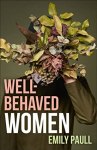
Book coverWell-behaved women is a debut collection of short stories by Western Australian writer Emily Paull. It is one of those collections that has a unique title, and what a perfect – and teasing – title it is for a collection of stories focused on women.
It has, you won’t be surprised to hear, the usual mothers, grandmothers, sisters and wives, but there are also teachers and students, writers, a step-father and step-daughter, and a vagrant woman. They span all ages. Most of the stories are told first person, with a few third person ones, and in nearly all the narrator or protagonist is, of course, female.

The collection starts with a bang, with a story described on the back page, so I’m not spoiling it, as “a world champion free-diver disappears during routine training” (“The sea also waits”). It’s the ideal opener because it’s about a woman who has chosen a dangerous sport because it’s – dangerous. She’s a woman whose “devil-may-care coastal ways” seem to disgust seemingly better behaved women with their painted nails and carefully tanned skin. It sets up the collection well as one likely to explore the nuances of women’s lives and the consequences of their decisions – oops, behaviour.

And so, from this first story on, Paull interrogates women’s lives from diverse angles. The stories read, mostly, like lovely little slices of life rather than as dramatic stories with twists. I like these sorts of stories, provided they ring true to life, because I’m curious about the choices people make. Paull has probably pored over these stories, honing them to the essential, but what we see is writing that looks easy. It flows well, and the stories show rather than tell, leaving readers to draw their conclusions. There’s nothing particularly inventive about the style or structure. Paull uses foreshadowing and flashbacks, traditionally, but judicially, to move her narratives along. The end result is a collection of accessible, well-crafted stories about relatable characters in, mostly, Western Australian settings.

The second story, “Miss Lovegrove”, has a young female drama student talking about her teacher. This teacher feels the need to tell her students the realities of life – “you will most likely never be on television at all during your careers, which will be short” – and she teaches our narrator a very cruel lesson. She is certainly not a well-behaved woman. Is she brutal? (Yes.) Is she bitter? (Probably.) Is she doing her young student a favour as she intimates? (We need to decide.) Fortunately, the next story, “Crying in public”, is gentler. It’s about the first real heart-break and a grandmother’s wisdom. Unlike “Miss Lovegrove”, Grandma wants to nurture her charge through the pain of the real world. This idea neatly links the two stories. There is, in fact, careful crafting in the order of the stories, with subtle links connecting one story to the next. I enjoyed identifying what I thought were the links!

Anyhow, other stories tell of friends found and lost, of coming out, of grief. In some, the stories could be any of us – an old high school flame returning to see if she can recover a past love (“Down south”), a sister grieving over her terminally ill sister (“Sister, madly, deeply”), a young woman discombobulated by her grandparents’ death (“Nana’s house”), a woman trying to fit the the image of the perfect wife (“The settlement”). But some are a little more dramatic, such as that about a woman whose backyard is found to hold a human skeleton (“From under the ground”), or the warm-hearted story about a vagrant woman caught in a bushfire (“The things we rescued”), or the tragic coming out story (“Picnic at Green’s Pool”).

What I most liked about the stories – even those that were more dramatic in flavour – is that the people are believable. Their emotions and reactions, in the main, are those of “normal”, flawed human beings. They make mistakes, like the young woman who leads on a colleague she’s not really interested in (“Nana’s house). They eat too much or too little, in a struggle to be themselves (“Dora”). And so on. You could see this as a feminist book. The title certainly suggests there’s an element of this in Paull’s thinking – but the book is not stridently so. The title is more wry, than barbed.

While most of the stories are average short story length, one, “Font de Gracia”, is a little longer. Its premise is a rather typical teacher-student affair, but it is well handled and resolved, without didacticism. It has some lovely writing, such as this description of mother-daughter tension:

Joana snatched up her bag without breaking eye contact with her mother. Their anger was like the pull between magnets.

It’s hard to pick favourites, but I did like the last two. “Versions of herself” is about a prickly 90-year-old in a retirement village – no, not in aged care or a nursing home, but independently living in a retirement village. It’s one of the broken-heart stories. Shirley Carruthers is not the most likeable woman around, but Paull, as she does with all her characters, encourages us to see and feel beneath the surface, to understand the whys. The point for me is that we don’t have to like everyone, but we can be kind.

The final story, “The woman at the Writers Festival”, concludes the collection beautifully, with a cheeky exploration of the writing life – particularly its challenges for women – and it does have a twist.

Well-behaved women, then, is a tight, engaging collection of stories about ordinary women, and the messiness of life. Rather than offer answers, it challenges readers to think about these messes, and consider what could be done to tidy them up a bit – next time around. Another good read from the people at Margaret River Press.

Challenge logoEmily Paull
Well-behaved women
Withcliffe: Margaret River Press, 2019
242pp.
ISBN: 9780648652113

(Review copy courtesy Margaret River Press)

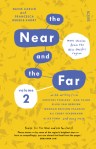
David Carlin and Francesca Rendle-Short (eds), The near and the far: More stories from the Asia-Pacific region, Vol. 2 (#BookReview)

Book cover

This anthology, like the first The near and the far volume, stems from a project called WrICE (Writers Immersion and Cultural Exchange), an intercultural and intergenerational program which “brings together Australian and Asia-Pacific writers for face-to-face collaborative residencies in Asia and Australia”. The most recent residencies have been in Indonesia (2018), The Philippines (2017) and China (2016). The editors write in their Introduction to this volume that these residencies provide a safe space in which writers come to trust “in a way that is powerful and unusual, that their bumbling work-in-progress and their wild hopes will be met with kindness.” This is probably why, as Maxine Beneba Clarke describes in her Forward, “the writing in this book veritably sings: it is a cacophony of poetry, essay-writing, fiction and nonfiction”.

This volume is structured similarly to the first, starting with the foreword and introduction, and concluding with some notes on WrICE and a list of contributors with mini-bios at the back. There is also, in this one, a conversation between the two editors. The works are again organised into three sections, this volume’s being Rites of passage, Connecting flights, and Homeward bound. For some reason, I enjoyed more of the pieces in first and third sections, than the second. There are 27 stories, with a little over half being by women; three are translated. As in the first volume, each piece is followed by a reflection by the author – on the writing process, their goals and/or their experience of WrICE.

To tame words with ideas (Nhã Thuyên)

Now the stories. Given the project, the writers are of course a diverse group, coming from Australia (including two First Nations writers), Vietnam, Indonesia, the Philippines, and elsewhere. I knew the Australians – Ali Cobby Eckermann, Alice Pung, Christos Tsiolkas, Ellen Van Neeerven – but most were new to me, which feels embarrassing, really.

I’m not sure I could ascertain a strong theme running through this collection as I did last time, but there is an overall sense of writers trying “to tame words with ideas” (“Utterances, by Nhã Thuyên, tr. by Nguyên-Hoàng Quyên), of trying to find the right words to articulate their ideas across diverse cultural spaces. I like this image of taming words with ideas. It suggests to me many things, including that words are hard to pin down, and that ideas/emotions/passions are hard to communicate in words. It is certainly something that you feel the writers working at in this book, some of them consciously, overtly, sharing their struggles with us.

I particularly liked the first section “Rites of passage”, with its pieces about, essentially, identity, though the subject matter includes issues like aging, coming out, postnatal depression, father-son relationships. Christos Tsiolkas in “Birthdays” writes of a gay man, grieving after the break-up of a longterm relationship, and facing aging alone. Told third-person, but with an immediacy that has you identifying with the narrator’s unhappy restlessness, his questioning of who he is, and where he is going, makes a perfect, accessible first piece for the anthology.

In “Eulogy for a career”, Asian Australian, Andy Butler explores the challenges of identity in white Australia, of finding his place, particularly as a young Asian-looking boy wanting to ballroom dance! He cynically notes that, after years of ostracism, he is suddenly, in this new pro-diverse world, being offered opportunities. “Progressive white people,” he writes, “can’t get enough of us”. But, he knows and we know how fragile this foundation is likely to be. First Nations writer Ellen van Neerven closes out this section with small suite of poems, “Questions of travel”, riffing on Michelle de Kretser’s novel of the same name. “When we travel”, she writes, “we walk with a cultural limp.” Our identities can be fluid or feral or freer – when we travel – but there are no easy answers to living and being.

In the second section, “Connecting flights”, the pieces are loosely linked by explorations of place and self. Mia Wotherspoon’s Iceland-set short story, “The blizzard”, exposes the moral and ethical complexities of contemporary political activism, while Steven Winduo’s “A piece of paradise” crosses continents, with characters from Papua New Guinea, Australia and the US pondering the possibility of intercultural relationships. Han Yujoo’s “Private barking” is one of the pieces that overtly addresses that challenge of taming words. “Sometimes we need a knife to write. (Or teeth)”, says Korean Yujoo, trying to write with her “little English”.

First Nations author, Ali Cobby Eckermann opens the last set with “Homeward bound”, a home-grounded poem set in a cave where self finds home in place, but knows it’s not secure. Else Fitzgerald’s  “Slippage” is a cli-fi short story, in which grief for the environment is paralleled by grief for a lost love. The very next story Lavanya Shanbhogue Arvind’s “A long leave of absence” is also about a lost love, this one due to a father’s forbidding the marriage, resulting in the narrator turning to alcohol. For each of these writers, home is fraught.

There are several pieces in this section that I’d love to share, but the one I must is deaf writer Fiona Murphy’s “Scripta Continua”. I must share it because it reiterates much of what Jessica White writes about in Hearing Maud (my review). This five-part piece takes us from the idea of “conversations”, which Murphy often feels like she is “peering into, rather than partaking in”, through the “spaces” (and silences) deaf people frequently inhabit, the fatiguing “attention” so necessary for communication, and the “writing” that helped her start to understand herself better, to “Auslan”, the sign language system that brings new, less fatiguing, ways of conversing and inhabiting space!

The final piece, “Wherever you are” by Joshua Ip, is a real treat. A long poem comprising 28 quatrains, it consistently flashed my memory with phrases and ideas that sounded familiar. Well, of course they did, because, as he explains in his closing reflection, “Each quatrain is a response to each writer’s gift, in sequence”! So 27 pieces, 27 quatrains in response, with a concluding one of his own. How clever, and what respectful fun many of them are. “Words span and spin the globe”, he writes. If you are interested in such words – touching, probing, confronting ones – I recommend this book.

Challenge logo

David Carlin and Francesca Rendle-Short (eds),
The near and the far: More stories from the Asia-Pacific region, Vol. 2
Melbourne: Scribe, 2019
295pp.
ISBN: 9781925849264

(Review copy courtesy Scribe)

Amanda O’Callaghan, This taste for silence (#BookReview)

Book coverShort story collections are rarely recognised in literary fiction awards, but Amanda O’Callaghan’s debut collection, This taste for silence, was shortlisted for this year’s Readings Prize for New Australian Fiction. The judges described it as “inventive in its themes and by an author unafraid to enfold her readers into unsettling reading experiences”. I would agree. This taste for silence is full of unusual turns that force us to see an issue or event from a different – and often unsettling – angle.
In an interview conducted by Readings, O’Callaghan says:

I certainly did not write these stories with any theme in mind, although once I saw the whole manuscript it was clear that themes were emerging all on their own. It soon became apparent that I liked writing about people with secrets. Your description of “unspoken histories” is perhaps closer to the mark; I do like thinking and writing about characters who, for a variety of reasons, cannot articulate how they feel, or what’s happened to them. Or what they’ve done.

As a result, this collection has been given an over-riding title – which I rather like – rather than being  titled for one of the stories contained within. Like O’Callaghan’s interviewer above, I too would have said that the book is more about unsaid things than about secrets, though of course, the former often implies or results in the latter. Some of these unsaid things may be deliberately so – or deliberately withheld for a time – while others are things, as O’Callaghan says above, that people can’t easily articulate.

So, to describe the book. It contains twenty-one stories, ranging  from flash or micro fiction pieces to the last and longest story, “The painting”, which runs for 40 pages. Fifteen of the stories have been published before, many through flash fiction competitions. Two of the longer stories were published in the (sadly) now-defunct Review of Australian Fiction. One of these is the opening story, “A widow’s snow”. It provides a perfect introduction to the collection because not only does it introduce the reader to the main ideas O’Callaghan explores in the collection, but it also exemplifies her skilled command over narrative. By this I mean the way she can string the reader along with little hints about what is really happening without ever letting our focus drift away from character to plot. Plot is not the important thing for O’Callaghan. Rather, it’s how, as Eddie ponders in “The painting”, characters cope with the “endings of things”.

Endings, then, are a thread in this collection, and, let’s not be coy about it, by “endings” I mean death, because most of the stories deal with death in some way. Murder, suicide, euthanasia, drowning, miscarriage, war deaths – along with the more usual deaths from illness – occur. Most of these deaths, though, don’t occur in the actual story. Two deaths, for example, are referred to in “A widow’s snow”, but both have happened before the story commences. The story starts lightly enough:

Roger, Maureen decided, is the kind of man who would appreciate an old-fashioned pudding. She flicked through the best of her recipe books, toyed with ideas like apple tart with a rich pastry crust – Gerald’s favourite, so not really an option – and all manner of sponges, even soufflés. She braved the mole-eyed newsagent (twice divorced, blinking at the door for a new, early-rising wife) and bought a couple of cookery magazines.

What an assured start to a story – and to a collection. There’s the humour, the hints about Roger’s character and Maureen’s hopes, and the straight but evocative language. The domestic details in the unfolding of this surprisingly shocking story are on point, skewering character and nailing the tone perfectly. In this story, it’s Roger who has the secret and Maureen who must decide how she’s going to cope with it. After this story, we know to be prepared for anything, and yet, I was still surprised, more than once, as I read on.

“A widow’s story”, told third person, is one of the longer pieces. It’s followed by a flash fiction piece, “Un uncommon occurrence”, which won the Allingham Flash Fiction Competition in 2015. (You can read it on their site.) This story is told second person and is, ironically, about what women are so often told is a “common” happening. You can probably guess what this is. The third story, “The turn”, is also told second person. It won the Carmel Bird Award for New Crime Writing, also in 2015. This is quite a macabre story, one that unsettles the reader by encouraging us to engage with the narrator until we get to the point where have to accept that we’ve been taken in … and yet, even then, we are forced to think around all the corners.

And so the stories continue, introducing us to a wide cast of people, young and old, male and female, some of them confronted with the ordinary, and others with the extraordinary. One of the impressive things about this collection, in fact, is the variety of characters and situations O’Callaghan presents to explore these gaps and silences. One of the stories I loved – which I won’t name so it won’t be spoiled if you read it – is told in the voice of a hoarder. As in most of the stories, its narrator’s true situation is only slowly revealed, in this case because she knows her behaviour is not socially acceptable. Once again, we are encouraged to see her from multiple angles rather than from the more usual, and simplistic, judgemental one.

The interesting question hanging over most of the collection’s characters is when or whether to speak the unspoken. Roger, in the first story, seems to decide that if there’s going to be a future in his burgeoning relationship with the titular widow, he needs to come clean. Other narrators, most of them first person, can’t help but let their story out, sometimes in a confessional tone, sometimes to relieve or share their pain. The practical, can-do Justin in “Legacy”, for example, is permanently scarred by his good deed, pondering “who would have thought practicality could be such a deadly characteristic?” The underlying point to the collection, then, is that unsaid things are tricky – left unsaid they can burn you up or lock you out from others, but, sometimes, saying them can have the same result.

So This taste for silence is a compelling but provocative book that forces us to confront the silences in our lives, to consider them from multiple perspectives and ask whether they work for ill or good. Our hoarder, for example, thinks the latter. Her story ends with her returning to her silent ways: “The house feels glad again, released. It hums with the joy of things ending”. Is it reasonable for us to disagree, much as we might like to? I suggest you read the book to see what you think.

AWW Challenge 2019 BadgeAmanda O’Callaghan
This taste for silence
St Lucia: UQP, 2019
197pp.
ISBN: 9780702260377

(Review copy courtesy UQP)

Lafcadio Hearn, Yuki-Onna (#Review)

I can’t believe how long it’s been since I’ve posted on a Library of America (LOA) Story of the Week. I usually “do” a few a year, but this is the first for 2019, even though I’ve identified several that I’ve wanted to do. However, when Lafcadio Hearn popped up last week – and with a Japanese story – I knew I really had to break the drought.

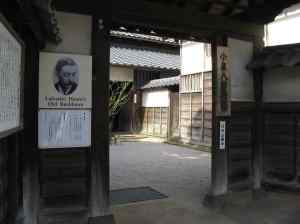
Image of Lafcadio Hearn's houseLafcadio Hearn (1850-1904) has appeared in this blog a couple of times before, the main time being in a Literary Road post from our 2011 trip to Japan when we visited Matsue. Hearn only lived there briefly but he met his Japanese wife there and it has a museum dedicated to him. Hearn is a fascinating man. Greek-born to a Greek mother and Irish father, he spent childhood years in Ireland before moving to the USA in 1869, where he then lived for two decades. Here he married a former slave who worked in his boardinghouse kitchen, and built his career as a journalist. In 1890 he went to Japan on a publisher’s commission. He married again, and lived out the rest of his life here, taking the name of Koizumi Yakumo. He became chair of English Language and Literature at the Tokyo Imperial University.

In their usual introduction, the Library of America quotes an article by another writer who appeared here only recently, Roger Pulvers. The article, in Japan Times, is titled “Lafcadio Hearn: ‘Japanese thru and tru'”. Pulvers provides a thoughtful, clear-eyed run-down of Hearn’s life, of his attitude to Japan, and particularly of his achievements as a writer. He says that Hearn:

was the shadow-maker, the illusionist who conjured up his own visions of Japan and gladly lost himself in them. He strove to leave Japan and return to the United States. Perhaps he realized that it was there that he had created his most accomplished work, attaining something he savored: notoriety. Again an ironical paradox emerges: He is remembered now in United States, if at all, not for his superb reportage on modern America but for his adoration of a long-gone Japan.

Pulvers says that Hearn loved “old” Japan –

He worshipped the static and wanted to see his beloved quaint Japan remain as sweet as it always was in his eye and the eyes of the world, bemoaning all progress: “What, what can come out of all this artificial fluidity!”

– but

loathed the modern Japanese male and what he stood for, and in this he recognized the futility of his task, a futility keenly felt toward the end of his years, where he heard “nothing but soldiers and the noise of bugles”.

Remember, when he died in 1904, Japan’s imperialism was at its height.

Hearn published roughly a book a year for the fourteen years he lived in Japan, but is best known for two of them, Kwaidan: Stories and studies of strange things (from which this post’s story comes) and Japan: An attempt at interpretation. Kwaidan comprises a number of ghost stories plus a non-fiction study of insects. Intriguing, eh?

Yuki-Onna, says the Library of America, means “snow woman”, and is “an ancient spirit who appears often in Japanese fiction, plays, and movies”. Hearn explains in the Introduction to Kwaidan that he’d heard this story from a farmer as a legend from his village. He says that he doesn’t know “whether it has ever been written in Japanese” but that “the extraordinary belief which it records used certainly to exist in most parts of Japan, and in many curious forms.” Wikipedia confirms in an article about this spirit that it dates back to the 14th to 16th centuries, and can be found in many Japanese prefectures including Aomori, Yamagata, Iwate, Fukushima, Niigata, Nagano, Wakayama, Ehime. If you know your Japan, you’ll know that these take us from northern Honshu down through the island and across to Shikoku.

The story is pretty simple, plot-wise, and given it’s just 4 pages long I’m not going to describe it here, except to say that it is about a vengeful snow spirit. Why she is vengeful is not made clear in Hearn’s story, but Wikipedia says that some legends believe she is the spirit of someone who perished in the snow. The legends vary over place and time, particularly in terms of how evil or aggressive she is.

I suggest you read it at the link below, as it will only take a few minutes. Meanwhile, I’m glad to have had this opportunity to remind myself of this intriguing 19th century character. Next, I’d love to read some of those American articles of his that Pulvers praises.

Lafcadio Hearn
“Yuki-Onna”
First published: Kwaidan: Stories and studies of strange things, 1904.
Available: Online at the Library of America

Anton Chekhov, The lady with the little dog (#Review)

Penguin collection, translated by Wilks, book cover

“The lady and with the little dog” was an out-of-left-field recommendation for my reading group for two reasons. One is that it is a single short story – not even a whole collection which we have done before. And the other is that the member who recommended it did so on the basis of its being referred to a few times in Sebastian Smee’s recent Quarterly Essay (72), Net loss: The inner life in the digital age, which I’ll review next, hopefully.

So, what to read? We were as a group challenged, albeit was a good challenge. First, “the lady and the little dog” has appeared in many Chekhov collections over the years, accompanied by different selections of stories (though of course some individual ones do recur more than others.) Second, the story has been translated by many translators, including Constance Garnett, Ivy Low Litvinov, collaborators Richard Pevear and Larissa Volokhonsky, and Ronald Wilks. So, do we read all or some of the other stories in the collections we variously acquired (or try, even, to suggest we all read the same collection? That wasn’t going to happen! Particularly given availability challenges.) Or, do we just read the story plus the work that inspired its recommendation? (But what about the fact that there was a mix-up not resolved until late in the month about what exactly was that work!) In the end, our being a disciplined but not controlling group, we all chose our own paths, which made for an interesting meeting.

Penguin collection, translated by Garnett, book cover

Now, I have to admit that at the end of my first reading of the story – this story that is the lead story in so many collections and so must be well-regarded – I was a little underwhelmed, though why is hard to explain. After all, much as I love Guy de Maupassant’s short stories with their dramatic twists, I also love quiet stories about character, which is more Chekhov’s style. I think the issue was that I read it too fast, too distractedly, because when I reread it, Chekhov’s skill started to shine through. Chekhov, by the way, is seen as marking the transition between the mid- to late-nineteenth century realism of de Maupassant and the modernism of early twentieth century Joyce.

The story concerns an adulterous affair between 40-year-old Gurov and the much younger Anna, who meet while holidaying in Yalta without their respective, unsatisfactory spouses. Gurov’s arranged marriage was to a woman whom he considered “not very bright, narrow-minded and unrefined” and who “makes love insincerely”, while Anna sees her husband as “no more than a lackey” or “flunky” (depending on your translation!) She wants “to live life to the full”. Gurov initially sees his seduction of and relationship with Anna as “just another adventure”, not expecting to care when she returns home to St Petersburg. But, after he returns to Moscow, he realises that he’s been touched by her. Life has become meaningless:

Those pointless business affairs and perpetual conversations – always on the same theme – were commandeering the best part of his time, his best strength, so that in the end there remained only a limited, humdrum life, just trivial nonsense.

Penguin collection, translated by Pevear and Voslonsky, book cover

Consequently, he seeks out Anna, and finds that she too was unhappy, and so their affair resumes.

As the affair progresses, Gurov makes a distinction between his inner and outer lives (which is what Smee references in his essay). Gurov thinks:

He was leading a double life: one was undisguised, plain for all to see and known to everyone who needed to know, full of conventional truths and conventional deception, identical to the lives of his friends and acquaintances; and another which went on in secret. And by some strange, possibly fortuitous chain of circumstances, everything that was important, interesting and necessary for him, where he behaved sincerely and did not deceive himself and which was the very essence of his life – that was conducted in complete secrecy; whereas all that was false about him, the front behind which he hid in order to conceal the truth– for instance, his work at the bank, those quarrels at the club, his notions of an ‘inferior breed’, his attending anniversary celebrations with his wife – that was plain for all to see. …

What I noticed more on my second read through was Gurov’s personal growth. In the beginning, he is bored, misogynistic, and selfish. He found men boring, and preferred female company, and yet “he always spoke disparagingly of women and whenever they were discussed in his company he would call them an ‘inferior breed’”. Moreover,

Repeated – and in fact bitter – experience had long taught him that every affair, which at first adds spice and variety to life and seems such a charming, light-hearted adventure, inevitably develops into an enormous, extraordinarily complex problem with respectable people – especially Muscovites, who are so hesitant, so inhibited – until finally the whole situation becomes a real nightmare.

Penguin collection, translated by Slater, book cover

Then Anna appears, and this self-centred man is suddenly possessed by “those stories of easy conquests … and the alluring thought of a swift, fleeting affair, of a romance with a strange woman whose name he didn’t even know.”

By the end, though, not only has he realised that he had “genuinely, truly fallen in love – for the first time in his life”, but that he had come to a new understanding of himself:

Anna Sergeyevna and he loved one another as close intimates, as man and wife, as very dear friends. They thought that fate itself had intended them for each another, and it was a mystery why he should have a wife and she a husband. And in fact, they were like two birds of passage, male and female, caught and forced to live in separate cages. They forgave one another all they had been ashamed of in the past, forgave everything in the present, and they felt that this love of theirs had transformed them both.

There is, however, no easy conclusion – no clever twist, no clear ending, happy or tragic.

And so, of course, as I should have realised on the first read, “The lady with the dog” (or “with the little dog” or “the lap dog” or “the pet dog”, depending on your translation) is a tight, moving, ironic story about a man who, like many of Jane Austen’s best characters in fact, discovers the errors of his attitudes, and is transformed by the knowledge.

Anton Chekhov
“The lady with the little dog”
in The lady with the little dog and other stories
(trans. Ronald Wilks)
London: Penguin Books, 2002)
(“The lady with the little dog”, first pub. 1899)
ISBN (eBook): 9780141906850

Avalailable online at Adelaide University’s etext site.

Chris Womersley, A lovely and terrible thing (#BookReview)

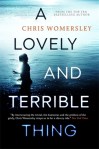
Book coverDescribed as “twenty macabre and deliciously enjoyable stories for readers of Fiona McFarlane and Lauren Groff”, Chris Womersley’s newest book – his debut collection of short stories – wasn’t necessarily a natural fit for me. I haven’t read Lauren Groff, but I have read and really liked Fiona McFarlane’s clever, memorable, The night guest (my review). However, the macabre is not something I naturally gravitate to. Still, I did like The great unknown (my review), edited by Angela Meyer, and I have been wanting to read Chris Womersley for some time, so I decided to put aside my reservations and give it a shot. I’m glad I did, because although there certainly is an element of the macabre here, the stories aren’t all so macabre that I felt the need to strap in for a shivery ride as the promos were also suggesting. This is not meant to put off those who like shivery rides, but to encourage those who don’t. It’s meant to say, in other words, that there’s something for most readers here.

The stories, in other words, do offer some variety. Most are told in first person male voices, but these voices range from children to teens to grown men, from sons and fathers, to brothers and friends, to husbands. There’s a hunchback, a junkie or two – and three stories use female voices. Despite this variety, however, there is an overall similarity in tone – somewhat melancholic, somewhat reflective. Many, in fact, are stories about something that happened in the past so they have that tone of – hmm, regret, or, if not that, of an uneasiness that has carried through to the present. Or sometimes, it’s just resignation. If you like nostalgia, this is not for you, as the first story makes clear:

My God, those suburban evenings, so full of hope and all its little victims. (“Headful of bees”)

So, what are they about? Fundamentally, and not surprisingly, they are about relationships – families, friends, neighbours, strangers, and, particularly, fathers and sons. Many relationships are under some sort of internal or external stress, or are unusual in some way. Most of these stories can be simply weird and, in some cases, even hopeful. But in other relationships, there’s power at play, and it is more often in these that the macabre, if not downright horror, ensues. In some stories, then, like the opening “Headful of bees”, a young person is mystified by the behaviour of an adult neighbour, while in others, such as the second one, “The house of special purpose”, a well-intentioned or naive person is cruelly taken advantage of by those who wield power.

The stories have been ordered in a way that manages our emotions. The truly macabre stories are interspersed with others, which reduces tension a little but also keeps us guessing. Will this story, we wonder, disturb and unnerve, or simply sadden us? There are a few truly shocking stories, and they include my favourites. Naming them, however, would spoil their impact. As one character, not from one of these stories, says:

You think you know people, but they always have something hidden away. It’s an awful lesson, corrosive … (“The age of terror”)

Fortunately, the collection ends on a story that, while containing tragedy, also offers hope about humanity. It’s not a happy story, but neither is it a complete downer, so we close the book feeling at least a little reassured that our journey has not been completely in vain.

Of course, there’s more to enjoying this book than the variety in and challenge of its stories. There’s also the writing. Womersley’s plotting and language is exquisite. I enjoyed his wordplays, and his use of metaphor. In “The middle of nowhere”, the drug-addicted protagonists are both literally and spiritually lost, and in “Growing pain”, a young adolescent girl’s grief and sense of alienation is manifested in a strange, physical way. Water features in many of the stories, as is signalled by the epigram from Moby Dick which ends with “as everybody knows meditation and water are wedded forever”. However, as everyone also knows, water is a paradoxical element – “another dimension, a netherworld” – that can both give and take. And so it is in these stories. Some of the most gruesome of them have water (or a place of water) at their core.

I said above that the stories are about relationships, which they are, but of course these relationships are explored through stories that deal with the things that confront us as humans. There are grieving parents and children, and people with regrets and failed aspirations. There are dreamers, junkies and mentally ill people. There’s birth and death, there’s deep love and desire for true connection, but there’s also revenge, child abuse and cruelty. Many of the stories explore, in some way, “the chasm that exists in all of us – between who we imagine ourselves to be and the person we truly are” (“The mare’s nest”). A character in “Dark the water, so deep the night” tells the young protagonist that “We tell stories to impose order upon the world, to give things meaning. To give us hope.” If there’s one thing we learn here, it’s that stories, on their own, can’t impose order. More often, they illuminate the chaos!

Of course, I didn’t love them all equally, and there is, as I’ve already said, some sameness to them. The tone is similar, and many are told by a narrator remembering the past. Also, many of the protagonists are young people trying to comprehend the adults around them, though there are older protagonists, including a 79-year-old woman in “The age of terror”.

However, I didn’t find one of them boring. This is not surprising because, although A lovely and terrible thing is Womersley’s first collection, he has been writing short stories for a long time. Sixteen of the twenty here, in fact, have been published before, from 2006 on, in some of the best literary magazines around, including Granta, Meanjin, The Griffith Review. Not a bad record, eh? The stories are, to be a little corny, lovely and terrible things. They take us, as another title in the collection suggests, to “the very edge of things”. What I like about them is that they do this with such control that, even when they push us to the limit, they feel true. Highly recommended.

Chris Womersley
A lovely and terrible thing: Short story collection
Sydney: Picador, 2019
270pp.
ISBN:

(Review copy courtesy Pan Macmillan Australia)

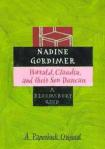
Nadine Gordimer, Harald, Claudia, and their son Duncan (#BookReview)

There are authors I read long before blogging whom I really want to document here, in some way. One of these is Nobel Laureate Nadine Gordimer who first came to my attention in 1983 with her memorable, confronting 1956 short story collection, Six feet of the country.

Nadine Gordimer, as I’m sure you know, had a lifelong concern for economic and racial inequality and injustice in South Africa, and this is evident in her short story, Harald, Claudia, and their son Duncan. The story is told third person through the perspectives of a mother and father, the titular Claudia and Harald. Early in the story, they are visited by Julian, their 30-year-old son Duncan’s friend. They assume there’s been an accident, but

This Julian draws the flaps of his lips in over his teeth and clamps his mouth before he speaks.

A kind of … Not Duncan, no, no! Someone’s been shot. Duncan, he’s been arrested.

This description of Julian is so typical of Gordimer in the way, in a few words, she conveys something grotesque, something that feels more than the bringing of bad news, even before we know why he is there.

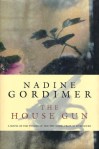
Book coverHowever, this 1996 story is particularly intriguing because it seems to be related to her 1997 novel The house gun. As far as I can tell, the first third of the story I read is very close to the first chapter of that book, but after that I don’t know. I do know that the details of the crime seem a little different in “my” story (but it may just be that they are not fully revealed). Also the novel’s Duncan is 27, while the story’s Duncan is 30. So, did Gordimer write the short story and then decide to flesh it out into a novel? I don’t know, but here is what Wikipedia says about The house gun, which was her second post-apartheid novel:

It follows the story of a couple, Claudia and Harald Lingard, dealing with their son Duncan’s murder of one of his housemates. The novel treats the rising crime rate in South Africa and the guns that virtually all households have, as well as the legacy of South African apartheid and the couple’s concerns about their son’s lawyer, who is black.

While the short story doesn’t emphasise all this, there is a reference to people having guns for protection, and there’s the sense that we are dealing with the post-apartheid world.

Anyhow, back to the story. What I love, as I’ve already intimated, is how Gordimer creates tone. Here’s our couple on hearing that the crime for which Duncan has been arrested is murder:

He/she. He strides over and switches off the television. And expels a violent breath. So long as nobody moved, nobody uttered, the word and the act within the word could not enter here. Now with the touch of a switch and the gush of breath a new calendar is opened. The old Gregorian cannot register this day. It does not exist in that means of measure.

What a wonderfully fresh way of conveying the sense of discombobulation, of unreality, that results when the world seems to change in an instant.

From here – it’s a Friday – we follow Harald and Claudia through to their son’s arraignment on Monday, and into the hours immediately after, at which point the story ends, fairly suddenly.

One of the themes, in the story anyhow, concerns the idea that no matter how much you try to lock yourself away from the “outside”, you can’t keep it from coming in. This has a political as well as a personal reading. The story starts by telling us that Harald and Claudia had recently moved from a house to a “town-house complex with grounds maintained and security-monitored entrance”. Later in the story, Claudia, a doctor, does her shift at the clinic which services “areas of the city and once genteel suburbs of Johannesburg where now there was an influx, a rise in and variety of the population.” During this shift, she considers the pain that it is her job to assuage – the pain that comes from inside, like a tumour, and that which comes from the outside, like being burnt or, yes, hit by a bullet. She reflects:

The pain that is the by-product of the body itself, its malfunction, is part of the self; somewhere, a mystery medical science cannot explain, the self is responsible. But this – the bullet in the head: the pure assault of pain.

This is surely a metaphor for that fear of the “outside” by the well-to-dos who choose to live in security-monitored complexes. What’s inside, the implication is, cannot be necessarily controlled but it’s part of your own world; what’s outside is to be feared. In this section of the story, there are references to socioeconomic differences. Claudia gives out diet sheets, for example, to people, mostly black, who, she knows, are “too poor for the luxury of these remedies”.

It is, then, just the sort of story I like to read. The careful word choice, the slightly odd syntax, plus things like the references to class and race, combine to convey something that is more than a simple murder plot involving a son and his devastated parents. As the narrator slyly says:

This is not a detective story. Harald has to understand that the mode of events that genre represents is actuality, this is the sequence of circumstantial evidence and interpretation by which a charge of murder is arrived.

Circumstantial evidence and interpretation. The stuff of complex lives in complex times, eh? I’d like to read the novel now.

Nadine Gordimer
Harald, Claudia, and their son Duncan
London: Bloomsbury Publishing, 1996
(A Bloomsbury Quid)
41pp.
9780747528913

Rudyard Kipling, The Janeites (#Commentary)

The topic for my local Jane Austen group’s March meeting was “Jane Austen in the trenches” which, I realise, sounds a bit anachronistic, given she died in 1817, nearly a century before the trenches we’re talking about. But, you see, Jane’s fame didn’t start in 1995 with Colin Firth and that wet shirt. No, her popularity took off around the late 19th century and has continued ever since, albeit with a huge spurt in the late 20th century. As Claire Harman states in Jane’s fame, she is the only writer “who is instantly recognisable by her first name”.

Rudyard Kipling

Kipling (Presumed Public Domain, via Wikipedia)

Anyhow, into the trenches. Our discussion was inspired by Rudyard Kipling’s short story “The Janeites”, first published in 1924. It’s a little tricky to read, being peppered with Cockney voices, but it’s worth the effort – and not just for Janeites. It is set in a London Masonic Lodge in 1920, during a weekly clean-up of the premises. There are three main characters – Brother Anthony, a veteran of army service in the Holy Land during World War I, now a taxi driver; Brother Humberstall, a hairdresser who is a veteran of artillery service in France and who suffers somewhat from shell-shock (now, PTSD); and the first-person narrator, ostensibly Kipling. Humberstall tells the others of his induction, during the war, into a secret society, the Janeites. He explains how he came to join this society, which included members from all ranks, and the tests he had to pass to do so. He tells how this society kept them sane during the war, and how it, in fact, saved him, when, after a terrible attack, he was his group’s only survivor:

… I walked a bit, an’ there was a hospital-train fillin’ up, an’ one of the Sisters—a grey-headed one—ran at me wavin’ ’er red ’ands an’ sayin’ there wasn’t room for a louse in it. I was past carin’. But she went on talkin’ and talkin’ about the war, an’ her pa in Ladbroke Grove, an’ ’ow strange for ’er at ’er time of life to be doin’ this work with a lot o’ men, an’ next war, ’ow the nurses ’ud ’ave to wear khaki breeches on account o’ the mud, like the Land Girls; an’ that reminded ’er, she’d boil me an egg if she could lay ’ands on one, for she’d run a chicken-farm once. You never ’eard anythin’ like it—outside o’ Jane. It set me off laughin’ again. Then a woman with a nose an’ teeth on ’er, marched up. “What’s all this?” she says. “What do you want?” “Nothing,” I says, “only make Miss Bates, there, stop talkin’ or I’ll die.” “Miss Bates?” she says. “What in ’Eaven’s name makes you call ’er that?” “Because she is,” I says. “D’you know what you’re sayin’?” she says, an’ slings her bony arm round me to get me off the ground. “’Course I do,” I says, “an’ if you knew Jane you’d know too.” “That’s enough,” says she. “You’re comin’ on this train if I have to kill a Brigadier for you,” an’ she an’ an ord’ly fair hove me into the train, on to a stretcher close to the cookers. That beef-tea went down well! Then she shook ’ands with me an’ said I’d hit off Sister Molyneux in one, an’ then she pinched me an extra blanket. It was ’er own ’ospital pretty much. I expect she was the Lady Catherine de Bourgh of the area.

Of course, you have to know your Jane Austen to get the Miss Bates reference … !

Jane Austen by sister Cassandra

Throughout the story Austen is only ever described as Jane, which bears out Harman’s comment above. There’s an entertaining description of Austen’s subject matter –

’Twasn’t as if there was anythin’ to ’em, either. I know. I had to read ’em. They weren’t adventurous, nor smutty, nor what you’d call even interestin’

– and some amusing references to various Austen characters, particularly Reverend Collins, Lady Catherine de Bugg (de Bourgh), General Tilney and Miss Bates. There’s also a comment that Austen did “leave lawful issue in the shape o’ one son”, and that was Henry James. Fair enough. At one stage, Humberstall chalks their guns with the names of Austen characters. His Janeite superiors approve, though there is some discussion about whether he’d accorded the right name to the right gun. For example:

… they said I was wrong about General Tilney. ’Cordin’ to them, our Navy twelve-inch ought to ’ave been christened Miss Bates …

Of course, much has been written about this story, including its secret society setting, the Masons, and Kipling’s intentions about that – but these other issues are not my focus here.

What is of interest is Humberstall’s statement late in the story:

“… You take it from me, Brethren, there’s no one to touch Jane when you’re in a tight place. …”

It is this that inspired our meeting because, while Kipling’s story is fiction, it is the case that Austen’s novels, among others, were provided to soldiers to read for morale. On the Kipling Society’s website is this:

In 1915, John Buchan and George Mackenzie-Brown, co-directors of Nelson, launched the highly successful Continental Library series, designed to be carried in soldiers’ pockets. Gassart [who wrote an article for the TLS in 2002] quotes the papers of W.B. Henderson, a Glaswegian schoolmaster attached to a Siege Battery in the Royal Garrison Artillery, in arguing that a book’s solace:

was its power to transport the infantryman from a world of “sergeants major and bayonet fighting, and trench digging and lorry cleaning and caterpillar greasing” into the fantasy of the novelist – and none was better at it than Jane Austen.

Her novels were also used during the war as part of therapy with shell-shock victims. Indeed, the above-mentioned Clare Harman says that three of Austen’s novels were “at the top of a graded Fever-Chart”. Academic Claire Lamont (in her paper, “Jane Austen and the nation”) suggests that this was because Austen’s “Englishness expresses itself as the standard of where and how one might live…”. Other critics have other ideas – though many of them are variations on this theme. One member of my group found a report that novels like Austen’s were used to gee-up damaged soldiers to get them back to the front! That shocked us somewhat. Bibliotherapy, it seems, is not a new thing.

Kipling, himself, was, not surprisingly, an Austen fan. As well as his story “The Janeites” (which term was coined by a critic back in the 1870s), he wrote a poem, whose final lines are used as an epigram for “The Janeites”:

Jane lies in Winchester, blessed be her shade!
Praise the Lord for making her, and her for all she made.
And while the stones of Winchester – or Milsom Street – remain,
Glory, Love, and Honour unto England’s Jane!

OK, so it’s a bit sentimental I admit, but he wrote it and that’s my excuse for using it to close today’s little commentary!

Rudyard Kipling
“The Janeites”
First published: Hearst’s International, MacLean’s, and the Story-Teller Magazine, May 1924
Available: Online at UWYO

Jennifer Down, Pulse points (Guest post by Amanda) (#BookReview)

Amanda is on a roll, reading several Aussie women writers, so when she offered me a review of Jennifer Down’s collection of short stories, Pulse points, of course I said yes. I love her opening explanation of why she loves short stories – I couldn’t have said it better myself.

Amanda’s review

Jennifer Downs, Pulse pointsI love short stories. They can be an introduction to literature, restore your faith in fiction and inspire awe in a mere few pages.  The good ones shed light on the human condition – who we are, what we do and why we do it. The great ones perceive and portray human complexity in original and vivid colours.

Pulse Points is a collection of 14 short stories by Jennifer Down, pulse points being the metaphor for emotional life changing moments. The stories are of varying quality. At best Down has a keen ear for dialogue, well-rounded characterisation and with sensitive depiction of issues. The stories are not plot driven, they do not deal with large macro political issues, no biting satire, no morphing magical realism and no laugh out loud moments. That is not a bad thing. That is just not Down’s style.

Instead the stories are focused on brief periods, sometime even moments, of the characters’ lives which are used to explore universal themes: loss, mourning, the treatment of women, rural isolation, disfranchisement and childhood neglect appear several times. These are stories about humanity.

Down utilises a traditional treatment of the short story form, the timeframe is largely linear with some flashbacks. The voices are polyphonic, switching between first and third person.

For my tastes, there were too many discordant stories and the linkage between the main title and the stories was too loose. I have been influenced by the style of Elizabeth Strout where characters in her short stories (Olive Kitteridge and Anything is possible) not only appear consistently though the novel linking one story to another but also providing an alternate prospective. Similarly, Jhumpa Lahiri (Interpreter of maladies) can write distinct, unconnected short stories but her ability to stick to an overarching theme is more disciplined.

As such Pulse points is best treated as a “pick and mix” rather than being read as a whole in one sitting.

In an interview with the Sydney Morning Herald, Down is quoted as saying “If I’m trying to bring attention to a particular moment, a point of tension or an image, you need to let it have a bit of space, to let it breathe. So, for me, having a more economical approach to language is one way of trying to achieve that.” Pulse points is populated with pared-down prose, but that is different from narrative restraint.

To that end, I prefer the stories in the collection that do not rely on melodramatic plot devices, sudden improbable violence or tragedy to propel the narrative. In some cases, the violent event jars the pacing of the story and interrupts the crescendo, distracting the reader and making one question the focus of the story (the eponymous “Pulse points” and “Vaseline”). For deft pacing and the seamless use of fictional violence (or the threat of) – George Saunders (Victory lap) and Flannery O’Connor come to mind.

Down’s strongest pieces are gentle, subtle explorations of profound themes using quotidian details and sound so authentic, they could be autobiographical:  in “Convalescence” dealing with the imbalance in a relationship, the sifting power balance and the sacrifice both partners endure. In “Pressure okay, Down manages to convey the gently mourning of the loss of a spouse who served as the conduit for an endearing father to understand his feisty adult daughter. “Turncoat” similarly explores the slow burn of mid-life crisis. Like most readers, I love recognising myself in characters, creating empathy and the sense of being understood.

She is at her best when dealing with sensitive, analytical, educated characters; less so when she tries to portray the mindless rage and violence of teenage boys in “Dogs” (the weakest piece). The narrative is too brief and too horrific to allow any three-dimensional view of the characters or their motivation.

Similarly, those stories set in Australia or dealing with Australians aboard (“Convalescence” and “Aokigaraha“) resonate more than pieces set in the US (“Vaseline” and “Eternal father”) where Down does not have the vernacular or familiarity to make the characters sound genuine. As a reader I was grappling for place names or dialogue to try to identify which country the story was taking part in to give the mind a sense of location and what to expect of the characters.

Some of her writing is wholly original, comparing the contents of a women’s handbag to the movements at the bottom of the seabed and at other times – “she dyed her hair the colour of sunshine” – her writing is more prosaic. Frequently, her stories end too abruptly, another paragraph or two even in a vignette could provide direction and closure for the reader.

A reader can tell that a lot of work has gone into crafting and refining these stories and it shows. But Down is still a very young writer and compared to more assured short story collections this falls short. This is Down’s second publication. Her first, the Magic hour is a widely acclaimed novel. I look forward to her future works.

AWW Challenge 2019 BadgeJennifer Down
Pulse points
Melbourne: Text Publishing, 2017
240pp.
ISBN: 9781925355970