Elisa Shua Dusapin, Winter in Sokcho (#BookReview)

French Korean writer Elisa Shua Dusapin’s award-winning debut novella, Winter in Sokcho, was published when she was just 22 years old. As the title conveys, it is set in Sokcho, a tourist town in the Republic of Korea near the border between the two Koreas. In fact, when the Korean peninsula was divided into two countries following World War II, Sokcho was on the Northern side, but became part of the South after the 1953 Korean War armistice 1953. I suspect Sokcho was chosen as the setting partly for its “divided” history, this being in-between, neither one thing or the other,

But, more on that later. The novel’s unnamed first person narrator is a 24-year-old French Korean woman who works in a struggling guesthouse. She seems to do everything – reception, cooking, cleaning – but with little enthusiasm. The novel opens with the arrival of an unexpected guest, the 40-something French graphic novelist, Yan Kerrand. The two are drawn to each other in some way, but, at least from Kerrand’s point-of-view, it doesn’t seem to be romantically driven. For our protagonist, the situation is a little more complex. She has a boyfriend – Jun-Oh – but it’s not a satisfactory relationship from her perspective. However, her fish-market worker mother is expecting an engagement any day. The situation is ripe for something different to happen in her life, but will it – and what, anyhow, does she want? She seems betwixt and between.

Winter in Sokcho has many of the features I like in a novella, starting with spare expressive prose, a tightly contained storyline, and a confined setting. There’s also a small cast of characters, with little or no digression into backstories. All we have is what’s happening now.

And, what is happening now is that the stranger’s appearance has affected our narrator. In the second paragraph, while registering him as a guest, she says

I felt compelled for the first time since I’d started at the guest house, to make excuses for myself. I wasn’t responsible for the run-down state of the place. I’d only been working there a month.

We then move to her visiting her mother, and another thread begins to appear, that of body image. We’ve already been told that one of the guesthouse guests is “seeking refuge from the city while she recovered from plastic surgery to her face”, and now we are introduced to our narrator’s mother’s concern about her appearance. She’s too thin, her mother says. Our narrator rejects this, but soon after, in a photograph her boyfriend has taken of her, she sees “a wasteland of ribs and shoulder blades receding into the distance … her bones sticking out” and is “surprised at how much”. When she’s with her mother, she binges on the food her mother makes, only to feel “sick” and later repelled by her “misshapen body”. There is a tension between this single mother and her daughter that pervades the novel. We sense that our narrator would like to leave Sokcho. Indeed, there’s a reference early on to the “literary world” suggesting she has aspirations in that area, but she feels she cannot leave her mother. Betwixt and between.

Throughout the novella, there’s an atmosphere of things being out of kilter or not quite right. Early on, the narrator describes Sokcho’s beach:

I loved this coastline, scarred as it was by the line of electrified barbed wire fencing along the shore.

This is not your typically loveable beach view, but she herself bears a physical scar on her thigh to which she often refers. It’s unexplained but there are hints later of self-harming. Meanwhile, later in the book, Kerrand tells her that he prefers the beaches of Normandy to those in southern France, because they are

Colder, emptier. With their own scars from the war.

And so the novella progresses, in this clipped spare prose, with a sort of wary dance going on between the narrator and Kerrand. He’s there for inspiration for the last book in his series about “a globe-trotting archaeologist … A lone figure. With a striking resemblance to the author.” She is intrigued by him. She offers to show him some local sights – the border region, with its checkpoint “No Laughing” rule, and the nearby national park, with its snowy mountains and waterfalls. She watches him, surreptitiously, as he draws by night, but always the drawings are destroyed by morning, because they are imperfect.

What does Kerrand see in her, what is he looking for? This being a first person narrative, we see it all through her eyes. She is as reliable a narrator as she can be, but like any first person narrator her viewpoint is limited by her perspective.

Winter in Sokcho does not have a simple resolution, but I’ll return to that idea of Sokcho being chosen as the setting. Its divided history mirrors our narrator who is also divided – in her French Korean heritage and her torn sense of self. Further, Sokcho is described as “always waiting”, as it seems also is our narrator, though for what, even she doesn’t really know.

How much is this a personal story and how much political? Two-thirds through, as she and Kerrand discuss their scarred beaches, she tells him (and just look at this writing):

Our beaches are still waiting for the end of the war that’s been going on for so long people have stopped believing it’s real. They build hotels, put up neon signs, but it’s all fake, we’re on a knife edge, it could all give way any moment. We’re living in limbo. In winter that never ends.

There can be no neat ending to such a story, but without spoiling anything, I’ll share something she sees in Kerrand’s final drawing:

A place, but not a place. A place taking shape in a moment of conception and then dissolving. A threshold, a passage …

Does this suggest hope, albeit tenuous – for both the narrator and her Korea? I’m reading it that way. As for the closing lines … they are glorious.

Read for Novellas in November, Week 2: Novellas in Translation.

Elisa Shua Dusapin
Winter in Sokcho
Translated from the French by Aneesa Abbas-Higgins
Melbourne: Scribe, 2021 (Orig. pub. 2016)
154pp.
ISBN: 9781922585011

(Review copy courtesy Scribe)
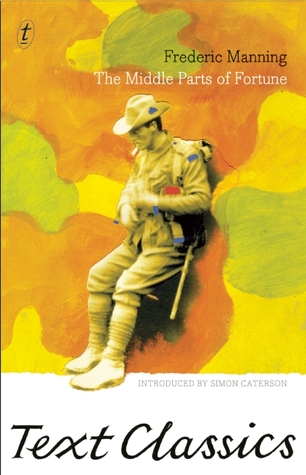
Frederic Manning, The middle parts of fortune, Ch. 1 (#Review, #1929 Club)

I had identified two novels for my 1929 read, M. Barnard Eldershaw’s A house is built and another. With Lisa also considering A house is built, I decided to go for the other. I started it, and am loving it, but I won’t finish it in time, so I thought I’d check my Australian anthologies for a 1929 offering, and found one. In the Macquarie PEN anthology of Australian literature is the first chapter of a book I’d been unaware of until I wrote my 1929 Monday Musings post this week. The book is The middle parts of fortune: Somme and Ancre, 1916, by Frederic Manning.

It particularly caught my attention because the title sounds more like a nonfiction book. So, I checked it. Yes, it is fiction, I clarified, and has an interesting history. I’ll start, though, with the author…

Frederic Manning (1882-1935) was born in Sydney. An apparently sickly child, he was educated at home, and when a teenager he formed a close friendship with Rev. Arthur Galton, who was secretary to the Governor of New South Wales. When Galton returned to England in 1898, Manning went with him, but returned to Australia in 1900. However, he returned to England in 1903 – when he was 21 – and there he remained. He produced all his writing from there, but the Australian Dictionary of Biography (linked on his name) claims him as Australian.

That’s all very well – for us to say now – but at the time of his death, according to Nicole Moore who wrote his entry in the Anthology, he was “largely unknown in Australia”. And yet, she continues, “his novel, The middle parts of fortune: Somme and Ancre, 1916 (1929) is cited around the world as one of the most significant and memorable novels of the First World War”. Indeed, she writes, it is “often grouped” with Ernest Hemingway’s Farewell to arms and Erich Remarque’s All quiet on the western front.

Manning served in the war from October 1915, first as Private (no. 19022) and later as a second lieutenant, though apparently the officer’s life did not suit him. He drank, and resigned his commission in February 1918. Wikipedia explains explains that, with increasing demand through the 1920s for writing about the war, and his having published some poems and a biography, he was encouraged to write a novel about his wartime experiences – and so The middle parts of fortune was born.

The story does not end here, however. The first edition was published privately and anonymously, under subscription, says Moore. Soon after, in 1930, an expurgated edition was published under the title Her privates we, with the author now identified as Private 19022. This version, Moore says, “removed the soldiers’ expletives that strongly punctuate the text”. Acceptable, apparently, for the private edition, but not for the public one! Wikipedia says that Manning was first credited as the author, posthumously in 1943, but the original text wasn’t widely published until 1977.

Wikipedia identifies the book’s admirers as including Ernest Hemingway, Arnold Bennett, Ezra Pound, and T. E. Lawrence. Lawrence is quoted as saying of The Middle Parts of Fortune that “your book be famous for as long as the war is cared for – and perhaps longer, for there is more than soldiering in it. You have been exactly fair to everyone, of all ranks: and all your people are alive”, while Ernest Hemingway called it “the finest and noblest novel to come out of World War I”. How could I have not known it?

Now, the book … Wikipedia says that each chapter begins with a quote from Shakespeare – answering a question I had, because Chapter 1 so starts. The source of the quote, however, is not cited, but a quick internet search revealed it to come from Act III, Scene 2 of Henry IV Part 2:

By my troth, I care not; a man can die but once;
we owe God a death. … and let it go which way it will,
he that dies this year is quit for the next.

It basically says that we can only die once, and that we’ll all die one day – so, we may as well accept our fate? A soldier’s creed?

Before I say briefly discuss the first chapter, I’ll add that Nicole Moore says that the protagonist’s nationality is not “made explicit” which is “in keeping with the novel’s deflation of military hierarchies and nationalism”. She goes on to say that it explores “the effect of war on reason and selfhood” and is thus “an existentialist study of the extremes of human experience”.

I’ve read several novels, over the years, about World War 1, including – to share another Australian one – David Malouf’s Fly away Peter. It too powerfully evokes the terrible impact of that war.

So, Manning’s Chapter 1 introduces us to a soldier stumbling back to the trenches after some action during which many men had been lost. Soon, he – named Bourne, we learn – is joined by a couple of Scottish soldiers – not from his battalion – and then an officer from his. The rest of the excerpt chronicles his moving through a “battered trench” to join his compatriots in their dugout, before setting off again to meet their captain and retire to their tents in the ironically, but truthfully, named “Happy Valley”.

The tone is one of desperate resignation. Faces are blank (despite “living eyes moving restlessly” in them); no energy is wasted in unnecessary talk; and whiskey is a necessary support after “the shock and violence of the attack, the perilous instant”. The description of their progress from the dugout to the camp above ground beautifully exemplifies the writing:

they saw nothing except the sides of the trench, whitish with chalk in places, and the steel helmet and lifting swaying shoulders of the man in front, or the frantic uplifted arms of the shattered trees, and the sky with clouds broken in places, through which opened the inaccessible peace of the stars.

The “frantic uplifted arms of the shattered trees” and the “inaccessible peace of the stars” conveys it all – and this is only Chapter1.

If you would like to know more about this novel, you can check Lisa’s blog, as she knew of this book and reviewed it back in 2015!

Read for the 1929 reading week run by Karen (Kaggsy’s Bookish Rambling) and Simon (Stuck in a Book).

Frederic Manning
The middle parts of fortune: Somme and Ancre, 1916 (1929)
in Macquarie PEN anthology of Australian literature (ed. Nicholas Jose)
Crows Nest: Allen & Unwin, 2009
pp. 365-369
ISBN: 9781741754407

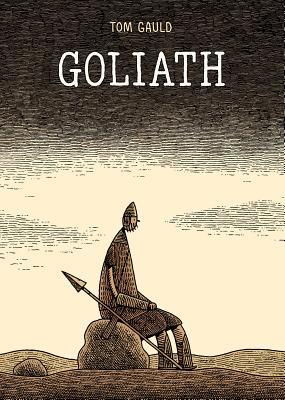
Tom Gauld, Goliath (#BookReview)

It’s probably just me, but I hadn’t heard of Tom Gauld until a member of my little volunteer indexing team sent me a link to some of his “cultural” cartoons in The Guardian. I was immediately enchanted. And then, he lent me one of Gauld’s graphic novels, the above-named Goliath. Being primarily a textual person, I am not a big graphic novel reader, but our son became keen on them in his teens, so I have some familiarity and have read a handful.

Now I’ve added Goliath to that elite bunch. It’s the sort of graphic novel I enjoy – spare, drily witty, a bit melancholic. It is also, as you will have assumed, a retelling of the biblical David and Goliath story. Like many modern retellings, Goliath is told from a different perspective, that of Goliath himself, who is seen as a pawn in the game of war. In a wry touch, Goliath is your quintessential gentle giant. When, out of the blue, he is approached to be measured for some armour, he says to the armour-maker, “Are you sure this isn’t a mistake? I mainly do admin”. As one who doesn’t mind a bit of admin, I’m with Goliath.

Gauld has published well over 20 books, starting back in 2001, but according to Wikipedia he is best known for Goliath (first published in 2012) and Mooncop (2016). I notice that his latest, published just this year, is Revenge of the librarians. Now, that’s one I’d love to read!

Anyhow, back to Goliath. Although he’d rather do admin work, destiny has other plans for him as we know – and so, he finds himself, under the Philistine king’s orders, waiting in a valley, armoured and armed up, issuing, morning and night, a challenge to the Israelites:

I am Goliath of Gath,
Champion of
the Philistines.

I challenge you:

Choose a man,
Let him come to me
that we may fight.

If he be able
to kill me
then we shall be your servants.

But if I kill him
then you shall be
our servants.

Poor Goliath. “I’m not a champion”, he says. In fact, he continues, “I’m the fifth worst swordsman in my platoon … I do paperwork. I’m a very good administrator.” But, in classic political spin, he’s told that there won’t be any fighting. He just has to “look like a champion” and “the enemy will cower”. We all know how that turned out … along came David (albeit in this version, after a very very long time of waiting for poor Goliath).

The reviews on the back cover sum it up beautifully. The New York Times says that Gauld uses “simple, clever images to explore the larger, more complicated issues of war and heroism”, while London’s The Times says, and I particularly like this, that “Goliath is a master class in reduction … a celebration of the Christian underdog becomes a subtle meditation on the power of spin and the absurdity of war”. The rest of the back cover review excerpts are similarly spot on.

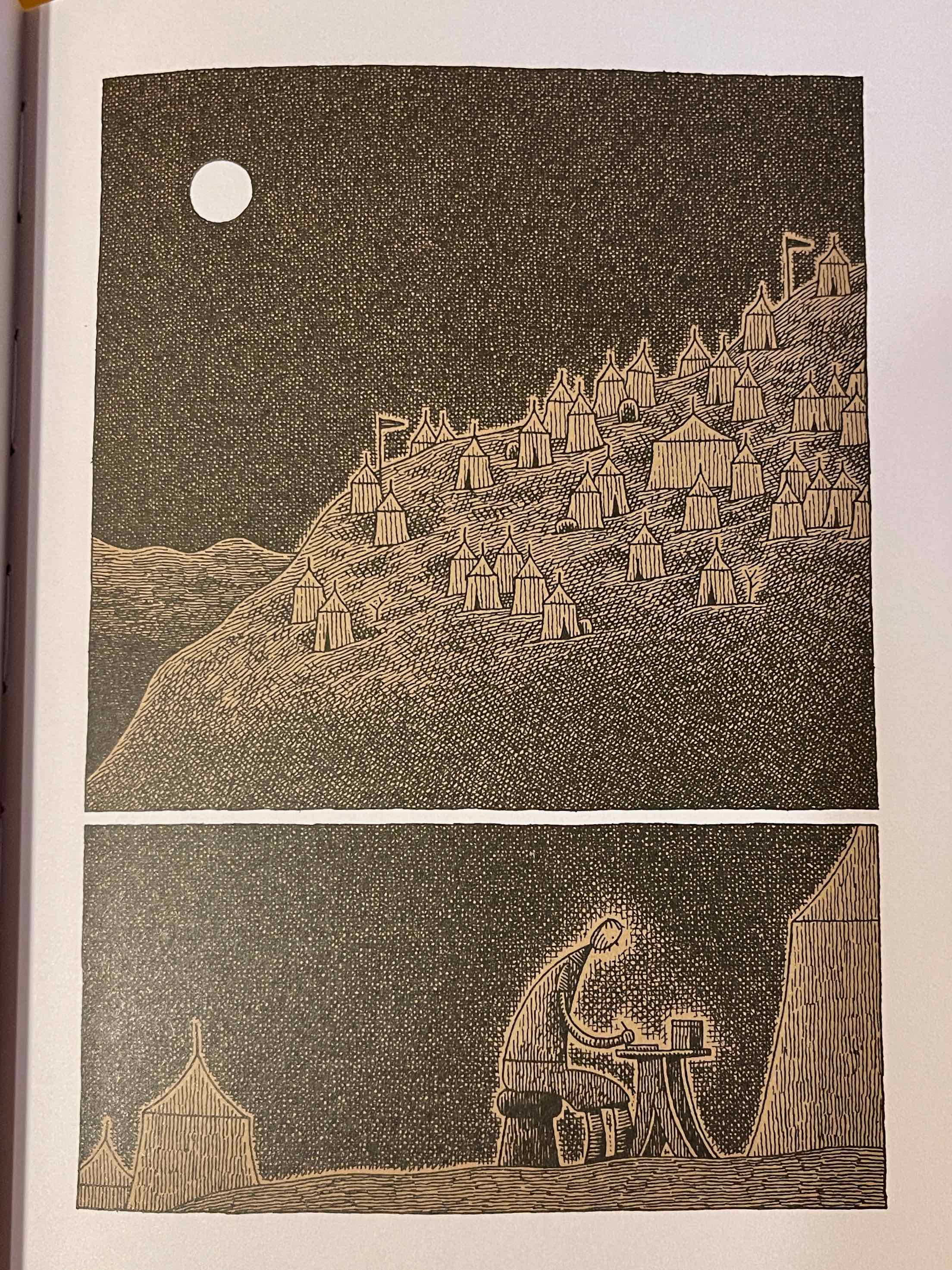
Small reproduction, allowed for review purposes.

So, did I enjoy it? Yes, I did. I liked the spareness of the art and the text. The first five textless pages set the scene – that is, they show Goliath going about his day quietly, peacefully, doing his paperwork, having a stretch at his desk, and trudging down the hill on which the encampment is located to get a drink. One of my challenges with graphic novels is taking in the images and the text, without letting one distract me from the other, but in Goliath the spareness of both made this easy. Making it easy to comprehend, though, is not the main reason for the spareness! It also reduces the story to its essence, encouraging us to engage with Goliath and what he is experiencing.

I also liked the humanity of Goliath and the small boy whose job it is to support him. As they traipse to see the captain, the small boy carries Goliath’s oversize shield. “Are you OK with that?”, asks Goliath. “Sort of” replies the boy. These two, we clearly see, are pawns in the game, potential “collateral damage” as it were, though of course the Philistine leaders believe they have the winning hand.

I also liked the subtle humour, which you have hopefully picked up already. And, of course, I appreciated the anti-war message conveyed through a twist which shows the ostensibly powerful giant as the manipulated underdog – just by changing the perspective. Something we all need to do, eh? See and feel things from another side. Recommended.

Tom Gauld
Goliath
Montreal: Drawn and Quarterly, 2017 (orig. ed. 2012)
[96]pp.
ISBN: 978770462991

Julian Barnes, Elizabeth Finch (#BookReview)

Julian Barnes’ Elizabeth Finch is a curious book. It’s my fourth Julian Barnes, and the third I’ve read with my reading group. In 1995 we read A history of the world in 10 1/2 chapters, and in 2012 it was his Booker Prize winning The sense of an ending (my review). (I have also read his curious but enjoyable Pedant in the kitchen.) All have intrigued me, for different reasons.

Elizabeth Finch tells the story of a man’s fascination with an inspirational teacher, the eponymous Elizabeth Finch, who taught an adult education class on Culture and Civilisation. This man is Neil, our first person narrator, and he maintains a friendship with EF (as he refers to her), through semi-regular lunches, until her death some two decades later. Through Neil’s memories of the class and his reading of EF’s papers that she’d bequeathed him, Barnes explores various ideas, including how we live our lives (particularly in terms of friendship and love), and the impact and thrust of history (primarily through considering the so-called last pagan emperor, Julian the Apostate). (Interestingly, the protagonist in The sense of an ending is also bequeathed personal writing.)

The novel, while told chronologically, is quirky in form. Part One comprises Neil’s introduction to EF, up to her death; Part Two contains Neil’s “essay” on Julian the Apostate (who was significant to EF’s ideas); and Part Three returns to Neil, now focusing on trying to understand EF with a view to possibly writing a memoir/biography. Here, he also catches up with old student friend, and ex-lover, Anna, who does enliven the book. In a sense, the novel reminded me a little of J.M. Coetzee’s tricksy books, like Elizabeth Costello and Diary of a bad year (my review), because they also tread this strange fiction/nonfiction, novel/philosophy ground.

At this point, I’m going to depart a little from my usual approach, and share some of my reading group’s discussion, because the book book engendered widely divergent reactions. They fell into three groups. One member loved it, describing it as a dense, compact novel which takes readers down interesting paths. She enjoyed thinking about Julian the Apostate, and what might have happened had he prevailed, and she enjoyed reading about the wide range of thinkers who have pondered Julian over time. A couple actively disliked it or were “very disappointed”. They felt the novel had some interesting threads but found it simplistic, repetitive, disjointed. They didn’t like the EF character, and one described the novel as “an ordinary study of a crush on an ordinary woman”. The rest of us, including me, had mixed feelings. Our reactions varied but we all found things to like (or be intrigued by) as well as dislike (or be mystified by). I won’t share all our ideas, but a couple of us felt that the book read like something that Barnes wanted to “get off his chest” at this stage in his life. (He’s 76). A couple of us particularly enjoyed the discussions of Epictetus and of history.

The book’s narrator, Neil, was problematic for some, but I rather liked his self-deprecatory tone, the sense of bumbling along as a middle-aged British male. Neil is not Barnes, but I wondered if he reflects Barnes’ self-assessment or, at least, a recognition of how he and his peers are viewed in the current age. It is tempting, actually, to see an autobiographical element to the novel, because EF was apparently inspired by the late British novelist Anita Brookner. She had beaten Barnes in the 1984 Booker Prize, but they had subsequently become friends and had lunched semi-regularly after that. I have read (and enjoyed) several of Brookner’s novels and can imagine her being somewhat like EF, who was “high-minded, self-sufficient, European” and “whose vocabulary was drawn from the same word-box she used for both writing and general conversation”. (Brookner’s books aways send me to the dictionary!)

What might Barnes have wanted to get off his chest? This is where I came unstuck a little. As I started reading the book, it felt like the elder Barnes wanting to work through long-pondered ideas, but what exactly were they? As the novel progressed, I felt less certain. Is Barnes – ironically perhaps – emulating EF, and throwing out seemingly random ideas for us all to consider. However, there are, actually, recurrent threads. One concerns whether the world might have been better had “history” fallen out differently. This is where Julian the Apostate comes in, because early in the novel EF poses the idea that Julian’s defeat in 363 was “the moment when European history and civilisation took a calamitous wrong turn” (p. 31), it being the moment when Christianity defeated paganism/Hellenism. I wondered if the novel was going to be an anti-Christianity treatise, but it’s not exactly. EF raises many questions – but she also draws some long bows. I think Barnes challenges us to think about this.

Anyhow, history is one of the book’s central concerns, which is not surprising, given Barnes’ age and the ideas that have underpinned his writing to date. I have only read three of his novels but from those, I’ve gathered that he likes to interrogate, often playfully, the slipperiness of life and relationships, culture and history. So, in this novel, he explores what we believe and who we rely on, when it comes to history (and that related field, biography). In his Julian essay, which some in my group found lifeless, Neil describes how perspectives on Julian’s role and significance varied over time. He’s been either completely ignored, or seen as the cause of all ills, or held up as a model for good thinking.

History, in other words, is “fallible”. It’s “for the long haul … not inert and comatose … [but] active, effervescent, at times volcanic”. This is not new, but worth repeating all the same.

EF also shares with the class an idea she attributes to Ernest Renan, which is that “getting its history wrong is part of being a nation” (p. 33). Renan, she points out, does not say part of “becoming” a nation. This point was appreciated by my reading group, given where Australian “history” is right now. I’m guessing it may also reflect Barnes’ own reflections on British history.

Another recurrent thread in the novel is EF’s interest in the Greek Stoic Epictetus‘ statement that

Some things are up to us and some are not up to us. Our opinions are up to us, and our impulses, desires aversions – in short, whatever is our own doing. Our bodies are not up to us, nor are our possessions, our reputations, or our public offices, or, that is, whatever is not our doing. (p. 21)

Epictetus’ point, as Anna clarifies with the often obtuse Neil in Part 3, is that learning to distinguish between the two, and understanding that we can’t do anything about what is not up to us, “leads to a proper philosophical understanding of life”. My reading group discussed this, with one member suggesting that “a proper philosophical understanding of life” means “not being neurotic”, that is, “not expending energy on the things you can’t influence”. Made sense to us!

The novel does meander a bit, but that’s not all bad if you find the ideas you are meandering through interesting. Ultimately, I’d say that Elizabeth Finch is part homage to the people who inspire us, part a discussion of the business of living, and part an exploration of the fallibility of history and biography. It is not Barnes’ most exciting book, but I found it compelling enough all the same.

Lisa (ANZLitLovers) also enjoyed this book, which in fact she generously sent me. Thanks so much Lisa. Her post commences with an interesting discussion of its cover.

Julian Barnes
Elizabeth Finch
London: Jonathan Cape, 2022
181 pp.
ISBN: 9781787333932

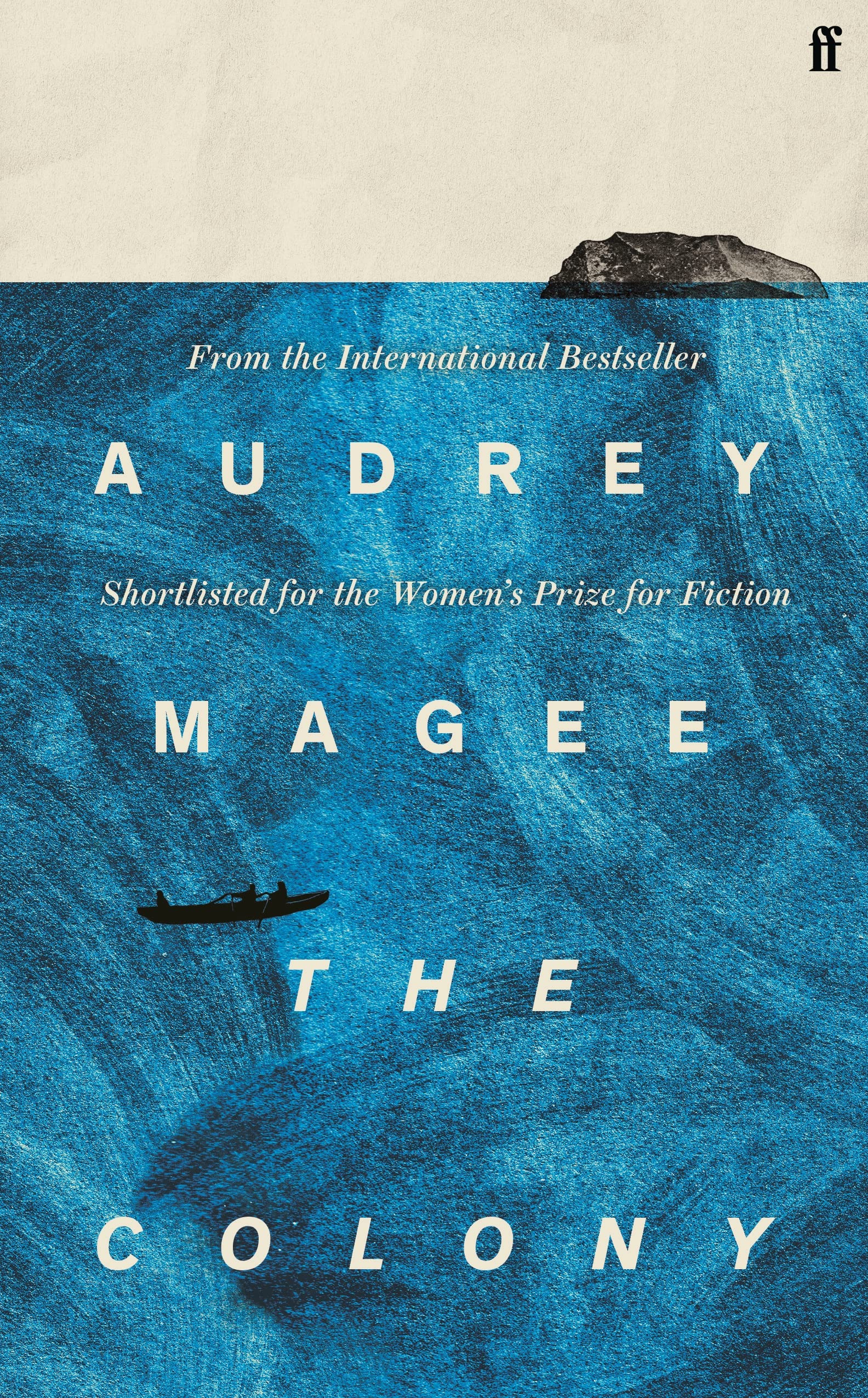
Audrey Magee, The colony (#BookReview)

Irish novelist Audrey Magee’s second novel, The colony, was my reading group’s August book, and it proved an excellent choice. Literary and highly readable, with vivid characters and a sophisticated exploration of its subject matter, The colony engaged us on all levels. It was longlisted for the 2022 Booker Prize (and may yet be shortlisted. We will know next week.)

The novel’s overall subject is, as the title implies, colonisation – and Magee teases out its personal, cultural and political ramifications through a small island colony off the west coast of the Republic of Ireland. The word colony, like much in this book, is multi-layered. The novel is set over the summer of 1979, easily dated for readers by reporting of the assassination of Louis Mountbatten in August 1979.

“the battle of the colonisers”

The colony is carefully structured, with chapters about what’s happening on the island alternated with reports of sectarian killings from the Troubles in the north. These reports are brief, stark, and devastating, and serve as a constant reminder of what colonisation can do. But these reports are just one of the layers in the novel, which starts with the arrival of the ambitious British artist Lloyd (whose name is not random. He has plenty of money!)

Lloyd is coming to the island to make his name. He is a modern colonialist in the way he assumes he can buy what he needs, and manipulate others, to achieve his goal. He promises, for example, to respect the islanders’ wishes that he not paint them, but this doesn’t last. The way Magee unfolds his role is clever and subtle, because the islanders, whose numbers have dwindled to twelve families, want and need his money to survive. His perspective is told through terse, poetic language.

Arriving soon after Lloyd is the French linguist, JP Masson. He has been visiting this Gaelic-speaking island for years, undertaking a longitudinal study of the island’s linguistic patterns for his PhD. JP is fierce about the need for the islanders’ language to preserved as is. He resents the infiltration of any English into the island, so Lloyd’s appearance is the last straw. It will, he believes, force a “sudden and violent ” shift to English, instead of the slow “linguistic evolution” to bilingualism that was under way:

The Irish here was almost pure, Lloyd, tainted only by the schoolchildren learning English, by the intermittent visits of emigrants returning from Boston and London with their sophisticated otherness, and by mercenaries in linguistic mediation, men like [islander] Micheál who want only to communicate, indifferent to the medium or its need for protection  …

JP’s perspective is told through the carefully thought prose of a writer, though when he is writing his paper on colonisation and language, I found it a bit heavy-handed, a bit too much of the telling not showing.

However, this issue of maintaining language – and its relationship to the colonial project – is intelligently explored. JP argues uncompromisingly for preserving the language, because it “carries their history, their thinking, their being”, and resists the fact that languages change. He rides roughshod over the islanders, insisting that they must use their language. Lloyd, on the other hand, wipes his hands of the issue, “not my concern” he says. Meanwhile, the islanders go about their business, continuing to speak their language with each other, while being willing to use English where it benefits them. They are no fools, for all JP’s exhortations:

What do you think, Micheál? said Masson. Are you less Irish when you speak English?
I don’t talk politics, Masson. You know that.
We’re talking about language, Micheál.
Same thing

Just this topic alone, and how Magee uses it to expose colonialism’s short, medium and long tail, could take up a whole review.

Throughout the novel, the islanders are caught in the middle, but maintain a healthy perspective:

Imagine that, said Mairéad. A Frenchman and an Englishman squabbling over our turf. 
They’ve been squabbling over our turf for centuries, said Francis. 

There is a wonderful, dry humour in this novel. And much of it comes from the islanders, who have their own way of dealing with things. But they, too, are not united. The matriarch, 89-year-old Bean Uí Fhloinn supports the old ways, and is a perfect subject for JP’s research, while her granddaughter Mairéad tends to be the voice of humane or sometimes just resigned reason. Her son James sees Lloyd as his way out. He doesn’t want to be a fisherman, as all the men before him have been (including his drowned father, grandfather and uncle). He shows real talent as an artist, and believes Lloyd’s promise to take him back to England at the end of summer.

And so, as summer progresses, tensions increase, between Lloyd and JP (who both come from colonising nations, for all JPs attempts to ignore his own complicated origins), but also between the islanders as they respond to what’s happening on the island and up north. They comment on the violence in the news reports. In one telling moment, Mairéad and her brother-in-law Francis discuss the Mountbatten assassination in which two teenage boys were also killed. For Mairéad this is wrong, whilst for Francis it’s “collateral damage”:

Where does this end, Francis?
In a united Ireland, Mairéad. One free of British rule.
And you’ll blow up innocent children to get it. Mairéad swallowed the last of her whiskey. You’re pathetic, Francis Gillan.

Violence is a constant presence in the book, from the relentless news reports to young James’ brutal killing of rabbits for food. Francis hangs over the novel ominously. What does he do on the mainland? What will he do to “get” Mairéad, for whom, she knows, he is “Waiting. In the long grass. Waiting for me to fall flat on my face so that he can pick me up and make me his.”

I am interested in this issue of violence and how it permeates society. It’s what I think Tsiolkas was on about in The slap (my review). When people are confronted with violence on a regular basis, how do they respond? How should they respond?

Another issue Magee explores is art. While Lloyd hides away, painting his magnum opus – which draws inspiration from Gauguin (another artist who worked in a colonial, exploitative environment) – the islanders discuss whether they should be worried. Is it “just” art, or something else?

James clearly understands that art has meaning, and recognises the message in Lloyd’s final painting:

It’s me as you want me to be seen, Mr Lloyd. As you want me to be interpreted.

It’s certainly not James as he wants to be seen. It’s a cruel scene, particularly given Lloyd’s earlier lofty dreams of showing “that art is greater than politics. Art as peacemaker, as bridge builder.”

Truly, The colony is, to use a favourite word of the islanders, a “grand” book. The writing is expressive, with various motifs running through it – like rabbits, apples, smells – and refrains, like “young widow island woman”. There are gorgeous descriptions of landscape and nature, and of daily life. There’s rhythmic variation, finely evoking different characters and tones. And there’s the shifting of perspectives, sometimes within paragraphs, which brought to mind Damon Galgut’s The promise (my review).

The colony recognises some of the fundamental ironies in the situation the islanders find themselves in. Both JP and Lloyd, who look like they might (or, at least could) do good, are ultimately there for their own aggrandisement. The little island colony, to which they come, functions then as a perfect microcosm of the colonised. With dwindling numbers, those remaining need to do what they can to survive, but the odds are stacked against them. It’s an all too common story, and Magee tells it skilfully, giving her novel an ending which makes its point without going for the high drama I half expected. It’s all the more powerful for that.

Coincidentally, Lisa and Jacqui (JacquiWine’sJournal) both reviewed this book last month, and both are worth reading.

Audrey Magee
The colony
London: Faber & Faber, 2022
376pp.
ISBN: 9780571367627 (Kindle ed.)

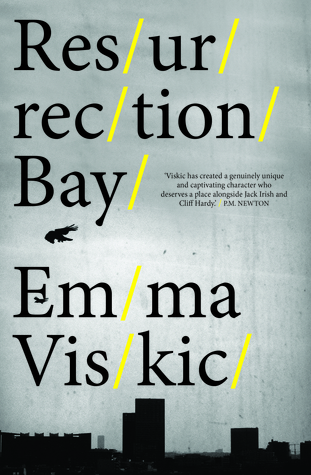
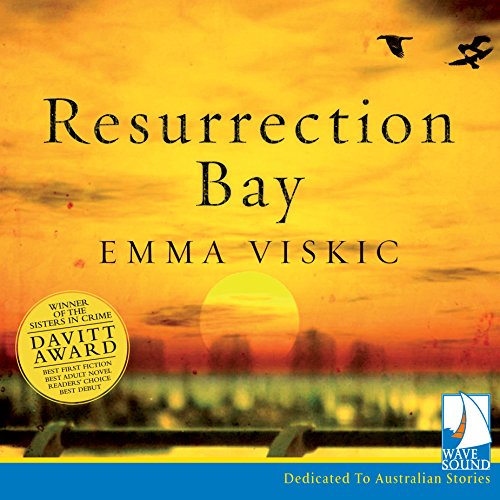
Emma Viskic, Resurrection Bay (#BookReview)

Back in February, I said I planned to “read” more audiobooks this year, and slowly I’m achieving that goal with Emma Viskic’s Resurrection Bay being my third for the year. In fact, it makes a particularly special contribution, because it is the first book I wanted to hear when we bought our new car with Apple CarPlay functionality back in 2019. That might sound strange for someone who claims to not read crime, but here’s the thing …

While I don’t, as a rule, read crime, I do like to keep up with new Australian works. Emma Viskic’s 2015-published debut crime novel featuring a deaf investigator captured my interest at a time when we were looking for more fiction featuring differently abled protagonists. I wanted to read it, but I thought my best bet would be in audiobook form, because crime is the sort of writing that can work well in the car. The problem was that every time I checked my library audiobook catalogue there was no Emma Viskic, until a couple of months ago. Consequently, Resurrection Bay was the novel of choice for our last road trip. And it was a good choice, except …

There are certain things you need in a car audiobook, we’ve found. One is that straightforward narratives work best. After all, one of the listeners is a driver who should be focusing mostly on the road. Drivers do not need to be trying to follow multiple strands or unpicking abstract language, for example. Viskic’s novel worked well in this regard. However, another is that the sound needs to be good, and easy to hear above road and car noise. Here is where we struck problems. The reader for this audiobook, Lewis Fitz-Gerald, was a great reader – and I am fussy about audiobook readers – but he used a wide dynamic range to convey emotion and meaning through his voice. This made hearing in the car very difficult at times. It would not be a problem, I expect, if you were listening to it through ear-pods while walking.

And now, I really should get to the book – but one more proviso. Because I experienced it in audio form, my comments will be general and briefer than usual.

Resurrection Bay is the first in Viskic’s Caleb Zelic series. He is a private investigator who has been profoundly deaf since early childhood – from meningitis (which was also behind author Jessica White’s deafness). Unlike Jessica, though, Caleb did learn to sign. GoodReads describes the plot as follows:

When a childhood friend is murdered, a sense of guilt and a determination to prove his own innocence sends Caleb on a hunt for the killer. But he can’t do it alone. Caleb and his troubled friend Frankie, an ex-cop, start with one clue: Scott, the last word the murder victim texted to Caleb. But Scott is always one step ahead.

“silence safer than words”

Fictional detectives, I have come to learn, are not usually easy people. They tend to be loners, or to have some personal problem/s which add to the challenge and interest of the narratives featuring them. Caleb, of course, has his deafness. He’s an outsider, not because deafness necessarily makes him so, but because he, as his Koori ex-wife Cat tells him, lets it make him so. He refuses to admit his hearing impairment to others when communication difficulties occur, and this desire to “appear normal” not only impacts his ability to do his job, but it impacts his relationship with her. He also, frustratingly, refuses to “hear” what she is saying, jumping to the wrong conclusion because he is not listening. His deafness, in other words, is more than physical. It is also mental and emotional. Communication is, then, an underlying theme or motif in the work.

However, I’ve gone off on a tangent, because of course the main story is the crime investigation, which Caleb undertakes with his business partner, the aforementioned Frankie. She has her own difficult past which includes having been an alcoholic. This Caleb knows. Their investigations take them from Melbourne to Caleb’s childhood home, the fictional Resurrection Bay, and in the process Caleb discovers things he didn’t know about his friend, the murder victim; jumps to conclusions about his brother Anton; and learns more about Frankie.

Resurrection Bay is a page-turner, as you would expect. It’s well-written, with good crime-characterisation, and vivid evocation of place. It’s emotionally moving because Viskic makes you invest in her characters, but it also has some very violent and bloody moments. I guessed what the twist might be, but I was never completely sure until the end – and how it all actually fell out contained surprises.

Now, though, I want to address the elephant in the room – the deaf protagonist, the Koori wife, and the whole whose-story-is-it-to-tell issue? Here’s the gen, from The Age. Viskic

says being half-Slav gave her an outsider status that honed her power of observation.
Her husband was raised in a Koori family and they have two grown daughters. One of her primary school classmates was deaf and the disability – and particularly the refusal to accept it as a disability by the deaf community – has always intrigued her. She learned Auslan for the novels.

Later in the article, she is quoted as saying that

writing from outside your own experience is dangerous … not just because people can shoot you down, but because you can do the wrong thing by people. But I wanted my nieces and nephews to have characters like them in a book. And also, it would have felt cowardly not to have done it.

I am not a hard-and-faster on this whose-story issue. I do think that where longterm disempowerment is involved, own-stories are the better and fairer way to go, but it’s grey. If writers have reasons for writing a particular story that is not their own, then they wear the consequences, as Viskic is clearly aware. Ultimately, it’s not for me to say, but I felt Resurrection Bay was written with sensitivity and respect. The rest is up to those who own these stories.

In 2016, Resurrection Bay won the Ned Kelly Award for Best First Fiction; and the Davitt Award for Best Adult Novel. An impressive debut.

Kimbofo enjoyed this novel too, and Bill has posted on Viskic’s fourth Caleb Zelic novel, Those who perish.

Emma Viskic
Resurrection Bay
(Read by Lewis Fitz Gerald)
Wavesound from WF Howes, 2017 (Orig. pub. 2015)
Duration: 7hrs 9mins
ISBN: 9781510064140

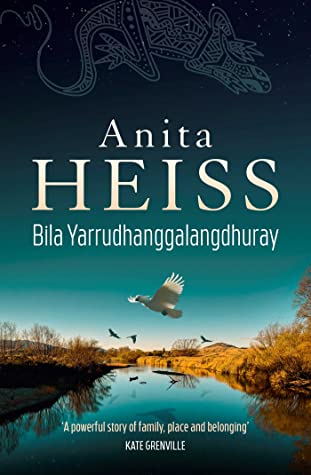
Anita Heiss, Bila Yarrudhanggalangdhuray (#BookReview)

Bila Yarrudhanggalangdhuray/River of dreams is Anita Heiss’ second work of historical fiction, her first being Barbed wire and cherry blossoms about the 1944 Cowra breakout in which she imagines a relationship between a Japanese escapee and a young First Nations Australian woman. I have not read that novel, but I have read, over the last year or so, other First Nations Australia historical novels, including Julie Janson’s Benevolence (my review) and the collaborative novel by non-Indigenous Australian Craig Cormick and First Nations writer Harold Ludwick, On a barbarous coast (my review). Long before these, though, was Kim Scott’s unforgettable The deadman dance (my review).

The value of these, and like books, to offering a First Nations perspective on the one-sided history that most of us grew up with cannot be under-estimated. Heiss, in fact, wrote in her Author’s Note and Acknowledgements, that through re-engaging with her Wiradyuri homelands in her early 50s,

I realised very quickly I had to honour those Ancestors who for millennia have lived, loved, and nurtured the land and each other. And I wanted to pay tribute to those who carry on culture, knowledge and language still today. I felt I had a responsibility as an author to write our Wiradyuri heroes – our men and women – into the Australian narrative where they had been ignored or forgotten too long.

Bila Yarrudhanggalangdhuray is her response to that realisation. It is of particular interest to me because it is set around Gundagai and Wagga Wagga, which are within three hours’ drive from where I live. Although I have been visiting the Gundagai region since the mid-1970s, it was only in recent years that I became aware of the story which is central to Heiss’ novel. This story concerns Gundagai‘s flood of 1852. As Wikipedia describes, the Murrumbidya flooded, killing at least 78 of the town’s population of 250 people. Using bark canoes, four local Aboriginal men, including Yarri, Jacky Jacky, and Long Jimmy, saved somewhere between 40 and 68 people. They were minimally recognised at the time, but, finally, in 2017 (2017!), a bronze sculpture of Yarri and Jacky Jacky, with canoe, was unveiled in Gundagai. Heiss’ novel concerns the life of a young Wiradjuri woman, Wagadhaany, the imagined daughter of Yarri.

The novel is told, like many historical novels, chronologically, and starts with a Prologue set in 1838, some 14 years before the main narrative starts. This prologue is important. It introduces Wagadhaany who, as a 4-year-old, is with her babiin, Yarri, as he tells a “White man” that the place they are standing on is “not a good place to live, Boss, too flat”, that it’s a “flood area”. Of course, the White man ignores this local knowledge and so the stage is set for 1852 when the devastating flood comes. By this time, Wagadhaany, now 18, is working as a servant for that very White man, Henry Bradley.

The flood and its immediate aftermath occupy the first five chapters of this 29-chapter novel. Only two sons of the Bradley family of six survive, along with Wagadhaany. The rest of the novel follows their lives over the next couple of decades, showing how little the White settlers learnt from the experience – practically, in terms of how to live on the land, and morally, in terms of their behaviour to the true owners of the country. Wagadhaany, who is bound, she is told, by the Master and Servants Act of 1840, has no agency in such a world.

“a witness without a voice”

Into this situation comes the young Quaker widow, Louisa, who, like the Bradley men, lost her family in the floods. I was surprised by the appearance of a Quaker, but Heiss also explains in her Note that there were Quakers in early colonial Australia, and they were interested in “the treatment of the convicts and the Aborigines”.

Louisa is an interesting character because she tries to treat Wagadhaany well. She calls her by her actual name, rather than Wilma, as James Bradley does; she works alongside her in the kitchen and garden; she gives her a bedroom in the house; and she converses with Wagadhaany as a friend. But, she has her blind-spots. She is oblivious to Wagadhaany’s lack of agency over her life, to the fact that, when the Bradleys (now including Louisa) move to Wagga Wagga, she thoughtlessly over-rides Wagadhaany’s wish to stay in the Gundagai area where her family is.

As the novel progresses, Wagadhaany’s homesickness for her family, and her country, increases. We are privy to Wagadhanny’s thoughts, to her awareness that there are limits – albeit unconscious ones – to Louisa’s concept of equality. Louisa is, after all, a product of her time and her culture – and Wagadhaany notices that, for all their “equality”, it is Wagadhaany who does the hardest, dirtiest, heaviest jobs, and that she is not paid a wage.

What the presence of Louisa does, though, is to add richness and nuance to the depiction of colonial society. She is a foil to the brutal, racist attitudes of James Bradley. She does not mitigate them but shows that his were not the only views around. Wagadhaany, on the other hand, tells it as it is from the First Nations’ perspective. In the early days after the flood, Heiss writes that Wagadhaany

feels like a witness without a voice. She was there, she lived through the horror of the flood, the fear, the physical exhaustion, the loss of those she knew. But no-one asks how she is, what she thinks or knows, or how she feels.

For all Louisa’s kindness, there is much Wagadhaany feels she can’t say, and so throughout the story she continues as a silent witness. Here she is reflecting on Louisa and work:

She wondered why Louisa had to be protected from hard work but the Wiradyuri women didn’t. And she wondered if that thought ever crossed Louisa’s mind, because that made them different, unequal …

Gradually, though, she starts to stand up for herself:

“I know I will have to work for you, I know about the masters and servants law, but you cannot keep me living here in the homestead against my will if you honestly believe I am your equal and that I should be as free as you”.

And Louisa, to her credit, “lets” her live with the river family.

Bila Yarrudhanggalangdhuray has strong characters, but it is also a genre novel with a strong plot, including of course, romance. I don’t want to spoil what is a good page-turning story, so I will leave the story here.

Heiss has several novels under her belt now. She knows how to tell a good story, and she is also very clear about her message. She uses her fiction to show what she wants the rest of us to know. In this novel, it’s the way First Nations people lived, the way they tried to work with the settlers, and the way they were gradually pushed off their land. She also, through Louisa, forces us to confront what really is being “a good White person”. So, not only does the novel tell some truths about Australia’s settler history but it is also immediately relevant to today.

In this novel, Heiss also, as First Nations writers are increasingly doing, incorporates language into the writing. There is a glossary at the back, but you rarely need it because most words are self-explanatory in context. Seeing “our” nation’s words in Australian literature is a truly exciting development.

Bila Yarrudhanggalangdhuray isn’t a perfect novel – and I struggled particularly with Louisa’s falling in love with the man she does. But this is a genre novel, and a bit of belief-stretching is allowed. The end result is a book that engages the reader with its strong protagonist in Wagadhaany, that wraps its vital messages in a compelling story, and, significantly, that ends authentically.

Lisa (ANZ LitLovers) has also recommends this book.

Anita Heiss is a Wiradyuri woman from NSW.

Anita Heiss
Bila Yarrudhanggalangdhuray
London: Simon & Schuster, 2021
393pp.
ISBN: 9781760850449

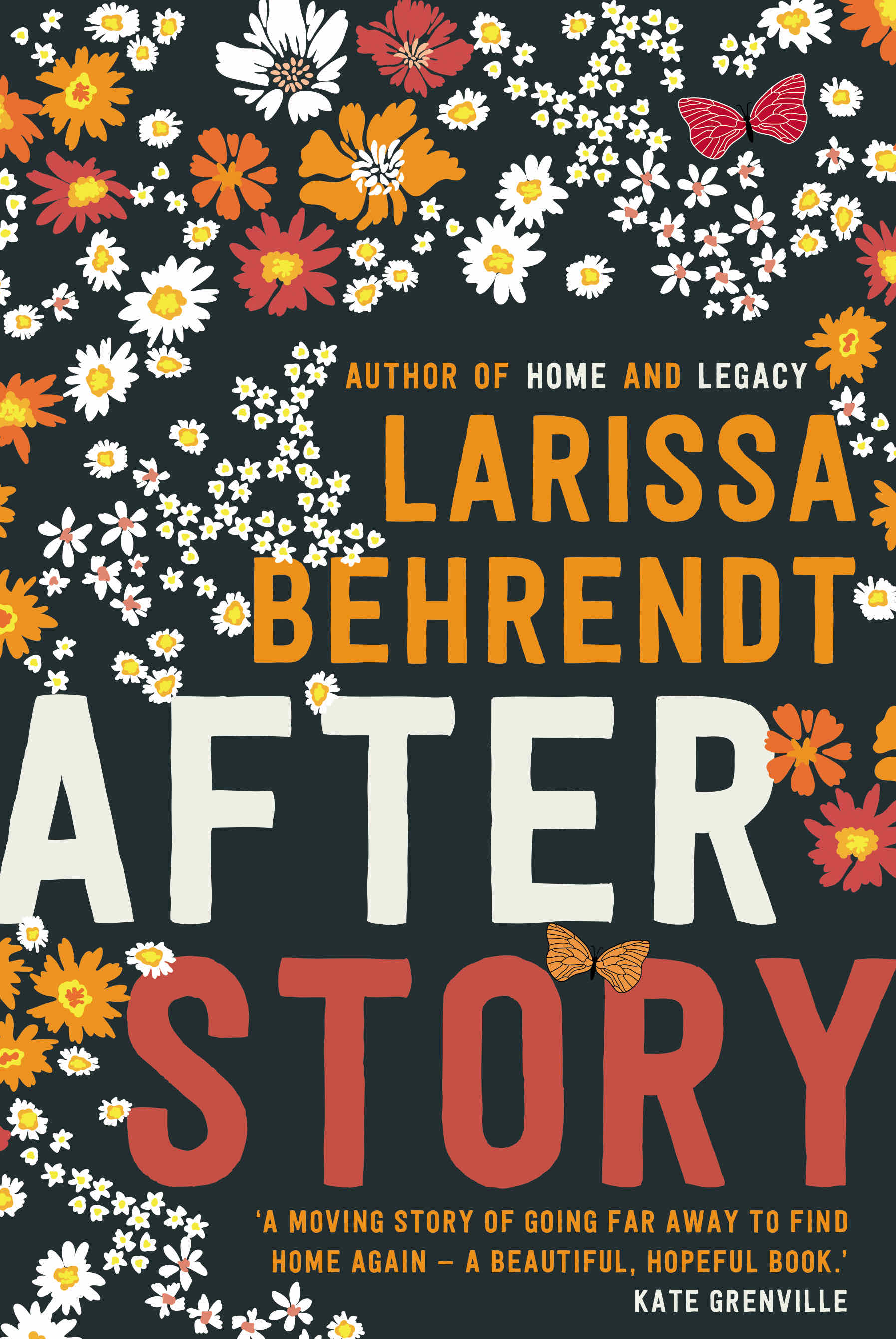
Larissa Behrendt, After story (#BookReview)

Larissa Behrendt’s latest novel After story has been on my wishlist since it came out last year, so I was thrilled when my reading group chose it as our 2022 NAIDOC-Week read. What self-respecting reader, after all, doesn’t like a literary tour?

After story, for those who haven’t caught up with it yet, is framed around a ten-day literary tour of England that is undertaken by a First Nations Australian mother and daughter, Della and Jasmine, whose relationship is fraught. Through this plot device, Behrendt marries her two storytelling loves – English literature and Indigenous Australian storytelling. In doing so, she draws comparisons between them, and explores ways in which both can reflect on and enhance our lives. She also shows how travel can be an engine of change for people.

Although it contains some very dark matter concerning grief and abuse, After story is a gentle and generous read – for two reasons. First, there’s the characters. Della and Jasmine, are strong, thoughtful and, importantly, real. Both have made mistakes in managing the challenges in their lives, but both genuinely want to have better relationships with those they love. Della, the less educated and more naive of the two, is particularly engaging for her honesty and lack of pretension, for her open-mindedness, and for the rawness of her pain. The other reason is the novel’s tone. It is clear and passionate about the wrongs done to Australia’s First Nations peoples but it is not angry. This is not to say that anger doesn’t have its place – it certainly does – but it’s not the only approach to telling the story of dispossession and dislocation.

What is particularly striking about this book is its structure and voice. After a prologue in Della’s voice telling of the disappearance twenty-five years ago of her 7-year-old daughter Brittany, the novel is structured by the tour, with each day being told, in first person, by Della and then Jasmine, until Day 8, when Della’s built-up grief overcomes her. After that, the order changes and Jasmine goes first. This change marks a turning point in their relationship – albeit not an immediate, epiphanic one. It also jolts the narrative out of a pattern that had risked becoming a little too rigorous. Like a coda, it makes the reader sit up and wonder what will happen next?

What does happen, however, as I’ve already implied, is not particularly dramatic. Rather, this book emulates something Virginia Woolf said, as Jasmine shares:

The great revelation perhaps never did come. Instead, there were little daily miracles, illuminations, matches struck unexpectedly in the dark.

Like life.

But, back to the structure. After story is one of those books in which the structure mirrors or supports its intention – and Jasmine, again, explains it well. Talking about Jane Eyre and Jean Rhys’ response to it in Wide Sargasso Sea, she says, “it’s compelling, the uncovering of the other side of the story”. “Uncovering the other side of the story” is the nub of this novel – personally, in terms of Della, Jasmine, and their relationship with each other and the rest of their family, and politically, in terms of the conflicting views and experiences of the colonisers and colonised. What Behrendt aims for in this novel, I believe, is to bring people together through improved mutual understanding.

Lest this sound too earnest, though, let me reiterate my earlier comment that this novel has a light touch. To balance the heavy material, which includes a number of losses including those related to abandoned and lost children, Behrendt creates a cast of typical tour participants. There’s the white male know-it-all professor and his seemingly mouse-like wife; the feminist young lesbian couple willing to take him on at every turn; the recently retired, educated middle-class couple; the bossy woman and her down-trodden sister; Della and Jasmine; and of course Lionel, the long-suffering tour guide, and bus-driver Brett. Behrendt handles these almost-stereotypical characters well, so that, by the end, even the arrogant Professor Finn is softened for us.

There is much humour in the telling, such as this, for example, from Della as she enters the British Museum, which, she has just discovered, still holds Aboriginal remains:

As we walked into the imposing white building there was a big glass bowl with money in it and a sign asking for donations.
“We already gave,” I said to the guard who was standing next to it.

Comments and asides like this are used throughout the novel to draw our attention to the truths we may not otherwise see. Truth, in fact, is a recurring idea in the novel – the withholding and the sharing. Della, reflecting on Thomas Hardy’s first wife being written out of history, remembers stories of erasure told by her community’s elder Aunty Elaine, and thinks “Sometimes the truth matters and you shouldn’t try to hide the facts”. A little later, Jasmine is also reminded of Aunty Elaine’s wisdom:

Aunty Elaine would remind me that there is more than one way to tell a story; there can sometimes be more than one truth. ‘The silences are as important as the words,’ she’d often say. There is what’s not in the archive, not in the history books – those things that have been excluded hidden overlooked.

Throughout the novel, Aunty Elaine’s stories and wisdom, shared through the memories of Della and Jasmine, provide the First Nations’ foil to the literary tour, sometimes enhancing, sometimes counteracting the messages and lessons of English literature.

I did, however, have one issue with the novel, one shared by a few in my reading group. This concerned its occasional didactic tone. Frequently, for example, the characters tell us what they’d learnt at various sites, such as about Jane Austen’s life or Virginia Woolf’s death. While we could see the point, the way the information was imparted did feel teachy at times. Fortunately, this tone did not extend to the novel’s underpinning ideas which are conveyed through the narrative rather than “told”.

In a Sydney Writers’ Festival panel, Behrendt said something that appeals to me, which is that the goal of being a great writer is to say something important. In After story, she has written an engaging, accessible novel, that also says important things – some subtle, some more overt, but all stemming, ultimately, from the traumas First Nations people have suffered, and continue to suffer, at the hands of the settlers.

Jasmine comes to a significant realisation near the end:

Suddenly I found the museum stuffy. When Aunty Elaine would talk about it, our culture felt alive – the sewing of possum cloaks … the gift of telling stories. They were living and breathing, not relics of the past, frozen in time. Looking at the artefacts surrounding me, I couldn’t help but feel I missed an opportunity with Aunty Elaine to capture her knowledge.

She had, she continues, “rightly valued education” but she had also “taken Aunty Elaine and her knowledge for granted”.

This is the call Behrendt makes in her novel. She wants both cultures given equal respect for what they can offer us. She knows the value of stories in bringing people together. Wouldn’t it be great if her story here achieved just that?

Larissa Behrendt is a Eualeyai/Kamillaroi woman

This book has been reviewed by several bloggers including Lisa, Brona and Kimbofo.

Larissa Behrendt
After story
St Lucia: UQP, 2021
307pp.
ISBN: 9780702263316

Jane Austen, Sense and sensibility (Vol. 3, redux)

Jane Austen, Sense and sensibility

I’ve called this post “Vol. 3, redux”, although it is my first post on volume 3. The reason is that for my Jane Austen group’s 2011 slow read of Sense and sensibility, I wrote posts on volumes 1 and 2, but not on volume 3 as I missed the meeting, and never did write up my own thoughts. This slow read, I have written up volume 1 (as “redux”), but I missed volume 2’s discussion, and again didn’t write up my thoughts. However, I did get to the volume 3 meeting and am naming my thoughts “redux” to match them up with the right re-read!

Now, a quick recap … In my recent volume 1 post, I discussed various ideas that had captured my attention, such as the novel’s autobiographical aspects, “fond” mothers, and appearance. Most of these had fallen away for me by the time I got to volume 3, but one idea that I mentioned – goodness, compassion and kindness – did not…

Triumph of kindness and generosity

From the novel’s beginning, the virtues of kindness, benevolence, generosity, charity are pitted against greed and self-interest. It starts with the sisters’ brother, John Dashwood, doing essentially nothing for his sisters while a distant cousin, Sir John Middleton, offers them a home at a good rental and supports them in any way he can. The theme continues through volumes 2 and into volume 3 where even characters who had been seen, initially, as somewhat silly if not vulgar, like Mrs Jennings and Charlotte Palmer, show kindness and compassion. They show up favourably against the greed and self-interest of Fanny and John Dashwood, Lucy Steele, and Willoughby.

Colonel Brandon is one of the characters whose kindness is evident from the start. Indeed, Elinor says to her mother near the end, that “his character does not rest … on one act of kindness”. A telling moment occurs when, in volume 3, he offers Edward Ferrars “a living”, after Edward’s own mother had disinherited him. The aforementioned John Dashwood finds this behaviour “improvident” and “astonishing” – and wonders why. Elinor responds, simply, that Colonel Brandon wanted “to be of use to Mr Ferrars”. That phrase, “to be of use”, conveys a sense of humility, of not wanting anything back, in his generosity.

It’s surely ironic when a page later, John Dashwood accuses sister Elinor of “ignorance of human nature”.

Mrs Jennings, too, who is described in the opening volume as “rather vulgar”, proves herself to be thoughtful and generous to Elinor and Marianne during their stay in her home in London. And when, in volume 3, Marianne falls seriously ill en-route home, Mrs Jennings

with a kindness of heart which made Elinor really love her, declared her resolution of not during from Cleveland as long as Marianne remained ill, and of endeavouring by her own attentive care, to supply to her the place of the mother she had taken her from.

Money is the root of …?

Money is another idea that threads through the novel from beginning to end: it is the death of Mr Dashwood which results in Mrs Dashwood and her daughters finding themselves homeless and impecunious. As the novel progresses, characters are defined by their attitude to money. There are well-off characters who are avaricious, like the aforementioned John Dashwoods and Mrs Ferrars, and well-off characters who are generous, like Sir John Middleton, Colonel Brandon and Mrs Jennings.

There are many in the novel, in fact, for whom money is so important they will sacrifice values like integrity and sincerity. Willoughby, in his confession to Elinor in Volume 3, admits

My affection for Marianne, my thorough conviction of her attachment to me–it was all insufficient to outweigh that dread of poverty, or get the better of those false ideas of the necessity of riches …

Of his rich fiancee, he says, “her money was necessary to me”.

Lucy Steele is, of course, the epitome of someone who schemes and manipulates for money, with little regard for the feelings of others. In the end, despite all her protestations of love, she is not willing to settle for the secure, if not rich, life that Elinor eventually has.

But what is it really all about?

As with all of Austen’s novels, what Sense and sensibility is about has been discussed and analysed and critiqued from literary, socioeconomic, feminist, historical, you-name-it perspectives. And, really, there is no one thing it is about. That is the joy and value of Austen. What she writes about, fundamentally, is people, and how we read her changes with our own experiences of life.

So here is where I am today. When I first read Sense and sensibility in my teens, I loved it. It was so romantic. Elinor gets her man, and is happy to live the life of an honest but not particularly well-off minister’s wife. Her sweet but overly romantic, emotional sister, gets the rich man. While that never seemed quite fair to me, as happily-ever-after stories go, I accepted it because it just showed what a person of integrity Elinor truly was. Love and esteem for an honest man were what made her happy.

And yet … what is Austen saying to us? Why do some of her heroines end up with less than dashing heroes? Well, I think it is partly because she was an early, if not the first, great novelist of realism. From this, her very first novel, she provides us with a microcosm of humanity. Like her later novels, Sense and sensibility is populated with flawed characters who represent complex humanity, unlike her Gothic and Sentimental novelist predecessors who tended to present the world in more morally absolutist, black-and-white terms. Not so Austen. Mrs Jennings might be “rather vulgar”, and a bit of an interfering gossip, but her heart is large and she’s generous. Mr Palmer, who seems cold and distant when first met away from home, shows himself to be kind and generous when a crisis occurs. And so on. Even Willoughby, despite his “selfish vanity”, is redeemed a little by his confession, and Austen allows him a reasonable life after all. I now see this confession as not being “clunky” as I’d once thought, but as important to Austen’s mission of portraying life.

But, back to Marianne. There was something that I noticed on this read that I’d never noticed before, and that concerned Marianne and her marriage to Colonel Brandon. One of the reasons I have always loved Sense and sensibility is for this quote:

Marianne Dashwood was born to an extraordinary fate. She was born to discover the falsehood of her own opinions, and to counteract, by her conduct, her most favourite maxims.

I so related to this – to the idea of proclaiming opinions before experience teaches us otherwise – that I hadn’t really seen the preceding paragraph, which concerns Marianne’s mother explicitly matchmaking Marianne with Colonel Brandon:

It was now her darling object. Precious as was the company of her daughter to her, she desired nothing so much as to give up its constant enjoyment to her valued friend; and to see Marianne settled at the mansion-house was equally the wish of Edward and Elinor. They each felt his sorrows, and their own obligations, and Marianne, by general consent, was to be the reward of all.

“The reward of all”. This sounds a bit suss! Austen continues …

With such a confederacy against her–with a knowledge so intimate of his goodness–with a conviction of his fond attachment to herself, which at last, though long after it was observable to everybody else–burst on her–what could she do?

And so, Marianne does come around to loving this good, kind man as Austen makes clearer a couple of paragraphs further on:

Marianne could never love by halves; and her whole heart became, in time, as much devoted to her husband, as it had once been to Willoughby.

The point, then, is that Sense and sensibility is not Romance with a capital-R, but a story about love – Elinor’s, from the start, and Marianne’s, eventually – that is based on genuine feeling combined with appreciation of the personal values that make a person worth loving.

There is so much more to this book but I’ll leave it here because I feel that, for now, I understand what it really is about!

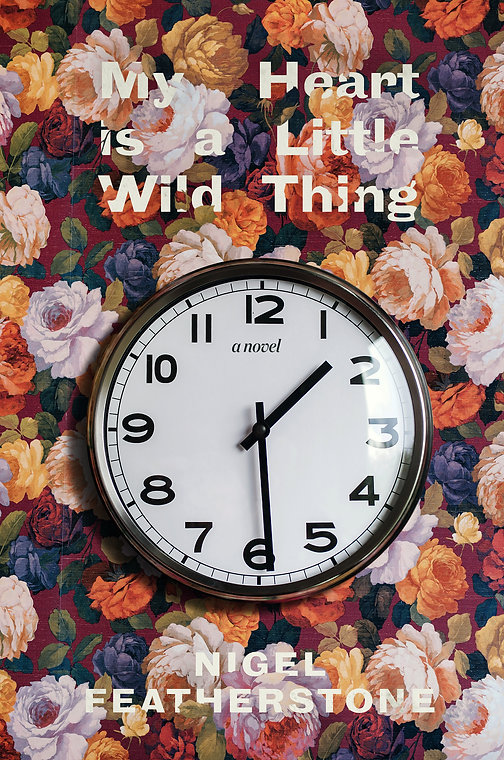
Nigel Featherstone, My heart is a little wild thing (#BookReview)

In late May, I reported on the Canberra launch of Nigel Featherstone’s latest novel, My heart is a little wild thing – and now I bring you my thoughts on this finely-observed book about a man’s reaching for his own life.

I’m going to start with a reflection on a question authors of books like this commonly get, which is, is the book autobiographical? In his launch, Nigel said that the book is not about him, but that things in his life – particularly the death of his mother – did inspire him. The book’s protagonist Patrick is clearly not Nigel, as those who have followed Nigel through his various social media accounts will know. Nigel, unlike the semi-closeted Patrick, has been in a committed relationship for over two decades, and Nigel, unlike Patrick, broke away from home and did forge his own life. At the launch, Nigel said that this book explores what his life might have looked like had he “obeyed his mother”, who didn’t want him to be a writer or to love men.

This novel then, is not his life, but it nonetheless draws on much from his life. For example, like Patrick, Nigel grew up in upper North Shore Sydney and frequented that city’s northern beaches. I enjoyed this because I spent my teen years in the same area, albeit a decade or so ahead of Nigel. I am also familiar with the other two main settings in the novel, the Southern Highlands and the Monaro, and am drawn to both, as I know Nigel is. Like Nigel’s Patrick, I do not really know why I so love the Monaro except, perhaps, because the favourite landscapes of my childhood were those wide open plains of outback Queensland. There is something captivating about them, even though, as Patrick, somewhat prophetically, writes of the Monaro,

It was all wide-screen barrenness, the only embellishment the fence lines, which cut across the tussocky landscape like tripwires.

Patrick shares other interests with Nigel, particularly music. Again, if you follow Nigel, you will know how important it is to him. He has, in fact, composed his own song-cycle. So, when he describes the music created by Lewis, the man Patrick meets, these descriptions, too, feel authentic.

But, despite all these similarities which ground the book so well in lived experience, Patrick is clearly not Nigel. As I listened to Nigel speak at the launch, and as I read the book, I was reminded of a favourite quote from Marion Halligan’s wise novel, Fog garden. The narrator writes about her character Clare:

She isn’t me. She’s a character in fiction. And like all such characters she makes her way through the real world which her author invents for her. She tells the truth as she sees it, but may not always be right.

And this, too, is Patrick.

“a fence I had crossed”

My heart is a little wild thing starts dramatically with Patrick heading off from Bundanoon to the Monaro in a distressed state the day after he’d “tried to kill his mother”. The actuality isn’t quite as bad as it sounds but Patrick, in his mid-40s, had been pushed to the limit by his demanding mother for whom, of her three children, he had pretty much sole responsibility. He needed out, a break, and so after the incident referred to in the opening paragraph, he drives to a steading (or barn) on a place called Jimenbuen, where he had spent many happy family holidays as a child.

Nigel explained at the launch that Jimenbuen is based on a little heritage-listed barn in Bobundra, on the Monaro near the foothills of the Snowy Mountains. It was when staying there that Nigel’s book finally took shape, and it is at Jimenbuen that Patrick finally takes a step towards a new life, when he decides to offer to help a man he has spied planting trees on the other side of the fence. That man is Lewis, and the rest, as they say, is history – except, of course, it’s not quite as simple as all that, because the course of true love rarely runs smooth, in fiction or in life.

However, we follow Patrick as he experiences real love for the first time in his life, and we continue to watch as Lewis returns to his life in Ireland while Patrick returns to his mother. How will it all resolve? That is not for me to share here.

The novel is about many things, but an overriding idea is that of freedom. It is signalled on the third page of the novel when, en route to Jimenbuen, Patrick describes the “odd choices” he’d made of CDs for the trip. “Perhaps”, he wonders, “they reminded me of a time when I felt free”. Three pages further on, Patrick explains that, prior to the incident, he had been planning a short getaway to Sydney, because it was a place where he “could be free”. The idea of freedom recurs throughout the novel. Nearly two-thirds through, he remembers a past conversation with his father, who had told him, “We must live our own lives”. Patrick, at the time, doesn’t fully understand this, fearing it’s “selfish”. And yet, intriguingly, near the end of the novel, Lewis tells Patrick about having seen him, when they were still boys, at a waterhole. Given how Patrick’s life had proceeded, it’s ironic, but Lewis says:

I saw you as neither male nor female, just someone who looked free. I can’t think of anyone more attractive than a person who knows how to be free, and who’s taken risks to be free.

Related to this idea of freedom are those of happiness and living life fully, all of which are encompassed in the novel’s epigraph, Verlaine’s “To live again, undying”. Through Patrick, Nigel explores just what this means – the balances, compromises, and the lines we need to draw every day to live good but true lives.

The novel explores other ideas too, including ageing, and the responsibility of children for caring for ageing parents. Nigel makes clear that this is not a one-way street. Parents need to meet their children half-way. They need to recognise that no matter how loving or dutiful their child is, that child also deserves respect and to be able to live their lives. A balance must be struck. Patrick, we see, gives and gives and gives to his mother, and receives little in return.

Ultimately though, the book is about the power of love and friendship, something that is subtly underpinned by references to a favourite novel that Patrick rediscovers at Jimenbuen. The novel is – and some of you will also surely know and love it – Paul Gallico’s The Snow Goose, about a damaged man and the love he finds and expresses.

During the book’s launch, Nigel talked about the value of fearless writing, which he also wrote about in his essay on Christos Tsiolkas (my post). It’s about being audacious and true – to yourself, your characters and your writing. Nigel has achieved that here, particularly in the way he explores, explicitly but sensitively, the complicated relationship between sensuality and sexuality, love and desire as Patrick reaches for the life that will sustain him.

My heart is a little wild thing is another of Nigel’s warm-hearted, character-focused books that deal with the complexity of family and relationships, and how we live our lives. The heart might be a little wild thing, but this book is a little beautiful thing – and not so little at that.

Nigel Featherstone
My heart is a little wild thing
Gadigal Country/Ultimo: Ultimo Press, 2022
282pp.
ISBN: 9781761150135