Anthony Doerr, Cloud Cuckoo Land (#BookReview)

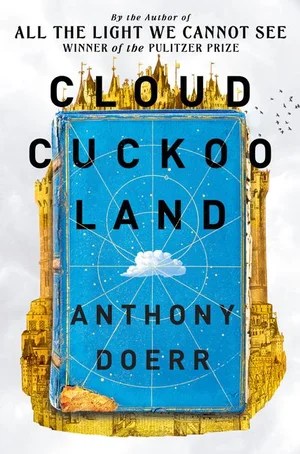
There was a collective cheer from the four librarians in my reading group when one of our members read Anthony Doerr’s dedication for his latest novel, Cloud Cuckoo Land. It goes like this “For the librarians then, now, and in the years to come”. Thank you Anthony! Cloud Cuckoo Land, at over 600 pages, is a big book and, like most big books, is about a lot of things, but threading through it is the idea of the book – and of the role played by librarians in fostering knowledge and reading. Indeed, the central event of the book takes place in a public library.

Those of you who have read the novel will know what I’m talking about, but for the rest of you I’ll take a step back. Anthony Doerr, from my limited experience of two novels, seems to like two things – multiple-points-of-view and young protagonists. All the light we cannot see (my review) has two protagonists from the same era, but Cloud Cuckoo Land takes it to another level with five protagonists spanning multiple centuries.

“It’s like we’re about to walk into the book” (Alex, fifth-grader)

The critical thing about these five characters is that they are outsiders – subversives, even – each confronting the received wisdom of their times. All live precarious lives. In the fifteenth century, in the Rhodope Mountains of Bulgaria, Omeir is born with a cleft palate. Those were superstitious times, so he, his siblings, mother and grandfather are ostracised and find themselves living in a ravine miles from their village. Omeir “imagines the adventures that might lie beyond”. Over the way, in Constantinople, is Anna, a poor orphan, living with her sister in a great embroidery house where they sew for a living. She daydreams about a better life than this, and, as Constantinople falls, sets about achieving it. Meanwhile, in 20th century Idaho, Zeno is born – in 1934, to be exact. He, too, is ostracised, an “undersized orphan with foreigners blood and a weirdo name. Ahead is what?” In the same state, born early in the 21st century is Seymour, living with his impoverished, hard-working, single mother. From birth he is difficult – fussy about food, textures and sounds – suffering, the school decides, from some sort of “disorder” or “combination thereof”. Nature is his sanctuary, “amazing … Big. Alive. Ongoing”. Out there, inspired by the great grey owl he calls Trustyfriend, “lifelong knots deep inside the boy loosen”. Finally, some time into the future, on the spaceship Argos, is Konstance, stuck in a life not of her choosing, and condemned to live all of it on board. She’s imaginative and suffers for it, mystifying her mother who believed their “imaginative faculties” had been “suppressed”.

Threading through each of their stories is a fictional codex from the real Ancient Greek author, Diogenes. It features Aethon, who, having all his life “longed to see more”, wants to become “a fierce eagle or a bright strong owl” and fly to the “city in the clouds”, the titular “Cloud Cuckoo Land, where no one wants for anything”. This codex plays different roles in the lives of our protagonists but for all of them it represents, at some time, hope, dreams and the value of books.

I’ve focused a lot on these characters, but that’s because they are the book. From these introductions you can see that Doerr has chosen young people who have little agency over what happens to them. The novel explores what they do to survive and make meaningful – authentic – lives for themselves in an imperfect world. What does it take to cope?

Fundamentally, the book is about challenge and change. For Aethon, our unifying character, the journey is not simple, and he is changed into undesirable creatures like a donkey and a “humble crow”. For our other characters, life also does not go to plan, with each surprised by what it dishes up to them. There are tricks in store for them – as well as for the reader – including in the codex itself which, in the course of its journey from Ancient Greece to the future, becomes jumbled, so its true ending is lost. However, in 2020, 86-year-old Zeno’s fifth-graders, who are rehearsing his translated and dramatised version in the public library, decide on an end, one that encompasses life’s reality.

Cloud Cuckoo Land, then, is also about books, but they too are vulnerable, as the scholar Licinius tells Anna:

“… books, like people, die. They die in fires or floods or in the mouths of worms or at the whims of tyrants. If they are not safeguarded, they go out of the world. And when a book goes out of the world, the memory dies a second death.”

Fortunately, though, Doerr clearly believes enough of us will safeguard them, and the novel ends way into the future with Aethon’s book being read to a young boy:

“And the tale I have to tell is so ludicrous, so incredible, that you’ll never believe a word of it, and yet”—she taps the end of his nose—“it’s true.”

As many of you will know, I love this.

Now, I’ll return to the title. “Cloud Cuckoo Land” is, literally, the name of an idyllic place in a real Ancient Greek play, Aristophanes’ The Birds, the place Aethon seeks in our codex. But, for me, the title also encompasses some interesting imagery. Cuckoos are birds, and all sorts of birds feature throughout the novel, representing nature, and freedom, amongst other things. Cuckoos, themselves, are sacred in some cultures, but some species, as we know, lay their eggs in other bird’s nests forcing, we could argue, those young to be resourceful outsiders. Then there are the “clouds”. As I read this book I couldn’t get the Joni Mitchell song “Both sides now” out of my head, with its line “it’s clouds illusions I recall .. I really don’t know clouds at all”, progressing to “life’s illusions … I really don’t know life at all”.

These two ideas – resourceful outsiders and life’s illusions – encapsulate for me this truly engaging book. Doerr presents for us life’s challenges – historic, economic, climatic – but he also offers the dreams and resourcefulness of humans in confronting these challenges. Zeno’s friend Rex describes the codex as “part fairy tale, part fool’s errand, part science fiction, part utopian satire”. This could also describe Doerr’s novel, but it is more too. Rich, complex, and highly readable, it contains multiple treasures and connections for engaged readers to find and make on their journey. I have barely skimmed its surface. It was a very popular start to my reading group’s year.

Anthony Doerr
Cloud Cuckoo Land
London: 4th Estate, 2021
627pp.
ISBN: 9780008478308 (e-Book)

Claire G. Coleman, Night bird (#Review)

Wirlomin-Noongar woman Claire G. Coleman’s short story “Night bird” is the second First Nations Australia story in Ellen van Neerven and Rafeif Ismail’s anthology Unlimited futures: Speculative, visionary Blak+Black fiction, the book I chose for Bill’s (The Australian Legend) Australian Women Writers Gen 5 Week. The week finished officially a week ago, but I’m hoping Bill won’t mind my still referencing it. Coleman is not new to my blog. I reviewed her debut novel, Terra nullius, the year after it came out. She has written more fiction and some non-fiction since then, with a clear focus on the devastating impact of colonisation on First Nations culture and people.

“Night bird” continues this focus. It follows Ambelin Kwaymullina’s story in the anthology, “Fifteen days on Mars” (my review), which works well, because both draw on the importance and role of Ancestors in First Nations culture. Coleman’s story is told first person by an artist who is “too afraid to sleep, too tired to be awake”, who drinks to drown her sorrows, who fears she may be “going mad again [my emph]”. She tells us

I am haunted by the ghost of my Ancestors’ Country like a phantom limb …

[…]

I have been cut off from my Country, my ancestors cut up, the land drilled and dug and eaten by machines … my wounded homeland won’t let me rest.

This is not a subtle story. The narrator (whom I think is female, so I’ll go with that) grieves for a life she “could never have” because Country has been “severed”. She has “returned to Country” but, finding it “dead”, “could feel nothing and none” of her Ancestors. She feels haunted, but by what or whom?

I can hear a voice but I can’t make it out. I can hear a song but I can’t catch the words. I can hear the wind and it’s stealing my breath. I can hear nothing and it is screaming.

Country is part of her, but she wants to be free of the haunting, the “wordless voice”, the “phantom presence” that won’t go away. There is a wind, but it is “coming from the wrong direction – away from Country”. Then,

The wind changes, it caresses my back, and suddenly it’s coming from Country.

However, at the same time, a man appears and threatens her. There are now two voices – his and the Ancestors. This is a story about a battle between disempowerment (represented by the man) and empowerment (represented by the Ancestors). Is she, and are they, strong enough to prevail?

I suspect this story was inspired by an experience Coleman describes in her article in Writing the Country (The Griffith Review 63). She describes the life-changing experience of going to Country in 2015, her family’s Country that had been taboo due to a massacre that had occurred there in the nineteenth century. She writes:

I didn’t go there until 2015, that place changed my life forever, my world, my life, even the way I breathed. I took the taboo air into my lungs and I did not die or maybe I did. The bones of my feet landed on the sand and returned to life, I was born again on Country. The story of that place made me a storyteller; story is in my veins.

She says an old man told her that “no matter where we go Country calls out to us” and she writes of the bird, the Wirlo (or curlew), that “to me and mine are family”. Its cry, its scream, “calls me home” – as does the night bird in this story. She describes how Country cares for people as they care for Country. She writes:

I wept when I realised Country had not forgotten me even when I did not know Country. My old-people, my ancestors, would care for me.

All of this is seems embedded in “Night bird”, so now, back to it. It is another example of “Indigenous futurism”. It is ground very much in the real world. The voices that our narrator hears are mysterious, sometimes coming from her phone, sometimes from the air around her, but they are not magical, not fantastical, they are the Ancestors – and the story envisions a healthy relationship with them and thus Country.

On her website, Coleman includes a link to an interview she did with VerityLa after Terra Nullius came out. Among the questions was that one we readers love, which is whether any authors or novels influenced her. The first one she named was HG Wells’ War of the worlds, because it “is great in giving an understanding of how to show an overwhelming powerful enemy destroying a less well-armed defender”.  “In fact,” she says, “War of the Worlds is a powerful text for the examination of invasion and colonisation”. You can certainly see its influence in Terra Nullius, and it is evident here too.

Claire G. Coleman
“Night bird”
in Ellen van Neerven and Rafeif Ismail (ed.), Unlimited futures: Speculative, visionary Blak+Black fiction
North Fremantle: Fremantle Press in association with Djed Press, 2022
pp. 66-73
ISBN: 9781760991463 (eBook)

D’Arcy Niland, The parachutist (#Review)

D’Arcy Niland has appeared in my blog before but not in his own right. He was the Australian-born husband of the New Zealand-born Australian writer Ruth Park. I have posted on their collaborative memoir, The drums go bang, and have written specifically about Ruth Park, but have never written specifically on Niland before.

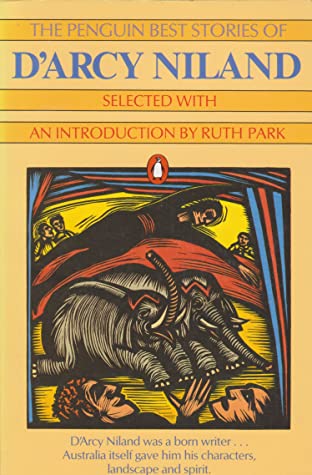
Niland is best known for his novel The shiralee, but he and Park were working writers who made their living from their craft, which means they wrote a lot – radio scripts, journalism, short stories, and novels. My path to his short story, “The parachutist”, though is a bit complicated. Over a decade ago, when my mother-in-law was still alive, I would search for suitable audiobooks for her, by which I mean books that had straightforward narratives, and not too much explicit sex and violence. She was 97 (and legally blind) when she died. A collection of D’Arcy Niland short stories seemed a possibility, but I’m not sure she ever did listen to it. Regardless, it ended back with us after she died, and we finally started listening to it on a recent road trip. The first story is titled, “The parachutist”.

Now with collections, I like to know each story’s origins. I discovered that the audiobook was based on a collection of Niland’s short stories selected by Ruth Park and published by Penguin in 1987. A start, but when did Niland, who died in 1967, write the story? The Penguin book might provide that information, but I don’t have it. However, given that back in Niland and Park’s heyday, newspapers were significant publishers of short stories, I decided to search Trove and, eureka, I found it. Well, that is, I found his story “The pilot”, which turned out to be the same story that was later published as “The parachutist”.

This discovery created another mystery: why the change of title? And when? Again, maybe Ruth Park discusses that in her Penguin introduction but … so, let’s just get on with the story. The plot concerns a predator and its prey. It starts just after a hurricane. A hawk, “ruffled in misery” comes “forth in hunger and ferocity” looking for food, expecting to find some “booty of the storm”. However, there is none, so it widens its search. Niland beautifully captures the devastation of the “ravaged” landscape and weakened hawk’s situation: “Desperate, weak, the hawk alighted on a bleak limb and glared in hate”. It’s vivid, visceral writing – and we feel some sympathy for this hawk.

It spies a dead field mouse, and gobbles it “voraciously”, but it’s not much as food goes, and just makes “the hawk’s appetite fiercer and lustier”. Niland, at this point, also introduces us to the hawk’s real nature, to the way it would normally “sup …. on the hot running blood of the rabbit in the trap, squealing in eyeless terror”. It will eat creatures still alive, in other words. Anyhow, still “frenzied with hunger”, this hawk spies something in a farmyard – a kitten playing, “leaping and running and tumbling”, completely “unaware of danger”. Life is fun. After checking for human presence, the hawk swoops, and suddenly the kitten finds itself “airborne for the first time in its life”:

The kitten knew that it had no place here in the heart of space, and its terrified instincts told it that its only contact with solidity and safety was the thing that held it.

It latches on for dear life. This is a powerful story that keeps your attention from beginning to its – hmmm – somewhat surprising end, which I won’t spoil. Instead, I will briefly return to the title. Niland describes the hawk and kitten doing battle in the sky, writing that, with the hawk now descending, the kitten “rode down like some fantastic parachutist”. Soon after, when the kitten’s claws are digging into the hawk’s breast, he says that “the kitten was the pilot now”.

So, “pilot”? This could suggest that the kitten is in control, but is it? “Parachutist”, on the other hand, seems more subtle, implying a somewhat mutual relationship between the two. It is not the sort of freely chosen relationship that parachutists traditionally have, but this later title introduces an ambiguity into the narrative.

I found the story compelling. It is told third person limited, with our point of view, and sympathy, shifting between the two protagonists. Its subject matter might be nature, but its themes are more universal, encompassing predator and prey, the powerful and the powerless, experience and innocence, and of course survival, given at different points in the story both the hawk’s and the kitten’s survival is at stake. What to do?

Also, this might be a long bow, but Niland apparently said about his 1955 novel The Shiralee, that “it is a Biblical truth that all men have burdens. This is the simple story of a man with a burden, a swagman with his swag, or shiralee, which in this case happens to be a child. I have often thought that if all burdens were examined, they would be found to be like a swagman’s shiralee – not only a responsibility and a heavy load, but a shelter, a castle and sometimes a necessity.” “The pilot” was published two years earlier, but we could argue that for the hawk, the kitten, with its fierce frenetic claws, turns into a burden. The storyline and outcome are simpler, of course, but was Niland playing with this idea too in his story?

Whatever, “The pilot” or “The parachutist” beautifully exemplifies Niland’s ability to capture and hold his reader’s attention with a strong narrative and expressive writing. I hope to share more of the stories in future.

D’Arcy Niland
“The parachutist” in Short stories collection
(Read by Dennis Olsen)
ABC Audio, 2007
ISBN: 9780733390616

D’Arcy Niland
“The parachutist” in The Penguin Best Stories of D’Arcy Niland
Penguin Books, 1987
ISBN: 9780140089271

D’Arcy Niland
“The parachutist” The Oxford book of animal stories
London, Oxford University Press, 2002 (orig. pub. 1994)
ISBN: 00192782215

D’Arcy Niland
“The pilot” in The Mail (Adelaide), 28 March 1953
Available online

Ambelin Kwaymullina, Fifteen days on Mars (#Review)

In 2014, Ambelin Kwaymullina, whose people are the Palyku of the Pilbara region of Western Australia, described herself in a Kill Your Darlings essay as writing “speculative fiction for young adults”. Three years later, in the 2017 Twelfth Planet Press anthology, Mother of invention, she said that she was “a Palyku author of Indigenous Futurisms”, citing Grace Dillon (as did I in this week’s Monday Musings) as the term’s originator. I share this progression in her thinking because it’s indicative of the energy and intellectual engagement among First Nations people with literature and the politics of what they are doing. Kwaymullina is an example of a First Nations Australian writer who is actively engaged in First Nations culture and thinking, as well as in the craft of writing.

I first came across Kwaymullina early in my volunteer work for the original Australian Women Writers Challenge, because many reviews for her young adult novels were posted to our database. But, I had not read her because YA literature is not my thing. However, I decided to read Ellen van Neerven and Rafeif Ismail’s anthology Unlimited futures: Speculative, visionary Blak+Black fiction for Bill’s (The Australian Legend) Australian Women Writers Gen 5 Week 15-22 January, and the first work in the anthology by an Australian woman was “Fifteen days on Mars” by Kwaymullina. Woo hoo… here was my chance to finally read her. I will post on more in this fascinating book, which I’ve not yet finished, later.

“Fifteen days on Mars” is an accessible short story, told chronologically from Day One to Day Fifteen. The politics is made clear in the opening paragraph, by beautifully skewering colonial settler behaviour concerning the naming of places:

It had been almost a year since we came to Mars. That was what I called this place although it had another name. It was Kensington Park or Windsor Estate or something like that but I couldn’t have said what because I could never remember it.

Our first person narrator Billie and her mum have come to Settler suburbia, where they are “the only Aboriginal people”, for some reason that is not immediately clear though we sense there’s a specific purpose. Billie hadn’t wanted to come but, as her mother’s only offspring without children, she’d drawn the short straw. The story starts with her pulling weeds from their garden, the very plants that the rest of the neighbourhood love, plants (I mean “weeds”) like roses. In this metaphorical way the colonial setting is established. This is a world we know. Very soon a new couple moves in across the road. Billie, at her Mum’s insistence, does the neighbourly thing, and makes contact. She quickly realises that their new neighbour, Sarah, is being abused by her husband, whom Billie calls The Suit. What to do?

To this point, notwithstanding the hint at the start that there’s something unusual about the situation, the story reads like a typical piece of contemporary fiction – that is, set in the known present world. But slowly, we become aware that something else is going on. Billie refers to “the rules”. Does she just mean the normal “rules” of social behaviour? Nope, our suspicion is right, there is something else. There’s reference to Sarah needing to “ask”, and to whether what or how she asks is “good enough for them upstairs”, aka “the Blue”, as Billie’s mum calls them. Billie says:

the truth was we knew very little about them, except they were some kind of intergalactic healers. But we knew why they’d come. It was because of the Fracture.

So now it’s clear we are in speculative fiction/Indigenous Futurism/Visionary Fiction/SFF territory. This is the sort of speculative fiction I can enjoy, something that doesn’t require me to learn a whole new world but that injects something new into the world I know, something that upends it a little.

The Fracture is not fully explained, but “something had smashed into the relationships that were space-time and cracks had spread out from the point of impact” resulting in, says Billie, “bubbles of the past floating across my reality”. The Blue, we are told, are trying to repair this Fracture, leaving humans “to do something about the bubbles” – but to the Blue’s rules. Billie’s mum had signed up “for the job of changing the bubble-world, or at least, of changing some of the people enough so they could exist in our reality”. Hmm, this makes them sound a bit like missionaries. An ironic twist?

Anyhow, the story continues, with a strong reference to the Stolen Generations, as Billie and her Mum, recognising these are “strange times”, try a different tack to save Sarah, and call on the ancestors. They hope the Blue won’t mind.

I will leave it there. I enjoyed the story – because it tells a First Nations story truthfully but generously; because the characters of Mum and Billie, while being somewhat stereotypical (the wise Mum and the reluctant Billie), are warm and engaging; and because the ideas and the story itself are intriguing to watch being played out.

In her 2017 piece cited above, Kwaymullina describes Indigenous Futurisms as “a form of storytelling whereby Indigenous peoples use the speculative fiction genre to challenge colonialism and imagine Indigenous futures”. This is exactly what she does in “Fifteen days on Mars”. The colonial legacy is unmistakeable, with most inhabitants of Settler suburbia remaining “unbelievably ignorant”, but she also offers glimmers of hope. I don’t eschew bleakness, but as an optimist I also appreciate it when writers can see paths to a better future. It’s energising.

Ambelin Kwaymullina
“Fifteen days on Mars”
in Ellen van Neerven and Rafeif Ismail (ed.), Unlimited futures: Speculative, visionary Blak+Black fiction
North Fremantle: Fremantle Press in association with Djed Press, 2022
pp. 42-64
ISBN: 9781760991463 (eBook)

Jessica Au, Cold enough for snow (#BookReview)

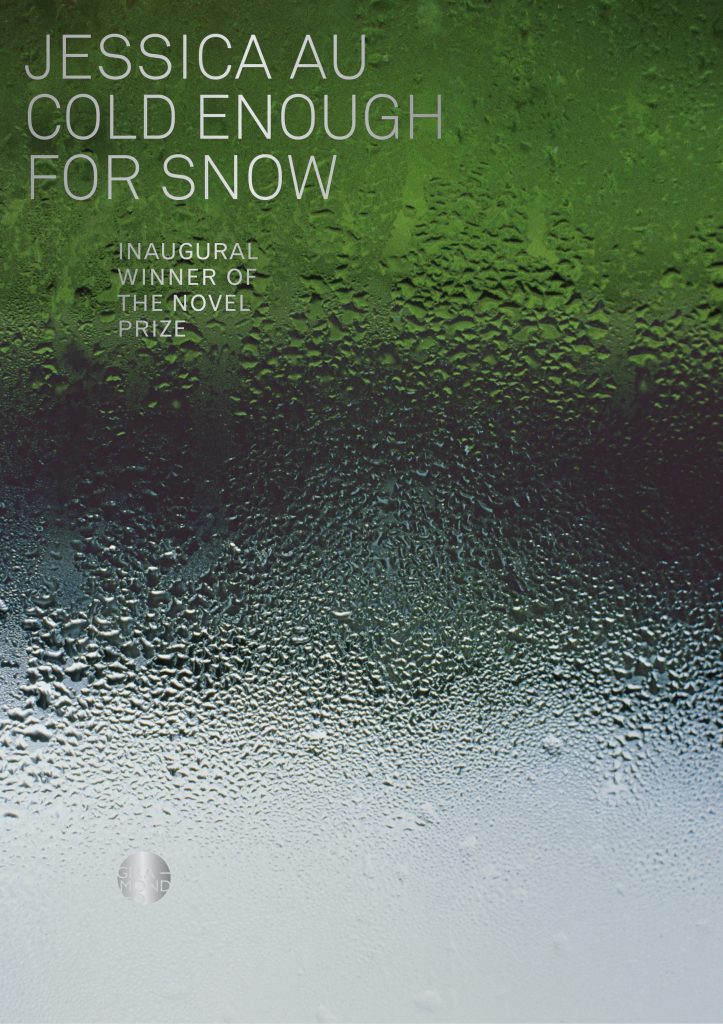
What did I say about mothers and daughters recently? Just when I thought I’d done with them for the year, along came another, Jessica Au’s gorgeous novella, Cold enough for snow. However, before I get to that, let me describe the award it won, The Novel Prize.

Cold enough for snow was the inaugural winner of this plainly named, but ambitious prize which was established by three independent publishers, Australia’s Giramondo Publishing, the UK and Ireland’s Fitzcarraldo Editions, and North America’s New Directions. It is “a biennial award for a book-length work of literary fiction written in English by published and unpublished writers around the world”, and looks for “works which explore and expand the possibilities of the form, and are innovative and imaginative in style”. The winner receives US$10,000 and simultaneous publication of their novel in Australia, New Zealand, the UK and Ireland, and North America.

Jessica Au’s novel was selected from over 1500 entries worldwide, and was published in the above-named territories this year, but is to be published in many more. It has made quite a splash, and was one of the most favourited Australian books in my recent 2022 Favourite Picks post. Those who nominated it used words like “meditative”, “mesmerising”, “elegance”, “exquisite” and “quietly brilliant”. I would agree with those.

Told first person, Cold enough for snow revolves around a holiday in Japan organised by a daughter for herself and her mother. They walk, and travel by train; they visit shops, cafes, galleries, churches and temples, the things you do in Japan. Very few places are identified, keeping the focus on the characters and the ideas being explored, rather than on travel. As someone who has visited Japan several times, I was initially frustrated by this. I wanted to compare my experiences with theirs, but I soon realised that this was not that sort of book. Once I accepted that, I also realised that it was, in fact, the sort of book I enjoy.

By this I mean that it is one of those quiet, reflective books, ones without a lot of plot – albeit I like plots too – but with lots to say about life and relationships, and with much to make you think. The novel has an overall chronological trajectory following the daughter and her mother’s journey but, along the way, the daughter – our first-person narrator – digresses frequently to consider other people and relationships in her life, particularly with her sister and partner. It is in these digressions, in particular, that we get a sense of what this trip is about.

Ostensibly, the book is about the daughter and her mother, who live in different Australian cities, reconnecting. In the opening paragraph, the daughter describes their walking to the train station:

All the while my mother stayed close to me, as if she felt that the flow of the crowd was the current, and that if we were separated, we would not be able to make our way back to each other, but continue to drift further and further apart.

However, it soon becomes clear that it is the daughter who is more concerned about drifting further apart. A couple of pages in she mentions that on a previous trip to Japan with her partner Laurie – one of the few named people in the novel – she “remembered thinking” that she wanted to share some of the fun she’d had with him with her mother. On the next page, she refers to a bonsai plant that her mother had had, and “remembered disliking it”, perhaps because it looked “unnatural, lonely, this very detailed, tiny tree, almost like an illustration, growing alone when it looked as if it should have been in a forest”. Subtly, Au has conveyed in the opening pages that the seemingly sure and in-control young woman we thought we had met is not that at all. Gradually this becomes more explicit. Nearly halfway through the novel, in one of her many digressions, she describes house-sitting for a lecturer and comments that “somehow it felt like I was living my life from outside in”.

There is a melancholic tone to this novel, which is not to say it is unhappy. It is simply that our narrator is uncertain about her life, while her mother, for whom she feels responsible, is quietly self-contained. Her relationships – with her partner, Laurie, with her sister, and with her mother – seem positive enough. It’s a ruminative book, in which the daughter’s thoughts roam between history, art, and life past and present, seemingly at will, but of course all carefully structured by Au to lead us to a deeper understanding. It’s a short book but I took time to read it because the thoughts and ideas, so quietly and delicately expressed, would constantly pull me up – because I am used to looking for meaning and answers in my reading. For example, early in the novel, she recounts looking at some pots in a museum. They were “roughly formed but spirited”, their handmade utility “undifferentiated from art”. I could grasp these ideas. So, it’s about art and life I thought, but then later, discussing Laurie’s father’s art, the daughter remembers feeling she didn’t “even know enough to ask the right questions”. And I realised that, perhaps, neither did I – and that this book, in which time and memory move fluidly rather than exactly, is about something very different.

The Japanese setting is perfect for this novel, because Japan too is paradoxical. In the cities, particularly, where our two spend most of their time, Japan is a bustling place but it also, sometimes in the smallest ways, manages to simultaneously exude stillness and quietness. Similarly telling is that the trip takes place in autumn – the mother and daughter’s favourite season – which is surely the season most conducive to reflection, and to the idea of change over which we have no control.

Early in the novel, one of the issues confronting our narrator becomes clear, that concerning whether to have children. She and Laurie have been discussing it exhaustively – between themselves, with their friends, and, it seems, also with her mother. She’s aware that, unlike her own generation, her mother very likely never had the opportunity to choose, and she comes to wonder

if it was okay either way, not to know, not to be sure. That I could let life happen to me in a sense, and that perhaps this was a deeper truth all along, that we control nothing and no one, though really I didn’t know that either.

Cold enough for snow is not easy to write about because its very essence is the mutability of life. How do you pin down something that seems to be about being unpinnable? And yet, Au manages to pin down this very fact, or, at least, to convey the idea that, as the daughter glimpses near the end, “perhaps it was alright not to understand all things, but simply to see and hold them”. A good book, methinks, to end the year on!

Lisa also reviewed this novel.

POSTSCRIPT: An excellent interview with the author on the publisher’s website.

Jessica Au
Cold enough for snow
Artarmon: Giramondo, 2022
98pp.
ISBN: 9781925818925

Nell Pierce, A place near Eden (#BookReview)

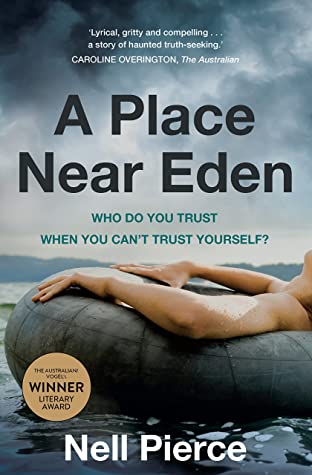
Nell Pierce’s debut novel, A place near Eden, won the 2022 The Australian/Vogel Literary Award. It was my reading group’s last book of the year, and it engendered a lively discussion, partly because our response was mixed and partly because its setting on the south coast of New South Wales is well-known to us.

Part coming-of-age novel, part mystery, part family drama, A place near Eden is told first person in the voice of Tilly who is around 20 years old when she is telling her story to a mysterious “you” – at least, “you” is not revealed to the reader until around half-way through the novel, so I won’t reveal it now. I can reveal however, that Tilly is trying to tell her side of a story to this “you”, and slowly, what this story is comes out of the murky recesses of her memory.

My reading group’s practice is to start with each of us briefly sharing our first impressions before we settle into deeper discussion. My first impressions for A place near Eden were that I loved its exploration of how truth can be manipulated or twisted, of different versions and perspectives of the same experience, and of the difference between facts and truths, in personal lives, in law, in art, but that I found the tone a bit heavy-handed, with little respite. Respite in tone – as Shakespeare knew – is good. A place near Eden is a reflective novel in which Tilly reviews the events that had happened to her, trying to make sense of them, so its tone is peppered throughout with “perhaps”, “maybe”, “looking back”, “in retrospect”, “now”, “still” and so on. It was a little unremitting. However, A place near Eden is a first novel so can be forgiven some flaws.

As you will have guessed, the title has both literal and metaphorical meanings: it is set near Eden in southern New South Wales, and the characters may be “near” but they don’t achieve being “in” Eden (paradise). Their own flaws prevent it.

The story starts with a prologue which looks back to halcyon days in the life of Tilly, then 13 years old, and her foster brother Sem and friend Celeste who were 14, almost 15 years old. The dynamic is set between them, one in which the younger Tilly is seen by the other two as “just a kid”. There is a bit of an experience gap between them – as can happen at the time of early puberty. An incident happens at the local pool that sets us up for the tone of the book, though it’s not “the” incident on which the book centres. In this incident, a small child falls – or is knocked – and hurts his head. Who did it? Tilly blames Celeste, though she herself “might” have done it. Writing later, she says:

The more I think on things, one way or the other, the more real they seem. That I was afraid of getting in trouble. Or that I wanted to punish Celeste. That it was her fault, or mine. I can believe it either way.

Throughout the novel, which primarily takes place when Tilly and Celeste are around 19 to 21 years old, the story is told in this maybe-this-maybe-that sort of tone. It is, essentially, a story about finding one’s self, one’s identity. In this case, it’s Tilly’s, so we see it all through her eyes, as she struggles to keep up with the just-a-bit-older, just-a-bit more experienced, just-a-bit more confident Celeste. This sort of uneven friendship is difficult to maintain.

“it could play either way” (Tilly)

So we come to the critical incident. Tilly and Celeste have been living at a holiday shack near Eden, while Sem – who is in a relationship with Celeste – comes and goes at will. One night, however, he disappears, and Tilly, who was drunk at the time, is blamed for it. Did she cause it or didn’t she? This is what she is trying to comprehend and explain to “you”.

Tilly is a character who likes facts – her preferred reading is the encyclopaedia – but she is aware that there is often a gap between facts and the truth (which she describes as “something that hissed out”). She is aware that “even when people try to tell the truth about something as mundane as a tomato, they couldn’t help but betray other things about themselves”. So, what are we to believe from this self-consciously unreliable narrator, from this narrator who says to us “saying something with confidence … can make a story real” and that “maybe we all embroider the truth sometimes”? Late in the novel, when she writes about telling her story to her lawyer, she says “I could feel stories emerging in my mind, ways of presenting things that I knew would please her”. She admits to lying to both the police and the lawyer, but that doesn’t, in fact, mean she is guilty of what she is accused of.

Alongside Tilly telling her story is her description of the documentary film being made about the case by her erstwhile boyfriend, Peter, who tells the story from three angles – the lost, troubled boy (Sem); a revenge story (Tilly); the manipulator (Celeste). In each version, different pieces of information are omitted to construct a specific viewpoint about what happened. It’s a clever portrayal of the “art” of the documentary. Tilly sees how “controlled” it is, and admits that she had “thought in art there might be truth”. Not here … though she had seen “truth” in Celeste’s portraits.

The book’s tagline on the cover is, “who do you trust when you can’t trust yourself?” This personal story is part of it, and reminds me of the recent conversation I attended with Heather Rose. She commented that “life is a process of forgiveness for the choices we make in order to be ourselves”. This could easily describe Tilly’s situation, as she struggles to come to terms with what she did – or what she may have done – in that tortuous process of becoming herself.

However, Nell Pierce also has a bigger story to tell, I believe. Late in the novel, Tilly comes to realise that, like her Mum, she is “sceptical of these neat stories we tell about people”. By concluding her book without a neat resolution, Pierce suggests to us that we too should beware of “neat stories”, that we should take nothing at face value. Question everything, just as Tilly seems to do.

Lisa also found this an intriguing book.

Nell Pierce
A place near Eden
Crows Nest: Allen & Unwin, 2022
296pp.
ISBN: 9781761066177

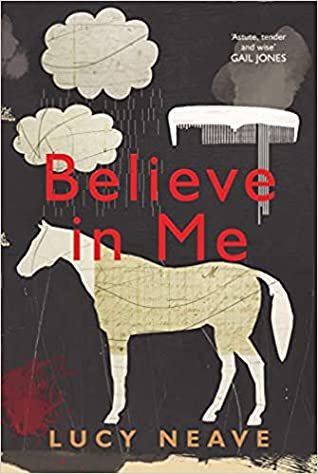
Lucy Neave, Believe in me (#BookReview)

Mother-daughter stories – in fiction and nonfiction – seem to have been particularly popular in recent years. Lucy Neave’s second novel Believe in me is one of these, but just this year I’ve read several others, including Larissa Behrendt’s novel After story and Jane Sinclair’s hybrid biography-memoir Shy love smiles and acid drops.

Their trajectories can vary, but in novels the most common one concerns a fractured relationship. More often than not, they are written from the point of view of the daughter (though in After story, Behrendt alternates the perspective between the two). Believe in me is one of those written from the daughter’s perspective, but in an interesting voice which switches between extended third person telling of her mother’s life and her first person telling of her own. The narrative starts around a year before Bet is born, out of wedlock in 1970s Sydney, to her 19-year-old American mother, Sarah. Why in Sydney and how Sarah became pregnant occupies the first quarter of the book.

However, the novel itself commences in 2004 with Bet telling us:

I would like to write down the portions of my mother’s story that I know, but I’m not exactly sure what happened to her in the year before I was born. At times, the anecdotes she told about her life make sense. At others, I traverse a tightrope high above the ground and have to fill the empty air beneath so that I can move from one place and time to another.

She is doing this because, she says, “if I can inhabit her consciousness, even a little, it might help me see who I am”. Immediately, then, we are clued into a problem, presumably the book’s key problem, that of Bet wanting to understand herself. She’s stalled it seems, but she needs, she continues, “to walk towards the future without always looking back”. Consequently, she tells her mother’s story by drawing on her mother’s scrapbooks “which are filled with overlapping memories and souvenirs and notes” and her own memory.

Sarah’s story is a sad and frustrating one. Bet introduces her in that first chapter as a naive, trusting 18-year-old from Poughkeepsie, New York. She’s being sent away by her mother, and the religious community to which they belong, on a three-month mission to Idaho with their preacher Isaiah. Well, the inevitable happens and Sarah finds herself unbelieved, pregnant and despatched to Sydney, far away from home, to have the baby. Sarah is expected to give her baby up for adoption – to a childless aunt and uncle who show her no warmth. However, with the help of midwife Dora, she manages to escape, and thence begins her new life as a single mother in a strange country. The Whitlam government is in, and things are changing, but life is still not easy for a single mother, particularly one as unprepared for life, and as unsupported, as Sarah was.

While the focus of the novel is Sarah, it is told through the eyes of Bet, and in Bet’s eyes her mother rarely measures up. She frequently describes her as weak, when Bet really wants her mother to be “unbroken, robust”. The child’s eyes, however, seem to be at odds with the reality. For example, one-third into the novel, Sarah realises that her own mother back home is never going to help her:

Sarah had thought that in the end her mom would understand what she needed … Now she understands her longings have always been irrelevant. She’s meant to accept all that she receives. Only sometimes, like now, she can’t. In any case, she’s someone else now, different to the core.

This idea of “acceptance” is an important mantra for Sarah. Religious in origin – accept what God gives you – it often frames her choices, but in fact, she doesn’t always “accept”. Indeed, she flees several men when she realises they are not right for her:

Some things, she realises – and why did it take her so long to work this out – should never be accepted. Some things turn out not to have come from heaven.

Nevertheless, a few pages later, Bet continues with the weakness theme, “a part of her was still weak, the way it had always been”. The story here is one of the child never fully knowing the parent. It’s ironic, in fact, that Bet sees Sarah as naive, which she was, because for much of the novel, so is Bet in terms of understanding the pressures Sarah was under. The result is an uncomfortable but very real tension between these two who both love each other but struggle to make that love work.

The idea of “acceptance” is one motif that runs through the novel, but another involves animals. Sarah becomes a wildlife carer – particularly for injured wildlife – and Bet, a vet, which reflects their mutual desire to nurture. More curious though is the fox motif which threads through the story. A baby fox, back in her American childhood, is the first wildlife Sarah rescues and cares for. She eventually releases him, but “foxes will always be with you” becomes a bit of a grounding talisman for her. The clue to it lies in her mother Greta’s advice when she sends Sarah off: “Don’t worry about us. Be as free as a bird, as a fox”. In the tradition of mothers and daughters, Greta wants more for Sarah than she had, just as Sarah in her turn wants more for Bet – and yet, in their turn, the daughters don’t understand and so don’t appreciate this in their mothers.

I did find one aspect of the novel somewhat challenging, and this relates to its “interesting voice”. I love “interesting voices”, but there were times when Bet’s telling of Sarah’s story felt awkward. How did Bet know this? Was it from the scrapbooks, from conversations, from Sarah’s own confidences, or Bet’s imagining? The uncertainty this occasionally engendered affected my ability to properly engage with Bet’s perspective. However, I did enjoy the novel, particularly the way Neave weaves through it many of the social issues affecting women in the decades she traverses. There’s a political element to this personal story.

So, how to end? Or, more to the point, what does it all mean? When I’m in doubt, there are three things I turn to – the opening paragraphs, the title, and, where it exists, the epigraph. I’ve already mentioned the opening which explains that Bet is writing Sarah’s story in order to understand herself better. This, I’d say, she achieves (but to say how would give too much away).

Believe in me does have an epigraph, and it’s appropriate for a book about fraught mother-daughter love. It’s from Eudora Welty’s The optimist’s daughter, “… any life, she had to believe, was nothing but the continuity of its love”. I’ve read some Welty, but not this one. However, this idea seems perfect for a daughter to take from her mother’s life.

And finally, there’s the title. It’s a little trickier. As I was reading the novel, I wondered who was saying “Believe in me”? Sarah? Bet? God (whom she’s supposed to accept)? The egregious Isaiah who tried to convince Sarah to lie for him? Probably all of these, conveying the challenge we all face regarding who to believe and trust. It’s only through hard experience that we come to really know whom we can believe. Lucy Neave’s Believe in me, with its perceptive exploration of complex relationships, is one of those reads that makes you think, and for that I enjoyed it.

Lisa also reviewed and enjoyed this book.

(Review copy courtesy UQP)

Lucy Neave
Believe in me
St Lucia: UQP, 2021
312pp.
ISBN: 9780702263361

Elizabeth von Arnim, Expiation (#BookReview #1929 Club)

I cannot remember when I last laughed out loud – a lot – when reading a book. The book that broke the drought is Elizabeth von Arnim’s Expiation. Even in her darkest, grimmest novel, Vera (my review), Von Arnim managed to make me splutter several times, albeit ruefully. Expiation, though, caused no such qualms.

I have loved Elizabeth von Arnim since I read Elizabeth and her German Garden in the early 1990s when Virago started publishing her. I went on to read several more of her books over the next few years, but then had a big gap until this year, when I read Vera. It reminded me how much I enjoy her. So, when I saw she had one published in 1929, I selected it for Karen and Simon’s 1929 Club. I finished it more or less on time, but the last couple of weeks have been so busy that I didn’t get to post it until now.

The edition I found was published by Persephone. They describe publishing it as first for them, because “it’s a novel by a well-known writer that has been entirely overlooked”. While most of Von Arnim’s books are in print with other publishers, Expiation, which they were now publishing ninety years after its first appearance, had been ignored. Why, they ask? Good question. I admit that, not having seen it around, I did fear it might be lesser.

Persephone offers some reasons. Firstly, the title “is not very catchy”. True, it’s not. They also suggest that its adultery theme would have been “faintly shocking” in 1929, and further that, although we now read it as a satire, at the time “the characters and their milieu may have seemed rather tame”. Would the satire have been missed? Anyhow, they quote from the novel’s opening chapter, which describes the novel’s central family and the London suburb they live in:

That important south London suburb appreciated the Botts, so financially sound, so continuously increasing in prosperity. They were its backbone. They subscribed, presided, spoke, opened.

This last sentence, Persephone says, “was what deliciously and instantly convinced us that this was a book for us”. I am so glad they did because from the first few pages I could tell it was a book for me too. It truly is delicious.

So now, the book. As you’ve gathered, the plot centres around adultery, which is made clear in the opening chapter. Milly has just been widowed, and her wealthy husband, Ernest Bott, has only left her £1,000 of his £100,000. The rest he has left to a charity for fallen women, with the cryptic note that “My wife will know why”. She does, of course, but thought she had got away with it. What is remarkable about this book, which chronicles how both Milly and the Botts react to the situation, is that we remain sympathetic to Milly. She’s a sinner, she knows she’s a sinner, but she wants to expiate. How, is the question?

The Botts, meanwhile, don’t know what to do. They do not want scandal to ruin their good name, and, anyhow, the male Botts in general rather like round, plump Milly versus their “bony” wives. Moreover, they are not known for meanness: “The family had always behaved well and generously in regard to money, and it would never do for Titford to suspect them of meanness.” Hmmm, a bit of appearance-versus-reality going on here. So, having decided, Jane-Austen-Sense-and-sensibility-style, not to give Milly some of their money, they agree to take her into their homes, in turn, until it all dies down, after which she can go live with Old Mrs Bott, who is perfectly happy to have her. Old Mrs Bott is the voice of reason in the novel. Experience has taught her

that in the end it all wouldn’t have mattered a bit what Ernest had meant or what Milly had done, and that they might just as well have been kind and happy together on this particular afternoon, as indeed on all their few afternoons, and together comfortably eaten the nice soup and sandwiches.

However, a spanner is thrown in their works when the shocked and mortified Milly disappears the day after the funeral. To say more about the plot would give too much away – even though the plot is not the main thing about this book.

What Von Arnim does through this plot is take us on a journey through humanity. Milly’s attempts at expiation often fall flat, either because she doesn’t manage to do what she plans or because others don’t behave towards her as she expects, even wants, them to do. For example, on one occasion, she has “no doubt at all that here at last she was in the very arms of expiation” and yet it comes “to her so disconcertingly, with a smile on its face”. Can this really be expiation? Milly’s not sure. One of the book’s ironies – and points – is, in fact, that the greatest sinner, technically, is among the kindest in reality.

The thing I like about Von Arnim is her generosity. It is on display throughout this novel as Milly, seeking expiation (but also to survive) moves between people she knows, from her previously sinning sister and her obliviously self-centred lover to the various Botts who range from the puritanical and pompous to the warm and lively. Most of these characters, like Austen’s, may come from a narrow realm of society but they represent a much wider spectrum of human behaviour. Like Austen, too, Von Arnim’s targets are not just the personal – greed, selfishness, narrow-mindedness, silliness, pride, self-importance, ignorance, and so on – but the societal, particularly gender, marriage and money. “Too much worldly prosperity”, she writes for example, “deadens people’s souls”.

So, in Expiation, Von Arnim skewers human nature and her society much like Jane Austen does. Sometimes the situations may be a little dated as they can also be in Austen, but human nature itself doesn’t change much – and this is so knowingly, so inclusively, and so generously, on display. There are some less than stellar people here, of course, but as in Austen, they are treated with respect for their humanness by the author, while also being exposed for exactly who they are. I’m going to – with difficulty – choose just a couple for you, one touching on the theme of sinning and morality, and the other on money.

Here is the eldest Bott, Alec, trying to avoid hosting Milly first, because of his wife’s puritanical approach to life:

He stopped, an undefined idea possessing his mind that Milly might be purer after having passed through the sieve of other visits, and more fit to stay with his wife …

Von Arnim’s language – so fresh and funny. And here is another Bott, Fred, telling his sons they will be helping Milly:

“Do you mean financially?” inquired Percy, his eyes still on his paper.
“Kindness,” said Fred.
“Kindness! Well, that’s cheap, anyhow,” said Dick.
“And easy,” said Percy, turning the pages. “I always liked Aunt Milly.”

Finally, I will leave you with one more bon mot from Old Mrs Bott who reflects, at one point during the novel:

It seemed as if these poor children had no sense whatever of proportion. They wasted their short time in making much of what was little, and little of what was much.

With a wit and a sense of humanity that is a joy to read, Expiation encourages us to think about what is important to living both a good life, and a kind and fair one.

Elizabeth von Arnim
Expiation
London: Persephone Books, 2019 (orig. pub. 1929)
314pp.
ISBN: 9781906462536

Elisa Shua Dusapin, Winter in Sokcho (#BookReview)

French Korean writer Elisa Shua Dusapin’s award-winning debut novella, Winter in Sokcho, was published when she was just 22 years old. As the title conveys, it is set in Sokcho, a tourist town in the Republic of Korea near the border between the two Koreas. In fact, when the Korean peninsula was divided into two countries following World War II, Sokcho was on the Northern side, but became part of the South after the 1953 Korean War armistice 1953. I suspect Sokcho was chosen as the setting partly for its “divided” history, this being in-between, neither one thing or the other,

But, more on that later. The novel’s unnamed first person narrator is a 24-year-old French Korean woman who works in a struggling guesthouse. She seems to do everything – reception, cooking, cleaning – but with little enthusiasm. The novel opens with the arrival of an unexpected guest, the 40-something French graphic novelist, Yan Kerrand. The two are drawn to each other in some way, but, at least from Kerrand’s point-of-view, it doesn’t seem to be romantically driven. For our protagonist, the situation is a little more complex. She has a boyfriend – Jun-Oh – but it’s not a satisfactory relationship from her perspective. However, her fish-market worker mother is expecting an engagement any day. The situation is ripe for something different to happen in her life, but will it – and what, anyhow, does she want? She seems betwixt and between.

Winter in Sokcho has many of the features I like in a novella, starting with spare expressive prose, a tightly contained storyline, and a confined setting. There’s also a small cast of characters, with little or no digression into backstories. All we have is what’s happening now.

And, what is happening now is that the stranger’s appearance has affected our narrator. In the second paragraph, while registering him as a guest, she says

I felt compelled for the first time since I’d started at the guest house, to make excuses for myself. I wasn’t responsible for the run-down state of the place. I’d only been working there a month.

We then move to her visiting her mother, and another thread begins to appear, that of body image. We’ve already been told that one of the guesthouse guests is “seeking refuge from the city while she recovered from plastic surgery to her face”, and now we are introduced to our narrator’s mother’s concern about her appearance. She’s too thin, her mother says. Our narrator rejects this, but soon after, in a photograph her boyfriend has taken of her, she sees “a wasteland of ribs and shoulder blades receding into the distance … her bones sticking out” and is “surprised at how much”. When she’s with her mother, she binges on the food her mother makes, only to feel “sick” and later repelled by her “misshapen body”. There is a tension between this single mother and her daughter that pervades the novel. We sense that our narrator would like to leave Sokcho. Indeed, there’s a reference early on to the “literary world” suggesting she has aspirations in that area, but she feels she cannot leave her mother. Betwixt and between.

Throughout the novella, there’s an atmosphere of things being out of kilter or not quite right. Early on, the narrator describes Sokcho’s beach:

I loved this coastline, scarred as it was by the line of electrified barbed wire fencing along the shore.

This is not your typically loveable beach view, but she herself bears a physical scar on her thigh to which she often refers. It’s unexplained but there are hints later of self-harming. Meanwhile, later in the book, Kerrand tells her that he prefers the beaches of Normandy to those in southern France, because they are

Colder, emptier. With their own scars from the war.

And so the novella progresses, in this clipped spare prose, with a sort of wary dance going on between the narrator and Kerrand. He’s there for inspiration for the last book in his series about “a globe-trotting archaeologist … A lone figure. With a striking resemblance to the author.” She is intrigued by him. She offers to show him some local sights – the border region, with its checkpoint “No Laughing” rule, and the nearby national park, with its snowy mountains and waterfalls. She watches him, surreptitiously, as he draws by night, but always the drawings are destroyed by morning, because they are imperfect.

What does Kerrand see in her, what is he looking for? This being a first person narrative, we see it all through her eyes. She is as reliable a narrator as she can be, but like any first person narrator her viewpoint is limited by her perspective.

Winter in Sokcho does not have a simple resolution, but I’ll return to that idea of Sokcho being chosen as the setting. Its divided history mirrors our narrator who is also divided – in her French Korean heritage and her torn sense of self. Further, Sokcho is described as “always waiting”, as it seems also is our narrator, though for what, even she doesn’t really know.

How much is this a personal story and how much political? Two-thirds through, as she and Kerrand discuss their scarred beaches, she tells him (and just look at this writing):

Our beaches are still waiting for the end of the war that’s been going on for so long people have stopped believing it’s real. They build hotels, put up neon signs, but it’s all fake, we’re on a knife edge, it could all give way any moment. We’re living in limbo. In winter that never ends.

There can be no neat ending to such a story, but without spoiling anything, I’ll share something she sees in Kerrand’s final drawing:

A place, but not a place. A place taking shape in a moment of conception and then dissolving. A threshold, a passage …

Does this suggest hope, albeit tenuous – for both the narrator and her Korea? I’m reading it that way. As for the closing lines … they are glorious.

Read for Novellas in November, Week 2: Novellas in Translation.

Elisa Shua Dusapin
Winter in Sokcho
Translated from the French by Aneesa Abbas-Higgins
Melbourne: Scribe, 2021 (Orig. pub. 2016)
154pp.
ISBN: 9781922585011

(Review copy courtesy Scribe)

Frederic Manning, The middle parts of fortune, Ch. 1 (#Review, #1929 Club)

I had identified two novels for my 1929 read, M. Barnard Eldershaw’s A house is built and another. With Lisa also considering A house is built, I decided to go for the other. I started it, and am loving it, but I won’t finish it in time, so I thought I’d check my Australian anthologies for a 1929 offering, and found one. In the Macquarie PEN anthology of Australian literature is the first chapter of a book I’d been unaware of until I wrote my 1929 Monday Musings post this week. The book is The middle parts of fortune: Somme and Ancre, 1916, by Frederic Manning.

It particularly caught my attention because the title sounds more like a nonfiction book. So, I checked it. Yes, it is fiction, I clarified, and has an interesting history. I’ll start, though, with the author…

Frederic Manning (1882-1935) was born in Sydney. An apparently sickly child, he was educated at home, and when a teenager he formed a close friendship with Rev. Arthur Galton, who was secretary to the Governor of New South Wales. When Galton returned to England in 1898, Manning went with him, but returned to Australia in 1900. However, he returned to England in 1903 – when he was 21 – and there he remained. He produced all his writing from there, but the Australian Dictionary of Biography (linked on his name) claims him as Australian.

That’s all very well – for us to say now – but at the time of his death, according to Nicole Moore who wrote his entry in the Anthology, he was “largely unknown in Australia”. And yet, she continues, “his novel, The middle parts of fortune: Somme and Ancre, 1916 (1929) is cited around the world as one of the most significant and memorable novels of the First World War”. Indeed, she writes, it is “often grouped” with Ernest Hemingway’s Farewell to arms and Erich Remarque’s All quiet on the western front.

Manning served in the war from October 1915, first as Private (no. 19022) and later as a second lieutenant, though apparently the officer’s life did not suit him. He drank, and resigned his commission in February 1918. Wikipedia explains explains that, with increasing demand through the 1920s for writing about the war, and his having published some poems and a biography, he was encouraged to write a novel about his wartime experiences – and so The middle parts of fortune was born.

The story does not end here, however. The first edition was published privately and anonymously, under subscription, says Moore. Soon after, in 1930, an expurgated edition was published under the title Her privates we, with the author now identified as Private 19022. This version, Moore says, “removed the soldiers’ expletives that strongly punctuate the text”. Acceptable, apparently, for the private edition, but not for the public one! Wikipedia says that Manning was first credited as the author, posthumously in 1943, but the original text wasn’t widely published until 1977.

Wikipedia identifies the book’s admirers as including Ernest Hemingway, Arnold Bennett, Ezra Pound, and T. E. Lawrence. Lawrence is quoted as saying of The Middle Parts of Fortune that “your book be famous for as long as the war is cared for – and perhaps longer, for there is more than soldiering in it. You have been exactly fair to everyone, of all ranks: and all your people are alive”, while Ernest Hemingway called it “the finest and noblest novel to come out of World War I”. How could I have not known it?

Now, the book … Wikipedia says that each chapter begins with a quote from Shakespeare – answering a question I had, because Chapter 1 so starts. The source of the quote, however, is not cited, but a quick internet search revealed it to come from Act III, Scene 2 of Henry IV Part 2:

By my troth, I care not; a man can die but once;
we owe God a death. … and let it go which way it will,
he that dies this year is quit for the next.

It basically says that we can only die once, and that we’ll all die one day – so, we may as well accept our fate? A soldier’s creed?

Before I say briefly discuss the first chapter, I’ll add that Nicole Moore says that the protagonist’s nationality is not “made explicit” which is “in keeping with the novel’s deflation of military hierarchies and nationalism”. She goes on to say that it explores “the effect of war on reason and selfhood” and is thus “an existentialist study of the extremes of human experience”.

I’ve read several novels, over the years, about World War 1, including – to share another Australian one – David Malouf’s Fly away Peter. It too powerfully evokes the terrible impact of that war.

So, Manning’s Chapter 1 introduces us to a soldier stumbling back to the trenches after some action during which many men had been lost. Soon, he – named Bourne, we learn – is joined by a couple of Scottish soldiers – not from his battalion – and then an officer from his. The rest of the excerpt chronicles his moving through a “battered trench” to join his compatriots in their dugout, before setting off again to meet their captain and retire to their tents in the ironically, but truthfully, named “Happy Valley”.

The tone is one of desperate resignation. Faces are blank (despite “living eyes moving restlessly” in them); no energy is wasted in unnecessary talk; and whiskey is a necessary support after “the shock and violence of the attack, the perilous instant”. The description of their progress from the dugout to the camp above ground beautifully exemplifies the writing:

they saw nothing except the sides of the trench, whitish with chalk in places, and the steel helmet and lifting swaying shoulders of the man in front, or the frantic uplifted arms of the shattered trees, and the sky with clouds broken in places, through which opened the inaccessible peace of the stars.

The “frantic uplifted arms of the shattered trees” and the “inaccessible peace of the stars” conveys it all – and this is only Chapter1.

If you would like to know more about this novel, you can check Lisa’s blog, as she knew of this book and reviewed it back in 2015!

Read for the 1929 reading week run by Karen (Kaggsy’s Bookish Rambling) and Simon (Stuck in a Book).

Frederic Manning
The middle parts of fortune: Somme and Ancre, 1916 (1929)
in Macquarie PEN anthology of Australian literature (ed. Nicholas Jose)
Crows Nest: Allen & Unwin, 2009
pp. 365-369
ISBN: 9781741754407