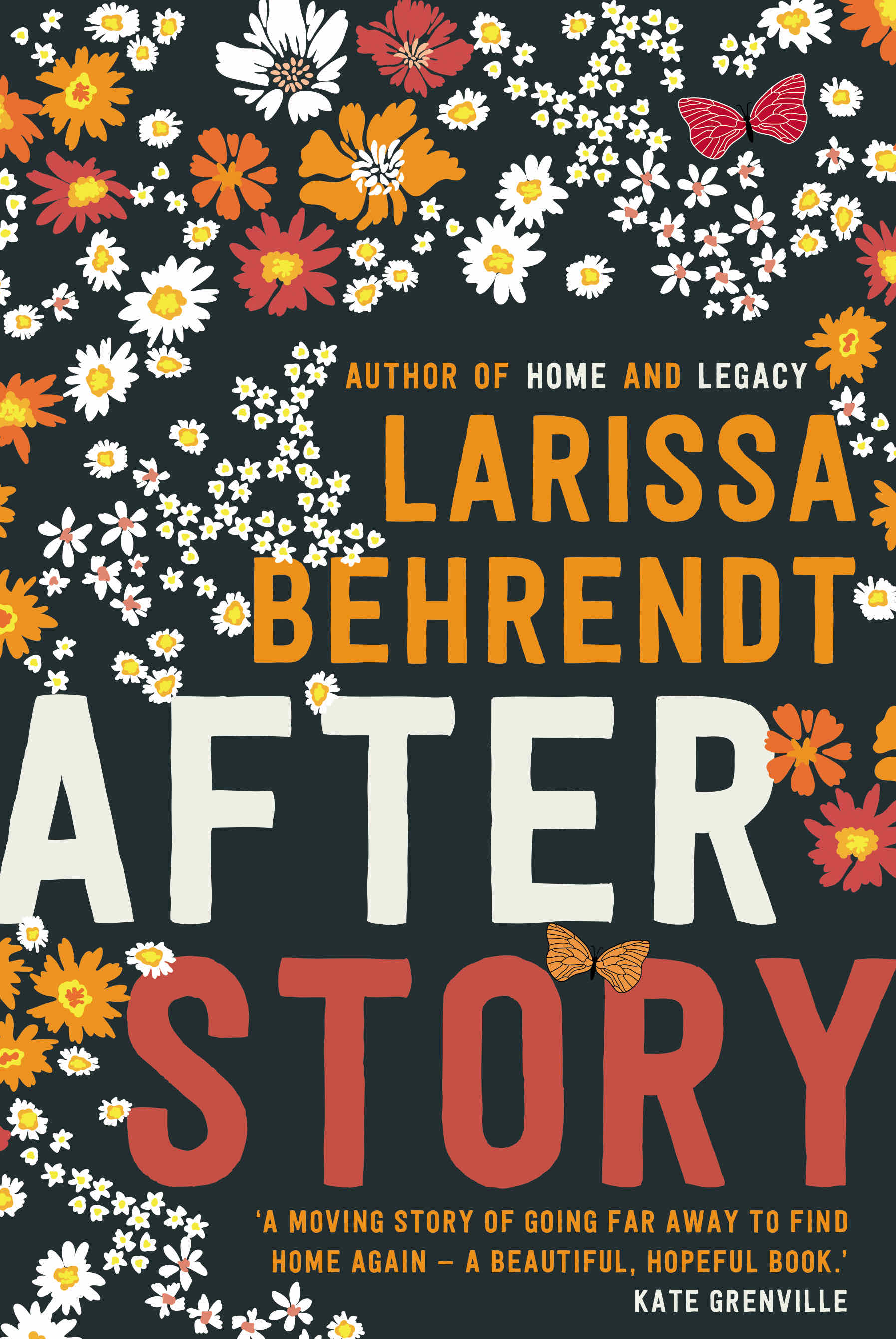
Larissa Behrendt, After story (#BookReview)

Larissa Behrendt’s latest novel After story has been on my wishlist since it came out last year, so I was thrilled when my reading group chose it as our 2022 NAIDOC-Week read. What self-respecting reader, after all, doesn’t like a literary tour?

After story, for those who haven’t caught up with it yet, is framed around a ten-day literary tour of England that is undertaken by a First Nations Australian mother and daughter, Della and Jasmine, whose relationship is fraught. Through this plot device, Behrendt marries her two storytelling loves – English literature and Indigenous Australian storytelling. In doing so, she draws comparisons between them, and explores ways in which both can reflect on and enhance our lives. She also shows how travel can be an engine of change for people.

Although it contains some very dark matter concerning grief and abuse, After story is a gentle and generous read – for two reasons. First, there’s the characters. Della and Jasmine, are strong, thoughtful and, importantly, real. Both have made mistakes in managing the challenges in their lives, but both genuinely want to have better relationships with those they love. Della, the less educated and more naive of the two, is particularly engaging for her honesty and lack of pretension, for her open-mindedness, and for the rawness of her pain. The other reason is the novel’s tone. It is clear and passionate about the wrongs done to Australia’s First Nations peoples but it is not angry. This is not to say that anger doesn’t have its place – it certainly does – but it’s not the only approach to telling the story of dispossession and dislocation.

What is particularly striking about this book is its structure and voice. After a prologue in Della’s voice telling of the disappearance twenty-five years ago of her 7-year-old daughter Brittany, the novel is structured by the tour, with each day being told, in first person, by Della and then Jasmine, until Day 8, when Della’s built-up grief overcomes her. After that, the order changes and Jasmine goes first. This change marks a turning point in their relationship – albeit not an immediate, epiphanic one. It also jolts the narrative out of a pattern that had risked becoming a little too rigorous. Like a coda, it makes the reader sit up and wonder what will happen next?

What does happen, however, as I’ve already implied, is not particularly dramatic. Rather, this book emulates something Virginia Woolf said, as Jasmine shares:

The great revelation perhaps never did come. Instead, there were little daily miracles, illuminations, matches struck unexpectedly in the dark.

Like life.

But, back to the structure. After story is one of those books in which the structure mirrors or supports its intention – and Jasmine, again, explains it well. Talking about Jane Eyre and Jean Rhys’ response to it in Wide Sargasso Sea, she says, “it’s compelling, the uncovering of the other side of the story”. “Uncovering the other side of the story” is the nub of this novel – personally, in terms of Della, Jasmine, and their relationship with each other and the rest of their family, and politically, in terms of the conflicting views and experiences of the colonisers and colonised. What Behrendt aims for in this novel, I believe, is to bring people together through improved mutual understanding.

Lest this sound too earnest, though, let me reiterate my earlier comment that this novel has a light touch. To balance the heavy material, which includes a number of losses including those related to abandoned and lost children, Behrendt creates a cast of typical tour participants. There’s the white male know-it-all professor and his seemingly mouse-like wife; the feminist young lesbian couple willing to take him on at every turn; the recently retired, educated middle-class couple; the bossy woman and her down-trodden sister; Della and Jasmine; and of course Lionel, the long-suffering tour guide, and bus-driver Brett. Behrendt handles these almost-stereotypical characters well, so that, by the end, even the arrogant Professor Finn is softened for us.

There is much humour in the telling, such as this, for example, from Della as she enters the British Museum, which, she has just discovered, still holds Aboriginal remains:

As we walked into the imposing white building there was a big glass bowl with money in it and a sign asking for donations.
“We already gave,” I said to the guard who was standing next to it.

Comments and asides like this are used throughout the novel to draw our attention to the truths we may not otherwise see. Truth, in fact, is a recurring idea in the novel – the withholding and the sharing. Della, reflecting on Thomas Hardy’s first wife being written out of history, remembers stories of erasure told by her community’s elder Aunty Elaine, and thinks “Sometimes the truth matters and you shouldn’t try to hide the facts”. A little later, Jasmine is also reminded of Aunty Elaine’s wisdom:

Aunty Elaine would remind me that there is more than one way to tell a story; there can sometimes be more than one truth. ‘The silences are as important as the words,’ she’d often say. There is what’s not in the archive, not in the history books – those things that have been excluded hidden overlooked.

Throughout the novel, Aunty Elaine’s stories and wisdom, shared through the memories of Della and Jasmine, provide the First Nations’ foil to the literary tour, sometimes enhancing, sometimes counteracting the messages and lessons of English literature.

I did, however, have one issue with the novel, one shared by a few in my reading group. This concerned its occasional didactic tone. Frequently, for example, the characters tell us what they’d learnt at various sites, such as about Jane Austen’s life or Virginia Woolf’s death. While we could see the point, the way the information was imparted did feel teachy at times. Fortunately, this tone did not extend to the novel’s underpinning ideas which are conveyed through the narrative rather than “told”.

In a Sydney Writers’ Festival panel, Behrendt said something that appeals to me, which is that the goal of being a great writer is to say something important. In After story, she has written an engaging, accessible novel, that also says important things – some subtle, some more overt, but all stemming, ultimately, from the traumas First Nations people have suffered, and continue to suffer, at the hands of the settlers.

Jasmine comes to a significant realisation near the end:

Suddenly I found the museum stuffy. When Aunty Elaine would talk about it, our culture felt alive – the sewing of possum cloaks … the gift of telling stories. They were living and breathing, not relics of the past, frozen in time. Looking at the artefacts surrounding me, I couldn’t help but feel I missed an opportunity with Aunty Elaine to capture her knowledge.

She had, she continues, “rightly valued education” but she had also “taken Aunty Elaine and her knowledge for granted”.

This is the call Behrendt makes in her novel. She wants both cultures given equal respect for what they can offer us. She knows the value of stories in bringing people together. Wouldn’t it be great if her story here achieved just that?

Larissa Behrendt is a Eualeyai/Kamillaroi woman

This book has been reviewed by several bloggers including Lisa, Brona and Kimbofo.

Larissa Behrendt
After story
St Lucia: UQP, 2021
307pp.
ISBN: 9780702263316

Jane Austen, Sense and sensibility (Vol. 3, redux)

Jane Austen, Sense and sensibility

I’ve called this post “Vol. 3, redux”, although it is my first post on volume 3. The reason is that for my Jane Austen group’s 2011 slow read of Sense and sensibility, I wrote posts on volumes 1 and 2, but not on volume 3 as I missed the meeting, and never did write up my own thoughts. This slow read, I have written up volume 1 (as “redux”), but I missed volume 2’s discussion, and again didn’t write up my thoughts. However, I did get to the volume 3 meeting and am naming my thoughts “redux” to match them up with the right re-read!

Now, a quick recap … In my recent volume 1 post, I discussed various ideas that had captured my attention, such as the novel’s autobiographical aspects, “fond” mothers, and appearance. Most of these had fallen away for me by the time I got to volume 3, but one idea that I mentioned – goodness, compassion and kindness – did not…

Triumph of kindness and generosity

From the novel’s beginning, the virtues of kindness, benevolence, generosity, charity are pitted against greed and self-interest. It starts with the sisters’ brother, John Dashwood, doing essentially nothing for his sisters while a distant cousin, Sir John Middleton, offers them a home at a good rental and supports them in any way he can. The theme continues through volumes 2 and into volume 3 where even characters who had been seen, initially, as somewhat silly if not vulgar, like Mrs Jennings and Charlotte Palmer, show kindness and compassion. They show up favourably against the greed and self-interest of Fanny and John Dashwood, Lucy Steele, and Willoughby.

Colonel Brandon is one of the characters whose kindness is evident from the start. Indeed, Elinor says to her mother near the end, that “his character does not rest … on one act of kindness”. A telling moment occurs when, in volume 3, he offers Edward Ferrars “a living”, after Edward’s own mother had disinherited him. The aforementioned John Dashwood finds this behaviour “improvident” and “astonishing” – and wonders why. Elinor responds, simply, that Colonel Brandon wanted “to be of use to Mr Ferrars”. That phrase, “to be of use”, conveys a sense of humility, of not wanting anything back, in his generosity.

It’s surely ironic when a page later, John Dashwood accuses sister Elinor of “ignorance of human nature”.

Mrs Jennings, too, who is described in the opening volume as “rather vulgar”, proves herself to be thoughtful and generous to Elinor and Marianne during their stay in her home in London. And when, in volume 3, Marianne falls seriously ill en-route home, Mrs Jennings

with a kindness of heart which made Elinor really love her, declared her resolution of not during from Cleveland as long as Marianne remained ill, and of endeavouring by her own attentive care, to supply to her the place of the mother she had taken her from.

Money is the root of …?

Money is another idea that threads through the novel from beginning to end: it is the death of Mr Dashwood which results in Mrs Dashwood and her daughters finding themselves homeless and impecunious. As the novel progresses, characters are defined by their attitude to money. There are well-off characters who are avaricious, like the aforementioned John Dashwoods and Mrs Ferrars, and well-off characters who are generous, like Sir John Middleton, Colonel Brandon and Mrs Jennings.

There are many in the novel, in fact, for whom money is so important they will sacrifice values like integrity and sincerity. Willoughby, in his confession to Elinor in Volume 3, admits

My affection for Marianne, my thorough conviction of her attachment to me–it was all insufficient to outweigh that dread of poverty, or get the better of those false ideas of the necessity of riches …

Of his rich fiancee, he says, “her money was necessary to me”.

Lucy Steele is, of course, the epitome of someone who schemes and manipulates for money, with little regard for the feelings of others. In the end, despite all her protestations of love, she is not willing to settle for the secure, if not rich, life that Elinor eventually has.

But what is it really all about?

As with all of Austen’s novels, what Sense and sensibility is about has been discussed and analysed and critiqued from literary, socioeconomic, feminist, historical, you-name-it perspectives. And, really, there is no one thing it is about. That is the joy and value of Austen. What she writes about, fundamentally, is people, and how we read her changes with our own experiences of life.

So here is where I am today. When I first read Sense and sensibility in my teens, I loved it. It was so romantic. Elinor gets her man, and is happy to live the life of an honest but not particularly well-off minister’s wife. Her sweet but overly romantic, emotional sister, gets the rich man. While that never seemed quite fair to me, as happily-ever-after stories go, I accepted it because it just showed what a person of integrity Elinor truly was. Love and esteem for an honest man were what made her happy.

And yet … what is Austen saying to us? Why do some of her heroines end up with less than dashing heroes? Well, I think it is partly because she was an early, if not the first, great novelist of realism. From this, her very first novel, she provides us with a microcosm of humanity. Like her later novels, Sense and sensibility is populated with flawed characters who represent complex humanity, unlike her Gothic and Sentimental novelist predecessors who tended to present the world in more morally absolutist, black-and-white terms. Not so Austen. Mrs Jennings might be “rather vulgar”, and a bit of an interfering gossip, but her heart is large and she’s generous. Mr Palmer, who seems cold and distant when first met away from home, shows himself to be kind and generous when a crisis occurs. And so on. Even Willoughby, despite his “selfish vanity”, is redeemed a little by his confession, and Austen allows him a reasonable life after all. I now see this confession as not being “clunky” as I’d once thought, but as important to Austen’s mission of portraying life.

But, back to Marianne. There was something that I noticed on this read that I’d never noticed before, and that concerned Marianne and her marriage to Colonel Brandon. One of the reasons I have always loved Sense and sensibility is for this quote:

Marianne Dashwood was born to an extraordinary fate. She was born to discover the falsehood of her own opinions, and to counteract, by her conduct, her most favourite maxims.

I so related to this – to the idea of proclaiming opinions before experience teaches us otherwise – that I hadn’t really seen the preceding paragraph, which concerns Marianne’s mother explicitly matchmaking Marianne with Colonel Brandon:

It was now her darling object. Precious as was the company of her daughter to her, she desired nothing so much as to give up its constant enjoyment to her valued friend; and to see Marianne settled at the mansion-house was equally the wish of Edward and Elinor. They each felt his sorrows, and their own obligations, and Marianne, by general consent, was to be the reward of all.

“The reward of all”. This sounds a bit suss! Austen continues …

With such a confederacy against her–with a knowledge so intimate of his goodness–with a conviction of his fond attachment to herself, which at last, though long after it was observable to everybody else–burst on her–what could she do?

And so, Marianne does come around to loving this good, kind man as Austen makes clearer a couple of paragraphs further on:

Marianne could never love by halves; and her whole heart became, in time, as much devoted to her husband, as it had once been to Willoughby.

The point, then, is that Sense and sensibility is not Romance with a capital-R, but a story about love – Elinor’s, from the start, and Marianne’s, eventually – that is based on genuine feeling combined with appreciation of the personal values that make a person worth loving.

There is so much more to this book but I’ll leave it here because I feel that, for now, I understand what it really is about!

Monday musings on Australian literature: Warm Winter Read

For several years now, Cathy of 746 books has been running a 20 Books of Summer challenge, which many Southern Hemisphere bloggers re-frame as “of Winter”. It’s a great initiative, and this year has over 120 participants. You go, Cathy! However, for something closer to home that’s geared to this winter, I thought I’d share with you Warm Winter Read. It is an initiative of Public Libraries Victoria, and I read about it on Angela Savage’s blog. Well-known as an author, Angela is also the CEO of Public Libraries Victoria.

As a retired librarian, I love checking out what libraries are doing – and when they encourage reading AND Australian authors and books, then I’m on side.

The program’s aim, Angela says, is “to encourage readers to develop a daily reading habit by tracking the days they read over June and July 2022”. It has been taken up by most of Victoria’s library services, and involves an app – the Beanstack app (here) – through which participants can log daily reading, take part in optional challenges and share book reviews. Apparently the optional challenges include things like, Angela writes, “read outside your home; read aloud to a pet, person or plant; and talk about what you’re reading in person or online”.

This is all great, but I’m mainly sharing it with you because the campaign has eight ambassadors, who are all “high-profile” Victorian authors. Each of these was asked to recommend four books to get readers started (although people can read any books). There are apparently bookmarks for each author, containing their recommendations.

The ambassadors are a diverse bunch (links on their names are to my posts on them) and so are their recommended books, which range across a wide variety of forms and genres, fiction and non-fiction. Their recommendations are:

  • Maxine Beneba Clarke: Maria Takolander’s Trigger warning; Claire G. Coleman’s Lies, damned lies; Alice Pung’s One hundred days; Ennis Cehić’s Sadvertising
  • Claire G Coleman: Omar Sakr’s Son of sin; Maxine Beneba Clarke’s How decent folk behave; Ellen van Neerven and Rafeif Ismail’s (ed), Unlimited futures; Evelyn Araluen’s Drop bear
  • Helen Garner: Sean O’Beirne’s A couple of things before the end; David Owen Kelly’s State of origin; Larissa Behrendt’s After story; Gabbie Stroud’s Teacher
  • Jane Harper: Sally Hepworth’s The younger wife; Karina Kilmore’s Where the truth lies; Kate Mildenhall’s The mother fault; Benjamin Stevenson’s Everyone in my family has killed someone
  • Toni Jordan: Genevieve Novak’s No hard feelings; Emily Spurr’s A million things; R.W.R. McDonald’s The Nancys; Paddy O’Reilly’s Other people’s houses
  • Rebecca Lim: Amani Haydar’s The mother wound; Trent Jamieson’s Day boy; Cixin Liu’s The three-body problem; Emma Viskic’s Resurrection Bay
  • Jock Serong: Emma Viskic’s Those who perish; Robert Gott’s The orchard thieves; Emily Brugman’s The islands; Michael Winkler’s Grimmish
  • Christos Tsiolkas: Emily Bitto’s Wild abandon; Angela Savage’s Mother of Pearl; Andy Jackson’s Music our bodies can’t hold; Judith Brett’s The enigmatic Mr Deakin

I have not heard of all these books, let alone read them, but I can see that the list offers something for most readers and should kickstart some thinking about what to read.

Different library services are promoting the program in different ways. Here are some: Goldfields Libraries; Hume Libraries; and Yarra Plenty Regional Library. BUT as I pottered around some of the sites, I also picked up other things that libraries are doing. For example, the Warrnambool Library advertises that it can help members access their vaccination certificates. What a great service for the less technologically proficient in our communities. I love how modern public libraries are comprehending and expressing their role as community information centres.

Also, in some communities, the local newspaper has got behind the program too. What about this one from the Shepparton News:

Come into your local library to check out a Warm Winter Read. You’ll find hot romances, spicy thrillers and toasty tales of fun and adventure. You can register and log your participation via the Beanstack website at www.plv.beanstack.orgor by downloading the Beanstack Tracker app from the Google Play Store or Apple App Store.

For readers who prefer ‘old-school’, pick up a tracking sheet from your local library. Lots of challenges to keep the next few months interesting.

And here I will leave you. This is a pretty short and simple Monday Musings, partly because I have joined the growing number of bloggers who have contracted COVID-19. So, while I’m not very sick, thanks to being fully vaccinated, I’m also not wonderfully chipper and need now to go take a nap!

Meanwhile, here’s a job for you: what would you have recommended if you’d been asked to suggest four books for a program like this? (And if you’re not Aussie, you can choose non-Aussie books!)

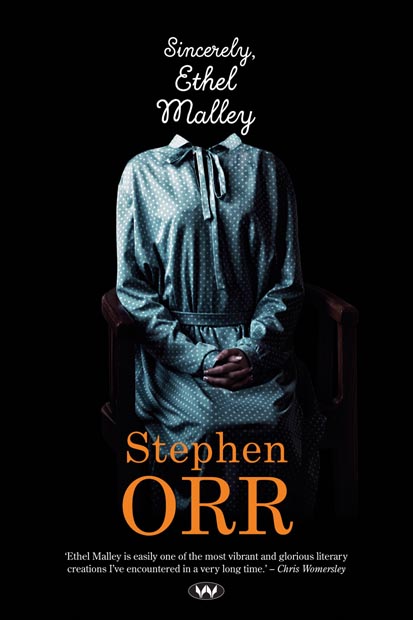
Stephen Orr, Sincerely, Ethel Malley (#bookreview)

Like Lisa, I’m a Stephen Orr fan, but for some reason it took me forever to finish his latest book, Sincerely, Ethel Malley, partly I think because while its characters are engaging, it’s a novel that deserves concentration which I seem to have in shorter supply this year. This is not meant to discourage readers, because it’s a fascinating, and wryly humorous read that explores a range of issues, to do with art and society, against a backdrop of war-time 1940s Australia.

As those who know the story will have guessed, Orr’s novel takes as its starting point the infamous Ern Malley literary hoax. To summarise Wikipedia, this hoax was perpetrated by two conservative writers, James McAuley and Harold Stewart, who created modernist-style poetry in the name of a fictitious poet, Ern Malley. They wrote the poems using random words from various reference books and rhyming dictionaries, and, in 1943 sent them, in the name of Ern’s sister Ethel, to Max Harris, editor of Angry Penguins, the journal of a modernist art and literary movement. This movement included some of the leading lights of the Heide art group, which was the inspiration for Emilly Bitto’s novel, The strays (my review). They were modern, confident, and prepared to tackle head on conservative Australia. It wasn’t long before the hoax was exposed, but that wasn’t the end of it, because Max Harris was then tried for publishing the poems, on the grounds of obscene content.

I have written about literary hoaxes earlier in this blog, and made some points about what hoaxes tell us. Among these are that they raise some fundamental issues for readers and critics about the nature of literature, about what we mean by authenticity and how we define quality. Is a work, for example, somehow less “authentic” and of less literary quality because the author isn’t who we believe s/he is? In other words, is the work the thing? These are some of the issues Orr explores in Sincerely, Ethel Malley.

The novel’s intent is also suggested by the four epigraphs, the first of which – with its own in-joke – is “ascribed” to Aeschylus. It suggests that Prometheus is the source of “every art possessed by man”, so, perhaps, why worry about anything but the art? Then there’s Frederick R. Ewing’s suggestion that the problem occurs from a misunderstanding over where “the truth left off and imagination began” – which, in a way, is the idea underpinning this book. The third comes from Max Harris arguing, essentially, against “playing god”. And finally, there’s Donald Crowhurst’s “it is the mercy”. I’ve never heard of Crowhurst but, according to Wikipedia, he was an amateur sailor who disappeared during a race. Wikipedia says that this statement, which he left behind “is obscure, [but] most commentators have accepted that it signifies his relief that, at last, he is leaving an unbearable situation”.

All this will tell you that Stephen Orr has big ideas in his sights. Fortunately for us, they are wrapped up in the engaging character of Ethel. She carries the novel. It starts in 1981, with her death, and then flashes back to 1943, which begins the main body of the novel and tells the story of Ern and his poems from Ethel’s (first-person) point-of-view. The novel’s last chapter returns to 1981, with Max hearing about Ethel’s death. Ethel (and Ern) are Sydney-based – which is where McAuley and Stewart were based – but most of the action takes place in Adelaide, where Max Harris was based.

In the 1970s, Adelaide was a beacon of progressive thought in Australia, but back in the 1940s it was a very different place. Orr is South Australian and captures the ambience of the place and time beautifully, as our Sydney-suburban housewife, Ethel, makes her way between the iconoclastic Max, the lively bookseller Mary Martin, and Adelaide’s conservative establishment.

I thoroughly enjoyed the explorations – many of them done with wit if not downright cheek – about truth and authenticity, about poetry not being meant to be understood but to be “interpreted”, and about the art versus the artist. It’s subversive in self-consciously confronting some of the things we say and think about art and literature. It tackles conservatism, our resistance to innovation – “Originality. If your writing’s worthwhile, most people will hate it”, Max tells Ethel. Early in the novel is a discussion within Harris’ theatre group about what play they will perform, one by Shaw or one by Cocteau. Most of the players argue that people won’t come to Cocteau, because they “want a story”. For boundary-pushing Max, “that’s their problem”. He wants to do something “modern” (hence, also, his interest in Ern). This dilemma is not confined to 1940s Adelaide, but is one arts communities grapple with constantly. What will audiences tolerate?

Orr’s skill is in presenting his “big” issues through “authentic”, engaging characters and strong narratives which draw us into their reality. Orr’s characters are always warm and authentic (even when fictionalising an already made-up person like Ethel) and his dialogue is so natural. The story of Ethel as she struggles to prove that Ern is real, and his poetry not obscene, is entertaining – particularly when people start questioning her existence too. It can get mind-bending some times, and quite rollicking other times, as Ethel flips between present and past, but it works.

All of this is in the service of issues Orr thinks are worth thinking about, but it’s the thinking and the questions that are, in the end, more important than the answers, with Ethel, of course, being our guide. Early on, she’s never heard of Sid Nolan, but by the end she can hold her own with the best of them as she struggles to defend herself, Ern and his art against those who question. It’s both heartfelt and funny.

There is a lot to this book, but fundamentally, I see it as being about conservatism. In addition to the whole modernist poetry debate, Orr makes pointed comments along the way about the press and academia, not to mention Australians themselves. Ethel tells Sid Nolan, she’s learnt that “Australians hate anyone who claims to be creative”. In Sincerely, Ethel Malley, Orr is teasing us, goading us even, into being open to new ways of seeing, just as Max Harris wanted to do in the 1940s – and he has done so with his usual skill combined with a good dose of fun.

Lisa (ANZLitLovers) loved this book and covered its essence very well.

Stephen Orr
Sincerely, Ethel Malley
Mile End: Wakefield Press, 2021
441pp.
ISBN: 9781743058084

Review copy courtesy Wakefield Press.

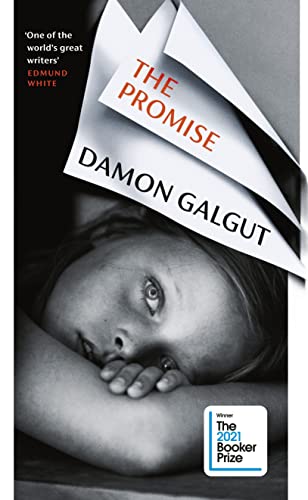
Damon Galgut, The promise (#BookReview)

Damon Galgut’s Booker Prize winning novel, The promise, is one of those novels that grabbed me intellectually and emotionally from its opening pages. The plot, itself, is straighforward. It concerns a White South African family’s promise to give a house on their property to their Black maid, whom their grandfather had acquired “along with the land”. The narrative tracks just how hard it is for the family to honour this promise. What makes the novel a Booker-Prize winner is the quality of the writing and how Galgut uses his story to create a potted history of South African life and politics in the post-Apartheid decades.

The novel is set between 1986 and 2018, and centres on the family, and their farm outside Pretoria. The family comprises Ma, Pa, and their three children, Astrid, Anton and Amor. In the opening pages, the youngest family member, Amor, overhears her dying Jewish mother extract the aforementioned promise from her Afrikaner father to give the house to Salome. Amor wants this promise honoured but achieving it turns out to be much harder than she expected.

The promise was my reading group’s May read and, somewhat unusually for us, it was universally enjoyed. Our ex-South African member used words like sharp, clever, funny, vicious, and said that Galgut nails the South Africa she knew and had experienced.

“something out of true at its centre”

There is so much to say about this book, that it’s hard to know where to start, but the writing is an excellent place, because it truly carries the novel. Particularly effective is the slippery voice (or point-of-view) which shifts perspective and person, sometimes mid-sentence. The effect, among other things, is to implicate us readers in the narrative. It prevents us distancing ourselves from the choices, decisions and behaviours we see. Here, for example, we shift from third to first in a paragraph:

For there is nothing unusual or remarkable about the Swart family  … We sound no different from the other voices, we sound the same and we tell the same stories, in an accent squashed underfoot, all the consonants decapitated and the vowels stove in. Something rusted and rain-stained and dented in the soul, and it comes through in the voice.

And here is a mid-sentence shift from third to second person:

But in truth he’s bored by this man, by his ordinary life and his ordinary wife, just as he’s bored by almost everything these days, all significance leaked away by now, and it doesn’t feel wrong to wait till he’s gone, then get up and wander out into the night, as if you’ve been drinking on your own. You probably have.

Alongside the voice is Galgut’s wordplay, his recognition of the power of words to clarify or obfuscate. Take the irony of the white family’s name, Swart, which means black. But it doesn’t stop there because it is also an archaic word for “baneful, malignant”. Take also the narrator’s frequent self-corrections that always nail home a point, like:

“So Salome has gone back to her own house instead, beg your pardon, to the Lombard place.” (Which reminds us that the promise has not been enacted.)

“He no longer calls himself dominee, he’s a pastoor these days, peddling a softer line in salvation to his customers, ahem, that is to say, his flock, so that everyone benefits.” (Which tells us something about this man of the church’s real motivations.)

Then there’s the idea of promise itself. What a loaded word that is. While this is the story of a family, The promise is ultimately a political novel, so Galgut deftly plays with the idea of “promise” in more ways than one. The novel opens and closes with false promises, related to the historical realities of 1986 and 2018, as well as to the family’s inaction. It also teases us with the idea that the end of Apartheid would bring the promise of a new South Africa, but it shows that ideal foundering. The failure of the country to live up to its promise is paralleled in the character of Anton who, at the beginning of the novel, is “full of promise”, as he describes himself in his unfinished autobiographical novel, but who, by the end, admits that he has not lived up to it:

He’s still stunned by the simple realisation that’s just struck. It’s true, I’ve wasted my life. Fifty years old, half a century, and he’s never going to do any of the things he was once certain he would do … Not ever going to do much of anything.

(Note the slip from third to first to third person, here!) There are many failed promises in the novel, including a minister’s failure to keep a confession.

Other motifs threading through the novel include the four funerals in four different religions/belief systems that shape the narrative’s four parts, and the fact that the Swart’s family business is a (failing) Reptile Park. How telling is that! Just think of all the allusions.

The characters are another compelling aspect of the novel. As an epigraph-lover, I can’t resist sharing Galgut’s from Frederico Fellini:

This morning I met a woman with a golden nose. She was riding in a Cadillac with a monkey in her arms. Her driver stopped and she asked me, ‘Are you Fellini?’ With this metallic voice she continued, ‘Why is it that in your movies, there is not even one normal person?’

What a hoot, and what a great epigraph choice. It immediately challenges us to consider what is “normal”, if such exists, and puts us on the alert about notions of normality. Galgut’s characters – even the minor ones like Lexington the driver (who “brings the Triumph to the front steps”), the homeless man (“as he keeps obsessively singing the first line to Blowin’ in the wind, let’s call him Bob”), and the various funeral workers – are carefully differentiated, and add depth to the picture being painted of a family and country in crisis. The irony is, I think, that each is disconcertingly normal – in their own way!

Early in the novel, the narrator describes the recently departed Ma’s spirit lingering around the house:

She looks real, which is to say, ordinary. How would you know she is a ghost? Many of the living are vague and adrift too, it’s not a failing unique to the departed.

“Vague and adrift” perfectly describes Astrid, Anton and Amor, none of whom have it together. The “quiet and attentive” Amor, however, is at least empathetic, and therefore the most sympathetic. She constantly shows heart, but, having little power in the family, her solution is to disappear at every opportunity, and live a spartan life, working as a nurse among the most needy. Could she have done more sooner?, is the question worth asking.

So, what is the takeaway from this novel? My reading group was unanimous in feeling that the novel is underpinned by the idea that when one group has an unhealthy position of power over another, both are diminished, if not destroyed. It is to Galgut’s credit, however, that he explores this without didacticism. We are never told what to think. Instead, he presents his characters’ thoughts, actions and decisions, and leaves us to consider what it all means.

We are also given this:

No truthful answers without cold questions. And no knowledge without truth.

The wonder of this book is that such a strong and serious story can be so exciting to read.

Lisa also loved it.

Damon Galgut
The promise
Vintage, 2021
295pp.
ISBN: 9781473584464 (Kindle ed.)

Jane Austen, Sense and sensibility (Vol. 1, redux)

Jane Austen, Sense and sensibility

In 2011, my Jane Austen group started a slow read of her novels in chronological order of publication, which meant that we started with the 1811-published Sense and sensibility. By slow read, we meant that each month we’d read a volume of the chosen novel, given most novels in those times were published in three volumes, and discuss just that volume to see what new ideas or insights we might have. We finished the project in 2017. Having spent the last five years looking at other works by Austen (like her Juvenilia) and exploring other topics relevant to her, we decided last year that it was time to “do” the novels again. So, once again, we’ve started with the first one.

For some of you, this will seem very dry, but for those of us who love Austen, there is much to be gained from these slow reads. If you are interested in what I wrote last time on volume one, check out the post, but here I’m sharing what thoughts popped up for me this time.

First though, I’ll repeat the caveats from 2011. I’m assuming that most readers who come to this post will know the plot. (If you don’t, Wikipedia provides a good summary.) Also, this is not a formal review but simply a sharing of some of the ideas that struck me during this slow reading.

Slow reading of Volume 1

I have always liked Sense and sensibility, while my dear Mum thought it one of her weakest. (There’s no accounting for tastes! In my group there are many who will never forget that Mum loved Northanger Abbey, which some of them don’t like much at all.)

Anyhow, here goes. It’s fascinating how each read of an Austen book focuses the mind on something different. That’s the richness of Austen, and what makes her a true classic. In my last slow read, my first-volume thoughts focused particularly on the idea of judgement, and money and income. This time, other ideas came to the fore for me, some partly affected, I think, by current concerns.

Autobiographical first novel?

But first, an idea I hadn’t fully thought through before was that it could be seen as a “typical” first novel, by which I mean, it has strong autobiographical elements. Anyone who knows Austen always think of this novel’s basic set-up of in terms of her life: the fact that Austen, her mother and sister, lost their home on the death of their husband/father, and had to wait for the kindness of relations to come to their aid, just as happens to the Dashwoods. However, on this reading, I realised there were other autobiographical elements. Others in the group had come to the same conclusion, and yet none of us had discussed this last time. Curious.

So, for example, our two sisters, the younger musical Marianne and the older artistic Elinor mirror musical Jane and her artist sister Cassandra. Moreover, Jane, we believe, was lively, like Marianne, compared with her more sober older sister. If Austen did draw on herself for Marianne, however, she’s gorgeously self-deprecating – though she does present Marianne as over-enthusiastic and excitable but fundamentally sound. There are several other elements we could point to from Austen’s biography, including her flirtation with Tom Lefroy being reflected in Marianne’s with Willoughby. They are very different men, but both men are whisked away by relations from the attractive but unsuitable, ie not-rich-enough, girl.

Appearances deceive?

Perhaps partly because I’ve been listening to ABC RN’s Face Value series, I seemed to be particularly alert to the many references to appearance. Admittedly, Austen describes appearance in all her novels, but it felt pointed here in a way that I don’t recollect seeing in later novels.

So, Edward Ferrars and Colonel Brandon are both described as not handsome, but both are appealing for their good understanding and interested attention in others. Willoughby, on the other hand, is described differently. When he appears on the scene, having rescued Marianne from her fall in the rain, Austen says that Mrs Dashwood would have would have been grateful had he been ”old, ugly, and vulgar”, but his “youth, beauty, and elegance” gave him added interest.

As for the women, Sir John Middleton and Charlotte Palmer talk of Elinor and Marianne as being pretty and therefore marriageable, while Lucy Steele is seen by the perceptive Elinor to have “beauty” but to “want … real elegance and artlessness”. And then there’s Mr Palmer who, just like Pride and prejudice’s Mr Bennet, had chosen his wife Charlotte for her beauty not her sense. Beauty, Austen seems to be saying, is something we should not give undue credit to.

Fond mothers?

Another issue which caught my attention this time around concerned mothers and mothering. Mothering (poor or lack of) features in many of Austen’s novels. Lizzie Bennet’s mother (Pride and prejudice) is silly; Emma (Emma) and Anne (Persuasion) don’t have a mother; Fanny’s (Mansfield Park) is too busy; and Catherine’s (Northanger Abbey) is away from her at a critical time. By contrast, Sense and sensibility has several active and involved, though not necessarily great, mothers, from the loving, hands-off Mrs Dashwood to the ultimate controller in Mrs Ferrars.

Very early on Mrs Dashwood’s style of mothering is described and Mrs Ferrars’ is hinted at, in relation to the apparent growing attraction between Elinor and Edward.

Some mothers might have encouraged intimacy from motives of interest, for Edward Ferrars was the eldest son of a man who died very rich; and some might have repressed it from motives of prudence, for, except for a trifling sum, the whole of his fortune depended on the will of his mother. But Mrs. Dashwood was alike uninfluenced by either consideration. It was enough for her that he appeared to be amiable, that he loved her daughter, and that Elinor returned the partiality.

Mrs Dashwood, who is probably the most present mother in Austen, is loving but not always wise. When Marianne falls into excessive despair at Willoughby’s sudden, unexplained departure, Elinor suggests she ask Marianne directly about her relationship with Willoughby. Mrs Dashwood replies that she “would not ask such a question for the world … I should never deserve her confidence again … I would not attempt to force the confidence of any one”. Elinor disagrees, seeing “this generosity overstrained, considering her sister’s youth … [but] … common sense, common care, common prudence, were all sunk in Mrs Dashwood’s romantic delicacy”.

However, Mrs Dashwood does provide good “maternal” advice to Edward, suggesting that finding some useful employment would help him be “a happier man”. She then mentions his mother:

Your mother will secure to you, in time, that independence you are so anxious for; it is her duty, and it will, it must, ere long become her happiness to prevent your whole youth from being wasted in discontent.

We haven’t met Mrs Ferrars at this point in the novel, but earlier references to her have not suggested a particularly loving or even dutiful mother. If Mrs Ferrars is one matriarch in the the novel, Mrs Jennings is another. Austen tells us that “She had only two daughters, both of whom she had lived to see respectably married, and she had now therefore nothing to do but to marry all the rest of the world”. She comes across in Volume 1, as gossipy, “vulgar”, but good-natured. Without second-guessing the next volume, let’s say that I think she warms as a motherly character then!

Her younger daughter, Charlotte Palmer is pregnant, but the older one, Lady Middleton, is the mother of three young children. She is the “fond mother” who “will swallow anything”. Her very existence depends on her role – she only comes to life when her children are around – and the shrewd Steele girls take advantage of this.

For Austen readers, the issue of mothers in Austen’s novels is a loaded one. Why are there so few sensible mothers in her novels? There is much we don’t know about Austen’s life, and one of the mysteries concerns her relationship with her mother. Some Austen researchers believe it was prickly. We’ll never know, but great mothers are rare in her novels – which may or may not tell us something .

And …

Other issues that grabbed my attention included the many references to goodness, compassion and kindness, and, not surprisingly, to sense and sensibility (which I briefly discussed in my previous volume 1 post).

Goodness appears on page 1, when we are told that Mr and Mrs Dashwood had shown “goodness of heart” to the uncle from whom they had inherited Norland, the estate that Mrs Dashwood must leave after her husband dies. As the volume progresses, Marianne talks of Edward’s “goodness and sense”; Sir John Middleton is described as being of “good heart”; and Colonel Brandon as having a “good nature”. These are not just words. Sir John’s “good heart” translates into real and practical kindness to the Dashwoods, and Edward values the “kindness” of the Dashwood family “beyond anything”.

I won’t continue because we’ll have to see how or whether these issues remain to the fore as I read on, or whether others will raise their heads. Instead, I’ll close one one of those insights that I love reading Austen for. It’s on Mrs Dashwood not being prepared to consider the tough possibilities (in this case concerning Marianne and Willoughby):

But Mrs Dashwood could find explanations whenever she wanted them, which at least satisfied herself.

How often do we justify things to ourselves that we’d be better not to? Mrs Dashwood isn’t alone I think. (Or, do I speak only for myself?)

Roll on volume 2.

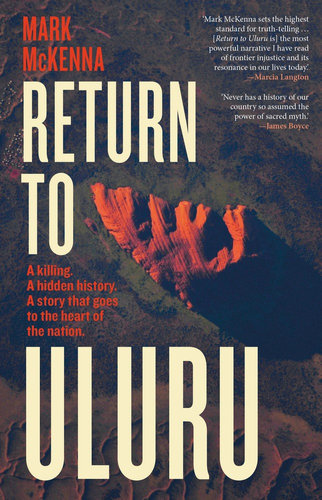
Mark McKenna, Return to Uluru (#BookReview)

Mark McKenna’s engrossing history, Return to Uluru, takes as its starting point the arrival in Central Australia, in 1931, of 29-year-old police officer, Bill McKinnon. Of course, Uluru’s true history reaches back into the almost-incomprehensible mists of geological time, and its human history back to the arrival of Indigenous Australians tens of thousands of years ago. But, a historian has to start somewhere, and McKenna’s choice of McKinnon’s arrival speaks to the particular story he wants to tell.

Uluru

Before I get to that, though, I would like to share my own little story. Mr Gums and I have visited Uluru three times (so far), in 2000, 2009, and 2015. Each visit, we walked around “the rock” rather than climb it, because that was the expressed preference of its traditional owners, the Anangu. In 2019, the climb was finally closed. Interestingly, each of our circumnavigations was a bit longer than the previous one, stretching from around 9kms the first time to around 11kms the last. This is because the Anangu have gradually moved the route away from particularly sacred sections of Uluru. It’s been a very slow process for the Anangu to claw back ownership of their own country and it is to this, really, that McKenna’s book ultimately speaks.

But, that’s not immediately obvious at the book’s opening. It’s divided onto four parts, with Part one, “Looking for the centre”, introducing the reader to Central Australia. It teases out the role of “the centre” in Australian life and culture, pitting its Indigenous history and significance against the early settlers/explorers’ “awe, terror and incomprehension” at what they found. McKenna writes that for the settler “to find the centre was to confront the metaphysical dilemma of being a white man in an Aboriginal country”:

What they saw as empty was layered with story … Where European explorers saw arid desolation, Aboriginal people knew a larder teeming with sources of animal protein and fat and a wide variety of plants that provided nutrition, medicine, tools and shelter.

McKenna then shifts from traditional history-writing to the personal, placing himself in the story by sharing his own experience of the Centre but continuing to reveal its history as well. This approach enables McKenna to reflect philosophically, as well as historically, on what he was doing. He conveys how confronting, and how paradoxical, the Centre can be. “It laid everything bare at the same time as it pushed all language and emotion within.” But, most significantly, he writes how actually visiting the centre “unsettled the history” that he had intended to write. So, let’s get to that.

Part two, “Lawman”, returns to a more traditional history – or biography, now – style. It tells the story of Bill McKinnon, who he was, how he ended up in the Centre, and what he did there. The focus, though, is a particular expedition in 1934 whose goal was to capture some Aboriginal men accused of killing, under Tribal Law, another Aboriginal man. One of these men, Yokununna, was shot and killed by McKinnon. This incident was to be just part of McKenna’s history but, as he wrote in Part one, it became the centre of the book when he recognised that the “biography of one moment in one man’s life encompassed the entire history of the centre and went straight to the heart of the nation’s long struggle to come to terms with its past”.

“Lawman” is the longest part of the book. Bill McKinnon was a complex man. He unquestioningly bought into the settler project and saw “discipline” as the key to maintaining control, a discipline that, of course, frequently involved brutality. But he wanted “to be both the centre’s law enforcer and its storyteller”. He was keenly interested in the centre’s history, and, writes McKinnon, had “moments of contemplation … when he became faintly aware of the depth and complexity of Aboriginal culture”. He was also a meticulous recordkeeper, and retained his records because “his desire to be present in history was insatiable”.

Part three, “Uluru”, the second longest part, returns, obviously, to focus on Uluru. Here, McKinnon comes back in the frame. He delves more deeply into the settler-era history of Uluru, interweaving it with Indigenous culture and stories. He traces the dispossession of the Anangu, as the settlers moved in, and their gradual return in the second half of the twentieth century. He identifies McKinnon’s shooting of Yokununna at the rock’s Mutitjulu Waterhole as “the foundational moment in a long history of injustice”. It is here that McKenna shows his historian’s eye for the symbolic that makes a point:

Uluru’s creation story and the frontier murder which defined the killing times for the Anangu more than any other event in the twentieth century took place at the same sacred site.

It is also in this part that we see the historian’s drive for the clue that nails the truth, and the challenge that can result. It occurs when he visits McKinnon’s daughter, and is given access to McKinnon’s archives. Remember what a recordkeeper he was? What McKenna finds transforms the story he was telling.

In the final part, “Desert Oak No. 1”, McKenna remains in the frame, as he shares more of his research journey. The focus is Yokununna (“Desert Oak No. 1”) and we start at the South Australian Museum where Yokununna’s skull had been identified. Till this point, I felt McKenna had managed well the tricky business of being a non-Indigenous historian writing an Indigenous-focused history, but I did feel he made a false step when describing the centre as a “region where darkness stalked the landscape”. The word “darkness” seems unfortunate in the context. This, however, is a small miss in a work that recovers a significant story and carefully places it within the context of the return of Uluru to the Anangu in 1983, and the 2017 Uluru Statement from the Heart. Returnng Uluru to its rightful owners is a win for all Australians because Uluru is the spiritual heart of our nation, and it’s critical that our heart be in the right place – if you know what I mean!

Return to Uluru is a beautiful book in every way. It is gorgeously produced. Those of us in my reading group who read the physical version loved the paper and the extensive images. We felt sorry for the Kindle readers who missed this experience. But more importantly, Return to Uluru is sophisticated, conceptually, in the structured way McKenna elicits the symbolism from the facts to make very clear not only what happened but why it matters.

For an historian’s perspective, check out Janine’s review.

Mark McKenna
Return to Uluru
Carlton, Vic: Black Inc, 2019
256pp.
ISBN: 9781760642556

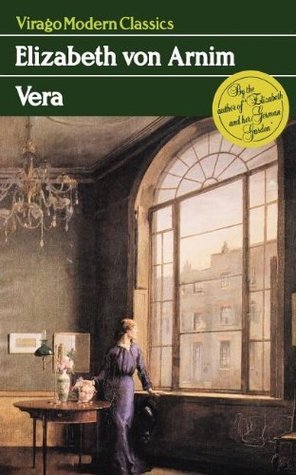
Elizabeth von Arnim, Vera (#BookReview)

After a run of tough reads in 2021, my reading group wanted something gentler, so I suggested that for our “classic” we do a novel by Elizabeth von Arnim, whose works I’ve loved for their pointed wit, delightful humour, and astute commentary on marriage and the relationship between men and women. As is my wont, I nominated one from my TBR shelves, Vera. To my delight, they agreed.

Then, before reading it, I decided to remind myself of von Arnim’s life, so I read Gabrielle Carey’s Only happiness here: In search of Elizabeth von Arnim (my review). Imagine my horror when, two-thirds through, Carey wrote that Vera was her “darkest” novel, “a haunting portrait of psychological tyranny”. What? Too late by then, but I did hope my reading group would, one, forgive me, and, two, not be turned off von Arnim. As it turned out, all those who attended the meeting liked the book and pronounced it “not too dark”. Was I pleased!

Nonetheless, Vera is a dark novel, one that reminded me of a book written four decades later by Elizabeth Harrower, The watch tower (my review). Both novels are about narcissism and coercive control, about older men who marry and tyrannise vulnerable and inexperienced much younger women.

Wuthering Heights by Jane Austen”

When Vera was published, readers and reviewers were, says Carey, confused. How did “playful, witty Elizabeth von Arnim, author of light social comedies” become “a gothic writer of macabre tragedy”? Von Arnim was distressed but cousin Katherine Mansfield’s husband, John Middleton Murry, is reported to have said to her, on the appearance of a negative review in The Times Literary Supplement, “Of course my dear, when the critics are faced with Wuthering Heights by Jane Austen, they don’t know what to say.”

This is an apposite comment for a few reasons – besides its intention to reassure. Firstly, von Arnim pointedly has Lucy, our young wife, read Wuthering Heights even though husband Everard calls it “morbid”. It’s an effective allusion, given the darkness of Brontë’s novel and its focus on obsessive love. However, Murry’s comment also conveys something about the experience of reading this novel, because, while it is dark and distressing, it still bears von Arnim’s Austen-like light touch, and that, I think, is what my reading group appreciated.

By now, if you haven’t read it yourself, you may be wondering why this novel is called Vera when the two protagonists I’ve named are Lucy and Everard? So, let me do a quick plot summary.

The novel begins with 22-year-old Lucy Entwhistle leaning on the front gate of the house in Cornwall that she and her father had taken for the late summer. Her father has just died suddenly and Lucy is in shock. Into view comes another – apparently – grieving person, the mid-forties Everard Wemyss, whose wife Vera had died a week or so ago. Things, though, are not quite as they seem. A shadow hangs over Vera’s death, with a suggestion that it may not have been accidental but a suicide. Lucy, unfortunately, is naive and vulnerable, and despite the best efforts of her wise Aunt Dot, she is swept into marriage, with socially unacceptable haste. After the honeymoon, Everard takes her to his county mansion, “The Willows”, where Vera had died. He makes no attempt to change anything – expecting Lucy to sleep in the same bed Vera did, to occupy Vera’s sitting room, to have breakfast overlooking the flagstones onto which Vera had fallen (or jumped). Kind, head-over-heels-in-love Lucy does her best to justify Everard’s increasingly controlling behaviour but it dawns all too quickly that he expects nothing less than utter servitude . 

And so, Lucy, whose usual state had been one “of affection and confidence”, learns that the “scenes” that she hated could not be avoided “for no care, no caution would for ever be able to watch what she said, or did, or look, or equally important, what she didn’t say, or didn’t do, or didn’t look”. It leaves her “afraid with the most dismal foreboding, that someday after one of them, or in the middle of one of them, her nerve would give out and she would collapse. Collapse deplorably; into just something that howled and whimpered.”

Lucy starts to think kindly of this Vera she’d never met.

“It’s wonderful, wonderful … what love will do” (The doctor)

It’s grim, certainly, but this is Elizabeth von Arnim, so there’s humour – black comedy – here too. There are some truly funny scenes, particularly involving the poor servants for whom Everard has not one ounce of humanity. These servants only stay at “The Willows” because he is in town all week. They can manage his cruelly imperious ways from Friday night to Monday morning, because the wages were higher than any they’d heard of. (They probably had to be!)

So, here is a scene in which Everard confronts the parlourmaid about a missing button on a piano leg cover:

“What do you see?” he asked.
The parlourmaid was reluctant to say. What she saw was piano legs, but she felt that wasn’t the right answer.
“What do you not see?” Wemyss asked, louder.
This was much more difficult, because there were so many things she didn’t see; her parents, for example.
“Are you deaf, woman?” he enquired.
She knew the answer to that, and said it quickly.
“No sir,” she said.

And so it continues, but you get the gist. The scene is indicative of Wemyss’ extreme bullying behaviour, but you can’t help laughing while feeling for the poor parlourmaid.

This black humour is one of the things that kept me reading. Another was von Arnim’s writing. She has wonderful turns of phrase, such as this of Lucy reining in some disturbing thoughts: “Lucy made a violent lunge after her thoughts, and strangled them”.

Von Arnim is also an excellent satirist and ironist. Just look at the doctor’s statement above. He’s surprised and unsure about the marriage to Lucy but, well, look what love can do! Already, however, we are aware that his initial uncertainty is more than valid. One of the points Carey makes in her book is von Arnim’s disappointment in love and marriage. In her experience – including the marriage to Francis Russell which inspired this novel – men change as soon as they are married or, as the heady days of love wane. Vera is at the extreme, but not unbelievable, end of this disappointment.

Finally, there’s Jane Austen. Elizabeth von Arnim – and I’m not the first to say this – owes much to Austen. From my first Von Arnim, Austen’s wit and astute observation of human nature shone through. She nails the way humans think and behave with, sometimes, excruciating accuracy. But von Arnim’s style in Vera is not Austen’s. We don’t have Austen’s omniscient third person voice. Vera is told third person, but von Arnim uses that technique more common to modernists, the interior monologue, with the narrative perspective shifting between the main characters – Lucy, Everard and Lucy’s wonderful Aunt Dot. In fact, a few of the last chapters are with Aunt Dot as she comes head-to-head with Everard and learns just how right she had been to be concerned – but, well, look “what love will do”.

There’s more to discuss in this book. There’s Wemyss’ deeply creepy infantalisation of his 22-year-old wife, calling her “a good little girl” and “my very own baby”. There’s also his insistence that everything can be simplified to one right answer. Initially, the overwhelmed, grieving Lucy finds this comforting but, having grown up in an atmosphere of intellectual enquiry, she starts to not only think that such an attitude might “cut one off from growth” and “shut one in an isolation”, but to doubt “whether it was true that there was only one way looking at a thing” or “that his way was invariably the right way”.

Too soon after her death, Elizabeth von Arnim was relegated to the realms of light romantic comedy, but that denies their value, even when you look at her lighter works. However, when you add Vera to her oeuvre, you have a writer whose work must be seen as relevant now as it ever was.

Elizabeth von Arnim
Vera
London: Virago, 1983 (orig. pub. 1921)
319pp.
ISBN: 9781844082810

Monday musings on Australian literature: Australia’s favourite genres

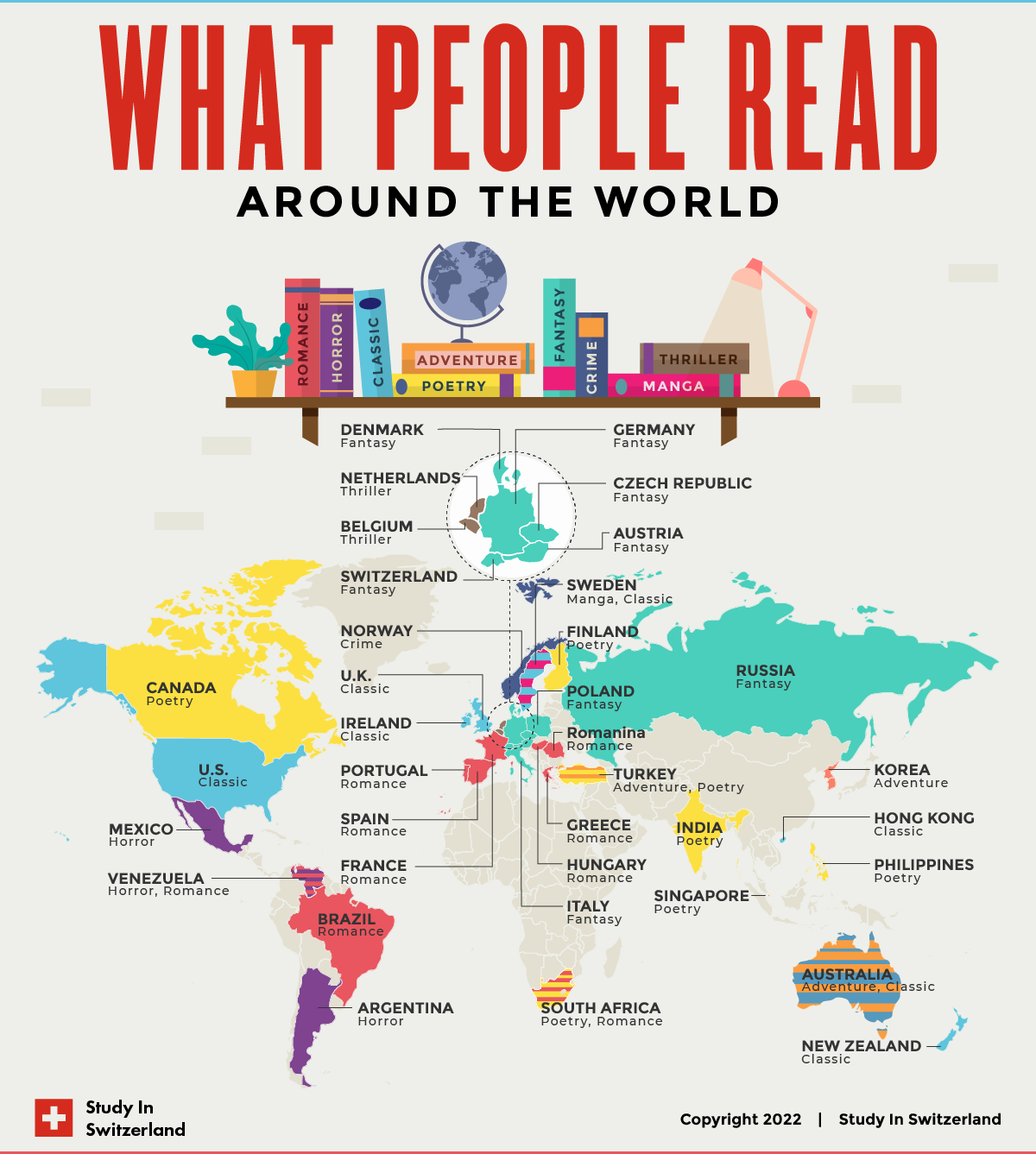
A week or so ago I received an email from an organisation called Studying in Switzerland. Their main focus, as their name suggests, is helping students who want to study in Switzerland, but it seems that they also do some research of their own. A recent project was to identify the most popular book genres – in countries where data was available. 

Their methodology was to analyse Google search queries on genres from different countries, and the results are intriguing. I haven’t found much discussion of their analysis to know how others view the effectiveness of the methodology. Does it match up with borrowing or book-buying data? Or, is what we read different to what we research?

Study in Switzerland says that:

Books continue to be a significant part of our lives, with reading being a popular pastime for many people. Indeed, a typical person reads 12 to 13 novels each year, and how people choose what to read has long piqued the curiosity of researchers. As a result, book publishing has a huge market size worldwide, with revenue reaching $112.5 billion in 2022.

Anyhow, here is what came up for Australia – they identified that Australians search most for Adventure and Classics! Is this what you would have guessed? If I’d been asked, I would have thought Crime. Indeed, I probably would have said “Crime, hands down”. And, of course, as I questioned, what is searched may be different from what is actually read.

We are not the only country interested in Classics. This genre was also popular in Sweden, Hong Kong, USA, UK, Ireland and New Zealand.

Worldwide, they say, Romance, Classics and Poetry are the most searched for genres but, drilling down, there are some interesting preferences. Asians and Canadians, for example, had Poetry first, while overall Europeans (like the Russians, Poles and Finns) go for Fantasy, although some of them (like the French and Spanish) searched more or Romance! Not surprisingly, Belgians, the Dutch and the Norwegians seemed to prefer Crime and Thrillers.

Study in Switzerland makes some assumptions about the reasons for the various preferences they found. Those assumptions make some sense, but they are not based, I believe, on this research.

For their report, please check out this link.

Meanwhile …

There is other research to look at. Back in 2017, a survey conducted by the Australia Council and Macquarie University of Australians’ reading habits, found something closer to what I expected, which is that

The most popular fiction genre is crime/mystery/thriller, with 49% of Australians having read a book of that genre in the last 12 months … followed by historical fiction on 36%, contemporary/general fiction on 33%, science fiction/fantasy on 32%, and classics on 31%.

However, they also found that just over half (51%) of Australians were interested in “literary fiction”, which they described as fiction “eligible for prizes like the Man Booker and Miles Franklin”. They also found that it’s generally older readers who are most interested in this fiction. Interestingly, they found that these “older readers also tend to be more interested in work by Australian authors”.

I did report on this survey back in 2017, and posed some questions at the end. Some of these might have been answered by …

A report on bookselling published by ArtsHub in 2019 which confirmed Australians’ interest in “home-grown authors”. They found “a 30% jump in local authors featured in the top 25 fiction titles” over the previous two years. Further, bookseller and Book Club coordinator, Jennifer Stephens at Brisbane’s Avid Reader Bookshop, Brisbane, reported that “we are reading a lot of Australian women writers”. (Music to my ears, of course.)

Overall, this report, which drew on two years of Nielsen BookScan data, concluded:

Australian readers’ priorities and interests are evident: self-help and finance, a taste for home-grown writers, an eye for feminist writing, curiosity about sexuality and gender, a fascination with crime and mystery, and a deep need for First Nations perspectives.

I wonder if things have changed much since then, particularly given the pandemic? Either way, it’s interesting to ponder whether there is a significant difference between what we search for online and what we actually buy, or, whether, Study in Switzerland has identified a big swing in our interests over the pandemic?

Any thoughts?

Ida Vitale, Byobu (#BookReview)

Uruguayan writer Ida Vitale’s Byobu was my reading group’s second book of the year. Originally published in Spanish in 2018, with the English translation released in 2021, Byobu is Vitale’s first book of prose to be translated into English. Few, if any of us, had heard of her – and yet, this now 98-year-old woman was, in 2019, named by the BBC as one of the 100 most influential women of the year. The things we don’t know!

Anyhow, Byobu is a curious book. It has no clear narrative, and only one character, the eponymous Byobu. It’s just 85 pages, and comprises 34 “chapters”. It is replete with allusions to a diverse range of writers, thinkers, musicians. In other words, it’s one of those books you can struggle with, if you don’t come up with a way of reading it. For me, this was to jettison preconceptions about what a novel is and go with the flow to see what fell out. And what fell out was a mind-opening, and sometimes witty, series of thoughts and observations about life and living. I can’t say I understood all of it, but I thoroughly enjoyed the reading experience.

The best way I can encapsulate Byobu is to describe it as a sort of modern Everyman story, the story of an individual in a world that can be confusing, if not sometimes downright hostile. The overall theme seems to me to be: How do you live in this world?

Before I explore this more, some basics. Byobu is set in Uruguay, and although there’s no plot per se, there is some structure. (I’d probably find more structure had I time to read it a few times). The opening chapter introduces the idea of “story” – and clues us into the idea that we are going to be unsettled:

a story’s existence, even if not well defined or well assigned, even if only in its formative stage, just barely latent, emits vague but urgent emanations. (“A story”)

The next few chapters introduce us to Byobu, conveying a general sense of who he is. These are followed by chapters that consider bigger issues in contemporary life.

However, although we are introduced to Byobu, he remains somewhat shadowy. We don’t know how old he is, but one member of my reading group suggested he was old, like his author, and that he encompasses an old person’s thoughts about life. I can accept that. Regardless, besides not knowing how old he is, we don’t know whether he is (or has been) married, has a family, is working, and so on. A family home is mentioned, and there are references to daily activities including attending a conference. All this vagueness supports the idea of him as an Everyman (albeit, possibly, an old one!)

We do, though, learn some things about the sort of person Byobu is. He can be indecisive. He has “an intractable inclination to complicate things”, and hates change. He’s not a good storyteller, but he likes nature and enjoys minutiae. Unfortunately, though,

often distracted by some minutia captivating him at a particular moment, he misses fragments of conversations that later turn out to be important. (“On anodyne things”)

I found him very human and engaging, to the degree I could, given his shadowiness.

I fear though that I’m not selling the book, so I’ll try now to share some of its joys and intellect. I’ll start by talking a little about the style. Many of the “chapters”, and I put them in quotation marks because some are only a paragraph long, start with what you could call truisms, but they don’t read as cliches, like:

Everything important lies below the surface. (“Terrestrial labours”)

Byobu concludes that he must begin by ending. (“Knots”)

Byobu has heard it said that ‘every mile has its rough patch’. (“Epiphanies”)

Byobu is not always able to predict how the situations he gets involved in will end. (“Dangerous misunderstandings”)

How can you be sure that the avenue, boulevard, or ordinary road you’re facing is not actually a blind alley? (“Crossroads”)

Just look at that sentence, “Byobu concludes that he must begin by ending”. So terse, so clever. “Knots”, in fact, is one of those one-paragraph chapters. It concerns Byobu’s realisation that if he doesn’t end his “trepidations” and “tepid transactions”, if he doesn’t “lay limbos aside” and “ignore everything initiated by the iniquitous” – he will have to “accustom himself” to “the cage”. But, can he recreate himself?

“Crossroads” addresses another recurrent idea in the book, the importance of the imagination, of mystery, over the mundane. Opposing mystery and imagination are “straight lines” which also recur, starting in the second chapter, “Life is not a straight line”. In “Knots”, Byobu learns that straightness “lays snares” and in “Against the Argive Way”, he is aware that “The world loves conversations in straight lines and single-minded strides. Intersections divert. Labyrinths confound.”

A few chapters in, then, it dawned on me that Byobu was about more than a man muddling through life, that it’s a commentary on modern life. Byobu pleads for the imagination, for not going in straight lines. It critiques conformity, power and authority, commercialisation, urbanisation, inhumanity, and resistance to change. “Internal coherence” explores resisting social pressure. It is “immoral”, it suggests, to accept a world “governed by the boorish authorities who rule during these evil times we inhabit”. Yet, Vitale realises resistance is not easy, so her Byobu “resists on the inside, while staying quiet and feigning surrender”.

In the penultimate “chapter”, “Byobu and the traffic light”, traffic lights are a metaphor for “supervision and compliance”. Here “the defiant … recognise the bad example of a behaviour that is a silent hymn to obedience to all authority”. Vitale goes on to suggest that traffic lights should, in fact, “innervate the pedestrians” (who are “increasingly incongruent elements in the city”) to “assume their role as essential antagonists”. This chapter is a call to defy, to rebel.

Lest this all sound rather bleak, let me say there’s beauty here too. There are, for example, some lovely descriptions of nature:

In the garden, jasmines reign supreme. At night the star jasmine is a vertical Milky Way, delirious with aroma. (“Seasons”)

And, there is quite a bit of humour. Much is of the quiet, understated sort, but it made me laugh. “It’s true”, thinks Byobu, “there were three Wise Men; not quite a battalion” or “They’d better not count on him. He’s not an abacus”.

I hate leaving this book, but of course I must, so, I will leave you with two ideas. The first comes from one of the two epigraphs. Neither were translated, but the second is by Henri Michaux, and it roughly translates as “In case of danger, joke”! Joking is part of this book, but it is also deadly serious. Speaking of “story”, the opening chapter exhorts Byobu (our Everyman) not to “underestimate its flexible, disordered density”. And neither should we, because this novel has much to offer those willing to go with its flow.

Ida Vitale
Byobu
Translated from the Spanish by Sean Manning
Edinburgh: Charco Press, 2021 (Orig. Pub. 2018)
85pp.
ISBN: 9781913867023