Julian Barnes, The sense of an ending (Review)

I should have known I wouldn’t be the first to think of it, but during my reading Julian Barnes‘ Booker Prize winning novel, The sense of an ending, I was suddenly reminded of TS Eliot‘s The love song of J. Alfred Prufrock. It was the melancholic tone, the sense of life having passed one by, that did it:

What did I know of life, I who had lived so carefully? Who had neither won nor lost, but just let life happen to him?

Doesn’t that remind you of “I have measured out my life with coffee spoons”? I don’t usually read reviews before I write my own, but I wondered if my thought had come to anyone else. Of course it had. I googled “julian barnes sense of an ending prufrock” and up came several hits. Oh well, I thought, at least I’m not going to sound totally foolish. There is safety in numbers, after all, which brings me back to Tony, the novel’s protagonist, who says, at another point in the novel:

I’m not odd enough not to have done the things I’ve ended up doing with my life.

I admit to having a certain fellow feeling with Tony, a self-confessed “average” person who’s led an average life “of some achievements and some disappointments”. But, enough self-revelation, let’s get on with the review.

I’ll start by saying that this book is right up my alley. Firstly, it’s a novella and regular readers here know how I love a good novella. Secondly, it’s a good novella, by which I mean it’s tightly constructed and sparely written. And thirdly, plot is not the main point; character and life are Barnes’ focus.

Nonetheless, while there’s not a strong plot, there is of course a story, and it concerns the aforesaid Tony. He’s the first person narrator and is a reliably unreliable one. He tells us this on the second page, while at the same giving away the novel’s essential form:

But school is where it all began, so I need to return to a few incidents that have grown into anecdotes, to some approximate memories which time has deformed into certainty. If I can’t be sure of the actual events any more, I can at least be true to the impressions those facts left. That’s the best I can manage.

This tight little para tells us a few things about what’s to come. The word “deformed” combined with the idea that he “can’t be sure of the actual events” tells us to beware, that imperfect (for whatever reason) memory is at play. The mention of returning “to a few incidents” describes the basic structure of the novel, as it does indeed focus on and tease out the ramifications of a “few incidents”.  And the reference to school hints that there might be something of the bildungsroman about it.

I still haven’t told you anything about the story, though, have I? It’s divided into two parts. In Part One, Tony is in his teens and twenties and focuses on his three male friends and his first serious girlfriend, Veronica. This part is less than 60 pages and, as Tony promises at the beginning, primarily comprises a few scenes from his life, linked by some running commentary. There are classroom scenes and a particularly memorable one involving his first  (and only) weekend visit to his girlfriend’s home. We come back to this scene in the second part. I loved how, after spending some 50 pages on his youth, Tony wraps up around 40 years of his adult life in two pages. Impressive writing.

In Part Two, Tony is confronted again with some of the major incidents from his youth and is forced to reconsider his sense of self. The most important of these incidents concerns the suicide of one of his friends … and gradually we get a whiff of a mystery, albeit one just hovering around the edges. This is because the mystery is not the main point.

Tony, in this part, is bequeathed, out of the blue, the diary of the friend who had committed suicide 40 years previously. Now, Tony believes that it is the witnesses to your life, those you spent time with, who “corroborate” who you are. As these people drop away, there is, he says “less corroboration, and therefore less certainty to what you are or have been”. He therefore sees this diary as potentially significant:

The diary was evidence; it was – it might be – corroboration. It might disrupt the banal reiterations of memory. It might jump start something – though I had no idea what.

The bequest does “jump start something” but to what purpose is the moot point. An issue that occupies Tony is that of change. “Does character develop over time?” he asks and then continues, in one of those little postmodern touches we’ve become used to, “In novels of course it does, otherwise there wouldn’t be much of a story”. You said it, Tony/Julian, we are tempted to respond, except that by this time Tony had so captured my attention that the minimal story was neither here nor there.

And this is where I’ll leave the story … and return to an issue I raised earlier in the post, that regarding its being something of a bildungsroman. It’s not a traditional coming-of-age novel because only the first part of the novel chronicles his development as a young man. But, something is jump started for Tony in his 60s that forces him to rethink who he had been and who he had become. Memory, he says, can lock you into

the same loops, the same facts and the same emotions. I press the button marked Adrian or Veronica, the tape runs and the usual stuff spins out. The events reconfirm the emotions – resentment,  sense of injustice, relief – and vice versa. There seems no way of accessing anything else; the case is closed.

Occasionally, however, something happens to break the loop, as it does for Tony. He is suddenly confronted with new (or, different) memories which bring new emotions. He looks at “the chain of responsibility” and sees “my initial there”. He learns that the things he’d thought fixed or certain can be dissolved, that memory cannot be relied upon and can, in fact, come back to bite you. Time and memory, Barnes shows us, are malleable, suggesting, to me at least, that perhaps we never really do come of age.

Julian Barnes
The sense of an ending
London: Vintage, 2011
150pp.
ISBN: 9780099564973

Izzeldin Abuelaish, I shall not hate (Review)

Revenge is a concept that I just don’t get. No, let me put that another way. I understand the emotions that give rise to the desire for revenge – though I’ve never, admittedly, been tested myself, not like, say, Izzeldin Abuelaish. What I don’t understand is the belief that revenge is the answer, that it will make something (whatever that thing is) better. I’ve never seen it do so. In fact, what it seems to do is make things worse. And so, I admire Abuelaish’s stance in his book, I shall not hate, because if anyone has been tested, he has.

Dr. Abuelaish & Rabbi David

Dr. Abuelaish & Rabbi David, Oct 2009 (Photo credit: achituv, using CC-BY-SA 2.0)

For those of you who don’t know his story, Abuelaish was born in the Jabalia Refugee Camp in the Gaza Strip in 1955. Through hard work and persistence, the encouragement of several teachers, and the support of his mother, he became a doctor, eventually specialising in gynaecology and obstetrics, and becoming an infertility expert. This, though, is not what the book is about. It’s about his ability to rise above horrific personal tragedy – the killing of three of his daughters by Israeli Defence Force (IDF) shells in January 2009 during a 23 day attack on Gaza* – and his decision:

I had two options to choose from: I could take the path of darkness or the path of light.

He chose the path of light, because, as he writes:

I believe in co-existence, not endless cycles of revenge and retribution. And possibly the hidden truth about Gaza can only sink in when it is conveyed by someone who does not hate.

Though making this choice – towards light – was clearly a conscious act, we readers aren’t surprised because we’ve seen him making this same choice throughout the book despite, as he says, being “tested by brutal circumstances the whole of my life, as have many people in Gaza”.

The book chronicles his life from birth to the tragedy – and then his response. He tells about his family’s leaving their farm (which was subsequently taken over by Ariel Sharon!) to join the refugees in Jabalia, and their lives in the camp. He describes the struggle to survive – under grinding poverty that’s rather reminiscent of Frank McCourt’s in Angela’s ashes. He understands how poverty and long-standing oppression lead to acts of violence. As a young boy, he saw education could provide a way out but writes of how without the encouragement of teachers he could well have given up in order to work to help support his parents and siblings. And, he describes his early experiences with Israelis, including working on an Israeli farm during a school vacation, and their joint recognition that they had more similarities than differences.

More alike than different. That’s one of the threads of his story. Another is his belief – and this, again, is a belief he has chosen – that good can come of bad. That’s how he has survived and will, presumably, always survive the setbacks that confront him. One of the lessons of the book is, I think, this one of choice – it is within us all to choose light over dark, hope over desperation. A cynical reader could see Abuelaish as naive except, and this is a big except, he has walked the talk. Not only did he experience the violent (I can’t begin to describe what he saw in his daughter’s bedroom minutes after the attack) deaths of his daughters but throughout his life he has faced immense obstacles to get where he’s got and to maintain his generous positive philosophy. Just reading his descriptions of getting in and out of Gaza – such as he did on a regular basis to work in an Israeli hospital – has made me decide that I will never again complain about being held up a few minutes at an airport for a random security check!

This is not literary fiction, but the story is so compelling it rises above the plain prose. If I had any criticism it would be that it gets a little repetitive at times – but then, I get the sense that life is pretty repetitive in Gaza! He tells his story chronologically, with the odd out-of-sequence digression to make a point. And, there is the rare use of medical imagery to convey an idea. He describes hate as a chronic disease and says:

I am a physician, and as a consequence I see things most clearly in medical terms. I am arguing that we need an immunisation program, one that injects people with respect, dignity, and equality, one that inoculates them against hatred.

It might sound like most of the book is just about talk, but Abuelaish is about more than that. He recognises that action is needed. This action can be as simple as bringing people together so they can share their experiences, find commonalities and learn to trust again. Trust in the Middle East is, he says, “gasping for air”. But, the point I really like is his argument that empowering women, changing their status and role, is a critical part of the solution. Girls need to be properly educated and women’s values need to be better “represented through leadership at all levels of society”. The impediments to achieving this are both financial and cultural, and he has established a foundation titled Daughters for Life to work towards this aim. “Investing in women and girls”, he writes, “is a way out of poverty and conflict”.

When the going gets tough, the tough get going … and Abuelaish is one tough, in the best senses of the word, guy. This is a book I won’t be forgetting in a hurry.

Izzeldin Abuelaish
I will not hate: A Gaza doctor’s journey on the road to peace and human dignity
London: Bloomsbury, 2010
237pp.
ISBN: 9781408814147

* This is not a spoiler. If you don’t come to the book already knowing the basic story, you will know it from the back page and from the foreword and opening chapters.

Gillian Mears, Foal’s bread (Review)

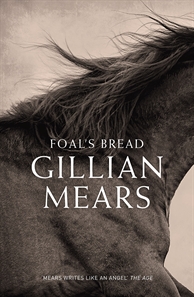
Gillian Mears' Foal's bread

Foal's bread cover (Courtesy: Allen & Unwin)

Foal’s bread is Gillian Mears’ first novel in around 16 years, though she has published short stories in the interim. This is a shame because she is a beautiful writer, particularly when she writes about the place she knows best, the farms of the New South Wales north coast.

Foal’s bread is about the Nancarrow family. Most of it takes place between 1926 and around 1950, as it follows the fortunes of Noah (Noey/Noh), her husband Roley (Rowley), and the extended family with which they live. Their main business is dairying, but their passion is the sport of horse high jumping. At the beginning of the novel, Roley is an Australian high jump champion and Noey a young 14 year-old girl with promise. They meet, marry (early in the novel, so no spoilers here) and start working hard to achieve their dream of having their own high jumping team. Hope on, Hope ever, is their motto. That’s the broad plot; the story is far more complex.

This is an archetypal story of strong country people coping (or not) with “luckiness and unluckiness” in life. In its depiction of hardship, stoicism and the will to survive in rural families, it reminded me – in tone if not in story – of Geoff Page’s The scarringThe hardship may come from different quarters, but in both there is a sense of forces out of one’s control combining with things of the characters’ own making. That mix – of characters’ judgement or behaviour clashing with luck (usually bad) – tends to make for a good story, in the right hands. It’s a bit Shakespearean in a way, the clash of character with “the elements”.

Australian Women Writers Challenge 2012 Badge

Australian Women Writers Challenge (Design: Book'dout - Shelleyrae)

In Foal’s bread, the “bad luck” has many sources, some human and some natural, such as incest, lightning strikes, giving birth to a disabled child, war and drought. How the characters cope with the trials confronting them is the core of the novel. Unfortunately, more often than not, they don’t cope very well. Why? Mainly due to their very human failings. Noey and Roley, whose marriage commences with great love and big dreams, don’t know how to communicate when calamity hits. Noey’s mother-in-law, Minna, lets her jealousy (“of the happiness she’d never seen before”) get the better of her and prefers to increase the tension between her son and his wife rather than to ameliorate it.

By now you’ll be thinking this sounds like a miserable story, and in some ways it is. But it’s not all darkness. While the novel has an almost elegiac tone, its movement is towards light. It has a three-part structure. There’s a very short Preamble which sets a tone of harshness and brutality with its references to incest, bushfires, floods, and animal cruelty.”Watch out you don’t cry” we are warned. Then there is the bulk of the novel in which the story of Noey and Roley is played out. This is followed by a Coda, set some 50 years later, in which we learn that “the old voices remain … funny, flinty, relentless”. These voices are carried into the future by Lainey, the strong, resourceful daughter of Roley and Noey, “her mother’s daughter through and through”.

A strong story, but what gives this novel its real power is the writing. Mears mixes the rough, ungrammatical country-speak of the era with glorious, rhythmical language describing the magpies, butcherbirds, trees, creeks and hills of One Tree Farm. The “one tree” is a jacaranda, and it features throughout the novel. It could almost be, dare I say it, a character. Early in the novel, when all is full of hope, it quivers “to create the feeling of a big bosomed woman wanting to waltz”. Later, as things start to collapse, it loses its leaves, but at the end “the old tree lives on … like a huge purple cloud hiding the rooflines”.

And then, of course, there are the horses. Reading this book reminded me a little of reading Tim Winton’s Breath. Mears does for horse high-jumping what Winton did for surfing. She made me feel the joy and beauty of the jump, of pushing oneself to achieve just that little bit more in a risky sport, of having a dream that keeps you going, of doing “the impossible”. Mears, like Winton, knows her subject inside out, and you feel it in her writing.

I fear I haven’t done the book justice. I’ve not really described its complex plot. I’ve named only a few of its large cast of colourful characters. It’s an ambitious book with big themes and a big style. Not everyone loves it. Some find the dialogue tricky or some descriptions overdone; some think the ending is disappointing; some think it’s stereotypical in places. I think none of these things. I’d love to know what you – if you’ve read it – think!

Gillian Mears
Foal’s bread
Sydney: Allen & Unwin, 2011
370pp.
ISBN: 9781742376295

(Uncorrected proof copy received from Lisa of ANZLitLovers in a blog giveaway)

Why did Jane Austen?

What is it about Jane Austen? We all know the basic dichotomy. You know, the division between those who dismiss her as being slight, inconsequential, fluffy, chicklit and those who read her again and again swearing that each time they do they find something new to enjoy and appreciate. But, do you know about the dissensions that rage amongst the ranks of the latter? I often wonder how a writer so loved and admired can engender such huge and ongoing debates amongst those very ones who love and admire her!

English: Fanny sewing (detail from File:Mp-Bro...

Fanny sewing in Mansfield Park (Illus. Brock, Public Domain, via Wikipedia)

Here are some of the issues Janeites debate ad infinitum:

  • Fanny should have married Henry Crawford, not Edmund (Mansfield Park)
  • Marianne and Colonel Brandon could never be happy (Sense and sensibility)
  • Emma’s relationship with Mr Knightley is too “incestuous” to be acceptable (Emma)
  • Fanny is a weak and boring heroine (Mansfield Park)
  • Henry Tilney didn’t really love Catherine but married her out of honour for his father’s poor treatment of her (Northanger Abbey)
You would think, wouldn’t you, that fans of her books, those who read them multiple times, would agree at least on basic plotting and characterisation? But not so.
Why is this? That is, how can readers disagree with Austen and yet love her? Well, I would argue that it’s her wit and humour, her comedy – and the fact that her comedy is pointed, wicked even, but not bitter. Mr Collins (of Pride and prejudice), for example, is one of her silliest, most comic creations. He’s a snob, he’s tactless, he’s boring, but does he get his come-uppance? No. He ends as he always was, sublimely unaware of his failings – and fortunately (for him) married to the tolerant, sensible Charlotte. Then there’s Mr Wickham, the villain of the same novel. Far from getting his come-uppance for his dastardly deed – other than being stuck in a marriage with a silly girl – he receives help from the families he wronged:
Though Darcy could never receive him at Pemberley, yet, for Elizabeth’s sake, he assisted him farther in his profession.
Perhaps I should rephrase this. It probably is a come-uppance for Wickham to be stuck with the silly Lydia. Likewise, for Maria Bertram (in Mansfield Park) to end up as she did:
It ended in Mrs. Norris’s resolving to quit Mansfield and devote herself to her unfortunate Maria, and in an establishment being formed for them in another country, remote and private, where, shut up together with little society, on one side no affection, on the other no judgment, it may be reasonably supposed that their tempers became their mutual punishment.
But these punishments are mild by comparison with what happened to “villains” in most novels of the 18th and 19th centuries. This comes about because Austen’s characters exhibit a psychological realism that is somewhat unusual for the time. Her characters aren’t archetypes. They are fully realised creations who move and act in a comprehensible way. We’ve all known (or been!) an over-emotional Marianne, a proud and reserved but reliable Darcy, a silly boy-chasing Lydia, a mine-is-bigger-than-yours John Thorpe, a too-willing-to-judge Elizabeth Bennet. To so accurately render humanity was Jane Austen’s aim, as she most clearly expressed in Northanger Abbey when she described a novel as something
in which the greatest powers of the mind are displayed, in which the most thorough knowledge of human nature, the happiest delineation of its varieties, the liveliest effusions of wit and humour, are conveyed to the world in the best–chosen language.
And this is why we Janeites keep reading – and arguing about – her.

Delicious descriptions from Down Under: Jahnavi Barua on reading

In my recent review of Jahnavi Barua’s Rebirth I quoted the following line: “No, I will not buy a book today. I will try and live in my life instead”. I really wanted, though, to quote the entire preceding paragraph, but it didn’t really suit the direction of my review. And so, instead, I’m posting it today.

The protagonist, Kaberi, is in a bookshop (as you will have guessed):

I begin with the As and work my way down the bookshelves. I stop at C; I have not read Disgrace yet and would have liked to have browsed through it but somehow today my heart is not in it. Still, I wander down the aisle looking at the familiar names; I am compelled to stop at K, Kawabata. I caress the spine of the book as if stroking the hand of an old and beloved friend. I cannot forget the girl in his book, The sound of the mountain. Her relationship with her father-in-law haunts me; is it possible that there can be only friendship between a man and a woman unrelated by blood? I had been so deeply unsettled by the book when I first read it; your father had only laughed. He said I had lived so little in the real world that the fictional appeared so significant to me.

I love this paragraph for so many reasons. Let me count the ways! No, let’s not be quite so mechanical but I will say that I like it for personal and structural reasons. Personal because I’ve read and loved the two books she describes, and because I can relate to her need to caress a loved book and her being unsettled by a great book.  And structural because this paragraph contains several clues to character and even plot in the book … but I won’t give those away (beyond of course what you’ve already gleaned from this piece of text itself).

Fergus W. Hume, The mystery of a hansom cab (Review)

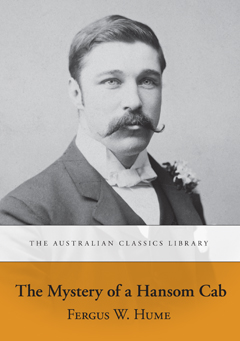
Hume Mystery of a Hansom Cab

The mystery of a hansom cab (Courtesy: Sydney University Press)

Sometimes you just have to break your reading “rules” don’t you? Two of mine are that I’m not much into detective fiction (despite having reviewed Peter Temple’s Truth here) and I don’t read self-published books – but then along came Fergus Hume‘s The mystery of a hansom cab. It’s a classic Australian crime novel – and it was “originally” self-published (says she cheekily)!

I’m not, you now know, an aficionado of crime fiction, so my assessment of this book may be the skewed one of a newbie not versed in the intricacies of crime writing. However, I must say that I found this a thoroughly enjoyable and engaging book, and would recommend it to crime and non-crime readers alike, for reasons that will soon become obvious. But first, the plot.

The story commences with a newspaper report of a murder that takes place in a hansom cab, and over the next few chapters we learn the name of the victim (a young man, Oliver Whyte, who was drunk at the time of his death) and that he was killed by a passenger who got into the cab, ostensibly to see him safely home. The detective on the case fairly quickly deduces that the murderer is a rival for the affections of a young society woman … and from here, as it always does, the plot thickens. The accused murderer declares his innocence, that he indeed has an alibi, but he will not divulge the information it would “curse” the life of his fiancée. The trial occurs and is resolved halfway through the novel. The rest explores … but wait, if I tell you this, I’ll give too much away, so I’ll stop here. The resolution, when it comes, is not a complete surprise but neither is it completely predictable. At least, not to non-aficionado me.

Australian Literature Month Platypus logo

Read for Reading Matters' Australian Literature Month

Now, why do I like it? To start with, it’s a well-told story, with nicely delineated characters. Then there’s the setting: it is primarily set in Melbourne, with a little excursion into the country, in the 1880s. This was a boom-time for what was known then as “Marvellous Melbourne” and Hume describes life in this well-to-do post-Gold Rush city with gorgeous clarity. Most of it concerns the middle classes – the professionals and self-made men – but we are also taken into the slums where prostitutes struggle to survive. Hume does not have the social justice goals of, say, William Lane (in The workingman’s paradise) but he doesn’t shy from describing some of the seamier aspects of the city:

Kilsip and the barrister kept for safety in the middle of the alley, so that no one could spring upon them unaware, and they could see sometimes on the one side, a man cowering back into the black shadows, or on the other, a woman with disordered hair and bare bosom, leaning out of a window trying to get a breath of fresh air … Kilsip, turning to the left, led the barrister down another and still narrower lane, the darkness and gloom of which made the lawyer shudder, as he wondered how human beings could live in such murky places.

Hume then describes the woman they had gone to meet, Mother Guttersnipe (how Dickensian is that?):

… a repulsive-looking old crone; and in truth, her ugliness was, in its very grotesqueness well worthy the pencil of a Doré.

This brings me to another aspect I enjoyed. It is chockablock with allusions to Shakespeare and the classics, and references to what the writer of the introduction describes as the “middle-brow, middle-class, international entertainment culture of North America and Europe”, such as the artist Doré, the composer Offenbach, and the writers Poe, Dickens and De Quincy. There’s also a cheeky reference to novelist Mrs Braddon – “Murdered in a cab … a romance in real life, which beats Mrs Braddon hollow” – containing a clue that readers of the time might have picked up.

There’s the 19th century style – third person omniscient, descriptive chapter titles, a touch (but not too much) of melodrama, light satire and humour, the use of little homilies (often to introduce chapters), and a (very) neatly tied up conclusion. This is not ponderous, heavy-handed 19th century writing, but good well-paced story-telling supported by lovely description and observations. Most of the light relief comes through minor characters, like the landlady Mrs Sampson and the young-man-about-town Felix Rolleston. Here is Mrs Sampson:

She was a small, dried-up little woman, with a wrinkled yellow-ish face. She seemed parched up and brittle. Whenever she moved she crackled, and one went in constant dread of seeing a wizen-looking limb break off short like the branch of some dead tree. When she spoke it was in a voice hard and shrill, not unlike the chirp of a cricket.

She is, for all this, a warm-hearted woman, but whenever she appears so do such words as “crackle’, “rustle”, and “chirp”. Beautifully vivid, but nicely controlled.

It is of course also 19th century in its worldview … and so has a patriarchal flavour. Our “plucky” heroine, Madge, buys “a dozen or more articles she did not want” writes the author. And in the resolution the men decide what they will and will not share with the women involved – “it would be useless to reveal” the truth to one female character as “such a relevation could bring her no pecuniary benefit”, and to another because “such a relation could do no good, and would only create a scandal”. The infantilisation of women, eh?

Fate also makes its appearance in the novel, from early on when the accused murderer’s life “hangs on a mere chance” to late in the novel when the author makes his position clear. He writes that men:

… created a new deity called Fate, and laid any misfortune which happened to them to her charge. Her worship is still very popular, especially among lazy and unlucky people, who never bestir themselves … After all, the true religion of fate has been preached by George Eliot when she says that our lives are the outcome of our actions. Set up any idol you please upon which to lay the blame of unhappy lives and baffled ambitions, but the true cause is to found in men themselves.

I’ve said it before, and I’m sure I’ll be saying it again: I could write on and on about this book. It has so much to explore and it would be fun to do so, but at this point I’ll simply recommend it to you and hope that you’ll find time to discover and enjoy it too. It was, in its time, a best-seller …

Fergus W. Hume
The mystery of a hansom cab
(The Australian Classics Library)
Sydney: Sydney University Press, 2010
(Orig. pub. 1886)
293pp.
ISBN: 9781920899561

(Review copy supplied by Sydney University Press)

Notable reads for 2011

I’ve been wondering whether to jump on the “Best of” bandwagon and, if I did it, how to do it. Then today I read Lizzy Siddal’s (love that name!) list and decided that I’d follow her lead and use categories rather than go for a simple Top Ten (or whatever) which always feels fraught. I know Lizzy’s not the only one to use categories but hers was the one that inspired me today.

However, for my categories I’m going to use book reviewer cliches since, of course, I never use them in my reviews!

Some mosts

  • Grittiest: Joyce Carol Oates’ Beasts for confronting sexual predation on multiple levels.
  • Most thought-provoking: André Gide’s The immoralist for, well, making me think.
  • Most rivetting: Lloyd Jones’ Hand me down world because even though I guessed the set up fairly early on I still wanted to know how it was going to play out.
  • Most haunting: Horace Walpole’s The castle of Otranto. What else? Case dismissed.
  • Most lyrical: Alan Gould’s The lakewoman for its mesmeric, poetic, romantic sensibility.
  • Most unflinching: Mario Vargas Llosa’s no-holds-barred The feast of the goat about the last days of the Trujillo regime … it was an apposite read given the events of the Arab Spring
  • Most powerful: That would have to be the power couple, Franklin and Eleanor: An extraordinary marriage, by Hazel Rowley
  • Most poignant: Jay Griffiths’ A love letter from a stray moon for being fiery, passionate and poignant all in one.

And, to be fair about it, a couple of leasts

  • Least epic: Jane Austen’s The Watsons. After all, how could an unfinished Jane Austen come even close to being epic?
  • Least nuanced: Howard Jacobson’s The Finkler question, though perhaps there’s nothing more nuanced than the substitution of “Finkler” for “Jew”?

There aren’t many Aussie books in this list, but that’s because I focused on Aussie highlights in this week’s Monday Musings. To include them again would be like double-dipping, wouldn’t it?

And now over to you … what were your most notable reads for 2011?

Oh, and Happy New Year to you all … may the reading gods smile kindly on you in 2012.

Banana Yoshimoto, The lake (Shadow Man Asian Literary Prize 2011)

Shadow Man Asian Literary Prize 2011 Badge
Image created by Matt Todd of A Novel Approach

When I saw that Banana Yoshimoto‘s novel The lake was shortlisted for the 2011 Man Asian Literary Prize I knew that it would be a high priority for me to read, because I like Japanese literature and I have read and enjoyed Yoshimoto (her novel Kitchen) before.

The first thing that struck me, however, as I started reading the book was a case of reading synchronicity. Roy’s The folded earth, the first book I reviewed for our Shadow Man Asian Literary Prize 2011 project, is about a young woman grieving the death of her husband. In The lake, the protagonist, Chihiro, also a young woman, has just lost her mother. And, in further synchronicity, both women meet men who impact their lives. This is not unusual, of course, but the thing is that in both books there is a sense of mystery surrounding these men. However, this is where the similarity ends: the mystery in The lake has nothing to do with the death of Chihiro’s mother. Rather, it relates to something the man has experienced, something that has clearly damaged him.

So, what is the plot? It is basically a romance. The first line of the novel is:

The first time Nakajima stayed over, I dreamed of my dead mom*.

Chihiro, our first person narrator, then flashes back to tell us about her background, her somewhat unusual life with her bar-owner mother and businessman father who never married due to his family’s objections. Chihiro is around 30, but this is, really, a coming-of-age novel because she doesn’t yet feel grown-up:

I’m still a child. I still need my parents, and yet, I suddenly feel I’m walking alone.

Into this solo life comes a young medical student, a “puzzling young man”, Nakajima, who lives in the apartment opposite hers. They first communicate non-verbally across the dividing space. Gradually Chihiro feels she is falling in love with Nakajima, but she is not sure, partly because he’s odd, uneasy, something he admits to but can’t (yet) explain. However, it is through learning to accept Nakajima, to not push him but simply to care for him, that Chihiro starts to grow up. At first she wants to have fun – “I didn’t want to deal with weighty matters” – but she comes to realise that she needs him, and senses that he is “the one”. All this develops before we know what happened to Nakajima. Plotting the story through Chihiro’s description of their developing relationship puts the focus less on what happened in the past – though we certainly want to know – and more on how two young “kind of weird” people might move together to a good future.

Now, here’s the rub. Do I let on what happened to Nakajima? The blurb inside the jacket hints at what it is, so perhaps it’s ok to. However, I think I won’t. All I’ll say is that the lake – to which Nakajima takes Chirihiro half way through the novel – and the brother and sister (Mino and Chii) living there are important to the resolution. Chii is bedridden and mute but she can foretell the future and she does this through Mino. This adds a supernatural element to the story, which works well enough for me though I’m not sure what it specifically adds to the novel (except perhaps a sense of “otherness” to the atmosphere?)

The more important question to ask is why has this novel been longlisted for the Man Asian Literary Prize? Is it more than a nicely written coming-of-age love story? Well, the mystery and its impact on Nakajima, Mino and Chii is a significant one, but that, from the way the story is told and how the plot is resolved, doesn’t seem to be the main point. It is clearly about grief, trauma and recovery, but I think this might be overlaid with the struggle in Japanese society, particularly for the current young generation, to not follow the norm blindly. Nakajima and Chihiro did not have “normal” upbringings. This means that, whether they like it or not, they symbolise nonconformity – and must, consequently, make active decisions about where to next. Freedom is not, I understand, a high value in Japanese society … but it is an issue that comes up regularly in the book. Chihiro’s parents aren’t, through family expectations, free to marry. The mystery surrounding Nakajima relates to a loss of freedom. In her work as a muralist, Chihiro’s only demand is the freedom to paint what she wants and, when that is threatened by a sponsor wanting her to incorporate an enormous logo into her mural, she intelligently but resolutely conducts a campaign to encourage him to change his mind.

Late in the novel, when talking about his experience, Nakajima says:

When you’re in a state of homogeneity, you’ve lost yourself.

Beyond loss and childhood trauma, then, it is the ongoing things like homogeneity, lack of freedom, the push to be normal that challenge Yoshimoto’s characters. But this is a quiet, lyrical book rather than a feisty one. It recognises that life involves “dull repetition of the same old thing” peppered by those “little leaps of your heart to put a splash of colour in the world”. Have I fully understood this novel? I’m not sure that I have … but I did enjoy reading it and thinking about the issues Yoshimoto seems to be exploring.

Matt of A Novel Approach and Lisa of ANZLitLovers, on our Man Asian team, have also reviewed it and are worth reading for their different takes.

Banana Yoshimoto
The lake
(trans. by Michael Emmerich)
Brooklyn: Melville House, 2011 (orig. Japanese ed. 2005)
188pp
ISBN: 9781933633770

* An American translation. We would say “mum”!

Andrew O’Hagan, The life and opinions of Maf the dog and of his friend Marilyn Monroe

Andrew O'Hagan 2009

O'Hagan 2009 (Courtesy: Treesbank, CC-BY 3.0, via wikipedia)

Andrew O’Hagan‘s The life and opinions of Maf the dog and of his friend Marilyn Monroe is a fun – though also serious – book, so I’m going to start with something trivial, just because it will provide a laugh to those who know me:

Like all dogs, I take for granted a certain amount of sanctioned laziness, but beaches, tanning, ice-cream? To me the beach is an unfixed term on a roasting spit, a stifling penance …

Yep, Maf and me, we don’t like beaches*! Enough digression, though … on to the book. First off, I liked it – but how to describe a book that roams so widely yet has such minimal plot? The story is told first person by Maf the dog. Maf (short for Mafia Honey) is a Maltese Terrier who was given (in reality as well as in fiction) to Marilyn Monroe by Frank Sinatra. In the first few chapters Maf moves from Scotland, where he is born, to the home of Vanessa Bell and Duncan Grant (of the Bloomsbury set), to the Los Angeles home of Natalie Woods’ parents, to Frank Sinatra to … well, you know who now. In the rest of the book we follow Maf as he lives with Marilyn Monroe, in New York and Los Angeles, in the last couple of years of her life.

The book though is less about Marilyn Monroe (that “strange and unhappy creature”) than it is about America and the author’s exploration of the issues that occupied, or typefied, America in the early 1960s. They were years of hope and excitement, when people believed they could (re)make themselves (“Let me start again” say the migrants coming in through Ellis Island). John F Kennedy was elected in 1960 and the Civil Rights movement was about to take centre stage. But Maf sees the American paradox, sees that the ideals of liberty and happiness are by no means assured.

A repeated motif in the book is that of interior decoration – and its literal meaning can be overlaid with something a little more symbolic:

My hero Trotsky would have made a great interior decorator: after all, decoration is all about personality and history, the precise business of making, discovering, choosing the conditions of life and placing them just so. The best decorators finding it quite natural to inject a splash of the dialectical into their materialism.

It’s a clever motif because it encompasses the perspective (the floor) from which dogs (like Maf) see and describe the world, the (often superficial) fascination with home decoration (which sees, for example, Monroe going to Mexico to buy goods that she never unpacks), and the more existential notion of “decorating” or fashioning oneself.

Another motif running through the book is Trotsky. The above quote comes early in the book, but there are many other references, including this one quite late:

Wasn’t he [Trotsky] the god of small things and massive ideas, a cultivator of man’s better instincts? That, my friends, is the greatest work of the imagination: not action, but the thought of action.

Maf sees Trotsky as an enlightened being, who might, just might have shown us the way, had he been given the chance. But, let’s move on, because this book – chockablock as it is with philosophers, artists, writers, actors, critics and politicians – rarely stands still. We are continually on the move, either physically as Maf moves from place to place, or mentally as Maf explores idea after idea, such as fiction and art versus reality, tragedy versus comedy, humans versus animals, interior decoration, psychoanalysis, politics and fame, master versus servant (even in the great democracy). These are not didactically or artificially explored in a let’s-tick-off-another-obsession way. They are neatly integrated into the story as Marilyn, with Maf in tow, experiences the last years of her life. She dines with Frank Sinatra, discusses books with Carson McCullers, is treated by her therapists, attends Lee Strasberg’s Actors Studio, discusses civil rights with JFK, works with Cukor on Something’s gotta give, and so on. As far as I can tell, all the facts of her life presented here are “real” – as are the major cultural movers and shakers depicted within. It can be daunting to confront so many names in such a short space, but there are some good laughs here if you just go with the flow.

While the facts are interesting, however, what makes the book are Maf’s observations. Somehow, O’Hagan manages to imbue Maf with a persona, a voice, that works. It’s not twee or sentimental. It’s a little tongue-in-cheek, it’s knowing, and it’s clear-eyed but with compassion where compassion’s due. Maf notices for example the paradox contained in:

… the upper classes arguing in favor of radical politics while their servants set down their tea in front of them.

One of the issues that crops up regularly is the line between art/fiction and reality, which is not surprising in a book populated with actors and other artists. Early in the book Maf tells us that dogs**:

have none of that fatal human weakness for making large distinctions between what is real and what is imagined.

I like this. I fear that too often we polarise life/reality and art/imagination, particularly in literary analysis. We might express discomfort, for example, with a dog narrating a story about people! We “trust” realism, and we distrust or are uncomfortable with the opposite, with what we deem to be “not believable”.

A little later, playing with this idea from a different tack, he tells us:

We are what we imagine we are: reality itself is the true fiction.

Marilyn’s inability to sort this out probably contributes to her undoing. The book’s title suggests that we will get to understand Marilyn, but we don’t. She is, at the end, as elusive, “unearthly”, “abstracted”, as ever she was … which is probably the most realistic (ha?) way to go!

Maf says Marilyn taught him that:

A novel must be what only a novel can be – it must dream, it must open the mind.

Can’t say better than that … and this book, I reckon, gives it a good shot.

Andrew O’Hagan
The life and opinions of Maf the dog and of his friend Marilyn Monroe
London: Faber and Faber, 2011
279pp
ISBN: 9780571216000

* A footnote, emulating Maf whose footnotes add to the fun of the book. I do like to visit the coast, to look at the sea. It’s the beaches – the spending hours on them – that I don’t like.

** In a footnote, Maf tells us there’s been a long tradition of animals speaking for humans, listing such writers as Cervantes, Orwell, Woolf, Swift, Checkhov, Gogol and Tolstoy, just in case we decide to question a tale told in his voice!

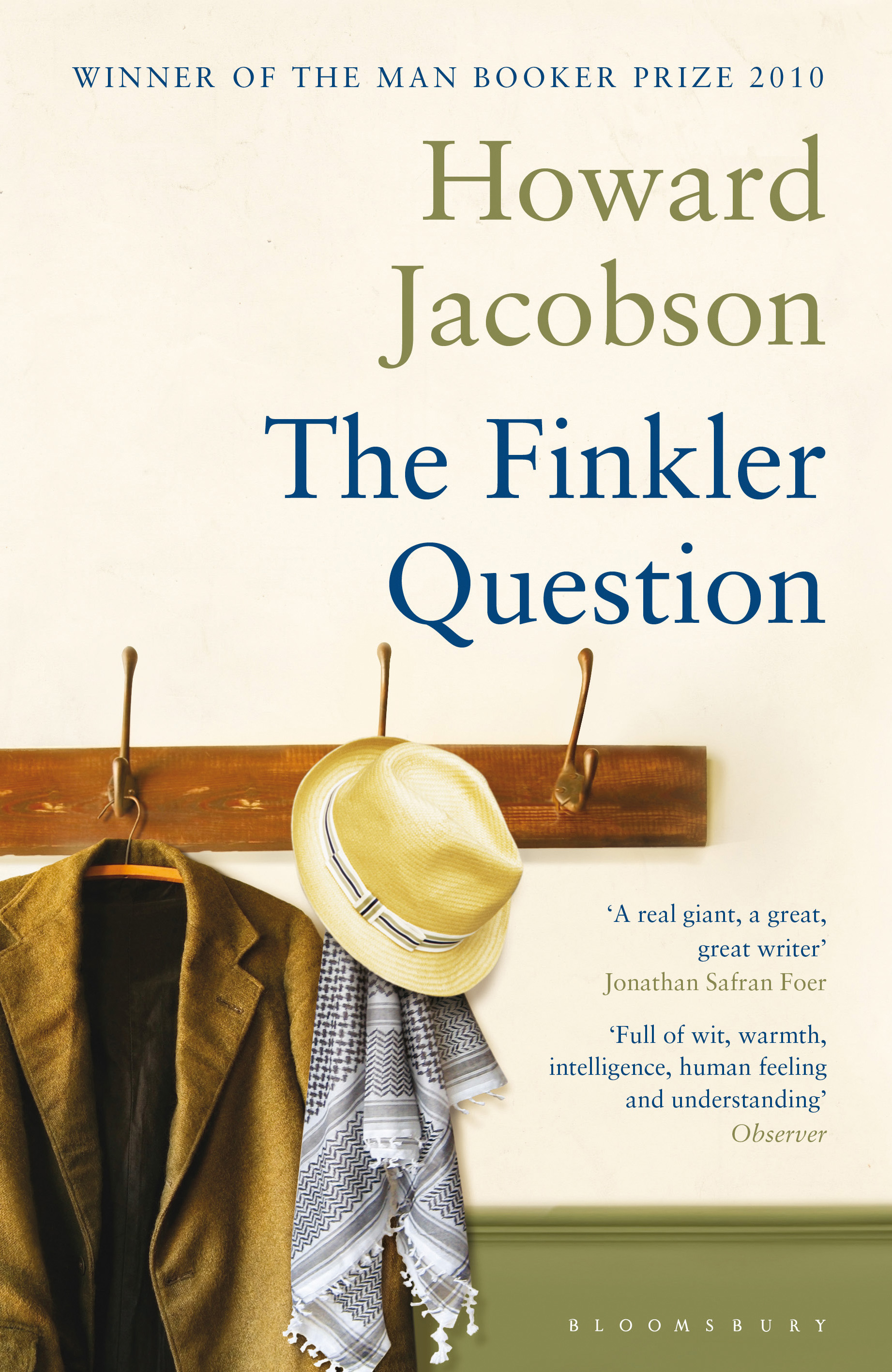
Howard Jacobson, The Finkler question

Howard Jacobson's The Finkler question

Howard Jacobson’s The Finkler question (Courtesy: Bloomsbury Publishing)

Whispering Gums, as you would expect, writes erudite marginalia and so you’d be in for a treat if you ever obtained my copy of Howard Jacobson‘s 2010 Booker award winning novel, The Finkler question. The margins are peppered with my reactions, like, you know, “Ha!” and “Oh dear”. Riveting stuff … and yet, what comments would you make in this book? Ah yes, “stereotyping” is another one, because that, really, is the springboard from which this rather funny book is written.

Do I need to summarise the plot? I feel that I’m about the last blogger to read this book, but just in case I’m not, here goes …  It concerns three longstanding friends: Julian Treslove and Sam Finkler who have been friends since schooldays, and Libor Sevcik who was their teacher at school. At the beginning of the book, Finkler and Libor, both Jews, have been recently widowed. Treslove, the non-Jew, is the “honorary third” widower because he is single (yet again). The novel’s premise is that Treslove would like to be a Jew …

Why, you might ask, would Treslove want to be a Jew (or, a Finkler, as he privately calls them – and hence the title)? It is not an accident that Treslove’s occupation when the novel opens is to be a paid double (or “lookalike”) of famous people at parties, conferences, corporate events:

Treslove didn’t look like anybody famous in particular, but looked like many famous people in general, and so was in demand if not by virtue of verisimilitude, at least by virtue of versatility.

And that’s pretty much how his Jewishness goes too. He might look and play the part but, deep down, can a non-Jew ever really be Jewish? Treslove is about to find out.

Jacobson has a way with words. It was this, together with the endless discussion, using every Jewish stereotype going, of what makes a Finkler (a Jew, remember!) a Finkler, that kept me going through a book that I wasn’t really sure was going anywhere. I laughed at Treslove’s incomprehension of Finkler (the character, this time):

“Do you know anyone called Juno?” Treslove asked.
“J’you know Juno?” Finkler replied, making inexplicable J noises between his teeth.
Treslove didn’t get it.
“J’you know Juno? Is that what you’re asking me?”
Treslove still didn’t get it. So Finkler wrote it down. D’Jew know Jewno?
Treslove shrugged. “Is that supposed to be funny?”

Oh dear! “Julian Treslove knew he’d never be clever in a Finklerish way” but, despite this, he continues with his goal to be Jewish. Meanwhile, Finkler, grieving for his wife and a marriage he still doesn’t understand, tries to dissociate himself from Jews (particularly Zionists) through membership of the ASHamed Jews. And Libor, grieving heavily for his true love, tries to dissuade Treslove from his ambition.

The book chronicles a year or so in the life of these three as each confronts his particular challenge. Treslove falls in love with Libor’s (Jewish) great-niece, Hephzibah, furthering, he hopes, his path to Jewishness; Finkler starts to fall out with the ASHamed Jews though not with their anti-Zionist principles; and Libor starts to fall out of life itself. All of this is told with both warmth and humour. The humour is always there, and yet is never pushed so far that the humanity of the characters is lost. You feel for them, despite their flaws and foibles. You want Julian, the hopeless father and failed lover, to make a go of it this time. You want Finkler to make peace with his Jewishness. And you want old Libor to get over his grief and join the world again. But through all this, you wonder, why? Why is Jacobson writing this story?

I have a few ideas. One may simply be to capture the diversity of Jewishness. Through all the stereotypes that made me laugh (Jews are musical, brokenhearted, rich, clever, comic, and so on), Jacobson shows that Jews, like any other group, are not all the same, cannot all be put in the one basket. Another  reason, though it’s depressing to think it’s needed, may be to defend Jews in an anti-Semitic world, to show their humanity. You care for these characters whose troubles with identity, love and loss are universal. And another may be to explore Zionism, safely. Can Zionism be defended? Has it changed into something more ugly, something that undermines its original conception?

In the end I did like this book because, while I was contemplating the “why”, I was engaged by the characters and their stories. The novel commences with Treslove, the would-be Jew, but it concludes with Finkler, the troubled Jew. Here he is, towards the end:

He was a thinker who didn’t know what he thought, except that he had loved and failed and now missed his wife, and that he hadn’t escaped what was oppressive about Judaism by joining a Jewish group that gathered to talk feverishly about the oppressiveness of being Jewish. Talking feverishly about being Jewish was being Jewish.

Ha! You said it, Mr Jacobson, I’m tempted to say. But that would be too smart-alecky of me because the book is, in fact, as much about humanity as it is about being Jewish.

Howard Jacobson
The Finkler question
London: Bloomsbury, 2011
370pp.
ISBN: 9781408818466