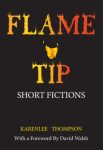
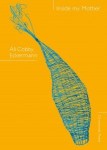
 Short story anthologies usually have some sort of organising principle – a theme, perhaps, such as Australian love stories, or a prize, such as the Margaret River Short Story Competition – but single author collections tend to be looser. Not so Karenlee Thompson’s Flame tip which she describes as containing “creative writing pieces that weave in and around the Tasmanian bushfires of 1967”. These fires, she writes, “left 62 people dead, 900 injured and over 7,000 homeless in a single day”.
With subject matter like this, you might think Flame tip would be distressing to read – and there is that. But Thompson manages to vary the tone enough, by injecting the occasional bit of humour and satire for example, to lighten the melancholy of the heavier stories. This humour, in fact, starts with David Walsh’s idiosyncratic (we would expect no less) introduction. He tells us he remembers the day – 7 February – because it was his first day of school, and his Mum forgot to pick him up. She “forgot” because she was fighting a fire on their back fence, but Walsh wonders whether this was a “viable excuse” or whether she chose to “triage the back fence over her weird and difficult son”. Whatever the reason, Walsh’s family lost neither home nor persons – unlike some of the characters in Thompson’s book.
So now, the book. Karenlee says in her introduction that it’s a collection to be “dipped into at random” and that her aim is “to present the truth ‘under the mask of fiction’ (to borrow from Gao Xingjian), revealing nuances of character and place, as well as repercussions that are often difficult to expose through nonfiction”. This is exactly what she achieves. Some of the stories are told from the point of view of people who experienced the day – who lost loved ones or property – and some are told by later generations. Sometimes the impact of the fires is direct and obvious, such as the wife who lost the love of her life (“Like a wall”), while elsewhere it is far less direct, such as the fickle lover in “Love, what is thy name?” whose grandparents lost their home in the fires.
Many of the stories of loss – the loss of a husband, parent or friend – are the sorts of stories you’d expect. I don’t mean by that, however, that they’re clichéd or uninteresting, but just that in such a collection you’d expect such stories of loss. Thompson ensures her stories are interesting by personalising the loss, and by creating “real” characters rather than the heroes and saints you tend to get in the media. An example is the betrayed wife in “A bird in the oven” who was 12 years old when she lost her mother in the fire and who took “a long time growing up”. Another is “The keeper of the satchel”, a man more damaged by his mother’s lack of love than by her death.
There are positive stories too, such as the young girl in “Jack Frost” who finds love. And there are surprising stories. One is “Medusa One Snake”, about how a family of birds manipulates fire to locate prey (the fleeing animals, “a mobile smorgasbord”). Another is “Degustation” about a woman on a date with the perfectly-named Augustus from a family which “had bought up all the available charred and rubble-ridden farms in the district, after the fire had rendered the singed locals almost comatose with shock”. There’s always someone ready to make a buck out of other people’s pain!
The issue of form … short fictions
The book is subtitled “short fictions”, and Thompson describes it as a collection of “creative writing pieces”. In other words, the term “short stories” isn’t used. There are “traditional” short stories here, but the collection also includes other “pieces”. There’s the shape poem “Flame”, an epistolary story (“Love, what is thy name”), and the piece titled “Lost” which riffs on lost-and-found ads. In it Margaret Groombell writes:
Lost
A life
Including: four-bedroom weatherboard home with indoor amenities, a much loved border collie answering to the name of Richie, a sense of security, linen and cutlery, a priceless hand-painted jardinière, stamp collection gathered and assembled over three generations, pink shower cap studded with daisies, deck of hand-painted burlesque playing cards, a position of some standing in the community, 2 striped deck chairs …
And so on. The random ordering of “items” here – “a sense of security” next to “linen and cutlery” – beautifully conveys the dislocation, the disorder, that such loss generates.
Another piece, “Annabelle, just looking”, plays with the idea of personal ads, but it’s an extended ad in which 72-year-old Annabelle explains her needs and why she’s where she is. She describes herself. She’s “never considered Botox or any of that other rubbish”, she says:
My forehead, therefore, is less like a flat screen TV and more like a topographical map. Life has surprised me, frightened me, delighted me – it’s all there in plain sight, writ large for the world to see.
Her demands aren’t many, but she hates “open fires”.
My final example is the short two-pager, “Cross stitch”, about Nettie who’s lost everything, but is surrounded by the macrame and aprons
made with altruistic fervour, no doubt, by women and girls who wanted to give her something to help her settle into a tiny house that had nothing from her life before.
I love the way Thompson, in piece after piece, breaks down popular notions about fires and their aftermath, and shows us the more likely reality.
So far, I’ve focused on the bushfire theme, but one of the lovely things about this collection is how Thompson interweaves other ideas into it. In “Like a wall” and “Jack Frost” she tackles racism and community prejudices. And in “Degustation” she satirises fine dining – degustation menus in particular – as well as the arrogance and sense of entitlement of the wealthy. It’s a delightful, funny story. Indeed, Thompson’s writing overall has a light touch, with a keen eye for the absurd.
Flame tip is a serious collection about a serious subject, and it could so easily have become heavy. However, by varying form, voice and tone, Thompson has produced a book that not only sustains our interest but that, despite its subject matter, is enjoyable to read. And that’s no mean feat.
Lisa (ANZLitLovers) also enjoyed the book
 Karenlee Thompson
Flame tip: Short fictions
Melbourne: Hybrid Publishers, 2017
166pp.
ISBN: 978 1 925272 73 4
(Review copy courtesy Hybrid Publishers)



 Whispering Gums