Eleanor Limprecht, The Coast (#BookReview)

I love to read Author’s Notes, Afterwords, or whatever they are called, at the end of novels, and particularly so when the novel is historical fiction. This is because these notes will often explain the author’s thought process, the line they have drawn between fiction and fact, the sources used, the level and type of research undertaken, and so on. It helps me understand “how” to read the book, if that makes sense. I was consequently pleased that Eleanor Limprecht had provided such information at the end of her fourth novel, The Coast, which is set in the former Coast Hospital lazaret in Little Bay, Sydney. This hospital was established in the 1880s for the treatment of infectious diseases, including small pox, tuberculosis, and the subject of this novel, leprosy (or Hansen’s Disease).

The Coast is set primarily in the first three decades of the twentieth century, and focuses on the story of Hilda/Alice who is nine when she is brought to the lazaret. However, while she provides the novel’s narrative and emotional centre, hers is not the only story told. We hear about other members of her family, including her mother Nellie/Clea who is at the Coast when she arrives. We also hear about one of the Hospital’s doctors, Will Stenger, who takes special interest in his lazaret patients. And, we have a story that somewhat parallels Alice’s, that of Jack/Guy, a Yuwaalaraay man, who also ends up at the lazaret, though not until he is an adult. I should explain here the dual names: leprosy patients would be given (or choose) a new name when they entered the hospital because, as Alice’s mother tells her, it’s better for their family if they disappear, “it’s better that no-one can find us”. Leprosy, at the time, was a reviled disease and sufferers were secluded under the Leprosy Act of 1890.

What author afterwords tell us

So, Limprecht’s words. I wanted them because I wanted to know whether she would address her First Nations character and, of course, being the thorough historical fiction writer she is, she does indeed discuss the issue. She had advice and feedback from Yuwaalaraay reader Nardi Simpson (whose Song of the crocodile I’ve reviewed) and Gamilaraay and Yuwaalaraay reader Frances Peters. She visited Angledool, Jack’s home, with the help of local First Nations people, and was shown around the Goondee Keeping Place at Lightning Ridge by First Nations people there. Her manuscript was also read by First Nations people associated with the La Perouse Aboriginal Land Council. All this supports my sense that she has rightly and respectfully included First Nations experience in her story.

Limprecht’s words provide other insights too, but I’ll mention just two of them. One is that she acknowledges various grants, including the Neilma Sydney Literary Travel Grant (see my post), which helped her visit another lazaret location, Peel Island. The other is that she acknowledges the History of Medicine Library at the Royal Australasian College of Physicians where she “found the records that inspired this story”. This interested me because the story contains many details about the lives of the patients at the lazaret, details that were so specific that I felt (and hoped) they were based on documented records – on reports, letters, and so on. This suggests that they were.

“nothing to look forward to” (Alice)

Limprecht also tells us in her words that she got the idea for this novel while researching her second novel, Long Bay (my review), making it before 2015. However, she also tells us that she finished writing it during the pandemic, which helped her “consider the continuing repercussions of stigmatising illness and the long-term effects of isolation”.

So now, the novel itself. The story is told in first person and third person voices – Alice’s in her voice, with the stories of the other three in third person. These four stories are interspersed with each other, and are told chronologically, but each starts at a different point in time, beginning with Jack (1905), then Alice (1910), Nellie (1892) and Will (1910), until they coalesce in 1926. Jack’s story encompasses his experiences as a stolen child and a soldier in the Middle East in World War 1. Through him, Limprecht ensures that First Nations’ lives are part of the life of the time she’s chronicling, something that many of our majority-culture-written histories and historical fiction have consistently omitted.

Jack’s story – of being taken from his family, returning to it, going to war and returning as an amputee who soon after ends up at Peel Island – conveys not just these facts, but the emotional impact of being stolen, of displacement, of racism (albeit his injured returned soldier status sometimes earned him begrudging recognition.) By sending him to Peel Island, Limprecht also documents the differential treatment at that lazaret between “white” and “others” (or, the “coloured camp”). This is a difference that he does not experience at The Coast under the more humane Dr Will.

Alice’s story follows, presumably, a typical trajectory of those who were isolated at a young age and spent the rest of their lives that way. (It’s a coming-of-age story as moving and as tragic as that of Anne Frank’s real one). As quarantine places go, The Coast lazarets – men’s and women’s – are humane. The patients live in cottages, they have access to a beach where they can swim and fish, and they can socialise with each other (though the women’s lazaret does not have a communal cottage like the men’s has!) But, “it’s no place to grow up”. Alice is an intelligent young woman, who quickly engages us with her warmth and honesty, but she also articulates the physical and emotional experience of this disease. Told first person, her story of resilience and resignation carries the novel.

Nellie’s and Will’s stories add additional depth and breadth to the lazaret community and thus the history. Both appear in the epilogue dated 1967. It didn’t feel narratively necessary to me, but historically it rounds out how leprosy treatment progressed and what happened to the Coast lazaret.

The coast is the sort of historical fiction I like, a well-researched, expressively-written story about an historical time and place I know little about, one that is worth knowing. It reminds us how far we have, or haven’t, come in our management of feared diseases, like AIDS, like COVID-19. It evokes with warmth and clarity the costs of ostracism and isolation. And, it puts First Nations people into the historical frame – naturally. A good read.

Lisa (ANZLitLovers) also liked this novel.

Eleanor Limprecht
The Coast
Sydney: Allen & Unwin, 2022
319pp.
ISBN: 9781760879402

(Review copy courtesy Allen & Unwin)
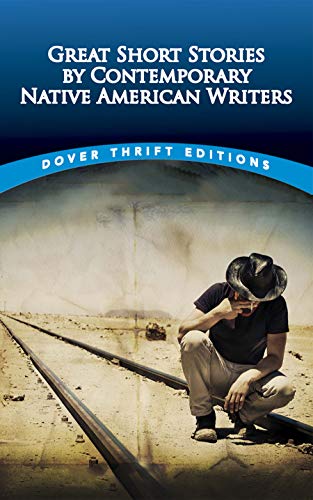
John M. Oskison, The singing bird (#Review)

From Zitkala-Ša’s 1901-published “The soft-hearted Sioux”, Great short stories by contemporary Native American writers jumps a quarter of a century to 1925, and John M. Oskison’s “The singing bird”.

John M. Oskison

Again, anthology editor Bob Blaisdell provides a brief intro to the author, but it’s Wikipedia that is able to provide more detail. John M(ilton) Oskison (1874-1937) was, like our two previous authors, of mixed parentage. He was born in Cherokee Nation to an English father and part-Cherokee mother. He went to Stanford University (where my friend who gave me the anthology went, in fact!) and was president of the Stanford Literary Society. Wikipedia says he was Stanford’s first Native American graduate. He apparently went to Harvard for graduate school but he left to become a professional writer after he won a short story competition.

By his death he had published novels, short stories and many pieces of journalism. A novel titled The singing bird was found in his papers in 2007 and subsequently published. Timothy Powell, writing about this novel, suggests it is “quite possibly the first historical novel written by a Cherokee”, and argues that it offers “an interpretation of indigenous history that stresses survival and empowerment over removal and despair”. It is set in the 1840s-50s, after the Cherokees had been removed to Indian Territory, and in it, Powell says, Oskison ‘skilfully blends fiction and reality, thoughtfully demonstrating how literature can rewrite the master narrative of “history” and bring to life moments in the past that remain outside the scope of the written records maintained by the dominant white society’. This sounds like the sort of historical fiction that is starting to appear in Australia, like Julie Janson’s Benevolence (my review) and Anita Heiss’s Bila Yarrudhanggalangdhuray (my review), novels that correct the colonial historical perspective that has been prevailed for too long. Oskison was, like our previous two authors, an activist.

Blaisdell focuses more on the story. He describes it as an “exciting, densely plotted story” but suggests the reader needs to “hold tight” because it is “dotted with odd, struggling phrasings that make it seem as if Oskison were translating it”. The title, he explains, refers to “cuckolding”, with “singing bird” being a term used by “full-bloods” for a “deceiving wife”. He suggests that ‘the issue of “full-bloods” versus half-breeds” is a messier theme’.

“The singing bird”

Powell says that it is not known when Oskison started writing his novel The singing bird. However, he does mention that this story was published in 1925 and wonders whether Oskison began to formulate the novel around this time. From Powell’s description of the novel, the characters names are different, it has a multilayered narrative structure unlike the story, and the narrative is very different, so let’s leave the novel there.

Wikipedia says of Oskison that “his fiction focused on the culture clash that mixed-bloods like himself faced”. “The singing bird” is interesting in this regard because, as Blaisdell suggests, a significant issue in the story concerns “full-bloods and half-breeds”. The story opens with Big Jim (Jim Blind-Wolfe) sending his wife Jennie away because it is time for the men to talk. They make up “the inner, unofficial council of the Kee-too-wah* organisation” and they are “self-charged with the duty of carrying out the ancient command to maintain amongst the Cherokees the full-blood inheritance of race purity and race ideals”.

This “council” is concerned about the “alarming late growth of outlawry in the tribe, an increase in crime due to idleness, drink and certain disturbing white men who had established themselves in the hills”. As they discuss this serious business, Oskison writes that “paradoxically … They would pass a jug of honest moonshine – but they would drink from it discreetly, lightly, as full blood gentleman should!” Nice touch!

Meanwhile, the ousted wife Jennie, takes herself to the “out cabin” with its “inviting pine-log room”. Here she awaits, we are told, Lovely Daniel who has already been introduced to us by the men, as their “wild half-breed neighbour”. Jennie, though, is expecting to “know shivery terror, the illicit thrill of the singing bird”. And so in the first two pages, the story is set up: Big Jim has sent his wife to the out cabin so that his little council can talk men’s business about half-breeds and white men, and that wife is waiting for one of those half-breeds to visit her in the cabin. Simple story of a dominating husband and unfaithful wife? Sounds it, but all is not as it seems. Oskison unfolds the plot well. We flash back to how Jennie and Lovely Daniel had come to know each other (including the development of his “wonderful plan, a credit to his half-breed shrewdness, if not to his name”), and to how enmity had developed between Big Jim and Lovely Daniel, before returning to the main narrative. There is a revenge theme to the story, one involving Lovely Daniel wishing to avenge having nearly been killed by Big Jim after a political altercation that had turned violent.

So if it’s not a simple unfaithful wife story, what is it? Well, it’s political. There is tension between the full-blood Kee-too-wahs and the half-breeds over whites, and the issue of leasing land to them. The full-bloods (through Big Jim) see leasing land as the thin end of the wedge, while the half-breeds (through Lovely Daniel) see the white man coming as inevitable anyhow. Big Jim, then, represents the Cherokees’ fight for their land, their fight “against “race deterioration and the decay of morale in the long years of contact with the White in Georgia and Tennessee”, while Daniel is the bad, wild man. As Blaisdell says, the theme of “full-bloods” versus half-breeds” is messy, particularly given Oskison was himself of mixed-descent. Perhaps we are intended to see this story – this conflict – more in terms of symbolism than realism, as a story about the primacy of protecting land and culture. (This suggests it’s an anti-assimilation story, though I believe there’s much discussion about Oskison’s attitude to assimilation.)

I found the writing a bit heavy-handed at times, but it also has an interesting tone. There is a sense in Oskison’s language, for example, that the full-blood Kee-too-wah men are not the whole answer either (as they sit “like remote, secret gods, in judgment on the conduct of a community”). And, although Jennie takes significant agency in the story, she is still expected, when it’s all over, to make breakfast for the men!

“The singing bird” is an intriguing story. It’s one that seems to raise as many questions as it answers, particularly when seen within the context of Oskison himself, of his oeuvre, and of course of his times – times I know little about.

* See Wikipedia.

John M. Oskison
“The singing bird” (orig. pub. Sunset Magazine, March 1925)
in Bob Blaisdell (ed.), Great short stories by contemporary Native American writers
Garden City: Dover Publications, 2014
pp. 25-39
ISBN: 9780486490953

Zitkala-Sa, The soft-hearted Sioux (#Review)

Zitkala-Ša’s “The soft-hearted Sioux” is the second story in the anthology, Great short stories by contemporary Native American writers, sent to me by my American friend. I posted on the first one, Pauline Johnson’s “A red girl’s reasoning”, a couple of weeks ago.

Zitkala-Ša

As he does for all the stories, anthology editor Bob Blaisdell provides a brief intro to Zitkala-Ša and her story. Also known by her married name, Gertrude Simmons Bonnin, Zitkala-Ša (1876-1938) was born at the Yankton Sioux Reservation in South Dakota. She was educated at a Quaker missionary school and then, because she wanted to be more than the presumed-for-girls job of housekeeper, she went to the Quaker-run liberal arts school, Earlham College. She went on the teach at the Carlisle Indian Industrial School. As with Johnson, Wikipedia fleshes out the details. It tells us that she hated being stripped of her culture at the Quaker missionary school, that she learnt piano and violin there, and that when she graduated from it in June 1895, “she gave a speech on the inequality of women’s rights”.

Wikipedia chronicles her life well, so do read it if you are interested. I’ll just add here that, it introduces her work with: “She wrote several works chronicling her struggles with cultural identity, and the pull between the majority culture in which she was educated, and the Dakota culture into which she was born and raised. Her later books were among the first works to bring traditional Native American stories to a widespread white English-speaking readership”. And it concludes that her “legacy lives on as one of the most influential Native American activists of the 20th century”.

Regarding “The soft-hearted Sioux”, Blaisdell explains that “it is narrated by a young Christianised man who returns to his Sioux reservation as a missionary” at which time his father says to him that “your soft heart has unfitted you for everything”. In this story, in other words, Zitkala-Ša exposes some of the iniquities of colonialism.

“The soft-hearted Sioux”

According to Wikipedia, Zitkala-Ša had a fruitful writing career, with two major periods, the first being 1900 to 1904, during which our story was published. In this period, she published legends from Native American culture – which she apparently started collecting while she was at Earlham – and autobiographical narratives. “The soft-hearted Sioux” has an autobiographical element, I guess. The protagonist is male, and I don’t believe she returned from college a missionary, but she did go to a Christian school. Other stories published in this time were clearly more autobiographical: “An Indian teacher among Indians”, “Impressions of an Indian childhood”, and “School days of an Indian girl” (all in 1900).

The story is told first person. At the opening, our narrator is in his “sixteenth year” and is sitting in the family’s teepee with his parents on either side of him, and his maternal grandmother in front. The grandmother is smoking a “red stone pipe” and it is passed around as they provide him with advice. It is time for him to find a woman, to learn to hunt and bring home meat, to become a warrior. We then jump nine years. He had not, he tells us, grown up to be “the warrior huntsman, and husband” expected of him. Instead, the mission school had taught him that killing was wrong. For “nine winters” he had “hunted for the soft heart of Christ, and prayed for the huntsman who chased the buffalo on the plains.” In the tenth year, he is sent back to his tribe

to preach Christianity to them with the white man’s Bible in my hand and a white man’s tender heart in my breast.

He no longer wears the buckskin clothes and blanket on his shoulders as he does at the opening. Now, “wearing a foreigner’s dress”, he walks “a stranger” into his father’s village.

The story then is about the impact and implications of assimilation, the dislocation it causes for both individuals and society. Our young man, thoroughly inculcated with Christian thought, arrives home to find his father ill, and being tended by the “medicine-man … the sorcerer of the plains”. He is disturbed about his father’s “unsaved soul” and tries to banish the “sorcerer”. So begins his life as a missionary. He knows it will be hard, but is confident he will succeed. I’ll leave the story there, as you can read it online (link below) but, knowing who is writing this story and why, you won’t be surprised to discover that he doesn’t succeed. The story is sentimentally told, in the style of the time, but its subject-matter is strong and emotive. Zitkala-Ša uses the motifs of the opposing Native American and Christian cultures well – the dress and customs, the knife of the brave versus the soft heart of the Christian, with softness here, equating less with gentleness than with weakness – to make her points.

Zitkala-Ša, herself, of course, was Christian-educated like her protagonist, but she went on to use the tools of that education to fight for the rights of First Nations people. She did that in various ways, including through politically activism. She was involved with the Society of American Indians (SAI) which, says Wikipedia,”was dedicated to preserving the Native American way of life while lobbying for the right to full American citizenship” and went on to found, with her husband, the National Council of American Indians. She also actively promoted women’s rights, through a grassroots organisation for women, the General Federation of Women’s Clubs.

But, an important part of her activism was through her writing. By publishing stories like “The soft-hearted Sioux” in majority-culture journals, like Harper’s Monthly and Atlantic Monthly, she hoped, I believe, to educate that culture in its impact on her people. The story is still worth reading today. Its style is dated, lacking some of the subtlety and nuance we are used to, but it nonetheless conveys truths that still stand and it provides us with a window on how long this fight has been going on. I’m loving being introduced to new-to-me writers and activists, like Pauline Johnson and Zitkala-Ša, through this book. They are women well worth knowing about.

Zitkala-Ša
“The soft-hearted Sioux” (orig. pub. Harper’s Monthly, March 1901)
in Bob Blaisdell (ed.), Great short stories by contemporary Native American writers
Garden City: Dover Publications, 2014
pp. 17-24
ISBN: 9780486490953
Available online at upenn

Robbie Arnott, Limberlost (#BookReview)

Where should I start my discussion of Robbie Arnott’s third novel, Limberlost? Perhaps with the epigraph. It’s by Gene Stratton Porter, and says, “In the economy of Nature, nothing is ever lost”. I have posted on Porter – on her essay, “The last Passenger Pigeon”. She was, says Wikipedia, an author, nature photographer, naturalist and silent-film producer.

Some of you will know her for her now classic novel, Girl of the Limberlost (1909). My mother adored it, and passed it on to me. I adored it too, and passed it on to my daughter, who adored it in her turn. It is a beautiful book about love of place (Indiana’s Limberlost Swamp) and a young woman, Elnora, living with a wounded, neglectful, widowed mother. It is about how Elnora obtains sustenance (physical and emotional) from nature. Yes, it’s a bit sentimental, in the style of the time, but Porter won me over with her description of the Limberlost Swamp and with her young protagonist Elnora’s strength. (Oh, and with Elnora’s beautiful lunchbox, which, apparently, also impressed author Joan Aiken! I wanted one.)

So, Robbie Arnott’s Limberlost … it draws more than a little – but also not a lot – from Porter and her novel. It is about a teenage boy Ned who, though not neglected like Elnora, is living with a loving but stressed and often remote father. It is set in a stunning and beautifully-rendered-by-Arnott environment, in this case northeast Tasmania, in the Tamar River valley. There are enough similarities to suggest that Arnott also loved Porter’s novel. However, Arnott has taken this kernel – troubled teenager left frequently alone in a beautiful environment – and woven a more subtle story about, well, let’s talk about that now …

Fundamentally, Limberlost is a coming-of-age novel but one that also happens to tell a whole life from childhood to 90s – in just over 200 pages. That’s impressive writing. If you like family sagas, this is not for you, but if you are interested in what makes a life a life then Arnott has written just the book. In this case, we are talking specifically the life of a man. I have reviewed a few books over the years that explore manhood – Christos Tsiolkas’ Barracuda (my review) and Sandy Gordon’s Leaving Owl Creek (my review), being two. Arnott’s book has its own take on this question.

He’d never felt so brotherless

The central narrative takes place over summer, near the end of World War 2, when Ned is 15. With his mother having died within months of his birth, and his two older brothers, Bill and Toby, being away at war, it is just Ned and his father on the family orchard, until big sister Maggie arrives to make it three. The core chronology follows Ned through summer, but the narrative shifts back and forth in time as events segue to other experiences in Ned’s life.

Ned is a sensitive, reflective young man. The novel starts with a scene from when he was 5. The community was awash with rumours and fears about a mad whale causing death and destruction at the mouth of the river, so Ned’s father had taken his three boys out in a boat to the eye of the storm, as it were. This little incident is key to the novel, because it is about facing fears, about checking the truth of stories, about memory – and about fathers and brothers. Throughout the novel, Ned struggles to remember what really happened in the various events of his life, starting with this one. Which brother had given him a coat that night when he’d shivered with cold? This bothers him, but what is more important is that “he remembered the warmth of the wool”.

It is perhaps the challenge of being the baby brother, but for Ned the struggle to feel competent – like his father, like his brothers – is ongoing. At 15, he dreams of having a boat, and he works hard to realise it, by trapping rabbits and selling the pelts. Achieving this dream would bring him two victories: “He’d have the boat, and he’d have people’s shock at the casual totality of his competence”. There is a guilty niggle, though, because his trapping for pelts looks “nobler” – providing pelts for slouch hats, while his brothers are at war – than he knows in his heart it is.

Limberlost, however, is not only about manhood and brotherhood. It is also a work of eco-literature (about which I’ve written before). The novel’s epigraph, along with the opening “mad whale” scene, clues us into this. Nature – the natural world – thrums through the novel – from the whale, the rabbits, and the quoll he mistakenly traps, to the beautiful giant manna gums (or “White Knights”) that Ned logs in a short stint on a logging crew. Many of the descriptions of the animals, plants and landscape are visceral in the way they act upon Ned’s emotions and consciousness. Ned’s relationship with this world is complex – at times it terrifies, at times it nurtures, at times he takes from it (such as logging and rabbit-trapping) and at times he gives back (such as returning the quoll), but it is always there. Arnott’s natural world is beautiful but fierce. It is also threatened – by man’s actions upon it – which Arnott shows graphically but not didactically.

There are many strong, dramatic descriptions of nature in the novel, but I’m gong to share a rare joyful one. It comes during Ned’s honeymoon, after he had experienced the true joys of lovemaking (in one of the best sex-scenes I’ve read for a while):

Afterwards he’d driven them across the plateau through white-fingered fog, through ghostly stands of cider gums, through thick-needled pencil pines, through plains of button grass and tarns, through old rock and fresh lichen, until the road twisted and dived into a golden valley. Here at winter’s end, thousands of wattles had unfurled their gaudy colours. As they descended from the heights their vision was swarmed by the yellow fuzz. Every slope, every scree, every patch of forest, every glimpse through every window was a scene of flowering gold.

The rolling, breathlessly joyful rhythm of this description is very different to that in the next paragraph where Ned’s old fears return, and the sentences become clipped, and staccato-like.

Arnott also refers to the presence of local First Nations peoples, to Ned’s awareness of their knowledge of the land. “At no point, Ned had heard, were they hungry” – not the way he and Callie were as they struggled to make their little orchard work. Some members of my reading group, with whom I read this book, felt this was anachronistic, but the Tasmanians amongst us argued that northern Tasmanians have long been aware of First Nations presence.

The final point I want to make concerns dreams and imagination. Ned, as I wrote above, feels guilty about his boat-dream when others think his rabbit-trapping is war-effort related, but it’s the dream that sustains him. When crisis comes and dreams are shattered – not in the way you are expecting so this is not a spoiler – Ned is devastated:

He wanted something to do, something to love. He had … nowhere to push his imagination, nothing to dream of … nowhere to turn his thoughts from reality … He felt cut loose from the anchors he’d been dropping all summer. He’d never felt so brotherless.

Limberlost is a great read. It is imbued with warmth for its world and characters, but it is not sentimental, nor simplistic, and no answers are given – except for one, the ties that bind, family. The novel starts and ends with father and brothers – but in between are real lives lived authentically in a vividly-rendered landscape that has its own life. Beautiful.

Several bloggers got to this before me, including Lisa, Kimbofo and Brona.

Robbie Arnott
Limberlost
Melbourne: Text Publishing, 2022
226pp.
ISBN: 9781922458766

Pauline Johnson, A red girl’s reasoning (#Review)

As some of you know, I have a close American friend, Carolyn, with whom I correspond weekly. We met in the early 1990s when I was living in California. During that time we started a reading group, so you won’t be surprised that our correspondence always includes reference to what we are – or are not – reading. What we recently realised is that we are not reading Native American literature. I was consequently thrilled to find Great short stories by contemporary Native American writers in my last Christmas parcel from her. I have now read the first three stories but today’s post is on the first one, “A red girl’s reasoning” by Pauline Johnson.

Pauline Johnson

The anthology’s editor, Bob Blaisdell, in his brief intro to the story, writes that Emily Pauline Johnson (1861-1913) was born on Six Nations Reserve near Brantford, Ontario. Her father, he says, was a Mohawk chief, and she was related to the American novelist, William Dean Howells, on her mother’s side. Wikipedia expands on this. It describes her as a Canadian poet, author, and performer. Regarding her parents, it says that “her father was a hereditary Mohawk chief of mixed ancestry and her mother was an English immigrant”.

Blaisdell says that Johnson started writing fiction after her father died to support the family, but Wikipedia again tells us more, focusing on her significance. It says that her poetry was published in Canada, the United States, and Great Britain, and that she was “among a generation of widely-read writers who began to define Canadian literature. She was a key figure … and has made an indelible mark on Indigenous women’s writing and performance as a whole”. Unfortunately, as so often happens, her literary reputation declined after her death, but, Wikipedia says, there has been renewed interest in her since the late 20th century.

If you are interested in her, do read the Wikipedia article because it’s reasonably thorough. Meanwhile, I will move on to …

“A red girl’s reasoning”

CanLit (where you can read the text online at the link below) says that “Red Girl’s Reasoning” was first published in Montreal’s Dominion Illustrated, in February 1893, and then, later that month, as “A Sweet Wild Flower” in Toronto’s Evening Star. Interestingly, CanLit’s online text, and the version in my anthology, both give it as “A red girl’s reasoning”. CanLit gives the author as E. Pauline Johnson. All details perhaps, but they do raise questions.

So, what’s our red girl’s reasoning? The story concerns the marriage between Christine, who is mixed-race (our ‘red girl”), and Charlie, a young white man. It starts with Christine’s white father counselling his “brand new son-in-law” to “Be pretty good to her, Charlie, my boy, or she’ll balk sure as shooting”. Charlie, as any new husband should, reassures him that of course he will, “there’s no danger of much else”. And all goes smoothly – for a while. She’s an asset to him … but, hold this thought because I want to digress to something else Pauline Johnson wrote, an essay titled “A strong race opinion: On the Indian girl in modern fiction”. It was published the year before this story, in 1892 (and is also available online).

In this essay, Johnson argues that people do not equate with their race, even though there are racial characteristics. “The American book heroine”, she writes, is allowed to be an individual. She does not have to have “American-coloured eyes” or an “American mode of dying”. She is allowed “an individuality ungoverned by nationalism”. This is not the case for “the Indian girl in modern fiction”. In an aside, she makes the point re “Indian”, that “there seems to be an impression amongst authors that such a thing as tribal distinction does not exist among the North American aborigines”. She continues:

The term “Indian” signifies about as much as the term “European,” but I cannot recall ever having read a story where the heroine was describes as “a European.” The Indian girl we meet in cold type, however, is rarely distressed by having to belong
to any tribe, or to reflect any band existing between the Mic Macs of Gaspé and the Kwaw-Kewlths of British Columbia…

She wrote this back in 1892 – how much has changed? Anyhow, her point is well-made. Johnson then details the stereotyping of “the Indian Girl” in fiction. She is always “Winona” or a name that ‘has a “Winona” sound to it’; she never has a surname; and her father is always a chief (like, in fact, Johnson’s father.) Further, this “Winona” is often suicidal, even though “suicide is an evil positively unknown among Indians”. She is always in love with “the young white hero”, and will betray her own people, but he “never marries her”. There’s more, but I think you’ve got the gist. (She does provide an exception, Charles Mair’s Tecumseh, in which the Indian Girl Iena “is the one book Indian Girl that has Indian life, Indian character, Indian beauty” – but, like her stereotyped sisters, she is not allowed to live.)

Needless to say, Johnson’s “red girl” does not have a Winona-sounding name and her white hero does marry her. Not only that, she stands up for herself when … but, I get ahead of myself. Before this, there is the wedding, which, Johnson writes, was not much, but fortunately groom Charlie didn’t mind:

in his heart he was deeply thankful to escape the flower-pelting, white gloves, rice-throwing, and ponderous stupidity of a breakfast, and indeed all the regulation gimcracks of the usual marriage celebrations …

This is significant to what follows, because the crisis, when it comes, is about Indian versus Canadian (western) marriage customs. Christine’s parents were married the “Indian” way, that is, there was a feast, but no other ritual. Charlie is aghast because he suddenly realises he has married someone “illegally born”! Her response – her “reasoning” – is that if he can’t accept that her parents are married by her mother’s customs, then she can’t accept that she and Charlie are married by his. And so the rift is wrought.

The story’s progression from here is fairly typical of nineteenth century short stories, but to say more would spoil the plot. I will say, though, that Christine does not die!

Blaisdell concludes his intro to the story that “while stagy” it “achieves some degree of pathos and delivers a strong comeuppance to Christian prejudices”. Yes, it is “stagy” (or, melodramatic, as I wrote in my margin) – but that’s fairly typical of its time. And it does deliver that comeuppance. But there is more to it. There is, for example, satire of white pretentious and superiority, a mockery of white storytelling even, in the way she uses the tropes of western rich man-poor girl stories:

She was “all the rage” that winter at the provincial capital. The men called her a “deuced fine little woman.” The ladies said she was “just the sweetest wildflower.” Whereas she was really but an ordinary, pale, dark girl who spoke slowly and with a strong accent, who danced fairly well, sang acceptably, and never stirred outside the door without her husband.

You can see the tongue firmly planted in Johnson’s cheek here.

Johnson’s story made a great opening to the anthology. It is somewhat dated in style and terminology, but its core concern, cultural clash, still holds true, and it is told with a light touch and a warmth towards its characters that engaged me.

Pauline Johnson
“A red girl’s reasoning” (1893)
in Bob Blaisdell (ed.), Great short stories by contemporary Native American writers
Garden City: Dover Publications, 2014
pp. 1-16
ISBN: 9780486490953
Available online at canlit

Gwendolyn Brooks, Maud Martha (#BookReview)

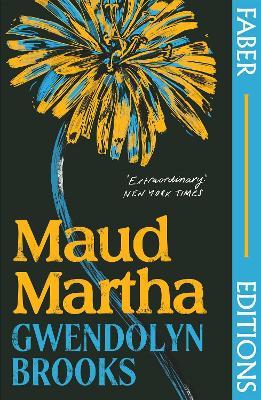
I came across Gwendolyn Brooks’ 1953-published novella, Maud Martha, on JacquiWine’s blog last year, and was confident it was a book for me – so I bought the e-Book version and read it slowly on my phone and iPad whenever I was out and about. This sort of reading doesn’t work for all books, but it did for Maud Martha because it is told in short vignettes (or “tiny stories” as Brooks’ called them) which cover the protagonist’s life from her childhood to motherhood. Her voice is so fresh, so honest, so real that I was completely captivated.

Gwendolyn Brooks (1917-2000) is a new author for me, perhaps because she was primarily a poet. In fact, Maud Martha is her only novel. She was the first African American to win the Pulitzer Prize (1950) and the first African American woman to be inducted into the American Academy of Arts and Letters (1976), but these are just two from an honours-filled career.

My edition of Maud Martha has an excellent introduction by the American critic and academic, Margo Jefferson. She ponders the novel’s disappearance from view, and posits that “it sank beneath the weighty canonical force of first novels by two of Brooks’s Black male peers”. Ralph Ellison’s Invisible man appeared in 1952, and James Baldwin’s Go tell it on the mountain in 1953, the same year as Maud Martha. By comparison, Maud Martha “looks” slim but, in real weight, it is anything but. Jefferson quotes from Brooks’ memoir in which she discusses the autobiographical element of the novel: ‘It is true that much in the “story” was taken out of my own life, and twisted, highlighted, or dulled, dressed up or down.’ I read this as meaning that what she describes is “true” though not necessarily factual. It’s “a novel”, says Jefferson, “by a Black woman about working-class Black life in the twenties, thirties and forties”.

“But dandelions were what she chiefly saw”

The book opens with an exquisite description of seven-year-old Maud Martha. It introduces us to a young girl who has dreams but also has her feet on the ground:

She would have liked a lotus, or China asters or the Japanese Iris, or meadow lilies—yes, she would have liked meadow lilies, because the very word meadow made her breathe more deeply, and either fling her arms or want to fling her arms, depending on who was by, rapturously up to whatever was watching in the sky. But dandelions were what she chiefly saw.

And, she was happy with them, those “yellow jewels for everyday”:

She liked their demure prettiness second to their everydayness; for in that latter quality she thought she saw a picture of herself, and it was comforting to find that what was common could also be a flower. And could be cherished! 

These opening paragraphs are telling: we learn a lot about Maud Martha – as you can see – and we are introduced to Brooks spare, poetic style. It is because of language like this that Brooks can tell Maud’s story from the early 1920s to the 1940s in barely 100 pages. Jefferson describes Brooks’ style as “like a sonnet sequence, each story delights in sensory and emotional details and each reveals another aspect of Maud Martha. Poets take liberties with prose notions of a story arc”.

So, through the stories Maud Martha grows up, questioning the real world while dreaming of New York, which is “a symbol” for her of “what she felt life ought to be. Jeweled. Polished. Smiling. Poised. Calmly rushing! Straight up and down, yet graceful enough”. She knows it’s a dream, but she stands by her right to dream. And, anyhow, “who could safely swear that she would never be able to make her dream come true for herself? Not altogether, then!—but slightly?—in some part?” This is a young woman, in other words, still with her feet on the ground but with imagination as well. 

Meanwhile, life goes on. She marries Paul who is fairer than she, enabling him to “pass” among whites or, at least, be more easily accepted by them. She knows her darkness pulls him back, “makes him mad”, but she’s not cowed. She knows who she is and what she can offer.

What she wanted was to donate to the world a good Maud Martha. That was the offering, the bit of art, that could not come from any other. She would polish and hone that.

And so she soldiers on through the bright moments and the disappointments, like settling for a kitchenette with a shared toilet when she marries Paul. Moments like these are universal. Other moments, though, are less so, because, of course, she faces racism – again and again – at the movies, while shopping for a hat, at a beauty parlour. A particularly painful occasion occurs when Santa Claus treats her little daughter Paulette differently from the white girls – and Paulette notices.

Another occasion concerns Maud Martha’s taking work as household help, because Paul is out of work. However, the way her employer and employer’s mother-in-law assume her inferiority causes her to understand “for the first time … what Paul endured daily … as his boss looked at Paul, so these people looked at her. As though she were a child, a ridiculous one, and one that ought to be given a little shaking …”. She decides to leave the job. Her employer won’t understand, but that doesn’t matter. What matters is that she’s “a human being” too, and she will not be treated otherwise if she can help it.

What makes Maud Martha special then is her – to use a cliche – resilience. No, it’s more than that, it’s her level-headed sense of self and a willingness to call what she sees. What’s remarkable in Brooks’ telling is the humanity and, often humour, with which she does it. Take, for example, Maud Martha’s description of her first beau:

He was decorated inside and out. He did things, said things, with a flourish. That was what he was. He was a flourish.

She was desperate to have a boyfriend, but not that desperate.

Maud Martha is just delicious to read. It is deeply, distressingly insightful about Black American experience in all the horrific ordinariness of ingrained, oblivious, white superiority, but the combination of intelligence, dignity and humour with which Brooks tells her story takes your breath away.

Gwendolyn Brooks
Maud Martha
London: Faber & Faber, 2022 (orig. pub. 1953)
126pp.
ISBN: 9780571373260 (e-Book)

Meet the Author: Dervla McTiernan

You’ve heard me say it before and I’m sure to say it again, I am not a “crime reader” – but I do read crime novels when something about them catches my attention. I have been interested to read Irish-born Australian writer Dervla McTiernan since her first book started appearing with positive reviews on the AWW database. As it turned out, this conversation brought out a couple of points that particularly interested me, and further spurred my interest in McTiernan’s novels.

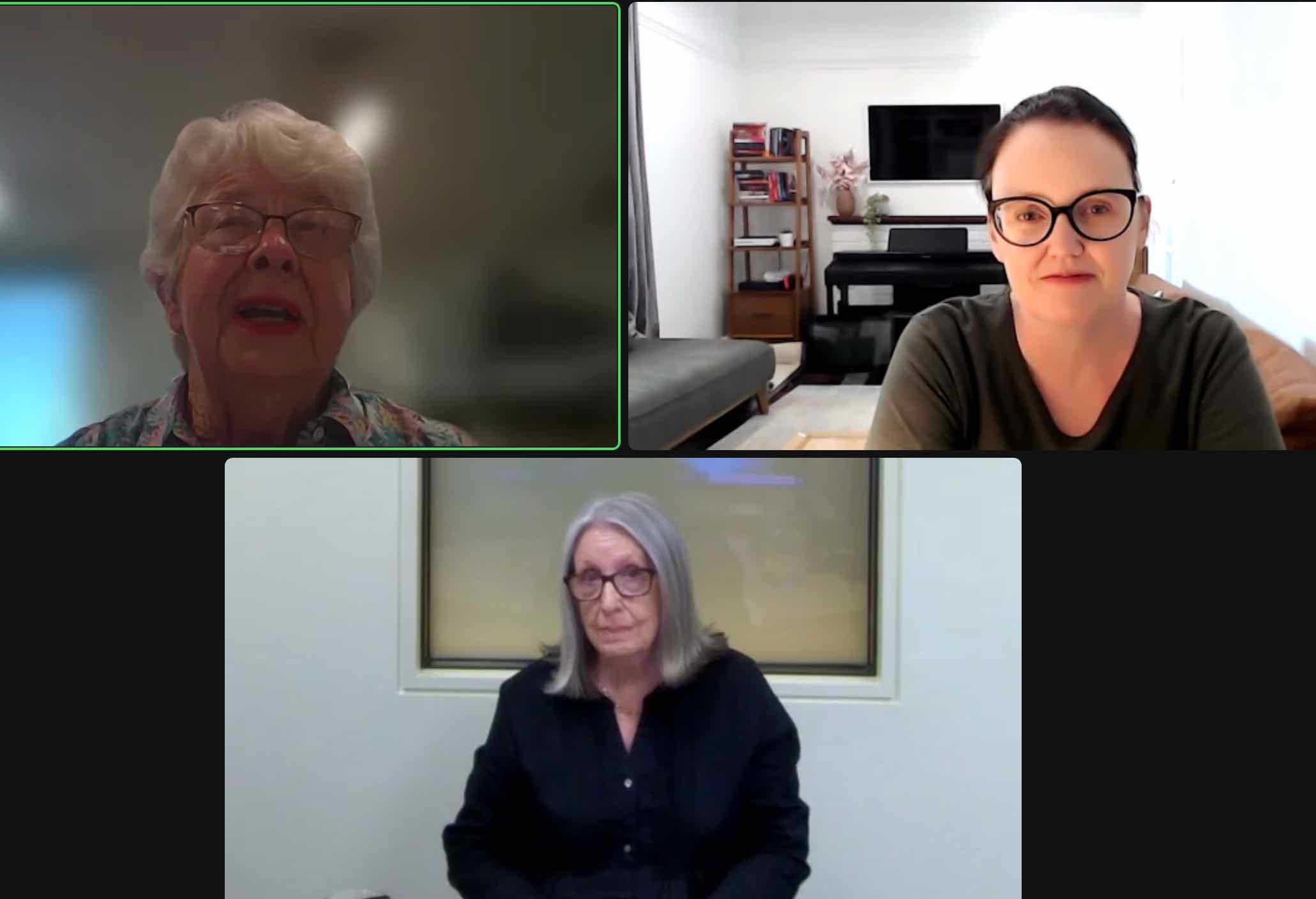
The participants

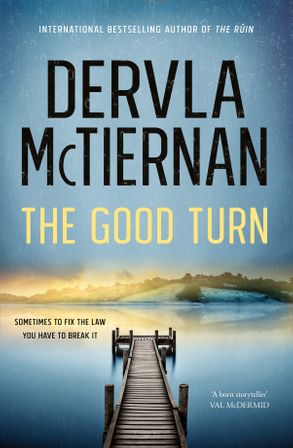
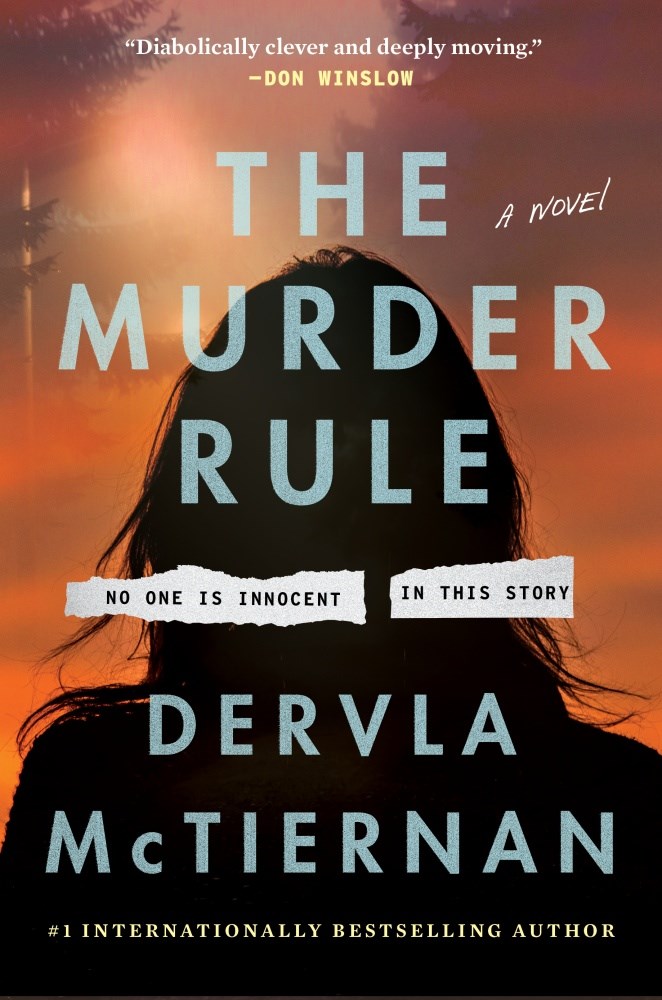
Dervla McTiernan: author of the internationally bestselling Cormac Reilly series (The rúinThe scholarThe good turn), and of three audio novellas The sistersThe roommate and The wrong one. She has won many awards, including an International Thriller Writer Award. Her latest novel is a standalone, The murder rule.

Anna Steele: since retirement has reviewed crime, historical and literary fiction for The Canberra Times and the ACM Press, using her nom-de-plume, Anna Creer. Before that, Anna was Head of English at Canberra Grammar School. I should add that I count Anna as a friend, as for many years we have been active members of our local Jane Austen group, JASACT.

The conversation

Anna commenced by explaining that the conversation would be structured as a retrospective of Dervla’s career so far, meaning it would not be one of those latest-book focused conversations. She also reassured Dervla and the audience that there would be no spoilers!

On how she started

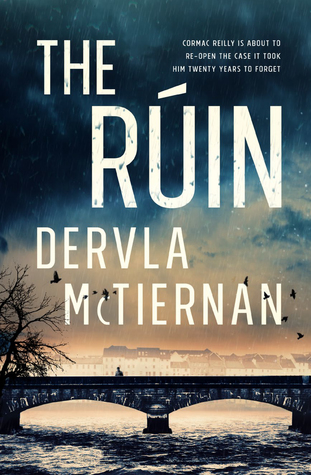
Dervla McTiernan, The ruin, book cover

Anna then mentioned Dervla’s Irish heritage, which is known for story-telling, and yet Dervla has said her writing would not have happened if she’d stayed in Ireland. Why? She followed this up with “why crime?”

Dervla said she’d been a lawyer in Ireland, but the 2007 GFC and its aftermath had been traumatic, with suicides and other serious distress amongst family and clients. By time she and her partner left Ireland in 2011, she never wanted to practise law again. After arriving in Perth and needing to support themselves, she nearly returned to law, but her husband reminded her of their promise to each other to now do it their way, so she got quasi legal work and wrote for two hours every night. The result was a contract with Harper Collins, and The rúin was born.

She said she had not initially intended to write crime, but she had a story she wanted to tell – about two siblings she named Maud and Jack. Up popped a young, uncertain twenty-something cop, Cormac Reilly, whose job it was to save the children. Also, she was a crime fiction reader.

On her detective, Cormac Reilly, and her success

Anna then asked more about Cormac Reilly. He’s not an alcoholic, not tormented, and he arrived on the scene, Anna felt, fully fledged. Dervla has called him, a “man of my generation”. What did this mean, Anna asked. Anna felt that he is one of the reasons for the success of the first novel, but wondered what Dervla thought.

Cormac, said Dervla, was a reaction to the crime fiction she was reading. She enjoys Ian Rankin, and others, but their male heroes tended to not have other responsibilities, which is not true to her generation’s experience of men. She wanted to write about someone she could admire, who could sustain relationships long term, about men who could change nappies, cook meals, and so on. She felt she’d be lying if she wrote an inept man. Love this – though I don’t think it’s only her generation that has “ept” men!

As for the novel’s success, although Anna instructed her not to be modest, Dervla said she really didn’t know. But, she did say that the story has to matter, that writers need to have genuine emotion about what they are writing, otherwise the writing is “dead on the page”.

On place

The next few questions concerned place, about which Dervla feels strongly. Why were her first three novels set in Ireland?

Dervla said that Galway, the setting for The rúin, is the place she knows best. Also, the story of Maud and Jack is an Irish story, and beyond that, she has questions and concerns about various aspects of Irish history.

Developing this, and moving us on to the second novel, The scholar, which is set in a university, Anna quoted Dervla’s statement that “all writers bring their life experience to their books”. Anna wondered what experience she’d brought to this novel. Again, Dervla said that she knows that place, a place that can be both safe and unsafe (particularly for women). The novel involves Cormac’s girlfriend, who is a scientist, which is not Dervla’s experience, but she has dealt with scientific issues in her legal work. Besides these are more subtle things such as how people talk.

Regarding the third Cormac Reilly book, The good turn, Anna, who clearly knows Dervla’s books well, noted that in this novel, policeman Peter Fisher, who had appeared in The scholar, has a much stronger role. She wondered why. She also noted that it is not set in Galway.

Dervla talked a bit about Peter Fisher, whom she clearly enjoyed writing. She was interested in his relationship with his father. Also, Cormac is a good person but is not universally liked, giving Peter a challenge – stick with Cormac or go with the consensus?

She set this novel in a rural area that she also knows well. She has decided to only write about places she wants to spend time in, but she also said that with Irish villages, they may be beautiful but you only have to scratch the surface …

On the trilogy

One of the things I enjoyed learning from this interview was Dervla’s decision to create in Cormac a competent man with outside responsibilities. The other thing I loved was Dervla’s response to Anna’s question regarding whether, given her comment that The good turn “rounds off” the previous two, she always knew Cormac Reilly was going to be a trilogy,

Dervla said that yes, she thinks it’s a trilogy – though she may write about Cormac again later. She didn’t want to write a long procedural series, as they tend to be episodic without overall narrative arcs. She wanted to challenge Cormac, to have a narrative arc which would see him changed by the end. I don’t like series, so I enjoyed hearing her perspective.

More on characters

Anna asked her about the female detective she’d started but not finished, and about the unlikeable Hannah Rokeby in The murder rule. Dervla said that she’d been waylaid from her female detective by the idea that became The murder rule. She was interested in the Innocence Project, which many Irish students get involved in, but felt she didn’t have a story. Then, she had the idea of flipping it: from having the traditional idealistic young woman to an angry, bitter one. She likes Hannah Rokeby. Hannah is “wish fulfilment” for her because Hannah represents the younger generation of women who don’t feel they have to be “the nice girl”, who, when they think something, “they own it”! Hannah’s problems are separate from her competence.

On police abuse of power in her books

Anna asked whether the police abuse of power that threads through the books was conscious or just part of the stories. Dervla felt it was the latter, but commented that in any community where there’s power there’s corruption. She said that teams like the police work very closely together and when something even a little untoward happens the tendency is to support the team rather than remember their true role!

On coming books, adaptations and the pandemic

The interview wrapped up with a number of questions about Dervla’s plans. Dervla explained that due to The murder rule she’d been given a three-book contract by Harper Collins’ American arm for books set in America. Her new book, now completed, is set in Vermont, which she visited. It’s about a young couple, in love and beloved in their community. They go away. He comes back, without her. Her parents want the truth, while his parents want to protect him.

Regarding when she will write an Australian-set novel, Dervla said she is currently working on a novella set in Perth and Margaret River.

Anna also asked her about the screen optioning of two of her novels. She’s not heard about The Rúin, but a miniseries for The murder rule is moving into full script.

Anna then asked whether the pandemic affected her writing, given she’d been writing a book a year until then. Dervla said it had been a weird artificial environment, and was a time of needing to focus more on family. She is usually always thinking of her characters when she is not doing other things, but the pandemic broke that pattern. It’s coming back though!

Q&A

There was a brief Q&A, which I’ll summarise:

  • On staying motivated when starting out: the two hours a night was her present to herself; she gave herself permission to have those two hours. This kept her going.
  • On support, like a writing group or mentor: she’s a solitary person, and so decided to put all her focus on writing, on doing the best writing she could. (It is a lonely profession, she had earlier admitted to Anna, so it is good for writers to make opportunities to engage with each other.)
  • On knowing how a police station works: research and common sense, she said. The Irish police produce useful annual reports.
  • On writing to deadlines: it is important if you are going to be a good publishing partner, but she also wants to write the best story she can, so deadlines are important but sometimes you need to take space.
  • On whether she feels the need to make female characters (like the tough Hannah Rokeby) likeable: no, she’s not driven to make her as likeable as Cormac.
  • On whether there’s a difference writing for audio versus print: can use fewer attributions (he said, she said, etc) and don’t need to describe responses (like “she gasped”) though she might provide a stage-type direction to person doing the reading.
  • On literary critics being scornful of crime: There are two writing worlds “commercial fiction” which is “story and character driven” and “literary fiction” which is not so. Some literary fiction can lift off the page, but not all. There is good and bad in both types, but for some, literary fiction is seen as the “real” writing. However, it is commercial fiction which supports publishing and bookshops. She’d like critics to recognise what people like to read. Anna commented that John Banville who has started writing crime, said that he “found freedom” in writing it.
  • On writing about murky psychological and social issues: she needs to start with character and let the story go from there. She doesn’t like to start with the theme. She doesn’t want to write issues-based books, but she will often write about something she’s angry about.

Another excellent conversation – well-prepared and generously answered.

Meet the author: Dervla McTiernan (with Anna Steele)
Webinar via Zoom, organised by the Friends of the National Library of Australia
Wednesday, 15 February 2023, 6-7pm

Anthony Doerr, Cloud Cuckoo Land (#BookReview)

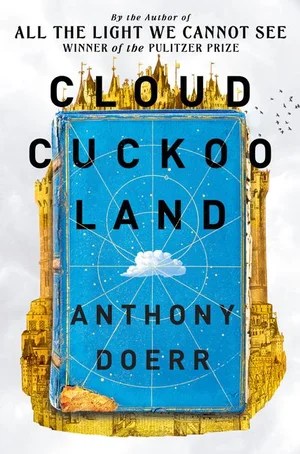
There was a collective cheer from the four librarians in my reading group when one of our members read Anthony Doerr’s dedication for his latest novel, Cloud Cuckoo Land. It goes like this “For the librarians then, now, and in the years to come”. Thank you Anthony! Cloud Cuckoo Land, at over 600 pages, is a big book and, like most big books, is about a lot of things, but threading through it is the idea of the book – and of the role played by librarians in fostering knowledge and reading. Indeed, the central event of the book takes place in a public library.

Those of you who have read the novel will know what I’m talking about, but for the rest of you I’ll take a step back. Anthony Doerr, from my limited experience of two novels, seems to like two things – multiple-points-of-view and young protagonists. All the light we cannot see (my review) has two protagonists from the same era, but Cloud Cuckoo Land takes it to another level with five protagonists spanning multiple centuries.

“It’s like we’re about to walk into the book” (Alex, fifth-grader)

The critical thing about these five characters is that they are outsiders – subversives, even – each confronting the received wisdom of their times. All live precarious lives. In the fifteenth century, in the Rhodope Mountains of Bulgaria, Omeir is born with a cleft palate. Those were superstitious times, so he, his siblings, mother and grandfather are ostracised and find themselves living in a ravine miles from their village. Omeir “imagines the adventures that might lie beyond”. Over the way, in Constantinople, is Anna, a poor orphan, living with her sister in a great embroidery house where they sew for a living. She daydreams about a better life than this, and, as Constantinople falls, sets about achieving it. Meanwhile, in 20th century Idaho, Zeno is born – in 1934, to be exact. He, too, is ostracised, an “undersized orphan with foreigners blood and a weirdo name. Ahead is what?” In the same state, born early in the 21st century is Seymour, living with his impoverished, hard-working, single mother. From birth he is difficult – fussy about food, textures and sounds – suffering, the school decides, from some sort of “disorder” or “combination thereof”. Nature is his sanctuary, “amazing … Big. Alive. Ongoing”. Out there, inspired by the great grey owl he calls Trustyfriend, “lifelong knots deep inside the boy loosen”. Finally, some time into the future, on the spaceship Argos, is Konstance, stuck in a life not of her choosing, and condemned to live all of it on board. She’s imaginative and suffers for it, mystifying her mother who believed their “imaginative faculties” had been “suppressed”.

Threading through each of their stories is a fictional codex from the real Ancient Greek author, Diogenes. It features Aethon, who, having all his life “longed to see more”, wants to become “a fierce eagle or a bright strong owl” and fly to the “city in the clouds”, the titular “Cloud Cuckoo Land, where no one wants for anything”. This codex plays different roles in the lives of our protagonists but for all of them it represents, at some time, hope, dreams and the value of books.

I’ve focused a lot on these characters, but that’s because they are the book. From these introductions you can see that Doerr has chosen young people who have little agency over what happens to them. The novel explores what they do to survive and make meaningful – authentic – lives for themselves in an imperfect world. What does it take to cope?

Fundamentally, the book is about challenge and change. For Aethon, our unifying character, the journey is not simple, and he is changed into undesirable creatures like a donkey and a “humble crow”. For our other characters, life also does not go to plan, with each surprised by what it dishes up to them. There are tricks in store for them – as well as for the reader – including in the codex itself which, in the course of its journey from Ancient Greece to the future, becomes jumbled, so its true ending is lost. However, in 2020, 86-year-old Zeno’s fifth-graders, who are rehearsing his translated and dramatised version in the public library, decide on an end, one that encompasses life’s reality.

Cloud Cuckoo Land, then, is also about books, but they too are vulnerable, as the scholar Licinius tells Anna:

“… books, like people, die. They die in fires or floods or in the mouths of worms or at the whims of tyrants. If they are not safeguarded, they go out of the world. And when a book goes out of the world, the memory dies a second death.”

Fortunately, though, Doerr clearly believes enough of us will safeguard them, and the novel ends way into the future with Aethon’s book being read to a young boy:

“And the tale I have to tell is so ludicrous, so incredible, that you’ll never believe a word of it, and yet”—she taps the end of his nose—“it’s true.”

As many of you will know, I love this.

Now, I’ll return to the title. “Cloud Cuckoo Land” is, literally, the name of an idyllic place in a real Ancient Greek play, Aristophanes’ The Birds, the place Aethon seeks in our codex. But, for me, the title also encompasses some interesting imagery. Cuckoos are birds, and all sorts of birds feature throughout the novel, representing nature, and freedom, amongst other things. Cuckoos, themselves, are sacred in some cultures, but some species, as we know, lay their eggs in other bird’s nests forcing, we could argue, those young to be resourceful outsiders. Then there are the “clouds”. As I read this book I couldn’t get the Joni Mitchell song “Both sides now” out of my head, with its line “it’s clouds illusions I recall .. I really don’t know clouds at all”, progressing to “life’s illusions … I really don’t know life at all”.

These two ideas – resourceful outsiders and life’s illusions – encapsulate for me this truly engaging book. Doerr presents for us life’s challenges – historic, economic, climatic – but he also offers the dreams and resourcefulness of humans in confronting these challenges. Zeno’s friend Rex describes the codex as “part fairy tale, part fool’s errand, part science fiction, part utopian satire”. This could also describe Doerr’s novel, but it is more too. Rich, complex, and highly readable, it contains multiple treasures and connections for engaged readers to find and make on their journey. I have barely skimmed its surface. It was a very popular start to my reading group’s year.

Anthony Doerr
Cloud Cuckoo Land
London: 4th Estate, 2021
627pp.
ISBN: 9780008478308 (e-Book)

Claire G. Coleman, Night bird (#Review)

Wirlomin-Noongar woman Claire G. Coleman’s short story “Night bird” is the second First Nations Australia story in Ellen van Neerven and Rafeif Ismail’s anthology Unlimited futures: Speculative, visionary Blak+Black fiction, the book I chose for Bill’s (The Australian Legend) Australian Women Writers Gen 5 Week. The week finished officially a week ago, but I’m hoping Bill won’t mind my still referencing it. Coleman is not new to my blog. I reviewed her debut novel, Terra nullius, the year after it came out. She has written more fiction and some non-fiction since then, with a clear focus on the devastating impact of colonisation on First Nations culture and people.

“Night bird” continues this focus. It follows Ambelin Kwaymullina’s story in the anthology, “Fifteen days on Mars” (my review), which works well, because both draw on the importance and role of Ancestors in First Nations culture. Coleman’s story is told first person by an artist who is “too afraid to sleep, too tired to be awake”, who drinks to drown her sorrows, who fears she may be “going mad again [my emph]”. She tells us

I am haunted by the ghost of my Ancestors’ Country like a phantom limb …

[…]

I have been cut off from my Country, my ancestors cut up, the land drilled and dug and eaten by machines … my wounded homeland won’t let me rest.

This is not a subtle story. The narrator (whom I think is female, so I’ll go with that) grieves for a life she “could never have” because Country has been “severed”. She has “returned to Country” but, finding it “dead”, “could feel nothing and none” of her Ancestors. She feels haunted, but by what or whom?

I can hear a voice but I can’t make it out. I can hear a song but I can’t catch the words. I can hear the wind and it’s stealing my breath. I can hear nothing and it is screaming.

Country is part of her, but she wants to be free of the haunting, the “wordless voice”, the “phantom presence” that won’t go away. There is a wind, but it is “coming from the wrong direction – away from Country”. Then,

The wind changes, it caresses my back, and suddenly it’s coming from Country.

However, at the same time, a man appears and threatens her. There are now two voices – his and the Ancestors. This is a story about a battle between disempowerment (represented by the man) and empowerment (represented by the Ancestors). Is she, and are they, strong enough to prevail?

I suspect this story was inspired by an experience Coleman describes in her article in Writing the Country (The Griffith Review 63). She describes the life-changing experience of going to Country in 2015, her family’s Country that had been taboo due to a massacre that had occurred there in the nineteenth century. She writes:

I didn’t go there until 2015, that place changed my life forever, my world, my life, even the way I breathed. I took the taboo air into my lungs and I did not die or maybe I did. The bones of my feet landed on the sand and returned to life, I was born again on Country. The story of that place made me a storyteller; story is in my veins.

She says an old man told her that “no matter where we go Country calls out to us” and she writes of the bird, the Wirlo (or curlew), that “to me and mine are family”. Its cry, its scream, “calls me home” – as does the night bird in this story. She describes how Country cares for people as they care for Country. She writes:

I wept when I realised Country had not forgotten me even when I did not know Country. My old-people, my ancestors, would care for me.

All of this is seems embedded in “Night bird”, so now, back to it. It is another example of “Indigenous futurism”. It is ground very much in the real world. The voices that our narrator hears are mysterious, sometimes coming from her phone, sometimes from the air around her, but they are not magical, not fantastical, they are the Ancestors – and the story envisions a healthy relationship with them and thus Country.

On her website, Coleman includes a link to an interview she did with VerityLa after Terra Nullius came out. Among the questions was that one we readers love, which is whether any authors or novels influenced her. The first one she named was HG Wells’ War of the worlds, because it “is great in giving an understanding of how to show an overwhelming powerful enemy destroying a less well-armed defender”.  “In fact,” she says, “War of the Worlds is a powerful text for the examination of invasion and colonisation”. You can certainly see its influence in Terra Nullius, and it is evident here too.

Claire G. Coleman
“Night bird”
in Ellen van Neerven and Rafeif Ismail (ed.), Unlimited futures: Speculative, visionary Blak+Black fiction
North Fremantle: Fremantle Press in association with Djed Press, 2022
pp. 66-73
ISBN: 9781760991463 (eBook)

D’Arcy Niland, The parachutist (#Review)

D’Arcy Niland has appeared in my blog before but not in his own right. He was the Australian-born husband of the New Zealand-born Australian writer Ruth Park. I have posted on their collaborative memoir, The drums go bang, and have written specifically about Ruth Park, but have never written specifically on Niland before.

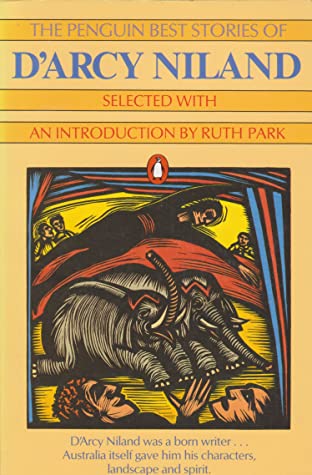
Niland is best known for his novel The shiralee, but he and Park were working writers who made their living from their craft, which means they wrote a lot – radio scripts, journalism, short stories, and novels. My path to his short story, “The parachutist”, though is a bit complicated. Over a decade ago, when my mother-in-law was still alive, I would search for suitable audiobooks for her, by which I mean books that had straightforward narratives, and not too much explicit sex and violence. She was 97 (and legally blind) when she died. A collection of D’Arcy Niland short stories seemed a possibility, but I’m not sure she ever did listen to it. Regardless, it ended back with us after she died, and we finally started listening to it on a recent road trip. The first story is titled, “The parachutist”.

Now with collections, I like to know each story’s origins. I discovered that the audiobook was based on a collection of Niland’s short stories selected by Ruth Park and published by Penguin in 1987. A start, but when did Niland, who died in 1967, write the story? The Penguin book might provide that information, but I don’t have it. However, given that back in Niland and Park’s heyday, newspapers were significant publishers of short stories, I decided to search Trove and, eureka, I found it. Well, that is, I found his story “The pilot”, which turned out to be the same story that was later published as “The parachutist”.

This discovery created another mystery: why the change of title? And when? Again, maybe Ruth Park discusses that in her Penguin introduction but … so, let’s just get on with the story. The plot concerns a predator and its prey. It starts just after a hurricane. A hawk, “ruffled in misery” comes “forth in hunger and ferocity” looking for food, expecting to find some “booty of the storm”. However, there is none, so it widens its search. Niland beautifully captures the devastation of the “ravaged” landscape and weakened hawk’s situation: “Desperate, weak, the hawk alighted on a bleak limb and glared in hate”. It’s vivid, visceral writing – and we feel some sympathy for this hawk.

It spies a dead field mouse, and gobbles it “voraciously”, but it’s not much as food goes, and just makes “the hawk’s appetite fiercer and lustier”. Niland, at this point, also introduces us to the hawk’s real nature, to the way it would normally “sup …. on the hot running blood of the rabbit in the trap, squealing in eyeless terror”. It will eat creatures still alive, in other words. Anyhow, still “frenzied with hunger”, this hawk spies something in a farmyard – a kitten playing, “leaping and running and tumbling”, completely “unaware of danger”. Life is fun. After checking for human presence, the hawk swoops, and suddenly the kitten finds itself “airborne for the first time in its life”:

The kitten knew that it had no place here in the heart of space, and its terrified instincts told it that its only contact with solidity and safety was the thing that held it.

It latches on for dear life. This is a powerful story that keeps your attention from beginning to its – hmmm – somewhat surprising end, which I won’t spoil. Instead, I will briefly return to the title. Niland describes the hawk and kitten doing battle in the sky, writing that, with the hawk now descending, the kitten “rode down like some fantastic parachutist”. Soon after, when the kitten’s claws are digging into the hawk’s breast, he says that “the kitten was the pilot now”.

So, “pilot”? This could suggest that the kitten is in control, but is it? “Parachutist”, on the other hand, seems more subtle, implying a somewhat mutual relationship between the two. It is not the sort of freely chosen relationship that parachutists traditionally have, but this later title introduces an ambiguity into the narrative.

I found the story compelling. It is told third person limited, with our point of view, and sympathy, shifting between the two protagonists. Its subject matter might be nature, but its themes are more universal, encompassing predator and prey, the powerful and the powerless, experience and innocence, and of course survival, given at different points in the story both the hawk’s and the kitten’s survival is at stake. What to do?

Also, this might be a long bow, but Niland apparently said about his 1955 novel The Shiralee, that “it is a Biblical truth that all men have burdens. This is the simple story of a man with a burden, a swagman with his swag, or shiralee, which in this case happens to be a child. I have often thought that if all burdens were examined, they would be found to be like a swagman’s shiralee – not only a responsibility and a heavy load, but a shelter, a castle and sometimes a necessity.” “The pilot” was published two years earlier, but we could argue that for the hawk, the kitten, with its fierce frenetic claws, turns into a burden. The storyline and outcome are simpler, of course, but was Niland playing with this idea too in his story?

Whatever, “The pilot” or “The parachutist” beautifully exemplifies Niland’s ability to capture and hold his reader’s attention with a strong narrative and expressive writing. I hope to share more of the stories in future.

D’Arcy Niland
“The parachutist” in Short stories collection
(Read by Dennis Olsen)
ABC Audio, 2007
ISBN: 9780733390616

D’Arcy Niland
“The parachutist” in The Penguin Best Stories of D’Arcy Niland
Penguin Books, 1987
ISBN: 9780140089271

D’Arcy Niland
“The parachutist” The Oxford book of animal stories
London, Oxford University Press, 2002 (orig. pub. 1994)
ISBN: 00192782215

D’Arcy Niland
“The pilot” in The Mail (Adelaide), 28 March 1953
Available online