Andra Putnis, Stories my grandmothers didn’t tell me (#BookReview)

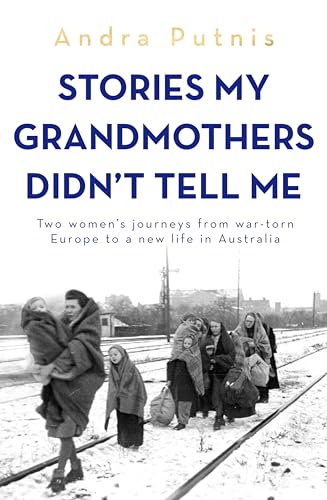
Cover

Local writer Andra Putnis’ book, Stories my grandmothers didn’t tell me: Two women’s journeys from war-torn Europe to a new life in Australia, was my reading group’s February read. Not only was it highly recommended by two members who had read it, but we were told the author would be happy to attend our meeting if we chose it. That was an offer too good to pass up, so we scheduled it.

We’ve had a few authors attend our meetings over the years, and it has always been worthwhile. Yes, it risks constraining discussion if people have any reservations about the book, but that has never really been a problem, either because there haven’t been serious reservations or because the value of having the author present has far outweighed any perceived impact on free discussion. In Putnis’ case, the story is so powerful and so well-told that it was unlikely there’d be any reservations that wouldn’t turn into questions about why or how she wrote her story.

“hidden pasts, still very much present”

Stories my grandmothers didn’t tell me is a family biography centring on the author’s two Latvian-born grandmothers, her maternal Grandma Milda (1913-1997) and paternal Nanna Aline (1924-2021). Teenage Aline was separated from her parents around 1942 to go serve in Germany’s war-time labour force. Meanwhile, in late 1944, with the war ending and the Soviet army looking set to return, 7-months pregnant Milda left Latvia with her parents and 18-month old son, enduring a tough, desperate journey. Both women ended up in UNRRA-managed Displaced Persons camps in Germany, where they experienced years of hardship before arriving in Australia in late 1949/1950. Milda, and later Aline, settled in Newcastle in the early 1950s, and met there through its tight-knit Latvian migrant community.

That’s the rough outline, but of course their stories – what they endured – are far more complicated, and Putnis wanted to understand. She told us that as a young child she had a sense of Latvia as almost an unreal fairytale place with beautiful forests, music and dancing, but she had also sensed, through family murmurs, a darker side, one that encompassed sadness and pain not only about Latvia but also about the family’s own story. She likened it to being on a boat, where you can see the surface but have no idea of what lies in the deeps below. She feared, as a granddaughter, that it wasn’t her place to go there, and worried about upsetting people. However, she did go there because she wanted to know and because Nanna Aline was willing. But, she said, she was always cognisant of just how far a granddaughter – even an older one – could, or should, go.

“moving between darkness and light”

I have read several hybrid war-related biography/memoirs written by family members, and this one is as good as any of them. This is not only because of the power of the story, and the honesty with which it is told – but also because of the structure Putnis uses. It is told chronologically, which is logical, but through the voices of Milda and Aline interspersed with those of others including, of course, Putnis’s own. I wanted to know about this and Putnis was happy to explain.

The structure was driven by Aline who told her story chronologically. She had thought deeply about and “understood the arc of her life”, said Putnis. So, with this in hand, Putnis started to piece Milda’s story – which was gathered less systematically – along the same lines. The challenge came in making the “weave” work, in getting the balance right, between them and their stories, and the wider historical, community and family framework.

Putnis worked on her book for nearly 20 years – with the occasional gap when life took over. Aline lived a long life so Putnis was able to spend a lot of time with her. Aline had also had the toughest life, particularly in terms of her personal choices and circumstances. Our hearts went out to her. Milda, on the other hand, died when Putnis was 19 years old, before she started working on her book. However, Milda had lived for nearly a decade with Putnis’s family, so Putnis had spent a lot of time talking with her, getting to know her. Putnis enhances both stories with information gleaned from conversations with other close family members, from secondary reading, and from primary research through letters, in archives, and so on.

The result is a coherent story of these two women told from more than one perspective, which has the effect of varying the intensity as we read – of mixing the light and the dark – and of enhancing authenticity, because the perspectives reinforce each other. It’s sophisticated and highly readable.

“the world is in tears” (Aline’s father)

It is a powerful and often heart-rending story, and it is to Putnis’s credit that she is able to convey both the individual personalities of her very different grandmothers and the universality of their experiences. Their experience of living under multiple invasions is both personal but, as we know too devastatingly well, political and general. Same for their experience of living in camps for years – of having your life on hold while you just survive. And for their experience of being migrants – “reffos” – in 1950s Australia. The negatives abound, with any positives achieved being hard fought. It’s a lesson in how ordinary lives are changed irrevocably by political actions way out of their control.

So, the book raises many questions – about the past and about what is happening now. Putnis also specifically raises the issue of protecting children, and I wanted to know about this too, because, given our knowledge of intergenerational trauma, how do you protect children from horror without laying them more open to ongoing trauma within? There is no easy answer, we concluded, but awareness and consideration about where to draw the line can only help.

Finally, Stories my grandmothers didn’t tell me, is fundamentally a book about the importance – and limits – of stories. Early on Putnis talks to Aline about her project, and Aline is clear about her intentions:

Alright then, I don’t remember everything. But I have my own point of view. Some old Latvian women go on about how wonderful things were before the war … You heard these stories? Well, it was not always like that. Not all the boys were good and I was not as kind to my māte [mother] as I should have been. If you want that story, you are talking to the wrong grandma.

Aline was brave, and this is a brave book about survival that doesn’t shy away from the tough and sad stories. But, more importantly, it conveys something about stories, which is that individual stories are very important, but they are not the whole story. In other words, the more stories we have the better picture we have – of history, and of the complexity of humanity that makes us who and what we are.

Putnis concludes with Aline’s funeral, and shares the words she spoke, which also encapsulate this book:

Nanna taught me nothing less than what it means to be human, to earn the grace and wisdom that come from surviving darkness and celebrating light.

I’d like to tell more stories about the book, including about Milda and the strong woman she was, but this post is long enough, so I’ll just encourage you to read the book for yourselves.

Andra Putnis
Stories my grandmothers didn’t tell me: Two women’s journeys from war-torn Europe to a new life in Australia
Crows Nest: Allen & Unwin, 2024
292pp.
ISBN: 9781761471322

Lisa Kenway, All you took from me (#GuestThoughts)

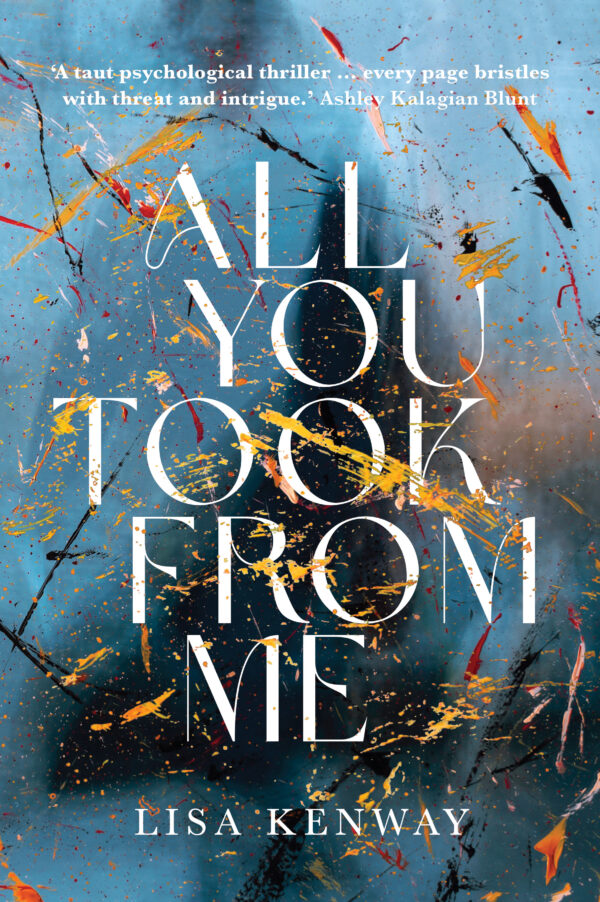
With my Review TBR pile teetering on the brink, I decided to call in a favour from Mr Gums, and handed him Lisa Kenway’s debut novel, All you took from me, thinking it might be up his alley.

Now, a word about Mr Gums. He is an engineer by training, and not the world’s biggest reader. When he does read – in the past at least – his go-to has been Jane Austen (whose books he has read multiple times, including more than once in German) and other classics. However, with more time at his disposal since retirement, he has started reading a little more broadly. He likes to be “entertained”, not overly challenged in his reading. (Apparently, reading Mansfield Park in German is not challenging!) Life is challenging enough, he says. So, crime fiction seemed to be a good fit, and he’s been trying out several authors with varying success. Chris Hammer is a big hit. Garry Disher goes down pretty well too. Peter Temple not so much. He has also read non-Australian crime writers – English, and others, including, recently, a Japanese author (thanks to JacquiWine). As you can tell from his Austen love, he is more than happy to read women writers, and has crime by Dervla McTiernan and Shelley Burr, and recently, Dinuka McKenzie’s first novel. So, why not Lisa Kenway?

So, Lisa Kenway. According to the media release that came with my review copy, she is an Australian writer and anaesthetist. This debut novel, All you took from me, was “inspired by her longstanding fascination with memory and consciousness”. An earlier manuscript version was longlisted for Hachette’s Richell Prize for Emerging Writers in 2020 (out of over 800 submissions). That must have given her confidence to keep working on it, because here it is, published by Transit Lounge in 2024.

Anyhow, the novel is set in two places – the Blue Mountains (which I love) and Sydney. The protagonist, Clare Carpenter, is an anaesthetist – write what you know! – whose husband has died in a single-vehicle car accident which also caused her to lose her memory. Soon after, she senses she is being followed by a stranger. Why? Finding the answer becomes her mission, but it is hampered by her loss of memory. Can she reverse that? Of course nothing is simple, and the risks and threats mount. This novel is not Mr Gums’ (nor my) preferred type of crime, which is the police procedural. It is, instead, as the blurbs say, a psychological thriller.

Mr Gums was intrigued by this debut, but he had reservations. He particularly liked the set up – the protagonist as anaesthetist. It was different, and an interesting idea. He enjoyed reading the technical details about anaesthesia, and liked the attention paid to details in those parts of the story. (Like me, he enjoys it when novels teach him about a world he doesn’t know much about.) However, this is also where his main reservation came, because, scientifically trained himself, he found Clare’s behaviour hard to believe. The risks she took, her foray into unscientific ideas, lost him. Mr Gums, though, has not been in the position Clare found herself in. Perhaps, in the same desperate circumstances, he might try anything too?

All you took from me is told first person, and the voice rings true. Clare is articulate and intelligent, and honest, as she starts to uncover less pleasant things about herself. The novel opens in the hospital a month after the accident, with Clare starting to return to her – new – consciousness. From here, the plot picks up, becoming increasing dramatic and sensational, as you’d expect for its genre, with Clare’s shaky memory, and her attempts to recover it, underpinning much of the intrigue. There are the usual red herrings and misleading threads, which kept Mr Gums challenged as he tried to work out what was true and what wasn’t.

Overall, Kenway’s novel is not Mr Gums’ preferred crime genre. He prefers more dogged analysis in his crime to the stress and tension of a thriller. However, he did conclude that All you took from me was “strangely entertaining”, which suggests to me that Kenway’s debut should not be the last novel she writes. I’d love to know if anyone else has read it?

Lisa Kenway
All you took from me
Melbourne: Transit Lounge, 2024
328pp.
ISBN: 9781923023123

[Review copy courtesy Transit Lounge (via Scott Eathorne of Quikmark Media)]

Melanie Cheng, The burrow (#BookReview)

You may have heard the announcement by Sean Manning, of Simon & Schuster’s flagship imprint in the US, that he will “no longer require authors to obtain blurbs for their books”. Australian media academic Julian Novitz discussed the decision in The Conversation in a piece titled “Brilliant, moving, thought-provoking! Simon & Schuster is dispensing with book blurbs – will it make any difference?” I considered writing a post on this, asking for your thoughts on these blurbs. Do they influence you in any way? But I didn’t. Instead, I am using it to introduce Australian author, Melanie Cheng’s latest novel, The burrow.

As you can see from the cover of my edition, it is beautifully spare, but it does have two blurbs. At the top is Christos Tsiolkas’ “stupendously good” and at the bottom, Helen Garner’s “how rare this delicacy – this calm, sweet, desolated wisdom”. Tsiolkas and Garner are respected, robust writers who don’t flinch from uncomfortable truths, so their commendation carries some weight with me. However, there are readers who don’t like these authors. Will that turn them away from the novel? I’d be interested to know. Meanwhile, I’ll get onto the book, which, at 184 well-spaced pages, is surely a novella.

The back cover tells me that it’s about a family confronting “long-buried secrets”, and that it “tells an unforgettable story about grief and hope”. Oh, and that the family buys a pet rabbit. There’s not a lot to go on here besides the usual cliches about secrets, grief and hope, but I was interested because I have had Melanie Cheng in my sights for some time, and it has just been shortlisted for this year’s Victorian Premier’s Literary Award.

It does seem, however, that grief is following me around this year, as the heart of this novel concerns the drowning death of a six-month-old baby girl some four years before the novel starts. The family – parents Amy and Jin Lee, and their remaining daughter, 10-year-old Lucie – is surviving intact, but only just. The novel is set in Melbourne during the pandemic, just as lockdown restrictions are being relaxed, so the family is needing to confront the outside world a little more. Reminding me somewhat of Charlotte Wood’s Stone Yard devotional (my review), our threesome is disturbed by two new additions, the pet rabbit bought for Lucie, and Amy’s mother Pauline who has broken her wrist and cannot live alone for a while. These two, along with the relaxing of lockdown, offer potential catalysts for change. Will it be for the good or will the family implode?

Cheng tells her story through the alternating third-person perspectives of the characters. The writing is beautifully spare, but also engaging and moving. Having experienced a devastating death in my own family – my sister, not my child – I am interested in how people traverse such grief, particularly when there is potential for blame and guilt. Every situation is different, but there are, I think, some universals – love, generosity, and communication (or lack thereof). The Lee family has some of each of these, but not enough, and hence the just-surviving-but-not-really-living state they find themselves in. It’s realistic, believable.

I am always impressed by writers who can unfold a story slowly, but in few words, and Cheng is one of these writers. What exactly happened is divulged gradually in such a way as to make us think about how it affected – and is still affecting – the person whose perspective we are reading. It lets us feel the different ways grief can stall us. It also gives us time to get to know the characters, and to understand and relate to them. For these reasons, the story is tricky to talk about because if I explain what happened, I undermine all Cheng’s good work, so I’ll leave the story here and get back to the two additions.

As actors in the story, the rabbit and Pauline are opposite ends of the spectrum. The rabbit is a quiet, largely passive presence which interacts minimally with the family but provides a focal point for their thoughts. He brings a “sparkle” back to Lucie’s eyes that had been missing for some time. However, as a prey animal he also reminds them of the fragility of life. A rabbit is an interesting choice, one that kept me thinking about in terms of his significance. The novel is titled “The burrow”, but it’s not a simple literal reference to the rabbit. A burrow is also referenced in the epigraph from Franz Kafka’s short story “The burrow”:

The most beautiful thing about my burrow is the stillness. Of course, that is deceptive. At any moment it may be shattered and then all will be over.

How are we to read this? The family has already been shattered, and at the opening of the novel it does feel as though all is over, that they are mainly going through the motions of living. But of course it’s not all over. Sure, they are not doing very well. They are isolated from others (and not just because of the lockdown which had given them “a reprieve”, excuses to not engage). But they are still together, and they haven’t completely given up. They buy the rabbit for Lucie when she shows interest in something; they invite Pauline back into their lives when it appears she needs them.

And this brings me to Pauline. She sweeps in, injecting much needed energy, whether they want it or not. She can’t help herself, and for death-focused Lucie it’s energising, “a good thing”. However, it’s also clear that Pauline is involved in Ruby’s death in some way, that it’s not only the pandemic that has separated her from the family for four years. Now, though, she might make the difference.

But, there’s no guarantee. The family suffers several setbacks, literal and metaphorical, on their journey – sickness, an intruder, conflict, and more. Their journey reflects that in Richard Adams’ classic, Watershed Down, which Pauline reads to Lucie and which she characterises as “the epic story of an odd group of rabbits and their quest to establish a thriving warren”.

There is so much to like about this book, and it starts with the characters. With almost as few brushstrokes as artist Phil Day used for the cover rabbit, Cheng has created characters who represent some big ideas and thoughts, who embody the humanity of unspeakable grief, but who are yet so very individual. It’s a great read, with an ending that captures hope and fragility at the same time.

Melanie Cheng
The burrow
Melbourne: Text Publishing, 2024
185pp.
ISBN: 9781922790941

Review copy courtesy Text Publishing

Monday musings on Australian literature: Prime Minister’s Summer Reading List, 2024

In early December last year, I started looking out for the Grattan Institute’s Prime Minister’s Summer Reading List for 2024. But somehow, although it was published on their website on 9 December, I missed it. I have no idea how, because I went to their website, but maybe I was a day or two too early, and then forgot in my Christmas-busyness-befuddlement. Anyhow, I believe it still has value, even if the PM is back at work, so here goes …

For those of you who haven’t caught up with this initiative, some background. The Grattan Institute is an Australian non-aligned, public policy think tank, which produces readable, reasoned reports on significant issues. They have also published annually, since 2009, their Prime Minister’s Summer Reading List which, as they wrote back in 2009, comprises “books and articles that the Prime Minister, or any Australian interested in public debate, will find both stimulating and cracking good reads”.

Here is the 2024 list in their order (but with the author first), accompanied by an excerpt from their reasoning, which is available in full on their site):

  • Clare Wright, Ṉäku Dhäruk The Bark Petitions: How the people of Yirrkala changed the course of Australian democracy (Australian): “The truths told in Wright’s Näku Dhäruk make it essential reading for the Prime Minister and the Australian people. If studying history helps us learn from our mistakes, Australia’s dismissal of the bark petitions is a chapter worth poring over.”
  • Adam Higginbotham, Challenger: A true story of heroism and disaster on the edge of space (British): “At its heart, Challenger is a human story … The frozen rubber O-rings that ultimately led to the disaster were a known problem. But a flawed decision-making process allowed it to become merely one ‘acceptable risk’ among many. As demands on governments grow even as trust in institutions declines, Higginbotham provides a timely reminder of the role of individual agency in shaping the success or failure of humanity’s greatest endeavours.” 
  • J. Doyne Farmer, Making sense of chaos: A better economics for a better world (American): “Farmer argues that traditional economics fails to grapple with the complexity and uncertainty of real-world economies. He makes the case for complexity economics, a new approach that draws insights from biology, neuroscience, and physics. This framework models the economy from the ground up, simulating the dynamic web of interactions between people, goods, and institutions … With vast data and computational power now available, complexity economics could be the next testbed for evidence-based policy.”
  • Caitlin Dickerson, Seventy miles in hell (American): “In contemporary debates, where migration policies are entwined with political positioning, easy scapegoating, and a way for politicians to signal ‘toughness’, migrants are often treated as numbers, inputs into an economy, or worse, rather than as human beings with their own hopes, strengths, and impossible choices … Dickerson’s message is clear … ‘What I saw in the jungle confirmed the pattern that has played out elsewhere: The harder migration is, the more cartels and other dangerous groups will profit, and the more migrants will die.’”
  • Madhumita Murgia, Code dependent: Living in the shadow of AI (Indian): “as AI is increasingly embedded in our systems and decisions, what does this mean for our society? … Murgia argues that our blindness to AI systems and how they work makes it harder for us to understand when they go wrong or cause harm. And there’s a risk that those harms disproportionately affect marginalised groups … The questions that policymakers must grapple with are almost as numerous as the possible uses of AI: How do we know if AI technologies are safe, or if they are being manipulated or used in discriminatory ways? Which laws need to be amended to take AI into account? More broadly, who is ultimately responsible when AI technologies cause harm?” 
  • Ceridwen Dovey, Only the astronauts (Australian): “Dovey, an Australian science writer as well as novelist, shows us humans as they might appear to the objects we create and use. Like Adam Higginbotham in Challenger, Dovey critiques the masculine bravado of the space race … This inventive collection of stories has moments of beauty, as well as laugh-out-loud fun …”

The selection process, we’re told, was rigorous. The staff book club “read, loved, loathed, and debated an extensive array of novels, non-fiction books, essays, and articles”. They believe their final six are “all cracking good reads”, and summarise their choices as follows:

Ṉäku Dhäruk and Challenger are case studies in how a handful of people can shape the course of history, for better or for worse.

Making Sense of Chaos argues that we can glean new insights into the economy by modelling individuals’ behaviour from the ground up.

Seventy Miles in Hell and Code Dependent remind us of the human consequences of our high-level policy choices on migration and AI.

Our last pick, Only the Astronauts, is a little different: it’s a series of vignettes about inanimate space objects. But it too offers a new perspective on the human experience by looking in from the outside.

It’s interesting – and, I admit, disappointing – that only two are by Australian writers. And again, only one is a work of fiction. Also, while the ongoing challenge of reconciling our colonial past is included, it’s not in a work by a First Nations writer – as excellent as Clare Wright is. However, I do like that, while it may look like some critical issues are not covered, there seems to be some big picture and lateral thinking included here, which is important.

My track record for reading Grattan’s selections is poor. To date, I have read two of 2022’s list, Debra Dank’s We come with this place (my review) and Jessica Au’s Cold enough for snow (my review), and only one of 2023’s list, Anna Funder’s Wifedom (my review), though I had hoped to also read Ellen van Neerven’s Personal score. Let’s see how I go with 2024’s list!

You can see all the lists to date at these links: 2009, 2010, 2011, 2012, 2013, 2014, 2015, 2016, 2017, 2018, 2019, 2020, 2021, 2022, 2023.

If you had the opportunity to make one book recommendation to the leader of your country, what would it be?

Andrew O’Hagan, Caledonian Road (#BookReview)

When my reading group started back in 1988, most of us were time-poor mothers so we had a rule-of-thumb that our books could not be longer than 350 pages. Those days, however, are long gone, and some time ago we agreed that our January (aka summer) read could be a BIG book. Last year, for example, it was Demon Copperhead (my review). This year, some were keen to read Andrew O’Hagan’s Caledonian Road, so that’s what we scheduled.

My problem is that while it’s summer, January is also tennis season. I don’t watch much sport, but I do love the tennis. Reading a big book while trying to keep up with the tennis is always a challenge. As is the fact that, as most of you know, I love short books. Give me a novella and I’m (usually) happy. However, I also love my reading group, and so I gave myself extra time and got stuck in. I was immediately engaged. The protagonist, fifty-two year old Campbell Flynn, art historian, writer and academic, captured me. There was a certain Jane Austen tone to the opening:

Tall and sharp at fifty-two, Campbell Flynn was a tinderbox in a Savile Row suit, a man who believed his childhood was so far behind him that all its threats had vanished.

Ha! He certainly was a tinderbox, as he was about to slowly implode. Further, as we soon discover, his childhood was not at all behind him, and is implicated in his unravelling. The first paragraph ends with some foreshadowing telling us that the first of his “huge mistakes” was not to “take people half as seriously as they took themselves”, with the second being “the proof copy” he had in his briefcase.

It is Thursday 20 May 2021, so the first wave of the pandemic is over but its long shadow provides a quiet background to the novel which is told over five parts, from Spring 2021 to Winter 2022, concluding around the time of the invasion of Ukraine in February 2022.

Now, back to my reading journey. I was interested, but as I read on, following the ups and increasing downs of Campbell’s life, along with those of an ever-growing cast of characters, there was a point where I started to baulk. It felt like a long wallowing in the ills of the modern western world. Did I need 640 pages of it? And then it clicked. I realised I was reading a modern take on the 19th century “condition-of-England” novel. These novels, as the The Victorian Web explains, “sought to engage directly with the contemporary social and political issues with a focus on the representation of class, gender, and labour relations, as well as on social unrest and the growing antagonism between the rich and the poor in England”. We’re talking Dickens’ “big” novels, Elizabeth Gaskell’s North and south and Mary Barton, and so on. I loved them.

“a deep dive into the era’s shallows” (Campbell)

These novels have to be big, because a nation’s “condition” does not comprise one issue but a network of them, and this is what O’Hagan pulls apart in Caledonian Road. Through a cast of around 60 characters, O’Hagan explores a grab bag of the various ills we read about every day, with a British spin. All the big issues are here, including toxic masculinity; intergenerational wars; racism; modern technology with its related concerns like security, privacy, hacking, and digital identity; disruption as activist action; financial corruption and malfeasance; foreign interference; and human trafficking. Grab bag these might sound, but they are overlaid and connected by the traditional biggies – class, entitlement and privilege, economic inequality, and now, globalisation.

There’s a lot going on, but O’Hagan’s characters are vividly drawn, the plot is compelling if complicated, it is satirical in tone, and the language is so captivating that I enjoyed reading it after all. It is, necessarily, a disjointed read with the narrative constantly switching between the different storylines that make the whole, but I found I didn’t need the cast of characters helpfully provided at the beginning because the context always made clear who they were.

Before I return to the subject matter, I must share a couple of perfect character descriptions. First is Milo, a person whom Campbell doesn’t take seriously enough, and second is Candy, Campbell’s sister-in-law, the fey do-gooder wife of the egregious Duke of Kendal:

The young man had edges and they often glinted on the blade of his charm. (p. 76)
and
Candy stood like an emaciated meerkat looking out for an opportunity to enthuse. (p. 262)

So now, back to the “condition-of-England” idea. The characters range across the breadth of British society, from twenty-somethings to eighty-somethings, and include MPs, aristocrats, academics, journalists, business people, actors, criminals, activists, do-gooders, hackers, landowners, renters, gang members, migrants, factory workers, and lorry drivers. But, what most of them have in common is an idea of what England is. The most poignant comes from the migrants, like Polish Mrs Krupa and her son’s undocumented employee, also Polish, Jakub. As Jakub’s life, under the control of human-traffickers-cum-drug-lords, starts looking different to what he expected, he begins “to wonder if England was anything like the myth he … had bought into”.

O’Hagan, then, explores with clarity and a healthy sense of irony, today’s England (or Britain). The flawed but self-questioning Campbell – increasingly conflicted by his middle-class success and working-class origins – is our guide through a story in which hope, promise and sincerity are set against hypocrisy, greed and hatred. Desperate to remain relevant to the times, and to be a decent person, Campbell lets his guard down, allowing the driven, idealistic Milo into his life. Both are complex characters, who test our moral compass. Others not so much, like the aristocratic Duke of Kendal and Lord Scullion, the Russian oligarch Aleksandr Bykov, the corrupt billionaire William Byre, and the criminal Bozydar, all of whom, indirectly or directly, slash and burn those around them. In between are the decent, including women like Campbell’s wife Elizabeth and sister Moira, and the powerless, like rapper Travis and undocumented migrant worker Jakub.

Towards the end of the novel, the unravelling Campbell, who has become “lost in the sprawling web of it all”, inverts my favourite EM Forster quote when he reflects to himself, “only disconnect”. It’s a paradox. Campbell’s survival will depend on disconnecting from all that is wrong in his world (technologically and personally), while hanging tight – keeping connected, in other words – to all that is good. Ultimately, while O’Hagan paints a grim picture of what is wrong – the superficial, the hypocritical, the greedy and the cruel – in England, he also leaves us with a glimmer of hope. There are good people and they can prevail – but, will they, is the question we are left with.

PS Caledonian Road, being a big book, invites multiple responses. You can read those by Brona and Jonathan, who approached it from different angles and perspectives.

Andrew O’Hagan
Caledonian Road
London: Faber & Faber, 2024
642pp.
ISBN: 9780571381388 (Kindle edition.)

Gideon Haigh, My brother Jaz (#Review)

When I posted my first review of the year – for Marion Halligan’s Words for Lucy – I apologised for starting the year with a book about grief and loss. What I didn’t admit then was that my next review would also be for a work about grief and loss, Gideon Haigh’s extended essay, My brother Jaz. This does not herald a change in direction for me, but is just one of those little readerly coincidences – and anyhow, they are quite different books.

For a start, as is obvious from its title, Haigh’s book is about a sibling, not a child. It was also much longer in the making. Halligan’s book was published 18 years after her daughter’s death, and was something she’d been writing in some way or other all along. Words are also Haigh’s business, but he ran as far as he could from his grief, and it was only in 2024, nearly 37 years after his 17-year-old brother’s death, that Haigh finally wrote, as he says in his Afterword, “something I had always wanted to write, but had suspected I never would”.

Before I continue, I should introduce Haigh for those of you who don’t know him. Haigh (b. 1965) is an award-winning Australian journalist, best known for his sports (particularly, cricket) journalism, but also for his writing about business and a wide range of social and political issues. He has published over 50 books. I’ve not read any, but I am particularly attracted to The office: A hardworking history, which won the Douglas Stewart Nonfiction Prize in 2013. However, I digress …

Unlike Halligan who, to use modern parlance, leant into her grief in what I see as a self-healing way – as much as you can heal – Haigh did the opposite. He did everything he could to avoid it; he worked, he writes, “to flatten it into something I could roll over”. And it affected him. If he, just 21 at the time, was a workaholic then, he doubled down afterwards and work became his refuge, his life:

It was the part of me that was good; it was the only part of me I could live with, and that sense has quietly, naggingly persisted. Go on, read me; it’s all I have to offer. The rest you wouldn’t like. Trust me. You don’t want to find out.

If this sounds a bit self-pitying, don’t fear, that is not the tone of the book. It is simply a statement of fact, and is not wallowed in. It represents, however, a big turnaround from someone who admits early in the book that he was known for his “pronounced, and frankly unreasonable, aversion to autobiographical writing”. This aversion was despite the fact that, “at the same time, trauma, individual and intergenerational” was something he’d written about – and been moved by – for a long time. So, in this first part of his six-part essay, we meet someone who had experienced deep pain, but had shrunk from indulging in a certain “kind of confessional nonsense”, and yet who increasingly found himself “backing towards an effort to discharge this story” to see if it made him “feel differently”.

What changed? Time of course is part of it. Haigh shies from cliches, as he should, but grief will out. It just can’t be bottled up forever, no matter how hard he tried, and so in early 2024, during the Sydney Test Match no less, “something previously tight had loosened” and over 72 hours he wrote the bulk of this essay. A major impetus was the break up of a relationship. It was time for a “reckoning”, he writes on page 76, but much earlier, on page 47, he alludes to it:

Why did I even start this? The only reason I can think of is that it has to be done. It can’t remain unwritten, just as I could never leave Jaz unremembered. I have myself to change, and how am I to do this unless I examine this defining event in my life face on?

This idea of the examined life is something Halligan mentions too in her memoir. She writes near the end of her book that “I do believe that the unexamined life is not worth living, and that an enormous part of that is the recollected life”.

What I hope I’ve conveyed here is the way this essay is driven – underpinned – by a self-questioning tone, more than a self-absorbed one. Even as Haigh writes it, he is interrogating his reasons (and perhaps by extension anyone’s reasons) for writing about the self. That this is so is made evident by the way the narrative, though loosely chronological, is structured by the writing process rather than by the “story”:

“OK it’s getting on to dawn, and I’m going to click on ‘Jasper Haigh [inquest] Reports for the first time” (p. 29)

“It’s raining, but I’ve just returned from a walk. I often walk when I have something to turn over in my head.” (p. 33)

“I’m at the point right now where I just wonder what the hell I am doing.” (p. 47)

“I have picked this up again after putting it aside to draw breath, to consider what next … So, I’m going to stagger on, with the excuse that this is no memoir: this is less a geology of my life than a core sample.” (p. 61)

This approach helps us engage with a writer who prefers to push us away. It finds, in a way, the art in the artifice, and enables Haigh to write something that questions the memoir form while at the same time paying the respect that the best memoirs deserve. It’s a juggling act, and I think he pulls it off.

By the end, Haigh is not sure whether writing this work – this raw “reckoning” to re-find his emotional bearings – has achieved anything. It is, he believes, “too early to tell”, but I wouldn’t be so sure. He is a writer, and he has put on paper the defining event – the “core sample” – of his life. That has to mean something.

Gideon Haigh
My brother Jaz
Carlton: Melbourne University Press, 2024
87pp.
ISBN: 9780522880830

Marion Halligan, Words for Lucy (#BookReview)

For my reading group’s tribute to Marion Halligan last year, I had planned to read one of her older novels, Wishbone, which I did (my review), and her last book, the memoir Words for Lucy, which I didn’t. But, I have now. I guess a book born of a mother’s grief for a daughter who died too young doesn’t make the cheeriest start to this year’s reviews. However, such is the life of a reader so you’ll just have to bear with me!

Lucy, for those who don’t know Halligan’s biography, was born in 1966, with a congenital heart defect. She was not expected to survive more than a few days, but she did – for nearly 39 years. In the end, however, in 2004, her heart gave out. I’ve read two other memoirs written by a mother about her seriously ill daughter, Isabel Allende’s Paula and Joan Didion’s The year of magical thinking. They are very different books and in fact, in Didion’s case, her daughter did not die during the book, though she did die young (and Didion wrote a book about that, Blue nights). The reason I am sharing this is that Halligan, Allende and Didion were all published authors, and it shows. As Halligan writes in the opening to her book, “My business is words”. For these three writers, the process of writing was an important part of how they processed their feelings. Halligan’s book might have come out some 18 years after Lucy’s death, but she’d been writing all that time.

While confirming my memory concerning Allende and Didion, I came across the Wikipedia article on Blue nights. It includes a quote from Rachel Cusk’s review of the book. She says “Didion’s writing is repetitive and nonlinear, reflecting the difficult process of coping with her daughter’s death”. While I don’t know about the reason, the “repetitive and nonlinear” description could equally be applied to Words for Lucy. The book is divided into twelve parts (plus a postscript), with each part comprising many small sections. There is an overall chronological arc to the book, in that after briefly describing Lucy’s death, Halligan does start with her birth, and tells of the funeral and wake near the end. What comes in between, however, is, writes Halligan, like “box of snapshots. You find your own way through the story, from random details”. In other words, if you are looking for a traditional grief memoir in which the memoirist works chronologically through the “stages” of their grief, you won’t find it here.

Carmel Bird and Marion Halligan
Carmel Bird and Marion Halligan, 2016

What you will find is a book about mothering and “daughtering”, about living with a chronically-ill child, about making memories and living with memories, about sadness and joy, about loss and grief (because Halligan has had more than you’d think fair), and about writing. It’s also about friendship. Having experienced my own devastating loss (of my sister in her early 30s), I know very well the value of friends. For Halligan, a great friend was the writer Carmel Bird. I was much moved by the role Carmel played in Lucy’s life, and by the love and support she clearly gave Marion.

Now, returning to Halligan’s “snapshots”, I enjoyed how, within a broad thematic structure, Halligan wanders through family life – from the lighthearted like Lucy’s love of things to the serious like her long and complex medical journey that cramped her life so much, from the family’s experience of living overseas to travelling there together later. From these, and more, so many truths emerge. For example, Halligan writes on page 2,

Love is so important to us. We so much need it. We can’t do without it. What we don’t realise at the beginning is the price it comes at.

Right there I knew I was going to like this book, because I was immediately taken back to my first pregnancy, and the fear I had that something would happen to this child I was bringing into the world. Ah well, I reassured myself, I didn’t have him (as the child turned out to be) before and I was fine, so I’d be alright! But of course, as soon as that child came into the world, my life changed and I realised things would never be the same, that if anything happened to him, I would not – indeed, could not – go back to how I was. The price of love…

The price of love isn’t all bad of course, even when the loved person dies, because there are the memories, and it is through memories that Halligan charts both Lucy’s life and her own grief. There is, though, a sort of paradox here that Halligan admits to. It’s what she calls the Janus face of grief. There’s the grief we feel for the person who has gone, for the life they are missing, the things they’ll not see or experience, and there’s that selfish grief the bereaved person feels, the loss, the misery, the wanting that person back in your life to make you happy (in effect).

It’s a complex thing grief – not linear, which Halligan knows and hence her book’s structure, and not all misery either, which Halligan also knows. Happy, joyful memories do pop up. You do laugh. Halligan describes some special memories, and then writes this beautiful thing about them:

Those are perfect memories, I can take them out whenever I like and run their cool and sparkling shapes though my fingers, look at their brilliant colours, the light refracting through them.

These memories may not be “factual”, may not be the same as those of others who experienced the same person or event, but as Halligan would tell her sisters who questioned her memory of some family event, “Write your own narratives … this is mine and I’m sticking to it”.

Throughout Words for Lucy there is the writer’s eye on what is fact and what is truth. Truths can be “different” (indeed, “many”, as Emmanuelle learns in Wishbone) while facts are “another matter”. And so, in the final pages of the book, Halligan, paying her due to “a memoir’s desire for honesty”, shares one last painful fact so that we don’t go away believing some wrong truths about her family.

Words for Lucy was Marion Halligan’s last book. It’s a memoir, and has the honesty that form demands. However, I see it as also containing her apologia, her final statement on what fiction is. For her, and she understood the slipperiness of this, it’s about truth, which is different from fact. “Fiction is always life”, she writes in this book. It means writers using life – including their own – “in all sorts of imaginative ways”. Think Jane Eyre, David Copperfield, and her own, somewhat controversial, The fog garden.

Ultimately, whether Halligan was writing fiction or nonfiction, words were her business. And these, her final ones, represent a fitting legacy for a brilliant career as well as a beautiful tribute to a beloved daughter.

Marion Halligan
Words for Lucy: A story of love, loss and the celebration of life
Port Melbourne: Thames and Hudson, 2022
218pp.
ISBN: 9781760762209

Sherman Alexie, War dances (#Review)

Sherman Alexie’s “War dances” is the fourteenth and last story in the anthology, Great short stories by contemporary Native American writers. It is also the longest story in the book, and the most intriguing in form.

Sherman Alexie

Anthology editor Bob Blaisdell introduces Alexie as “born in 1966, of Coeur d’Alene and Spokane heritage”, meaning he is from US’s Pacific northwest. Describing Alexie as the “most colloquial” of the writers in the anthology, Blaisdell also says that he writes “with a confessional voice that is often humorous”. Not surprisingly, given Alexie is a contemporary and award-winning author, Wikipedia provides quite a lot more, too much in fact to share here in even summary form, so click on the link if you are interested. There are personal and political controversies there, as well as several literary awards.

Essentially, though, Wikipedia describes him as “a Native American novelist, short story writer, poet, screenwriter, and filmmaker”. And, citing a couple of sources, Wikipedia says this about his themes:

Alexie’s poetry, short stories, and novels explore themes of despair, poverty, violence, and alcoholism in the lives of Native American people, both on and off the reservation. They are lightened by wit and humor. According to Sarah A. Quirk from the Dictionary of Library Biography, Alexie asks three questions across all of his works: “What does it mean to live as an Indian in this time? What does it mean to be an Indian man? Finally, what does it mean to live on an Indian reservation?” The protagonists in most of his literary works exhibit a constant struggle with themselves and their own sense of powerlessness in white American society.

“War dances”

“War dances”, as I wrote above, has an intriguing form. Blaisdell writes in his introductory Notes for the anthology that “we feel as if the writer [Alexie] is discovering the story himself and extending conventional short story boundaries as he composes it: we encounter an interview a checklist, a poem, a critique of that poem and continual jokes and revelations”.

Now, as far as I can tell, the “story” titled “War dances” comes from a book of short stories of the same name. It won the PEN/Faulkner Award for Fiction in 2010. GoodReads’ entry for the book describes it as “a virtuoso collection of tender, witty, and soulful stories that expertly capture modern relationships from the most diverse angles.” My problem is that I don’t know whether the “story” in Blaisdell’s anthology is a coherent excerpt from this book, or whether Blaisdell has selected disparate pieces to represent the work as a while. Whichever it is, I found an online version in The New Yorker. It comprises essentially the same content, with just a few differences that suggest some editing has happened between the versions. Also, in Blaisdell’s book the short pieces are numbered 1 to 16, while in The New Yorker they are not. None of this is probably germane to my comments so I’ll say no more. Consider yourselves informed!

I thoroughly enjoyed reading this piece (these pieces). The quotes I’ve shared about his work all ring true from what I read here – the mix of forms (lists, poems, interviews, and so on), the wit and humour, the “diverse angles”. It is a work that draws from Native American experience, but that encompasses wider personal and political issues.

By personal issues, I mean his dealing with significant familial relationships, and by political, I mean his recognition that Native Americans don’t exclusively suffer from the socioeconomic (including health) ramifications of racial discrimination. While the pieces seem disparate, there is an overall narrative arc concerning the narrator’s own health – he is diagnosed with a meningioma – and his father’s. There are also recurring motifs which connect many of the pieces – insects, like Kafka’s bug (or cockroach), being one. Here is a scene from the first person narrator visiting his father in hospital. You can see the pointed use of bees here:

How had this change happened? For the first sixty-seven years of his life, my father had been a large and dark man. And now he was just another pale and sick drone in a hallway of pale and sick drones. A hive, I thought, this place looks like a beehive with colony collapse disorder. (4, Blankets)

The imagery here is clear, but not laboured. Alexie doesn’t, in general, labour his points but lets humour do the talking. The second last piece comprises questions for his dying father, the first one being

True or False?: when a reservation-raised Native American dies of alcoholism it should be considered death by natural causes. (15, Exit Interview for My Father)

There are many references to race, and to its construction by other in the determination to distinguish and separate, while for our narrator, no such distinction truly exists:

And then I saw him another Native man … Well, maybe he was Asian; lots of those in Seattle. He was a small man, pale brown, with muscular arms and a soft belly. Maybe he was Mexican, which is really a kind of Indian too, but not the kind that I needed. It was hard to tell sometimes what people were. Even brown people guess the identity of other brown people. (4, Blankets)

This is followed by a self-deprecating racist joke … the reason a Mexican was not the kind of Indian our narrator needed was because he was looking for a blanket for his shivering, hospitalised father, and, well, Indians do blankets don’t they! The dialogue with the man, who is indeed Indian, is priceless.

So, these pieces build up. Entertaining to read, with their varied forms and chatty but cleverly humorous style, they convey specific truths about racism, and larger ones about identity, change and loss. In terms of this work at least, I’d say Sarah Quirk’s above-quoted three questions nail it. “War dances” – including for its very title – makes a worthy conclusion to this anthology.

(Thanks to Carolyn for this book.)

Sherman Alexie
“War dances” (orig. pub. 2009)
in Bob Blaisdell (ed.), Great short stories by contemporary Native American writers
Garden City: Dover Publications, 2014
pp. 104-127
ISBN: 9780486490953

Available online, with some differences, at The New Yorker (August 10 and 17, 2009)

Sonya Voumard, Tremor (#BookReview)

As I’ve previously reported, Sonya Voumard’s short memoir, Tremor, is one of the two winners of this year’s Finlay Lloyd 20/40 Publishing Prize. Earlier this month, I reviewed the fiction winner, P.S. Cottier and N.G. Hartland’s novella The thirty-one legs of Vladimir Putin. Now it’s Voumard’s turn, with her book on living with a neurological movement disorder called dystonia.

While essentially a memoir, Tremor also fits within that “genre” we call creative nonfiction. The judges would agree, I think, given their comment that Tremor is “notable for its compellingly astute interweaving of the author’s personal experience with our broader societal context where people with disabilities, often far more challenging than her own, try to adapt to the implicit expectations and judgements that surround them” (back cover). The interweaving of something personal with something wider is a common feature of creative nonfiction, but what seals the deal for me is its structure. Tremor has a strong – subjective – narrative arc that propels the reader on, with more objective information providing the necessary support.

The narrative opens on December 3, 2020, the day Voumard is to undergo brain surgery for her condition. It leaves us in no doubt that what we are about to read is a very personal journey. “I am”, she writes on this first page, “a hairless head on top of a flimsy cotton gown and long compression socks”. But then, two sentences later, she opens a new paragraph with, “as I wait to be taken to the operating theatre, I channel my inner journalist. I’m on a news assignment for which I have already gathered some key facts.” And just like that, we are in journalist mode, with Voumard describing her condition and the relatively new treatment she is about to receive, followed by some facts and figures. Around 800,000 Australians, she informs us, experience tremors of the body, and about 70,000 of these have dystonia. A couple of paragraphs later we flash back to early 1960s Melbourne. Voumard is four or five years old, and her personal trajectory begins with an anecdote about dropping a bottle of milk, about being “clumsy, prone to dropping things”, but also being “a risk-taker”.

From here, the book takes us on the two journeys I’ve just intimated. There’s the mostly chronological one tracking her life with dystonia until we arrive – at the end of the book – back at the beginning with her surgery and its aftermath. And there’s her exploration of dystonia, its causes, diagnosis, and treatment. Voumard binds these two journeys together with her astute, and empathetic, reflections and analyses. She knows what it’s like to live with a disability, even if early on she didn’t recognise it as such.

So, for example, she chronicles the tactics she’d use to hide her shaking, in order to get jobs and then to demonstrate she could do them (when clearly she could). She would sit on her hands, refuse offers of drinks, self-medicate with alcohol. Whatever it took to hide her condition. She talks about navigating a medical world that is so “siloed” that diagnoses ranged from the “psychogenic” (due to “some sort of failure of womanhood, an unfulfilled yearning, a cloak for something else”) to the “purely physical” (like a sports injury or from computer use) – depending on the speciality she was dealing with – when it was something else altogether. She touches on the cost of treatment, the overall politics of medicine, the gender issues which see women’s conditions so often dismissed.

And, lest I’ve given the wrong impression, she does this not only through her own experiences, but through those of others – met personally, or found through her research – ensuring that Tremor is not a “misery memoir” but something bigger, that contributes to our understanding of how people navigate a world in which they don’t fit the norm. This navigation has a few prongs: the obvious ones relate to coping with the physical limitations, discomfort, and/or pain the condition brings; and the less visible ones concern managing your expectations and aspirations, while also dealing with how people interact with you. Voumard shares the story of a woman who had suffered for over twenty years from cervical dystonia before she got a diagnosis. While diagnosis didn’t bring a cure, “identifying her condition had helped her to live her life more calmly, to not try to do too much and to understand something of others’ suffering”.

Voumard, you’ve probably realised by now, packs a lot into the 20/40 form (that is, into 20,000 to 40,000 words). At the winners’ conversation, she said there is the assumption that to be marketable you need to write 55,000 plus words. She had the bones, and had then started filling them out, but it was just “flab”. The competition, and then Julian Davies’ editing guidance, taught her that she had a good “muscular story”. So she set about “decluttering”. The end result is interesting, because this book doesn’t have that spare feeling common to short works. Tremor feels tight – there’s little extraneous detail – but not pared back to a single core.

Voumard, in fact, covers a lot of ground. She uses the Eurydice Dixon murder case, for example, to epitomise her ongoing interest in media and reporting, particularly regarding structural disadvantage and social justice. She also contextualises the latter stages of her journey against the 2019 bushfires, the 2020-2021 pandemic and lockdowns, and the 2022 floods in NSW’s northern rivers. Why all this? The subtitle explains it. This book, this “tremor”, is not just about a movement disorder but about something bigger:

My more recent thinking about disability has strengthened my belief in the urgent need to privilege the voices of others more marginalised than mine. But I also cling to the concept of freedom of speech – not as a neoliberal, tabloid-news defender of hate speech – but as someone striving to find ways to respond to the challenges of a democratic society that is becoming more disordered.

Tremor is another beautiful, thoughtful product of the Finlay Lloyd stable. Recommended.

Read for Novellas in November, because, while not a novella, it is a short work.

Sonya Voumard
Tremor: A movement disorder in a disordered world
Braidwood: Finlay Lloyd, 2024
129pp.
ISBN: 9780645927023

Review copy courtesy Finlay Lloyd.

PS Cottier and NG Hartland, The thirty-one legs of Vladimir Putin (#BookReview)

Earlier this month, I posted on a conversation with the winners of the 2024 Finlay Lloyd 20/40 Publishing Prize, P S Cottier and N G Hartland, who wrote The thirty-one legs of Vladimir Putin, and Sonya Voumard, who wrote Tremor. On the surface, these books look very different, but conversation facilitator, Sally Pryor, found some similarities suggesting both explore ideas related to identity, one’s place in the world, and how we can be captured and defined by the systems within which we live. Having now read Cottier and Hartland’s novella, and having started Voumard’s memoir, I can see she has a point.

If you didn’t read my conversation post, you may be wondering what the heck this book with its curious title is about. Besides the fact that it’s a novella, which I love, I was attracted to it from the moment I saw it on the shortlist because the description said it “spirits us away on a comedic journey into a world where the reality and absurdity of political power are increasingly indistinguishable”. That sounded just too delicious and I was glad to see it win.

Ok, so I still haven’t told you what it’s about, but be patient, I’m getting there. The novella was inspired, said Cottier and Hartland, by the idea that there are such things as Putin “body doubles”. There is even a Wikipedia page about this “theory” so it is a thing, as they say! The titular “thirty-one legs” belong to 16 of these body doubles whose stories are told in the book. Sixteen, you ask? That doesn’t compute from 31? True, but one of the doubles only has one leg! How can that be, you might also ask, how can a “double” of two-legged Putin only have one leg? Good question, and I won’t give it away, but let’s just say that the idea epitomises the absurdity of the notion.

Now, this is a collaborative novel, and if I understood correctly from the conversation, Cottier and Hartland started by “pushing out” individual Putins. In fact, the novella reads rather like a set of interconnected short stories because each Putin stands alone, with minimal connection between them except they are all Putin doubles and most of them assume there must be others. However, there is a narrative arc to the whole. Each Putin tells us something about their recruitment and its impact on their lives, with some threads recurring through the different Putins, depending on their location and personality. Two Putins also bookend the story. Surfing Putin, Dave McDermott in Western Australia, opens the book in the Prologue and concludes it with his own story, while English Putin Samuel Chatswood starts off the stories proper, and returns with the penultimate story. Each chapter is titled with the name and location of a Putin, so we have, for example, “Maja Dahl, Oslo, Norway”, “Richie ‘The Putin’ Rogers, Cirencester, England”, “Joppe Stoepke, The Hague, Netherlands”, and “Andrei Galkin, Rostov-on-Don, Russia”.

The set-up, or plot, is simple. People from around the world who look like Putin have been recruited to act as Putin doubles should they be so needed. This recruitment has happened over twenty years, but the book is set post the Ukraine invasion, so our doubles suspect they will not be called upon to play Putin. Some are quite edgy about this, while others are more phlegmatic. For all of them, though, being paid – because paid they are, monthly, from an anonymous bank account – comes with questions, if not challenges.

Our first fully-fledged Putin, Samuel Chatswood from London, sets the scene. He tells us about his fears about being a double. Not only is he frequently teased about his resemblance to Putin and asked “why anyone would want to invade Ukraine?”, but he’s anxious because he has been increasingly getting dark looks from strangers since the Skripal poisoning. However, having recently spied another lookalike, he is “comforted” by the idea that “whatever suspicion and recriminations are possible, they are less likely to entangle me if I’m not the only Putin lookalike”. He also heralds the denouement, when he returns to find that such comfort might have been misplaced.

We meet all sorts of Putins, from the fearful, through the deluded, and the thoughtful, to the confident or more upbeat, but all ponder what being a Putin double means for them. For some their own identity gets lost in the role, and some are confused, or at least perplexed, about what’s expected of them. For others, like the resourceful Chilean, Sebastian Soto, it’s a business proposition, while several capitalise on their lookalike-ness. Steve Pinebrother in “International Waters”, for example, not only makes money, secretly, as a double but, publicly, as a performer on a cruise ship. Each one is beautifully individuated, and I find it hard to pick a favourite. There’s much humour in many of their stories, but there’s pathos too, particularly with those who get lost in – or fearful about – their roles. Life is not simple when you accept money without clarity, eh?

“the butterfly of truth does not need questions to emerge from its cocoon of facts”

So, what’s the takeaway. An obvious one is contemporary culture’s focus on appearance and its willingness to monetise looks without much substance behind it. But another is murkier. This novella, I’m tempted to say, could be read as an allegory of the changing world order. No matter where the Putins live, recent changes are unsettling them. The ground is shifting and they (we?) don’t know how to react. Do they bury their heads in the sand, believing it will be alright? Do they wait for the inevitable or, try to withdraw? Or do they take action, and if so, what action can they take? For French Putin, Hugo Fournier,

It matters not, I conclude, what is reality and what is an extravagant theory from a feverish mind. The answer of course is that I should trust no one. I am the only Putin who can, and will, look after me.

Is such isolationism the answer? Through their various Putins, Cottier and Hartland pose serious questions, including, what do we believe and what we can or should we do?

The thirty-one legs of Vladimir Putin is an audacious “what if” story. Its episodic approach works well in the novella form. Were the book much longer, the conceit would, I think, start to lose its freshness. As it is, there are enough Putins to provide a variety of stories, without becoming repetitive. The tone is light enough to be highly entertaining, but the content is informed and thoughtful enough to engage our minds. This book would make a perfect Christmas stocking stuffer, which is not to say I put it on a par with chocolates and scratchies, but that it is small in size, well-priced, physically lovely, and a thoroughly absorbing read.

Read for Novellas in November.

PS Cottier and NG Hartland
The thirty-one legs of Vladimir Putin
Braidwood: Finlay Lloyd, 2024
115pp.
ISBN: 9780645927016

Review copy courtesy Finlay Lloyd.