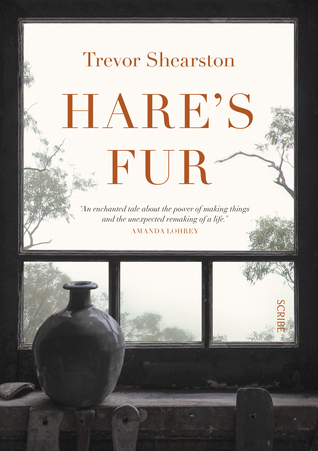
Trevor Shearston, Hare’s fur (#BookReview)

While I want to, I often don’t manage to follow up books recommended by Lisa but Trevor Shearston’s Hare’s fur particularly caught my attention. He was an Australian author I didn’t know; the novel is set in the Blue Mountains; and the protagonist is a potter, which sounded intriguing. So, I bought it – over a year ago, in fact, when I had a bookshop gift voucher to spend – but have only just managed to squeeze it into my schedule.

It’s a lovely read. However, I was surprised to discover that Shearston has published several novels, and a short story collection. His 2013 novel Game, about bushranger Ben Hall, was longlisted for the Miles Franklin Award, and shortlisted for the Christina Stead and Colin Roderick awards. Hare’s fur is quite a different book – at least, ostensibly, as I haven’t read Game to know its style or underlying concerns!

So, Hare’s fur. It tells the story of Russell Bass, a recently widowed 70-something potter living in the beautiful Blackheath area of the Blue Mountains. Unlike his potter son-in-law, Hugh, Russell sources the rock for his glazes in the canyons below his home. On one of his forays – to a remote creek that he thinks only he visits – he hears voices, and, on further investigation, discovers three children living in a cave, teen Jade who is looking after her younger sister Emma and little brother Todd. They are, he discovers, hiding from child welfare (DoCS) and the police. What would you do? The novel – novella, really, I’d say – tells the story of the relationship that develops between these four, and how Russell navigates this tricky human, legal and moral territory.

Now, before I go further, I was interested to see in Trevor Shearston’s GoodReads author page a book called The impact of society on the child: Proceedings of the inaugural annual meeting. I can’t find what his role was. It doesn’t seem he was editor or assistant editor, but, assuming he was involved, it suggests a formal interest in children’s well-being. Certainly, that is the essential theme of this novel. It’s about deciding what’s responsible and being generous, in the face of justifiable fear and lack of trust.

From Govett’s Leap, Blackheath

What’s lovely about this novel is that the adults involved – not just Russell, but, peripherally, his daughter and son-in-law who live 30-minutes walk away, and his neighbour – are open to solving this problem. They recognise the very real risks and challenges of Russell’s desire to protect the children, but they don’t resort to black-and-white solutions. I will leave what happens there, because one of the joys of the novel is following the various characters’ decisions and actions as they navigate this tricky situation.

Other joys of the novel include the writing, and particularly the descriptions of the landscape. Here is part of Russell’s walk down to his creek:

Tea-tree and lomandra had grown across the opening of the abandoned lookout. He pushed through the clumps of blades to the apron of lichened concrete and found the faint pad that only his feet maintained, skirting to the right of the platform through wind-sculpted casuarinas and hakea and more tea-tree to the cliff edge. There he stopped and removed his beanie and took the sun on his face and scalp. It was the last direct sunlight he would know until he stood again on this spot. …

He describes the birds and flowers, the colours and the misty coldness of the mountains, so beautifully.

The characterisation is good too. Told third person but from Russell’s perspective, we are privy to the feelings of this man who is still grieving his wife but is getting on with it. His daughter and son-in-law, and his neighbour, invite him over for dinner or drop meals on his doorstep, but he’s not helpless. He’s sad and a bit lonely, but he has his work. His relationship with the children is gentle, thoughtful and respectful. His response to Jade is wise,

She lacks education, he told himself, not intelligence. Don’t talk down to her.

Then there’s the title – hare’s fur. Hands up, if you know what it means? I didn’t, but it’s a special kind of brown glaze. Jade asks him how he turns the rocks into glaze. He tells her

… when it’s heated to a high enough temperature it’ll melt again. And, having lots of iron in it, that gives a black glaze. If I’m lucky, with streaks of dark blue, or red, or sometimes little brown flecks that look like animal fur.

One of Russell’s most treasured possessions is a valuable, 900-year-old hare’s fur tea bowl bequeathed him by a collector. Why the novel is titled for this is not obvious, but presumably part of it relates to the fact that this glaze is precious and rare, and needs to be nurtured like the children he has found. There’s a point where he shows Jade this bowl and lets her hold it. He tells her she can go look at it in his room any time, but asks her not to pick it up. Trusting her like this, with an object precious to him, is significant – but not laboured in the novel.

Hare’s fur is a positive book about the importance of trust and respect, and of being open to others. It’s also about how lives can be remade. Russell is as lucky as the children that they found each other.

Trevor Shearston
Hare’s fur
Melbourne: Scribe, 2019
194pp.
ISBN: 9781925713473

Margaret Hickey, Rural dreams (#BookReview)

Rural dreams is another collection of short stories from small independent publisher MidnightSun, and it’s another good one. I hadn’t heard of Margaret Hickey before, but her website says that she’s won a number of awards and is a performed playwright. Relevant to this book is that Hickey grew up in small country towns in Victoria and currently lives in that state’s northeast. In other words, in this book about rural lives, she knows whereof she speaks.

Like most short story collections, Rural dreams comprises stories told in different voices and points-of-view. The narrators, male and female, range from teens to the middle-aged, and the stories are told in first person and third person voices, with one told second person. The tone varies from funny to sad, from reflective to scary, and the subject matter represents a wide gamut of rural lives, from those who have left to those who want to leave, from those who are farmers to those who are sea-changers. And, of course, it encompasses a range of rural issues, to do with farming, dying land and dying towns, for example, as well as those more universal human issues involving love and loss, joy and fear.

I greatly enjoyed most of the stories – there’s usually one or two in a collection that doesn’t quite connect. The opening story, “Saturday morning”, fired the perfect opening salvo. Told third person, it’s about a young engineering student named Simon who now lives in a share house in Melbourne but who gets up early every Saturday morning, through winter, to drive about three hours home to play football. Even he wonders why he does it, given the way it disrupts his weekend, but, as he hits “the shire boundaries”

… there it comes, that big ball of a sun, that big ball of orange rising up over the horizon. It jolts him every time. Rays light up the stone fences, hit the trees and illuminates the paddocks. The old gums shimmer green and grey in the early morning light and world appears golden quiet. It’s like it is every Saturday, a new era.

They might have a chance today.

He’s home.

“This place, it gets to you”, says the old coach, in “Coach”. And place, of course, underpins most of these stories, whether it’s the Wimmera or Mallee or Ninety Mile Beach in Gippsland.

Counterpointing our narrator in “Saturday morning” is the young Year 12 student in the next story, “Glory days”. Living in the dry Wimmera, he is sweating his ATAR score, dreaming of escape to the city where there’ll be “no more discussions about rain and cows, it will be all about novels and films and experience”.

And so the stories continue, wending across the state, and further afield. “A bit of scrapbooking” promotes the joys of living in the oft-maligned Surfers Paradise in southeast Queensland. Reminiscent a little of Kath and Kim, this story contrasts our narrator’s life in Surfers with her son’s and his partner’s in Melbourne. She just can’t understand his move there for, he told her, “a bit of culture”:

Well, I’ve never understood that. We’ve got culture all around us up here.

Take Jupiter’s Casino–it’s full of all sorts! You’ve got your Sheiks, your Maoris, your South Australians. And you can buy your sushi, your ravioli and your chicken schnitzel in every dining establishment. Every kweezeen you like.

A first person voice is the perfect choice for this story. It made me laugh. Its humour combined with a warm touch at the end makes it just the right antidote – can an antidote come first? – to the darker story, “Desolate”, which follows. This story, and the longest one in the collection “The Precipice”, are the darkest stories here. In “Desolate” our sea-changing narrator from St Kilda, whose “barely disguised air of yuppiedom did little to hide the threat of violence that lurked beneath”, finds that beautiful deserted beaches harbour their own issues. The opening to this story is deliberate:

It’s one of those days that almost kills you; it’s that beautiful.

In “The precipice” and “The Renovation” the titles are pointedly metaphorical, with the former being about domestic violence which is clearly not confined to cities. This story builds up slowly from a therapeutic bushwalk to one of horror for the three women involved. The end, though, is perfect. Hickey, who clearly loves rural living, is realistic rather than rosy about it. She references violence, drought, and issues like the potentially damaging health impact of chemicals, without being didactic or polemical. She know the characters too, like the middle-aged man still living at home who just “likes birds” of the feathered variety (“Twitcher”) or “town weirdo” Joe who cares about the land regardless of the locals (“Overcoat Joe”) or the single-mum who stands up for her scholarship-winning son at his hoity-toity private school (“Mind your language”).

As many contemporary Australian writers are increasingly doing, Hickey also incorporates references to Indigenous Australian lives and culture. She doesn’t attempt to speak for them, but these references suggest an awareness that’s important. Anna, in “The precipice”, remembers a place called “the Leap for the stories of Aboriginal families herded there by whites in the early days of settlement”; Ruby in “The renovation” is told about the middens in the community she’s moved to; Peter remembers the scar trees in “Binky”.

Finally, while the stories are stand-alone, a few are subtly linked. Kate Brunt, a netball player from the town mentioned by Simon (“Saturday morning”), is one of the young travellers in “The wanderer”. The coach (“Coach”) briefly mentions Simon. These links have no overall narrative significance, but they have a nice grounding effect.

Rural dreams is a love letter to rural Australia, one that recognises the tensions and challenges, as well as the warmth and community. Hickey gently mocks Australia’s ongoing romance with the bush, giving us instead an image that is real and human. A truly engaging read.

Challenge logo

Margaret Hickey
Rural dreams
Adelaide: MidnightSun, 2020
232pp.
ISBN: 9781925227680

(Review copy courtesy MidnightSun)

Bernadine Evaristo, Girl, woman, other (#BookReview)

If ever there was a “zeitgeist” book, Bernadine Evaristo’s 2019 Booker Prize winning novel, Girl, woman, other is it. It might be an English-set novel about black British women, “the embodiment of Otherness”, but its concerns, ranging from ingrained inequality, racism and sexism to newer issues such as globalisation, are contemporary – and relevant far beyond its setting.

Take, for example, sexual violence. One young woman, after being raped, is not sure exactly what happened:

    wondering if he’d done anything wrong or was it her fault
    she should have stayed and talked to him about it
    he might have said he hadn’t heard her saying no

(Chapter 2: LaTisha)

This could have been set in Australia, given discussions happening here right now. It is truly troubling how many young women apparently feel uncertain about what they’ve experienced, and turn it back on themselves. But now, having leapt in to make my “zeitgeist” point, I’ll start again, properly!

Girl, woman, other is an astonishing book, as most of my reading group agreed. It’s fresh and exuberant, but oh so biting too. As much poetry as prose, it has minimal punctuation and yet it just flows. It’s a risky book – what great art isn’t? – because, in addition to its idiosyncratic style, it comprises multiple points-of-view that move back-and-forth in time. There are four main chapters, each divided into three parts with each part in the voice of a different character. This makes 12 voices in all! The voices within each chapter are closely related in some way – mothers, daughters, friends – but the links between the four chapters are more subtle. This demands much of the reader.

Fortunately, the voices are captivating. Spanning over a century, they range from the ultra-confident 19-year-old Yazz, daughter of a lesbian mother, to 93-year-old Hattie, a strong-minded farmer and great-grandmother. All are women, and all have some genetic links with African or Caribbean cultures, some from a few generations back, others being themselves migrants. Through them, Evaristo interrogates a diversity of experiences and responses to colour, in particular, in contemporary England. Hattie’s mother, for example, had an Abyssinian father, and she herself had married an African-American GI. However, with the colour fading amongst her descendants, the family is less than happy when it is reintroduced by Julie who “saw not the darkness of his skin but the lightness of his spirit”. Hattie reflects

    none of them identifies as black and she suspects they pass as white, which would sadden Slim if he was still around 
    she doesn’t mind, whatever works for them and if they can get away with it, good luck to them, why wear the burden of colour to hold you back?
    the only thing she objects to is when they objected to Chimango when he arrived on the scene, a fellow nurse at the hospital where Julie worked, from Malawi
    Hattie was sickened by their behaviour, they should’ve been more enlightened 
    but the family was becoming whiter with every generation 
    and they didn’t want any backsliding

(Chapter 4: Hattie)

You can see how well the language flows, and how accessible it is. It’s experimental but unforced. You can also see the author’s approach to her subject matter, which is to show, through her characters, different behaviours, values and attitudes. With 12 characters telling of their interactions with even more people, the breadth of humanity Evaristo encompasses is breathtaking – and it is all done without judgement. Some characters might, and do, judge each other, but Evaristo doesn’t. She lets them speak for themselves, which requires us to read attentively.

So, when Dominique’s female lover increasingly restricts her life, we see abusive control long before she does. And, when 93-year-old Hattie’s mother, Grace, experiences postpartum depression in the early 20th century, it is not named. Who talked about that then? But we recognise it immediately.

Issues come and go in this novel, whether they are up-to-the-minute topics, such as Brexit or transgender rights, or ongoing issues in women’s lives such as violence or ageing. Underpinning it all, however, is race and inequality. Being “othered” is common to Evaristo’s characters, and they all deal with it differently, but we see very clearly its debilitating, devastating impact.

    oh to be one of the privileged of this world who take it for granted that it’s their right to surf the globe unhindered, unsuspected, respected

(Chapter 2: Carole)

By now you might be thinking a few things – that the novel is heavy-going, perhaps, or that it’s chaotic. But nothing doing. For all its seriousness – and there are definitely grim moments – the novel has a light touch, frequently bitingly satiric, sometimes simply funny, always human. Nineteen-year-old Yazz, for example, is a hoot with her teenage know-it-all confidence. Many recognise their failings, as they grow older, such as Amma appreciating her father too late or Carole realising her supportive teacher had feelings. Transgender Morgan, the epitome of the modern activist, speaks many truths:

    Megan was part Ethiopian, part African-American, part Malawian, and part English
    which felt weird when you broke it down like that because essentially she was just a complete human being

Chapter 4: Megan/Morgan

And, although the novel may sound chaotic, it does have an overarching structure. It starts hours before Amma’s play – the one she hopes will finally make her name – is to premiere at the National Theatre, and it ends with the After Party and an Epilogue, which, combined, bring most of the characters together. The ending, in fact, is clever. The After Party is political, drawing together the threads and reminding us that there’s a long way to go before black people in white societies are not defined by their colour. The Epilogue, on the other hand, is personal, showing us that there’s always human connection and that that, really, is the stuff of life – if only we could all see it.

Girl, woman, other is such a read. Uncompromising in its politics, but also warm and cheeky, it offers heart and intelligence in equal measure.

Bernadine Evaristo
Girl, woman, other
Hamish Hamilton, 2019
453pp.
ISBN: 9780241985007 (ebook)

Leah Swann, Sheerwater (#BookReview)

Book cover

I’ve been wanting to read Leah Swann’s Sheerwater, having read and enjoyed, a few years ago, her short story collection, Bearings (my review). However, I didn’t get around to buying a copy, so was pleased to see it available as an audio book when I was looking for listening matter for our recent Melbourne trip. I thought we’d finish it on the trip but, in the end, the sightseeing was so interesting that we listened less than we thought we would. We’ve finished it now!

But, how to write about a crime book in which the main mystery – the disappearance of two boys – is resolved for us early on. At least, resolved in the sense that we discover what has happened to them and who was involved. As it turns out, though – and we learn this quickly – there’s another story to tell, and it’s a powerful, terrifying and unfortunately only too relevant one, a story of domestic violence, of power and control that isolates those who are vulnerable.

Interestingly, the novel’s opening reminded me strongly of the unforgettable opening to Ian McEwan’s Enduring love, which, as it happens, is also about dysfunctional love, albeit a different sort. There is also an ironic allusion to Australian literature’s “lost child” motif, when Ava thinks “this was a Continent where you could still get lost”, because these children aren’t “lost” – per se!

Anyhow, the story takes place over three days, and is told in alternating 3rd person voices, primarily those of the mother Ava, father Laurence, and 9-year-old Max who is the older of the two sons. Swann does an impressive job of getting into the heads of these disparate characters. Each one feels psychologically real, and their stories are compelling – well, most of their stories. Laurence is way too chilling to be compelling, but he is scarily real.

Now, I’m not going to write my usual sort of review, because listening to a novel (particularly while driving) doesn’t provide the same opportunity for reflection (and note-taking) that reading does, and certainly not for recording quotes, though I did jot down a few when I wasn’t the driver. The novel falls into the literary crime category, I’d say, for several reasons: it’s not a traditional crime novel; it’s told from multiple points of view; and the language is highly descriptive, if not poetic.

The title Sheerwater, for example, has multiple meanings. There’s the literal one, it being the name of the town that Ava is escaping to, and a literal and metaphorical one in that shearwaters (or, mutton birds), at the time the book is set, are doing their big migration south. They start the novel and each of the three days (if I remember correctly). There’s a sense that their impressive endurance mirrors that of women like Ava, and their arduous journey that of the boys. If we push it, there could also be a play on the words “sheer water” given the multiple meanings of “sheer” (pure, perfect, precipitous) and the role of water and the sea in the novel.

“We become evil when we hide the truth from ourselves” (Mother)

Swann creates a melancholic tone early on with phrases like “no pity under its wings”, and “sea of shipwrecks and stolen lives”. The no-nonsense but ultimately supportive policewoman Ballard is described by Ava as having a face like the “impermeable slap of seawashed stone”. It’s not all completely grim though. There is a lot of love, and Ava’s comment on one person’s kindness being enough to sustain a whole childhood is beautiful albeit, in a sense, prophetic.

So, was this book good to listen to? Yes, and no. Katherine Tonkin reads it well, including bursting into little verses of song when required. I didn’t find her voice intrusive, which can be a problem with audiobooks. However, for me, such highly descriptive books are better read than listened to. Somehow, when listening, there’s a greater sense of wanting to get on with the story. The descriptions and internal ruminations got in the way of that, whereas reading it would have allowed me to better absorb the language and descriptions, to feel and consider them, so I’m sorry about that.

Still, the narrative is strong, and it grabbed our attention, forcing us to think hard about each character, their truthfulness, their motivations, and the soundness of their actions. Who would you believe, and what would you do (if you were any of the characters involved), are the questions you confront as you read. The ending is also strong, emotional – and, dare I say it, appropriate.

In Sheerwater, Swann uses fiction to put flesh on the media stories we hear about domestic violence, encouraging us to see behind the stories to feel the confusion, roller-coaster emotions, helplessness and terror that those involved experience. Sheerwater is a book that says something.

Read for Reading Matters Southern Cross Crime Month

Challenge logo

Leah Swann
Sheerwater
(Read by Katherine Tonkin)
Bolinda/HarperCollins Audio, 2020
8hrs 44min (Unabridged)
ISBN: 9781460782354

Garry Disher, Bitter Wash Road (#BookReview)

Garry Disher’s Bitter Wash Road has been sitting on my TBR pile for over seven years. It was sent to me on spec but, as crime is not my preferred reading, I didn’t feel obliged to read it – and yet, I hung onto it, just in case… So, when Kim (Reading Matters) decided to run an Aussie-New Zealand crime month, I knew what I was going to read.

Actually, though, this is not the first Disher to appear on my blog. Text had previously sent me an earlier one of his, Wyatt, which I managed to talk Son Gums into guest reviewing for me. You can read his review here. However, Wyatt is a thriller with an anti-hero as its protagonist, so is very different to Bitter Wash Road, a police procedural featuring the more sympathetic constable, Paul Hirschhausen (Hirsch).

More sympathetic he may be, but straightforward he is not, because Hirsch is a recently demoted detective who has been sent three hours north from Adelaide to a “single-officer police station” in Tiverton, a fictional “blink-and-you’d-miss-it-town” in struggling “wheat and wool” country. Having previously worked with a team of corrupt detectives, Hirsch, though not found guilty (which, he realises, is different to being found “not guilty”), has “a stink clinging to him”. For whatever reason, Internal Investigations is not convinced he’s clean. Consequently, Hirsch finds himself investigating crime in a fearful community where the police are hated, while also having to watch his own back. Who can he trust?

“an air of waiting”

To my surprise, I greatly enjoyed this novel. It’s well-plotted, so that while the ending isn’t a complete surprise – surely it’s not a good crime novel if it is? – there are enough possibilities thrown in your path along the way to keep you pondering which way it will go. However, it’s not the plot that grabbed me. It’s the characterisation, the writing, and the subtle way contemporary issues are referenced or implicated in the story.

Hirsch is introduced in the first paragraph as the “new cop in Tiverton” and then we immediately meet him through a phone conversation with his sergeant, Kropp, in nearby Redruth. Some shots have been heard out near Tin Hut and he is to investigate. We are then launched into the action as Hirsch drives off, but we are also introduced to his character. He’s observant and careful, but also, probably sensibly, a bit paranoid. When he comes across a gum tree blocking the road, he sees it as a potential ambush, but on closer inspection it’s simply a fallen branch:

All that sinewy health on the outside and quiet decay within.

A bit like the police, really.

With such language the tone is set. Hirsch is isolated, physically and psychologically, like many in the region, for different reasons. This is a tough place where Sergeant Kropp’s two brutal constables, Nicholson and Andrewartha, terrorise the locals, paying particular attention – if you know what I mean – to young girls and Indigenous youths. Hirsch needs all his resources to navigate this lot and the rest of the community’s officials. Fortunately, he’s a true policeman, sizing up every place and person he sees or comes across, alert to every nuance in behaviour. This is, after all, the key both to survival and getting at the truth.

Now, I’m not an expert on writing about crime, but even I realise that I haven’t actually mentioned the crime. It wasn’t the gunshots out near Tin Hut, in fact, but the body of a dead girl out that way, along Bitter Wash Road. Hit and run? Or something else? A little later, a woman is found dead, this time looking like suicide. What is going on in the area? Were these deaths murders? Are they connected?

Set in a dry, struggling outback community, Bitter Wash Road is an example of a sub-genre that is now loosely known as outback or drought or bush noir. It is typified by remote communities living in harsh, unforgiving landscapes, and, as Disher makes clear, by the sort of sexism and racism that is peculiar to such settings (which is not to say they aren’t found in other settings too.)

In this sub-genre you would, I expect, find descriptions like this:

A five-hour round trip. Lengthening shadows striped the crops, the highways, the hillsides. More birds on more wires. An air of waiting, of things drying, turning to dust.

So, with suggestive writing like this, a compelling and complex character like Hirsch, and a plot with as many dips and turns as its titular road, Bitter Wash Road makes splendid reading. I’m not surprised that Disher decided a few years later to return to Hirsch with Peace (2019) and Consolation (2020).

Read for Reading Matters Southern Cross Crime Month. Kim has also reviewed this novel.

Garry Disher
Bitter Wash Road
Melbourne: Text Publishing, 2013
325pp.
ISBN: 9781922079244

Review copy courtesy Text Publishing

Jayant Kaikini, No presents please: Mumbai stories (#BookReview)

Book cover

Jayant Kaikini is an Indian (Kannada) poet, short story writer, playwright, a public intellectual and a lyricist in Kannada Cinema. Kannada is new to me, but it’s the language widely spoken in the Indian state of Karnataka, where Kaikini was born (in 1955). He is regarded, according to Wikipedia, as one of the most significant contemporary writers in Kannada and is “credited with revolutionising the image of Kannada film songs”. I make this point because references to film and film songs abound in No presents please.

No presents please is a collection of short stories that are both ordinary and extraordinary at the same time, but before I talk about them I’d like to share some insights from the translator, Tejaswini Niranjana, who was also involved in selecting the stories. She shares the issues she faced in translating Kaikini’s work, particularly “the flavour of the speech, the hybrid Hindu-Urdu-Dakhani speech, that is the cultural vernacular of Bombay” and is prominent in the stories. It’s clear that there were vigorous discussions about translating this speech. Kaikini apparently complained about her “frugality”, but she was worried about how the book would challenge readers not proficient in Hindustani. She solved it “by doing parallel translations–leaving in the Hindustani but giving the meaning in English either close by or elsewhere in the sentence so that the attentive reader eventually understands the meaning”. I read this discussion after reading the book. I must say that there were times when I was a little challenged, but my reading philosophy is to go with the flow and, overall, Niranjana’s approach combined with my strategy worked!

The other point I want to share is Niranjana’s insight into the content of these stories which, as the subtitle clearly states, are about Mumbai. But, here’s the thing: Kaikini has, Niranjana writes, “mastered the ruse of the ordinary”. By this she means that every story “begins with an extremely ordinary person or situation–sometimes both” but that “the ordinary often reveals itself as surreal”. Her challenge was

to maintain the ordinariness of the narrative until it could be maintained no longer, and to let the translation lead the reader along without drawing attention to itself. At the same time, when the surreal began to seep into the story, and the ruse of the ordinary opened out onto a different terrain of engagement for the characters, the translation had to find the right words to signal this “turn”.

She’s right about the stories moving, almost imperceptibly at times, from the ordinary to the surreal. I suspect that Kaikini’s (sometimes subtle, sometimes less so) references to cinema help us readers have the right mindset for shifting between reality and illusion, which is more how I would describe most of the funny little moments, than actual surrealism.

So, the collection. Titled by last story in the book, it contains sixteen stories, dated between 1986 and 2006. All are written third person, and explore Mumbai as it is experienced by its “ordinary” inhabitants. The first story, “Interval”, is about a young couple who meet at a cinema where he works and she’s an audience member:

That these two were planning to run away together early tomorrow was a fact nestling snugly in the dark, like the secret of a bud that had not yet blossomed.

You can tell here that Kaikini was first a poet. What happens is not at all what you would expect – which is one of the delights of this collection. The stories are not predictable, but neither do they have dramatic twists. Things just work out differently, quite often. In a neat rounding off, the last, titular, story, is about a young engaged couple with no family, and what happens as they draft their wedding invitation.

“the friendships among strangers” (City without mirrors)

In between are stories about, for example, a father looking for a husband for his daughter (“City without mirrors”), the despairing father of a very naughty but irrepressible 6-year-old-boy (“A spare pair of legs”), a bus-driver wanting to return to his village for an annual festival (“Crescent moon”), a stunt man (“Toofan Mail”), roommates who suddenly become estranged (“Partners”), a loyal maid who becomes ill (“A truck full of Chrysanthemums”), and a child quiz contestant (“Tick tick friend”). These stories pull no punches about the lives of people living on the margins or struggling in some way. Kaikini is not afraid to expose some of Mumbai’s (and India’s) underbelly. In “City without mirrors”, a bachelor is “aghast at the cruelty of a situation in which an old man had to speak to a complete stranger about the proof of virginity of his nearly forty-year-old daughter”.

Many of the stories, like “City of mirrors”, involve chance meetings between strangers, strangers who tend to offer something positive, rather than danger. “Tick tick friend” is about a young quiz contestant coming to the big city to compete in a television studio that happens to be in the basement of a hospital. Schoolgirl Madhu and her father meet a young man in the hospital canteen. His cheeky, positive attitude to life buoys them. Mogri (“Mogri’s world”) grows up in a chawl with her mother and frequently absent father. Early on, she realises that sex can be women’s downfall, but learns through meeting an older waiter at work that there are different ways of being between men and women.

In “Water”, two men, one ill with cancer, meet on a plane and spend a night with the third, their taxi-driver, when a huge storm creates havoc in the city. It’s a moving story, full of philosophical observations about life. Taxi-driver Kunjbhai, answering whether life seems “like hell or like heaven”, says:

Well, everything depends on how we think about it. If I think I’m happy, it’s happy I am. If I think I’m sad, then I’m sad.

That may sound a bit pat, I suppose, but in the context, it’s beautiful. I liked this story for the warmth generated between three strangers.

And that’s the thing about this book. For all the challenges most of its characters face, there is also warmth and humour in the telling, the end result being stories that don’t drag you down but that also don’t lull you into thinking all is well. There’s acceptance and resilience, but also little glimmers of hope in the stories.

No presents please won the DSC Prize for South Asian Literature in 2018. It’s the first translated work to win the award, and the jury particularly noted “the outstanding contribution” of the translator. That tells you, I think, how special this book is.

Jayant Kaikini
No presents please: Mumbai stories
Translated from the Kannada by Tejaswini Niranjana
Melbourne: Scribe, 2020 (Orig. pub. in India, 2017)
267pp.
ISBN: 9781922310187

(Review copy courtesy Scribe)

Tsitsi Dangarembga, This mournable body (#BookReview)

Zimbabwean author Tsitsi Dangarembga’s This mournable body was my reading group’s February book. Shortlisted for the Booker Prize, it is Dangarembga’s third novel, and is a sequel to Nervous conditions (1988) and The book of not (2006), neither of which I’ve read. These novels are written in English, the language of Dangarembga’s schooling, though she also speaks Shona.

It is a remarkable book, for its subject matter, vivid writing and the complexity of its protagonist, Tambu (Tambudzai). Wikipedia’s article on Nervous conditions describes Tambu’s character, saying “her desire for an education and to improve herself seem strong enough to overcome just about anything. She is very hard on herself, and always strives to do her best and make the correct decisions”. This perfectly describes the character I met in This mournable body, except that by now Tambu is around 40 years old and disappointed that life has not worked out as she had hoped. Indeed, she is out of work and living in a boarding house, eking out her savings from her previous copy-writing job in order to survive. A sense of failure and an air of desperation surrounds her.

Interestingly, Dangarembga chose a second person voice to tell Tambu’s story. There are various reasons for choosing this voice. Madeleine Dickie chose it for her novel Red can origami (my review) to involve if not implicate the reader in the world she was describing. I don’t know why Dangarembga chose it, but my guess is to convey Tambu’s apparent dissociation from her self. Second person avoids both the objective insight that an omniscient third person voice can provide and the confessional immersion in a life that first person offers. Tambu is struggling; she is caught between her Western-education with its Western-style aspirations and her Zimbabwean family and culture. We see her pain, but second person keeps her and us a little remote from it, as if she and we are watching it, not fully comprehending what is happening.

The novel is set in troubled late 1990s Harare, on the cusp of the millennium. It has a three-part structure – Ebbing, Suspended, and Arriving – which chronicles the trajectory of this period in Tambu’s life. In Ebbing, we see Tambu’s hopes for a successful, secure life, ebb:

Fear, your recurrent dread that you have not made enough progress toward security and a decent living, prickles like pins and needles at the mention of “village.” You have dodged this fear for too long—all your conscious life.

We also learn some of the reasons for the state she’s in, despite having been plucked from her village by her uncle and given a good “white” education. These reasons include the fact that although having gained Independence, Zimbabwe remains a racist place where black Zimbabweans still suffer under the colonialism they “thought” they’d thrown off. Tambu had had a good job as a copywriter in an advertising agency:

you have no one but yourself to blame for leaving your copywriting position. You should have endured the white men who put their names to your taglines and rhyming couplets. You spend much time regretting digging your own grave over a matter of mere principle.

Late in Ebbing, Tambu manages to obtain a decent job as a teacher, but it doesn’t last long, largely because her insecurity – her jealousies and fears – result in her self-destructing.

Suspended starts with her having been suspended from this job and admitted to a psychiatric hospital where her life is effectively “suspended” as she struggles to regain her mental health and equanimity. This she does, with the help of her family, including cousin Nyasha who takes her in. Incomprehensibly to Western-focused Tambu, Nyasha had returned, with her German husband and two children, from an apparently successful life in Europe, to work for the community, and specifically to improve things for Zimbabwean youth.

In the final part, Arriving, Tambu finds herself working for Tracey, her white Zimbabwean nemesis who had been a schoolmate at the prestigious Young Ladies’ College of the Sacred Heart and then her boss at the copywriting agency. Tracey is setting up an eco-tourism business, Green Jacaranda, and sees potential in Tambu – and indeed, Tambu seems to start to find herself, both personally and professionally, but I will leave the plot here …

This mournable body, however, is more than just a story about Tambu. Dangarembga weaves Zimbabwean social and political history into her narrative. While Tambu hadn’t been involved in pre- and post-Independence violence, many in her family had. The impact of war – particularly on women – provides one of the running commentaries throughout the novel. One refrain concerns her sister Netsai’s loss of a leg, which works as a visible reminder of personal and national losses:

Sometimes I ask if people forgot that many people went to war. Because if they have not forgotten, these people in this country, what is going on with them? Why are they so foolish? Do they think we went for this? … This is not what we went for and stayed for without food and blankets, even clothes, without our parents or relatives. Some of us without legs. Yet now we are helpless and there is nothing we can do to remove the things we see that we didn’t go to fight for.

Independence, in other words, is not working out the way they expected. The interplay of race, gender and colonialism continues to impede the country’s growth. Through her characters, Dangarembga powerfully conveys that old mantra “the personal is the political” – even though Tambu, ironically, tries to avoid talking politics with Tracey. “I don’t believe in politics”, she naively tells Tracey.

This mournable body is a serious and often heartbreaking novel, but there is also humour, much of it in the form of irony and satire. Here’s Tracey on her new business, echoing, for different reasons, Tambu’s dislike of “village”:

Everything’s Green Jacaranda eco! And you can’t say village. … That kind of promise doesn’t work these days either. It’s got to sound like fun, not under-development, soil erosion and microfinance.”

Tracey is either oblivious to – or chooses to ignore – the truths of Zimbabwean culture, preferring to exoticise a generalised notion of “Africa” for her business. In one excruciating scene she asks Tambu to organise village women to dance bare-breasted for their tourists.

At the other end of the spectrum is Tambu’s landlady’s now late husband, a black Zimbabwean who had profited from Independence. He had experienced an horrific accident, but

His biggest blow was what happened to his BMW and his temporary relegation to a lowly Datsun Sunny. People admired the stoicism with which Manyanga put up with this.

Dangarembga’s Zimbabwe is a complex society that has been riven by internal and external conflicts over decades, conflicts that are, in part, personified in Tambu’s difficulty in separating out her own goals from the “white” ones she had been educated into. While Dangarembga provides no easy answers, she suggests there are paths of hope, paths that rest with individual people who have a firm grip on what they want for themselves and for their country. This mournable body is an excruciating read at times, but the insights and perspectives it offers, particularly to Westerners whose assumptions it questions, are worth the pain and challenge.

Lisa (ANZLitLovers) was also impressed by this book.

Tsitsi Dangarembga
This mournable body
London: Faber & Faber, 2020 (orig. ed. 2018)
288pp.
ISBN: 9780571355532 (Kindle ed.)

Jasmine Seymour and Leanne Mulgo Watson, Cooee mittigar: A story on Darug songlines (#BookReview)

Recently, on a bit of a whim, I bought two books from the Indigenous Australian publishing company, Magabala Books. They were the younger readers-young adult novel, Black Cockatoo (my review), which had been shortlisted for a few awards, and this picture book, Cooee mittigar, which had just won the 2020 Prime Minister’s Literary Award for Children’s Fiction. It is described on the Awards website as “introducing children and adults-alike to Darug ‘Nura’ (Country) and language”. So, a book for children and adults. I’m in …

The book tells the story of the seasons*, as understood or experienced by Sydney’s Darug people, through the eyes of the black swan, Mulgo. It is a perfect example of the generosity of Indigenous Australians. Despite being dispossessed of their country, despite being repeatedly discounted as having anything important to contribute, despite being overlooked or specifically excepted by policy-makers, they come back again and again, willing to share their knowledge – and, particularly, their language – when there’s a real risk that it too might be taken from them. They seem to understand, when so many don’t, that it’s only by sharing and communicating with each other our values and belief systems that we can mature as a nation.

And so, we have this beautiful hardback, written and illustrated by two Darug women, Jasmine Seymour and Leanne Mulgo Watson. Like many recent books I’ve read by Indigenous Australian writers, it incorporates Indigenous – Darug here, of course – language into the story. The technique they use is, in two-page spreads, to tell the story using English and Darug words, immmediately followed (on the same spread) by a glossary for the Darug words used. So, for example, we have:

In the time of yuruka and burara
Elders tell us not to hunt the buru.

yuruku – hot
burara – dry
buru – kangaroo

The glossary words are presented in slightly smaller but still clear text. The illustrations for the page, as you’d expect in a picture book, help convey the meaning. This spread, for example, is dominated by hot-dry looking yellows and tans, with two kangaroos lazing in the grass.

But now, let’s go back to the beginning. The book starts with a welcome: “Warami mittigar. Welcome friend. … Cooee mittigar. Come here friend.” We are then introduced to our guide, the afore-mentioned black swan, Mulgo, who tells us that she will teach us “about Darug life” – and off we go, starting, logically, with an introduction to Biami (dreaming ancestor spirit) and the idea of Darug dreaming and the songlines which tell the story of “Nura” or country. From here, we move through the seasons, starting when the “the darrabura [day] grows long and the weather warms up”. Each step of the way, we are told what to look for, what might be happening, what we can do, with respect to country and the natural environment, such as:

During dagara, gulgadya will bloom –
ready to be turned into spears.

dagara – frost
gulgadya – grasstree

The story ends with the gentle request to “tread softly on our lands”.

The language flows simply – though, as a non-indigenous reader, I’m sure it would take me a few readings to feel comfortable enough with the words to make it sound good aloud. Leanne Mulgo Watson’s illustrations draw mostly from greens, blues and yellows, but with touches of other hues. They are gorgeously evocative of the text, making them a delight for all readers, but they also provide good opportunities for actively engaging younger readers (and listeners).

At the end of the book is a complete glossary of the Darug words used throughout, with a simple pronunciation guide, which is a feature I’ve missed in other books. So, for example, there’s “warami – wara me – hello”. There is also a one-page description of Darug Country, and another page providing brief bios of Seymour and Watson.

Cooee mittigar concludes with a statement of its creators’ intentions, which are “to share Darug language and culture and show that the Darug people are still strong on Country”. They also “hope that Cooee mittigar will contribute to the continuation of stories and culture”. I’d be surprised if they haven’t achieved this, but I hope that in publishing this post I will have made my contribution to supporting their goals.

Challenge logo

Jasmine Seymour and Leanne Mulgo Watson (illus.)
Cooee mittigar: A story on Darug songlines
Broome: Magabala Books, 2019
48pp.
ISBN: 9781925936865

* As many Australians know, Indigenous Australians do not see the year through “our” four-season calendar, but through different seasons depending on the country.

Carl Merrison and Hakea Hustler, Black cockatoo (#BookReview)

Black cockatoo is a young adult novel written by Indigenous Australian author, Carl Merrison, and his non-Indigenous collaborator, Hakea Hustler, and illustrated by Indigenous Australian illustrator, Dub Leffler. It is a beautiful, little (in size, not value) book that made quite a splash when it was published. It was shortlisted for several children’s literature awards in 2019, including those by the Children’s Book Council of Australia, Readings, the Australian Book Industry Association, and the Queensland Literary Awards. However, it is not the sort of book that I would normally post on here, so I plan to keep this review short.

I say this for a few reasons. For a start, children’s and young adult literature are not my main interest, though I do occasionally make exceptions, as I am making here. My main reason, however, is that not only am I not the typical age demographic for this book, but I am also the wrong cultural demographic, which makes me two steps removed from its target audience. But, I ordered this book from Magabala because I was intrigued about what was being written for young Indigenous readers, and it is on that basis that I’m posting on the book.

The story is set in a remote community in Australia’s Kimberley region, and focuses on 13-year-old Mia. She is disturbed to see her 15-year-old brother, Jy, becoming increasingly alienated from his community and culture, but feels powerless to do anything about it. In the book’s first chapter she rescues a young black cockatoo (dirrarn) which had been injured by Jy who had been target practising with his shanghai. The dirrarn is her totem animal.

What makes this book interesting for someone like me to read is the way it conveys the issues that I, an outsider, am aware of through my reading. One of these is the issue of family breakdown in Indigenous communities. Mia and her brother are being raised by their mother and grandparents, and haven’t seen their father or his family for many years. It’s clear that this is a tough gig for the grandparents. Mia overhears her grandfather (her jawiji) tell her grandmother that he’s “just tired”, and that:

I’m not sure I have it in me to teach him the right ways anymore. He’s just so headstrong.

In one way, of course, Jy is a typical teenager – stubborn and defiant – but concern about this behaviour is magnified in Indigenous communities where disconnection from culture can leave young people, young men in particular, highly vulnerable. In this story, the grandparents, like many in Indigenous communities, do their best to inculcate knowledge of and respect for culture, while also supporting their grandchildren’s need to make their way in a world they don’t know themselves.

This brings me to the main subject of this story, Mia. Her angst stems not only from her concern about her brother, but from having to make a decision about whether to take up her place at “a fancy school down south”. She’s confronting that conundrum faced by young Indigenous people that I’ve also gleaned through my reading, the challenge of straddling two cultures. There is a lovely sense here of Mia being supported and encouraged by her family, but also of her having some agency in what she does:

“You live in both worlds,” her grandmother added. “You will be strong in both ways.”

Black cockatoo is a short story but Merrison and Hustler pack a lot in here about the warmth and humour within extended Indigenous families, which lightens the more serious concerns they confront. The tone is not heavy, which is appropriate given the aim of this book being presumably to support young Indigenous people in making good choices rather than to demoralise them with the challenges they face!

The book is illustrated by Dub Leffler, with stylish, sometimes realistic sometimes more subtle, black-and-white images opening each chapter. Words from Jaru language are lightly scattered through the text:

It had been a proper long barranga dry weather, so to hunt we didn’t have to travel far to find big fat bin.girrjaru bush turkey.

There are two small glossaries at the end, one of Jaru words, and the other of Aboriginal English/Kriol words, that are used in the text.

While not all issues are resolved by the end, as you would expect, the novel’s conclusion, as you would also expect, is positive, with Mia coming to realise both her own inner strength and that she has the ongoing support of family and culture. It’s a good message in an accessible book, it seems to me, but the real proof is whether it works for its target readers, and that, of course, I don’t know.

Challenge logo

Carl Merrison and Hakea Hustler
Dub Leffler (illus.)
Black cockatoo
Broome: Magabala Books, 2018
62pp.
ISBN: 9781925360707

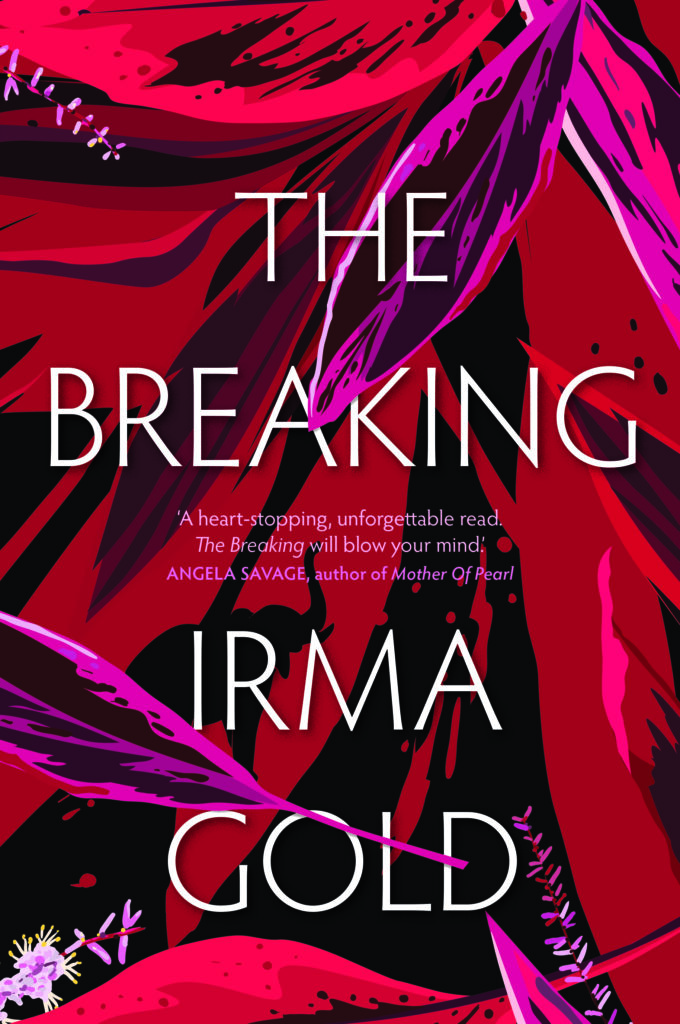
Angela Savage, Mother of Pearl (#BookReview)

Book cover

Having commented in my Reading Highlights post about how little self-directed reading I did last year, I decided to start the year with just that, before returning to the Review TBR pile. What to choose? Many books jostled for attention, but in the end I chose Angela Savage’s novel Mother of Pearl because I felt it would be a warm-hearted but meaty read, just right for this time of year. I was right.

Let’s start with the meaty first. The subject matter is commercial surrogacy, in Thailand specifically. This surrogacy involving “farang” couples was banned in Thailand during the writing of this book, but that doesn’t invalidate it. Many novels have been written about behaviours, cultures, practices that have changed or disappeared – and, anyhow, commercial surrogacy still exists in various forms in different countries around the world. So, on many fronts, both contemporary and historical, Mother of Pearl has much to offer.

And what it offers is a sensitive portrayal of a very complex issue. On the surface, the novel is about a childless Australian couple paying a poor Thai woman to carry “their” baby (created using the husband’s sperm and a donor egg) but, as Savage wrote on novelist Amanda Curtin’s blog*, what specifically interested her were “the political, ethical, cultural and emotional aspects of overseas surrogacy”. This, of course, makes the book sound very much like an “issues” novel, and it is. However, Savage, who is an experienced and award-winning crime writer – I have reviewed her novel, The dying beach – has written a novel that shows not tells, that is in no way didactic, that explores the “issue” from multiple angles without moralising.

How does she do this? Partly by creating well-rounded and engaging characters, which include Meg (the would-be mother), her sister Anna (an experienced Southeast Asian aid worker), and surrogate mother Mod. There are others, including Meg’s husband Nate. The novel starts in 1998 with Mod who is, then, a 16-year-old girl. We learn of the role of temple culture in her life, and we hear her “fortune” told which says that her “good luck will be earned, not won”. The novel then jumps ten years and we are introduced to forty-year-old Anna, recently returned from Cambodia, and her 14-months-younger sister Meg who has, ostensibly, given up the idea of having a child after years of trying, including gruelling IVF rounds. However, at Anna’s place, she meets a gay couple with a child born to a Thai surrogate mother, and the seed is sown.

Who are the winners, who are the losers (Anna, paraphrased)

From here, the novel, like many modern novels, switches perspectives, primarily between Mod, Anna and Meg, to explore the emotions and motivations, the practice and legalities of commercial surrogacy, and the cultural implications in Thailand. Anna – who is experienced in Thai culture and, let us say, the “disinterested” party – is our main guide through all this. She is, I’d say, our voice, because she is the one concerned about the exploitative aspects of this surrogacy. However, she comes to see that it’s a little more complex than would appear on the surface. This is not to argue that such surrogacy is a good thing, but that neither is it a black-and-white issue.

I particularly liked the way Savage explored the different motivations of surrogate mothers through Mod’s spending time with other surrogates and potential surrogates. We learn not only of the need for money, but of factors like the desire to earn Buddhist merit and the exploitation of young Thai women by their boyfriends and fathers. Exploitation, we realise, is a complex beast.

So, the novel is meaty because it does tease out many of those “political, ethical, cultural and emotional” factors that Savage intended to do. Meg’s single-minded focus on having a child, and the pressure this creates on others, is quietly interrogated. Aid-worker Anna’s discomfort with the exploitativeness of commercial surrogacy is teased out, as she faces reassessing “the moral high ground, where she’d once felt so at home”. The financial, cultural and emotional implications for Mod are also genuinely explored.

However, the novel is also warm-hearted because it is non-judgemental. Our main characters aren’t perfect. Meg and Anna, in particular, have their sisterly squabbles, tensions and fallings-out, but their disagreements aren’t bitter, and they both “put their foot in it” at times. More importantly, though, Savage leaves it to the reader to consider the issues and decide where we stand, and why.

Finally, underpinning all this is the writing. Mother of Pearl, which is logically divided into three parts – Preconception, Gestation, Afterbirth – is an accessible novel. The alternating perspectives are easy to follow, the pacing is good, and the writing flows well. There are some perfect descriptions, like

Anna recoiled like a sea anemone poked with a stick. She was fixed to the rock face; everything moved around her.

but they are not overdone in a novel for which the narrative is the driving force. I was concerned for a while that Meg and Nate were too good to be true, given the stresses they’d been under for years, but Savage injected enough little cracks to reassure me that they hadn’t stepped out of a romance novel. Finally, there’s the perfectly apposite pearl motif, which is also handled with a light touch.

Mother of Pearl, then, respects the complexity of its “issue” without becoming polemical. In so doing, it discourages judgement where compassion should prevail, and yet is clear-eyed about the realities that make surrogacy so problematical. A good choice for my first book of 2021.

Lisa (ANZLitLovers) also appreciated this book.

Challenge logo

Angela Savage
Mother of Pearl
Transit Lounge, 2019
318pp.
ISBN: 9781925760354

* Thanks to Lisa for providing the link to this post.