Chrystopher J. Spicer: Cyclone country: The language of place and disaster in Australian literature (#BookReview)

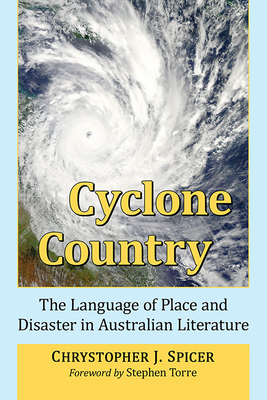
I love thinking about place in literature, so I was intrigued when Chrystopher Spicer, cultural historian and adjunct senior research fellow at North Queensland’s James Cook University, offered me his book Cyclone country: The language of place and disaster in Australian literature for review. Unfortunately, I’ve taken a while to get to it.

Place can be a contentious issue for readers, and I’ve become embroiled in many discussions over the years on the topic. However, this is not going to be one of those, not because I have nothing more to say, but because Spicer’s book looks at place from a different angle. His focus is, obviously, cyclones, and was inspired by the fact that he lives in northern Queensland, a tropical region known for its often highly destructive cyclones. Despite this, people stay. How do they incorporate their experience into their sense of place, and, more significantly, into their understanding of who they are personally and as a community? Cyclones bring chaos and destruction, but, paradoxically, they are also part of the fabric of place they destroy.

It is in this context that cyclones (and similar “nature catastrophes”) can be catalysts for literature. It specifically was for Susan Hawthorne’s eco-poetry collection Earth’s breath. Spicer wanted to explore whether such literature provides “a means by which individuals and societies can cope with and integrate these events into their lives, culture and place” and how weather catastrophes like cyclones “speak of our relationships with place and the people in it”. Concluding his introduction, he identifies his objectives as

to explore how we integrate a violent, chaotic, and destructive weather feature into our culture through the use of storytelling and structure. At the same time, I hope to convey a sense of the connectivity and commonality of people search for meaning amid the meaninglessness of chaos and catastrophe.

“in with through” (Hawthorne)

Spicer explores all this through eight chapters. The first two and the last are devoted to general discussion about cyclones, cyclones and place, and cyclones in literature. In these chapters in particular, Spicer draws on academics, critics, and other writers to provide a theoretical underpinning to his argument. The fundamental point is that stories shape the places in which we live and that in the same process people and place are mapped by those stories. He adopts the word “terroir”, traditionally used to describe wine regions, arguing that it encompasses both the tangible habitat and the spiritual sense that is imbued in that habitat from living within it. Weather, he argues, is inseparable from the physical and experiential aspects of the landscape. As poet Susan Hawthorne writes:

I am in with through the cyclone
which is inside with through me

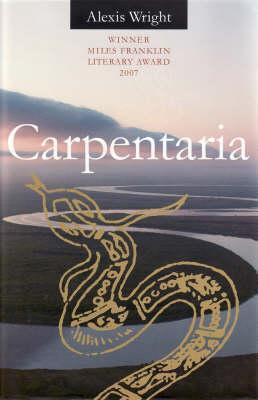
The book’s other five chapters explore his ideas through specific works set in or around Queensland and its cyclonic environment: Vance Palmer’s Cyclone (Lisa’s review), Thea Astley’s A boatload of home folk (with references to other works including The multiple effects of rainshadow which I’ve reviewed), Patrick White’s The eye of the storm (Lisa’s review), Susan Hawthorne’s Earth’s breath, and Alexis Wright’s Carpentaria (my post).

Storms and cyclones have, of course, featured in literature as long as people have been telling stories, and Spicer provides many examples. Their “propensity to be intense life-changing personal experiences” naturally leads to their use in literature, often as metaphor for “epiphany and revelatory apocalypse”. I’m sure all of us have examples from our reading. For me, Shakespeare stands out.

Alexis Wright, Carpentaria

The five authors Spicer explores use cyclones in different ways, but there are recurring ideas. Epiphany, revelation, with a corresponding opportunity to change or start afresh, underpin the stories. Serpents and similar monsters feature frequently, whether it’s Palmer’s Leviathan, or Hawthorne’s ouroboros, or Wright’s Rainbow Serpent. I’m simplifying here but, essentially, their role varies from being the monster that embodies and explains the chaos to something that is more organically part of the process of chaos and renewal. Somewhat related to this, but separate too, is a cyclical view of nature and thus life. This idea is particularly developed by Hawthorne and Wright, in whose works the apocalyptic event contains the cycle of beginning and end, of life and death and life again.

For White, the image or metaphor is a little different again, but also related, with his using the spiral and the mandala or circle. For his protagonist, it’s in the “eye” of the storm, or the “still point” of the spiralling word, that revelation is found, and epiphany achieved. Astley, too, suggests Spicer, sees us as all being “part of a swirling, spiralling, cyclonic universe”. However, instead of going into the eye, her characters try to escape the cyclone, something which Astley herself said, “is not possible”. The main Astley book that Spicer explores, A boatload of home folk, has been criticised as awful, unlikeable, but Spicer disagrees, arguing that, ultimately, Astley, like the other writers, “uses the elemental cyclone as a trope of apocalypse that is both an instrument of destruction and a catalyst of revelation.” It is what the cyclone draws out of the despair in the novel’s characters that is significant.

In the end, there are two main ideas I took from this book. One is that cyclone literature helps us to understand the event, to incorporate the resultant chaos into our lives, and thus, to “integrate nature catastrophes” into our sense of place, or terroir. While Spicer’s focus is cyclones, he also mentions “nature catastrophes”. Consequently, I’d argue that his argument holds for places which frequently experience other such catastrophes, like bushfires, tornadoes, earthquakes, and recurring long droughts. People who live in places frequented by such catastrophic events, and who choose to remain in those places, must surely “integrate” the experience in some way into their identity as a person of that place, and into their understanding of how to live in that place. Spicer’s discussion of Susan Hawthorne’s Earth’s breath addresses this idea in depth.

The other idea relates more generally to how writers use cyclones/storms to explores broader ideas. In a way, this extends beyond Spicer’s specific goals regarding place. Whether or not writers are inspired by actual cyclonic events or purely imagined ones, in real or imagined places, they can and do use cyclones to explore spiritual and/or psychological upheavals in their characters’ lives. Spicer’s selections are all Queensland-related, so place is quintessential to the stories, but his analysis shows that cyclones in literature also transcend place to encompass something more universally human.

In the final section of his book, “The Cyclone as Universal Trope”, Spicer writes that –

Such events and the stories of them can challenge previous human experience, thereby providing opportunity to move forward and rebuild, opportunity for the emergence of the new.

– with “the new” embodying both the tangible and the intangible aspects of our lives.

Spicer’s book is well-researched and thorough in its analysis, and is supported by an excellent bibliography and index. I found it fascinating. It’s not for everyone. However, it makes an excellent contribution to our understanding of the tropes of Australian literature, including reminding us that it’s not all about “the bush”.

Lisa also reviewed this book.

Chrystopher J. Spicer
Cyclone country: The language of place and disaster in Australian literature
Jefferson, NC: McFarland, 2020
202pp.
ISBN: 9781476681566

Review copy courtesy of the author

Maggie O’Farrell, Hamnet (#BookReview)

Book cover

Not unusually, I’m late to this book that was all the talk in 2020 – and, I may not have read it at all if it hadn’t been for my reading group. I’m talking, as you will have guessed from the post title, of Maggie O’Farrell’s Hamnet.

As most of you will know, Hamnet’s plot draws from the life of Shakespeare (never named in the novel) and Anne Hathaway, and the death of their son Hamnet at the age of 11. There was an older sister, Susanna, and Hamnet’s twin sister, Judith. O’Farrell explains her interest in her Author’s Note:

Lastly, it is not known why Hamnet Shakespeare died: his burial is listed but not the cause of his death. The Black Death or ‘pestilence’, as it would have been known in the late sixteenth century, is not mentioned once by Shakespeare, in any of his plays or poetry. I have always wondered about this absence and its possible significance; this novel is the result of my idle speculation.

Because this book has been well-covered already online, I’m going to take a slightly different tack with this post, and focus on a couple of questions.

“She herself might tell a different story”

With all books, but particularly with historical fiction, one of my questions is, why did the author choose to write their story. O’Farrell partly answers it in her Author’s note. However, there is also, surely, a feminist reading, because, although the novel is titled Hamnet, it is primarily about his mother Agnes (as Anne is named in Shakespeare’s will). Early in the novel, O’Farrell writes “This is the story, the myth of Agnes’s childhood. She herself might tell a different story”.

The thing is, we don’t know a lot about Agnes Hathaway which makes her ripe for historical fiction. What we do know is that women’s stories were – and too often still are – rarely told, but that that doesn’t mean their lives were unimportant. It means that importance hasn’t been placed on them. Whoever Agnes really was, O’Farrell has created a wonderful, eccentric character, who is perceptive, warm, independently-minded, a little flawed but engaged in the life of her family and community. She is fun to read about.

Besides telling a story about her, though, O’Farrell also presents, through her, a story about grief, and this, for me, was one of the strongest aspects of the novel. Agnes’ thoughts about burying her son, her astonishment that people can complain about their children, her utter discombobulation were so real:

Agnes is not the person she used to be. She is utterly changed. She can recall being someone who felt sure of life and what it would hold for her …

This person is now lost to her for ever. She is someone adrift in her life, who doesn’t recognise it. She is unmoored, at a loss. … Small things undo her. Nothing is certain any more.

So real …

Hamlet?

Warning: Spoiler of sorts

Given the novel is titled for Hamnet, rather than for its main protagonist, Agnes, it’s worth considering why, and this leads us to the play Hamlet. The novel ends with Agnes attending a performance of her husband’s play, which confirms the significance of this play to the novel. The epigraph to the novel’s second part is a quote from Hamlet (V:ii): “Thou livest;/ . . . draw thy breath in pain,/ To tell my story”. But, Hamlet could scarcely be seen to be Hamnet’s story, though I did have a little laugh at the point in the novel where Hamnet chooses to die:

They cannot both live: he sees this and she sees this. There is not enough life, enough air, enough blood for both of them. Perhaps there never was. And if either of them is to live, it must be her. He wills it. He grips the sheet, tight, in both hands. He, Hamnet, decrees it. It shall be.

Eleven-year-old Hamnet seems, here, to be far more decisive than his namesake who is known for his prevarication. This, however, is not what we are expected to take away from the novel I’m sure!

So, what else? Well, there’s the grief theme, which Hamlet can be seen to “resolve” in the novel. Agnes, devastated after her son’s death, can’t understand her husband returning to work – and writing comedies:

His company are having a great success with a new comedy. They took it to the Palace and the word was that the Queen was much diverted by it.

There is a silence. Judith looks from her mother, to her sister, to the letter. 

A comedy? her mother asks.

She is even more devastated though to learn that her husband has gone on to write a play using their son’s name – Hamnet and Hamlet being interchangeable – so she goes to London to confront him. What happens is something else. Initially, she feels eviscerated:

How could he thieve this name, then strip and flense it of all it embodies, discarding the very life it once contained? 

But then, as she sees the ghost father and living son, she starts to see something else:

He has, Agnes sees, done what any father would wish to do, to exchange his child’s suffering for his own, to take his place, to offer himself up in his child’s stead so that the boy might live.

My reading group discussed the question of the play a little, though we didn’t come to any particular conclusion, which I rather like. However, we did talk about how Shakespeare wrote his darkest, strongest plays, including the four great tragedies, after Hamnet’s death, which suggests that his son’s death had a big impact on him. A member also raised the play’s existential nature, seeing it exploring the fragility of life – “to be or not to be” – and how you go on in the face of bleakness.

Now, I could go on and talk about the style (language, use of present tense, symbolism), the decision not to name Shakespeare, and the dual storyline structure, as I normally would, but I’m sure they’ve been discussed elsewhere, so I’m leaving it this time. There were aspects of the novel that I question, but the truth is that I fell for Agnes and her story.

So, I’m going to leave you with two quotes, one from the husband, one from the wife.

It is so tenuous, so fragile, the life of the playhouses. He often thinks that, more than anything, it is like the embroidery on his father’s gloves: only the beautiful shows, only the smallest part, while underneath is a cross-hatching of labour and skill and frustration and sweat. 

Gardens don’t stand still: they are always in flux. 

These relate to their spheres of activity, but they also say something about life, don’t you think?

Maggie O’Farrell
Hamnet
London: Tinder Press, 2020
310pp.
eISBN: 9781472223814

Nancy Jin and Rosalind Moran, These strange outcrops (#BookReview)

Bagging Canberra – often used synonymously for the Federal Government – is almost a national sport, but in recent years anthologies have appeared to counter this with more complex stories about this place. The first two I’ve read – The invisible thread, edited by Irma Gold (my review) and Meanjin’s The Canberra issue (my review) – commemorated Canberra’s centenary, but last year saw the publication of the evocatively titled These strange outcrops.

This anthology is the work of two young Canberrans, Nancy Jin and Rosalind Moran, who founded Cicerone Journal. Established in 2018, it is, they say,

a Canberra-based publication that seeks to encourage an open curiosity about the world in a socio-political climate of disconnection and disenchantment. We aim to publish writing that is exploratory and thoughtful, and new and unusual.

The journal’s fifth edition will be devoted to speculative fiction, and is due soon.

So now, These strange outcrops, which is subtitled, Writing and art from Canberra. It comprises original short stories, poems, and visual art created by established and emerging Canberra writers, and has a specific goal, as the editors write in their Foreword. It “grew out of a desire to question media narratives that portray Australia’s capital city as a place of disconnection and insularity”. They note that with a population of 400,000, Canberra and the surrounding region is “home to far more stories and perspectives than are commonly depicted in the news”. They wanted, they say, to “challenge the prejudices and stereotypes” and “celebrate the varied lives and imaginings of this unique place”.

“blurry at the edges” (Owen Bullock)

They have achieved their goal, and with style. This publication is physically gorgeous, from the cover, with its iconic Canberra bus stop framed by two Canberra floral emblems (the Royal Bluebell and Correa), through its beautiful endpapers comprising a correa blossom pattern, to the care taken with the design of the individual pieces. I can’t imagine any contributor not being thrilled with the look of their contribution.

But, the main point is, of course, the content. It more than lives up to the appearance, by which I mean, the book is not just a pretty face. An important thing with anthologies is the order, and it’s clear that the editors thought carefully about this. They start with the physical Canberra, and its natural environment, which is one of the reasons many of us love this place, and conclude with the experiences of different members of Canberra’s diverse population. In between, are various explorations of a wide range of aspects of life in Canberra, from those common to us all (like Cheryl Polonski’s poem “Wintertime in Canberra” and Penelope Layland’s poem “Showtime”) to some that speak to more specific experiences (like Daniel Ray’s prose piece about that challenging post-Year-12 time, “Queanbeyan: Quinbean: Clear water”). Some contributions are movingly personal, while others are unapologetically political. The end result is an authentic whole, that shows Canberra to be a rich and complex place, a bit “blurry at the edges” but with enough commonality at the core that makes us real, regardless of what outsiders might think.

Now, I did have some favourites, and will share a few of them over the rest of this post. The opening set of poems, “Canberra Haiku” by Owen Bullock beautifully introduces the collection, with its series of little impressions portaying Canberra’s breadth, from flowers peeking through a cracked pavement to a tattooed bus passenger and a permaculture working bee, from magpies and our mountains and lake to heatwaves and “blurry … edges”. The next few pieces explore place, often with an awareness of what was before we came, such as Janne D Graham’s poem “Crace Park” which conveys a sense of wrongness in our “calculated spaces”. A sort of antidote – or comment on this – is Helen Moran’s vibrant painting “Rainbow Serpent sleeping in Lake George”, the Rainbow Serpent being significant to many First Nations Australia peoples. It mesmerises me, because, while looking simple, it evokes complex and conflicting ideas. Set against a dark blue and black background, the bright, cheery serpent also looks ready to pounce. At least, that’s how it appears to me.

Patricia Piccinini, Sky Whale, pic: Nick-D from Wikipedia, using CC-BY-SA 3.0

Some of the pieces invoke wry humour to make their point, like Fiona McIlroy’s poem “sky whale” which uses the Patricia Piccinini’s Canberra-Centenary-commissioned hot-air balloon “The Skywhale” to reflect on attitudes to public art that challenges perceptions.

Canberra is
determined
to have a whale of a time
in the Centenary
to live it up
to lighten up
kick up our heels
yet a flying
maternal mammal
is just pushing the
envelope

The wordplay throughout the poem is delicious.

“come so far, lost so much” (Joo-Inn Chew)

Some of the strongest pieces concern migration and racism. Canberra, like much of Australia, is a multicultural place. We have Ngunnawal and other First Nations people here; we have Australian-born residents who have come from around Australia for work; and we have migrants including refugees. We have – or had, before the pandemic – an annual, vibrant and successful Multicultural Festival, which celebrates this aspect of the region, but several pieces in the anthology convey the sadness and pain that must always come with migration, regardless of its cause. Anita Patel speaks in “What are you cooking?” of the sadness of losing her mother in another part of the world, so that even those weekly phone conversations are no longer possible, while Joo-Inn Chew’s poem “A new arrival at Companion House” talks of the hope contained in the birth of a baby to people who have “come so far, lost so much”.

Others are much darker, speaking to non-acceptance, such as Michelangelo Curtotti’s ironically titled poem “The welcome”. In one of those perfect segues, this poem is followed by Stuart McMillen’s graphic short story, “I used to be a racist”.

As frequently happens when reviewing anthologies, I’ve only cursorily dipped into the treasures contained within. I apologise to all those contributors whom I don’t mention here, but know that you’ve been read and heard. The best thing would be for more to read your work in this thoughtful, considered anthology. It can be purchased from Cicerone (linked above).

Meanwhile, let’s finish on Rafiqah Fattah’s defiant poem, “Generation selfie”, about the 16 to 25 year olds who are too often ignored or passed over:

And now, there is a tremor in the air
We are here

Challenge logo

Nancy Jin and Rosalind Moran
These strange outcrops: Writing and art from Canberra
Canberra: Cicerone Journal, 2020
74pp.
ISBN: 9780646814155

Irma Gold and Susannah Crispe, Where the heart is (#BookReview)

I don’t normally review children’s books, particularly children’s picture books, but I do make exceptions, one being Irma Gold. I have multiple reasons for this. Irma Gold is local; she is one of the Ambassadors for the ACT Chief Minister’s Reading Challenge; she writes across multiple forms (including, novels, short stories and children’s books, in all of which I’ve reviewed her); and, if you click my tag for her, you will get a sense of just how active she is as a writer, editor and supporter of literary culture, particularly in the ACT. Hence this exception!

But, there is another reason too, which is that Where the heart is not only a delightful book but it slots very nicely into her growing oeuvre. Before I discuss that, though, I’ll describe this, which is her most recent book. Gold explains on its opening page that it was inspired by the true story of Dindim, a Magellanic penguin which, in 2011, was washed up on an island village outside Rio de Janeiro. The bird had been caught up in an oil spill. The fisherman who found him, Joao, cleaned and cared for him until Dindim returned to the wild. However, ever since then, Dindim has returned, annually, to Joao to spend several months of the year with him. There are questions about where he goes, but in Gold’s story it is Patagonia. Patagonia is one of the theories, because it is a major breeding ground for these penguins.

This sort of detail, however, is not critical to the story. It is fiction after all. What is critical to the story is that it tells of the potentially disastrous impact of oil spills on animals. It also tells of the importance of wild animals being free. This is what Joao believed. He brought the penguin back to health and set him free. It’s just that the penguin had other ideas. It also tells of the friendship that can develop between humans and wild animals.

What makes this a gorgeous book is the way Gold tells the story. It’s simply told but the language is not condescending, and it naturally incorporates local culture. Joao and the penguin mend nets, eat sardine sandwiches, and go shopping together, with this “shopping” being at a village market stall. It’s also warm-hearted. It encourages us to think about kindness, tenderness and loyalty, making it a feel-good read. Yet, there is also a narrative arc that encompasses a variety of emotions, including a sense of fear and drama as Dindim journeys back.

Not far from Joao’s beach, the sky swelled and lightning jagged. Dindim rode waves and wondered if he would make it. He was exhausted.

A little bit of drama makes it fun to read aloud to littlies, which I look forward to doing when lockdowns end and I’m able to see our little grandson again!

However, this is a picture book, so for it to succeed the illustrations have to be good as well. Fortunately, they are. I think this is illustrator Susannah Crispe’s first book, though she has another coming out this year. I’m not surprised she has, because she has done a beautiful job with this one. The colours are bright and inviting, but are conveyed with a warmth and softness that support the story. This is nowhere more obvious than in the two facing pages that contain only penguins. The expected intense black-and-white of the penguins is there, yet muted, and the white space surrounding Dindim visually conveys the text’s description of the “ache” in Dindim’s heart. Crispe also incorporates lovely little details from nature in her illustrations, like hummingbirds, butterflies, turtles and albatrosses. These all support the story by adding to its sense of place, but they also create interest when reading to littlies. “Can you find the turtle”, etc!

What I’m saying, in other words, is that this picture book is just the right package.

Irma Gold Craig Phillips Megumi and the bear book cover

And there I’ll leave it to return to my opening comment on Gold’s oeuvre, because I am seeing a pattern. The obvious one – from her previous picture book Megumi and the bear (my review) and The breaking (my review) – is her interest in wild animals, and in the relationship between humans and animals. Closely related to this is an interest in conservation, animal rights and the environment. And then – yes, there’s more – overlaying all of this is the importance of friendship, between humans, and between animals and humans. There’s a quiet joy in this, which is something Gold said, in a recent conversation, that she wanted to convey. I believe she has, and look forward to what comes next.

Challenge logo

Irma Gold and Susannah Crispe (illus.)
Where the heart is
Chatswood: EK Books, 2021
[32pp.]
ISBN: 9781925820874

Marie Younan with Jill Sanguinetti, A different kind of seeing: My journey (#BookReview)

In many ways, Marie Younan’s A different kind of seeing: My journey is a standard memoir about a person overcoming the limitations of her disability which, in this case, is blindness. It’s told first person, chronologically, from her grandparents’ lives through her birth in Syria to the present when she is in her late 60s and living in Melbourne. However, there are aspects of her story which add particular interest, and separate it, in a way, from the crowd.

One of these aspects is that Younan’s story is not only a story about blindness, but about migration and cultural difference. Younan is Assyrian, and was born, the seventh of 12 children, in the small village of Tel Wardiyat in northeast Syria. Her maternal and paternal grandparents moved, variously, through Turkey, Iran, Russia, Greece and Kurdistan escaping genocide and persecution before they all ended up in Tel Wardiyat. In her own life, Younan’s family moved to Beirut, but with some of the family having already migrated to Melbourne and with civil unrest increasing in Lebanon, more of the family applied to migrate to Australia. Younan herself was initially rejected because of her blindness, so, while her parents left for Melbourne in 1975, she returned to Syria, before moving to Athens to an older sister. Finally, in 1978, and now in her mid-20s, she was granted a visa for Australia joined her parents and family. (What a kind nation we are!)

If this wasn’t enough challenge, Younan’s life was also affected by her conservative upbringing. The book starts with a little prologue chapter describing how, at the age of 7, she came to properly understand her difference, that she is blind:

it dawned on me that there was a ‘thing’ called seeing that everyone else could do except me […]

It was the day my life as a blind person began.

We gradually come to realise that Younan was, as a child, doubly disadvantaged, because while she was brought up lovingly, nurtured by parents and siblings, she was excluded from so much that could have helped her develop as a person. She was not allowed to go to school; she was not allowed to go to big family events like weddings; and when a doctor suggested a corneal transplant for her when she was 10, her grandmother and father refused, because they didn’t believe such a thing was possible. Further, when she was 12, a relative offered to take her to a boarding school for blind girls – so she could “learn something and grow up with knowledge” – but her grandmother and father again opposed it. Her father said,

‘I’ve got 12 children, and I’m not sending one to boarding school, especially if she’s disabled.’

She was heartbroken, asking her mother why not. She didn’t “know anything about the world, or about life”, and badly wanted to. Yet, she expresses no bitterness in the book towards her family. Indeed, she dearly loves and respects them.

Anyhow, she arrives in Australia, highly dependent on her family and functionally illiterate.

I have spend a lot of time on this first part of the book because not only is her early life so interesting in its difference from my own life, but because it lays the groundwork for the astonishing changes she made in her life, with the help and inspiration of others, after her arrival here. I’m not going to detail all that. I’ll simply say that, largely through the mentorship of a man called Ben Hewitt (to whom the book is dedicated), she was introduced to various services, organisations and people that resulted in her learning to read; learning Braille; studying psychology and later interpreting; travelling around Victoria speaking on behalf of the Royal Victorian Institute for the Blind; and working as an interpreter, including for refugees through Foundation House. It’s an amazing trajectory – and one told quietly, and with humility and respect for her family and for all who helped her on the way.

It’s not surprising that she’s been described as “Ben’s biggest challenge and his best success story”. His role in encouraging her, in turning around her thinking from “I can’t” to “I can” cannot be underestimated, because, by the time she met him, Younan had a desire to learn but very little confidence in her ability to do so.

For all its straightforwardness, though, her story does have a little mystery. Younan was not born blind, but became blind when she was a few months old. Just what caused her blindness is a little question that runs through the book, and I’ll leave it to you to discover, but well-intended actions by a much-loved grandmother were involved. It’s a heartbreaking story of mistakes, accidents and missed opportunities, but Younan, if she resents any of it, has the grace to focus on what she has, not what she hasn’t or what might have been.

Now, you may have noticed that this book was written “with” Jill Sanguinetti, who has appeared here before with her own memoir. Younan met Sanguinetti around 1988 at the Migrant Women’s Learning Centre, when she joined sighted migrant women in a Return to Learning class. Sanguinetti was the teacher, and explains in the her Introduction to the book how she and Younan had stayed in touch after the class finished. Some years later, they “decided to work together to write the story of Younan’s life and educational journey”. Younan is, she writers, a “mesmeric storyteller”, but with one thing and another, it took 8 years to finalise the book. There were “many cycles of telling and writing, re-telling and re-writing”, and it shows in the end product, which is tight and keeps focused on the main theme of Younan’s journey from a dependent, innocent young girl to the independent achiever she is today.

A good – and relevant – read.

Challenge logo

Marie Younan with Jill Sanguinetti
A different kind of seeing: My journey
Melbourne: Scribe, 2020
214pp.
ISBN: 9781922310256

(Review copy courtesy Scribe.)

Douglas Stuart, Shuggie Bain (#BookReview)

How to write about a book that has made such a big splash that it has already been extensively reviewed. What more can one say? This is what I’m facing with Douglas Stuart’s debut and Booker Prize-winning novel, Shuggie Bain.

I haven’t, in fact, read much about it, because I prefer to come to books fresh, but I have heard an interview with Stuart, and I can imagine what has been written about his book. I have also discussed it with my reading group. All I can do is just launch in, and write what I would normally write, but I fear it won’t add anything fresh to the discussion. It will, however, record, for me, my thoughts and feelings.

The story

For those of you who haven’t yet read Shuggie Bain, it tells the story of its eponymous protagonist growing up in public housing in 1980s industrial Glasgow. This was the time of Thatcher, a time when mines, shipyards, railyards closed, resulting in significant unemployment and the usual fallout when men can’t work and women and children end up on welfare:

Whole housing estates of young men who were promised the working trades of their fathers had no future now. Men were losing their very masculinity.

This is important, but it is also just the backdrop for the personal story of Shuggie and his mother Agnes. There are other characters, but these two are the book’s core.

The story starts in 1992 with Shuggie, nearly 16, living on his own in a boarding house in Southside Glasgow. He is clearly pitied by the people around him, so the question for us is why is he there alone, how did he get there? We then go back to 1981, where we meet Shuggie’s family, thirty-nine-year-old Agnes, her second husband Shug, and Shuggie’s two older siblings, Catherine and Leek, who were born to Agnes’ first husband. It is not a happy situation. They are all living in a flat with Agnes’ parents, Wullie and Lizzie, and Agnes feels a failure.

When Shug does take his family away, it’s a cruel action, and Agnes and her three children soon find themselves alone, living on welfare payments in the desolate Pithead – a housing scheme which had “the plainest, unhappiest-looking homes Agnes had ever seen”. She knew Shug was “a selfish animal”, but she wasn’t expecting this. From here, their lives are a struggle, though Agnes – now drinking heavily – tries her darnedest to maintain appearances amongst women who reject her and her airs.

The characters

Agnes’ airs! Stuart has an impressive ability to create vivid, real characters. Even the villains of the piece – like Shug – are recognisable as people beyond the “type”, in his case a macho, violent, womaniser, they represent. This is no mean feat. However, it’s Agnes, Shuggie and, to a degree, Leek, who are our focus.

Agnes is a woman with aspirations. She’s resourceful, when sober, and wants more than the life she’s been dealt. But, she is unable to find a way out, largely because, for women of her time and place, it seems that a man is the answer. Her first husband Brendan tries to buy her happiness, but he’s boring. Then the flashy Shug comes along. For all his failings, and they abound, he too tries to buy her happiness, but tires of all her “wanting”.

Unfortunately, one of the things Agnes wants is “to take a good drink”. Her drinking, which was already evident when they lived at her “mammy’s”, becomes a serious problem at Pithead. Life, for her children, becomes insufferable. Catherine skedaddles into an early marriage as soon as she can, while the sensitive, artistic Leek withdraws into himself, leaving the young Shuggie to be the main watcher over his mother. And this is where this novel’s credentials as autofiction come into play, because the evocation of the child-addict parent relationship reads so authentically. We can’t help admiring Agnes’ gallus, while also despairing for her and her children.

So, it’s a heartbreaking story. Not only does Shuggie struggle with his addicted mother – loving her, caring for her in ways that a child should never have to – but he must cope with his own outsiderness that he doesn’t understand. From a very young age his way of talking, dressing and walking, not to mention his disinterest in typical boy things, are ridiculed. He’s called names, beaten up, ostracised, and he doesn’t know why. At 10 years old, aware he’s “no right”, he asks his mother, “What’s wrong with me, Mammy?” If she knows, she doesn’t tell him, but a few years later, he realises that Leek, who had tried to teach him to toughen up, had known all along.

Leek is the support act, figuratively and literally, to Shuggie and his mother. He quietly provides support in the background, even after he eventually leaves home. He’s resentful of the impact on his own ambitions to become an artist, but he sticks around, taking labouring work, because he is needed. In many ways, he’s the hero of the novel, and my heart went out to him as much as to Shuggie. This, I think, says it all:

he looked like a half-shut penknife, a thing that should be sharp and useful, that was instead closed and waiting and rusting.

The writing

It also gives you a flavour of the book’s expressive writing. One of the first things you might notice is that Stuart loves a simile. The book is full of them, but they are so good, like

“The auld man’s face crumpled like a dropped towel.”

and

“The unwelcome presence of a man was like a school bell.”

and so many of Agnes, such this when Shug leaves her

“Agnes, sparkling and fluffy, was lying like a party dress that had been dropped on the floor”.

The book is also well structured, opening in 1992, which immediately tells us that whatever happens Shuggie is going to survive, and ending back in 1992, this time on a note of hope, albeit a tentative one.

Stuart uses vernacular extensively, resulting in much unfamiliar-to-me vocabulary – boak, hauch, gallus, to name a few – but they are understandable from the context, and essential to setting the scene. The novel is not at all hard to read. Indeed it’s beautiful – and easier to understand than some spoken Scottish can be!

Moreover, for all its bleakness, the novel has a good smattering of humour. Here’s Shuggie defending his mother, drunk and over-dressed, marching into the hospital to see her dying father,

Shuggie heard the nurse say to a male attendant that she thought for sure Agnes was a working girl.

“She is not,” said Shuggie, quite proudly. “My mother has never worked a day in her life. She’s far too good-looking for that.” 

What it all means

The novel is, as I’ve said, autobiographical, but that doesn’t mean that Stuart simply sat down and wrote his life. Shuggie Bain reads as a considered piece of fiction that has some things to tell – about dashed dreams, the powerlessness of women in a male-dominated world, poverty, addiction and outsiderness. It’s both political and personal about what happens to lives when the ground beneath is taken away. And yet, for all that, it’s also about love – child-to-mother, brother-to-brother, friend-to-friend – that survives in places you barely expect it to. No-one in my reading group was sorry we scheduled it.

Douglas Stuart
Shuggie Bain
London: Picador, 2020 (2021 eBook)
355pp.
ISBN: 9781529019308

Claudine Jacques, The Blue Cross/La Croix bleue (#Review, #WITmonth)

I haven’t taken part in Women in Translation month (#WITmonth) before but decided to dip my toes in this year with a translated short story. I hoped to find one online and I did, “The Blue Cross” (or, in its original French, “La Croix bleue”) by New Caledonian writer Claudine Jacques. Coincidentally, I found it was translated by Patricia Worth who now, apparently, lives in Canberra. She translated it as part of her Master of Translation Studies. It was published in The AALITRA* Review, with the English presented alongside the French.

I didn’t know Claudine Jacques, but Worth provides some information on her website. Jacques was born in Belfort, France, moving to New Caledonia as a sixteen-year-old with her parents. She’s lived there ever since. She ran a vocational training centre, before establishing a publishing company, but she now, says Worth,”devotes herself almost exclusively to writing”. She and other authors founded the Association des Écrivains de la Nouvelle-Calédonie (New Caledonian Society of Authors) in 1997.

Literary Bureau Trames adds that Jacques lives “in the bush”, and has run the local village library for 20 years. She also runs the Boulouparis comic strip festival, is involved in writing workshops for schoolchildren and in an initiative of the Association Écrire en Océanie (Writing in Oceania) which has identified talent in young Caledonians.

Worth says she finds Jacques’ writing “compelling” and is particularly interested in “the social problems laid out in her stories”. She “was surprised to find numerous similarities between the histories of Australia and New Caledonia”. Her favourite Jacques novel is Cœurs barbelés, which is about the “painful experiences of white Caledonians and the indigenous Kanak people trying to live harmoniously on an island”.

Worth has translated several of Jacques’ short stories, with three available online. “The Blue Cross” is the first I found. It comes from a collection, Le cri de l’acacia. Google translate summarised the description I found: “The cry of the acacia or all those cries that you can’t hear! Because they would be too strong, too present, too throbbing … hear the life that endures in banal tragedies or squeaky comedies, universal deep down in the intimate and the tiny, the grandiose and the derisory. All these crumpled fates are those of everyday heroes” who are the “valiant men and intrepid women with extraordinary courage … in the face of violence, alcohol, pornography and the addiction of their own lives”.

“The Blue Cross”** certainly fits this description. Its story is one of those universal, banal, domestic tragedies, one with alcohol at its centre, and a courageous woman who does the right thing. Jéhovana, the woman and wife at the centre of the story, is married to an alcoholic who is no longer fully employed due to his drinking. She has tried to maintain appearances:

She wasn’t used to making certain judgements and, out of decency, put them off. What would the neighbours and the family say, seeing her speaking and acting for him? Yet at the last family meeting it was to her that they spoke; she had given her opinion while stating plainly that it was for both of them and that she was doing it under her husband’s control, but it seemed to her that no one had been fooled.

She’s behaving as a widow would and wonders if she’d be better off if it were true

freed from all these constraints, this waiting, this shouting, these beatings, this fetid washing stinking of vomit and alcohol, and especially from the shame that she and her children bore! 

For his part, he is conflicted. She is no longer interested in him, “had banished him” from her bed.

Now and then he forced himself on her, he had the right, she was his wife, but he had less and less strength and his desire for her had softened with time. And then he didn’t like to see her sad preoccupied look; she was so happy at the beginning of their marriage but now would often cry. How could he continue to desire a woman who cries?

It all comes to a head at their son’s Communion celebration. She begged him to not drink, but, well, of course he’s an alcoholic and is unable to keep his promise. What happens next is not particularly surprising, but the resolution is, perhaps, though, then again, perhaps not. The story certainly conveys, without telling, the complexity of situations like this – particularly for women.

It’s hard to comment on the writing, given I’m reading a translation, but I enjoyed reading the story. It is told well, giving us just enough information for us to get a sense of the two main protagonists, and just enough description to set the scene for us. The most interesting thing about the choices the author has made is to name the woman, Jéhovana, but not the man. Does this suggest that he stands for all such men, while Jéhovana’s situation and decisions are individual? And Jéhovana’s name? I don’t know it, but it does bring to mind the God, Jehovah. Does this give us a hint regarding her character?

In all, an interesting story. I can see why Worth likes Jacques’ work.

Notes on the translation

Worth prefaces her transaction with some comments. She says that she left in the text “culture-specific expressions – from New Caledonian-French, Wallisian and Polynesian languages – whose meanings were clear, feeling this added “richness to the story in the way Jacques allowed them to enrich her French”. That makes sense. She includes a glossary, as Jacques did. In some cases, however, she expanded where a French expression has a specific cultural meaning in New Caledonia.

I can’t really comment on the quality of the translation, as my French isn’t up to that, but I did notice that Worth changed some of Jacques’ punctuation. For example, there’s one long sentence in French, with just commas separating the different parts, that Worth breaks into two sentences, and uses a semi-colon. It looks sensible to me, but I wonder if it says something about French style versus English style. Does anyone have any ideas on that?

* AALITRA: The Australian Association for Literary Translation.

** The Blue Cross: an international organisation “engaged in the prevention, treatment and after care of problems related to alcohol and other drugs”.

Claudine Jacques
“The Blue Cross” (“La Croix blue”) from Le cri de l’acacia (2007)
(trans. Patricia Worth)
in The AALITRA Review Vol. 0 No. 2 (2010)

Avalailable online at LaTrobe University’s Open Journal Systems site.

Nardi Simpson, Song of the crocodile (#BookReview)

Nardi Simpson’s Song of the crocodile is a tight multi-generational saga set in the fictional town of Darnmoor over the last decades of the twentieth century. It tells the story of the people of the Campgrounds, who are ostracised, exploited and abused by the white townspeople. Between the Campgrounds and the town proper, with its ironically named Grace and Hope Streets, is the tip, which was created by knocking down “strangely scratched gums” on the old bora grounds. The road to the tip, and on to the Campgrounds, is Old Black Road. The stage is set …

“trespassers on their own country”

The story is told in three parts which span three generations of the Billymil family – Celie, her daughter Mili, and Mili’s eldest son Paddy. Celie’s part starts, however, with her mother, Margaret. Margaret not only runs the town hospital’s laundry, but also undertakes the major load of nursing the hospital’s First Nations patients. They are housed on “the back verandah” and are mostly ignored by the hospital’s medical staff. In this way, very early in the novel, we get the picture loud and clear about how the town’s Indigenous people are treated. The racism, the omniscient narrator tells us, is “hidden yet glaring. It’s the Darnmoor way”.

But there is a parallel story going on here, too, that of the spirits and ancestors, the “knowledge keepers”, who reside among the stars. They “wait for their loved ones to arrive” but they also introduce an important idea underlying this story – the “connectedness” of “all living or once lived things”. This connection is symbolised in the novel by threads and ropes that join sky and earth through birds and trees to the roots underground. I loved that Simpson shared this, that she trusted her readers to respect a worldview that’s foreign to many of us.

Intrinsic to this connectedness, of course, is the land. Some of the book’s most lyrical writing comes from descriptions of the country – rivers, trees, birds – in which it is set. This country is the freshwater plains of northwest New South Wales, the traditional lands of Simpson’s Yuwaalaraay heritage. In her novel its main feature is the Mangamanga River, “known by some as the wide-bodied, liquid boss of the plains.” It is to this river that Mili and/or members of her family go to refresh their spirits, but the men of Darnmoor want to control it, and protect themselves, by building a levee between the town and the Campgrounds.

Essentially, then, Song of the crocodile is the story of people who are made to feel “trespassers in their own land”. But, it’s also the story of strong, resilient women who forge a community on the Campgrounds. With guts and confidence, Celie turns her mother’s laundry skills into a business called the Blue Shed, providing work for herself and the other women. These women are a joy to read about, but they and their families are barely tolerated by the town, which ensures they know their place. When Mili’s bright young friend Trilpa wins a mathematics prize she is disqualified on trumped-up grounds, and when Mili, herself, applies for permission – permission, would you believe – to continue school past the age of 15, she too is brought down, by Mayor Mick Murphy, in the worst way.

“threads of broken lore”

Needless to say, it’s a difficult story. Too many people, people we’ve come to love, “pass” too young. As the oppression of those left behind builds, creating “hopelessness and grief”, the beast – Garriya, our titular crocodile – starts to stir. Regular hints of his rumbling imbue the novel with a sense of foreboding.

The crocodile is apparently a creator being in Yuwaalaraay country, but his evocation in this novel, as Garriya, is unleashed by the evil that has been visited upon the Campground people, evil that has broken the country’s lore. We feel him coming, and Mili’s alienated son Paddy is the conduit. Desperate to counteract this, spirit songman Jakybird wants to reconnect the “threads of broken lore”. He prepares his spirit “choir” for one last, powerful song, Garriya’s cycle. The climax is shocking, but the ending is cheekily open.

All this sounds grim, but I didn’t find it hopeless. There is delightful warmth and humour in the interactions between the Campground women, and there is humour and hope in the spirit world. Through these, Simpson gives us a complex story of oppression and survival. For all the misery suffered by the Billymils and their community, there is hope in their resilience, in their ongoing connection to country, and in their determination to keep passing on culture. Early in the novel, laundry worker Joyce addresses the parcels for delivery, using drawings that convey “a belonging, a knowledge, a truth of the place on which they walked and worked”:

In most cases the recipients failed to notice the mark, tearing the paper off and crushing it into a ball. It didn’t matter that eventually it was taken to the tip and returned to the earth. What mattered were the boys on the bikes that delivered them, that read the symbols then read the land. The drawings and the washing restored old journeys, countrymen walking on places they knew.

Simpson also, as First Nations writers are increasingly doing, uses Yuwaalaraay language throughout. She doesn’t directly translate it and there is no glossary. This bothered some of my reading group, while others of us felt the meaning was always clear – or clear enough. Here, for example, is Margaret in Chapter 1:

“Yaama. Dhii ngaya gaagilanha. Who wants a cuppa?” Margaret pushed open the door to the hospital’s back verandah, its hingers squealing as she entered. “How are we all today?”

Song of the crocodile was my reading group’s July book, and it resulted in one of our liveliest discussions this year, as we defended our diverse responses to its ideas, style, characters and tone.

For me it was an absorbing read. It is uncompromising in its portrayal of the insidious racism that First Nations Australians confront and the devastating impact of that on the spirit, but it also shows resilience in the face of that, and it affirms that culture is strong. That has to be a positive thing?

For Lisa’s and other blog reviews, check her ILW Fiction Reading List.

Challenge logo

Nardi Simpson
Song of the crocodile
Sydney: Hachette Australia, 2020
401pp.
ISBN: 9780733643743

Emma Ashmere, Dreams they forgot (#BookReview)

Emma Ashmere’s short story collection, Dreams they forgot, is different again from recent short story collections I’ve read. Certainly very different from the most recent, Adam Thompson’s Born into this (my review). One of the things that makes it different is its breadth in terms of time and place. Thompson’s collection, for example, is mostly contemporary, with occasional forays into the past and a little jump into the future. It is also very definitely centred in Tasmania. Ashmere’s collection on the other hand, while having some grounding in South Australia, has stories set elsewhere in Australia as well as overseas, including London, France, Bali and even Borneo. Furthermore, a significant number of the stories are historical fiction, with some set in colonial Australia, or during the Depression, for example, or post war, or in the 1970s. This is quite unusual in my experience of short story collections.

Unusual I say, but not surprising, because Emma Ashmere’s debut book is an historical fiction novel, The floating garden (my review). It is one of those books that has stuck with me because it tells such a strong story of social injustices that occurred during the building of the Sydney Harbour Bridge.

I could, then, start my discussion with the story in this collection which concerns the Bridge during its construction (“The sketchers”), but instead I’m going to the final story, because it gave me a laugh. This story, “Fallout”, concerns the (not funny) nuclear testing at Maralinga and concludes with the narrator taking her mother to the National Film and Sound Archive (NFSA) in Canberra to show her some relevant treasures. What a great little promo for the importance of collecting institutions like the NFSA. But, that’s not what made me laugh. As some of you know, I spent most of my career at the NFSA, and this is how our narrator introduces it:

I tell her I live with my girlfriend in Canberra and work at the Film and Sound Archive with a bunch of other failed actors, part-time poets and overlooked opera singers.

I wish I could count myself as one of those, but I’m far too prosaic. However, there is probably an element of truth in what she writes. All I can say is that at least the NFSA offers gainful, and valuable, employment! This story, dealing as it does with the “fallout” from nuclear testing – great wordplay here – makes a fitting and strong end to Ashmere’s collection, which deals with all sorts of fallouts in people’s lives.

Take the first story, for example. Titled “The winter months”, it concerns a young woman who, like many young people, is uncertain about what she wants to do with her life, much to her mother’s frustration. She’s in England, and is doing a TEFL course (Teaching English as a Foreign Language) which, she believes, “is going to change everything. It will give me purpose. A goal. A life”. She meets and is attracted to a mysterious and seemingly confident young woman, Aveline, but, unbeknownst to our narrator, Aveline has her own challenges, and suddenly disappears.

“The winter months”, however, is more complex than I’ve described here. It introduces us to several types of characters and relationships which thread through the collection – uncertain young women, lepidopterists (would you believe), mothers-and-daughters, neglected wives, fledgling same-sex attractions, to name a few. The result is that, as the book progresses, some stories start to feel linked, even though in most cases the link isn’t actual. The effect though is to ground the collection because this feeling is supported by recurring concerns.

One of these is Ashmere’s concern for social justice, for overlooked people, for women in particular. “Nightfall” tells the story of a young Irishwoman who arrives in Adelaide during goldfields days:

Most of us here Behind the Wall sailed across the sea with our Billies, Jemmies or Toms. No sooner did they set their boots in the dust, they streaked off like a dog chasing a rabbit across a field, all glint and muscle and hunger and bragging about what they will become. I waited for my Billy to bring back rabbits and gold, but he didn’t come.

And so, girls like her were left behind:

It’s the same in every port for girls like us. You stand with the bones of your back pressed against the wall as sailors rope up their harpoons and aim them at your lower parts, or you go into a tavern for a drink.

She ends up working for an abortionist who is, of course, more concerned about not being caught than her health and safety … This story was shortlisted for the 2019 Commonwealth Writers Prize.

Other stories explore the impact on relationships of PTSD in times when there was no support or recognition (“Warhead” and “Seaworthiness”), and another, as already mentioned, looks at the aftermath of nuclear testing at Maralinga. Many of the more contemporary stories feature children and young adults who find themselves caught in worlds they don’t fully understand or don’t yet know how to handle. “The violin” is a carefully told story about a controlling young man and his bride-to-be.

There is a melancholic or, at least resigned, tone to many of the stories, but most are not completely depressing. While happy endings might be rare, little wins or rebellions or, in some cases, lovely acts of grace lighten the endings. As with most collections, there are stories that didn’t quite work for me, but those that did more than made up for the rest. I particularly loved “Seaworthiness” and “The violin”, but most read well.

This brings me to the title, which is not one of the stories in the collection. What does it mean? It’s certainly true that many of the characters had dreams, and it’s also true that in most cases these dreams do not come to fruition. Did they forget them? Not always, but, for better or worse, other dreams – or, at least events – replace them.

If you’d like a taste of Ashmere’s writing, you can read one of the stories, “Standing up lying down”, online at Overland. I’ll finish with a quote from it:

Apparently she’d heard Laurie’s conference paper on the omissions and silences in Australian history, how particular stories are concreted over, while others are constructed and celebrated in their place.

In Dreams they forgot, Ashmere retrieves some of these concreted over stories – those she feels able to, anyhow – and gives them a darned good airing.

Challenge logo

Emma Ashmere
Dreams they forgot
Mile End: Wakefield Press, 2020
239pp.
ISBN: 9781743057063

(Review copy courtesy Wakefield Press)

Jonathan Shaw, None of us alone (#BookReview)

Some of you will know of Jonathan Shaw as the blogger at Me fail? I fly! If you read his blog, you will also know that he loves poetry: he writes it, he reviews it. None of us alone is his first commercially published collection, though he has self-published five collections and has had a number of poems published in journals like Quadrant, Going Down Swinging, and, would you believe, the European Journal of International Law. None of us alone, styled a chapbook, contains 24 poems, selected from his previous collections and published works.

I enjoy reading Jonathan’s* poetry reviews, because he takes us through the poems, sharing his thoughts as he goes. I also like the fact that though he sounds confident, he admits to not always being sure that he’s picked up the nuance or, say, understood all the “metaphorical dimensions” of a poem, so I know he’ll forgive my errors and misses here. Then again, I don’t plan to discuss particular poems in detail, the way he often does, so I may avoid big errors!

However, I will say that Jonathan plays with various forms including sonnets (which seem to be a favourite), free verse and traditional ABAB quatrains. His rhyming is confident and comfortable rather than forced, which is a great start. His allusions are accessible, and his resolutions are usually clear, with the sonnets mostly ending in a rhyming couplet, which make their point. Overall, the tone tends to be neutral or lightly melancholic, with touches of humour, even where the subject is serious. This sort of writing appeals to me.

The poems in None of us alone draw from Shaw’s life, his domestic, artistic and political interests, and so are easily relatable to Australians of a certain age and persuasions. There are gorgeous poems about dogs (“The dogs outside Orange Grove Markets”) and (“She looks out”), for example, that will speak to dog lovers. There are poems inspired by art exhibitions (“Sculpture by the sea”) or attending a play (“This is just to say”). And, most particularly, there are poems responding to the politics of the day (asylum-seekers, same-sex marriage, domestic violence, and climate change.) The first poem, in fact, is a climate change themed sonnet, “Demo”

… We
rallied, one link in a chain
of rallies all around Australia
crying out against the failure
of governments who play the role
of sycophants to Old King Coal.

I like the cheekiness of another sonnet “Unprecedented again”, which he wrote just last year. You can find it on his blog. However, while looking for it on his blog, I learnt something, which is that his favourite form is not, in fact, a sonnet, as I felt I had ascertained from this collection, but an Onegin Stanza. You’d have to be a poetry purist to know though! Anyhow, the poem plays on the idea that the “unprecedented” just keeps on coming, in one form or another, creating a fine line between the unprecedented and the precedented.

“A pronunciation lesson” – a free verse poem – is one of the poems that has been published before. It has also been read on ABC’s Poetica. I’m not surprised by its success because it lures us into a sense of calm before hitting us in the guts with a stand-alone last line. Its subject is Hiroshima, and it is followed by another free verse poem on Hiroshima, “Correspondence”, this one expressing the cynicism of one who knows how it goes. You can live too long! And indeed, there are poems here that recognise our mortality.

Before I finish, I must mention the beautiful design of this little series, with its classy front-papers, and the cover of this particular work. It features a photograph of a ceramic heart from the “Connecting Hearts Project” by potter (and Jonathan’s partner) Penny Ryan. The collection includes a poem inspired by these hearts, “2 July 2016”. The artwork and the poem address the pain experienced by asylum-seeker detainees, and the “malice” of governments refusing to open their hearts to them:

Unwrapped, this heart confronts that malice:
our beating hearts can face our fear –
Close down those camps, bring those hearts here.

And here I’ll leave it, because it’s a little book – a chapbook – and you can buy it, as I did, for $5 plus postage and handling. Check Jonathan’s post for details.

* I haven’t met Jonathan in person but have “known” him long enough in the blogosphere that I felt silly using my usual last name style, Shaw, to discuss this book of his.

Jonathan Shaw
None of us alone
Port Adelaide: Picaro Press (Ginninderra Press), 2021
28pp.
ISBN: 9781761091247