Willa Cather, The bookkeeper’s wife (#Review)

Willa Cather
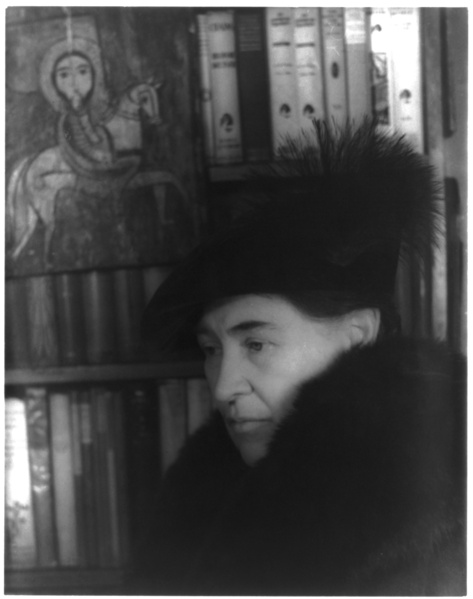
Willa Cather, 1936 (Photo: Carl Van Vechten; Public domain, via Wikipedia)

It’s nearly two years since I posted on a Library of America (LOA) short story, and it’s over a year since they published Willa Cather’s “The bookkeeper’s wife” as their Story of the Week. However, this morning I had a quiet moment and decided to check over my little LOA TBR list. Willa Cather’s seemed just the ticket because, as I have written before, I like her “robust, somewhat terse and yet not unsubtle style”. I have read three novels by Cather, and a few short stories, starting with, “Peter”, which was first published in 1892. “The bookkeeper’s wife” was published much later, in 1916, after her first three novels were published, but before My Ántonia (1918). (You can check out my Cather posts here.)

One of the notable things about her stories is their variety. Not all are about the tough life of the pioneer, or even about midwestern landscapes, albeit these were among her favourite preoccupations. She did write about urban environments, and this story is one of those.

“The bookkeeper’s wife”

LOA’s usual introductory notes explain that in 1917, Willa Cather was working on a new book, a short story collection called Office wives. These stories would be published in Century magazine, and would then be published in book form. The book never eventuated, and only four stories were written, of which three were published. The fourth manuscript has, apparently, been lost.

LOA suggests that the proposed title for the series, Office wives

seems to have been a subtle act of provocation; of the five working women featured in Cather’s three stories—stenographers, typists, clerical workers—only Stella Bixby, “the bookkeeper’s wife,” is married … Cather explores the ways in which working women and their male supervisors mirror, in a distorted fashion, the domestic arrangements between wives and husbands. 

The stories offer a different look at the “New Woman” type which was the vogue in popular magazine fiction of the early twentieth century. These women were financially independent employees in warehouses, shops, and offices, but Cather – as was her wont – had a more realistic take on the situation. She understood the prevailing power structures in such work environments, and her stories, says LOA, “depict how the freedom and independence available to women in the workplace” were “still limited by their dependence on and subservience to men”.

Cather knew whereof she spoke, having worked herself in the business world. LOA says that she had worked “as an editor, columnist, and occasional business manager at Home Monthly in Pittsburgh; as the telegraph desk reporter and headline writer for the Pittsburg Leader, a daily newspaper; and, most significantly, as a staff member from 1906 to 1912 at McClure’s magazine, where she became the managing editor”.

Interestingly, despite the planned book title, the protagonist of the first story she wrote for it, “The bookkeeper’s wife”, is the man, the bookkeeper. But, his wife, Stella, as the title implies, is the story’s linchpin. Superficially, the plot set-up suggests something predictable. It starts with our bookkeeper, Percy Bixby, sitting at his desk at work. He’s the last one there and he is about to embezzle (sorry, “accept a loan from”) his company in order to marry Stella, a stenographer working for another company, and offer her the lifestyle she expects. He has won her over a flashier man, salesman Charlie Greengay, whom Stella knew “would go further in the world” but who didn’t have Percy’s “warm, clear, gray eyes”. We think we know where this will go, but, pleasingly, it only partly plays to expectation.

The story is told third person, mainly through the eyes of Percy, but we do have moments in Stella’s head, and in that of Percy’s similar-aged boss, Oliver Remsen Junior. What makes the story so enjoyable to read, besides its plotting, is Cather’s tight, spare writing. Her words carry weight. Look at the names for a start, the stolid Percy Bixby, the exciting Charlie Greengay, the aspirational Stella Brown, and the classy Oliver Remsen Junior. Description is minimal, but there’s just enough to layer meaning, like Percy and Stella’s “clock, as big as a coffin and with nothing but its two weights dangling in its hollow framework”, and their “false fireplace”. Five years in, the marriage is clearly “hollow”, “false”. It’s worth noting, however, that they have had a baby die, but we only hear this via Oliver, so how it has impacted the marriage is left to us to think about.

Of course, Percy is found out – part-way through the story – because he ‘fesses up, in fact. There are no histrionics, no high drama. Each character behaves in accordance with their nature as established by Cather. Percy, who like so many young men got caught up in the competition for a pretty girl with high expectations, is fundamentally honest and sensible, albeit rather ordinary. Charlie’s “dash and color and assurance” sees him win, even when he loses. Oliver, a new-style humane boss, was prepared to help Percy, but has to be realistic in the end, while the titular Stella – she of the “hair [that] had to be lived up to” – ultimately sees the fundamental difference between her and Percy. Needing excitement and show, she decides to go for it, but we are told enough to know that it is still a man’s world and that, for all her independence, things may not turn out the way she so confidently expects.

“The bookkeeper’s wife”, from its title to its ending, is so beautifully nuanced that, even today, one hundred years later, we might see that things are, perhaps, not as different as we might have expected.

Willa Cather
“The bookkeeper’s wife”
First published: in Century, May 1916. 
Available: Online at the Library of America

Monday musings on Australian literature: Forgotten writers 6, Constance Clyde

“Forgotten” is a subjective thing, as I suggested with my fifth post in this series on Lillian Pyke whose reputation as a children’s writer has survived in niche circles at least. My next subject, Constance Clyde, like Lillian Pyke, has entries in both AustLit and Wikipedia suggesting some notability, but I had not heard of her before.

Like my last three Forgotten Writers, Clyde was the subject of one of my posts on the Australian Women Writers (AWW) blog this year. Once again, I am not including here the piece written by Clyde that I published there, but it’s a little different from the more romantic stories I’ve published. Titled, “The paying back”, it references a failed romance but its subject is the relationship between a mother and her unmarried daughter … check it out at AWW.

Constance Clyde

Constance Clyde (1872-1951), born Constance Jane McAdam, is another writer who wrote under a few names, but Constance Clyde seems to be the name by which she was best known, as well as the name she mostly wrote under. However, for the record, AustLit says that she also wrote under Clyde Wright, Pen, C.C. and C. Clyde. Christopher Dawson, writing in the Inside Boggo Road Gaol blog, describes her as the “author of a novel, contributor to high-class English reviews, sometime social editress of a Christchurch (N.Z.) newspaper, and in 1906 one of Emmeline Pankhurst’s Suffragettes”. He sums her up, in his 2023 article, as “a formidably independent woman”.

Clyde was born, the 11th child in her family, on 25 Jul 1872 in Glasgow, Scotland, and died in Brisbane, Queensland, on 30 Aug 1951. The “Clyde”, both Dawson and I suspect, comes from Glasgow’s Clyde River. She moved to Dunedin, New Zealand, with her family when she was 7, and was schooled there. According to Australian writer and journalist Zora Cross (writing as Bernice May), Constance Clyde’s first poem, called “Blighted Hopes,” was published in the Otago Witness when she was twelve, and she won second prize in a story competition for adults when she was still at school.

She arrived in Sydney in 1898, where she continued her career in literature and journalism, contributing to Australian and English newspapers, including the Sydney Bulletin. Cross says that Clyde was one of the first women to contribute to the Bulletin regularly, and that it was the Bulletin that gave her “the idea that one can and should write from the soul”. She also says that “Possessed of a rippling sense of humor, a pen as strong and vigorous as a man’s at times, it is because she does write with her soul that this writer has so many admirers.” Cross, adds later that Clyde

thoroughly mastered the tense, compressed drama the pink-covered weekly [The Bulletin] favored, and her work earned the admiration of the reader and the envy of the aspiring writer of the day.

Meanwhile, Dawson says New Zealand academic Kirstine Moffatt describes Clyde’s subject matter as encompassing “social, feminist and literary questions”. Wikipedia says that, in an essay entitled “The Literary Woman”, Clyde urged women to continue “to make brilliant discoveries in the realm of the emotions”.

In 1903, Clyde went to London to pursue a literary career, and her only novel, A pagan’s love, was published there in 1905. Anti-Puritan, it apparently explored ideas about women’s dependence, which included the heroine considering an extra-marital relationship with a man. Cross writes that while in London, Clyde met leading writers like HG Wells and Bernard Shaw.

In 1907, she was imprisoned in Holloway Prison as one of the suffragettes who ’caused a disturbance’ in the House of Commons. She wrote about this experience – which I found in Hobart’s The Mercury (June 24 1907) – from how she went about ensuring that she was arrested through to her release after thirteen days incarceration. It’s worth reading, not only for its firsthand experience but for its insight into who she was, but I’ll just share this little reference to Australia and Australian literature. She says one visitor was not allowed to give her a rose, but another was

permitted to leave a book. It is Tom Collins’s “Such is Life,” and she had previously reviewed it as a volume “suitable for reading in a desert, island, or gaol.” I find its acid philosophy, flavoured by eucalyptus, thoroughly refreshing!

Some time later, she returned to New Zealand, and in 1925 co-authored a travel book with journalist Alan Mulgan. In 1928, while living in Auckland, she was described by Sydney’s Smith’s Weekly as “one of the most brilliant and versatile of Australasian women journalists”. The article explains that:

In order to understand officialdom, Miss Clyde in recent years accepted appointments in New Zealand institutions, being on the staff of a backward school, sub-matron of a women’s gaol, and attendant at a mental asylum of 1500 inmates. She is strongly opposed to the new N.Z. Child Welfare Act, which she contends gives the official too much power over family life. Her great desire is to have proper Montessori teachers in New Zealand for such backward children as do come into the hands of the State.

In 1931, she was ejected from the New Zealand Parliament for protesting against the 1925 Child Welfare Act. She was a true activist, in other words.

Sometime after this, in the early 1930s, she returned to Australia, to Brisbane, where she was again imprisoned in 1935, this time for refusing to pay a fine for fortune-telling using tea-leaves. Dawson reports that, when in court for this offence, she said, “I thought that I could do some good in this depression by sympathy, kindness and advice, and especially by telling people that there is nothing wrong with this world except the monetary system.” As Dawson added, “even reading tea leaves could become a political platform” for Constance Clyde. Somehow, in between all this she wrote prolifically, with AustLit listing over 130 works by her, most of them short stories, the latest dated 1938.

Sadly, as Dawson chronicles, her life ended quietly, petering out “in the mundane concerns of suburbia after such an ambitious foray into the bohemian literary circles of turn-of-the-century Sydney and London”. There was no obituary. Forgotten already it seems!

Sources

  • Bernice May (aka Zora Cross), “Constance Clyde“, Constance Clyde”, The Australian woman’s mirror, 3 July 1928 (Accessed: 22 July 2024[
  • Christopher Dawson, Constance Clyde of Dutton Park: Author and Suffragette, 16 May 2023 [Accessed 22 June 2024]
  • Christopher Dawson, “A Suffragette Recalls Boggo Road Gaol“, Inside Boggo Road blog, 17 June 2018 [Accessed: 22 June 2024]
  • Constance Clyde, Wikipedia (citing several sources) [Accesed; 21 June 2024]
  • Constance McAdam, AustLit (sourced from A. G. Stephens, ed., Australian Autobiographies, vol.2) [Accessed 21 June 2024]

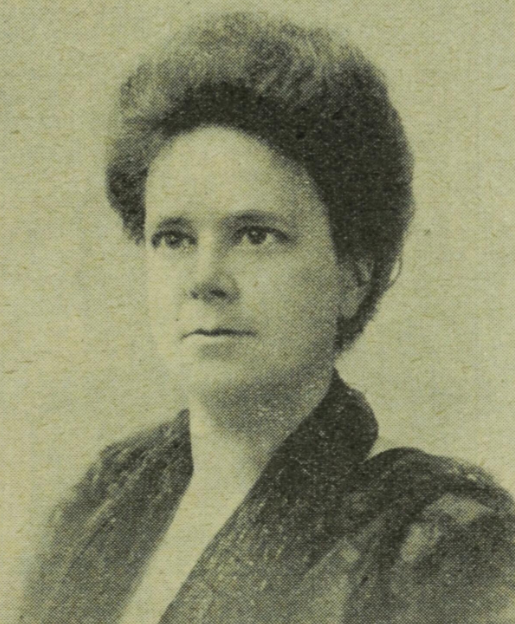
Image: Constance Clyde in her suffragette days, circa 1914, from Australian Women’s Mirror 1928. Public Domain from Wikipedia.

Monday musings on Australian literature: Forgotten writers 5, Lillian Pyke

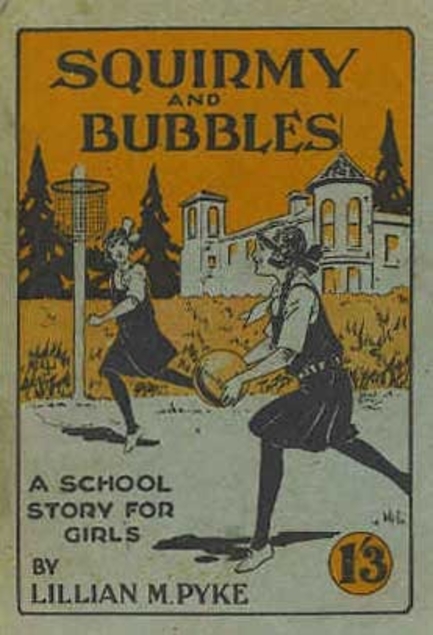
The subjects for my Monday Musings sub-series on forgotten Australian writers vary in the degree to which they’ve been forgotten, but those still remembered are only so in niche areas. Today’s subject Lillian Pyke is one of these, in that although no longer well-known, her reputation as a children’s writer has survived somewhat.

Pyke, like my two most recent Forgotten Writers, Marion Simons and Kate Helen Weston, was the subject of one of my posts on the Australian Women Writers (AWW) blog this year. As with these two, I am not including here the piece written by Pyke that I published at AWW. It is a sweet romance titled “Mary’s mother”, which means it’s not in the genre for which she is best known, but it offers an insight into the times while showing how, in some ways, times haven’t changed all that much … check it out at AWW.

Lillian Pyke

Lillian Pyke (1881-1927) was an Australian children’s writer, who also wrote adult novels under the pseudonym of Erica Maxwell. However, the adult short story I published at AWW was published under her real name, Lillian Pyke.

Pyke was born Lillian Maxwell Heath, the tenth child to her English-born parents, on 25 August 1881 at Port Fairy, in Victoria. She went to school in Melbourne, and then worked as a teacher and journalist there until she married Richard Dimond Pyke on 7 April 1906. According to her obituary in The Queenslander, Richard’s brother was W. T. Pyke, manager of Melbourne’s famous Cole’s Book Arcade. The couple moved to Gympie, Queensland, where he worked as an accountant for a railway construction company. (And where I lived for a brief time during my childhood.) They had three children, before he died by suicide in 1914. Pyke then returned to Melbourne where she took up writing again to support her family. In other words, like my previous subject in this series, Kate Helen Weston, she was widowed with young children and also seems to have managed to eke some sort of living from writing.

Pyke appears both in Wikipedia and the Australian dictionary of biography, and Trove searches also produced a few articles about her, so she clearly made some mark on her times. Kingston, in the ADB, says that between 1916 and 1927 she wrote sixteen books that were classified as children’s books, though today they’d probably be classified as Young Adult. She also wrote three novels for adults, as Erica Maxwell. One of these, A wife by proxy (1926), apparently contained Esperanto themes. It was translated into Esperanto, and published in 1930 as Anstataria Edzino. She also wrote A guide to Australian etiquette, edited short story collections, and adapted an Ethel Turner story.

Kingston writes that “most of her stories for both children and adults came out of her experience of Queensland railway construction camps or her involvement in education, and had an improving intention”. A Heath family tree webpage quotes the Oxford Companion to Australian Children’s Stories as saying of her school stories that her “educational ideas… are notably enlightened and ahead of her time”, and that her “novels about railway construction camps in Queensland are realistic insights into the life of construction workers and their families.” It’s worth noting, too, that in the list of her works on this page are three “Cole’s” books.

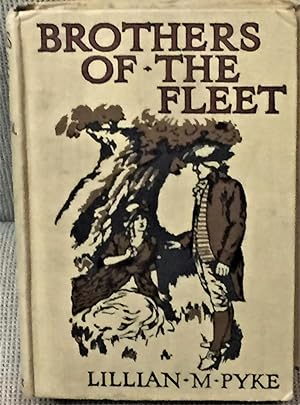
Contemporary reviewers and columnists were generally positive about her books. The Queenslander wrote (17 November 1923) that her “stories of public school life in Australia are becoming famous” and suggests that perhaps her “best work is in her descriptive novels with a railway construction camp for a back-ground; but there is no doubt her stories of school life in Australia are almost unrivalled”. The same paper, writing a year later (15 November 1924) says her latest novel Brothers of the fleet is set in “those far-off and almost forgotten days of Australia’s beginning” and is her first attempt at an historical novel. They hope that it’s “the beginning of another rich vein of her imagination”.

Pyke died of renal failure at Brighton, Victoria, on 31 August, 1927. Her obituary in Brisbane’s The Telegraph (8 September) provides a biography, and concludes that they understand that one of her latest books, Three bachelor girls, was being filmed. However, I can find no evidence that that eventuated. Launceston’s Examiner (22 October) offers a more effusive obituary, explaining that having been widowed young, she

gallantly took up the pen as a means of livelihood and it was not long before her name was bracketed with those of Ethel Turner and Mary Grant Bruce as the most popular authoress of minor fiction in this part of the world.

Big praise. The Examiner also makes an interesting political point. Having just commented on her having had to work to support her children, it suggests it’s “ironical”

that her death should have occurred just before the first Australian Authors’ Week, which may be the beginnings of better things for those who try to live by the pen out here. In a popularity plebiscite held in connection with this “week” Mrs. Pyke polled remarkably well.

It concludes:

Mrs. Pyke’s work has a rare charm, which is all the more to be appreciated when it is realised that most of her writing was done under great difficulties. She was young always in her outlook, and by no means old in years, and her death at a time when she still had years for development before her is a regrettable loss to Australian literature. She has left a name of which her children can be proud.

Sources

  • Beverley Kingston, ‘Pyke, Lillian Maxwell (1881–1927)‘, Australian Dictionary of Biography, National Centre of Biography, Australian National University, 2005, accessed online 22 April 2024.
  • Lillian Pyke, in Wikipedia, accessed 22 April 2024
  • Other sources are linked in the article

Eli Funaro, The dog pit (#Review)

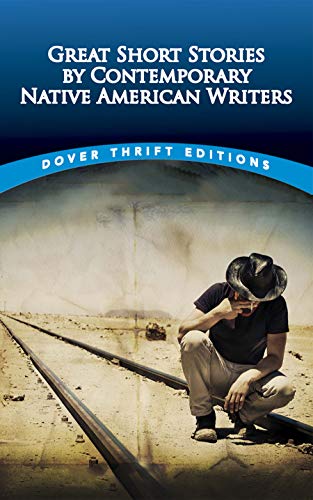
Eli Funaro’s “The dog pit” is the twelfth of fourteen stories in the anthology, Great short stories by contemporary Native American writers. Like the previous stories by Thomas King and Duane Niatum, it was written in the 1990s.

Eli Funaro

Anthology editor Bob Blaisdell provides very little information about Funaro, and I have to say that I have very little more to add. Blaisdell says that he “seems to hail from Minnesota, where he is a video director” and that his “plain-spoken and shocking story was written for a program at the Institute of American Indian Arts at Santa Fe”. That’s it.

All I’ve found is that someone called Eli Funaro – presumably the same one – is part of a media company called A Tribe Called Geek, which describes itself as

an award-winning media platform for Indigenous Geek Culture and Stem. But we are more than just a media platform. We are a community of intelligent, imaginative, innovative and creative Indigenerds acknowledging and advancing the visibility of our contributions to pop culture and STEM. From indigenous superheroes to Harry Potter and more, our podcasts, website and social media are a celebration of Indigenous Representation and Geekery.

When I tried to enter the “A Tribe Called Geek” website, I got one of those “Not Secure” warnings. While it’s probably OK to proceed, I’m not prepared to take the risk.

So, all I have is a list of 35 articles by Eli Funaro at a site called Muck Rack. Clicking on the articles takes me to that website with its “not secure” warning, and to find out more about Funaro at Muck Rack I have to join, which I’m not going to do. Funaro is not in Wikipedia, and nor is A Tribe Called Geek, but Muck Rack is. It’s a software program that “connects public relation offices and journalist listing on social media”.

What all this says to me is that Funaro seems to be more a journalist than a writer of fiction, and that his affiliation and ongoing interest is Indigenous. His articles – some of which are dated “three months ago” – seem to be mostly reviews, such as of the Wolverine movie, and of Marvel comics. The list provides a brief summary, or the opening sentence, and it’s clear that most reference “Indigenous” issues. For example, on Marvel’s Echo comics, Funaro writes that “of all the Indigenous Heroes appearing in the Marvel Universe, Echo stands out as one of the more unique comic book characters”.  Echo – or Maya Lopez – is a Cheyenne woman.

“The dog pit”

“The dog pit” is one of the shortest stories in the anthology. It is told first person in the voice of an eight-year old boy who lives on the “rez” – reservation – where, he tells us, “no garbage trucks … came to pick up your trash”, the implication being that other people had this service. So, Saturday is Garbage Day, and our narrator and his dad’s job is to haul their garbage to the dump.

The story opens with “It was a sunny Saturday, the day that dog died”. A few paragraphs in we are introduced to our boy’s dog Corky, for which his father seems to have little time. “You fed that mutt yesterday” he says, when the boy wants to feed his dog before they head off. But soon they are on their way, along “untitled roads”. Another indication of their second-class status.

The boy finds a pink ball in the glove-box and starts playing with it. However, when his father, having told him he can have it, also tells him he’d taken it from a dead man at the hospital where he works as a janitor, the boy is not so sure he wants it. His father, we are learning, is a practical man. Life is tough and he doesn’t have time for sentiment.

So they get to the dump, with its piles of burning trash and rancid smell, empty their bins, and go through their routine of bleaching their bins before they leave for home. While this is happening, the boy picks up the ball again, only to be told by his dad that the old man who had died holding the ball had probably not been the only person to have died holding it. This makes him anxious; he fears there will be many dead people angry with him if he keeps the ball.

Then we get to the death of the dog mentioned in the opening sentence. It involves the titular dog pit, and is cruel. The boy doesn’t know what to make of it, but doesn’t want his dog to end up there. HIs father, who might be practical, is not hard and says this wouldn’t have to happen. The story concludes with the boy creating his own stories about death with his new Zartan and Stormshadow toys, but also on a sense of a childish ability to put it aside. This is where I come a bit unstuck, because a point is being made in referencing these GI Joe-series figures, but there are cultural nuances that I am not fully across.

On the surface, “The dog pit” is a story about the innocence-versus-experience aspect of youth, on the gradual way we become aware of the darker side of life without taking it all in at once, but there are deeper socioeconomic and sociocultural issues being explored here, ones that Funaro seems to have continued to explore.

It’s not a perfect story. The language doesn’t always stay true to an eight-year-old’s voice, but this is probably the work of a young writer. It works overall, however, because it’s tightly told.

Eli Funaro
“The dog pit” (orig. pub. 1994)
in Bob Blaisdell (ed.), Great short stories by contemporary Native American writers
Garden City: Dover Publications, 2014
pp. 95-99
ISBN: 9780486490953

Thomas King and Natasha Donovan, Borders (#BookReview)

Earlier this year I posted on Thomas King’s short story “Borders” from Bob Blaisdell’s anthology, Great short stories by contemporary Native American writers. The story was written in 1991, but as I noted in my post, it has also been adapted into a teleplay for the CBC, and turned into a graphic novel for younger readers. I was intrigued, and because I loved the story, I bought the graphic novel, on the assumption that we will share it with our grandchildren in a few years.

To recap a little from my original post. Wikipedia describes King as an “American-born Canadian writer and broadcast presenter who most often writes about First Nations”. Born in California in 1943, he “self-identifies as being of Cherokee, Greek, and German descent”, and has written novels, children’s books, and short stories. I also shared from Wikipedia a quote they include from King’s book, The inconvenient Indian, because it’s relevant to Borders:

“The issue has always been land. It will always be land, until there isn’t a square foot of land left in North America that is controlled by Native people”.

In that post I summarised the story, and I’ll repeat that here too. The narrative comprises two alternating storylines, both of which are told first person through the eyes of a young boy. One storyline concerns his much older sister, Laetitia, leaving home at the age of 17 to live in Salt Lake City, Utah, while the other tells of a trip he makes with his mother some five or so years later to visit this sister.

The crux of the story lies in what happens at the US-Canada border. Asked to give her “citizenship”, the mother insists “Blackfoot” and is denied entry. She refuses to offer anything else. As a result, she and her son get caught in a no-man’s land when, attempting to return to Canada, the same response to the same question results in her being refused entry there too. As one of the border officials tries to explain to her, “it’s a legal technicality, that’s all”. Of course, that’s not all. Blackfoot people ranged across the great northwest of America in what is now known as America and Canada. For our narrator’s mother, that land is her “citizenship”, not that she is American or Canadian, and she will not back down.

So, to the graphic novel. The illustrator is Natasha Donovan, who is described at the back of the book as “a Métis illustrator, originally from Vancouver, Canada”. She has illustrated, among other books, “the award-winning graphic novel Surviving the city, as well as the award-winning Mothers of Xsan children’s book series.”

This graphic novel version of Borders is beautiful. It turns what is a perfectly suitable story for pre-adult readers into a book that should appeal to and engage these readers. It contains King’s full text as far as I can tell, enhanced (if I can use that word) with Donovan’s gorgeous drawings. Because it is designed for younger readers, the drawings are simple enough to appeal to younger readers, but they offer a subtle depth which make the story well worth reading in this form by older readers too. The original story is told in a spare style, which leaves the reader to imagine (work out) the ideas and emotions behind the words. In this graphic version, sometimes the illustrations replicate the words, but in many cases they value add. This is not to say that value-adding is necessary, as it’s a gem of a story, but that the drawings encourage the reader to stop, think, and consider what the words might be saying.

An example: of their second night stuck in border-limbo, our narrator says that “The second night in the car was not as much fun as the first, but my mother seemed in good spirits and, all in all, it was as much an adventure as an inconvenience”. The panel following this depicts chicken wire in the foreground with a flock of birds flying off in the background, conveying some of the tension between the constraint of borders and the idea of freedom. The next panel, also textless, shows mother and son companionably sitting on the boot of their car, eating their sandwiches. In the border-guard scenes, the narrator mentions their guns. Donovan picks this up, providing frequent close-ups of guns, gun belts and holsters when the guards are present, which suggests authority and, perhaps, menace without overplaying the idea of fear.

What I liked about this graphic version, too, is how much it encouraged me to “see” things from our young protagonist’s perspective. I saw it in the text, but it becomes more vivid and immediate in this version. We see him report what he is seeing, and his own thoughts; we see him inserting his boy-ish wishes and perspectives. There is a running theme, from the beginning, about food which marks his focus on the concrete, on his needs. He asks Mel, the duty-free shopkeeper, for a hamburger, which he doesn’t get, but the next day:

Mel came over and gave us a bag of peanut brittle and told us that justice was a damn hard thing to get, but that we shouldn’t give up.

I would have preferred lemon drops, but it was nice of Mel anyway.

In this way, King conveys the truth as experienced by our young boy, but the wider truth that is happening around him – the strength of the mother’s identity and her determination to preserve it. Occasionally, our young narrator perceives some of these truths too. He sees the pride – and yes, the not always positive stubbornness – displayed by his mother and sister, but concludes:

Pride is a good thing to have, you know. Laetitia had a lot of pride, and so did my mother. I figured that someday I’d have it too.

Hachette’s promo for the graphic novel version describes it as resonating “with themes of identity, justice, and belonging”. It is exactly that – and conveys so much that is both personal and political, making it a rich book for any age to think about and consider.

Thomas King (story) and Natasha Donovan (Illustrator)
Borders (text from the 1993 published version)
New York and Boston: Little, Brown and Company, 2021
[192pp.]
ISBN: 9780316593052

Monday musings on Australian literature: Untangling the tangles

Introducing last week’s Monday Musings, I mentioned that the article I was sharing in that post contained a clue to a curly identification I was working on for my upcoming Australian Women Writers blog post. I said that I might share that puzzle this week, and that is what I am doing.

I will get to that soon, but as I also explained last week, that very article that I shared came with its own identification puzzle. That article was signed W.M., and best I cold find was W.M. Kyle, M.A. (or, William Marquis Kyle). He was a loose fit, because while he was a contemporaneous Queenslander, and did write newspaper articles, his interests seemed more philosophy than literature. Fortunately, some of my regular commenters took up the challenge. (How great is this!)

Melanie (Grab the Lapels) posited William Montgomerie Fleming but, while his dates fit, he seems unlikely in terms of his location and focus. I’m glad, though, to add him to my knowledge bank. Meg, however, came up with Winifred Moore, whom she found in Women Journalists in Australian History in a discussion about “the confinement of women journalists to the women’s pages”. Meg wrote that this article said that “under the direction of Winifred Moore from the 1920s, the Brisbane Courier’s ‘Home Circle’ section included a political column of sorts, profiling public personalities in Australia and abroad, alongside the usual recipes and serialised novels.” (You can read more about Moore at the Australian Women’s Register.)

So, of course, I researched Winifred Moore a little more (pun unintended). She wrote the “Home Circle” pages under the pseudonym of “Verity”. But, I also found references to a paper she had given on women writers in 1927 (three years after the article I posted on last week) . So, thanks to Meg, I think there is a good chance that she may be our W.M. I plan to share more on her later. Meanwhile, the original puzzle …

The mysterious J.M. Stevens

I had chosen a story by J.M. Stevens to be my May post for the Australian Women Writer’s Challenge, but, as we find all too frequently, identifying our writers can prove tricky. So it was for J.M. Stevens.

A major source for Australian writers is the (fire-walled) AustLit database and I was delighted to find that J.M. Stevens did have an entry there. It gave me some of her background, including her parentage, and identified an apparently better-known sister as Maymie Ada Hamlyn-Harris, who was a writer and convenor of the Lyceum Club literary circle. It also said that Stevens married John Frederick Stevens around 1917 which means, of course, that her last name stayed the same.

Book cover for The mad painter

Austlit gives her dates as 1887 to 30 May 1944, and uses J.M. Stevens as their name heading for her. They add that she also wrote under other names: Joan Marguerite Stevens, Janie M. Stevens, Joan M. Stevens. The University of Melbourne’s Colonial Australian Popular Fiction digital archive agrees with Austlit’s dates, but uses Janie M. Stevens as their name heading. They list one book for her, The mad painter and other bush sketches, by J.M. Stevens.

All well and good. It seemed pretty straightforward, but I like to find more if I can and this is where things came a bit unstuck because on 31 May 1944, Brisbane’s The Telegraph reported on the death of Mrs Joan M. Stevens. It says:

Mrs Joan M. Stevens, whose death look place yesterday afternoon at her home, Bylaugh, Glenny Street, Toowong, had been an invalid for many years. She was the fifth daughter of the late Mr E. J. Stevens MLC and the late Mrs Stevens, and had lived practically the whole of her life in Brisbane and Southport. Mrs Stevens was gifted musically, showed considerable talent as a painter and like several members of her family possessed distinct literary gifts, two of her books having been accepted for publication in the south. The late Mrs Stevens, who was the wife of Mr John F. Stevens, is survived by her husband, one daughter, three sons, and one granddaughter. Mrs Stevens was the third sister in the same family to die within six months; Miss Alys Stevens died in November last in Melbourne, and her eldest sister, Miss J. M. Stevens, died in Brisbane a few weeks ago.

So, this seems like “our” J.M. Stevens – same death date, and married to Mr John F. Stevens. But, they also mention a sister, “Miss J.M. Stevens”. Oh oh! Who is this? Three months later, on 17 August, this same newspaper announced the posthumous publication of a novel This game of murder, and says it

was written by the late Joan M. Stevens (Mrs J. F. Stevens), whose death took place a short time ago. The late Mrs Stevens, who was the fifth daughter of the late Mr E. J. Stevens, MLC, a former managing director of the “Courier,” belonged to a literary family. Her sisters included the late Miss J. M. Stevens, the writer of short stories and nature studies, whose death occurred earlier in the year. Another sister is Mrs M. Hamlyn-Harris, who has published several books of verse.

Now, AustLit had said that J.M. Stevens (remember, aka Joan M. Stevens and Janie M. Stevens) was a freelance journalist, with articles and short stories appearing in the leading magazines and weeklies in Australia and New Zealand in the earlier part of her life. In her later years, it says, she wrote a long series of nature studies for the Sunday Mail.

I was starting to feel confused. We have a Mrs. J.M. Stevens and a Miss J.M. Stevens. We have a Joan M. Stevens and a Janie M. Stevens. And it seems that despite AustLit’s entry, they are not the same person, but sisters who both wrote. We know that Joan wrote This game of murder, but who wrote The mad painter and other bush sketches? The cover says J.M. Stevens. It sounds like a nature-related work – the sort of writing that Miss J.M. Stevens did. Certainly Brisbane’s The Week writing about this book on 7 January 1927 describes its author as “Miss Stevens … nature lover and also something [of] a humorist”.

Then I found it! The Brisbane Courier, in an article on Queensland writers on 15 October 1927 identifies Janie Stevens as The mad painter’s author. So, clearly we have two sisters here with the initials J.M. One (Miss Janie) wrote The mad painter, and the other (Mrs Joan) wrote This game of murder. The life dates (at least, the death date) given by AustLit for J.M. Stevens and the Colonial Australian Popular Fiction archive for Janie Stevens, are for Joan. I have shared all this with the AustLit researchers who are always happy to receive feedback. Their challenge now, besides confirming my deduction, will be to identify who wrote which of the newspaper articles ascribed to J.M. Stevens!

I really should be doing more reading …

Monday musings on Australian literature: Queensland’s women writers, 1920s

Yesterday, as I was trying to untangle a curly identification for my next Australian Women Writers blog post, I came across an interesting article in The Brisbane Courier. Published on 15 October 1927, and penned by one W.M., the 1300-word article is titled “Queensland Women Writers: Poets and Novelists“. Of course, it caught my attention, and not only because buried within was an important clue for my puzzle (about which I might write next Monday).

Although I’ve written several Trove-inspired posts about Australian literature in the 1920s and 30s, this one caught my attention for two reasons – it is focused on just one state (Queensland) and is limited to women writers. I don’t know whether W.M. wrote separately about Queensland’s men writers, because it’s hard to search on by-lines like “W.M.” I did try to identify him. He may be William Marquis Kyle, whom I came across via an announcement for a lecture to be given by “Mr. W.M. Kyle, M.A.” He was appointed Professor of Philosophy at the University of Queensland in 1938. The best record I found for him included that “he gave public lectures, wrote and reviewed newspaper articles and was well known as a broadcaster”.  So, on this slim basis, I am going to refer to “W.M.” as he/him.

Queensland women writers

W.M. commences by talking about poetry, arguing that

When we contemplate the work of Australian writers, we can hardly fail to be impressed with the large proportion who have chosen poetry rather than prose as their medium. May it not be that a young nation, like a young writer, turns to poetry as more fitting than prose to express wonder and joy in a country which inspires emotions and sensations most appropriately uttered in lyrical form?

He goes on to say that whether his reasoning is true or not, “there is a larger amount of creditable verse than prose in the imaginative literature of Australia” and this is “apparent in any survey of the women writers of Queensland and their work”. But, he says, two novelists do occupy the first and last positions in his chronological list of Queensland women writers: Mrs Campbell Praed and Mrs Dorothy Cottrell. Both have appeared on my blog before.

W.M.’s article starts with brief paragraphs on the older writers. They are (links go to their Wikipedia pages):

For these six writers, W.M. identifies a work or two, and adds some assessment or description. I’m not sure why he allows Sumner Locke her own name, given she married Henry Logan Elliott. Perhaps it’s that most if not all her works were published before she married, and she died the following year. Anyhow, he praises her, saying “her style was forcible and direct, as shown in her novels”.

He has positive words for all these writers. Of Rosa Praed, he says:

Her style was simple and illustrative, and she had the faculty of making her characters “live.” Her descriptions of the social life of early Brisbane, centring in Government House, show that in many respects the social life of the present time still resembles that of 30 years ago.

Mary Hannay Foott’s “poetic style was simple, but distinguished by considerable lyrical power”, and he praises her versatility. Mabel Forrest’s early promise, evident in a story published when she was 10, “has been fulfilled by an exceptionally large output of poetry, short stories, descriptive articles, and novels”. And, while her novels “contain many descriptive passages of outstanding charm and sincerity, upon her verse rests her claim to rank among the foremost writers of Australia to-day.” Her novel The wild moth was adapted to screen by Charles Chauvel in The moth of Moonbi.

Emily Coungeau had, he says, “a mind attuned to the beauty of Nature and the best in human hearts” which enabled her “to produce verse of much charm and sensibility”. Emily Bulcock’s poetry, on the other hand, was characterised by a “strong spiritual note”.

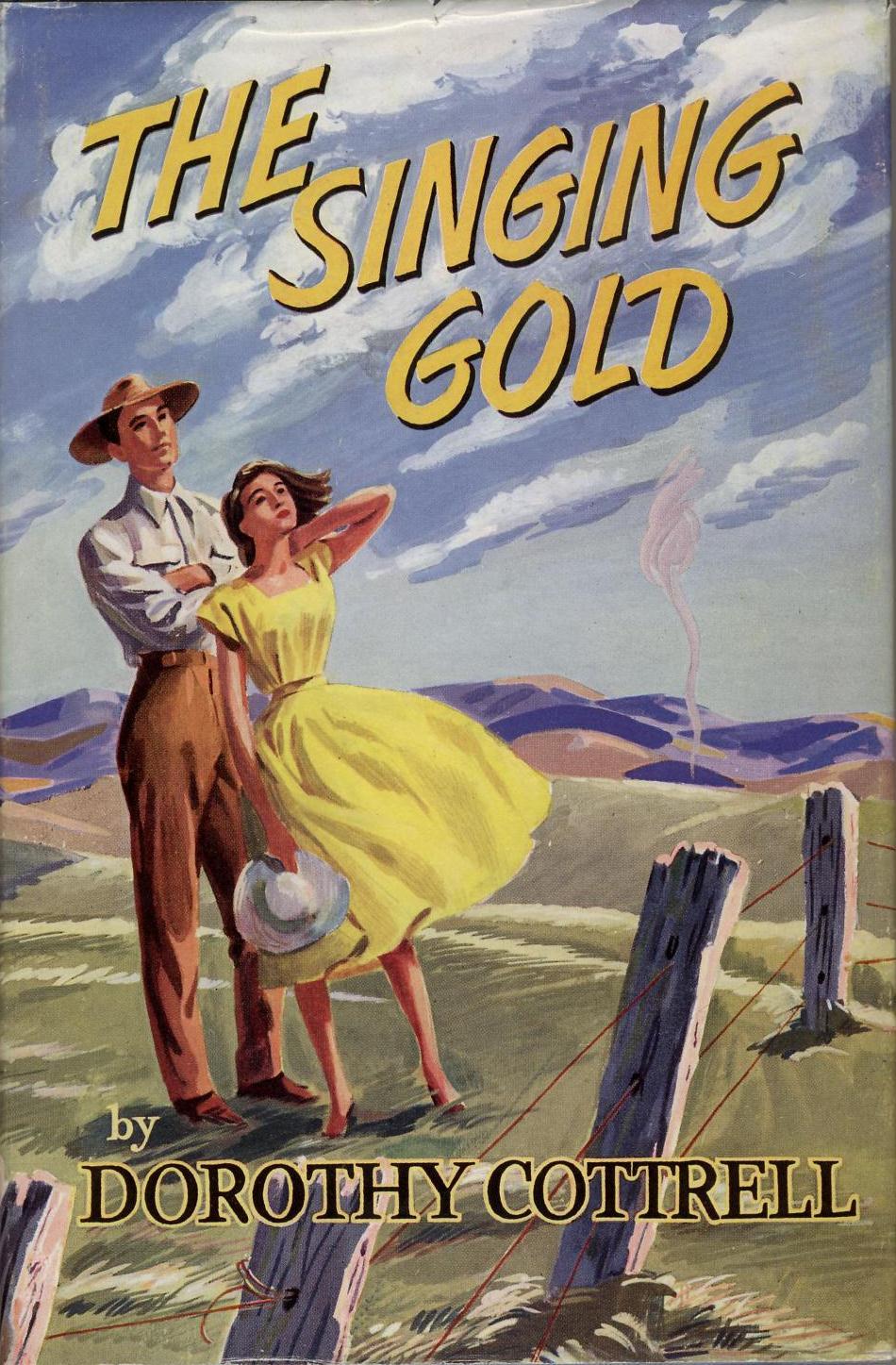
The rest of the writers, listed under the heading “Other writers”, are given one sentence or less, with the exception of the first in the list, Zora Cross. Her reputation has lasted more than most of the above. The reason for the short shrift given to her seems to be that she made her home in Sydney, so, not really a Queensland writer it seems! Few of the others are remembered today, except perhaps for the last on his list, the aforementioned Mrs Dorothy Cottrell. She, he writes, “is hailed by American publishers as a writer of exceptional power”. Her novel The singing gold was first serialised in The ladies home journal. The cover here is the 1956 edition (obvious from the fashion!) which suggests she remained popular for some time. A later story of hers became Ken Hall’s 1936 film, Orphan of the wilderness.

However, I will comment on one other. Wikipedia and the ADB have an entry for Nelle Tritton (1899-1946) whom Wikipedia writes as Lydia “Nellé” Tritton, and ADB as Lydia Ellen (Nell) Tritton. She had an interesting life. She was born in Brisbane in 1899, but in her mid-20s, she went to London and toured Europe, gained “a reputation for knowledge of international affairs”, and married a former officer of Russia’s White Army. The marriage ended in 1936, and in 1939, she married the exiled Russian prime minister Alexander Kerensky in Pennsylvania. ADB writes of their time in America that “their life, when they were together, was idyllic, with numerous visitors and games of croquet”. W.M. tells us none of this – much of which happened after 1927 – but it’s interesting that he’s included her, given she was barely in Australia. All he says of her is that “while still in her teens” she wrote a booklet of “Poems”. Curious – but fascinating. 

W.M. concludes that, from his brief survey, “it is evident that the work of Queensland writers has reached a standard which justifies and claims adequate attention from the reading public”, and he quotes literary critic Bertram Stevens, who had died in 1922 but had apparently said:

Australia has now come of age, and is becoming conscious of its strength and its possibilities. Its writers to-day are, as a rule, self-reliant and hopeful. They have faith in their own country; they write of it as they see it, and of their work and their joys and fears in simple direct language.

Monday musings on Australian literature: Forgotten writers 4, Kate Helen Weston

In 2021, I started my Monday Musings sub-series on forgotten Australian writers, with posts on Helen Simpson and Eliza Hamilton Dunlop. This year I added Marion Simons, who was my first post on the Australian Women Writers (AWW) blog this year. As I explained then, Elizabeth Lhuede and I have decided to focus this year on sharing public domain works published in 1924 – or written by writers who died in 1924. So today, I am introducing another writer I’ve posted on there, Kate Helen Weston.

As with Marion Simons, I am not including here the piece written by Simons that I published at AWW. It is an entertaining piece titled “The ubiquitous apostrophe”. If love discussions of grammar and punctuation, do check it out at AWW.

Kate Helen Weston

Kate Helen Weston (1863-1929) was born Kate Helen Carter in Ballarat, Victoria, to British parents who came to Australia for the gold rush, but she died in Adelaide. Indeed, one “L.B.” described her in The Australian Woman’s Mirror (of 24 February 1925) as “one of the best-known of Adelaide’s feminine inky-wayfarers”. She has an entry in AustLit, and in Debra Adelaide’s Australian women writers: a bibliographic guide, but not in the Australian dictionary of biography or Wikipedia. Adelaide’s News (10 December 1924) provided a brief biography of her in their “Pen Portraits of People” series, after she was elected president of the Liberal Women’s Educational Association.

These sources aren’t quite in tune with each other. AustLit says that she married John Samuel Weston “in Adelaide in 1885, and moved there in 1892”. Adelaide’s News says she married “Mr. J.T. Weston … and later came to Adelaide”. AustLit says that she was widowed in 1894, and “turned to writing to provide financially for herself and her children. She contributed to many Australian newspapers, and published fiction between 1911 and 1928”. They also say that “she was Lady Superintendent of the Elder Conservatorium in Adelaide between 1900 and 1914”. The News, on the other hand, says that “after her husband’s death she accepted the position of secretary to the Elder Conservatorium, which she held for 22 years”. So, some minor differences in detail here – in the name of her husband and in her Elder Conservatorium role. These would be good to clarify, but for now I’m noting them and moving on.

The News tells us that she “developed literary and artistic tastes” and had published three novels in London. In fact, she published four novels, one a few years after the News’s article. Her novels were The partners (1911), The man MacDonald (1913), The prelude (1914) and The vagabond soul (1928). The man MacDonald, says News, “had a wide vogue”. Melbourne’s Table Talk (26 July 1928), announcing the publication of The vagabond soul, said that “the story, which contains a dramatic situation of some originality, is entirely Australian in setting, and it is written with the same facile spontaneity which characterises Mrs Weston’s other novels”. But, her novels have not lasted.

Both AustLit and the News mention her other literary and journalistic work, but AustLit is more specific, telling us that she contributed to many Australian newspapers. They say she was “music and art critic for The Register, contributed to The Woman’s Record – a monthly publication – and, according to her obituary in The Advertiser, she was the ‘founder of community singing in Adelaide’.” She received a Commonwealth Literary Fund Fellowship in 1915, and was also actively involved in the National Council of Women.

Weston was clearly well-known in Adelaide’s literary circles. The News (9 September 1924) reports on an address she gave at the monthly meeting of the Liberal Women’s Educational Association. (Th Association aimed to educate women in political and social matters, but, said The Register on 2 March 1926, it could also become active in social reform, “when necessary”.)

Anyhow, the focus of Weston’s talk was Australian Women Writers. The News starts with:

It was not until one began to reckon up the women writers of Australia, said Mrs. Weston, that it was realised how many there were and what a contribution they had made to the literature of Australia in poetry, prose, and journalistic work, though it was only of late years that woman had met man on equal ground in the field of journalism. 

Turning then to poetry, she said that Australian men were credited with being better poets than Australian women, but she believed that the work of women poets was “possibly much more original in style as it bore the impress of no old world stylist, and invariably expressed the writer’s personal outlook on life”. Mary Gilmore, for example, “spoke always with a woman’s voice and wrote, not of things but of humanity and the home”. She named, and apparently read from many, contemporary Australian poets.

She then talked about fiction, arguing that it’s through fiction that the life of an age is chronicled. She named many novelists including those we still recognise today, like Mary Gaunt, Ada Cambridge, Mrs Campbell (Rosa) Praed, and Ethel Turner. She also mentioned – and I think this is an astute and significant recognition – the “many letter writers, whose small contributions fitted into the interstices of the wall of literature which was being built”. 

She concluded by arguing that the Commonwealth Government needed to more actively encourage Australian literature. She pointed to the lack of Australian publishing houses and the small market. She said, writes the News, that “writers of fiction could not afford to remain in their own country, but were forced to go to the fogs of London or the bustle of America, where they lost their nationality and their English”. And she urged would-be writers “to read all styles, and copy none” – and to practise constantly. 

The News and AustLit both describe her other, considerable, community involvements and achievements. These included having a tilt at politics. The News writes that she stood for a ward in municipal elections in 1923, and “polled the highest percentage of votes ever gained by a woman in the elections in this State”. Her death, after falling from a tram from which she never regained consciousness, seems tragic.

So far I have written on four women writers for this year’s AWW project. Two, Marion Simons and Alice Tomholt, never married, and two, Kate Helen Weston and Lillian Pyke, were widowed with young children. All, it seems, managed to eke some sort of living from writing. 

Monday musings on Australian literature: 1937 in fiction (2) – and Trove

Karen’s (Kaggsy’s Bookish Rambling) and Simon’s (Stuck in a Book) “Year Club” officially finished yesterday, but I focused so much in last week’s post on the issue of the state of Australian criticism, that I didn’t get to share some other ideas I found. So, I’ve decided to bookend the week with Monday Musings posts!

Trove

First, though, I’d like to explain a little about how I use Trove. For those who don’t know what Trove is, it is an online library database managed by the National Library of Australia. It is a fantastic resource for researchers because it contains an extensive – in depth and breadth – range of digital resources, including newspapers, journals and gazettes; official and personal archives and manuscripts; images; archived websites; and more. I mostly use the digitised newspaper collection, so I’m going to focus on it.

The process for putting non-born-digital newspapers online involves scanning the papers (from print or microfiche form) and then using OCR (optical character recognition) to produce readable text. On Trove, we see both the original and the OCR-ed texts. The quality or accuracy of the OCR text varies greatly, depending on the quality of the original from which the scanning was done. Trove’s solution to this has been to use crowdsourced (aka volunteer) text-correction.

Of course, as a librarian, I can’t use a service like this without doing my bit, so whenever I search Trove I end up doing corrections. This can be a tedious business when the original was poor, and can take a large amount of time. But, I don’t want to link in my blog an article that my readers will find hard to read, so, to do the time! The result is that I may not always research Trove as much as I would like in order to write my posts, but I hope that I research enough to make what I say valid or worthwhile!

I do sometimes cut corners. Where the item I am interested in is, say, part of a multi-subject column, I will, occasionally, only correct the section of interest to me. That’s a pragmatic decision I just need to make sometimes. (Just telling you in case you click on one of these links and wonder what I have been doing!!)

Back to 1937

On developing Australian literature

In my last post I focused on discussion about the importance of a good critical culture to the development of an Australian literature, but other thoughts about the state of Australian literature were also shared during the year. For example, in February, commenting on a gathering – attended by “many prominent men” – to commemorate Henry Lawson, the Williamstown Advertiser observed that Lawson’s “Australianism” is a heritage to be treasured, and that Australians need to

encourage home writers whose individuality cuts through the meshes of old-world hyperorthodoxy in literature, which conveys an assumption that the “blawsted colonials” are mere vulgarians.

Two months later on 10 April, Melbourne’s The Herald ran an article discussing the development of Australian literature, comparing it with the the challenges faced by American literature. It looked at the two nations, and commented on the problems faced by Australian writers. It suggested that America had now developed its own style. From the realism of Dreiser and Anderson, “the American literary spirit has taken lucid shape in the works of Ernest Hemingway and John Dos Passos”. It says that this new spirit represents “a revolt against nineteenth century English romanticism” and that the new style encompasses “typical Americanisms, the characteristic speech, the special vocabulary, the distinctive syntax and, above all, the natural mode of expression”.

Is Australia ready for “the emergence of a style in which an Australian outlook is implicit, and which would incorporate the characteristic speech, syntax and vocabulary of Australia?” Creating this, it argues, “is a labor of love; there is no material reward in it, at present”. Unfortunately, Australia, it says, has not recognised its similarity to America, and “is still awed by the heaped-up riches of the English literary tradition”. This does not, it concludes, prevent our making an “intelligent assessment of the lines upon which distinctively Australian writing should, develop”.

A week later, 17 April, there was a lengthy riposte in The Herald. You can read it at the link provided, because it covers several issues, but it starts by arguing that the most important issue is

that people read books not because they are written by Englishmen, or Americans, or Australians, but because they are entertaining.

So there, you writers! Write what the readers want! “Patriotism,” it says, “does not enter into the plain man’s choice of books”. It accepts that there’s a critical minority of readers who are interested in the technical experiments needed to improve literary standards, but

A critical minority … does not make a best-seller. For that the writer must look to the reading public as a whole, to the suburban libraries, to the man who has never heard of James Joyce or Aldous Huxley— except when one of his books is banned.

The article then argues that Australian artists have developed an Australian style, and suggests how Australian writers might proceed. It concludes that “it would be absurd to believe that the public is hostile or the Australian scene barren” (which I don’t believe the previous article argued.)

Education

Education is critical to encouraging interest in local literatures. At least, it is, I’d argue, for those whose culture has been – or risks being – swamped by larger cultures. The issue of education popped up a few times in 1937.

A pointed reference came from Brisbane’s The Catholic Advocate of 14 October. Written, I believe, by “Pasquin”, it opens with:

Is there a Chair of Australian Literature in any one of our six Universities?

It notes that “the University of Queensland tacks on to the course of English literature half-a-dozen lectures or so on Australian letters”, but then says

Surely it is a disgrace to Australia that in none of our seats of learning is our literature considered worth anything more than a digression or an aside.

It then goes on to ask how many Professors of English Literature are Australian? Go Pasquin, eh? “It is no wonder we have an inferiority complex”. Pasquin then pushes on:

How many are English ex-patriates like Professor Cowling of Melbourne, who in a recent article in the Sydney Morning Herald declared that he was at a loss to name a single Australian novel suitable for the classroom.

Hmm … Many journalists in 1937 could name “good” Australian writers, like, Henry Handel Richardson and Katharine Susannah Prichard! Pasquin concludes by saying that “Even J. T. Lang has been moved to describe the Senate of the Sydney University as “the most un-Australian body in Australia.”

Meanwhile, grass roots action was occurring. The Sydney Morning Herald reported (14 October) that the Workers’ Educational Association (WEA) had organised “a tutorial class in Australian Literature” for the summer. It was to be run by Fisher University librarian and critic H. M. Green, and Hartley Grattan, an American literary critic, with expertise in Australian literature.

On 9 November, Sydney’s The Workers Weekly reported that a Central Cultural Council had been established as the result of a conference convened by Sydney’s Writers’ Association. Indeed, it appears this conference had not only inspired the abovementioned WEA course but the Teachers’ Federation deciding to give more attention to the teaching of Australian literature in schools!

Keeping to the subject of schools, my last 1937 article comes from Queensland’s The Northern Miner on 18 December. It reported on a speaker at a Sydney luncheon. Dr. G. Mackaness, described by the ADB as “educationist, author and bibliophile”, made an “appeal for a better appreciation of Australian literature”. He saw the education system as one of the problems, and said “it was appalling that over a period of five years only one Australian writer was included in the books which had been chosen for Leaving or Intermediate Certificate examinations”. This report concluded that:

The fault of lack of appreciation of Australian literature was equally divided among those who had the selection of certain literature for studies, the non-progressiveness of Australian publishers to help the Australian writer, and the uneducated mind of the average Australian to the culture obtainable from Australian authorship.

We have come a long way since then, but there’s always more to do…

Previous Monday Musings for the “years”: 1929, 1936, 1954, 1940, 1962 and 1937.

Marjorie Barnard, The lottery (#Review, #1937 Club)

This will probably be my only review for the 1937 Year Club but I am thrilled to do it, because it is by Marjorie Barnard, an author whom I have mentioned many times, but have not yet managed to review here. My post is on a short story from her collection, The persimmon tree and other stories, which is one of the very few short story collections I’ve read more than once. It is so good. And don’t just take it from me. Carmel Bird mentions it in her bibliomemoir, Telltale, calling it “extraordinarily powerful”.

I wasn’t sure, in fact, what I was going to read for this week. I certainly hadn’t considered this collection because it was first published in 1943 but, rummaging around Trove, I discovered a story by Marjorie Barnard in The Bulletin of 6 January 1937. The page was titled “Of a lottery winner: First Prize” but I recognised it immediately, and let out an internal whoop. Here was my chance.

“The lottery”, as it is titled in the collection, has been anthologised, including in The Penguin best Australian short stories (1991), though the titular story, “The persimmon tree” is, I believe, the most commonly anthologised from the collection.

Who was Marjorie Barnard?

Marjorie Barnard (1897-1987) was an Australian novelist and short story writer, critic, historian and librarian. She wrote five collaborative novels with Flora Eldershaw, under the pseudonym, M. Barnard Eldershaw. Their first novel, A house is built, was published in 1929, having jointly won, with Katharine Susannah Prichard’s Coonardoo, The Bulletin prize in 1928. Their last, the futuristic Tomorrow and tomorrow and tomorrow was censored, and published in an expurgated edition as Tomorrow and tomorrow in 1947. Barnard also wrote works of literary criticism, and is credited with writing the first assessment of Patrick White (in Meanjin in 1956) and the first biography of Miles Franklin. (Jill Roe writes of the biography in the ADB, saying that “written with misgivings and before the release of Franklin’s voluminous papers, it exhibited characteristic virtues, with insight and style making up for ambivalence and inevitable error.”)

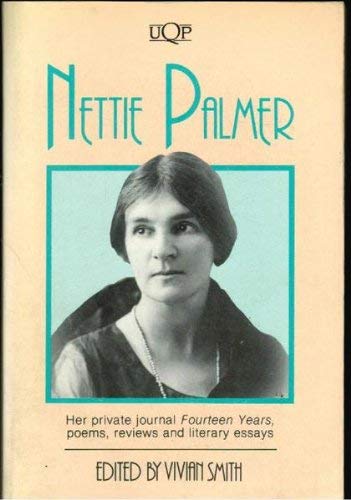
Barnard, along with Eldershaw, and other Sydney-based writers, like Frank Dalby Davison, was deeply concerned about the social and economic upheavals of the 1930s. These three, known as “the triumvirate”, held literary soirees which were attended by like-minded writers including Xavier Herbert and Miles Franklin. They were active in promoting writer’s rights (through the Fellowship of Australian Writers), and opposed censorship. She was a pacifist, and was apparently named in those political witch hunts of the 1950s, making her cautious about what she admitted to in terms of political affiliations. She was one of many writers who corresponded with, and often asked advice of, Nettie Palmer. She was a significant force.

In 1983, she was awarded the Patrick White Award, as was also her admirer Carmel Bird, years later. Hers was a long, and active life – far too long for me to cover here – and unfortunately, I don’t think anyone has done a biography of her. She is more than a worthy subject.

“The lottery”

What is so “extraordinarily powerful” about The persimmon tree and other stories is the quietly controlled but clear-eyed way Barnard interrogates human experience, in general, and women’s experience, in particular. Many of the stories have a strong feminist undercurrent, and “The lottery” is one of these. What makes it remarkable is that it is told third person through the perspective of the husband, which sets us up to align with him – perhaps.

The story is set in suburban Sydney. It starts with the husband, Ted Bilborough, having just boarded the ferry on his way home from work. His co-passengers tell him – show him in the paper, in fact – that his wife had won the lottery, “Mrs. Grace Bilborough, 52 Cuthbert-street.’… First prize, £5OOO, Last Hope Syndicate.” The thing is, Ted didn’t know. We then follow him on his way home as he goes through various emotions – and as he does so, we glean a picture of who he is and the sort of life his wife has led. A disconnect builds between how he – the perfect unreliable narrator – sees that life and the way we do.

At first, we are told that “everyone likes Ted”. He’s decent, it seems, in that typical-for-the-time suburban-husband way, and because of this “he’d always expected in a trusting sort of way to be rewarded, but not through Grace”. It’s little qualifications like this – “but not through Grace” – that give the game away.

Alongside Ted’s thoughts are descriptions of the evening. They too contain nuances that suggest deeper truths are at play. “The sun was sinking into a bank of grey cloud, soft and formless as mist” and two pine-trees have a “soft arrested grace”, a bit like his Grace, we readers might think. A little further on, “Ted could see that the smooth water was really a pale, tawny gold with patches, roughened by the turning tide, of pale frosty blue”.

He wonders how she’d paid for the ticket, “He hadn’t noticed any difference in the housekeeping, and he prided himself he noticed everything”. He starts to rethink Grace, who’d been “a good wife”, while he’d been “a good husband”. Indeed, “theirs was a model home” but, “well, somehow he found it easier to be cheerful in other people’s homes than in his own”. Whose fault is this? Well, Grace’s of course!

She wasn’t cheery and easy-going. Something moody about her now. Moody. He’d worn better than Grace; anyone could see that, and yet it was he who had had the hard time. All she had to do was to stay at home and look after the house and the children. Nothing much in that. She always seemed to be working, but he couldn’t see what there was to do that could take her so long. 

And so it continues, Ted ruminating on the situation, on their marriage, and on how things might proceed – even starting to feel a bit magnanimous with this money that’s not his own – until he arrives home, and discovers exactly what Grace intends. It’s all in the name of the Syndicate!

The writing is delicious. Spare, and accessible, it nails women’s lives and the constrictions so many live under. There is little agency for many of her women, and Barnard draws this with such simple but knowing realism it takes your breathe away. I love many of the stories in the book – and this is as good as any of them.

* Read for the 1962 reading week run by Karen (Kaggsy’s Bookish Rambling) and Simon (Stuck in a Book) who, I discovered, has reviewed the collection.

Marjorie Barnard
“The lottery” (orig. pub. in The Bulletin, 6 January 1937)
in Marjorie Barnard, The persimmon tree and other stories
London: Virago Press, 1985 (first published by Clarendon in 1943)
pp. 97-105

Full text of The persimmon tree and other stories is available online at the Internet Archive