Jane Austen, Sanditon (Unfinished) (#Review)

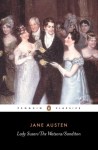
Jane Austen, Lady Susan, The Watsons, Sanditon

I first read Jane Austen’s unfinished novel, Sanditon, in the early 1970s, when I was deep into my love of Austen and had to read everything she wrote. This meant reading her two unfinished novels (the other being The Watsons which I’ve written about here twice before) and her Juvenilia, parts of which I’ve also discussed here. A little later I read the Sanditon completion “by Jane Austen and Another Lady” that was published in 1975. Since then I’ve read Sanditon again, but before I started this blog.

Austen started Sanditon in January 1817, and wrote 12 chapters before leaving it in mid-March, presumably because of her ill-health. She died in July of that year. Like The Watsons, it tantalises Austen fans – even moreso in a way, because we have no information about how she planned to finish it. Here’s what we have …

The novel is set in Sanditon, which Mr Parker and his partner, Lady Denman, are developing into a seaside resort. Due to a carriage accident at the novel’s opening, Mr and Mrs Parker stay at the home of the Heywoods in the country some distance from Sanditon. When they return to Sanditon two weeks later, they bring the Heywoods’ eldest unmarried daughter, the 22-year-old Charlotte, with them. Much of the rest of the novel is seen through her eyes as she meets the various residents of, and visitors to, Sanditon. Like all of Austen’s novels, it is set in a small place and focuses on a few families. But, was it moving in new directions?

The book’s subject is the new fascination with health, and the associated belief in the value of sea-bathing. Some of the fragment’s best comedy comes from descriptions of Mr Parker’s two sisters and brother, Susan, Diana and Arthur, and their various ailments, most, if not all, of which seem imaginary. Indeed, sensible Charlotte suspects “a good deal of fancy” in their “extraordinary state of health.” In her opinion, the number of their “disorders and recoveries” that are “so very much out of the common way, seemed more like the amusement of eager minds in want of employment than of actual afflictions and relief”. She suspects most of their sufferings were

from fancy, the love of distinction and the love of the wonderful. – They had charitable hearts and many amiable feelings – but a spirit of restless activity.

They are kind, and well-intentioned, but she feels

there was vanity in all they did, as well as in all they endured.

Seekers of information about early 19th century health attitudes and practices can learn something from these few chapters.

But there’s more to Sanditon than this health and hypochondria theme, and it relates to money. Of course, money features in Austen’s previous books, but mostly in association with marriage prospects, as it does also in Sanditon. But there’s something new in this novel, something broader about how money operates – about the making of money, and  consumerism. Mr Parker’s sisters are actively involved in finding people to go to Sanditon to take advantage of its health benefits. Mr Parker is thrilled to see cottages in the village “smartened up with a white curtain and ‘Lodgings to let’” signs, but Lady Denman is concerned that lodgings are “underlet”. She is therefore pleased to hear about the possibility of more people coming, through the exertions of Mr Parker’s siblings: “That sounds well”, she says. “That will bring money”. These people include West Indians, who are known to have “full purses” and to “spend more freely.” Lady Denman knows, however, that ensuring stable economics is not simple:

But then, they who scatter their money so freely, never think of whether they may not be doing mischief of raising the price of things – and I have heard that’s very much the case with your West-injines – and if they come among us to raise the price of our necessaries of life, we shall not much thank them Mr Parker.’

Before this, just after Mr Parker had enthused about Sanditon, Mr Heywood had said:

‘Yes – I have heard of Sanditon,’ replied Mr Heywood. – ‘Every five years, one hears of some new place or other starting up by the sea, and growing the fashion. – How they can half of them be filled, is the wonder! Where people can be found with money or time to go to them! – Bad things for a country; – sure to raise the price of provisions and make the poor good for nothing – …’

All this suggests Austen was aware of the changes coming to post-war England. What a shame, she didn’t get to show us what she was thinking.

I’m not going to explore this idea further, nor the tantalising appearance in Chapter 12 of “half-mulatto” Miss Lambe, but move on to a couple of delicious “bits”. One that intrigued me this read is a passing reference to something that’s often discussed, now, regarding the degree to which we separate art from the artist where the artist’s values or behaviour contradict our own. In Sanditon, the man we expect to be the villain, Sir Edward, praises poet Robert Burns. However, our sensible commentator Charlotte is more measured:

‘I have read several of Burns’ poems with great delight,’ said Charlotte as soon as she had time to speak, ‘but I am not poetic enough to separate a man’s poetry entirely from his character; – and poor Burns’s known Irregularities, greatly interrupt my enjoyment of his Lines.

If Charlotte is Austen’s mouthpiece and our guide to life in Sanditon, as she seems to be, this could also be Austen’s condemnation – but with so little of the novel finished, I wouldn’t want to say definitively. However, I love that she raises this contentious issue.

Another “bit” I want to share relates to Austen’s awareness of “modern” expressions. Here she is on the introduction of two sister to Sanditon society:

… the Miss Beauforts were soon satisfied with ‘the circle in which they moved in Sanditon’ to use a proper phrase, for everybody must now ‘move in a circle’, – to the prevalence of which rotatory motion, is perhaps to be attributed the giddiness and false steps of many.

This is pure Austen, complete with a sting in the tail.

I’ll finish here by saying that although Sanditon comprises an early draft of just 12 chapters, and we don’t know where Austen was going, there’s much to enjoy in it – and to ponder, particularly regarding her writing direction – if you love Austen’s work.

Jane Austen
“Sanditon”
in Lady Susan, The Watsons, Sanditon
London: Penguin Books, 1974
ISBN: 9780141907901 (eBook)
Kate Chopin, Her letters (#Review)

Kate Chopin

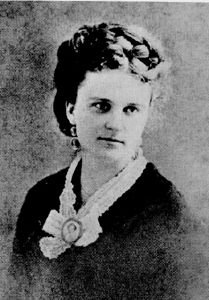
Kate Chopin (Public domain, via Wikipedia)

There are a few American authors who, when they pop up as a Library of America (LOA) Story of the Week, I try to read. These include Edith Wharton, Willa Cather and Kate Chopin. I don’t always manage to read them, but I have read the latest Kate Chopin story they’ve published, “Her letters”. And my, what a powerful one it is. Yes, I know, most of her stories are powerful, but this is certainly up there.

The story is pretty simple, plot-wise, though I shall avoid spoiling it as you may wish to read it from the link below. It starts with a woman, sitting by a “generous wood fire … in an ample fireplace” though outside is “a leaden sky in which there was no gleam, so rift, no promise”. She’s decided that she needs to destroy some letters that, we soon realise, relate to an adulterous affair. She’s been meaning to do this for four years in fact, but they’ve “sustained her … kept her spirit from perishing utterly”. However, she believes her days are numbered and, like many diary-writers and letter-owners, she fears their impact on those left behind, particularly on one “near to her, and whose tenderness and years of devotion had made him, in a manner, dear to her.” Her husband, in other words. The “in a manner” here is telling, isn’t it?

But, she can’t do it. Chopin’s description of her pain at the idea of losing them is visceral. What should she do? She lights on a solution, which is to leave them “in charge of the very one who, above all, should be spared knowledge of their contents.” So, she ties them back up, and leaves them with this note:

“I leave this package to the care of my husband. With perfect faith in his loyalty and his love, I ask him to destroy it unopened.”

Of course, she does die first, and he finds the bundle of letters with the note. (On a day much like that day we’d met her: “The day was much like that day a year ago when the leaves were falling and rain pouring steadily from a leaden sky which held no gleam, no promise.”) What do you think he does?

It’s another powerful story from Chopin, about love, passion, adultery – and also honour and trust. It is a story of its time, but there’s a universality to it too. What is so good about it, though, is the controlled way Chopin unravels the plot, and her language. It’s a little full-blown to our ears, perhaps, but she sustains melancholic tones so well, while at the same time conveying character and emotion.

Without spoiling the ending, I’ll share another excerpt. When the husband finds the bundle of letters, he guesses, of course, that they contain a secret, one that may unlock to him something about this wife whom he’d known “to have been cold and passionless, but true, and watchful of his comfort and his happiness.” He’s affected, but he ponders:

… she had embodied herself with terrible significance in an intangible wish, uttered when life still coursed through her veins; knowing that it would reach him when the annihilation of death was between them, but uttered with all confidence in its power and potency. He was moved by the splendid daring of the act, which at the same time exalted him and lifted him above the head of common mortals.

The conclusion is predictable when you get there, but Chopin leads you carefully along with the husband as he works through the problem. The story has no simple answer, and certainly no condemnation, which is Chopin’s way. She doesn’t judge or pontificate. Rather, she leaves it open for (or, forces!) the reader to consider the ways in which our actions affect others, not to mention the issue of love, passion and marriage, and the accommodations we do or don’t make.

As with other stories by her – including “Fedora”, the last one I reviewed – Chopin didn’t immediately find a publisher for “Her letters”. LOA says:

When she finished the story in December 1894, Chopin sent it off to The Century, which had published several of her previous submissions. By this time Chopin was a well-known and respected writer, but the story was rejected—almost surely because it dealt with a woman’s adulterous affair. The magazine’s editor, Richard Watson Gilder, “felt that fiction should be pleasant and avoid the horrifying, the indelicate, or the immoral,” as Chopin scholar Per Seyersted puts it.

Vogue, though, had no such compunctions – and published it as they had other previously rejected stories of hers. One day I’ll read a biography of her …

Let me know what you think, if you read it (just 8 pages) at the link below.

Note: My other Kate Chopin reviews are A pair of silk stockings, After the winterA respectable womanDésirée’s baby, Morning walk and Fedora.

Kate Chopin
“Her letters”
First published: Vogue, April 11 and 18, 1895
Available: Online at the Library of America

Jane Austen, The Watsons (Unfinished) Redux

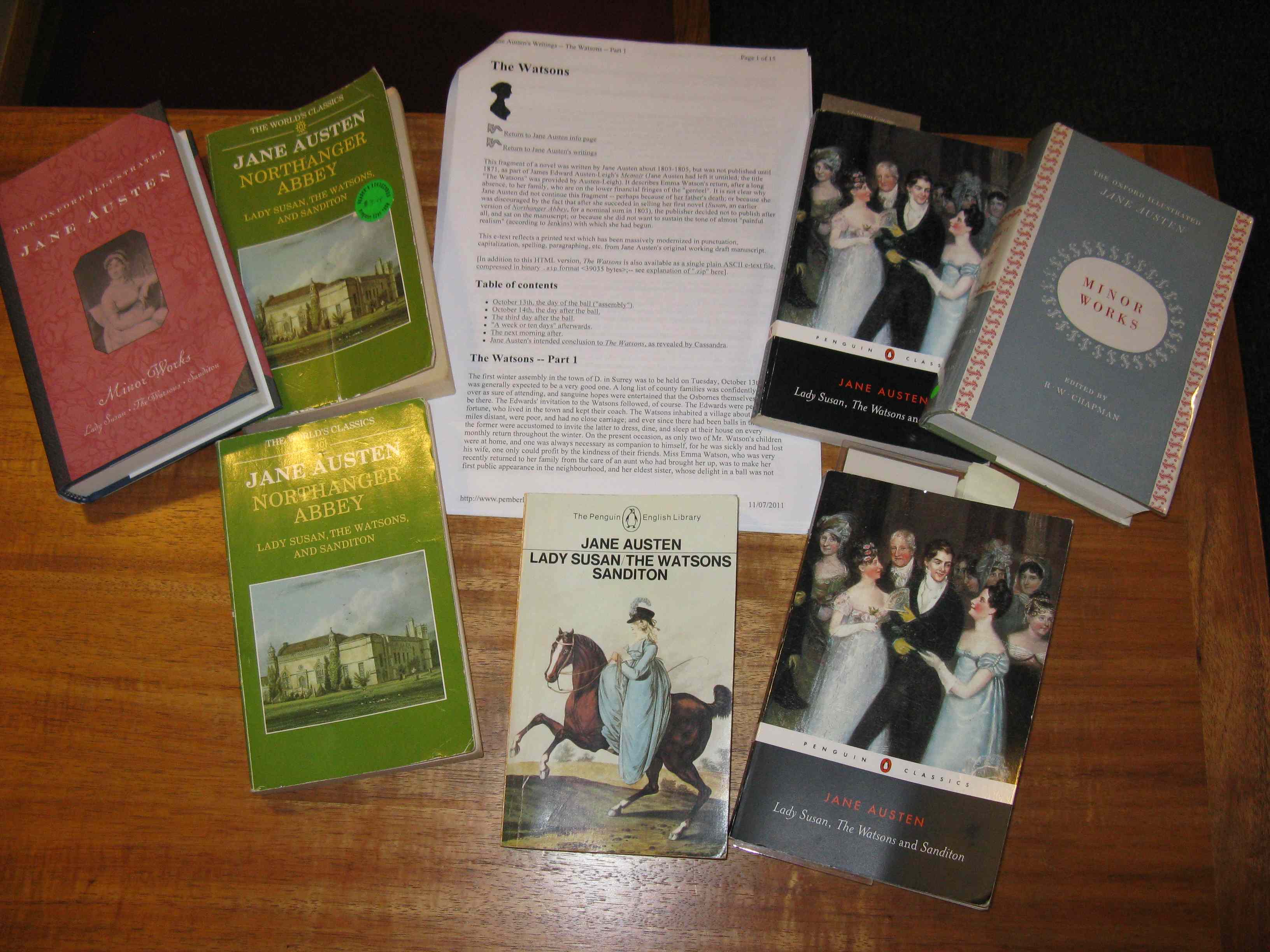
Book covers for Jane Austen's The Watsons

Book covers for Jane Austen’s The Watsons

Jane Austen fans, as you probably know, do a lot of re-reading. Given we only have six complete novels, plus her juvenilia and a couple of unfinished novels, we have little choice. Fortunately, it’s not a chore! And so, having completed rereading all her novels over the last few years for their respective 200th anniversaries, my local Jane Austen group decided to return to her two unfinished novels, starting this month with The Watsons. This was the third time we’ve done it in our relatively short existence. We did it in 2008 and again in 2011 (at which time I wrote my own reflections for this blog).

I do not plan here to write a “proper” review, so if you are interested in my thoughts, please check the link above. However, there are a couple of additional comments I’d like to make, starting with the question I posed in my 2011 post. The question relates to its unfinished nature. There are in fact two main questions regarding this: why did she stop writing it and why didn’t she pick it up again? And here I’ll quickly recap the novel’s background for those who don’t know it. The Watsons was written in Bath probably around 1803-1805, though there isn’t complete consensus about this. It’s commonly believed that she abandoned it after her father’s death in 1805 because of sadness and the resultant uncertainty in her living conditions. Whether this is true or not, it is true that she didn’t take up serious writing again until she settled in Chawton in 1809.

Now, it was at Chawton that she took up two earlier works, which became her first two published books, Sense and sensibility and Pride and prejudice. Why did she not then take up The Watsons and rework/finish it too? This is the more interesting question, I think, than why she stopped it in the first place. There are some theories around, though I haven’t investigated them thoroughly. However, her nephew James Austen-Leigh, who wrote the first “memoir” we have about her life, conjectures that Austen had become aware of “the evil of having placed her heroine too low, in such a position of poverty and obscurity” but I’m not sure I buy it.

My group discussed this idea, and we all felt that Austen had other “poor” heroines, of whom Fanny Price is the obvious example. But, the Dashwood girls were not well-to-do either. It’s true that Austen’s plan for The Watsons, as Cassandra reported, was for things to get worse for our heroine, but still …

No, my idea is different. The Watsons is broadly about four sisters and their marriage prospects – as is Pride and prejudice and Sense and sensibility. When we look at The Watsons, which Austen started after drafting those two books, we can see characters and storylines which remind us of these first two books. And so, I wonder whether, having published P&P and S&S, Austen felt she didn’t have enough new ideas to add to this storyline and wanted to try something different. Certainly, the next book, Mansfield Park, was something different. The marriage plot is still there, but it’s about a poor relation who is taken in by her wealthier ones. The interesting thing is that The Watsons commences with the return of 19-year-old Emma Watson to her family having spent 14 years with a wealthy uncle and aunt. Perhaps Austen decided to explore the story of the poor relation from a different angle, from the time of arrival at the new home?

Another thing about The Watsons is that as well as having characters who remind us of those first two novels, it also has characters reminiscent of some in later books, particularly in Emma. This suggests that while she didn’t finish The Watsons, her work on it wasn’t wasted – and she knew it.

We’ll never know of course. There’s so much we don’t know about our Jane, but it is fun trying to fill in the gaps.

A couple of apposite quotes

There’s more I could explore about this tiny fragment of around 17,500 words, but I’ll save those for the next re-read! Instead, I’ll conclude with two excerpts which grabbed my attention this time.

Gender and money

The first is a conversation between the heroine Emma and the wealthy aristocrat, Lord Osborne, who is interested in her, though his regard is not returned. In this conversation, he suggests that all women should ride horses:

‘I wonder every lady does not. – A woman never looks better than on horseback. –’
‘But every woman may not have the inclination, or the means.’
‘If they knew how much it became them, they would all have the inclination, and I fancy Miss Watson – when once they had the inclination, the means would soon follow.’
‘Your lordship thinks we always have our own way. – That is a point on which ladies and gentlemen have long disagreed. – But without pretending to decide it, I may say that there are some circumstances which even women cannot control. – Female economy will do a great deal my Lord, but it cannot turn a small income into a large one.’

Here we see Emma’s mettle. She stands up to Lord Osborne – to his assumptions about women and to his obliviousness that not all people have the means he has.

On reading to escape

And finally, The Watsons contains another of those wonderful quotes by Austen about books and reading. Here, right near the end of the fragment, Emma is thinking about the downturn in her fortunes through the death of her uncle:

The evils arising from the loss of her uncle were neither trifling, nor likely to lessen; and when thought had been freely indulged, in contrasting the past and the present, the employment of mind, the dissipation of unpleasant ideas which only reading could produce, made her thankfully turn to a book.

So, even in 1805, reading was seen as a way to occupy the mind and so escape, for a while, the troubles of life.

Jane Austen
“The Watsons”
in The Oxford illustrated Jane Austen. Vol VI, The minor works (ed. R.W. Chapman)
London: Oxford University Press, 1969
pp. 315-363

Monday musings on Australian literature: AusLit Women Academics on Colonial Women Writers

Over January, some of us Australian litbloggers – as the result of Bill’s (The Australian Legend) AWW Gen 1 Week – have been talking about early Australian women writers. It’s a topic of great interest to me, ever since the 1980s when I became interested in these writers. There seemed to be a flurry, at that time, of academics and researchers writing in this area – and this work has continued. For my benefit – and hopefully for others – I thought I’d document some of those who pioneered this research (in my time anyhow.)

Debra Adelaide

Adelaide (1958-) is probably best known now as a novelist, and I’ve reviewed her most recent novel, The women’s pages, here.  But I first knew of her as a researcher and writer about our older Aussie women writers. I bought both of her books on this topic back when they came out. One is A bright and fiery troop: Australian women writers of the nineteenth century (1988), which is a collection of essays she edited, covering writers like Louisa Atkinson, Catherine Helen Spence, Ada Cambridge and Tasma. (Adelaide acknowledges two woman in my list below, Dale Spender and Elizabeth Webby.) The other, which was published the same year, is Australian women writers: a bibliographic guide (1988). It is a comprehensive list (to the best of her research by the late 1980s) of all Aussie women writers. It includes a brief description of and a list of works by each writer. A wonderful resource.

Patricia Clarke

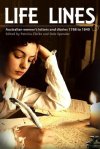
Clarke (1926-) is a historian focusing on women in nineteenth century Australia, including writers of all forms/genres. her books include Pen portraits: women writers and journalists in nineteenth century Australia (1988), The governesses: Letters from the colonies, 1862-1882 (1989), Pioneer writer: the life of Louisa Atkinson, novelist, journalist, naturalist (1990), Tasma: The life of Jessie Couvreur (1994), and Rosa! Rosa!: a life of Rosa Praed, novelist and spiritualist (1999). With Dale Spender (see below), she also published Life lines: Australian women’s letters and diaries 1788-1840 (1992). I love that these books look at writing beyond fiction – as important as that is – to letters, diaries, and journalism.

Joy Hooton

Hooton (1935-), an academic, is perhaps a bit of a ring-in to this group. She co-authored both The Oxford companion to Australian literature (1986) and the Annals of Australia literature (both of which I have). She is also an authority on autobiographic writing, and has published an anthology of autobiographical writing from the convict era to the present day, Australian lives: an Oxford anthology (1998). Most of the early writers, here, though, are male. However, I’ve included her because her works, particularly the Oxford companion and the Annals, are useful sources for researchers. And because just to be a woman academic, particularly one born pre-WW2, would not have been easy.

Elizabeth Morrison

Morrison (1936-) is another historian of colonial times, but her speciality is the role of the Australian newspaper press as publisher of serial fiction, particularly in the colonial era. She edited two of Ada Cambridge ‘newspaper novels’,  A Woman’s Friendship and A Black Sheep, which were published by UNSW Press, but she has also written many academic articles and given lectures on the subject. I have her edition of A woman’s friendship (republished 1995, orig, 1889), which was published in the Colonial Texts Series series, by UNSW Press (through, surprisingly, the Australian Defence Force Academy where Morrison was based).

Dale Spender

Spender (1943-) is an academic and feminist who has spread her wings wider than “just” Australian women, but her Australian credentials include being founding editor of Pandora Press (which published several of the older Aussie women authors I read in the 1980s, including Rosa Praed’s The bond of wedlock) and a commissioning editor of the Penguin Australian Women’s Library (whose books I also read, including Ada Cambridge’s Sisters). She also wrote Writing a new world: Two centuries of Australian women writers (1988). (Thanks Bill, for the reminder!)

Spender’s wider interests include early British women writers, and in this area her books include Mothers of the novel: 100 good women writers before Jane Austen (1986)You can see why I’m interested in her! I have this book on my Kindle!

You might like to check out her website. I do like her definition of “himitator”.

Elizabeth Webby

You may remember Webby (1942-), because my last two Monday Musings drew from a lecture of hers – but I didn’t say much about her except that she’s a retired academic. She was Professor of Australian Literature at the University of Sydney for nearly 20 years, and has been editor of the literary journal Southerly. She researched both colonial and modern Australian (women’s and men’s) literature, and perhaps her main legacy, publication-wise, is as editor of the Cambridge companion to English literature (2000), which I have. She has written numerous articles and given lectures on colonial literature, including an article on colonial women poets in Adelaide’s A bright and fiery troop. She has also published a bibliography about our early Australian poets, Early Australian poetry: an annotated bibliography of original poems published in Australian newspapers, magazines and almanacs before 1850. Bibliographies make for pretty dry reading, but how important they are!

I thank these, and all the other academics, who thought researching Aussie women writers was an important thing to do. I’m sure it wasn’t always easy.

I’ve only selected a few, of course – those that have been particularly relevant and useful to me – but if you have some favourites in this sphere that you’d like to share, I’d love to hear about them.

Monday musings on Australian literature: Reading aloud in colonial Australia

At the end of last week’s Monday Musings post on literary culture in colonial Australia, I commented that author Elizabeth Webby had also discussed the practice of reading aloud, and that I might do a future post on that. Well, not only might I, but I’ve decided to do it this week because I was fascinated. (Just to recap, last week’s post drew from Webby’s lecture titled “Reading in colonial Australia”, which is available online). And, would you believe, February 1 is World Read Aloud Day!

So, I’ll start briefly with Webby’s discussion and then move on to some of my own research, from Trove of course. She starts by saying that reading aloud remained popular throughout the nineteenth century alongside a rise in silent, individual reading. She writes:

Those worried about the excessive reading of fiction by women and young people were particularly keen to encourage the domestic practice of reading aloud. A father reading aloud to his family in the evening formed an ideal Victorian domestic scene: he could monitor what was being consumed by his wife, sons and daughters; they had the advantage of his company and attention.

(There’s that gender issue again!) She shares information gleaned from diaries. One mother, for example, would not allow Shakespeare while another was very happy to read from Dumas’ 8-volume Celebrated crimes (1839-1841). Webby says this “reminds us that individual readers have always been free to set their own rules about what should be read, ignoring the more restrictive norms of their times.” She also discusses the encouragement of reading aloud for women (“as an alternative to idle gossip as they sewed or carried out other more sedentary household jobs”) and bush-workers (“as a more profitable alternative to gambling and yarning”), and the ongoing concern about what was read (but I discussed some of that last week.)

A modern author reading: Malouf reading from Ransom, NLA, 16/8/2009

Webby then describes the rise of “penny reading” in the second half of the nineteenth century. This is the practice of attending public readings for the cost of a penny. While Dickens never toured Australia, as he had Britain and the USA, readings from his books were popular at these penny readings, which were apparently popular in Victoria. There were also “philanthropic” souls who read, free-of-charge, to hospital patients and prison inmates. Webby suggests that regarding readings for prisoners, the authorities would have seen them as having value as “cheap entertainment combined with a controlled use of fiction as a means of moral reformation”. There was, she says, a strong continuing belief in “the humanising value of literature”.

What I found in Trove*

Having read Webby’s discussion, I was keen to see if the topic was discussed in newspapers of the time – and my, was it! It seemed particularly popular in papers of the later nineteenth century, with much of the commentary I found coming from the 1870s. It was generally earnest, and had two main threads: the importance of reading aloud well; and the value of reading aloud (along with a concern that people weren’t doing enough of it).

A long article by Sarah Ellis in the Sydney Morning Herald on 21 January 1870 starts with:

Amongst the accomplishments which belong to education of the highest order, reading aloud ought certainly to hold a prominent place – that is, the art of reading aloud so as to give the full meaning of what is read, and at the same time to charm the ear of those who listen.

She then discusses how reading aloud is so often unsatisfactory, how people adopt a voice that doesn’t change or adapt to the meaning of what they are reading. She suggests that one of the causes is the reduction of reading aloud in the home. Poor education is another cause but an article in the Mount Alexander Mail (25 October 1878) reports on a lecture by Mr T.P. Hill, a well-known elocutionist of the time, who discusses the finding of school inspectors “that this neglected, but important branch of elementary education was moving forward in the right direction”. Unfortunately, though, “in a few districts … complaints were made of the monotonous and sing-song manner in which the voice was allowed to degenerate”.

My final example regarding the issue of reading aloud well, raises again the gender issue. It comes from the Avoca Mail (26 June 1877):

It is much to be regretted that the charming accomplishment of reading aloud is not more cultivated by ladies. … To do this well, a certain amount of study is requisite. First of all, it is necessary to acquire a habit of sustaining the voice; then one must learn to modulate the tones, to attend to the punctuation, and, above all, the reader must have a fair appreciation of the author’s meaning. This involves a study of English literature, which is so sadly needed by most young ladies who are supposed to have a finished education.

Oh dear, those “young ladies”, eh? Gender also comes up in the aforementioned Sarah Ellis’s article, and here I shift into the issue of why people should read aloud. Reading aloud, she says, can “increase the number of our innocent enjoyments”, “make the social hours of life glide pleasantly along”, and “prevent them from becoming vapid or wearisome”. She then separately identifies the value for women and men:

Amongst women, this accomplishment might go far to help them in filling their homes with interest; amongst men, it would help them on all public occasions, when called upon to speak or read.

Oh well, that was then – a woman’s place was in the home. We wouldn’t expect anything different, would we? I should add that Ellis spends some time discussing the best book to read aloud, the Bible, which Webby says would have been the “most-read” book in colonial Australia.

So, reading aloud was seen as good for family togetherness, for entertainment, for education, and for usefulness in the outside world. Indeed, in terms of the latter, the writer in the Ovens and Murray Advertiser (13 October 1877), reporting on another lecture by Mr T.P. Hill, describes it as “an art which at the Bar might save lives, which in the Senate might save nations, and which in the Pulpit might save souls”. Meanwhile, in terms of the former more recreational value, Ellis overlays a moral value, describing it as a “counter charm of a social and intelligent nature to take the place of pleasures which are purely sensational”!

I will end, though, with another reason which you mightn’t have seen coming. It’s from the Queenslander (6 February 1897):

The late Sir Henry Holland says in his ‘”Medical Notes” that persons who have a tendency to pulmonary disease should methodically practice “those actions of the body through which the chest is in part filled or emptied of air.” He advises that those whose chests are weak should read aloud at stated intervals …

World Read Aloud Day 2018See, reading aloud really is good for you!

Do you have any experience of reading aloud as an adult, either reading or listening (besides, that is, reading to children), and if so, I’d love to hear about it? Audiobooks? Live reading?

* Note that when I say Trove, I mean its digitised newspapers subset, because Trove, in fact, currently covers over 560 million “Australian and online resources: books, images, historic newspapers, maps, music, archives and more”. Note, too, that many of the articles I found appeared in many newspapers around the country.

Monday musings on Australian literature: Literary culture in colonial Australia

National Library of Australia
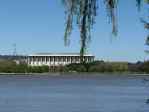
National Library of Australia, from the other side of Lake Burley Griffin

Bill of The Australian Legend’s AWW Gen 1 Week, which has just finished, focused on the authors and the books they wrote about colonial Australia. However, what about the readers? I’ve been planning to write a post on literary culture in colonial Australia for some time, and today seems to be just the right time! My post draws heavily on retired academic Elizabeth Webby’s 2011 John Alexander Ferguson Memorial Lecture titled “Reading in colonial Australia” which was published in the Journal of the Royal Australian Historical Society (vol. 97, pt. 2) in December 2011 (available online). Webby starts by recognising the work done by lawyer-book collector-bibliographer Ferguson whose much-researched collection is at the National Library of Australia and who is commemorated there by the Ferguson Room.

It’s a fascinating lecture, for the content and for the discussion of the information sources Webby used to discover who read what in colonial Australia (1788 to 1901). (I’m always interested in the research process.) There are letters, of course, from colonists back to home, asking for books. Then there are advertisements listing personal libraries for sale. Early explorer George Bass’s library for example contained mostly books on medicine, science, law, theology plus classical authors like Horace, Virgil and Homer. A library typical of “gentlemen’s libraries of the period”. It contained very little fiction.

Another explorer, a couple of decades later, was John Oxley. His library was sold in 1828, and, Webby writes, it

displayed a decidedly stronger taste for fiction, indicating the shift towards novels as the main form of recreational reading which began in this period, although still deplored by many. When John Oxley’s library was sold by auction in Sydney in August 1828 about half of the 330 or so lots listed in the catalogue were works of fiction. They included such recent publications as Sir Walter Scott’s Tales of the Crusaders (1825), the American novelist Fenimore Cooper’s The Prairie (1827), as well as Gothic thrillers like Anne Radcliffe’s Gaston de Blondeville (1826) and Mary Shelley’s early science fiction tale Last Man (1826). Oxley clearly was a regular purchaser of the latest English books.

Later in the article, discussing attitudes to women readers, she refers to the sale of “a lady’s library” in 1833. While she didn’t see a list, it was described as comprising ‘upwards of six hundred volumes, chiefly standard Works, by the most esteemed ancient and modern authors, forming altogether a collection of English Literature rarely to be met with out of Europe'”. She uses this to counter the belief that women only read fiction!

Another fascinating source of information about what people were reading are advertisements for missing books. Fascinating. Besides providing information about what people had in their libraries, they also tell us how precious books were. In some of the ads she found, people threatened legal action or offered rewards. So, of course, I went to Trove to see what I could find. I found some of those Webby describes, but I also found one from June 1830 that seemed to be about recalling books that had been lent out and were now needed back for an estate auction. The list is fairly long, and looks like one of those aforesaid typical “gentlemen’s collections”. It has classics, sermons, theological works, essays, dictionaries and so on, but very little fiction, except for Sir Walter Scott, who’ll appear again later! The list ends with the statement that “The Public are also informed, that this extensive and valuable Library will in a short time be sold by Public Auction, of which due notice will be given. As Mr. HOWE’S Library is well known, it would be useless to make further comments at this time.” Clearly they expected the books to be returned, but I wonder what sort of comments it was useless to make?

Webby also explores lending libraries. They varied greatly. Some were set up by churches, and focused on morality and religion, with “frivolous” or “pernicious” publications being excluded. Some were created for “the colonial elite”, such as the Hobart Town Book Society and Sydney’s Australian Subscription Library. And some were set up to provide reading matter for working people. These were the Mechanics’ Institutes and Schools of Arts whose buildings are still familiar sights in Australian country towns. The short-lived Hobart Town Mechanics Institute was founded in 1827, and Sydney had established its Sydney Mechanics’ School of Arts in 1833. By 1834, it had “upwards of five hundred volumes … consisting of works on science, history and general literature, chiefly contributed by the liberal donations and loans of members and friends.” Indeed, Webby makes several references to people being asked to donate books from their own libraries to, for example, make them available to “the enquiring mechanic, who can find time to dive into their contents.” In truth, though, mechanics did not comprise the main memberships of these organisations.

And here is a good point to discuss what Webby calls the fiction debate. Those of you interested in the history of reading will know that novels were disparaged for a long time. I’ve written before about Jane Austen’s famous defence of the novel in Northanger Abbey, in which she described them as works

in which the greatest powers of the mind are displayed, in which the most thorough knowledge of human nature, the happiest delineation of its varieties, the liveliest effusions of wit and humour, are conveyed to the world in the best–chosen language.

Northanger Abbey was published in 1817 so Austen’s defence is contemporaneous with the period we are discussing. Webby quotes James Ross, editor of the Hobart Town Courier, as supporting novel-reading in 1831. He defended the so-called “frivolous” reading tastes of members, arguing that recreational reading was valid after the “toil of a long day in some official, public or private arduous operation.” He also argued that reading English novels was, as Webby puts it, “almost a patriotic duty”, because these books

keep alive in no small degree that amor patriae, that attachment to our mother country and that familiarity with the manners and relish for the habits of our countrymen which is at all times so desirable.

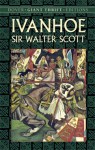
Sir Walter Scott, Ivanhoe
Ivanhoe, first published 1819.

Webby identifies some of the fiction that was being read – including Jane Austen, Charles Dickens and Bulwer Lytton – but the author who pops up most frequently in her survey of the early to mid-nineteenth century is Sir Walter Scott. The first book order from the 1826-established Australian Subscription Library, for example, included only one novelist, Scott.

And the 1836 report of the Sydney Mechanics’ School of Arts defended the inclusion of novels in its library, with the argument, you’ll see, that is still used to defend, for example, the reading of comics. The report says:

… it ought to be remembered, that a taste for reading has to be formed before works of a more philosophical character will be relished or appreciated, and that if any book is likely to accomplish this more speedily than another, it is the works of Scott–containing, as they do, a vast fund of historical information, mixed up, in an agreeable shape, with the manners and customs of different periods.

Webby discusses much more, including the role of periodicals and newspapers in reading culture. She also writes about “reading aloud”, but I might save that for another post.

It’s clear from Webby’s lecture that the information available was scattered and incomplete. She praises Evandale Subscription Library in Tasmania which “stands out for the completeness of its records”. Please note this any of you who are currently involved in organisations, such as reading groups: keep your records! One day, some researcher will want them!

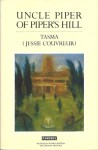
Tasma (Jessie Couvreur), Uncle Piper of Piper’s Hill (#BookReview)

Tasma, Uncle Piper of Piper's Hill

The first thing to say about Tasma’s debut novel Uncle Piper of Piper’s Hill is that it’s rather wordy, speaking to a literacy different from that of today’s readers. For this reason, Uncle Piper won’t appeal to readers who like short simple sentences, and a plot which moves along at a good clip with little reflection or commentary. Consider yourself warned, but know also that, according contemporary reports, this novel made Tasma famous in a week.

So, if you enjoy immersing yourself in the writing of different times, and are interested in late 19th century Australia, Uncle Piper has plenty to offer, starting with well-drawn characters who, in modern clothes, would be as real today as they were in 1888.

Take father, the Uncle Piper of the title, and his son George, for example. Uncle Piper is a self-made man. In his case this involved emigrating from England, where he was poor and with few prospects, to Melbourne, where, starting as a lowly butcher, he worked hard to establish himself as the wealthy, successful businessman he is at the novel’s opening. Now, what often happens when parents struggle to establish themselves and create for their children opportunities that they never had? Why, those children take their easy, comfortable lives for granted. That’s what! Not a new story, is it?

And so, about a third of the way through the novel, we have a wonderful scene between father and son over a girl of whom the father doesn’t approve. Feeding this scene is a two-decade history of growing frustration on Uncle Piper’s part and a learned, practised nonchalance on George’s. The scene is delicious and requires no suspension of disbelief to understand. Here’s a short excerpt of a confrontation in Uncle Piper’s beloved tower at Piper’s Hill:

So he [George] courted a personal attack … and sat caressing his moustache, as was his wont, with his eyes bent on the floor, while his father exposed his grievances in a crescendo key.

If there was anything humiliating in being rated as an “able-bodied young man who wasn’t worth his salt,” as a loafer who was hardly fit to “jackaroo” on a station, as a “lazy lubber” who would “go to the dogs if it weren’t for his father,” George never betrayed that he felt humiliated by so much as the twitching of an eyelid. Persistently stroking the ends of his moustache with an air of profound abstraction, he made it apparent, as soon as Mr. Piper stopped to take breath, that he was suppressing an inclination to yawn.

Can’t you just see it – the increasingly apoplectic father and his determinedly calmly indifferent son!

In basic plot, Uncle Piper of Piper’s Hill is a romance, a marriage story, set against the social backdrop of a meeting between these well-to-do parvenu Pipers, and the impoverished but upper crust Cavendishes. The lowly-born Mrs Cavendish is Uncle Piper’s sister. At the beginning of the novel, the Cavendishes are on a boat being brought out to Australia by Uncle Piper who has, in effect, been supporting them for years and who would now like them with him. He’s offered to find the reluctant Mr Cavendish a job “in the government”. The Cavendishes include two daughters, the kind, unassuming Margaret and her younger sister, the beautiful and imperious Sara. Sara follows her father’s mould of snobbish self-regard trumping any sense of human feeling or empathy, while Margaret is in her mother’s caring and hardworking mould.

Coming out on the same boat is the thirty-something Rev. Lydiat who, unbeknownst to them all, is also connected to the Pipers – this is a nineteenth century novel after all. His now-deceased mother had been Uncle Piper’s second wife. So, the afore-mentioned George is his step-brother, and Uncle Piper’s still-a-child daughter Louey, whom he’d had with the Rev’s mother, is of course his half-sister. But wait, there’s more. Also in Uncle Piper’s household is Laura, the Rev. Lydiat’s sister, whom Uncle Piper had promised his wife, on her deathbed, to care and provide for.

… a house divided against itself …

And now the plot gets complicated – though it’s easy to follow in the book. Rev. Lydiat falls (purely, of course) in love with Sara, while on the boat. And George and Laura, unrelated by blood, are in love. But, Uncle Piper wants George to marry his as-yet-unseen-to-any-of-them cousin Sara. And just to round all this off, Margaret is quietly, humbly, in love with Rev. Lydiat. Lest you give up at this point and think this all sounds a bit silly, let me say that despite its fairly traditional plot of love-triangles and interfering parents, the book has a lot more to offer.

So, where to go from here? There are many angles from which this book could be discussed. Issues like religion, money and class (as I’ve already mentioned), colonial life and the Australian landscape, and even the book’s relevance to Tasma’s biography, are all well worth exploring. I could also have fun teasing out comparisons between this book and Jane Austen’s Persuasion (my review). It’s not hard to see Sir Walter Elliot and his daughter Elizabeth in Mr Cavendish and Sara, or to see Anne Elliot in the capable Margaret. I could also talk about the style, and the influence on the style and tone of its being originally serialised in a newspaper.

However, given my previous reading of Aussie women writers at the time – of Ada Cambridge’s A woman’s friendship and Sisters, and Rosa Praed’s The bond of wedlock – I’d like to mention Tasma’s social commentary, particularly regarding women. Part of the commentary relates to the opportunities offered by Australian life. Uncle Piper’s generosity and capacity for hard work is offset against the snobbery of Mr Cavendish who is happy to take his brother-in-law’s money while continuing to hold himself “above” his host. He is snobbish, selfish and shallow, and by the end of the novel, has learnt nothing. Uncle Piper, on the other hand, along with his son George, learns some lessons and, by the end both have recognised and corrected some of their less tolerant behaviours.

For Uncle Piper much of this change relates to his step-daughter Laura Lydiat. For all his generosity, Uncle Piper has his faults. He can be autocratic, for a start. This does not sit well with the opinionated Laura. She has rejected religion, can be sarcastic, and has an “uncompromising disregard of feelings with which she does not agree”, albeit being very happy to eat at Uncle Piper’s table and wear the clothes he provides! She also does not approve of marriage:

though I abominate the system of marriage, though I think the yoking of two people together without a chance of release–as if the yoke mightn’t gall them any day–perfectly barbarous and absurd–still, in view of our ‘exceptional case’–there, don’t be demonstrative till you’ve heard me to the end–in view, as I said, of our ‘exceptional case,’ I’d have gone off with you to the registrar’s any morning–no, nothing would induce me to go to church–and have signed myself Laura Piper, instead of Laura Lydiat!

MISS THIS IF YOU DON’T WANT TO KNOW WHO MARRIES WHOM …

At the end of the novel, when the also-changed Laura does indeed marry, Tasma compares gentle, dutiful Margaret’s response to the marriage service with Laura’s:

She [Margaret] had followed the service in its most literal sense with all the earnestness of her nature, and would have had no sympathy with the half-perceptible gleam that might have been detected in Laura’s eyes at being called upon to obey George.

START READING HERE AGAIN …

The novel is not, as you can tell from this gentle hint, overtly didactic. There is some running authorial commentary, but the ideas and themes are well conveyed through the story and the characters, who are, for the most part, realistic though there are some saints and sinners among them.

Uncle Piper owes much to the Victorian novel tradition, but one adapted to an Australian setting. The plot overlays a New World made-good story over the more traditional romance narrative. The result is a novel which explores some new ideas about life within a familiar format, which makes it particularly special, I think, for Antipodean readers. Tasma should be read more.

Posted as a contribution to Bill (the Australian Legend)’s Australian Women Writers Gen 1 Week. See also my Monday Musings post this week on Tasma.

AWW Badge 2018

Tasma (Jessie Couvreur)
Uncle Piper of Piper’s Hill: An Australian novel
Project Gutenberg of Australia eBook, 2006
(Originally serialised in The Australasian, 1888; published as a volume, 1889)
Available online at Project Gutenberg of Australia

Monday musings on Australian literature: Tasma (aka Jessie Couvreur)

Tasma, c. 1890. (Public Domain, from the State Library of Victoria, via Wikipedia)

This week Bill (of The Australian Legend) is running an Australian Women Writers Gen 1 Week, through which he plans to highlight Australian women writers from our first generation of writers, which he defines as “those writers who came before the 1890s and the Sydney Bulletin ‘Bush Realism’ school, although many of them continued writing into the first part of the 20th century.” These women, several of whom I read before blogging, include Louisa Atkinson, Ada Cambridge, Rosa Praed, Catherine Helen Spence, and Tasma. I have written about some of these writers before, particularly Louisa Atkinson and Ada Cambridge, so today I’ve decided to highlight Bill’s week by writing on another, Tasma, whose book Uncle Piper of Piper’s Hill I’ve promised to contribute to his project.

Who was Tasma?

Born Jessie Huybers in London in 1848, Tasma (as she later styled herself) came to Hobart, Australia, with her parents in 1852. Her family was apparently among the more prominent in Hobart, with their friends including successful author Louisa Meredith (1812-1895) and her husband Charles. In 1867 Tasma married the 25-year-old Charles Fraser moving to Melbourne with him. However, the marriage was troubled and Tasma returned to Hobart in 1872, leaving her debt-ridden husband behind. The following year she sailed to England with her mother and youngest siblings, and spent the next couple of years soaking up European culture with her family. Returning to Melbourne and her husband in 1875, she discovered that he’d had a child with a servant. With divorce, particularly initiated by women, rare, they remained married but lived mostly separate lives.

She started writing in 1877, taking the pseudonym Tasma to honour the colony of her youth, and in 1878 her first articles were published. In 1879 she returned to Europe with her mother and some siblings, determined to earn her living as a writer. This also marked the final break with Charles, and they were divorced in 1883.

And here I’ll quote biographer Patricia Clarke (see below):

Tasma’s life deserves to be much better known, and not only because of her now almost forgotten fame as a novelist. Just as interesting and more gender-defying, she was also an acclaimed public lecturer in Europe, and a foreign correspondent for the London Times, both roles that contradicted the perception of women as solely home­bound. In her personal life also, Tasma defied all the stereotypes of the nineteenth-century woman by separating from, and divorcing, her first husband.

DPAC’s article (see below) describes her as “a celebrity lecturer” on the “geography, history, industries, culture and social progress of Australia” and says that her lectures were reported in French, Belgian and other newspapers. She met the eminent and more compatible, albeit significantly older, Auguste Couvreur in 1881, and married him in 1885, but before that, writes Clarke:

For six years before her second marriage, Tasma lived the life of a ‘New Woman’, the independent woman then beginning to appear both in real life and in fiction. From her base in Paris she earned her own living and was involved in the radical issues of the day. An interviewer wrote, ‘She was not a woman to hide the light of her militant radicalism under a bushel. When pressed to talk about her method of writing, she spoke instead of the latest developments in collectivism, and made an impassioned plea for the poor’.

Sadly, Jessie Couvreur died in 1897 of coronary heart disease, just before her 49th birthday. Way too young for someone who clearly gave a lot to her times.

What did she write?

Tasma, Uncle Piper of Piper's Hill

During her life, Tasma wrote, according to the DPAC article, 7 novels, 20 short stories (several set in Tasmania) and over 36 articles on a variety of subjects. Uncle Piper of Piper’s Hill, her first novel, was published in 1889, and her last, A fiery ordeal, was published, posthumously, in 1897, the year she died.

In her chapter in Debra Adelaide’s A bright and fiery troop, Margaret Harris quotes 20th century poet and novelist Winifred Birkett’s claiming Tasma as Australian

… in spite of her Dutch-French parentage, English birth, Belgian marriage, and long continental residence and professional career! She has been called by people who cannot get away from systems of category and comparison, “the Australian Jane Austen” and “the Australian George Eliot”, but without bringing her under the patent of any other writer’s name we may remember her simply as the “Tasma” of her own titling, and Australian enough by such an implication.

Interesting! Of course, I did my own bit of research in Trove and found some similar references from her 19th century contemporaries. One article in Tasmanian News (11 August 1892) reported on an interview conducted for a “Celebrity at Home” column in The World journal, writing that “Her interviewer credits her with much of the spirit of Thackeray and George Eliot, which, in combination with marked originality, is the secret of her success.” And an article from the year before in Tasmania’s Mercury (21 January 1891) writes that

The favourite Christmas book of 1888 [Uncle Piper] went through three editions before January, 1890. The success of her last two works has been equally marked, and Mr. Edmund Yates, the most competent of judges, regards her as a story writer of extraordinary power. “Uncle Piper” may very likely live as long as “Charles O’Malley,” and it is not impossible that one of “Tasma’s” literary efforts in the Chaussée de Vleugrat [sic] may yet attain the immortality of “Villette.”

Tasma, The penance of Portia James

Strong praise, eh! I’ve only read 20% (on my Kindle) of Uncle Piper to date, and, while the style owes more to late Victorian than to Jane Austen’s Regency/Georgian era, I can see the comparison in some of the cheekiness I’m reading. To see Eliot, Thackeray and/or Bronte, I think I’ll need to read more!

I won’t say more about her writing, except to share a comment made by Clarke regarding her descent into obscurity:

The usual explanation for her obscurity is that, like other Australian women writers who wrote about love, marriage and domestic relationships and whose main characters were women, her reputation has been overtaken and submerged by the Bulletin school of almost exclusively male writers who emerged in the 1890s. These writers glorified the traditions of mateship and the bush to establish what came to be seen as the authentic picture of Australia. Perhaps Tasma’s later obscurity was influenced by the fact that she died at a relatively young age, that for the second half of her life she lived in Europe, and that she had no direct descendants to keep her memory alive. Other nineteenth-century Australian women writers, such as Ada Cambridge and Rosa Praed, lived much longer, the former in Australia and survived by children, but this has not saved them from a similar, if perhaps less marked, obscurity.

If you’d like to know more, check out the sources below and/or watch for my post later this week …

Sources

Beilby, Raymond. ‘Couvreur, Jessie Catherine (1848–1897)’, Australian Dictionary of Biography, National Centre of Biography, Australian National University, published first in hardcopy 1969.

Clarke, Patricia. ‘In the steps of Rosa Praed and Tasma: Biographical details: A lecture by Harold White Fellow, Patricia Clarke‘, National Library of Australia, Canberra, 1993

‘Couvreur, Jessie Catherine (1848–1897)’, Obituaries Australia, National Centre of Biography, Australian National University. Also available in the original form at Trove, titled “The late ‘Tasma’ Courvreur”, The Mercury, 27 October 1897.

Harris, Margaret. ‘The writing of Tasma, the work of Jessie Couvreur’, in A bright and fiery troop (ed. by Debra Adelaide), Ringwood, Penguin Books, 1988.

‘Tasma (Jessie Couvreur nee Huybers)’, in Signifiant Tasmanian Women, Department of Premier and Cabinet (DPAC) (Tasmania). (Entry based on Patricia Clarke’s Tasma: The life of Jessie Couvreur, 1994)

Jane Austen’s Persuasion, Vol. 2

Jane Austen, Persuasion

I recently posted my thoughts on Volume 1 of Persuasion, which I read for my Jane Austen group’s slow reading of the novel. This post, obviously, is on the second (and last) volume. As before, I’ll be focusing on reflections from this read rather than writing a traditional review. And, again, just in case you need a refresher on the plot or characters, please check Wikipedia.

Persuasion

… and Self-interest

Last meeting, my Jane Austen group discussed Lady Russell’s advice to Anne. Some found it wanting while others felt she was justified in recommending that 19-year-old Anne reject Captain Wentworth’s proposal. In Volume 2, we get to question Lady Russell’s judgement again, when she sees Mr Elliot as a good suitor for Anne.

So, we have a conundrum. She’s Anne’s friend and supporter, but she’s also a member of the aristocracy, which is not presented positively in the book, and her judgement is suspect. What are we to make of her?

At the end of the novel, Lady Russell is treated well. Is this because her advice, poor though it is (in hindsight, particularly), doesn’t stem from self-interest? Here is Austen wrapping up Lady Russell at the end:

There is a quickness of perception in some, a nicety in the discernment of character, a natural penetration, in short, which no experience in others can equal, and Lady Russell had been less gifted in this part of understanding than her young friend. But she was a very good woman, and if her second object was to be sensible and well-judging, her first was to see Anne happy.

If we agree that Lady Russell is redeemed because her focus was Anne’s happiness, not self-interest, where does this leave Mrs Smith? She was prepared not to share with Anne her knowledge of Mr Elliot’s character, her reason being:

After listening to this full description of Mr. Elliot, Anne could not but express some surprise at Mrs. Smith’s having spoken of him so favourably in the beginning of their conversation. “She had seemed to recommend and praise him!” “My dear,” was Mrs. Smith’s reply, “there was nothing else to be done. I considered your marrying him as certain, though he might not yet have made the offer, and I could no more speak the truth of him, than if he had been your husband. My heart bled for you, as I talked of happiness.

But, given her hopes for Anne interceding on her behalf with Mr Elliot, is there not some self-interest in her decision not to influence Anne? Mrs Smith’s situation was dire in a way that Lady Russell’s was not, but … Anyhow, she too is treated well in the novel’s wrapping up.

What this says to me is that while Austen gently satirises groups (such as the aristocracy) or ideas (such as persuasion/influence/advice-giving), she is not black-and-white about it. She understands humanity – and would like us to, too!

… or, being persuadable

Last post I commented on Anne’s wondering whether Captain Wentworth, after Louisa’s accident at Lyme, might have realised “that a persuadable temper might sometimes be as much in favour of happiness, as a very resolute character.” Well, in the resolution, we discover that he did!

There, he had learnt to distinguish between the steadiness of principle and the obstinacy of self-will, between the darings of heedlessness and the resolution of a collected mind.

Meanwhile, Anne tells him that, despite the pain it caused, her 19-year-old self was right to listen to Lady Russell:

I must believe that I was right, much as I suffered from it, that I was perfectly right in being guided by the friend whom you will love better than you do now. To me, she was in the place of a parent. Do not mistake me, however. I am not saying that she did not err in her advice. It was, perhaps, one of those cases in which advice is good or bad only as the event decides.

This last sentence reminds me of that “good spirit” narrator in The museum of modern love (my review) who said in the opening paragraph, “It’s a human condition to admire hindsight. I always thought foresight was so much more useful”. If only Anne knew, eh, what the event would decide?

Anne Elliot, Fanny Price and Elinor

Jane Austen fans love to consider her characters, to discuss who is the worst villain or the best hero, or whether character X is like character Y, and so on. So, when my Jane Austen group discussed this volume, one member hesitatingly suggested that Anne Elliot could be seen as a mature Fanny Price (Mansfield Park). Yes, I said, I had the same thought! Not so some other members of the group, but here’s the thing. Both Anne and Fanny resist pressure or encouragement to marry people they don’t love, both have strong moral codes, both nearly lose their “love” to rivals, both are relied upon by their families to provide nurturing and support. There are differences. Anne, with her “higher” social position, has more power and agency than Fanny, the poor cousin, but a couple of could see a distinct similarity.

Another member responded that she saw a likeness to Elinor (Sense and sensibility). There is some argument for that too. Elinor is also a steady, moral character who is relied on by her family, and she too nearly loses her “love” to another. And, like Anne and Fanny, Elinor does not need to learn lessons the way Marianne (Sense and sensibility), Elizabeth (Pride and prejudice), Emma (Emma), and Catherine (Northanger Abbey) do. But she doesn’t have to contend with pressure from others the way Anne and Fanny do, which is why I’d see a closer connection between Anne and Fanny.

The Navy

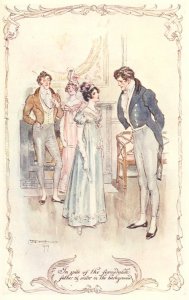
Anne and Captain Wentworth, Ch 20
Anne and Captain Wentworth in front of her “formidable” family (CE Brock, Public Domain)

I said in my Volume 1 post that I’d talk about the Navy in this post, but I’ve ended up talking about other things. However, it’s worth mentioning that in Persuasion, Jane Austen, who had two Naval brothers, presents the Navy positively, as family-oriented men whose values draw more from having good relationships with their families and their “brother” officers  than from status/position. Here is Anne watching Admiral and Mrs Croft in Bath:

They brought with them their country habit of being almost always together. He was ordered to walk to keep off the gout, and Mrs. Croft seemed to go shares with him in everything, and to walk for her life to do him good. Anne saw them wherever she went. …  Knowing their feelings as she did, it was a most attractive picture of happiness to her. She always watched them as long as she could, delighted to fancy she understood what they might be talking of, as they walked along in happy independence, or equally delighted to see the Admiral’s hearty shake of the hand when he encountered an old friend, and observe their eagerness of conversation when occasionally forming into a little knot of the navy, Mrs. Croft looking as intelligent and keen as any of the officers around her.

This continues her feelings from late Volume 1 when the visiting party in Lyme had spent time with Captain Wentworth and his naval friends. She saw their hospitality, their lack of “the usual style of give-and-take invitations, and dinners of formality and display” that typified her circle. “These would have been all my friends,” she thinks, and the idea lowers her spirits. It’s surely no coincidence that in this novel Austen presents some of the worst of the aristocracy with its focus on appearance and position against the best of the Navy with, as Louisa notices, “their friendliness, their brotherliness, their openness, their uprightness”.

And then there’s the last line of the novel:

She gloried in being a sailor’s wife, but she must pay the tax of quick alarm for belonging to that profession which is, if possible, more distinguished in its domestic virtues than in its national importance.

What does this mean, besides the point that being married into the Navy means you will always have the worry of war? Many have discussed the meaning of “more distinguished in its domestic virtues than in its national importance”, with some believing that it is Austen suggesting a new world in which the professional classes, the middle class, represented here by the Navy, is gaining ascendance in English life.

What do you think?

Jane Austen’s Persuasion, Vol. 1

Jane Austen, Persuasion

My Jane Austen group is reading Persuasion – eleven years since we last did it – because 2017 is the 200th anniversary of its publication. Of course I’ve read it several times, so, as you’ll know from my other Austen re-reads, my aim here is to focus on reflections from this read rather than to write a traditional review.

You’ll probably also know that my group often does slow reads of her novels, a volume at a time. Persuasion was published in two volumes, so last month we read Volume One. It finishes at Chapter 12, just after Louisa Musgrove has her fall at Lyme. This post is about this volume.

But first, I want to say something my relationship with Persuasion. I first read it in 1972 when the second TV miniseries was screened in Australia. I was reading it in tandem with the screening, and the night the last episode screened I sat up late to finish the last chapters. I’ll never forget my emotional response to it. I can’t remember whether the miniseries was a good one, but I sure thought the book was. Why?

Persuasion doesn’t have the sparkle of Pride and prejudice, nor the  young spoofy humour of Northanger Abbey, nor even the heroine we love to laugh at in Emma, but it is quiet, emotional and deeply felt. Its heroine Anne, at 27 years old, is Austen’s oldest. She’s caring, intelligent, but put upon by her unappreciative family – and yet we don’t feel she’s a pushover. The novel’s romance, when it comes, feels right and well-earned. No-one ever says that Austen should not have married Anne to her man the way some do about some of her other heroines such as Marianne in Sense and sensibility, and Fanny in Mansfield Park. No, when it comes to Persuasion, Austen fans are generally in agreement: it’s a lovely book in which the hero and heroine belong together. But, it’s about so much more too …

I’m not going to provide a summary, so if you need to refresh yourselves on the plot and characters please check Wikipedia.

A specific setting

I’m not sure why it is, but on this my nth (i.e. too many to count) reading of Persuasion, I suddenly noticed that it was the only book, really, that gives us a very specific date and that is set pretty much exactly contemporaneous with when Austen was writing it. It starts in “this present time, (the summer of 1814)” and ends in the first quarter of 1815. This period pretty much covers the hiatus in the Napoleonic Wars when Napoleon was exiled to Elba – and is why Naval Officers are out and about, on land and available for appearing in Persuasion! Sir Walter’s friend and advisor, Mr Shepherd tells him:

This peace will be turning all our rich Navy Officers ashore. They will all be wanting a home.

It is the appearance of the Navy and Austen’s contrasting the substance of naval officers with the superficiality of the aristocracy that gives Persuasion its particular interest – beyond its lovely story, I mean. It is very much a book about social change. (I should say, here, that Austen was partial to the Navy, having two successful Naval brothers)

Two themes

Anyhow, this idea and that relating to persuasion are developed in Volume 1 through various themes, two of which I’ll discuss here.

Appearance and Social status

That social status is a major concern is heralded on the book’s first page when we are told about Sir Walter’s favourite book: “he was a man who, for his own amusement, never took up any book but the Baronetage”. The narrator tells us soon after that:

Vanity was the beginning and the end of Sir Walter Elliot’s character; vanity of person and of situation.

However, he has not been sensible with his money, and needs to rent out his home Kellynch-hall, hence my earlier quote. But, Sir Walter doesn’t like the Navy, and his reasons convey two of the novel’s themes – the focus on status and the cult of appearance. His response to the idea of renting his home to a Naval officer is:

Yes; it is in two points offensive to me; I have two strong grounds of objection to it. First, as being the means of bringing persons of obscure birth into undue distinction, and raising men to honours which their fathers and grandfathers never dreamt of; and secondly, as it cuts up a man’s youth and vigour most horribly; a sailor grows old sooner than any other man …

This is of course ironic, because the naval officer, Admiral Croft, to whom he eventually agrees to rent the place is a thoroughly decent man (who removes Sir Walter’s myriad “looking glasses” when he takes residence). Croft also, Anne “fears”, looks after the Kellynch estate and its people far better than her family did. However, for Sir Walter, the only thing that matters is status.

As the novel progresses, the difference between the Navy and the aristocracy is further developed, but more on that anon.

Anne’s sister Mary is highly aware of her status as a Baronet’s daughter, and the “precedence” due to her. That she stands on this demonstrates her superficiality and lack of decent human feeling. She complains when she goes to her in-laws’ home that her mother-in-law does not always give her precedence. One of her sisters-in-law complains to Anne:

I wish any body could give Mary a hint that it would be a great deal better if she were not so very tenacious; especially, if she would not be always putting herself forward to take place of mamma. Nobody doubts her right to have precedence of mamma, but it would be more becoming in her not to be always insisting on it.

Later, after Louisa’s fall at Lyme, when it is suggested that calm, capable Anne remain behind to care for Louisa, Mary objects:

When the plan was made known to Mary, however, there was an end of all peace in it. She was so wretched, and so vehement, complained so much of injustice in being expected to go away, instead of Anne;—Anne, who was nothing to Louisa, while she was her sister …

Here again is Mary’s misplaced sense of “precedence”. It is also a lovely example of Austen’s plotting, because only a few chapters earlier Mary had refused to stay home from a family party to look after her own injured little boy, preferring Anne do it. Austen had set us up nicely to see the superficiality of Mary’s desire to care for her sister-in-law. The more you read Austen, as I’ve said before, the more you see how fine her plotting is.

Strength of character versus Persuasion (or the influence of others)

Another ongoing issue in the novel concerns strength of character. Captain Wentworth reflects on Anne’s lack thereof in refusing their engagement when she was 19:

He had not forgiven Anne Elliot. She had used him ill; deserted and disappointed him; and worse, she had shewn a feebleness of character in doing so, which his own decided, confident temper could not endure. She had given him up to oblige others. It had been the effect of over-persuasion. It had been weakness and timidity.

A little later, he praises Louisa Musgrove’s strength of mind, but we, the reader, realise her pronouncements are theoretical. She had not been put to the test. She says:

What!—would I be turned back from doing a thing that I had determined to do, and that I knew to be right, by the airs and interference of such a person?—or, of any person I may say. No,—I have no idea of being so easily persuaded. When I have made up my mind, I have made it.

Meanwhile, Louisa shares gossip about Anne, suggesting that Lady Russell, who had discouraged Anne from marrying Captain Wentworth, had also discouraged her from marrying Charles Musgrove (which of course reinforces for Wentworth the idea of Anne’s weakness of character).

… and papa and mamma always think it was her great friend Lady Russell’s doing, that she did not.—They think Charles might not be learned and bookish enough to please Lady Russell, and that therefore, she persuaded Anne to refuse him.

In this case, though, the decision was all the then 22-year-old Anne’s – but Wentworth only hears the gossip.

Henrietta adds to the chorus about Lady Russell’s persuasive power:

I wish Lady Russell lived at Uppercross, and were intimate with Dr. Shirley. I have always heard of Lady Russell, as a woman of the greatest influence with every body! I always look upon her as able to persuade a person to any thing!

You can see Austen building up the plot here, leading us to see Wentworth as unlikely to be interested in Anne again.

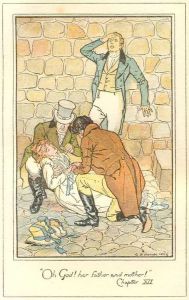
Persuasion, Lyme fall, CE Brock
Oh God! her father and mother (CE Brock, 1893?)

Anne, though, sees that firmness of character can go too far, that Louisa’s wilfulness against the advice of others had resulted in her potentially life-threatening fall. She wonders

whether it ever occurred to him now, to question the justness of his own previous opinion as to the universal felicity and advantage of firmness of character; and whether it might not strike him, that, like all other qualities of the mind, it should have its proportions and limits. She thought it could scarcely escape him to feel, that a persuadable temper might sometimes be as much in favour of happiness, as a very resolute character.

Will he see it her way? We’ll have to read Volume 2 to find out!

There’s a lot more I could say, but I think I’ve said enough. Next post I plan to take up the Navy issue a bit more …