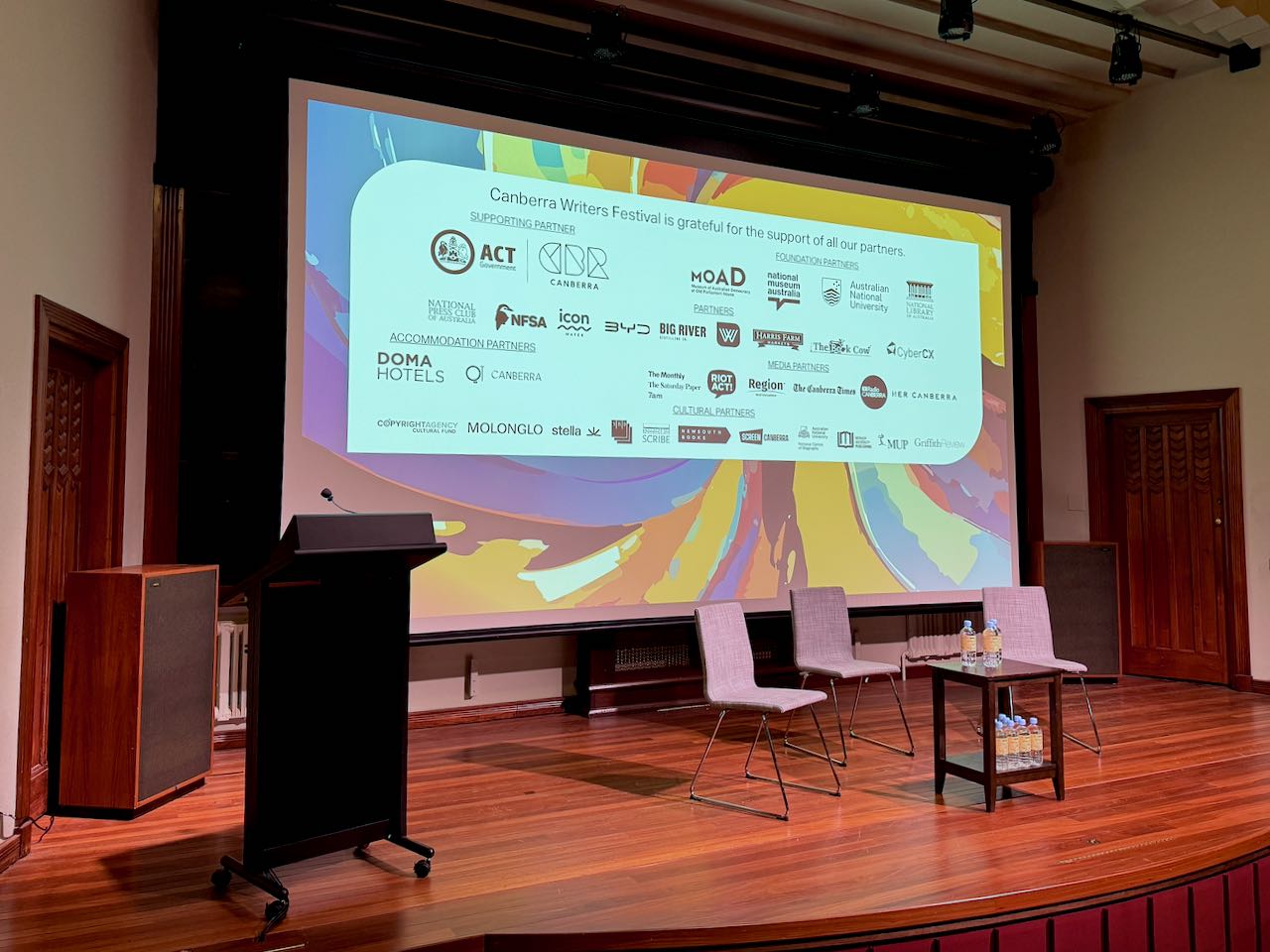
In 2019, I wrote a detailed wrap-up of that year’s Canberra Writers Festival, and I thought to do one this year, though I didn’t have the fascinating stats I had in 2019. However, with this year’s festival bumping up against November, which is a very busy month in the blogosphere, I’ve decided to scale down my plans and just share some ideas which caught my attention, mainly because they popped up more than once in the six sessions I attended.
Many of the ideas related to the ideas that drive the authors or that affects their writing lives.
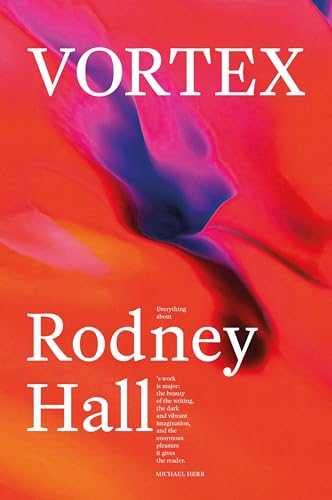
- Who are the decisionmakers, how are things being decided: Rodney Hall and Catherine McKinnon, in slightly different ways, indicated that these questions drive much of what they write. Hall said “we don’t know when the things that affect our lives are hatched”, and that too often we react (and act) without asking “why” things have happened. Similarly, McKinnon is interested in understanding our governments and the decisions they make, in thinking about who we are trusting to make decisions.
- Writing about the self: While autofiction and writing about the self are a strong trend of modern writing, they don’t appeal to all writers. Not surprisingly, the self-described classicist Rodney Hall is one of these. He sees his classicism as being out of step with his peers, whom he admires but who are interested in more personalised expression, because people “want the dirt of what you are yourself”. Robbie Arnott was more forthright. He sees the modern focus on writing on the self as raising mundanity to art. (I can enjoy both – it’s all about degree!)
- Writing to encourage feeling in readers: Robbie Arnott and Anita Heiss were both very clear about wanting to make people feel. Heiss wants readers to feel with her characters. She see this as the power of fiction. (In fact, she suggested this differentiated fiction from nonfiction, which I can’t agree with. I know I’m not the only one who has been powerfully moved by nonfiction. As a blog-reader wrote to me, what about Anne Frank’s diary, for a start?) Arnott was also vey clear about his goals in this regard. For him, the aim of fiction is not to render the world as it is but how it feels. He starts by looking for the emotion.
- Historical fiction, and looking at what it is about NOW that the past can illuminate: Once upon a time I avoided historical fiction, but that time has long gone, because I’ve learnt that historical fiction can explore ideas that speak to me. Catherine McKinnon and Emily Maguire both talked about the relevance of historical fiction to now. First, there’s the issue of retrieving history that has been lost (the role played by women, for example, or queer lives), because it didn’t meet the prevailing (often patriarchal) mindset. But McKinnon also talked about how you look for the story you want to tell now – at what it is about now that you want to speak to, at what it is about humans that is interesting to us now. So, the 2005 Oppenheimer-biography, American Prometheus was, she felt, about how people could be picked up and then dropped, but she was interested in decisionmaking (and how it can be petty).
- On living in our loud, noisy, controlling, egotistical world: Charlotte Wood and Robbie Arnott both referred to this (but would have covered it more in the session I couldn’t attend due to a clash, The power of quiet): Wood said she understands the appeal of asceticism in our “you-can-have-everything world”, bur recognises that the idea of “obedience” (versus wanting to argue) is a challenge for the ego in our egotistical world. Arnott’s quietness is based in his focus on landscape and nature. Both, at least as I heard them, see value in withdrawing (at least for a while) from the noise that can get in the way of being.
Some ideas, not surprisingly, related more to their craft.
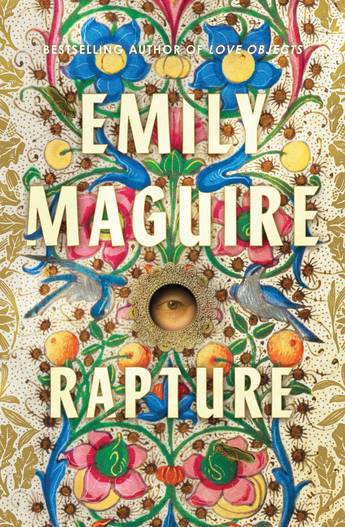
- The craft: What I heard was writers knowing (or learning) how much the craft of writing does the job they want, rather than focusing on plot or character, for example. A good structure, the right voice, sentences that do something – these are what makes writing come alive, what makes their stories work. Structure, for example, is fundamental to what Rodney Hall does. Arnott talked about crafting his books sentence-by-sentence. Maguire and Wood talked about “propulsion” in their narratives coming from the language, the sentences, the voice. “If the voice is strong”, said Wood, “the reader will follow along. It’s propulsive. That’s the key.”
- Writing as a vocation, that is, as something you must do, kept coming through, and was specifically mentioned by Charlotte Wood, Emily Maguire, and Robbie Arnott. It’s their sacred place.
None of this is mind-shatteringly new, I suppose, but these ideas interested me for different reasons – usually related to the context in which they were explored, or the slant or angle they were given. I hope you find something of interest here.
So, does anything here speak to you?




 Whispering Gums