Poetry at the Gods … with Les Murray

What can I say but that it was wonderful to be in the presence of the man who is arguably Australia’s greatest living poet, Les Murray. Poetry at the Gods is a monthly event which has been run for many years by local poet Geoff Page*. (The Gods is a cafe-bar attached to the Australian National University’s Arts Centre.) I have only managed to get to a few readings over the years but, having had to miss Murray in the past, I was darned sure I was going to make it this time. Not only did I get there, but I got my copy of his Selected poems (Black Inc, 2007) signed. Woo hoo!

Before continuing, I should briefly explain Murray for non-Australians who may not have heard of him. His career has spanned over forty years. He has won multiple awards, has published many volumes of poetry (not to mention verse novels and prose works), is on the National Trust of Australia’s 100 Living Treasures, and is often spoken of, here at least, as a Nobel Laureate contender. I must admit that I don’t always get his poetry – but I enjoy the challenge. That’s poetry isn’t it?

Les Murray, Best 100 poems

Courtesy: Black Inc

Now to the evening. Murray read in two “sets” both lasting around 30 minutes. The first set comprised unpublished (I believe he said) poems written in recent years, while the second came from The best 100 poems of Les Murray published by Black Inc in 2012. (I am currently reading their Best 100 poems of Dorothy Porter).

I’m afraid I can’t tell you much about the reading. As much as I love attending poetry readings, because it is special to hear poets read their own poems, I find it hard to report on them. No sooner is one poem read, than the next one starts. It’s impossible – for me anyhow – to process the poems and say something meaningful about them as a whole. I will however make a few scattered observations.

I’m not sure how much Murray, now 75 years old, had planned in advance what he was going to read, but it looked pretty impromptu. In both “sets” he simply (simply?) flicked through the book he was reading from and chose poems he seemed to feel like reading. Sometimes he provided a few words of introduction to the poem, sometimes he didn’t. Sometimes he gave a little chuckle before or after, and sometimes he didn’t! In the first half, the poems ranged across such diverse subjects  as an apartment block in Beijing, English as a second language, and the challenge of writing haiku. I wish I had them before me. The variety spoke to an active, curious mind, to the poet’s ability to draw something beautiful, meaningful, from pretty well anything, which is what we want our poets to do, isn’t it? Oh, for such a mind.

In his second set, he read some poems that I do have before me, poems such as “The future”, “Postcard”, Lyrebird” and “Dead trees in the dam”. One that has stuck in my memory is the poem about his son who has autism. Titled “It allows a portrait in line scan at fifteen”, it was written when his son was fifteen, and perfectly conveys what I understand to be the experience of living with autism:

Giggling, he climbs all over the dim Freudian
psychiatrist who told us how autism resulted
from refrigerator parents

The poem conveys the split between the person and “it”, the condition. There’s humour, frustration and anger, as much the son’s as the parents’. Murray conveys the fascination with facts and rules, the focus on objectivity, the prodigious memory, that can be typical of autism. The final lines are heart-rending:

He surfs, bowls, walks for miles. For many years
he hasn’t trailed his left arm while
running.
I gotta get smart! looking terrified into the
years. I gotta get smart.

Religion is important to Murray. In fact, the two books of his that I have are dedicated “To the glory of God”. However, his poems are not, overall, self-consciously religious, are not dogmatic but many are informed by a faith in and an understanding of religion. In this context and as one who likes thinking about words and truths, I enjoyed poem “Poetry and Religion”. Here are the opening lines:

Religions are poems. They concert
our daylight and dreaming mind, our
emotions, instinct, breath and native gesture

into the only whole thinking: poetry.
Nothing’s said until it’s dreamed out in words
and nothing’s true that figures in words only.

And that, I think, is as good a place as any to end on, don’t you think?

*I’ve reviewed his verse novel The scarring.

Monday musings on Australian literature: Writing the Australian landscape (3)

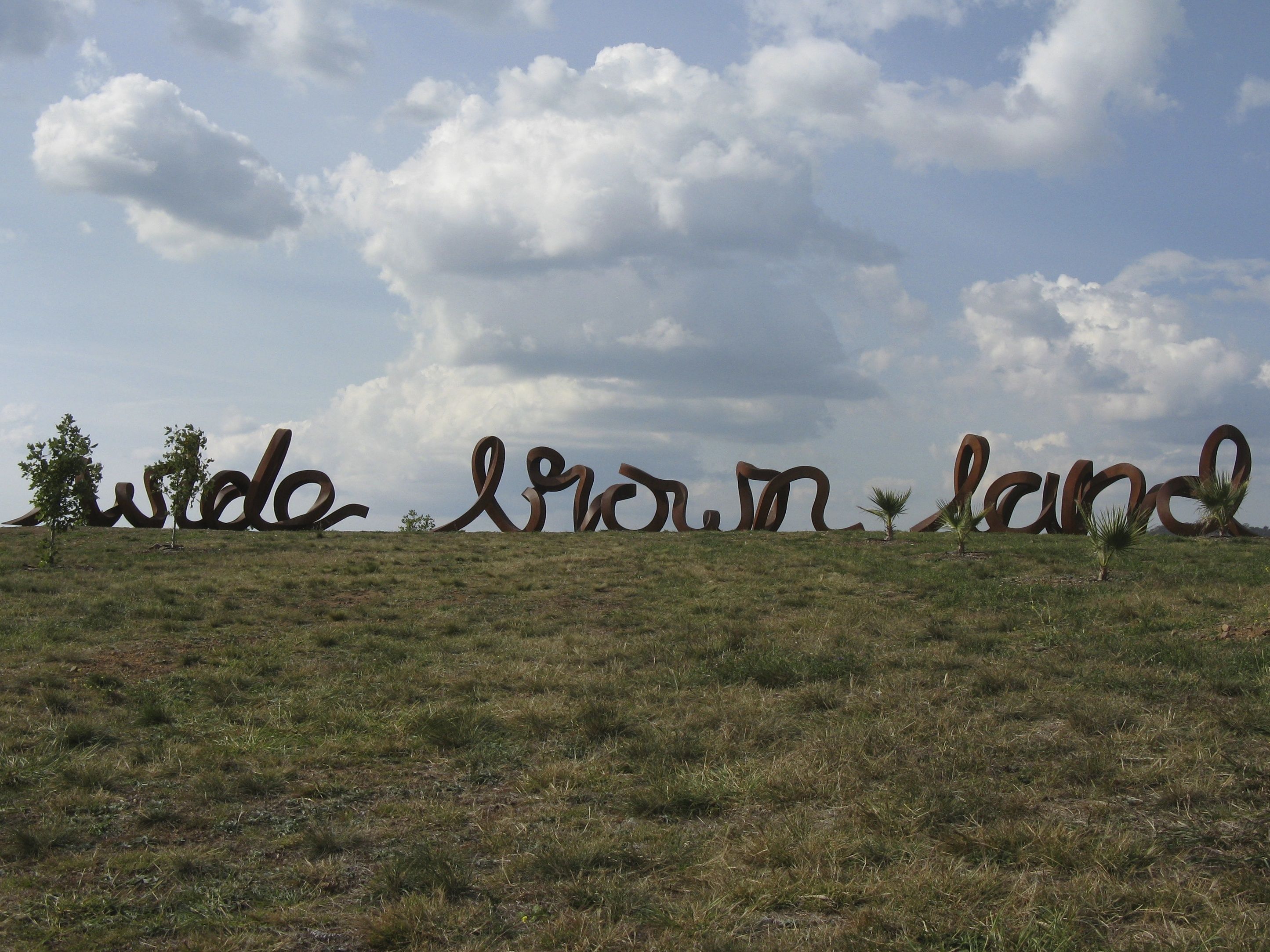
Wide Brown Land sculpture

Wide Brown Land (National Arboretum)

Back in August I wrote two posts (here and here) about the National Library of Australia’s conference, Writing the Australian landscape. At the time I said that I would provide a link when the talks became available on-line.

Well, they apparently went on-line a month or so ago and the NLA very kindly tweeted the fact to me. However, I was overseas at the time and having a semi-break from constant on-line connection – and have consequently only caught up with the tweet now. Better late than never eh?

So, if you are still interested in checking out any of the wonderful talks I discussed in my posts, here is the link.

As you may remember from my posts, I found it all excellent, but if I had to recommend some to you, these would be the ones:

  • Murray Bail‘s keynote address on day 1, which was provocative about what he sees as our (Australian) need to define ourselves by our landscape. He concluded by asking readers to be “explorers” and open to new ways of writing, to not expect “landscape” to be the way into Australianness.
  • Bill Gammage‘s keynote address on day 2, which was provocative in a different way, arguing that there is a progression from notions of “landscape” and “place” to “country” which, in indigenous terms, is synonymous with “culture”. He argued that we still “view” the land as outsiders, rather than seeking to relate to it in a more spiritual, organic way, and challenged us to be willing to learn from indigenous Australians.
  • Jeanine Leane’s paper which, among other things, confronted us with our (that is, white/non-indigenous) preconceived notions about what we define as Australian classics. Now I have the paper I can quote directly. It was powerful. She said:

Through Xavier Herbert, Patrick White, David Malouf & more recently Kate Grenville who among others have been hailed as nation writers & what I saw and still see to some extent in Australian literature to date is a continuous over-writing of settler foundation stories which overwrite Aboriginal experience and knowledge. Settlers are always re-settling and Australian literature really reflects this and the critics and scholars write of such works as if everyone reading it is also a settler reader.

It is very hard, Leane showed us, to step outside our own world-view … but that’s why we read, talk about reading, and listen to readers and writers isn’t it? I certainly found my world-view shifting as we went through the weekend. How do I, as a non-indigenous Australian, need and want to relate to this land I also call home. It would be presumptuous to try to relate to it as an indigenous person does. But we are lucky here to have people with such a deep knowledge of and relationship with the land. We can learn a lot from them: practical things about how to care for the land, and, perhaps more importantly, what a true relationship with the land really means and the responsibility accompanying that.

Anyhow, I’m very glad to be able to share the link to the papers, and would love to hear from you if you do read any of them.

Monday musings on Australian literature: GenreCon

I returned from seven weeks of gallivanting abroad to several emails* about something called GenreCon, which will take place next week from October 11 to 13 at the State Library of Queensland. I hadn’t heard of this before, which is probably not surprising as it seems to be a new event. As you’ve probably guessed from the title, GenreCon is, as the website puts it:

… a three-day convention for Australian fans and professionals working within the fields of romance, mystery, science fiction, crime, fantasy, horror, thrillers, and more. One part party, one part celebration, one part professional development: GenreCon is the place to be if you’re an aspiring or established writer with a penchant for the types of fiction that get relegated to their own corner of the bookstore.

Readers here know that genre fiction is not my speciality, but that doesn’t mean I never read it, or that I’m not interested in keeping an eye on what’s happening to it, particularly in Australia. In fact, I’ve become far more aware and (generally) knowledgeable about genre fiction since my involvement with the Australian Women Writers’ Challenge – and that, I think, is a good thing. I have read and reviewed a few books this year that would fall under the genre hat, such as Anita Heiss‘s Paris dreaming (my review), Krissy Kneen‘s Steeplechase (my review), and Courtney Collins’ The burial (my review), and I’ve enjoyed each one, for different reasons.

As is usual at these sorts of events, there will be a number of international and national guests, some “author” and some “industry” as they put it. Australian author guests include she-who-needs-no-introduction-here Anita Heiss (my, she’s a hard-working woman), thriller writer Kathryn Fox, jack-of-all-trades writer John Birmingham, and romance writer Anne Gracie. Industry guests include reviewers, editors, and publishers. And again, like many conferences, there will be program streams: “the craft of genre writing, business and industry awareness, and researching for fiction”.

In the run-up to the conference, AustLit (about which I wrote a few months ago) has been sending out regular emails suggesting how its scholarly database reflects, or can be used to research, Australian genre fiction. For example:

  • AustLit has developed, since 2009, the Australian Popular Medievalism dataset, which lists Australian-written works (published between 1995-2010) featuring medieval ideas/settings. It’s currently a research project, but let’s hope the time-period is extended to cover all-time so that it can become a useful resource.
  • you can search on such topics as fairytales appearing in Australian genre fiction, or norse and germanic myths, or, presumably, a wide range of other topics, but these are the examples AustLit gives because they relate to conference topics.
  • media tie-in fiction (that is, fiction inspired by other media such as films, television, games) is an active segment of the genre world, but has attracted somewhat uneven scholarly attention to date.

In other words, while genre fiction may be at the lighter more fun end of the reading spectrum, it is nonetheless worthy of serious analysis and research. After all, if you want to know how people lived, what they thought, what influenced them, in a particular time, popular culture is a critical place to start. It’s important therefore that data be collected now … and so I’ve enjoyed AustLit’s taking up the gauntlet and demonstrating its contribution to the genre discussion.

I hope the convention goes well, and look forward to reading some reports of it after the event.

* Yes, I know I can read emails while I’m away but life was pretty busy on the road, and so I limited my reading to emails from family and friends. Consequently, I returned to a gazillion emails in my inbox waiting my rapt attention. Ha!

Monday musings on Australian literature: Writing the Australian landscape

Wide Brown Land sculpture

Wide Brown Land (National Arboretum)

This weekend just gone I had the privilege – well, I paid to go, but still it was a privilege – to attend a conference at the National Library of Australia titled Writing the Australian landscape. You can see why I had to go … wild brumbies couldn’t keep me away.

But if, perchance, the topic hadn’t attracted me, the line-up of speakers sure would have. They included:

There wasn’t a boring one among them. (The full list of speakers, and chairs, is available online) Kudos to the National Library* for putting together an excellent program and to the speakers who had all taken the topic seriously and offered much for the audience to think about. I think I can speak for all who attended when I say that we laughed, cried and winced (though perhaps not always at the same things.)

All that’s by way of introduction. Now I’d better do the hard yakka and share some thoughts and ideas, but that’s not going to be easy.

I’ll start with a little manifesto, if I can call it that. The way I see it, to be a white (non-indigenous) Australian today is to feel a little uncomfortable. Many of us love being Australian, love the land or country we call home, and yet are aware of the cost to others of our being here, of the dispossession we brought to others. But, we can’t be ashamed of being western**. That’s our heritage, that’s what informed our thought processes. However, we can be ashamed of assuming that others think the way we do and, worse, of assuming that others want to think the way we do (or be the way we are). My – our – challenge is to be open to other ways of thinking, to respect them and to learn what we can from them. While almost all the conference speakers were non-indigenous, there was a lot of goodwill amongst the speakers and the audience in the room, a lot of willingness to open our eyes. Please read my notes on the conference with this in mind.

Why write (about) the landscape?

And so, I really do have to start now. The conference got off to a rather provocative start with Miles Franklin award-winning author Murray Bail giving the Kenneth Binns lecture. Speaking from his western-writer standpoint, Bail was concerned that we were even having the conversation. Other western literatures, he argued, are not preoccupied as we are with landscape and, related to that in his mind, with national distinctiveness. Did Tolstoy, he asked, worry about his “Russianness”? No, he said, we read Tolstoy for the moral questions he explores, to learn how to live, be happy, be wise. For Bail, landscape is a New World concern, which that quintessential New World country the USA has now shaken.

Bail suggested that only when we are at ease with ourselves will our need to discuss place (or landscape) fall away. I found this a fascinating idea and will be thinking about it for a long time:

  • Is our fascination with landscape a bad thing?
  • Is our landscape so different, so forbidding, that it will always play on us? (But then, aren’t other landscapes, such as the Siberian desert forbidding?).
  • Does our particular history of occupation and dispossession mean that place and landscape will for a long time yet be a fraught issue?
  • Will the fact that for indigenous Australians morality is tied to the land, to country, mean that considering landscape will always be part of our literature?

What does (the) landscape mean?

Historian Bill Gammage gave the keynote address on the second day. His focus was very much on indigenous relationship to land, to country, which is the subject of his most recent multiple award-winning book The biggest estate on earth. His argument was that “country” is not about nature (about landscape) but about culture, and that non-indigenous Australians could learn a lot about our country by learning from indigenous Australians what they know and are able, within their laws, to tell us. I loved his glass-half-full statement that the point is not how much knowledge indigenous Australians have lost but how much they still know. Gammage, like Bail, recognised we are challenged by our landscape, but his conclusion was not that we should aim to stop writing about it but How long must we continue to write our landscape as outsiders?

I will share more from the weekend – including Jeanine Leane’s powerful paper – but for now these two keynote papers nicely encapsulate the weekend in which we explored the progression from Landscape to Place to Country to Culture.

* I understand audio and printed versions of the talks will be available on the NLA’s website. I’ll provide a link when they become available.

** * Yes, I know, not all non-indigenous Australians are western but I’m using this partly by way of comparison, and partly because it’s my heritage. And yes, we can be ashamed of things westerners have done but not, I think, of being who we are.

Monday musings on Australian literature: Notes on the Sydney Writers’ Festival from a non-attendee

One day I swear I will get to the Sydney Writers’ Festival – properly, I mean. I have been to one session once, but that barely counts. Late May, though, tends to be one of my busiest times of the year, so the years pass and I don’t get to the Festival. I do, though, try to follow it a bit, and so today I thought I’d pass on a few, very idiosyncratic things, that I’ve picked up around the traps.

Discovering new writers

Festivals are great for discovering new writers. Although I watched Q&A last week and enjoyed the panel discussion with several writers from the Festival, my festival experience really started on Thursday with Michael Cathcart’s live interview with South African writer Lauren Beukes (broadcast on Books and Arts Daily on Radio National). Not being a big reader of psychological thrillers, I hadn’t heard of her before and wasn’t really sure I’d be interested in the interview but I would have been sorry to have missed this. Cathcart asked some pointed questions, including the implications of writing in detail about violent acts against women. Beukes, though, was up to the challenge. She spoke of how the real victims of violent crimes tend to be just names, that we don’t hear their stories, that we are never encouraged to think about the sort of deaths they faced – the terror, the pain, they go through before they die. She wrote her latest novel The shining girls from the girls’ points of view because she wanted us to know them, to empathise with them, though she recognised that titillation is also always there in the genre. She also set this novel in Chicago, not South Africa where rape and violence against women are rife, because she wanted to make it clear that there’s violence and corruption everywhere, not just South Africa.

Beukes believes that fiction has a social function. She writes, she said, because there are things we need to talk about. She doesn’t write to lecture, to specifically change people’s minds, but to encourage discussion.

For more interviews with writers from the Festival, do check out Radio National, particularly Books and Arts Daily’s page.

Dilettantish interests*

The secret River cover

Famous Chong cover (Courtesy: Text)

An important part of my Festival experience in recent years is reading John’s reports on his Musings of a Literary Dilettante blog. To date, John has written three posts on the Festival. The first was on a session called The Uncommon Reader, a panel discussion with critics James Wood, Geordie Williamson and Jane Gleeson-White, chaired by Tegan Bennett Daylight. In the session these critics named the books that they go to again and again. John’s post is interesting for this alone. Don’t all we readers love to know what books other readers love?

John’s second post was on book design. If you are interested in this topic, do read his post. He reports on what several designers had to say, including Text Publishing‘s award-winning designer, WH Chong. If you read Australian published books you are sure to have seen some Chong covers. John’s post resulted in a discussion (in the comments section) regarding design in the e-book world and the commercial function of design.

John’s third post is a moving tribute to Gillian Mears, author of Foal’s bread (my review), who, many of you will know, suffers from MS and needs to manage her energy carefully. It’s therefore a real treat to see her in public forums. John’s post provides a lovely insight into Mears now – the struggles she’s facing, the things that still interest and concern her, her love of nature and the outdoors, her change of mind concerning euthanasia, and, despite it all, her sense of humour.

Flying high … on poetry, stories and creativity*

This year, I also read another blogger’s reports, Jonathan of Me Fail? I Fly. Jonathan went to two days of the festival. In his first post Jonathan describes a few events, starting with the launch of four chapbooks of poetry by the poets, David Malouf, Robert Adamson, Martin Harrison and Adam Aitken. I loved Jonathan’s comment that “The mutual respect and affection among the five people [including poet Luke Davies who launched the books] on the dais was something wonderful: completely the opposite of the internecine strife for which poets are supposedly famous”. Jonathan then went to another poetry event, Harbour City Poets, at which five poets, Margaret Bradstock, John Carey, David Musgrave, Louise Wakeling and Les Wicks, read. His post concludes on two more events that day: Robert Green on Creativity and Stories Then and Now. This post gave me a good sense of how busy attending festivals can be – particularly since Jonathan had to rush home in the middle to feed his dog!

On his second day at the festival, Jonathan attended two events: Writers who blog with Mark Forsyth, Tara Moss, Lorraine Elliott and Angela Meyer, and Beyond Climate Denial on a Neoliberal Planet with Jeff Sparrow, Robert Manne and others. I was of course most interested in his report of the blogging session. Jonathan says he managed to ask the first question at the end of the session:

I asked about difficulties with comments. Mark had a ready, sensible answer: ‘Don’t start an argument on the Internet.’ Tara took the microphone: ‘My advice is, Start arguments on the Internet.’ They were both right, of course. I liked Tara’s final note: ‘When you do get into an argument, don’t say anything you wouldn’t want to see quoted in the newspaper.’

Love it … don’t you?

The Guardian doesn’t like Sydney’s rain

Yesterday’s Guardian (UK) online has an article titled “Ten thoughts to take from the Sydney Writers’ Festival”. The article is more entertaining than usefully edifying, but I did love “Five: on euphemisms” regarding “the sorts of euphemisms reviewers use to disguise their negative thoughts on books”. James Ley said that “‘Interesting’ is a usefully neutral term”, and Susan Wyndham suggested that “ambitious” is helpful, saying that “you don’t necessarily have to say whether the work achieved those ambitions or not”! I have two somewhat contradictory questions to ask you regarding this. Should reviewers disguise their negative thoughts? And, what euphemisms do you use? I must say that I try very hard not to use “interesting”!

But, what really made me laugh was the Guardian‘s parenthetical eleventh thought that “Sydney doesn’t do rain well. Know that you will not be able to buy an umbrella at the festival, anywhere, ever.”  The Guardian people clearly aren’t used to a country where drought is common! It wasn’t until we travelled to Japan that we discovered there are countries which sell umbrellas everywhere.

* I hope I haven’t stolen John and Jonathan‘s thunder. Their posts say much more than I’ve noted here. Do go read them at the links I’ve provided.

POSTSCRIPT: Podcasts are available of some talks. Go to the Sydney Writers’ Festival site and click on SWF Blog tab to find them. Thanks to DKS of Pykk for reminding me.

Woven Words: What a night!

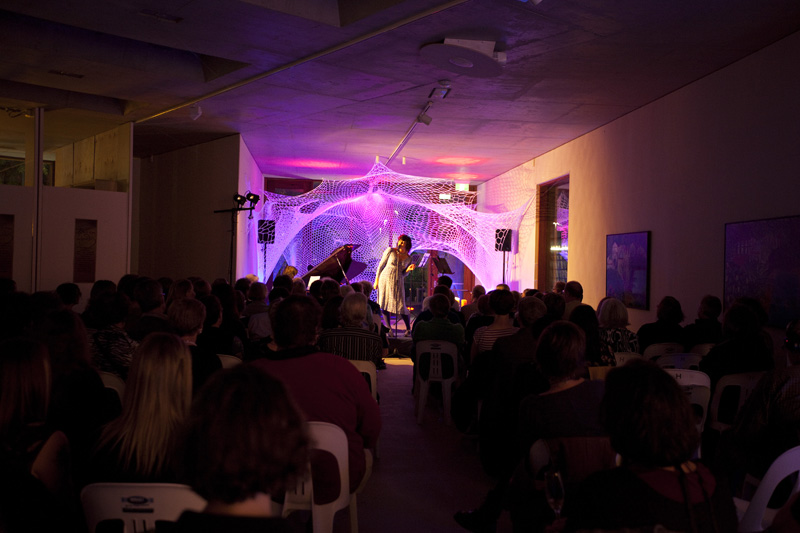
Chanel Cole, Nishi Gallery (Photo: Katherine Griffiths)

Chanel Cole, Nishi Gallery (Photo: Katherine Griffiths)

As we were driving home from Woven Words, the most recent event associated with The invisible thread anthology, it occurred to me that the evening, which blended words with music, was rather like a three movement musical composition. It went a bit like this:

  1. Sara Dowse‘s bright and slightly quirky allegro
  2. Alex Miller‘s intense adagio
  3. Alan Gould‘s cheeky scherzo.

The event took place in an intimate venue in Canberra’s newest inner city precinct, New Acton, which, I understand, is positioning itself as an arts hub. Even before a fire in mid-2011 set the area back, there had been some lovely musical evenings in Flint, one of the precinct’s restaurants. The Nishi Gallery, though, is a very recent player on the block, so recent that I’m not quite sure what its long-term plans are. Last night, however, it became a delightful space in which a gathering of, guessing here, about 100 people heard three great authors read from their works, bookended by music (mostly) chosen by them and performed by local professional musicians. It was, in a word, a blast.

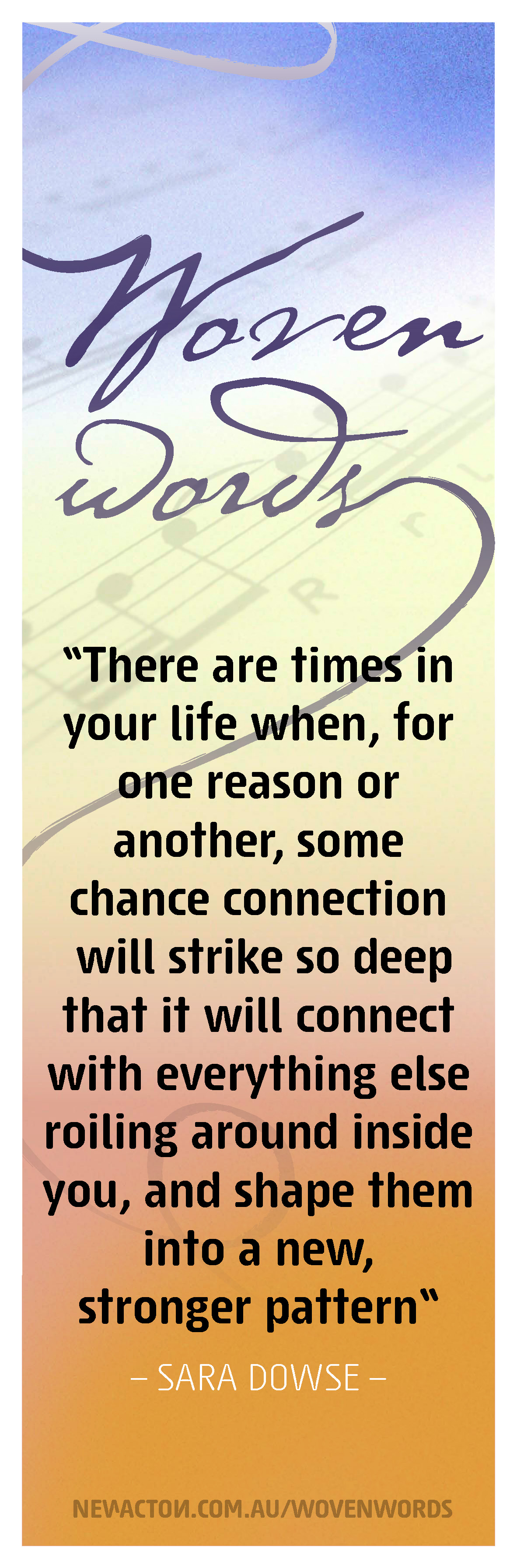
Sara Dowse text

Sara Dowse (Courtesy: NewActon.Com)

After some pre-show piano music performed by Adam Cook, Allegro started with the gorgeous Chanel Cole singing Kurt Weil’s “Speak Low” accompanied by Cook. Sara Dowse chose this because it was the theme song of Ava Gardner‘s film, One Touch of Venus, which is the title of Dowse’s piece in The invisible thread. In it she describes a weekend she spent with Ava Gardner when she was 7 and Gardner about 24. An unusual choice perhaps for a Canberra anthology, but the anthology isn’t solely about Canberra. Dowse’s piece is about those moments in your life in which you learn something precious and lasting. Her time with Gardner provided one of those moments for her. Her movement finished with another jazz piece performed by Cole and Cook, “Old Devil Moon”.

At question time I asked her how someone with such strong creative drive – she sings, writes and paints – ended up working in bureaucracy. She was, for those who don’t know, the first head of the Office of Women’s Affairs which was established by our new reformist Prime Minister, Gough Whitlam, in 1972. Her answer was perfect: They were very creative times, she said.  Can’t argue with that. They were.

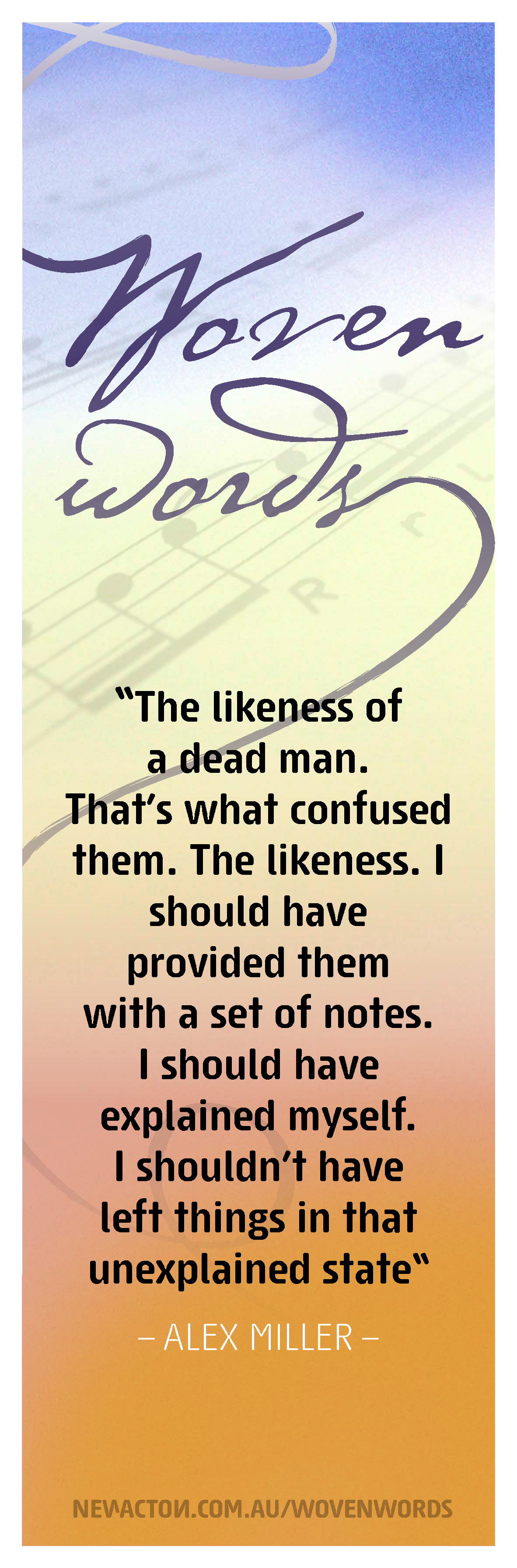
Alex Miller

Alex Miller (Courtesy: NewActon.com)

After a short break, it was time for Adagio, my least favourite movement when I was a young music-lover. I was impatient, wanted something faster, with more beat. Now, though, I’ve learnt to enjoy and love the slow and the opportunity it provides to dwell. Tonight’s Adagio provided exactly that … It was bookended by Adam Cook playing the “City of Carcosa” by Larry Sitsky and the CSO (Canberra Symphony Orchestra) String Quartet playing Samuel Barber’s elegaic “Adagio”. Alex Miller has a love-hate relationship with Canberra, mostly the latter it seems! He earned a polite but forgiving (I think) hiss from the audience when he said that no-one chooses to live in Canberra. Wrong! However, he also said that he felt privileged to be involved in the event.

Miller suggested that writers would like to write music, that music manages to express something that writers never quite achieve. Now that’s something for us to ponder. Has it to do with music being the universal language I wonder? Would all writers agree? He talked about writing – about the importance of voice, about the imagination and the act of “imagining something into being”. How to write his novel, The sitters, from which he read, came while he was sleeping on a plane flight between Los Angeles and Sydney. It is about a portrait artist, and explores the nature of “art” and the relationship between artist and subject. The reading ended on:

It’s a story not an explanation.

I like that … it sounds simple but packs a lot.

Alan Gould

Alan Gould (Courtesy: NewActon.com)

The final movement, Scherzo, belonged to poet-novelist Alan Gould. It started with CSO String Quartet performing Percy Grainger’s “Molly on the Shore”. I noticed Gould’s head, up front, bopping away just like mine. Gould read several poems starting with “The Roof Tilers” which I mentioned in a recent Monday Musings. I love that poem. Gould was an engaging reader, introducing each poem with some background. He read his most recent poem “A Rhapsody for Kenneth Slessor” and “Sea Ballad“. And concluded with two flamenco inspired poems, first describing the challenge of replicating in poetry a flamenco rhythm. He read “Flamenco Rehearsal” and “Flamenco Pair”, at times toe-tapping the rhythm as he went. Appropriately, Gould’s movement ended with guitarist Campbell Diamond performing two Spanish pieces, “Junto al Generalife” by Joaquín Rodrigo and (appropriately) “Finale” by Antonio José.

When asked, at the end, whether a sense of dislocation was important to being an artist, Gould, also a model shipmaker, said that for him it was more a sense of being “oceanic” which he described as “being at home in the unstable element”. That may be why I’m a reader not a writer!

The evening was beautifully em-ceed by ABC 666 Radio announcer, Genevieve Jacobs. She was a charming presenter who engaged well with each writer. And she managed her high heels on the tiny stage with great courage!

The evening had a few little challenges. The microphones did not properly work for the singer who opened the evening, the seats were a little hard after three hours, and the venue has just one all-purpose toilet. These were minor. Far more important was the wine! As an Anything-But-Reisling girl, I do hope a choice of white wine is offered next time …

Seriously though, it was a delightful evening. The writers were generous, the musicians superb. Irma Gold, editor of The invisible thread, is doing a stunning job of exploring and exposing the invisible threads that connect the anthology to other arts, to readers, to Canberra. It’s exciting to be part of it.

POSTSCRIPT: With thanks to Dave, of NewActon.Com, for the images.

Monday musings on Australian literature: Inaugural First Nations Australia Writers Workshop

I had planned another topic for today’s Monday Musings, but when I heard via AustLit News about the inaugural First Nations Australia Writers Workshop to be held in May this year, I decided to write about it sooner rather than later …

The workshop aims to bring together established and emerging writers of Aboriginal and Torres Strait Islander backgrounds with a view to further developing indigenous arts practice. It is being presented by the First Nations Australia Writers Network (FNAWN) and is to be held at the State Library of Queensland, in Brisbane, from 9th-10th May, 2013. The Network was apparently established last year and its Chairperson is Canberra-based Wiradjuri poet, writer, activist Kerry Reed-Gilbert.

The workshop has an impressive line-up of presenters, including writers I have reviewed here:

  • Alexis Wright whose Carpentaria (see my review) won the Miles Franklin Award in 2007. It has been published in many countries and been translated into multiple languages. She has written several other works, and has a new novel coming out this year.
  • Melissa Lucashenko who won the Dobbie award for her first novel Steam pigs. Her latest novel is Mullumbimby (2013). (See my review for her short story “The silent majority).
  • Anita Heiss about whom I’ve written several times on this blog. Her most recent book is her memoir, Am I black enough for you?, which I plan to read and review in a couple of months. Heiss also co-edited The Macquarie PEN Anthology of Aboriginal Literature. (See my review of her Paris dreaming.)
  • Kim Scott whose novel That deadman dance (see my review) won multiple awards including the Miles Franklin Award in 2011. Like Wright, Scott has had several novels and short stories published.
  • Marie Munkara whose Every secret thing (see my review) won the David Unaipon Award in 2008 and whose next novel will be published this year.

Exciting list, eh? Other presenters are Kerry Reed-Gilbert, Bruce Pascoe, Sam Wagan Watson and more, including some new names to me. AustLit News also mentions Tony Birch whose novel Blood was shortlisted for the Miles Franklin Award last year, but I can’t find him on the Workshop’s website. Sharon Shorty, a Canadian First Nation writer, will also be presenting.

The program is broad-ranging with an emphasis on practical issues – copyright, preparing your manuscript, the future of the book, “writing our stories” – which is what you’d expect for a workshop. Creative Partnerships Australia puts it this way:

With the rapid and seemingly constant changes in the publishing and literary sectors it is imperative that Australia’s Indigenous writers embrace the knowledge, technology and global context for the sustainable development of their livelihoods and their art.

If you would like to keep in touch with the Workshop:

Tax-deductible (for Australians anyhow) donations are welcome to support attendance, particularly by writers from remote areas. Click this link if you are able to help.

Monday musings on Australian literature: ACT Writers Showcase

It’s been a good week for literature in the ACT. Not only was the UC Book Project announced but on Thursday, our centenary anthology The invisible thread was launched.

Irma Gold, The invisible thread

Irma Gold, editor, at the launch of The invisible Thread

The launch was a well-organised event: it found the perfect balance between formality and informality, and didn’t run too long! The book was launched by writer Felicity Packard, best known as one of the award winning writers on the Underbelly series. She spoke entertainingly about the invisible threads – people, places, events – between her and the book. It was nicely and appropriately done. She was followed by four readings from the book, three by authors Blanche d’Alpuget, Adrian Caesar and Francesca Rendle-Short, and one by Meredith McKinney, daughter of Judith Wright. Being of a certain age, I related to the fact that Wright’s and Caesar’s poems both dealt in some way with age. Editor Irma Gold concluded the launch with the usual thanks … and the whole was emceed by local radio announcer Alex Sloan. The venue – the New Acton courtyard – was perfect for the warm spring evening. It was a treat to be present.

The invisible thread, by Irma Gold

Cover (Courtesy: Irma Gold and Halstead Press)

Irma has also been interviewing many of the still-living authors included in the anthology. The interviews – and the stylish book trailer – can be seen on her You Tube channel. Well worth checking out during those hazy lazy post-Christmas days if you don’t have time now. Nigel Featherstone whom I’ve reviewed is there, as is the exciting poet and rap artist Omar Musa, as is the new-to-me poet Melinda Smith, as is … well you get the point. More interviews are to be added weekly over the next couple of months.

But, these are not, really, the point of today’s post. At the launch Irma announced another initiative associated with the book – wow, that woman has worked hard. It’s the ACT Writers Showcase, a website dedicated to, obviously, showcasing writers from the ACT. Irma explained at the launch that the anthology includes only 70 of the 100 plus writers considered for it. The showcase is an attempt to ensure that all writers are noticed, promoted and, most importantly, receive the due they deserve. Irma, herself, for example, is not in the book – but she is in the showcase.

Authors can be located via the search box or the writers’ index. There is a brief bio and list of publications for each author, and an excerpt of their work. I’m told this is a pretty unique site – but, whether it is or not, it’s not only a great resource for readers but also makes a significant contribution to documenting “all that’s past and what’s to come”* in ACT literary culture.

Are you aware of any similar initiatives in your corner of the world?

* from “A Valediction”, by Adrian Caesar

Monday musings on Australian Literature: Australian Literary Festivals

I’ve been thinking for some time about writing a Monday Musings on Australia’s Literary Festivals but I have finally been spurred to do it after attending the Canberra Readers’ Festival last weekend. This is partly because I actually managed to attend a festival and partly because the last speaker was Australian literary doyen, Frank Moorhouse, who caught my attention with his statement that literary festivals are really a thing of the last 10-15 years.

Hmm, I thought, is that right? I’ve been aware of literary (and arts) festivals for way longer than that, and I recently read that the Brisbane Writers’ Festival is celebrating its 50th anniversary this year. However, I think his main point was that over the last decade or so they have started to make their presence felt. They are multiplying in number, and attendances are increasing significantly. Moorhouse said that last year over half a million people attended literary festivals in Australia and that this number had increased by 10% on the previous year. The Melbourne Writers’ Festival had around 50,000 attendees this year, and around 80,000 have been attending the Sydney Writers’ Festival since 2007. Wow!

Of course, as a librarian, I wanted to know the source of his information, so I went looking. I didn’t find all the figures I wanted, but I did find find some interesting things to share with you:

  • there is an excellent website (which I have seen before) for Australian Literary Festivals, and they have an associated Facebook page. It’s not foolproof – our Canberra Readers’ Festival was not on it – but it’s a start. It has a calendar, which is always useful for holiday planning!
  • bloggers (of course) blog about festivals they attend – which helps spread the word about how great they are (or can be) to attend. And some bloggers provide lists of festivals, such as writer Jason Nahrung, whom I discovered through the Australian Women Writers Challenge 2012.
  • authors, at least some anyhow, like attending festivals*. Not only do they get to promote their books and engage with readers (through Q&A sessions and book-signings) but they get to meet and talk with other writers! Earlier this year Thomas Keneally said about going to a festival in the USA that “It will be particularly delightful to walk in the presence of other writers in the same streets and districts that formed Tennessee Williams’s sensibility.” Nick Earls has likewise commented on how the Brisbane Writers’ Festival aims “to unite local writers with those from abroad”.
  • literary festivals are about as diverse as literature is itself. There are the big city festivals and the regional festivals (like the now well-known Byron Bay Writer’s Festival which started in 1997); there are festivals devoted to general literature and those that are genre-based; there are festivals which focus on big names and those which foster local writers; there are festivals designed specifically for children and young writers and those for poets; there are those – well, you get my drift. Check the links in my second dot-point above and you’ll see what I mean.
  • literary festivals can rejuvenate dying country towns. Just look at Clunes for example. Who had heard of Clunes, Victoria, 5 years ago? Now every reader worth his/her salt will heard of Clunes and its annual weekend book and literary festival. It started 5 years ago specifically to revive the town and this year earned “a coveted international Booktown listing”. First-day attendance this year “smashed” previous attendances.

The value and role of these festivals is supported by the Federal Government’s major arts funding arm, the Australia Council which, in its Literature Sector Plan for 2012-2014, lists the following under its Sector Issues of Concerns:

The Literature Board welcomes the fact that each year more and more regional towns in Australia are establishing their own writers’ festivals. These, along with the major capital city festivals, form a vibrant infrastructure for Australian literature and provide increased opportunities for writers to earn performance fees and promote their work. However, within the limited financial resources available to the Literature Board, it is not possible to offer support to every applicant.

Ah, money … there’s the rub. Festivals, even small ones, aren’t cheap but they are “a good thing” – for the attendees (wh0, as Moorhouse said, demonstrate by their attendance, a hunger for ideas and discussion) and for the health of the arts and therefore society as a whole.

Do you like literary festivals? Why or why not? And, if so, I’d love to hear which ones you attend, and what makes a good festival for you.

* But they do, funnily enough, like to be treated well. I like this post from an English author on “how not to run a literary festival” from an Author’s point of view.

Canberra Readers’ Festival 2012: For the love of reading

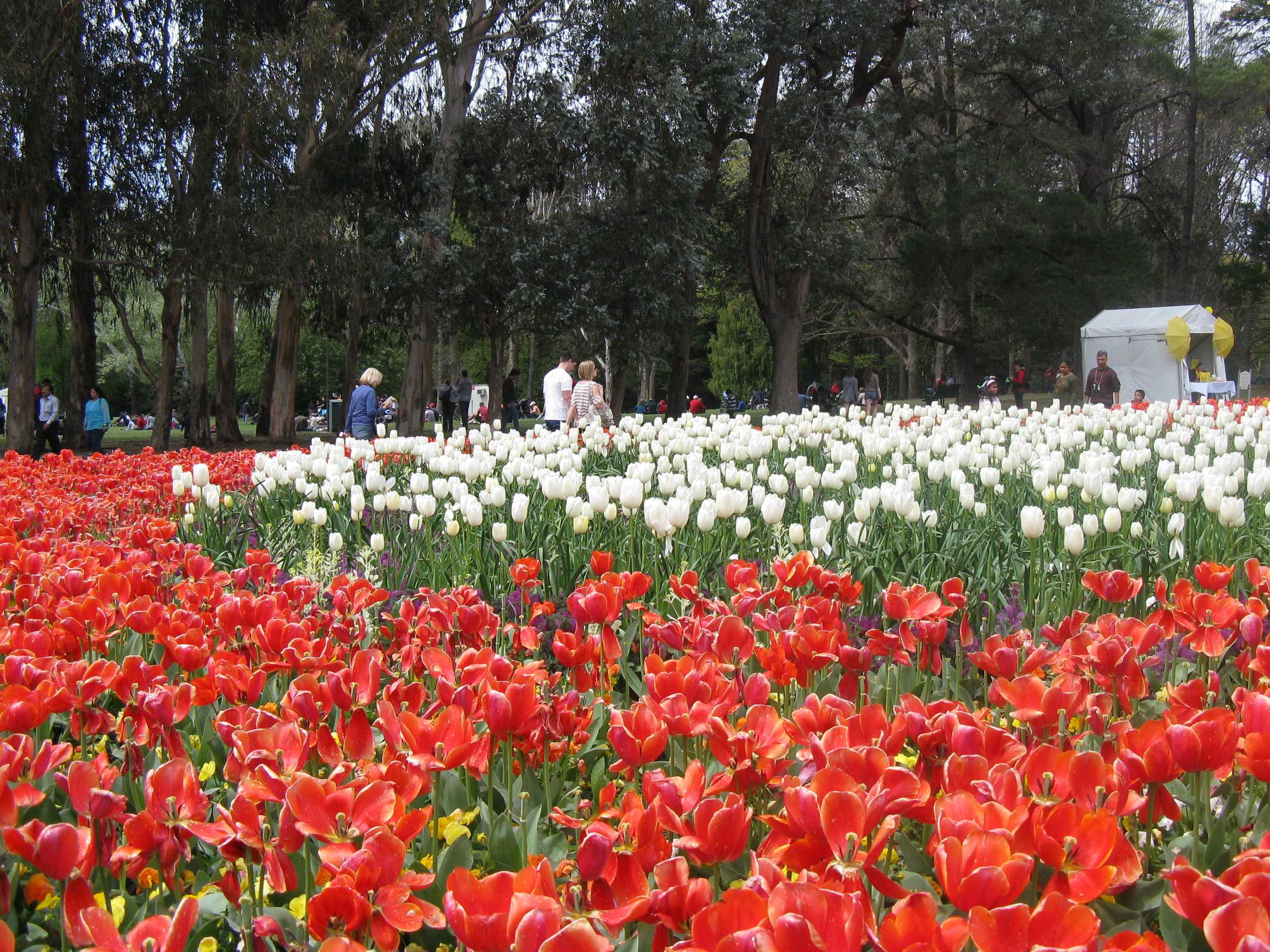
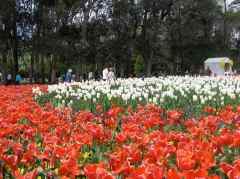
Floriade 2011

Small corner of Floriade 2011: tulips among the gum trees

You could all be looking at tulips …

said Kate Grenville, the first speaker at today’s Canberra Readers’ Festival. She was referring to Floriade, Canberra‘s popular, crowd-drawing annual spring festival, and the fact that today was a glorious day. Just right, in fact, for tiptoeing through the festival’s stunning tulip beds. But instead, we keen readers were in the Playhouse listening to our favourite authors talk about writing and  reading. After all, like Scarlett O’Hara, we all knew that “tomorrow is another day”!

Session 1: Kate Grenville: “Family Stories”

After a generous welcome to country by the local representative of Australia’s original story-tellers, Ngunnawal elder Aunty Agnes Shea, Kate Grenville took the floor – and presented a passionate argument for the importance of capturing and keeping stories. She blessed her mother for insisting on repeating the family stories that eventually inspired her to research and write The secret river – and thence The lieutenant and Sarah Thornhill. She read excerpts from stories written by the 97-year-old John Mackie, and argued that “you can’t make up” the experiences of people from the past, that only by reading what they felt and experienced can you manage to turn them into convincing fiction. Sure, you can do research, she said, but you don’t know what to research if you don’t have the stories to guide you. She wouldn’t have known, for example, to research “a scuffler” if Mackie hadn’t written about one.

Grenville concluded by quoting Australian poet Dame Mary Gilmore who argued for preserving the things of the past. Gilmore wanted to write about people, not events; she wanted to show “not the miles walked but the feet that walked them”.

Session 2a: Anita Heiss: Writing Aboriginal Australia into the literary landscape

What an inspiring and entertaining speaker. Heiss commenced by describing what inspired her to write: she was on an international plane flight and overhead a passenger, whose neighbour had said he’d met “a fourth generation Australian”, responding with “you can’t get any more Australian than that!” This interchange showed Heiss that Aboriginal Australians did not appear on “Australia’s identity radar” and she set about correcting that gap in our awareness. Being tertiary educated, Heiss says she’s in the top 1% of the bottom 2.5% of Australians and consequently believes she has a responsibility to “voice our truths”, to show the commonalities as well as the differences in the lives of indigenous and non-indigenous Australians. She clearly takes this responsibility seriously and has published a significant body of work, encompassing children’s and adult fiction and non-fiction.

Heiss was very clear about wanting to provide a resource for people to understand indigenous experience and identity in Australia. What’s good about fiction she said, is “you can create the world you want to live in”. Having not yet read Heiss, I bought one of her books!

Session 2b: Melina Marchetta: The role of travel in establishing setting

Marchetta’s talk was a more practical one about how she needs to visualise a place before she can describe it. I found this intriguing, particularly as she was talking about her Lumatere fantasy series. She needs to travel to see real places that she’ll describe in fantasy? You can tell I’m not a fantasy reader! It all made sense though when she showed photographs from her travels in France, Turkey, and so on, and read excerpts from her books to show how she used her knowledge of places like the rock villages in France to create her fantasy mediaeval world. She, a little sheepishly, read one excerpt which contained quite a bit of geological data, telling us that the general rule is that your reader should not see your research, but in this case she felt it was justified.

Session 3a: Hazel Edwards: Non-boring anecdultery

Self-described author-preneur (and hippopotamus lady*), Hazel Edwards took us on a lively ride through her writing life, which spans multiple forms and approaches from children’s picture-books to adult non-fiction, from writing on her own to collaborative writing. She loosely structured her talk using the letters from ANECDULTERY – as in A for Anecdote, E for e-Books, N for Non-boring, L for Literary Terrorism, and so on, ending in Y for Why! Her talk was full of the wisdom of an experienced writer, delivered with warmth, confidence and humour. She had some great turns of phrase. For example, she told us that her initial reaction to one research subject was that he’d suffered “a charisma bypass” but she grew to love him. She defined history as “high gossip not boring facts”. Edwards believes research is critical, stating that if “you don’t get something right, your reader is no longer going to trust you”.

She said her most significant book is the coming-of-age novel, f2m: the boy within, about a young woman who transitions to being a man. She co-wrote this, using email and skype, with the New Zealand-based ftm writer, Ryan Kennedy.

Session 3b: Kel Robertson: In defence of (trying desperately to be) popular fiction

Kel Robertson? Who is Kel Robertson? Well, I’m embarrassed to say that he’s a local writer who shared the 2009 Ned Kelly Award for Best (Crime) Fiction with Peter Corris for his latest novel, Smoke and mirrors. This same book also won the ACT section of the National Year of Reading competition which is why, he said, it was he addressing us and not one of Canberra’s other writers.

Robertson was in turn entertaining, realistic and provocative about the role of so-called popular, or accessible, fiction – what he calls “entertainments” – in the reading firmament. He told us that it is the popular writers – the Matthew Reillys, for example – who make it possible for publishers to take a risk on new writers, who pay the bills of literary fiction. Having made this point, he then went on to argue that a good reading diet needs its fast food as well as muesli in order to “feed the intellect and satisfy the hunger for diversion”. Many readers, he believes, move to and fro between simple and complex reads. He said that when he is feeling down he grabs “something that is accessible to nourish my psyche” and that he’d like to see a correlation done between “light recreational reading” and “the happiness index”. I’d like to think he has a point … wouldn’t it be good if books could take the place of prozac! I bought Smoke and mirrors for Mr Gums and may, you never know, dip into it myself.

Section 4: Frank Moorhouse: Memoir Writing and Ethics

Frank Moorhouse** is one of the grand old men of Australian literature, best known for his Edith trilogy. The third in this series, Cold light, recently won the Queensland Literary Award for fiction, which he described as “now probably the most noble prize to win because it’s the citizens’ prize, not the Premier’s prize”. Moorhouse didn’t fully speak to the announced topic of his talk – Memoir Writing – but ranged over a variety of issues to do with contemporary reading and culture. He argued that diaries, books on how to garden, weave and so on, make important contributions to culture, to documenting how we live and to shaping an Australian aesthetic. Some of these books, he argued, are written with flair and can survive into the future just as have, say, Samuel PepysDiary and Izaak Walton’s The compleat angler (1653). He spoke of the relatively recent rise of literary (readers’) festivals and author events, suggesting that they demonstrate a recognition of the importance of the arts in contemporary Australia. He teased out some of the implications of the e-revolution in books, saying, perhaps a little tongue-in-cheek, that e-books make lending books a little harder and “that’s good for writers”.

Moorhouse is not, I’m pleased to say, a grumpy old man. He sees the internet as a positive thing which encourages writing.  He is a judge of a major short story competition in Australia and said that the number of entries is increasing as is the quality of the writing. Wow! He concluded with Samuel Johnson’s statement that writing and reading help us endure life***.

While I’d like to think they help us do more than “endure”, this seemed a good note on which the Festival could end, and end at this point it did. I do hope this Festival – beautifully emceed by Louise Maher – becomes a permanent part of Canberra’s cultural calendar.

* Edwards wrote the hugely popular children’s picture book, There’s a hippopotamus on our roof eating cake.
** Bryce Courtenay was the originally listed author for Session 4 but clearly withdrew after his announcement that he has been diagnosed with terminal cancer.
*** The actual quote is, I think, “The only end of writing is to enable the readers better to enjoy life, or better to endure it.” That sounds more like it.