Delicious descriptions: Elizabeth Jolley on the value of libraries

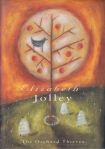
Elizabeth Jolley, The orchard thievesRegular readers will know that in June I joined in Lisa’s (ANZLitLovers) Elizabeth Jolley Week by posting two reviews, one of which was for the novella Orchard thieves. In that post I mentioned the sly humour, but I didn’t really share a quote to demonstrate it. However, I knew that I could always write a Delicious Descriptions post, so here it is.
It comes when the grandmother is walking home from the library. She had urged one of her extra library-book tickets to another library patron because “she knew how awful it was to get home only to discover that the books were familiar, having been read before.” As a librarian by profession, I loved it.

Anyhow, our grandmother is also a bit of a worrier, regularly thinking about various disasters that could befall her or her family:

On the way home the grandmother thought about the special kind of wealth there was in the possession of library-book tickets. They were reassuring and steady like the pension cheque. She never went anywhere without her purse. You could never know in advance what the day had in store. There might come a time when it would be necessary to offer all she had to appease an intruder. She knew of women who spread crumpled and torn newspapers all round their beds at night so that they would hear an intruder coming closer. Or, she might be held at knife point by someone in the street. She would offer all she had in her purse, small change, pension cheque and the library-book tickets. There would be absolutely no need for the villain to either strangle or stab her in order to snatch her purse. She would hold it out to him and tell him he could have it and be off. She would tell him this in plain words. The library-book tickets might even make a changed man of him, especially if he had never had a chance to use a public lending library during a life with all the deprivation brought about by being on the run.

I mean, really, don’t you love it?

Delicious descriptions: Tasma’s country town

Tasma, Uncle Piper of Piper's HillIt’s some time since I wrote a Delicious Descriptions post, but these three paragraphs from Tasma’s Uncle Piper of Piper’s Hill  (beginning of Pt IV, CH 3, “Laura does penance”), which I reviewed a few days ago, are too delicious not to share:

THE remark that Voltaire made about the great Russian Empire, when he compared it to a pear that was rotten before it was ripe, might be applied with equal truth to many a Victorian township. But the comparison, let me hasten to add, only holds good as regards the buildings and general aspect of these places. That “peace and contentment reign” therein, and that the small storekeeper and cockatoo farmer have nothing in the way of extortionate taxation or prompt knouting to fear in the land of democracy and universal suffrage, may be taken for granted. Nevertheless, as I said before, in the matter of their arriving at decay before they reach maturity, there are many Australian townships that might take Voltaire’s remark to themselves.

Barnesbury is one of these. Its oldest inhabitants, still in their prime, look back with regret to the days when it was the railway terminus; when all the coaches, and buggies, and bullock-drays, and four-in-hands, and squatters and diggers made it their head-quarters; and money spending and money-making, and consequent joviality, were the order of the day. Then it was that the three banks were built, in front of the largest of which the cows and geese graze peacefully today. Those fine-sounding names were given to the broad tracks leading away into the bush, which a few years more (it was fondly imagined) would transform into bustling streets. The great bluestone publichouse, designed for a monster hotel, was completed as far as its first story, but as it was never carried any farther, it naturally possesses at the present time a somewhat squat appearance, with a suggestively make-shift roof, and a general air of having been stopped in its growth. The church, too, was begun upon quite an ambitious scale, for to the credit, be it said, of Victorian country-folk, they pay as liberally for their religion as for their beer, and the Barnesbury spire was to be a “thing of beauty” in the eyes of all men. But the church, unhappily, shared the fate of the public-house and the banks. The spire that was to have been a “joy for ever” to the residents of Barnesbury shrank into a small wooden bell–tower, not unlike a pigeon house, and the incumbent deemed himself fortunate when a weatherboard verandah, without a floor, was affixed to the modest bluestone cottage dignified by the name of the parsonage.

The same evidence of having been brought to a sudden halt in by-gone years, and of having never been set going again, clung to the commerce of Barnesbury. The one and only street ran down and up a hill, which is not the same thing as to run up and down one. In the hollow mid-way was a row of shops of the most casual order, in one or any of which you might purchase almost anything from a bonnet to a wash-hand basin. On race-days, or tea meeting evenings at the school-house, it was not unusual to see as many as three spring-carts, with a bush-buggy and riding-horses, fastened to the posts in front of the one bit of wide pavement that remained. On election days the crowd was even greater, but its chief scene of action was the afore-mentioned Junction Hotel, which made up in extent what it had lost in height, and which could have gathered almost all the population into its bar.

I chose this excerpt for a few reasons. The allusions to Voltaire in the first paragraph and to Keats in the second reflect Tasma’s erudition, but they are used to effect rather than simply to show off. The Voltaire reference in the first paragraph underpins her promotion of Australia as a good and fair place to live, an idea which some commentators see as a theme throughout her works. She says that it is a place of “peace and contentment”, that “the small storekeeper and cockatoo farmer have nothing in the way of extortionate taxation or prompt knouting to fear in the land of democracy and universal suffrage” – unlike the Russian Empire, for example, as described by Voltaire.

The language, throughout, is clever, wry, cheeky, such as the description of the town’s main (only) street: “The one and only street ran down and up a hill, which is not the same thing as to run up and down one.” In other words, the main part of the town is probably at the bottom and indeed it is, in “the hollow”, which supports the suggestion that this is a struggling town. Other examples are that on race days you can expect to see “as many as three spring-carts, with a bush-buggy and riding-horses” (a whole three!) in the town, and that Victorian country people pay as well for religion as their beer!

This is the town where our main characters will learn something about themselves, and thence deserve their happy endings. It’s a great setting.

Delicious descriptions: Kim Mahood’s desert

Kim Mahood, Position doubtfulI wanted to use this Descriptions series to share a couple of Mahood’s gorgeous descriptions from her memoir, Position doubtful, which I reviewed recently, but I’ve decided to share one about maps and relationships (and you’ll probably see why), and a description.

From a mapping expedition:

The shortcomings of my prototype map soon become evident. The first lesson in the overlapping of knowledge systems is that Aboriginal knowledge doesn’t confine itself to the square dimensions of the canvas. Traditional jurisdictions extend to Well 50 in the west and to Jalyuwarn in the south. The ancestral dingoes who created the lake came down from the north and Kiki, the falling star, fell from the sky in the east. All these places and events are off the map.

– Puttem, I am told. You can fixem up later.

I puttem, and the edges of the canvas became congested with names that belong to the country outside the square.

She goes on to describe the process of capturing stories and knowledge, how “each site has its attendant stories – dreaming stories and traditional ways of living, accounts of the station days and mission days and first-contact encounters.” So fascinating – but these maps can be fraught with risk too.

Samphire Shrubland

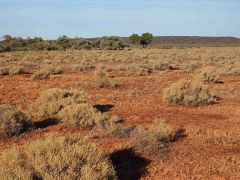
Samphire landscape, Central Australia (By Mark Marathon, using CC BY-SA 4.0, via Wikimedia Commons)

From a trip to Lake Ruth, 2008:

… The anthills on the plain are small and crenelated, like urban skylines. Ahead of us the horizon feels unstable, as if we are approaching an edge of some kind. The sandy soil becomes littered with limestone pebbles, and the anthills morph into the massive conical forms of cathedral mounds. Abruptly, the salt lake is before us, a negative space boundaried to the south by another unstable horizon. …

Between the salt lake and the limestone ridge where we have halted is a low red dune, an arc of sand created by wind and waves when the ephemeral lakes were substantial bodies of water. Stunted ti-tree grows along the dune, and red and gold samphire spreads out onto the salt crust, which is buckled and crisp. The southern horizon ripples with dissolving light, like wind moving through invisible fields of grass.

These descriptions of the desert are so vivid, so true. They show that Mahood is not just a mapmaker and artist, but a writer too.

Delicious descriptions: Freya Stark on a studied absence of curiosity

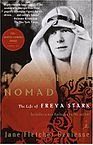
Jane Fletcher Geniesse, Passionate nomad, book coverUsually I post a Delicious Description after my main post on the book in question, but I’m reversing my practice this time, for no other reason than time. I haven’t quite finished my main post but am going to be out of town for a few days, so I thought I’d whet your appetite while I’m away.

The description comes from Jane Fletcher Geniesse’s biography, Passionate nomad: the life of Freya Stark. For those of you who don’t know, Stark was, among other things, a travel writer. She lived for 100 years, from 1893 to 1993, and was, a respected Middle East expert. Geniesse, here, quotes from Stark’s second, and highly regarded book, The valleys of the Assassins, about her travels in western Iran where few or no outsiders had been. She is commenting on how the ordinary villagers are fascinated by her, asking her multiple times to stand of the roof so everyone can see her, while the Elders withdraw, not wanting “to show interest in so negligible an object”. She draws the following conclusion:

It is a remarkable thing, when one comes to consider it, that indifference should be so generally considered a sign of superiority the world over; dignity or age, it is implied, so fill the mind with matter that other people’s indiscriminate affairs glide unperceived off that profound abstraction: that at any rate is the impression given not only by village mullahs, but by ministers, bishops, dowagers and well-bred people all over the world, and the village of Shahristan was no exception, except that the assembled dignitaries found it more difficult to conceal the strain which a total absence of curiosity entails.

This is one of the best types of travel writing, I think, that which sees the particular and then draws out the general or universal, showing us that regardless of our “exotic” locations and dress and customs, we are all much the same. Don’t you agree?

Delicious descriptions: Louise Mack’s dialogue and satire

Over Christmas, during one of my conversations with Son Gums, he commented how he tires of meaningless conversations, conversations, for example, in which people discuss a television series they’ve seen but say nothing of note. He mimicked the sort of conversation he meant … well, imagine my surprise when, in one of those surprising synchronicities, I came across exactly that sort of conversation a few days later in Louise Mack’s The world is round (my review). Here is part of it – the two speakers are at a social gathering, and published author Musgrave is eavesdropping:

It was the girl who pushed the ball this time. ‘Have you ever read a book called Lost in the Zodiac?’
‘No, never read it. Who’s it bai?’
‘I don’t know. I never look who a book’s by. Do you?’
‘No. Tell you an awfully naice book. Read it on board coming out, Miss Nobody of Nowhere.’
‘I haven’t read it. Is it good?’
‘Very good. Very er–er–interestin’.’
‘Is it? I must get to that. Do you know who it’s by?’
‘One of those French fellows, I think. Sounds like  a Frenchman. One of those detective plots, you know.’
‘Oh yes, I know. Like that book everyone was reading the other day, I forget the name of it.’
‘Yes. Sort of detective yarn you know. Very good.’
‘There’s a book called A Painted Polyanthus’ – Musgrave gave a sigh for a man he knew who would have revelled in this with a joy as keen as his own. ‘They say it’s very good. I haven’t read it yet.’
‘Neither have I.’
Musgrave was disappointed.
‘Have you read Speech in Passing?’
‘Oh yes, I read that. I cried over it.’
‘No? Did you? Bai Jove!’ leering sentimentally.
‘Yes, I couldn’t help it.’
‘The “sulky man” – he was a rum cove, wasn’t he? He was funny wasn’t he.’
‘I don’t think he was a sulky man at all.’
‘Neither do I. The only called him that,’ boldly.
Her voice changed.
‘”And Ida died,”‘ she quoted, in tones that suggested to you that she was just going to burst into tears.
Musgrave turned his head to see how she was looking. Just as he thought. Her head was a little on one side, her eyes were staring sadly straight back in front of her, and her mouth was doing its best to look pensive and full of feeling.
‘”And Ida died,”‘ she said again.
That was evidently the one point about the story that had struck her most impressively. Unfortunately hers was not the face to express the feeling she would fain have conveyed …

You can see why those early critics praised her dialogue and satire, can’t you? It’s quite delicious.

Note: The strange spellings, like “bai”, are attempts to phonetically capture the Australian accent – and is clearly being satirised.

Delicious descriptions: Pierre Lemaitre on the artist

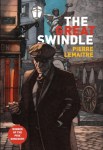
Pierre Lemaitre, The great swindleI recently reviewed Pierre Lemaitre’s The great swindle which is primarily about postwar France – specifically about the way returned soldiers were treated, and more broadly about money and the way it was driving behaviour, values and relationships. I’ll share just one little specific reference to this, a description of the scurrilous (and poverty-stricken aristocrat) Pradelle, because it contains a delightfully subversive allusion to you know who:

Anyone will tell you that a man in possession of such good looks and such a name must be in want of a fortune. This was certainly the lieutenant’s view, and indeed his only concern.

I didn’t manage to squeeze this bit of Austen-citing (as the Jane Austen Society of Australia calls it) into my post, so had to share it here before getting to the main reason for this post, the artist. Édouard, the severely disfigured soldier, had been rejected by his single-minded businessman father long before the war because he was not the right sort of son. He was effeminate and more interested in drawing than in business. For Monsieur Péricourt, this was an anathema – and is why Édouard did not want to return home after the war.

So, imagine Édouard’s disappointment when Albert, his loyal friend and carer, rejects his memorial fraud proposal:

For his pains, Édouard had only a series of worthless sketches. He broke down. This time, there were no tears, no tantrums, no sulks, he felt insulted. He was being thwarted by a pissant little accountant in the name of inviolable pragmatism. The eternal struggle between the artist and the bourgeoisie was being played once more; though the details were slightly different, this was the war he had lost to his father. An artist is a dreamer, hence of no value. This was what Édouard thought he could hear behind Albert’s pronouncements. With Albert, as with his father, he felt relegated to the role of scrounger, a ne’er-do-well interested only in vain pursuits. He had been patient, practical, persuasive, but he had failed. The rift between him and Albert was not a difference of opinion, but a difference of culture; Édouard found his friend petty, mean, with no drive, no ambition, no glint of madness.

Unlike M. Péricourt, Albert is not ruthless and he does not see his friend as having “no value”. Indeed, he liked Édouard’s art. His reasons come from a genuine moral sense combined with a valid fear of the consequences. But the end result is the same from Edouard’s point of view, a rejection of the imagination, a lack of that little “glint of madness”. This idea of the artist is not a major theme in the book – and is not really discussed in any of the reviews I’ve now checked out – but ideas about art and the imagination do underpin much of the novel.

Delicious descriptions: Robyn Cadwallader’s voices

Robyn Cadwallader, The anchoressIn my recent review of Robyn Cadwallader’s The anchoress, I included very few quotes or excerpts to show her writing. Somehow my post ended up in other directions. But, she had some wonderful ways of describing the world she created, and I’d like to share one aspect to demonstrate this.

Locked away in her cell, Sarah had to rely on her senses, particularly hearing, to experience and understand her world. I greatly enjoyed Cadwallader’s descriptions of people’s voices.

Sarah’s first confessor-advisor, was old Father Peter:

His voice, though old and weary, was blue-green behind the black curtain, like the quiet water where the river deepens beyond the mill. Sometimes I didn’t hear the meaning of his words but let them float away, the murmur of flowing water calming me.

Gorgeous, isn’t it? (And this is how I often read “difficult” books – I let the words flow over me, rather than worry at them, and they often make sense, eventually.)

And here is young Father Ranaulf, fairly early in Sarah’s enclosure when she is starting to get into self-destructive behaviours, believing she’s following the advice of a past (now dead) anchoress:

Agnes? Guiding you? What do you mean? His voice had the edge of a plough blade, blunt but cutting.

Father Ranaulf for much of the novel comes across to Sarah as inflexible – because he is – but he starts to shift as people help him understand, empathise with, Sarah and her life. So, here he is later in the novel bringing her some, well, rather subversive papers:

Father Ranaulf’s voice sounds like stone that will not crumble. I have resented it, wanted to shout and scream at it, shake his dry words until they lose their order and their certainty. But that day, the day he brought the pages, his voice had tiny grains in it, specks of sand that shifted as he spoke, as if uncertain where to settle.

Of course, it’s not just the sound of the voices that are important to Sarah, but the words themselves. Well into the novel, Sarah hears the village men talking in the church about the Lord’s plans for using the common land that is critical to their livelihood:

Words were coloured grey and brown and black, with quick touches of red. Gradually, I recognised the men’s voices from what their wives had told me about them.

And one last one. It comes when Sarah is starting to realise what the Lord, Thomas, has been up to:

Thomas had returned to Friaston, but his words clung to the stones.

Given the importance of stones in the mediaeval world, the consistency of this imagery works really well to evoke Sarah’s world and her experience of it. It also contributes to our understanding of her character. Similarly, Cadwallader uses birds throughout the novel to convey some of her themes – freedom from body, freedom of the spirit, aspiration and risk. But that’s another story, which I’ll leave for you to discover.

Delicious descriptions: Chinua Achebe’s people and places

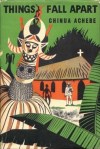
Chinua Achebe, Things fall apart

First edition, from Heinemann (via Wikipedia)

In my recent post on Chinua Achebe’s classic, Things fall apart, I focused mostly on its themes and ideas, which drove the quotes I chose to share. Here I want to show more of his writing, including his wit and use of imagery.

I’ll start with this early description of the protagonist, Okonkwo, who is determined not to be like his failure of a father:

When he walked, his heels hardly touched the ground and he seemed to walk on springs, as if he was going to pounce on somebody. And he did pounce on people quite often. He had a slight stammer and whenever he was angry and could not get his words out quickly enough, he would use his fists. He had no patience with unsuccessful men. He had had no patience with his father.

At first the phrases “heels hardly touched the ground” and “walk on springs” conjured for me (anyhow) Jesus Christ walking on water, but they’re immediately followed by the very un-Christlike idea of pouncing on people, confirming that the reference is instead to powerful, predatory cats. The “slight stammer” could garner some sympathy from us. We can understand the frustration of not being able to speak fluently, but resolving it with his fists again undercuts the possibility of our sympathy. And the last two sentences! Love them. The economy – and wit – with which he makes the point. And to not respect his father? Unfortunately, for all his determination to not be like his father, to be an admirable man respected by all, he ends up with a son who doesn’t respect him. This is the sort of writing I love, writing that gives with one hand and takes away with another, that requires me to fully engage my brain as I read.

Oh, and the rhythm of this paragraph is lovely too – long sentence, short sentence, then long, followed by short, short. It just reads well.

There’s a lot of lovely imagery – mostly earth and nature related which you’d expect given the book’s setting – but I’ll just share one. It describes Okonkwo’s son Nwoye being tempted by the new (that is, Christian) religion:

But there was a young lad who had been captivated. His name was Nwoye, Okonkwo’s first son. It was not the mad logic of the Trinity that captivated him. He did not understand it. It was the poetry of the new religion, something felt in the marrow. The hymn about brothers who sat in darkness and in fear seemed to answer a vague and persistent question that haunted his young soul – the question of the twins crying in the bush and the question of Ikemefuna who was killed. He felt a relief within as the hymn poured into his parched soul. The words of the hymn were like the drops of frozen rain melting on the dry plate of the panting earth. Nwoye’s callow mind was greatly puzzled.

For an agricultural society, the image of rain on a “panting earth” provides a perfect description of Nwoye’s desperation for comfort.

Other imagery relates to aggression, violence, strength – wrestling, fire, knives – which is reflects the novel’s themes and the character of its protagonist. Again, I’ll just choose one example. It’s short and comes from Part 3 after Okonkwo has returned to his village to find the white man’s arrival has caused a breakdown in village relationships. Obierika says of the white man that:

He has put a knife on the things that held us together and we have fallen apart.

And with that, Achebe unites the novel’s title, its narrative arc, and the epigraph:

Turning and turning in the widening gyre
The falcon cannot hear the falconer;
Things fall apart; the centre cannot hold;
Mere anarchy is loosed upon the world.
(from “The second coming”, WB Yeats)

Such a beautifully conceived novel.

Delicious descriptions from Elizabeth Harrower’s country

Elizabeth Harrower, A few days in the country and other stories

The hardback cover

In my recent review of Elizabeth Harrower’s short story collection, A few days in the country, and other stories, I included a few excerpts from the stories, but they primarily were chosen to reflect the themes and content. In this post, I want to focus on her use of language, through just a small number of examples as, of course, I don’t want to steal the thunder from the book itself.

Because Harrower’s focus is the psyche and human relationships, her “country” is as much the mind and heart as setting or place. Consequently, my selections here will cover this wider concept of country, but I’ll start with a physical description. It takes place off Scotland Island in Sydney’s beautiful Pittwater, in “The beautiful climate”. The family, Hector Shaw and his wife and daughter, are fishing, at Hector’s command of course. Here is the scene:

Low hills densely covered with thin gums and scrub sloped down on all sides to the rocky shore. They formed silent walls of a dark subdued green, without shine. Occasional painted roofs showed through. Small boats puttered past and disappeared.

I don’t think I need to tell you how our women are feeling, do I?

Here is a description of Alice and her favoured brothers, in “Alice”:

Meanwhile, the boys swam in attention and praise, and at an early age had had so much that they never needed it again, could afford to discard that particular life buoy and plunge out with a glossy confidence in their qualities. Alice never even learned to dog-paddle. Who would notice if she sank? The deep end was too risky for a girl whose brilliant dark-red curls could be so easily overlooked.

I love the sustained metaphor here.

In “English lesson”, protagonist Laura is devastated by a letter (from a man) responding to a letter of hers (which her friends told her she should write). We are not told the content of these letters, just the impact on Laura:

But could shock have the effect of bringing about a permanent physical change? Could she doubt it? Everything about her, physical and metaphysical, had sunk, shrunk. She was shorter, pruned, slightly murdered.

Can we doubt the impact?

And finally, here is Dan from “The cost of things”, unhappy in his marriage, but returning to his wife after a long business trip away during which he has had an affair:

He felt like someone who has had the top of his head blown off, but is still, astonishingly, alive, and must learn to cope with the light, the light, and all it illuminated.

If these don’t appeal to you, then maybe Harrower isn’t the writer for you, but if they do, I say, hop to it … and find one of her books.

Delicious descriptions from Elizabeth Harrower’s Circles

Elizabeth Harrower, In certain circlesIn my recent review of Elizabeth Harrower’s In certain circles, I focused on the book’s form and overall themes, and warned that I’d produce a Delicious Descriptions to share some of her writing. So, here it is, organised by headings to keep it simple …

Gender

I didn’t focus on gender in my review, but this is Harrower, and it is one of her ongoing concerns. It was in The watch tower, where the powerlessness of neglected young women put them in danger’s way, psychological and physical, and it’s here, in this novel, where women’s choices are constrained by expectations and conventions.

I’ll just share one scene. It occurs when Zoe responds to Lily who doesn’t believe Zoe understands how some women put children first. Zoe feels she understands only too well:

‘What I do understand is that at any point in a woman’s life she may come across something like a cement pyramid in the middle of the road. Another person. People. She’s capable of sitting there, convinced that it would be impossible to forsake her position, till it becomes a private Thermopylae. This sort of block was probably designed for the survival of our species, but the cost’s high. What makes men superior is that they don’t – on the whole – stop functioning forever because of another person. They lack this built-in handicap, and are they lucky!’

Zoe is finally seeing the light – though where she sees this “built-in handicap” originating is not clear! She admits elsewhere that she’s been complicit in her dismantlement, that she’d “agreed to be devalued”, but she’s also aware that there are other drivers. It’s part of the complexity of this novel that nothing, including gender, is black-and-white.

Emotional states

Harrower captures her characters’ emotional states with breathtaking economy. Since they’re short I’ll give you a few examples.

Zoe, soon after meeting Stephen:

He despised her. An invisible hand dragged a steel rake across her body.

My, that’s visceral isn’t it?

Here is Anna during a conversation with Russell. By this time their unstated feelings for each other are starting to affect their ability to relate naturally:

Speaking in a tone of enormous objectivity, looking straight ahead, Anna felt her skeleton waver secretly, as though it were seaweed pressed about by movements of deepest seas, invisible on the glittering surface.

You feel the effort it takes her, here, to keep strong. I also love this description of Anna after the crisis:

Anna was stared at. As though by choice, she left her face undefended, and her trustfulness was felt by others as a gift of purest generosity, as a sort of honour.

By contrast, here is her brother Stephen around the same time, finally confronting the waste of his and Zoe’s relationship:

Like someone kidnapped and dragged across a frontier into a place where the language and laws were wholly unknown, he glanced about with a mix of desperation and bafflement.

Place

While the interior is Harrower’s focus, she can write exteriors beautifully, usually to reflect, or contrast, her characters’ emotions.

Anna, widowed not so long ago and wiser in affairs of the heart, talks to Zoe about time being short. Zoe, in the early rosy years of her marriage, doesn’t understand her, thinking:

This was the wrong moment for pensive utterances–a gorgeous, glowing evening with the beach down there suddenly deserted and the sand turning cool and white, and the calm harbour a bay of light, and the trees beatified by the late sunlight.

Blissful – and yet methinks the “cool and white” could also intimate the chill around the corner?

And here are Zoe and Stephen, after fifteen years of marriage:

They went along the beach and swam in Russell’s pool before anyone was awake. The sun rose swiftly and built a shifting honeycomb of light on the green floor of the pool. The early morning had a glassy fragility, and Zoe felt the link between herself and Stephen to have that same extreme fragility and transparency; a breath could shatter it. Stephen churned through the water. She shivered and pulled on her towelling coat, prudently absent from past and future.

I mean, really, that last sentence. It’s a kicker isn’t it?

This was not an easy post to write, not because it was hard to find good examples to share but because it was hard to choose from so many delicious descriptions. All I can say is that I hope those I’ve chosen are good enough to inspire you to read this book, if you haven’t already.