Why I link to Wikipedia

Those who regularly read my blog will have noticed that I link to Wikipedia more often than to other more seemingly appropriate sources. This is not necessarily because Wikipedia is the best source to link to for the item in question but because Wikipedia:

  • usually provides a basic intro to/definition of the topic or term I am hyperlinking from
  • is likely to be permanent whereas other links can break over time
  • nearly always contains under External Links the alternative link I would have chosen!

This last point is the most critical one. Next time you follow a link on my blog and wonder why on earth I chose Wikipedia to link to because the article itself seems pretty minimal (and sometimes the articles are), take a look at the list of External Links. Chances are you will find something there of interest. If you don’t, well, it may just be that I couldn’t – or was too lazy to (hmmm) – find anything better!

Oh, and while we are talking about Wikpedia, I heard on Radio National (not a Wikipedia link this time!) this morning that the Australian branch of Wikimedia was going to meet today with about 170 representatives from Australian museums and galleries to talk about collaboration. I assume they’ll be more successful than the parent Wikimedia was with UK’s National Portrait Gallery. (Cheap shot I know, as that situation was not the result of collaborative talks!). Anyhow, it is interesting to see the trajectory of Wikipedia’s path to the point where the world’s major cultural institutions are now seriously interested in collaborating. (Listen to the Radio National Link – Liam Wyatt of Wikimedia gives an example or two of recent collaborations).

More on blogging, images and copyright

Courtesy of Uncommon Depth at flickr (using Creative Commons Licence)

Courtesy of Uncommon Depth at flickr (using Creative Commons Licence)

Those of you who have read my very early posts will know that copyright on images is an important issue for me – it’s why I often don’t have a lot of images on my posts, much as I’d like to. I’m sure that it won’t be long before the whole copyright situation is blown sky high but, until it does, I’m erring on the side of caution.

Today I was sent two links concerning a controversy at Wikipedia regarding the uploading there of images from the National Portrait Gallery in London. Apparently the Gallery has threatened legal action on a Wikipedian who uploaded onto Wikipedia over 3000 public domain images from the Gallery. The Gallery claims that while the original images are in public domain, their scans are protected by copyright. This is just one of their claims. It is all explained in an edition of Wikipedia’s magazine Signpost.

Another Signpost edition comprises an open letter written by three administrators to the Wikipedia community. It explains the reasoning behind Wikipedia’s philosophy while also recognising where institutions like the Gallery are coming from. It gives examples of other more positively negotiated solutions to the problem. A basic issue is that cultural institutions spend a lot of money preserving and storing their collections, and never have enough funding to do all they need to do. Many supplement their incomes by charging fees for commercial use of their images. Often, in the case of public domain images, they call this fee a “preservation” or “handling” fee. In our new digital world, many institutions are starting to free up non-commercial use of low-resolution images and I have myself obtained permission to upload low resolution images onto Wikipedia. However, the Wikipedian in question downloaded high resolution images from the National Portrait Gallery…a whole new ball-game.

You can see the challenge. The world is full of institutions holding immense and rich collections of material that the rest of us would like to access. These institutions are caught in a bind – the digital world exponentially increases their ability to provide access to their collections but it also hugely increases the risk of non-approved or even illegal use of their collections. And, the rights issue is a complex one. We users are not always aware, when looking at an image, what is in copyright and what isn’t. The issue is further complicated by the fact that we live in a global world but we do not have global copyright laws … I am regularly frustrated in my hunt for images by there being no statement anywhere concerning rights.

They might be juggernauts, but it is organisations like Wikipedia, Google and Flickr which are likely to push the issue to a conclusion. We all know a picture tells a thousand words … and we now have the technology to achieve it. All we need is for our rules and laws to catch up with the technology.

Stitching up the NGA

What a thrill! Today, as the result of blogger Ms Textual’s posts about her knitting for the National Gallery of Australia’s Knitta Project, I decided to pop over and check it out. I only planned to go for ten minutes or so, and who should I spy but Ms Textual herself. After a moment of shyness I decided to make myself known and we had a delightful chat while she waited for her transport to arrive. She is as friendly as she comes across on her blog and I am chuffed to have met in the flesh yet another cyber connection. Woo hoo!

Anyhow, here are some photos…I’m sure she’ll post some more interesting ones soon.

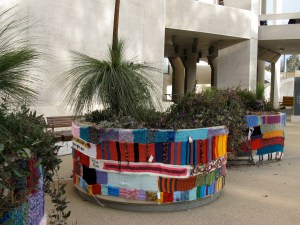
Wrapped planters at the lower entrance to the NGA

Wrapped planters at the lower entrance to the NGA

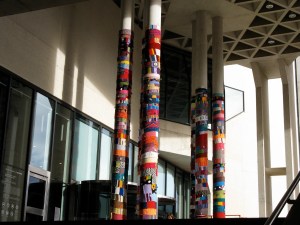
Wrapped poles outside the main entrance, taken from below

Wrapped poles outside the main entrance, taken from below

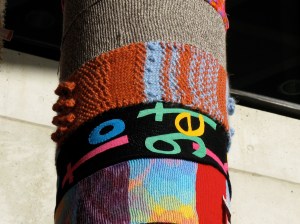
Ms Textual's gorgeous textured ochre and sky blue piece wrapped around a pole

Ms Textual's gorgeous textured ochre and sky blue piece wrapped around a pole

Another section of wrapped pole

Another section of wrapped pole

You get the picture? Good on the NGA for encouraging a sense of fun – and good on the knitters for rising to the challenge. I do love a touch of irreverence with my art every now and then – and this was just the right touch for a greyer than usual Canberra winter’s day. (Oh, and thanks to Lisa at ANZLitLovers for introducing me to Ms Textual through her blogroll.)

Book blogs and book covers

Courtesy: Uncommon Depth at flickr (Creative Commons)

Courtesy: Uncommon Depth at flickr (Creative Commons)

Clearly it would be in publishers’ interests to allow the free uploading of book covers by book bloggers, and clearly most book bloggers do upload book covers. But, having worked for many years in a profession (librarian/archivist) where copyright has been an everyday concern, I have been seeking some clarity on this issue. While I don’t expect to be sued by a publisher – in my experience most copyright owners will politely ask you to remove a misuse than fire their big guns to start with – I would like to understand the parameters within which I can comfortably work.

Consequently, I started by emailing 3 publishers for books I’ve reviewed (elsewhere). One publisher responded immediately stating that their terms and conditions allowing use of covers by “media, the book trade, libraries and others for appropriate purposes related to the books without any need to clear permission” included book blogs. Another responded cautiously at first stating that covers are complex (and they are, I suppose, as there are designers, there can be images sourced elsewhere incorporated into the design, and so on) and that people can be touchy about “negative portrayals”(!), but to their credit came back to me a few days later with blanket approval for use of their covers in my blog. Two down, one to go … and still, some 14 days later, waiting.

In the meantime, LibraryThing provides covers for free downloading and Amazon too has a service. Another source is OpenLibrary. But the copyright issue is not fully canvassed on these sites as far as I can tell. And that’s understandable – after all copyright law is different from jurisdiction to jurisdiction.

So where does that leave book bloggers – alone with their commonsense, I reckon!

My name

Snow Gum, Dead Horse Gap walk, Kosciuszko National Park

This is my first individual blog, and I’ve decided to name it taking words from my old high school song.  I have never forgotten it – perhaps because it seems so atypical in its “floweriness”. Here it is:

Minerva, by our southern seas,
Her sacred groves replanted
With whispering gums to woo the breeze
That floats o’er lands enchanted.
With ageless hills she rimmed her bower,
Her sunlit shrine of learning,
And here we keep through shine and shower
The Torch of knowledge burning.

Chorus:
Then grasp the torch another hand
Has cast for our endeavor,
By faith with fortitude this brand
We’ll keep aflame forever.

The treasures time has handed down.
Were dearly bought by sages,
The poison cup, the martyr’s crown
Lay guerdon through the ages.
Their faith with fortitude we’ll make
The mould of our endeavor,
And Hornsby, pride of place will take
Among the schools forever.

I should add that our logo was “the torch of knowledge” and motto “faith with fortitude”. Anyhow, my main aim is to talk books and reading, but who knows, I might talk about other things as well. I’ll just see how it goes.