Monday musings on Australian literature: Guest post by Lisa from ANZLitLovers

When I started this Monday musings series, I said that I’d have the occasional guest post. The first one, I decided then, had to be Lisa at ANZLitLovers. Not only did she give me a lot of encouragement when I started blogging (thanks Lisa!) but she is one of our most committed bloggers on Australian literature. In her day life she is a primary school librarian, and so she decided to do her Guest Post on a subject dear to her heart. Read on …

How do we raise the next generation of booklovers?

In recent weeks there’s been a lot of chat in the blogosphere about the impact of eBooks in the marketplace, but I think reading is under more pressure from the diversity of entertainment choices that are available now, than it is from the method used to deliver the book.  I grew up without TV, so weekly visits to the library with my father were an essential component of my life from the time I first learned to read, and I’ve never lost that reading habit. Children now have so many choices, it can be hard for them to find time for a book.

So how do we raise the next generation of booklovers?  If you’re a booklover yourself, it’s important to you that your kids are too, but it’s important for all of us because reading books makes better people of us.  The world needs better people, right?

As a booklover myself I think children are deprived if they don’t have access to lovely books, so all the children in my life get books for presents until they turn into sulky teenagers, and then they’re on their own.  But getting books for presents doesn’t necessarily turn a child into one who loves books…

Remember little Scout, in To Kill A Mockingbird, when her foolish teacher forbids her to read with her father anymore? Scout is appalled.  ‘Until I feared I would lose it, I never loved to read. One does not love breathing.’  She learned to read not with pretty picture books but by reading the most boring of texts over her father’s shoulder.  She loved to do it because she was with him.  However that was in a different age, and there’s nothing to tell us that Scout went on voraciously reading books into adulthood.

As a teacher-librarian, it’s my job to share books with children.  Primary librarians don’t just manage library acquisitions and book processing, or guide students with their book borrowing and research.  We teach as well.  I have 17 classes for an hour each week.  I’m supposed to teach them research skills, and I do, but I think the literature part of my curriculum is much more important.  The kids I teach might not remember how to takes notes for a project but they will always remember the meaning of the word ‘perfidy’ – and the moral issues that lie behind it – because I read them Kate DiCamillo’s Tale of Despereaux.  They’ll also remember joining in that pleasurable gasp of woe at the end of the lesson because they have to wait till the following week to find out what will happen next.  Suspense is good!

Our definition of literature is ‘those books that you always remember, forever and ever’. What are the ones that they apply this definition to? Here are some of them:
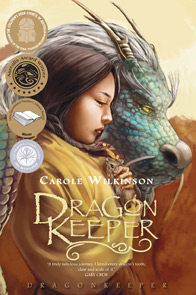
Dragon Keeper book cover
Cover image from Black Dog Books


DragonKeeper by Carole Wilkinson is a compelling fantasy/adventure series about a nameless slave girl in Ancient China whose job it is to feed the dragons.  Most boys past a certain age won’t put up with female central characters, but they sit still and listen for this one.  When the evil dragon hunter turns up to kill the last dragon for its body parts, she flees with it on an epic journey to protect a mysterious stone.  The book won the CBCA (Children’s Book Council of Australia) Book of the Year and took out a host of other awards, and my students and I went on to become keen fans of this wonderful Melbourne author. The sequel, Garden of the Purple Dragon, was shortlisted everywhere in 2006, Dragon Moon won the CBCA Award in 2008, and now there is a prequel – Dragon Dawn – which shows us Danzi as a young dragon, a mere 1000 years old.  A great favourite.

Sticking with dragons for the time being, I always read Lily Quench and the Dragon of Ashby by Natalie Prior to lure Years 3 and 4 students to reading.  Once again there is a female hero plagued by self-doubt, but she rises to the occasion (literally) when Queen Dragon lands in the grey, miserable town of Ashby and challenges the evil Black Count who has taken over everything and rules with an iron fist.  This one is rich in opportunities for discussion too, but it also features droll humour which eight and nine year old students can appreciate.  This is one of a series of seven, so the other six books are whisked off the shelves by borrowers before I’ve got to the end of chapter two…

The Deltora Quest by Emily Rodda series is a blockbuster.   Three trusty companions travel across Deltora to retrieve magic artefacts and defeat the evil Shadow Lord.  It’s a particular favourite with kids who play computer games involving collecting artefacts to fight off the Bad Guys.  No matter how many of these books I buy there are never enough, and I’ve given up trying to shelve them where they belong on the R shelf.  They have a tub of their own where the kids can riffle through looking for the title they want. (There are 15 in the series).

Another favourite is Truck Dogs, A Novel in Four Bites by Graeme Base.  He’s a picture book author and first editions of this book have full colour artwork, showing the bizarre creatures featured in this SF adventure.  It takes place at some time in the future in outback Australia when dogs have mutated into hybrid vehicles, part canine-part machine.  The hero, Sparky, (a Jack Russell/ute cross) is a scamp forever in trouble, but when a gang of Rottweilers come into town to steal all the town’s petrol, he leads the Mongrel Pack street gang to defeat Mr Big, (a Chihuahua/BMW cross) and save the day.  It’s an exciting romp with tongue-in-cheek humour and kids love it.

Do-Wrong Ron by Steven Herrick is completely different.  It’s a novel in free verse, and it tells the story of Ron who is good-hearted but manages to do almost everything wrong.  He tries to help Isabella’s grandmother who is too sad and lonely to go out of her house, and as usual things go wrong – but turn out right.  This is a great book for those under-confident kids who think they’re never going to belong, and the gentle humour is lovely.

Billy Mack’s War by James Roy is a great antidote to boys’ enthusiasm for war.   It’s set in 1945 and it tells the story of how shamefully the POWs were treated when they were evacuated back to Australia from Japan.  Billy doesn’t know his father, and he’s embarrassed and his loyalties are tested when he hears people talk about the POWs ‘sitting out the war’ while others fought.  His father’s experienced such horrors that he’s not coping with freedom very well. Not a book for under 11s, but a book that will intrigue older readers around Anzac Day…

Finally, although it’s British, I can’t resist including my favourite, Sir Gawain and the Green Knight, retold brilliantly by Michael Morpurgo, Britain’s Children’s Laureate.  This ancient tale from the 14th century takes place in Camelot, where on New Year’s Eve the feasting is interrupted by a strange green man who confronts the reputation of King Arthur’s knights with a fearsome challenge.  It is Sir Gawain who has to prove that he has courage, determination and honour, and it is this one that has my students pleading for me to read the finale even after the bell is long gone for them to go out to play.  We talk about the seven knightly virtues, and whether they still apply today; we talk about why Gawain says his life is less important than his king’s, and we talk about why flirting with your best mate’s girl is so wrong.  I read Michael Morpurgo’s version of Beowulf to Years 5 & 6 too and they love that as well (especially the gory bits), but it is Sir Gawain and his quest to do the right thing when tempted not to, who speaks to them across the centuries.

While nearly all my students love listening to stories in the library each week, I know that they don’t all turn into booklovers.  However some kids, who never used to borrow, now do so regularly and they’re in the library before school pestering me to buy new books as well.  I wish I knew the secret that makes this happen for more of them…

Back to Sue … Thanks Lisa for this inspired and inspiring guest post. Now, we’d love to hear your thoughts on the issue …
For voyeurs only – I’m at Scene of the Blog

Scene of the blog graphis

If you want to have a little peek at where I blog, go check out my Scene at Kittling: Books … and while there, do have a look around her blog. I love her Widget headings, such as “Top commenters, Bless ’em”. We do, too, don’t we! Note to self: Try to comment more on other blogs.

Anyhow, thanks Cathy for inviting me to be one of your Scenes. I rather enjoyed preparing my Scene. And it was fun checking out the other Scenes and discovering how many of us are “sofa bloggers”. I discovered, as you assured me, that I wasn’t alone!

What is a classic: Guest post at DesertBookChick

Those who read this blog may have come across DesertBookChick (DBC) before. She’s the one who doesn’t like Jane Austen! In fact, she admits that, despite being a PhD, she’s a bit anxious about classics in general. However, not one to shy away from a challenge, she has declared August Classics Month on her blog. She is running a range of activities for this, including guest posts. Today the guest blogger is me. Do go check out her blog. And, if you’ve come here from there, you are most welcome to check me out!

Anyhow, writing that post – and reading some of the comments already made on DBC’s blog this month – has made me think more on this whole classics business. And here is what I think…

They must speak to some universal truth

That is, what they say about human nature has to ring as true today as when they were written. There is a fascinating little paradox here though, because classics can come and go. Clearly there is something more going on – something, perhaps, commercial or political or academic, which brings me to …

They must stand the test of time (and place)

Little Black Dress

Little Black Dress, says Clker.com (Courtesy: Chika87 at Clker.com)

To know they ring as true today as when they were written, some time must have elapsed. Think classic fashion. A classic LBD (aka little black dress) is one which looks as smart (note, not trendy, not funky, but smart) today as it did 30 years ago. It may show its age around the edges – perhaps an older style fabric, or a slightly different length – but it still works beautifully.

The way I test this for literature is not by defining an arbitrary amount of time but by a more pragmatic rule-of-thumb. And that is multiple reprintings – not in the first flush of publication, but some years down the track. The more years down the track and the more reprintings, the more classic perhaps? Or, at least, the closer it gets to the pantheon of classics, like, say, Shakespeare and Jane Austen!

But it is not always quite this simple

Some books die and then are revived. Sometimes this is to do with “fashion” in academia as writers fall in and out of favour (but I’m not going to explore this one now). Sometimes though there is something more, shall we say, political going on. And here I’m referring to minorities, such as, oh, women! In the 1970s, with the revival of feminism, there appeared a number of publishers who fossicked out works by women that had been lost (the works that is, not the women!). Virago Press and The Women’s Press are two biggies, but there were (and still are) many others. They (re)introduced us (or me at least!) to writers like Elizabeth von Arnim. These presses revealed that, while the meaning of “classic” as expressing something universal may be a commonly agreed thing, what we get to read is a highly constructed thing.

I’d love to know what you think. What do you mean by classic (excluding the Greeks for the time being!)? Do you purposefully choose or not choose to read classics, or is the notion of making such a distinction irrelevant to you? What are your favourite classics?

And, if you are interested in what some others are saying on this, do pop over to DesertBookChick. While there, you could always help me in my project of changing her mind about Jane Austen!

Book Review Bingo, or Words to Avoid in Book Reviews

Am I the last to hear about Michelle Kerns list of twenty most annoying book review clichés, published in examiner.com in March last year? I think it flickered across my radar briefly a little while ago but it was brought vividly to my attention last week when Ramona Koval (presenter of Radio National’s The Book Show here in Australia) interviewed Michelle Kerns and salon.com reviewer, Laura Miller. I’m not going to report fully on the interview: you can listen to it here if you want to.

Since writing that article, Kerns has created a “game” called “Book Review Bingo“. It contains 24 clichés – with some changes from the original 20 – and they’re listed below (in alphabetical order so you can quickly locate, or not, your favourites):

  • at once (as in something is “at once a romance and a mystery”)
  • beautifully written
  • compelling
  • epic
  • fully realised
  • gritty
  • haunting
  • in the tradition of
  • lyrical
  • nuanced
  • pitch-perfect
  • powerful
  • readable
  • riveting
  • rollicking
  • stunning
  • sweeping
  • that said
  • thought-provoking
  • timely
  • tour de force
  • unflinching
  • unputdownable
  • x meets x (such as “McCarthy meets Hemingway”)

In the interview, the three speakers (Koval fully engaged in this one) discussed (and disagreed to some degree on) favourite (can you call them that?) clichés. One disagreement concerned “that said”. Miller, and I agree with her, suggested it’s not a cliché but more of a connecting word/phrase, a word you use to move from one point or sentence to another. Miller suggested that “however” is used for similar purposes, and that you would never call it a cliché.

That said(!), my questions to you are:

  • Do you agree with these clichés?
  • What is your view on clichés? Do you actively avoid them? Are there times when you think they can be used?
  • Do you have your own pet clichés (that you use, or hate to see used)?

I do try hard to avoid clichés but I know I don’t always succeed – and sometimes there just doesn’t seem to be a better word. What about you?

And, if you are further interested in the subject, you may also like to read Kerns’ report on Robert McCrum’s (of the Guardian) publisherspeak (aka blurbspeak) list. It will make you laugh, if nothing else.

The limits of Google

I’m sure you’ve all had them, those searches that bring people to your blog by accident. Well, let me rephrase that: as far as Google is concerned it makes good sense, but you know the poor searcher at the other end of the keyboard would not agree.

Smiling cartoon face

Cheesy? (Courtesy: Mohamed Ibrahim, via clker.com)

I just have to share with you one that came to me yesterday. The search was:

Why do my gums smell cheesy?

“What the?” I thought. It’s obvious why the “gums” got to me but the rest? So I did the same search in Google and sure enough my blog was listed as hit no. 4 – and it’s there because in my post on The lady in the van I included a quote that has the words “a cheesy smell”. Nowhere are “gums” mentioned in that post, except of course in my blog name.

I often wonder to what degree Google uses proximity in its search algorithms – not a lot it seems*. It is this sort of thing that should tell the world that we still need librarians. Google is great – don’t get me wrong – but I cringe a little when I hear people say that they want to find things just like they do in Google. When time is money (or is short, in any way), Google on its own can be a frustrating beast.

Oh, and do you want to know what no. 6 in the hit list was? It’s “My boa smells” from Constrictors Forum. It refers to a boa that might have “cheesy nasty smelling junk on his gums“. To find this junk, though, you have to “hold him gently behind the neck and use your thumb to pull his lip down GENTLY”. You learn something new every day … thanks Google!

* DISCLAIMER: There are ways to refine the search in Google using asterisks but it’s not very sophisticated. If you Google  (ha!) “Google proximity searching” (with or without the quotation marks), you will find some interesting discussions.

George Orwell, Confessions of a book reviewer

It’s been a while since I wrote on a George Orwell essay so it seemed – while I’m still reading my current read – to be a good time to do another. And what better, given my recent “how to write a book review” post, than to do Orwell’s essay on book reviewing.

Book Stack

Books (Courtesy: OCAL, from clker.com)

Orwell, as usual, makes you laugh. The essay starts off describing a rather seedy sounding person who is either malnourished or, if he’s recently had a lucky break, is suffering from a hangover. This person, Orwell says, is a writer. Could be any writer, he says, but let’s say he’s a reviewer. Yes, let’s, I thought, this could be interesting. This poor reviewer has a bundle of books from his editor who says that  they “ought to go well together”. They are:

“Palestine at the Cross Roads” [the essay is dated 1946! Oh dear], “Scientific Dairy Farming”, “A Short History of European Democracy” (this one is 680 pages and weighs four pounds [the satire is not necessarily subtle!], “Tribal Customs in Portuguese East Africa”, and a novel, “It’s Nicer Lying Down” (probably included by mistake).

(Note: Square brackets, me; round ones, George)

He goes on to say that, for a few of these, this reviewer knows little and so will need to read enough to avoid making some howler which will betray him to the author and the general reader. See my “How to review post” and the injunction to “Be accurate”! Harriet and I were serious! And then he describes how, at the last minute, just before the deadline, the reviewer will produce something:

All the stale old phrases – ‘a book that no one should miss’, ‘something memorable on every page’, ‘of special value are the chapters dealing with, etc etc’ – will jump into place like iron filings obeying the magnet.

Remember what Harriet and I said about adjectives? That goes for clichéd phrases too. He says that “the prolonged, indiscriminate reviewing of books … not only involves the praising of trash … but constantly inventing reactions towards books about which one has no spontaneous feelings whatsoever”.

To remedy this, he suggests that non-fiction books would be best reviewed by an expert in the subject and that novel reviewing could be done well by amateurs, but concludes that this is all too hard to organise so the editor “always finds himself reverting to his team of hacks”.

And then, here comes the crunch. He says:

None of this is remediable so long as it is taken for granted that every book deserves to be reviewed.

His preference is that we should ignore the majority of books “and give very long reviews – 1000 words is a bare minimum – to the few that seem to matter”.  He goes on to say that it is useful to publish short announcements of forthcoming books, but that 600 word reviews (even of books the reviewer likes) are “bound to be worthless”. (Phew, mine here tend to be around 1000 words, give or take! But, I do also think that there is something to be said for succinctness.)

There is a little more but this is the gist. Don’t you think Orwell would be rather fascinated to see today’s rather anarchic world of litblogs where amateur reviewers are doing exactly what he said – and where publishers, even if not newspaper and magazine editors – are starting to see the benefit of people reviewing books they want to review. Of course, he may not like the potential impact on his professional reviewer income stream, but them’s the breaks!

A light interlude, but will Desert Book Chick approve?

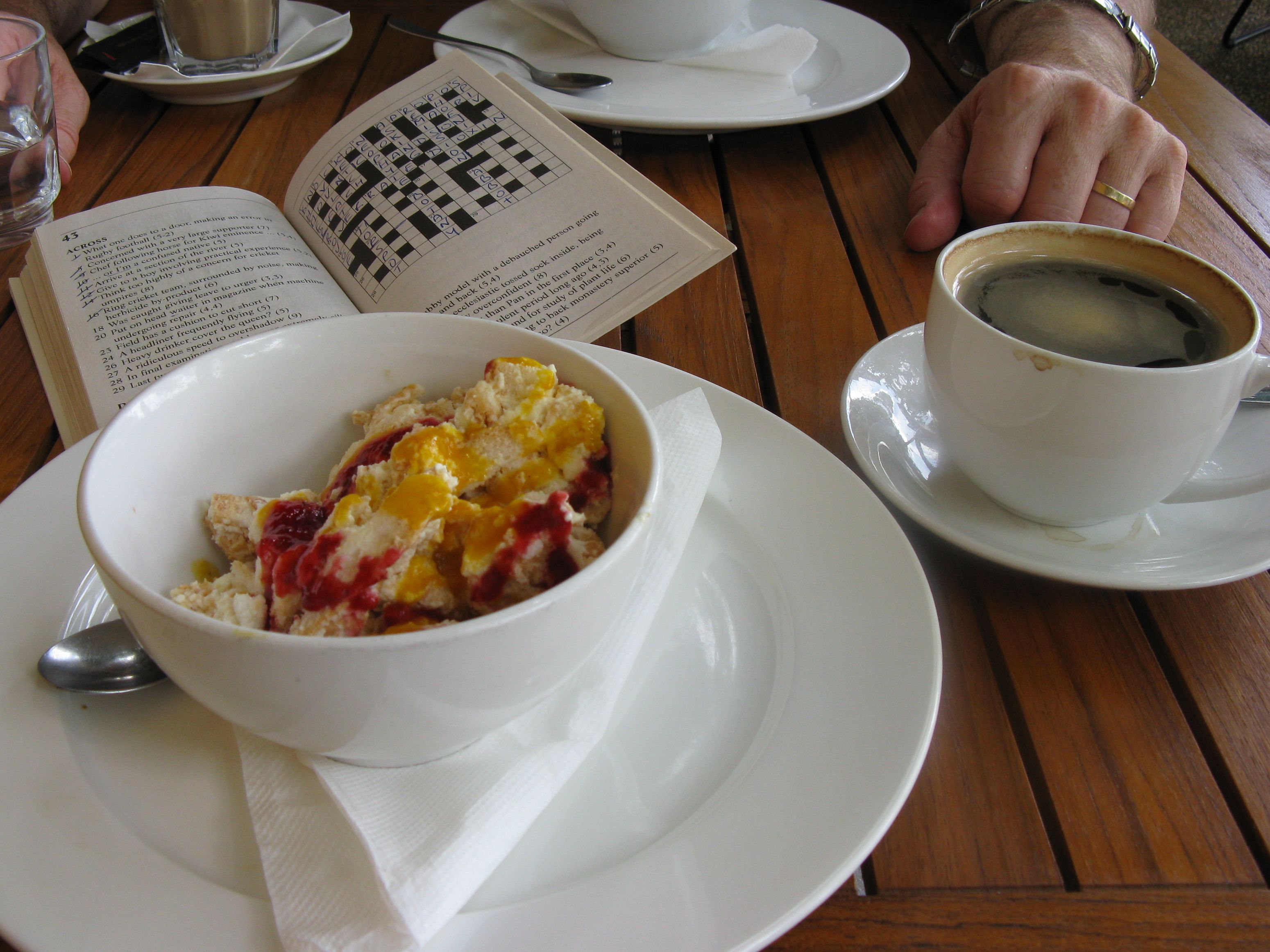
I have nearly finished my next book/s and so a review will be coming up any moment now, but in the meantime I thought I would post this photo:

Coffee, cake and crosswords at Pialligo Estate Winery

Coffee, cake and crosswords

Now, the thing is, Desert Book Chick recently wrote a post on the Five Things that turn her off (some) book blogs – and one of them is “Foodie/Book Blogs”. I rather like Desert Book Chick – even though SHE doesn’t like Jane Austen – but I wonder if I have now earned her ire forever because here is a foodie, sorta, post. Except, it’s not really.

Book bloggers, and online bookgroupies, often talk about their penchant for never being without a book, so that if they find themselves suddenly stranded on their own – say, on a train or bus, or in a cafe, or in a doctor’s waiting room – they will not be bored, and I’m no different. I ALWAYS have a book with me. But, sometimes, I’m not quite stranded. Sometimes I’m with Mr Gums*, and my mother taught me that it’s rude to read in front of another person. So, what to do? There are, after all, only so many topics you can find to talk about when you spend a lot of time together. What we do – and have done since our dating days way back in the mid 1970s – is do cryptic crosswords together. And so it was that some weeks ago we found ourselves lunching at the Pialligo Estate Winery. We’d had a good chat over lunch and consequently decided over our coffee and dessert to bring out the crossword book and voilà, the photographic evidence. Oh, and the cake, actually an interpretation of Eton Mess, was delicious, but in deference to Desert Book Chick I’ll not wax any more lyrically than that.

*Mr Gums. Since starting this blog 10 months ago, I have been struggling to find a way of referring to my “other half” or “significant other” or “DH”. (Take your pick.) Ms Textual uses The Vet, while Lisa at ANZLitLovers uses The Spouse. Both work nicely. On our daughter’s blog, Wayfaring Chocolate, Mr Gums is L. Engineer. I think I will use that from now on.

Six months old today!

Precious things: My kids and some of my toppling TBR piles!

I started writing this blog six months ago today – and what a fun experience it’s been, not only because I’ve enjoyed forming my thoughts into some sort of coherent (I hope ) whole, but also because it has introduced me to a vibrant, welcoming and encouraging book blogging community. I put off starting a blog for a long time exactly because I feared being caught up in another community – not because I hate community but because I feared spreading myself too thinly. Well, I probably am spread a bit too thinly across all my interests and enthusiasms but I don’t regret starting blogging for one minute. And for that I thank you lovely bloggers who have taken the time to read and comment on my blog and, where I’ve needed it, to offer help and guidance. Thankyou!

Like most bloggers – I think – I am interested in who comes to my blog and what they come for. My most popular post by far (and “by far”, I mean so “by far” that there’s not another post within cooee) is my post on the film Coco Avant Chanel. The post is about the “biopic” but the searches that lead to it all seem to be for Coco Chanel herself. I’m truly gobsmacked. And moreso because this post has not one comment on it. Curious, as well as gobsmacking.

My second most popular post, if you can call it a post, is, not surprisingly “Who am I?”. My third, though, intrigues me again. It is not one of my Australian posts (my Winton post comes in fourth) but my post on the Indonesian book This earth of mankind by Pramoeyda Ananta Toer. All I can think is that he continues to be studied internationally and hence the slow but constant hits on it. I’m not going to bore you by listing all my top ten posts and analysing them, but they are an eclectic lot and include posts on:

  • the indigenous poet Kath Walker (aka Oodgeroo Noonuccal),
  • the Aktimate speakers I bought for my iPod,
  • the Sydney Blue Gum, and
  • the one on Jane Austen that mentions The Times newspaper of 1785. I have no idea why people are searching for  “The Times 1785” but they are, and they get my post. I wonder if they are happy when they get there? I’ll never know cos they never tell me…

And that, I suppose, is the rub. We know more or less what those who comment think but what about all the others? Who are they? Did they find our posts useful? Ah, sweet mystery of life ….

Advice to would-be women journalists, 1930s style

While I was researching something completely different today, I came across a wonderful – you’ll see why soon – article titled “Not much fun in being a woman journalist – or is there?” in the second issue of The ABC Weekly published on 9 December 1939 by the Australian Broadcasting Commission. The article was written by Zelda Reed, an American who was working her way around the world as a journalist. The editor says that Miss Reed has directed the article “to ambitious Australian girls who think, perhaps, that JOURNALISM IS SUCH FUN” (their stress).

Miss Reed starts by describing how “the talkies [that is, movies] have discovered that there is glamour in the newspaper business” and goes on to give a rundown of the typical plot involving “cheeky young females” who “peck perkily at their portables and indulge in gay repartee with that winsome character, the Editor”. HOWEVER, Miss Reed warns, young women dreaming of such a career should first “well study the seamy side of the journalist’s lot”.

She says would-be reporters should be aware of:

a curious paradox in the minds of practically all editors. These men are liberals by temperament and feminists by conviction. They will do everything to help women break down the prejudice against their sex – everything, that is, except hire them as general news reporters.

Dorothy Dix (released to Public Domain, at Wikipedia)

Dorothy Dix (released to Public Domain, at Wikipedia)

She says that the real paying jobs are not the adventurous ones – and cites Dorothy Dix as one who makes very good money without ever having to move from her desk. This leads her into the traditional areas in which women do well – because “nobody else wants them. The women’s page editors, the society editors…” and so on. You know the drill.

Then she dashes any hopes of romance! She says that

Gallantry is not a strong point among the men who work on newspapers. Except when salaries are involved, these are the men who believe in equality of the sexes and act on it!

Hmmm…what does that mean? They believe in equality but don’t want to marry it? Well, she goes on to say that newspaper men have “none of the elementary requirements for a good husband”. In other words, “men reporters … go in for irresponsibility as an art” and “lack material ambition, and are proud of it”!

So, the positives? Well, there’s never being bored in a newspaper office because “entertaining companions, with a rich store of anecdotes, will always drop their work to share a coffee with you”. And a female reporter “will have her scrapbooks filled with forgotten scoops [and] a reputation as a ‘top journalist for a woman’. But that is a Bohemian reward which perhaps one woman in a million finds satisfactory”. Well…

Her conclusion is that

the rest [the other 999,999 women in a million, that is] would do well to run like rabbits whenever the urge to work on a newspaper creeps over them – they’ll pay a price that is exorbitant for the doubtful privilege of being the uninvited guest at a social function, or meeting a few front-page characters face to face.

Miss Reed, it seems, doesn’t think much of the career that is taking her around the world! I’m sure there’s truth in what she says – and I’m sure things have changed since then. All I can say is that I’ll stick to blogging. May not be as adventurous but I can have the fun of writing what I like while steering clear of all those non-materialistic irresponsible male writers!

You know you are hooked

…on blogging when you start writing your blog in your head while you are out and about enjoying something. This is what happened to me last night (and it’s not the first time) when I was at a Kate Ceberano concert (sorry Kate – but I did pull myself up quickly and start concentrating again). The concert was her Kate Ceberano – 25 Live Tour which celebrates her 25 years in show business. The support act was Carl Riseley, a rather gorgeous and confident “big band swing-style” singer and trumpeter from Queensland.

Anyhow, a little aside. One of the delights of being retired in Australia is that you get to listen to ABC Radio National programs on all sorts of topics. And so, just last week, I heard an interview on Bush Telegraph with Jim Haynes, the author of a book titled The ultimate guide to country music in Australia. There is a relevance I promise to this digression from an article on jazz-soul-pop-musical theatre singer Kate, and it is this: Haynes suggested that missing on the current country music scene in Australia are good interpreters of song. He said the tendency today is to want to be a singer-songwriter but that interpreting the songs of others is also an important part of the scene.

Kate and her band (including brother Phil at right) (Mobile phone image, August 2009)

Kate and her band (including brother Phil at right) (Mobile phone image, August 2009)

This brings us to Kate. Of course, interpretation is a more intrinsic part of the jazz scene but Kate’s concert included a delightful mix of interpreted and original songs, with the interpreted songs being every bit as engaging as the originals. Carl Riseley warmed us up nicely with an entertaining mix of mostly swing style music, interspersed with the odd bit of trumpet and finishing somewhat surprisingly (unless you follow Riseley I gather) with his version of Boz Scaggs‘ “Lido Shuffle”. And then Kate came on and sang for around 2 hours. She comes across as warm, confident and irrepressible. Her voice is powerful but also has a rich mellowness, and she sang a wide repertoire  including a song she wrote for her mother and her somewhat raunchy also self-penned hit single “Pash”, songs from her Jesus Christ Superstar days, her gorgeous version of “The First Time Ever I Saw Your Face” and much more besides.

Oh, and curvaceous Kate looked wonderful in the sparkly long black dress she started in, the white diva gown she changed into, and the tight little black number that she wore to end the concert. 25 years on and Kate is still going strong. It’s hard to think that she won’t still be in another 25 years.  It was a truly joyous night.