To write my recent post on David Marr, I did some research, as I usually do when I take notes at a lecture or seminar, because I need to make sure that the book title or author name or quote that I recorded in my notes are correct. That’s how, for example, I found the exact quote from Cavafy that I used in my post.
However, when doing this research I sometimes uncover items that don’t relate to the topic I’m researching but are too good to not share. In the case of Marr, one of the pieces I found was an interview with Marr conducted by the National Library not long before the lecture. It’s not long but contains a couple of comments that I loved.
The full interview is available online at the NLA, but I’m just going to share his responses to three questions.
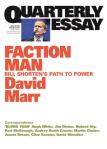
The first question asked what was “the best part of writing” his latest book, his Quarterly Essay on Bill Shorten titled “Faction man”. Marr answered
Learning what I didn’t know then explaining it to readers as baffled as I once was.
I liked this because in the lecture we attended he described himself as an “explainer”. Makes sense to me. In fact it’s what we want writers like Marr to do for us, isn’t it?
The next question I want to share asked him for “the strangest piece of advice” he’d “ever been given as a writer”. He responded:
When you’re cutting, never cut the jokes. The old newspaper editor who told me this wasn’t inviting me to be trivial. He was saying: delighting readers matters and humour is a way to the truth.
I totally agree. We can be too earnest at times. A good sense of humour never gets in the way of the truth, in my experience.
The last question I’m sharing asked him for “the strangest question” he’d been asked about his writing. He said
My mother rang one day years ago and asked: ‘Are you working today or just writing?’ I’ve celebrated that ever since.
Besides making me laugh, it brought me back to his Seymour lecture and why he wrote his biography of Patrick White: it was inspired by a contradiction between White’s statement that his parents never wanted him to be a writer and the fact that his parents apparently bankrolled a publisher in order to encourage them to publish White’s poems. (Interestingly, Bill, commenting on my Seymour post, said that his parents didn’t want him to be a truck drive but they still helped him by his first truck. So, perhaps White’s parents’ action doesn’t contradict White’s statement about their wishes for him!)
This week Mr Gums and I went to our second Seymour Biography Lecture, an annual lecture devoted to life-writing which was endowed by the Seymours in 2005. Our first, last year, was given by Robert Drewe who discussed memoir as a form of life-writing that is differentiated from but as valid as autobiography. It was a wonderful lecture, so we were keen to attend this year’s, and particularly when David Marr was announced as the speaker.
David Marr, NLA, Sept 2016
David Marr, as you may know, is one of Australia’s most recognisable contemporary public intellectuals. He wrote a biography of controversial politician and Chief Justice Sir Garfield Barwick (Barwick) and the multi-award-winning biography Patrick White: A life. In recent years he has written several biographical essays for the Quarterly Essay: on John Howard (2007), Kevin Rudd (2010), Tony Abbott (2012), George Pell (2013), and Bill Shorten (2015). The National Library of Australia’s Director-General, Anne-Marie Schwirtlich said, when introducing him, that these essays represent “a new form of biography”. That sounded interesting, but it turned out not to be the subject of his lecture. Oh well … a topic for another day, perhaps?
At this point David Marr got up to speak … I’ve seen him many times on television, but I greatly enjoyed seeing him in person. He has a lovely, natural speaking style – articulate, but informally formal if that makes sense. He started by saying how good it was to be giving a lecture in someone’s name, not in their memory but in their presence! (The Seymours were in the audience).
What’s the story?
Marr commenced by describing how he was called to Patrick White’s place in 1988 during one of White’s “near-death” experiences. When he got there, other family and friends were already there, waiting for the ambulance. Eventually, Wendy the ambo arrived, walked in, and asked, very appropriately Marr said, “What’s the story?” As it turned out White lived through more episodes like this, before dying in 1990. He told us all this, not so much because it was an interesting story, but to make the point that although he was present at these occasions, and although he wrote about them in his White biography, we will not find him there. That is, he did not put himself in the room with the others. In fact, he did not put himself in the book anywhere (although he admitted, slyly, that of course he is everywhere in the book – the words, the judgements, are his).
Marr then gave us his rules for biographers, but I’m afraid I only got four of the five down. They are:
The voice of the subject must be clear;
The biography must not “muck around with time”;
The biographer must spare the reader his/her “homework”; and
The biographer must stay out of the life.
This last “rule” would be the theme of his lecture …
Be an invisible biographer
Before exploring this, however, Marr said that it is the biographer’s truth that everybody’s life is open to writing about, that no-one owns his/her life. True, yes, he said, but “mighty obstacles can be put in your way”. Subjects can:
Stop their friends talking to you
Block access to their papers
Withhold copyright consent. He expanded here on family ownership of copyright, and the typical family view that “what’s hidden in life must be hidden in death”. (Hence, methought, sisters like Cassandra Austen destroy precious letters!)
Place a curse on their biographers. Here he mentioned Greek poet, Cavafy, who wrote “From all I did and all I said/Let no one try to find out who I was” (“Hidden things”). Cavafy also said that sometimes it is better to wait, that some things cannot be understood until time has passed.
Marr said he feared every one of these obstructions when he approached White – particularly the curses! But the timing was right for White, and Marr’s biography project was, amazingly, accepted. Marr described his aims as absolutely conventional: “I was born in Pymble after all,” he said! They included finding out who White was, where his books came from, his impact on the world and world’s on him, and so on. But White – the irascible White – saw it quite differently. He saw it as his “last reckoning”, his last chance to see where all his life passions had ended up, his last chance to see which of his many and diverse arrows had hit their mark.
Marr spent four years (I think) on the project, meeting with White, visiting places he’d been, meeting people he knew, and so on, but he is not in the book. Editors today, he said, would “tell me to get in there”, to write of his adventures in research. He described this style as “quest biographies”, and he doesn’t (generally) like them. They “inflict their homework on readers” and “they also bugger around with time”. For example, the biographer may write about being in Greece researching the subject’s life while simultaneously describing the subject’s life in that place in some time past. Biographers can also, inappropriately in Marr’s view, foreshadow aspects of the subject’s life, as in “that was the last time X ever went to Y”. He argued that it is the great drama of our lives that we don’t know what is going to happen. Great biographers make the future unknown, he said. Even though we usually know the fate of the subject, a good biographer can make it a surprise.
He gave examples of visible biographers that he doesn’t like, but admitted that rules can be broken. The “quest biography” is, for example, suitable for the life of a fraud. And there are cases where the biographer has “absolutely earned the right” to be in the biography, the perfect example being Boswell in his Life of Johnson. Boswell’s world was Johnson. He spent twenty years talking, living, arguing with Johnson. Do the work, said Marr, put in the years, and deal with yourself as ruthlessly as Boswell does!
Then Marr admitted that he has broken his own rule – when there’s been a purpose for him to be there in the work. His Quarterly Essay on Kevin Rudd is an example. He told of dining with Rudd who, late in the meal, asked Marr what his essay was about. When Marr told him, Rudd lost his temper, in a very controlled way. He was “astonishingly eloquent”, Marr said, speaking from his “angry heart” and Marr had to be there to be able to describe the experience.
So, there are no rules, but overall he’d like to see an end to biographers in the text. They should be in the shadows, “manipulating everything”, and saving their stories about themselves and their research for writers’ festivals and, when they’re old, for lectures!
Q&A
We had about 15 to 20 minutes of Q&A but some of the questions, interesting though they were, ranged wider than the focus of Marr’s lecture, so I’ll keep this brief.
How do you choose who to write about? Marr chose White because he read something contradictory about White’s parents. White had always said that they did not want him to be a writer, but then Marr read somewhere that White’s parents had bankrolled a publishing project on the condition they published a book of White’s poems. He wrote his Barwick biography because he was enraged by what Barwick was getting away with. He’s an explainer he said, rather than a creator.
Do you as a biographer ever withhold information? Yes, said Marr. There are some private matters that have no place in biography. His deal with Patrick White, he hastened to say, was that it was his (i.e. Marr’) book and he would write what he wanted to write. Any information he withheld, then, was withheld because it was not, in his opinion, essential to our understanding of White. Legal issues, too, can sometimes result in information being omitted, as has happened with his various Quarterly Essays on contemporary politicians.
During the book signing at the end of the evening, Marr commented that his was “a craft lecture”, meaning I suppose that it wasn’t a theoretical or philosophical one on the form and its meaning. Well, “craft” it may have been but I enjoy hearing from writers about their craft and, anyhow, amongst the “craft”, as you can probably tell, we got a bit of theory and philosophy too. Another wonderful Seymour lecture, with another thoughtful, inspiring writer.
I cannot let this week pass without adding my voice to the tributes made by my blogger friends to anthropologist-historian Inga Clendinnen (1934-2016), who died last week at the too-young age of 82. It seemed fitting to delay my tribute for a couple of days to make her a Monday Musings topic. Clendinnen deserves no less (says she, applying a gravitas to her Monday Musings that they don’t really warrant!)
Now, I wonder how many of my non-Australian readers have heard of or know much about this rather significant Australian public intellectual? Clendinnen’s first area of speciality – and the subject of her first two books – was the Aztec civilisation. I haven’t read those books. She then wrote another which is on my TBR, Reading the Holocaust (1998). Her next was the first I read, her memoir Tiger’s eye (2000). Critic Morag Fraser described it as follows (the back blurb):
This is a rare book … it is memoir, history, fiction, a documenting of filial gratitude and ingratitude, and a record of the cauldron of a near-fatal illness, all bundled coherently – that’s the miracle – between covers.
The book was inspired by her experience with liver disease (and her ensuing transplant) … but this disease in turn inspired her to contemplate all sorts of things about life – hers and life in general – about the things that interest her, like writing, for a start, and of course about the experience of being seriously ill. (Oh dear, I’ve always wanted to reread this, and am now becoming distracted from the task at hand by dipping into it!) She talks about how writing is her way of understanding herself. Much of what she says is thoughtful, serious, philosophical, but there are also light touches:
Meanwhile, I wrote. I was in a big mixed ward and discovered when I pulled out my writing pad that in such a ward writing is ‘letter-writing’, and therefore a collective activity. Topics and items of local interest were offered by patients and by nursing staff. If I said, defensively, that I was writing stories, passing strangers–chaplains, orderlies, tea-ladies–would stop to empty a bucket of tales about their dogs or their ex-wives over me, or would say that they are writers too, or would be when they could get around to it. When they weren’t too busy living.
I love how she captures that special world that is the hospital.
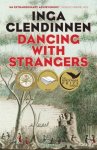
Anyhow, moving on. The book that really brought her to wider attention in Australia was her multi-award-winning book, Dancing with strangers (2003). In her Introduction she describes it as “a telling of the story when a thousand British men and women, some of them convicts and some of them free, made a settlement on the east coast of Australia … and how they fared with the people they found there.” “A” telling, she writes. I like that. She also explains how she aimed to apply the disciplines of history (which can be “culture-insensitive”) and anthropology (which can be insensitive to “temporal change”) to an analysis of episodes recorded in primary resources in order to understand better what people did and why they did it. In other words, she teases out possible cultural assumptions, expectations, and, even, aspirations which might have underpinned the behaviours and events that have too often been simplified in the historical record we all know.
So, in this history, we have Clendinnen, our historian, saying things like “I think Baneelon believed he had fully instructed Phillip as to what was in store for him”, and
There is another possibility in this hall-of-mirrors world: that Barangaroo’s funeral rites were muted not because of Barangaroo’s social isolation, but because of Baleen’s ongoing ambition to impress the British, in this case with the reverent sedateness of his mourning. After all, he has watched enough British burials.
She concludes by arguing, logically it seems to me, that “to understand history we have to get inside episodes, which means setting ourselves to understand our subjects’ changing motivations and moods in their changing contexts, and to tracing the devious routes by which knowledge was acquired, understood and acted upon.” This is the sort of history I enjoy reading …
Every time, in fact, that I read Clendinnen on history I am mystified all over again about her strong criticism of Kate Grenville’s comments regarding The secret river. I keep thinking I’m missing something. In Dancing with strangers Clendinnen uses her knowledge of culture and human beings to fill gaps or find different explanations for how people behaved which is, in a different but to me related way, what “literary” historical novelists do. We could get caught up in semantics here, in arguing exceptions and rules, and so on, but my feeling (with no evidence I admit) is that Grenville’s over-exuberant-at-the-time way of explaining what she was doing “got up Clendinnen’s nose”. I read (and enjoyed) Clendinnen’s Quarterly Essay on “The history question: Who owns the past (QE23)” (2006) and the section in which she discusses novelists and historians is replete with my marginalia! I’ll leave it there!
Finally, the last book of hers that I’ve read is her essay collection, Agamemnon’s kiss (2006). One of the dedicatees is “my unknown [liver] donor, April 1994”. Not surprisingly, the collection includes essays on health, life and death. It also includes writings on reading fiction, writing history, the history wars, the Holocaust. And she writes about other writers, such as Hilary Mantel and Penelope Fitzgerald. In the last titular essay, she writes (yet again) about reading and writing. I’ll end with something that I think we’d all agree with:
Rewarding reading is like being luxuriously absorbed in intimate conversation with a person not previously known, but whose words somehow interweave with the lonely interior monologue we conduct inside our heads. In real life we might encounter such a conversation in five, ten or twenty years, or possibly not at all. In a world of libraries and bookshops it is forever at our fingertips …
Vale Inga Clendinnen. Thank you for all your wonderful books, and for the intimate conversations we can now, because of them, continue to have with you.
For tributes from other bloggers, please see
Michelle’s of Adventures in biography (who brought Clendinnen’s death to my attention last week)
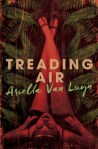
It wasn’t until I reached the end of Ariella Van Luyn’s debut novel, Treading air, that I discovered it was loosely based on the life of a real person. I’m glad it happened that way. I like introductions, but I always read them last because I like to come to my reading as unencumbered as possible – and totally unencumbered I was with this one. Even the title gives nothing away.
So, I was pleasantly surprised to find the first page labelled “Brisbane 1945”, because I spent some of my formative years in Brisbane, albeit rather later than 1945. I was even more surprised, a couple of chapters in, to find a section labelled “Townsville 1922”, because my Mum was born in Townsville at the end of that decade, and I visited it a few times in my youth. There, see how I’ve sneakily given you the historical setting – and implied the structure – without specifically saying so?
Now, let’s get to the story. As Van Luyn explains in her acknowledgements at the end of the novel, it concerns Elizabeth (Lizzie) O’Dea, aka Betty Knight/O’Brian/Stewart/Johnson, who was born in Brisbane around the turn of the 20th century*. She married Joe O’Dea and moved to Townsville in 1922 where Joe was promised a job. However, as Van Luyn tells it, Joe soon loses that job, and Lizzie, with few work skills, becomes a prostitute, which she sees as far more lucrative, and yes, less demeaning, than the domestic work her mother had done. From there, life becomes increasingly challenging … but, I’ll leave the plot here, because there are other things to discuss.
The novel opens in Brisbane’s lock hospital where Lizzie’s been sent by a magistrate. This opening set-up gives me a great opportunity to discuss how Van Luyn uses fiction and history to construct her character and story. Brisbane’s Courier Mail and the Townsville Daily Bulletin both report on a case at that time: Lizzie is accused of “attempting to steal £20” which brings about a “bond” (deferred) sentence on 8 May 1945. The Courier-Mail writes
“It is rather remarkable,” said Mr. Wilson, “that in this long list of stealing convictions she has never been given a chance to see if she could reform. “We will just try it for an experiment. …” Mr. Wilson ordered O’Dea to enter into a bond to come up for sentence if called upon within six months. “We will both thank you, sir,” said the woman as she left the dock.
Mr Wilson’s “experiment” idea resulted from O’Dea arguing that she wanted a chance to be there for her husband Joe’s imminent release from his 20-year prison sentence.
However, the “crime” Van Luyn uses in the opening of her novel is Lizzie’s stealing “tins of bully beef and some US army blankets”. This crime actually occurred in 1944 and the court case in October of that year resulted in a fine of £5. Here is Van Luyn’s story of the court case in her opening chapter:
At first, in the police court, surrounded by dark wood, she couldn’t make sense of what Mr Wilson was saying about Joe. In a wig that hung down his cheeks, he looked at her medical report and decided to be generous: only six weeks in the lock hospital to recover [because she’d been found to have “the clap”]. He said when Joe got out a few days after she had, they could start a new life together. “We’ll try it for an experiment,” Wilson said, and Lizzie wanted to stick her fingers in his eyeballs. She isn’t a bloody lab rat.
My marginalia here is: “feisty, independent”. So, I have two points to make. One is that Van Luyn shifts a crime of which Lizzie was accused to a different time because, presumably, it’s a more interesting time, narratively speaking. And the other is that, instead of having Lizzie thank Mr Wilson, Van Luyn has her responding (internally, anyhow) in a feisty manner to establish Lizzie as an independent woman, a survivor. For an historian, these “plays” with the facts would be unforgivable, but for Van Luyn, they enable her to engage the reader in the story and quickly establish the sort of person she believes, from her research, that Lizzie was. In other words, Van Luyn plays with the “facts” to create her “truth”. As she is writing fiction, I have no problem with that! Do you?
The other main point I want to make about this book draws from Sulari Gentill’s comments at the Canberra Writers Festival. She said she likes to find interesting but forgotten people. I understood this to mean working class people and minorities, that is, the “little” people, the women, and those disadvantaged by culture, race, and so on. This is certainly what Van Luyn does here. In addition to Lizzie, a working class woman, she also has Chinese and indigenous characters in Townsville. In this focus on the “forgotten people”, her book reminds me of others I’ve reviewed recently, including Eleanor Limprecht’s Long Bay (my review) about abortionist Rebecca Sinclair, and Emma Ashmere’s The floating garden (my review), which uses fictional people to tell the story of a real situation, the removal of marginalised people from their Milson’s point community to make way for the Sydney Harbour Bridge.
“Her life has twisted away from her”
Back to the story. It’s told third person, but from Lizzie’s perspective, and alternates between the 1920s and the mid 1940s, so we know at the beginning that Lizzie’s been “on the game” and is a survivor. Several dramas occur during the novel – including a murder, a shooting, an attempted suicide – and all these can be found in court records of the time. Van Luyn doesn’t over-sensationalise these, any more than she does Lizzie’s life as a prostitute. She is, though, explicit in her descriptions, giving us a picture of a lusty, resourceful young woman who’s determined to survive. Life is tough going, however. Lizzie, like Townsville, is “unformed”, but Joe, she comes to realise, “can’t look after her” as she’d hoped, so “she has to look after herself”. Moreover, although prostitution is more lucrative than domestic work, she’s not very good at saving – not surprisingly, given her upbringing – so the gap between the dream of an independent future and the reality stays wide for much of the novel.
It’s to Van Luyn’s credit that she has managed to create out of a scrappy historical record a character who, petty criminal though she is, not only comes alive but engages us fully. This is not a sentimental story, but it nonetheless reminds us that not everyone gets a lucky start in life. There are Lizzies still amongst us today. This is the sort of historical fiction I enjoy.
Ariella Van Luyn Treading air South Melbourne: Affirm Press, 2016 282pp. ISBN: 9781925344011
(Review copy courtesy Affirm Press)
* Researching Trove, I found several court reports in which her age wanders around wildly, suggesting birthdates anywhere between 1893 to 1902.
Promotion is hotting up for the inaugural Australian Short Story Festival (ASSF) to be held in Perth this year, from October 21st to 23rd. At least, it’s hotting up, if you follow them on social media, because they’ve been actively promoting the event on Twitter and Instagram*. ASSF Inc is a non-profit organisation, and they are aiming big: this is their first event but on their website they describe it as “an annual festival celebrating short stories in written as well as spoken form.” Annual! Good for them. I like the fact, too, that they are talking about spoken and written short stories.
Australian writers bring to the genre of the short story, a form so loose and so generous that almost anything can be attempted within its porous borders. (Amanda Lohrey, on ASSF’s Instagram, 27 July)
ASSF explains that theirs is “the first national event to focus exclusively on the short story form”. It therefore “offers a unique contribution to the nation’s literary culture, as well as a timely response to the current resurgence of this aesthetically exacting narrative form”. It certainly seems to be so – that is, I do sense that the form is enjoying a resurgence. Anyhow, to continue … they say that the festival will “bring together short story writers, storytellers, publishers, and editors of literary magazines, as well as readers, and will connect audiences with both Australian and international short story writers”. They are committed to being culturally-inclusive, both in terms of speakers and audiences. Let’s hope they achieve this – particularly in terms of the audience, because the program does look pretty positive in terms of diversity.
And, they are already planning the 2017 Festival which they advise will be held in Adelaide.
Short stories do not say this happened and this happened and this happened. They are a microcosm and a magnification rather than a linear progression. (Isabelle Carmody, on ASSF’s Instagram, 20 July)
Courtesy: Margaret River Press
The organising committee includes some Western Australians who’ve graced these pages before in some form or other. There’s Caroline Wood, who is Director of both the Centre for Stories and Margaret River Press. I’ve reviewed a few books, including two short story anthologies, from this lovely little press. There’s also MidnightSun publisher Anna Solding. I’ve reviewed a short story anthology of theirs too. There are also two authors, Laurie Steed and Susan Midalia (who has appeared in one of the anthologies I’ve reviewed and co-edited another), as well as Catherine Nose, editor of Westerly Magazine, and Ada Chung representing the City of Subiaco.
So, what will be happening at the Festival? They released their program a few days ago – and it looks good. The style is looks to be typical writers festival with “in conversation” sessions, workshops and panel discussions on contemporary topics. The opening address will be given by, arguably, the doyenne of Australian short story writing, Cate Kennedy, and the closing address by one of Western Australia’s best-known writers, Kim Scott. “In conversation” sessions are being held with writers like Ellen van Neerven, Fiona McFarlane and Paddy O’Reilly, all of whom I’ve reviewed here; the workshops include topics like editing; and there’s a whole slew of other sessions that sound inspired and inspiring, ranging from the practical like publishing, structure, and voice to general interest topics like emerging writers, adapting for stage and screen, flash fiction and poetry, and crossing the cultural divide. And of course there are spoken word sessions like the “street side readings walk trail”.
Write your story as it needs to be written. Write it honestly, and tell it as best as you can. I’m not sure there are any other rules. Not ones that matter. (Neil Gaiman, on ASSF’s Instagram, 31 May)
It all sounds wonderfully interesting and exciting – and not overly expensive (as you’ll see if you check out the website links I’ve provided). I wish the Festival great luck – not that I think they’ll need it given the thinking and planning I’ve seen to date. I look forward to reading all about it on my favourite Western Australian litblogs!
A word after a word after a word is power. (Margaret Atwood, on ASSF’s Instagram, 5 September).
* I’ve included, throughout this post, some of the Instagram posts I’ve been seeing over the last few months. I’ve loved them.
As I mentioned in my post on The best Australian science writing 2015, Iran Ben-Barak was a runner-up in the Bragg UNSW Press Science Writing Prize in 2015 with his article “Why aren’t we dead yet?” It’s an entertaining article about a complicated subject – pathogens (which are many and varied), the immune system, and how the two deal with each other.
He starts off by saying that in antiquity people thought disease was an act of God, and then, a little later on, they decided disease came from an imbalance of the four humours. Now though, he said, we have
the wonderful world of bacteria and viruses, toxins and free radicals, leukocytes and antigens and antibodies, cytokines and chemokines, MHC molecules and V(D)J recombination and hypervariable antigen binding and CD25+ regulatory T-cells and … It’s enough to make anyone’s head spin.
He goes on to explain that it’s even more complicated because “diseases can be genetic, or infectious, or can be the result of the body’s own workings breaking down in one way or another” and that even this isn’t where it ends because “diseases are caused by a combination of any of the above. For instance: you can’t catch cancer from other people – except for the types that you can. Or: you get infected with malaria by mosquito bites – unless you’re naturally immune to it by virtue of a certain allele of your DNA.” In other words, it’s not a simple story he has to tell. He writes:
In the meantime, I have a problem. It’s a problem I share with any writer who wishes to drive home the point that something is complicated. Simply saying ‘It’s complicated’ not only doesn’t really convey any of the flavour, but it also sounds sort of lazy. On the other hand, this book is meant to be read by you – the interested layperson or student. It’s not a textbook, and so while laying out the complications in agonising detail would indeed make the point, the reader would suffer for it, and readers don’t tolerate this kind of behaviour anymore; I might find myself unceremoniously tossed back on the bookshelf, and it’s cramped up there.
I enjoyed his style. I learnt a lot about how complicated our immune system is and why it is so hard to find cures and treatments for the myriad diseases we contract. I also learnt the value of having writers around who can make science comprehensible to laypeople like me.
It was one of the more science-minded members of my reading group who tentatively suggested we add The best Australian science writing 2015 anthology to this year’s schedule. I’m not sure why she was uncertain because we’ve shown ourselves to be pretty open readers. Our main question when someone suggests a book is “Will there be something to talk about?” I can’t imagine a book like this lacking in things to talk about. And so we scheduled it.
Five editions of this anthology have been published, each with a different editor, so I was tickled to find that our edition’s editor was Bianca Nogrady whose thoughtful book about death and dying, The end, I reviewed a couple of years ago.
Now, an anthology like this can be read in different ways. You can read it sequentially, as I did because I know editors put thought into ordering their content. Nogrady did a careful job here, not butting articles on similar topics up against each other, but ordering them in a way that built on our understanding. Alternatively, you can pick and choose depending on your interests, though the titles don’t always give away their contents. What are science writers doing getting creative with their titling! Or, in this case, you could meander through the anthology by following the links to “like” articles provided at the end of each article. Presumably your perambulations would get you through them all at the end! This approach might be a fun (and enlightening) way to read it, but I was on a deadline, so …
I started at the engaging Foreword by Adam Spencer, the Australian comedian and radio presenter with a special interest in science and maths, and read on. I was quickly engaged and read it almost like a page-turner. Truly! Of course, there was the odd article that didn’t really grab me, and some grabbed me so much that I’ll not forget them in a hurry, but overall it was an enjoyable, stimulating read.
In her Introduction, Nogrady analyses the content. She says that while the 2014 anthology featured several articles “on our changing climate and its repercussions, this year there were an overwhelming number of submissions about our vanishing biodiversity, and what could be or is being done about it”. She argues that this “suggests a shift away from the big picture catastrophe of climate change – in the face of which many of us feel utterly powerless – towards a more specific and manageable concern”. She also notes that there were “a number of articles exploring the rapidly evolving field of robotics and artificial intelligence” and observes that “despite being a relatively small nation, we have long held our own in the global science and technology arena”. This is certainly borne out by the articles in the anthology. I’d add a third thread – medical issues. We probably don’t need an explanation for this one. Who is not interested in health and medicine!
Entrants for the annual Bragg UNSW Prize for Science Writing, named for the father and son who were Australia’s first Nobel laureates, form the core of the anthology. The 2015 winner was Christine Kenneally’s “The past may not make you feel better”. Excerpted from her Stella prize-winning book The Invisible History of the Human Race, it explores, from multiple angles, DNA testing and genomic counselling, using Huntington’s chorea as its reference point. The runners-up were Idan Ben-Barak’s “Why aren’t we dead yet”, a wonderfully lucid and surprisingly entertaining description of pathogens and the immune system, and Trent Dalton’s “Beating the odds” about the driven Australian man who has developed an artificial heart.
There are several reasons why I enjoyed the read, and I’ll dot point them to keep it simple:
subject matter: although I’m not at all scientifically inclined, I recognise the significant role science (or STEM) plays in our lives – in health, the environment, our buildings and transport, for a start. These essays, selected for their ability to communicate scientific issues well, were just what I needed to bring me up to speed, particularly in those areas I’m pretty ignorant in, such as robotics. James Mitchell Crow’s prize-shortlisted article “Robots on a roll”, for example, introduced me to “big” robots working on the Brisbane docks and in Pilbara mines.
radical ideas: some articles challenged current thinking or practices. These included Brodie Smith’s “Playing God” on the idea that we should use triaging to manage the problem of vanishing species and Michael Sleaze’s also prize-shortlisted article, “Aliens versus predators: the toxic toad invasion”, which argues that this invasion, while not a good thing, is not the disaster we’ve believed it to be.
esoteric topics: by this I mean articles on topics I would never have known about had I not read the anthology. Lauren Fuge’s “The women who fell through the cracks of the universe” delves into late 19th to early 20th century astronomy to tell us about “Pickering’s harem“, the mostly unsung women (or “human computers”) who contributed hugely to “the first Henry Draper Catalogue, a catalogue of more than 10 000 stars classified according to spectrum, published by Pickering in 1890”. Of course, I loved that this article was as much about history as about science!
style: the articles varied in style and tone. There was even a poem or two. There were some written in first person, giving a personal perspective. In “How I rescued my brain”, David Roland took us on his journey of diagnosis, treatment and eventual recovery from his stroke. And there were some written with a light, humorous touch. Ian Lunt’s “Field guide to the future”, for example, provides a delightful comparison between traditional printed field-guides (I particularly love wildflower ones) and the new digital ones.
But here’s the common problem with anthologies and collections – how to do the book justice without naming every contribution. I think I’ll just share a few quotes, to give you a flavour, starting with Slezak on the toads:
The toads are spreading further and faster than anyone expected, and they do have a devastating impact when they first arrive in a region. But most animals are adapting to their presence surprisingly quickly, and some even benefit.
‘If you’re a frog, the toad is your superhero,’ says Shine. ‘You’ve got its picture up on the wall. This guy is coming in, he looks like a frog and is killing everything that attacks frogs. If you’re a green tree frog, what more could you hope for in life?’
[…] ‘I’ve gone to thinking it’s a good-news story about the resilience of ecosystem. (from “”Aliens versus predators: the toxic toad invasion”)
Here is Ian Lunt on the fact that printed field guides must use words (not audio) to describe bird calls:
With a budget for paint – one illustration per species – but none for sound, cheerful ornithologists turned to onomatopoeia: ‘Pee-pee-pee-peeooo, Wee-willy-weet-weet, It-wooa-weet-sip, Zzzt zzzt zzzt. Cher-cher-cherry-cherry, Wah-i-wah-i-wah-oo, Twitchy tweedle, Kupa-ko-ko, Lik-lik-lik’. Less cheerful colleagues followed suit: ‘Chop-chop, Four o’clock, Wide-a-wake, Walk to work. Want a whip? It’s for teacher. Tweet-your-juice, Sweet pretty creature’. (All real calls, I assure you.) (from “Field guide to the future”)
And thirdly, here is Idan Ben-Barak on the human immune system:
And so, an immune system must correctly identify a diverse array of harmful creatures and react to each one in its own special way. Oh, and you know what would be very helpful? If it could remember the pathogens it’s encountered before and store this information on file, somehow, so that it could make short work of them the next time they pop in. And it needs to be prepared for new invaders it’s never encountered before, because life is like that. And it needs to be prepared for completely new invaders nobody has ever encountered before in the history of humankind, because pathogens evolve over time. And it needs to be economical, so the body can keep it operational. And it needs to be fairly unobtrusive, so the body can keep functioning normally. And it needs to do it all very quickly, every time, or the body will be overrun, because pathogens multiply like the devil. (from “Why aren’t we dead yet”)
Hopefully by now, I’ve convinced you that this is a great read – and if I haven’t, well, you’re probably a lost cause! Either way I’ll leave it here.
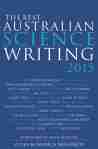
Bianca Nogrady (ed) The best Australian science writing 2015
Sydney: NewSouth Publishing, 2015
ISBN: 9781742242231 (ebook)
It’s a funny thing about writers festivals: there’s nothing really new to be said about reading and writing – surely we’ve said it all – and yet everything seems to feel new! Why is that? I guess it’s the stimulating environment that festivals create (the repartee that occurs between participants) and that there are always different ways of saying the same things (different spins, angles, perspectives). Whatever it is, I enjoy it and am glad we have our own festival again. (Most of my recent festival experience has been through ABC RN and podcasts!)
It’s all about the content …
For my own benefit, I want to tie up some threads that stood out to me:
Historical fiction: if you’ve read my Festival posts (listed at the end of this post), you’ll know that historical fiction was one of the threads that followed me (or I followed!) during the festival. It featured in a few sessions, but particularly in Waking the dead with Paul Daley, Sulari Gentill and Ros Russell. They all talked about the importance of plausibility and authenticity, but I particularly liked Gentill’s statement that historical fiction is about writing “plausible tales” about what might have happened, which gives insight into what did happen. This is what Kate Grenville was about in her controversial The secret river isn’t it? Some historical fiction, though, does focus on what did happen, but these are often told from a particular perspective. And here Gentill made another interesting point. She said her aim is not to present an absolute or rounded version of an historical person but an angle or perspective of that person that is true. This frees her to explore lesser-known sides of or possibilities regarding historical figures that may have been glossed over or ignored in the historical record. Finally, Gentill talked about giving voice to people whose stories are not always told (which made me think of recent Aussie books like Eleanor Limprecht’s Long bay and Emma Ashmere’s The floating garden.) I should add here that while I’m quoting Gentill, these ideas were more widespread – just stated differently.
Indigenous authors and issues: the Festival did not have many indigenous authors present. Indeed the Festival was probably not high on diversity all up. My sense is that this is not an unusual situation with Australian literary festivals. Of course, I don’t know how hard our organisers tried in this area, but it’s something worth noting. The only indigenous authors I noticed were Bruce Pascoe (whose session I missed because it clashed with Omar Musa and Jennifer Rayner) and Stan Grant (who didn’t come in the end). However, indigenous issues – and awareness of the sensitivities surrounding “white” people writing on indigenous life – were evident. Kim Mahood’s session was particularly relevant because it directly confronted indigenous-non-indigenous relationships with each other and the land, but in other sessions, such as the book launches for Richard Begbie’s Cotter and Nicholas Hasluck’s The Bradshaw case, audience members asked about indigenous people’s reactions to “white” authors writing about them. Unfortunately, in neither case was there time for in-depth discussion of the issue.
Politics: as I said in one of my posts, politics was a major theme of the festival. There were many sessions and events which focused specifically on this topic – the Hansard Monologues sessions, Leigh Sales and Annabel Crabbe, to name some. I didn’t attend these, though, so can’t comment. However, political issues and ideas underpinned two sessions I attended – Merlinda Bobis, and Jennifer Rayner and Omar Musa. While I love art for art’s sake (to be simplistic about it) and don’t think art has to have a message, I am drawn to writing that has a strong social justice purpose. Merlinda Bobis and Omar Musa are particularly inspiring in this regard. Bobis was passionate about changing our current political narrative from the politics of fear to the politics of caring. Loved it. And, if you know Musa, you’ll know that his passion is that of giving voice to minorities, to the disenfranchised. Both feel strongly that the arts can play a critical role in “saving” or changing us. Keeping a focus on politics – in diverse (!) ways – would be a logical thing for Canberra’s festival.
One of the joys of festivals is the opportunity to discover lesser-known or niche writers among the better known, and this festival did well here. There were the big overseas names like Yann Martel, AC Grayling, and Eimaar McBride, but there were also many wonderful Aussie writers – well-known and not so – to get to know a little better. For me, although I didn’t get to all I’d have liked, the mix was good. If I couldn’t attend one event, there was sure to be another that would be (and turned out to be) just as interesting.
… but the organisation is important too.
The festival had a lovely buzz about it, and from what I saw, it seemed that attendees were engaged and happy to be involved in such a well-organised event. I say well-organised because everything in my experience flowed smoothly, with problems (like my AWOL tickets) being handled pleasantly and without fuss.
There were a few issues though, and I’ll share them here because they might be helpful:
Advance notice/promotion: many people just did not know about the festival until quite late in the year, which suggests that marketing next time needs to be louder and reach deeper in the Canberra community. I “liked” the Facebook page, and subscribed in other ways, but found the information a little sporadic. I heard others say they didn’t know about it at all until very late.
Venues: the venues were great overall in terms of size and comfort – well, the ones I attended (NLA, NPG and Hotel Realm) anyhow – but I did find the widespread nature of the Festival (around the Parliamentary Triangle, Barton and over the lake) a little problematic. You could waste serious Festival time travelling between venues. Some of my session choices were made – and altered – due to this issue. It was a little disappointing, too, that Bookplate at the NLA closed up serving food so early. I think it was about 3.30pm or before on Saturday. With an all-day festival, it would be good to have more food available for longer, as food breaks don’t necessarily happen, depending on chosen sessions, at “normal” times. That said, Bookplate did a good job under pressure – in my experience.
Ticketing: I found the structure of the ticketing a little tricky to understand and navigate, particularly for the 5-event package which I opted for. (It was the best option by the time I booked). It wasn’t easy to work out what was available on the package and what had to be ordered separately. I worked out some – such as the Special Event morning tea – but other sessions that I thought were sold out were probably only available individually.
These are minor issues in the scheme of things, because overall it was a friendly, happy, content-rich festival. And it was encouraging to see so many of our cultural institutions and local organisations getting behind it.
So, thanks to the committee, the sponsors, and the volunteers (of course) for an enjoyable and stimulating weekend. And special thanks to Canberra’s literary grand dame, Marion Halligan. She was a real trojan in the number of sessions she took part in – and her input was so nicely relaxed and down-to-earth.
I look forward to doing it all again – in a more organised way – next year! August 25 to 27 is in my diary.
For my previous posts on the Festival you can check out the following links: Day 1, Day 2, and Day 3.
Back in 2012, I reported on Text Publishing’s new initiative to publish Australian classics, with new introductions, and market them at a very affordable $12.95. I was thrilled and hoped the venture would take off. Well, it did, and now four years later they have published the 100th title in the series. What a wonderful achievement – for them and for readers of Australian literature. I have loved seeing favourite authors in print again and, particularly, being introduced to new ones (to me) including the luminous Elizabeth Harrower and the intriguing Madeleine St John.
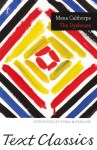
Text’s 100th Classic
Text Publishing – quite rightly – is planning to celebrate this milestone but, before I talk about that, I should tell you the title of the 100th book shouldn’t I? It’s a book and author I hadn’t heard of, The dyehouse by Mena Calthorpe. Originally published in 1961, it was, according to Wikipedia, shortlisted for the Miles Franklin Award. Hmm … I wonder where the Wikipedia author got that from, because on the Wikipedia Miles Franklin page it says that they’ve not been able to find records of shortlists released prior to 1987. Fiona McFarlane, who wrote the introduction to Text’s release, says it was “commended for the Miles Franklin Award”. I wonder where that came from too. I’d love to know more about the early history of the awards. However, that’s not my concern today.
The dyehouse belongs to the tradition of social realist novels – to which Ruth Park’s Harp in the south belongs, not to mention many of the books written by our women writers of the 1920s to 1940s. It is set in a textile factory, and the Australian Women’s Weekly, reporting its publication, quoted Calthorpe as saying:
All my life I’ve just written for myself, for experiment. I started this novel when I was working in the dyehouse, simply to practise writing dialogue.
McFarlane tells us that Calthorpe was a member of the Communist Party in the 1950s, and after leaving that joined the Australian Labor Party. She was also secretary for a while of the “leftist Australasian Book Society”. It’s not surprising, then, that she wrote in the social realist style.
McFarlane says that the book received mostly favourable reviews, from the “right-wing Bulletin to the left-wing Tribune“. However, my research did uncover a less than favourable one from The Canberra Times’ reviewer “RR”. RR was rather circumspect about it, praising it with one hand and panning it with the other. S/he writes:
Despite its immaturity of style, it is an impressive piece of work—about a factory, factory workers, unsubtle seduction, and love.
Its characters range from a not-very-convincing All Black, Renshaw, to a veritable troupe of Snowy Whites. The few in-betweens, notably Oliver Henery, are the really interesting characters. They almost come to life. The story is about simple people experiencing simple emotions.
“Almost come to life”. Oh dear. Describing it as, among other things, the story of “a lovesick girl and her search for the Real Thing”, s/he says
This is trite material. That Mrs. Calthorpe makes it interesting is a tribute to her skill.
Yet the book is badly overwritten and pretentious. It needs ruthless pruning of its “literary” passages […
…] She has considerable skill as a writer, her great strength appears to be story construction. When she stops fascinating herself with her own clever prose, throws away her thesaurus, and gets down to telling a story simply, economically, and honestly she may well be a force to be reckoned with on the Australian literary scene.
Well, that final point is good isn’t it? Interestingly, when the book was republished by Hale and Iremonger in 1983, suggesting faith in it, The Canberra Times’ reviewer, author Marian Eldridge, was more positive. She ends her piece with:
Calthorpe’s views about the exploitation of people are clear but at no time does she preach at the reader. Nor does she offer pat solutions. She is too good an artist for that: through spare, clear prose and jaunty dialogue she creates a series of intermeshing situations that she lets speak for themselves. She does not probe deeply into the psychology of her diverse characters but neither has she created stereotypes.
The Dyehouse’ is a fine example of the social realist genre. Through Calthorpe’s vivid, compassionate picture of people at work we learn a great deal about the actual processes in a dyehouse, or at least one of 25 years ago. I find very satisfying a piece of fiction that both tells a good story and explains how things work.
So, Eldridge likes her prose … anyhow, that’s enough for now. I’ll say more when I read it myself!
Text’s celebration plans
Text is clearly proud of its achievement – as it should be – and is planning a multi-pronged celebration, which will hopefully also promote these books to more Australian readers. Celebratory activities include:
events at writers festivals;
giveaways and reader competitions;
a revamped website including a literary map of Australia and New Zealand;
initiatives for bookshop promotions;
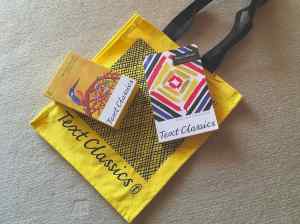
a boxed set of 100 Text Classics Postcards (thanks Text for my complimentary set); and
a free “I could never get bored with reading” (Amy Witting) tote bag for customers buying Text Classics at participating bookshops.
If you are interested in any of these I suggest you go to their website and “become a text member”. While there you will see a special deal of 5 classics for $50. You’ll also see Text’s Top Ten classics. Guess which book is number one? Elizabeth Harrower’s The watch tower (my review). What a service Text has done for Australian literature by bringing this author to our attention. I wonder what great finds Text will bring to us in the next 100?
Oh no! Because, as I explained in my first post, I booked late, I missed some events that I would love to have attended, but I was thrilled that one of my “musts” was still available, Charlotte Wood (author of The natural way of things). However, I woke up in the morning, looked at the Festival website, and saw that the session had been cancelled “due to illness”. Another headline act I’d wanted to attend, Stan Grant, had been cancelled shortly before the Festival “due to unforeseen circumstances”. Disappointing for us, and of course for the hardworking organisers, but that’s festivals isn’t it! Fortunately, I had three other sessions booked for the day and, you know, the lesser-known lights are generally just as interesting as the “stars”. It’s just that they’re, well, lesser known. And, there is a silver lining: this will now be a shorter post – for me to write and you to read – than yesterday’s magnum opus.
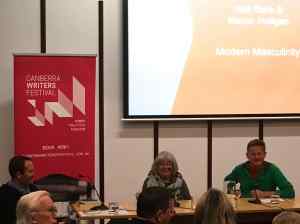
Nick Earls and Marion Halligan: “Modern masculinity” (hosted by Dr Christopher Chapman)
National Portrait Gallery curator, Dr Chapman, who is responsible for the Tough and Tender Exhibition, introduced authors Marion Halligan and Nick Earls, noting that both their recent books deal with boyhood and manhood. He quoted RW Connell on the hierarchy of modern masculinity and its basis in social and cultural expectations. “Alternative” males, Connell writes, are disenfranchised in the majority culture, even though the “majority” idea of masculinity doesn’t necessarily guide most men’s lives.
Halligan said she doesn’t think consciously of issues like this when writing but relies on her experience, which is of tender, kind, non-aggressive – though admittedly not always virtuous – men. The protagonist of Goodbye sweetheart who dies in the first pages – does that mean he’s the protagonist, Marion wondered aloud! – is not a good man.
Commenting on the fact that back in the 17th-18th centuries a common aspiration for men and boys was to be Robinson Crusoe – to be able to survive on their own in the wild – Earls noted that this scenario had no human contact. He writes his men at a time of challenge in their lives, at moments of reckoning, but these are often quiet moments, and involve connections with others, sometimes children. These men, like Halligan’s, have decent hearts, but make mistakes.
Halligan commented that she likes that Earls’ books are not miserable. They are not about dysfunctional families but can include moments of dysfunction. Earls confirmed this assessment, saying he wanted to write “real” families who connect with each other but for whom things sometimes go awry.
And so the discussion continued, moving fluidly, more like a conversation than a formal interview, though Chapman did inject some questions.
Halligan talked about changes in childhood between her generation and that of her grandchild, wondering about the impacts of these changes, while Earls spoke of some of the boys in his recent novella series, The wisdom tree. He talked of using an 11-12-year-old boy as a protagonist because this is the age of starting to push boundaries, of wanting to be successfully independent but also being a little fearful. He wanted the narrator of this story, NoHo, to be naive about what he was seeing. In another of the novellas, he puts a twenty-something rapper, his minder, and a 40-something rock journalist together, setting their different worldviews against each other.
Chapman asked Earls and Halligan what writers about men they liked. Earls, rather surprisingly, named Richard Ford, Raymond Carver, and Cormac McCarthy. He quickly qualified his nominations by saying he doesn’t “like” the men created by these writers but is fascinated by how they construct types of masculinity that he doesn’t relate to as a man, but that he believes and is interested in as a reader. Halligan, conversely, said she likes people who write characters like hers, writers liked William Trevor and John Banville who create muddled and not necessarily virtuous men. She does like Carver, though, for his sentences!
(I loved Halligan’s aside that she now reads on her iPad because if she buys more books she would have to move out of house! I hear you Marilyn!).
There was much more in a conversation that wove naturally between real life experiences and the writing of fiction, not surprising in authors who base their fiction in contemporary life. The audience Q&A continued this flavour. Some questions furthered the “literary” discussion, looking at whether the archetypal hero can encompass wider conceptions of masculine and feminine qualities and, more generally, at the challenge of constructing characters. Other questions moved into the personal. Earls discussed parenting. What do you keep and what reject from previous generations’ practices? And, of course, this topic couldn’t be discussed without some reference to the impact of feminism on the growing confidence in girls and increasing confusion about roles and expectations for boys.
A final point nicely made was that authors can create fluidity in gender roles, which must surely contribute to the wider conversation.
Kim Mahood (with Gia Metherell)
Interviewer, and ex-Canberra Times literary editor, Gia Metherell commenced by telling us that the focus of her session with author and artist Kim Mahood would be her recently published memoir, Position doubtful. She started by quoting Susan Wyndham’s recent description of Mahood:
On the morning I meet the artist and writer Kim Mahood, she has driven her ute nonstop for 1000 kilometres on her way home to Canberra from the Tanami Desert in Western Australia, a journey she has made back and forth across the continent for more than 20 years with the compulsion of a migrating bird.
A small, lean figure with a dry sense of humour, unfazed by flat tyres and solitude, Mahood seems honed for no-frills survival. Cleaning out her vehicle after the long drive with her dog, Pirate, she found a wire used for digging out witchetty grubs, a tomahawk and remnants of cooked kangaroo tail. Yet her conversation and her creative work have the subtle eloquence of an urban intellectual.
OK, including quotes like this is going make this post longer than planned. Sorry folks, but this is such an apposite description. Although Kim Mahood spends part of her life in my region, I hadn’t really heard of her until I read her eye-opening piece, “Blow-ins on the cold desert wind”, in The invisible thread. She spent much of her childhood on a cattle station in the Tanami Desert. That station is now owned by indigenous people, but in adulthood Mahood returned to the area and now shares her time between there and here.
Much of the conversation focused on her experience of and relationship to land – as an artist and as a white person spending time in indigenous communities. It made for a very thoughtful development of ideas that are currently circulating contemporary Australian thought (and explored in such books as Bill Gamma’s The greatest estate on earth). Mahood thinks that landscapes enter us at a physiological level, particularly those landscapes we experience when young. She talked about different layers of knowing the land – traditional, pastoral, sacred/ritual.
And this of course brought us to that uncomfortable issue in contemporary Australia: how we non-indigenous people, who also call this country home, understand our own relationship to the land we “usurped” or “took up”. Mahood is living this challenge. She described not knowing how to respond when she returned to her old home; she felt stripped of her knowledge and identity (which, of course, is how indigenous people would have felt when the land was originally taken from them). How do white people make connections with land they love without disenfranchising indigenous people? You do it, she said, by putting yourself in their hands. It takes time, and you have to become “less precious about stuff”, like your car! Anyhow, this issue and this solution are the central ideas of her book.
Her book’s title captures this conundrum. “Position doubtful” has a literal meaning which describes places that cannot be definitively placed on maps, but it also works as a metaphor capturing her uncertainty. This reference to maps neatly segued us to mapping, Mahood’s art and indigenous art – and how these relate to understanding of land, of country. Mahood talked of a mapmaking project designed to help geologist Jim Bowler (he of Lake Mungo fame) research evidence about ancient climates in the area. The Tanami, she said, has no permanent water, but the entire landscape is marked by water. Occasional massive rainfalls can reactivate its “deep past” landscape.
Metherell asked whether indigenous art can work as maps. Mahood was measured in her response, but said that yes, orientations of places to each other are right, but that these paintings “embody” experience. They are complex “maps” that encompass stories, they are open, unfinished documents.
And here I’m going to make this post a little longer again by sharing part of the reading Mahood gave from her book. She’s describing doing a painting:
… the edge of the cliffs breaks against the sky like a wave. I score it with hard strokes of the brush, an emphatic horizontal line that differentiates my approach from the local aboriginal concentration on ground and surface. This seems important. Although my own perceptions have undergone all sorts of modifications, I know the horizon is more than a visual dimension. It is as much a symbol in its way as the concentric circles that indicate sites and routes, and it’s a symbol to which I can lay claim. The horizon is one of the perceptual fault lines that runs between white and Aboriginal ways of understanding country …
She discussed the intersection between local knowledge and scientific knowledge. For indigenous people, the people have to be healthy for the country to be healthy, whereas scientists look at “fixing” the environment. There is a very deep gap in ideas of causality. Maps, she believes, can bring the two ways of thinking together.
At some point Mahood said that she writes better than she talks. Hmm, I know exactly how she feels, except she was completely articulate and has no need for uncertainty on this front!
But, I think I’ll stop here. It was a deeply satisfying session. I hope that I’ve given you a flavour – and a sense of what you missed by not being there! Yes, I know, I probably missed some other wonderful session – but that’s the nature of festivals isn’t it? The point is to be satisfied with what you decide to go to – and I was.
I’ll just close with a brief reference to terminology. The Walmajarri people with whom she works call white people kartiya. She commented that we don’t in Australia have a single term to describe non-indigenous people the way they New Zealanders have, for example. She wishes we did, so we don’t have to be referred to as “non” (that is, “non-indigenous”).
Oh, and she described Position doubtful as a love story. I’m looking forward to reading it.
Jennifer Rayner and Omar Musa, Generation less (with Laura White)
My final session of the festival was probably also my most overtly political, as its focus was Jennifer Rayner’s book Generation less in which she explores her theory that her generation, the Millennials, (she was born in 1986) will be the first generation in 80 years to be worse off than its parents. When her parents were her age, she said, they had a house, stable jobs, and a superannuation scheme under way. We are facing a time of reducing opportunity for young people, she argued, and if we don’t do something about it, everyone will be worse off.
Departing from my more usual chronological reporting, I’m going to start with a comment I heard as I was leaving the theatre. The person, around my age, said to her companion, “I really just wanted to hear him talk because he’s such an interesting character”. Hmmm … if this was referring to Omar Musa versus Jennifer Rayner, which I presume it was, then was the hidden message here that she didn’t much engage with the rest of what she heard? Certainly, the two – also of a certain age – who were sitting behind me didn’t seem to, as they left partway after quite a bit of muttering between themselves. Of course, it may be that they had an important dinner engagement to get ready for. But enough of that, let me get back to my report …
Because, the point is that Rayner’s thesis can be confronting to us of the baby-boomer generation. It would be easy to get defensive, except, as members of the audience pointed out, many of us have children in her generation and are seeing firsthand of what she speaks. Rayner admitted that she was expecting quite a backlash, but for this reason she has more often got understanding and a desire to do something.
Despite the dry-sounding nature of all this, it was in fact a lively and engaging session. Poet-rapper Omar Musa (also author of a novel, Here come the dogs) of course helped here. His intensely serious, but humorous, approach to what he does injected lightness, while also underpinning the importance of the concerns being discussed. He introduced himself by performing his hard-hitting poem, “My generation”.
His concerns are a little different to those of Rayner’s but they intersect. He is particularly interested in the disenfranchisement or disengagement of younger people, particularly of young “minority” men who don’t have the purpose of their immigrant parents. They feel disengaged from Canberra’s policy-makers.
Musa’s focus is people not usually written about, he said. Race, class, gender issues cause friction, he said, and create a combustible society. Feminism has a strong place, but for young men there is a “toxic masculinity”, and an inclination to see them as perpetrators. But they’re human beings too, he argued, and he wanted to humanise them in his novel.
So, the session shifted pretty easily between Rayner’s logical, evidence-based commentary, and Musa’s arts-based one. Rayner defined the issues confronting her generation as having three prongs: Work, Wealth and Well-being. In a nutshell, this means that (and she supported it with relevant data):
WORK: It is harder for young people to achieve stable jobs in the workforce, and wage inequality between ages is increasing
WEALTH: Her generation is “worth” less than her parents’ at the same age
WELLBEING: Her generation doesn’t have kids as early, doesn’t partner up as early, stay at home longer, all of which affects their emotional development and thus wellbeing.
Rayner said she grew up in the optimism of the Hawke era, while Musa talked of the disconnect between Keating who had a vision for the future, seeing the best Australia as ahead of us, and Howard who looked back to the halcyon days of the 1950s.
Rayner admitted that those young people who have gone to university are on a path – a slower path than the past, but they have one. Her main concern is the other 60% for whom there are fewer entry-level jobs and who end up doing insecure often “cobbled together” work. It is particularly here that Rayner and Musa saw parallels between their books. Those currently worse off are young men who drop out of school early. They become “badly dispossessed” such as the housepainter in Musa’s novel. Musa was inspired by Christos Tsiolkas’ The slap, he said, except that Tsiolkas is about the middle class while his concerns the aspirational or working class in a changing cultural landscape.
(At some point here, Musa laughingly praised Rayner as being “so articulate”. She certainly knew her stuff, but Musa, though seeming to be briefly thrown on a couple of occasions, is no slouch – and was certainly not “put out”. They just had to work at times to find idea-connections in terms of their respective approaches!)
It wasn’t all negative though. Discussion also focused on solutions. These are mostly institutional and structural, said Rayner, because the problem has been caused by policies that have been put into place over years. Young people need to be part of the conversation, alongside business councils, seniors’ organisations and unions, for example.
She said that economic insecurity is at the base of the problem, and housing is the defining issue in terms of health and well-being. The 25-35-year-old group is struggling to buy their first homes, she said. Musa said don’t look at him. “I’m a poet, I’m not into economics”. We laughed!
Anyhow, Rayner said that her book is based on hard data, and she (aligned with the ALP, she disclosed), wants good evidence-based public policy. But, what can we do? Rayner had some answers: vote for policies that will address the inequities, such as policies reforming negative-gearing and capital gains tax, policies that increase access to apprenticeships and those improving security for workers. There are also practical things, like not taking advantage of injurious policies. There are, in other words, moral choices we can make now – as well as when we cast our vote every three years. Later, she also referred to the increasing and successful, use of citizen juries – made up of a random group of people – to feed ideas into policy development, as another solution.
Musa’s solution was, as you’d expect, more personal. Listen to young people, he said, understand their stories in complex and nuanced ways, not by reverting to stereotypical views. Such listening demonstrates an openness to reconsidering our assumptions. He referred to Nigerian writer, Chimamanda Ngozie Adichie who refers to the danger of the single narrative. Poetry in Australia, he said, is now being taken up by other races – it’s no longer the domain of white middle class poets – and he hopes the thoughts and ideas of this generation of poets will start to feed into the public forum. “The arts and storytelling will save us!” he argued with passion,
There was more, including a detailed discussion of Musa’s novel, his exploration of the “messiness of the clash between class and agendas”, and his wish to show tension, not resolve it.
Then, I guess, came a real point of difference between the two. Musa wants a more radical shift. He suggested that talking about house-buying is no longer relevant, that there are those who, considering issues like climate change, want a different life and world. Rayner agreed there has been some shift in what young people value, that they can be less consumerist, but she believes most still want what their parents wanted, and that they should have the option.
The session concluded with another performed poem by Musa. It was one of his more positive ones he said. It started, “Let me tell you about a father and son feud” and ended with
Trying to be a better me
Can’t say better than that.
… and here ended my festival. I plan a little recap post in a few days – if I can marshall my thoughts together. In the meantime, a huge thanks to the organisers, volunteers, supporters and sponsors. It was a wonderful event and I was thrilled to hear that it will be back next year. Put August 25-27 in your diaries now folks!
 The first question asked what was “the best part of writing” his latest book, his Quarterly Essay on Bill Shorten titled “Faction man”. Marr answered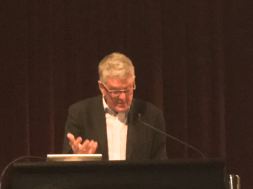



 Whispering Gums