Monday musings on Australian literature: 19th century travellers in Australia

I’m a bit of a sucker for 19th century travellers. The one who started it all was Flora Tristan with her Peregrinations of a pariah (1838). Yes, I know, she was a Frenchwoman travelling in South America, so she’s not actually relevant here. And yet, before I get to travellers in Australia I must mention other works I’ve dipped into: Washington Irving’s Tales of the Alhambra (1832), Isabella Bird’s Unbeaten tracks in Japan (1880), and Lafcadio Hearn’s Glimpses of unfamiliar Japan (1894). Of these, Isabella Bird is the only one to have also visited Australia, of which more anon.

Gerstacker

Public domain (via Wikipedia)

None of these, though, inspired this specific post. That honour goes to my current read, Freidrich Gerstäcker’s Australia: A German traveller in the age of gold which was first published in German in 1854, and has now been published in an English translation by Wakefield Press. It chronicles his travels in Australia in the early 1850s. As I started reading it, it occurred to me that while I’ve spoken before about 19th century explorers’ journals, I haven’t mentioned travel writing from the same period.

However, as I started doing a little research, I realised that, particularly given the period and how little the country had been “explored”, there is – or can be – a pretty fine line between explorers’ journals and those of travellers. The difference, I’d say, must be the intention, and here I’ll quote Gerstäcker:

Merely having set foot on a foreign part of the world has its own charm. No matter how passionately people are attached to their own country, they still want to see a different one, so that they can think longingly back to their own.

I’m not sure that the last bit is critical, but he does capture the traveller’s desire to see something different for his or her own reasons, as against the explorer’s goal which is more to travel to new places to gain geographical and/or scientific knowledge, usually for the benefit or use of others. For the person interested in history, though, both offer valuable “primary” insight into the life of another time.

So, I thought I’d share a few 19th century travellers (chronologically by their writings) who wrote about their travels in Australia:

Charles Darwin’s A naturalist’s voyage around the world (1860, text on PGA) describes his visit to Australia in 1836. He opens Chapter 19 with his arrival in Sydney Harbour:

Early in the morning a light air carried us towards the entrance of
Port Jackson. Instead of beholding a verdant country, interspersed
with fine houses, a straight line of yellowish cliff brought to our
minds the coast of Patagonia. A solitary lighthouse, built of white
stone, alone told us that we were near a great and populous city.

He tells of going out to Bathurst “to gain a general idea of the appearance of the country” and goes on to describe what he sees (including “the extreme uniformity of the vegetation”). He comments on his experience of indigenous Australians and also mentions convicts, but his main focus was the natural environment. After spending a couple of weeks in the area around Sydney, the Beagle went down to Hobart before heading to New Zealand.

Ellen Clacy’s A Lady’s Visit to the Gold Diggings of Australia in 1852–1853 (1853, text on PGA): Clacy visited the Australian goldfields with her brother, and was only in Australia for a year or so. Her book was one of many used by Clare Wright in her award-winning The forgotten rebels of Eureka (my review). Wright quotes Clacy’s advice to Englishwomen considering emigration:

Do so by all means … the worse risk you run is that of getting married and finding yourself treated with twenty times the respect and consideration you may meet in England.

The reason for this, Clacy argues, is that because there are so few women “we may be pretty sure of having our own way”. Hmm.

Here she is on Melbourne, or, one aspect anyhow:

The most thriving trade there, is keeping an hotel or public-house, which always have a lamp before their doors. These at night serve as a beacon to the stranger to keep as far from them as possible, they being, with few exceptions, the resort, after dark, of the most ruffianly characters.

Gerstäcker comments on “the truly astonishing number” of pubs in Sydney. Seems our drinking culture started early!

Friedrich Gerstäcker’s Australia: A German traveller in the age of gold (1854): it will be a while before I finish this, but I’ve read nearly a third and am loving his descriptions of mid-19th century Sydney and of his intrepid trip along the Murray. His observations on the people and the landscape, flora and fauna he meets and sees along the way add not only to my understanding of early white-settled Australia but also of mid-19th century European thought. I love that he keeps an eye out for the bunyip, though he’s aware that there’s a chance it doesn’t exist!

Anthony Trollope’s Australia and New Zealand (1873): Trollope visited Australia in 1871, when he was 56-years-old and having negotiated, writes Fullerton (see below), a contract to write a book about the trip. Fullerton writes that “few visitors to Australia have ever worked so hard at seeing everything, learning about Australian institutions and customs, observing locals at work and at play, and covering so much ground, as did Anthony Trollope”. The aim of the book was to be useful to potential English migrants to Australia.

Isabella Bird’s “Australia Felix: First impressions of Australia” (in Leisure Hour, Feb 10, 1877): I’ve enjoyed her writings on Japan but haven’t tracked down an e-version of this article. All I know is that she “disliked” Australia. It was the first exotic place she visited (besides a trip with cousins to the USA) and I wonder whether her attitude might partly be due to inexperience as a traveller – but that may just be me being defensive!

Five is probably enough for my purposes. It’s a subject I’ll return to when I review Gerstäcker’s book … and possibly again in future posts because there are many journals out there.

Sources:

  • Susannah Fullerton, Brief encounters: Literary travellers in Australia 1836-1939, 2009 (includes more writers than I’ve mentioned here including Joseph Conrad and Robert Louis Stevenson)
  • Project Gutenberg Australia (PGA)
  • Clare Wright, The forgotten rebels of Eureka (2013)
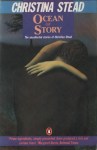
Christina Stead, Ocean of story, Pt 1: The early years – Australia (Review)

Christina Stead, Ocean of storyContribution no. 2 for Lisa’s Christina Stead Week from Ocean of story: the uncollected stories of Christina Stead.

My first post was on the titular story, “Ocean of story”, which is also used as the collection’s Introduction. After this Introduction, the stories have been organised into 7 sections by editor RG Geering. These sections are presented chronologically, Geering says, reflecting Stead’s timeline, not when they were written. The first is, therefore, logically titled “The Early Years – Australia”. It contains three stories – “The old school”, “The milk run” and “A little demon” – all of which have children as their central subject, which is, perhaps, interesting given Stead had none of her own.

Now, if you ever went to primary (or elementary) school, and that’s all of you I presume, you will enjoy “The old school”. If you were a girl, you’ll probably enjoy it even more. “The old school” was, Geering says, one of the few things Stead worked on in the last years of her life. It was published in Southerly in 1984. It’s like a little slice of life, and like the other two stories, starts with a fairly detailed setting of the scene before she gets to her main subject matter.

So, “The old school” starts with a description of the school, followed by a description of what happens at the school, or, more precisely of what the rumours say happens. But, we are told, in spite of this, “cause and effect” are clearer at school than at home, and “mostly concerned the boys”. Boys who are bad – who truant for example – will go to “the reformatory”. And if you go to the reformatory, your next stop will be prison. And who knows all this? Why “the informants” of course. And who are these “informants”, these “small sages”? Well, Stead writes, they are the “natural moralists, two or three to a class and as far as I knew, all little girls”. From here we are regaled with stories about these informants’ moral pronouncements by this “I”, this “I” who appears in two of the stories and who is an observer, rather than a participant, from within. In “The old school” then, the “I” is a student at the school.

The rest of the story explores the “moral questions” debated by these “informants”, whom Stead describes in more detail:

The informants, our moralists, had clean dresses, pink, blue or sprigged, patent leather shoes and white socks, and curls natural or rag. They did clean school work too, even when we got pen and ink. Goodness alone knows how, with their pink cheeks and shiny curls and neatly dressed brink little mothers, they got all this news about jails, reformatories, judges and sentences, lashings, canings, bread and water.

They are, of course, often little tyrants, deciding which child will be approved and which won’t. The rest of the story chronicles some of their pronouncements and their impacts on their peers. Whenever anything happened in the school “they knotted together, a town moot: they discussed, debated and delivered an opinion.” What the teachers said was to them only “hearsay”. Our “I” character doesn’t have an opinion. She “thought then that cruelty and injustice were natural and inevitable during all of a poor creature’s life”. (The use of “then” would be worth exploring.)

The main story concerns poor little Maidie Dickon who is, literally, “poor” and thus ostracised by our “natural moralists”. She didn’t have the right shoes, didn’t bring the right notes from her mother, and didn’t have her own pen and paper and so would be given some from the school supply. “It isn’t fair” cry the well-provided “informants” who also prove, mystifyingly to our “I”, to be excellent “newsgatherers”. They somehow know about Maidie’s roadworker father, who is (illegally, in those days) striking, and washerwoman mother.

You are getting the drift I’m sure of the story and will be realising that Stead’s focus is on the “natural” justice delivered by these “sages” or “moralists” to those less able to defend for themselves, while the “I”, Stead’s young self, tries to make sense of it all, of how the world works. The ending is gorgeously sharp. The story could take up a whole post – I loved its vivid picture and its passion – but I’ll move on.

“The milk run” was published in The New Yorker in 1972 (and later appeared in a Penguin anthology, The Penguin book of the road, published in 2008). It is set in the same area of southern Sydney as “The old school”, but it tells the story of a family and a little boy whose job it is to get the family’s milk from the grandfather’s dairy a mile away. Stead takes some time setting the physical scene, and describing the family and the boy, Matthew, who worships his father.

It is a beautifully detailed story of a particular place and time. Stead captures ordinary family life and tensions with such precision – a comment here, a brief conversation there, convey all we need to know about the various relationships. It conveys a child’s eye view of the world, the child’s incomprehension of adult behaviour. Things happen. Sometimes they make sense to Matthew, sometimes they don’t. Sometimes the father he worships supports him, sometimes he doesn’t. But, after a lucky find, Matthew gathers to himself a warming thought, something that offers him comfort when all else is uncertain.

And finally, “A little demon”, which was published, Geering says, in “an almost identical version” in the Harvard Advocate in 1973. It’s a satire, which again starts with setting a wider scene by describing a large and successful but rather insular family, the Masons. On the surface, they seem to be perfect, but asides and hints suggest that the surface is just that. There’s something a little claustrophobic and inward-looking about them with their “same notions” and suspicion of travel.

Into this family is born Stevie, the titular “little demon”. We hear a lot about him – the horror of his behaviour and what a trial he is to his mother, though, strangely, not to his teacher who finds him “very good” – but we don’t meet him until the last couple of pages. We are told what an “adorable” person his mother is, and how much she loves her two dogs, Duff and Rags. And here come some hints about who this adorable Mariana really is because, you see, she loved Duff and didn’t want her to ever have puppies. Why would you, after all, “spoil” that beautiful dog by letting her have puppies? Hmm, does this tell us something about Mariana’s attitude to motherhood? Ironically though, she falls in love with Rags, one of Duff’s unwanted puppies, the irony doubled because she doesn’t love her own offspring.

It all starts to go bad for Stevie when the cat that he found upset the dogs. He took the cat’s part, “just for a day or two; and then he saw which way the wind was blowing and lost interest”. And here the rot sets in. Stevie is depicted as having no feelings for animals, and as doing everything he can “to be disagreeable, to annoy, to tease”. How old is this Stevie that everyone – except perhaps his grandmother who defends him – hates? About 5!

It’s a satirical story in which Stead skewers shallowness and self-centredness, not to mention lack of maternal feeling. The language here is more heightened, using exaggeration and exclamation, than the more natural language of the previous two stories. It also has a somewhat stronger plot: we are set up to want to meet this Stevie, and there is a delicious little twist or sting in the tail, which the other two stories don’t have.

I’ve enjoyed reading these stories for Christina Stead Week. I’ll try to read more down the track, but in the meantime they have given me added insight into Stead, into the variety in her writing and into some of her broader themes. Thanks Lisa for the little push to read at least a bit of Ocean of story!
AWW Logo 2016

Christina Stead
“The old school”, “The milk run” and “A little demon”
in Ocean of story: The uncollected stories of Christina Stead
Ringwood: Penguin Books, 1986
552pp.
ISBN: 9780140100211

Monday musings on Australian literature: 1902 in Australian literature

Why, you may be asking, have I chosen 1902 for this post? After all, it’s not a nice round number of years ago, like 100. I could tease you with hints, but I want to get onto the post proper, so I’ll just tell you: it was the year Christina Stead was born. And, as you’ll have realised if you read yesterday’s post, this week in Lisa of ANZLitLovers’ Christina Stead Week. Now, of course, Stead wasn’t particularly sentient that year, but I thought it might be fun to see what was happening in literature in the (Aussie) world she was born into.

But first, let’s look at who else was born in 1902. Most interesting to me is Dymphna Cusack, whose memoir of her teaching days, A window in the dark, and first novel, Jungfrau, I’ve reviewed here. My research of the National Library of Australia uncovered that Cusack and Stead corresponded with each other, though I think Stead had a closer relationship with Cusack’s literary collaborator, Florence James. Anyhow, also born this year were Alan Marshall, famous for his autobiography I can jump puddles, and a lesser known author, Dorothy Cottrell, who had two novels adapted for film, one of them in her lifetime, Orphan of the wilderness.

Now, what was published in 1902? I’m going to focus on novels and short stories, because these were Stead’s main forms, and I’ve selected names that are reasonably well-known (to my mind anyhow). Here goes:

  • Barbara Baynton’s Bush studies (my reviews can be found here)
  • Rolf Boldrewood’s The ghost camp or, the avengers
  • Henry Lawson’s Children of the bush, plus individual stories
  • Louise Mack’s An Australian girl in London (I have Mack on my TBR)
  • Rosa Praed’s The insane root: A romance of a strange country and her autobiography, My Australian girlhood (I’ve read her The bond of wedlock)
  • Ethel Turner’s Young love (I have reviewed her Juvenilia)

There are others, but most are writers who are not known now, such as Hume Nisbett and Ambrose Pratt.

The interesting question is whether any of these writers influenced Stead? Did she read them as she was growing up? Not having read any biographies of her, I can’t say. However, Baynton and Mack went overseas in the late 19th to early 20th centuries, seeing it as important for establishing a writing career. Expatriation could offer better access to publishers and “a freer life” (Carole Ferrier). Stead also went to England (and later the US) a couple of decades later. She may not have explicitly “followed” them,  but it was a popular path for serious writers. There is an argument – both in her time and now – that Stead’s lack of recognition in Australia stems partly from the lengthy time she spent overseas. You can, it seems, be away from “home” too long! According to Wikipedia, she ‘only returned to Australia after she was denied the Britannica-Australia prize on the grounds that she had “ceased to be an Australian”‘.

A significant person active at the time of Stead’s birth is Vida Goldstein, the politician and women’s rights activist. In 1902 she was the Australian delegate at the International Women’s Suffrage Conference in Washington, DC. Again, whether Stead knew of her, I don’t know, but she was a person worth knowing and was part of a long tradition of Australian women who cared about women’s rights and broader social reform. Stead’s first novel, Seven poor men of Sydney, documenting “the relentlessness of poverty”, demonstrates her interest in similar issues.

I know this little post doesn’t tell us much about Stead, herself, but I found it interesting to research and think about. More useful might be to look at literary life around the time she turned 21? We might then find and think about those who were more likely her peers. Hmmm …

Research:

  • 1902 in Australian literature (Wikipedia)
  • Hooton, Joy and Harry Heseltine, Annals of Australian literature, 2nd ed. Melbourne: OUP, 1992
  • Trove (various newspaper articles!)

Christina Stead, Introduction: Ocean of story (Review, possibly)

Christina Stead, Ocean of storyI am so glad Lisa (ANZLitLovers) has given me an excuse, her Christina Stead Week, to finally pick up Ocean of story: The uncollected stories of Christina Stead. I bought this book, in 1991, from a sale table for all of 98 (Australian) cents! What a bargain. I then popped it on my Australian literature TBR shelves, where it has sat, and sat, and sat – until now.

Before I get to it, though, I must confess that this post’s title is a bit of a lie. Christina Stead just called this story “Ocean of story”, but RG Geering, the editor of this “uncollected” collection, made it the Introduction to the book. I decided that I could use this to differentiate in my post title that the post is just about this introductory story. Fair enough?

Now to the overall collection. I am on record as stating that I don’t read introductions to books before I read the book itself. I would in fact prefer these “introductions” to be called “afterwords” and placed at the end. And that’s what Geering has done here except, being perverse, I’d rather that for such a “curated” collection it had been at the beginning! Consequently, I didn’t see it until I’d read the first story and, finding it a little unusual, wondered why there wasn’t some sort of editor’s introduction. So, I went looking. And there, at the end, was his Afterword!

Geering writes that the book

brings together for the first time most of the short prose writings that appeared in various places (journals, magazines and newspapers) outside the thirteen volumes of fiction published during her own life, along with other unpublished pieces found among her personal papers after her death.

And then he says that he has grouped the pieces “according to their settings and contents rather than chronologically”. In this way, they will “follow the contours of [her] somewhat wandering life.” Then, right towards the end of his Afterward, he finally describes the opening piece: it’s

a contribution to ‘The International Symposium on the Short Story’ in Kenyan Review, 1968 … [and] is a highly personal essay, rather than a conventional article.

And that is exactly what it is, a “highly personal essay”, one that, by its end, has given us a “highly personal” understanding of what stories, and particularly short stories, meant to Stead. It starts:

I love Ocean of Story, the name of an Indian treasury of story; that is the way I think of the short story and what is part of it, the sketch, anecdote, jokes cunning, philosophical, and biting, legends and fragments. Where do they come from? Who invents them? Everyone perhaps. Who remembers them so that they pass endlessly across city life? I know some of those marvellous rememberers who pass on their daily earnings in story; and then they are forgotten to become fragments, mysterious indications. Any treasury of story is a residue of the past and a record of the day.

I love the open-endedness of her conception. It’s a free-flowing one that allows stories to take all forms. She goes on to say that “what is unique about the short story is that we all can tell one, live one, even write one down.”

Then she turns autobiographical, starting with her childhood with her father. She was, she says, “born into the ocean of story, or on its shores”, the daughter of a “lively young scientist”. He

told his tales. He meant to talk me asleep. He talked me awake.

Ha, the impact of stories on an imaginative child, which Stead clearly was. He told her stories drawn from his zoological work, and “stories of the outback…and even a few historic events.” But then comes the important thing – the thing that is important to all who read – that is, what stories do for us. She writes that the thousand stories she heard between two and four and a half

formed my views – an interest in men and nature, a feeling that all were equal, the extinct monster, the coral insect, the black man and us; and another curious feeling in me, of terrestrial eternity, a sun that never set.

This feeling came via her father’s nature-related stories which taught her that while death was necessary, there was always “a frail print” left. However, the storytelling – these times that allowed her “to see the unseen” – ended when she was four and a half and her father remarried. The magic was imprinted by then though!

“the million drops of water”

Indeed, she sees stories as “magical”. You only need for someone to say, she says, “Here’s a story; it happened to me” and all will listen. We seek stories – even those “twisted, inferior, cramped, and sterile stories on TV” – because we hope to recognise and “have explained our own existence”. She’s right – on both superficial (what am I doing) and deeper, more psychological (who am I) levels – don’t you think? She continues:

It isn’t necessary that these stories should be artistic or follow formula or be like Chekhov or the last metropolitan fad, or anything. The virtue of the story is its reality and its meaning for any one person: that is its pungency.

She argues that while the “masterpiece” might be appropriate for professionals, “the essential for us is integrity and what is genuine.” She then, interestingly given she wrote this in 1968, harks back to stories of the 1930s:

not all are memorable (some are) but all record the realities of the days when America was suffering and looking for a way out and thinking about its fate; and – look at those same today – they are a vivid and irreplaceable memento. That is what is best about the short story: it is real life for everyone; and everyone can tell one.

In other words, “the story has a magic necessary to our happiness”! We seek “the powerful story rooted in all things which will explain life to us”. I love all this. It is such an argument for the importance and value of the arts.

Stead concludes by telling a story about a group near London that she once joined. All were asked to stand up and tell a story, and

everyone, those stuffy and snug people came to life, became mouths out of which bubbled stories poor and ordinary or before unheard of.

There it was, she says, “the ocean of story”. And this happens everywhere, anytime. So,

The short story can’t wither and, living, can’t be tied to a plan. It is only when the short story is written to a rigid plan, or done as an imitation, that it dies. It dies when it is pinned down, but not elsewhere. It is the million drops of water that are the looking-glasses of all our lives.

I classed this post as “(Review, possibly)” because I haven’t really written a review. Rather, I’ve described/shared Stead’s attitude to stories – and to story-making and storytellers. I love her egalitarianism, even when describing stories that are “poor and ordinary”; I love her flexible idea of what makes a story; I love her chatty, idiosyncratic style; and most of all I love her passion for the importance of stories (particularly short stories) to our lives. I look forward to reading at least some of those in this book.

AWW Logo 2016Christina Stead
“Introduction: Ocean of story”
in Ocean of story: The uncollected stories of Christina Stead
Ringwood: Penguin Books, 1986
552pp.
ISBN: 9780140100211

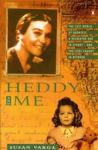
Susan Varga, Heddy and me (Review)

Susan Varga, Heddy and me Book cover

Penguin edition

Susan Varga’s biography-cum-memoir, Heddy and me, was first published back in 1994, so why am I reading it now? By a rather circuitous route, as it happens. Lesley Lebkowicz, whose The Petrov poems I’ve reviewed, read my post on Anna Rosner Blay’s Sister, sister, and suggested to Susan Varga that she might like to send me her book to review. Varga apparently liked the idea and consequently I received an email from her personal assistant offering it to me. I had heard of it, and am interested in the subject matter, so I said yes. That was, embarrassingly, over four months ago, for which I apologise, but eventually its time came and here, finally, is my review.

I’ll start with the judges’ comment when they chose the book to win the 1994 Christina Stead Award for Biography, Autobiography or Memoir*. They described it as “the front rank of autobiographical writing in this country”. That’s a big call but, having read it, I agree, because it is an engrossing book which intelligently negotiates two usually opposing forms, biography and autobiography/memoir. In it, Varga tells the story of her Hungarian Jewish mother Heddy – her life in Hungary, her experience of World War 2, and her subsequent emigration with her extended family to Australia. But, in telling this story, Varga, as the title conveys, also tells her own. She was born, mid-war, in 1943 and was just 5 when the family migrated. Hers was a complicated growing up in which she struggled to find self. She finally realised, late in her research, that she straddles two generations: the first (those who migrated) and the second (the children of those migrants).

Now, I can see why Lebkowicz thought I might be interested in this book, because both books involve a daughter not only telling the Holocaust-survival-and-migration story of a mother, but also working through her understanding of and relationship with that mother. Like Blay after her, Varga captured much of her mother’s story via tape recorder:

… the room itself is imposing, with its long oak table and chairs covered in embossed velvet. Imposing but not unfriendly, which is very much Mother’s style.

I switch on the tape-recorder. She talks, I listen. She [unlike Blay’s mother] doesn’t need much prompting; she’s telling me her life story, which she knows will be raw material for a book. In the past when people have said to her, ‘Heddy, you should tell your life story,’ she has said, ‘I’m waiting for Susan.’

I’ve told her it won’t be her life story, not properly. It will be filtered through my reactions and thoughts, my second generation eyes.

And Varga’s eyes are complicated, sometimes testy ones, as she strives to comprehend her strong-willed mother. So, like Blay’s book, Heddy and me is an amalgam of biography and autobiography, thereby neatly sidestepping David Marr’s injunction for biographers to get out of their story! Like Blay’s book, too, Heddy and me is a story of survival – of a peculiar combination of luck, resourcefulness and judgment – and it’s a story of the lasting impacts of the war. For both families, one of those impacts is an ongoing sense of fear:

… the fear of impermanence, the readiness to flee, takes the form, among others, of a deep conservatism running through the older generation, as if any change at all could result in their lives being uprooted again. They are over-protective, still prone to buy their children a diamond, something portable, just in case.

And we children feel a pervasive fear that we do not know how to express. Impermanence and insecurity lurk in the shadows behind this all-Australian red-brick security.

I found this analysis, this explanation of conservatism, enlightening – and helpful.

However, despite similarities with Blay’s book, Varga’s is different. For a start there are the obvious departures. Varga’s family is Hungarian to Blay’s Polish one, and Varga’s mother was married with a young child when the war started while Blay’s mother was still a teenager. Moreover, Varga’s mother managed to avoid, through various subterfuges, being sent to a concentration camp. She didn’t suffer the ghetto and concentration camp terrors and depredations of Blay’s mother, but Heddy and her colourful mother Kató, whose story is also told here, did suffer, including being raped multiple times by their Russian liberators. There are deeper differences too, speaking to the different psychologies of the two families, their individual wartime experiences, and how these subsequently played out in their post-war lives. And there’s the structure. Varga interweaves her own story and her reactions to her mother’s story within the one narrative flow, while Blay carefully differentiates her voice from her mother’s and aunt’s.

A particularly fascinating part of Varga’s book is the picture she paints of Hungarian society before, during and after the war. I learnt a lot, for example, about Budapest – its vibrant pre-war culture and life, albeit a life that, for its Jewish inhabitants, had its paradoxes. They lived, writes Varga, an outwardly normal life, “clinging to continuity while awaiting upheaval”. Varga chronicles the trajectory of anti-Semitism, from pre-war to the out-of-the-frying-pan-into-the-fire situation in which Hungary’s Jews found themselves post-war, when Nazism was replaced by Communism. Indeed, having survived the war, Heddy, Kató and family were prepared to stay in Budapest until it became clear to Heddy “that the noose was tightening again, like Hitler, except then it was against the Jews, now against everyone.” So, Heddy, ever attuned it seems to the political nuances around her, worked on her family until they agreed to move to “the New World”. Later, as part of research for her book, Varga returns to Hungary with her mother, and becomes aware of the increasing (or, really, continuing) anti-Semitism:

As I begin to grasp the subtleties of political life in the post-Communist world, I find it awful that the Jews should once again need friends and protectors, I think of 1943, when Hungary’s Jews still thought themselves safe because Kállay, or some other prominent politician, was their friend.

Once again, I am astonished, though I suppose by now I shouldn’t be, at how deeply anti-Semitism seems to run, particularly in Europe.

And here, I’m going to insert some personal connections with Varga’s story. I mentioned in my review of Sister, sister that I’d spent some time in my Sydney youth with Jewish people – eastern European Jews – who were business friends of my father’s. Blay’s and now Varga’s books consequently ring true for me, Varga’s particularly, because her parents did exactly what many of these people did – they set up business in the rag trade, and then handbags. I still have some handbags to prove it! But, my connections with Varga are more than this, because I went to the same high school she did, albeit a decade later. Unfortunately, Varga’s experience was not as positive as mine, partly due to her increasing sense of disconnection with her family and partly to the fact that by my time in the mid-to-late 1960s society was becoming less rigid (even in strict government girls’ schools). It was at that school that my understanding of civil rights – particularly, then, relating to racism and anti-Semitism – was honed. This is rather ironic given Varga found it “a school of endless strictures and platitudes”.

Anyhow, enough about me, and back to the book. Heddy and me was, I suspect, groundbreaking when it was first published, not so much for its portrayal of personal experience of the Holocaust, because such stories started appearing soon after the war, but for Varga’s intensely personal exploration of women’s experience and identity across three generations, before, during and after the war. Since then, similar stories have been written – Blay’s, for example, and another I’ve reviewed, Halina Rubin’s Journeys with my mother. However, these later books don’t minimise the power of Heddy and me, which not only illuminates the personal and familial costs of the Holocaust, but also provides an historical perspective on that mysterious thing we call human behaviour. This book deserves a continued life.

AWW Logo 2016Susan Varga
Heddy and me
Abbotsford: Bruce Sims Books, 2000 (2nd ed.; Orig. ed. Penguin, 1994)
304pp.
ISBN: 9780957780033

(Source: Susan Varga)

* Unfortunately FAW’s awards website only goes back to 1999. This comment is on the front cover of my edition, and is credited to “Christina Stead Award”.

Monday musings on Australian literature: The Hope Prize

I came across the beautifully named Hope Prize over the weekend via some online service. Was it Twitter? Was it Facebook? Perhaps even Instagram though I think not, but I really can’t recollect. Such is our online lives, eh?

Anyhow, the Hope Prize, was, according to the website, established by the Brotherhood of St Laurence “thanks to the generosity of the late Prudence Myer and the support of her family*, to encourage writing that transcends stereotypes of ‘the poor’ and reflects the resilience we know that people show in the face of poverty and testing times.” The Prize is supported by publisher Simon and Schuster and Readings bookshop.

So, what is the prize for? Well, it is subtitled the Brotherhood of St Laurence Short Story Competition. I understood from the site where I first read about it, that it’s geared to amateur writing. The competition rules say that entries “must be the original work of the applicant” and “must not have been published, broadcast, or won a monetary prize in any competition”. The applicant must also be a resident of Australia, and the story must be between 2,000 and 5,000 words.

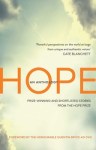
Hope prize short stories book coverThe judges for the inaugural prize, whose winners have just been announced, were Australian actor Cate Blanchett, novelist Kate Grenville, and ex-Governor General Quentin Bryce. What a lovely panel (albeit an all-female one. Perhaps it would be good to include a token male next year! Sorry, couldn’t resist that.) Anyhow, the website says that “they were impressed with the very high standard of writing and reported that all the finalists revealed powerful perspectives on the world at large, and displayed unique, unpretentious and authentic voices.” According to an article in the Sydney Morning Herald (SMH), a collection, which will include the winning and commended stories, will be published by Simon & Schuster on November 9. Sounds like a gift worth buying and giving.

But now, the winners:

  • First Prize, $5,000: Catherine Moffat for “Better Homes and Gardens”
  • Second Prize, $3,000: Eloise Young for “555 to Reservoir”
  • Third Prize, $2,000: Katherine Hayes for “Queen St”
  • Young Writer winner, $500: Eleanor George for “Colours”

There were also six highly commended stories.

… an entirely different perspective …

The abovementioned SMH article says that the winning story, “Better Homes and Gardens”, is “narrated by a young girl who lives in her father’s car with her little sister and describes her trying to stay afloat at school”. Cate Blanchett says of this story that

I suddenly saw the world from an entirely different perspective … It’s language and perspective on the world that in middle class society we take for granted. I felt like my entire world had been turned upside down.

She says that the stories did not confirm stereotypes and were “utterly illuminating”.

Quentin Bryce says that the stories, which present the perspectives of refugees, asylum seekers and homeless people, gave her a real understanding of the isolation experienced by many Australians every day. SMH quotes her as saying:

I was reading those stories again and thinking about what this publication is about; about poverty and disadvantage and the compassion you really feel very deeply. It gives you an awareness of how easily life can change.

And finally to return to Blanchett, she is, SMH says, “a firm believer that great works of art and literature can be catalysts for change”. I have to agree, and love her passion and support for projects like these.

Hope: an anthology will be available in trade paperback and format, and royalties are being donated to the prize. You can order via the Simon and Schuster site, or presumably buy from shops like Readings, after November 9.

What an encouraging initiative this is – one which encourages the arts while also working to raise awareness of social justice – and what a great example of what philanthropy can do.

* I’m not sure if this has been organised through the Myer Foundation, but the Myers, through four generations now, are among Australia’s most signifiant philanthropists in the arts, social welfare and the environment. Prudence Myer was married to Kenneth Myer, whom I met eons ago through his active support of the National Library of Australia.

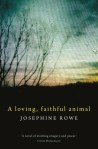
Josephine Rowe, A loving, faithful animal (Review)

Josephine Rowe, A loving faithful animal

How many novels have you read featuring the Vietnam War? I’ve not read many I must say, but last year I did review Charles Hall’s Summer’s gone, and now this year I’ve read Josephine Rowe’s A loving, faithful animal. It’s a debut novel but, from its form, you can tell that Rowe is an accomplished short story writer. I have in fact read one of her short stories – from her collection, Tarcutta Wake. Unusually for me, I didn’t review it at the time. I think this is because I planned to read the whole collection, but that hasn’t happened (yet, anyhow), which is clearly my loss.

So, before I discuss the content of this novel, I should explain what I mean by my comment regarding short stories and its form. For a start, it’s a multi-voice novel. On its own, this is not unusual, but here the voices are also in different persons, which is not unheard of either, really. However, added to this is the fact that the chapters (or “stories”), particularly “Breakwall”, could be read as stand-alone pieces. To make the novel out of these pieces, they are linked via character, and there’s an overall chronological narrative arc to them, but they also remain little jewels in themselves. There’s real skill here, in the way Rowe juggles her voices, perspectives, stories to create a very satisfying whole.

Now, to discuss the novel itself. It comprises six stories, starting in second person with Ruby, whom we come to realise is the younger daughter of the book’s central family. It then progresses through four stories told from different third person limited perspectives – Ruby’s mother Evelyn, her father Jack, her uncle and father’s brother Les or Tetch, and her sister Lani – before returning to Ruby’s second person voice to conclude. The story is one of a family broken by the father’s ongoing trauma (PTSD) following his Vietnam War experience. It’s a devastating story showing how such trauma can play out, resulting in domestic violence, dividing loyalties and causing splits in families.

… she did not drive away …

The novel opens on New Year’s Eve, around 1990. The family has struggled on for some time. Jack has been unable to retain good employment, going in and out of rehab, with Evelyn always drawing him back, wanting their relationship and the family to work. But, every time she takes him back, she loses something too, particularly in terms of the respect of her elder daughter. As the novel opens, it’s New Year’s Eve, and Jack has gone, for good this time it seems, after something unspeakably brutal – the full details are never, fortunately, given – has happened to the family’s pet dog, Belle, the titular “loving faithful animal”. Except, as you’d expect, there’s more to the title than this. Evelyn, too, is “a loving faithful animal”, as in her way is Ruby and, perhaps we could also argue, Jack’s half-brother, Les/Tetch. He had escaped the war by “getting rid of his own fingers” and now hovers on the edge of the family, wanting to keep an eye on them, wanting his brother to be okay, but wanting too some family for himself.

What I enjoyed most about this book, besides its tackling this important subject, is its empathetic but unsentimental portrayal of its characters. Evelyn’s loyalty (her faithfulness) is shown to be both admirable and stupid. We see the catch-22, damned-if-you-do-damned-if-you-don’t nature of her situation, with the added element of a young girl having made her bed, that is, having married against her parents’ advice, and now having to lie in it:

But she could never quite bring herself to. Run out on him like that. And it was never as simple as money. It was never as simple as pride, because she’s not sure she’s never had much of that either. Or if she does, it hasn’t turned out to be worth much, not when it comes right down to it. (II “The Coastal Years”)

Life is cruel, particularly when stubbornness and lack of forgiveness face off against each other. Anyhow, we also ache for Jack who can’t escape his past, and nor “get a handle on” the future, so leaves rather than inflict more cruelty. We see and understand Lani’s decision to reject it all and escape into a future on her own, while Ruby stays determinedly loyal. Every decision though comes at a cost.

It’s not an easy book to read, and not just because of the subject matter. Rowe is not the sort of writer who wants to tell a simple narrative. She wants to convey emotions, psychology, motivations, not just actions, because these are the stuff of life. And this requires a particular sort of writing which, for Rowe here, is a sort of minimalist, sometimes disjointed, sometimes lyrical style:

This is Exhibit A in the Museum of Possible Futures, the life that might have rolled out smooth as a bolt of satin, if she had just swung her slender legs up into that beautiful car and driven as fast as she could in the opposite direction, leaving the man with the camera far behind. Your father, he could keep the photograph.

But she did not drive away. Instead she sold the car and spent every night of her life trying to lead your father out of the jungle, out of the mud, away from the cracks of invisible rifles, strange lights through the trees. (I “A Loving, Faithful Animal”)

There’s more of course – isn’t there always? – including little running motifs involving cicadas and panthers, and Tetch whom I’ve barely mentioned, but I’ll close here. This is the sort of book that I’d love to see in next year’s awards shortlists, for its writing and for its fierce, authentic evocation of the lasting effects of war. I wonder if I will.

Lisa (ANZLitLovers) was also impressed by the book.

AWW Logo 2016

Josephine Rowe
A loving, faithful animal
St Lucia: UQP, 2016
200pp.
ISBN: 9780702253966

Monday musings on Australian literature: Women writers on the outback

After I posted my completion of the AWW Bingo Card yesterday a discussion ensued on Lisa’s ANZLitLovers blog regarding her comment on the dearth of books written by women “set in the outback”. That got me thinking … and it seemed like a good topic to play with in a Monday Musings.

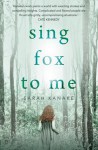
Sarah Kanake, Sing Fox to meThere’s a question to resolve first, that of defining “outback”. What do we mean by it? In my post, I said that I tended to see “the outback” as Australia’s dry remote regions, but for the Bingo I used Sarah Kanake’s Sing fox to me (my review) which is set in a remote mountainous area of Tasmania. Meanwhile, over at Lisa’s blog, a commenter suggested that Lucy Treloar’s Salt Creek is set in the outback (I’ll drop the inverted commas from now on!), to which Lisa replied that she “did think of Salt Creek (because I loved it) but it’s on the coast down on the Coorong, not the outback.”

So, what – or where – is this Outback?

I did some research. Online dictionaries offer broad definitions – “the back country or remote settlements; the bush (usually preceded by the)” (dictionary.com) and “the remote bush country of Australia” (The Free Dictionary). The Advanced English Dictionary, quoted by the Collins Dictionary, has it as “The parts of Australia that are far away from towns are referred to as the outback.”

However, perhaps the best definition for our purposes is that offered by The Oxford Companion to Australian Literature (2nd ed.):

‘Outback’ denotes the remote and sparsely settled inland districts of Australia but does not indicate such extreme remoteness as implied in a similar expression, the ‘Never-Never’.

It goes on to say that the term was used in the latter part of the 19th century, but became more common in the 20th century, so much so that “the original semi-colloquial expression is now an orthodox term”. It also says that while the outback was romanticised, particularly by bush balladists like Banjo Paterson, Henry Lawson “forcibly” presented the other side in his Some popular Australian mistakes where he wishes “that Australian writers would leave off trying to make a paradise out of the Outback Hell”.

I’ve read elsewhere* that the outback is the region “past” the bush. So “past” the bush but not as far as the “Never-Never”! Now, as a librarian, I’m into categorising, but I also recognise that categories need to be loose and flexible. So, I’m going to accept any area that is sparsely populated and that has a challenging or forbidding environment to live in. This means, I’d argue, that mountainous Tasmania could qualify, but that the Coorong is borderline. It’s only 150kms from Adelaide and it is coastal rather than inland (which is where we tend to see the outback), but it does have a rather challenging environment.

Outback literature – past

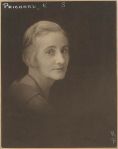
Katharine Susannah Prichard

Prichard, 1927/8 (Courtesy: State Library of NSW, via Wikimedia Commons)

I’m not going to write a deeply researched thesis on this, but write primarily from “the top of my head”. Generally – and I am generalising – much late 19th to early 20th century literature set in the outback tended to be about nationalism, identity and the pioneering spirit. There were novels by women about farmers and pioneers (such as Katharine Susannah Prichard’s The pioneers, my review). Miles Franklin wrote her autobiographical novel, My brilliant career, about a grazier’s daughter who wanted a different life from that being mapped out for her, and then of course there’s the remarkable Barbara Baynton whose short stories in Bush studies (my reviews) certainly didn’t “make paradise” of the outback. Life for her characters, particularly women, was hellish. Baynton and Franklin were realists who didn’t buy into the romance of the bush.

Their realism, and that of some of their peers, was picked up through the middle of the twentieth century by writers like Ruth Park (Swords and crowns and rings, which I’ve reviewed and which is set partly in rural areas before moving to Sydney), Kylie Tennant (The battlers) and Eve Langley’s The pea pickers (my review). But, it’s a huge subject and I really want to get to what inspired this post, contemporary women’s writing about the outback. (The Bingo challenge itself though, I should add, didn’t specify contemporary writing.)

Outback literature – current

In the discussion on Lisa’s post, she suggested that today’s outback novels deal with issues like inheritance and indigenous ownership, to which I added climate change and environmental issues. Before continuing, I should mention that there’s a whole genre of writing that I’m not including here, rural romance, because my focus today is literary fiction.

Alice Robinson, Anchor PointAnd in this area, contemporary women writers have been contributing some provocative books. Gillian Mears’ historical novel, Foal’s bread (my review), is about hard country life, about conservatism and snobbery which refuses to see substance. Jessica White’s contemporary novel Entitlement (my review), on the other hand, explores issues relating farming succession and indigenous connection to land. Cli-fi, fiction about climate change, can be set anywhere, but not surprisingly a subset is set on farms, which is where Alice Robinson’s Anchor point (my review) sits. She also touches on indigenous ownership issues.

And then, of course, there’s Thea Astley who I’d argue is still “contemporary” given she only died in 2004. Most of her books are set in remote places, including her last novel, published in 1999, Drylands (my review). It is set in “a God-forgotten tree-stump of a town” which is “being outmanoeuvred by the weather. As simple as that. Drought. Dying stock.” Drylands moves us into the dystopian vein and brings me to a book which probably wouldn’t immediately be thought of as an outback novel. I’m talking Charlotte Wood’s The natural way of things (my review), which is set in a remote, isolated place that is critical to the way the plot plays out.

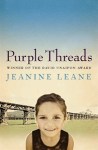
Jeanine Leane's Purple threads

Finally, in this very brief survey, I must mention Indigenous writing. Ali Cobby Eckermann’s Ruby Moonlight (my review) is an historical verse novel exploring early contact between indigenous and non-Indigenous people in remote South Australia. Jeanine Leane’s Purple threads (my review) tells of a mostly-female indigenous family living on a small piece of land in the Gundagai area of New South Wales in the 1950s to 1960s. It explores the experience of being indigenous, being lesser, in a rural community. And Alexis Wright’s Carpentaria (my review) is set in a fictional town called Desperance in northwest Queensland. It depicts conflict between different indigenous groups and with the local multinational mining company, and exposes the psychological, spiritual and physical impact of colonisation on indigenous people.

Note: Bill (Australian Legend) has reminded me in his Bingo post that “the Outback” is a white construct. Mea culpa, he’s right, but I’m going to stick with my paragraph above, because I don’t want to ignore indigenous writing. How hard it is, sometimes, to get out of our own world-view.

So, it’s now very clear to me that women are still writing books set in the outback (by my definition). It’s also clear that the issues they are addressing have moved on – not surprisingly – from those of a century ago.

I’d like to know what you think. Do you accept that these books are “outback” novels? And have they reminded you of other novels by women set in the outback? Now that I’ve started, I could certainly go on …

If you are not Aussie, do you have anything equivalent in your national literature?

* Albeit in Wikipedia, with no citation.

AWW Bingo 2016 Challenge Completed

For a blogger of more than 7-years standing who doesn’t take part in memes and challenges, I’m doing a good job this month. First it was 6 degrees of separation earlier this month, and now it’s a bingo game. I have good reasons for these exceptions, but I don’t expect you really want to know those, so let’s just get on with it.

AWW Logo 2016Back in April, Kelly from Orange Pekoe Reviews created two Bingo cards for the AWW Challenge and posted them on the blog. The date for completion was set as 31 October. A couple of days ago, AWW participant Christy Collins became the first person to post that she’d completed the challenge. Now, my life has been so busy these last 6 months or so that I’ve not actively pursued the challenge. However, I’ve kept the cards next to my work area and have checked them every now and then. After Christy posted her completion, I had another look and blow me down but I’d complete one! Now, that’s the sort of challenge I like as you know, one that’s not a challenge!

So, here’s my post recording that I completed Card One:

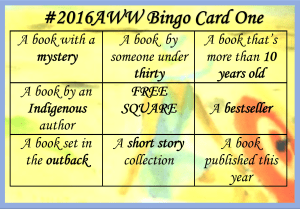
2016 Bingo Card One

  • A book with a mystery: Not being a big reader of crime/mystery books, I was initially glad that this didn’t say “a mystery book”, because it meant I could choose any book which contained a mystery. However, as it turned out, I did read a crime mystery this year, Dorothy Johnston’s engaging Through a camel’s eye: A sea-change mystery (my review). It’s first in her new series set around where she lives on the southern Victorian coast.
  • A book by someone under 30: I really thought this would be the stumbling block for me. I  read quite a few books by young women writers, but which ones are under thirty and which are just over? It’s not always easy to find out. Fortunately, I was saved by Leah A who titled her book perfectly for my purpose, Ten silly poems by a ten year old (my review). Can’t be clearer than that. Thanks Leah! And thanks for your delightful book too.
  • A book that’s more than ten years old: I haven’t read as many classics this year, but I did read Kate Jennings’ autobiographical novel Moral hazard (my review), which was first published in 2002. Not only did it help me meet this challenge but it introduced me to the existence of “business novels”.
  • A book by an indigenous author: I’ve read a few indigenous authors this year, but the one I want to choose here is Ali Cobby Eckermann’s mesmeric verse novel Ruby Moonlight (my review). If I’d been going to do Card 2, I would have saved it for that, because it would have satisfied that card’s “book with poems” category”.
  • My choice (Free square): Oh dear, what to choose here? It’s a toss-up between two collections of essays, Garner’s Everywhere I look and Fiona Wright’s Small acts of disappearance, and Julie Proudfoot’s award-winning novella, The neighbour. But, for her honest handling of such a difficult subject, the experience of an eating disorder, I’ll choose Wright’s book (my review).
  • A bestseller: Fortunately, the challenge didn’t define what it meant by “bestseller”, otherwise I might have had a challenge here, but Charlotte Wood’s The natural way of things (my review) was listed a few times in Melbourne bookshop Readings’ Top Ten sellers of the week. I think that qualifies, don’t you?
  • A book set in the outback: I tend mostly to think of “the outback” as Australia’s dry remote regions, but for this category I’m submitting Sarah Kanake’s debut novel Sing fox to me (my review) set in a remote mountainous area of Tasmania.
  • A short story collection: Now, in this category I have a few excellent choices, including books by Tegan Bennett Daylight and Cassie Flanagan Wilanski, but I’m going to choose Elizabeth Harrower’s A few days in the country, and other stories (my review). That woman can so write, and I’m determined that now re-discovered she’s not going to disappear again.
  • A book published this year: Again, I could choose from several books, but for her wonderful turns of phrase and exploration of mental illness, I’m choosing Anna Spargo-Ryan’s The paper house (my review)

Now, that wasn’t too hard … I rather enjoyed looking at this year’s reading from a different angle, and being reminded of some very fine reading I’ve done.

If you had done this challenge, what books would you have chosen in any of these categories. (Unlike us challenge participants, you don’t have to limit yourself to Australian women!)

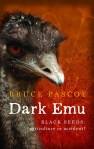
Bruce Pascoe, Dark emu, black seeds: Agriculture or accident? (Review)

Bruce Pasco, Dark emu

Indigenous author Bruce Pascoe’s Dark emu, black seeds: Agriculture or accident? was my reading group’s October book, and a very interesting read and discussion it turned out to be. It’s not a simple book to discuss and really got us thinking, eliciting a variety of responses, though we all agreed with Pascoe’s basic premise that we Australians need to revise our understanding of, and beliefs about, Australia’s history. How could we not?

Publisher Magabala’s website says Dark emu

argues for a reconsideration of the ‘hunter-gatherer’ tag for pre-colonial Aboriginal Australians and attempts to rebut the colonial myths that have worked to justify dispossession.

Pascoe, they continue, contends that indigenous “systems of food production and land management have been blatantly understated in modern retellings of early Aboriginal history”.

A case to be argued

Dark emu is, then, a book that is determined to argue a case – and herein lies its challenge. In his Introduction, Pascoe sets out his main thesis which is that Aboriginal economy was “much more complicated … than the primitive hunter-gatherer lifestyle we had been told was the simple lot of Australia’s First People”. He asks:

Could it be that the accepted view of Indigenous Australians simply wandering from plant to plant, kangaroo to kangaroo in hapless opportunism was incorrect? (p.12)

Now, there are a couple of things here that disconcerted me. Firstly, emotive language like “hapless” doesn’t help when you want to present a logically argued case. And, anyhow, “hapless” is not a word I would ever apply to hunter-gatherer societies. Being hunter-gatherers doesn’t, to my mind, mean they don’t know their environment and don’t use this sense and knowledge in their hunting and gathering. But secondly, I didn’t comprehend his argument that the early settlers had no legitimate right to seize the land because Aboriginal Australians were practising agriculture:

In denying the existence of the economy they were denying the right of the people their land and fabricating the excuse that is at the heart of Australia’s claim to legitimacy today. (p.17)

Arguing this seemed to me to imply the corollary that if indigenous Australians did not have this economy, if they were indeed simply hunter-gatherers, then taking the land would be legitimate? But surely the fundamental truth is that, regardless of how indigenous people were living and using the land, it was their home and they had a right to be treated as the owners? Being on the path to sedentism, practising agriculture and aquaculture, didn’t, in my mind, make their ownership of the land more legitimate. Did it? I needed to understand this a bit more so, unusually for me, I set off looking for discussions of the book before completing my review, and I found the answer.

It was in a discussion of the book by Amy McQuire at NewMatilda.com. McQuire wanted to know why Australia had “so readily embraced” Dark emu, and whether it meant Australians must now “embrace the issue of sovereignty and treaty”. She quotes Professor of Law Megan Davis (from It’s our country: Indigenous arguments for meaningful constitutional recognition and reform):

“It mattered whether claiming a territory was done by settlement or whether by conquest and cession, because each had differing implications for the reception or not of British law.

“Settlement occurs when the land is desert and uncultivated and it is inhabited by backward people.

“Conquest means that it is a forcible invasion of occupied land and cession means that there is a treaty over occupied land. In the case of conquest, the laws of people conquered apply until the Crown or other foreign power laws apply, and in regard to cession, a treaty is entered into but the Crown or foreign power abrogates it.”

She writes “When lands are cultivated, then they are gained through conquest or they are ceded by a treaty”. And when lands are conquered or ceded, it still has laws of its own.

“Until the Crown asserts sovereignty and actually changes them ‘the ancient laws of the country remain’.”

Ah, so now the penny dropped. It’s all about the “law” (European law, that is), not about “reason” or “logic”. Pascoe makes reference to “Australia’s claim to legitimacy”. He discusses the way colonisers can fabricate history and be reluctant to credit colonised peoples (e.g.. p.61) for their achievements, and in so doing underrate sovereignty. But it didn’t properly click with me. I consequently didn’t see why he was arguing so forcefully for this “new” vision of pre-colonial Aboriginal Australian life. I was reading it more as an interesting, and yes very important, contribution to our understanding of Australian history, and I was seeing it as a way of correcting the historical record, and therefore of restoring the “truth” and, critically, “Aboriginal pride in the past”. But I didn’t fully grasp the import of the distinction he was making (and why, accordingly, the odd emotive word or long bow crept in.)

Convincing the doubters

However, this little niggle didn’t stop my being thoroughly engaged by the book. I loved the way Pascoe interrogates records from the past, particularly the journals of explorers such as Charles Sturt and Thomas Mitchell, to prove that Aboriginal Australians* were developing a sedentary culture based on intensification of agriculture and aquaculture. They managed the land, “manipulating the landscape” to produce crops for harvesting, corral animals for hunting, and trap fish for capturing and spearing. They irrigated, they built wells and dams, they stored food for future use. They built dwellings and lived in village groups. And they had been doing so for thousands, if not tens of thousands, of years making them among the world’s earliest, if not the first, agriculturalists (depending on whose “dating” you believe).

Pascoe, however, doesn’t stop at his argument that they practised agriculture. He also contends that they practised it sustainably, using a variety of techniques, including what archaeologist Rhys Jones called “firestick farming”. He argues that there’s much about Aboriginal practices that we could learn and use today, and that modern Australian agriculture could be more sustainable, particularly in our environmentally-uncertain-climate-changing world, if we focused our efforts on Australian plants and animals.

The depth of Pascoe’s research is mind-boggling, and is perhaps partly explained by his comment in that NewMatilda.com article that academics had criticised his previous writing, which apparently used his own words. He decided “to use an authority that they respected … the explorers and the settlers… you know the ‘heroic’ first settlers.” (Oh dear!) But he also draws on a wealth of other research from anthropologists (like WEH Stanner), archaeologists (like Rhys Jones), historians (like Gill Gammage and Rupert Gerritsen), and others. The book is heavily but not intrusively footnoted (I do like a footnote!), and contains an extensive bibliography.

While I would never have called myself a doubter needing to be convinced, it is true that, for all my interest in the subject, my knowledge of indigenous history and culture was rather out of date. Dark emu should, really, be read by all Australians, and at 156 pages of text, it is not a big ask.

Several of my blogger friends have reviewed this book, including historians Janine (Resident Judge of Port Phillip) and Yvonne (Stumbling Through the Past), as well as teacher-librarian Lisa (ANZLitLovers) and biographer Michelle (Adventures in Biography).

* Terminology, terminology! I note that Pascoe mostly uses the term Aboriginals.

Bruce Pascoe
Dark emu, black seeds: Agriculture or accident?
Broome: Magabala Books, 2014
175pp.
ISBN: 9781922142436