Emily Maguire, An isolated incident (#BookReview)

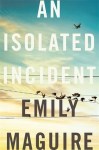
Emily Maguire, An isolated incidentEmily Maguire’s novel, An isolated incident, reminded me of Charlotte Wood’s The natural way of things (my review). Sure, An isolated incident is a crime novel, albeit a genre-bending one, while The natural way of things is a dystopian novel, but both deal with the same fundamental issue, misogyny. Wood exposes the scapegoating of women for their sexuality, while Maguire tackles violence against women (and in doing so, also traverses some of the same ground regarding attitudes to women’s sexuality).

That Maguire is going to confront the issue head-on is implicit in the irony of her title. Twenty-five-year-old Bella’s murder may have happened in an isolated place, and such murders may be rare in her small country town, but as we all know in our media-fuelled times, violence against women is not isolated. Indeed, it happens with terrible frequency. Maguire makes sure that not only do we not forget this, but that we see it in its entirety.

I started by saying that An isolated incident is a genre-bending crime novel. Now, I’m no expert in crime fiction but I know enough to recognise that this book inverts our expectations. In a nod to the genre, the novel is told chronologically with the chapters named by the date, such as “Monday, 6 April”. However, it is not told from the point-of-view of the police or detectives, and it does not focus on the whodunnit aspect, though the investigation does provide an ongoing thread. Instead, the story is told through two voices – the first person voice of Chris, Bella’s grieving big sister, and the third person voice of journalist May who has come to town with her own demons regarding a married lover. This narrative approach enables Maguire to broaden her reach, to focus on things other than catching the criminal, because that is the least relevant – I almost said least important except of course we do want these perpetrators off our streets – part of the story. The most relevant is why does this violence happen, and how does it affect those involved.

Maguire does not, however, provide any answers to these questions. Who knows why it happens? But Maguire does show some of the ways misogyny plays out in everyday life, from the “all piss and wind … harmless” pest who follows women in his car, through men who won’t take no, the men in the pub who know about violent men but do nothing, the schoolboy who enacts his sexual attraction by creating ugly pictures, to actual domestic violence resulting in a wife’s death. It’s powerful because it’s all so real – and true. And, definitely not isolated.

In a telling exchange between May and Chris, May says:

‘… You don’t realise how much most men dislike women. And knowing that, most women can’t relax around men the way you do. Can’t let ourselves show that we like them even if we really do.’

‘Ah. That’s a different thing, though. I like ’em fine, but I’m never relaxed, not fully. It’s like with dogs. All the joy in the world, but once you’ve seen a labrador rip the face off a kid, you can’t ever forget what they’re capable of.’

Late in the novel, Chris ponders this whole issue of the things men do and don’t do, and, heartbreakingly, decides:

… and there are men … who are pure and good of heart and intent and who only want to be our friends and brothers and lovers but we have no way of telling those from the others until it’s too late, and that, perhaps, is the most unbearable thing of all.

Similarly powerful is the way Maguire captures bereaved sister Chris’ grief. Chris is a down-to-earth, small-town barmaid who’s not above taking the odd man home for a little necessary money on the side. Her grief, her loss, is overwhelming, threatening to upset her sanity, and Maguire captures it well, including showing the impact of requiring a relative to identify a body when that body has been horrifically disfigured. The memory of how Bella looked, and imagining how the disfigurement occurred, add significantly to Chris’s grief.

An intriguing thread in the novel concerns the role of writing. Through May being a writer, Maguire explores, initially, the exploitative behaviour of journalists. They sweep into town en masse, intrude on people’s lives, trot out their jargon-laden reports about “close-knit” communities, and when the excitement is over, breeze out again to the next drama. May is one of these, until something about this story, and about Chris, results in her quitting her job to stay.

She explains to her brother why. It’s because she wants her writing to help overcome “the fear, the injustice”, whether by helping to catch the killers or just writing about Bella in a real way rather than simply as a victim. A little later, she tries to convince Chris to talk to her, arguing that her writing may help bring justice. As she argues with Chris, we wonder how much of what she is saying is sincere and how much is desperation to get a story, now that she’s freelance. Maguire writes:

May had started speaking in desperation but as the words came she realised she had once believed all of this about the power of a well-written story. The quaver in her voice told her that maybe she still did.

Hmm, is this Maguire, too, arguing for the value of writing her novel – and for writing in general?

So, did I like the novel? I did enjoy reading it. Maguire’s writing is compelling: it was easy to engage with Chris particularly, and to be interested in journalist May. Maguire’s picture of Strathdee is convincing, and she successfully imbues the story with a complexity that offers no easy answers. If it has a failing, it’s that it’s spread a little thin across the issues – male violence, media intrusion, grief and closure – resulting in an ending that didn’t quite punch an emotional or intellectual point home.

Quite coincidentally, just as I finished this book, Mr Gums and I watched the 2008 miniseries of Sense and sensibility, whose script was written by Andrew Davies. Towards the end comes a line from Marianne, albeit not Austen’s. Having been “burnt” by the dastardly Willoughby, she asks Elinor,  “What do men want from us – perhaps they don’t see us as people but as playthings”. Fortunately, many (most, perhaps) men do see women as people, but these novels, together with books like Anna Krien’s Night games (my review), remind us that we still have a long way to go before there is true equality, true respect, between the sexes.

This book has been reviewed by several of my blogging friends, including Michelle (Adventures in Biography), Bill (The Australian Legend), Lisa (ANZLitLovers), Kate (booksaremyfavouriteandbest), and Kim (Reading Matters). Two didn’t like it much, the others were more positive!
aww2017 badgeEmily Maguire
An isolated incident
Sydney: Picador, 2016
343pp.
ISBN: 9781743538579
Monday musings on Australian literature: Changing literary tastes (1)

Research can send you off on all sorts of tangents – particularly if don’t have to be focused. What fascinating things you can find when you go with the flow (in the wonderful Trove)! It started with my recent post on Currawong Press, which, somewhat serendipitously, led to a post on books published in The Australian Women’s Weekly. It also led to this one on literary (or reading) tastes in 1920s to 1940s Australia, through an article published in the Sun in 1947 which mentioned the strange fact that some books by Currawong Press on taxation had become best-sellers almost overnight, but it said a lot more too …

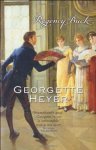
Georgette Heyer Regency BuckHowever, let me introduce the topic. That Sun article set me off on a trail which uncovered several articles discussing the public’s literary tastes, and how and why the “experts” thought they were changing. The experts were mostly librarians and booksellers. In 1929, The Sydney Morning Herald asked the large circulating libraries whether they’d seen changes from the previous year’s borrowing. Yes, said the librarians. They noted:

  • a changing of the guard in popular authors, but since none of the names – except one – are familiar to me, I won’t detail them. The one I did recognise was identified as “rapidly approaching the status of best-sellers”, Georgina Heyer! Well, I sort of recognised her, as presumably they meant Georgette Heyer. Her books would have been gaining traction around then, and I can’t find a Georgina.
  • a decline in the “sex-novel”, and also in plays. “Once upon a time every play published by Pinero and other popular dramatists sold almost as well as a novel”. How interesting.
  • increased interest in detective and mystery stories, and historical novels
  • increased interest in short story collections. Woo hoo! They write that “a very few years ago publishers hesitated to bring out volumes of short stories. That is all changed now.” Is an increased interest happening again now do you think?
  • increased sales of “standard works” (in “pocket editions”). They were “selling so amazingly well that there is almost evidence enough to show that the general public is being weaned from the frothier varieties of books”

What a fascinating insight into reading habits. I have no idea how “scientific” these observations were, but librarians are very trustworthy people, you know!

The Sunday Mail in 1932 explored changing tastes in detective fiction, arguing that “the reader of to-day wants to pit his brains against those of the detective, and so the mystery novel is assuming more and more the aspect of a mental problem”. When asked, Brisbane booksellers and librarians:

emphasised that there are “thrillers” and “thrillers,” detective stories and detective stories. The popularity of the detective thriller of the Edgar Wallace type, it was explained, was on the decline even before the death of that undoubted master, but not so the intellectual “thriller.”

They describe in some detail what makes an “intellectual thriller”.

The article also mentions increased interest in Australian books, and notes the surprising popularity of Swedish physician Axel Munthe’s The story of San Michele. It apparently “emerged from obscurity into something like the status of a best seller, all because a few people allowed themselves the pleasure of reading it ‘on chance’.” The booksellers said that bestsellers of “today are 100 per cent superior in literary merit to the bestsellers of five and six years ago”. This was the Depression era … I wonder what impact that had on reading tastes.

This idea of improved public taste was repeated in 1933 in an article in the Horsham Times which reported a statement by visiting English publisher John Lane, from Bodley Head. He said

there had been an improvement in the literary taste of the reading public throughout the world, and the demand among the great body of the public to-day was for clean healthy stories and plain dirt had little sale.

I’m not sure that “clean healthy stories” are guaranteed to be “literary”, but probably “plain dirt” isn’t? Lane suggests that “cheap lending libraries [presumably in England] were responsible for changing the literary tastes of readers in the industrial classes from the penny story magazine to volumes, and would eventually raise the literary standard of the masses”. Oh dear, this sounds a bit snooty, but I do like his belief that libraries were helping widen people’s reading tastes.

Now we jump t0 1937, with the Depression on its way out, and an article in Melbourne’s Argus titled “Novels are less popular”. It says that demand was changing, with “tastes more serious”. This came from Melbourne librarians who said that the borrowing of novels had decreased from 75% of their loans to 65%. Prahran Library chief librarian gave a reason for this:

The uncertainty of the international situation in Europe, he said, was resulting in many former readers of fiction asking for such books as Gunthe’s “Inside Europe,” and other works on economics and politics. The depression had made borrowers’ tastes more serious, and there was a growing demand for books on the trades and useful arts.

Interesting eh? Sometimes we hear that in hard times people turn to lighter fare, but apparently not always. Except, the report continues:

The [unnamed] chief librarian at a large city library said that with the return of more prosperous times many persons who had been forced to read during the depression were now finding their relaxation and amusement at the cinema. There had been a large decline in the borrowing of low grade fiction.

Hmm, there’s that “low grade fiction” again. And “forced to read during the depression” suggests that reading was not the entertainment of choice then (as that reader survey says it is in contemporary Australia)? The article quotes the librarian of the Borough of St Pancreas London as also attributing “the decline in the popularity of the novel to the appeal of wireless and cinemas”.

Anyhow, now we come to the 1947 article in Sydney’s Sun which inspired this post. Titled “Tastes in books were changing”, it looks at bookbuying in the lead up to that year’s Christmas.  It opens by stating that “book-buying boom, which began in the war years, is being maintained in the peace”. Booksellers said that:

  • War books were generally “out”, with some exceptions. However, publishers felt that war books would return just as the publication of All Quiet On the Western Front had generated renewed interest in World War 1
  • “Thrillers” were also declining, and “the sale of Westerns was negligible”
  • Australian books were popular, with most booksellers “displaying Australian books on special counters” (something we discussed recently). One firm reported that the sale of Australian books had doubled in recent years: the “First edition of Flying Doctor Calling, by Ernestine Hill (Angus and Robertson), sold out in a week. An Australian classic that keeps on selling and selling is The Fortunes of Richard Mahoney, by Henry Handel Richardson.”
  • Long historical novels were in “big demand”
  • Books about Australia and other countries were very popular. A bookseller suggested that “The quiz craze may have something to do with this thirst for knowledge among Australians”. (Love the quiz craze!)
  • European migrants were keen book buyers, buying “expensive books on politics, art, music
  • Children’s books were selling well, perhaps partly due to “the high price of toys”

The article also discussed the increasing cost of books, but said people were paying the high prices “without demur”. It also noted that “unfortunately for Australian authors the boom in Australian books” had coincided with “unprecedented publishing difficulties”, which they describe in some detail. The situation was so bad that “Some local publishers are more than a year behind in their programmes and there isn’t much likelihood of catching up for a long time to come. Dozens of accepted Australian manuscripts are awaiting publication.” Poor writers.

Through these articles, there’s an ongoing thread of concern about “literary quality”. Do we see this same earnestness about whether people are reading “quality” in book reporting today? Or, are we more tolerant of diverse reading interests?

Rebekah Clarkson, Barking dogs (#BookReview)

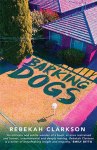
Rebekah Clarkson, Barking dogsThe best way to describe Rebekah Clarkson’s debut book, Barking dogs, is that it’s a portrait of a community undergoing social change. This community is Mount Barker on the outskirts of Adelaide. Once a farming community, it is now, says Wikipedia, “one of the fastest growing areas in the state”, the province of developers, the aspirational and the upwardly mobile, rich pickings in other words for an observant novelist. But, did you notice that I said “debut book” not “novel”? This is because, superficially, this book presents as a collection of short stories. However …

What’s in a name? It reminded me of the recent discussion about Junot Díaz’s debut book, Drown, on the ABC’s First Tuesday Bookclub. Drown is also a collection of short stories, but panel members argued that it could be defined as a novel because “the stories are too interlinked for us not to see it as a narrative whole”. Drown, though, does have the same narrator throughout, which Clarkson’s book doesn’t. Her book is probably closer to Tim Winton’s The turning. Like Barking dogs, its stories are set in the same place, and it has some recurring characters, though, from memory, I’d say recurring characters are a stronger feature of Clarkson’s book.

The question is, of course, does any of this matter? Not really, except that calling it a novel might attract more readers – you know, those who say they don’t like short stories. And, it is always relevant to consider form, even if, in the end, the actual label is irrelevant.

The form, style and structure of Barking dogs, do, in fact, give us much to consider. There are, for example, 13 stories. Are we meant to consider the “negative” implications of the number 13 in terms of this community’s future? Why does Clarkson start the collection with a troubling story (“Here we lie”) set at a later time in the book’s chronology, and end with a story set at the earliest time (“If it wasn’t this”)? The fact that this last story, although set in the seemingly idyllic rural days, ends rather bleakly on the image of a tree “alone, stark and bare” suggests that Clarkson recognises the complexity in all communities. Again, I was reminded of Pulitzer prize-winning author Paul Beatty on the First Tuesday panel talking about how he sometimes plays around with the order of the stories in Drown, and how this changes its impact.

Regardless of the overall intention, though, the stories make great reading. Whether they are told 1st, 2nd or 3rd person, and whether the narrator is male or female, young, middling or older, or struggling financially or more well-off, Clarkson is able to get inside her characters’ heads. She captures, and explores, the feelings, values and thoughts, the confusions, uncertainties, and pretensions, of her town’s inhabitants. We can “see” it all: the struggle to pay mortgages, to maintain meaningful marriages, to raise their children (or to conceive them in the first place), to get on with their neighbours, to achieve the lives to which they aspire.

A number of motifs run through the book, including the murdered girl Sophie Barlow (whose family appears in the second story, “Something special, something rare”, but whose story is never fully told), the Wheeler family which forms the main connecting thread in the collection, and of course the barking dogs of the title. These, together with the setting, contribute to the coherence of the whole.

Some stories stood out more than others. This may say more about my particular interests, rather than the quality of the stories, but it may also be that the stories that are more connected by characters are more engaging because of the story development they entail. It’s a book that would bear multiple readings, because even skimming it for this review revealed further links and connections that I missed on my first pass.

The overall theme, that of a community going through change, is beautifully encapsulated in the story “Hold me close”, in which the recently widowed Edna, a long-term resident of the town’s now rural outskirts, struggles to understand the aspirations and lifestyle of her daughter, Andrea, who has moved back to the area. Andrea lives in a “ex-display home village” and, Edna thinks, is more interested in appearance than substance. This tension between striving for success and being, hmm, more real is played out in various ways in the other stories.

The Wheelers

But, perhaps the best way to illuminate the book is to look briefly at how the Wheeler family is woven through the book. The Wheelers are 49-year-old Malcolm, a successful management professional, his confident teacher wife, Theresa, their 11-year-old son Martin who’s been diagnosed with Asperger’s, and Jasper, their barking dog. They epitomise the new families in the area – their aspirations, their values, and their problems – and at least one of them appears, or is referred to, in seven of the stories. The first references are in passing. In “Something special, something rare”, Martin has been physically bullied by Liam Barlow, but we don’t meet him specifically, and in the following story “World peace” he is again referred to, this time by one of his classmates. We gather he’s a little different, and doesn’t fit in well with the normal schoolyard cut-and-thrust.

The next four stories (4th, 7th, 9th and 11th) in which they appear are told from their perspectives, the first two from Malcolm’s, then one from Martin’s, and finally Theresa’s. I don’t want to give too much away, but we get the picture of a fairly kind, laissez-faire husband married to a more go-ahead, shall we say, proactive, wife. In the fourth story, “Raising boys”, we also meet their barking dog who is bothering his neighbour, and in the seventh, which is, structurally, the central story, Malcolm receives some terrible news which provides the book’s emotional heart. The penultimate story, “Jasper”, is shocking. It exposes the cracks in “society today”, such as unrealistic aspirations, lack of neighbourly communication, fractured marital relationships.

Interestingly, while the stories are not presented chronologically, the Wheelers’ “story” is, giving the book a clear narrative arc. The overall order, perhaps, provides its thematic one, one that warns against rose-coloured glasses about the past.

Unfortunately, I am using an uncorrected proof copy from which quotes are forbidden (though I have “quoted” one or two phrases which I hope is okay!). However, I do want to briefly mention the writing, which maintains an effective satirical tone while also conveying a level of tenderness for the characters. There’s some lovely irony too. We know for example, that poor Graham Barlow’s vision for his business, Winners, is unlikely to be realised (“Something special, something rare”), and that Gladeview Park, where many of our characters live, does not provide the “Serene and fun-filled living” environment promised on the estate’s sign (“Jasper”).

Barking dogs offers a thoughtful, intelligent look at contemporary suburban life. It explores what a pristine, homogenous white middle-class enclave might look like. Unfortunately, it looks more like a bunch of isolated individuals than a healthy community, partly because the pressures that drive them seem to prevent real engagement with each other. It doesn’t need to be this way.aww2017 badge

Rebekah Clarkson
Barking dogs (Uncorrected bound proof)
South Melbourne: Affirm Press, 2017
240pp.
ISBN: 9781925475494

(Review copy courtesy Affirm Press)

Monday musings on Australian literature: ACT Writers Centre

Do you have a writers centre in your neck of the woods? We do in Australia, but I’ve barely written about them before. They generally provide support and/or training for writers, via online and face-to-face mechanisms, some free-of-charge but most fee-paying, and tend to be membership organisations. Over coming months, I’ll share what’s happening in different centres around Australia, but I’m starting here with the one in my city, the ACT Writers Centre.

First though, a little anomaly – to do with apostrophes! I note that the ACT Writers Centre has no apostrophe in its name, while the Australian Writers’ Centre does. Whyfor this thusness? A quick survey around the various Australian state centres revealed that most do not use the apostrophe (with the Northern Territory appearing to have a foot in both camps, depending on which page you are on!) It’s like Mothers/Mother’s/Mothers’ Day. I prefer the no-apostrophe approach. As in, what sort of (adjectival) day is it? It’s a mothers day, that is, a day for mothers. Rather than, whose (possessive) day? It’s mother’s day, a day owned by mothers. It seems that most writers centres in Australia see it the adjectival way. Either that or they don’t know their apostrophes, and that would be a worry!

Enough pedantry, let’s get on with the ACT Writers Centre. It describes itself as:

the leading organisation of writing-based culture in the ACT. Our mission is to develop writers and their work.

How do they do this? Well, by running programs, offering prizes or awards, and providing services such as manuscript assessment, editing, and mentorship. Most of these are fee-based. They also have a blog, Capital Letters.

In this post, I’m going to focus on four special programs offered, but they also offer various courses. Currently, the ACT Writers Centre runs four main programs:

HARD COPY

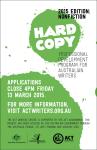
HARDCOPY 2015 flyerI’ve written about Hard Copy before, in a previous Monday Musings post. The first program was held in 2014, so this year’s will be its fourth. They describe it as “a national professional development program that helps build the capacities, aptitudes and resources emerging Australian writers need to reach their potential.”  Its aim is not specifically to achieve publication for its participants, but to help them with manuscript/project development, to arm them with an understanding of how the Australian publishing industry works, and to help them “build connections and relationships within the industry/writing community”.

This program, which is run by our local centre, receives funding from the Australia Council for the Arts, and is offered nationally, that is, not just to ACT-based writers. Also, it alternates between fiction and non-fiction writing. This year’s program, as the one run in 2015, is for non-fiction writing.

All this is pretty dry. For an insider’s perspective, do read Michelle’s posts on her blog, Adventures in Biography, on her experience of the 2015 program. She had a great experience – and I was pleased because I got to meet her while she was here! She found the program very helpful, to say the least.

Between the Lines

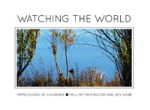
Hetherington and Webb, Watching the worldYou know that mantra, the one that says to be a writer you need to be a reader? Well, the ACT Writers Centre clearly believes it to be so, because this year they are offering “a facilitated book discussion group for writers with an active practice”. This sounds a bit like a reading group, but with two big differences. First, it has  a professional leader, in this case Professor Jen Webb from the University of Canberra (whose book with poet Paul Hetherington, Watching the world, I reviewed a couple of years ago). And secondly, the focus will be on “authorial technique and achievement, rather than subjective personal judgements on whether or not the book is ‘good’ or ‘bad’”.

The focus this first year will be Australasian literary novels. You can see the list on the link I’ve provided on the heading. There are 6 books, as it’s a bimonthly program: three are by men and three by women, three are by New Zealand writers including one by Maori writer Witi Ihimaera, and one is by a woman of indigenous Australian background (Melissa Lucashenko). I’d love to see their discussions written up on the Capital Letters blog!

ACT Writer-in-Residence

This is the program which, when I read about it last week, inspired today’s post. It’s a new three-year program offered by the Writers Centre in collaboration with the University of New South Wales (Canberra) and with support from the Copyright Agency Ltd. Again, you can read the details of what the program offers and expects on the link I’ve provided. Like HARD COPY it is not limited to ACT Writers. It is mainly geared to established writers, but “suitably qualified developing writers” were also encouraged to apply.

Last week the three writers were announced:

  • 2017: Isobelle Carmody, fantasy writer, particularly of the immensely popular, much translated, Obernewtyn Chronicles. (Daughter Gums was, and still is, a big fan.)
  • 2018: Jane Gleeson-White, prize-winning non-fiction writer who plans to research a novel set during World War II.
  • 2019: Angela Gardner, poet who apparently has a project on “Air” which will “include some novel public programs for Canberra – including balloon flying”.

I was initially surprised to see that all three writers have been announced now, but I guess it does enable the later writers to plan their lives, something I suspect writers often don’t get an opportunity to do!

ACT Literary Bloggers

And now comes the one close to my heart! It’s another new program, and another collaborative one, this time with the National Library of Australia. It “provides an opportunity for two emerging ACT-region writers to attend events at the National Library of Australia and document the experience for the ACT Writers Centre’s Capital Letters blog. The program, which will run from May to December, includes a mentorship with ….” yep, me, Whispering Gums! What an honour, and how interesting it’s going to be. The program is particularly aimed at writers who’d like to write about “the literary arts for the online environment”.

The two bloggers have been chosen: playwright and performance maker Emma Gibson, and blogger/podcaster and writer Angharad (Tinted Edges).

I am looking forward to working with Emma and Angharad, particularly to jointly exploring ways in which blogging can be used to further promote literary culture in the (our, any) community. You may hear more about this later in the year.

Linda Neil, All is given (#BookReview)

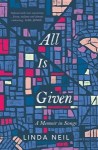
Linda Neil, All is given, coverLinda Neil’s second book, All is given, is subtitled “a memoir in songs”.  I wondered if this meant her memoir would be structured around specific songs – but that’s probably way too prosaic an idea. Certainly, it’s not what I got! I’m somewhat embarrassed to say that I didn’t know of Linda Neil, who is described in the brief author bio as “writer, songwriter and documentary-producer”, but I did enjoy getting to “know” her through this book.

The memoir starts with “Prologue: Songbook”, and immediately I had one of those glimmers of enlightenment because she opens with the end of a house concert. Now, friends of ours hold house concerts. They are such wonderful to-be-treasured occasions, which provide a beautiful way of enjoying music away from big formal concert halls or noisy popular venues. For the performer, however, there are challenges. The concert that Neil opens her memoir on finished at 11pm, and she was hungry, not to mention “spent” after nearly three hours of “singing and telling stories”. Not so, necessarily, the audience. They were energised, inspired, and wanting to talk with her in this lovely intimate venue! So, with food from her host in her hand she sits to chat with one of these people – and discovers that what the woman really wanted to do was share her own stories, which had been stimulated by the concert. Neil, as it turned out, enjoyed hearing her stories – but I learnt a lesson about house-concert etiquette!

Another issue comes up in this opening chapter which attracted my attention. She says that many people think love songs, which she was singing, are autobiographical. However, she writes,

in my experience, they may well be inspired by real people, but the form of a song means that, from this basis of fact, changes need to be made. A bass line is added perhaps. Something high is included. A man becomes a woman. A five-letter name expands to eight …

and so on. The point is, “the facts may not always be true, but the feelings certainly are”. “YES”, I wrote in the margin. And I loved her rider: “and if some events did not happen exactly the way they are described, perhaps they should have”. Haha! Love it. That is what creativity, and living, are about…

Hence, she writes in the last paragraph of this opening chapter:

So think of this collection of stories as a book of songs that contains improvisations and variations on themes of truth. If you listen closely enough you might even be able to hear the fabric of facts and fiction as they are stitched together.

What follows are delightful, non-chronological, stories of travel. This book, in fact, is as much travel memoir as a musical one, and as much about travel to the self as about the places she visits – Shanghai, Paris, Kathmandu, Kolkata, Ulaanbaatar, to name a few – though she writes engagingly about them too.

… a pilgrim of the imagination …

All is given is just a lovely read. Neil presents as a person with such an open heart and curious mind, with such a willingness to give things a go and to test her own preconceptions, that she can’t help but be interesting to read. And when you add to this, her clear, fresh prose, well, you have a book that is a winner on multiple levels. Here, for example, she’s in Paris:

Sometimes a city is the kind of place where, despite being on your own, you are never alone.  Where sitting under a statue or leaning over a balustrade of a bridge is an invitation. You have to discern very quickly, though, who might waylay you, who might waste your time and who might be, like you, a pilgrim of the imagination on a voyage through change. But if your antenna is working properly, the chance encounter with a stranger might bring you something you need at that particular moment in time, something that might not come in any other part of the world, but exactly where you sense of wonder and curiosity has led you, across oceans and skies, out of safety into the unknown.

I wanted to share all of this, but particularly that phrase “a pilgrim of the imagination on a voyage through change”.

This is what the book is about. It’s partly, of course, about the places she goes, the people she meets, the seemingly serendipitous discoveries, such as the recording studio in Kathmandu and the YWCA in Kolkata where she meets a group of people volunteering at Mother Theresa’s Missionaries of Charity, but it’s mainly about the things she learns.

She learns, for example, on her first solo trip, which paradoxically is the last one described in the book, not to travel with the Lonely Planet Guide, because “travel was best unplanned”. It’s a lesson I’m starting to learn. I can’t imagine giving up the guides altogether – not being, clearly, a complete “pilgrim of the imagination” – but I’m gradually freeing myself from the shackles of “musts” to the wonders of “let’s explore”. She experiences the “gift of stories – of listening to and receiving them, of being in the right place at the right time”. This is “the magic of travel”. She learns that she can sometimes be “prim”, when she lectures a young girl on modest dressing in India, where she was “once open-minded”, but on the other hand, that she could be “free”, in opening up to people, where once she “might have felt more cautious”. These are the surprises of travel.

She learns, too, in Mongolia that “freedom” is not the simple concept we like to think it is, that for many Mongolians the initial liberation from Russia was “a catastrophe”. Her Mongolian friend reminds her, once again she says, that:

western narratives of history aren’t the only ones, and that … there are many ways to tell the story of our collection past.

A lesson we Australians are very slowly learning now as we come to grips with different versions of our colonial past. She learns, through this and other experiences, “not to romanticise places” where the reality for the locals is very different, but also to “be happy with tiny moments”.

And so the memoir goes. I’ve focused on travel’s lessons because those reflections spoke to me. Another reviewer could very well pick up the musical motifs, her journey through sound, or perhaps explore the organic way she intersperses moments from her youth with those from travel. The point is, whatever your interest, All is given is an engaging, enjoyable read by a writer-musician who sees that being “real and true” is sometimes different from “being perfect or even good”, but who often manages to achieve both.

aww2017 badgeLinda Neil
All is given: A memoir in songs
St Lucia: UQP, 2016
238pp.
ISBN: 9780702254093

(Review copy courtesy UQP)

Monday musings on Australian literature: Reading the reader (Survey)

Late last month, the Australia Council of the Arts released the results of a survey they conducted with Macquarie University. It is, the introduction to their final summary says, “the third stage of a major study of Australia’s changing book industry, by the Australian Research Council and Macquarie University.” The project, according to the Macquarie University website aimed to investigate:

  1. Authors and their responses to changing circumstances;
  2. Book publishers and the ways in which they contribute economic, social and cultural value; and
  3. Practices of contemporary book readers.

They say they are looking into extending the research into other parts of the “Australian book industry”. Today, I’m going to focus on the readers, which is the only part in which the Australia Council was apparently involved but, having discovered the whole project, I just might delve a little more into it in future posts.

The summary document’s subtitle is “A survey of Australian reading habits”. What ho! I wish they’d asked me!

So, who did they study?

There were three parts of the research:

  • A series of focus groups: with Year 8 students at Ryde Secondary College, and with different groups at Parramatta Library (both book clubs that meet at the library and the general public)
  • An online survey of Australians aged 14 years and over undertaken by Roy Morgan Research in October 2016. The final sample of 2,944 was, they say, “nationally representative in terms of age, gender, geographic location, income and ethnicity”.
  • A seminar with masters degree students at Macquarie University.
Their research found, overall, “a strong culture of books and reading in Australia”. It appears that “although developments in digital technology have radically changed many daily habits and pastimes, reading books is one of the nation’s favourite leisure activities, ahead of browsing the internet and watching television.” How fascinating. I’m a little surprised, but pleased. They did say their sample was nationally representative, but would an online survey of just under 3,000 people really catch a representative sample of all Australians? I admit to a little scepticism (is that fair?) but still, the findings are interesting.

Overall, they found that

Australians:
  • value and enjoy reading, and would like to do more of it. Apparently we spend more TIME “browsing the internet and watching television” but are more likely to rank reading books as our favourite leisure activity over these activities. The most common reason we read for pleasure is “to relax and release stress”. This probably explains what we most like to read – see a couple of points below!
  • mix up digital forms with more traditional ways of reading. The majority of us apparently still read print, but over half of us mix this with e-reading, and 12% use audiobooks.
  • read more books than book sales suggest, which is not surprising, I would have thought, given the use of libraries, lending between friends etc (and this is what they found). When we buy books, the major chains are our main source, followed by online bookstores, and then secondhand shops with independent local bookshops a close fourth.
  • like crime/ thrillers/mysteries best! I am fascinated, really, that these “relax” people, but I know this is so (and not just from the survey). The main reason I read is not “to relax and release stress”, and “thrillers and mysteries” are not my favourite reads, so I’m out of step here. You can probably guess the most popular non-fiction category? Yes, autobiography/biography/memoir. Interestingly, the survey found that “around half (51%) of all Australians (including those who are currently non-book readers) are interested in reading the types of books that may be eligible for literary prizes such as the Man Booker and the Miles Franklin and 45% enjoy literary classics. A similar number (48%) are interested in literary fiction by Australian writers past and present.” What they say, and what they do, though, seems a little different.
  • value Australian books and the Australian book industry. I’ll just quote the first paragraph here which is that “The majority of Australians (65%) like to read fiction by Australian authors and 59% like to read non-fiction by Australians. Readers aged 50 and over are the most likely to consciously choose Australian-authored books, while younger readers tend to like Australian books without thinking about the nationality of the author. There is a strong level of interest (42%) in books and writing about Indigenous Australia.”

The report goes on to provide breakdowns of the numbers, including these points regarding interest in reading Australian writers, Australian literary fiction and indigenous writers. There tended to be some gap, in these areas, in terms of people’s interest and what they are actually reading. The report also notes that the most frequent readers – and this is no surprise – are female, over 30 years old and tertiary-educated.

You can read all the detail at the report I’ve linked to above, and that report provides a link to the more academic data provided by Macquarie University. I didn’t go there, I’m afraid. Life is a bit too busy.

Playing with the data

I did, though, have a play with the fun interactive dashboard of the data, which enables users to interrogate the data a little via various parameters. For example:
  • 10% of all readers (all genders and ages) who use online sources to find out about books, use book blogs/bloggers. But if you change the parameters to Frequent Readers who are Female and aged 30-39, then 19% use book blogs/bloggers, while only 7% of Frequent Female Readers who are 60-69 do. Funnily (!), Occasional Male readers aged 14-19 seem not to have ever heard of book blogs/bloggers, whereas their Female counterparts have! Overall, book blogs/bloggers are fourth in terms of online sources of information after online booksellers, Facebook and GoodReads. Other sources include online literary journals, Instagram, Twitter and YouTube. It’s really interesting to see the difference here between different permutations of readers.
  • Regarding physical sources, only 5% of all readers (all genders and ages) obtain information from face-to-face bookclubs, but change that to Frequent Readers who are Female, and the percentage jumps to 10%. The most popular physical source is “word of mouth”, at 60% plus for most of the possible permutations.
  • 42% of All Australians (all genders and ages) agree that “books and writing about indigenous Australians are of interest to me“, but if you change the parameters to Frequent Readers who are Female and All ages, the percentage jumps to 56%. Further refine that to Female Frequent Readers who are 60-69 and it jumps a bit more to 60%. By contrast, the percentage for Male Frequent Readers in the same age group (60-69) is just 45%.
Help Books Clker.com

(Courtesy OCAL, via clker.com)

There’s a whole lot of fun to be had exploring the factors people consider when choosing books to read – such as topic/subject/setting/style, or liking the author, or reader reviews, or the cover. There are eighteen reasons, and they can be explored by the same permutations – Frequent, Occasional or All readers; Female/Male or All genders; and age breakdowns or All ages. Interestingly, in all the permutations I checked, Reader Reviews ranked higher than Professional Reviews. Hmm … how much of that is due to the dearth of professional reviews available these days. The top reason though, that people base their choice on what to read, is “topic, subject, setting or style”.

The interesting thing, now, is to see what, if anything, is done with this research. For example, if people are interested in reading Australian writers or indigenous writers, but don’t, why is that? Is it that there’s not enough specific promotion of these books in the places most people go to? Or?

Any comments?

Monday musings on Australian literature: Books in The Australian Women’s Weekly, 1930s-1950s

This will be a short post, tonight, mainly because I couldn’t find, in the time I had available, enough information for my original idea – which was to discuss The Australian Women’s Weekly’s support for Australian writers. This was inspired by my coming across, during last week’s research into Currawong Publishing Company, an article about a prize for writers being offered by The Weekly (as it is known, familiarly) in 1941. There were two prizes, one for a short story and one for a serial. The reason it popped up during my search was because M.L.L. Woolacott of Currawong Publishing Company was one of the people quoted as supporting the prize. S/he said:

It is gratifying to see a publication such as The Australian Women’s Weekly play a leading role in the movement towards firmly establishing literature in Australia. For this is the moment to give Australian writers every opportunity.

Before I continue to the main matter of today’s post, I’d like to share what a couple of other people said. Novelist Katharine Susannah Prichard (see my review of her The pioneers) said:

Australia has many writers who would produce fine stories and novels if only they could be assured of having their works published in Australia. This competition being launched by The Australian Women’s Weekly is going to give them that chance.

And novelist Eleanor Dark (see my review of her Juvenilia), whose book The timeless land had just been selected as book-of-the-month in the USA, said that “Literature in Australia needs encouraging, for without encouragement the growth will be slow.”

So, a lot of positive support, but I had trouble tracking down an announcement of the winners, and whether the competition was run again. The information could be there, but there’s only so much time …

However, as I was researching this, I did discover that during the 1930s to 1950s, The Weekly regularly published complete novels in an issue, often in a supplement. They were, I’d say, more like novellas or very-long-form short stories, but what a great service the magazine provided to readers – and presumably to the writers whose work was published.

Now, reader, you know what I did next: I checked out these novels and writers to see if any were recognisable. I only checked a handful – there’s only so much time, you know – but I found that mostly the names were not known to me, nor to Professor Google or AustLit. Some were, though, such as T.C. Bridges whose Messenger’s millions appeared in 1935 and C.K. Thompson whose The third man (not THE third man, of course!) also appeared in 1935. The third man Supplement is headed “complete book-length novel”. A book-length novel? I wonder what other sorts of novels there are? Anyhow, Thompson was a journalist based in the Hunter Valley of New South Wales. T.C Bridges, on the other hand, was born in England and worked primarily as a freelance writer. Although he was clearly published in Australia, AustLit says that they have no evidence that he visited Australia.

This was then popular literature, perhaps even pulp fiction, but I’m impressed that during a time when people didn’t always have a lot of disposable income they could find books in their magazine. (Of course, there were also the public libraries.)

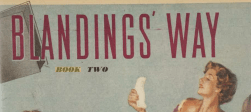
Blandings Way, Book Two, magazine headerBut now, I said this was going to be short, and I’m going to stick to that promise, so I’m concluding with a summary of “the story so far” for Book Two of Blanding’s Way, written by Eric Hodgins and published in 1952:

THE STORY SO FAR: In their Dream Home at Lansdale the Blandings had all sorts of exciting things happen. The vegetable garden produced a record crop, the fields caught fire, thirteen-year-old Joan became a prize-winning essayist, and Mr. Blandings was elected to the school board. NOW

I do love that the exciting things included producing a record crop, becoming a prize-winning essayist, and being elected to the School Board. Sounds right up my alley! Oh, in case you are interested, the “book” occupies 10 multi-column-tiny-font pages of the magazine. If you tried to print the “book” it would, according to my system, take 64 pages.

Note: The National Library of Australia has produced a discovery page for The Weekly, from which their digitised articles can be accessed directly. You can in fact, locate and read any issue published between establishment in 1933 and 1982. Now, if I had the time …

Jill Roe, Our fathers cleared the bush (#bookreview)

Jill Roe, Our fathers cleared the bushAs that old pop song goes, what kind of fool am I? I went, you see, to Macquarie University, which I chose for its then modern approach to tertiary education. It was great, but somehow, I didn’t end up in tutorials taught by Thea Astley, nor did I study Australian history in which Jill Roe was one of the University’s foundation lecturers. What was I thinking? Hindsight is a marvellous thing, eh?

Most of you will know who Thea Astley is, but non-Australians, in particular, may not know Jill Roe. She is best known for her comprehensive award-winning biography of Miles Franklin (see a review by Lisa, ANZLitLovers), but she wrote many books and was, among other things, a regular contributor to the Australian Dictionary of Biography. The book I’m reviewing here, Our fathers cleared the bush, was published last year, only months before her death early this year.

Old and new regionalism

What a fascinating read it was – for its content, which tells the story of Eyre Peninsula, a part of Australia I don’t know, and for its form and style. This latter is what I’m going to focus on mostly in this post. The book’s subtitle, “remembering Eyre Peninsula”, provides some clue to its form, which I’d describe as an amalgam of memoir/family history, regional history and historiography. Roe seems, overall, to be exploring an approach to writing the history of regions.  In her introduction she writes:

The aim is not so much to tell my own story – though I often start there – nor to fill a gap in the literature – though there is one – but rather, on the basis of personal reflections and a now quite extensive range of materials, to capture some key aspects of, and moments in, the regional experience over time.

“Extensive range of materials”. Hold that thought, because I’ll come back to it. For now, though, I’m sticking to the regional history idea. Chapter 7, one of my favourites in fact, is titled “I danced for the Queen”. In it she writes quite a bit about regionalism and regional histories. She suggests that as Australian history established itself in the 1950s and 60s, “some fine regional studies appeared” and she names a few. It was “a golden age of regional history when it seemed the national story was becoming clear”. But, she argues, that was “old regionalism”. Since the 1970s, new issues and factors have arisen. These include the understanding of “regionalism” itself; the rise of interest in local and family history which is adding “new building bricks, even new layers” to the undertaking and appreciation of regional history; the role of the environment; and that major factor, the recognition of Aboriginal history, which she says introduces a discontinuity into held narratives. She suggests that exploring Aboriginal history “seems to work best in regional frameworks”. Perhaps, but there is also need to include Aboriginal history in the overarching national story. I presume she would argue that too?

She teases out the Aboriginal history issue a bit more. She says:

On a grander scale, the history of the Kimberley in Western Australia is being transformed by research into the Aboriginal experience, much of it distressing, none of it yet settled or fully integrated into the national story. This history may be hard for some to take in, but that is because it adds new data and a challenging dimension to taken-for-granted narratives. In time, along with environmental and the other histories, Indigenous history will most likely lead to a new regional history in this country.

She then makes what could almost be a manifesto:

… my firm belief that any history in which people cannot recognise themselves – whether proudly or ruefully, in surprise or dismay – is not good history.

Beautifully said, and hard to argue with – at least these days when we don’t accept that history begins and ends with great deeds by big men (and occasionally women).

“a now quite extensive range of materials”

Now, histories can often be rather dry, but Our fathers cleared the bush has a lovely conversational tone. It almost felt like she was talking to me as I read along. We learn a lot about life on the Peninsula from the 1840s to the 1960s and beyond. We hear about farms and schools, churches and sport, transport and the country show. I laughed at her comment that when she turned her mind back to the Peninsula in 1998, she “paid no attention to sport as a source of social life and values, a mistake I mustn’t make again”. Anyhow, all these are features of country life, and many are shared through the prism of her and her family’s experience, but while we come away knowing the skeleton of her life, this is definitely not a memoir. The focus is the history.

However, as well as telling the history, she also shares her methodology and her sources. She says that “the discovery of a new source is the historian’s delight”. She mentions women’s diaries and school records; and she talks about the value and limits of census data. She uses anecdotal evidence but carefully notes the unreliability of recall. She notes there are limits to what personal memories can offer the large picture. In her family, for example, there were no sons so the daughters “did more than usual of the outdoor work.” It would be not be valid to generalise, then, she’s saying, from her family. For some readers, Roe’s historiographical discussions might get in the way of the history itself, but I enjoyed getting to know the historian’s mind.

Finally, she also points to histories that are still waiting, such as “a comprehensive account of the Aboriginal experience of the Eyre Peninsula”. Others include “the coming of service stations” to Australia or the role of Greek Orthodox churches in fishing communities. Anyone looking for a PhD topic might like to start here!

So, I’m at the end of my post and I’ve told you very little about the Eyre Peninsula. All I can say is that if you are interested in the Peninsula, or in the history of rural Australia, you should find what you’re looking for in this book (particularly given its index and extensive end-notes) but if you are interested in approaches to modern history writing, this would also be a good book to read. Roe says, early on, that her approach to history is “post-modern, in the sense that it can’t come to a definite conclusion”. That is certainly what she has presented here – a story about a region that tells us much but which also leaves many questions to be answered – because life goes on and there’s always more historical research to do.

PS For a lovely tribute to Jill Roe written just after her death, please read blogger (and historian) Yvonne’s post.

aww2017 badgeJill Roe
Our fathers cleared the bush: Remembering Eyre Peninsula
Mile End: Wakefield Press, 2016
249pp.
ISBN: 9781743054291

(Review copy courtesy Wakefield Press)

Telling indigenous Australian stories

This weekend is particularly significant for indigenous Australians. No, let me rephrase that: it’s significant for all Australians because what happens to indigenous Australians marks who we are as a nation. And, right now, who we are is not wonderful.

Anniversaries galore

If you’re Australian, you’ll know what I’m talking about, but for everyone else, the situation is that we have two important anniversaries this weekend. Today, 26th May, is the 20th anniversary of the tabling in Parliament of the Bringing Them Home report documenting the Stolen Generations. (On 26th May the following year, the first National Sorry Day was held to keep front and centre our poor treatment of indigenous Australians, so next year will be its 20th anniversary). Then tomorrow, 27th May, is the 50th anniversary of a referendum held in Australia to change the Constitution regarding indigenous Australians. The resounding Yes vote (90% overall) ensured that indigenous Australians would from then on “be counted in reckoning the Population”. It also gave the Federal Government the power to pass legislation specifically for indigenous Australians. And, just to add to the significance, next week, on 3 June, will be the 25th anniversary of the Mabo decision which recognised native title in Australia.

These anniversaries are, naturally, causing much reflection about what has been achieved since then, and what we (and indigenous Australians in particular) would like to achieve. The truth is that achievement has been woeful. Indigenous Australians’ health, education, incarceration rates – and so on – are significantly worse than for the rest of the population. It’s outrageous – and a subject too big for me here. However, I did want to mark this time, so am going to return to an issue we’ve discussed here before – who tells indigenous Australians’ stories. I’ve chosen this approach because of a serendipitous find in the National Library (NLA) bookshop yesterday.

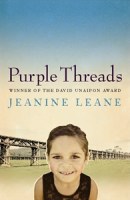
Jeanine Leane's Purple threads

Courtesy University of Queensland Press*

You see, I’ve been wondering recently what indigenous writer, Wiradjuri-woman, Jeanine Leane is up to. I greatly enjoyed her book, Purple threads (my review), and was impressed by the forthrightness and clarity with which she discussed this issue of telling indigenous Australian stories at an NLA conference back in 2013. She spoke particularly about classics, and she said this (re-quoting from one of my posts):

Through Xavier Herbert, Patrick White, David Malouf & more recently Kate Grenville, who among others have been hailed as nation writers & what I saw and still see to some extent in Australian literature to date, is a continuous over-writing of settler foundation stories which overwrite Aboriginal experience and knowledge. Settlers are always re-settling and Australian literature really reflects this and the critics and scholars write of such works as if everyone reading it is also a settler reader.

Now, here comes the serendipitous bit. I was browsing the Library’s bookshop yesterday while waiting for a meeting and noticed a recent issue (No. 225, Summer 2016) of the lit journal, Overland. I find it hard to resist lit journals so I picked it up and, flicking through the table of contents, saw an article by Jeanine Leane titled “Other people’s stories: When is writing cultural appropriation?”. That was all the excuse I needed to buy the issue.

Settler narratives controlling indigenous stories

In some ways it goes over ground I’ve written on before, but that post discussed an article on the topic by non-indigenous writer, Margaret Merrilees. She argued that “questions of appropriation become issues of personal ethics, conscience issues”. However, Merrilees was approaching the topic more from a practising writer’s point of view, and she made some sense regarding the challenge confronting non-indigenous writers. If they leave indigenous characters out altogether they are continuing the dominant culture’s silencing of indigenous lives but if they include them they risk not getting it right.

Leane explores the issue from a broader political view. She’s concerned that the “Australian” story continues to be in the hands of “settler” writers and that their stories – including, and particularly, those involving indigenous characters, like Katharine Susannah Prichard’s Coonardoo and Patrick White’s A fringe of leaves – become “the authoritative narrative of settler colonialism”. Readers see these books as “Aboriginal stories” but they are not, she says.

She unpicks Lionel Shiriver’s controversial dismissal of concerns about “cultural appropriation” at the Brisbane Writers’ Festival last year. She argues that Shriver’s idea of writers using “empathy” to create characters who are “other” to themselves does not recognise what this “empathy” really involves. For Leane, you don’t get this “empathy” from archival research but from social and cultural immersion. She criticises Australian writers for not having “this level of exposure” and, moreover, for not “striving for it”.

Leane accepts that the books by “settler” writers – like Kate Grenville, et al – have a place in the study of Australian literature but they need to be read and studied side by side with works by indigenous Australian writers, who are now emerging and challenging settler representations. She refers to Larissa Behrendt’s analysis of White’s A fringe of leaves in her book Finding Eliza: Power and colonial storytelling (a book I’ve still to read but which Lisa, Michelle and Bill have reviewed on their blogs).

Engagement through literature

Leane ends her essay discussing what she sees is the critical issue – which is not whether non-indigenous authors should include indigenous characters in the their books or how they can do it – but the paucity of indigenous writing being taught in schools. She argues there is a link between the higher attrition of indigenous students in schools and “the lack of Aboriginal voice and representation in the curricula”. And,  further, she asks,

if, on the whole, non-Indigenous people are not reading Indigenous self-representation, how can they write about Indigenous lives and experiences? Put another way, if non-Indigenous people are still only encountering Indigenous people via the works of non-Indigenous writers/historians/filmmakers/artists, then are they really encountering us at all? How can they even think about writing about us if you don’t really know us?

Very good question – which addresses both Shriver’s ideas re “empathy” and Merrilees’ concern about including indigenous characters.

Leane quotes Canadian scholar Margery Fee who addresses the gap between indigenous and non-indigenous people. There needs to be a conversation between us, she says – and that conversation, says another Canadian, Judy Iseke-Barnes, can be had through the sharing of literature. Yes! Iseke-Barnes talks of “conversation-through-literature, of cross-cultural engagement through ‘deep and informed readings’ of Indigenous texts”. She sees this as an ongoing process. Leane argues that “this kind of engagement must precede any discussion of how to ‘write’ Indigenous people.”

She then teases out this engagement, clarifying in simple terms exactly what it means, and concludes that without sincerely trying to understand indigenous culture, it is impossible to properly represent indigenous characters. It is, instead, cultural appropriation, it’s “stealing someone else’s story, someone else’s voice”.

I like that Leane not only presents the problem here – and argues it lucidly – but she has a solution. And it’s a solution that would surely make sense to any reader – which presumably is all of you who read my blog? I’m glad I found – serendipitously – what Leane was up to!

This essay is available online, free, at the Overland site, but if you’d like to support them, you can also buy it at the link.

Monday musings on Australian literature: Currawong Publishing Company

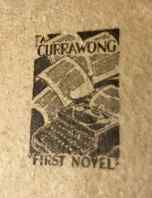
Currawong First Novel logoAs regular readers know, I’ve been involved in much clearing out of houses over the last eighteen months. I have, as a result, accumulated a small but interesting collection of older books, several of which I have already posted on. Today’s post is inspired by another such book, And all the trees are green (1944), by A.E. Minnis who’s unknown to me. However, my post is not so much on Minnis but on the book’s publisher, Currawong Publishing Company.

It captured my attention for a couple of reasons, starting with the little logo on the plain front cover which reads “Currawong First Novel”. Inside, there is a publisher’s Foreword which says that the novels in the series are all “first novels” (obviously) by “young Australian authors”. That made me sit up. I wondered how many authors whom we now know got their start with Currawong – the way many contemporary authors got their start with publishers like McPhee Gribble (such as Helen Garner and Tim Winton) and Fremantle Press (Elizabeth Jolley). Anyhow, the Foreword goes on to set out its philosophy, which is that their authors are chosen mainly for three reasons:

Each author has a story to tell, and tells it. [Haha, love that “and tells it” bit]
Each author’s style shows more than a promise of developing into a powerful literary instrument.
Each author is Australian, either by birth or adoption.

They continue to say that they invite manuscripts from authors who have not had a novel published in Australia or overseas, that “the setting of the plot of any novel submitted need not be Australian”, and, something most authors would love, that “each author whose work is accepted will be placed under contract to The Currawong Publishing Company for his or her next three literary works”.

You can see why I wanted to find out more about them. The AustLit database, which is, unfortunately, only fully accessible by subscription (which I don’t have) says this

The Currawong Publishing Company was a war-time success, active from about 1942 to 1951. Currawong issued a wide variety of fiction – including mysteries, westerns, romances, and fantasies – under the slogan ‘You can’t go wrong with a Currawong’; with a few exceptions, Currawong’s authors were Australian. Currawong also issued a series of ‘Unpopular Pamphlets’, advancing left-wing economic and socialist ideas for post-war reconstruction.

I was also able to read, before I hit the paywall, that the most referenced work relating to this entry is Kylie Tennant’s award-winning debut novel, Tiburon, albeit Currawong’s edition was a later “pocket” one.

Anyhow, Currawong sounded interesting, so I decided to research further, but they aren’t listed in my copies of The Oxford companion to Australian literature, nor The Cambridge companion to Australian literature, nor the index in the Annals of Australian literature. I could find them in Trove, of course, though mostly as the publisher of books being reviewed. That’s better than nothing!

I found, for example, a review of a novel by Ailsa Craig, If blood should stain the wattle (1947). The reviewer calls it a “fine first novel by an Australian author” and says:

Her style is impressive and she writes convincingly about country scenes with which she is familiar … It is rather a sombre story of a modern tyrant who rules the lives of his family in almost mediaeval style. You will find it an enthralling study of human relationships handled simply yet vividly.

The Courier-Times reviewer was a little less glowing, saying “There is quiet talent here but a little too much of the Daphne du Maurier technique to give it its own personality” though does admit that “the story is a good one, well-told”. Meanwhile, over at The Age, the reviewer says that the book was highly commended in the competition won by Ruth Park’s Harp in the south! Ailsa Craig, according to AustLit, was “a writer, journalist and scholar. She was also the first female London correspondent for the Sydney Morning Herald” and she won the prestigious, in Australian journalism circles, Walkely Award.

After Trove, I turned to Professor Google. I didn’t find a lot but did find, in Google books, a reference in History of the book in Australia, Vol. 3: Paper empires, edited by Craig Munro. The reference, which appears in the essay by Ian Morrison titled “Case study: Pulp fiction”, explains that Currawong was one of the leading publishers of pulp fiction – those mysteries, westerns, fantasies, etc – during the war years.

Unfortunately, in all this research, I couldn’t find much about the reason I decided to write this post, their “first novel” series, but I did find this little anecdote in one of those end-of-year articles newspapers like to write about books. The Sunwrote this in its article, “Tastes in books were changing”:

Oddity of the publishing year has been the fact that two books on taxation became bestsellers almost overnight. Earlier in the year Currawong Publishing Company issued “I Can Get It For You Tax-Free!” by E. Kellie, with an introduction by Sydney taxation expert J. A. L. Gunn. In quick time three editions of the book were sold. Currawong has now published, at 10/6, a sequel entitled “Farmers, Bushrangers, Businessmen,” by B. Hall, curiously with an introduction by J. A. L. Gunn. The title is drawn from the indiscreet remarks made about Australia in London last year by Dr. C. E. M. Joad. B. Hall’s book is as witty and as shrewdly informative about taxation affairs as E. Kellie’s book. Chapter headings range from “How to Jack Up Your Director’s Remuneration” to “Don’t Go Shop Crazy Till You Get Your Provisional Assessment.” ‘The publishers’ claim that Mr. Hall can teach Mr. Kellie a thing or two about income tax legerdemain is amply confirmed and must be causing Treasurer Chifley some concern. Taxpayers can confidently anticipate a companion book next year by Capt. Starlight with an introduction by J. A. L. Gunn. (14 December 1947)

There is a joke here – besides the fact that a book on tax went quick-smart into three editions! –  in that the books were, in fact, written by J.A.L. (John Angus Alexander) Gunn. The so-called authors, E Kellie and B. Hall, allude to bushrangers Ned Kelly and Ben Hall, hence the reviewer’s reference to the next book being by Captain Starlight! I’m not sure that all the contemporary reviewers got this. (By the way, Gunn was a highly respected accounting practitioner and was elected into the Australian Accounting Hall of Fame.)

During all this research I found a wide variety of books published by Currawong, in addition to pulp fiction – a book on Indonesia and one by A.O. Neville on Australia’s coloured minority; a book on Australian art, and one containing plays; an autobiography by tennis player Dinny Pails, and much more. They were clearly an active publisher in their time.

As for A E Minnis, I could find little about him – though I did discover that it’s a him. The only review I found starts with “Mr Minnis writes interestingly concerning the odyssey of his young hero, Dick Radford” but it then goes on to just describe the story. I wonder if Mr Minnis ever got his next two books!