Ali Cobby Eckermann, Too afraid to cry (#BookReview)

ANZ Lit Lovers Indigenous Literature Week bannerHaving reviewed Yankunytjatjara/Kokatha woman Ali Cobby Eckermann’s poetry collection, Inside my mother (my review) for Lisa’s ANZlitLovers Indigenous Literature Week, 2017, I decided to also read her 2012 memoir, Too afraid to cry. It filled in a lot of gaps, which is not necessary to appreciate or comprehend the poetry but which does deepen the understanding.

The memoir’s dedication starts with the lines:

this is a poetic memoir
a story of healing
not burdened by blame
And that is pretty well what it is. It’s not an angry book, so much as a sorrowful one. Sorrow about the abuses and losses that affected her childhood and early adulthood, in particular. The sorrow starts early, when she’s young, and abused. She writes of her uncle rubbing her leg inappropriately, and progressing to assault, though she doesn’t say that because she’s only 7 years old. However, while she may not have the language to analyse what was happening to her, she does have the language to describe the feelings:

I felt the icy wind inside my head begin to blow. I could not move. The icy wind is very dangerous.

This “icy wind” becomes a metaphor throughout the book for the abuse, for her memory of it, and for its impact on her psyche until she can no longer cry – “the ice block had turned to stone, and now there was no moisture left inside me”. Hence the title of the memoir.

So, to summarise the book before I delve any further, Too afraid to cry is the story of a young indigenous baby adopted by a non-indigenous family. It’s a good loving family, with parents who, unable to have children, adopted four – two from the mission – and fostered another. But this family, as loving as it is, is a deeply religious one which does not understand the pain experienced by children from a different culture to its own. The result is that Eckermann is left to contend with racism and abuse that she, too, does not initially understand. Here, for example, is a schoolyard experience:

[I] didn’t notice that they had begun to form a circle around me, but I did notice that the icy wind was blowing inside my head and was starting to freeze my guts. Someone held me while other hands pulled my underpants down. There was a strange noise in my ears, like a faraway scream, but I could still hear the sounds of those doing the laughing and teasing. They said they wanted to know if I was the same as other girls. Someone laughed, saying they didn’t know if ‘boongs’ were different. I was frozen with the icy wind roaring through my body. I didn’t want to know what a ‘boong’ was.

Note the “icy wind” again. As childhood turns to adolescence, Eckermann, who had been an excellent student, begins to withdraw from her family and turns instead to alcohol and drugs to cope with the pain and sense of disconnect. It’s not a surprising story, but it’s a useful one for those who don’t understand what disconnection from one’s own culture can do, particularly in a society where difference is not tolerated. Eckermann learns much later, apparently, of the ridicule her adoptive mother had faced for having aboriginal children.

Anyhow, gradually, after many experiences, painful ones, risky ones and some more positive, Eckermann finds her way to her own culture, and healing begins:

Slowly the stone inside me turned to ice and then the ice began to melt. I felt real tears on my face for the first time in my adult life.

What’s remarkable about the memoir – something you may have guessed from what I’ve written – is her ability to get into her head at the time, to write from the point of view of the age and person she was when the things she describes happened, rather writing them as memory that she is now reflecting and commenting on. Of course the telling of the experience, the choosing of which experiences to tell, is a form of commentary, but I’m sure you get my point.

The memoir is remarkable for other reasons too. It’s told in 92 short anecdotal chapters, which are divided into four parts. The style is spare, with short, simple sentences. This is a book which shows rather than tells. Much of the commentary is conveyed through poems inserted between some of the chapters, such as “Heroin” between Chapters 45 and 46. It’s a short poem, like most of hers, and uses repetition and powerful wordplay on the word “arms”, to invoke prostitution, loving and heroin. The last stanza reads:

in their arms
they survive
a modern world.

Some of the poems appear again – the same or sometimes changed* – in Inside my mother.

Another aspect of the memoir, which adds to its sense of almost mythic universality, though is probably also done to protect individuals, is her minimal use of actual names. Her siblings, for example, include Big brother, Foster brother, and some relations are Aunty and Uncle. She does though name her mothers.

Too afraid to cry is an innovative and evocative memoir, which manages to convey hurt and pain, truthfully, but with a generosity that is humbling.
aww2017 badgeAli Cobby Eckermann
Too afraid to cry
Elsternwick: Ilura Press, 2012
224pp.
ISSN: 978-1-921325-29-8 (eBook)

* Changed, I think. I’m writing this in California, and my copy of Inside my mother is back in Australia.
Monday musings on Australian literature: ACT Litbloggers under way

A few weeks ago I posted on the ACT Litblogging program for which I am a mentor. But, I’ll just recap in case you missed that post. Titled ACT Lit-bloggers of the Future, this is a collaborative program between the ACT Writers Centre and the National Library of Australia (NLA). It provides for two emerging ACT-region writers to attend events at the National Library of Australia and post their experience on the Writers Centre’s Capital Letters blog, as well as for that mentorship from me.

The two bloggers, playwright and performance maker Emma Gibson, and blogger/podcaster and writer Angharad (Tinted Edges), are now well underway. They have posted on three events, and more posts, I know, are scheduled for the next month. The posts to date reveal the variety of programs offered by the National Library, an impressive variety really, when you know that the bloggers, due to their work and other life commitments, have not been able to attend every event available.

Here are the posts published to date:

  • Hugh Mackay, Selling the dreamAuthor talk with social commentator and prolific writer Hugh Mackay, held on 6 June, and posted by Angharad. The book was Selling the dream, on the advertising industry, and Angharad, who loves attending author talks – as most keen readers do – enjoyed both the overall experience and what she learnt about advertising, including its increasing role in political campaigns. As you usually do at author talks, she bought the book and had it signed!
  • Presentation on the life and death of botanical illustrator Dorothy English Paty by curator Nat Williams, on 28 June, and posted by Emma. Emma, who has always liked botanical illustration, was throughly engaged by this introduction to Paty (1805-1836), a little-known early Australian amateur artist. The Library has two of her Newcastle sketchbooks in its Nan Kivell Collection and this talk focused on presenter Williams’ research. As Emma says, although there are many gaps in our knowledge about her, the survival of these notebooks, together with research by people like Williams, will ensure that she (and the contributions she made) are not lost to us.
  • NAIDOC 2017 week collection talk titled Our voice, presented by librarian Ryan Stoker on 6 July, and posted by Emma. Described as a collection talk, this event involved Stoker highlighting “a variety of interviews, social histories and folklore recordings” that the Library has collected from Aboriginal and Torres Strait Islanders. As a playwright, Emma is attuned to things aural, and takes her own audio recordings when travelling. Not surprisingly then, she found the talk illuminating, particularly in relation to how this collection at the NLA might help keep indigenous languages alive.

More posts, as I said in my introduction, are coming, including one from Angharad on an author talk by the popular and successful Australian fantasy and historical fiction writer Kate Forsyth. Look for that, and others by our two bloggers, on the Capital Letters blog. You can subscribe to it via the box in the right sidebar.

Meanwhile, our two bloggers would love it if you read these current posts and left them a comment!

You are very likely to hear more about this program later in the year, but I did want to share what’s been done to date – and give a little heads up to the good work being done by the NLA, ACT Writers Centre, and our two bloggers.

A short post today, but I’m sure you won’t complain about that!

Australian Women Writers 2017 Challenge completed

Carmel Bird, Family skeletonI usually write my completion post for the Australian Women Writer’s Challenge, around the middle of the year, even though I plan to take part until the year’s end. As in previous years, I signed up for the top-level, Franklin, which involves reading 10 books and reviewing at least 6, and as in previous years I’ve exceeded this. However, it’s good to get the completion post out of the way before the end of year madness begins!

I have, so far this year, contributed 16 reviews to the challenge, two more than for last year’s completion post.

Here’s my list in alphabetical order (by woman author), with the links on the titles being to my reviews:

Unlike last year’s half-way list, I did review one classic and a book by an indigenous woman author this year. There are other differences too. Last year I’d read just three memoirs (with two of those being hybrid biography-memoirs) while this year I’ve reviewed five memoirs to date. The fiction-nonfiction ratio, though, is still roughly the same.

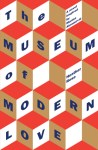
aww2017 badgeLast year, I ended the post on plans for the rest of the year – and said that they would include reading at least one indigenous woman, Ali Cobby Eckermann, which indeed I did (her Ruby Moonlight). This year, however, I’m not setting out any plans. I do know I’ll be reading Heather Rose’s Stella Prize winner, The museum of modern love, as my reading group is doing that. (We will be reading a couple of other women writers, but they are not Australian.) As for the rest of my reading plans for the year, they are undefined – which means I could very well be as surprised as you by what turns up!

Monday musings on Australian literature: Mid-year awards round-up

As is my wont, I have not been posting this year on all the awards that have been announced  – on their longlists, shortlists or even their winners – though I have done some. It can become a bit overwhelming. Instead, I’ve decided that a mid-year recap might be a useful way to go – so, since we have now passed the year’s halfway mark, that time has come. I’ll mention the awards I’ve chosen to do, in chronological order of their announcement.

Stella Prize

Heather Rose, The museum of modern loveThe Stella Prize is now one of the first awards to be announced in the year, and I did post on the longlist.  From this longlist, a shortlist of six books were chosen:

  • Between a wolf and a dog, by Georgia Blain
  • The hate race, by Maxine Beneba Clarke (my review)
  • Poum and Alexandre, by Catherine de Saint Phalle
  • An isolated incident, by Emily Maguire (my review)
  • The museum of modern love, by Heather Rose
  • Dying: A memoir, by Cory Taylor

And the winner, announced in early March, was Heather Rose’s The museum of modern love, which I will be reading with my reading group later this year.

Indie Book Awards

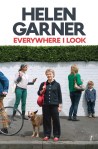
Helen Garner, Everywhere I lookThe winners of these awards, which are run by Australian independent booksellers, were announced in late March. Several awards are made, which you can check out on their site but those most relevant to my blog are:

  • FictionThe last painting of Sarah De Vos, by Dominic Smith
  • Non-fiction: Everywhere I look, by Helen Garner (my review)

The New South Wales Premier’s Literary Awards

These awards are multipronged and far too complex for me to report on in detail here. You can see the full list of winners, which were announced in late May, on Wikipedia. However, those of most relevance to me were:

  • Christina Stead Prize for FictionThe museum of modern love, by Heather Rose
  • UTS Glenda Adams Award for New Writing: Letter to Pessoa, by Michelle Cahill

ABIA, or the Australian Book Industry Awards

These awards, announced in late May, only a few days after the NSW Premier’s awards, are also multipronged. You can read the full list on the ABIA website, so again I’ll just share the most-reelvant-to-me award here, the  Literary fiction of the year award, which went to The last painting of Sarah De Vos, by Dominic Smith.

I should add that the hugely popular bestselling Australian author Di Morrissey was inducted into the ABIA Hall of Fame, and also that, for the first time this year, an award was made for Audiobook of the year, which nicely recognises the popularity and value of this form of “reading”.

Oh, and interestingly, the overall winner, Jane Harper’s The dry, was also the overall winner at the Indie Book Awards earlier in the year. So, the overall winner and the literary winner of both these awards were the same. The shortlists at both are judged by independent panels.

Miles Franklin Shortlist

While the Miles Franklin Award won’t be announced until later this year, it’s such a significant award in Australia that I’m going to share the shortlist here which was announced in June. The shortlist is:

  • Emily McGuire’s An isolated incident (Picador) (my review)
  • Mark O’Flynn’s The last Days of Ava Langdon (UQP)
  • Ryan O’Neill’s Their brilliant careers (Black Inc Books)
  • Philip Salom’s Waiting (Puncher and Wattman)
  • Josephine Wilson’s Extinctions (UWAP)

Nice to see a gender mix, and good representation from smaller publishers, including two university presses!

Delicious descriptions: Kim Mahood’s desert

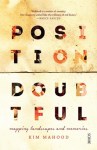
Kim Mahood, Position doubtfulI wanted to use this Descriptions series to share a couple of Mahood’s gorgeous descriptions from her memoir, Position doubtful, which I reviewed recently, but I’ve decided to share one about maps and relationships (and you’ll probably see why), and a description.

From a mapping expedition:

The shortcomings of my prototype map soon become evident. The first lesson in the overlapping of knowledge systems is that Aboriginal knowledge doesn’t confine itself to the square dimensions of the canvas. Traditional jurisdictions extend to Well 50 in the west and to Jalyuwarn in the south. The ancestral dingoes who created the lake came down from the north and Kiki, the falling star, fell from the sky in the east. All these places and events are off the map.

– Puttem, I am told. You can fixem up later.

I puttem, and the edges of the canvas became congested with names that belong to the country outside the square.

She goes on to describe the process of capturing stories and knowledge, how “each site has its attendant stories – dreaming stories and traditional ways of living, accounts of the station days and mission days and first-contact encounters.” So fascinating – but these maps can be fraught with risk too.

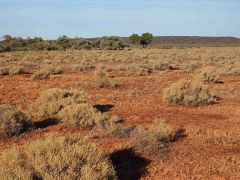
Samphire Shrubland

Samphire landscape, Central Australia (By Mark Marathon, using CC BY-SA 4.0, via Wikimedia Commons)

From a trip to Lake Ruth, 2008:

… The anthills on the plain are small and crenelated, like urban skylines. Ahead of us the horizon feels unstable, as if we are approaching an edge of some kind. The sandy soil becomes littered with limestone pebbles, and the anthills morph into the massive conical forms of cathedral mounds. Abruptly, the salt lake is before us, a negative space boundaried to the south by another unstable horizon. …

Between the salt lake and the limestone ridge where we have halted is a low red dune, an arc of sand created by wind and waves when the ephemeral lakes were substantial bodies of water. Stunted ti-tree grows along the dune, and red and gold samphire spreads out onto the salt crust, which is buckled and crisp. The southern horizon ripples with dissolving light, like wind moving through invisible fields of grass.

These descriptions of the desert are so vivid, so true. They show that Mahood is not just a mapmaker and artist, but a writer too.

Monday musings on Australian literature: Guest post from Bill of The Australian Legend

It’s been two years since I last published a Guest Post, for no any other reason than that the idea slipped off the radar as other busy-ness took over. However, during a recent email correspondence with (relatively new) blogger Bill, the idea re-popped into my head, and so I asked him, as he explains below.

First though, a quick intro. Bill appeared on the Australian lit-blog scene just over two years ago with quite a bang. Well, that’s a bit overly dramatic perhaps. What I mean is that he launched himself as a serious player in the lit-blogosphere, and one with a very particular agenda – to write about independent women, particularly independent women writers. Well, of course, I was interested in that and have enjoyed some good discussions here and on his blog ever since. If you’re likewise interested, I suggest you start with his About page and move on from there.  Meanwhile, let’s give the floor to Bill …

*****

Apart from my friend Michelle at Adventures in Biography who got me started on Lit.Blogging, Sue here at Whispering Gums was the first blogger I followed and who followed me. So I owe her a great debt, and feel guilty each time I think of the imaginary detective story where the private eye’s principal informant is the toothless derelict … Whispering Gums. (The real, and much nicer, origin of her name is here.)

It is a matter of great pride to me to be invited to do a guest post, and I’m only sorry that it is under false pretences. I was discussing (by email) with Sue some reviews I had put up on the Australian Women Writers Challenge site and I asked her in passing what she thought of biographies of women writers by men. My intended question was did she think the AWWC site should list them. Sue however thought I was asking her opinion of the biographies themselves, and promptly put it back onto me!

Do you remember the old BBC Radio show Just A Minute which was often used as a filler on Radio National? Well I feel like (the late) Derek Nimmo leaning in to the microphone to speak for 60 seconds on the life cycle of newts. But here goes, 1000 words on Biographies of Women Writers by Men, starting now.

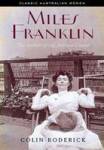
Colin Roderick, Miles FranklinI have reviewed two such biographies, Brian Mathews on Louisa Lawson and Colin Roderick on Miles Franklin. The former is a good example of a man being able to write sympathetically and insightfully about a woman, and the latter is not.

Walking up and down my own shelves I see I have numerous biographies by women. Three – Roe, Barnard and Coleman – on Miles Franklin, Barbara Baynton by Penne Hackforth Jones, Christina Stead by Chris Williams, two by Sylvia Martin – Aileen Palmer and Passionate Friends, ‘collected’ lives by Drusilla Modjeska, and by Dale Spender, Tomalin’s Jane Austen and Gaskell’s Charlotte Bronte; and I also have two more by men, Brian Dibble on Elizabeth Jolley (Doing Life which I really ought to have reviewed by now) and Ric Throssell on his mother, Katharine Susannah Prichard.

Of course, as you may know, I am an old white guy and so I am probably the very last person to be attempting to answer the implied question: does it matter? Well, in the case of Colin Roderick (1911-2000), one of the most influential figures in the Aust.Lit industry in the middle of the last century, his gender matters a great deal. He runs Franklin down both as a writer and as a woman:

[her] unshakeable conviction of physical inferiority and lack of physical attraction… converted her into a skittish coquette stringing two or three men along simultaneously and a synthetic man-hater… It forced her to become a defensively bellicose propagandist for feminist causes.

He routinely misstates her commitment to feminism, and writes that a determined suitor might have cured her flirtatiousness with a spanking. In the comments to my piece on Roderick, author Jess White, taking comfort from my description of him, describes Roderick’s biography of Rosa Praed, In Mortal Bondage, as “bizarre & bordering on fiction in places.”

The Roe biography of Franklin I would describe as asexual, but the earlier (in fact the first) biography, by Marjorie Barnard, which I haven’t read for a long time, does seem to me to reflect the fact that it is written by a woman. It starts (stereotypically!) by describing how Franklin dressed and how she looked: “her smile. Radiant, quick and gay, it transformed her. It was irresistible and in her old age still charming and youthful.” And ends with an analysis of love: “[Miles] held in her heart an impossible ideal of human relationships and when she found it unrealizable, not so much for herself as in the lives of others, she was bitterly hurt and disappointed”, which I have never been able to express half so well.

Unlike Roderick, Matthews takes Lawson’s feminism seriously and gives a good account of it. In fact, he takes Lawson seriously as poet, businesswoman, leading figure in the women’s movement at the turn of the century, and as a mother (with four difficult adult children!) Whether he adequately emphasizes with her, perhaps only a woman could tell. Unfortunately for Matthews there was very little evidence to say how Louisa spent her private life after leaving her husband – although we’re pretty sure she didn’t want to get pregnant again.

Marianne van Velzen in her account of Ernestine Hill turned to fiction to round out those areas where evidence was lacking, an approach which Matthews discusses and dismisses, and which I think detracts greatly from the usefulness of those autobiographies which resort to it.

At this point in my writing I went away for a couple of days, and by sitting, driving, with the radio off, was able to refine my ideas. We have seen that biographies may be ‘factual’ or ‘fictionalized’. Then, from a ‘gender studies’ point of view we may also categorise them as: Neutral, Masculinist, and Feminist. The problem of course with ‘Neutral’ is that old, conservative, white men regard their own point of view as neutral and all others as radical. But let us say for argument’s sake that ‘neutral’ is the gathering and presentation of historical material without (much) gender analysis, and that Jill Roe’s Stella Miles Franklin is an example of this. Colin Roderick’s biographies of Franklin and Praed are clearly ‘masculinist’, in that he devalues the opinions of the women he is writing about and ascribes to them motives which he wouldn’t ascribe to men. An example of a ‘feminist’ biographer might be Sylvia Martin who is exploring the space between spinsterism and lesbianism by looking into the lives of single women writers like Mary Fullerton.

A further division is suggested by Nathan Hobby who is both a blogger and PhD student writing a biography of Katharine Susannah Prichard. At the end of 2015 he wrote, “The best biographies, in my opinion, are generally written by biographers who care about biography as a genre rather than biographers who are simply passionate about their subject.”  So then we also have ‘serious’ biographers and the ‘simply passionates’. The latter definition clearly captures rellos such as Ric Throssell and journalists like Marrianne van Velzen.

If you are thinking I have drifted a bit far from the topic, I guess the questions I am trying to get to are: How many Australian women writers have been the subject of biographies by ‘serious’ men? And, assuming only Roderick actually attacks his subjects, how many of those biographies were sympathetic, and how many missed the point?

Now, all you Whispering Gum-nuts out there, it’s down to you. I’ve listed the four that I have. How many have I missed?

Thanks Bill for taking up my invitation – and for presenting some different angles for us all to think about regarding biographers and their biographies.

Ali Cobby Eckermann, Inside my mother (#BookReview)

ANZ Lit Lovers Indigenous Literature Week banner

Ali Cobby Eckermann, a Yankunytjatjara/Kokatha woman, has featured a few times on this blog, including in my review of her verse novel, Ruby Moonlight, and my Monday Musings post on her winning the valuable Windham-Campbell Prize this year. She is now appearing again as I review her poetry collection, Inside my mother, for Lisa’s ANZlitLovers Indigenous Literature Week, 2017.

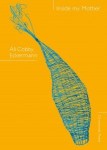
Ali Cobby Eckermann, Inside my mother

Inside my mother is a challenging read, particularly if you are an occasional reader of poetry like I am, but it’s well worth the effort – for the insights it offers, and for the pure pleasure of reading a skilled wordsmith. As the title suggests, the collection’s focus is mothers – and there’s a reason for this, one all too familiar to First Nations Australians. Cobby Eckermann’s family has a history of children being taken from their mothers – her mother was taken from her mother, Cobby Eckermann was taken from hers, and then Cobby Eckermann had to give up her son for adoption. You can hear and feel the pain of these losses in the collection, but you can hear more too, because while these losses frame the collection, Eckermann doesn’t confine herself to them.

The collection is divided into four parts, which build up in intensity until we reach the last part in which the focus is squarely on grandmothers, mothers and children – and the attendant losses.

The poems, though, are not all grim in tone, they vary in form, and they are held together by recurring motifs or ideas, specifically, mothers (of course), sky, earth and birds, all of which make perfect sense given the author, her culture and themes. The first poem is one of a small number of shape poems. Shaped like a bird’s wing, and titled “Bird song”, it references the power of Indigenous spirituality, and ironically comments on how it was so often co-opted by the church. It gets the collection off to a good start. Part 3 starts with another poem about birds, “Tjulpu”. It comprises two-line stanzas, with a separate final last line, and attests to the power of birds for the speaker. “Life is extinct/without bird song”, it starts.

The first First Nations Australian poet I ever read, probably like most Australians around my age, was Oodgeroo Noonuccal (or Kath Walker, as my still loved edition had her). When I started reading Inside my mother, I wasn’t immediately reminded of Noonuccal, but when I got to the devastating poem written in the voice of a woman who drinks too much, “I tell you true”, I immediately thought of Noonuccal’s poems and their effective blend of the personal and the political. The poem is a plea for people to not rush to judge when they see someone “drunk and loud and cursing/Don’t judge too hard ‘cos you don’t know/What sorrows we are nursing”.

This poem looks simple. It uses those traditional rhetorical tools of rhyme and repetition to produce a singsong rhythm which satirically mocks the seriousness of the story it is telling. The effect is mesmerising. The second verse starts:

I can’t stop drinking I tell you true
Since I found my sister dead
She hung herself to stop the rapes
I found her in the shed

Other poems deal with traditional culture (“Vengeance”), political issues (“Hindmarsh Island”, “Kulila”, “Oombulgarri“), love (“Love 22/06/10”), stolen generations (“Severance”, “First born”, “The letter”), to name just a few. The meaning of some of these, particularly those I’ve listed under political issues, depend on knowledge of the politics they reflect. I needed, for example, to look up Oombulgarri.

Some poems are more personal (or, personally political!), such as “Eyes”, to give just one example. “Which eyes will she need today”, the speaker asks? Those of terror, or submission, or of “wonder or contempt”. I won’t tell you which ones she chooses, but they’re appropriate for the overall tone of this collection, reflecting its sorrow and its grit.

And then some, as usually happens with poetry collections, I found a little obscure, although, as I reread many for this review, more of them fell into place. You can’t rush poetry.

While it’s not my favourite poem in the collection, the last poem in Part 1 is appropriate to end on because it addresses the theme of this year’s NAIDOC Week. It’s called “Lament”, and is another poem featuring two-line stanzas, and repetition. Of the six stanzas, three are the same: “I can not stop/must sing my song”. And why can’t he stop? Because he’s the “last speaker/of my mother tongue.” Language. So important.

aww2017 badge

Ali Cobby Eckermann
Inside my mother
Artarmon: Giramondo, 2015
90pp.
ISBN: 9781922146885


Monday musings on Australian literature: Reading indigenous literature

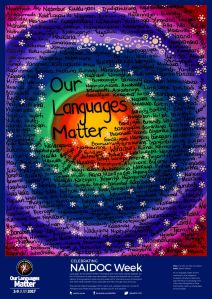
2017 National NAIDOC Poster (used under Creative Commons licence, CC BY-NC-N4 4.0)

Each July, as well as contributing at least one review to Lisa’s ANZLitLovers Indigenous Literature Week, I try to write a Monday Musings post related in some way to NAIDOC week which, as Aussies will know, is a week, usually the first full week in July, during which activities are planned to “to celebrate the history, culture and achievements of Aboriginal and Torres Strait Islander peoples”. Each year there is a theme, and this year it’s a good one, Our languages matter.

I have for as long as I can remember – since high school anyhow – been interested in social justice and civil rights (as we called it in the 1960s & 1970s). I read a lot back then about indigenous Australians and African-Americans in particular, such books as Douglas Lockwood’s I, the Aboriginal and Katharine Susannah Prichard’s Coonardoo. These books helped fire my feelings about injustice: they showed me some of the impacts of the inequities stemming from racism and of course they touched my emotions.

However, the only indigenous Australian writer I remember reading was Kath Walker as she was known then (or Oodgeroo Noonuccal as she became), until I read Sally Morgan’s My place in 1988. These writers started to help me see and feel, under the skin, the experience of being indigenous in Australia.

Now, if you keep up with discussions about the value of reading, you are sure to have read the various arguments for, or theories about, how reading can improve empathy. There was a Scientific American article in 2013 which reported that “Researchers [Emanuele Castano, a social psychologist, and PhD candidate David Kidd] in New York City have found evidence that literary fiction improves a reader’s capacity to understand what others are thinking and feeling.” Another article in The Washington Post in 2016 reported on cognitive psychologist Robert Oatley’s research of over a decade and his conclusion “that engaging with stories about other people can improve empathy and theory of mind”, resulting in improved “social ability”.

There are the naysayers to these arguments, of course, and I don’t know if reading fiction has increased my ability to empathise or not, but I can’t help agreeing with novelist Joyce Carol Oates’ statement that “Reading is the sole means by which we slip, involuntarily, often helplessly, into another’s skin.” “Sole” may be pushing it too far, but otherwise here’s my experience … and I fear I’m a bit clumsy in putting it but hope it makes sense!

I have become aware in recent years that my understanding and awareness of indigenous lives has deepened beyond the intellect and simple empathy, to a level of “knowing”.  In other words, I knew about – and could empathise with – the sense of loss, anger, disempowerment that those earlier, mostly non-indigenous writers described, but now that empathy is increasingly underpinned by knowledge of how dispossession plays out. I can never know what such historic dispossession does to a person’s psyche from personal experience but reading writers like Kim Scott, Alexis Wright, Jeanine Leane, Marie Munkara and many others, has given me the next best thing.

To labour it a little more: because I “know” my white anglo culture, I can can more quickly understand the context for a story about a gay man or an abused wife even though I’m neither of these. The leap to real empathy, which I’m arguing requires a thorough understanding of the underlying culture, is not a big one when people come from my own world. When they don’t, I can empathise at a human level – at the level any of us can when we see someone else in pain, struggling, angry, triumphant, and so on – but I sense that it’s a shallow empathy that doesn’t comprehend the forces behind that pain (etc). How do you get to comprehend those forces?

Well, Jeanine Leane, as I wrote in a recent post, says you need to immerse yourself in the “other’s” culture, in her case, indigenous Australian culture. For most of us, however, this is very difficult, if not impossible, but Leane argues that reading indigenous literature, that is writings by indigenous people about indigenous people’s lives, is a way in which we can engage with the culture. In her book, Position doubtful, which I reviewed recently, Mahood talks about the moments she waits for when, in a sense, a lightbulb turns on, when she experiences “a cognitive shift”. It’s that cognitive shift that I feel happening as I read more and more indigenous authors (of both fiction and non-fiction, particularly memoirs). It manifests in the fact that I don’t have to recalibrate my bearings so much when I open a book by an indigenous author. Certain things are givens – such as the original dispossession, the stolen generations, relationship to country. I don’t have to work to understand these, as I read, they’re there.

I hope this doesn’t repeat too much what I’ve written before, and I hope that it doesn’t sound arrogant, because it’s not meant to. I certainly know that I have much more to learn and understand. However, while I read and listen to commentaries in papers, on television, via the radio, it is through the indigenous writers I’ve read that what once felt more like information is now becoming a truth. I think that’s a powerful thing – and is why I’d argue that more Australians need to read more indigenous authors.

Kim Mahood, Position doubtful (#BookReview)

Kim Mahood, Position doubtfulKim Mahood’s memoir Position doubtful is a such a stimulating read. That might sound weird for a book whose subtitle is Mapping, landscapes and memories, but the thing is that it hits the spot in so many ways that are central to the issues confronting Australians right now. In other words, it’s about our relationship to place. Specifically, it’s about how kartiya* (non-indigenous Australians) comprehend our love for place, how we reconcile that vis-à-vis that of indigenous Australians, and how we go about respecting each other’s relationship with our land. Mahood may not explicitly generalise it like this, as for her it’s a personal journey – one exploring her experience of place and her reckoning of that with the indigenous owners – but I believe we can extrapolate her thinking to encompass something more universally Australian.

So, let me describe this personal aspect of the journey first, because this is, essentially, a memoir. It primarily covers the twenty years or so, from the mid 1990s, during which Mahood, chasing “unfinished business”, made annual trips back, from her Canberra region base, to the Tanami Desert region where she’d spent her childhood on a cattle station run by her parents, but which is now owned by the local Warlpiri people. She chronicles her desert art trips with Pam Lofts, the mapmaking she does to document country and stories, her various itinerant jobs, and most of all her relationships in the communities in which she stays, particularly Mulan (a Walmajarri community) and Balgo (where she works early on in the art centre).

Maps underpin her way of viewing and understanding place, and have become, also, the basis of her art practice. Early in the book, she writes:

In recent years I have made a number of maps with Aboriginal people, designed to reveal common ground between white and Aboriginal ways of representing and understanding country … The information marked on them is a mixture of Aboriginal knowledge – traditional camp sites, the birthplaces of individuals, the tracks of ancestors – scientific information about ancient shorelines and archaeological investigations, and the template of bores and paddocks and tracks and boundaries that represent the cattle stations and stock routes of white settlement. They serve different purposes – aboriginal, scientific, testimonial, environmental – depending on when and where they are used. Often there is a mismatch between my interpretation and the Aboriginal interpretation of their purpose.

So, this is a story about communication and negotiation, about sharing knowledge and understanding, about layers and multiple meanings, and above all, about respect for other while standing one’s own ground. The way Mahood navigates all this – the accommodations and understandings she works through, socially, personally, intellectually, scientifically, artistically and philosophically – is, really, what the book’s about. And it’s what makes it such a relevant read.

Now it’s my turn, I’m going to tell my side of the story

But of course, to write this story, she had to confront that issue I’ve raised here several times before of kartiya speaking for and/or about indigenous people. She addresses this in the last chapter (without specifically discussing the issue itself), when she describes visiting Mulan in September 2015 to tell them about her book. She organises several meetings, and reads “everything” that she thinks “might offend or upset people”. She is particularly anxious about her suggestion that the “popular version” of a massacre story she’s been told could be “a compilation of several distinct events” but she needn’t have worried. Her listeners nodded in agreement and pointed her to other people she could talk to.

This massacre “story” reminded me of another ongoing thread of mine – that one about “fact” versus “truth”. The truth is that massacres occurred – that’s not denied – but the evidence is now so murky that the various “facts” presented don’t always align. Does this mean the history, the recording of massacres, is wrong? I don’t think so.

a template of country infused with multiple meanings

The book is structured more or less chronologically following her trips, but she does move backwards and forwards occasionally – to finish an experience or flesh out a story. In between the more chronological, narrative chapters, are specifically reflective ones where she pauses to explore an idea. One is titled “Mapping Common Ground”. In it she articulates her ideas about language, maps, and being human. She says that “mapmaking was the common ground” on which she and her “Aboriginal companions put together our different conceptions of country”. She describes how maps “captured the imagination of the local mob”. They provided

concrete evidence of the knowledge that existed in the country, and they represented country in a way that everyone could understand, including the kartiya upon whom so much of the negotiations about land depended. … But the maps also aggravated the simmering arguments about who came from where, who owned which place.

And there, you see, is the politics. Politics is not Mahood’s focus but it is there, and the more you know about indigenous history, past and present, in Australia, the more you see it in the book. It’s there in the implications of changing a word from “custodians” to “ownership”, in the absence of middle-aged men resulting in matriarchies, in the “unintended consequences” of the 1968 equal wages bill, in the high prevalence of disease like diabetes, in who has or controls the money, and so on. It’s rather a mess, but “fixing” is not Mahood’s aim here, so she notes and moves on.

The title itself subtly references the underlying politics. Literally it means “of uncertain position” and is often used, for example, to indicate shipwrecks. However, when her father used the term, while navigating in the Tanami Desert, Mahood writes:

The term lodged in my mind as a metaphor for the way in which white Australians move through and occupy the country, especially the less accessible parts of it. And while the advent of satellite technology has given us the tools to find and map geographic locations with great accuracy, it seems to me that our position in relation to the remote parts of the country is more doubtful than it ever has been.

Metaphor, in fact, underpins much of how Mahood sees and explains the world, and I enjoyed that aspect of her writing, the way she finds some term or experience or object to reference bigger meanings.

Position doubtful is not exactly an easy read, but it’s a thoroughly engaging one. As memoirs go, it’s a strange hybrid, combining wonderfully warm and sometimes funny anecdotes about the people she meets and travels with, oral histories, indigenous creation stories, poetic insets, travel writing containing beautiful descriptions of landscapes, and of course her introspective reflections on who she is and what she’s doing. She allows herself to be vulnerable, and yet there’s a strong sense of self there too.

Kim Mahood, Gia Metherell

Bessie’s map, from the book and shown at CBR Writers Festival, 2016

I’ll close with some comments she makes regarding a trip to Lake Gregory with local owners and kartiya, including the palaeontologist Jim Bowler. It’s aim was to create “a cross-cultural document” showing “the interplay between  Aboriginal knowledge and western scientific knowledge in a form … easily accessible to both Walmajarri and kartiya“. She writes:

To have the ancient geography interpreted simultaneously through modern science and the Waljirri or dreaming, lays down a template of country infused with multiple meanings. While I don’t believe the creation stories in a literal way, they breathe animate life into the landscape in a form as potent and awe-provoking as the deep-time story Jim’s science tells. They complement rather than contradict each other.

And then, she talks of a discussion with Bessie, premier traditional owner for the area, in which they look at Bessie’s painting (see my image above) and the big painted map created during the project. As they talk, Mahood writes:

In putting together these two ways of conceptualising the same place, I experience a cognitive shift from which I will never entirely cover.

It’s a cognitive shift that is gradually happening throughout Australia – I hope – as we all come to terms with our different ways of seeing our history and our relationship to place and each other. This book makes an excellent contribution to this process.

Lisa (ANZLitLovers) appreciated this book too. Her write-up fills in some of the gaps I couldn’t cover without writing a tome.

aww2017 badgeKim Mahood
Position doubtful: Mapping, landscapes and memories
Brunswick: Scribe, 2016
320pp.
ISBN: 9781925321685

* Kartiya: white people (there is no one indigenous word for white people)

Monday musings on Australian literature: Changing literary tastes (2)

My last Monday Musings post was on Changing literary tastes from the 1920s to 1940s, using newspaper articles I’d found in the National Library of Australia’s Trove. Today’s post draws on just one article from the 1950s. I’m choosing just one because it, unusually in my experience, has a by-line – for a person worth introducing – and because the article is so delightful.

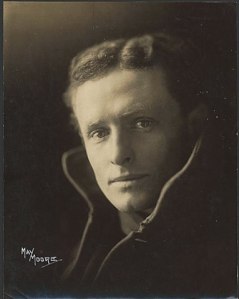
Leon Gellert, 1920s, by May Moore (Presumed public domain, nla.gov.au/nla.pic-an11253492, via Wikipedia)

So, the by-line. It is Leon Gellert (1892-1977), but I can’t resist telling you that when I first heard his name all I could think of was a tragic epic poem I read as a child about the dog Gelert (sometimes Gellert). Being a dog lover, that tale of a faithful dog has dogged me (sorry!) so powerfully ever since that whenever I heard the name Leon Gellert I couldn’t get past the dog – until now.

Why now? Because the article I found in Trove titled “The decline of the bookcase” was so entertaining that I decided to shake off my childish memory and check the man out. I found him in the Australian Dictionary of Biography (ADB). Biographer Gavin Souter describes him as “soldier, poet and journalist”. Gellert was born in South Australia, and taught briefly before he enlisted with the AIF. He ended up at Gallipoli on 25 April 1915, was injured, and repatriated home in 1916 after which he returned to teaching. He wrote poetry during and after the war. Souter describes him as “Australia’s closest approximation to a Brooke or Sassoon”. His short, powerful poem, “The jester in the trench”, appears in Jamie Grant’s 100 Australian poems you need to know.

According to Souter his early promise was not sustained and he turned to journalism. In 1942 he became The Sydney Morning Herald‘s literary editor “and wrote a graceful column, ‘Something Personal’, for the Saturday book pages”. The article I found is one of these, so let’s look at it.

Published on 16 June 1951, it captured my attention because it starts off talking about bookcases, and what reader isn’t interested in them! He starts

RECENTLY I roamed the city in search of some ready-made bookshelves. It was an almost fruitless search. The few that came within the bounds of my requirements were pitifully stunted little things obviously designed by craftsmen who had never read a book in their lives. The top-most compartment reached no higher than a man’s waist and the lowest could be approached only by crawling on all fours.

I was confident I would enjoy reading this. He then talks about

glass-fronted book-cupboards; ungainly remnants from late Victorian days now raised to the peerage with the dubious rank of “antique.” These, doubtless, once held their stern leather-bound arrays of Scott and Thackeray and Carlyle, close-corseted in the gloom against casual and curious hands. But they were too prohibitive in price for my pocket and too full of shadows for my purpose. There is so much unlatching and probing to be undertaken that the extraction of a volume is like an obstetrical operation.

Hmm, we Gums rather like glass-fronted bookcases because of the dust factor – but we only have a couple (recently inherited), and he is right about the “unlatching and probing”. He continues in a similarly entertaining vein, pronouncing his preference for bookcases “of open countenance that smile their invitation across the whole length of a room.” This is the type we mostly have – floor to (nearly) ceiling, most double-stacked. Very convenient, but pretty dusty too! What are your favourite types of bookcases?

He progresses from describing various bookcases to discussing their dearth in contemporary homes. He says where once they had a place in every small home, now they are viewed with suspicion:

How often have I admitted a guest to hear him exclaim, with a tincture of mistrust, as he crossed the threshold for the first time, “Ah, I see you are a reader,” and that mark you, with no more evidence to guide him than a meagre rack of books in what is referred to with sweeping hyperbole, as the entrance hall!

Hands up if, like Gellert and us, your first of many bookcases is in your entrance “hall”.

And then he gets on to WHAT people are reading …

He says that in the past people all read the same sort of material – a wide mix encompassing the likes of Henry James, H. G. Wells, Thomas Hardy, Eden Phillpots and Stanley Weyman (who was also known, says Wikipedia, as “the Prince of Romance”). “Those beyond the pale”, he writes, “read Mr. Garvice“. I had to look him up too! He was a very popular writer of romance in the early twentieth century.

However, now, he says, readers are dividing into two groups, “those who read, let us say, Virginia Woolf, E. M. Forster, Graham Greene and Joyce Cary, and the vast mass who read what I believe are called ‘Westerners’.” What’s more, he suggests, these groups are contemptuous of each other. This is interesting. Is he right that this divide, one that still largely exists today, only started around the 1950s?

Anyhow, then, having mentioned “westerners”, which, according to the writers in my first post, were their way out, he moves on to detective novels. He wonders if they are the cause of the impermanence he’s identified. The detective fiction craze has been going for forty years he says. When will it stop? One of their attractions, he thinks, is that they are a game that can be played in private, like patience, and they have “something in common with the crossword puzzle”. He quite likes detective novels himself, but is concerned that, having lasted more than thirty years – his marker for “the most obstinate vogue in history” –  detective fiction will “establish itself as a durable department of literature.”

He trots out, too, a concern about what it means to love detective fiction. We deride melodrama, he says, but “the most outrageous complexity of treachery, murder, torture and rape is regarded, by the intellectual and the illiterate, as legitimate fun”. Is it really the harmless game people think, he asks? He then tells us that detective fiction is popular with world leaders. Hitler loved them, as do “the most distinguished statesmen in the English-speaking” world and “the most scholarly writers and the most immaculate ministers of religion”. They all “squander countless hours in company with M. Poirot and Lord Peter Wimsy”. And yet, he says, when people worry about child delinquency, it’s cinema and radio they blame!

He concludes by wondering whether the time could come when detective fiction is banned. He doesn’t really want to see that, but at least it could “help to reestablish our pride in the permanent companionship of good books”.

We now know that detective fiction has indeed become “a durable department of literature”, but I’d argue that we have also reestablished our “pride in the permanent companionship of good books” (if he was right that it had been lost). Putting aside for a moment economic issues, the interesting question here is how important to literary culture is “the permanent companionship of good books” – meaning ownership and storage in personal bookcases – versus the fact that people are reading (as he says people were in his time).