Monday musings on Australian literature: Place

Place. It’s a complex thing isn’t it?

Arti (Ripple Effects) commented on my recent post on Gerard Manley Hopkins‘ “Spring and Fall” that

… while spring may be a welcome sight, for some strange reasons, I miss winter’s snow. (not the temp. just the beautiful snow scenes).

Would I miss winter and snow? Not on your nelly! Meanwhile, Nigel Featherstone (Under the counter or a flutter in the dovecot) wrote in response my comment on a recent post of his:

As to the drive to and from Canberra: most of my trips are through Lake Bathurst; so amazing – all that sky!

But arriving in the ACT is always a good feeling. Though almost immediately I miss my home town.

Isn’t place interesting? So difficult to capture accurately…
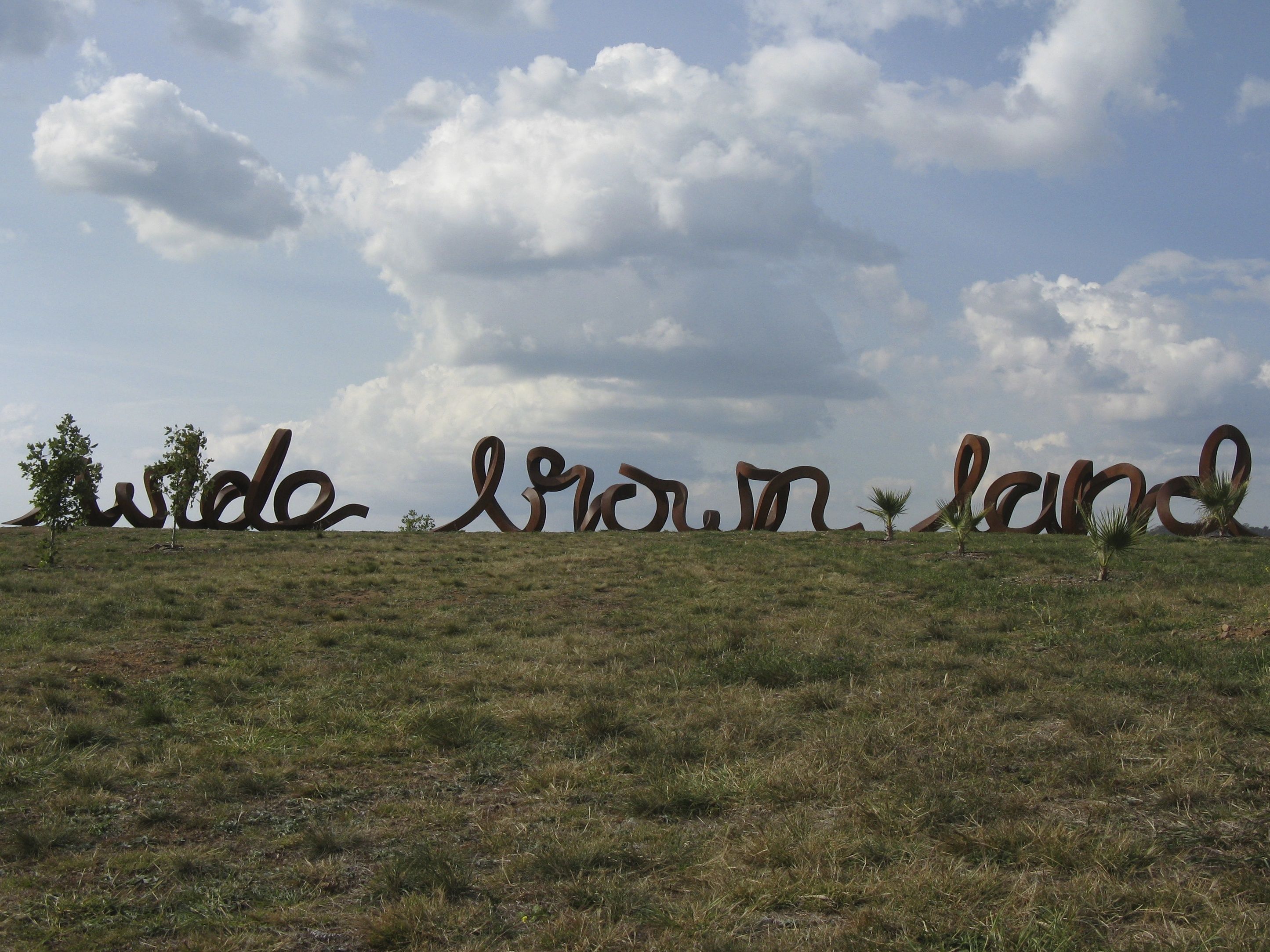
Wide Brown Land sculpture

Wide Brown Land (National Arboretum)

These comments got me to thinking about my sense of place – and then about place in literature. First me. My love of the Australian landscape came home to me when we returned in 1985 from a two-year posting in Virginia, USA. Like most Aussies, I’d read a lot of fiction from the northern hemisphere and had somehow been imbued with the idea that the loveliest landscape is lush and green and the best houses are two-storey. After enjoying two years in such a place, I wondered how I’d feel about returning home. I needn’t have worried. We drove back into my city and it felt wonderful. I knew then that here, this  browner place with its scraggly vegetation, was my place.

Now for literature. I can think of two main uses of place in literature. One is the obvious one, place as setting, as background for the action. I enjoy reading good descriptions of place, and have shared some in my reviews. My favourite descriptions are sensory, enabling me to “feel” and “see” the place and its impact on the characters. A favourite example is the opening paragraph of Charles Dickens Bleak House. It’s hard to forget London and its fogs after that.

The other use, though, is more complex. It’s to do with our relationship to place – the way we interact with place, the way we feel about it, the way it interacts with us.

But here’s the rub. Relationship to place is complicated in colonial/settler societies like ours, societies which have taken over someone else’s place. How do we reconcile that? There’s a fundamental conflict between our two different experiences of place, and it’s discomforting. We want to respect and better understand the original owners’ values while validating our own. Literature (and the arts in general) can help us work through these issues –  by directly exposing and exploring the conflict, and more subtly by sharing our respective experiences. For literature to be effective, of course, we need universal literacy – but that’s another story.

Fortunately, more indigenous writers are being published and we are hearing their voices about land, about country. We need to hear it, we need to share and talk. In That deadman dance, Kim Scott tackles head on the issue of land and ownership, of competing values and different understandings, in the early days of settlement. Killam, the soldier, has to give up to the Governor a place he’d taken:

Mr Killam was learning what it was to have someone move in on what you thought was your very own home. He thought it was the last straw. The very last.

Meanwhile, Skelly tramps about the land with a gun in his hand, explaining:

Well, it’s not our home is it?

And entrepreneur Chaine decides, at one point, to give up his farming goal for whaling:

Whaling was better than attempting to work this land with its topsy-turvy seasons  and poor soil, and there’d be trouble with the natives, farming. The best land was their land, too.

For our indigenous narrator, Bobby, land is something known, felt:

And then Bobby found a sheet of granite, and a small rock hole covered with a thin stone slab and filled with water. He crouched to it, he touched the stone, and sensed home.

In the end, of course, the “settlers” win and we descendants are left with the legacy of loving land that was not ours. Kim Scott has made an intelligent contribution to the conversation about this complex business of land.

Some years before Kim Scott’s book (2011), Andrew McGahan, a non-indigenous writer, wrote The white earth (2004), a contemporary story set on the eve of Native Title. It’s about the love of land, by both indigenous and non-indigenous people, about greed and putting money and land ahead of spiritual and emotional values. It’s a little melodramatic, but it’s a powerful read. The old grazier believes that:

Ownership could not be shared. Not the power of it, not the weight of it either. It could be crushing that weight, encompassing all the history that the land had ever witnessed, the summation of the lives and deaths of all those who had walked it before. But William [his great nephew] barely even knew the station – he hadn’t smelled it or touched it or felt the terrible age in its bones …

The irony is that this is a man who loves his land, but selfishly and greedily. There are indigenous people who own this land and Native Title is being enacted. His daughter says:

This law is brand new, it has to be interpreted by judges. Maybe the Kuran people haven’t kept up their presence, but if they argue that eighty years ago their entire male population was killed off while trying to – then what? What humane person isn’t going to consider that a reasonable excuse, no matter what the letter of the law might say?

This is a complex novel with no easy ending …

And I have ranged far from what inspired me to write this post but it comes down to this: we have a long way to go before we (non-indigenous people) can feel comfortable about our love of our place. We need the arts to help us through it … I suspect Nigel would agree.
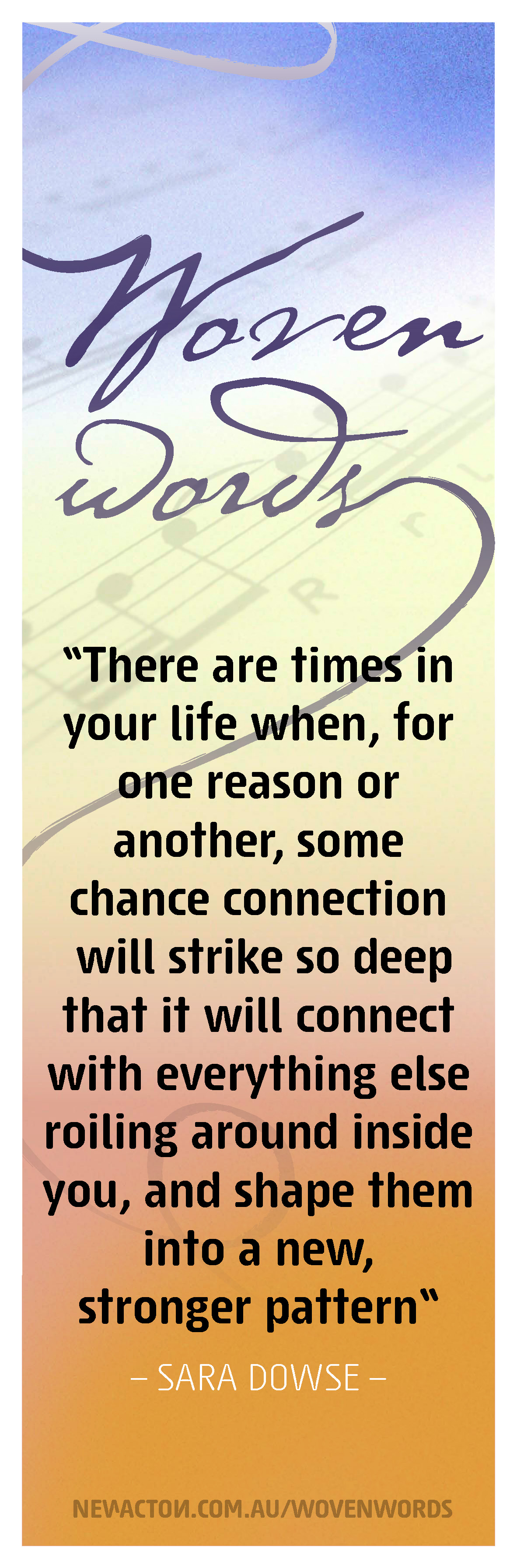
Woven Words: What a night!

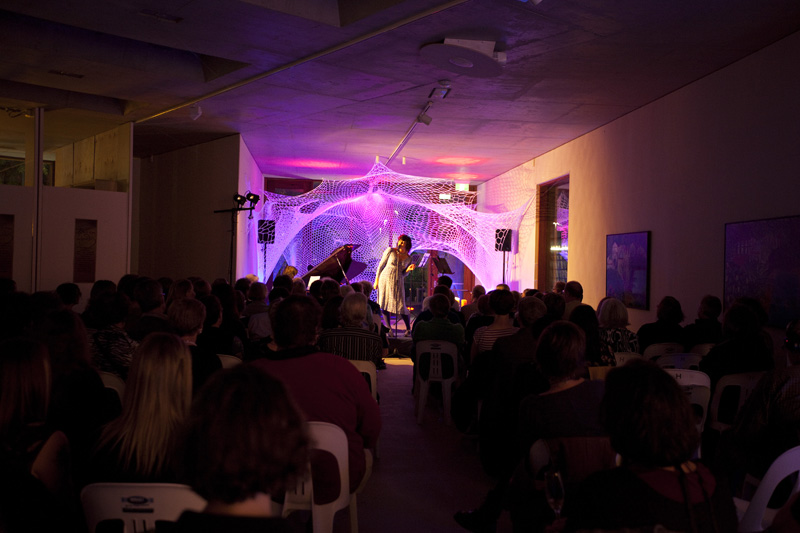
Chanel Cole, Nishi Gallery (Photo: Katherine Griffiths)

Chanel Cole, Nishi Gallery (Photo: Katherine Griffiths)

As we were driving home from Woven Words, the most recent event associated with The invisible thread anthology, it occurred to me that the evening, which blended words with music, was rather like a three movement musical composition. It went a bit like this:

  1. Sara Dowse‘s bright and slightly quirky allegro
  2. Alex Miller‘s intense adagio
  3. Alan Gould‘s cheeky scherzo.

The event took place in an intimate venue in Canberra’s newest inner city precinct, New Acton, which, I understand, is positioning itself as an arts hub. Even before a fire in mid-2011 set the area back, there had been some lovely musical evenings in Flint, one of the precinct’s restaurants. The Nishi Gallery, though, is a very recent player on the block, so recent that I’m not quite sure what its long-term plans are. Last night, however, it became a delightful space in which a gathering of, guessing here, about 100 people heard three great authors read from their works, bookended by music (mostly) chosen by them and performed by local professional musicians. It was, in a word, a blast.

Sara Dowse text

Sara Dowse (Courtesy: NewActon.Com)

After some pre-show piano music performed by Adam Cook, Allegro started with the gorgeous Chanel Cole singing Kurt Weil’s “Speak Low” accompanied by Cook. Sara Dowse chose this because it was the theme song of Ava Gardner‘s film, One Touch of Venus, which is the title of Dowse’s piece in The invisible thread. In it she describes a weekend she spent with Ava Gardner when she was 7 and Gardner about 24. An unusual choice perhaps for a Canberra anthology, but the anthology isn’t solely about Canberra. Dowse’s piece is about those moments in your life in which you learn something precious and lasting. Her time with Gardner provided one of those moments for her. Her movement finished with another jazz piece performed by Cole and Cook, “Old Devil Moon”.

At question time I asked her how someone with such strong creative drive – she sings, writes and paints – ended up working in bureaucracy. She was, for those who don’t know, the first head of the Office of Women’s Affairs which was established by our new reformist Prime Minister, Gough Whitlam, in 1972. Her answer was perfect: They were very creative times, she said.  Can’t argue with that. They were.

Alex Miller

Alex Miller (Courtesy: NewActon.com)

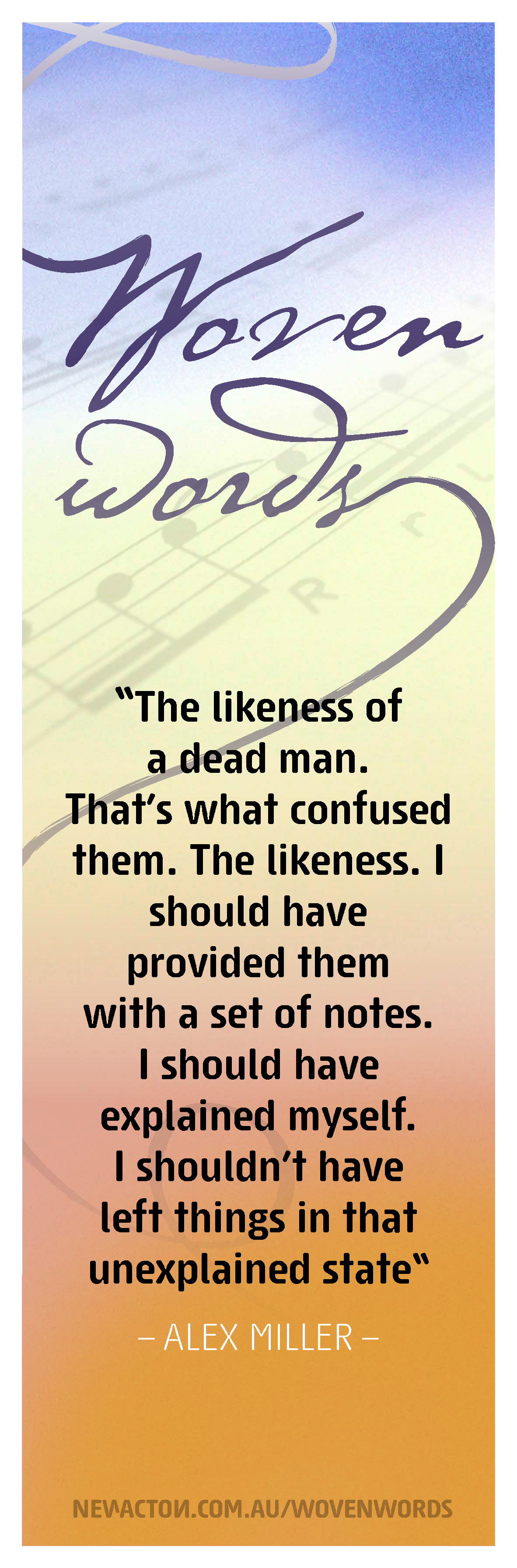
After a short break, it was time for Adagio, my least favourite movement when I was a young music-lover. I was impatient, wanted something faster, with more beat. Now, though, I’ve learnt to enjoy and love the slow and the opportunity it provides to dwell. Tonight’s Adagio provided exactly that … It was bookended by Adam Cook playing the “City of Carcosa” by Larry Sitsky and the CSO (Canberra Symphony Orchestra) String Quartet playing Samuel Barber’s elegaic “Adagio”. Alex Miller has a love-hate relationship with Canberra, mostly the latter it seems! He earned a polite but forgiving (I think) hiss from the audience when he said that no-one chooses to live in Canberra. Wrong! However, he also said that he felt privileged to be involved in the event.

Miller suggested that writers would like to write music, that music manages to express something that writers never quite achieve. Now that’s something for us to ponder. Has it to do with music being the universal language I wonder? Would all writers agree? He talked about writing – about the importance of voice, about the imagination and the act of “imagining something into being”. How to write his novel, The sitters, from which he read, came while he was sleeping on a plane flight between Los Angeles and Sydney. It is about a portrait artist, and explores the nature of “art” and the relationship between artist and subject. The reading ended on:

It’s a story not an explanation.

I like that … it sounds simple but packs a lot.

Alan Gould

Alan Gould (Courtesy: NewActon.com)

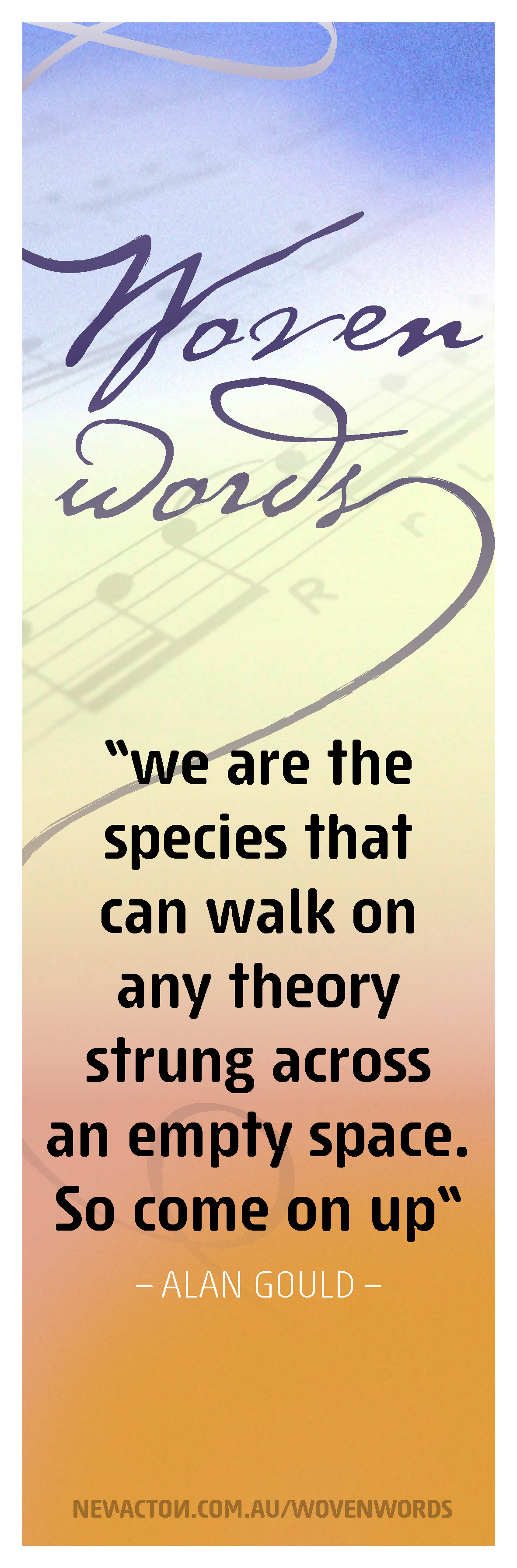
The final movement, Scherzo, belonged to poet-novelist Alan Gould. It started with CSO String Quartet performing Percy Grainger’s “Molly on the Shore”. I noticed Gould’s head, up front, bopping away just like mine. Gould read several poems starting with “The Roof Tilers” which I mentioned in a recent Monday Musings. I love that poem. Gould was an engaging reader, introducing each poem with some background. He read his most recent poem “A Rhapsody for Kenneth Slessor” and “Sea Ballad“. And concluded with two flamenco inspired poems, first describing the challenge of replicating in poetry a flamenco rhythm. He read “Flamenco Rehearsal” and “Flamenco Pair”, at times toe-tapping the rhythm as he went. Appropriately, Gould’s movement ended with guitarist Campbell Diamond performing two Spanish pieces, “Junto al Generalife” by Joaquín Rodrigo and (appropriately) “Finale” by Antonio José.

When asked, at the end, whether a sense of dislocation was important to being an artist, Gould, also a model shipmaker, said that for him it was more a sense of being “oceanic” which he described as “being at home in the unstable element”. That may be why I’m a reader not a writer!

The evening was beautifully em-ceed by ABC 666 Radio announcer, Genevieve Jacobs. She was a charming presenter who engaged well with each writer. And she managed her high heels on the tiny stage with great courage!

The evening had a few little challenges. The microphones did not properly work for the singer who opened the evening, the seats were a little hard after three hours, and the venue has just one all-purpose toilet. These were minor. Far more important was the wine! As an Anything-But-Reisling girl, I do hope a choice of white wine is offered next time …

Seriously though, it was a delightful evening. The writers were generous, the musicians superb. Irma Gold, editor of The invisible thread, is doing a stunning job of exploring and exposing the invisible threads that connect the anthology to other arts, to readers, to Canberra. It’s exciting to be part of it.

POSTSCRIPT: With thanks to Dave, of NewActon.Com, for the images.

Dorothy Johnston, The house at number 10 (Review)

Johnston, House at Number 10 bookcover

Courtesy: Wakefield Press

Dorothy Johnston‘s The house at number 10 has one of the cheekiest opening sentences I’ve read for a long time … but I’m not going to tell you what it is. If you are interested you’ll have to find out for yourselves – and tell me if you agree.

I decided to read this novel for a couple of reasons. Firstly, I’d known of Dorothy Johnston since the 1980s but have only read some short stories (specifically, those in the recent Canberra-focused anthologies, The invisible thread and Meanjin’s Canberra Issue.) Secondly, I chose this particular novel because it is set in Canberra and this Centenary year I’m focusing a little, though not exclusively, on books set in Canberra or by Canberra writers.

Dorothy Johnston was a founding member of the Seven Writers, a group of women writers in Canberra who met for many years to share and critique each other’s writing. They have become the stuff of legend, at least to Canberra readers. Johnston has written several novels including four crime novels set in Canberra. She has also been shortlisted for the Miles Franklin award – twice. But The house at number 10 is not one of her crime novels, nor one of the shortlisted novels. It is, though, a good read … and it’s time I got to it!

The novel is set in the early 1990s, on the cusp of the legalisation of the sex industry in Canberra. Its protagonist, late-twenties-something Sophie, has been left by her husband, Andrew, not for another women but for “a floating, open-ended freedom”, for “a raft of girls”. They are sharing the care of their four-year-old, rather self-possessed daughter, Tamsin, and Sophie, now living in the garden flat at the back of the old widow Mrs B’s home, needs to support herself. So she applies for a job in a small, newly established and rather shabby brothel in the suburb of Kingston, at 10 Andover Street. Hence the novel’s title. The novel explores Sophie’s various relationships – with Elise and Kirsten who work in the brothel, with Marshall the brothel owner and Elise’s partner, with her landlady, with her old friend (and architect) Ann, with a couple of her clients, and of course with her estranged husband and her daughter.

There is a little bit of the “oh what tangled webs we weave” about this novel as Sophie strives to keep her two lives separate – but Johnston is not so much interested in mysteries and intrigues here as in how we navigate complicated relationships and cope with betrayal. It’s a surprising set-up but it works, because she keeps the story grounded in the relationships and not in its potential for salaciousness.

And the relationships are what keep you reading, as Johnston slowly draws the various characters into Sophie’s new life. Ann designs a renovation for the brothel, Mrs B takes over fixing up its garden. Characters look out for each other – Kirsten deflects Marshall who is keen to try out this new “girl”, while Sophie looks out for Kirsten through a long illness; Ann and Mrs B accept Sophie’s choice, supporting her while also offering advice. Not all is rosy though. Elise is suspicious and prickly, and Ann has a little fling with Andrew, albeit with Sophie’s not-overly-happy knowledge.

Underpinning all this is a tension stemming from Sophie’s grief and anger at her abandonment. She doesn’t rant, and she holds it together in front of her daughter, but her feelings are made clear when she meets her first client:

She handed him a condom and he rolled it expertly. Now, she thought, now, as grief at her failed marriage made barriers transparent, each one constructed of material so thin she could burst through it at will. Anger welled up, and resentment and self-pity. Blame struck out and swam through the lamplight towards this stranger who wore Andrew’s hair.

It’s a dangerous game she’s playing, particularly when she takes on Jack, who is into bondage, something the brothel has not offered before. For Sophie, though, it provides an opportunity to enact revenge on Andrew, displaced though it is to Jack. She knows he’s not Andrew, but she can imagine so – and this works for a while. However, you can’t of course maintain a secret or divided life forever. Eventually the crunch comes, and Sophie risks losing what matters to her most …

Besides her sensitive characterisation, Johnston also does place well. Canberra is rightly depicted as a place in which ordinary people live and go about their business, but she also captures its particular beauty – the “flat, clean” sun which has a “greedy kind of clarity”, and the light and colours of the changing seasons that are so marked in Canberra. The house at number 10 has a character of its own – shabby, but somehow warm with its worn out armchair and cosy kitchen. Not quite what you’d expect for a brothel – though how would I know – and yet it feels true. And there’s Sophie’s garden flat with its comforting garden:

There was the dark green garden, watered to the gills, and the sense it always gave her of luxury, repleteness, a deep satisfaction with its own existence.

Johnston uses imagery lightly but effectively. Sophie’s divided life is represented by her living on one side of the lake and working on the other. We often drive with her over the lake, making the transition clear. As the novel builds to its climax, the colour “red” and words like “fire” and blood” start to appear, suggesting anger, violence (real or imagined), and revenge. Contrasted with this are references to water, primarily via the lake and a Cupid fountain bought for the brothel’s garden, implying something more female, perhaps calming but also a little mysterious. And then, throughout, there’s gardening and its association with nurture and growth, with vision and imagination.

So what really is it about? Revenge is the motive for the plot, but it is not really the theme. Rather, it’s about facing life bravely and taking risks even if you “draw blood”, about friendship and the things you do for your friends, and about love in all its guises. A quiet book, despite its subject matter, and well worth the read.

AusLitMonth2013Dorothy Johnston
The house at number 10
Kent Town: Wakefield Press, 2005
257pp.
ISBN: 9781862546837

Read for Australian Women Writers’ Challenge and Reading Matters’ Australian Literature Month.

Monday musings on Australian literature: Stella, Carrie and friends

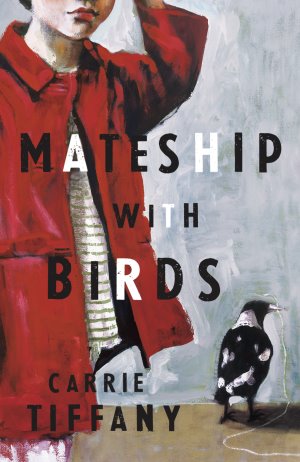
Mateship with Birds (Courtesy: Pan MacMillan)

Book Cover (Courtesy: Pan MacMillan)

For those of you who haven’t yet heard the news, I’d better start with the announcement that last week Carrie Tiffany‘s novel, Mateship with birds, was announced the winner of the inaugural Stella Prize. Unfortunately, the book is still on my TBR but with its also being shortlisted for the NSW Premier’s Literary Award and longlisted for the Miles Franklin Award, I need to get a move on.

Okay, now that I’ve got that off my chest, back to Stella and Carrie. When she was announced as the winner of the Prize, Tiffany, according to tweets on the night, immediately advised that she would return $10,000 of the $50,000 prize to be shared among the remaining shortlisted writers: Courtney Collins (The burial), Michelle de Kretser (Questions of travel), Lisa Jacobson (The sunlit zone), Cate Kennedy (Like a house on fire) and Margo Lanagan (Sea hearts). She wanted to recognise, I believe, the co-operative spirit of the Stella Prize, and the fact that women writers are supportive of each other. Go Carrie, I say.

Now to the “friends” part of this post’s title. In addition to the above gesture, she also said on the night that:

The Stella Prize is an opportunity to fete and honour writing by Australian women. When I sit down to write I am anchored by all of the books I have read. My sentences would not have been possible without the sentences of Christina Stead, Thea Astley, Elizabeth Jolley, Beverley Farmer, Kate Grenville, Gillian Mears, Helen Garner and the many other fine Australian writers that I have read and continue to read.

What a great list of writers. I first read all of these women, except Christina Stead, in the 1980s, and was blown away by the quality of their writing. Not only do they all tell wonderful stories but, as Tiffany implies, they write great sentences. You can have the best story in the world but if you can’t write a good sentence you’re not going to get far.

And sentences are clearly important to Tiffany, because in addition to mentioning them in her acceptance speech, she referred to them in an interview conducted by the Stella Prize team the day before the announcement. She was asked why she became a writer, and she said:

More than anything I wanted to become a reader and I’m pleased to have achieved that. In my early twenties I worked as a park ranger in Central Australia. I live in Melbourne now and work as a farming journalist. I started writing fiction ten or so years ago. I don’t remember any momentous shift, just a hankering to make some sentences of my own.

She was right to follow that hankering because, from what I’ve read and from the awards she’s won and been listed for, she too can write great sentences, can write in fact, like the women she named, brave sentences that take risks … I look forward to reading Mateship with birds.

Delicious descriptions from Down under: Courtney Collins and landscape

There was so much to write about Courtney Collins’ novel The burial in my review this week that I couldn’t share one of my favourite aspects – her gorgeous descriptions of the landscape. When I say gorgeous, I should clarify that the landscape itself isn’t always gorgeous, but her descriptions, her ability to evoke the landscape visually, spiritually and emotionally certainly is.

The imagery draws from the mountains and the earth, and is imbued with multiple meanings. The mountains represent magic and mystery, but also danger, while the earth conveys time and stories. The descriptions feel Australian – and yet there’s little reference to specific, identifiable features, such as gum trees.

Here are two descriptions of the earth:

THE EARTH, AS I can feel it, is pressed together at points and ruptured in parts. And so events seem to fold into each other, like burial and birth. It’s not like the smooth and undulating beauty of a ribbon streaming out. No. The earth buckles with the stories it holds of all those who have cried and all those who have croaked.

and

the earth disturbed and compacting as they rode, all of untold time beneath them.

I love the way these descriptions convey something eternal, permanent, not always benign but somehow reassuring nonetheless. By contrast, here are descriptions involving mountains and our three main characters – Jessie, Jack Brown and then Barlow:

She felt odd—as if some great fissure had finally opened up, and all of the convolutions of herself were meeting at the surface, like so many coincidences at once. And somewhere in it all was her own distinct nature.

Sitting by the ravine she felt her past was not behind her or beneath her, it was everywhere at once, living through her, and the boy and Joe and Bill were just like those she had known before and here on the mountain was something like a second chance …

and

The mountains unfolded and soon he felt with all of his wanting that she would split the summit, come tearing out through the trees and ride determinedly towards him. But she did not.

and

For Barlow, the mountains had unfolded without meaning. The colours and shapes continued to be strange to him and as they had moved higher up the slope he felt the clouds weighing in like the ceiling of a room that was sinking down upon him …

Quite different aren’t they? The mountains seem to be more about self – about defining self – sometimes positive, sometimes not, but often associated with a sense of change.

It’s strong language with slightly unusual rhythms. I found it effective and rather mesmerising.

Queensland Literary Awards … to continue in 2013

There’s sometimes a fine line in the blogging world between promoting and supporting. I don’t see my role being to promote particular authors or books, but overall I like to think that my blog supports literature in general, and Australian literature in particular. A by-product of that support is probably promotion, but that’s not my goal. However, today I’m going to stray more into the promotion side of the line – but there’s a good reason for it, and there’s no monetary gain for the organisation I’m promoting so, here goes …

Queensland Literary Awards LogoThis week’s Monday Musings was about my new Australian Literary Awards page in which I’ve listed Australia’s main literary awards for fiction. I included the new Queensland Literary Awards without being completely certain whether they would continue, given their history. Today their continuation was confirmed in an email from Queensland Literary Awards Inc. The email says:

The Queensland Literary Awards (QLAs) were established through significant public support in 2012. The QLAs are Queensland’s most significant suite of literary prizes. They celebrate, nurture, and applaud the talents and achievements of Australia’s writers.

We have received outstanding support from numerous partners to keep the awards alive again this year.

They asked if I would help get the word out about the awards. How could I say no, given all the work they’ve done and the support they’ve received from others? Queensland is, after all, my home state and has a long history of literary awards.

This year’s award categories are:

  • The Courier‐Mail People’s Choice Queensland Book of the Year
  • Deloitte Fiction Book Award
  • University of Queensland Non‐Fiction Book Award
  • University of Southern Queensland History Book Award
  • State Library Queensland Poetry Collection—Judith Wright Calanthe Award
  • Australian Short Story Collection—Steele Rudd Award
  • Griffith University Young Adult Book Award
  • Children’s Book Award
  • Gadens Feature Film Script Award
  • Emerging Queensland Author—Manuscript Award (supported by University of Queensland Press)
  • Unpublished Indigenous Writer—David Unaipon Award (supported by Copyright Agency Cultural Fund and University of Queensland Press)

Two of the awards – The Courier‐Mail People’s Choice Queensland Book of the Year and the Emerging Queensland Author—Manuscript Award – are limited to Queensland authors, but the other nine are national awards. I rather like the idea of designating a couple of awards for the state of origin while retaining the national focus overall.

If you want to know more about the awards and how to nominate – the time-frame is tight – please click here.

Courtney Collins, The burial (Review)

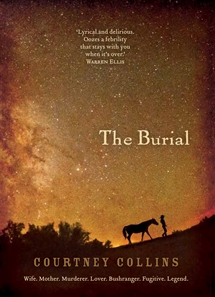
Book cover (Courtesy: Allen & Unwin)

Book cover (Courtesy: Allen & Unwin)

I became aware of Courtney Collins’ The burial when it was longlisted for the Stella Prize. It has since been shortlisted for the Stella, shortlisted for the new writing award in the NSW Premier’s Literary Awards, and longlisted for the Dobbie Literary Award for new writing. It had previously been shortlisted for the 2009 Australian/Vogel Award for Unpublished Manuscripts. This is one impressive debut. While I’m attracted to several of the books longlisted for the Stella, I particularly wanted to read this one because of its subject matter; it is inspired by the life of Jessie Hickman, an Australian woman bushranger. I hadn’t heard of her before and thought this would be an interesting introduction. I wasn’t wrong. The burial is no ordinary historical fiction.

The bulk of the novel takes place in 1921 when 27-year-old Jessie, having had a gutful of her abusive, horse rustling husband Fitz, takes off, having first … well, let’s just say, done to him what she’d been wanting to do for a long time. In other words, she’s on the run. Now Jessie is no saint. She’s already been in prison for rustling, but she didn’t deserve the treatment she got at the hands of Fitz. The novel chronicles Jessie’s escape, and the story of the two men looking for her, Jack Brown, her lover and co-horse rustler for Fitz, and Sergeant Barlow, who has a story of his own. Escape is, we discover, Jessie’s speciality. It’s not for nothing that the book starts with a story of Houdini, or that Jessie’s horse is named for him.

As I read, I was reminded of two American writers – Toni Morrison and her powerful, gut-wrenching novel Beloved, and Cormac McCarthy and his western novels – for pretty obvious reasons. The burial is narrated by Jessie’s prematurely born daughter whom she kills and buries at the start of the novel, reminiscent of Sethe’s daughter Beloved, despite their different behaviours. And the elemental, evocative language along with the themes – human against human, human against nature, in a forbidding and lawless environment – immediately bring Cormac McCarthy to mind.

What is particularly impressive about this debut is Collins’ handling of the narrative voice and structure. The baby’s voice is generous and wise, not maudlin or pathetic. She cares about this mother of hers, and is a bit like a guardian spirit, albeit one without any power. Somehow, despite what Jessie did to her, she humanises Jessie and encourages us to feel sympathy rather than horror. Collins is light-handed in her use of this trope. As the novel progresses, it feels like a third person story, which it is, really, because it is not about the narrator but is her story of her mother. Every now and then, though, we are reminded of our narrator when she says “my mother”.  As for the structure, the narrative alternates, loosely rather than rigorously, between Jessie’s story and that of Brown and Barlow. It’s basically chronological but there are flashbacks to fill us in on Jessie’s origins as we follow her escape.

Back now to the story. Early in the novel, Jessie is released from jail to be an apprentice horse-breaker and domestic help to Fitz, and pretty soon we are told all we need to know:

Her hope was that her employer was a good man. But he was not.

I love the way Collins’ language flows – from lyrical description to the plain and straight.

Fortunately, Jessie, while fearful of this man who beats her, is also spunky and “found freedom in the ways she defied him”. There is a bit of the picaresque in the novel, as we follow Jessie’s escape and the various people she meets, but it has none of the lightness of that form. A better description is probably gothic. It’s a tough world Jessie finds herself in – one that is particularly cruel to women and children. She spends time, for example, with an old couple. The woman wants her because “All of these years in this miserable place I have prayed for the company of someone other than you and here she is. I am taking her”. The man’s response?  “She’s of no value”!

The brightest spot in the novel occurs when Jessie meets a gang of young rustlers led by the 16-year-old Joe in a spirit of mutual support and cooperation. She joins them and helps them in a well-planned heist in which they manage to steal 100 cattle, sell them at saleyards and return to the hills before the owner notices the loss. It is remote country, after all. However, the theft is discovered and a bounty is put on Jessie’s head – for the cattle they believe she’s stolen and for the rumoured murder of Fitz. And so the final hunt begins involving a bunch of men who are after the bounty, and Brown and Barlow who hope to get to her first.

For a while the gang stays hidden but, eventually, some of the hunters get close:

That’s the sound of desperate men, said Joe. I know this type of man, said Bill. He has no god. And he is all the more dangerous to us because, worse than that, he has no law in him or myth to live by.

Jessie, at her insistence, heads off alone, setting up the climax which is not totally unpredictable – after all, one can’t stay on the run forever – but which contains its surprises.

This is a novel about a hard world in which

A man can rape or kill and expect no consequence except his own consequence. You mean conscience? Consequence is what I said and what I mean to say!

But it is also about love and forgiveness, magic and myth, resilience and resourcefulness … I’ll not forget it quickly.

Courtney Collins
The burial
Sydney: Allen & Unwin, 2012
ISBN: 9781743311875 (Kindle ed.)

Read for Australian Women Writers’ Challenge and Reading Matters’ Australian Literature Month.

Monday musings on Australian literature: Australia’s major Literary Awards

This will be a short Monday Musings … aren’t you pleased!

The literary award season for 2013 is hotting up with the most exciting thing on the horizon being the announcement of the inaugural Stella Prize due tomorrow, 16 April. In addition to this, though, we have also seen the announcement of longlists and shortlists for a few other awards, and even a winner or two. I’m finding it hard to keep up …

Award Symbol

No. 1! (Courtesy: OCAL via clker.com)

Now, while I don’t make a practice of reporting on all awards, I do like to know what’s going on. So, I have created a new page on my blog for Australia’s main national literary awards. It’s not a complete list of all literary awards offered in Australia but of the significant ones that are exclusively or mostly awarded to fiction books or fiction writers in the national arena. I plan to include in the page the major dates for announcements of long lists, short lists, and winners for each award for the current year. I have linked each award, where possible, to its Wikipedia page, on the assumption that that’s likely to be the most stable page and will, in most cases, provide a link to the award’s official site – where there is one. I find it quite frustrating, in fact, that many of the awards do not have well-maintained sites. It is quite hard, for example, to find the important dates for this year’s announcements, and so you’ll see that the list is incomplete.

Anyhow, there you have it for this week … please look at the page if you are interested, and if you see any glaring omissions or errors, let me know.

Madeleine St John and the right thing

There were many ideas I wanted to discuss or share in my review of Helen Trinca’s biography, Madeleine: A life of Madeleine St John, but it was starting to get too long … so I thought I’d save some points for another post or two.

Madeleine St John it seems had some very strong ideas about how to live one’s life – in both the more superficial areas, such as manners and customs, and in those areas to do with values, with morals and ethics. In terms of the former, Trinca writes at one point, when describing how Madeleine churned through friends:

It was ‘so very easy to do the wrong thing around Madeleine’. Her taste was perfect and her manners were sublime, but she felt no shame in making others feel ill-at-ease about their own behaviour.

I must say that my view of manners is that the first mark of good manners is making the other person feel comfortable, but, there you go, I’m not a member of the upper class so what would I know! Trinca provides many examples of the erratic way Madeleine treated her friends and family – and there are too many examples from a wide variety of sources for us not to believe them. She would cut them off and then want them back. And back they usually came because, as one, David Bambridge, said, she was “quite cutting and prickly … rather grand at times, but also kind, generous and funny”.

With all this in mind, I was fascinated by the excerpt Trinca provides from the obituary written by Christopher Potter, her publisher at Fourth Estate which published her last three novels. He wrote:

Language and a questioning of faith are the two poles of St John’s created world, as may also have been true of her domestic world … Beneath the sly and witty veneer of her writing, she explores questions that are basically theological: we must do the right thing, but how can we tell what the right thing is? This question is at the heart of all her novels … She lived by a strict moral code, the rules of which were only truly clear to herself.

All I can say is, curiouser and curiouser. She was one interesting woman … and I look forward to testing this proposition when I read the next book of hers in my pile.

Monday musings on Australian literature: AWW Challenge 2013 First Quarter Progress Report

Regular readers here know that while I generally do not do challenges I am taking part in the Australian Women Writers’ Challenge – because it’s what I like to read anyhow. The challenge, which began last year, was so successful that the initiator Elizabeth Lhuede, decided to continue it this year – and called on other bloggers to help. I am one of those bloggers and have responsibility for overseeing the Literary (fiction and non-fiction) area. We have now completed the first quarter of 2013 – how can that be, by the way (!) – and I thought it might be interesting to produce a bit of a report card.

Australian Women Writers ChallengeBefore I continue, I need to explain that the “Literary” category isn’t easy to define. The Challenge’s policy is that reviewers allocate the category/ies to the books they review, though the AWW Blog Team does do the occasional editing or tweaking where there are glaring errors. Given that proviso, on with my quarterly report – and I’ll start by providing some perspective. In 2012 some 1526 reviews were logged for the challenge. So far, in the first quarter of 2013, 614 reviews have been logged. Clearly, the challenge is gaining momentum, which is really exciting. These reviews cover the whole gamut of women’s writing – all genres, non-fiction, poetry, short stories, and even some self-published works.

Kate Grenville - Cambridge - January 2012

Kate Grenville, Cambridge, January 2012 (Photo credit: Chris Boland, via Wikipedia)

In the “literary” area, which for the purposes of my survey here includes “Classics”, 112 reviews (or more) were logged in the first quarter, representing over 20% of the reviews posted. These reviews cover 71 authors, which means of course that several authors have been reviewed multiple times. The most frequently reviewed authors are:

  • Kate Forsyth whom I must admit I don’t know: Six reviews for her novel The wild girl
  • Karen Foxlee whose Anatomy of wings I read before I started blogging: Six reviews, including five for her current novel The midnight dress
  • Miles Franklin, of course: Five reviews ranging across her work, including one for her diaries
  • Kate Grenville whose The lieutenant I reviewed last year: Three reviews
  • Lisa Jacobson whose The sunlit zone has been shortlisted for the inaugural Stella Prize: Three reviews for The sunlit zone.
  • Dorothy Porter, whose The bee hut I’ve reviewed: Three reviews for two of her works
  • Madeleine St John, the subject of Helen Trinca’s biography which I’ve just reviewed: Three reviews for The women in black
  • ML Stedman whose debut novel The light between oceans is winning or being shortlisted for many awards: Four reviews for The light between oceans
  • Amy Witting, a late bloomer: Three reviews ranging across her work

Besides these, there are also reviews for well-known writers like Helen Garner, Anna Funder and Ruth Park and for writers not known to me. There are reviews for poetry, including verse novels by Lisa Jacobson and Dorothy Porter, and poetry collections by Amy Witting and Suzanne Edgar. There are of course gaps, but overall it’s encouraging to see such a diverse range of Aussie women writers brought together in one place. It can only be good for them, and for Australian literature in general, to be so clearly identified.

While the challenge is about reviewing women writers, this does not mean the reviewers have to be women. It’s encouraging to see several men actively contributing to the challenge. Some men are clearly not averse to reading books written by women!

If you are interested in the challenge and would like to take part – it’s never too late – or would like to check out some of the reviews, click here for the challenge site and have a look around. I’d be surprised if you didn’t find something to interest you. And, if you see any major discrepancies in categorisation, please let us know.

Are you taking part in the Challenge? And if so, is it changing what you read?