Michelle de Kretser, Questions of travel (Review)

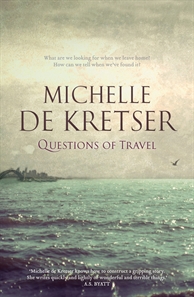
Hardback cover (Courtesy: Allen & Unwin)

Hardback cover (Courtesy: Allen & Unwin)

Every now and then a book comes along that is so sweeping in its conception, that it almost defies review. Such a book is this year’s Miles Franklin Award winner, Questions of travel by Michelle de Kretser. Consequently, I’m going to focus on one aspect that particularly spoke to me – and that is her exploration of place and its meaning/s in contemporary society.

“Soon everyone will be a tourist”

As the title suggests, the novel is about travel – but travel in its widest sense. In fact, without being too corny, it is, really, about the journey of life. As our heroine Laura, thinking about her married lover Paul, ponders:

Perhaps she was an item on the checklist: the wild oats of Europe, the career back home, marriage, mortgage, fatherhood, adultery, the mandatory stopping places on the Ordinary Aussie Grand Tour, with renos*, divorce and a coronary to follow.

That made me splutter in my coffee …

First, though, a brief overview of the plot. The story is told chronologically, alternating between the Australian Laura and Sri Lankan Ravi. Both were born in the 1960s, and the novel chronicles their lives until 2004 when they’d be around 40. Laura, under-appreciated by her family (cruelly described by her father as “the runt of the bunch”) and aimless, travels the world before returning to Sydney in her mid-30s, still rather directionless, but now an experienced freelance travel-writer. Ravi grows up in Sri Lanka, marries and has a son, but a shocking event results in his coming to Australia in 2000 as an asylum-seeker, the same year that Laura returns. You might think at this point that you know where the novel is heading, but you’ll be getting no spoilers from me!

And so we have two significant types of traveller – the tourist (with some business travel thrown in) and the refugee/emigrant. De Kretser explores these comprehensively, and with, I must say, thrilling insight. Thrilling is an unusual word in this context, I suppose, but I can’t think of a better one to describe my reaction to the way de Kretser, point-by-point, unpicks the world of travel, skewering all sorts of assumptions, expectations and pretensions as she goes. I almost got to the point of cancelling my next overseas trip! After all, as Laura discovers, “to be a tourist was always too arrive too late”. How many times have you been told that x place was better in the 80s, only to remember that in the 80s you were told it was better in the 60s!

“Geography is destiny”

So Ravi is told by his teacher Brother Ignatius. This, for all the serious and satirical exploration of travel and tourism, is what the book means most to me. Brother Ignatius tells his students that “History is only a byproduct of geography”. While we could all have fun exploring a chicken-and-the-egg argument, I’d find it hard to deny its fundamental truth.

Laura spends most of the book travelling, or thinking and writing about travel. She’s the quintessential modern person, believing:

What was the modern age if not movement, travel, change?

Living in England she sees the long-standing connections people have to their place, while

Her own people struck Laura, by comparison, as a vigorous, shallow-rooted plant still adapting itself to alien soil.

She returns to Australia, following the death of the gay man she’d loved, hoping for meaning, connection. Geography, place, home had asserted itself … as it usually does. But life doesn’t prove to be much easier. Struggling to find her place, she finds once again that “noone was asking her to stay”.

Meanwhile, Ravi struggles to adjust to his circumstances. Grieving for what he’s lost, he (with his “eyes that had peered into hell”) goes through the motions of living and working. People such as his landlady and her family, and his work colleagues, are kind – enough – but de Kretser shows how skin-deep, how superficial, our practice of diversity and, worse, our humanity is. We do not easily accept people from “other” places. “Otherness”, de Kretser proves, “is readily opaque”. Australians, for example, ask Ravi which detention centre he’d been in because, of course, as an asylum-seeker that’s where he’d been! And, if he hadn’t, was he a “real” refugee. (One of the book’s many other themes, in fact, is “authenticity”.) Ravi, it has to be said, doesn’t help himself. He doesn’t share his history (should he have to?) and, fearing obligations, he resists any help that isn’t essential.

“Place had come undone”

While Laura and Ravi struggle with where they are, they also confront the fact that by the late twentieth century place isn’t only physical. Ravi had discovered, back in Sri Lanka, the world of “disembodied travel”, though his wife Malini had proclaimed “Bodies are always local”. This imagery, seemingly light at the time, carries a heavy weight. Later, finding settling into his new geographical location difficult, Ravi starts to find escape and even solace in virtual places, including visiting people’s homes via real estate sites. De Kretser doesn’t miss any opportunity to explore the ways we “travel” and it never feels forced. It all fits, emulating the way travel fits into our lives.

For Laura, the virtual intrudes mostly through work where she is a commissioning editor for Ramsays, a travel guide company. As the 21st century takes hold, the e-zone division of her company starts to increase in importance. Some of the novel’s best satire is found in the portrayal of corporate culture at Ramsays. It’s laugh-out-loud, sometimes excruciatingly so.

“Time was a magician, it always had something improbable up its sleeve …”

While the novel’s subject matter is travel, in all its guises and in what it says about how we relate to place and each other, the overriding theme is that literal and existential question, What Am I Doing Here? It tackles the big issues that confront us all every day – Time, Truth, Memory, Death and, of course, the most fraught of all, Other People.

Towards the end of the novel, Laura realises that:

… the moment that mattered on each journey resisted explanation … because it addressed only the individual heart.

We could say the same about a great book … and so I apologise for my paltry attempt here to explain de Kretser’s witty, warm and powerful novel. If you have any interest in contemporary literature and its take on modern living, this is the book for you.

For an equally positive perspective, check out Lisa’s (ANZLitLovers) excellent review.

Michelle de Kretser
Questions of travel
Sydney: Allen & Unwin, 2012
517pp
ISBN: 9781743317334

* Aussies commonly abbreviate words with “o” or “ie” endings. “Renos” therefore refers to “renovations”.
Monday musings on Australian literature: Best Young Australian Novelists

Back in May, the Sydney Morning Herald (SMH) announced its Best Young Australian Novelists awards. They have been doing this for 17 years, though I only became aware of them a few years ago. They are usually announced at or to coincide with the Sydney Writers Festival.

The judges this year were Marc McEvoy, SMH Literary Editor Susan Wyndham and Melbourne author Kristin Krauth whom I’ve only become aware of through the Australian Women Writers Challenge. To be eligible, writers have to be “35 years or younger when their book is published”. So, the award is called “Best Young Australian Novelists” but it is apparently granted on the basis of a specific book.

This year’s winners are:

  • Romy Ash whose Floundering was short-listed for this year’s Stella Prize, Dobbie Literary Award, and Miles Franklin Literary Award, among others. An impressive achievement for her debut novel. She has also written short stories, and I’ve read one, “Damming”, which was published in Griffith Review Edition 39. I have not, though, read Floundering. It apparently explores “the menace of a hostile landscape”. I’m fascinated by the fact that the outback continues to be a significant presence or theme in Australian literature. Ash argues that while writing about the outback may seem a cliche, the point is that much of Australia is “not benign”. That surely is the point, and is what makes it so rich with dramatic possibility.
  • Paul D Carter for Eleven Seasons which won the 2012 Vogel Literary Award and was shortlisted for the UTS Glenda Adams Award for New Writing in the 2013 New South Wales Premier’s Literary Awards. The novel is apparently about “boys obsessed with football and the men who live by its rules”. Sounds like one that would be interesting ro read in the context of Anna Krien’s Night Games which I reviewed last month. Interestingly Carter’s day-job is teaching English in a Melbourne girls’ school.
  • Zane Lovitt, Midnight Promise

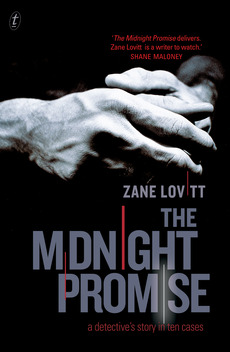
    Book cover (Courtesy: Text Publishing)

    Zane Lovitt whose Midnight promise I have – woo hoo – read and reviewed here. It’s more a collection of interconnected short stories, but there is a loose narrative thread running through it following the career of its  private detective protagonist.

  • Emily Maguire for Fishing for tigers. Maguire, unlike most of the winners, has quite a few books, including three other novels, to her name, and has won the Best Young Australian Novelist award before. She teaches creative writing, and it sounds like she’s well qualified to do so, doesn’t it? Fishing with tigers was inspired by Grahame Greene’s The quiet American, and is about “divorcee Mischa Reeve, 35, whose affair with Vietnamese-Australian Cal, 18, upsets her friends, including Cal’s father, Matthew”.
  • Ruby J. Murray whose Running dogs was, like Carter’s Eleven seasons, also shortlisted for the UTS Glenda Adams Award for New Writing in the 2013 New South Wales Premier’s Literary Awards. I hadn’t heard of Murray, I must admit, but this book sounds interesting. It’s set in Indonesia, which is a significant country for Australia, and like Maguire’s Vietnam-located Fishing for tigers, it is about an expat Australian aid worker. Murray, who worked in Indonesia in 2009, was horrified at how little Australians knew (know!) about Indonesia despite its importance to us economically and politically, not to mention being a major holiday destination for Australians.
  • Majok Tulba for Beneath the darkening sky. It, like Maguire and Murray’s books, is set outside Australia, in this case, in Sudan. And, like Romy Ash’s Floundering, it was shortlisted for the Commonwealth Book Prize. It’s narrated by an 11-year-old village boy and is “about child soldiers in Africa”. It’s fiction. Tulba says he used some experiences he and his brother had, but he was not himself a child soldier. Apparently Sudanese rebels tried to recruit him but he “failed the test – he was shorter than an AK-47 assault rifle“! Lucky him, eh?
They sound like an interesting bunch of authors and books, don’t they? And, I’m rather intrigued that half of them are not set in Australia, which reflects our increasingly multicultural society. It’s good to see our literature recognising this.
In 2012, only three awards were made – Melanie Joosten for Berlin Syndrome, Jennifer Mills for Gone (which is waiting patiently in my shelves to be read), and Rohan Wilson for The Roving Party. Past winners have included Nam Le, Christos Tsiolkas, Chloe Hooper and Markus Zusak.

Identity … Cusack meets Heiss

A few days ago I reviewed Dymphna Cusack’s A window in the dark, a sort-of memoir of her two decades as a teacher. As seems to happen more often than not, I found synchronicities between it and my previous read, Anita Heiss’s Am I black enough for you? The main one relates to identity.

I shared, in this week’s Monday Musings, Heiss’s statement regarding the functions of Aboriginal literature. One of these is that it:

assists understanding of the diversity of our identities.

Literature, in other words, helps us understand who we are and where we come from – and it does this both for “us” (those who belong) and “other” (those who are outside but are related in some way).

Cusack argues strongly for “relevant” education and is critical of a curriculum that seemed suited only to a university-bound minority. This doesn’t mean, though, that she wanted to promote a purely “practical” or “vocationally-oriented” curriculum. As a student of history and literature, she believed in the importance of the humanities BUT she also believed that they needed to be relevant. For example, she believed that rather than forcing all students to learn ancient languages (like Latin), they needed to be expert in their own language:

But I soon came to realise that English and history teachers have in their hands the tools with which a genuine education is forged. In all the countries in which I have since lived, I have realised the particular and vital importance of teaching the native language. This is not only the vocal instrument by which one learns to express one’s thoughts; it is the key to the thoughts of others …

She believed, in other words, that all students – academic and non-academic – should be inculcated

with a love of literature and the capacity to express themselves clearly – surely the best heritage heirs to all our culture can have …

Because

The more we know about our background, the better we know our identity …

So, there we have it … Cusack, writing in 1976 of her experience in the 1920s-40s, and Heiss, writing nearly 40 years later, both argue that identity (knowing who we are) is intrinsically linked to language, literature and history. This may be self-evident to most of us, but somehow it seems, we need to keep reiterating it … and so here I am, doing my bit …

Dymphna Cusack, A window in the dark (Review)

Dymphna Cusack‘s A window in the dark has been glaring at me from my TBR pile for many years now. Not being able to stand it any longer, I decided to sneak it in before my next reading group book, Michelle de Kretser‘s Questions of travel. Posthumously published by the National Library of Australia, A window in the dark is Cusack’s chronicle of her teaching years, spanning 1922 to 1943.

For those who haven’t heard of her, Dymphna Cusack (1902-1981) is an Australian writer best known for her collaborative novel (with Florence James), Come in spinner (1951), and Caddie, the story of a barmaid (1953), which was made into a successful feature film in 1976. According to Debra Adelaide‘s comprehensive introduction, Cusack was not interested in writing her autobiography but, in the mid-1970s, three decades after she finished teaching, she decided to write about this part of her life. While much has changed since 1975/6 when she wrote it (let alone 1944 where the story ends), A window in the dark – “my job was opening a window in the dark for the minds entrusted me” – is an interesting read. It is not, though, a typical writer’s memoir; its focus really is teaching and education.

The book is well produced with an excellent introduction and explanation of its genesis by Debra Adelaide (though I would have loved an index). It was prepared from the version included with her papers held by the National Library of Australia. This version is probably the final draft, but Adelaide believes that Cusack would have done more work on it, had it found a publisher. Certainly, it does have some rough edges, but not enough to spoil the content nor to prevent our getting some sense of Cusack as a person, as a writer, and of course as a teacher.

Cusack tells the story of her years as a teacher chronologically, starting with university and her decision to accept a bonded Teachers College Scholarship. However, a number of themes run through the book and I’m going to frame the rest of this post through some of them.

Format: Photograph Notes: Dymphna Cusack (1902...“The sum total of my years of teaching in Broken Hill and Goulburn was the conviction that the high school curriculum was insane”

Cusack decided very early in her career that the curriculum she was required to teach was unsuitable for all but the minority who planned to go on to university. She rails, in particular, against the teaching of ancient languages (Latin) and against the focus on British history and English (as in from England) literature (both only to the end of the nineteenth century, what’s more). She criticises educational practice which relied heavily on examinations and argues against dependence on IQ assessment for identifying capable students. She is disgusted by corporal punishment. She does become a bit repetitive, as she moves from school to school, but that simply reinforces her passion for relevant education and humane methods. Being personally interested in local and contemporary history, she’s distressed that students weren’t taught about their own places. Students in Broken Hill were taught nothing about that city’s origins, nor its geology and botany. Students in Parkes learnt nothing about William Farrer and his pioneering work with wheat. And so on … Students learnt, well, I’ll let her tell you:

It was the same in every country town I lived in. An essential part of our history was ignored, whether massacres of whites by blacks or blacks by whites, while we got bogged down in the Hundred Years’ War or the Thirty Years’ War or the Seven Years’ War – all taught with no reference whatever to the basic economic causes underlying them.

She was happiest when, for various reasons, she was given non-examination classes to teach. Then she could teach what she thought was useful. A playwright herself, she was renowned for her drama classes, and the school plays she produced.

“I look so middle-class; it’s my nose”

Despite her ongoing frustrations (not to mention chronic health issues), she had, you can see from this quote, a sense of humour. Cusack belonged to that wonderful cohort of left-leaning writers in early to mid-twentieth century Australia, a cohort which included Miles Franklin (with whom she collaborated on books), Flora Eldershaw and Frank Dalby Davison.  She had a finely honed moral and social conscience, and was acutely aware of injustice. She was not above using her “middle-class” look to get a hearing on issues important to her. She was distressed that Australia, which, by the 1850s was

politically and socially the most advanced country in the world … should by the middle twenties be bogged down into a morass of social and sectarian bigotry and educational conservatism.

Cusack became convinced of the “wickedness of our economic system”, which could not fund milk for children of unemployed parents but could, somehow, find the “money for everything for war”. She abhorred the power those with money had over others. She became unpopular with the Department of Education for her outspokenness on social and economic justice issues, and was particularly critical of the treatment of “that much-maligned creature, the woman teacher”.

“What we want is the warmth, the humanity, the feeling for Newcastle that is inherent in everything you write about …”

So said BHP’s Newcastle manager Keith Butler to Cusack in 1943 as he offered to pay for a novel about Newcastle and the steelworks. Not surprisingly, Cusack would have none of it. She did, however, write her novel, titled Southern steel (1953), and it was, apparently, a positive portrayal. Cusack wrote throughout her teaching career – mostly plays, many of which were performed on the ABC but only some of which have ever been published. She tackled tricky-for-her-times issues such as racism, workers conditions’ and war. Her second novel, Jungfrau (1936), which explored young women, their sexuality and abortion, was runner-up in the Bulletin’s S. H. Prior memorial prize. It was shocking for its time.

“… I found in my teaching life teachers are sublime optimists – why, I never knew.”

And yet, she must have known, for she stuck to teaching through years of ill-health and poor treatment by those in power. She did it, partly of course to support herself, but partly too because she loved her students. She was still receiving thankyou letters from them in her last years. That surely says something.

Australian Women Writers ChallengeWhy, though, read a book written in the mid-1970s about education in the 1920s-40s? It is not, after all, a memoir, so there are gaps in the story of her life – particularly in terms of her significant relationships. And while she mentions some of the plays and novels she wrote during the time, she does this mostly in relation to something happening in her teaching life. Moreover, it’s not particularly interesting in terms of form. That is, she doesn’t play, as some writers do when writing non-fiction, with narrative style or voice or perspective. Yet, there are reasons for reading it. It works as social history and a history of education. It provides insight into the development of her political philosophy and social values. It shows off her skills as a writer, particularly her ability to evoke people and place. And, for all its seriousness, it contains many entertaining anecdotes.

I’m so glad I finally read what turned out to be a fascinating book about (and by) a compassionate, funny and feisty woman whose intelligence is displayed on every page. Would that every child had teachers like this.

Dymphna Cusack
A window in the dark
Canberra: National Library of Australia, 1991
175pp.
ISBN: 9780642105141

Monday musings on Australian literature: Role of Aboriginal literature

Most keen readers have firm views about the value of reading to them. Some, I think, read mainly to escape. Others like to be opened to other ways of being and thinking. Others like the things they learn – yes, even from fiction! And still others love beautiful or interesting language. These aren’t the only reasons, and aren’t mutually exclusive, but are I think among the main reasons …

Last week I reviewed Anita Heiss‘s Am I black enough for you? Heiss has a PhD in Aboriginal literature and publishing, and is active in promoting Aboriginal literature. She has co-edited The Macquarie PEN Anthology of Australian Aboriginal literature, and she was the guiding force behind BlackWords, the topic of last week’s Monday Musings. She is a writer herself (of novels, poetry and non-fiction) and has published two children’s books co-written with students of La Perouse Primary School as the result of workshopping stories with them. She is regularly invited to talk about Aboriginal literature – in Australia and overseas – at conferences and seminars. You won’t be surprised then to know that she has very clear ideas about the role of Aboriginal literature.

Here is what she says in Am I black enough for you?:

Aboriginal literature from Australia serves many purposes: it records our ‘truths’ about history; it functions as a tool for reconciliation, allowing non-Indigenous Australians to engage with us in non-confrontational ways; it provides a means of self-representation in Australian and world literature and assists understanding of the diversity of our identities; finally, it challenges subjective and often negative media stereotypes and interpretations in our lives.

While this feeds into some of the reasons we read, it is a far more political manifesto for literature than we are used to. But then Indigenous Australians are in a very particular, and minority, position.

By some definitions, aspects of this could almost be seen as propaganda – in the sense that she’s essentially talking about promoting a cause – but propaganda, once a neutral term, now has very negative connotations. It contains notions of ‘skewing” facts, and of coercion and control, usually by the state. This of course is not what Heiss is talking about – but she is talking about the role literature can play in reflecting and expressing, to both the self and other, a particular view of things. Whether this is conscious – as Heiss clearly is with her chicklit books (see my review of Paris dreaming) – or subconscious is not really the point. (If it’s too conscious, too manipulative, and/or not believable, readers will stay away). The point for Heiss is that more indigenous writers need to be able to express themselves so that indigenous and non-indigenous people will better understand and know the reality of indigenous Australian life and experience, rather than rely on non-indigenous-written texts and stereotyping. Education, more than persuasion, is what she sees as the goal.

Heiss’s manifesto, as I’m calling it, also made me think of “ideological” novels, that is, those novels which consciously argue a philosophical or political, that is, ideological, line. But this too, I think, is not really what Heiss is saying – though individual indigenous novels could very well fit this specific definition. She is recognising, rather, that all literature functions as part of the prevailing ideology (or culture) within which it is written and therefore can’t help but impact this ideology simply by being, regardless of whether it reinforces or questions or rejects existing norms. The more Aboriginal literature is published, the more it is likely to shift the prevailing ideology, which is a good thing.

Why am I writing this? Just, I guess, because as a reader I like to think about who writes and why they write the things I read, and about the role literature plays in my life (and our collective lives). I appreciated Heiss’s clear manifesto on what she believes and thus on why she does what she does. I wanted to share it – and tease it out a little. I’ve done that, and now I’m happy!

Two under-the-radar Australian literary awards announced

A couple of lesser known – but significant to me – literary awards were announced over the last week or so, one national and the other local. I’d like to tell you about them!

ALS Gold Medal 2013

The ALS Gold Medal is awarded by the Association for the Study of Australian Literature. It doesn’t usually get a lot of publicity, partly I suspect because it doesn’t carry a large purse but, rather, well, a gold medal! It is ” awarded annually for an outstanding literary work in the preceding calendar year”. Last year it was won by Gillian MearsFoal’s bread (my review), which also won the Prime Minister’s Literary Award (for Fiction). This year the medal was won by Michelle de Kretser’s Questions of travel, which also won, in May, the Miles Franklin Award. It’s my next read – and I can’t wait. The judges said:

Questions of Travel embarks on an exploration of the present and emerging conditions of late modernity on a scale that could only be successfully achieved by a highly accomplished writer. Through her two central characters, Australian woman, Laura, and Sri Lankan man, Ravi, De Kretser creates an expansive fictional space that both traverses continents while never losing sight of the separateness of individual lives defined by their especial relationships to place and culture, new and old. (AustLit News)

It was selected from a shortlist of five, which included books that haven’t been appearing on many other shortlists: Jessie Cole’s Darkness on the Edge of Town, Robert Drewe‘s Montebello, Christopher Koch‘s Lost Voices and P.A. O’Reilly’s The Fine Colour of Rust.

For reviews of these books, please check out Lisa at ANZLitLovers who’s already read them all!

ACT Poetry Prize 2013

I don’t often report on poetry prizes, and particularly not on local ones, but given my focus on Canberra’s Centenary this year, I figured why not. And, anyhow, I like the winning and shortlisted poems. There were apparently 128 entries, and they were judged by a blind panel of local poets, two male, one female.

The winning poem (and you can read it and the two shortlisted ones online) is “Inside” by Lesley Lebkowicz, whom I only really discovered this year through her short story about her immigrant parents,”The good shoppers”, in The invisible thread. “Inside” is about that invisible disease that afflicts women, osteoporosis, about living with something “inside”. Interestingly, this is also what “The good shoppers” is about, though what the characters are living with inside in that story is their experience of the Holocaust. “Inside” is a short poem, just 15 lines. Its language is accessible and evocative

Inside her, bone sheared off from itself like
limestone in a private landslide – and she fell.

But just when you think that’s all there is, you get the ending. It adds another layer to the story. Read it (using the link in the first line of this para).

The two shortlisted poems are also by women – Libby Porter (“Stabat Mater”, a bittersweet poem about loss, framed through perspectives on age) and Elizabeth Lawson (“Emily Kngwarreye”, a wry poem about indigenous versus non-indigenous attitudes to art). You can read them too at the link.

Canberra is, I think, blessed to have such excellent poets.

Monday musings on Australian literature: BlackWords

NAIDOC Week, to which last week’s Monday Musings was dedicated, officially finished yesterday, but I’ve decided to bookend it with another Monday Musings focusing on indigenous Australian literature. This post, in fact, also harks back to two Monday Musings ago which talked about the AustLit database – because I want to introduce you to one of AustLit’s projects, BlackWords.

BlackWords was established in 2006 under the guidance of Dr Anita Heiss (whose Paris dreaming I reviewed earlier this year and whose memoir Am I black enough? for you I’ll be reviewing this week). It is a resource for and database of Aboriginal and Torres Strait Island writers and storytellers. It contains, where available, the standard information provided throughout the database:

  • author biography
  • lists of works by the author and about the author

Aboriginal and Torres Strait Islander Australians are the traditional keepers of their oral history, we are the custodians presiding over Indigenous Australian literature … (Indigenous writer and David Unaipon Award winner Yvette Holt)

It now contains records for over 5,000 people and organisations. Wow! The database aims to cover “published and unpublished books, stories, plays, poems, and criticism associated with eligible writers and storytellers … in English, in Australian languages, and in translations.” Given that the loss of language is a significant concern for our indigenous peoples, capturing works in Australian languages is a particularly important goal.

… each time we translate black words onto white paper we are reclaiming an integral piece of our heritage, culture and language.” (Yvette Holt)

Tara June WInch

Tara June Winch (Photo: Howcheng, using CC-BY-SA 3.0, via Wikipedia)

Currently the BlackWords homepage spotlights three featured authors: Tara June Winch, Anita Heiss and Samuel Wagan Watson. Click on the author’s name and you get taken to their AustLit page. In the right sidebar of their page is something called Resource Maps. For Anita Heiss and Tara June Winch these include Wiradjuri Trail (Wiradjuri being the nation they both belong to). The Resources Maps contain hand-built links to internet sources on the topic. As with all of AustLit, these maps are works in progress.

The left sidebar contains a variety of links, encouraging other explorations, such as “Teaching with BlackWords”,  “Publishers” and “Translations”.

Specifically for BlackWords, the site also includes a timeline of historical dates significant for Aboriginal and Torres Strait Islander people. It starts at 1788 … the date when white people established their first settlement in Australia. The text entries for these dates include links to works and authors in the database. Also, under the dates – where relevant – are links for search terms that will lead searchers to works indexed in the database about the event/date. So, for example, under 1788, are links for Pemulwuy, an Aboriginal warrior who resisted the white invasion, and Bennelong, who was captured by Governor Phillip and found himself caught between two cultures. (The timeline is a little tricky to find. It would be more obvious if placed in the left sidebar, but instead it’s a dot point under “About” on the About page.)

… when storytellers speak, their words will inextricably tie indigenous peoples to their lands and to their mobs … (Yvette Holt)

BlackWords is a wonderful initiative and has now reached the critical mass to be of value to indigenous and non-indigenous Australians alike. It is for resources like this that the Internet is at its best, don’t you think?

Melissa Lucashenko, How green is my valley (Review)

Almost a year ago I reviewed a short story, “The silent majority”, by Melissa Lucashenko. It was published in the Griffith Review of November 2009. I enjoyed the story and so, in honour of NAIDOC Week and ANZLitLovers Indigenous Literature Week, I thought I’d review another of her Griffith Review contributions. This one, “How green is my valley”, is described as a memoir, and was published in Winter 2006.

I love how Lucashenko, with her dual Aboriginal and European heritage, traverses both in her writing. She commences “The silent majority” with the famous opening words of Pride and prejudice – “”It is a truth universally acknowledged”. The title of this piece immediately brings to mind Richard Llewellyn‘s classic novel How green was my valley, and clues us into her themes: beauty under threat, complicated relationships with land, and the precarious balances involved in maintaining it.

Lucashenko starts her memoir – though, really, I’d call it a personal essay – with a Mark Twain quote, which has a prescience now that he could not have guessed:

Everybody talks about the weather/but nobody does anything about it.

She then describes the experience of torrential rain in Bundjalung country, the coastal regions of north-east New South Wales/southeast Queensland. She’s moved, she says, to “one of Australia’s wettest shires”. The first half of the essay describes how residents manage – or don’t – the rain. She talks of students being let off school, of the weather not distinguishing between rich and poor, and of how community is fostered as people with 4WDs deliver food to the stranded who don’t. “The information we receive from land”, she says, “is tightly nuanced”. Farmers watch closely and know how the days will pan out once the rain sets in:

We who live on Bundjalung land know that eventually the rain will stop, the mould will retreat and the mud will dry. Whatever climate change is going to mean for our kids, in the short term life for us will return to normal.

Then, halfway through the essay, comes the sting in the tail: she reminds us that the inhabitants of Tuvalu will lose their home in the next few decades as their island is submerged, and the semi-traditional hunting lifestyle of the Inuit of the Arctic Circle “will be shattered by global warming even sooner”. She wonders whether indigenous people like the Inuit will be able to translate “the clan, the traditions of egalitarianism, stoicism and intensely valued community, to life in suburbs and towns.”

Lucashenko’s thesis is that it can be done, that it is possible to be “bicultural”, to span the chasm “between industrial and indigenous views of the ‘good life’ and what constitutes a proper society”. She argues that the egalitarian ethic espoused by Henry Lawson and Banjo Paterson

the traditions of mateship that faithfully mimic the brotherhood of initiated Aboriginal men and the myriad skills of surviving from and maintaining the land – were learned by some colonial whites from Aboriginal people.

Hmm … I haven’t heard that before. I suspect Australia’s mateship tradition has rather multi-pronged origins but this could certainly be part of it.

Lucashenko’s point though is to draw a parallel between white Australians’ love of land and indigenous people’s. She says that any Australian who has holidayed at the same beach every summer, or “diligently looked after” their own little patch, has “walked in Aboriginal footsteps” whether they know it or not. Hmmm … again I think this is a little bit of a long bow, in the sense that there are people all over the world who love their bit of land. But it doesn’t spoil her argument that it would have been good had the influence of Aboriginal knowledge and practice been greater, because then

More Australians might have learned not just to love the place (as some indisputably do) but to listen to the land more seriously. Had more Aboriginal philosophers been valued rather than shot or packed off to missions, all Australians might have learned the careful and intense attention to detail that many of us in the valley are still forced to practise as a matter of course.

With climate change breathing down our necks, will we all “be rooned”, she asks (alluding to one of my favourite old ballads “Said Hanrahan“). Will our “valley” be destroyed by our inability to tame our capitalistic consumerist urges, or will we learn in time how to be true custodians of our land?

Melissa Lucashenko
“How green is my valley”
Published in the Griffith Review, Edition 12, Winter 2006
Available: Online at the Griffith Review

Monday musings on Australian literature: Indigenous Australian memoirs

As Australians would know, this week – July 7-14 – is NAIDOC week. NAIDOC originally stood for an organisation – ‘National Aborigines and Islanders Day Observance Committee’ – but the acronym has now become the name of the week itself. Fascinating how acronyms can take on lives of their own, isn’t it? Anyhow, the theme for this year’s celebrations is We value vision: Yirrkala Bark Petitions 1963.

This theme commemorates the 50th anniversary of two bark petitions which were sent by the Yolngu people of Yirrkala in northeast Arnhem Land to the Australian Parliament. The petitions concerned the Commonwealth Government’s granting of mining rights on land excised from Arnhem Land. They asked the Government to recognise the Yolngu peoples’ traditional rights and ownership of their lands. These petitions were the first indigenous Australian documents recognised by the Government and helped, the NAIDOC website says, to “set into motion a long process of legislative and constitutional reforms for Aboriginal and Torres Strait Islander people”. Many Australians know of Eddie Mabo and the Native Title Act of 1993, but I wonder how many know of actions like this which occurred decades earlier?

In this spirit of commemorating the past, I thought today’s Monday Musings could focus on indigenous Australian memoirs/autobiographies. I’ve written on this topic before, and so will try to avoid repeating myself too much. Interestingly, all of the books I mention below are by women. The Cambridge companion to Australian literature says, in fact, that since the 1970s, Aboriginal women have dominated indigenous autobiography.

A number of themes run through indigenous memoirs/autobiographies and, of course, identity is a big one. One of the best known examples of a memoir about identity is Sally Morgan‘s My place which was published in 1988, Australia’s bicentenary year – the bicentenary, that is, of white settlement in Australia. It was not a year that was universally celebrated by indigenous Australians, for good reason. My place was, possibly, the first book by an indigenous Australian that many non-indigenous Australians had read – and it became a best-seller. Morgan, also an artist, told the story of her family – and of their shame that was so strong that she had not been told she was indigenous. She’d been let think she was of Indian (that is, from the subcontinent) extraction, until she was well into her teens. I haven’t read My place since 1988, but I expect it would still stand up well today. Morgan is a great story-teller.

Anita Heiss‘s Am I black enough for you, which was published in 2012, is also about identity, but in a different more confident way. I’m reading this one now. In it, Heiss aims to educate Australians about the breadth of indigenous life and experience in Australia, to show us that people do not have to be living a traditional indigenous life in the desert to identify as indigenous.

A big topic for indigenous memoirs is the experience of the Stolen Generation. Many of these also deal with identity, but from a specific point of view. I mentioned one – Doris Pilkington‘s Following the Rabbit Proof Fence – in my previous post. While I’ve read a couple of novels dealing with this issue since that post, I haven’t read more memoirs. There are many out there, though, including Rosalie Fraser’s Shadow Child: A Memoir of the Stolen Generation (1998), Doris Kartinyeri’s Kick the tin (2000), Donna Meehan’s It is no secret: The story of a stolen child (2000).

As Australians would know, the most comprehensive study of the Stolen Generation appeared in the government report Bringing them home (1997). This 700-page report contains excerpts from the testimonies of over 500 indigenous people about their or their families’ experiences of being stolen.

A common style of memoir – for indigenous and non-indigenous people alike – is what I’d call the “success memoir”. You know, those chronicling major success or high achievement. Sydney 2000 Olympic Games gold medallist Cathy Freeman wrote Cathy: Her own story in 2003. As often happens with memoirs written by non-writers, she had a co-author, the sportswriter Scott Gullan.

Last but not least is the simple story-of-my-life memoir, though most memoirists wouldn’t be writing their stories if they really were simple! Ruby Langford Ginibi would fall into this category – I think, as I haven’t read her yet. Ginibi published her first book, the gorgeously titled Don’t take your love to town, in 1988 when she was 54. She won a Human Rights Literary Award for it. Ginibi was a lecturer in and historian of Aboriginal history, but her start was way different. She married young, had nine children, lived and worked in the bush, and also worked as a clothing machinist. One of the obituaries written after her death says:

Through her numerous books, short stories, poetry, interviews and public appearances and her commitment to ‘edu-ma-cating’ non-Aboriginal people about Indigenous peoples’ circumstances and struggle she made a distinctive and substantial contribution to Australian history and literature.

 “‘Edu-ma-cating’ non-Aboriginal people”. That’s what all these writers are doing in their different ways … I’m glad they are, and will continue to read a few each year.

Unfortunately, many of these books are likely to be out of print but most should be available in libraries – in Australia at least. If you’d like to read one, I suggest you do so now and join ANZLitLovers Indigenous Literature Week. Lisa will, I understand, accept reviews after the week has finished.

Rachel Hennessy, The heaven I swallowed (Review)

Rachel Hennessy, The heaven I swallowed

Cover: Courtesy Wakefield Press

It feels strange to be reviewing a Vogel Literary Award runner up, which Rachel Hennessy’s The heaven I swallowed was in 2008, in a year when the judges decided not to award the prize because they didn’t find ‘that special quality that a winning entry has’. C’est la vie I suppose, but what a shame for this year’s entrants. I hope it doesn’t discourage them. Rejections can be good for you – or so I’ve been told.

The heaven I swallowed is Hennessy’s second novel, though I hadn’t heard of her before. Her first, The Quakers, won the Adelaide Festival Award for an Unfinished Manuscript. She has also had many short stories published, a short play performed, and a short film, Not Waving, Drowning, screened at several festivals. She’s clearly been around.

According to Wakefield Press’s Media Release, The heaven I swallowed was inspired by Hennessy’s grandmother who was a member of the Stolen Generations, and by her paternal great-aunt whose husband fought in the second world war. The novel is set in the 1950s, with flashbacks to the past. It tells the story of Grace (Gracie to her husband Fred) and opens around 1950 when Grace is 40. She’s alone, having lost her husband, Fred, to the war, and childless, having had a miscarriage after Fred enlisted. She decides to take in 12-year-old Aboriginal girl, Mary, who, we later realise, is a stolen child. Grace, though, has been told that Mary’s an orphan. Caring for her, Grace says, represents “the epitome of my goodness”. The novel is divided into two parts, with the second part set 5 years after the first.

My problem is how to talk about it without giving too much away. Telling you what separates the two parts would rather spoil the tale. It’s not a heavily plot-driven story, but there are some significant events that mark its progress, so instead I’ll focus on character and style. And, I’ll start by saying the novel reminded me of Anita Brookner. Grace could have stepped right out of a Brookner novel. She’s an outsider, she’s isolated, she’s lonely. She was an orphan, brought up by nuns – and that seems to have set her off on a path from which she finds it hard to deviate.

This orphan business leads to one of the main themes of the novel – secrets, lies and deception. Grace identifies with orphans. She often reads about them. Jane Eyre, David Copperfield and Tom Jones all make appearances in the novel. Consequently, Grace feels an affinity with Mary – though Mary says she has a mother. When Grace discovers, via her parish priest who had organised Mary’s placement, that Mary’s mother is looking for her, she accepts the priest’s advice and hides this fact from Mary. After all, as Father Benjamin says, “the girl’s much better off with you”. Yep, that’s true! She’s learning a lot about housework! Such was usually the lot of stolen generation girls.

This, though, is not the only lie in Grace’s life. There’s another big one that shadows her – to do with her role as a widow – and there are innumerable small ones. Many are those “little white lies” people tell, but in Grace’s case they are a way of life and serve to isolate her from those people who do reach out to her. Meanwhile, she is doing her best to raise Mary, albeit relying a little too much on the nuns’ methods she experienced, methods that were short on love and high on rules. One of the rules concerns lying: “Don’t lie to me again Mary”, she says. The irony, the hypocrisy, is not lost on the reader.

The heaven I swallowed is a well-plotted novel with lovely links that unite the plot, characters and themes. For example, the opening scene is a flashback to an experience Grace has when she was 12 – a visitation at night from what she believes is the Virgin Mary. Twenty-eight years later, 12-year-old Mary comes to stay with her. She feels Mary as a “presence”, but she also comes to love her, in her own way. Visits, visiting, presence, shadows run through the novel – some physical, some imagined, some spiritual. They provide much of the novel’s tension.

The story is told first person, by Grace. I found her a sympathetic character, but Murray Waldren on the back cover of my edition calls her “a memorable monster”. That’s a little harsh, I think. Grace makes many, many mistakes, but she’s a person in pain, describing herself at one point as “alone and untethered”. She’s not intentionally cruel, she’s not vicious, but she’s defensive and self-centred. In trying to protect herself she hurts both others and herself. It’s a credit to Hennessy that she can write about a “perpetrator” of the Stolen Generations with such compassion – she enables us to empathise with Grace without at all condoning her behaviour.

It would be hard for any book to follow Hilary Mantel‘s Bring up the bodies, and I must say that for the first few pages of this novel I was a little disengaged. Here we go, I was thinking, another girl damaged by her religious upbringing, but Hennessy soon got me in. She has captured the era – the 1950s with its small-mindedness, its gossipy church communities, its racism and sexism – convincingly. She seems to have listened to her family’s stories well!

As for Mary? Well, you’ll have to read the book to find out what happens to her. I recommend you do, because this is a quiet but fierce little book about real people and real situations. It’s not always pretty, but it has a heart.

Rachel Hennessy
The heaven I followed
Kent Town: Wakefield Press, 2013
182pp.
ISBN: 9781862549487

(Review copy courtesy Wakefield Press)