Kate Grenville, One life: My mother’s story (Review)

Kate Grenville is one of Australia’s best known contemporary writers, and is one of that small band to have succeeded both critically and commercially. Most know her for The secret river, which was shortlisted for the Man Booker Prize among other awards. I enjoyed that, and the other novels of hers that I’ve read, with my favourite being The idea of perfection which won the, then, Orange Prize. I also loved her non-fiction work, Searching for The secret river, about researching for and writing The secret river. I was, consequently, keen to read her latest book, One life: My mother’s story, when I heard it was to be published this year.
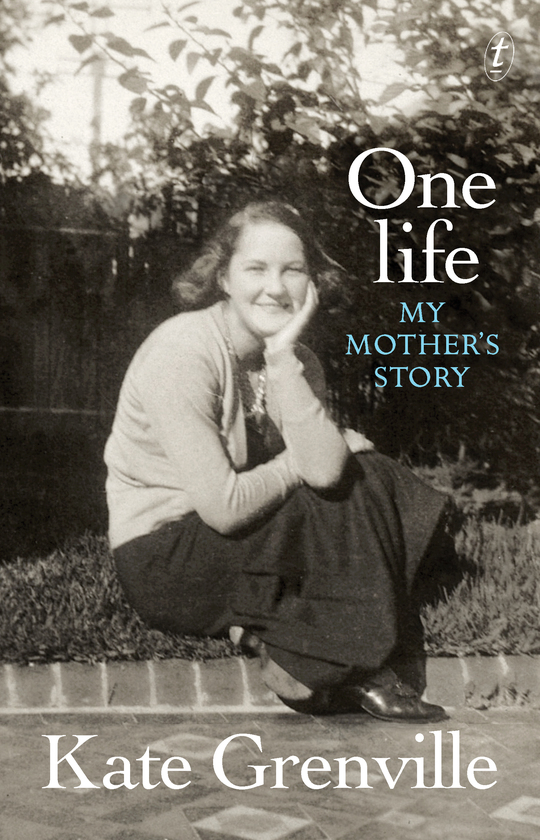
Kate Grenville, One lifeGrenville’s mother, Nance, was born in 1912, and died in 2002. Sorting through her mother’s papers later, Grenville discovered multiple notebooks containing her mother’s attempts to write her story. Nance apparently tried different ways of writing it – including, Grenville quotes, trying “to write it backwards”. However, her attempts always petered out, never going past her early forties “perhaps because by then she felt less need to look back and try to understand”. And so, Grenville’s book sticks to that, stopping (except for a short postscript) when Nance was 38 and pregnant with Kate. Wah! How disappointing not to be able to read about Kate’s childhood!

When I first heard of the book, I thought of Meg Stewart’s fascinating Autobiography of my mother, which I read a few decades ago. Stewart is the daughter of artist Margaret Coen and author Douglas Stewart (who, coincidentally, was born in 1913, one year after Nance). They are, however, very different books, not only because these two women led very different lives – one an artist married to a writer, and the other a pharmacist married to a lawyer – but because Stewart wrote her book in first person, as if she were indeed writing her mother’s autobiography, while Grenville opted for the more expected third person approach of a biography.

Given Grenville’s mother was not an artist or famous in any way, and given, as I’ve already said, she doesn’t write about her writer-daughter’s childhood, why is this book worth reading? Grenville, in her prologue, admits that her mother “wasn’t the sort of person biographies are written about” but argues that her story is worth telling because “not many voices like hers are heard. People of her social class – she was the daughter of a rural working class couple who became pub-keepers – hardly ever left any record of what they felt and thought and did.” The result, as Grenville – ever with an eye on history – says, is that “our picture of the past is skewed towards the top lot”. Grenville argues convincingly that the stories of people like her mother are well worth hearing, though I do think the argument has largely already been won. Many contemporary historians (and others, like museum curators) are, as we’ve seen in the books now being published and exhibitions being created, demonstrably interested in the lives of “ordinary people”.

The paradox, though, is that Grenville’s mother’s story is not at all an “ordinary” one. She was born to rather mis-matched parents, Dolly and Bert, whose marriage had been orchestrated, in 1910, by Dolly’s mother. Nance and her two brothers were “dragged” around the state as their parents worked on farms, in pubs, in the city, in country towns. Nance was sent away to a convent school, where she was very unhappy, wanting always to be part of a family. They experienced the Depression, and her parents lost their pub in Tamworth as a result. At the end of her teens, Nance wondered:

what would have happened if her parents had been unadventurous and contented with their lot. She’d have grown up in Gunnedah, left school at fourteen as they had, married a farmer and had six children … Yes, she wanted to meet someone, get married, have children. She wanted to be happy. But she knew now that she wanted something else as well.

What that “now” refers to is completing her first year of pharmacy studies in 1930. It is this, I think, that proves Nance, while never famous, to be no “ordinary” woman – but one who was “part of the world of the future, not the faded past”. So she becomes a pharmacist, and, after a few romantic adventures, some of which also prove her to be not quite “ordinary”, she meets Troskey-ite lawyer Ken Grenville Gee, the man she married and with whom she had three children.

It was not an easy marriage. Nance fell in love with Ken, but she gradually realised that he didn’t love her. He was a fair but remote man. He acknowledged women and respected Nance’s intelligence. He was happy for her to return to work – particularly when they needed the money! – though he, for all his forward thinking in some areas, never gave a thought to the necessary childcare arrangements or to the housework that still needed to be done. It might be a devoted daughter’s bias, but Grenville presents her mother as a loving woman, with a strong mind and a wonderful can-do attitude.

Running through the story of a woman is also the story of a time and place, of Australia in the first half of the twentieth century. Nance, from a working class background, comes to agree with middle-class-but-socialist Ken that ordinary people never have a chance. She realises that

what people called destiny was really the system everyone was part of. The ones on the top of the pile kept everyone thinking they could get ahead, when in fact ordinary people never had a chance.

War and the Depression taught her that. Nance also faces the challenges of being a woman in a patriarchal society. Not only was there the expectation that she would manage the domestic realm while working outside the home, but she was treated with unfairness and disdain when she applied for her pharmacist licence, despite having the required qualifications and paperwork.

I loved all this, but I did find it an odd book to read, and I think this is due to the voice, to the fact that while it’s not an autobiography it is far more intimate than the usual biography. Kate’s knowledge – or understanding – of her mother’s motivations and behaviour is so intense that I found the third person voice disconcerting at times, all the while enjoying the insights. Grenville’s prose is simple, straightforward, but not plain. Imagery is used with restraint, with the focus primarily on the story and Nance’s thoughts and feelings. Here’s an example, a description of Nance, always wanting family, returning home between her first and second year of pharmacy study:

Nance leaned on the windowsill of her old room, looking up at the washed-out green of the hill behind town. There was nothing for her here. Only that failing hotel, the cranky mother, the father muddled up with some other woman. If this had ever been any kind of home for her, it wasn’t one any longer.

One life is a fascinating, engaging book. Grenville’s insights into her parents’ marriage, and particularly her mother’s thinking, reflect the empathy you’d expect from a novelist. How much comes from Nance’s own words, and how much is extrapolation, is not clear, but the book is convincing – on both the psychological level and as a social history. It is well worth reading for both those reasons.

awwchallenge2015Kate Grenville
One life: My mother’s story
Melbourne: Text Publishing, 2015
260pp.
ISBN: 9781922182050

(Review copy courtesy Text Publishing)
Monday musings on Australian literature: Australian novels adapted for opera

Today’s post is inspired by an article, “Fly away Peter: When Australian literature goes to the opera”, published in May this year in The Conversation. Written by Associate Professor of Vocal Studies and Opera at the University of Sydney, it was inspired by the production of an opera based on David Malouf’s wonderful novel, Fly away Peter.

Now, as some of you may remember, I’ve mentioned Fly away Peter several times in this blog, one being in my second Monday Musings post. Fly away Peter is one of my favourite Australian novels and is also one of a fairly select group of Australian novels dealing with the first world war. I have also mentioned David Malouf in relation to opera before, most recently in a Monday Musings post on Australian novelists and poets who have also written libretti. Malouf has written a few libretti, the most famous being for Patrick White’s Voss, about which I wrote in a post on The Voss Journey. You can probably see, by now, why I was interested in Halliwell’s article.

Halliwell discusses a number of Australian novels/short stories that have been adapted for opera – and I’m going to share them here, in alphabetical order by novelist (with links to my reviews, where I’ve done one):

  • Barbara Baynton’s “The chosen vessel” (my review) was adapted by Australian-British composer and festival director, Jonathan Mills, with libretto by Australian poet Dorothy Porter. It was retitled The ghost wife and premiered in 1996. Halliwell writes that “Baynton’s bleak story, debunking the dominant male myth of the noble bushman, was translated into a confronting music theatre work”. It was performed in Melbourne and Sydney, and had, says Halliwell, a “well-regarded run in London”.
  • Peter Carey’s Bliss was adapted by Australian composer Brett Dean, with libretto by British librettist Amanda Holden. It premiered in Sydney in 2010 to a positive reception, says Halliwell, and was similarly positively received in Melbourne and Edinburgh. It was later presented, in a new production, in Hamburg, under Australian conductor and supporter of the work, Simone Young.
  • Helen Garner’s The children’s Bach (my review) was adapted by Australian composer Andrew Schultz, with libretto by Australian librettist Glenn Perry. It premiered in Melbourne in 2008. Halliwell describes it as “a lightly-scored and evocative chamber opera which took the central metaphor of the fugue from the novel”.
  • Patrick White’s Voss was adapted by Australian composer Richard Meale with libretto, as I’ve already said, by David Malouf. It premiered at the Adelaide Festival in 1986. Halliwell says that it was “hailed at its premiere in 1986 as the ‘Great Australian Opera'”, but it has never been produced again – at least not yet. There have been attempts to adapt Voss for film but some have argued that, while its mystical, visionary aspects translate well to opera, this is not so easy for film.
  • Tim Winton’s The riders was adapted by Australian composer Iain Grandage with libretto by Australian poet, novelist, playwright and librettist, Alison Croggon, It premiered in Melbourne last year (2014). Matthew Westwood wrote in The Australian that “Grandage uses a hunting instrument — the horn — to evoke a man’s odyssey across Europe for the wife who has deserted him. (Frustratingly for that man, Scully, and many of Winton’s readers, the elusive Jennifer never appears.)” Oh dear. I must say that The riders is one of Winton’s least memorable works for me – and I don’t think I’m the only one to feel that way. However, the adaptation was very positively received, says Halliwell.

Alison Croggon is reported in The Guardian as saying that although it’s daunting, it’s logical to write libretti if you write poetry. This makes sense to me: rhythm is critical to poetry, songs and music. Three of the five librettists here – Porter, Malouf and Croggon – are poets.

Halliwell commences his article by quoting Malouf’s statement that “No libretto can reproduce the novel from which it is drawn”. Grandage and Croggon like to call their opera “a reimagining rather than an adaptation”. I’d argue that this is true of all adaptations of a work from one form to another. It’s surely unrealistic to expect a work to be the same. The challenge for the adaptation is to decide what is the essence of the work and to convey that – and for audiences to see if they agree!

Anyhow, if you are interested more widely in the subject of novels adapted for opera, you can check out this Wikipedia category page. It’s by no means complete – indeed not all of the operas I’ve listed here are included.

I’d love to hear whether you have seen any operas adapted from modern novels. Or, do you have a favourite novel you’d love to see adapted for opera?

Tony Birch and Ellen van Neerven in Review of Australian Fiction 10 (4)


Review of Australian FictionI have been wanting to write about the oddly titled Review of Australian Fiction for some time. I say oddly titled because, contrary to what it might sound like, this does not contain reviews but short fiction. Established in 2012, it is published, electronically (or digitally), every two weeks. Each issue contains two stories by Australian authors: one by an established author, and the other by an emerging author, chosen by the established author. Funnily, in the issue I’m reviewing here, it’s the emerging author, Ellen van Neerven, whom I’ve read before, not the established one, Tony Birch. But, I’m so glad that Lisa’s Indigenous Literature Week has given me the opportunity to a) finally read something by Birch, and b) finally read Review of Australian Fiction issue.

Tony Birch, “Spirit in the night”

Birch’s story is told first person by a young indigenous boy, the 11-year-old Noah Sexton. He’s dirty, smelly, poorly dressed, and no-one wants to know him – except the new girl, Heather, who invites him to sit next to her. She’s “the cleanest person I’d ever seen” with “no pox rashes, bites or scars like I had”. At lunchtime, Heather offers the hungry Noah a sandwich and engages him in conversation. She asks him why he sits alone, and he gives the classic reply:

‘I sit here because I’m a Sexton.’

She doesn’t know what that means of course. When he discovers that her father is the policeman “in charge of the station”, he assumes:

Our mob was well known to the police, and I knew straightaway that as soon as her father got the story on the family name, she wouldn’t be sitting under any tree offering me a vegemite sandwich.

But, it doesn’t quite work out the way he expected. When he explains to the friendly Heather that he’s from “the only abo family left in town”, she tells him that “abo” is “a dirty word” and that “people like you, we call them half-castes. It’s more proper”. Noah disagrees, telling her that “an abo’s an abo, no matter how black or white he is … Far as whitefella is interested, the shit smells just the same.” Heather shows discomfort at this language, but Noah doesn’t care. He’s “beginning to think she was only another do-gooder”. He tells her about how his people have been treated in town, but Heather tells him her father will be different, that “he’s always fair, to both sides”. Not surprisingly, Noah is (silently) sceptical. Nonetheless, this little bit of kindness from Heather brings out a new sense of self in Noah – he doesn’t wolf down the sandwich, pretending he has a few manners, and when he gets up to go into school after that first lunch he dusts his pants off “for maybe the first time in my life”.

And so Heather spends most lunchtimes with Noah, because she’s a Christian and it’s “a sin to turn away from those in need”. Noah doesn’t like being seen as a “charity case” but is so enamoured of Heather that he’ll “put up with anything”. Understandable, given his treatment at school before.

I won’t describe any more. This is a clever story about do-gooders. Birch has astutely chosen for his protagonist a young boy on the cusp of puberty. Noah, straddling that line between childhood and adulthood, has a sense of his agency, and yet not quite the experience, nor the resources, to insist on enacting it. It’s a story about confused emotions, and about smugness and self-satisfaction. It’s about the right to dignity, and, of course, about power.

Ellen van Neerven, “Sweetest thing”

awwchallenge2015Unique, original, fresh are words I avoid when writing reviews, not only because they feel cliched but because they can be contested by anyone whose reading experience is wider than mine. So, instead, I’ll just comment on Ellen van Neerven’s capacity to surprise. I found it in her Heat and light which I reviewed earlier this year, and in “Sweetest thing”.

“Sweetest thing” is a third-person story about Serene, the child of an indigenous mother and the town’s Dutch baker. She is addicted to having her breasts suckled. It all started in puberty (“that pertinent time of a woman’s life”) with her first experience of having a man suckle her breast occuring with a male tutor when she’s nearly fourteen. He lifts up her shirt:

Beautifully out of herself, she was open and messy and dislocated like a bouquet being readied for a vase, flowers, stems, spores spread everywhere.

Nothing else happens besides this suckling, but Serene feels “bliss” and “knew then that this was what she had been programmed to need”. Slowly, as Serene schemes and positions herself to have her need met, we learn about loss. We learn, for example, about the Kedron pub, which “had refused Serene’s grandparents entry” but which is now

a haunt for women of her mother’s ilk: divorced, discarded, with loose threads of long silent and secret relationships carried under their shirts.

Under their shirts. A reference to their breasts? We learn about the gradual withdrawal of her father as he starts to focus on his “real daughter”. Serene feels anger at “the silence in her life, at his hypocrisy”.

Born into this in-between world – not quite rejected as her grandparents were, but not fully accepted either – Serene believes she deserves “comfort, worship, devotion. Trust and understanding”, but fears “hollowness”.

And so, her life progresses through school and early womanhood into mature adulthood. She has friends, she experiences casual sex, she becomes a masseuse – but still there’s the need for suckling, to have “the most basic of her needs met”. Again, I’ll leave the story here. It’s longer than Birch’s and spans a few decades of Serene’s life, which includes a meaningful relationship and a successful career.

“Sweetest thing” is an edgy story. Serene’s unusual addiction works as a rather confronting metaphor for what all humans need – love and acceptance. What I like about Van Neerven, here and in Heat and light, is that her indigenous characters are not “types”. Their indigeneity is part of who they are, and is fundamental to the challenges they confront, but her characters are also “universal” – that is, they are needy, flawed characters who muddle along, just as the rest of us do, in the lives they find themselves in. It’s powerful stuff.

ANZ_ILW2015Read for ANZLitLovers’ Indigenous Literature Week.

Tony Birch, “Spirit in the night”
and
Ellen van Neerven, “Sweetest thing”
in: Review of Australian Fiction 10 (4), May 2014

Monday musings on Australian literature: Australian literary autobiographies

I’ve written Monday Musings on autobiographies and memoirs by indigenous Australians, and I’ve reviewed biographies of Australian writers, like Mary Durack and Madeleine St John. However, I haven’t written about what we might call literary autobiographies, that is, autobiographies by authors. So, today’s the day. I have read several literary autobiographies, but few since I started blogging. Being a reader, I’m interested in writers’ autobiographies or memoirs – because I’m interested in writers, and because, rightly or wrongly, I expect a good writer to be able to write a good autobiography (however we define “good”!)  There are, as I’m sure you know some famous/popular/well-regarded author autobiographies, such as Nabokov’s Speak, memory, but of course here I’m focussing on Australians.

I’m not going to get into the why and wherefores of writing autobiography or analyse how useful or relevant they might be to understanding a particular writer’s works.I’m just going to list – alphabetically by author – a few that I’ve either read, dipped into, or would like to read.

Robert Drewe’s The shark net (2000) and Montebello: A memoir (2012). I haven’t read The shark net, though it’s on my TBR. However, I did see the 2003 television miniseries. For those of you who don’t know, this is quite different to the usual writer’s growing up story. Drewe grew up in Perth in the 1950s and 1960s when the serial killer Eric Edgar Cooke was creating havoc with the locals’ sense of security. “The murders immediately changed the spirit of the place”, he writes. Drewe knew this man, and knew one of his victims. He wrote this memoir “to try to make sense of this time and place”. I haven’t heard much about Montebello, but Drewe is a significant Australian writer.

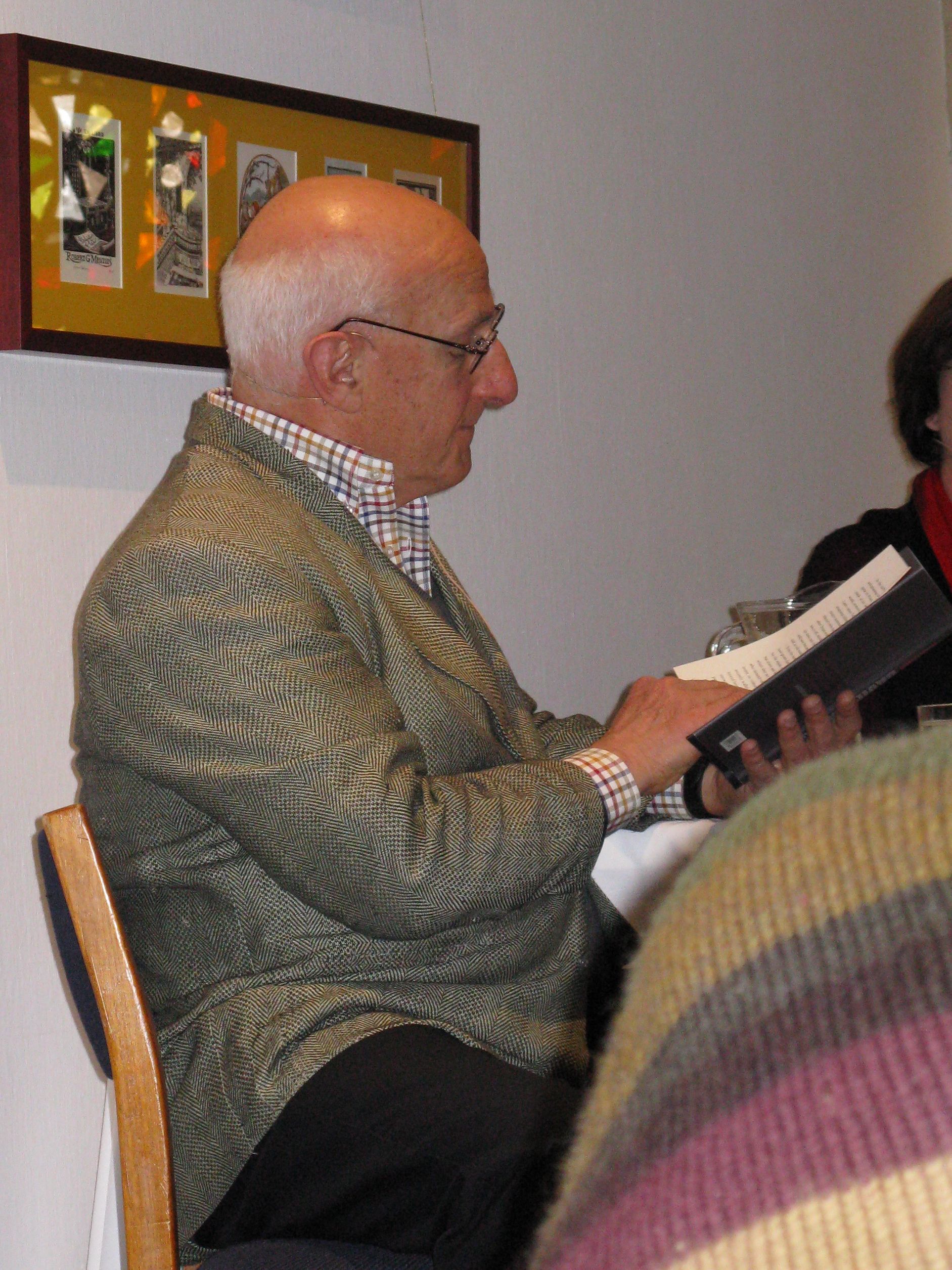
David Malouf reading Ransom

Malouf reading Ransom, National Library of Australia, August 2009

David Malouf’s 12 Edmondstone St (1985) is a very short book, running to just 134 pages. 12 Edmonstone Street is the address of the Brisbane house he grew up in, but this is not your typical autobiography starting with “I was born in …”. Instead, it discusses selected places in his life, starting with that childhood home. I enjoyed his description of that home, of its weatherboard construction with verandahs. His father, he writes, wanted something more modern, something permanent, like brick.

As for verandahs. Well, their evocation of the raised tent flap gives the game away completely. They are a formal confession that you are just one step up from nomads.

So of course, as soon as he could, he closed it in.

This is a thoughtful, meditative – Malouf-like – book.

Ruth Park’s A fence around the cuckoo (1992) and Fishing in the Styx (1993) are more traditional autobiographies, but they are not ordinary. I read them both when they came out and loved them – as much as I loved Park’s books, like her Harp in the South trilogy. A fence around the cuckoo won the Age Book of the Year Non-fiction Award in 1992.

Together, the two books are great reads about life in New Zealand and Australia in the early to mid twentieth century. They also provide wonderful insight into the writer she was to become, and tell the story of one of Australia’s most famous literary couples, Ruth Park and D’Arcy Niland. Here she is on an early contact with Niland (when she was still in New Zealand and he in Australia). He sent, she writes

a stately and respectful letter, carefully written in the sender’s amazing handwriting, and really got up my nose. The writer seemed to think I was some powerful editorial person, capable of assisting him to sell his stories in New Zealand. … I banged off a letter on my three-decker monster, saying that I was but a lowly copyholder with no efficacy or charisma whatsoever, and if he offered to sell my stories in Australia it might be more to the point. Reading his letter now, it is a marvel that the future father of my children did not take a terminal huff and go off and father someone else’s. However, he was choked off for months, much to my relief.

Hal Porter’s The watcher on the cast-iron balcony (1963) is the first of several memoirs written by Porter. It is regarded as an Australian classic, and covers his growing up years. Porter, however, has a reputation for an interest in paedophilia, which has resulted in some different “readings” of this book. Not having read it or any of Porter’s work, I’m afraid I can’t comment.

Patrick White’s Flaws in the glass (1981) is on my TBR. I dip into it frequently when I’m thinking about White, but have not managed to find time to read it from cover to cover. I should though, because every time I dip into it, I find something well worth my dip! For example, he comments frequently on his homosexuality, reflecting particularly on what it means for him and his art. Here is one:

Indeed, ambivalence has given me insights into human nature, denied, I believe, who are unequivocally male or female – and Professor Leonie Kramer*. I would not trade my halfway house, frail though it be, for any of the entrenchments of those who like to think themselves unequivocal.

[…]

Where I have gone wrong in life is in believing that total sincerity is compatible with human intercourse. Manoly [White’s longterm partner], I think, believes that sincerity must yield to circumstance, without necessarily becoming tainted with cynicism. His sense of reality is governed by a pureness of heart which I lack. My pursuit of that razor-bald truth has made me a slasher.

The New York Times Book Review is quoted on my back cover saying that it is “as absorbing an autobiography as has been written by a novelist this century”. Oh dear, I really should read it. Wish I could emulate Stefanie of So Many Books who consistently has five, six or more books simultaneously on the go.

* An Australian academic whom White disdained and called “Killer Kramer”. This singling out of her here is typical of White’s bite.


Do you have favourite literary autobiographies?

Alice Robinson, Anchor point (Review)

Alice Robinson, Anchor PointI love it when the book I’m reading picks up ideas explored in my previous book. Alice Robinson’s debut novel Anchor point is, in reality, far removed from Mark Henshaw’s The snow kimono (my review), but the first line of Henshaw’s book – “There are times in your life when something happens after which you are never the same” – could have been Robinson’s first line. Her focus is more personal than Henshaw’s audacious broad sweep, but the point is still made with punch.

Another aspect of this novel that popped out for me is its rural focus. Rural romance is becoming popular here, but not much of our literary fiction focuses on the rural – on farm life, specifically, I mean. In this regard, it reminded me a little of Jessica White’s Entitlement (my review), though they are different books in terms of what drives them.

Have I intrigued you? I hope so, but it would probably help if I now told you a bit about it, rather than the books it reminded me of! The novel starts with a small family on a farm – ten-year-old Laura, five-year-old Vik, their artist-potter mother Kath, and farmer father Bruce. It’s clear there are tensions between the parents, and early in the novel Kath disappears. Interestingly, White’s novel also has a disappearance. Anyhow, young Laura, in a state of anger and shock, makes, as the book’s promos say, “an impulsive decision that will haunt her for decades”. Nonetheless, she fills the gap left – she mothers Vik, takes on the domestic duties, and helps her father on the farm. Robinson conveys beautifully the impact of on her – her pride in helping out, her exhaustion and loneliness, and her realisation of what she is missing. Her childhood, like that of a character in Henshaw’s The snow kimono, was “wrenched” from her. Late in the novel Laura reflects on “what she had lost, what she had cost herself”.

The novel is told third person, in a linear structure. It is divided into parts identified by dates: 1984, 1997, 2008 and 2018. Such a span could suggest saga, but this is a quieter work. It has its dramas, but the tone is not dramatic, which conveys a sense that this is life. Life, in other words, comes with highs and lows, and you just have to get on with it. So we follow the family as Vik grows up and leaves home for university, and as Laura eventually leaves too, at the suggestion of her father. There is always, though, the pull of the farm for Laura – and she does return.

Besides the family drama and the resulting narrative arc to do with Kath’s disappearance, the book is also concerned with farming and the land. Bruce and Laura struggle against drought, bushfires and land degradation to keep the farm going. Climate change hangs over this novel. By 2018 Laura has given up the struggle to regenerate the farm: “the climate had long stopped being something she understood”. This little jump into the future is surely a message from the author, and gives the book a foot in the cli-fi genre.

The other important land issue for farmers – indigenous people and their relationship with the land – is also a thread, introduced early on via Laura’s school friend, the indigenous boy Joseph. This issue is not laboured but bubbles along underneath, coming to the surface in 2018 when Joseph reappears as a man asking for occasional access to the farm for his people. Laura is taken aback:

The land belonged to her and Vik. She thought how mixed up they all were. There was what they believed and what they did, the stories they told. So many truths contained in skin, concentric rings. Laura imagined herself a log, sawn open. How many layers.

She remembers Joseph’s help in the past, and recollects the canoe tree on the property. “‘Course'”, she says, “You can use the place any time you like”.

Like White, for whom this issue is more central, Robinson offers no longterm resolution, but it’s positive to see non-indigenous authors addressing it. (As an aside, I can’t help but think Robinson’s naming one of the farms in the area, the Jolley farm, is a little tribute to Elizabeth Jolley.)

Robinson introduces another contemporary concern, Alzheimer’s. It works well as a plot device, but she does push it a little far. Not unbelievably so, but enough to weigh the novel down a little with issues. On the other hand, it could also work as a metaphor for the way we “forget” what we’ve done and are doing to indigenous people, and to the land.

I enjoyed Robinson’s prose. Here for example is a description of time passing:

The months broke across the year in alternating tasks: clearing, fencing, cutting wood.

And here is a description of the house, when Laura returns after a time away:

The house looked long abandoned, falling into the dry earth. Paint worn away by weather. Verandah sagging. Foundations shifted like rheumatic joints, as though it hurt the wooden skeleton to stay still.

The language, as you can see, is generally spare – sentences tend to be short, and not a lot of time is wasted in long descriptions, just as Laura herself has little time for anything but work.

Overall Anchor point is a tight, well conceived novel. The title, meaning “a safe place”, can be read in multiple ways. Laura does find some “safety” or redemption, but it’s not a simple or easy one for her, and the land itself is far from safe. In the end, it’s all about choices, and, as Laura learns, our choices can create ripples that last long after they’re made. Best, really, to make good choices first off. I’m not sure we’ve learnt that lesson yet.

Lisa at ANZLitLovers also enjoyed the novel.

awwchallenge2015Alice Robinson
Anchor point
South Melbourne: Affirm Press, 2015
263pp.
ISBN: 9781922213617

(Review copy courtesy Affirm Press)

Mark Henshaw, The snow kimono (Review)

Mark Henshaw, The snow kimonoI wasn’t far into Mark Henshaw’s The snow kimono before I started to sense some similarities to Kazuo Ishiguro. I was consequently tickled when, about halfway through, up popped a secondary character named Mr Ishiguro. Coincidental? I can’t help thinking it’s not – but I haven’t investigated whether Henshaw has said anything about this. I’m not at all suggesting, however, that The snow kimono is derivative. It’s certainly not. It’s very much its own book, one that manages to somehow marry an Ishiguro-like “floating” and rather melancholic pace with a page-turning one. On the surface it’s a mystery story, but in reality is something far more complex. Interested? Read on …

Before I discuss the novel, though, I do want to say a little about the author who is not well known. The snow kimono is Henshaw’s second novel. His first, Out of the line of fire, was published in 1988, and was well-received critically, garnering a couple of awards. The snow kimono won this year’s New South Wales Premier’s Literary Award for fiction. Henshaw has worked as a translator, but retired in 2012 as a curator at the National Gallery of Australia in Canberra, which is where I attended the launch of this book late last year. (PS I lied a bit about this being Henshaw’s second novel. He has also written two collaborative crime fiction novels, under the name J M Calder, with another local writer, John Clanchy, whose Six I’ve reviewed here)

And now, back to The snow kimono. It is set in Paris and Japan, with a brief foray to Algeria, and spans the late 1950s to the late 1980s. It concerns the lives of a Frenchman, the retired Inspector Jovert, and two Japanese men, a former Professor of Law, Tadashi Omura, and his old schoolfriend, the writer Katsuo Ikeda. The novel has a complex structure, moving backwards and forwards in time, and between the two main storytellers, Jovert and Omura.

The story commences in Paris, 1989, with the recently retired Jovert receiving a letter from a woman claiming to be a daughter he didn’t know he had (from a relationship in Algeria some thirty years previously). Coincidentally – or is it? – he is confronted by Omura, who has his own tortuous daughter-who-is-not-really-my-daughter story. The novel comprises the stories told by these two men: Omura of his life in Osaka and friendship with the narcissistic Katsuo, and Jovert of his experience in Algeria as a French “interrogator” and of his wife and son. Early on we discover that Omura is the guardian of Katsuo’s daughter because Katsuo is in gaol for an undisclosed (until much later) crime. Complex “truths” about parents and children, and about about who is really whom, underpin the plot’s narrative. There are lies galore …

“the future changes everything”

This novel is a captivating read – for its language, story and ideas – but it demands concentration. There are many characters, and relationships can be obscure or seemingly convoluted. However, as the two men talk, we realise that, while on the surface a plot is slowly being unravelled, Henshaw’s real interests are deeper. How do you live with the lies you have kept, or told yourself? What is memory, and how does it relate to truth? How meaningful is truth at any one time when “the future changes everything”. What does this mean?

Two-thirds though the novel, Jovert reflects

that he had spent most of his life listening to people, sifting through what they said, weighing, assessing. Trying to fit things together. But life, unlike crime, was not something you could solve. What people told you was not always the truth; the truth was what you found out, eventually, by putting all the pieces together. And sometimes not even then.

This is a clue to the paradoxical nature of this novel, and to one of the reasons why it reminds me of Ishiguro. Ishiguro’s books, like Henshaw’s novel, tend to be about memory, its reliability and what it does or doesn’t tell us about who we are. Of course, memory is not an unusual theme for novelists, but it’s the tone, the use of foreshadowing, and the ground-shifting, the pulling of the rug from under us one way and then another, that connected these two authors for me.

So, in The snow kimono, it’s not only Omura and Katsuo who have been living on secrets and lies, but also Jovert. Confronted by the letter and by Omura’s challenge to him that he should meet his daughter, he starts the process of forcing “his memory to surrender what he has spent decades trying to forget”. He had seen memory as a “sanctuary” that can bind people together, but he now sees this is “an illusion”. Memories can in fact “change, be destroyed, be rewritten”, they can be “shuffled, reshuffled”. And so, the man who, during the Algerian War of Independence, had coldly and brutally encouraged others “to recall things they might have otherwise forgotten. Or said they had” now has to confront the “truth”.

The problem is that:

Memory is a savage editor. It cuts time’s throat. It concertinas life’s slow unfolding into time-less event, sifting the significant from the insignificant in a heartless, hurried way. It unlinks the chain. But how did you know what counted unless you let time pass?

Memory is not absolute. It’s mutable, shifting with time, with perspective, with maturity.

I found The snow kimono a deeply satisfying book for this very reason. It suggests that nothing is fixed and that, moreover, as Katsuo cynically says to Omura, there is no “completion”. What does all this say, though, about how we are to live, because surely, this is what the book is about.

The novel’s opening paragraph states that “there is no going back”. This idea is repeated in the narrative: Jovert states after a brutal time in Algeria that “truth can’t be undone”, and Katsuo says after other brutality that “you can’t undo what you’ve done”. However, Jovert does come to believe that “perhaps it was not too late to atone”. What do you think?

There is so much more to this book that I might be driven to write another post …

Mark Henshaw
The snow kimono
Melbourne: Text Publishing, 2014
396pp.
ISBN: 9781922182340

Monday musings on Australian literature: Science-based non-fiction

National Science Week, which inspired last week’s post, finished yesterday, but I decided to extend it a day by writing a post on Australian non-fiction on science subjects. I’ll focus of course on works created for general readers, not academic works. Unlike last week’s list, I haven’t read all the books I list here. Given the surge in general science publishing in the last decade or so, I bet you all have favourites – including of course non-Australian books. I look forward to hearing about them.

Science is a rather broad church, and I’m interpreting it broadly, so this is an eclectic list. As last week, the books are listed in order of publication

Margaret Wertheim’s Pythagoras’ trousers: God, physics and the gender wars (1995) is a book I read with my reading group, though my memory tells me I didn’t finish it! My excuse, as I recollect, is that it was a busy time. Wertheim is an Australian science writer who has lived for some time now, I believe, in the USA. In this book she argues that physics has, traditionally/historically been associated with God. Stephen Hawking and Einstein, she says, both invoke God in their writing. She develops this argument further to suggest that “the priestly culture of physics” has worked as a barrier to women entering the field. This book is now 20 years old. If she was right then, is she still now? I’m not sure about the religion aspect, but gender imbalance is still an issue in many sciences (though not, interestingly, in medicine!)

Tim Flannery’s The Weather Makers: The history and future impact of climate change (2005) is a book I should have read, particularly as I have it in my TBR pile. It won a New South Wales Premier’s Literary Prize for Critical Writing. Flannery is probably Australia’s best known and most prolific scientist-writer. Trained as a palaeontologist, he now uses his science to support his role these days as an environmentalist and climate change activist. For a list of his writing, which includes his quarterly essay on extinction that I have reviewed, check out his Wikipedia page.

Mohammed Khadra’s Making the Cut: A Surgeon’s Stories Of Life On The Edge (2009) is the memoir of a urologist. I read it just before I started blogging. Like many science-based books for a general market, this book is not so much about the science of medicine as about ethics and politics. It provides a fascinating insight into the tough life of medical students. I loved Khadra’s discussion of how he arrived at his choice of speciality. Khadra believes that surgeons must understand humankind and that one of best ways to teach this is through poetry! Every chapter in the book starts with a poem, just as his surgical tutorials, when he was Professor of Surgery, ended with poetry.

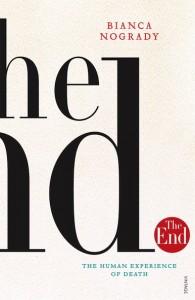
Bianca Nogrady, The end book coverBianca Nogrady’s The end: The human experience of death (2013) (my review) looks at death from every conceivable angle – medical, sociological, psychological, philosophical, legal and ethical. One of the most intriguing discussions – from a medical and ethical review – in the book concerns defining death. It’s not as easy as it might first appear! Nogrady is an Australian science journalist, and in this book she treads a fine line between expert opinion and anecdote, not letting either run away with the book to the detriment of the other. The anecdotes breathe life into the book, while the experts bring us back to earth!

Fred Watson’s Star-craving mad (2013) was described by the Sun Herald reviewer as “a lighthearted romp through the cosmos … [which] tackles the big questions about our place in the universe without ever being pompous, condescending, boring or baffling”. I haven’t read this book, but I included it because I have heard Watson, live, most recently at this weekend’s Griffyn Solo concert focussing on Urmas Sisask’s astronomy-inspired music. Watson is an astronomer who is well recognised as a communicator, winning, in 2006, the Australian Government’s Eureka Prize for Promoting Understanding of Science.

Christine Kenneally’s The invisible history of the human race (2014) was shortlisted for this year’s Stella Prize. Kenneally, a science journalist, draws on scientific research into genetics and DNA to explore who we are, where we’ve come from and where we might be going. Little questions like that. I haven’t read it, but some bloggers I respect (Resident Judge and Adventures in Biography) have, and loved it for its lucid presentation of complex ideas. I really should read it.

If you’re Australian, did you take part in any Science Week activities, like perhaps the Stargazing World Record event? And, if you’re not (or even if you are), do you have any non-fiction books about scientific matters that you’d like to recommend?

Monday musings on Australian literature: Novels about scientists

It’s National Science Week (15-23 August) here down under and, while science is not my area of expertise, my mind is always opened by the breadth of events and discussions that take place. I don’t, I admit, get to many events, but I do enjoy the increased focus on science on my favourite radio station, ABC Radio National. For example, a program this weekend on the art of (scientific) taxonomy fascinated my librarian-archivist mind!

And then it occurred to me that I could do my own little “program” here – a post on novels featuring scientists. I’m going to mostly avoid the obvious – science fiction, where scientists often abound – and suss out more general fiction. It’s not easy and this is necessarily a selection of course. I’d love to hear of any novels you love about scientists. As always, although my focus here is, by definition, Australian, you can spread your thoughts as widely as you like!

I’m listing the books in the order they were published. I have read them all, but many before I started blogging.

Geraldine Brooks’ Year of wonders (2001) is set in a village in England in the 17th century during the time of the plague. Its main character, a widow and housemaid, learns how to use herbs for medical purposes, after previous owners of the herb garden had been murdered for practising witchcraft. Science, it’s clear, has not always been respected! Another Brooks’ novel, The people of the book, 2008, has as its main character a museum paper conservator, a job which relies heavily on scientific knowledge and principles.

Sue Woolfe’s The secret cure (2003) is set in a hospital science lab. The main character is a cleaning lady, secretly, searching for a cure for her autistic daughter. She, during the course of the book, has to deal with researchers and other scientific professionals, who don’t always show science and scientists in the most positive light as they grapple for fame and recognition. The novel is partly narrated by another worker in the hospital – a repair and maintenance man who, himself, seems to suffer from a form of autism. The novel explores, broadly, what being human means, and is one of the first novels I read about autism/Asperger Syndrome.

Carrie Tiffany’s Everyman’s rules for scientific living (2006) was inspired by Victoria’s Better Farming Train, which, between the Great Depression and the Second World War, traveled through small country towns to provide practical advice of all sorts to farming people. The train’s staff, in the novel, included a nurse and seamstress, a chicken expert, and the scientist Robert Pettigrew, a soil expert with indefatigable faith in value of superphosphates. It was a time when science was seen as the answer to all challenges, but … well, if you haven’t read this, I recommend it to you. It’s a little treasure.

Jordan Fall Girl

Fall girl cover (Courtesy: Text Publishing)

Eva Horning’s Dog boy (2009) (my review) is about a young boy who, after the disappearance of his parents, is taken in by a pack of dogs. It’s a feral child story, and the first part focuses on his experience as a “dog”. He is eventually reintroduced to the human world and becomes a subject of interest for husband-and-wife scientists, psychiatrist Dimitry and paediatrician Natalya, who start to wonder whether, for all that humans “know”, the boy may have been better off with his dog family.

Toni Jordan’s Fall girl (2010) (my review) is a comic novel about Ella Canfield, an evolutionary biologist who seeks funding to prove that the extinct Tasmanian Tiger still exists – except that Dr Canfield is not who she appears. She is in fact a con-artist, trying to snare Daniel Metcalfe, or at least his money! Things don’t though, go as she expected, and various tables, as you might expect, are turned as Jordan spoofs scientific research and grant seeking, among other targets.

Graeme Simsion’s The Rosie project (2013) (my review) is a romantic comedy about genetics professor Don Tilman and his search for a wife. Genetics plays a role when he puts his “wife project” on hold to help bartender-turned-student Rosie with her “father project”.

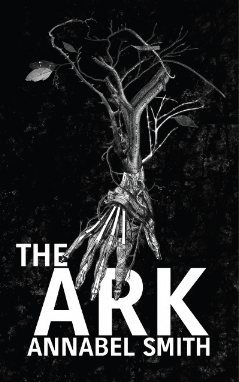
Annabel Smith. The arkAnnabel Smith’s The ark (2014) (my review) is a dystopian novel in the relatively new genre of cli-fi. “The Ark” is a seed bank aimed at preserving seeds for the future. Built into a remote mountain-side, it is populated by people selected for their skills, which include of course scientists and technologists. Most of the novel takes place between 2041 an 2043 in a post peak oil crisis world, and explores explores the tensions that develop as power undermines trust in a small community where co-operation is critical to survival. In this case, while science could be seen to be both the cause of and solution to the situation the world has found itself in, for this group science turns out to be the least of their problems, because once again, as in Dog boy, humans find themselves facing some uncomfortable truths about, yes, humans.

Have you noticed that several of these “scientists” are not quite what you’d expect? We have a cleaning lady seeking a cure for her daughter, a housemaid becoming a herbalist during the plague, a con artist pretending to be a scientist to lure a wealthy donor … I will avoid, however, drawing simplistic conclusions from this, and simply ask if you would like to recommend any novels featuring scientists!

Wendy Scarfe, Hunger town (Review)

Scarfe, Hunger Town, Wakefield PressA little over halfway through Wendy Scarfe’s novel, Hunger town, one character says to another that “kindness needs to be a political way of life”. It sounds a little naive I suppose, but in recent months the idea of kindness, in the political as much as the personal arena, has been playing on my mind. How different would Australia be (I’m being parochial here), if our leaders espoused kindness, tolerance and acceptance in their sound-bites, and if, heaven forbid, they placed a value on kindness in their policy-making?

Kindness is not exactly the main theme of this Great Depression era novel but politics certainly is. Set mostly in South Australia’s Port Adelaide River district from the mid 1920s to late 1934, Hunger town tells the story of the struggles of wharf labourers to survive as unemployment and hunger took hold. It explores the ensuing political unrest and the growing attraction of leftist political ideologies like communism and anarchism, alongside unionism, in such a volatile environment.

The novel is told first person in the voice of Judith Larsen, who, at the beginning of the novel, lives on a hulk with her Norwegian-born coal lumper father and homemaker-then-soup-kitchen-volunteer mother. Judith (Jude), intelligent, strong-willed and attuned to social justice issues from an early age, develops her drawing skill to become a cartoonist. Early in the novel she meets her well-to-do friend Winnie’s cousin, Harry, who is not so well-to-do, and a relationship develops. However, while their love story runs through the novel, it is not, as in most “genre” historical fiction, the main narrative arc. They marry, with little romantic build up, part-way through the novel. No, the main narrative focuses on the travails of the workers, and on Jude and Harry’s involvement in the politics of their times, Jude through her satirical cartoons, and Harry through the Communist Party.

The question that always comes to mind with historical fiction is why? Why choose to write about a particular time and place – besides, of course, intrinsic interest in certain times? Some readers love to escape to what they see as a more exciting, adventurous or romantic period. But for me, the book has to be more than “just” history. It has to throw light on “the human condition” and, preferably, encourage reflections on the present. What does the history tell us about who we are, how we got here, I want to know, and (yes, I admit it) can we learn any lessons from it?

Scarfe’s book achieves this for me. Not only does it offer a vivid portrayal of the richness and variety of life on the Port Adelaide wharves, but it encourages us to think about the relationship between the political and the personal, and about how governments do or don’t support some of its most vulnerable people, the working poor. It teases out the differences between theory, idealism and realism. It considers the role of violence. And, along the way, it raises issues like freedom of speech, and the role of the artist. All very topical, n’est-ce pas?

You have probably realised by now that this is a “big” book. Scarfe tells her story in 5 parts through a well-defined set of characters. Although relatively long, around 450 pages, the novel is tightly structured. Seemingly unimportant points made early in the novel reappear with significance later. An example is Harry’s “Judith, you are a card”. Once said, it appears as a refrain throughout, and plays a role in the conclusion. Characters are foils for each other – such as the warm idealistic Harry versus the unemotional, theoretical Communist Party organiser, Nathan; or the pretty, emotional, seemingly superficial Winnie versus the no-nonsense, practical, more socially aware Judith. We can also see Harry, who “really did envisage and believe in a socialist utopia” as a foil for Judith, whose cartoons are grounded “in a more savage awareness of what I saw as the gap between dream and reality”.

Scarfe’s writing is clear and direct, but peppered with lovely turns of phrase. The fog lifts, “not all at once but as if the sun took fistfuls and shook it apart”. Miss Marie, arriving at the women’s march

stepped down from her taxi and made her regal path through the crowd like dawn breaking through a mass of sooty clouds. She was a gasp of radiant colour …

There were times, though, when I wondered whether the first-person voice was the best choice for the novel. Judith is an interesting character, with a strong mind and a good heart. She’s also rather opinionated, occasionally taking sets against people with little (initial, anyhow) provocation. It’s probably just me, but I sometimes yearned for a wise third person omniscient narrator to rub off her edges! That said, Judith, who is described by her art teacher, mentor and friend, Miss Marie, as “an instinctive radical but an individual thinker” guides us engagingly through her world.

As the novel progresses and things worsen on the wharves with scab labour brought in to replace the striking workers, Harry heads off to Spain with Nathan, at the time of the Asturian Miners Strike, to see communism in action. Without giving too much away, this results in, a few months later, Judith and Miss Marie setting off in pursuit. Scarfe’s descriptions of France and particularly Spain in the early 1930s are vivid and believable, and tension builds as our two women, posing as the artists they really are, navigate borders and gun-toting guards to move deep into Franco’s territory. After witnessing a brutal event, Jude produces a cartoon, but Miss Marie demurs about sending it off. Jude, the artist, insists, despite the risks:

To not protest would leave a wound on my soul that might never heal.

The novel concludes with a resolution of sorts to the plot line, but leaves the main questions unanswered. This is as it should be, because these questions – how to balance the political with the personal, and what sort of politics will create a better, fairer society – have no simple answer.

I started by referring to the issue of kindness. I’m going to close on another issue that is close to my heart, that of moderation. Early in the novel, Judith meets librarian Joe Pulham who introduces her to the Aristotelian idea of living moderately. It’s an idea she returns to frequently though, as Miss Marie says, “moderation is not easy. It involves compromise, and to compromise, what do we give up?” Darned if I know, but it seems to me that negotiating that compromise is the best way forward?

Lisa Hill at ANZLitLovers also liked this book.

awwchallenge2015Wendy Scarfe
Hunger town
Mile End: Wakefield Press, 2014
454pp.
ISBN: 9781743053362

(Review copy courtesy Wakefield Press)

Monday musings on Australian literature: Ernestine Hill

Regular readers of my musings will know by now that I sometimes use this spot to explore and share things that I don’t know much about. This post is one such. It was inspired by an article I read a year ago in Inside Story, Swinburne University of Technology’s online journal about current affairs and culture. The article was titled “How American servicemen found Ernestine Hill in their kit bags”, and was written by Anna Johnson, an academic from the University of Tasmania.

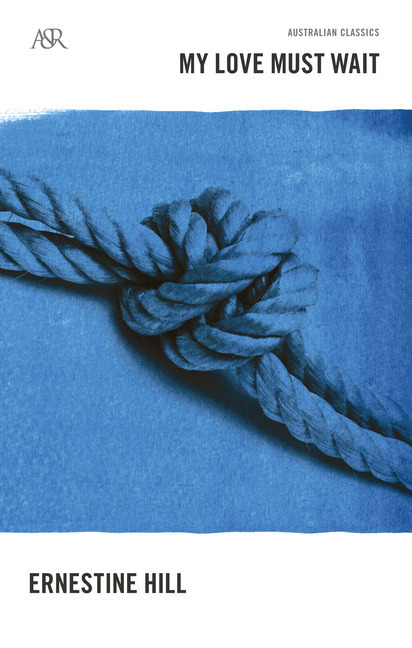
My love must wait 2002 cover

Cover for A&R Classics edition

Ernestine Hill (1899-1972) first came to my attention as a teenager with her novel, My love must wait, about Matthew Flinders. Although it was published in 1941, long before my teens, it was still popular at a time when young adult fiction had not come into its own. Primarily a journalist and travel writer, she only wrote that novel. And it’s not, I must clarify, the book that found its way into American servicemen’s kit bags! That book was Australian frontier, published in Australia in 1937 as The great Australian loneliness. Johnson doesn’t spend much time on these kitbags, but the story is that America’s non-profit Council on Books in Wartime, which believed books were “weapons in the war of ideas”, sent “stimulating reading [in Armed Services Editions*] to soldiers so that their leisure time was both educational and enjoyable”. I hadn’t known about this.

Johnson’s focus though is Hill, whom she describes as a “middlebrow” writer. She writes:

Although these so-called middlebrow writers [such as Ion Idriess and Frank Clune] have been frequently scorned by critics and neglected by subsequent Australian literary history, they were very influential cultural brokers who mediated debates about place, race, and culture for the interested general reader.

Hill’s books, says Johnson, were widely popular because they “were perfectly pitched between a sentimental attachment to late nineteenth-century ideas about the bush [..] and great excitement about modern technology and enterprise”. The Great Australian Loneliness, she writes, treads a fine line between lamenting “the passing of the old bushmen and their way of life” and celebrating “pilots and planes whose mail runs ‘have brought the Great Australian Loneliness well on to the map’.” Her writing was often condemned by critics “as romanticised purple prose” but Johnson suggests her books “forged bonds … between people who were geographically, socially and culturally dispersed”.

Hill’s popularity meant that booksellers loved her and promoted her, to the detriment of Australia’s more literary writers. Miles Franklin wrote in her diaries (ed. Paul Brunton) about a dinner held by Ell’s (a Newcastle bookseller) in September 1949:

I was able to note that booksellers, or representatives of publishers know little of the contents of the books they vend. They have not the taste, the ear, or the capacity. Take the case under observation, A & R [Angus and Robertson] boosted Idriess, an old steady, & Timms who is a thruster and insister & whom a person with Dr Mackaness’s literary standards considers an important Australian writer. But they did not bother about my books. I was there because invited by the cultural committee of Newcastle. My book continues to sell steadily though I’ve never had a Christmastide sale, was denied editions during the war boom in favour of E. Hill, who has powerful boosters behind her. I’ve never had a window or even a counter display.

Poor Miles. Hopefully not all booksellers and publishers were the same, but it’s a reminder that being a literary author has never been easy. I wonder how many people read Ion Idriess and EV Timms today?

Anyhow back to Hill. Reflecting her times, she was uneasy about multiculturalism, and wanted more white women, to support white men, in the outback. Johnson writes that her “vision of white Australia was common in the 1930s” and that she was “rarely complimentary to Aboriginal, Chinese, Malay, or Afghan Australians”, although she apparently filled her books with colourful vignettes about the lives of these people. She was, however, more positive about indigenous Australians. Johnson writes that she

attested to violent colonial conditions and lamented the passing of Indigenous lives and histories whose formative role in the nation had largely gone unrecorded. Her books and journalism joined others in modernising attitudes, which eventually saw the liberalisation that benefited Aboriginal people from the late 1960s onwards, even if her ‘modern’ opinions now seem uncomfortably tainted with colonialism.

So, a mixed bunch in terms of her attitudes. Regarding her book being published in America, she was thrilled. Articles by her were also published there. She wrote, in the 1940s, that she was encouraged “to rush my best and most arresting articles on this country to America to make them conscious of what a loss we’d be. Britain has never realised that. We must call Americans here.” Fascinating to see Hill’s vision of the power of literature, and its critical role, as Johnson describes it, in “securing the nation’s geopolitical future”.

Hill was a complex woman. She was also a friend of Daisy Bates, and, according the Australian Dictionary of Biography (link above), there was some controversy over Hill’s contribution to some of Bates’ writing.

Unfortunately, I couldn’t find any e-texts of Hill’s books, but once again Trove came to the rescue. Here is an excerpt of the foreword from The great Australian loneliness:

It was in July 1930 that I first set out, a wandering ‘copy-boy’ with swag and typewriter, to find what lay beyond the railway lines. Across the painted desert and the pearling seas, by aeroplanes and camel and coastal ship, by truck and lugger and packhorse and private yacht, the trail has led me on across five years and 50,000 miles, a trail of infinite surprises. I have interviewed men living in wurlies of paperbark who read Gibbon and wrote Greek and danced in corroboree, witch-doctors of the Warramunga, lepers and the dying, deep sea divers and prospectors for gold. I have attended Japanese feasts of lanterns, Chinese banquets, black fellow burials, and Greek weddings. Many of the notes have been taken by the flickering of the camp fire—the typewriter has always been with me, dangling from a camel-saddle jingling on a truck, covered with a camp sheet in the rains.” (The Shepparton Adviser, 31/3/1937)

Another book to add to the TBR list.

* A complete list of the 1322 titles is available online.